
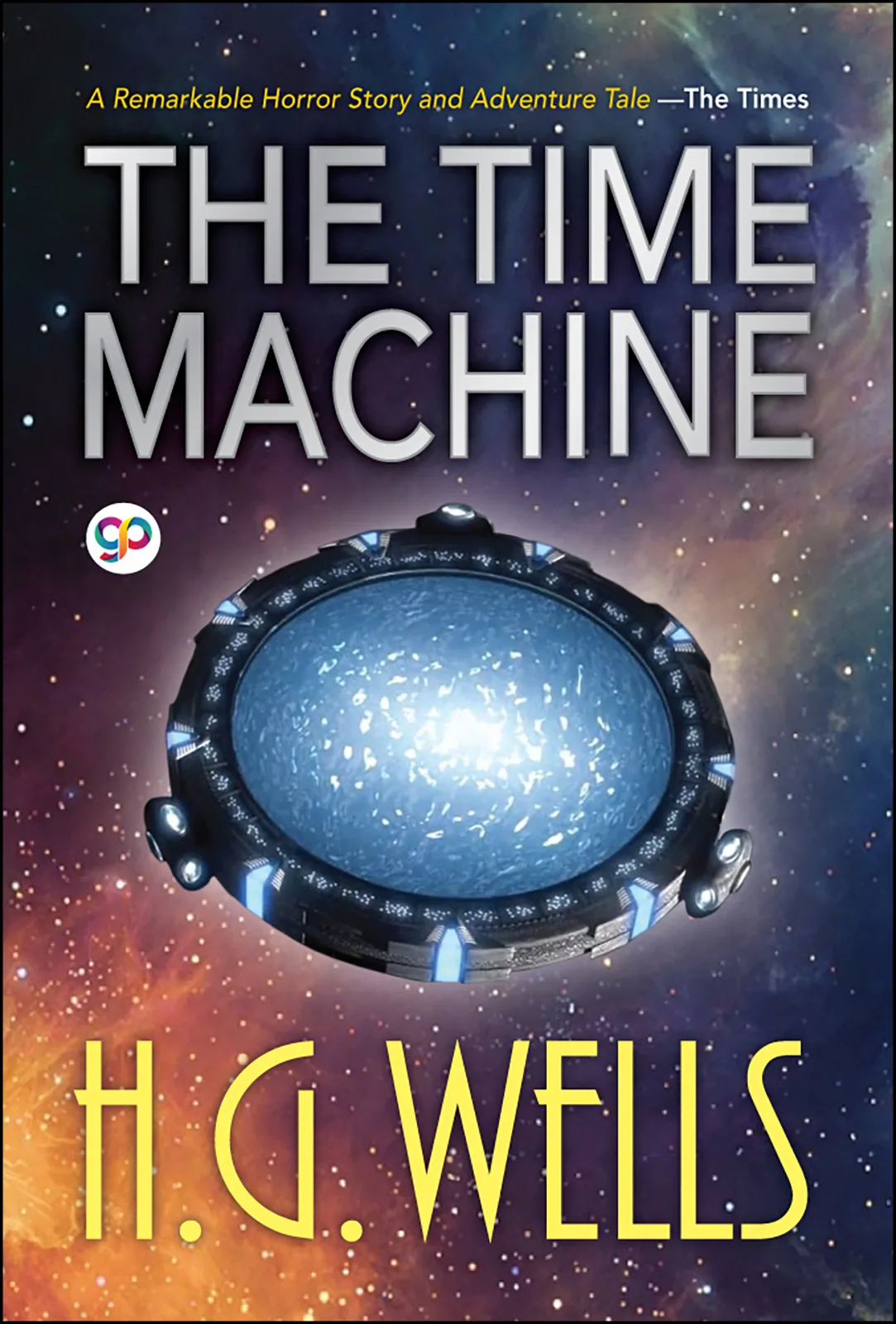
The Time Machine
Paperback
• 136 Pages
• INR 245.00
• English
• 9789387669048
No ratings yet
| Publisher | General Press |
|---|---|
| ISBN13 | 9789387669048 |
| ASIN/SKU | 9387669041 |
| Book Format | Paperback |
| Language | English |
| Pages | 136 |
| List Price | INR 245.00 |
| Subject Code | FIC028080, FIC004000, JUV022000, FIC028070 |
| Publishing Date | 09/04/2018 |
| Dimensions | 8.25 x 5.25 x 1.0 inches |
| Book Code | BD00068002 |
Buy this Book
Amazon Stores
Ebook Stores
Other Stores
Discover The Time Machine by H.G. Wells. This book is published by General Press in Paperback format, ISBN 9789387669048, ASIN 9387669041, under Science Fiction and Fantasy, Time Travel, Dystopian.
Book Description
Imagine building a machine that could carry you forward through centuries the way a train carries you across a country — and then arriving at the destination to find that humanity has become something almost unrecognizable. That is the electrifying premise of 'The Time Machine' by H.G. Wells, the foundational work of science fiction that essentially invented the concept of mechanical time travel and remains one of the most intellectually charged adventure stories ever written.
The story centers on an unnamed inventor known only as the Time Traveller, a brilliant and restless Victorian scientist who presents his skeptical dinner guests with a startling claim: he has built a device capable of moving through time as freely as through space. When they dismiss him, he proves it — and soon undertakes a journey of his own, hurtling nearly a million years into the future to see what has become of the world he knows.
What he finds is both wondrous and deeply disturbing. The Earth of the far future is inhabited by two distinct races — the gentle, childlike Eloi, who live in crumbling palaces and seem to do nothing at all, and the pale, subterranean Morlocks, who labor in the dark beneath the surface. The Time Traveller initially tries to make sense of this strange arrangement with the confident rationalism of a Victorian gentleman, but the reality he slowly uncovers is far more unsettling than anything he anticipated.
Wells uses this future world as a vehicle for pointed social commentary, embedding sharp questions about class, labour, and the long-term consequences of inequality into what reads on the surface as a gripping adventure. The book is short and propulsive, but its ideas have a way of staying with you long after the final page. For a story written in the 1890s, it is extraordinary how much it still feels like a warning — and how little of what it warns against has been heeded.
The story centers on an unnamed inventor known only as the Time Traveller, a brilliant and restless Victorian scientist who presents his skeptical dinner guests with a startling claim: he has built a device capable of moving through time as freely as through space. When they dismiss him, he proves it — and soon undertakes a journey of his own, hurtling nearly a million years into the future to see what has become of the world he knows.
What he finds is both wondrous and deeply disturbing. The Earth of the far future is inhabited by two distinct races — the gentle, childlike Eloi, who live in crumbling palaces and seem to do nothing at all, and the pale, subterranean Morlocks, who labor in the dark beneath the surface. The Time Traveller initially tries to make sense of this strange arrangement with the confident rationalism of a Victorian gentleman, but the reality he slowly uncovers is far more unsettling than anything he anticipated.
Wells uses this future world as a vehicle for pointed social commentary, embedding sharp questions about class, labour, and the long-term consequences of inequality into what reads on the surface as a gripping adventure. The book is short and propulsive, but its ideas have a way of staying with you long after the final page. For a story written in the 1890s, it is extraordinary how much it still feels like a warning — and how little of what it warns against has been heeded.
Author Biography
H.G. Wells (Herbert George, 1866) was born to a working class family in Kent, England. Young Wells received a spotty education, interrupted by several illnesses and family difficulties, and became a draper's apprentice as a teenager. The headmaster of Midhurst Grammar School, where he had spent a year, arranged for him to return as an 'usher', or student teacher. Wells earned a government scholarship in 1884, to study biology under Thomas Henry Huxley at the Normal School of Science. Wells earned his bachelor of science and doctor of science degrees at the University of London. After marrying his cousin, Isabel, Wells began to supplement his teaching salary with short stories and freelance articles, then books, including 'The Time Machine' (1895), 'The Island of Dr. Moreau' (1896), 'The Invisible Man' (1897), and 'The War of the Worlds' (1898).
Wells created a mild scandal when he divorced his cousin to marry one of his best students, Amy Catherine Robbins. Although his second marriage was lasting and produced two sons. His 100 books included many novels, as well as non-fiction, such as 'A Modern Utopia' (1905), 'The Outline of History' (1920), 'A Short History of the World' (1922), 'The Shape of Things to Come' (1933), and 'The Work, Wealth and Happiness of Mankind' (1932). Wells used his international fame to promote his favorite causes, including the prevention of war, and was received by government officials around the world. He is best remembered as an early writer of science fiction and futurism.
Wells created a mild scandal when he divorced his cousin to marry one of his best students, Amy Catherine Robbins. Although his second marriage was lasting and produced two sons. His 100 books included many novels, as well as non-fiction, such as 'A Modern Utopia' (1905), 'The Outline of History' (1920), 'A Short History of the World' (1922), 'The Shape of Things to Come' (1933), and 'The Work, Wealth and Happiness of Mankind' (1932). Wells used his international fame to promote his favorite causes, including the prevention of war, and was received by government officials around the world. He is best remembered as an early writer of science fiction and futurism.
Editorial Reviews
Editorial Reviews will be added soon…
Book Summary
H. G. Wells’s The Time Machine, first published in 1895, is one of the foundational works of modern science fiction. Although it is a short novel, its ideas are remarkably large. Through the strange journey of an unnamed Time Traveller into the distant future, Wells explores time, human evolution, social inequality, industrial civilization, and the possible fate of humanity. The story is exciting on the surface, but beneath its adventure lies a dark warning about what human society might become if its divisions, comforts, and weaknesses continue unchecked.
The novel begins in the home of the Time Traveller, an intelligent and unconventional scientist who has gathered several friends to hear his ideas about time. He argues that time should be understood as another dimension, much like length, width, and height. If people can move through space, he reasons, there should theoretically be a way to move through time as well. His guests are doubtful, but the Time Traveller claims to have built a machine capable of doing exactly that. During a later experiment, he demonstrates the machine and then disappears into the future.
The Time Traveller eventually stops in the year 802,701. At first, the future appears surprisingly beautiful. Humanity seems to have eliminated many of its old problems. The landscape is peaceful, the climate is pleasant, and enormous buildings and gardens suggest that civilization has become comfortable and prosperous. The Time Traveller encounters small, delicate people called the Eloi. They are friendly and childlike, but they appear intellectually weak, physically fragile, and incapable of serious work. They spend their days playing, eating, and enjoying themselves without any obvious responsibilities.
At first, the Time Traveller assumes that humanity has achieved a kind of paradise. He imagines that technological progress and social development have finally removed poverty, struggle, and hardship. Yet something about the Eloi feels wrong. They seem to have lost qualities that once made human beings strong and capable. They are curious only in a limited way and show little courage or determination. Their civilization appears to have reached comfort at the cost of intelligence, independence, and resilience.
The mystery deepens when the Time Traveller discovers that his machine has disappeared. He realizes that someone has taken it and hidden it inside a large structure. While searching for it, he becomes increasingly aware that another human species exists underground. These creatures are the Morlocks, pale and frightening beings who live beneath the surface and emerge at night. Unlike the Eloi, the Morlocks are active, practical, and accustomed to darkness and machinery. They maintain the underground world and appear to possess skills that the Eloi have completely lost.
The Time Traveller gradually develops a disturbing theory about the relationship between the two species. He concludes that humanity has evolved into two separate races as a result of its ancient social divisions. The Eloi represent the descendants of the privileged upper classes, who lived lives of comfort and leisure. The Morlocks represent the descendants of the working classes, who spent generations underground maintaining the machinery and infrastructure on which civilization depended. Over immense stretches of time, these social differences have become biological differences.
This idea is one of the most powerful aspects of the novel. Wells transforms class inequality into a horrifying vision of evolutionary separation. The rich may believe that comfort makes them superior, but the Time Traveller discovers that excessive comfort can produce weakness. At the same time, the oppressed working population may develop strength and practical ability, but its harsh existence can also make it brutal and alienated. The two groups are not simply good and evil; they are the distorted results of an unequal society that has continued for thousands of generations.
The Time Traveller’s situation becomes more dangerous when he realizes that the Morlocks are not merely frightening underground workers. They have begun to hunt the Eloi. The relationship between the two species has turned into something close to predator and prey. The Time Traveller himself is threatened when he explores the Morlocks’ underground world. His fear increases because the future he had initially imagined as peaceful and civilized now appears deeply unnatural.
During his journey, the Time Traveller meets an Eloi woman named Weena. She becomes emotionally important to him because, unlike many of the other Eloi, she shows genuine affection and attachment. When he saves her from drowning, she becomes devoted to him. Their relationship gives the story a human dimension. The Time Traveller is no longer simply studying the future like a scientist; he becomes personally connected to someone living within it. His concern for Weena makes the dangers of the future more immediate and painful.
The Time Traveller eventually discovers that the Morlocks have been hiding his machine. He manages to recover it, but his escape is complicated by his need to protect Weena. He encounters the Morlocks in a forest and attempts to defend himself using fire. The situation becomes chaotic and dangerous, and Weena disappears during the struggle. The Time Traveller is eventually forced to leave the future behind.
But before returning to his own time, he travels even farther into the future. What he sees there is even more frightening. The Earth has become almost lifeless. Humanity has disappeared, and strange creatures inhabit a world dominated by silence and decay. The sun appears enormous and reddish, and the environment is cold and desolate. The Time Traveller realizes that the future does not necessarily lead toward endless progress. Eventually, the human species itself may vanish.
This final vision changes the meaning of the entire story. The future is not a simple line of improvement. Wells presents time as a vast process in which civilizations can rise, decay, and disappear. Human beings may believe themselves to be the masters of nature, but they remain vulnerable to forces much larger than their ambitions.
When the Time Traveller returns to his own era, he tells his companions what he has seen. Some of them remain skeptical, while others are fascinated. He later prepares to make another journey into time and leaves behind the possibility that he may discover even more about humanity's fate. His final disappearance gives the story an open and mysterious ending.
At its heart, The Time Machine is not simply a story about traveling through time. It is a warning about the consequences of social inequality and complacency. Wells suggests that civilization can become so comfortable that it loses the qualities necessary for survival. The Eloi have everything they need, yet they have become weak. The Morlocks are powerful and capable, yet their world is dark and brutal. Neither group represents a healthy form of humanity.
The novel also questions the popular belief that technological and social progress automatically make life better. Wells was writing during a period of rapid industrialization and enormous confidence in human progress. His story challenges that optimism by asking what might happen if society solves immediate problems without solving deeper inequalities. His future is therefore both imaginative and deeply political.
Ultimately, The Time Machine remains powerful because it combines adventure with serious reflection. The Time Traveller's journey takes readers into a distant future, but its real subject is the human present. Wells asks us to consider what our choices, inequalities, comforts, and ambitions might eventually produce. The book leaves us with an unsettling but valuable lesson: progress cannot be measured simply by comfort or technology. A civilization's true strength lies in its ability to preserve intelligence, compassion, courage, and human connection. If those qualities disappear, even the greatest achievements of civilization may eventually become meaningless.
The novel begins in the home of the Time Traveller, an intelligent and unconventional scientist who has gathered several friends to hear his ideas about time. He argues that time should be understood as another dimension, much like length, width, and height. If people can move through space, he reasons, there should theoretically be a way to move through time as well. His guests are doubtful, but the Time Traveller claims to have built a machine capable of doing exactly that. During a later experiment, he demonstrates the machine and then disappears into the future.
The Time Traveller eventually stops in the year 802,701. At first, the future appears surprisingly beautiful. Humanity seems to have eliminated many of its old problems. The landscape is peaceful, the climate is pleasant, and enormous buildings and gardens suggest that civilization has become comfortable and prosperous. The Time Traveller encounters small, delicate people called the Eloi. They are friendly and childlike, but they appear intellectually weak, physically fragile, and incapable of serious work. They spend their days playing, eating, and enjoying themselves without any obvious responsibilities.
At first, the Time Traveller assumes that humanity has achieved a kind of paradise. He imagines that technological progress and social development have finally removed poverty, struggle, and hardship. Yet something about the Eloi feels wrong. They seem to have lost qualities that once made human beings strong and capable. They are curious only in a limited way and show little courage or determination. Their civilization appears to have reached comfort at the cost of intelligence, independence, and resilience.
The mystery deepens when the Time Traveller discovers that his machine has disappeared. He realizes that someone has taken it and hidden it inside a large structure. While searching for it, he becomes increasingly aware that another human species exists underground. These creatures are the Morlocks, pale and frightening beings who live beneath the surface and emerge at night. Unlike the Eloi, the Morlocks are active, practical, and accustomed to darkness and machinery. They maintain the underground world and appear to possess skills that the Eloi have completely lost.
The Time Traveller gradually develops a disturbing theory about the relationship between the two species. He concludes that humanity has evolved into two separate races as a result of its ancient social divisions. The Eloi represent the descendants of the privileged upper classes, who lived lives of comfort and leisure. The Morlocks represent the descendants of the working classes, who spent generations underground maintaining the machinery and infrastructure on which civilization depended. Over immense stretches of time, these social differences have become biological differences.
This idea is one of the most powerful aspects of the novel. Wells transforms class inequality into a horrifying vision of evolutionary separation. The rich may believe that comfort makes them superior, but the Time Traveller discovers that excessive comfort can produce weakness. At the same time, the oppressed working population may develop strength and practical ability, but its harsh existence can also make it brutal and alienated. The two groups are not simply good and evil; they are the distorted results of an unequal society that has continued for thousands of generations.
The Time Traveller’s situation becomes more dangerous when he realizes that the Morlocks are not merely frightening underground workers. They have begun to hunt the Eloi. The relationship between the two species has turned into something close to predator and prey. The Time Traveller himself is threatened when he explores the Morlocks’ underground world. His fear increases because the future he had initially imagined as peaceful and civilized now appears deeply unnatural.
During his journey, the Time Traveller meets an Eloi woman named Weena. She becomes emotionally important to him because, unlike many of the other Eloi, she shows genuine affection and attachment. When he saves her from drowning, she becomes devoted to him. Their relationship gives the story a human dimension. The Time Traveller is no longer simply studying the future like a scientist; he becomes personally connected to someone living within it. His concern for Weena makes the dangers of the future more immediate and painful.
The Time Traveller eventually discovers that the Morlocks have been hiding his machine. He manages to recover it, but his escape is complicated by his need to protect Weena. He encounters the Morlocks in a forest and attempts to defend himself using fire. The situation becomes chaotic and dangerous, and Weena disappears during the struggle. The Time Traveller is eventually forced to leave the future behind.
But before returning to his own time, he travels even farther into the future. What he sees there is even more frightening. The Earth has become almost lifeless. Humanity has disappeared, and strange creatures inhabit a world dominated by silence and decay. The sun appears enormous and reddish, and the environment is cold and desolate. The Time Traveller realizes that the future does not necessarily lead toward endless progress. Eventually, the human species itself may vanish.
This final vision changes the meaning of the entire story. The future is not a simple line of improvement. Wells presents time as a vast process in which civilizations can rise, decay, and disappear. Human beings may believe themselves to be the masters of nature, but they remain vulnerable to forces much larger than their ambitions.
When the Time Traveller returns to his own era, he tells his companions what he has seen. Some of them remain skeptical, while others are fascinated. He later prepares to make another journey into time and leaves behind the possibility that he may discover even more about humanity's fate. His final disappearance gives the story an open and mysterious ending.
At its heart, The Time Machine is not simply a story about traveling through time. It is a warning about the consequences of social inequality and complacency. Wells suggests that civilization can become so comfortable that it loses the qualities necessary for survival. The Eloi have everything they need, yet they have become weak. The Morlocks are powerful and capable, yet their world is dark and brutal. Neither group represents a healthy form of humanity.
The novel also questions the popular belief that technological and social progress automatically make life better. Wells was writing during a period of rapid industrialization and enormous confidence in human progress. His story challenges that optimism by asking what might happen if society solves immediate problems without solving deeper inequalities. His future is therefore both imaginative and deeply political.
Ultimately, The Time Machine remains powerful because it combines adventure with serious reflection. The Time Traveller's journey takes readers into a distant future, but its real subject is the human present. Wells asks us to consider what our choices, inequalities, comforts, and ambitions might eventually produce. The book leaves us with an unsettling but valuable lesson: progress cannot be measured simply by comfort or technology. A civilization's true strength lies in its ability to preserve intelligence, compassion, courage, and human connection. If those qualities disappear, even the greatest achievements of civilization may eventually become meaningless.
Sample Chapters
Chapter 1
The Time Traveller (for so it will be convenient to speak of him) was expounding a recondite matter to us. His grey eyes shone and twinkled, and his usually pale face was flushed and animated. The fire burned brightly, and the soft radiance of the incandescent lights in the lilies of silver caught the bubbles that flashed and passed in our glasses. Our chairs, being his patents, embraced and caressed us rather than submitted to be sat upon, and there was that luxurious after-dinner atmosphere when thought roams gracefully free of the trammels of precision. And he put it to us in this way—marking the points with a lean forefinger—as we sat and lazily admired his earnestness over this new paradox (as we thought it) and his fecundity.
‘You must follow me carefully. I shall have to controvert one or two ideas that are almost universally accepted. The geometry, for instance, they taught you at school is founded on a misconception.’
‘Is not that rather a large thing to expect us to begin upon?’ said Filby, an argumentative person with red hair.
‘I do not mean to ask you to accept anything without reasonable ground for it. You will soon admit as much as I need from you. You know of course that a mathematical line, a line of thickness nil, has no real existence. They taught you that? Neither has a mathematical plane. These things are mere abstractions.’
‘That is all right,’ said the Psychologist.
‘Nor, having only length, breadth, and thickness, can a cube have a real existence.’
‘There I object,’ said Filby. ‘Of course a solid body may exist. All real things—’
‘So most people think. But wait a moment. Can an instantaneous cube exist?’
‘Don’t follow you,’ said Filby.
‘Can a cube that does not last for any time at all, have a real existence?’
Filby became pensive. ‘Clearly,’ the Time Traveller proceeded, ‘any real body must have extension in four directions: it must have Length, Breadth, Thickness, and—Duration. But through a natural infirmity of the flesh, which I will explain to you in a moment, we incline to overlook this fact. There are really four dimensions, three which we call the three planes of Space, and a fourth, Time. There is, however, a tendency to draw an unreal distinction between the former three dimensions and the latter, because it happens that our consciousness moves intermittently in one direction along the latter from the beginning to the end of our lives.’
‘That,’ said a very young man, making spasmodic efforts to relight his cigar over the lamp; ‘that... very clear indeed.’
‘Now, it is very remarkable that this is so extensively overlooked,’ continued the Time Traveller, with a slight accession of cheerfulness. ‘Really this is what is meant by the Fourth Dimension, though some people who talk about the Fourth Dimension do not know they mean it. It is only another way of looking at Time. There is no difference between Time and any of the three dimensions of Space except that our consciousness moves along it. But some foolish people have got hold of the wrong side of that idea. You have all heard what they have to say about this Fourth Dimension?’
‘I have not,’ said the Provincial Mayor.
‘It is simply this. That Space, as our mathematicians have it, is spoken of as having three dimensions, which one may call Length, Breadth, and Thickness, and is always definable by reference to three planes, each at right angles to the others. But some philosophical people have been asking why three dimensions particularly—why not another direction at right angles to the other three?—and have even tried to construct a Four-Dimension geometry. Professor Simon Newcomb was expounding this to the New York Mathematical Society only a month or so ago. You know how on a flat surface, which has only two dimensions, we can represent a figure of a three-dimensional solid, and similarly they think that by models of three dimensions they could represent one of four—if they could master the perspective of the thing. See?’
‘I think so,’ murmured the Provincial Mayor; and, knitting his brows, he lapsed into an introspective state, his lips moving as one who repeats mystic words. ‘Yes, I think I see it now,’ he said after some time, brightening in a quite transitory manner.
‘Well, I do not mind telling you I have been at work upon this geometry of Four Dimensions for some time. Some of my results are curious. For instance, here is a portrait of a man at eight years old, another at fifteen, another at seventeen, another at twenty-three, and so on. All these are evidently sections, as it were, Three-Dimensional representations of his Four-Dimensioned being, which is a fixed and unalterable thing.
‘Scientific people,’ proceeded the Time Traveller, after the pause required for the proper assimilation of this, ‘know very well that Time is only a kind of Space. Here is a popular scientific diagram, a weather record. This line I trace with my finger shows the movement of the barometer. Yesterday it was so high, yesterday night it fell, then this morning it rose again, and so gently upward to here. Surely the mercury did not trace this line in any of the dimensions of Space generally recognized? But certainly it traced such a line, and that line, therefore, we must conclude was along the Time-Dimension.’
‘But,’ said the Medical Man, staring hard at a coal in the fire, ‘if Time is really only a fourth dimension of Space, why is it, and why has it always been, regarded as something different? And why cannot we move in Time as we move about in the other dimensions of Space?’
The Time Traveller smiled. ‘Are you sure we can move freely in Space? Right and left we can go, backward and forward freely enough, and men always have done so. I admit we move freely in two dimensions. But how about up and down? Gravitation limits us there.’
‘Not exactly,’ said the Medical Man. ‘There are balloons.’
‘But before the balloons, save for spasmodic jumping and the inequalities of the surface, man had no freedom of vertical movement.’
‘Still they could move a little up and down,’ said the Medical Man.
‘Easier, far easier down than up.’
‘And you cannot move at all in Time, you cannot get away from the present moment.’
‘My dear sir, that is just where you are wrong. That is just where the whole world has gone wrong. We are always getting away from the present moment. Our mental existences, which are immaterial and have no dimensions, are passing along the Time-Dimension with a uniform velocity from the cradle to the grave. Just as we should travel down if we began our existence fifty miles above the earth’s surface.’
‘But the great difficulty is this,’ interrupted the Psychologist. ‘You can move about in all directions of Space, but you cannot move about in Time.’
‘That is the germ of my great discovery. But you are wrong to say that we cannot move about in Time. For instance, if I am recalling an incident very vividly I go back to the instant of its occurrence: I become absent-minded, as you say. I jump back for a moment. Of course we have no means of staying back for any length of Time, any more than a savage or an animal has of staying six feet above the ground. But a civilized man is better off than the savage in this respect. He can go up against gravitation in a balloon, and why should he not hope that ultimately he may be able to stop or accelerate his drift along the Time-Dimension, or even turn about and travel the other way?’
‘Oh, this,’ began Filby, ‘is all—’
‘Why not?’ said the Time Traveller.
‘It’s against reason,’ said Filby.
‘What reason?’ said the Time Traveller.
‘You can show black is white by argument,’ said Filby, ‘but you will never convince me.’
‘Possibly not,’ said the Time Traveller. ‘But now you begin to see the object of my investigations into the geometry of Four Dimensions. Long ago I had a vague inkling of a machine—’
‘To travel through Time!’ exclaimed the Very Young Man.
‘That shall travel indifferently in any direction of Space and Time, as the driver determines.’
Filby contented himself with laughter.
‘But I have experimental verification,’ said the Time Traveller.
‘It would be remarkably convenient for the historian,’ the Psychologist suggested. ‘One might travel back and verify the accepted account of the Battle of Hastings, for instance!’
‘Don’t you think you would attract attention?’ Said the Medical Man. ‘Our ancestors had no great tolerance for anachronisms.’
‘One might get one’s Greek from the very lips of Homer and Plato,’ the Very Young Man thought.
‘In which case they would certainly plough you for the Little-go. The German scholars have improved Greek so much.’
‘Then there is the future,’ said the Very Young Man. ‘Just think! One might invest all one’s money, leave it to accumulate at interest, and hurry on ahead!’
‘To discover a society,’ said I, ‘erected on a strictly communistic basis.’
‘Of all the wild extravagant theories!’ began the Psychologist.
‘Yes, so it seemed to me, and so I never talked of it until—’
‘Experimental verification!’ cried I. ‘You are going to verify that?’
‘The experiment!’ cried Filby, who was getting brain-weary.
‘Let’s see your experiment anyhow,’ said the Psychologist, ‘though it’s all humbug, you know.’
The Time Traveller smiled round at us. Then, still smiling faintly, and with his hands deep in his trousers pockets, he walked slowly out of the room, and we heard his slippers shuffling down the long passage to his laboratory.
The Psychologist looked at us. ‘I wonder what he’s got?’
‘Some sleight-of-hand trick or other,’ said the Medical Man, and Filby tried to tell us about a conjurer he had seen at Burslem; but before he had finished his preface the Time Traveller came back, and Filby’s anecdote collapsed.
The thing the Time Traveller held in his hand was a glittering metallic framework, scarcely larger than a small clock, and very delicately made. There was ivory in it, and some transparent crystalline substance. And now I must be explicit, for this that follows—unless his explanation is to be accepted—is an absolutely unaccountable thing. He took one of the small octagonal tables that were scattered about the room, and set it in front of the fire, with two legs on the hearthrug. On this table he placed the mechanism. Then he drew up a chair, and sat down. The only other object on the table was a small shaded lamp, the bright light of which fell upon the model. There were also perhaps a dozen candles about, two in brass candlesticks upon the mantel and several in sconces, so that the room was brilliantly illuminated. I sat in a low arm-chair nearest the fire, and I drew this forward so as to be almost between the Time Traveller and the fireplace. Filby sat behind him, looking over his shoulder. The Medical Man and the Provincial Mayor watched him in profile from the right, the Psychologist from the left. The Very Young Man stood behind the Psychologist. We were all on the alert. It appears incredible to me that any kind of trick, however subtly conceived and however adroitly done, could have been played upon us under these conditions.
The Time Traveller looked at us, and then at the mechanism. ‘Well?’ said the Psychologist.
‘This little affair,’ said the Time Traveller, resting his elbows upon the table and pressing his hands together above the apparatus, ‘is only a model. It is my plan for a machine to travel through time. You will notice that it looks singularly askew, and that there is an odd twinkling appearance about this bar, as though it was in some way unreal.’ He pointed to the part with his finger. ‘Also, here is one little white lever, and here is another.’
The Medical Man got up out of his chair and peered into the thing. ‘It’s beautifully made,’ he said.
‘It took two years to make,’ retorted the Time Traveller. Then, when we had all imitated the action of the Medical Man, he said: ‘Now I want you clearly to understand that this lever, being pressed over, sends the machine gliding into the future, and this other reverses the motion. This saddle represents the seat of a time traveller. Presently I am going to press the lever, and off the machine will go. It will vanish, pass into future Time, and disappear. Have a good look at the thing. Look at the table too, and satisfy yourselves there is no trickery. I don’t want to waste this model, and then be told I’m a quack.’
There was a minute’s pause perhaps. The Psychologist seemed about to speak to me, but changed his mind. Then the Time Traveller put forth his finger towards the lever. ‘No,’ he said suddenly. ‘Lend me your hand.’ And turning to the Psychologist, he took that individual’s hand in his own and told him to put out his forefinger. So that it was the Psychologist himself who sent forth the model Time Machine on its interminable voyage. We all saw the lever turn. I am absolutely certain there was no trickery. There was a breath of wind, and the lamp flame jumped. One of the candles on the mantel was blown out, and the little machine suddenly swung round, became indistinct, was seen as a ghost for a second perhaps, as an eddy of faintly glittering brass and ivory; and it was gone—vanished! Save for the lamp the table was bare.
Everyone was silent for a minute. Then Filby said he was damned.
The Psychologist recovered from his stupor, and suddenly looked under the table. At that the Time Traveller laughed cheerfully. ‘Well?’ he said, with a reminiscence of the Psychologist. Then, getting up, he went to the tobacco jar on the mantel, and with his back to us began to fill his pipe.
We stared at each other. ‘Look here,’ said the Medical Man, ‘are you in earnest about this? Do you seriously believe that that machine has travelled into time?’
‘Certainly,’ said the Time Traveller, stooping to light a spill at the fire. Then he turned, lighting his pipe, to look at the Psychologist’s face. (The Psychologist, to show that he was not unhinged, helped himself to a cigar and tried to light it uncut.) ‘What is more, I have a big machine nearly finished in there’—he indicated the laboratory—’and when that is put together I mean to have a journey on my own account.’
‘You mean to say that that machine has travelled into the future?’ said Filby.
‘Into the future or the past—I don’t, for certain, know which.’
After an interval the Psychologist had an inspiration. ‘It must have gone into the past if it has gone anywhere,’ he said.
‘Why?’ said the Time Traveller.
‘Because I presume that it has not moved in space, and if it travelled into the future it would still be here all this time, since it must have travelled through this time.’
‘But,’ I said, ‘If it travelled into the past it would have been visible when we came first into this room; and last Thursday when we were here; and the Thursday before that; and so forth!’
‘Serious objections,’ remarked the Provincial Mayor, with an air of impartiality, turning towards the Time Traveller.
‘Not a bit,’ said the Time Traveller, and, to the Psychologist: ‘You think. You can explain that. It’s presentation below the threshold, you know, diluted presentation.’
‘Of course,’ said the Psychologist, and reassured us. ‘That’s a simple point of psychology. I should have thought of it. It’s plain enough, and helps the paradox delightfully. We cannot see it, nor can we appreciate this machine, any more than we can the spoke of a wheel spinning, or a bullet flying through the air. If it is travelling through time fifty times or a hundred times faster than we are, if it gets through a minute while we get through a second, the impression it creates will of course be only one-fiftieth or one-hundredth of what it would make if it were not travelling in time. That’s plain enough.’ He passed his hand through the space in which the machine had been. ‘You see?’ he said, laughing.
We sat and stared at the vacant table for a minute or so. Then the Time Traveller asked us what we thought of it all.
‘It sounds plausible enough to-night,’ said the Medical Man; ‘but wait until tomorrow. Wait for the common sense of the morning.’
‘Would you like to see the Time Machine itself?’ asked the Time Traveller. And therewith, taking the lamp in his hand, he led the way down the long, draughty corridor to his laboratory. I remember vividly the flickering light, his queer, broad head in silhouette, the dance of the shadows, how we all followed him, puzzled but incredulous, and how there in the laboratory we beheld a larger edition of the little mechanism which we had seen vanish from before our eyes. Parts were of nickel, parts of ivory, parts had certainly been filed or sawn out of rock crystal. The thing was generally complete, but the twisted crystalline bars lay unfinished upon the bench beside some sheets of drawings, and I took one up for a better look at it. Quartz it seemed to be.
‘Look here,’ said the Medical Man, ‘are you perfectly serious? Or is this a trick—like that ghost you showed us last Christmas?’
‘Upon that machine,’ said the Time Traveller, holding the lamp aloft, ‘I intend to explore time. Is that plain? I was never more serious in my life.’
None of us quite knew how to take it.
I caught Filby’s eye over the shoulder of the Medical Man, and he winked at me solemnly.
Chapter 2
I think that at that time none of us quite believed in the Time Machine. The fact is, the Time Traveller was one of those men who are too clever to be believed: you never felt that you saw all round him; you always suspected some subtle reserve, some ingenuity in ambush, behind his lucid frankness. Had Filby shown the model and explained the matter in the Time Traveller’s words, we should have shown him far less scepticism. For we should have perceived his motives; a pork butcher could understand Filby. But the Time Traveller had more than a touch of whim among his elements, and we distrusted him. Things that would have made the frame of a less clever man seemed tricks in his hands. It is a mistake to do things too easily. The serious people who took him seriously never felt quite sure of his deportment; they were somehow aware that trusting their reputations for judgment with him was like furnishing a nursery with egg-shell china. So I don’t think any of us said very much about time travelling in the interval between that Thursday and the next, though its odd potentialities ran, no doubt, in most of our minds: its plausibility, that is, its practical incredibleness, the curious possibilities of anachronism and of utter confusion it suggested. For my own part, I was particularly preoccupied with the trick of the model. That I remember discussing with the Medical Man, whom I met on Friday at the Linnaean. He said he had seen a similar thing at Tubingen, and laid considerable stress on the blowing out of the candle. But how the trick was done he could not explain.
The next Thursday I went again to Richmond—I suppose I was one of the Time Traveller’s most constant guests—and, arriving late, found four or five men already assembled in his drawing-room. The Medical Man was standing before the fire with a sheet of paper in one hand and his watch in the other. I looked round for the Time Traveller, and—‘It’s half-past seven now,’ said the Medical Man. ‘I suppose we’d better have dinner?’
‘Where’s——?’ said I, naming our host.
‘You’ve just come? It’s rather odd. He’s unavoidably detained. He asks me in this note to lead off with dinner at seven if he’s not back. Says he’ll explain when he comes.’
The Time Traveller (for so it will be convenient to speak of him) was expounding a recondite matter to us. His grey eyes shone and twinkled, and his usually pale face was flushed and animated. The fire burned brightly, and the soft radiance of the incandescent lights in the lilies of silver caught the bubbles that flashed and passed in our glasses. Our chairs, being his patents, embraced and caressed us rather than submitted to be sat upon, and there was that luxurious after-dinner atmosphere when thought roams gracefully free of the trammels of precision. And he put it to us in this way—marking the points with a lean forefinger—as we sat and lazily admired his earnestness over this new paradox (as we thought it) and his fecundity.
‘You must follow me carefully. I shall have to controvert one or two ideas that are almost universally accepted. The geometry, for instance, they taught you at school is founded on a misconception.’
‘Is not that rather a large thing to expect us to begin upon?’ said Filby, an argumentative person with red hair.
‘I do not mean to ask you to accept anything without reasonable ground for it. You will soon admit as much as I need from you. You know of course that a mathematical line, a line of thickness nil, has no real existence. They taught you that? Neither has a mathematical plane. These things are mere abstractions.’
‘That is all right,’ said the Psychologist.
‘Nor, having only length, breadth, and thickness, can a cube have a real existence.’
‘There I object,’ said Filby. ‘Of course a solid body may exist. All real things—’
‘So most people think. But wait a moment. Can an instantaneous cube exist?’
‘Don’t follow you,’ said Filby.
‘Can a cube that does not last for any time at all, have a real existence?’
Filby became pensive. ‘Clearly,’ the Time Traveller proceeded, ‘any real body must have extension in four directions: it must have Length, Breadth, Thickness, and—Duration. But through a natural infirmity of the flesh, which I will explain to you in a moment, we incline to overlook this fact. There are really four dimensions, three which we call the three planes of Space, and a fourth, Time. There is, however, a tendency to draw an unreal distinction between the former three dimensions and the latter, because it happens that our consciousness moves intermittently in one direction along the latter from the beginning to the end of our lives.’
‘That,’ said a very young man, making spasmodic efforts to relight his cigar over the lamp; ‘that... very clear indeed.’
‘Now, it is very remarkable that this is so extensively overlooked,’ continued the Time Traveller, with a slight accession of cheerfulness. ‘Really this is what is meant by the Fourth Dimension, though some people who talk about the Fourth Dimension do not know they mean it. It is only another way of looking at Time. There is no difference between Time and any of the three dimensions of Space except that our consciousness moves along it. But some foolish people have got hold of the wrong side of that idea. You have all heard what they have to say about this Fourth Dimension?’
‘I have not,’ said the Provincial Mayor.
‘It is simply this. That Space, as our mathematicians have it, is spoken of as having three dimensions, which one may call Length, Breadth, and Thickness, and is always definable by reference to three planes, each at right angles to the others. But some philosophical people have been asking why three dimensions particularly—why not another direction at right angles to the other three?—and have even tried to construct a Four-Dimension geometry. Professor Simon Newcomb was expounding this to the New York Mathematical Society only a month or so ago. You know how on a flat surface, which has only two dimensions, we can represent a figure of a three-dimensional solid, and similarly they think that by models of three dimensions they could represent one of four—if they could master the perspective of the thing. See?’
‘I think so,’ murmured the Provincial Mayor; and, knitting his brows, he lapsed into an introspective state, his lips moving as one who repeats mystic words. ‘Yes, I think I see it now,’ he said after some time, brightening in a quite transitory manner.
‘Well, I do not mind telling you I have been at work upon this geometry of Four Dimensions for some time. Some of my results are curious. For instance, here is a portrait of a man at eight years old, another at fifteen, another at seventeen, another at twenty-three, and so on. All these are evidently sections, as it were, Three-Dimensional representations of his Four-Dimensioned being, which is a fixed and unalterable thing.
‘Scientific people,’ proceeded the Time Traveller, after the pause required for the proper assimilation of this, ‘know very well that Time is only a kind of Space. Here is a popular scientific diagram, a weather record. This line I trace with my finger shows the movement of the barometer. Yesterday it was so high, yesterday night it fell, then this morning it rose again, and so gently upward to here. Surely the mercury did not trace this line in any of the dimensions of Space generally recognized? But certainly it traced such a line, and that line, therefore, we must conclude was along the Time-Dimension.’
‘But,’ said the Medical Man, staring hard at a coal in the fire, ‘if Time is really only a fourth dimension of Space, why is it, and why has it always been, regarded as something different? And why cannot we move in Time as we move about in the other dimensions of Space?’
The Time Traveller smiled. ‘Are you sure we can move freely in Space? Right and left we can go, backward and forward freely enough, and men always have done so. I admit we move freely in two dimensions. But how about up and down? Gravitation limits us there.’
‘Not exactly,’ said the Medical Man. ‘There are balloons.’
‘But before the balloons, save for spasmodic jumping and the inequalities of the surface, man had no freedom of vertical movement.’
‘Still they could move a little up and down,’ said the Medical Man.
‘Easier, far easier down than up.’
‘And you cannot move at all in Time, you cannot get away from the present moment.’
‘My dear sir, that is just where you are wrong. That is just where the whole world has gone wrong. We are always getting away from the present moment. Our mental existences, which are immaterial and have no dimensions, are passing along the Time-Dimension with a uniform velocity from the cradle to the grave. Just as we should travel down if we began our existence fifty miles above the earth’s surface.’
‘But the great difficulty is this,’ interrupted the Psychologist. ‘You can move about in all directions of Space, but you cannot move about in Time.’
‘That is the germ of my great discovery. But you are wrong to say that we cannot move about in Time. For instance, if I am recalling an incident very vividly I go back to the instant of its occurrence: I become absent-minded, as you say. I jump back for a moment. Of course we have no means of staying back for any length of Time, any more than a savage or an animal has of staying six feet above the ground. But a civilized man is better off than the savage in this respect. He can go up against gravitation in a balloon, and why should he not hope that ultimately he may be able to stop or accelerate his drift along the Time-Dimension, or even turn about and travel the other way?’
‘Oh, this,’ began Filby, ‘is all—’
‘Why not?’ said the Time Traveller.
‘It’s against reason,’ said Filby.
‘What reason?’ said the Time Traveller.
‘You can show black is white by argument,’ said Filby, ‘but you will never convince me.’
‘Possibly not,’ said the Time Traveller. ‘But now you begin to see the object of my investigations into the geometry of Four Dimensions. Long ago I had a vague inkling of a machine—’
‘To travel through Time!’ exclaimed the Very Young Man.
‘That shall travel indifferently in any direction of Space and Time, as the driver determines.’
Filby contented himself with laughter.
‘But I have experimental verification,’ said the Time Traveller.
‘It would be remarkably convenient for the historian,’ the Psychologist suggested. ‘One might travel back and verify the accepted account of the Battle of Hastings, for instance!’
‘Don’t you think you would attract attention?’ Said the Medical Man. ‘Our ancestors had no great tolerance for anachronisms.’
‘One might get one’s Greek from the very lips of Homer and Plato,’ the Very Young Man thought.
‘In which case they would certainly plough you for the Little-go. The German scholars have improved Greek so much.’
‘Then there is the future,’ said the Very Young Man. ‘Just think! One might invest all one’s money, leave it to accumulate at interest, and hurry on ahead!’
‘To discover a society,’ said I, ‘erected on a strictly communistic basis.’
‘Of all the wild extravagant theories!’ began the Psychologist.
‘Yes, so it seemed to me, and so I never talked of it until—’
‘Experimental verification!’ cried I. ‘You are going to verify that?’
‘The experiment!’ cried Filby, who was getting brain-weary.
‘Let’s see your experiment anyhow,’ said the Psychologist, ‘though it’s all humbug, you know.’
The Time Traveller smiled round at us. Then, still smiling faintly, and with his hands deep in his trousers pockets, he walked slowly out of the room, and we heard his slippers shuffling down the long passage to his laboratory.
The Psychologist looked at us. ‘I wonder what he’s got?’
‘Some sleight-of-hand trick or other,’ said the Medical Man, and Filby tried to tell us about a conjurer he had seen at Burslem; but before he had finished his preface the Time Traveller came back, and Filby’s anecdote collapsed.
The thing the Time Traveller held in his hand was a glittering metallic framework, scarcely larger than a small clock, and very delicately made. There was ivory in it, and some transparent crystalline substance. And now I must be explicit, for this that follows—unless his explanation is to be accepted—is an absolutely unaccountable thing. He took one of the small octagonal tables that were scattered about the room, and set it in front of the fire, with two legs on the hearthrug. On this table he placed the mechanism. Then he drew up a chair, and sat down. The only other object on the table was a small shaded lamp, the bright light of which fell upon the model. There were also perhaps a dozen candles about, two in brass candlesticks upon the mantel and several in sconces, so that the room was brilliantly illuminated. I sat in a low arm-chair nearest the fire, and I drew this forward so as to be almost between the Time Traveller and the fireplace. Filby sat behind him, looking over his shoulder. The Medical Man and the Provincial Mayor watched him in profile from the right, the Psychologist from the left. The Very Young Man stood behind the Psychologist. We were all on the alert. It appears incredible to me that any kind of trick, however subtly conceived and however adroitly done, could have been played upon us under these conditions.
The Time Traveller looked at us, and then at the mechanism. ‘Well?’ said the Psychologist.
‘This little affair,’ said the Time Traveller, resting his elbows upon the table and pressing his hands together above the apparatus, ‘is only a model. It is my plan for a machine to travel through time. You will notice that it looks singularly askew, and that there is an odd twinkling appearance about this bar, as though it was in some way unreal.’ He pointed to the part with his finger. ‘Also, here is one little white lever, and here is another.’
The Medical Man got up out of his chair and peered into the thing. ‘It’s beautifully made,’ he said.
‘It took two years to make,’ retorted the Time Traveller. Then, when we had all imitated the action of the Medical Man, he said: ‘Now I want you clearly to understand that this lever, being pressed over, sends the machine gliding into the future, and this other reverses the motion. This saddle represents the seat of a time traveller. Presently I am going to press the lever, and off the machine will go. It will vanish, pass into future Time, and disappear. Have a good look at the thing. Look at the table too, and satisfy yourselves there is no trickery. I don’t want to waste this model, and then be told I’m a quack.’
There was a minute’s pause perhaps. The Psychologist seemed about to speak to me, but changed his mind. Then the Time Traveller put forth his finger towards the lever. ‘No,’ he said suddenly. ‘Lend me your hand.’ And turning to the Psychologist, he took that individual’s hand in his own and told him to put out his forefinger. So that it was the Psychologist himself who sent forth the model Time Machine on its interminable voyage. We all saw the lever turn. I am absolutely certain there was no trickery. There was a breath of wind, and the lamp flame jumped. One of the candles on the mantel was blown out, and the little machine suddenly swung round, became indistinct, was seen as a ghost for a second perhaps, as an eddy of faintly glittering brass and ivory; and it was gone—vanished! Save for the lamp the table was bare.
Everyone was silent for a minute. Then Filby said he was damned.
The Psychologist recovered from his stupor, and suddenly looked under the table. At that the Time Traveller laughed cheerfully. ‘Well?’ he said, with a reminiscence of the Psychologist. Then, getting up, he went to the tobacco jar on the mantel, and with his back to us began to fill his pipe.
We stared at each other. ‘Look here,’ said the Medical Man, ‘are you in earnest about this? Do you seriously believe that that machine has travelled into time?’
‘Certainly,’ said the Time Traveller, stooping to light a spill at the fire. Then he turned, lighting his pipe, to look at the Psychologist’s face. (The Psychologist, to show that he was not unhinged, helped himself to a cigar and tried to light it uncut.) ‘What is more, I have a big machine nearly finished in there’—he indicated the laboratory—’and when that is put together I mean to have a journey on my own account.’
‘You mean to say that that machine has travelled into the future?’ said Filby.
‘Into the future or the past—I don’t, for certain, know which.’
After an interval the Psychologist had an inspiration. ‘It must have gone into the past if it has gone anywhere,’ he said.
‘Why?’ said the Time Traveller.
‘Because I presume that it has not moved in space, and if it travelled into the future it would still be here all this time, since it must have travelled through this time.’
‘But,’ I said, ‘If it travelled into the past it would have been visible when we came first into this room; and last Thursday when we were here; and the Thursday before that; and so forth!’
‘Serious objections,’ remarked the Provincial Mayor, with an air of impartiality, turning towards the Time Traveller.
‘Not a bit,’ said the Time Traveller, and, to the Psychologist: ‘You think. You can explain that. It’s presentation below the threshold, you know, diluted presentation.’
‘Of course,’ said the Psychologist, and reassured us. ‘That’s a simple point of psychology. I should have thought of it. It’s plain enough, and helps the paradox delightfully. We cannot see it, nor can we appreciate this machine, any more than we can the spoke of a wheel spinning, or a bullet flying through the air. If it is travelling through time fifty times or a hundred times faster than we are, if it gets through a minute while we get through a second, the impression it creates will of course be only one-fiftieth or one-hundredth of what it would make if it were not travelling in time. That’s plain enough.’ He passed his hand through the space in which the machine had been. ‘You see?’ he said, laughing.
We sat and stared at the vacant table for a minute or so. Then the Time Traveller asked us what we thought of it all.
‘It sounds plausible enough to-night,’ said the Medical Man; ‘but wait until tomorrow. Wait for the common sense of the morning.’
‘Would you like to see the Time Machine itself?’ asked the Time Traveller. And therewith, taking the lamp in his hand, he led the way down the long, draughty corridor to his laboratory. I remember vividly the flickering light, his queer, broad head in silhouette, the dance of the shadows, how we all followed him, puzzled but incredulous, and how there in the laboratory we beheld a larger edition of the little mechanism which we had seen vanish from before our eyes. Parts were of nickel, parts of ivory, parts had certainly been filed or sawn out of rock crystal. The thing was generally complete, but the twisted crystalline bars lay unfinished upon the bench beside some sheets of drawings, and I took one up for a better look at it. Quartz it seemed to be.
‘Look here,’ said the Medical Man, ‘are you perfectly serious? Or is this a trick—like that ghost you showed us last Christmas?’
‘Upon that machine,’ said the Time Traveller, holding the lamp aloft, ‘I intend to explore time. Is that plain? I was never more serious in my life.’
None of us quite knew how to take it.
I caught Filby’s eye over the shoulder of the Medical Man, and he winked at me solemnly.
Chapter 2
I think that at that time none of us quite believed in the Time Machine. The fact is, the Time Traveller was one of those men who are too clever to be believed: you never felt that you saw all round him; you always suspected some subtle reserve, some ingenuity in ambush, behind his lucid frankness. Had Filby shown the model and explained the matter in the Time Traveller’s words, we should have shown him far less scepticism. For we should have perceived his motives; a pork butcher could understand Filby. But the Time Traveller had more than a touch of whim among his elements, and we distrusted him. Things that would have made the frame of a less clever man seemed tricks in his hands. It is a mistake to do things too easily. The serious people who took him seriously never felt quite sure of his deportment; they were somehow aware that trusting their reputations for judgment with him was like furnishing a nursery with egg-shell china. So I don’t think any of us said very much about time travelling in the interval between that Thursday and the next, though its odd potentialities ran, no doubt, in most of our minds: its plausibility, that is, its practical incredibleness, the curious possibilities of anachronism and of utter confusion it suggested. For my own part, I was particularly preoccupied with the trick of the model. That I remember discussing with the Medical Man, whom I met on Friday at the Linnaean. He said he had seen a similar thing at Tubingen, and laid considerable stress on the blowing out of the candle. But how the trick was done he could not explain.
The next Thursday I went again to Richmond—I suppose I was one of the Time Traveller’s most constant guests—and, arriving late, found four or five men already assembled in his drawing-room. The Medical Man was standing before the fire with a sheet of paper in one hand and his watch in the other. I looked round for the Time Traveller, and—‘It’s half-past seven now,’ said the Medical Man. ‘I suppose we’d better have dinner?’
‘Where’s——?’ said I, naming our host.
‘You’ve just come? It’s rather odd. He’s unavoidably detained. He asks me in this note to lead off with dinner at seven if he’s not back. Says he’ll explain when he comes.’
Reader Reviews
No reviews yet.
The Time Machine
Download Cover Image
Do you want to download the full cover image for The Time Machine?