
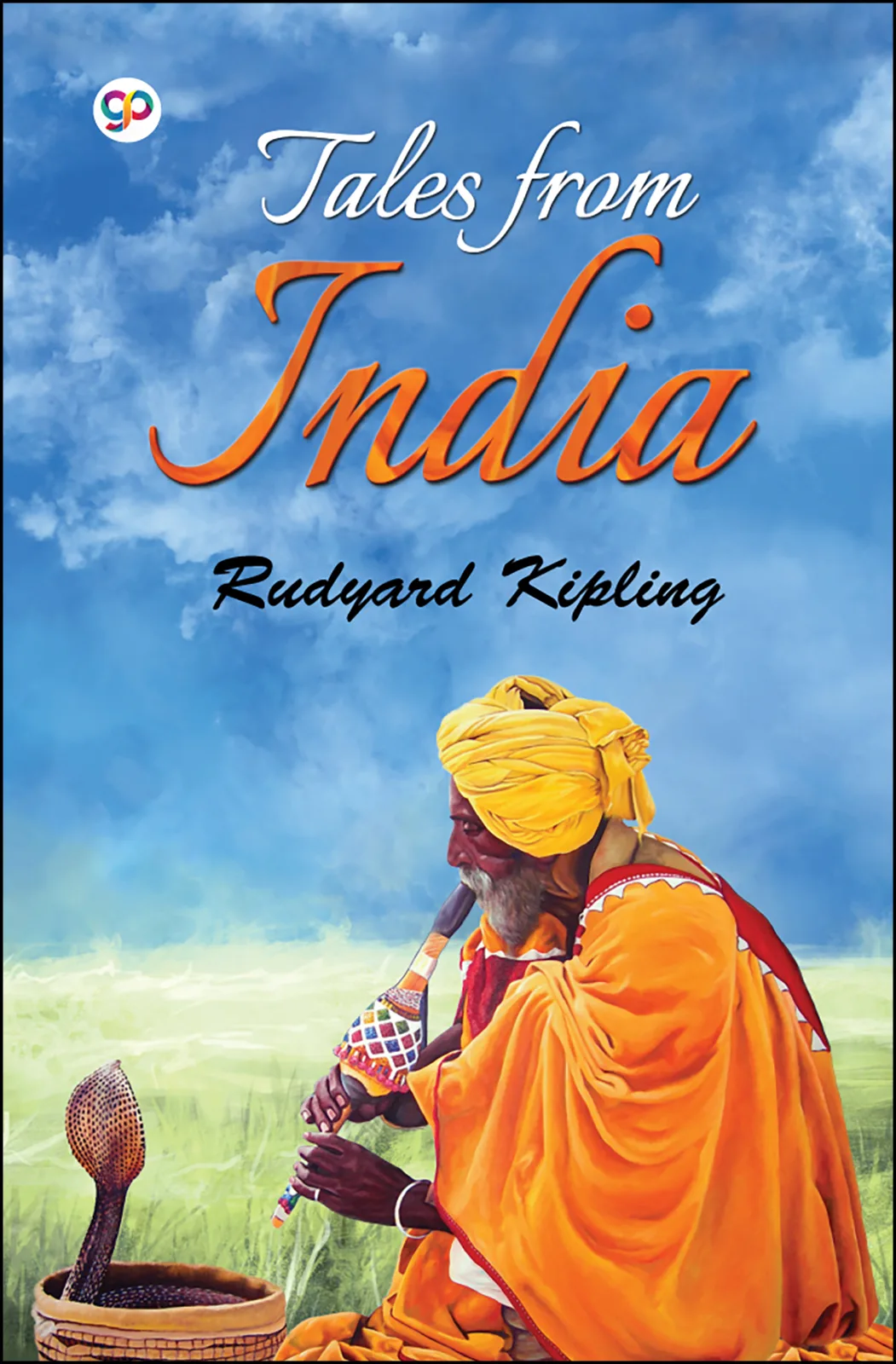
Tales from India
Hardcover
• 308 Pages
• INR 595.00
• English
• 9789387669123
No ratings yet
| Publisher | General Press |
|---|---|
| ISBN13 | 9789387669123 |
| ASIN/SKU | 9387669122 |
| Book Format | Hardcover |
| Language | English |
| Pages | 308 |
| List Price | INR 595.00 |
| Subject Code | SOC011000, JUV012000, TRV000000 |
| Publishing Date | 25/01/2018 |
| Dimensions | 8.25 x 5.25 x 1.0 inches |
| Book Code | BD00068009 |
Buy this Book
Amazon Stores
Ebook Stores
Other Stores
Discover Tales from India by Rudyard Kipling. This book is published by General Press in Hardcover format, ISBN 9789387669123, ASIN 9387669122, under Literature and Fiction, Short Stories, Indian Fiction.
Book Description
Step into a world where animals speak, ancient wisdom comes alive, and the landscapes of India become the setting for stories filled with humor, wonder, danger, and quiet lessons about human nature. 'Tales from India' by Rudyard Kipling is a classic collection of children’s literature and animal folklore that draws readers into the vibrant storytelling traditions of the Indian subcontinent.
Across these engaging tales, Kipling brings together memorable animals, curious characters, village life, and the mysterious beauty of India. The stories often explain the habits, appearances, and personalities of animals through imaginative adventures, while also exploring ideas such as courage, cleverness, loyalty, pride, friendship, and survival. Rather than presenting simple moral lessons, the collection allows each story to unfold naturally, giving its characters room to make mistakes, outwit one another, face danger, and discover unexpected truths.
Kipling’s storytelling is especially memorable for the way he gives animals distinct personalities and voices. A clever creature may overcome a stronger opponent through intelligence, while another may learn that pride or carelessness can have consequences. Beneath the playful surface, these stories reveal a keen observation of the natural world and the relationships between creatures. The settings are equally important, evoking forests, villages, rivers, roads, and other corners of India with a strong sense of atmosphere.
'Tales from India' remains appealing because its stories can be enjoyed on two levels: as entertaining adventures for younger readers and as richly imagined folklore for adults interested in classic literature and Indian-inspired storytelling. Kipling’s lively descriptions and memorable characters make the collection easy to revisit, while its themes continue to invite reflection. For readers who enjoy classic children’s stories, animal tales, folklore, and imaginative adventures, this collection offers a fascinating journey into a world where every creature seems to have a story to tell—and you may find yourself wondering what tale waits on the very next page.
Across these engaging tales, Kipling brings together memorable animals, curious characters, village life, and the mysterious beauty of India. The stories often explain the habits, appearances, and personalities of animals through imaginative adventures, while also exploring ideas such as courage, cleverness, loyalty, pride, friendship, and survival. Rather than presenting simple moral lessons, the collection allows each story to unfold naturally, giving its characters room to make mistakes, outwit one another, face danger, and discover unexpected truths.
Kipling’s storytelling is especially memorable for the way he gives animals distinct personalities and voices. A clever creature may overcome a stronger opponent through intelligence, while another may learn that pride or carelessness can have consequences. Beneath the playful surface, these stories reveal a keen observation of the natural world and the relationships between creatures. The settings are equally important, evoking forests, villages, rivers, roads, and other corners of India with a strong sense of atmosphere.
'Tales from India' remains appealing because its stories can be enjoyed on two levels: as entertaining adventures for younger readers and as richly imagined folklore for adults interested in classic literature and Indian-inspired storytelling. Kipling’s lively descriptions and memorable characters make the collection easy to revisit, while its themes continue to invite reflection. For readers who enjoy classic children’s stories, animal tales, folklore, and imaginative adventures, this collection offers a fascinating journey into a world where every creature seems to have a story to tell—and you may find yourself wondering what tale waits on the very next page.
Author Biography
Rudyard Kipling (1865-1936) was born in Bombay, but educated in England at the United Services College, Westward Ho, Bideford. In 1882 he returned to India, where he worked for Anglo-Indian newspapers.
His literary career began with Departmental Ditties (1886), but subsequently he became chiefly known as a writer of short stories. A prolific writer, he achieved fame quickly. Kipling was the poet of the British Empire and its yeoman, the common soldier, whom he glorified in many of his works, in particular Plain Tales from the Hills (1888) and Soldiers Three (1888), collections of short stories with roughly and affectionately drawn soldier portraits. His Barrack Room Ballads (1892) were written for, as much as about, the common soldier. In 1894 appeared his Jungle Book, which became a children's classic all over the world. Kim (1901), the story of Kimball O'Hara and his adventures in the Himalayas, is perhaps his most felicitous work. Other works include The Second Jungle Book (1895), The Seven Seas (1896), Captains Courageous (1897), The Day's Work (1898), Stalky and Co. (1899), Just So Stories (1902), Trafficks and Discoveries (1904), Puck of Pook’s Hill (1906), Actions and Reactions (1909), Debits and Credits (1926), Thy Servant a Dog (1930), and Limits and Renewals (1932). During the First World War Kipling wrote some propaganda books. His collected poems appeared in 1933.
Kipling was the recipient of many honorary degrees and other awards. In 1926 he received the Gold Medal of the Royal Society of Literature, which only Scott, Meredith, and Hardy had been awarded before him.
Rudyard Kipling died on January 18, 1936.
His literary career began with Departmental Ditties (1886), but subsequently he became chiefly known as a writer of short stories. A prolific writer, he achieved fame quickly. Kipling was the poet of the British Empire and its yeoman, the common soldier, whom he glorified in many of his works, in particular Plain Tales from the Hills (1888) and Soldiers Three (1888), collections of short stories with roughly and affectionately drawn soldier portraits. His Barrack Room Ballads (1892) were written for, as much as about, the common soldier. In 1894 appeared his Jungle Book, which became a children's classic all over the world. Kim (1901), the story of Kimball O'Hara and his adventures in the Himalayas, is perhaps his most felicitous work. Other works include The Second Jungle Book (1895), The Seven Seas (1896), Captains Courageous (1897), The Day's Work (1898), Stalky and Co. (1899), Just So Stories (1902), Trafficks and Discoveries (1904), Puck of Pook’s Hill (1906), Actions and Reactions (1909), Debits and Credits (1926), Thy Servant a Dog (1930), and Limits and Renewals (1932). During the First World War Kipling wrote some propaganda books. His collected poems appeared in 1933.
Kipling was the recipient of many honorary degrees and other awards. In 1926 he received the Gold Medal of the Royal Society of Literature, which only Scott, Meredith, and Hardy had been awarded before him.
Rudyard Kipling died on January 18, 1936.
Editorial Reviews
Editorial Reviews will be added soon…
Book Summary
Tales from India by Rudyard Kipling is a collection of short stories drawn largely from his experiences and observations of British India. The title is used for several editions and selections of Kipling’s Indian stories; one widely circulated edition gathers 36 stories, including “The Finest Story in the World,” “Wee Willie Winkie,” “The Story of Muhammad Din,” “In Flood Time,” “The Man Who Would Be King,” “The Strange Ride of Morrowbie Jukes,” “The Phantom Rickshaw,” and “Beyond the Pale.” Rather than telling one continuous story, the collection offers a broad and sometimes sharply contrasting portrait of life in colonial India. Soldiers, civil servants, villagers, merchants, lovers, travelers, and outsiders move through its pages, while Kipling combines realism, humor, adventure, tragedy, superstition, and the supernatural.
Kipling was born in Bombay and spent part of his childhood in India, an experience that gave him an unusually intimate familiarity with the sounds, landscapes, languages, customs, and working life of British India. His stories are therefore rich in physical detail. Heat, dust, monsoon rain, crowded bazaars, railway stations, military camps, government offices, remote villages, and lonely roads are not simply backgrounds; they create the atmosphere in which his characters live and make their decisions.
A major group of stories focuses on the British Indian Army and the ordinary soldiers who serve in it. Stories such as “With the Main Guard,” “The Rout of the White Hussars,” “The Drums of the Fore and Aft,” and “The Madness of Private Ortheris” show soldiers facing boredom, danger, discipline, fear, friendship, and homesickness. Kipling often presents soldiers as flawed but deeply human men. They joke, drink, quarrel, boast, and sometimes behave foolishly, yet they also display courage and loyalty. Through them, he reveals the demanding and sometimes lonely life behind the grand language of empire.
Some of the most memorable stories, however, move away from military life and explore the complicated relationship between British and Indian society. In “The Story of Muhammad Din,” a small human relationship becomes emotionally powerful because of the simplicity and vulnerability of the characters. The story demonstrates Kipling’s ability to find tragedy in an apparently ordinary encounter. His India is not populated only by historical heroes or political figures; it is also made up of children, servants, workers, beggars, villagers, and people whose lives can be changed by events far beyond their control.
The collection also repeatedly explores the supernatural. In “My Own True Ghost Story,” “The Phantom Rickshaw,” “The Strange Ride of Morrowbie Jukes,” and “In the House of Suddhoo,” the ordinary world becomes uncertain. Ghosts, visions, mysterious events, and unexplained experiences challenge the confidence of characters who believe they understand reality. Kipling uses supernatural elements not merely for entertainment but to reveal fear, guilt, loneliness, and psychological instability.
“The Phantom Rickshaw,” for example, centers on a man who becomes haunted by the memory of a woman with whom he had a relationship. The ghostly appearance can be read literally within the story, but it also reflects the character’s guilt and inability to escape the consequences of his actions. In this way, the supernatural becomes a language for emotional truth.
Another important strand is adventure and exploration. “The Man Who Would Be King” follows Daniel Dravot and Peachey Carnehan, two former soldiers who dream of becoming rulers of a remote region beyond the borders of British India. Their ambition initially succeeds, but their fantasy of power eventually collapses. The story is exciting and often humorous, yet underneath the adventure lies a serious meditation on arrogance, imperial ambition, and the human desire for control. The men discover that ruling others is far more complicated than imagining oneself a king.
Kipling also writes about love and forbidden relationships, particularly across the racial and cultural boundaries of colonial society. “Beyond the Pale” is one of the clearest examples. The story portrays an Englishman who becomes involved with an Indian woman, but the relationship is constrained by the rigid social divisions of colonial India. Kipling presents these boundaries as powerful and dangerous. Affection cannot easily overcome the assumptions and structures surrounding race, class, gender, and imperial authority.
The collection frequently portrays India as a place of enormous cultural complexity. Indian characters are not presented as belonging to a single type. They include servants, religious figures, criminals, traders, villagers, officials, artists, and ordinary families. Kipling often gives them distinctive voices and personalities. At the same time, modern readers may notice that some of his portrayals are shaped by the assumptions and prejudices of the colonial period. His stories can therefore be both vivid literary documents and revealing examples of how colonial writers understood the society in which they lived.
One of the strongest qualities of the collection is its sense of place. Kipling writes with extraordinary attention to movement, speech, weather, clothing, smells, animals, military routines, and local landscapes. India becomes almost a living presence. The monsoon can determine the rhythm of life; heat can affect judgment and health; roads and railways connect distant worlds; and the vastness of the landscape can make individuals feel isolated or insignificant.
His writing also moves easily between humor and tragedy. A comic military anecdote may sit beside a story of death or madness. Characters may begin in confidence and end in despair. This mixture gives the collection emotional variety and prevents India from becoming merely an exotic setting for adventure.
Yet the book is ultimately concerned with human vulnerability. Kipling repeatedly shows people trying to control circumstances that are larger than themselves. Soldiers struggle against fear, lovers struggle against social barriers, adventurers struggle against their own ambition, and lonely individuals struggle against memory or guilt. Sometimes they survive through courage and friendship; sometimes they are defeated by forces they cannot understand.
The collection is also valuable because it captures the contradictions of the colonial experience. Kipling admired aspects of the British imperial system and often wrote sympathetically about soldiers and administrators, but his stories also reveal the loneliness, cultural misunderstanding, arrogance, exploitation, and psychological strain produced by colonial rule. The result is more complicated than simple propaganda. His fictional world contains both admiration for imperial service and glimpses of its human costs.
Ultimately, Tales from India is best understood as a panorama rather than a single narrative. Its stories present India as beautiful, dangerous, mysterious, humorous, divided, and deeply human. Kipling’s characters often live between cultures, between duty and desire, or between what they believe and what reality finally reveals. The collection’s lasting strength comes from its storytelling: vivid scenes, memorable personalities, suspense, humor, and an exceptional ear for dialogue.
At the same time, reading Kipling today requires awareness of his historical position. His India is the India of the British Raj, viewed largely through the eyes of a writer shaped by colonial society. Some descriptions therefore reflect attitudes that modern readers may find stereotypical or troubling. Nevertheless, the stories remain important literary and historical documents. They show both the extraordinary observational power of Kipling and the limitations of the world in which he lived. Together, they create a fascinating portrait of an India where different cultures, classes, beliefs, and ambitions existed side by side, often uneasily, and where ordinary human emotions—love, fear, loneliness, courage, greed, loyalty, and hope—continued to connect people across those divisions.
Kipling was born in Bombay and spent part of his childhood in India, an experience that gave him an unusually intimate familiarity with the sounds, landscapes, languages, customs, and working life of British India. His stories are therefore rich in physical detail. Heat, dust, monsoon rain, crowded bazaars, railway stations, military camps, government offices, remote villages, and lonely roads are not simply backgrounds; they create the atmosphere in which his characters live and make their decisions.
A major group of stories focuses on the British Indian Army and the ordinary soldiers who serve in it. Stories such as “With the Main Guard,” “The Rout of the White Hussars,” “The Drums of the Fore and Aft,” and “The Madness of Private Ortheris” show soldiers facing boredom, danger, discipline, fear, friendship, and homesickness. Kipling often presents soldiers as flawed but deeply human men. They joke, drink, quarrel, boast, and sometimes behave foolishly, yet they also display courage and loyalty. Through them, he reveals the demanding and sometimes lonely life behind the grand language of empire.
Some of the most memorable stories, however, move away from military life and explore the complicated relationship between British and Indian society. In “The Story of Muhammad Din,” a small human relationship becomes emotionally powerful because of the simplicity and vulnerability of the characters. The story demonstrates Kipling’s ability to find tragedy in an apparently ordinary encounter. His India is not populated only by historical heroes or political figures; it is also made up of children, servants, workers, beggars, villagers, and people whose lives can be changed by events far beyond their control.
The collection also repeatedly explores the supernatural. In “My Own True Ghost Story,” “The Phantom Rickshaw,” “The Strange Ride of Morrowbie Jukes,” and “In the House of Suddhoo,” the ordinary world becomes uncertain. Ghosts, visions, mysterious events, and unexplained experiences challenge the confidence of characters who believe they understand reality. Kipling uses supernatural elements not merely for entertainment but to reveal fear, guilt, loneliness, and psychological instability.
“The Phantom Rickshaw,” for example, centers on a man who becomes haunted by the memory of a woman with whom he had a relationship. The ghostly appearance can be read literally within the story, but it also reflects the character’s guilt and inability to escape the consequences of his actions. In this way, the supernatural becomes a language for emotional truth.
Another important strand is adventure and exploration. “The Man Who Would Be King” follows Daniel Dravot and Peachey Carnehan, two former soldiers who dream of becoming rulers of a remote region beyond the borders of British India. Their ambition initially succeeds, but their fantasy of power eventually collapses. The story is exciting and often humorous, yet underneath the adventure lies a serious meditation on arrogance, imperial ambition, and the human desire for control. The men discover that ruling others is far more complicated than imagining oneself a king.
Kipling also writes about love and forbidden relationships, particularly across the racial and cultural boundaries of colonial society. “Beyond the Pale” is one of the clearest examples. The story portrays an Englishman who becomes involved with an Indian woman, but the relationship is constrained by the rigid social divisions of colonial India. Kipling presents these boundaries as powerful and dangerous. Affection cannot easily overcome the assumptions and structures surrounding race, class, gender, and imperial authority.
The collection frequently portrays India as a place of enormous cultural complexity. Indian characters are not presented as belonging to a single type. They include servants, religious figures, criminals, traders, villagers, officials, artists, and ordinary families. Kipling often gives them distinctive voices and personalities. At the same time, modern readers may notice that some of his portrayals are shaped by the assumptions and prejudices of the colonial period. His stories can therefore be both vivid literary documents and revealing examples of how colonial writers understood the society in which they lived.
One of the strongest qualities of the collection is its sense of place. Kipling writes with extraordinary attention to movement, speech, weather, clothing, smells, animals, military routines, and local landscapes. India becomes almost a living presence. The monsoon can determine the rhythm of life; heat can affect judgment and health; roads and railways connect distant worlds; and the vastness of the landscape can make individuals feel isolated or insignificant.
His writing also moves easily between humor and tragedy. A comic military anecdote may sit beside a story of death or madness. Characters may begin in confidence and end in despair. This mixture gives the collection emotional variety and prevents India from becoming merely an exotic setting for adventure.
Yet the book is ultimately concerned with human vulnerability. Kipling repeatedly shows people trying to control circumstances that are larger than themselves. Soldiers struggle against fear, lovers struggle against social barriers, adventurers struggle against their own ambition, and lonely individuals struggle against memory or guilt. Sometimes they survive through courage and friendship; sometimes they are defeated by forces they cannot understand.
The collection is also valuable because it captures the contradictions of the colonial experience. Kipling admired aspects of the British imperial system and often wrote sympathetically about soldiers and administrators, but his stories also reveal the loneliness, cultural misunderstanding, arrogance, exploitation, and psychological strain produced by colonial rule. The result is more complicated than simple propaganda. His fictional world contains both admiration for imperial service and glimpses of its human costs.
Ultimately, Tales from India is best understood as a panorama rather than a single narrative. Its stories present India as beautiful, dangerous, mysterious, humorous, divided, and deeply human. Kipling’s characters often live between cultures, between duty and desire, or between what they believe and what reality finally reveals. The collection’s lasting strength comes from its storytelling: vivid scenes, memorable personalities, suspense, humor, and an exceptional ear for dialogue.
At the same time, reading Kipling today requires awareness of his historical position. His India is the India of the British Raj, viewed largely through the eyes of a writer shaped by colonial society. Some descriptions therefore reflect attitudes that modern readers may find stereotypical or troubling. Nevertheless, the stories remain important literary and historical documents. They show both the extraordinary observational power of Kipling and the limitations of the world in which he lived. Together, they create a fascinating portrait of an India where different cultures, classes, beliefs, and ambitions existed side by side, often uneasily, and where ordinary human emotions—love, fear, loneliness, courage, greed, loyalty, and hope—continued to connect people across those divisions.
Sample Chapters
Sample Chapters will be added soon…
Reader Reviews
No reviews yet.
Tales from India
Download Cover Image
Do you want to download the full cover image for Tales from India?