
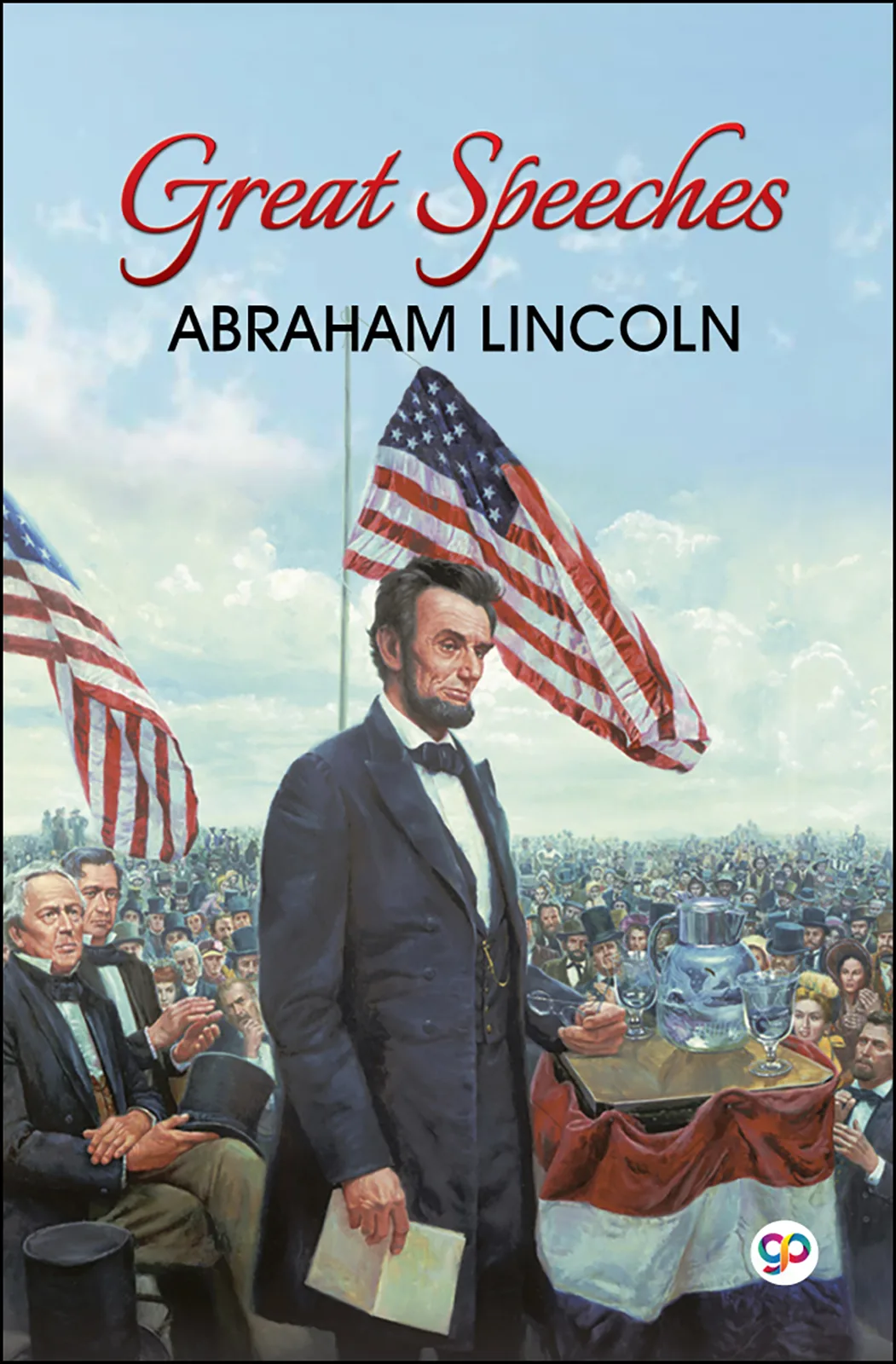
Great Speeches of Abraham Lincoln
Hardcover
• 166 Pages
• INR 345.00
• English
• 9789387669154
No ratings yet
| Publisher | General Press |
|---|---|
| ISBN13 | 9789387669154 |
| ASIN/SKU | 9387669157 |
| Book Format | Hardcover |
| Language | English |
| Pages | 166 |
| List Price | INR 345.00 |
| Subject Code | HIS036040, HIS036050, LCO018000 |
| Publishing Date | 03/02/2018 |
| Dimensions | 8.25 x 5.25 x 1.0 inches |
| Book Code | BD00068012 |
Buy this Book
Amazon Stores
Ebook Stores
Other Stores
Discover Great Speeches of Abraham Lincoln by Abraham Lincoln. This book is published by General Press in Hardcover format, ISBN 9789387669154, ASIN 9387669157, under History, Social Science, Reference.
Book Description
This is a wonderful collection of Lincoln's most famous speeches in complete and unabridged form. The simple yet memorable eloquence of his speeches, proclamations and personal correspondence is recorded here in a representative collection of 16 documents.
Abraham Lincoln displayed a remarkable facility in his use of the written word. His 'Farwell to Springfield' speech, 'Gettysburg Address' and 'Annual Messages to Congress', all collected in one book. This important volume will also fascinate admirers of Abraham Lincoln, Americana enthusiasts, Civil War buffs and any lover of the finely crafted phrase.
Abraham Lincoln displayed a remarkable facility in his use of the written word. His 'Farwell to Springfield' speech, 'Gettysburg Address' and 'Annual Messages to Congress', all collected in one book. This important volume will also fascinate admirers of Abraham Lincoln, Americana enthusiasts, Civil War buffs and any lover of the finely crafted phrase.
Author Biography
Abraham Lincoln was the sixteenth President of the United States, serving from March 4, 1861 until his assassination. As an outspoken opponent of the expansion of slavery in the United States, Lincoln won the Republican Party nomination in 1860 and was elected president later that year. During his term, he helped preserve the United States by leading the defeat of the secessionist Confederate States of America in the American Civil War. He introduced measures that resulted in the abolition of slavery, issuing his Emancipation Proclamation in 1863 and promoting the passage of the Thirteenth Amendment to the Constitution in 1865.
Editorial Reviews
Editorial Reviews will be added soon…
Book Summary
Great Speeches of Abraham Lincoln is a collection of some of Abraham Lincoln’s most important public addresses and writings. Together, these speeches trace the political and moral journey of the United States through one of the most difficult periods in its history: the growing conflict over slavery, the secession of the Southern states, the Civil War, and the struggle to preserve the Union. More than political documents, Lincoln’s speeches reveal the development of a leader who gradually came to see the preservation of the Union, the destruction of slavery, and the meaning of American democracy as parts of the same moral struggle.
One of the earliest important speeches in the collection is Lincoln’s “House Divided” speech, delivered in 1858. Speaking during his campaign for the U.S. Senate, Lincoln argued that the country could not remain permanently divided between states where slavery was permitted and states where it was prohibited. His famous image of a “house divided” expresses his belief that the growing conflict over slavery would eventually force the nation to confront the issue directly. Lincoln did not yet advocate immediate abolition everywhere, but he recognized that the political compromise surrounding slavery was becoming increasingly impossible to maintain.
The Lincoln-Douglas debates also demonstrate his developing political philosophy. Lincoln repeatedly challenged the idea that slavery should be allowed to expand simply because some people considered it a matter of local choice. His arguments were grounded in the Declaration of Independence and the principle that all people possess a fundamental claim to liberty. At the same time, he carefully distinguished between opposing the expansion of slavery and advocating immediate social equality in every respect. His language reflected both the moral convictions and political limitations of his era.
In his Cooper Union Address of 1860, Lincoln made a detailed argument about the intentions of the American founders concerning slavery. He appealed to historical evidence to show that many of the nation’s founders had opposed the expansion of slavery. The speech was important because it presented Lincoln not as a radical revolutionary but as a politician seeking to restore what he believed to be the original principles of the republic. His growing national reputation helped him secure the Republican nomination for president.
After his election, the nation moved rapidly toward civil war. Lincoln’s First Inaugural Address attempted to prevent the final collapse of the Union. He spoke directly to the Southern states and insisted that he had no intention of interfering with slavery where it already existed under law. Yet he firmly rejected secession. The Union, he argued, was more than a temporary arrangement that individual states could abandon whenever they wished.
The speech is remarkable for its mixture of firmness and restraint. Lincoln warned that there should be no violence unless it was forced upon the government. He ended by appealing to the better feelings of the American people, suggesting that the bonds of affection between citizens were stronger than the divisions created by politics. His goal was not humiliation or revenge but reconciliation.
The Gettysburg Address, perhaps Lincoln’s most famous speech, transforms the Civil War from a conflict over political authority into a profound test of democratic government. Speaking at the dedication of a cemetery for soldiers who had died at Gettysburg, Lincoln connected the war to the principles expressed in the Declaration of Independence. The United States, he argued, had been founded on the proposition that human beings are equal and that government should ultimately belong to the people.
The speech is remarkably short, but its meaning is enormous. Lincoln does not simply honor the dead. He asks the living to continue the work for which the soldiers sacrificed themselves. The war becomes a test of whether a nation founded on democratic ideals can survive. His famous vision of “government of the people, by the people, for the people” presents democracy as something fragile that requires continual sacrifice and renewal.
As the war continued, Lincoln’s Second Inaugural Address revealed an even deeper and more reflective understanding of the conflict. By this point, victory for the Union was approaching, but Lincoln refused to celebrate triumphantly. Instead, he considered why the war had happened and what it meant morally.
He suggested that slavery was the fundamental cause of the conflict and that the suffering of the war might represent a terrible national judgment. Yet he did not portray the North as completely innocent or the South as uniquely evil. His language is filled with humility and uncertainty about divine purposes. Rather than claiming that God was simply on the Union’s side, Lincoln wondered whether both sides might be experiencing the consequences of a national sin.
This humility leads to one of the most powerful themes in his speeches: reconciliation without hatred. Lincoln urged Americans to act “with malice toward none” and “charity for all.” Even after years of devastating warfare, he imagined rebuilding the nation without turning victory into an excuse for revenge.
Across these speeches, Lincoln’s understanding of freedom also evolves. Initially, his political argument focused heavily on preserving the Union and preventing the expansion of slavery. As the war progressed, however, emancipation became increasingly central to the meaning of the conflict. The Emancipation Proclamation and Lincoln’s later speeches reflected his growing conviction that the Union could not be permanently preserved while slavery remained at the heart of American political life.
What makes Lincoln’s speeches enduring is not merely their historical importance. It is the combination of moral seriousness, political realism, humility, and compassion that runs through them. Lincoln understood that leadership requires more than having strong opinions. It requires persuading people who disagree, recognizing political realities without surrendering principles, and knowing when firmness must be balanced by mercy.
His speeches also reveal his belief that democracy depends upon moral responsibility. A republic cannot survive simply because its constitution exists on paper. Citizens must believe in the principles behind it, and leaders must be willing to defend those principles even when doing so is difficult.
Ultimately, Great Speeches of Abraham Lincoln presents a portrait of a leader whose thinking matured through crisis. Lincoln began as a politician trying to preserve a divided nation and ended as a statesman who saw the Civil War as a struggle over the deepest meaning of American freedom.
His greatest message is not one of triumph but of responsibility. A nation must continually work to make its ideals real. Freedom requires courage, democracy requires sacrifice, and reconciliation requires generosity. Lincoln’s speeches remain powerful because they remind readers that political greatness is not simply the ability to win a conflict. It is the ability to emerge from conflict with a larger understanding of justice, humanity, and the common good.
One of the earliest important speeches in the collection is Lincoln’s “House Divided” speech, delivered in 1858. Speaking during his campaign for the U.S. Senate, Lincoln argued that the country could not remain permanently divided between states where slavery was permitted and states where it was prohibited. His famous image of a “house divided” expresses his belief that the growing conflict over slavery would eventually force the nation to confront the issue directly. Lincoln did not yet advocate immediate abolition everywhere, but he recognized that the political compromise surrounding slavery was becoming increasingly impossible to maintain.
The Lincoln-Douglas debates also demonstrate his developing political philosophy. Lincoln repeatedly challenged the idea that slavery should be allowed to expand simply because some people considered it a matter of local choice. His arguments were grounded in the Declaration of Independence and the principle that all people possess a fundamental claim to liberty. At the same time, he carefully distinguished between opposing the expansion of slavery and advocating immediate social equality in every respect. His language reflected both the moral convictions and political limitations of his era.
In his Cooper Union Address of 1860, Lincoln made a detailed argument about the intentions of the American founders concerning slavery. He appealed to historical evidence to show that many of the nation’s founders had opposed the expansion of slavery. The speech was important because it presented Lincoln not as a radical revolutionary but as a politician seeking to restore what he believed to be the original principles of the republic. His growing national reputation helped him secure the Republican nomination for president.
After his election, the nation moved rapidly toward civil war. Lincoln’s First Inaugural Address attempted to prevent the final collapse of the Union. He spoke directly to the Southern states and insisted that he had no intention of interfering with slavery where it already existed under law. Yet he firmly rejected secession. The Union, he argued, was more than a temporary arrangement that individual states could abandon whenever they wished.
The speech is remarkable for its mixture of firmness and restraint. Lincoln warned that there should be no violence unless it was forced upon the government. He ended by appealing to the better feelings of the American people, suggesting that the bonds of affection between citizens were stronger than the divisions created by politics. His goal was not humiliation or revenge but reconciliation.
The Gettysburg Address, perhaps Lincoln’s most famous speech, transforms the Civil War from a conflict over political authority into a profound test of democratic government. Speaking at the dedication of a cemetery for soldiers who had died at Gettysburg, Lincoln connected the war to the principles expressed in the Declaration of Independence. The United States, he argued, had been founded on the proposition that human beings are equal and that government should ultimately belong to the people.
The speech is remarkably short, but its meaning is enormous. Lincoln does not simply honor the dead. He asks the living to continue the work for which the soldiers sacrificed themselves. The war becomes a test of whether a nation founded on democratic ideals can survive. His famous vision of “government of the people, by the people, for the people” presents democracy as something fragile that requires continual sacrifice and renewal.
As the war continued, Lincoln’s Second Inaugural Address revealed an even deeper and more reflective understanding of the conflict. By this point, victory for the Union was approaching, but Lincoln refused to celebrate triumphantly. Instead, he considered why the war had happened and what it meant morally.
He suggested that slavery was the fundamental cause of the conflict and that the suffering of the war might represent a terrible national judgment. Yet he did not portray the North as completely innocent or the South as uniquely evil. His language is filled with humility and uncertainty about divine purposes. Rather than claiming that God was simply on the Union’s side, Lincoln wondered whether both sides might be experiencing the consequences of a national sin.
This humility leads to one of the most powerful themes in his speeches: reconciliation without hatred. Lincoln urged Americans to act “with malice toward none” and “charity for all.” Even after years of devastating warfare, he imagined rebuilding the nation without turning victory into an excuse for revenge.
Across these speeches, Lincoln’s understanding of freedom also evolves. Initially, his political argument focused heavily on preserving the Union and preventing the expansion of slavery. As the war progressed, however, emancipation became increasingly central to the meaning of the conflict. The Emancipation Proclamation and Lincoln’s later speeches reflected his growing conviction that the Union could not be permanently preserved while slavery remained at the heart of American political life.
What makes Lincoln’s speeches enduring is not merely their historical importance. It is the combination of moral seriousness, political realism, humility, and compassion that runs through them. Lincoln understood that leadership requires more than having strong opinions. It requires persuading people who disagree, recognizing political realities without surrendering principles, and knowing when firmness must be balanced by mercy.
His speeches also reveal his belief that democracy depends upon moral responsibility. A republic cannot survive simply because its constitution exists on paper. Citizens must believe in the principles behind it, and leaders must be willing to defend those principles even when doing so is difficult.
Ultimately, Great Speeches of Abraham Lincoln presents a portrait of a leader whose thinking matured through crisis. Lincoln began as a politician trying to preserve a divided nation and ended as a statesman who saw the Civil War as a struggle over the deepest meaning of American freedom.
His greatest message is not one of triumph but of responsibility. A nation must continually work to make its ideals real. Freedom requires courage, democracy requires sacrifice, and reconciliation requires generosity. Lincoln’s speeches remain powerful because they remind readers that political greatness is not simply the ability to win a conflict. It is the ability to emerge from conflict with a larger understanding of justice, humanity, and the common good.
Sample Chapters
The Perpetuation of Our Political Institutions: Address Before the Young Men’s Lyceum of Springfield, Illinois, January 27, 1838
When Lincoln arrived in Springfield, the new state capital of Illinois, on April 15, 1837, he was a struggling young attorney of 28. His political career had begun in 1834 with his election to the Illinois legislature from Sangamon County, where he had made his home in the little town of New Salem since 1831. He moved to Springfield, then a city of about 2,000 inhabitants, to join the law offices of John Todd Stuart a young Whig colleague of his in the state legislature who had encouraged him to pursue his goal of becoming an attorney. In his speech before the Young Men’s Lyceum, a popular debating society, Lincoln delivered this impassioned defense of the rule of law as the indispensable safeguard of America’s treasured political institutions.
The background of the speech was an increasing tide of violence against blacks and their abolitionist sympathizers, particularly in Southern and border states. As Lincoln reported—alluding to events that were much in the news and familiar to his listeners —this sudden mob violence was aimed not only at innocent blacks, but at those who were, or were merely thought to be, their supporters.
Lincoln argued that the only real threat to America’s political institutions as they had come down from the Founding Fathers was this manifest withering away of the nation’s respect for the rule of law. Only mob rule could bring down the new Republic’s democratic institutions. America was too strong and too isolated to be threatened by any outside force—the only danger of despotism came from the mob within.
Lincoln’s oratorical skills, evident even in this early effort, gave impetus to his rise in Illinois legal and political circles in the coming decade.
As a subject for the remarks of the evening, the perpetuation of our political institutions, is selected.
In the great journal of things happening under the sun, we, the American People, find our account running, under date of the nineteenth century of the Christian era. We find ourselves in the peaceful possession of the fairest portion of the earth, as regards extent of territory, fertility of soil, and salubrity of climate. We find ourselves under the government of a system of political institutions, conducing more essentially to the ends of civil and religious liberty, than any of which the history of former times tells us. We, when mounting the stage of existence, found ourselves the legal inheritors of these fundamental blessings. We toiled not in the acquirement or establishment of them—they are a legacy bequeathed us, by a once hardy, brave, and patriotic, but now lamented and departed race of ancestors. Theirs was the task (and nobly they performed it) to possess themselves, and through themselves, us, of this goodly land; and to uprear upon its hills and its valleys, a political edifice of liberty and equal rights; ’its ours only, to transmit these, the former, unprofaned by the foot of an invader; the latter, undecayed by the lapse of time and untorn by usurpation, to the latest generation that fate shall permit the world to know. This task gratitude to our fathers, justice to ourselves, duty to posterity, and love for our species in general, all imperatively require us faithfully to perform.
How then shall was perform it?—At what point shall we expect the approach of danger? By what means shall we fortify against it?—Shall we expect some transatlantic military giant, to step the Ocean, and crush us at a blow? Never!—All the armies of Europe, Asia and Africa combined, with all the treasure of the earth (our own excepted) in their military chest, with a Buonaparte for a commander, could not by force, take a drink from the Ohio, or make a track on the Blue Ridge, in a trial of a thousand years.
At what point then is the approach of danger to be expected? I answer, if it ever reach us, it must spring up amongst us. It cannot come from abroad. If destruction be our lot, we must ourselves be its author and finisher. As a nation of freemen, we must live through all time, or die by suicide.
I hope I am over wary; but if I am not, there is, even now, something of ill-omen, amongst us. I mean the increasing disregard for law which pervades the country; the growing disposition to substitute the wild and furious passions, in lieu of the sober judgment of Courts; and the worse than savage mobs, for the executive ministers of justice. This disposition is awfully fearful in any community; and that it now exists in ours, though grating to our feelings to admit, it would be a violation of truth, and an insult to our intelligence, to deny. Accounts of outrages committed by mobs, from the every-day news of the times. They have pervaded the country, from New England to Louisiana;—they are neither peculiar to the eternal snows of the former, nor the burning suns of the latter;—they are not the creature of climate—neither are they confined to the slave-holding, or the non-slave-holding States. Alike, they spring up among the pleasure hunting masters of Southern slaves, and the order loving citizens of the land of steady habits.—Whatever, then, their cause may be, it is common to the whole country.
It would be tedious, as well as useless, to recount the horrors of all of them. Those happening in the State of Mississippi, and at St. Louis, are, perhaps, the most dangerous in example and revolting to humanity. In the Mississippi case, they first commenced by hanging the regular gamblers; a set of men, certainly not following for a livelihood, a very useful, or very honest occupation; but one which, so far from being forbidden by the laws, was actually licensed by an act of the Legislature, passed but a single year before. Next, negroes, suspected of conspiring to raise an insurrection, were caught up and hanged in all parts of the State: then, white men, supposed to be leagued with the negroes; and finally, strangers, from neighboring States, going thither on business, were, in many instances subjected to the same fate. Thus went on this process of hanging, from gamblers to negroes, from negroes to white citizens, and from these to strangers; till dead men were seen literally dangling from the boughs of trees upon every road side; and in numbers almost sufficient, to rival the native Spanish moss of the country, as a drapery of the forest.
Turn, then, to that horror-striking scene at St. Louis. A single victim was only sacrificed there. His story is very short; and is, perhaps, the most highly tragic, of anything of its length, that has ever been witnessed in real life. A mulatto man, by the name of Mclntosh, was seized in the street, dragged to the suburbs of the city, chained to a tree, and actually burned to death; and all within a single hour from the time he had been a freeman, attending to his own business, and at peace with the world.
Such are the effects of mob law; and such are the scenes, becoming more and more frequent in this land so lately famed for love of law and order; and the stories of which, have even now grown too familiar, to attract any thing more, than an idle remark.
But you are, perhaps, ready to ask, “What has this to do with the perpetuation of our political institutions?” I answer, it has much to do with it. Its direct consequences are, comparatively speaking, but a small evil; and much of its danger consists, in the proneness of our minds, to regard its direct, as its only consequences. Abstractly considered, the hanging of the gamblers at Vicksburg, was of but little consequence. They constitute a portion of population, that is worse than useless in any community; and their death, if no pernicious example be set by it, is never matter of reasonable regret with anyone. If they were annually swept, from the stage of existence, by the plague or small pox, honest men would, perhaps, be much profited, by the operation.—Similar too, is the correct reasoning, in regard to the burning of the negro at St. Louis. He had forfeited his life, by the perpetration of an outrageous murder, upon one of the most worthy and respectable citizens of the city; and had he not died as he did, he must have died by the sentence of the law, in a very short time afterwards. As to him alone, it was as well the way it was, as it could otherwise have been—But the example in either case, was fearful.—When men take it in their heads to-day, to hang gamblers, or burn murderers, they should recollect, that, in the confusion usually attending such transaction, they will be as likely to hang or burn someone who is neither a gambler nor a murderer as one who is; and that, acting upon the example they set, the mob of to-morrow, may, and probably will, hang or burn some of them by the very same mistake. And not only so; the innocent, those who have ever set their faces against violations of law in every shape, alike with the guilty, fall victims to the ravages of mob low; and thus it goes on, step by step, till all the walls erected for the defence of the persons and property of individuals, are trodden down, and disregarded. But all this even, is not the full extent of the evil.—By such examples, by instances of the perpetrators of such acts going unpunished, the lawless in spirit, are encouraged to become lawless in practice; and having been used to no restraint, but dread of punishment, they thus become, absolutely unrestrained.—Having ever regarded Government as their deadliest bane, they make a jubilee of the suspension of its operations; and pray for nothing so much, as its total annihilation. While, on the other hand, good men, men who love tranquility, who desire to abide by the laws, and enjoy their benefits, who would gladly spill their blood in the defence of their country; seeing their property destroyed; their families insulted, and their lives endangered; their persons injured; and seeing nothing in prospect that forebodes a change for the better; become tired of, and disgusted with, a Government that offers them no protection; and are not much averse to a change in which they imagine they have nothing to lose. Thus, then, by the operation of this mobocratic spirit, which all must admit, is now abroad in the land, the strongest bulwark of any Government, and particularly of those constituted like ours, may effectually be broken down and destroyed—I mean the attachment of the People. Whenever this effect shall be produced among us; whenever the vicious portion of population shall be permitted to gather in bands of hundreds and thousands, and burn churches, ravage and rob provision-stores, throw printing presses into rivers, shoot editors, and hang and burn obnoxious persons at pleasure, and with impunity; depend no it, this Government cannot last. By such things, the feeling of the best citizens will become more or less alienated from it; and thus it will be left without friends, or with too few, and those few too weak, to make their friendship effectual. At such a time and under such circumstances, men of sufficient talent and ambition will not be wanting to seize the opportunity, strike the blow, and overturn that fair fabric, which for the last half century, has been the fondest hope, of the lovers of freedom, throughout the world.
I know the American People are much attached to their Government;—I know they would suffer much for its sake;—I know they would endure evils long and patiently, before they would ever think of exchanging it for another. Yet, notwithstanding all this, if the laws be continually despised and disregarded, if their rights to be secure in their persons and property, are held by no better tenure than the caprice of a mob, the alienation of their affections from the Government is the natural consequence; and to that, sooner or later, it must come.
Here then, is one point at which danger may be expected.
The question recurs, “how shall we fortify against it?” The answer is simple. Let every American, every lover of liberty, every well wisher to his posterity, swear by the blood of the Revolution, never to violate in the least particular, the laws of the country; and never to tolerate their violation by others. As the patriots of seventy-six did to the support of the Declaration of Independence, so to the support of the Constitution and Laws, let every American pledge his life, his property, and his sacred honor;—let every man remember that to violate the law, is to trample on the blood of his father, and to tear the character of his own, and his children’s liberty. Let reverence for the laws be breathed by every American mother, to the lisping babe, that prattles on her lap—let it be taught in schools, in seminaries, and in colleges; let it be written in Primers, spelling books, and in Almanacs;—let it be preached from the pulpit, proclaimed in legislative halls, and enforced in courts of justice. And, in short, let it become the political religion of the nation; and let the old and the young, the rich and the poor, the grave and the gay, of all sexes and tongues, and colours and conditions, sacrifice unceasingly upon its altars.
While ever a state of feeling, such as this, shall universally, or even, very generally prevail throughout the nation, vain will be every effort, and fruitless every attempt, to subvert our national freedom.
When I so pressingly urge a strict observance of all the laws, let me not be understood as saying there are no bad laws, nor that grievances may not arise, for the redress of which, no legal provisions have been made.—I mean to say no such thing. But I do mean to say, that, although bad laws, if they exist, should be repealed as soon as possible, still while they continue in force, for the sake of example, they should be religiously observed. So also in unprovided cases. If such arise, let proper legal provisions be made for them with the least possible delay; but, till then, let them, if not too intolerable, be borne with.
There is no grievance that is a fit object of redress by mob law. In any case that arises, as for instance, the promulgation of abolitionism, one of two positions is necessarily true; that is, the thing is right within itself, and therefore deserves the protection of all law and all good citizens; or, it is wrong, and therefore proper to be prohibited by legal enactments; and in neither case, is the interposition of mob law, either necessary, justifiable, or excusable.
But, it may be asked, why suppose danger to our political institutions? Have we not preserved them for more than fifty years? And why may we not for fifty times as long?
We hope there is no sufficient reason. We hope all dangers may be overcome; but to conclude that no danger may ever arise, would itself be extremely dangerous. There are now, and will hereafter be, many causes, dangerous in their tendency, which have not existed heretofore; and which are not too insignificant to merit attention. That our government should have been maintained in its original form from its establishment until now, is not much to be wondered at. It had many props to support it through that period, which now are decayed, and crumbled away. Through that period, it was felt by all, to be an undecided experiment; now, it is understood to be a successful one.—Then, all that sought celebrity and fame, and distinction, expected to find them in the success of that experiment. Their all was staked upon it:—their destiny was inseparably linked with it. Their ambition aspired to display before an admiring world, a practical demonstration of the truth of a proposition, which had hitherto been considered, at best no better, than problematical; namely, the capability of a people to govern themselves. If they succeeded, they were to be immortalized; their names were to be transferred to counties and cities, and rivers and mountains; and to be revered and sung, and toasted through all time. If they failed, they were to be called knaves and fools, and fanatics for a fleeting hour; then to sink and be forgotten. They succeeded. The experiment is successful; and thousands have won their deathless names in making it so. But the game is caught; and I believe it is true, that with the catching, end the pleasures of the chase. This field of glory is harvested, and the crop is already appropriated. But new reapers will arise, and they, too, will seek a field. It is to deny, what the history of the world tells us is true, to suppose that men of ambition and talents will not continue to spring up amongst us. And, when they do, they will as naturally seek the gratification of their ruling passion, as others have so done before them. The question then, is, can that gratification be found in supporting and maintaining an edifice that has been erected by others? Most certainly it cannot. Many great and good men sufficiently qualified for any task they should undertake, may ever be found, whose ambition would aspire to nothing beyond a seat in Congress, a gubernatorial or a presidential chair; but such belong not to the family of the lion, or the tribe of the eagle. What! Think you these places would satisfy an Alexander, a Caesar, or a Napoleon?—Never! Towering genius disdains a beaten path. It seeks regions hitherto unexplored.—It sees no distinction in adding story to story, upon the monuments of fame, erected to the memory of others. It denies that it is glory enough to serve under any chief. It scorns to tread in the footsteps of any predecessor, however illustrious. It thirsts and burns for distinction; and, if possible, it will have it, whether at the expense of emancipating slaves, or enslaving freemen. Is it unreasonable then to expect, that some man possessed of the loftiest genius, coupled with ambition sufficient to push it to its utmost stretch, will at some time, spring up among us? And when such a one does, it will require the people to be united with each other, attached to the government and laws, and generally intelligent, to successfully frustrate his designs.
Distinction will be his paramount object, and although he would as willingly, perhaps more so, acquire it by doing good as harm; yet, that opportunity being past, and nothing left to be done in the way of building up, he would set boldly to the task of pulling down.
Here then, is a probable case, highly dangerous, and such a one as could not have well existed heretofore.
Another reason which once was; but which, to the same extent, is now no more , has done much in maintaining our institutions thus far. I mean the powerful influence which the interesting scenes of the revolution had upon the passions of the people as distinguished from their judgment. By this influence, the jealousy, envy, and avarice, incident to our nature, and so common to a state of peace, prosperity, and conscious strength, were, for the time, in a great measure smothered and rendered inactive; while the deep-rooted principles of hate, and the powerful motive of revenge, instead of being turned against each other, were directed exclusively against the British nation. And thus, from the force of circumstances, the basest principles of our nature were either made to lie dormant, or to become the active agents in the advancement of the noblest of cause—that of establishing and maintaining civil and religious liberty.
When Lincoln arrived in Springfield, the new state capital of Illinois, on April 15, 1837, he was a struggling young attorney of 28. His political career had begun in 1834 with his election to the Illinois legislature from Sangamon County, where he had made his home in the little town of New Salem since 1831. He moved to Springfield, then a city of about 2,000 inhabitants, to join the law offices of John Todd Stuart a young Whig colleague of his in the state legislature who had encouraged him to pursue his goal of becoming an attorney. In his speech before the Young Men’s Lyceum, a popular debating society, Lincoln delivered this impassioned defense of the rule of law as the indispensable safeguard of America’s treasured political institutions.
The background of the speech was an increasing tide of violence against blacks and their abolitionist sympathizers, particularly in Southern and border states. As Lincoln reported—alluding to events that were much in the news and familiar to his listeners —this sudden mob violence was aimed not only at innocent blacks, but at those who were, or were merely thought to be, their supporters.
Lincoln argued that the only real threat to America’s political institutions as they had come down from the Founding Fathers was this manifest withering away of the nation’s respect for the rule of law. Only mob rule could bring down the new Republic’s democratic institutions. America was too strong and too isolated to be threatened by any outside force—the only danger of despotism came from the mob within.
Lincoln’s oratorical skills, evident even in this early effort, gave impetus to his rise in Illinois legal and political circles in the coming decade.
As a subject for the remarks of the evening, the perpetuation of our political institutions, is selected.
In the great journal of things happening under the sun, we, the American People, find our account running, under date of the nineteenth century of the Christian era. We find ourselves in the peaceful possession of the fairest portion of the earth, as regards extent of territory, fertility of soil, and salubrity of climate. We find ourselves under the government of a system of political institutions, conducing more essentially to the ends of civil and religious liberty, than any of which the history of former times tells us. We, when mounting the stage of existence, found ourselves the legal inheritors of these fundamental blessings. We toiled not in the acquirement or establishment of them—they are a legacy bequeathed us, by a once hardy, brave, and patriotic, but now lamented and departed race of ancestors. Theirs was the task (and nobly they performed it) to possess themselves, and through themselves, us, of this goodly land; and to uprear upon its hills and its valleys, a political edifice of liberty and equal rights; ’its ours only, to transmit these, the former, unprofaned by the foot of an invader; the latter, undecayed by the lapse of time and untorn by usurpation, to the latest generation that fate shall permit the world to know. This task gratitude to our fathers, justice to ourselves, duty to posterity, and love for our species in general, all imperatively require us faithfully to perform.
How then shall was perform it?—At what point shall we expect the approach of danger? By what means shall we fortify against it?—Shall we expect some transatlantic military giant, to step the Ocean, and crush us at a blow? Never!—All the armies of Europe, Asia and Africa combined, with all the treasure of the earth (our own excepted) in their military chest, with a Buonaparte for a commander, could not by force, take a drink from the Ohio, or make a track on the Blue Ridge, in a trial of a thousand years.
At what point then is the approach of danger to be expected? I answer, if it ever reach us, it must spring up amongst us. It cannot come from abroad. If destruction be our lot, we must ourselves be its author and finisher. As a nation of freemen, we must live through all time, or die by suicide.
I hope I am over wary; but if I am not, there is, even now, something of ill-omen, amongst us. I mean the increasing disregard for law which pervades the country; the growing disposition to substitute the wild and furious passions, in lieu of the sober judgment of Courts; and the worse than savage mobs, for the executive ministers of justice. This disposition is awfully fearful in any community; and that it now exists in ours, though grating to our feelings to admit, it would be a violation of truth, and an insult to our intelligence, to deny. Accounts of outrages committed by mobs, from the every-day news of the times. They have pervaded the country, from New England to Louisiana;—they are neither peculiar to the eternal snows of the former, nor the burning suns of the latter;—they are not the creature of climate—neither are they confined to the slave-holding, or the non-slave-holding States. Alike, they spring up among the pleasure hunting masters of Southern slaves, and the order loving citizens of the land of steady habits.—Whatever, then, their cause may be, it is common to the whole country.
It would be tedious, as well as useless, to recount the horrors of all of them. Those happening in the State of Mississippi, and at St. Louis, are, perhaps, the most dangerous in example and revolting to humanity. In the Mississippi case, they first commenced by hanging the regular gamblers; a set of men, certainly not following for a livelihood, a very useful, or very honest occupation; but one which, so far from being forbidden by the laws, was actually licensed by an act of the Legislature, passed but a single year before. Next, negroes, suspected of conspiring to raise an insurrection, were caught up and hanged in all parts of the State: then, white men, supposed to be leagued with the negroes; and finally, strangers, from neighboring States, going thither on business, were, in many instances subjected to the same fate. Thus went on this process of hanging, from gamblers to negroes, from negroes to white citizens, and from these to strangers; till dead men were seen literally dangling from the boughs of trees upon every road side; and in numbers almost sufficient, to rival the native Spanish moss of the country, as a drapery of the forest.
Turn, then, to that horror-striking scene at St. Louis. A single victim was only sacrificed there. His story is very short; and is, perhaps, the most highly tragic, of anything of its length, that has ever been witnessed in real life. A mulatto man, by the name of Mclntosh, was seized in the street, dragged to the suburbs of the city, chained to a tree, and actually burned to death; and all within a single hour from the time he had been a freeman, attending to his own business, and at peace with the world.
Such are the effects of mob law; and such are the scenes, becoming more and more frequent in this land so lately famed for love of law and order; and the stories of which, have even now grown too familiar, to attract any thing more, than an idle remark.
But you are, perhaps, ready to ask, “What has this to do with the perpetuation of our political institutions?” I answer, it has much to do with it. Its direct consequences are, comparatively speaking, but a small evil; and much of its danger consists, in the proneness of our minds, to regard its direct, as its only consequences. Abstractly considered, the hanging of the gamblers at Vicksburg, was of but little consequence. They constitute a portion of population, that is worse than useless in any community; and their death, if no pernicious example be set by it, is never matter of reasonable regret with anyone. If they were annually swept, from the stage of existence, by the plague or small pox, honest men would, perhaps, be much profited, by the operation.—Similar too, is the correct reasoning, in regard to the burning of the negro at St. Louis. He had forfeited his life, by the perpetration of an outrageous murder, upon one of the most worthy and respectable citizens of the city; and had he not died as he did, he must have died by the sentence of the law, in a very short time afterwards. As to him alone, it was as well the way it was, as it could otherwise have been—But the example in either case, was fearful.—When men take it in their heads to-day, to hang gamblers, or burn murderers, they should recollect, that, in the confusion usually attending such transaction, they will be as likely to hang or burn someone who is neither a gambler nor a murderer as one who is; and that, acting upon the example they set, the mob of to-morrow, may, and probably will, hang or burn some of them by the very same mistake. And not only so; the innocent, those who have ever set their faces against violations of law in every shape, alike with the guilty, fall victims to the ravages of mob low; and thus it goes on, step by step, till all the walls erected for the defence of the persons and property of individuals, are trodden down, and disregarded. But all this even, is not the full extent of the evil.—By such examples, by instances of the perpetrators of such acts going unpunished, the lawless in spirit, are encouraged to become lawless in practice; and having been used to no restraint, but dread of punishment, they thus become, absolutely unrestrained.—Having ever regarded Government as their deadliest bane, they make a jubilee of the suspension of its operations; and pray for nothing so much, as its total annihilation. While, on the other hand, good men, men who love tranquility, who desire to abide by the laws, and enjoy their benefits, who would gladly spill their blood in the defence of their country; seeing their property destroyed; their families insulted, and their lives endangered; their persons injured; and seeing nothing in prospect that forebodes a change for the better; become tired of, and disgusted with, a Government that offers them no protection; and are not much averse to a change in which they imagine they have nothing to lose. Thus, then, by the operation of this mobocratic spirit, which all must admit, is now abroad in the land, the strongest bulwark of any Government, and particularly of those constituted like ours, may effectually be broken down and destroyed—I mean the attachment of the People. Whenever this effect shall be produced among us; whenever the vicious portion of population shall be permitted to gather in bands of hundreds and thousands, and burn churches, ravage and rob provision-stores, throw printing presses into rivers, shoot editors, and hang and burn obnoxious persons at pleasure, and with impunity; depend no it, this Government cannot last. By such things, the feeling of the best citizens will become more or less alienated from it; and thus it will be left without friends, or with too few, and those few too weak, to make their friendship effectual. At such a time and under such circumstances, men of sufficient talent and ambition will not be wanting to seize the opportunity, strike the blow, and overturn that fair fabric, which for the last half century, has been the fondest hope, of the lovers of freedom, throughout the world.
I know the American People are much attached to their Government;—I know they would suffer much for its sake;—I know they would endure evils long and patiently, before they would ever think of exchanging it for another. Yet, notwithstanding all this, if the laws be continually despised and disregarded, if their rights to be secure in their persons and property, are held by no better tenure than the caprice of a mob, the alienation of their affections from the Government is the natural consequence; and to that, sooner or later, it must come.
Here then, is one point at which danger may be expected.
The question recurs, “how shall we fortify against it?” The answer is simple. Let every American, every lover of liberty, every well wisher to his posterity, swear by the blood of the Revolution, never to violate in the least particular, the laws of the country; and never to tolerate their violation by others. As the patriots of seventy-six did to the support of the Declaration of Independence, so to the support of the Constitution and Laws, let every American pledge his life, his property, and his sacred honor;—let every man remember that to violate the law, is to trample on the blood of his father, and to tear the character of his own, and his children’s liberty. Let reverence for the laws be breathed by every American mother, to the lisping babe, that prattles on her lap—let it be taught in schools, in seminaries, and in colleges; let it be written in Primers, spelling books, and in Almanacs;—let it be preached from the pulpit, proclaimed in legislative halls, and enforced in courts of justice. And, in short, let it become the political religion of the nation; and let the old and the young, the rich and the poor, the grave and the gay, of all sexes and tongues, and colours and conditions, sacrifice unceasingly upon its altars.
While ever a state of feeling, such as this, shall universally, or even, very generally prevail throughout the nation, vain will be every effort, and fruitless every attempt, to subvert our national freedom.
When I so pressingly urge a strict observance of all the laws, let me not be understood as saying there are no bad laws, nor that grievances may not arise, for the redress of which, no legal provisions have been made.—I mean to say no such thing. But I do mean to say, that, although bad laws, if they exist, should be repealed as soon as possible, still while they continue in force, for the sake of example, they should be religiously observed. So also in unprovided cases. If such arise, let proper legal provisions be made for them with the least possible delay; but, till then, let them, if not too intolerable, be borne with.
There is no grievance that is a fit object of redress by mob law. In any case that arises, as for instance, the promulgation of abolitionism, one of two positions is necessarily true; that is, the thing is right within itself, and therefore deserves the protection of all law and all good citizens; or, it is wrong, and therefore proper to be prohibited by legal enactments; and in neither case, is the interposition of mob law, either necessary, justifiable, or excusable.
But, it may be asked, why suppose danger to our political institutions? Have we not preserved them for more than fifty years? And why may we not for fifty times as long?
We hope there is no sufficient reason. We hope all dangers may be overcome; but to conclude that no danger may ever arise, would itself be extremely dangerous. There are now, and will hereafter be, many causes, dangerous in their tendency, which have not existed heretofore; and which are not too insignificant to merit attention. That our government should have been maintained in its original form from its establishment until now, is not much to be wondered at. It had many props to support it through that period, which now are decayed, and crumbled away. Through that period, it was felt by all, to be an undecided experiment; now, it is understood to be a successful one.—Then, all that sought celebrity and fame, and distinction, expected to find them in the success of that experiment. Their all was staked upon it:—their destiny was inseparably linked with it. Their ambition aspired to display before an admiring world, a practical demonstration of the truth of a proposition, which had hitherto been considered, at best no better, than problematical; namely, the capability of a people to govern themselves. If they succeeded, they were to be immortalized; their names were to be transferred to counties and cities, and rivers and mountains; and to be revered and sung, and toasted through all time. If they failed, they were to be called knaves and fools, and fanatics for a fleeting hour; then to sink and be forgotten. They succeeded. The experiment is successful; and thousands have won their deathless names in making it so. But the game is caught; and I believe it is true, that with the catching, end the pleasures of the chase. This field of glory is harvested, and the crop is already appropriated. But new reapers will arise, and they, too, will seek a field. It is to deny, what the history of the world tells us is true, to suppose that men of ambition and talents will not continue to spring up amongst us. And, when they do, they will as naturally seek the gratification of their ruling passion, as others have so done before them. The question then, is, can that gratification be found in supporting and maintaining an edifice that has been erected by others? Most certainly it cannot. Many great and good men sufficiently qualified for any task they should undertake, may ever be found, whose ambition would aspire to nothing beyond a seat in Congress, a gubernatorial or a presidential chair; but such belong not to the family of the lion, or the tribe of the eagle. What! Think you these places would satisfy an Alexander, a Caesar, or a Napoleon?—Never! Towering genius disdains a beaten path. It seeks regions hitherto unexplored.—It sees no distinction in adding story to story, upon the monuments of fame, erected to the memory of others. It denies that it is glory enough to serve under any chief. It scorns to tread in the footsteps of any predecessor, however illustrious. It thirsts and burns for distinction; and, if possible, it will have it, whether at the expense of emancipating slaves, or enslaving freemen. Is it unreasonable then to expect, that some man possessed of the loftiest genius, coupled with ambition sufficient to push it to its utmost stretch, will at some time, spring up among us? And when such a one does, it will require the people to be united with each other, attached to the government and laws, and generally intelligent, to successfully frustrate his designs.
Distinction will be his paramount object, and although he would as willingly, perhaps more so, acquire it by doing good as harm; yet, that opportunity being past, and nothing left to be done in the way of building up, he would set boldly to the task of pulling down.
Here then, is a probable case, highly dangerous, and such a one as could not have well existed heretofore.
Another reason which once was; but which, to the same extent, is now no more , has done much in maintaining our institutions thus far. I mean the powerful influence which the interesting scenes of the revolution had upon the passions of the people as distinguished from their judgment. By this influence, the jealousy, envy, and avarice, incident to our nature, and so common to a state of peace, prosperity, and conscious strength, were, for the time, in a great measure smothered and rendered inactive; while the deep-rooted principles of hate, and the powerful motive of revenge, instead of being turned against each other, were directed exclusively against the British nation. And thus, from the force of circumstances, the basest principles of our nature were either made to lie dormant, or to become the active agents in the advancement of the noblest of cause—that of establishing and maintaining civil and religious liberty.
Reader Reviews
No reviews yet.
Great Speeches of Abraham Lincoln
Download Cover Image
Do you want to download the full cover image for Great Speeches of Abraham Lincoln?