
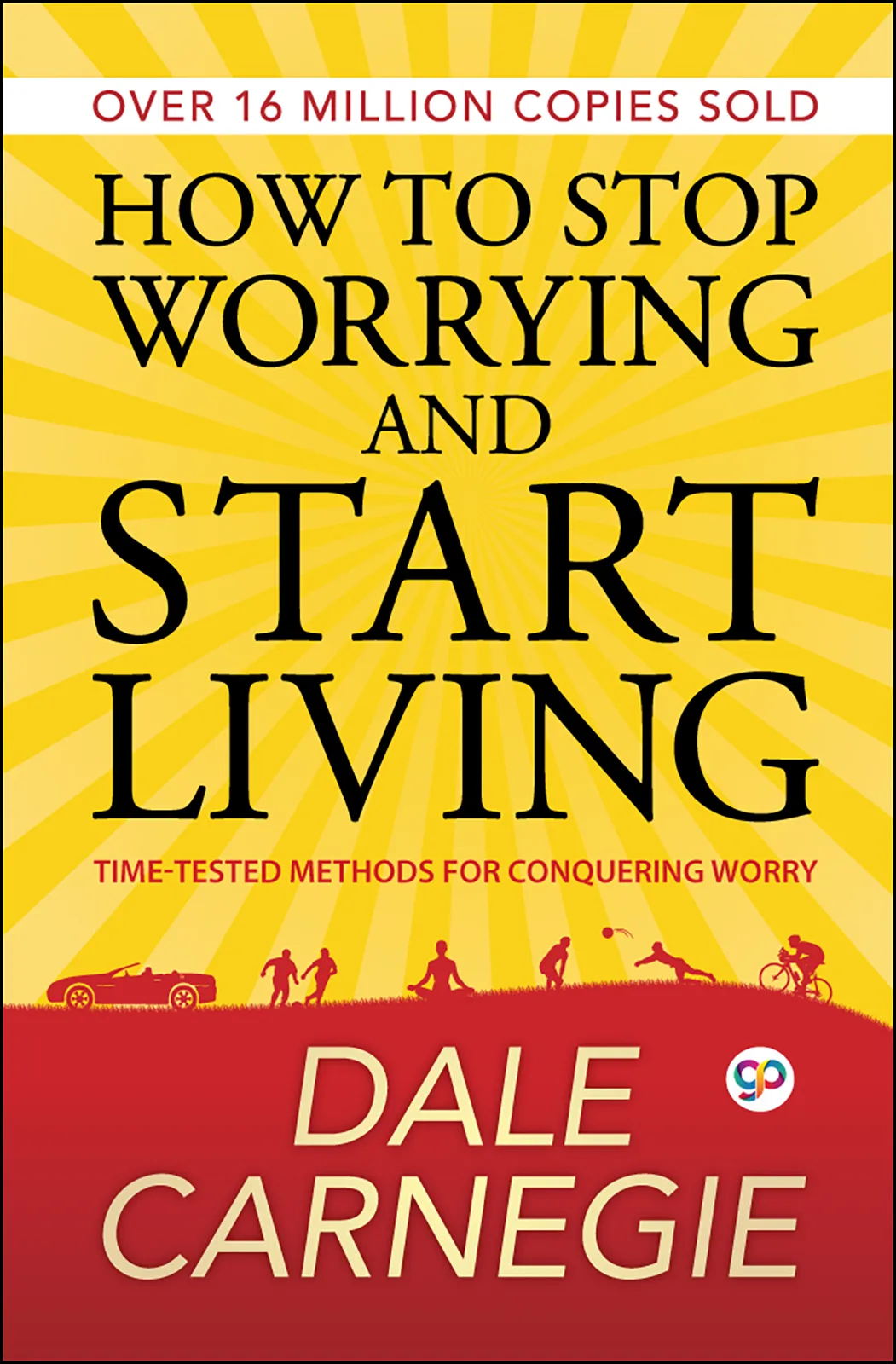
How to Stop Worrying and Start Living
Hardcover
• 320 Pages
• INR 495.00
• English
• 9789387669161
No ratings yet
| Publisher | General Press |
|---|---|
| ISBN13 | 9789387669161 |
| ASIN/SKU | 9387669165 |
| Book Format | Hardcover |
| Language | English |
| Pages | 320 |
| List Price | INR 495.00 |
| Subject Code | SEL030000, SEL027000, LAN032000 |
| Publishing Date | 03/02/2018 |
| Dimensions | 8.25 x 5.25 x 1.0 inches |
| Book Code | BD00068013 |
Buy this Book
Amazon Stores
Ebook Stores
Other Stores
Discover How to Stop Worrying and Start Living by Dale Carnegie. This book is published by General Press in Hardcover format, ISBN 9789387669161, ASIN 9387669165, under Self-Help, Personal Transformation, Motivational.
Book Description
What if you could break free from the constant cycle of fear, overthinking, and anxiety that steals the joy from everyday life? 'How to Stop Worrying and Start Living' by Dale Carnegie is a classic self-help and personal development book that offers practical, down-to-earth guidance for anyone who wants to worry less, think more clearly, and live with greater confidence and peace of mind.
Rather than presenting worry as something that can simply be switched off, Carnegie explores why people become trapped in anxious thoughts and how they can gradually change the way they respond to problems. Drawing on real-life experiences, stories, observations, and lessons from people who have faced difficult circumstances, he shows that much of our suffering comes not only from problems themselves but from the way we imagine, replay, and magnify them in our minds. His approach is reassuring because it focuses on simple actions that ordinary people can apply in daily life.
The book encourages readers to deal with problems one step at a time instead of becoming overwhelmed by everything that might go wrong. Carnegie explains the value of examining facts, making decisions, accepting what cannot be changed, and concentrating attention on the present moment. He also discusses how fear of criticism, fatigue, uncertainty, financial concerns, and difficult relationships can feed worry, while offering practical ways to develop a calmer and more constructive outlook.
At the heart of 'How to Stop Worrying and Start Living' is the idea that a fulfilling life is built through habits of thought and action. Carnegie does not promise a life without difficulties; instead, he teaches readers how to meet difficulties without allowing them to dominate their minds. His warm, conversational style makes the advice accessible, while the many examples give his ideas a human and relatable quality.
For readers searching for a timeless guide to overcoming worry, managing stress, building emotional resilience, and finding greater enjoyment in everyday life, this book remains remarkably relevant. Its message is simple but powerful: you may not be able to control everything that happens, but you can learn to change how you face it. The real question is whether Carnegie’s practical wisdom can help you reclaim the calm and confidence that worry has taken away.
Rather than presenting worry as something that can simply be switched off, Carnegie explores why people become trapped in anxious thoughts and how they can gradually change the way they respond to problems. Drawing on real-life experiences, stories, observations, and lessons from people who have faced difficult circumstances, he shows that much of our suffering comes not only from problems themselves but from the way we imagine, replay, and magnify them in our minds. His approach is reassuring because it focuses on simple actions that ordinary people can apply in daily life.
The book encourages readers to deal with problems one step at a time instead of becoming overwhelmed by everything that might go wrong. Carnegie explains the value of examining facts, making decisions, accepting what cannot be changed, and concentrating attention on the present moment. He also discusses how fear of criticism, fatigue, uncertainty, financial concerns, and difficult relationships can feed worry, while offering practical ways to develop a calmer and more constructive outlook.
At the heart of 'How to Stop Worrying and Start Living' is the idea that a fulfilling life is built through habits of thought and action. Carnegie does not promise a life without difficulties; instead, he teaches readers how to meet difficulties without allowing them to dominate their minds. His warm, conversational style makes the advice accessible, while the many examples give his ideas a human and relatable quality.
For readers searching for a timeless guide to overcoming worry, managing stress, building emotional resilience, and finding greater enjoyment in everyday life, this book remains remarkably relevant. Its message is simple but powerful: you may not be able to control everything that happens, but you can learn to change how you face it. The real question is whether Carnegie’s practical wisdom can help you reclaim the calm and confidence that worry has taken away.
Author Biography
Dale Carnegie (1888–1955) was a pioneering American writer, lecturer, and developer of world-renowned courses in self-improvement, salesmanship, corporate training, public speaking, and interpersonal skills. Born into poverty on a farm in Maryville, Missouri, Carnegie sought a way out of his early struggles through education. He attended State Teachers College in Warrensburg, where he discovered a profound natural talent for debate and public speaking. After graduating, he worked various rigorous sales jobs—including selling bacon, soap, and lard for Armour and Company—before moving to New York City to briefly pursue a career in acting.
In 1912, recognizing a widespread need among professionals for improved communication skills, Carnegie convinced a local YMCA manager to let him teach a public speaking class in exchange for a percentage of the proceeds. The class was a massive, immediate success, ultimately leading to the establishment of the Dale Carnegie Institute. His core teaching philosophy centered on the idea that success in business and life depends far more on one's ability to communicate effectively, build self-confidence, and interact positively with others than on purely technical knowledge.
Carnegie’s monumental breakthrough occurred in 1936 with the publication of How to Win Friends and Influence People. Originally intended merely as a supplemental textbook for his courses, the book became an unprecedented overnight sensation. It offered practical, highly accessible advice on handling people, winning them over to your way of thinking, and leading without arousing resentment. It has since sold tens of millions of copies worldwide, fundamentally shaping the modern self-help genre.
Carnegie later authored several other influential works, including How to Stop Worrying and Start Living (1948). His pragmatic wisdom, rooted in genuine appreciation and empathy for others, continues to transform lives, cementing his enduring legacy as a titan of personal development.
In 1912, recognizing a widespread need among professionals for improved communication skills, Carnegie convinced a local YMCA manager to let him teach a public speaking class in exchange for a percentage of the proceeds. The class was a massive, immediate success, ultimately leading to the establishment of the Dale Carnegie Institute. His core teaching philosophy centered on the idea that success in business and life depends far more on one's ability to communicate effectively, build self-confidence, and interact positively with others than on purely technical knowledge.
Carnegie’s monumental breakthrough occurred in 1936 with the publication of How to Win Friends and Influence People. Originally intended merely as a supplemental textbook for his courses, the book became an unprecedented overnight sensation. It offered practical, highly accessible advice on handling people, winning them over to your way of thinking, and leading without arousing resentment. It has since sold tens of millions of copies worldwide, fundamentally shaping the modern self-help genre.
Carnegie later authored several other influential works, including How to Stop Worrying and Start Living (1948). His pragmatic wisdom, rooted in genuine appreciation and empathy for others, continues to transform lives, cementing his enduring legacy as a titan of personal development.
Editorial Reviews
Editorial Reviews will be added soon…
Book Summary
Dale Carnegie’s How to Stop Worrying and Start Living is a practical guide to dealing with anxiety, fear, uncertainty, and the endless mental habits that prevent people from enjoying the present. First published in 1948, the book is built around a simple idea: worry rarely solves tomorrow’s problems, but it can easily destroy today’s peace. Carnegie does not promise a life without difficulties. Instead, he teaches readers how to face difficulties calmly, think more realistically, and develop habits that make worry less powerful.
The book begins by recognizing how common worry is. People worry about money, work, health, relationships, criticism, failure, and the future. Often, the actual problem is not the event itself but the mind’s repeated rehearsal of possible disasters. A person may spend hours imagining what could go wrong even though none of those things has happened.
Carnegie therefore encourages readers to develop a practical method for handling problems rather than allowing vague anxiety to dominate the mind.
Living in “Day-Tight Compartments”
One of Carnegie’s most memorable principles is the idea of living in “day-tight compartments.” He compares life to a ship divided into watertight compartments. When water enters one section, the entire ship does not necessarily have to sink. In the same way, people should learn to close off yesterday and tomorrow when necessary and concentrate on today.
The past cannot be changed, while the future cannot be completely controlled. The only part of life over which we have meaningful influence is the present moment. Carnegie therefore encourages readers to ask themselves: What can I do today?
This does not mean ignoring the future. Planning is sensible; worrying endlessly about the future is not. The distinction is between preparation and anxiety. Preparation leads to action. Worry often leads only to mental exhaustion.
Facing the Worst
When a problem causes intense anxiety, Carnegie recommends confronting it directly rather than avoiding it. First, a person should ask what the worst possible outcome would be. Then, if necessary, one should mentally accept that possibility. Finally, the person should calmly work toward improving the situation.
This method may sound pessimistic, but Carnegie believes it actually reduces fear. Uncertainty often makes anxiety worse. Once we identify the worst possibility, the mind has something definite to work with.
Acceptance also creates emotional distance. Instead of thinking, “This cannot happen,” a person can say, “If this happens, how will I respond?” The question shifts from helpless fear to practical problem-solving.
Analyzing Worry
Carnegie places great emphasis on systematic analysis. When something is troubling us, he suggests identifying the real facts of the situation. What exactly is the problem? What are the possible solutions? What action should be taken? Once a decision has been made, it is usually better to act rather than endlessly reconsider the same question.
This is important because worry often feeds on indecision. The mind keeps returning to the same problem because no clear course of action has been chosen.
Carnegie’s approach is therefore straightforward: gather the facts, consider the alternatives, make a decision, and move forward.
Avoiding Needless Worry
A large portion of the book deals with unnecessary worry. Carnegie observes that people often suffer not because of actual circumstances but because they exaggerate them mentally. Fear can magnify a small problem until it appears enormous.
He encourages readers to ask whether the issue will still matter months or years from now. This wider perspective can reduce the emotional intensity of temporary difficulties.
He also emphasizes accepting what cannot be changed. Some circumstances are outside our control. Fighting mentally against an unchangeable fact only creates additional suffering. Acceptance allows a person to redirect energy toward what can actually be influenced.
The Physical Side of Worry
Carnegie recognizes that worry affects the body as well as the mind. Constant tension can produce exhaustion, irritability, poor concentration, and other physical problems. He therefore recommends rest and relaxation as important parts of a healthy life.
He encourages people to develop habits that interrupt mental tension. Taking breaks, relaxing the body, changing one's environment, enjoying hobbies, and getting sufficient rest can all help prevent the mind from becoming trapped in repetitive anxious thinking.
Work itself can also be beneficial. Meaningful activity gives the mind something constructive to focus on and reduces the space available for unnecessary worry.
Dealing with Criticism
Another major source of worry is the fear of what other people think. Carnegie argues that criticism is unavoidable. Even if a person behaves well, someone will eventually disapprove.
Instead of trying to satisfy everyone, he encourages readers to develop inner confidence. Constructive criticism should be examined honestly, while unfair criticism should not be allowed to control one's emotions.
Carnegie also suggests that criticism can sometimes reveal useful information. Rather than reacting defensively, we can ask whether there is something to learn from it. This transforms criticism from a personal threat into an opportunity for improvement.
Developing a Positive Way of Living
Carnegie repeatedly emphasizes gratitude and appreciation. People who focus exclusively on what they lack can become trapped in dissatisfaction. Those who deliberately notice the good things in their lives are more likely to experience contentment.
He encourages readers to cultivate interests, help others, and become absorbed in meaningful activities. Self-centered worry often becomes weaker when attention is directed toward other people.
The book also encourages readers to avoid dwelling on resentment. Holding onto anger can keep a person psychologically tied to someone who may no longer even be thinking about the conflict. Forgiveness, in Carnegie’s framework, is partly an act of freeing oneself from unnecessary emotional burdens.
The Central Lesson
How to Stop Worrying and Start Living does not suggest that difficult circumstances can be eliminated. Instead, Carnegie teaches that our response to difficulty can be changed.
His philosophy is practical rather than abstract. When a problem appears, face the facts. Determine what can be done. Take action. Accept what cannot be changed. Then return your attention to the life that is happening now.
The deepest lesson of the book is that worry steals life in advance. We can spend today suffering over something that may never happen tomorrow. Carnegie wants readers to reverse that habit.
Life will always contain uncertainty, disappointment, loss, and difficult decisions. But it also contains friendship, work, beauty, laughter, learning, and countless ordinary moments that can easily be missed when the mind is consumed by fear.
Ultimately, Carnegie’s message is a simple invitation to live rather than merely anticipate living. The goal is not to become careless or indifferent, but to become practical, resilient, and present. We cannot control everything that happens to us, but we can learn to meet life one day at a time—with clearer thinking, purposeful action, acceptance, gratitude, and courage.
The book begins by recognizing how common worry is. People worry about money, work, health, relationships, criticism, failure, and the future. Often, the actual problem is not the event itself but the mind’s repeated rehearsal of possible disasters. A person may spend hours imagining what could go wrong even though none of those things has happened.
Carnegie therefore encourages readers to develop a practical method for handling problems rather than allowing vague anxiety to dominate the mind.
Living in “Day-Tight Compartments”
One of Carnegie’s most memorable principles is the idea of living in “day-tight compartments.” He compares life to a ship divided into watertight compartments. When water enters one section, the entire ship does not necessarily have to sink. In the same way, people should learn to close off yesterday and tomorrow when necessary and concentrate on today.
The past cannot be changed, while the future cannot be completely controlled. The only part of life over which we have meaningful influence is the present moment. Carnegie therefore encourages readers to ask themselves: What can I do today?
This does not mean ignoring the future. Planning is sensible; worrying endlessly about the future is not. The distinction is between preparation and anxiety. Preparation leads to action. Worry often leads only to mental exhaustion.
Facing the Worst
When a problem causes intense anxiety, Carnegie recommends confronting it directly rather than avoiding it. First, a person should ask what the worst possible outcome would be. Then, if necessary, one should mentally accept that possibility. Finally, the person should calmly work toward improving the situation.
This method may sound pessimistic, but Carnegie believes it actually reduces fear. Uncertainty often makes anxiety worse. Once we identify the worst possibility, the mind has something definite to work with.
Acceptance also creates emotional distance. Instead of thinking, “This cannot happen,” a person can say, “If this happens, how will I respond?” The question shifts from helpless fear to practical problem-solving.
Analyzing Worry
Carnegie places great emphasis on systematic analysis. When something is troubling us, he suggests identifying the real facts of the situation. What exactly is the problem? What are the possible solutions? What action should be taken? Once a decision has been made, it is usually better to act rather than endlessly reconsider the same question.
This is important because worry often feeds on indecision. The mind keeps returning to the same problem because no clear course of action has been chosen.
Carnegie’s approach is therefore straightforward: gather the facts, consider the alternatives, make a decision, and move forward.
Avoiding Needless Worry
A large portion of the book deals with unnecessary worry. Carnegie observes that people often suffer not because of actual circumstances but because they exaggerate them mentally. Fear can magnify a small problem until it appears enormous.
He encourages readers to ask whether the issue will still matter months or years from now. This wider perspective can reduce the emotional intensity of temporary difficulties.
He also emphasizes accepting what cannot be changed. Some circumstances are outside our control. Fighting mentally against an unchangeable fact only creates additional suffering. Acceptance allows a person to redirect energy toward what can actually be influenced.
The Physical Side of Worry
Carnegie recognizes that worry affects the body as well as the mind. Constant tension can produce exhaustion, irritability, poor concentration, and other physical problems. He therefore recommends rest and relaxation as important parts of a healthy life.
He encourages people to develop habits that interrupt mental tension. Taking breaks, relaxing the body, changing one's environment, enjoying hobbies, and getting sufficient rest can all help prevent the mind from becoming trapped in repetitive anxious thinking.
Work itself can also be beneficial. Meaningful activity gives the mind something constructive to focus on and reduces the space available for unnecessary worry.
Dealing with Criticism
Another major source of worry is the fear of what other people think. Carnegie argues that criticism is unavoidable. Even if a person behaves well, someone will eventually disapprove.
Instead of trying to satisfy everyone, he encourages readers to develop inner confidence. Constructive criticism should be examined honestly, while unfair criticism should not be allowed to control one's emotions.
Carnegie also suggests that criticism can sometimes reveal useful information. Rather than reacting defensively, we can ask whether there is something to learn from it. This transforms criticism from a personal threat into an opportunity for improvement.
Developing a Positive Way of Living
Carnegie repeatedly emphasizes gratitude and appreciation. People who focus exclusively on what they lack can become trapped in dissatisfaction. Those who deliberately notice the good things in their lives are more likely to experience contentment.
He encourages readers to cultivate interests, help others, and become absorbed in meaningful activities. Self-centered worry often becomes weaker when attention is directed toward other people.
The book also encourages readers to avoid dwelling on resentment. Holding onto anger can keep a person psychologically tied to someone who may no longer even be thinking about the conflict. Forgiveness, in Carnegie’s framework, is partly an act of freeing oneself from unnecessary emotional burdens.
The Central Lesson
How to Stop Worrying and Start Living does not suggest that difficult circumstances can be eliminated. Instead, Carnegie teaches that our response to difficulty can be changed.
His philosophy is practical rather than abstract. When a problem appears, face the facts. Determine what can be done. Take action. Accept what cannot be changed. Then return your attention to the life that is happening now.
The deepest lesson of the book is that worry steals life in advance. We can spend today suffering over something that may never happen tomorrow. Carnegie wants readers to reverse that habit.
Life will always contain uncertainty, disappointment, loss, and difficult decisions. But it also contains friendship, work, beauty, laughter, learning, and countless ordinary moments that can easily be missed when the mind is consumed by fear.
Ultimately, Carnegie’s message is a simple invitation to live rather than merely anticipate living. The goal is not to become careless or indifferent, but to become practical, resilient, and present. We cannot control everything that happens to us, but we can learn to meet life one day at a time—with clearer thinking, purposeful action, acceptance, gratitude, and courage.
Sample Chapters
Part One : Fundamental Facts You Should Know About Worry
Chapter 1 : Live in “Day-Tight Compartments”
In the spring of 1871, a young man picked up a book and read twenty-one words that had a profound effect on his future. A medical student at the Montreal General Hospital, he was worried about passing the final examination, worried about what to do, where to go, how to build up a practice, how to make a living.
The twenty-one words that this young medical student read in 1871 helped him to become the most famous physician of his generation. He organised the world-famous Johns Hopkins School of Medicine. He became Regius Professor of Medicine at Oxford—the highest honor that can be bestowed upon any medical man in the British Empire. He was knighted by the King of England. When he died, two huge volumes containing 1,466 pages were required to tell the story of his life.
His name was Sir William Osier. Here are the twenty-one words that he read in the spring of 1871—twenty-one words from Thomas Carlyle that helped him lead a life free from worry: “Our main business is not to see what lies dimly at a distance, but to do what lies clearly at hand.”
Forty-two years later, on a soft spring night when the tulips were blooming on the campus, this man, Sir William Osier, addressed the students of Yale University. He told those Yale students that a man like himself who had been a professor in four universities and had written a popular book was supposed to have “brains of a special quality”. He declared that that was untrue. He said that his intimate friends knew that his brains were “of the most mediocre character”.
What, then, was the secret of his success? He stated that it was owing to what he called living in “day-tight compartments.” What did he mean by that? A few months before he spoke at Yale, Sir William Osier had crossed the Atlantic on a great ocean liner where the captain standing on the bridge, could press a button and—presto!—There was a clanging of machinery and various parts of the ship were immediately shut off from one another—shut off into watertight compartments. “Now each one of you,” Dr. Osier said to those Yale students, “is a much more marvelous organisation than the great liner, and bound on a longer voyage. What I urge is that you so learn to control the machinery as to live with ‘day-tight compartments’ as the most certain way to ensure safety on the voyage. Get on the bridge, and see that at least the great bulkheads are in working order. Touch a button and hear, at every level of your life, the iron doors shutting out the Past—the dead yesterdays. Touch another and shut off, with a metal curtain, the Future—the unborn tomorrows. Then you are safe—safe for today! … Shut off the past! Let the dead past bury its dead … Shut out the yesterdays which have lighted fools the way to dusty death … The load of tomorrow, added to that of yesterday, carried today, makes the strongest falter. Shut off the future as tightly as the past … The future is today … There is no tomorrow. The day of man’s salvation is now. Waste of energy, mental distress, nervous worries dog the steps of a man who is anxious about the future … Shut close, then the great fore and aft bulkheads, and prepare to cultivate the habit of life of ‘day-tight compartments’.”
Did Dr. Osier mean to say that we should not make any effort to prepare for tomorrow? No. Not at all. But he did go on in that address to say that the best possible way to prepare for tomorrow is to concentrate with all your intelligence, all your enthusiasm, on doing today’s work superbly today. That is the only possible way you can prepare for the future.
Sir William Osier urged the students at Yale to begin the day with Christ’s prayer: “Give us this day our daily bread.”
Remember that that prayer asks only for today’s bread. It doesn’t complain about the stale bread we had to eat yesterday; and it doesn’t say: “Oh, God, it has been pretty dry out in the wheat belt lately and we may have another drought—and then how will I get bread to eat next autumn—or suppose I lose my job—oh, God, how could I get bread then?”
No, this prayer teaches us to ask for today’s bread only. Today’s bread is the only kind of bread you can possibly eat.
Years ago, a penniless philosopher was wandering through a stony country where the people had a hard time making a living. One day a crowd gathered about him on a hill, and he gave what is probably the most—quoted speech ever delivered anywhere at any time. This speech contains twenty-six words that have gone ringing down across the centuries: “Take therefore no thought for the morrow; for the morrow shall take thought for the things of itself. Sufficient unto the day is the evil thereof.”
Many men have rejected those words of Jesus: “Take no thought for the morrow.” They have rejected those words as a counsel of perfection, as a bit of Oriental mysticism. “I must take thought for the morrow,” they say. “I must take out insurance to protect my family. I must lay aside money for my old age. I must plan and prepare to get ahead.”
Right! Of course you must. The truth is that those words of Jesus, translated over three hundred years ago, don’t mean today what they meant during the reign of King James. Three hundred years ago the word thought frequently meant anxiety. Modern versions of the Bible quote Jesus more accurately as saying: “Have no anxiety for the tomorrow.”
By all means take thought for the tomorrow, yes, careful thought and planning and preparation. But have no anxiety.
During the war, our military leaders planned for the morrow, but they could not afford to have any anxiety. “I have supplied the best men with the best equipment we have,” said Admiral Ernest J. King, who directed the United States Navy, “and have given them what seems to be the wisest mission. That is all I can do.”
“If a ship has been sunk,” Admiral King went on, “I can’t bring it up. If it is going to be sunk, I can’t stop it. I can use my time much better working on tomorrow’s problem than by fretting about yesterday’s. Besides, if I let those things get me, I wouldn’t last long.”
Whether in war or peace, the chief difference between good thinking and bad thinking is this: good thinking deals with causes and effects and leads to logical, constructive planning; bad thinking frequently leads to tension and nervous breakdowns.
I recently had the privilege of interviewing Arthur Hays Sulzberger, publisher of one of the most famous newspapers in the world, The New York Times. Mr. Sulzberger told me that when the Second World War flamed across Europe, he was so stunned, so worried about the future, that he found it almost impossible to sleep. He would frequently get out of bed in the middle of the night, take some canvas and tubes of paint, look in the mirror, and try to paint a portrait of himself. He didn’t know anything about painting, but he painted anyway, to get his mind off his worries. Mr. Sulzberger told me that he was never able to banish his worries and find peace until he had adopted as his motto five words from a church hymn: One step enough for me.
Lead, kindly Light…
Keep thou my feet: I do not ask to see
The distant scene; one step enough for me.
At about the same time, a young man in uniform—somewhere in Europe—was learning the same lesson. His name was Ted Bengermino, of 5716 Newholme Road, Baltimore, Maryland—and he had worried himself into a first-class case of combat fatigue.
“In April, 1945,” writes Ted Bengermino, “I had worried until I had developed what doctors call a ‘spasmodic transverse colon’—a condition that produced intense pain. If the war hadn’t ended when it did, I am sure I would have had a complete physical breakdown.
“I was utterly exhausted. I was a Graves Registration, Noncommissioned Officer for the 94th Infantry Division. My work was to help set up and maintain records of all men killed in action, missing in action, and hospitalised. I also had to help disinter the bodies of both Allied and enemy soldiers who had been killed and hastily buried in shallow graves during the pitch of battle. I had to gather up the personal effects of these men and see that they were sent back to parents or closest relatives who would prize these personal effects so much. I was constantly worried for fear we might be making embarrassing and serious mistakes. I was worried about whether or not I would come through all this. I was worried about whether I would live to hold my only child in my arms—a son of sixteen months, whom I had never seen. I was so worried and exhausted that I lost thirty-four pounds. I was so frantic that I was almost out of my mind. I looked at my hands. They were hardly more than skin and bones. I was terrified at the thought of going home a physical wreck. I broke down and sobbed like a child. I was so shaken that tears welled up every time I was alone. There was one period soon after the Battle of the Bulge started that I wept so often that I almost gave up hope of ever being a normal human being again.
“I ended up in an Army dispensary. An Army doctor gave me some advice which has completely changed my life. After giving me a thorough physical examination, he informed me that my troubles were mental. ‘Ted’, he said, ‘I want you to think of your life as an hourglass. You know there are thousands of grains of sand in the top of the hourglass; and they all pass slowly and evenly through the narrow neck in the middle. Nothing you or I could do would make more than one grain of sand pass through this narrow neck without impairing the hourglass. You and I and everyone else are like this hourglass. When we start in the morning, there are hundreds of tasks which we feel that we must accomplish that day, but if we do not take them one at a time and let them pass through the day slowly and evenly, as do the grains of sand passing through the narrow neck of the hourglass, then we are bound to break our own physical or mental structure.’
“I have practised that philosophy ever since that memorable day that an Army doctor gave it to me. ‘One grain of sand at a time … One task at a time.’ That advice saved me physically and mentally during the war; and it has also helped me in my present position in business. I am a Stock Control Clerk for the Commercial Credit Company in Baltimore. I found the same problems arising in business that had arisen during the war: a score of things had to be done at once—and there was little time to do them. We were low in stocks. We had new forms to handle, new stock arrangements, changes of address, opening and closing offices, and so on. Instead of getting taut and nervous, I remembered what the doctor had told me.
‘One grain of sand at a time. One task at a time.’ By repeating those words to myself over and over, I accomplished my tasks in a more efficient manner and I did my work without the confused and jumbled feeling that had almost wrecked me on the battlefield.” One of the most appalling comments on our present way of life is that half of all the beds in our hospitals are reserved for patients with nervous and mental troubles, patients who have collapsed under the crushing burden of accumulated yesterdays and fearful tomorrows. Yet a vast majority of those people would be walking the streets today, leading happy, useful lives, if they had only heeded the words of Jesus: “Have no anxiety about the morrow”; or the words of Sir William Osier: “Live in day-tight compartments.”
You and I are standing this very second at the meeting-place of two eternities: the vast past that has endured forever, and the future that is plunging on to the last syllable of recorded time. We can’t possibly live in either of those eternities—no, not even for one split second. But, by trying to do so, we can wreck both our bodies and our minds. So let’s be content to live the only time we can possibly live: from now until bedtime. “Anyone can carry his burden, however hard, until nightfall,” wrote Robert Louis Stevenson. “Anyone can do his work, however hard, for one day. Anyone can live sweetly, patiently, lovingly, purely, till the sun goes down. And this is all that life really means.”
Yes, that is all that life requires of us; but Mrs. E. K. Shields, 815, Court Street, Saginaw, Michigan, was driven to despair—even to the brink of suicide—before she learned to live just till bedtime. “In 1937, I lost my husband,” Mrs. Shields said as she told me her story. “I was very depressed—and almost penniless. I wrote my former employer, Mr. Leon Roach, of the Roach-Fowler Company of Kansas City, and got my old job back. I had formerly made my living selling books to rural and town school boards. I had sold my car two years previously when my husband became ill; but I managed to scrape together enough money to put a down payment on a used car and started out to sell books again.
“I had thought that getting back on the road would help relieve my depression; but driving alone and eating alone was almost more than I could take. Some of the territory was not very productive, and I found it hard to make those car payments, small as they were.
“In the spring of 1938, I was working out from Versailles, Missouri. The schools were poor; the roads bad; I was so lonely and discouraged that at one time I even considered suicide. It seemed that success was impossible. I had nothing to live for. I dreaded getting up each morning and facing life. I was afraid of everything: afraid I could not meet the car payments; afraid I could not pay my room rent; afraid I would not have enough to eat. I was afraid my health was failing and I had no money for a doctor. All that kept me from suicide were the thoughts that my sister would be deeply grieved, and that I did not have enough money to pay my funeral expenses.
“Then one day I read an article that lifted me out of my despondence and gave me the courage to go on living. I shall never cease to be grateful for one inspiring sentence in that article. It said: ‘Every day is a new life to a wise man.’ I typed that sentence out and pasted it on the windshield of my car, where I saw it every minute I was driving. I found it wasn’t so hard to live only one day at a time. I learned to forget the yesterdays and to not-think of the tomorrows. Each morning I said to myself: ‘Today is a new life.’
“I have succeeded in overcoming my fear of loneliness, my fear of want. I am happy and fairly successful now and have a lot of enthusiasm and love for life. I know now that I shall never again be afraid, regardless of what life hands me. I know now that I don’t have to fear the future. I know now that I can live one day at a time—and that ‘Every day is a new life to a wise man.’”
Who do you suppose wrote this verse:
Happy the man, and happy he alone,
He, who can call today his own:
He who, secure within, can say:
“Tomorrow, do thy worst, for I have liv’d today.”
Those words sound modern, don’t they? Yet they were written thirty years before Christ was born, by the Roman poet Horace.
One of the most tragic things I know about human nature is that all of us tend to put off living. We are all dreaming of some magical rose garden over the horizon—instead of enjoying the roses that are blooming outside our windows today.
Why are we such fools—such tragic fools?
“How strange it is, our little procession of life!” wrote Stephen Leacock. “The child says: ‘When I am a big boy.’ But what is that? The big boy says: ‘When I grow up.’ And then, grown up, he says: ‘When I get married.’ But to be married, what is that after all? The thought changes to ‘When I’m able to retire.’ And then, when retirement comes, he looks back over the landscape traversed; a cold wind seems to sweep over it; somehow he has missed it all, and it is gone. Life, we learn too late, is in the living, in the tissue of every day and hour.”
The late Edward S. Evans of Detroit almost killed himself with worry before he learned that life “is in the living, in the tissue of every day and hour.” Brought up in poverty, Edward Evans made his first money by selling newspapers, then worked as a grocer’s clerk. Later, with seven people dependent upon him for bread and butter, he got a job as an assistant librarian. Small as the pay was, he was afraid to quit. Eight years passed before he could summon up the courage to start out on his own. But once he started, he built up an original investment of fifty-five borrowed dollars into a business of his own that made him twenty thousand dollars a year. Then came a frost, a killing frost. He endorsed a big note for a friend—and the friend went bankrupt. Quickly on top of that disaster came another: the bank in which he had all his money collapsed. He not only lost every cent he had, but was plunged into debt for sixteen thousand dollars. His nerves couldn’t take it. “I couldn’t sleep or eat,” he told me. “I became strangely ill. Worry and nothing but worry,” he said, “brought on this illness. One day as I was walking down the street, I fainted and fell on the sidewalk. I was no longer able to walk. I was put to bed and my body broke out in boils. These boils turned inward until just lying in bed was agony. I grew weaker every day. Finally my doctor told me that I had only two more weeks to live. I was shocked. I drew up my will, and then lay back in bed to await my end. No use now to struggle or worry. I gave up, relaxed, and went to sleep. I hadn’t slept two hours in succession for weeks; but now with my earthly problems drawing to an end, I slept like a baby. My exhausting weariness began to disappear. My appetite returned. I gained weight.
“A few weeks later, I was able to walk with crutches. Six weeks later, I was able to go back to work. I had been making twenty thousand dollars a year; but I was glad now to get a job for thirty dollars a week. I got a job selling blocks to put behind the wheels of automobiles when they are shipped by freight. I had learned my lesson now. No more worry for me—no more regret about what had happened in the past—no more dread of the future. I concentrated all my time, energy, and enthusiasm into selling those blocks.”
Edward S. Evans shot up fast now. In a few years, he was president of the company. His company—the Evans Product Company—has been listed on the New York Stock Exchange for years. When Edward S. Evans died in 1945, he was one of the most progressive business men in the United States. If you ever fly over Greenland, you may land on Evans Field—a flying-field named in his honour. Here is the point of the story: Edward S. Evans would never have had the thrill of achieving these victories in business and in living if he hadn’t seen the folly of worrying-if he hadn’t learned to live in day-tight compartments.
Five hundred years before Christ was born, the Greek philosopher Heraclitus told his students that “everything changes except the law of change”. He said: “You cannot step in the same river twice.” The river changes every second; and so does the man who stepped in it. Life is a ceaseless change. The only certainty is today. Why mar the beauty of living today by trying to solve the problems of a future that is shrouded in ceaseless change and uncertainty-a future that no one can possibly foretell?
Chapter 1 : Live in “Day-Tight Compartments”
In the spring of 1871, a young man picked up a book and read twenty-one words that had a profound effect on his future. A medical student at the Montreal General Hospital, he was worried about passing the final examination, worried about what to do, where to go, how to build up a practice, how to make a living.
The twenty-one words that this young medical student read in 1871 helped him to become the most famous physician of his generation. He organised the world-famous Johns Hopkins School of Medicine. He became Regius Professor of Medicine at Oxford—the highest honor that can be bestowed upon any medical man in the British Empire. He was knighted by the King of England. When he died, two huge volumes containing 1,466 pages were required to tell the story of his life.
His name was Sir William Osier. Here are the twenty-one words that he read in the spring of 1871—twenty-one words from Thomas Carlyle that helped him lead a life free from worry: “Our main business is not to see what lies dimly at a distance, but to do what lies clearly at hand.”
Forty-two years later, on a soft spring night when the tulips were blooming on the campus, this man, Sir William Osier, addressed the students of Yale University. He told those Yale students that a man like himself who had been a professor in four universities and had written a popular book was supposed to have “brains of a special quality”. He declared that that was untrue. He said that his intimate friends knew that his brains were “of the most mediocre character”.
What, then, was the secret of his success? He stated that it was owing to what he called living in “day-tight compartments.” What did he mean by that? A few months before he spoke at Yale, Sir William Osier had crossed the Atlantic on a great ocean liner where the captain standing on the bridge, could press a button and—presto!—There was a clanging of machinery and various parts of the ship were immediately shut off from one another—shut off into watertight compartments. “Now each one of you,” Dr. Osier said to those Yale students, “is a much more marvelous organisation than the great liner, and bound on a longer voyage. What I urge is that you so learn to control the machinery as to live with ‘day-tight compartments’ as the most certain way to ensure safety on the voyage. Get on the bridge, and see that at least the great bulkheads are in working order. Touch a button and hear, at every level of your life, the iron doors shutting out the Past—the dead yesterdays. Touch another and shut off, with a metal curtain, the Future—the unborn tomorrows. Then you are safe—safe for today! … Shut off the past! Let the dead past bury its dead … Shut out the yesterdays which have lighted fools the way to dusty death … The load of tomorrow, added to that of yesterday, carried today, makes the strongest falter. Shut off the future as tightly as the past … The future is today … There is no tomorrow. The day of man’s salvation is now. Waste of energy, mental distress, nervous worries dog the steps of a man who is anxious about the future … Shut close, then the great fore and aft bulkheads, and prepare to cultivate the habit of life of ‘day-tight compartments’.”
Did Dr. Osier mean to say that we should not make any effort to prepare for tomorrow? No. Not at all. But he did go on in that address to say that the best possible way to prepare for tomorrow is to concentrate with all your intelligence, all your enthusiasm, on doing today’s work superbly today. That is the only possible way you can prepare for the future.
Sir William Osier urged the students at Yale to begin the day with Christ’s prayer: “Give us this day our daily bread.”
Remember that that prayer asks only for today’s bread. It doesn’t complain about the stale bread we had to eat yesterday; and it doesn’t say: “Oh, God, it has been pretty dry out in the wheat belt lately and we may have another drought—and then how will I get bread to eat next autumn—or suppose I lose my job—oh, God, how could I get bread then?”
No, this prayer teaches us to ask for today’s bread only. Today’s bread is the only kind of bread you can possibly eat.
Years ago, a penniless philosopher was wandering through a stony country where the people had a hard time making a living. One day a crowd gathered about him on a hill, and he gave what is probably the most—quoted speech ever delivered anywhere at any time. This speech contains twenty-six words that have gone ringing down across the centuries: “Take therefore no thought for the morrow; for the morrow shall take thought for the things of itself. Sufficient unto the day is the evil thereof.”
Many men have rejected those words of Jesus: “Take no thought for the morrow.” They have rejected those words as a counsel of perfection, as a bit of Oriental mysticism. “I must take thought for the morrow,” they say. “I must take out insurance to protect my family. I must lay aside money for my old age. I must plan and prepare to get ahead.”
Right! Of course you must. The truth is that those words of Jesus, translated over three hundred years ago, don’t mean today what they meant during the reign of King James. Three hundred years ago the word thought frequently meant anxiety. Modern versions of the Bible quote Jesus more accurately as saying: “Have no anxiety for the tomorrow.”
By all means take thought for the tomorrow, yes, careful thought and planning and preparation. But have no anxiety.
During the war, our military leaders planned for the morrow, but they could not afford to have any anxiety. “I have supplied the best men with the best equipment we have,” said Admiral Ernest J. King, who directed the United States Navy, “and have given them what seems to be the wisest mission. That is all I can do.”
“If a ship has been sunk,” Admiral King went on, “I can’t bring it up. If it is going to be sunk, I can’t stop it. I can use my time much better working on tomorrow’s problem than by fretting about yesterday’s. Besides, if I let those things get me, I wouldn’t last long.”
Whether in war or peace, the chief difference between good thinking and bad thinking is this: good thinking deals with causes and effects and leads to logical, constructive planning; bad thinking frequently leads to tension and nervous breakdowns.
I recently had the privilege of interviewing Arthur Hays Sulzberger, publisher of one of the most famous newspapers in the world, The New York Times. Mr. Sulzberger told me that when the Second World War flamed across Europe, he was so stunned, so worried about the future, that he found it almost impossible to sleep. He would frequently get out of bed in the middle of the night, take some canvas and tubes of paint, look in the mirror, and try to paint a portrait of himself. He didn’t know anything about painting, but he painted anyway, to get his mind off his worries. Mr. Sulzberger told me that he was never able to banish his worries and find peace until he had adopted as his motto five words from a church hymn: One step enough for me.
Lead, kindly Light…
Keep thou my feet: I do not ask to see
The distant scene; one step enough for me.
At about the same time, a young man in uniform—somewhere in Europe—was learning the same lesson. His name was Ted Bengermino, of 5716 Newholme Road, Baltimore, Maryland—and he had worried himself into a first-class case of combat fatigue.
“In April, 1945,” writes Ted Bengermino, “I had worried until I had developed what doctors call a ‘spasmodic transverse colon’—a condition that produced intense pain. If the war hadn’t ended when it did, I am sure I would have had a complete physical breakdown.
“I was utterly exhausted. I was a Graves Registration, Noncommissioned Officer for the 94th Infantry Division. My work was to help set up and maintain records of all men killed in action, missing in action, and hospitalised. I also had to help disinter the bodies of both Allied and enemy soldiers who had been killed and hastily buried in shallow graves during the pitch of battle. I had to gather up the personal effects of these men and see that they were sent back to parents or closest relatives who would prize these personal effects so much. I was constantly worried for fear we might be making embarrassing and serious mistakes. I was worried about whether or not I would come through all this. I was worried about whether I would live to hold my only child in my arms—a son of sixteen months, whom I had never seen. I was so worried and exhausted that I lost thirty-four pounds. I was so frantic that I was almost out of my mind. I looked at my hands. They were hardly more than skin and bones. I was terrified at the thought of going home a physical wreck. I broke down and sobbed like a child. I was so shaken that tears welled up every time I was alone. There was one period soon after the Battle of the Bulge started that I wept so often that I almost gave up hope of ever being a normal human being again.
“I ended up in an Army dispensary. An Army doctor gave me some advice which has completely changed my life. After giving me a thorough physical examination, he informed me that my troubles were mental. ‘Ted’, he said, ‘I want you to think of your life as an hourglass. You know there are thousands of grains of sand in the top of the hourglass; and they all pass slowly and evenly through the narrow neck in the middle. Nothing you or I could do would make more than one grain of sand pass through this narrow neck without impairing the hourglass. You and I and everyone else are like this hourglass. When we start in the morning, there are hundreds of tasks which we feel that we must accomplish that day, but if we do not take them one at a time and let them pass through the day slowly and evenly, as do the grains of sand passing through the narrow neck of the hourglass, then we are bound to break our own physical or mental structure.’
“I have practised that philosophy ever since that memorable day that an Army doctor gave it to me. ‘One grain of sand at a time … One task at a time.’ That advice saved me physically and mentally during the war; and it has also helped me in my present position in business. I am a Stock Control Clerk for the Commercial Credit Company in Baltimore. I found the same problems arising in business that had arisen during the war: a score of things had to be done at once—and there was little time to do them. We were low in stocks. We had new forms to handle, new stock arrangements, changes of address, opening and closing offices, and so on. Instead of getting taut and nervous, I remembered what the doctor had told me.
‘One grain of sand at a time. One task at a time.’ By repeating those words to myself over and over, I accomplished my tasks in a more efficient manner and I did my work without the confused and jumbled feeling that had almost wrecked me on the battlefield.” One of the most appalling comments on our present way of life is that half of all the beds in our hospitals are reserved for patients with nervous and mental troubles, patients who have collapsed under the crushing burden of accumulated yesterdays and fearful tomorrows. Yet a vast majority of those people would be walking the streets today, leading happy, useful lives, if they had only heeded the words of Jesus: “Have no anxiety about the morrow”; or the words of Sir William Osier: “Live in day-tight compartments.”
You and I are standing this very second at the meeting-place of two eternities: the vast past that has endured forever, and the future that is plunging on to the last syllable of recorded time. We can’t possibly live in either of those eternities—no, not even for one split second. But, by trying to do so, we can wreck both our bodies and our minds. So let’s be content to live the only time we can possibly live: from now until bedtime. “Anyone can carry his burden, however hard, until nightfall,” wrote Robert Louis Stevenson. “Anyone can do his work, however hard, for one day. Anyone can live sweetly, patiently, lovingly, purely, till the sun goes down. And this is all that life really means.”
Yes, that is all that life requires of us; but Mrs. E. K. Shields, 815, Court Street, Saginaw, Michigan, was driven to despair—even to the brink of suicide—before she learned to live just till bedtime. “In 1937, I lost my husband,” Mrs. Shields said as she told me her story. “I was very depressed—and almost penniless. I wrote my former employer, Mr. Leon Roach, of the Roach-Fowler Company of Kansas City, and got my old job back. I had formerly made my living selling books to rural and town school boards. I had sold my car two years previously when my husband became ill; but I managed to scrape together enough money to put a down payment on a used car and started out to sell books again.
“I had thought that getting back on the road would help relieve my depression; but driving alone and eating alone was almost more than I could take. Some of the territory was not very productive, and I found it hard to make those car payments, small as they were.
“In the spring of 1938, I was working out from Versailles, Missouri. The schools were poor; the roads bad; I was so lonely and discouraged that at one time I even considered suicide. It seemed that success was impossible. I had nothing to live for. I dreaded getting up each morning and facing life. I was afraid of everything: afraid I could not meet the car payments; afraid I could not pay my room rent; afraid I would not have enough to eat. I was afraid my health was failing and I had no money for a doctor. All that kept me from suicide were the thoughts that my sister would be deeply grieved, and that I did not have enough money to pay my funeral expenses.
“Then one day I read an article that lifted me out of my despondence and gave me the courage to go on living. I shall never cease to be grateful for one inspiring sentence in that article. It said: ‘Every day is a new life to a wise man.’ I typed that sentence out and pasted it on the windshield of my car, where I saw it every minute I was driving. I found it wasn’t so hard to live only one day at a time. I learned to forget the yesterdays and to not-think of the tomorrows. Each morning I said to myself: ‘Today is a new life.’
“I have succeeded in overcoming my fear of loneliness, my fear of want. I am happy and fairly successful now and have a lot of enthusiasm and love for life. I know now that I shall never again be afraid, regardless of what life hands me. I know now that I don’t have to fear the future. I know now that I can live one day at a time—and that ‘Every day is a new life to a wise man.’”
Who do you suppose wrote this verse:
Happy the man, and happy he alone,
He, who can call today his own:
He who, secure within, can say:
“Tomorrow, do thy worst, for I have liv’d today.”
Those words sound modern, don’t they? Yet they were written thirty years before Christ was born, by the Roman poet Horace.
One of the most tragic things I know about human nature is that all of us tend to put off living. We are all dreaming of some magical rose garden over the horizon—instead of enjoying the roses that are blooming outside our windows today.
Why are we such fools—such tragic fools?
“How strange it is, our little procession of life!” wrote Stephen Leacock. “The child says: ‘When I am a big boy.’ But what is that? The big boy says: ‘When I grow up.’ And then, grown up, he says: ‘When I get married.’ But to be married, what is that after all? The thought changes to ‘When I’m able to retire.’ And then, when retirement comes, he looks back over the landscape traversed; a cold wind seems to sweep over it; somehow he has missed it all, and it is gone. Life, we learn too late, is in the living, in the tissue of every day and hour.”
The late Edward S. Evans of Detroit almost killed himself with worry before he learned that life “is in the living, in the tissue of every day and hour.” Brought up in poverty, Edward Evans made his first money by selling newspapers, then worked as a grocer’s clerk. Later, with seven people dependent upon him for bread and butter, he got a job as an assistant librarian. Small as the pay was, he was afraid to quit. Eight years passed before he could summon up the courage to start out on his own. But once he started, he built up an original investment of fifty-five borrowed dollars into a business of his own that made him twenty thousand dollars a year. Then came a frost, a killing frost. He endorsed a big note for a friend—and the friend went bankrupt. Quickly on top of that disaster came another: the bank in which he had all his money collapsed. He not only lost every cent he had, but was plunged into debt for sixteen thousand dollars. His nerves couldn’t take it. “I couldn’t sleep or eat,” he told me. “I became strangely ill. Worry and nothing but worry,” he said, “brought on this illness. One day as I was walking down the street, I fainted and fell on the sidewalk. I was no longer able to walk. I was put to bed and my body broke out in boils. These boils turned inward until just lying in bed was agony. I grew weaker every day. Finally my doctor told me that I had only two more weeks to live. I was shocked. I drew up my will, and then lay back in bed to await my end. No use now to struggle or worry. I gave up, relaxed, and went to sleep. I hadn’t slept two hours in succession for weeks; but now with my earthly problems drawing to an end, I slept like a baby. My exhausting weariness began to disappear. My appetite returned. I gained weight.
“A few weeks later, I was able to walk with crutches. Six weeks later, I was able to go back to work. I had been making twenty thousand dollars a year; but I was glad now to get a job for thirty dollars a week. I got a job selling blocks to put behind the wheels of automobiles when they are shipped by freight. I had learned my lesson now. No more worry for me—no more regret about what had happened in the past—no more dread of the future. I concentrated all my time, energy, and enthusiasm into selling those blocks.”
Edward S. Evans shot up fast now. In a few years, he was president of the company. His company—the Evans Product Company—has been listed on the New York Stock Exchange for years. When Edward S. Evans died in 1945, he was one of the most progressive business men in the United States. If you ever fly over Greenland, you may land on Evans Field—a flying-field named in his honour. Here is the point of the story: Edward S. Evans would never have had the thrill of achieving these victories in business and in living if he hadn’t seen the folly of worrying-if he hadn’t learned to live in day-tight compartments.
Five hundred years before Christ was born, the Greek philosopher Heraclitus told his students that “everything changes except the law of change”. He said: “You cannot step in the same river twice.” The river changes every second; and so does the man who stepped in it. Life is a ceaseless change. The only certainty is today. Why mar the beauty of living today by trying to solve the problems of a future that is shrouded in ceaseless change and uncertainty-a future that no one can possibly foretell?
Reader Reviews
No reviews yet.
How to Stop Worrying and Start Living
Download Cover Image
Do you want to download the full cover image for How to Stop Worrying and Start Living?