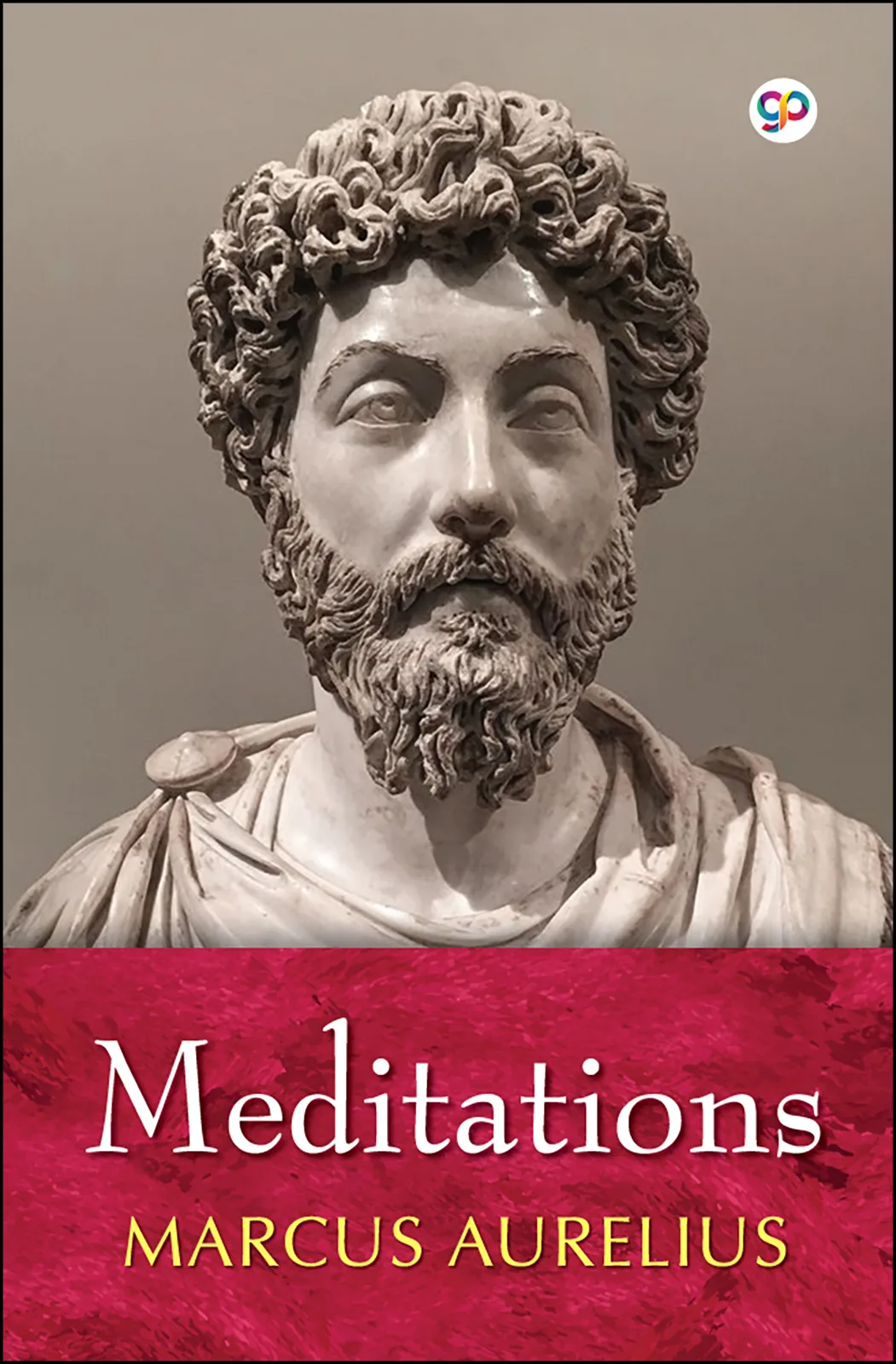
Meditations
Hardcover
• 200 Pages
• INR 445.00
• English
• 9789388118781
No ratings yet
| Publisher | General Press |
|---|---|
| ISBN13 | 9789388118781 |
| ASIN/SKU | 9388118782 |
| Book Format | Hardcover |
| Language | English |
| Pages | 200 |
| List Price | INR 445.00 |
| Subject Code | PHI002000, PHI005000, OCC019000, Node 11047 |
| Publishing Date | 21/11/2018 |
| Dimensions | 8.25 x 5.25 x 1.0 inches |
| Book Code | BD00068042 |
Buy this Book
Amazon Stores
Ebook Stores
Other Stores
Discover Meditations by Marcus Aurelius. This book is published by General Press in Hardcover format, ISBN 9789388118781, ASIN 9388118782, under Non Fiction, Philosophy, Ethics and Morality.
Book Description
'Meditations' by Marcus Aurelius is one of the most enduring works of philosophy, offering a deeply personal reflection on how to live a life of wisdom, integrity, and inner peace. Written as a series of private journal entries by the Roman emperor, the book was never intended for publication. Yet its honest insights into the human condition have inspired readers for nearly two thousand years.
Rooted in the principles of Stoic philosophy, Meditations encourages readers to focus on what they can control while accepting with grace the things they cannot. Marcus Aurelius reflects on the importance of self-discipline, humility, patience, and compassion, reminding himself that external events are often beyond human influence, but one's thoughts, choices, and actions remain within personal control. He emphasizes that true happiness comes not from wealth, status, or praise, but from living according to reason and virtue.
Throughout the book, the emperor confronts universal challenges such as fear, anger, loss, mortality, and the pressures of leadership. Rather than presenting abstract philosophical theories, he shares practical guidance for facing adversity with courage and maintaining moral character in every circumstance. His reflections reveal a leader striving to become a better person despite the immense responsibilities he carried.
Written in a thoughtful and timeless style, 'Meditations' remains a powerful guide to personal growth and resilience. Its wisdom continues to resonate with modern readers, offering practical lessons on cultivating inner strength, emotional balance, and a life guided by purpose, self-awareness, and enduring values.
Rooted in the principles of Stoic philosophy, Meditations encourages readers to focus on what they can control while accepting with grace the things they cannot. Marcus Aurelius reflects on the importance of self-discipline, humility, patience, and compassion, reminding himself that external events are often beyond human influence, but one's thoughts, choices, and actions remain within personal control. He emphasizes that true happiness comes not from wealth, status, or praise, but from living according to reason and virtue.
Throughout the book, the emperor confronts universal challenges such as fear, anger, loss, mortality, and the pressures of leadership. Rather than presenting abstract philosophical theories, he shares practical guidance for facing adversity with courage and maintaining moral character in every circumstance. His reflections reveal a leader striving to become a better person despite the immense responsibilities he carried.
Written in a thoughtful and timeless style, 'Meditations' remains a powerful guide to personal growth and resilience. Its wisdom continues to resonate with modern readers, offering practical lessons on cultivating inner strength, emotional balance, and a life guided by purpose, self-awareness, and enduring values.
Author Biography
Marcus Aurelius Antoninus was born to an upper-class Roman family in A.D. 121 and was later adopted by the future emperor Antoninus Pius, whom he succeeded in 161. His reign was marked by a successful campaign against Parthia, but was overshadowed in later years by plague, an abortive revolt in the eastern provinces, and the deaths of friends and family, including his co-emperor Lucius Verus. A student of philosophy from his earliest youth, he was especially influenced by the first-century Stoic thinker Epictetus. His later reputation rests on his Meditations, written during his later years and never meant for formal publication. He died in 180, while campaigning against the barbarian tribes on Rome's northern frontier.
Editorial Reviews
Editorial Reviews will be added soon…
Book Summary
"Meditations" by Marcus Aurelius is one of the most influential works of philosophy ever written, offering a deeply personal record of the thoughts and reflections of a Roman emperor striving to live a virtuous life. Rather than being intended for publication, the book is a private journal in which Marcus Aurelius reminds himself how to remain calm, disciplined, and morally upright despite the immense responsibilities of ruling the Roman Empire. Drawing upon the principles of Stoic philosophy, he reflects on the nature of human existence, the importance of reason, and the value of self-control. Instead of presenting a continuous story with characters and events, the book unfolds as a series of brief observations and practical lessons that encourage readers to cultivate wisdom, resilience, and inner peace in the face of life's constant challenges.
Throughout the work, Marcus Aurelius repeatedly reminds himself that people have little control over external events but complete control over how they respond to them. Illness, failure, criticism, loss, and even death are unavoidable parts of life, yet they need not disturb a person's inner character. He argues that peace of mind comes from accepting reality rather than resisting it. By recognising that many difficulties are outside human control, individuals can stop wasting energy on anger, fear, or resentment and instead focus on acting with integrity. This perspective encourages emotional balance and teaches that lasting happiness depends on one's own attitudes rather than changing circumstances.
A central theme of the book is the importance of living according to reason and virtue. Marcus Aurelius believes that every individual has the ability to distinguish right from wrong through rational thought. Wisdom, justice, courage, and self-discipline are presented as the highest qualities a person can develop, while wealth, fame, power, and physical pleasure are considered temporary and unreliable sources of satisfaction. He frequently reminds himself not to be distracted by praise or discouraged by criticism because public opinion constantly changes. Instead, true success should be measured by whether one has acted honestly, fulfilled one's responsibilities, and remained faithful to moral principles regardless of the outcome.
Another significant idea explored in *Meditations* is the temporary nature of human life. Marcus Aurelius reflects often on the certainty of death, not as a cause for fear but as a reminder to live wisely. He observes that countless generations have lived, struggled, and disappeared, leaving behind little more than memories that also eventually fade. Rather than viewing this reality with despair, he believes it should inspire gratitude for the present moment and encourage people to use their limited time purposefully. Every day becomes an opportunity to practise kindness, improve one's character, and contribute positively to the lives of others instead of becoming consumed by trivial concerns or endless ambition.
The book also emphasises humanity's shared nature and the importance of treating others with patience and compassion. Marcus Aurelius acknowledges that people can be selfish, dishonest, arrogant, or ungrateful, but he insists that such behaviour should not provoke hatred or revenge. Instead, individuals should remember that everyone is shaped by different experiences, beliefs, and limitations. Since all human beings are part of the same larger community, cooperation and understanding are far more valuable than conflict. Even when confronted by injustice or hostility, he encourages responding with fairness and dignity rather than allowing another person's actions to determine one's own character.
Marcus Aurelius frequently turns his attention inward, examining his own weaknesses with remarkable honesty. He recognises that maintaining self-discipline requires constant effort because the mind is easily distracted by pride, desire, laziness, or unnecessary worry. Rather than pretending to possess perfect wisdom, he uses his journal as a way of correcting himself and renewing his commitment to Stoic ideals. These reflections reveal that personal growth is a lifelong process built upon repeated self-examination. Every mistake becomes an opportunity to learn, and every challenge offers another chance to strengthen one's character through thoughtful action rather than emotional impulse.
Nature occupies an important place in Marcus Aurelius' philosophy. He sees the universe as an ordered and interconnected whole governed by rational principles, with every event serving a purpose within a larger pattern that human beings cannot fully comprehend. Because individuals are part of this natural order, they should accept both favourable and difficult experiences with humility. Resisting reality only creates unnecessary suffering, while accepting it allows people to live in harmony with the world around them. Marcus frequently compares human life to changing seasons, flowing rivers, or passing clouds, reminding himself that change is constant and should be embraced rather than feared.
Despite being written nearly two thousand years ago, many of the situations Marcus Aurelius reflects upon remain familiar today. He considers how to remain focused amid distractions, how to deal with criticism without becoming defensive, how to fulfil demanding responsibilities without resentment, and how to maintain integrity when surrounded by dishonesty or selfishness. His advice consistently points back to the same principle: individuals should concentrate on what they can control—their thoughts, choices, and actions—while accepting everything else with patience and courage. This practical approach makes the book relevant not only to philosophers but also to anyone seeking guidance in everyday life.
Ultimately, "Meditations" is a timeless exploration of character, responsibility, and the pursuit of inner peace. Through honest self-reflection and practical wisdom, Marcus Aurelius presents a philosophy that values humility over pride, reason over impulse, and service over self-interest. His journal encourages readers to meet life's uncertainties with courage, to accept change with grace, and to treat others with compassion regardless of circumstance. Rather than promising an easy or trouble-free existence, the book teaches that true strength comes from governing one's own mind and living according to enduring moral principles. Its enduring appeal lies in its simplicity and sincerity, offering guidance that continues to resonate with readers across cultures and generations as they seek meaning, resilience, and wisdom in an ever-changing world.
Throughout the work, Marcus Aurelius repeatedly reminds himself that people have little control over external events but complete control over how they respond to them. Illness, failure, criticism, loss, and even death are unavoidable parts of life, yet they need not disturb a person's inner character. He argues that peace of mind comes from accepting reality rather than resisting it. By recognising that many difficulties are outside human control, individuals can stop wasting energy on anger, fear, or resentment and instead focus on acting with integrity. This perspective encourages emotional balance and teaches that lasting happiness depends on one's own attitudes rather than changing circumstances.
A central theme of the book is the importance of living according to reason and virtue. Marcus Aurelius believes that every individual has the ability to distinguish right from wrong through rational thought. Wisdom, justice, courage, and self-discipline are presented as the highest qualities a person can develop, while wealth, fame, power, and physical pleasure are considered temporary and unreliable sources of satisfaction. He frequently reminds himself not to be distracted by praise or discouraged by criticism because public opinion constantly changes. Instead, true success should be measured by whether one has acted honestly, fulfilled one's responsibilities, and remained faithful to moral principles regardless of the outcome.
Another significant idea explored in *Meditations* is the temporary nature of human life. Marcus Aurelius reflects often on the certainty of death, not as a cause for fear but as a reminder to live wisely. He observes that countless generations have lived, struggled, and disappeared, leaving behind little more than memories that also eventually fade. Rather than viewing this reality with despair, he believes it should inspire gratitude for the present moment and encourage people to use their limited time purposefully. Every day becomes an opportunity to practise kindness, improve one's character, and contribute positively to the lives of others instead of becoming consumed by trivial concerns or endless ambition.
The book also emphasises humanity's shared nature and the importance of treating others with patience and compassion. Marcus Aurelius acknowledges that people can be selfish, dishonest, arrogant, or ungrateful, but he insists that such behaviour should not provoke hatred or revenge. Instead, individuals should remember that everyone is shaped by different experiences, beliefs, and limitations. Since all human beings are part of the same larger community, cooperation and understanding are far more valuable than conflict. Even when confronted by injustice or hostility, he encourages responding with fairness and dignity rather than allowing another person's actions to determine one's own character.
Marcus Aurelius frequently turns his attention inward, examining his own weaknesses with remarkable honesty. He recognises that maintaining self-discipline requires constant effort because the mind is easily distracted by pride, desire, laziness, or unnecessary worry. Rather than pretending to possess perfect wisdom, he uses his journal as a way of correcting himself and renewing his commitment to Stoic ideals. These reflections reveal that personal growth is a lifelong process built upon repeated self-examination. Every mistake becomes an opportunity to learn, and every challenge offers another chance to strengthen one's character through thoughtful action rather than emotional impulse.
Nature occupies an important place in Marcus Aurelius' philosophy. He sees the universe as an ordered and interconnected whole governed by rational principles, with every event serving a purpose within a larger pattern that human beings cannot fully comprehend. Because individuals are part of this natural order, they should accept both favourable and difficult experiences with humility. Resisting reality only creates unnecessary suffering, while accepting it allows people to live in harmony with the world around them. Marcus frequently compares human life to changing seasons, flowing rivers, or passing clouds, reminding himself that change is constant and should be embraced rather than feared.
Despite being written nearly two thousand years ago, many of the situations Marcus Aurelius reflects upon remain familiar today. He considers how to remain focused amid distractions, how to deal with criticism without becoming defensive, how to fulfil demanding responsibilities without resentment, and how to maintain integrity when surrounded by dishonesty or selfishness. His advice consistently points back to the same principle: individuals should concentrate on what they can control—their thoughts, choices, and actions—while accepting everything else with patience and courage. This practical approach makes the book relevant not only to philosophers but also to anyone seeking guidance in everyday life.
Ultimately, "Meditations" is a timeless exploration of character, responsibility, and the pursuit of inner peace. Through honest self-reflection and practical wisdom, Marcus Aurelius presents a philosophy that values humility over pride, reason over impulse, and service over self-interest. His journal encourages readers to meet life's uncertainties with courage, to accept change with grace, and to treat others with compassion regardless of circumstance. Rather than promising an easy or trouble-free existence, the book teaches that true strength comes from governing one's own mind and living according to enduring moral principles. Its enduring appeal lies in its simplicity and sincerity, offering guidance that continues to resonate with readers across cultures and generations as they seek meaning, resilience, and wisdom in an ever-changing world.
Sample Chapters
Book One
From my grandfather Verus I learned good morals and the government of my temper.
* * *
From the reputation and remembrance of my father, modesty and a manly character.
* * *
From my mother, piety and beneficence, and abstinence, not only from evil deeds, but even from evil thoughts; and further, simplicity in my way of living, far removed from the habits of the rich.
* * *
From my great-grandfather, not to have frequented public schools, and to have had good teachers at home, and to know that on such things a man should spend liberally.
* * *
From my governor, to be neither of the green nor of the blue party at the games in the Circus, nor a partizan either of the Parmularius or the Scutarius at the gladiators’ fights; from him too I learned endurance of labour, and to want little, and to work with my own hands, and not to meddle with other people’s affairs, and not to be ready to listen to slander.
* * *
From Diognetus, not to busy myself about trifling things, and not to give credit to what was said by miracle-workers and jugglers about incantations and the driving away of daemons and such things; and not to breed quails for fighting, nor to give myself up passionately to such things; and to endure freedom of speech; and to have become intimate with philosophy; and to have been a hearer, first of Bacchius, then of Tandasis and Marcianus; and to have written dialogues in my youth; and to have desired a plank bed and skin, and whatever else of the kind belongs to the Grecian discipline.
* * *
From Rusticus I received the impression that my character required improvement and discipline; and from him I learned not to be led astray to sophistic emulation, nor to writing on speculative matters, nor to delivering little hortatory orations, nor to showing myself off as a man who practises much discipline, or does benevolent acts in order to make a display; and to abstain from rhetoric, and poetry, and fine writing; and not to walk about in the house in my outdoor dress, nor to do other things of the kind; and to write my letters with simplicity, like the letter which Rusticus wrote from Sinuessa to my mother; and with respect to those who have offended me by words, or done me wrong, to be easily disposed to be pacified and reconciled, as soon as they have shown a readiness to be reconciled; and to read carefully, and not to be satisfied with a superficial understanding of a book; nor hastily to give my assent to those who talk overmuch; and I am indebted to him for being acquainted with the discourses of Epictetus, which he communicated to me out of his own collection.
* * *
From Apollonius I learned freedom of will and undeviating steadiness of purpose; and to look to nothing else, not even for a moment, except to reason; and to be always the same, in sharp pains, on the occasion of the loss of a child, and in long illness; and to see clearly in a living example that the same man can be both most resolute and yielding, and not peevish in giving his instruction; and to have had before my eyes a man who clearly considered his experience and his skill in expounding philosophical principles as the smallest of his merits; and from him I learned how to receive from friends what are esteemed favours, without being either humbled by them or letting them pass unnoticed.
* * *
From Sextus, a benevolent disposition, and the example of a family governed in a fatherly manner, and the idea of living conformably to nature; and gravity without affectation, and to look carefully after the interests of friends, and to tolerate ignorant persons, and those who form opinions without consideration: he had the power of readily accommodating himself to all, so that intercourse with him was more agreeable than any flattery; and at the same time he was most highly venerated by those who associated with him: and he had the faculty both of discovering and ordering, in an intelligent and methodical way, the principles necessary for life; and he never showed anger or any other passion, but was entirely free from passion, and also most affectionate; and he could express approbation without noisy display, and he possessed much knowledge without ostentation.
* * *
From Alexander the grammarian, to refrain from fault-finding, and not in a reproachful way to chide those who uttered any barbarous or solecistic or strange-sounding expression; but dexterously to introduce the very expression which ought to have been used, and in the way of answer or giving confirmation, or joining in an inquiry about the thing itself, not about the word, or by some other fit suggestion.
* * *
From Fronto I learned to observe what envy, and duplicity, and hypocrisy are in a tyrant, and that generally those among us who are called Patricians are rather deficient in paternal affection.
* * *
From Alexander the Platonic, not frequently nor without necessity to say to any one, or to write in a letter, that I have no leisure; nor continually to excuse the neglect of duties required by our relation to those with whom we live, by alleging urgent occupations.
* * *
From Catulus, not to be indifferent when a friend finds fault, even if he should find fault without reason, but to try to restore him to his usual disposition; and to be ready to speak well of teachers, as it is reported of Domitius and Athenodotus; and to love my children truly.
* * *
From my brother Severus, to love my kin, and to love truth, and to love justice; and through him I learned to know Thrasea, Helvidius, Cato, Dion, Brutus; and from him I received the idea of a polity in which there is the same law for all, a polity administered with regard to equal rights and equal freedom of speech, and the idea of a kingly government which respects most of all the freedom of the governed; I learned from him also consistency and undeviating steadiness in my regard for philosophy; and a disposition to do good, and to give to others readily, and to cherish good hopes, and to believe that I am loved by my friends; and in him I observed no concealment of his opinions with respect to those whom he condemned, and that his friends had no need to conjecture what he wished or did not wish, but it was quite plain.
* * *
From Maximus I learned self-government, and not to be led aside by anything; and cheerfulness in all circumstances, as well as in illness; and a just admixture in the moral character of sweetness and dignity, and to do what was set before me without complaining. I observed that everybody believed that he thought as he spoke, and that in all that he did he never had any bad intention; and he never showed amazement and surprise, and was never in a hurry, and never put off doing a thing, nor was perplexed nor dejected, nor did he ever laugh to disguise his vexation, nor, on the other hand, was he ever passionate or suspicious. He was accustomed to do acts of beneficence, and was ready to forgive, and was free from all falsehood; and he presented the appearance of a man who could not be diverted from right rather than of a man who had been improved. I observed, too, that no man could ever think that he was despised by Maximus, or ever venture to think himself a better man. He had also the art of being humorous in an agreeable way.
* * *
In my father I observed mildness of temper, and unchangeable resolution in the things which he had determined after due deliberation; and no vainglory in those things which men call honours; and a love of labour and perseverance; and a readiness to listen to those who had anything to propose for the common weal; and undeviating firmness in giving to every man according to his deserts; and a knowledge derived from experience of the occasions for vigorous action and for remission. And I observed that he had overcome all passion for boys; and he considered himself no more than any other citizen; and he released his friends from all obligation to sup with him or to attend him of necessity when he went abroad, and those who had failed to accompany him, by reason of any urgent circumstances, always found him the same. I observed too his habit of careful inquiry in all matters of deliberation, and his persistency, and that he never stopped his investigation through being satisfied with appearances which first present themselves; and that his disposition was to keep his friends, and not to be soon tired of them, nor yet to be extravagant in his affection; and to be satisfied on all occasions, and cheerful; and to foresee things a long way off, and to provide for the smallest without display; and to check immediately popular applause and all flattery; and to be ever watchful over the things which were necessary for the administration of the empire, and to be a good manager of the expenditure, and patiently to endure the blame which he got for such conduct; and he was neither superstitious with respect to the gods, nor did he court men by gifts or by trying to please them, or by flattering the populace; but he showed sobriety in all things and firmness, and never any mean thoughts or action, nor love of novelty.
And the things which conduce in any way to the commodity of life, and of which fortune gives an abundant supply, he used without arrogance and without excusing himself; so that when he had them, he enjoyed them without affectation, and when he had them not, he did not want them. No one could ever say of him that he was either a sophist or a home-bred flippant slave or a pedant; but everyone acknowledged him to be a man ripe, perfect, above flattery, able to manage his own and other men’s affairs. Besides this, he honoured those who were true philosophers, and he did not reproach those who pretended to be philosophers, nor yet was he easily led by them. He was also easy in conversation, and he made himself agreeable without any offensive affectation. He took a reasonable care of his body’s health, not as one who was greatly attached to life, nor out of regard to personal appearance, nor yet in a careless way, but so that, through his own attention, he very seldom stood in need of the physician’s art or of medicine or external applications.
He was most ready to give way without envy to those who possessed any particular faculty, such as that of eloquence or knowledge of the law or of morals, or of anything else; and he gave them his help, that each might enjoy reputation according to his deserts; and he always acted conformably to the institutions of his country, without showing any affectation of doing so. Further, he was not fond of change nor unsteady, but he loved to stay in the same places, and to employ himself about the same things; and after his paroxysms of headache he came immediately fresh and vigorous to his usual occupations. His secrets were not but very few and very rare, and these only about public matters; and he showed prudence and economy in the exhibition of the public spectacles and the construction of public buildings, his donations to the people, and in such things, for he was a man who looked to what ought to be done, not to the reputation which is got by a man’s acts. He did not take the bath at unseasonable hours; he was not fond of building houses, nor curious about what he ate, nor about the texture and colour of his clothes, nor about the beauty of his slaves.
His dress came from Lorium, his villa on the coast, and from Lanuvium generally. We know how he behaved to the toll-collector at Tusculum who asked his pardon; and such was all his behaviour. There was in him nothing harsh, nor implacable, nor violent, nor, as one may say, anything carried to the sweating point; but he examined all things severally, as if he had abundance of time, and without confusion, in an orderly way, vigorously and consistently. And that might be applied to him which is recorded of Socrates, that he was able both to abstain from, and to enjoy, those things which many are too weak to abstain from, and cannot enjoy without excess. But to be strong enough both to bear the one and to be sober in the other is the mark of a man who has a perfect and invincible soul, such as he showed in the illness of Maximus.
* * *
To the gods I am indebted for having good grandfathers, good parents, a good sister, good teachers, good associates, good kinsmen and friends, nearly everything good. Further, I owe it to the gods that I was not hurried into any offence against any of them, though I had a disposition which, if opportunity had offered, might have led me to do something of this kind; but, through their favour, there never was such a concurrence of circumstances as put me to the trial. Further, I am thankful to the gods that I was not longer brought up with my grandfather’s concubine, and that I preserved the flower of my youth, and that I did not make proof of my virility before the proper season, but even deferred the time; that I was subjected to a ruler and a father who was able to take away all pride from me, and to bring me to the knowledge that it is possible for a man to live in a palace without wanting either guards or embroidered dresses, or torches and statues, and such-like show; but that it is in such a man’s power to bring himself very near to the fashion of a private person, without being for this reason either meaner in thought, or more remiss in action, with respect to the things which must be done for the public interest in a manner that befits a ruler.
I thank the gods for giving me such a brother, who was able by his moral character to rouse me to vigilance over myself, and who, at the same time, pleased me by his respect and affection; that my children have not been stupid nor deformed in body; that I did not make more proficiency in rhetoric, poetry, and the other studies, in which I should perhaps have been completely engaged, if I had seen that I was making progress in them; that I made haste to place those who brought me up in the station of honour, which they seemed to desire, without putting them off with hope of my doing it sometime after, because they were then still young; that I knew Apollonius, Rusticus, Maximus; that I received clear and frequent impressions about living according to nature, and what kind of a life that is, so that, so far as depended on the gods, and their gifts, and help, and inspirations, nothing hindered me from forthwith living according to nature, though I still fall short of it through my own fault, and through not observing the admonitions of the gods, and, I may almost say, their direct instructions; that my body has held out so long in such a kind of life; that I never touched either Benedicta or Theodotus, and that, after having fallen into amatory passions, I was cured; and, though I was often out of humour with Rusticus, I never did anything of which I had occasion to repent; that, though it was my mother’s fate to die young, she spent the last years of her life with me; that, whenever I wished to help any man in his need, or on any other occasion, I was never told that I had not the means of doing it; and that to myself the same necessity never happened, to receive anything from another; that I have such a wife, so obedient, and so affectionate, and so simple; that I had abundance of good masters for my children; and that remedies have been shown to me by dreams, both others, and against blood spitting and giddiness...; and that, when I had an inclination to philosophy, I did not fall into the hands of any sophist, and that I did not waste my time on writers of histories, or in the resolution of syllogisms, or occupy myself about the investigation of appearances in the heavens; for all these things require the help of the gods and fortune.
Book Two
Among the Quadi at the Granua
Begin the morning by saying to thyself, I shall meet with the busy-body, the ungrateful, arrogant, deceitful, envious, unsocial. All these things happen to them by reason of their ignorance of what is good and evil. But I who have seen the nature of the good that it is beautiful, and of the bad that it is ugly, and the nature of him who does wrong, that it is akin to me, not only of the same blood or seed, but that it participates in the same intelligence and the same portion of the divinity, I can neither be injured by any of them, for no one can fix on me what is ugly, nor can I be angry with my kinsman, nor hate him, For we are made for co-operation, like feet, like hands, like eyelids, like the rows of the upper and lower teeth. To act against one another then is contrary to nature; and it is acting against one another to be vexed and to turn away.
* * *
Whatever this is that I am, it is a little flesh and breath, and the ruling part. Throw away thy books; no longer distract thyself: it is not allowed; but as if thou wast now dying, despise the flesh; it is blood and bones and a network, a contexture of nerves, veins, and arteries. See the breath also, what kind of a thing it is, air, and not always the same, but every moment sent out and again sucked in. The third then is the ruling part: consider thus: Thou art an old man; no longer let this be a slave, no longer be pulled by the strings like a puppet to unsocial movements, no longer either be dissatisfied with thy present lot, or shrink from the future.
* * *
All that is from the gods is full of Providence. That which is from fortune is not separated from nature or without an interweaving and involution with the things which are ordered by Providence. From thence all things flow; and there is besides necessity, and that which is for the advantage of the whole universe, of which thou art a part. But that is good for every part of nature which the nature of the whole brings, and what serves to maintain this nature. Now the universe is preserved, as by the changes of the elements so by the changes of things compounded of the elements. Let these principles be enough for thee, let them always be fixed opinions. But cast away the thirst after books, that thou mayest not die murmuring, but cheerfully, truly, and from thy heart thankful to the gods.
* * *
Remember how long thou hast been putting off these things, and how often thou hast received an opportunity from the gods, and yet dost not use it. Thou must now at last perceive of what universe thou art a part, and of what administrator of the universe thy existence is an efflux, and that a limit of time is fixed for thee, which if thou dost not use for clearing away the clouds from thy mind, it will go and thou wilt go, and it will never return.
* * *
Every moment think steadily as a Roman and a man to do what thou hast in hand with perfect and simple dignity, and feeling of affection, and freedom, and justice; and to give thyself relief from all other thoughts. And thou wilt give thyself relief, if thou doest every act of thy life as if it were the last, laying aside all carelessness and passionate aversion from the commands of reason, and all hypocrisy, and self-love, and discontent with the portion which has been given to thee. Thou seest how few the things are, the which if a man lays hold of, he is able to live a life which flows in quiet, and is like the existence of the gods; for the gods on their part will require nothing more from him who observes these things.
* * *
Do wrong to thyself, do wrong to thyself, my soul; but thou wilt no longer have the opportunity of honouring thyself. Every man’s life is sufficient. But thine is nearly finished, though thy soul reverences not itself but places thy felicity in the souls of others.
From my grandfather Verus I learned good morals and the government of my temper.
* * *
From the reputation and remembrance of my father, modesty and a manly character.
* * *
From my mother, piety and beneficence, and abstinence, not only from evil deeds, but even from evil thoughts; and further, simplicity in my way of living, far removed from the habits of the rich.
* * *
From my great-grandfather, not to have frequented public schools, and to have had good teachers at home, and to know that on such things a man should spend liberally.
* * *
From my governor, to be neither of the green nor of the blue party at the games in the Circus, nor a partizan either of the Parmularius or the Scutarius at the gladiators’ fights; from him too I learned endurance of labour, and to want little, and to work with my own hands, and not to meddle with other people’s affairs, and not to be ready to listen to slander.
* * *
From Diognetus, not to busy myself about trifling things, and not to give credit to what was said by miracle-workers and jugglers about incantations and the driving away of daemons and such things; and not to breed quails for fighting, nor to give myself up passionately to such things; and to endure freedom of speech; and to have become intimate with philosophy; and to have been a hearer, first of Bacchius, then of Tandasis and Marcianus; and to have written dialogues in my youth; and to have desired a plank bed and skin, and whatever else of the kind belongs to the Grecian discipline.
* * *
From Rusticus I received the impression that my character required improvement and discipline; and from him I learned not to be led astray to sophistic emulation, nor to writing on speculative matters, nor to delivering little hortatory orations, nor to showing myself off as a man who practises much discipline, or does benevolent acts in order to make a display; and to abstain from rhetoric, and poetry, and fine writing; and not to walk about in the house in my outdoor dress, nor to do other things of the kind; and to write my letters with simplicity, like the letter which Rusticus wrote from Sinuessa to my mother; and with respect to those who have offended me by words, or done me wrong, to be easily disposed to be pacified and reconciled, as soon as they have shown a readiness to be reconciled; and to read carefully, and not to be satisfied with a superficial understanding of a book; nor hastily to give my assent to those who talk overmuch; and I am indebted to him for being acquainted with the discourses of Epictetus, which he communicated to me out of his own collection.
* * *
From Apollonius I learned freedom of will and undeviating steadiness of purpose; and to look to nothing else, not even for a moment, except to reason; and to be always the same, in sharp pains, on the occasion of the loss of a child, and in long illness; and to see clearly in a living example that the same man can be both most resolute and yielding, and not peevish in giving his instruction; and to have had before my eyes a man who clearly considered his experience and his skill in expounding philosophical principles as the smallest of his merits; and from him I learned how to receive from friends what are esteemed favours, without being either humbled by them or letting them pass unnoticed.
* * *
From Sextus, a benevolent disposition, and the example of a family governed in a fatherly manner, and the idea of living conformably to nature; and gravity without affectation, and to look carefully after the interests of friends, and to tolerate ignorant persons, and those who form opinions without consideration: he had the power of readily accommodating himself to all, so that intercourse with him was more agreeable than any flattery; and at the same time he was most highly venerated by those who associated with him: and he had the faculty both of discovering and ordering, in an intelligent and methodical way, the principles necessary for life; and he never showed anger or any other passion, but was entirely free from passion, and also most affectionate; and he could express approbation without noisy display, and he possessed much knowledge without ostentation.
* * *
From Alexander the grammarian, to refrain from fault-finding, and not in a reproachful way to chide those who uttered any barbarous or solecistic or strange-sounding expression; but dexterously to introduce the very expression which ought to have been used, and in the way of answer or giving confirmation, or joining in an inquiry about the thing itself, not about the word, or by some other fit suggestion.
* * *
From Fronto I learned to observe what envy, and duplicity, and hypocrisy are in a tyrant, and that generally those among us who are called Patricians are rather deficient in paternal affection.
* * *
From Alexander the Platonic, not frequently nor without necessity to say to any one, or to write in a letter, that I have no leisure; nor continually to excuse the neglect of duties required by our relation to those with whom we live, by alleging urgent occupations.
* * *
From Catulus, not to be indifferent when a friend finds fault, even if he should find fault without reason, but to try to restore him to his usual disposition; and to be ready to speak well of teachers, as it is reported of Domitius and Athenodotus; and to love my children truly.
* * *
From my brother Severus, to love my kin, and to love truth, and to love justice; and through him I learned to know Thrasea, Helvidius, Cato, Dion, Brutus; and from him I received the idea of a polity in which there is the same law for all, a polity administered with regard to equal rights and equal freedom of speech, and the idea of a kingly government which respects most of all the freedom of the governed; I learned from him also consistency and undeviating steadiness in my regard for philosophy; and a disposition to do good, and to give to others readily, and to cherish good hopes, and to believe that I am loved by my friends; and in him I observed no concealment of his opinions with respect to those whom he condemned, and that his friends had no need to conjecture what he wished or did not wish, but it was quite plain.
* * *
From Maximus I learned self-government, and not to be led aside by anything; and cheerfulness in all circumstances, as well as in illness; and a just admixture in the moral character of sweetness and dignity, and to do what was set before me without complaining. I observed that everybody believed that he thought as he spoke, and that in all that he did he never had any bad intention; and he never showed amazement and surprise, and was never in a hurry, and never put off doing a thing, nor was perplexed nor dejected, nor did he ever laugh to disguise his vexation, nor, on the other hand, was he ever passionate or suspicious. He was accustomed to do acts of beneficence, and was ready to forgive, and was free from all falsehood; and he presented the appearance of a man who could not be diverted from right rather than of a man who had been improved. I observed, too, that no man could ever think that he was despised by Maximus, or ever venture to think himself a better man. He had also the art of being humorous in an agreeable way.
* * *
In my father I observed mildness of temper, and unchangeable resolution in the things which he had determined after due deliberation; and no vainglory in those things which men call honours; and a love of labour and perseverance; and a readiness to listen to those who had anything to propose for the common weal; and undeviating firmness in giving to every man according to his deserts; and a knowledge derived from experience of the occasions for vigorous action and for remission. And I observed that he had overcome all passion for boys; and he considered himself no more than any other citizen; and he released his friends from all obligation to sup with him or to attend him of necessity when he went abroad, and those who had failed to accompany him, by reason of any urgent circumstances, always found him the same. I observed too his habit of careful inquiry in all matters of deliberation, and his persistency, and that he never stopped his investigation through being satisfied with appearances which first present themselves; and that his disposition was to keep his friends, and not to be soon tired of them, nor yet to be extravagant in his affection; and to be satisfied on all occasions, and cheerful; and to foresee things a long way off, and to provide for the smallest without display; and to check immediately popular applause and all flattery; and to be ever watchful over the things which were necessary for the administration of the empire, and to be a good manager of the expenditure, and patiently to endure the blame which he got for such conduct; and he was neither superstitious with respect to the gods, nor did he court men by gifts or by trying to please them, or by flattering the populace; but he showed sobriety in all things and firmness, and never any mean thoughts or action, nor love of novelty.
And the things which conduce in any way to the commodity of life, and of which fortune gives an abundant supply, he used without arrogance and without excusing himself; so that when he had them, he enjoyed them without affectation, and when he had them not, he did not want them. No one could ever say of him that he was either a sophist or a home-bred flippant slave or a pedant; but everyone acknowledged him to be a man ripe, perfect, above flattery, able to manage his own and other men’s affairs. Besides this, he honoured those who were true philosophers, and he did not reproach those who pretended to be philosophers, nor yet was he easily led by them. He was also easy in conversation, and he made himself agreeable without any offensive affectation. He took a reasonable care of his body’s health, not as one who was greatly attached to life, nor out of regard to personal appearance, nor yet in a careless way, but so that, through his own attention, he very seldom stood in need of the physician’s art or of medicine or external applications.
He was most ready to give way without envy to those who possessed any particular faculty, such as that of eloquence or knowledge of the law or of morals, or of anything else; and he gave them his help, that each might enjoy reputation according to his deserts; and he always acted conformably to the institutions of his country, without showing any affectation of doing so. Further, he was not fond of change nor unsteady, but he loved to stay in the same places, and to employ himself about the same things; and after his paroxysms of headache he came immediately fresh and vigorous to his usual occupations. His secrets were not but very few and very rare, and these only about public matters; and he showed prudence and economy in the exhibition of the public spectacles and the construction of public buildings, his donations to the people, and in such things, for he was a man who looked to what ought to be done, not to the reputation which is got by a man’s acts. He did not take the bath at unseasonable hours; he was not fond of building houses, nor curious about what he ate, nor about the texture and colour of his clothes, nor about the beauty of his slaves.
His dress came from Lorium, his villa on the coast, and from Lanuvium generally. We know how he behaved to the toll-collector at Tusculum who asked his pardon; and such was all his behaviour. There was in him nothing harsh, nor implacable, nor violent, nor, as one may say, anything carried to the sweating point; but he examined all things severally, as if he had abundance of time, and without confusion, in an orderly way, vigorously and consistently. And that might be applied to him which is recorded of Socrates, that he was able both to abstain from, and to enjoy, those things which many are too weak to abstain from, and cannot enjoy without excess. But to be strong enough both to bear the one and to be sober in the other is the mark of a man who has a perfect and invincible soul, such as he showed in the illness of Maximus.
* * *
To the gods I am indebted for having good grandfathers, good parents, a good sister, good teachers, good associates, good kinsmen and friends, nearly everything good. Further, I owe it to the gods that I was not hurried into any offence against any of them, though I had a disposition which, if opportunity had offered, might have led me to do something of this kind; but, through their favour, there never was such a concurrence of circumstances as put me to the trial. Further, I am thankful to the gods that I was not longer brought up with my grandfather’s concubine, and that I preserved the flower of my youth, and that I did not make proof of my virility before the proper season, but even deferred the time; that I was subjected to a ruler and a father who was able to take away all pride from me, and to bring me to the knowledge that it is possible for a man to live in a palace without wanting either guards or embroidered dresses, or torches and statues, and such-like show; but that it is in such a man’s power to bring himself very near to the fashion of a private person, without being for this reason either meaner in thought, or more remiss in action, with respect to the things which must be done for the public interest in a manner that befits a ruler.
I thank the gods for giving me such a brother, who was able by his moral character to rouse me to vigilance over myself, and who, at the same time, pleased me by his respect and affection; that my children have not been stupid nor deformed in body; that I did not make more proficiency in rhetoric, poetry, and the other studies, in which I should perhaps have been completely engaged, if I had seen that I was making progress in them; that I made haste to place those who brought me up in the station of honour, which they seemed to desire, without putting them off with hope of my doing it sometime after, because they were then still young; that I knew Apollonius, Rusticus, Maximus; that I received clear and frequent impressions about living according to nature, and what kind of a life that is, so that, so far as depended on the gods, and their gifts, and help, and inspirations, nothing hindered me from forthwith living according to nature, though I still fall short of it through my own fault, and through not observing the admonitions of the gods, and, I may almost say, their direct instructions; that my body has held out so long in such a kind of life; that I never touched either Benedicta or Theodotus, and that, after having fallen into amatory passions, I was cured; and, though I was often out of humour with Rusticus, I never did anything of which I had occasion to repent; that, though it was my mother’s fate to die young, she spent the last years of her life with me; that, whenever I wished to help any man in his need, or on any other occasion, I was never told that I had not the means of doing it; and that to myself the same necessity never happened, to receive anything from another; that I have such a wife, so obedient, and so affectionate, and so simple; that I had abundance of good masters for my children; and that remedies have been shown to me by dreams, both others, and against blood spitting and giddiness...; and that, when I had an inclination to philosophy, I did not fall into the hands of any sophist, and that I did not waste my time on writers of histories, or in the resolution of syllogisms, or occupy myself about the investigation of appearances in the heavens; for all these things require the help of the gods and fortune.
Book Two
Among the Quadi at the Granua
Begin the morning by saying to thyself, I shall meet with the busy-body, the ungrateful, arrogant, deceitful, envious, unsocial. All these things happen to them by reason of their ignorance of what is good and evil. But I who have seen the nature of the good that it is beautiful, and of the bad that it is ugly, and the nature of him who does wrong, that it is akin to me, not only of the same blood or seed, but that it participates in the same intelligence and the same portion of the divinity, I can neither be injured by any of them, for no one can fix on me what is ugly, nor can I be angry with my kinsman, nor hate him, For we are made for co-operation, like feet, like hands, like eyelids, like the rows of the upper and lower teeth. To act against one another then is contrary to nature; and it is acting against one another to be vexed and to turn away.
* * *
Whatever this is that I am, it is a little flesh and breath, and the ruling part. Throw away thy books; no longer distract thyself: it is not allowed; but as if thou wast now dying, despise the flesh; it is blood and bones and a network, a contexture of nerves, veins, and arteries. See the breath also, what kind of a thing it is, air, and not always the same, but every moment sent out and again sucked in. The third then is the ruling part: consider thus: Thou art an old man; no longer let this be a slave, no longer be pulled by the strings like a puppet to unsocial movements, no longer either be dissatisfied with thy present lot, or shrink from the future.
* * *
All that is from the gods is full of Providence. That which is from fortune is not separated from nature or without an interweaving and involution with the things which are ordered by Providence. From thence all things flow; and there is besides necessity, and that which is for the advantage of the whole universe, of which thou art a part. But that is good for every part of nature which the nature of the whole brings, and what serves to maintain this nature. Now the universe is preserved, as by the changes of the elements so by the changes of things compounded of the elements. Let these principles be enough for thee, let them always be fixed opinions. But cast away the thirst after books, that thou mayest not die murmuring, but cheerfully, truly, and from thy heart thankful to the gods.
* * *
Remember how long thou hast been putting off these things, and how often thou hast received an opportunity from the gods, and yet dost not use it. Thou must now at last perceive of what universe thou art a part, and of what administrator of the universe thy existence is an efflux, and that a limit of time is fixed for thee, which if thou dost not use for clearing away the clouds from thy mind, it will go and thou wilt go, and it will never return.
* * *
Every moment think steadily as a Roman and a man to do what thou hast in hand with perfect and simple dignity, and feeling of affection, and freedom, and justice; and to give thyself relief from all other thoughts. And thou wilt give thyself relief, if thou doest every act of thy life as if it were the last, laying aside all carelessness and passionate aversion from the commands of reason, and all hypocrisy, and self-love, and discontent with the portion which has been given to thee. Thou seest how few the things are, the which if a man lays hold of, he is able to live a life which flows in quiet, and is like the existence of the gods; for the gods on their part will require nothing more from him who observes these things.
* * *
Do wrong to thyself, do wrong to thyself, my soul; but thou wilt no longer have the opportunity of honouring thyself. Every man’s life is sufficient. But thine is nearly finished, though thy soul reverences not itself but places thy felicity in the souls of others.
Reader Reviews
No reviews yet.
Meditations