
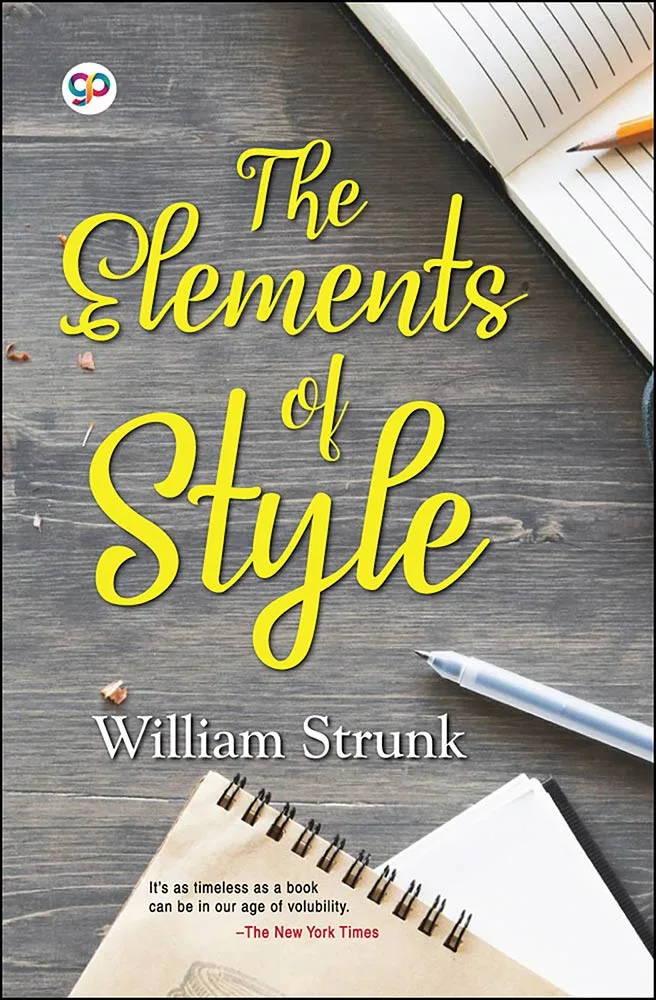
The Elements of Style
Paperback
• 86 Pages
• INR 245.00
• English
• 9789389157123
No ratings yet
| Publisher | General Press |
|---|---|
| ISBN13 | 9789389157123 |
| ASIN/SKU | 9389157129 |
| Book Format | Paperback |
| Language | English |
| Pages | 86 |
| List Price | INR 245.00 |
| Subject Code | LAN025000, EDU016000, EDU029040, LAN002000 |
| Publishing Date | 22/05/2019 |
| Dimensions | 8.25 x 5.25 x 1.0 inches |
| Book Code | BD00068053 |
Buy this Book
Amazon Stores
Ebook Stores
Other Stores
Discover The Elements of Style by William Strunk. This book is published by General Press in Paperback format, ISBN 9789389157123, ASIN 9389157129, under Reference, Writing and Publishing, Education and Teaching.
Book Description
William Strunk Jr.’s "The Elements of Style" is much more than a rigid manual of grammar and punctuation; it is a timeless, heartfelt plea for clarity and empathy in communication. Affectionately known as 'the little book', this indispensable guide strips away the intimidating complexities of the English language to reveal the profound beauty of simple, direct prose. At its core, Strunk’s philosophy is captured in his most famous directive: "Omit needless words." He believed that every word must justify its existence, not to restrict the writer’s creativity, but to fiercely protect the reader’s time and attention. Writing, in Strunk’s view, is an act of deep consideration.
By championing the active voice, precise vocabulary, and clean sentence structures, the book teaches us how to clear the fog of confusion from our thoughts. What makes this guide so universally beloved—especially after E.B. White’s later graceful revisions—is its deeply human touch. It does not scold; rather, it empowers. It reminds us that behind every sentence is a person trying to connect with another. Cluttered writing builds walls, while lucid writing builds bridges.
Ultimately, 'The Elements of Style' is a timeless meditation on respect and authenticity. It assures us that we do not need to hide behind flowery, pretentious language to sound intelligent. True brilliance lies in the humble, powerful art of being understood.
By championing the active voice, precise vocabulary, and clean sentence structures, the book teaches us how to clear the fog of confusion from our thoughts. What makes this guide so universally beloved—especially after E.B. White’s later graceful revisions—is its deeply human touch. It does not scold; rather, it empowers. It reminds us that behind every sentence is a person trying to connect with another. Cluttered writing builds walls, while lucid writing builds bridges.
Ultimately, 'The Elements of Style' is a timeless meditation on respect and authenticity. It assures us that we do not need to hide behind flowery, pretentious language to sound intelligent. True brilliance lies in the humble, powerful art of being understood.
Author Biography
William Strunk, Jr., was a professor of English at Cornell University and author of the The Elements of Style. After revision and enlargement by his former student E. B. White, it became a highly influential guide to English usage during the late 20th century, commonly called Strunk & White.
Editorial Reviews
Editorial Reviews will be added soon…
Book Summary
"The Elements of Style: Writing Strategies with Grammar" by William Strunk Jr. is one of the most respected guides on English writing ever published. Though modest in length, it has had a lasting influence on generations of students, teachers, journalists, authors, and professionals. Rather than overwhelming readers with hundreds of grammar rules, Strunk focuses on the essential principles that make writing clear, direct, and effective. The book argues that good writing is not about using complicated words or impressive sentences but about expressing ideas with honesty, precision, and simplicity. Every chapter encourages writers to respect both the language and their readers by communicating thoughts in the clearest possible way.
The book begins by explaining the basic rules of English grammar and usage. Strunk presents these rules in a straightforward manner, making them easy to understand and remember. He discusses correct sentence structure, punctuation, subject-verb agreement, pronoun use, and proper word forms. Instead of treating grammar as a dry set of restrictions, he shows how these rules create clarity and prevent misunderstanding. Even experienced writers often overlook small grammatical mistakes that weaken their work, and Strunk demonstrates how careful attention to these details improves the overall quality of writing.
A major theme throughout the book is the importance of brevity. Strunk repeatedly advises writers to eliminate unnecessary words and avoid expressions that add little meaning. He believes that every word in a sentence should serve a purpose. Long, complicated sentences often confuse readers, while concise writing makes ideas easier to follow. This does not mean writing should become dull or mechanical. Instead, Strunk encourages writers to choose words carefully so that every sentence communicates its message with maximum impact. His famous advice to "omit needless words" has become one of the most quoted principles in the world of writing.
The book also explores the importance of organization and logical structure. Strong writing is more than a collection of correct sentences; it is a carefully arranged sequence of ideas. Strunk encourages writers to place related thoughts together, maintain a clear flow from one point to the next, and ensure that each paragraph develops a single main idea. Smooth transitions help readers follow the argument without confusion. Whether writing an essay, report, article, or letter, thoughtful organization makes the content more engaging and persuasive.
Another valuable lesson in the book is the importance of choosing precise words. Strunk warns against vague expressions, unnecessary repetition, and inflated language. He encourages writers to select words that accurately express their intended meaning rather than relying on fashionable phrases or overly complex vocabulary. Precision not only improves readability but also builds trust between the writer and the reader. When words are chosen with care, readers can understand the author's ideas without guessing or becoming distracted by awkward language.
Strunk also emphasizes the relationship between style and personality. While grammar provides the foundation, style gives writing its character. He advises writers to develop a natural voice rather than trying to imitate others or sound artificially sophisticated. Honest writing reflects genuine thought and confidence. At the same time, personal style should never come at the expense of clarity. The book reminds readers that the primary goal of writing is communication, and every stylistic choice should help readers understand the message more easily.
The book includes practical examples that illustrate both effective and ineffective writing. By comparing sentences before and after revision, Strunk shows how small changes can significantly improve clarity and readability. These examples demonstrate that strong writing often comes from careful editing rather than inspiration alone. Revising drafts, removing unnecessary details, correcting grammar, and simplifying awkward constructions are presented as essential parts of the writing process. The book encourages writers to view revision not as a burden but as an opportunity to strengthen their ideas.
Although the language and examples reflect the period in which the book was written, its core principles remain remarkably relevant. Modern communication has expanded from books and newspapers to emails, blogs, websites, social media, and digital content, yet the need for clear and effective writing has only increased. Students rely on these principles for academic assignments, professionals use them in business communication, and creative writers apply them to make stories more engaging. The book's advice continues to influence style guides and writing courses around the world because its emphasis on clarity and precision never goes out of date.
In the end, The Elements of Style: Writing Strategies with Grammar is much more than a grammar handbook. It is a practical guide to thoughtful communication that teaches writers how to express ideas with confidence, simplicity, and purpose. William Strunk Jr. reminds readers that effective writing is built on careful word choice, logical organization, correct grammar, and respect for the audience. Its timeless lessons prove that powerful writing does not depend on complexity but on clear thinking and disciplined expression. Whether someone is just beginning to write or has years of experience, this classic book offers lasting guidance that helps transform ordinary writing into communication that is accurate, graceful, and memorable.
The book begins by explaining the basic rules of English grammar and usage. Strunk presents these rules in a straightforward manner, making them easy to understand and remember. He discusses correct sentence structure, punctuation, subject-verb agreement, pronoun use, and proper word forms. Instead of treating grammar as a dry set of restrictions, he shows how these rules create clarity and prevent misunderstanding. Even experienced writers often overlook small grammatical mistakes that weaken their work, and Strunk demonstrates how careful attention to these details improves the overall quality of writing.
A major theme throughout the book is the importance of brevity. Strunk repeatedly advises writers to eliminate unnecessary words and avoid expressions that add little meaning. He believes that every word in a sentence should serve a purpose. Long, complicated sentences often confuse readers, while concise writing makes ideas easier to follow. This does not mean writing should become dull or mechanical. Instead, Strunk encourages writers to choose words carefully so that every sentence communicates its message with maximum impact. His famous advice to "omit needless words" has become one of the most quoted principles in the world of writing.
The book also explores the importance of organization and logical structure. Strong writing is more than a collection of correct sentences; it is a carefully arranged sequence of ideas. Strunk encourages writers to place related thoughts together, maintain a clear flow from one point to the next, and ensure that each paragraph develops a single main idea. Smooth transitions help readers follow the argument without confusion. Whether writing an essay, report, article, or letter, thoughtful organization makes the content more engaging and persuasive.
Another valuable lesson in the book is the importance of choosing precise words. Strunk warns against vague expressions, unnecessary repetition, and inflated language. He encourages writers to select words that accurately express their intended meaning rather than relying on fashionable phrases or overly complex vocabulary. Precision not only improves readability but also builds trust between the writer and the reader. When words are chosen with care, readers can understand the author's ideas without guessing or becoming distracted by awkward language.
Strunk also emphasizes the relationship between style and personality. While grammar provides the foundation, style gives writing its character. He advises writers to develop a natural voice rather than trying to imitate others or sound artificially sophisticated. Honest writing reflects genuine thought and confidence. At the same time, personal style should never come at the expense of clarity. The book reminds readers that the primary goal of writing is communication, and every stylistic choice should help readers understand the message more easily.
The book includes practical examples that illustrate both effective and ineffective writing. By comparing sentences before and after revision, Strunk shows how small changes can significantly improve clarity and readability. These examples demonstrate that strong writing often comes from careful editing rather than inspiration alone. Revising drafts, removing unnecessary details, correcting grammar, and simplifying awkward constructions are presented as essential parts of the writing process. The book encourages writers to view revision not as a burden but as an opportunity to strengthen their ideas.
Although the language and examples reflect the period in which the book was written, its core principles remain remarkably relevant. Modern communication has expanded from books and newspapers to emails, blogs, websites, social media, and digital content, yet the need for clear and effective writing has only increased. Students rely on these principles for academic assignments, professionals use them in business communication, and creative writers apply them to make stories more engaging. The book's advice continues to influence style guides and writing courses around the world because its emphasis on clarity and precision never goes out of date.
In the end, The Elements of Style: Writing Strategies with Grammar is much more than a grammar handbook. It is a practical guide to thoughtful communication that teaches writers how to express ideas with confidence, simplicity, and purpose. William Strunk Jr. reminds readers that effective writing is built on careful word choice, logical organization, correct grammar, and respect for the audience. Its timeless lessons prove that powerful writing does not depend on complexity but on clear thinking and disciplined expression. Whether someone is just beginning to write or has years of experience, this classic book offers lasting guidance that helps transform ordinary writing into communication that is accurate, graceful, and memorable.
Sample Chapters
I. Introductory
This book aims to give in brief space the principal requirements of plain English style. It aims to lighten the task of instructor and student by concentrating attention (in Chapters II and III) on a few essentials, the rules of usage and principles of composition most commonly violated. In accordance with this plan it lays down three rules for the use of the comma, instead of a score or more, and one for the use of the semicolon, in the belief that these four rules provide for all the internal punctuation that is required by nineteen sentences out of twenty. Similarly, it gives in Chapter III only those principles of the paragraph and the sentence which are of the widest application. The book thus covers only a small portion of the field of English style. The experience of its writer has been that once past the essentials, students profit most by individual instruction based on the problems of their own work, and that each instructor has his own body of theory, which he may prefer to that offered by any textbook.
The numbers of the sections may be used as references in correcting manuscript.
The writer’s colleagues in the Department of English in Cornell University have greatly helped him in the preparation of his manuscript. Mr. George McLane Wood has kindly consented to the inclusion under Rule 10 of some material from his Suggestions to Authors.
The following books are recommended for reference or further study: in connection with Chapters II and IV, F. Howard Collins, Author and Printer (Henry Frowde); Chicago University Press, Manual of Style; T. L. De Vinne, Correct Composition (The Century Company); Horace Hart, Rules for Compositors and Printers (Oxford University Press); George McLane Wood, Extracts from the Style-Book of the Government Printing Office (United States Geological Survey); in connection with Chapters III and V, The King’s English (Oxford University Press); Sir Arthur Quiller-Couch, The Art of Writing (Putnam), especially the chapter, Interlude on Jargon; George McLane Wood, Suggestions to Authors (United States Geological Survey); John Lesslie Hall, English Usage (Scott, Foresman and Co.); James P. Kelley, Workmanship in Words (Little, Brown and Co.). In these will be found full discussions of many points here briefly treated and an abundant store of illustrations to supplement those given in this book.
It is an old observation that the best writers sometimes disregard the rules of rhetoric. When they do so, however, the reader will usually find in the sentence some compensating merit, attained at the cost of the violation. Unless he is certain of doing as well, he will probably do best to follow the rules. After he has learned, by their guidance, to write plain English adequate for everyday uses, let him look, for the secrets of style, to the study of the masters of literature.
II. Elementary Rules of Usage
1. Form the possessive singular of nouns by adding ‘s.
Follow this rule whatever the final consonant. Thus write,
Charles’s friend
Burns’s poems
the witch’s malice
This is the usage of the United States Government Printing Office and of the Oxford University Press.
Exceptions are the possessive of ancient proper names in -es and -is, the possessive Jesus’, and such forms as for conscience’ sake, for righteousness’ sake. But such forms as Achilles’ heel, Moses’ laws, Isis’ temple are commonly replaced by
the heel of Achilles
the laws of Moses
the temple of Isis
The pronominal possessives hers, its, theirs, yours, and oneself have no apostrophe.
2. In a series of three or more terms with a single conjunction, use a comma after each term except the last.
Thus write,
red, white, and blue
gold, silver, or copper
He opened the letter, read it, and made a note of its contents.
This is also the usage of the Government Printing Office and of the Oxford University Press.
In the names of business firms the last comma is omitted, as,
Brown, Shipley & Co.
3. Enclose parenthetic expressions between commas.
The best way to see a country, unless you are pressed for time, is to travel on foot.
This rule is difficult to apply; it is frequently hard to decide whether a single word, such as however, or a brief phrase, is or is not parenthetic. If the interruption to the flow of the sentence is but slight, the writer may safely omit the commas. But whether the interruption be slight or considerable, he must never insert one comma and omit the other. Such punctuation as
Marjorie’s husband, Colonel Nelson paid us a visit yesterday,
Or
My brother you will be pleased to hear, is now in perfect health,
is indefensible.
If a parenthetic expression is preceded by a conjunction, place the first comma before the conjunction, not after it.
He saw us coming, and unaware that we had learned of his treachery, greeted us with a smile.
Always to be regarded as parenthetic and to be enclosed between commas (or, at the end of the sentence, between comma and period) are the following:
(1) the year, when forming part of a date, and the day of the month, when following the day of the week:
February to July, 1916.
April 6, 1917.
Monday, November 11, 1918.
(2) the abbreviations etc. and jr.
(3) non-restrictive relative clauses, that is, those which do not serve to identify or define the antecedent noun, and similar clauses introduced by conjunctions indicating time or place.
The audience, which had at first been indifferent, became more and more interested.
In this sentence the clause introduced by which does not serve to tell which of several possible audiences is meant; what audience is in question is supposed to be already known. The clause adds, parenthetically, a statement supplementing that in the main clause. The sentence is virtually a combination of two statements which might have been made independently:
The audience had at first been indifferent. It became more and more interested.
Compare the restrictive relative clause, not set off by commas, in the sentence,
The candidate who best meets these requirements will obtain the place.
Here the clause introduced by who does serve to tell which of several possible candidates is meant; the sentence cannot be split up into two independent statements.
The difference in punctuation in the two sentences following is based on the same principle:
Nether Stowey, where Coleridge wrote The Rime of the Ancient Mariner, is a few miles from Bridgewater.
The day will come when you will admit your mistake.
Nether Stowey is completely identified by its name; the statement about Coleridge is therefore supplementary and parenthetic. The day spoken of is identified only by the dependent clause, which is therefore restrictive.
Similar in principle to the enclosing of parenthetic expressions between commas is the setting off by commas of phrases or dependent clauses preceding or following the main clause of a sentence.
Partly by hard fighting, partly by diplomatic skill, they enlarged their dominions to the east, and rose to royal rank with the possession of Sicily, exchanged afterwards for Sardinia.
Other illustrations may be found in sentences quoted under Rules 4, 5, 6, 7, 16, and 18.
The writer should be careful not to set off independent clauses by commas: see under Rule 5.
4. Place a comma before a conjunction introducing a co-ordinate clause.
The early records of the city have disappeared, and the story of its first years can no longer be reconstructed.
The situation is perilous, but there is still one chance of escape.
Sentences of this type, isolated from their context, may seem to be in need of rewriting. As they make complete sense when the comma is reached, the second clause has the appearance of an afterthought. Further, and is the least specific of connectives. Used between independent clauses, it indicates only that a relation exists between them without defining that relation. In the example above, the relation is that of cause and result. The two sentences might be rewritten:
As the early records of the city have disappeared, the story of its first years can no longer be reconstructed.
Although the situation is perilous, there is still one chance of escape.
Or the subordinate clauses might be replaced by phrases:
Owing to the disappearance of the early records of the city, the story of its first years can no longer be reconstructed.
In this perilous situation, there is still one chance of escape.
But a writer may err by making his sentences too uniformly compact and periodic, and an occasional loose sentence prevents the style from becoming too formal and gives the reader a certain relief. Consequently, loose sentences of the type first quoted are common in easy, unstudied writing. But a writer should be careful not to construct too many of his sentences after this pattern (see Rule 14).
Two-part sentences of which the second member is introduced by as (in the sense of because), for, or, nor, and while (in the sense of and at the same time) likewise require a comma before the conjunction.
This book aims to give in brief space the principal requirements of plain English style. It aims to lighten the task of instructor and student by concentrating attention (in Chapters II and III) on a few essentials, the rules of usage and principles of composition most commonly violated. In accordance with this plan it lays down three rules for the use of the comma, instead of a score or more, and one for the use of the semicolon, in the belief that these four rules provide for all the internal punctuation that is required by nineteen sentences out of twenty. Similarly, it gives in Chapter III only those principles of the paragraph and the sentence which are of the widest application. The book thus covers only a small portion of the field of English style. The experience of its writer has been that once past the essentials, students profit most by individual instruction based on the problems of their own work, and that each instructor has his own body of theory, which he may prefer to that offered by any textbook.
The numbers of the sections may be used as references in correcting manuscript.
The writer’s colleagues in the Department of English in Cornell University have greatly helped him in the preparation of his manuscript. Mr. George McLane Wood has kindly consented to the inclusion under Rule 10 of some material from his Suggestions to Authors.
The following books are recommended for reference or further study: in connection with Chapters II and IV, F. Howard Collins, Author and Printer (Henry Frowde); Chicago University Press, Manual of Style; T. L. De Vinne, Correct Composition (The Century Company); Horace Hart, Rules for Compositors and Printers (Oxford University Press); George McLane Wood, Extracts from the Style-Book of the Government Printing Office (United States Geological Survey); in connection with Chapters III and V, The King’s English (Oxford University Press); Sir Arthur Quiller-Couch, The Art of Writing (Putnam), especially the chapter, Interlude on Jargon; George McLane Wood, Suggestions to Authors (United States Geological Survey); John Lesslie Hall, English Usage (Scott, Foresman and Co.); James P. Kelley, Workmanship in Words (Little, Brown and Co.). In these will be found full discussions of many points here briefly treated and an abundant store of illustrations to supplement those given in this book.
It is an old observation that the best writers sometimes disregard the rules of rhetoric. When they do so, however, the reader will usually find in the sentence some compensating merit, attained at the cost of the violation. Unless he is certain of doing as well, he will probably do best to follow the rules. After he has learned, by their guidance, to write plain English adequate for everyday uses, let him look, for the secrets of style, to the study of the masters of literature.
II. Elementary Rules of Usage
1. Form the possessive singular of nouns by adding ‘s.
Follow this rule whatever the final consonant. Thus write,
Charles’s friend
Burns’s poems
the witch’s malice
This is the usage of the United States Government Printing Office and of the Oxford University Press.
Exceptions are the possessive of ancient proper names in -es and -is, the possessive Jesus’, and such forms as for conscience’ sake, for righteousness’ sake. But such forms as Achilles’ heel, Moses’ laws, Isis’ temple are commonly replaced by
the heel of Achilles
the laws of Moses
the temple of Isis
The pronominal possessives hers, its, theirs, yours, and oneself have no apostrophe.
2. In a series of three or more terms with a single conjunction, use a comma after each term except the last.
Thus write,
red, white, and blue
gold, silver, or copper
He opened the letter, read it, and made a note of its contents.
This is also the usage of the Government Printing Office and of the Oxford University Press.
In the names of business firms the last comma is omitted, as,
Brown, Shipley & Co.
3. Enclose parenthetic expressions between commas.
The best way to see a country, unless you are pressed for time, is to travel on foot.
This rule is difficult to apply; it is frequently hard to decide whether a single word, such as however, or a brief phrase, is or is not parenthetic. If the interruption to the flow of the sentence is but slight, the writer may safely omit the commas. But whether the interruption be slight or considerable, he must never insert one comma and omit the other. Such punctuation as
Marjorie’s husband, Colonel Nelson paid us a visit yesterday,
Or
My brother you will be pleased to hear, is now in perfect health,
is indefensible.
If a parenthetic expression is preceded by a conjunction, place the first comma before the conjunction, not after it.
He saw us coming, and unaware that we had learned of his treachery, greeted us with a smile.
Always to be regarded as parenthetic and to be enclosed between commas (or, at the end of the sentence, between comma and period) are the following:
(1) the year, when forming part of a date, and the day of the month, when following the day of the week:
February to July, 1916.
April 6, 1917.
Monday, November 11, 1918.
(2) the abbreviations etc. and jr.
(3) non-restrictive relative clauses, that is, those which do not serve to identify or define the antecedent noun, and similar clauses introduced by conjunctions indicating time or place.
The audience, which had at first been indifferent, became more and more interested.
In this sentence the clause introduced by which does not serve to tell which of several possible audiences is meant; what audience is in question is supposed to be already known. The clause adds, parenthetically, a statement supplementing that in the main clause. The sentence is virtually a combination of two statements which might have been made independently:
The audience had at first been indifferent. It became more and more interested.
Compare the restrictive relative clause, not set off by commas, in the sentence,
The candidate who best meets these requirements will obtain the place.
Here the clause introduced by who does serve to tell which of several possible candidates is meant; the sentence cannot be split up into two independent statements.
The difference in punctuation in the two sentences following is based on the same principle:
Nether Stowey, where Coleridge wrote The Rime of the Ancient Mariner, is a few miles from Bridgewater.
The day will come when you will admit your mistake.
Nether Stowey is completely identified by its name; the statement about Coleridge is therefore supplementary and parenthetic. The day spoken of is identified only by the dependent clause, which is therefore restrictive.
Similar in principle to the enclosing of parenthetic expressions between commas is the setting off by commas of phrases or dependent clauses preceding or following the main clause of a sentence.
Partly by hard fighting, partly by diplomatic skill, they enlarged their dominions to the east, and rose to royal rank with the possession of Sicily, exchanged afterwards for Sardinia.
Other illustrations may be found in sentences quoted under Rules 4, 5, 6, 7, 16, and 18.
The writer should be careful not to set off independent clauses by commas: see under Rule 5.
4. Place a comma before a conjunction introducing a co-ordinate clause.
The early records of the city have disappeared, and the story of its first years can no longer be reconstructed.
The situation is perilous, but there is still one chance of escape.
Sentences of this type, isolated from their context, may seem to be in need of rewriting. As they make complete sense when the comma is reached, the second clause has the appearance of an afterthought. Further, and is the least specific of connectives. Used between independent clauses, it indicates only that a relation exists between them without defining that relation. In the example above, the relation is that of cause and result. The two sentences might be rewritten:
As the early records of the city have disappeared, the story of its first years can no longer be reconstructed.
Although the situation is perilous, there is still one chance of escape.
Or the subordinate clauses might be replaced by phrases:
Owing to the disappearance of the early records of the city, the story of its first years can no longer be reconstructed.
In this perilous situation, there is still one chance of escape.
But a writer may err by making his sentences too uniformly compact and periodic, and an occasional loose sentence prevents the style from becoming too formal and gives the reader a certain relief. Consequently, loose sentences of the type first quoted are common in easy, unstudied writing. But a writer should be careful not to construct too many of his sentences after this pattern (see Rule 14).
Two-part sentences of which the second member is introduced by as (in the sense of because), for, or, nor, and while (in the sense of and at the same time) likewise require a comma before the conjunction.
Reader Reviews
No reviews yet.
The Elements of Style
Download Cover Image
Do you want to download the full cover image for The Elements of Style?