
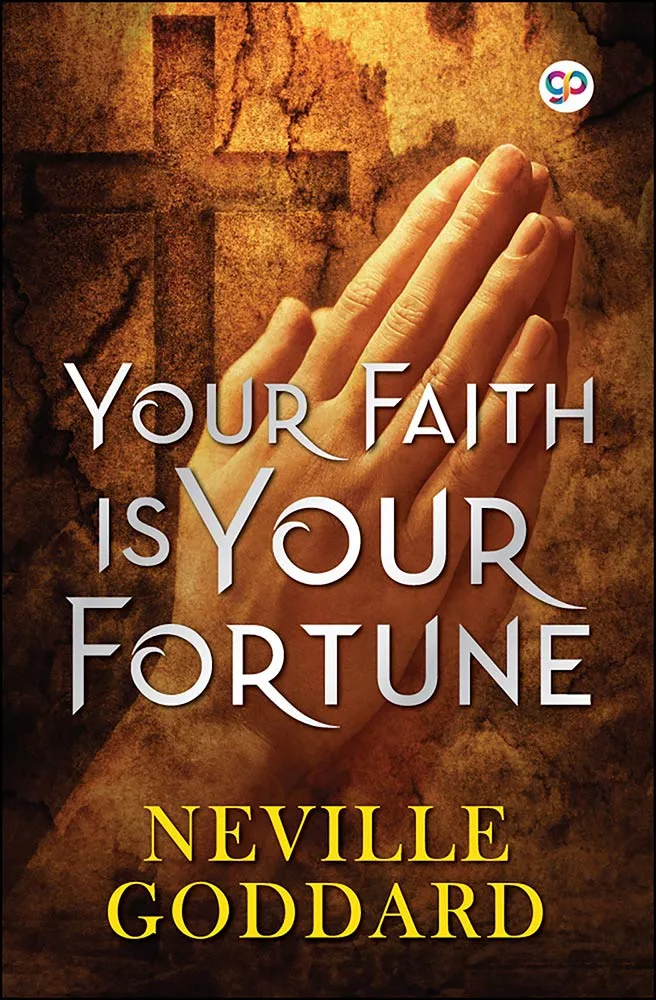
Your Faith is Your Fortune
Paperback
• 132 Pages
• INR 275.00
• English
• 9789389157161
No ratings yet
| Publisher | General Press |
|---|---|
| ISBN13 | 9789389157161 |
| ASIN/SKU | 9389157161 |
| Book Format | Paperback |
| Language | English |
| Pages | 132 |
| List Price | INR 275.00 |
| Subject Code | REL062000, REL022000, REL012040, OCC036020 |
| Publishing Date | 22/05/2019 |
| Dimensions | 8.25 x 5.25 x 1.0 inches |
| Book Code | BD00068057 |
Buy this Book
Amazon Stores
Ebook Stores
Other Stores
Discover Your Faith is Your Fortune by Neville Goddard. This book is published by General Press in Paperback format, ISBN 9789389157161, ASIN 9389157161, under Self-Help, Spirituality, New Thought.
Book Description
There is a version of your life that already exists — fully realized, abundant, and whole — and the only thing standing between you and it is what you genuinely believe to be true. That is the arresting, quietly radical claim at the heart of 'Your Faith is Your Fortune' by Neville Goddard, an early and essential work of metaphysical self-help that introduced many readers to one of the twentieth century's most original and compelling spiritual thinkers.
Goddard's central teaching in this book is a bold reinterpretation of scripture and spiritual law. He argues that the Bible, read literally, misses its own deepest meaning — that its stories are not historical accounts but psychological dramas, maps of the inner world, and instructions for how the human mind creates reality. For Goddard, "God" is not a distant external being but the deepest creative power within human consciousness itself, and faith is not passive belief but the active, felt conviction that what you desire is already real.
The book moves through a series of chapters that build this case with remarkable clarity and force. Goddard draws on the words and teachings of Jesus, reading familiar passages through an entirely new lens and arriving at conclusions that feel both surprising and strangely self-evident. His prose is calm and assured, free of the breathless urgency that characterizes so much of the prosperity and manifestation literature that came after him. He writes like someone who has tested these ideas thoroughly and found them to hold.
At the practical level, the book teaches readers to use imagination deliberately — not as daydreaming or wishful thinking, but as the primary creative faculty through which inner states are impressed upon outer reality. Assumption, Goddard insists, is everything. What you accept as true about yourself and your world, you will eventually live.
Whether you come to this book from a spiritual background or simply with an open and curious mind, Goddard has a way of making you see the relationship between thought and experience in a light you won't easily forget.
Goddard's central teaching in this book is a bold reinterpretation of scripture and spiritual law. He argues that the Bible, read literally, misses its own deepest meaning — that its stories are not historical accounts but psychological dramas, maps of the inner world, and instructions for how the human mind creates reality. For Goddard, "God" is not a distant external being but the deepest creative power within human consciousness itself, and faith is not passive belief but the active, felt conviction that what you desire is already real.
The book moves through a series of chapters that build this case with remarkable clarity and force. Goddard draws on the words and teachings of Jesus, reading familiar passages through an entirely new lens and arriving at conclusions that feel both surprising and strangely self-evident. His prose is calm and assured, free of the breathless urgency that characterizes so much of the prosperity and manifestation literature that came after him. He writes like someone who has tested these ideas thoroughly and found them to hold.
At the practical level, the book teaches readers to use imagination deliberately — not as daydreaming or wishful thinking, but as the primary creative faculty through which inner states are impressed upon outer reality. Assumption, Goddard insists, is everything. What you accept as true about yourself and your world, you will eventually live.
Whether you come to this book from a spiritual background or simply with an open and curious mind, Goddard has a way of making you see the relationship between thought and experience in a light you won't easily forget.
Author Biography
Neville Lancelot Goddard (1905–1972) was a prominent and highly influential teacher in the New Thought movement, best known for his philosophy on the creative power of the human imagination. Born in St. Michael, Barbados, Goddard moved to New York City in 1922 to study drama. While working as a dancer and actor, his interests shifted toward mysticism after meeting an eccentric Ethiopian rabbi named Abdullah, who mentored him in Kabbalah, esoteric Christianity, and the psychological interpretation of scripture.
Leaving the theater behind, Neville dedicated his life to teaching what he termed "The Law of Assumption"—the principle that one can manifest their desires by vividly assuming the feeling of the wish fulfilled. Unlike many of his contemporaries, he taught that the Bible was not a historical record but a psychological drama mapping the evolution of human consciousness, asserting that the divine creator is the human imagination itself.
Throughout the mid-20th century, he delivered hundreds of unscripted lectures across the United States and authored foundational metaphysical classics, including Feeling is the Secret and The Power of Awareness. Today, Goddard’s visionary teachings continue to experience a massive resurgence, profoundly shaping modern self-help, spirituality, and manifestation philosophies.
Leaving the theater behind, Neville dedicated his life to teaching what he termed "The Law of Assumption"—the principle that one can manifest their desires by vividly assuming the feeling of the wish fulfilled. Unlike many of his contemporaries, he taught that the Bible was not a historical record but a psychological drama mapping the evolution of human consciousness, asserting that the divine creator is the human imagination itself.
Throughout the mid-20th century, he delivered hundreds of unscripted lectures across the United States and authored foundational metaphysical classics, including Feeling is the Secret and The Power of Awareness. Today, Goddard’s visionary teachings continue to experience a massive resurgence, profoundly shaping modern self-help, spirituality, and manifestation philosophies.
Editorial Reviews
Editorial Reviews will be added soon…
Book Summary
Neville Goddard’s Your Faith Is Your Fortune is a spiritual and philosophical book built around a simple but powerful idea: the way a person thinks, imagines, and believes has a profound influence on the life that person experiences. First published in 1941, the book presents Goddard’s interpretation of the Bible as a guide to understanding consciousness rather than merely as a record of historical or religious events. He argues that faith is not passive belief in something outside ourselves. Instead, faith is an active inner conviction, supported by imagination, that can shape the direction of our lives.
At the center of the book is Goddard’s understanding of God. He does not present God primarily as a distant being who watches human beings from outside. Instead, he repeatedly identifies God with consciousness itself. The divine, in his view, is present within every person. This idea changes the meaning of prayer and faith. Rather than begging an external power to change circumstances, a person should recognize the creative power already present within consciousness. The inner world becomes the starting point from which the outer world is experienced.
Goddard’s interpretation of the biblical phrase “I AM” is especially important. He sees “I AM” as the deepest statement of personal existence. Before a person identifies himself as successful, unsuccessful, wealthy, poor, loved, rejected, capable, or incapable, there is simply the awareness of being. For Goddard, this awareness is sacred. The words that follow “I am” are therefore significant because they define the identity a person accepts. If someone continually thinks, “I am unlucky,” “I am a failure,” or “I am not worthy,” those assumptions can become powerful patterns of experience. Conversely, constructive assumptions can create a different direction.
The book therefore places enormous importance on imagination. Goddard does not regard imagination as a childish escape from reality. He treats it as a creative faculty. What a person vividly imagines and emotionally accepts can influence expectations, behavior, attention, and ultimately circumstances. Imagination allows a person to experience mentally what has not yet appeared physically. The task is not merely to wish for something but to imagine it as though it were already true.
This leads to one of Goddard’s central practices: entering into the feeling of the wish fulfilled. Instead of constantly focusing on the absence of what one wants, the individual should imagine the desired condition as already accomplished. Someone seeking financial security, for example, should not continually rehearse the feeling of being deprived. Instead, the person should cultivate the inner experience of security and sufficiency. The important change takes place first in consciousness.
Goddard emphasizes that emotion gives imagination its force. A vague thought may have little impact, but an idea deeply accepted as true can influence the whole personality. He therefore encourages readers to pay attention to the emotional assumptions behind their thoughts. Fear, resentment, insecurity, and hopelessness can become habitual states just as confidence, gratitude, love, and peace can. The individual’s task is to become conscious of these patterns and deliberately choose better ones.
Another major theme is the power of belief. Goddard argues that people often allow their circumstances to determine what they believe is possible. They look at present conditions and conclude that the future must resemble the past. He reverses this relationship. Instead of allowing present circumstances to dictate imagination, he asks readers to let imagination establish the inner condition from which they approach life. In this sense, faith means trusting an unseen possibility strongly enough to live psychologically from it.
His interpretation of biblical stories follows the same principle. Goddard reads biblical figures and events symbolically, seeing them as representations of psychological and spiritual states. Characters such as Adam, Eve, Abraham, Moses, and Christ are not treated simply as historical individuals. They represent aspects of consciousness and stages of inner development. Biblical language, therefore, becomes a symbolic vocabulary through which the reader can examine the self.
Goddard gives special importance to Christ. His interpretation differs from traditional Christian theology because he emphasizes Christ as a divine principle or state of consciousness within humanity. The story of Christ’s birth, death, and resurrection can therefore be understood as a symbolic description of transformation. The “resurrection” of an idea, for instance, can represent the emergence of a new state of consciousness after an old identity has been abandoned.
The concept of transformation is central to the book. Goddard believes that changing circumstances begins with changing the inner state from which one experiences life. If a person repeatedly identifies with fear and limitation, those states become familiar. To change, the person must stop feeding the old identity and begin inhabiting a new one. This requires persistence because deeply established assumptions do not disappear after one positive thought.
Goddard also stresses the importance of mental discipline. He does not suggest that people should suppress every negative thought. Rather, he wants them to become aware of what they repeatedly accept as true. A passing worry is different from a belief that one continually reinforces. The goal is to choose the ideas that deserve attention and refuse to give unnecessary authority to destructive assumptions.
Prayer, in Goddard’s interpretation, is therefore closely connected with imagination. Instead of asking repeatedly for an uncertain future, the person imagines the desired outcome as already accomplished and responds internally as though it were real. Gratitude becomes especially meaningful because it expresses the feeling that the desired condition has already been received. Prayer becomes a state of consciousness rather than merely a spoken request.
The title, Your Faith Is Your Fortune, summarizes this philosophy. Goddard’s “fortune” is not limited to financial wealth. It includes the quality of one’s relationships, sense of purpose, confidence, peace, and overall experience of life. Faith becomes a kind of inner capital because what a person consistently believes about himself and the world influences what he notices, expects, attempts, and accepts.
The book also contains a strong message about responsibility. If consciousness plays such an important role in experience, then individuals cannot simply blame circumstances for everything. Goddard encourages readers to examine their assumptions rather than constantly criticizing external conditions. This does not mean that every hardship is consciously created by the person experiencing it. Rather, his emphasis is on the power individuals possess to change their inner response and direction.
At its most practical level, the book asks readers to imagine deliberately. Before sleeping, when the mind is relaxed, a person can mentally rehearse a desired situation. The scene should be short, simple, and emotionally convincing. Instead of watching oneself achieve the goal from a distance, one should imagine experiencing it directly. The purpose is to make the desired state feel natural.
Ultimately, Your Faith Is Your Fortune is a book about the relationship between consciousness and possibility. Its central teaching is that people are not merely passive observers of life; they participate in creating the meaning and direction of their experience through their assumptions, imagination, and faith. Goddard’s interpretation of Scripture is unconventional and deeply rooted in metaphysical thought, but his practical message is straightforward: become conscious of what you repeatedly believe, stop allowing fear to define your identity, imagine the life you want as possible and present, and cultivate the inner state that corresponds to it.
Whether one accepts Goddard’s metaphysical claims literally or views them as a form of psychological self-discipline, the book offers an enduring invitation to examine the inner stories that shape our lives. It reminds readers that imagination can be used either to magnify fear or to open the door to hope. For Goddard, genuine faith begins when a person stops seeing the desired future as something impossibly distant and begins, inwardly, to live from the conviction that transformation is already possible.
At the center of the book is Goddard’s understanding of God. He does not present God primarily as a distant being who watches human beings from outside. Instead, he repeatedly identifies God with consciousness itself. The divine, in his view, is present within every person. This idea changes the meaning of prayer and faith. Rather than begging an external power to change circumstances, a person should recognize the creative power already present within consciousness. The inner world becomes the starting point from which the outer world is experienced.
Goddard’s interpretation of the biblical phrase “I AM” is especially important. He sees “I AM” as the deepest statement of personal existence. Before a person identifies himself as successful, unsuccessful, wealthy, poor, loved, rejected, capable, or incapable, there is simply the awareness of being. For Goddard, this awareness is sacred. The words that follow “I am” are therefore significant because they define the identity a person accepts. If someone continually thinks, “I am unlucky,” “I am a failure,” or “I am not worthy,” those assumptions can become powerful patterns of experience. Conversely, constructive assumptions can create a different direction.
The book therefore places enormous importance on imagination. Goddard does not regard imagination as a childish escape from reality. He treats it as a creative faculty. What a person vividly imagines and emotionally accepts can influence expectations, behavior, attention, and ultimately circumstances. Imagination allows a person to experience mentally what has not yet appeared physically. The task is not merely to wish for something but to imagine it as though it were already true.
This leads to one of Goddard’s central practices: entering into the feeling of the wish fulfilled. Instead of constantly focusing on the absence of what one wants, the individual should imagine the desired condition as already accomplished. Someone seeking financial security, for example, should not continually rehearse the feeling of being deprived. Instead, the person should cultivate the inner experience of security and sufficiency. The important change takes place first in consciousness.
Goddard emphasizes that emotion gives imagination its force. A vague thought may have little impact, but an idea deeply accepted as true can influence the whole personality. He therefore encourages readers to pay attention to the emotional assumptions behind their thoughts. Fear, resentment, insecurity, and hopelessness can become habitual states just as confidence, gratitude, love, and peace can. The individual’s task is to become conscious of these patterns and deliberately choose better ones.
Another major theme is the power of belief. Goddard argues that people often allow their circumstances to determine what they believe is possible. They look at present conditions and conclude that the future must resemble the past. He reverses this relationship. Instead of allowing present circumstances to dictate imagination, he asks readers to let imagination establish the inner condition from which they approach life. In this sense, faith means trusting an unseen possibility strongly enough to live psychologically from it.
His interpretation of biblical stories follows the same principle. Goddard reads biblical figures and events symbolically, seeing them as representations of psychological and spiritual states. Characters such as Adam, Eve, Abraham, Moses, and Christ are not treated simply as historical individuals. They represent aspects of consciousness and stages of inner development. Biblical language, therefore, becomes a symbolic vocabulary through which the reader can examine the self.
Goddard gives special importance to Christ. His interpretation differs from traditional Christian theology because he emphasizes Christ as a divine principle or state of consciousness within humanity. The story of Christ’s birth, death, and resurrection can therefore be understood as a symbolic description of transformation. The “resurrection” of an idea, for instance, can represent the emergence of a new state of consciousness after an old identity has been abandoned.
The concept of transformation is central to the book. Goddard believes that changing circumstances begins with changing the inner state from which one experiences life. If a person repeatedly identifies with fear and limitation, those states become familiar. To change, the person must stop feeding the old identity and begin inhabiting a new one. This requires persistence because deeply established assumptions do not disappear after one positive thought.
Goddard also stresses the importance of mental discipline. He does not suggest that people should suppress every negative thought. Rather, he wants them to become aware of what they repeatedly accept as true. A passing worry is different from a belief that one continually reinforces. The goal is to choose the ideas that deserve attention and refuse to give unnecessary authority to destructive assumptions.
Prayer, in Goddard’s interpretation, is therefore closely connected with imagination. Instead of asking repeatedly for an uncertain future, the person imagines the desired outcome as already accomplished and responds internally as though it were real. Gratitude becomes especially meaningful because it expresses the feeling that the desired condition has already been received. Prayer becomes a state of consciousness rather than merely a spoken request.
The title, Your Faith Is Your Fortune, summarizes this philosophy. Goddard’s “fortune” is not limited to financial wealth. It includes the quality of one’s relationships, sense of purpose, confidence, peace, and overall experience of life. Faith becomes a kind of inner capital because what a person consistently believes about himself and the world influences what he notices, expects, attempts, and accepts.
The book also contains a strong message about responsibility. If consciousness plays such an important role in experience, then individuals cannot simply blame circumstances for everything. Goddard encourages readers to examine their assumptions rather than constantly criticizing external conditions. This does not mean that every hardship is consciously created by the person experiencing it. Rather, his emphasis is on the power individuals possess to change their inner response and direction.
At its most practical level, the book asks readers to imagine deliberately. Before sleeping, when the mind is relaxed, a person can mentally rehearse a desired situation. The scene should be short, simple, and emotionally convincing. Instead of watching oneself achieve the goal from a distance, one should imagine experiencing it directly. The purpose is to make the desired state feel natural.
Ultimately, Your Faith Is Your Fortune is a book about the relationship between consciousness and possibility. Its central teaching is that people are not merely passive observers of life; they participate in creating the meaning and direction of their experience through their assumptions, imagination, and faith. Goddard’s interpretation of Scripture is unconventional and deeply rooted in metaphysical thought, but his practical message is straightforward: become conscious of what you repeatedly believe, stop allowing fear to define your identity, imagine the life you want as possible and present, and cultivate the inner state that corresponds to it.
Whether one accepts Goddard’s metaphysical claims literally or views them as a form of psychological self-discipline, the book offers an enduring invitation to examine the inner stories that shape our lives. It reminds readers that imagination can be used either to magnify fear or to open the door to hope. For Goddard, genuine faith begins when a person stops seeing the desired future as something impossibly distant and begins, inwardly, to live from the conviction that transformation is already possible.
Sample Chapters
Chapter 1 : Before Abraham Was
“Verily, verily, I say unto you, before Abraham was, I AM.” —John 8:58
“In the beginning was the Word, and the Word was with God, and the Word was God.”
In the beginning was the unconditioned awareness of being, and the unconditioned awareness of being became conditioned by imagining itself to be something, and the unconditioned awareness of being became that which it had imagined itself to be; so did creation begin.
By this law, first conceiving, then becoming that conceived, all things evolve out of nothing; and without this sequence there is not anything made that is made.
“Before Abraham or the world was, I AM.” “When all of time shall cease to be, I AM.” I AM the formless awareness of being conceiving myself to be man. By my everlasting law of being I AM compelled to be and to express all that I believe myself to be.
I AM the eternal Nothingness containing within my formless self the capacity to be all things. I AM that in which all my conceptions of myself live and move and have their being, and apart from which they are not.
I dwell within every conception of myself; from this withinness, I ever seek to transcend all conceptions of myself. By the very law of my being, I transcend my conceptions of myself, only as I believe myself to be that which does transcend.
I AM the law of being and beside ME there is no law. I AM that I AM.
Chapter 2 : You shall Decree
“So shall my word be that goeth forth out of my mouth; it shall not return unto me void, but it shall accomplish that which I please, and it shall prosper in the thing whereto I sent it.”
Isaiah 55:11
Man can decree a thing and it will come to pass.
Man has always decreed that which has appeared in his world. He is today decreeing that which is appearing in his world and he shall continue to do so as long as man is conscious of being man.
Nothing has ever appeared in man’s world, but what man decreed that it should. This you may deny; but try as you will, you cannot disprove it for this decreeing is based upon a changeless principle. Man does not command things to appear by his words, which are, more often than not, a confession of his doubts and fears. Decreeing is ever done in consciousness.
Every man automatically expresses that which he is conscious of being. Without effort or the use of words, at every moment of time, man is commanding himself to be and to possess that which he is conscious of being and possessing.
This changeless principle of expression is dramatized in all the Bibles of the world. The writers of our sacred books were illumined mystics, past masters in the art of psychology. In telling the story of the soul, they personified this impersonal principle in the form of a historical document both to preserve it and to hide it from the eyes of the uninitiated.
Today, those to whom this great treasure has been entrusted, namely, the priesthoods of the world, have forgotten that the Bibles are psychological dramas representing the consciousness of man; in their blind forgetfulness, they now teach their followers to worship its characters as men and women who actually lived in time and space.
When man sees the Bible as a great psychological drama, with all of its characters and actors as the personified qualities and attributes of his own consciousness, then—and then only—will the Bible reveal to him the light of its symbology. This Impersonal principle of life which made all things is personified as God. This Lord God, creator of heaven and earth, is discovered to be man’s awareness of being. If man were less bound by orthodoxy and more intuitively observant, he could not fail to notice in the reading of the Bibles that the awareness of being is revealed hundreds of times throughout this literature. To name a few: “I AM hath sent me unto you.” “Be still and know that I AM God.” “I AM the Lord and there is no God.” “I AM the shepherd.” “I AM the door.” “I AM the resurrection and the life.” “I AM the way.” “I AM the beginning and the end.”
I AM; man’s unconditioned awareness of being is revealed as Lord and Creator of every conditioned state of being. If man would give up his belief in a God apart from himself, recognize his awareness of being to be God (this awareness fashions itself in the likeness and image of its conception of itself), he would transform his world from a barren waste to a fertile field of his own liking.
The day man does this he will know that he and his Father are one, but his Father is greater than he. He will know that his consciousness of being is one with that which he is conscious of being, but that his unconditioned consciousness of being is greater than his conditioned state or his conception of himself.
When man discovers his consciousness to be the impersonal power of expression, which power eternally personifies itself in his conceptions of himself, he will assume and appropriate that state of consciousness which he desires to express; in so doing he will become that state in expression.
“Ye shall decree a thing and it shall come to pass” can now be told in this manner: You shall become conscious of being or possessing a thing and you shall express or possess that which you are conscious of being.
The law of consciousness is the only law of expression. “I AM the way”. “I AM the resurrection”. Consciousness is the way as well as the power which resurrects and expresses all that man will ever be conscious of being.
Turn from the blindness of the uninitiated man who attempts to express and possess those qualities and things which he is not conscious of being and possessing; and be as the illumined mystic who decrees, on the basis of this changeless law. Consciously claim yourself to be that which you seek; appropriate the consciousness of that which you see; and you too will know the status of the true mystic, as follows:
I became conscious of being it. I am still conscious of being it. And I shall continue to be conscious of being it until that which I am conscious of being is perfectly expressed.
“Yes, I shall decree a thing and it shall come to pass.”
Chapter 3 : The Principle of Truth
“Ye shall know the truth, and the truth shall make you free.”
John 8:32
The truth that sets man free is the knowledge that his consciousness is the resurrection and the life, that his consciousness both resurrects and makes alive all that he is conscious of being. Apart from consciousness, there is neither resurrection nor life.
When man gives up his belief in a God apart from himself and begins to recognize his awareness of being to be God, as did Jesus and the prophets, he will transform his world with the realization, “I and My Father are one” but “My Father is greater than I.” He will know that his consciousness is God and that which he is conscious of being is the Son bearing witness of God, the Father.
The conceiver and the conception are one, but the conceiver is greater than his conception. “Before Abraham was, I AM.” Yes, I was aware of being before I became aware of being man, and in that day when I shall cease to be conscious of being man I shall still be conscious of being.
The consciousness of being is not dependent upon being anything. It preceded all conceptions of itself and shall be when all conceptions of itself shall cease to be. “I AM the beginning and the end”. That is, all things or conceptions of myself begin and end in me, but I, the formless awareness, remain forever.
Jesus discovered this glorious truth and declared Himself to be one with God, not the God that man had fashioned, for He never recognized such a God. Jesus found God to be His awareness of being and so told man that the Kingdom of God and Heaven were within.
When it is recorded that Jesus left the world and went to His Father it is simply stating that He turned His attention from the world of the senses and rose in consciousness to that level which He desired to express. There He remained until He became one with the consciousness to which He ascended. When He returned to the world of man, He could act with the positive assurance of that which He was conscious of being, a state of consciousness no one but Himself felt or knew that He possessed. Man who is ignorant of this everlasting law of expression looks upon such happenings as miracles.
To rise in consciousness to the level of the thing desired and to remain there until such level becomes your nature is the way of all seeming miracles. “And I, if I be lifted up, I shall draw all men unto me.” If I be lifted up in consciousness to the naturalness of the thing desired, I shall draw the manifestation of that desire to me.
“No man comes unto Me save the Father within Me draws him”, and “I and My Father are one.” My consciousness is the Father who draws the manifestation of life to me. The nature of the manifestation is determined by the state of consciousness in which I dwell. I am always drawing into my world that which I am conscious of being.
If you are dissatisfied with your present expression of life, then you must be born again. Rebirth is the dropping of that level with which you are dissatisfied and rising to that level of consciousness which you desire to express and possess.
You cannot serve two masters or opposing states of consciousness at the same time. Taking your attention from one state and placing it upon the other, you die to the one from which you have taken it and you live and express the one with which you are united.
Man cannot see how it would be possible to express that which he desires to be by so simple a law as acquiring the consciousness of the thing desired. The reason for this lack of faith on the part of man is that he looks at the desired state through the consciousness of his present limitations. Therefore, he naturally sees it as impossible of accomplishment.
One of the first things man must realize is that it is impossible, in dealing with this spiritual law of consciousness, “to put new wine into old bottles or new patches on old garments.” That is, you cannot take any part of the present consciousness into the new state. For the state sought is complete in itself and needs no patching. Every level of consciousness automatically expresses itself.
To rise to the level of any state is to automatically become that state in expression. But, in order to rise to the level that you are not now expressing, you must completely drop the consciousness with which you are now identified. Until your present consciousness is dropped, you will not be able to rise to another level. Do not be dismayed. This letting go of your present identity is not as difficult as it might appear to be. The invitation of the scriptures, “To be absent from the body and be present with the Lord” is not given to a select few; it is a sweeping call to all mankind. The body from which you are invited to escape is your present conception of yourself with all of its limitations, while the Lord with whom you are to be present, is your awareness of being.
To accomplish this seemingly impossible feat, you take your attention away from your problem and place it upon just being. You say silently but feelingly, “I AM”. Do not condition this awareness but continue declaring quietly, “I AM, I AM”. Simply feel that you are faceless and formless and continue doing so until you feel yourself floating.
“Floating” is a psychological state which completely denies the physical. Through practice in relaxation and wilfully refusing to react to sensory impressions, it is possible to develop a state of consciousness of pure receptivity. It is a surprisingly easy accomplishment. In this state of complete detachment, a definite singleness of purposeful thought can be indelibly engraved upon your unmodified consciousness. This state of consciousness is necessary for true meditation.
This wonderful experience of rising and floating is the signal that you are absent from the body or problem and are now present with the Lord; in this expanded state you are not conscious of being anything but I AM, I AM; you are only conscious of being.
When this expansion of consciousness is attained, within this formless deep of yourself, give form to the new conception by claiming and feeling yourself to be that which you, before you entered into this state, desired to be. You will find that within this formless deep of yourself all things appear to be divinely possible. Anything that you sincerely feel yourself to be, while in this expanded state, becomes, in time, your natural expression.
And God said, “Let there be a firmament in the midst of the waters.” Yes, let there be a firmness or conviction in the midst of this expanded consciousness by knowing and feeling I AM that, the thing desired.
As you claim and feel yourself to be the thing desired, you are crystallizing this formless liquid light, that you are, into the image and likeness of that which you are conscious of being.
Now that the law of your being has been revealed to you, begin this day to change your world by revaluing yourself. Too long has man held to the belief that he is born of sorrow and must work out his salvation by the sweat of his brow. God is impersonal and no respecter of persons. So long as man continues to walk in this belief of sorrow, so long will the walk in a world of sorrow and confusion, for the world in its every detail, is man’s consciousness crystallized.
In the Book of Numbers it is recorded, “There were giants in the land and we were in our own sight as grasshoppers, and we were in their sight as grasshoppers.”
Today is the day, the eternal now, when conditions in the world have attained the appearance of giants. The unemployed, the armies of the enemy, business competition etc. are the giants which make you feel yourself to be a helpless grasshopper.
We are told we were first in our own sight helpless grasshoppers and because of this conception of ourselves were to the enemy helpless grasshoppers.
We can be to others only that which we are to ourselves. Therefore, as we revalue ourselves and begin to feel ourselves to be the giant, a center of power, we automatically change our relationship to the giants, reducing these former monsters to their true place, making them appear to be the helpless grasshoppers.
Paul said of this principle, “It is to the Greeks (or the so-called wise men of the world) foolishness; and to the Jews (or those who look for signs) a stumbling block” with the result that man continues to walk in darkness rather than awake to the realization, “I AM the light of the world.”
Man has so long worshipped the images of his own making that at first he finds this revelation blasphemous, but the day man discovers and accepts this principle as the basis of his life, that day man slays his belief in a God apart from himself.
The story of Jesus’ betrayal in the Garden of Gethsemane is the perfect illustration of man’s discovery of this principle. We are told, the crowds armed with staves and lanterns sought Jesus in the dark of night. As they inquired after the whereabouts of Jesus (salvation), the voice answered, “I AM”; whereupon the entire crowd fell to the ground. On regaining their composure, they again asked to be shown the hiding place of the savior and again the savior said, “I have told you that I AM, therefore if ye seek Me, let all else go.”
Man in the darkness of human ignorance sets out on his search for God, aided by the flickering light of human wisdom. As it is revealed to man that his I AM or awareness of being is his savior, the shock is so great, he mentally falls to the ground, for every belief that he has ever entertained, tumbles, as he realizes that his consciousness is the one and only savior. The knowledge that his I AM is God, compels man to let all others go, for he finds it impossible to serve two Gods. Man cannot accept his awareness of being as God and at the same time believe in another deity.
With this discovery, man’s human ear or hearing (understanding) is cut off by the sword of faith (Peter) as his perfect disciplined hearing (understanding) is restored by (Jesus) the knowledge that “I AM” is Lord and Savior.
Before man can transform his world, he must first lay this foundation or understanding. “I AM the Lord.” Man must know that his awareness of being is God. Until this is firmly established so that no suggestion or argument of others can shake him, he will find himself returning to the slavery of his former belief. “If ye believe not that I AM He, ye shall die in your sins.” Unless man discovers that his consciousness is the cause of every expression of his life, he will continue seeking the cause of his confusion in the world of effects, and so shall die in his fruitless search.
“I AM the vine and ye are the branches.” Consciousness is the vine and that which you are conscious of being is as branches that you feed and keep alive. Just as a branch has no life except it be rooted in the vine, likewise things have no life except you be conscious of them. Just as a branch withers and dies if the sap of the vine ceases to flow towards it, so do things and qualities pass away if you take your attention from them; because your attention is the sap of life which sustains the expression of your life.
“Verily, verily, I say unto you, before Abraham was, I AM.” —John 8:58
“In the beginning was the Word, and the Word was with God, and the Word was God.”
In the beginning was the unconditioned awareness of being, and the unconditioned awareness of being became conditioned by imagining itself to be something, and the unconditioned awareness of being became that which it had imagined itself to be; so did creation begin.
By this law, first conceiving, then becoming that conceived, all things evolve out of nothing; and without this sequence there is not anything made that is made.
“Before Abraham or the world was, I AM.” “When all of time shall cease to be, I AM.” I AM the formless awareness of being conceiving myself to be man. By my everlasting law of being I AM compelled to be and to express all that I believe myself to be.
I AM the eternal Nothingness containing within my formless self the capacity to be all things. I AM that in which all my conceptions of myself live and move and have their being, and apart from which they are not.
I dwell within every conception of myself; from this withinness, I ever seek to transcend all conceptions of myself. By the very law of my being, I transcend my conceptions of myself, only as I believe myself to be that which does transcend.
I AM the law of being and beside ME there is no law. I AM that I AM.
Chapter 2 : You shall Decree
“So shall my word be that goeth forth out of my mouth; it shall not return unto me void, but it shall accomplish that which I please, and it shall prosper in the thing whereto I sent it.”
Isaiah 55:11
Man can decree a thing and it will come to pass.
Man has always decreed that which has appeared in his world. He is today decreeing that which is appearing in his world and he shall continue to do so as long as man is conscious of being man.
Nothing has ever appeared in man’s world, but what man decreed that it should. This you may deny; but try as you will, you cannot disprove it for this decreeing is based upon a changeless principle. Man does not command things to appear by his words, which are, more often than not, a confession of his doubts and fears. Decreeing is ever done in consciousness.
Every man automatically expresses that which he is conscious of being. Without effort or the use of words, at every moment of time, man is commanding himself to be and to possess that which he is conscious of being and possessing.
This changeless principle of expression is dramatized in all the Bibles of the world. The writers of our sacred books were illumined mystics, past masters in the art of psychology. In telling the story of the soul, they personified this impersonal principle in the form of a historical document both to preserve it and to hide it from the eyes of the uninitiated.
Today, those to whom this great treasure has been entrusted, namely, the priesthoods of the world, have forgotten that the Bibles are psychological dramas representing the consciousness of man; in their blind forgetfulness, they now teach their followers to worship its characters as men and women who actually lived in time and space.
When man sees the Bible as a great psychological drama, with all of its characters and actors as the personified qualities and attributes of his own consciousness, then—and then only—will the Bible reveal to him the light of its symbology. This Impersonal principle of life which made all things is personified as God. This Lord God, creator of heaven and earth, is discovered to be man’s awareness of being. If man were less bound by orthodoxy and more intuitively observant, he could not fail to notice in the reading of the Bibles that the awareness of being is revealed hundreds of times throughout this literature. To name a few: “I AM hath sent me unto you.” “Be still and know that I AM God.” “I AM the Lord and there is no God.” “I AM the shepherd.” “I AM the door.” “I AM the resurrection and the life.” “I AM the way.” “I AM the beginning and the end.”
I AM; man’s unconditioned awareness of being is revealed as Lord and Creator of every conditioned state of being. If man would give up his belief in a God apart from himself, recognize his awareness of being to be God (this awareness fashions itself in the likeness and image of its conception of itself), he would transform his world from a barren waste to a fertile field of his own liking.
The day man does this he will know that he and his Father are one, but his Father is greater than he. He will know that his consciousness of being is one with that which he is conscious of being, but that his unconditioned consciousness of being is greater than his conditioned state or his conception of himself.
When man discovers his consciousness to be the impersonal power of expression, which power eternally personifies itself in his conceptions of himself, he will assume and appropriate that state of consciousness which he desires to express; in so doing he will become that state in expression.
“Ye shall decree a thing and it shall come to pass” can now be told in this manner: You shall become conscious of being or possessing a thing and you shall express or possess that which you are conscious of being.
The law of consciousness is the only law of expression. “I AM the way”. “I AM the resurrection”. Consciousness is the way as well as the power which resurrects and expresses all that man will ever be conscious of being.
Turn from the blindness of the uninitiated man who attempts to express and possess those qualities and things which he is not conscious of being and possessing; and be as the illumined mystic who decrees, on the basis of this changeless law. Consciously claim yourself to be that which you seek; appropriate the consciousness of that which you see; and you too will know the status of the true mystic, as follows:
I became conscious of being it. I am still conscious of being it. And I shall continue to be conscious of being it until that which I am conscious of being is perfectly expressed.
“Yes, I shall decree a thing and it shall come to pass.”
Chapter 3 : The Principle of Truth
“Ye shall know the truth, and the truth shall make you free.”
John 8:32
The truth that sets man free is the knowledge that his consciousness is the resurrection and the life, that his consciousness both resurrects and makes alive all that he is conscious of being. Apart from consciousness, there is neither resurrection nor life.
When man gives up his belief in a God apart from himself and begins to recognize his awareness of being to be God, as did Jesus and the prophets, he will transform his world with the realization, “I and My Father are one” but “My Father is greater than I.” He will know that his consciousness is God and that which he is conscious of being is the Son bearing witness of God, the Father.
The conceiver and the conception are one, but the conceiver is greater than his conception. “Before Abraham was, I AM.” Yes, I was aware of being before I became aware of being man, and in that day when I shall cease to be conscious of being man I shall still be conscious of being.
The consciousness of being is not dependent upon being anything. It preceded all conceptions of itself and shall be when all conceptions of itself shall cease to be. “I AM the beginning and the end”. That is, all things or conceptions of myself begin and end in me, but I, the formless awareness, remain forever.
Jesus discovered this glorious truth and declared Himself to be one with God, not the God that man had fashioned, for He never recognized such a God. Jesus found God to be His awareness of being and so told man that the Kingdom of God and Heaven were within.
When it is recorded that Jesus left the world and went to His Father it is simply stating that He turned His attention from the world of the senses and rose in consciousness to that level which He desired to express. There He remained until He became one with the consciousness to which He ascended. When He returned to the world of man, He could act with the positive assurance of that which He was conscious of being, a state of consciousness no one but Himself felt or knew that He possessed. Man who is ignorant of this everlasting law of expression looks upon such happenings as miracles.
To rise in consciousness to the level of the thing desired and to remain there until such level becomes your nature is the way of all seeming miracles. “And I, if I be lifted up, I shall draw all men unto me.” If I be lifted up in consciousness to the naturalness of the thing desired, I shall draw the manifestation of that desire to me.
“No man comes unto Me save the Father within Me draws him”, and “I and My Father are one.” My consciousness is the Father who draws the manifestation of life to me. The nature of the manifestation is determined by the state of consciousness in which I dwell. I am always drawing into my world that which I am conscious of being.
If you are dissatisfied with your present expression of life, then you must be born again. Rebirth is the dropping of that level with which you are dissatisfied and rising to that level of consciousness which you desire to express and possess.
You cannot serve two masters or opposing states of consciousness at the same time. Taking your attention from one state and placing it upon the other, you die to the one from which you have taken it and you live and express the one with which you are united.
Man cannot see how it would be possible to express that which he desires to be by so simple a law as acquiring the consciousness of the thing desired. The reason for this lack of faith on the part of man is that he looks at the desired state through the consciousness of his present limitations. Therefore, he naturally sees it as impossible of accomplishment.
One of the first things man must realize is that it is impossible, in dealing with this spiritual law of consciousness, “to put new wine into old bottles or new patches on old garments.” That is, you cannot take any part of the present consciousness into the new state. For the state sought is complete in itself and needs no patching. Every level of consciousness automatically expresses itself.
To rise to the level of any state is to automatically become that state in expression. But, in order to rise to the level that you are not now expressing, you must completely drop the consciousness with which you are now identified. Until your present consciousness is dropped, you will not be able to rise to another level. Do not be dismayed. This letting go of your present identity is not as difficult as it might appear to be. The invitation of the scriptures, “To be absent from the body and be present with the Lord” is not given to a select few; it is a sweeping call to all mankind. The body from which you are invited to escape is your present conception of yourself with all of its limitations, while the Lord with whom you are to be present, is your awareness of being.
To accomplish this seemingly impossible feat, you take your attention away from your problem and place it upon just being. You say silently but feelingly, “I AM”. Do not condition this awareness but continue declaring quietly, “I AM, I AM”. Simply feel that you are faceless and formless and continue doing so until you feel yourself floating.
“Floating” is a psychological state which completely denies the physical. Through practice in relaxation and wilfully refusing to react to sensory impressions, it is possible to develop a state of consciousness of pure receptivity. It is a surprisingly easy accomplishment. In this state of complete detachment, a definite singleness of purposeful thought can be indelibly engraved upon your unmodified consciousness. This state of consciousness is necessary for true meditation.
This wonderful experience of rising and floating is the signal that you are absent from the body or problem and are now present with the Lord; in this expanded state you are not conscious of being anything but I AM, I AM; you are only conscious of being.
When this expansion of consciousness is attained, within this formless deep of yourself, give form to the new conception by claiming and feeling yourself to be that which you, before you entered into this state, desired to be. You will find that within this formless deep of yourself all things appear to be divinely possible. Anything that you sincerely feel yourself to be, while in this expanded state, becomes, in time, your natural expression.
And God said, “Let there be a firmament in the midst of the waters.” Yes, let there be a firmness or conviction in the midst of this expanded consciousness by knowing and feeling I AM that, the thing desired.
As you claim and feel yourself to be the thing desired, you are crystallizing this formless liquid light, that you are, into the image and likeness of that which you are conscious of being.
Now that the law of your being has been revealed to you, begin this day to change your world by revaluing yourself. Too long has man held to the belief that he is born of sorrow and must work out his salvation by the sweat of his brow. God is impersonal and no respecter of persons. So long as man continues to walk in this belief of sorrow, so long will the walk in a world of sorrow and confusion, for the world in its every detail, is man’s consciousness crystallized.
In the Book of Numbers it is recorded, “There were giants in the land and we were in our own sight as grasshoppers, and we were in their sight as grasshoppers.”
Today is the day, the eternal now, when conditions in the world have attained the appearance of giants. The unemployed, the armies of the enemy, business competition etc. are the giants which make you feel yourself to be a helpless grasshopper.
We are told we were first in our own sight helpless grasshoppers and because of this conception of ourselves were to the enemy helpless grasshoppers.
We can be to others only that which we are to ourselves. Therefore, as we revalue ourselves and begin to feel ourselves to be the giant, a center of power, we automatically change our relationship to the giants, reducing these former monsters to their true place, making them appear to be the helpless grasshoppers.
Paul said of this principle, “It is to the Greeks (or the so-called wise men of the world) foolishness; and to the Jews (or those who look for signs) a stumbling block” with the result that man continues to walk in darkness rather than awake to the realization, “I AM the light of the world.”
Man has so long worshipped the images of his own making that at first he finds this revelation blasphemous, but the day man discovers and accepts this principle as the basis of his life, that day man slays his belief in a God apart from himself.
The story of Jesus’ betrayal in the Garden of Gethsemane is the perfect illustration of man’s discovery of this principle. We are told, the crowds armed with staves and lanterns sought Jesus in the dark of night. As they inquired after the whereabouts of Jesus (salvation), the voice answered, “I AM”; whereupon the entire crowd fell to the ground. On regaining their composure, they again asked to be shown the hiding place of the savior and again the savior said, “I have told you that I AM, therefore if ye seek Me, let all else go.”
Man in the darkness of human ignorance sets out on his search for God, aided by the flickering light of human wisdom. As it is revealed to man that his I AM or awareness of being is his savior, the shock is so great, he mentally falls to the ground, for every belief that he has ever entertained, tumbles, as he realizes that his consciousness is the one and only savior. The knowledge that his I AM is God, compels man to let all others go, for he finds it impossible to serve two Gods. Man cannot accept his awareness of being as God and at the same time believe in another deity.
With this discovery, man’s human ear or hearing (understanding) is cut off by the sword of faith (Peter) as his perfect disciplined hearing (understanding) is restored by (Jesus) the knowledge that “I AM” is Lord and Savior.
Before man can transform his world, he must first lay this foundation or understanding. “I AM the Lord.” Man must know that his awareness of being is God. Until this is firmly established so that no suggestion or argument of others can shake him, he will find himself returning to the slavery of his former belief. “If ye believe not that I AM He, ye shall die in your sins.” Unless man discovers that his consciousness is the cause of every expression of his life, he will continue seeking the cause of his confusion in the world of effects, and so shall die in his fruitless search.
“I AM the vine and ye are the branches.” Consciousness is the vine and that which you are conscious of being is as branches that you feed and keep alive. Just as a branch has no life except it be rooted in the vine, likewise things have no life except you be conscious of them. Just as a branch withers and dies if the sap of the vine ceases to flow towards it, so do things and qualities pass away if you take your attention from them; because your attention is the sap of life which sustains the expression of your life.
Reader Reviews
No reviews yet.
Your Faith is Your Fortune
Download Cover Image
Do you want to download the full cover image for Your Faith is Your Fortune?