
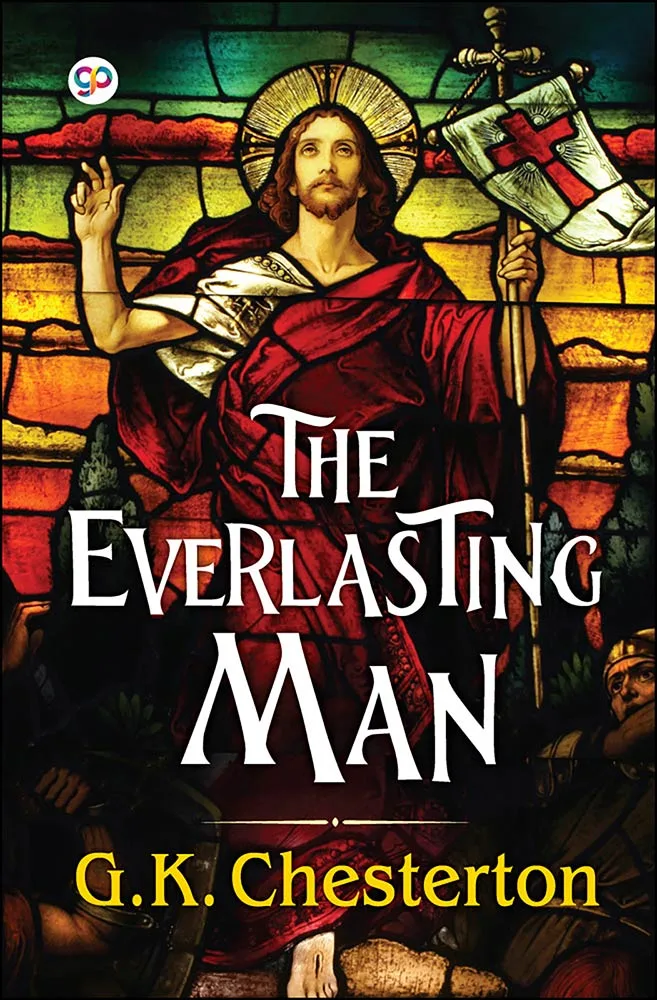
The Everlasting Man
Hardcover
• 262 Pages
• INR 495.00
• English
• 9789389440010
No ratings yet
| Publisher | General Press |
|---|---|
| ISBN13 | 9789389440010 |
| ASIN/SKU | 9389440017 |
| Book Format | Hardcover |
| Language | English |
| Pages | 262 |
| List Price | INR 495.00 |
| Subject Code | REL067030, REL015000, PHI022000 |
| Publishing Date | 01/08/2019 |
| Dimensions | 8.25 x 5.25 x 1.0 inches |
| Book Code | BD00068079 |
Buy this Book
Amazon Stores
Ebook Stores
Other Stores
Discover The Everlasting Man by G.K. Chesterton. This book is published by General Press in Hardcover format, ISBN 9789389440010, ASIN 9389440017, under Christian Books and Bibles, Christian Theology, Christianity.
Book Description
In this book G.K. Chesterton explains how religion—a blend of philosophy and mythology—satisfies both the human intellect and the spirit, and sets man starkly apart from any other living creature. Addressing evolution, feminism, and cultural relativism within the context of religion, the book also examines religious skepticism. According to Chesterton, the shape of the key is not important. What matters is that it fits the lock and opens the door. An emphatic affirmation of Christian faith, The Everlasting Man is leavened with the author's characteristic wit and wisdom, and appeals to the mind as well as the heart.
Author Biography
Gilbert Keith Chesterton was born in London, England, in 1874. He began his education at St Paul's School, and later went on to study art at the Slade School, and literature at University College in London. Chesterton wrote a great deal of poetry, as well as works of social and literary criticism. Among his most notable books are ‘The Man Who Was Thursday’, a metaphysical thriller, and ‘The Everlasting Man’, a history of humankind's spiritual progress. After Chesterton converted to Catholicism in 1922, he wrote mainly on religious topics. Chesterton is most known for creating the famous priest-detective character Father Brown, who first appeared in ‘The Innocence of Father Brown.’ Chesterton died in 1936 at the age of 62.
Editorial Reviews
Editorial Reviews will be added soon…
Book Summary
G.K. Chesterton’s The Everlasting Man, first published in 1925, is a sweeping work of Christian philosophy, history, anthropology, and apologetics that attempts to explain the significance of Christianity by looking at the entire story of humanity. Rather than beginning with theological doctrine and simply defending it, Chesterton starts with a larger question: What is a human being, and what makes humanity different from the rest of nature? From there, he traces human history from prehistoric existence through ancient civilizations and classical religion to the emergence of Christianity. The book ultimately argues that Christianity is not an accidental product of history but the fulfillment of tensions and longings that had been present in human culture from the beginning. Chesterton’s purpose is therefore both intellectual and imaginative: he wants readers to recover a sense of wonder about humanity, history, religion, and the Christian faith.
The book is divided into two broad parts. The first, commonly known as “On the Creature Called Man,” examines humanity itself and the development of civilization. The second, “On the Man Called Christ,” focuses on Jesus and Christianity. This structure is essential to Chesterton’s argument. He believes that Christianity can be properly understood only after we understand the peculiar nature of the human being. The first part asks what makes human beings unique; the second asks what it means that Christianity places a particular human being—Jesus Christ—at the center of its understanding of reality.
Chesterton begins by challenging theories that reduce humanity to merely another stage in the evolution of animals. He does not deny that human beings have physical relationships with the natural world, but he argues that the human mind, imagination, language, art, religion, moral consciousness, and capacity for civilization cannot be adequately explained by treating humans as simply more advanced animals. His central point is not merely biological difference but spiritual and cultural difference. Humans make pictures, tell stories, bury their dead, create rituals, formulate moral laws, build civilizations, and search for meaning. They do not merely respond to their environment; they interpret it.
This argument leads Chesterton to one of his most memorable ideas: man is the animal that creates images and symbols. Prehistoric art is especially important to him. The cave paintings and early artistic remains of ancient humanity demonstrate, in his view, that prehistoric people possessed imagination and symbolic intelligence. The primitive human being was not merely a brute struggling for food. He was already capable of representing the world through art and symbol. For Chesterton, this is evidence of the extraordinary creative power of the human mind.
He also challenges the popular image of “primitive man” as an intellectually undeveloped creature who gradually became civilized through a simple upward progression. Chesterton sees human history as far more complicated. Early societies could possess sophisticated forms of art, ritual, social organization, and religious thought, while supposedly advanced societies could fall into barbarism or moral confusion. Civilization is not guaranteed to move permanently upward. It can be built, lost, rebuilt, and transformed. Human beings are capable of both extraordinary creativity and extraordinary destruction.
The theme of wonder runs throughout the book. Chesterton believes that modern people often become so accustomed to the world that they stop seeing how strange and remarkable it is. Human existence itself is astonishing. The fact that people can look at the universe and ask what it means is already extraordinary. Chesterton’s argument is therefore partly a recovery of wonder. He wants readers to look again at things they think they already understand and discover that they are much more mysterious than ordinary explanations suggest.
This approach connects to his criticism of materialism. Materialism, in Chesterton’s usage, is not simply the recognition that physical matter exists. It is the philosophical tendency to explain everything about human beings through physical processes alone. Chesterton believes such explanations leave out precisely what is most interesting about humanity: consciousness, freedom, moral responsibility, imagination, and the search for meaning. A purely material explanation may describe the mechanisms of human life, he argues, without explaining the full significance of being human.
Chesterton then turns toward the development of ancient religion and mythology. He does not portray pagan religions as meaningless nonsense. On the contrary, he recognizes their imaginative richness and their attempts to answer profound questions about life, death, nature, fertility, suffering, and destiny. Yet he also sees paganism as containing contradictions. Different gods represent competing aspects of reality, and myths can preserve both moral insight and destructive impulses. The ancient world sensed something important about reality but struggled to integrate its insights into a coherent vision of the human person and the moral universe.
One of Chesterton’s most interesting observations concerns the relationship between paganism and Christianity. He argues that Christianity did not simply appear in a cultural vacuum. The ancient world had already produced many religious and philosophical attempts to understand reality. Greek philosophy sought truth through reason; Roman civilization developed ideas of law and order; various mystery religions explored death and rebirth; Jewish religion emphasized monotheism, morality, covenant, and history. Christianity emerged into this world and, according to Chesterton, unexpectedly brought together elements that had previously remained divided.
The second half of The Everlasting Man therefore shifts dramatically toward Jesus Christ. Chesterton’s argument is not simply that Jesus was a great moral teacher. He believes that this description is inadequate because the Christian story makes much stronger claims about Christ. Jesus is presented simultaneously as genuinely human and as possessing a significance that goes beyond ordinary humanity. Chesterton sees this combination as one of Christianity’s most distinctive features.
Chesterton spends considerable time examining the personality and teachings of Christ. He argues that Jesus cannot easily be placed into familiar categories. He is compassionate but also demanding, gentle but capable of severe words, concerned with individuals but also making universal claims, humble yet speaking with extraordinary authority. Chesterton believes that attempts to reduce Jesus to merely a wise teacher often fail to account for these apparently contrasting qualities. The Christian understanding of Christ, he argues, makes better sense of the paradox because Christianity claims that Christ is both God and man.
The concept of paradox is central to Chesterton’s interpretation. He sees Christianity as a religion of apparently opposing truths held together: God becomes man; strength appears through weakness; victory comes through sacrifice; greatness is found through humility; life emerges through death. Chesterton does not regard these paradoxes as logical weaknesses. He sees them as clues to the depth of Christian thought. Christianity, in his view, has the unusual ability to hold apparently contradictory truths together without reducing one side to the other.
The crucifixion becomes especially important in this argument. Chesterton sees the Cross as the dramatic center of Christianity because it transforms suffering, sacrifice, defeat, and death into part of a story of redemption. Christianity does not simply deny suffering or explain it away. It enters directly into suffering through the person of Christ. The Christian God is not presented as a distant observer of human pain but as one who experiences it from within human history.
Chesterton also considers the resurrection to be indispensable. Christianity, he argues, cannot be reduced to a collection of moral teachings attributed to Jesus. The resurrection is what turns the story into something radically different. The disciples move from despair to extraordinary confidence, and the Christian movement begins with the proclamation that death has been overcome. For Chesterton, Christianity’s historical influence makes most sense when the resurrection is taken seriously as the central claim around which the faith developed.
Another major theme is the relationship between Christianity and the ancient world. Chesterton argues that Christianity did not simply destroy pagan culture; it transformed and redirected many of its human aspirations. Paganism contained genuine insights about beauty, courage, nature, sacrifice, and transcendence, but Christianity reorganized these elements around a new understanding of God and humanity. The result was not simply another religion but a new synthesis of spiritual and cultural ideas.
Chesterton also argues that Christianity preserved a balance between extremes. He believes many philosophical systems become distorted when one virtue or principle is elevated at the expense of others. Christianity, in his interpretation, protects this balance. It calls for humility without self-hatred, courage without cruelty, love without sentimentality, reason without rationalism, and spiritual discipline without contempt for the physical world. Christianity is therefore presented as a system capable of keeping competing truths in creative tension.
The book's treatment of history is consequently different from a conventional historical narrative. Chesterton is less interested in providing a neutral chronology than in identifying what he believes are the deeper patterns of human civilization. He sees recurring tendencies: pride and humility, freedom and authority, civilization and barbarism, spiritual longing and material distraction. Christianity, he argues, enters this recurring human drama with a distinctive answer.
The title The Everlasting Man itself points toward Chesterton’s deepest idea. Humanity is “everlasting” not because individual people are physically immortal but because the human mystery persists throughout history. Human beings remain recognizable across thousands of years. The prehistoric artist, ancient philosopher, medieval pilgrim, and modern citizen may live in vastly different societies, yet all confront questions of love, death, morality, beauty, purpose, and God. Humanity changes its technologies and institutions, but its fundamental spiritual questions remain remarkably constant.
Chesterton’s writing style is as important as his argument. He uses paradox, humor, exaggeration, irony, metaphor, and vivid imagery. His prose often moves through surprising turns rather than following the orderly style of an academic textbook. This can make The Everlasting Man lively and memorable, but it can also make the argument demanding. Chesterton often prefers a dramatic statement to a cautious qualification. Readers should therefore understand that the book is a work of Christian apologetics rather than a neutral academic history of religion.
The work has had an especially notable influence because it was written partly in response to intellectual trends that Chesterton believed reduced human beings to biological or economic explanations. He wanted to defend the uniqueness of humanity and the intellectual seriousness of Christianity. His argument is not that every detail of Christian history can be proven through philosophical reasoning. Rather, he argues that Christianity provides an unusually comprehensive explanation of the strange combination of human qualities visible throughout history.
For modern readers, The Everlasting Man remains valuable even when they disagree with Chesterton’s conclusions. The book asks important questions about what makes humans human and whether purely material explanations are sufficient. It also encourages readers to look at Christianity historically rather than merely as a private set of beliefs. Chesterton wants the reader to consider the possibility that the Christian story represents a dramatic turning point in humanity’s understanding of itself.
Ultimately, The Everlasting Man is an argument for the uniqueness and dignity of human beings and for the extraordinary significance of Jesus Christ. Its first half suggests that humanity is too imaginative, moral, symbolic, creative, and spiritually restless to be adequately described as merely an advanced animal. Its second half argues that Christianity provides an explanation for these characteristics by placing the human story within the story of God becoming man. Chesterton sees Christ as the point at which the long search of humanity encounters a radically new claim: that the God whom humanity has sought has entered human history.
For readers searching for an in-depth summary of The Everlasting Man by G.K. Chesterton, the book’s central message can be expressed simply: to understand Christianity, we must first understand the extraordinary creature called man, and to understand man fully, we must consider the possibility of Christ. Chesterton’s vision is deliberately grand. He moves from prehistoric caves to ancient religions, from philosophy to mythology, from the rise of civilization to the life and death of Jesus. Throughout, he argues that humanity is a creature of mystery, imagination, morality, and longing. Christianity, in his interpretation, does not erase that mystery but fulfills it. Whether approached as Christian apologetics, cultural criticism, religious philosophy, or a provocative meditation on human history, The Everlasting Man remains a powerful invitation to look at humanity and Christianity with fresh eyes—and to recover a sense of wonder about both.
The book is divided into two broad parts. The first, commonly known as “On the Creature Called Man,” examines humanity itself and the development of civilization. The second, “On the Man Called Christ,” focuses on Jesus and Christianity. This structure is essential to Chesterton’s argument. He believes that Christianity can be properly understood only after we understand the peculiar nature of the human being. The first part asks what makes human beings unique; the second asks what it means that Christianity places a particular human being—Jesus Christ—at the center of its understanding of reality.
Chesterton begins by challenging theories that reduce humanity to merely another stage in the evolution of animals. He does not deny that human beings have physical relationships with the natural world, but he argues that the human mind, imagination, language, art, religion, moral consciousness, and capacity for civilization cannot be adequately explained by treating humans as simply more advanced animals. His central point is not merely biological difference but spiritual and cultural difference. Humans make pictures, tell stories, bury their dead, create rituals, formulate moral laws, build civilizations, and search for meaning. They do not merely respond to their environment; they interpret it.
This argument leads Chesterton to one of his most memorable ideas: man is the animal that creates images and symbols. Prehistoric art is especially important to him. The cave paintings and early artistic remains of ancient humanity demonstrate, in his view, that prehistoric people possessed imagination and symbolic intelligence. The primitive human being was not merely a brute struggling for food. He was already capable of representing the world through art and symbol. For Chesterton, this is evidence of the extraordinary creative power of the human mind.
He also challenges the popular image of “primitive man” as an intellectually undeveloped creature who gradually became civilized through a simple upward progression. Chesterton sees human history as far more complicated. Early societies could possess sophisticated forms of art, ritual, social organization, and religious thought, while supposedly advanced societies could fall into barbarism or moral confusion. Civilization is not guaranteed to move permanently upward. It can be built, lost, rebuilt, and transformed. Human beings are capable of both extraordinary creativity and extraordinary destruction.
The theme of wonder runs throughout the book. Chesterton believes that modern people often become so accustomed to the world that they stop seeing how strange and remarkable it is. Human existence itself is astonishing. The fact that people can look at the universe and ask what it means is already extraordinary. Chesterton’s argument is therefore partly a recovery of wonder. He wants readers to look again at things they think they already understand and discover that they are much more mysterious than ordinary explanations suggest.
This approach connects to his criticism of materialism. Materialism, in Chesterton’s usage, is not simply the recognition that physical matter exists. It is the philosophical tendency to explain everything about human beings through physical processes alone. Chesterton believes such explanations leave out precisely what is most interesting about humanity: consciousness, freedom, moral responsibility, imagination, and the search for meaning. A purely material explanation may describe the mechanisms of human life, he argues, without explaining the full significance of being human.
Chesterton then turns toward the development of ancient religion and mythology. He does not portray pagan religions as meaningless nonsense. On the contrary, he recognizes their imaginative richness and their attempts to answer profound questions about life, death, nature, fertility, suffering, and destiny. Yet he also sees paganism as containing contradictions. Different gods represent competing aspects of reality, and myths can preserve both moral insight and destructive impulses. The ancient world sensed something important about reality but struggled to integrate its insights into a coherent vision of the human person and the moral universe.
One of Chesterton’s most interesting observations concerns the relationship between paganism and Christianity. He argues that Christianity did not simply appear in a cultural vacuum. The ancient world had already produced many religious and philosophical attempts to understand reality. Greek philosophy sought truth through reason; Roman civilization developed ideas of law and order; various mystery religions explored death and rebirth; Jewish religion emphasized monotheism, morality, covenant, and history. Christianity emerged into this world and, according to Chesterton, unexpectedly brought together elements that had previously remained divided.
The second half of The Everlasting Man therefore shifts dramatically toward Jesus Christ. Chesterton’s argument is not simply that Jesus was a great moral teacher. He believes that this description is inadequate because the Christian story makes much stronger claims about Christ. Jesus is presented simultaneously as genuinely human and as possessing a significance that goes beyond ordinary humanity. Chesterton sees this combination as one of Christianity’s most distinctive features.
Chesterton spends considerable time examining the personality and teachings of Christ. He argues that Jesus cannot easily be placed into familiar categories. He is compassionate but also demanding, gentle but capable of severe words, concerned with individuals but also making universal claims, humble yet speaking with extraordinary authority. Chesterton believes that attempts to reduce Jesus to merely a wise teacher often fail to account for these apparently contrasting qualities. The Christian understanding of Christ, he argues, makes better sense of the paradox because Christianity claims that Christ is both God and man.
The concept of paradox is central to Chesterton’s interpretation. He sees Christianity as a religion of apparently opposing truths held together: God becomes man; strength appears through weakness; victory comes through sacrifice; greatness is found through humility; life emerges through death. Chesterton does not regard these paradoxes as logical weaknesses. He sees them as clues to the depth of Christian thought. Christianity, in his view, has the unusual ability to hold apparently contradictory truths together without reducing one side to the other.
The crucifixion becomes especially important in this argument. Chesterton sees the Cross as the dramatic center of Christianity because it transforms suffering, sacrifice, defeat, and death into part of a story of redemption. Christianity does not simply deny suffering or explain it away. It enters directly into suffering through the person of Christ. The Christian God is not presented as a distant observer of human pain but as one who experiences it from within human history.
Chesterton also considers the resurrection to be indispensable. Christianity, he argues, cannot be reduced to a collection of moral teachings attributed to Jesus. The resurrection is what turns the story into something radically different. The disciples move from despair to extraordinary confidence, and the Christian movement begins with the proclamation that death has been overcome. For Chesterton, Christianity’s historical influence makes most sense when the resurrection is taken seriously as the central claim around which the faith developed.
Another major theme is the relationship between Christianity and the ancient world. Chesterton argues that Christianity did not simply destroy pagan culture; it transformed and redirected many of its human aspirations. Paganism contained genuine insights about beauty, courage, nature, sacrifice, and transcendence, but Christianity reorganized these elements around a new understanding of God and humanity. The result was not simply another religion but a new synthesis of spiritual and cultural ideas.
Chesterton also argues that Christianity preserved a balance between extremes. He believes many philosophical systems become distorted when one virtue or principle is elevated at the expense of others. Christianity, in his interpretation, protects this balance. It calls for humility without self-hatred, courage without cruelty, love without sentimentality, reason without rationalism, and spiritual discipline without contempt for the physical world. Christianity is therefore presented as a system capable of keeping competing truths in creative tension.
The book's treatment of history is consequently different from a conventional historical narrative. Chesterton is less interested in providing a neutral chronology than in identifying what he believes are the deeper patterns of human civilization. He sees recurring tendencies: pride and humility, freedom and authority, civilization and barbarism, spiritual longing and material distraction. Christianity, he argues, enters this recurring human drama with a distinctive answer.
The title The Everlasting Man itself points toward Chesterton’s deepest idea. Humanity is “everlasting” not because individual people are physically immortal but because the human mystery persists throughout history. Human beings remain recognizable across thousands of years. The prehistoric artist, ancient philosopher, medieval pilgrim, and modern citizen may live in vastly different societies, yet all confront questions of love, death, morality, beauty, purpose, and God. Humanity changes its technologies and institutions, but its fundamental spiritual questions remain remarkably constant.
Chesterton’s writing style is as important as his argument. He uses paradox, humor, exaggeration, irony, metaphor, and vivid imagery. His prose often moves through surprising turns rather than following the orderly style of an academic textbook. This can make The Everlasting Man lively and memorable, but it can also make the argument demanding. Chesterton often prefers a dramatic statement to a cautious qualification. Readers should therefore understand that the book is a work of Christian apologetics rather than a neutral academic history of religion.
The work has had an especially notable influence because it was written partly in response to intellectual trends that Chesterton believed reduced human beings to biological or economic explanations. He wanted to defend the uniqueness of humanity and the intellectual seriousness of Christianity. His argument is not that every detail of Christian history can be proven through philosophical reasoning. Rather, he argues that Christianity provides an unusually comprehensive explanation of the strange combination of human qualities visible throughout history.
For modern readers, The Everlasting Man remains valuable even when they disagree with Chesterton’s conclusions. The book asks important questions about what makes humans human and whether purely material explanations are sufficient. It also encourages readers to look at Christianity historically rather than merely as a private set of beliefs. Chesterton wants the reader to consider the possibility that the Christian story represents a dramatic turning point in humanity’s understanding of itself.
Ultimately, The Everlasting Man is an argument for the uniqueness and dignity of human beings and for the extraordinary significance of Jesus Christ. Its first half suggests that humanity is too imaginative, moral, symbolic, creative, and spiritually restless to be adequately described as merely an advanced animal. Its second half argues that Christianity provides an explanation for these characteristics by placing the human story within the story of God becoming man. Chesterton sees Christ as the point at which the long search of humanity encounters a radically new claim: that the God whom humanity has sought has entered human history.
For readers searching for an in-depth summary of The Everlasting Man by G.K. Chesterton, the book’s central message can be expressed simply: to understand Christianity, we must first understand the extraordinary creature called man, and to understand man fully, we must consider the possibility of Christ. Chesterton’s vision is deliberately grand. He moves from prehistoric caves to ancient religions, from philosophy to mythology, from the rise of civilization to the life and death of Jesus. Throughout, he argues that humanity is a creature of mystery, imagination, morality, and longing. Christianity, in his interpretation, does not erase that mystery but fulfills it. Whether approached as Christian apologetics, cultural criticism, religious philosophy, or a provocative meditation on human history, The Everlasting Man remains a powerful invitation to look at humanity and Christianity with fresh eyes—and to recover a sense of wonder about both.
Sample Chapters
Sample Chapters will be added soon…
Reader Reviews
No reviews yet.
The Everlasting Man
Download Cover Image
Do you want to download the full cover image for The Everlasting Man?