
The Wit and Wisdom of Gandhi
Hardcover
• 178 Pages
• INR 395.00
• English
• 9789389440560
No ratings yet
| Publisher | General Press |
|---|---|
| ISBN13 | 9789389440560 |
| ASIN/SKU | 9389440564 |
| Book Format | Hardcover |
| Language | English |
| Pages | 178 |
| List Price | INR 395.00 |
| Subject Code | HIS062000, REF019000, SEL027000, BIO000000 |
| Publishing Date | 20/09/2019 |
| Dimensions | 8.25 x 5.25 x 1.0 inches |
| Book Code | BD00068109 |
Buy this Book
Amazon Stores
Ebook Stores
Other Stores
Discover The Wit and Wisdom of Gandhi by Mahatma Gandhi. This book is published by General Press in Hardcover format, ISBN 9789389440560, ASIN 9389440564, under Biographies and Memoirs, Philosophy, Nonfiction.
Book Description
Assembled with skill and sensitivity, this selection of brief and incisive quotations range from religion and theology, personal and social ethics, service, and international and political affairs, to the family, education, culture, Indian problems, and Gandhi's most original concept, satyagraha — group nonviolent direct action.
Some quotes from this book:
« Ahimsa is the highest ideal. It is meant for the brave, never for the cowardly.
« Eating for the sake of pleasure is a sin like animal indulgence for the sake of it.
« The real meaning of economic equality is 'to each according to his need'.
« Without prayer there is no inward peace.
Some quotes from this book:
« Ahimsa is the highest ideal. It is meant for the brave, never for the cowardly.
« Eating for the sake of pleasure is a sin like animal indulgence for the sake of it.
« The real meaning of economic equality is 'to each according to his need'.
« Without prayer there is no inward peace.
Author Biography
Born in 1869 in the coastal town of Porbandar, India, Mohandas Karamchand Gandhi was raised in a devout Hindu family heavily influenced by Jain pacifist teachings. After completing his early education in India, he traveled to London in 1888 to study law and jurisprudence. Upon passing the bar, he briefly attempted to establish a legal practice in Bombay before accepting a fateful year-long contract to work in South Africa in 1893.
Instead of a brief stint, Gandhi spent over two decades in South Africa, where he faced severe, systemic racial discrimination. These experiences fundamentally transformed him from a shy lawyer into a resilient civil rights activist. It was here that he first developed and implemented Satyagraha, his defining philosophy of nonviolent civil disobedience, successfully mobilizing the Indian expatriate community to protest oppressive colonial laws.
Returning to India in 1915, Gandhi brought his formidable organizing skills and moral authority to the Indian independence movement. Assuming leadership of the Indian National Congress, the "Mahatma" (Great Soul) orchestrated massive nationwide campaigns against British colonial rule, including the famous Salt March of 1930 and the "Quit India" movement of 1942. His methods relied entirely on peaceful non-cooperation, boycotts, and fasting, which continually captured the world's attention.
Throughout his life of activism, Gandhi was also a remarkably prolific writer and journalist. He founded and edited several influential newspapers, using them to advocate for social reforms, religious harmony, and the eradication of untouchability. His most enduring literary contribution is his deeply introspective autobiography, The Story of My Experiments with Truth, which detailed his lifelong pursuit of spiritual purity, dietary discipline, and the profound moral convictions that guided his political vision.
Though India finally achieved independence in 1947, the violent partition of the subcontinent into India and Pakistan left Gandhi deeply sorrowful. While tirelessly working to quell Hindu-Muslim communal violence, he was assassinated by a Hindu nationalist in January 1948 at the age of seventy-eight. He left behind an unparalleled legacy as the father of modern India and a global icon of peaceful resistance.
Instead of a brief stint, Gandhi spent over two decades in South Africa, where he faced severe, systemic racial discrimination. These experiences fundamentally transformed him from a shy lawyer into a resilient civil rights activist. It was here that he first developed and implemented Satyagraha, his defining philosophy of nonviolent civil disobedience, successfully mobilizing the Indian expatriate community to protest oppressive colonial laws.
Returning to India in 1915, Gandhi brought his formidable organizing skills and moral authority to the Indian independence movement. Assuming leadership of the Indian National Congress, the "Mahatma" (Great Soul) orchestrated massive nationwide campaigns against British colonial rule, including the famous Salt March of 1930 and the "Quit India" movement of 1942. His methods relied entirely on peaceful non-cooperation, boycotts, and fasting, which continually captured the world's attention.
Throughout his life of activism, Gandhi was also a remarkably prolific writer and journalist. He founded and edited several influential newspapers, using them to advocate for social reforms, religious harmony, and the eradication of untouchability. His most enduring literary contribution is his deeply introspective autobiography, The Story of My Experiments with Truth, which detailed his lifelong pursuit of spiritual purity, dietary discipline, and the profound moral convictions that guided his political vision.
Though India finally achieved independence in 1947, the violent partition of the subcontinent into India and Pakistan left Gandhi deeply sorrowful. While tirelessly working to quell Hindu-Muslim communal violence, he was assassinated by a Hindu nationalist in January 1948 at the age of seventy-eight. He left behind an unparalleled legacy as the father of modern India and a global icon of peaceful resistance.
Editorial Reviews
Editorial Reviews will be added soon…
Book Summary
The Wit and Wisdom of Gandhi is best understood not as a conventional autobiography or a single, continuous argument, but as a collection of Gandhi’s thoughts, observations, principles, and memorable statements drawn from the many years of his public life. The book brings together the ideas that shaped his understanding of truth, non-violence, religion, politics, society, education, human relationships, work, poverty, and personal discipline. Reading it is like listening to Gandhi in conversation: sometimes gentle and reflective, sometimes humorous and sharply critical, but almost always concerned with the difficult question of how a human being should live.
At the heart of Gandhi’s thought is the idea of truth. For him, truth was not simply a matter of speaking honestly or avoiding lies. Truth was a lifelong search. Gandhi often described his own life as an experiment with truth because he believed that no person could claim to possess complete truth. This belief gave his philosophy both humility and courage. A person must seek truth sincerely, examine his own mistakes, and be prepared to change when experience proves him wrong. In this sense, truth is not merely something to be declared; it is something to be lived.
Closely connected with truth is Gandhi’s principle of ahimsa, or non-violence. He did not see non-violence as weakness or passive submission. On the contrary, he regarded it as one of the greatest forms of courage. To refuse to hate an opponent, even while resisting injustice, required extraordinary self-control. Gandhi’s concept of non-violence therefore went beyond avoiding physical violence. It also demanded freedom from hatred, revenge, cruelty, and the desire to humiliate another person. His approach suggested that the real victory in a conflict occurs when injustice is challenged without destroying the humanity of the person who commits it.
The book also reveals Gandhi’s distinctive understanding of politics. He did not believe that politics could be separated completely from morality. Political freedom, in his view, was meaningful only when it helped ordinary people live with dignity. This is why his political ideas were closely connected with personal responsibility, self-discipline, service, and social reform. He repeatedly warned against seeking power merely for personal advantage. A political movement that changes rulers without changing the character and values of society cannot produce genuine freedom.
One of the most striking aspects of Gandhi’s wisdom is his insistence that freedom begins with the individual. He believed people often complain about society while ignoring their own conduct. If a person wants honesty in public life, he must practice honesty privately. If he wants peace, he must learn to control anger. If he wants social equality, he must examine his own prejudices. Gandhi’s approach therefore turns political and social problems into personal moral questions. He asks readers not merely, “What is wrong with the world?” but also, “What am I doing that contributes to the problem?”
His attitude toward wealth and material possessions is equally important. Gandhi did not condemn every form of property or comfort, but he strongly opposed greed and the unlimited accumulation of wealth in a world where many people lacked basic necessities. His idea of trusteeship proposed that those who possessed wealth should regard themselves as trustees rather than absolute owners. Wealth, in this view, carries a social responsibility. A prosperous person has an obligation to use resources in ways that benefit the wider community. The idea reflects Gandhi’s larger belief that human beings are connected and that personal success cannot be morally isolated from the suffering of others.
The book also contains Gandhi’s reflections on poverty and the dignity of labour. He admired simple living because it helped people distinguish between genuine needs and unnecessary desires. Manual work was especially important to him. He believed that no honest work should be considered inferior and that people should participate directly in useful labour rather than becoming completely dependent on others. His famous emphasis on the spinning wheel symbolized more than the production of cloth. It represented self-reliance, dignity, economic independence, and solidarity with ordinary people.
Religion occupies another important place in Gandhi’s thought. He was deeply religious, but his understanding of religion was broad and personal rather than narrowly sectarian. He respected different faiths and believed that religions could lead people toward the same moral truths while following different paths. At the same time, he did not think religious belief should excuse intolerance. True religion, in his understanding, should make a person more truthful, compassionate, humble, and willing to serve others. Religious identity without moral conduct was of little value.
Gandhi’s comments on education are also revealing. He believed education should develop the whole person rather than merely fill the mind with information. Knowledge should be connected with character, practical ability, responsibility, and service. A truly educated person should become capable of thinking independently and living responsibly. This explains why Gandhi was suspicious of education that produced cleverness without conscience. Intelligence, in his view, becomes dangerous when it is not guided by moral judgment.
The “wit” in the title is important because Gandhi’s wisdom was not always expressed in solemn language. He could be wonderfully direct, ironic, and humorous. His sharp observations often exposed contradictions in human behaviour without requiring complicated philosophical arguments. He understood that a simple sentence could sometimes reveal more than a long speech. His humour also made his criticism less bitter. Even when addressing serious injustice, he could use understatement or irony to make people pause and think.
Perhaps the most humane quality of the book is Gandhi’s willingness to acknowledge his own imperfections. He did not present himself as someone who had reached moral perfection. Instead, he repeatedly emphasized experimentation, self-examination, failure, and improvement. This makes his ideas feel less like commandments and more like an invitation to undertake one’s own moral journey. His strength came partly from admitting weakness and learning from experience.
Ultimately, The Wit and Wisdom of Gandhi presents a philosophy of life built around truth, non-violence, simplicity, self-discipline, compassion, and service. Its deepest message is that meaningful social change cannot be separated from personal transformation. Gandhi asks us to resist injustice without hatred, pursue truth without arrogance, use wealth responsibly, respect different beliefs, value honest labour, and examine our own conduct before judging others. His ideas may invite disagreement, especially on questions where modern life has changed dramatically, but they remain valuable because they challenge readers to think about the relationship between freedom and responsibility.
The lasting power of Gandhi’s wisdom lies in its simplicity. He continually brings large questions—war and peace, poverty and wealth, politics and religion—back to everyday choices. How we speak, what we consume, how we treat an opponent, whether we admit a mistake, whether we serve someone who cannot repay us: these ordinary actions, he suggests, are where moral life actually happens. The book therefore leaves the reader with more than a collection of memorable sayings. It offers a practical challenge—to make truth a habit, compassion a strength, simplicity a choice, and service a natural part of living.
At the heart of Gandhi’s thought is the idea of truth. For him, truth was not simply a matter of speaking honestly or avoiding lies. Truth was a lifelong search. Gandhi often described his own life as an experiment with truth because he believed that no person could claim to possess complete truth. This belief gave his philosophy both humility and courage. A person must seek truth sincerely, examine his own mistakes, and be prepared to change when experience proves him wrong. In this sense, truth is not merely something to be declared; it is something to be lived.
Closely connected with truth is Gandhi’s principle of ahimsa, or non-violence. He did not see non-violence as weakness or passive submission. On the contrary, he regarded it as one of the greatest forms of courage. To refuse to hate an opponent, even while resisting injustice, required extraordinary self-control. Gandhi’s concept of non-violence therefore went beyond avoiding physical violence. It also demanded freedom from hatred, revenge, cruelty, and the desire to humiliate another person. His approach suggested that the real victory in a conflict occurs when injustice is challenged without destroying the humanity of the person who commits it.
The book also reveals Gandhi’s distinctive understanding of politics. He did not believe that politics could be separated completely from morality. Political freedom, in his view, was meaningful only when it helped ordinary people live with dignity. This is why his political ideas were closely connected with personal responsibility, self-discipline, service, and social reform. He repeatedly warned against seeking power merely for personal advantage. A political movement that changes rulers without changing the character and values of society cannot produce genuine freedom.
One of the most striking aspects of Gandhi’s wisdom is his insistence that freedom begins with the individual. He believed people often complain about society while ignoring their own conduct. If a person wants honesty in public life, he must practice honesty privately. If he wants peace, he must learn to control anger. If he wants social equality, he must examine his own prejudices. Gandhi’s approach therefore turns political and social problems into personal moral questions. He asks readers not merely, “What is wrong with the world?” but also, “What am I doing that contributes to the problem?”
His attitude toward wealth and material possessions is equally important. Gandhi did not condemn every form of property or comfort, but he strongly opposed greed and the unlimited accumulation of wealth in a world where many people lacked basic necessities. His idea of trusteeship proposed that those who possessed wealth should regard themselves as trustees rather than absolute owners. Wealth, in this view, carries a social responsibility. A prosperous person has an obligation to use resources in ways that benefit the wider community. The idea reflects Gandhi’s larger belief that human beings are connected and that personal success cannot be morally isolated from the suffering of others.
The book also contains Gandhi’s reflections on poverty and the dignity of labour. He admired simple living because it helped people distinguish between genuine needs and unnecessary desires. Manual work was especially important to him. He believed that no honest work should be considered inferior and that people should participate directly in useful labour rather than becoming completely dependent on others. His famous emphasis on the spinning wheel symbolized more than the production of cloth. It represented self-reliance, dignity, economic independence, and solidarity with ordinary people.
Religion occupies another important place in Gandhi’s thought. He was deeply religious, but his understanding of religion was broad and personal rather than narrowly sectarian. He respected different faiths and believed that religions could lead people toward the same moral truths while following different paths. At the same time, he did not think religious belief should excuse intolerance. True religion, in his understanding, should make a person more truthful, compassionate, humble, and willing to serve others. Religious identity without moral conduct was of little value.
Gandhi’s comments on education are also revealing. He believed education should develop the whole person rather than merely fill the mind with information. Knowledge should be connected with character, practical ability, responsibility, and service. A truly educated person should become capable of thinking independently and living responsibly. This explains why Gandhi was suspicious of education that produced cleverness without conscience. Intelligence, in his view, becomes dangerous when it is not guided by moral judgment.
The “wit” in the title is important because Gandhi’s wisdom was not always expressed in solemn language. He could be wonderfully direct, ironic, and humorous. His sharp observations often exposed contradictions in human behaviour without requiring complicated philosophical arguments. He understood that a simple sentence could sometimes reveal more than a long speech. His humour also made his criticism less bitter. Even when addressing serious injustice, he could use understatement or irony to make people pause and think.
Perhaps the most humane quality of the book is Gandhi’s willingness to acknowledge his own imperfections. He did not present himself as someone who had reached moral perfection. Instead, he repeatedly emphasized experimentation, self-examination, failure, and improvement. This makes his ideas feel less like commandments and more like an invitation to undertake one’s own moral journey. His strength came partly from admitting weakness and learning from experience.
Ultimately, The Wit and Wisdom of Gandhi presents a philosophy of life built around truth, non-violence, simplicity, self-discipline, compassion, and service. Its deepest message is that meaningful social change cannot be separated from personal transformation. Gandhi asks us to resist injustice without hatred, pursue truth without arrogance, use wealth responsibly, respect different beliefs, value honest labour, and examine our own conduct before judging others. His ideas may invite disagreement, especially on questions where modern life has changed dramatically, but they remain valuable because they challenge readers to think about the relationship between freedom and responsibility.
The lasting power of Gandhi’s wisdom lies in its simplicity. He continually brings large questions—war and peace, poverty and wealth, politics and religion—back to everyday choices. How we speak, what we consume, how we treat an opponent, whether we admit a mistake, whether we serve someone who cannot repay us: these ordinary actions, he suggests, are where moral life actually happens. The book therefore leaves the reader with more than a collection of memorable sayings. It offers a practical challenge—to make truth a habit, compassion a strength, simplicity a choice, and service a natural part of living.
Sample Chapters
Sample Chapters will be added soon…
Reader Reviews
No reviews yet.
The Wit and Wisdom of Gandhi
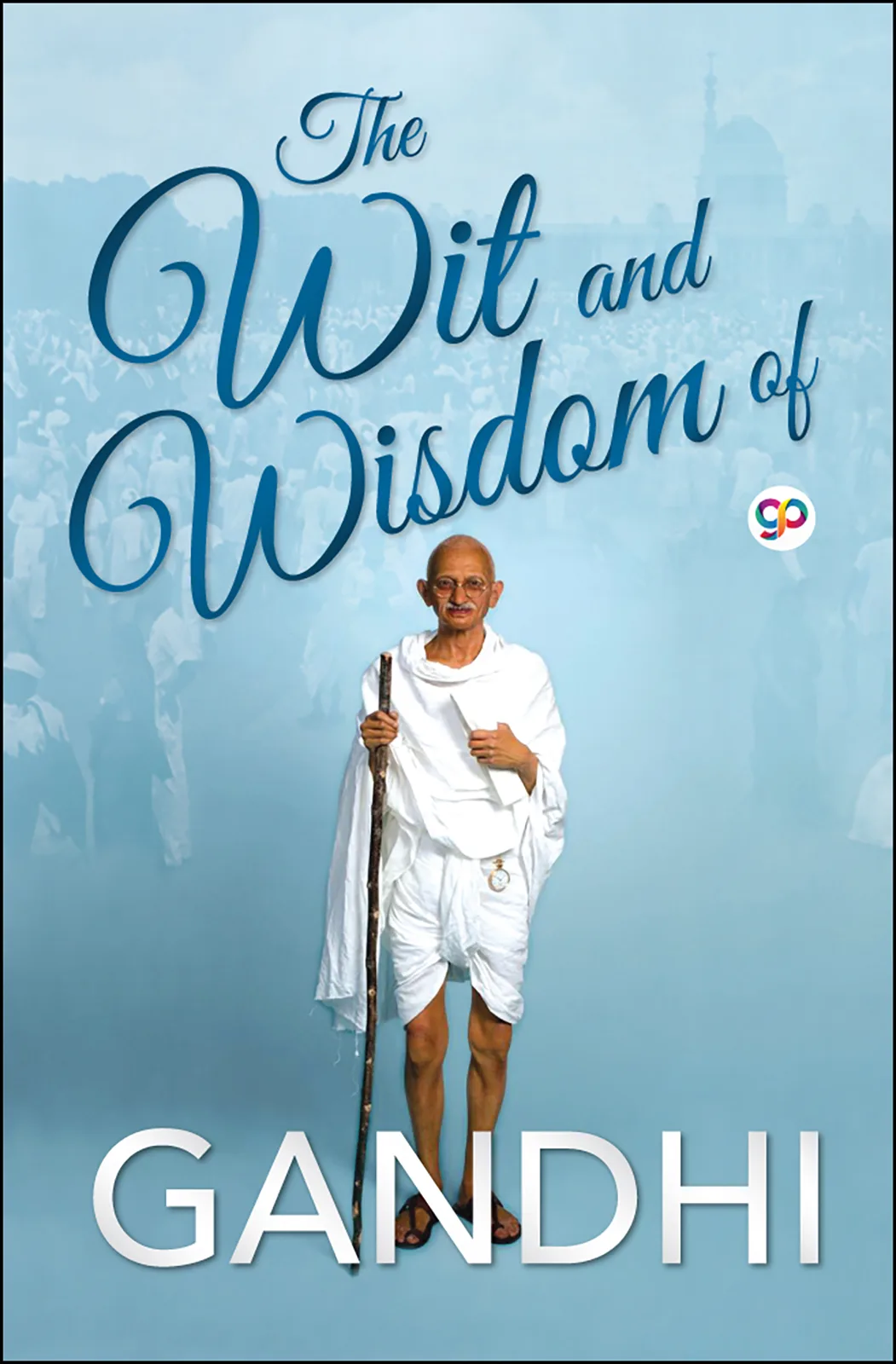
Download Cover Image
Do you want to download the full cover image for The Wit and Wisdom of Gandhi?