
Meditation and Its Methods
Paperback
• 80 Pages
• INR 245.00
• English
• 9789389716320
No ratings yet
| Publisher | General Press |
|---|---|
| ISBN13 | 9789389716320 |
| ASIN/SKU | 9389716322 |
| Book Format | Paperback |
| Language | English |
| Pages | 80 |
| List Price | INR 245.00 |
| Subject Code | SEL019000, SEL024000, SEL021000, SEL003000 |
| Publishing Date | 01/08/2020 |
| Dimensions | 8.25 x 5.25 x 1.0 inches |
| Book Code | BD00068117 |
Buy this Book
Amazon Stores
Ebook Stores
Other Stores
Discover Meditation and Its Methods by Swami Vivekananda. This book is published by General Press in Paperback format, ISBN 9789389716320, ASIN 9389716322, under Self-Help, Spirituality, Philosophy.
Book Description
What if the greatest journey you could take is not across the world, but deep within your own mind? 'Meditation and Its Methods' by Swami Vivekananda is a spiritual and philosophical guide that explores the practice of meditation, the nature of the mind, and the path toward inner peace and self-realization. Drawing from Vedanta and the ancient traditions of yoga, Vivekananda presents meditation not as an escape from everyday life, but as a powerful method for understanding oneself and discovering the deeper possibilities of human consciousness.
At the heart of the book is the idea that the restless mind can be trained. Thoughts, desires, emotions, and distractions often pull a person in countless directions, making it difficult to experience genuine calm or clarity. Vivekananda explains how meditation helps gather this scattered mental energy and turn it inward. Through concentration, discipline, self-control, and steady practice, the seeker gradually learns to observe the mind rather than remain controlled by every passing thought.
The book also introduces readers to different approaches to meditation and explains the importance of developing concentration before attempting deeper spiritual practices. Vivekananda discusses ideas such as controlling the senses, focusing attention, cultivating purity of thought, and recognizing the deeper Self beyond the changing personality. His explanations are practical as well as philosophical, making the teachings accessible even to readers who are encountering meditation and Vedanta for the first time.
Rather than presenting meditation as a quick technique for temporary relaxation, Vivekananda treats it as a transformative discipline capable of changing how a person understands life, consciousness, and the self. His emphasis on patience and persistent practice gives the book a timeless quality, especially for modern readers seeking greater mental clarity and spiritual direction.
'Meditation and Its Methods' remains an engaging introduction to Vivekananda's vision of meditation and its potential to awaken the mind to a deeper reality. For anyone curious about meditation, yoga, Vedanta, or the search for inner freedom, this book offers ideas that may continue to resonate long after the final page.
At the heart of the book is the idea that the restless mind can be trained. Thoughts, desires, emotions, and distractions often pull a person in countless directions, making it difficult to experience genuine calm or clarity. Vivekananda explains how meditation helps gather this scattered mental energy and turn it inward. Through concentration, discipline, self-control, and steady practice, the seeker gradually learns to observe the mind rather than remain controlled by every passing thought.
The book also introduces readers to different approaches to meditation and explains the importance of developing concentration before attempting deeper spiritual practices. Vivekananda discusses ideas such as controlling the senses, focusing attention, cultivating purity of thought, and recognizing the deeper Self beyond the changing personality. His explanations are practical as well as philosophical, making the teachings accessible even to readers who are encountering meditation and Vedanta for the first time.
Rather than presenting meditation as a quick technique for temporary relaxation, Vivekananda treats it as a transformative discipline capable of changing how a person understands life, consciousness, and the self. His emphasis on patience and persistent practice gives the book a timeless quality, especially for modern readers seeking greater mental clarity and spiritual direction.
'Meditation and Its Methods' remains an engaging introduction to Vivekananda's vision of meditation and its potential to awaken the mind to a deeper reality. For anyone curious about meditation, yoga, Vedanta, or the search for inner freedom, this book offers ideas that may continue to resonate long after the final page.
Author Biography
Swami Vivekananda (12 January 1863 – 4 July 1902), born Narendra Nath Datta, was an Indian Hindu monk and chief disciple of the 19th-century saint Ramakrishna. He was a key figure in the introduction of the Indian philosophies of Vedanta and Yoga to the Western world and is credited with raising interfaith awareness, bringing Hinduism to the status of a major world religion during the late 19th century. He was a major force in the revival of Hinduism in India, and contributed to the concept of nationalism in colonial India. Vivekananda founded the Ramakrishna Math and the Ramakrishna Mission. He is perhaps best known for his speech which began, "Sisters and brothers of America ...," in which he introduced Hinduism at the Parliament of the World's Religions in Chicago in 1893.
Born into an aristocratic Bengali family of Calcutta, Vivekananda was inclined towards spirituality. He was influenced by his guru, Ramakrishna, from whom he learnt that all living beings were an embodiment of the divine self; therefore, service to God could be rendered by service to mankind. After Ramakrishna's death, Vivekananda toured the Indian subcontinent extensively and acquired first-hand knowledge of the conditions prevailing in British India. He later travelled to the United States, representing India at the 1893 Parliament of the World Religions. Vivekananda conducted hundreds of public and private lectures and classes, disseminating tenets of Hindu philosophy in the United States, England and Europe. In India, Vivekananda is regarded as a patriotic saint and his birthday is celebrated there as National Youth Day.
Born into an aristocratic Bengali family of Calcutta, Vivekananda was inclined towards spirituality. He was influenced by his guru, Ramakrishna, from whom he learnt that all living beings were an embodiment of the divine self; therefore, service to God could be rendered by service to mankind. After Ramakrishna's death, Vivekananda toured the Indian subcontinent extensively and acquired first-hand knowledge of the conditions prevailing in British India. He later travelled to the United States, representing India at the 1893 Parliament of the World Religions. Vivekananda conducted hundreds of public and private lectures and classes, disseminating tenets of Hindu philosophy in the United States, England and Europe. In India, Vivekananda is regarded as a patriotic saint and his birthday is celebrated there as National Youth Day.
Editorial Reviews
Editorial Reviews will be added soon…
Book Summary
Meditation and Its Methods by Swami Vivekananda is a compact but powerful collection of his teachings on meditation, assembled from his lectures, writings, and conversations. Rather than presenting meditation as a technique for relaxation, Vivekananda treats it as a discipline for discovering the deepest truth about oneself. The book is organized around two broad approaches—meditation according to Yoga and meditation according to Vedanta—and together they show that meditation is both a practical method for mastering the mind and a path toward realizing the divine nature within.
The human mind, Vivekananda explains, is ordinarily restless, scattered, and controlled by impressions from the outside world. We are constantly pushed and pulled by sights, sounds, desires, fears, memories, and habits. As a result, we rarely experience ourselves as truly free. Meditation begins the process of reversing this condition. Instead of allowing the mind to react automatically to everything around it, the practitioner learns to observe, concentrate, and govern it.
The book does not pretend that meditation is easy. The mind behaves like something wild and difficult to restrain. When a person first sits quietly, thoughts that were unnoticed during ordinary activity suddenly become obvious. Memories, worries, plans, desires, and random impressions arise one after another. The beginner may therefore feel that meditation is making the mind more restless. Vivekananda’s teaching is reassuring: the thoughts were already there; meditation simply makes us aware of them. The task is to persist patiently.
The Yoga section emphasizes concentration and progressive control of mental activity. Vivekananda explains meditation through stages such as concentration, meditation, and absorption. Concentration gathers the scattered mind around a chosen object. As concentration deepens, interruptions from unrelated thoughts gradually weaken, and meditation becomes more continuous. At the highest level, known as samadhi, the distinction between the meditator, the act of meditation, and the object of meditation is profoundly transformed.
Vivekananda also stresses preparation. A suitable place, regular practice, a calm body, disciplined habits, and a sincere attitude help create the right conditions. He encourages seekers to meditate at regular times and to cultivate purity, steadiness, and self-control. Yet he does not reduce spirituality to posture or breathing exercises. These practices support meditation, but the real objective is mastery of consciousness. The body is an instrument; the mind is the field of practice; the aim is spiritual realization.
One of the book’s striking themes is meditation’s power to make a person inwardly free. Human beings are often slaves to circumstances. Something pleasant happens and we become excited; something painful happens and we collapse into sorrow. Meditation teaches another possibility: we can learn not to be completely dictated by external events. This does not mean becoming cold or indifferent. Rather, it means developing enough inner strength to remain balanced. The person gradually discovers a center of awareness that is deeper than passing pleasure and pain.
The Vedanta section takes this insight to a higher philosophical level. If Yoga emphasizes controlling the mind, Vedanta asks us to investigate who the mind ultimately belongs to and who we really are. Vivekananda repeatedly challenges the ordinary identification of the self with the body, personality, thoughts, and emotions. According to Vedanta, the deepest Self, the Atman, is not limited by these changing conditions. It is spiritual, free, and fundamentally one with Brahman, the ultimate reality. Meditation therefore becomes a way of turning inward and recognizing this truth, rather than merely producing calmness.
This perspective also changes the meaning of spiritual life. Vivekananda does not want people to accept religious ideas simply because they have inherited them. He demands experience and realization. Religion, in his view, must eventually become something personally known rather than merely intellectually believed. Meditation is one of the means through which abstract spiritual claims can become living experience. The seeker moves from hearing about truth to realizing it.
The book also presents meditation as a force for moral transformation. As the mind becomes quieter and more concentrated, selfish impulses lose some of their power. Fear, anger, attachment, and hatred can be observed rather than automatically obeyed. The practitioner begins to recognize spiritual reality in others. Thus meditation is not an escape from life or a private exercise performed for personal comfort. Properly understood, it should make a person more compassionate, fearless, disciplined, and capable of serving others.
Vivekananda’s teaching is also universal. He does not insist that every person must approach meditation in exactly the same way. Different minds require different approaches, and his wider philosophy allows for devotional, intellectual, contemplative, and disciplined paths. What matters is sincerity, perseverance, concentration, and the desire for truth. Meditation can begin with a simple practice, but its horizon is immense: freedom from bondage and the realization of one’s divine nature.
Ultimately, Meditation and Its Methods is less a book about sitting quietly than a book about becoming inwardly awake. Vivekananda asks the reader to stop living entirely at the mercy of circumstances and to discover the immense potential of the mind and spirit. His message is demanding but hopeful: the power needed for transformation is already within us. Through steady practice, self-control, concentration, and deeper self-knowledge, the restless mind can become a source of strength rather than confusion. Meditation then becomes not merely a technique, but a journey from distraction to awareness, from dependence to freedom, and from the limited sense of “I” to the realization of the deeper Self.
The human mind, Vivekananda explains, is ordinarily restless, scattered, and controlled by impressions from the outside world. We are constantly pushed and pulled by sights, sounds, desires, fears, memories, and habits. As a result, we rarely experience ourselves as truly free. Meditation begins the process of reversing this condition. Instead of allowing the mind to react automatically to everything around it, the practitioner learns to observe, concentrate, and govern it.
The book does not pretend that meditation is easy. The mind behaves like something wild and difficult to restrain. When a person first sits quietly, thoughts that were unnoticed during ordinary activity suddenly become obvious. Memories, worries, plans, desires, and random impressions arise one after another. The beginner may therefore feel that meditation is making the mind more restless. Vivekananda’s teaching is reassuring: the thoughts were already there; meditation simply makes us aware of them. The task is to persist patiently.
The Yoga section emphasizes concentration and progressive control of mental activity. Vivekananda explains meditation through stages such as concentration, meditation, and absorption. Concentration gathers the scattered mind around a chosen object. As concentration deepens, interruptions from unrelated thoughts gradually weaken, and meditation becomes more continuous. At the highest level, known as samadhi, the distinction between the meditator, the act of meditation, and the object of meditation is profoundly transformed.
Vivekananda also stresses preparation. A suitable place, regular practice, a calm body, disciplined habits, and a sincere attitude help create the right conditions. He encourages seekers to meditate at regular times and to cultivate purity, steadiness, and self-control. Yet he does not reduce spirituality to posture or breathing exercises. These practices support meditation, but the real objective is mastery of consciousness. The body is an instrument; the mind is the field of practice; the aim is spiritual realization.
One of the book’s striking themes is meditation’s power to make a person inwardly free. Human beings are often slaves to circumstances. Something pleasant happens and we become excited; something painful happens and we collapse into sorrow. Meditation teaches another possibility: we can learn not to be completely dictated by external events. This does not mean becoming cold or indifferent. Rather, it means developing enough inner strength to remain balanced. The person gradually discovers a center of awareness that is deeper than passing pleasure and pain.
The Vedanta section takes this insight to a higher philosophical level. If Yoga emphasizes controlling the mind, Vedanta asks us to investigate who the mind ultimately belongs to and who we really are. Vivekananda repeatedly challenges the ordinary identification of the self with the body, personality, thoughts, and emotions. According to Vedanta, the deepest Self, the Atman, is not limited by these changing conditions. It is spiritual, free, and fundamentally one with Brahman, the ultimate reality. Meditation therefore becomes a way of turning inward and recognizing this truth, rather than merely producing calmness.
This perspective also changes the meaning of spiritual life. Vivekananda does not want people to accept religious ideas simply because they have inherited them. He demands experience and realization. Religion, in his view, must eventually become something personally known rather than merely intellectually believed. Meditation is one of the means through which abstract spiritual claims can become living experience. The seeker moves from hearing about truth to realizing it.
The book also presents meditation as a force for moral transformation. As the mind becomes quieter and more concentrated, selfish impulses lose some of their power. Fear, anger, attachment, and hatred can be observed rather than automatically obeyed. The practitioner begins to recognize spiritual reality in others. Thus meditation is not an escape from life or a private exercise performed for personal comfort. Properly understood, it should make a person more compassionate, fearless, disciplined, and capable of serving others.
Vivekananda’s teaching is also universal. He does not insist that every person must approach meditation in exactly the same way. Different minds require different approaches, and his wider philosophy allows for devotional, intellectual, contemplative, and disciplined paths. What matters is sincerity, perseverance, concentration, and the desire for truth. Meditation can begin with a simple practice, but its horizon is immense: freedom from bondage and the realization of one’s divine nature.
Ultimately, Meditation and Its Methods is less a book about sitting quietly than a book about becoming inwardly awake. Vivekananda asks the reader to stop living entirely at the mercy of circumstances and to discover the immense potential of the mind and spirit. His message is demanding but hopeful: the power needed for transformation is already within us. Through steady practice, self-control, concentration, and deeper self-knowledge, the restless mind can become a source of strength rather than confusion. Meditation then becomes not merely a technique, but a journey from distraction to awareness, from dependence to freedom, and from the limited sense of “I” to the realization of the deeper Self.
Sample Chapters
Meditation According to Yoga
What is Meditation?
What is meditation? Meditation is the power which enables us to resist all this. Nature may call us, “Look, there is a beautiful thing!” I do not look. Now she says, “There is a beautiful smell; smell it!” I say to my nose, “Do not smell it”, and the nose doesn’t. “Eyes, do not see!” Nature does such an awful thing – kills one of my children, and says, “Now, rascal, sit down and weep! Go to the depths!” I say, “I don’t have to.” I jump up. I must be free. Try it sometimes… [In meditation], for a moment, you can change this nature. Now, if you had that power in yourself, would not that be heaven, freedom? That is the power of meditation.
How is it to be attained? In a dozen different ways. Each temperament has its own way. But this is the general principle: get hold of the mind. The mind is like a lake, and every stone that drops into it raises waves. These waves do not let us see what we are. The full moon is reflected in the water of the lake, but the surface is so disturbed that we do not see the reflection clearly. Let it be calm. Do not let nature raise the wave. Keep quiet, and then after a little while she will give you up. Then we know what we are. God is there already, but the mind is so agitated, always running after the senses. You close the senses and [yet] you whirl and whirl about. Just this moment I think I am all right and I will meditate upon God, and then my mind goes to London in one minute. And if I pull it away from there, it goes to New York to think about the things I have done there in the past. These [waves] are to be stopped by the power of meditation. (CW4.248)
The Gate to Bliss
Meditation is the gate that opens that to us. Prayers, ceremonials, and all the other forms of worship are simply kindergartens of meditation. You pray, you offer something. A certain theory existed that everything raised one’s spiritual power. The use of certain words, flowers, images, temples, ceremonials like the waving of lights brings the mind to that attitude, but that attitude is always in the human soul, nowhere else. [People] are all doing it; but what they do without knowing it, do knowingly. That is the power of meditation.
Slowly and gradually we are to train ourselves. It is no joke – not a question of a day, or years, or maybe of births. Never mind! The pull must go on. Knowingly, voluntarily, the pull must go on. Inch by inch we will gain ground. We will begin to feel and get real possessions, which no one can take away from us – the wealth that no man can take, the wealth that nobody can destroy, the joy that no misery can hurt any more. (CW 4.248-249)
In Search of Truth
Yoga is the science which teaches us how to get these perceptions. It is not much use to talk about religion until one has felt it. Why is there so much disturbance, so much fighting and quarrelling in the name of God? There has been more bloodshed in the name of God than for any other cause, because people never went to the fountain-head; they were content only to give a mental assent to the customs of their forefathers, and wanted others to do the same. What right has a man to say he has a soul if he does not feel it, or that there is a God if he does not see Him? If there is a God we must see Him, if there is a soul we must perceive it; otherwise it is better not to believe. It is better to be an outspoken atheist than a hypocrite.
Man wants truth, wants to experience truth for himself; when he has grasped it, realised it, felt it within his heart of hearts, then alone, declare the Vedas, would all doubts vanish, all darkness be scattered, and all crookedness be made straight. (CW 1.127-28)
How Restless is the Mind!
How hard it is to control the mind! Well has it been compared to the maddened monkey. There was a monkey, restless by his own nature, as all monkeys are. As if that were not enough someone made him drink freely of wine, so that he became still more restless. Then a scorpion stung him. When a man is stung by a scorpion, he jumps about for a whole day; so the poor monkey found his condition worse than ever. To complete his misery a demon entered into him. What language can describe the uncontrollable restlessness of that monkey? The human mind is like that monkey, incessantly active by its own nature; then it becomes drunk with the wine of desire, thus increasing its turbulence. After desire takes possession comes the sting of the scorpion of jealousy at the success of others, and last of all the demon of pride enters the mind, making it think itself of all importance. How hard to control such a mind! (CW 1.174)
A Tremondous Task
According to the Yogis, there are three principal nerve currents; one they call the Idâ, the other the Pingalâ, and the middle one the Sushumnâ, and all these are inside the spinal column. The Ida and the Pingala, the left and the right, are clusters of nerves, while the middle one, the Sushumna, is hollow and is not a cluster of nerves. This Sushumna is closed, and for the ordinary man is of no use, for he works through the Ida and the Pingala only. Currents are continually going down and coming up through these nerves, carrying orders all over the body through other nerves running to the different organs of the body.
The task before us is vast; and first and foremost, we must seek to control the vast mass of sunken thoughts which have become automatic with us. The evil deed is, no doubt, on the conscious plane; but the cause which produced the evil deed was far beyond in the realms of the unconscious, unseen, and therefore more potent.
This is the first part of the study, the control of the unconscious. The next is to go beyond the conscious. So, therefore, we see now that there must be a twofold work. First, by the proper working of the Ida and the Pingala, which are the two existing ordinary currents, to control the subconscious action; and secondly, to go beyond even consciousness.
He alone is the Yogi who, after long practice in self-concentration, has attained to this truth. The Sushumna now opens and a current which never before entered into this new passage will find its way into it, and gradually ascend to (what we call in figurative language) the different lotus centers, till at last it reaches the brain. Then the Yogi becomes conscious of what he really is, God Himself. (CW 2. 30, 34, 36)
Environment for Meditation
Those of you who can afford it will do better to have a room for this practice alone. Do not sleep in that room, it must be kept holy. You must not enter the room until you have bathed, and are perfectly clean in body and mind. Place flowers in that room always; they are the best surroundings for a Yogi; also pictures that are pleasing. Burn incense morning and evening. Have no quarrelling, nor anger, nor unholy thought in that room. Only allow those persons to enter it who are of the same thought as you. Then gradually there will be an atmosphere of holiness in the room, so that when you are miserable, sorrowful, doubtful, or your mind is disturbed, the very fact of entering that room will make you calm. This was the idea of the temple and the church, and in some temples and churches you will find it even now, but in the majority of them the very idea has been lost. The idea is that by keeping holy vibrations there the place becomes and remains illumined. Those who cannot afford to have a room set apart can practice anywhere they like. (CW 1. 145)
Requisites for Meditation
Where there is fire, or in water or on ground which is strewn with dry leaves, where there are many ant-hills, where there are wild animals, or danger, where four streets meet, where there is too much noise, where there are many wicked persons, Yoga must not be practiced. This applies more particularly to India. Do not practice when the body feels very lazy or ill, or when the mind is very miserable and sorrowful. Go to a place which is well hidden, and where people do not come to disturb you. Do not choose dirty places. Rather choose beautiful scenery, or a room in your own house which is beautiful. When you practice, first salute all the ancient Yogis, and your own Guru, and God, and then begin. (CW 1. 192)
Time for Meditation
You must practice at least twice every day, and the best times are towards the morning and the evening. When night passes into day, and day into night, a state of relative calmness ensues. The early morning and the early evening are the two periods of calmness. Your body will have a like tendency to become calm at those times. We should take advantage of that natural condition and begin then to practice. Make it a rule not to eat until you have practiced; if you do this, the sheer force of hunger will break your laziness. In India they teach children never to eat until they have practiced or worshipped, and it becomes natural to them after a time; a boy will not feel hungry until he has bathed and practiced. (CW 1. 144-45)
Now Pray!
Mentally repeat:
Let all beings be happy;
Let all beings be peaceful;
Let all beings be blissful.
So do to the east, south, north and west. The more you do that the better you will feel yourself. You will find at last that the easiest way to make ourselves healthy is to see that others are healthy, and the easiest way to make ourselves happy is to see that others are happy. After doing that, those who believe in God should pray—not for money, not for health, nor for heaven; pray for knowledge and light; every other prayer is selfish. (CW 1. 145-46)
The First Lesson
Sit for some time and let the mind run on. The mind is bubbling up all the time. It is like that monkey jumping about. Let the monkey jump as much as he can; you simply wait and watch. Knowledge is power, says the proverb, and that is true. Until you know what the mind is doing you cannot control it. Give it the rein; many hideous thoughts may come into it; you will be astonished that it was possible for you to think such thoughts. But you will find that each day the mind’s vagaries are becoming less and less violent, that each day it is becoming calmer.
Give up all argumentation and other distractions. Is there anything in dry intellectual jargon? It only throws the mind off its balance and disturbs it. Things of subtler planes have to be realised. Will talking do that? So give up all vain talk. Read only those books which have been written by persons who have had realisation. (CW 1. 174, 176-77)
Now Think!
Think of your own body, and see that it is strong and healthy; it is the best instrument you have. Think of it as being as strong as adamant, and that with the help of this body you will cross the ocean of life. Freedom is never to be reached by the weak. Throw away all weakness. Tell your body that it is strong, tell your mind that it is strong, and have unbounded faith and hope in yourself. (CW 1. 146)
A Few Examples of Meditation
Imagine a lotus upon the top of the head, several inches up, with virtue as its centre, and knowledge as its stalk. The eight petals of the lotus are the eight powers of the Yogi. Inside, the stamens and pistils are renunciation. If the Yogi refuses the external powers he will come to salvation. So the eight petals of the lotus are the eight powers, but the internal stamens and pistils are extreme renunciation, the renunciation of all these powers. Inside of that lotus think of the Golden One, the Almighty, the Intangible, He whose name is Om, the Inexpressible, surrounded with effulgent light. Meditate on that. Another meditation is given. Think of a space in your heart, and in the midst of that space think that a flame is burning. Think of that flame as your own soul and inside the flame is another effulgent light, and that is the Soul of your soul, God. Meditate upon that in the heart. (CW 1. 192-93)
How to Reach the Goal
Whether you live or die does not matter. You have to plunge in and work, without thinking of the result. If you are brave enough, in six months you will be a perfect Yogi. But those who take up just a bit of it and a little of everything else make no progress. It is of no use simply to take a course of lessons.
To succeed, you must have tremendous perseverance, tremendous will. “I will drink the ocean,” says the persevering soul, “at my will mountains will crumble up.” Have that sort of energy, that sort of will, work hard, and you will reach the goal. (CW 1. 178)
What is Meditation?
What is meditation? Meditation is the power which enables us to resist all this. Nature may call us, “Look, there is a beautiful thing!” I do not look. Now she says, “There is a beautiful smell; smell it!” I say to my nose, “Do not smell it”, and the nose doesn’t. “Eyes, do not see!” Nature does such an awful thing – kills one of my children, and says, “Now, rascal, sit down and weep! Go to the depths!” I say, “I don’t have to.” I jump up. I must be free. Try it sometimes… [In meditation], for a moment, you can change this nature. Now, if you had that power in yourself, would not that be heaven, freedom? That is the power of meditation.
How is it to be attained? In a dozen different ways. Each temperament has its own way. But this is the general principle: get hold of the mind. The mind is like a lake, and every stone that drops into it raises waves. These waves do not let us see what we are. The full moon is reflected in the water of the lake, but the surface is so disturbed that we do not see the reflection clearly. Let it be calm. Do not let nature raise the wave. Keep quiet, and then after a little while she will give you up. Then we know what we are. God is there already, but the mind is so agitated, always running after the senses. You close the senses and [yet] you whirl and whirl about. Just this moment I think I am all right and I will meditate upon God, and then my mind goes to London in one minute. And if I pull it away from there, it goes to New York to think about the things I have done there in the past. These [waves] are to be stopped by the power of meditation. (CW4.248)
The Gate to Bliss
Meditation is the gate that opens that to us. Prayers, ceremonials, and all the other forms of worship are simply kindergartens of meditation. You pray, you offer something. A certain theory existed that everything raised one’s spiritual power. The use of certain words, flowers, images, temples, ceremonials like the waving of lights brings the mind to that attitude, but that attitude is always in the human soul, nowhere else. [People] are all doing it; but what they do without knowing it, do knowingly. That is the power of meditation.
Slowly and gradually we are to train ourselves. It is no joke – not a question of a day, or years, or maybe of births. Never mind! The pull must go on. Knowingly, voluntarily, the pull must go on. Inch by inch we will gain ground. We will begin to feel and get real possessions, which no one can take away from us – the wealth that no man can take, the wealth that nobody can destroy, the joy that no misery can hurt any more. (CW 4.248-249)
In Search of Truth
Yoga is the science which teaches us how to get these perceptions. It is not much use to talk about religion until one has felt it. Why is there so much disturbance, so much fighting and quarrelling in the name of God? There has been more bloodshed in the name of God than for any other cause, because people never went to the fountain-head; they were content only to give a mental assent to the customs of their forefathers, and wanted others to do the same. What right has a man to say he has a soul if he does not feel it, or that there is a God if he does not see Him? If there is a God we must see Him, if there is a soul we must perceive it; otherwise it is better not to believe. It is better to be an outspoken atheist than a hypocrite.
Man wants truth, wants to experience truth for himself; when he has grasped it, realised it, felt it within his heart of hearts, then alone, declare the Vedas, would all doubts vanish, all darkness be scattered, and all crookedness be made straight. (CW 1.127-28)
How Restless is the Mind!
How hard it is to control the mind! Well has it been compared to the maddened monkey. There was a monkey, restless by his own nature, as all monkeys are. As if that were not enough someone made him drink freely of wine, so that he became still more restless. Then a scorpion stung him. When a man is stung by a scorpion, he jumps about for a whole day; so the poor monkey found his condition worse than ever. To complete his misery a demon entered into him. What language can describe the uncontrollable restlessness of that monkey? The human mind is like that monkey, incessantly active by its own nature; then it becomes drunk with the wine of desire, thus increasing its turbulence. After desire takes possession comes the sting of the scorpion of jealousy at the success of others, and last of all the demon of pride enters the mind, making it think itself of all importance. How hard to control such a mind! (CW 1.174)
A Tremondous Task
According to the Yogis, there are three principal nerve currents; one they call the Idâ, the other the Pingalâ, and the middle one the Sushumnâ, and all these are inside the spinal column. The Ida and the Pingala, the left and the right, are clusters of nerves, while the middle one, the Sushumna, is hollow and is not a cluster of nerves. This Sushumna is closed, and for the ordinary man is of no use, for he works through the Ida and the Pingala only. Currents are continually going down and coming up through these nerves, carrying orders all over the body through other nerves running to the different organs of the body.
The task before us is vast; and first and foremost, we must seek to control the vast mass of sunken thoughts which have become automatic with us. The evil deed is, no doubt, on the conscious plane; but the cause which produced the evil deed was far beyond in the realms of the unconscious, unseen, and therefore more potent.
This is the first part of the study, the control of the unconscious. The next is to go beyond the conscious. So, therefore, we see now that there must be a twofold work. First, by the proper working of the Ida and the Pingala, which are the two existing ordinary currents, to control the subconscious action; and secondly, to go beyond even consciousness.
He alone is the Yogi who, after long practice in self-concentration, has attained to this truth. The Sushumna now opens and a current which never before entered into this new passage will find its way into it, and gradually ascend to (what we call in figurative language) the different lotus centers, till at last it reaches the brain. Then the Yogi becomes conscious of what he really is, God Himself. (CW 2. 30, 34, 36)
Environment for Meditation
Those of you who can afford it will do better to have a room for this practice alone. Do not sleep in that room, it must be kept holy. You must not enter the room until you have bathed, and are perfectly clean in body and mind. Place flowers in that room always; they are the best surroundings for a Yogi; also pictures that are pleasing. Burn incense morning and evening. Have no quarrelling, nor anger, nor unholy thought in that room. Only allow those persons to enter it who are of the same thought as you. Then gradually there will be an atmosphere of holiness in the room, so that when you are miserable, sorrowful, doubtful, or your mind is disturbed, the very fact of entering that room will make you calm. This was the idea of the temple and the church, and in some temples and churches you will find it even now, but in the majority of them the very idea has been lost. The idea is that by keeping holy vibrations there the place becomes and remains illumined. Those who cannot afford to have a room set apart can practice anywhere they like. (CW 1. 145)
Requisites for Meditation
Where there is fire, or in water or on ground which is strewn with dry leaves, where there are many ant-hills, where there are wild animals, or danger, where four streets meet, where there is too much noise, where there are many wicked persons, Yoga must not be practiced. This applies more particularly to India. Do not practice when the body feels very lazy or ill, or when the mind is very miserable and sorrowful. Go to a place which is well hidden, and where people do not come to disturb you. Do not choose dirty places. Rather choose beautiful scenery, or a room in your own house which is beautiful. When you practice, first salute all the ancient Yogis, and your own Guru, and God, and then begin. (CW 1. 192)
Time for Meditation
You must practice at least twice every day, and the best times are towards the morning and the evening. When night passes into day, and day into night, a state of relative calmness ensues. The early morning and the early evening are the two periods of calmness. Your body will have a like tendency to become calm at those times. We should take advantage of that natural condition and begin then to practice. Make it a rule not to eat until you have practiced; if you do this, the sheer force of hunger will break your laziness. In India they teach children never to eat until they have practiced or worshipped, and it becomes natural to them after a time; a boy will not feel hungry until he has bathed and practiced. (CW 1. 144-45)
Now Pray!
Mentally repeat:
Let all beings be happy;
Let all beings be peaceful;
Let all beings be blissful.
So do to the east, south, north and west. The more you do that the better you will feel yourself. You will find at last that the easiest way to make ourselves healthy is to see that others are healthy, and the easiest way to make ourselves happy is to see that others are happy. After doing that, those who believe in God should pray—not for money, not for health, nor for heaven; pray for knowledge and light; every other prayer is selfish. (CW 1. 145-46)
The First Lesson
Sit for some time and let the mind run on. The mind is bubbling up all the time. It is like that monkey jumping about. Let the monkey jump as much as he can; you simply wait and watch. Knowledge is power, says the proverb, and that is true. Until you know what the mind is doing you cannot control it. Give it the rein; many hideous thoughts may come into it; you will be astonished that it was possible for you to think such thoughts. But you will find that each day the mind’s vagaries are becoming less and less violent, that each day it is becoming calmer.
Give up all argumentation and other distractions. Is there anything in dry intellectual jargon? It only throws the mind off its balance and disturbs it. Things of subtler planes have to be realised. Will talking do that? So give up all vain talk. Read only those books which have been written by persons who have had realisation. (CW 1. 174, 176-77)
Now Think!
Think of your own body, and see that it is strong and healthy; it is the best instrument you have. Think of it as being as strong as adamant, and that with the help of this body you will cross the ocean of life. Freedom is never to be reached by the weak. Throw away all weakness. Tell your body that it is strong, tell your mind that it is strong, and have unbounded faith and hope in yourself. (CW 1. 146)
A Few Examples of Meditation
Imagine a lotus upon the top of the head, several inches up, with virtue as its centre, and knowledge as its stalk. The eight petals of the lotus are the eight powers of the Yogi. Inside, the stamens and pistils are renunciation. If the Yogi refuses the external powers he will come to salvation. So the eight petals of the lotus are the eight powers, but the internal stamens and pistils are extreme renunciation, the renunciation of all these powers. Inside of that lotus think of the Golden One, the Almighty, the Intangible, He whose name is Om, the Inexpressible, surrounded with effulgent light. Meditate on that. Another meditation is given. Think of a space in your heart, and in the midst of that space think that a flame is burning. Think of that flame as your own soul and inside the flame is another effulgent light, and that is the Soul of your soul, God. Meditate upon that in the heart. (CW 1. 192-93)
How to Reach the Goal
Whether you live or die does not matter. You have to plunge in and work, without thinking of the result. If you are brave enough, in six months you will be a perfect Yogi. But those who take up just a bit of it and a little of everything else make no progress. It is of no use simply to take a course of lessons.
To succeed, you must have tremendous perseverance, tremendous will. “I will drink the ocean,” says the persevering soul, “at my will mountains will crumble up.” Have that sort of energy, that sort of will, work hard, and you will reach the goal. (CW 1. 178)
Reader Reviews
No reviews yet.
Meditation and Its Methods
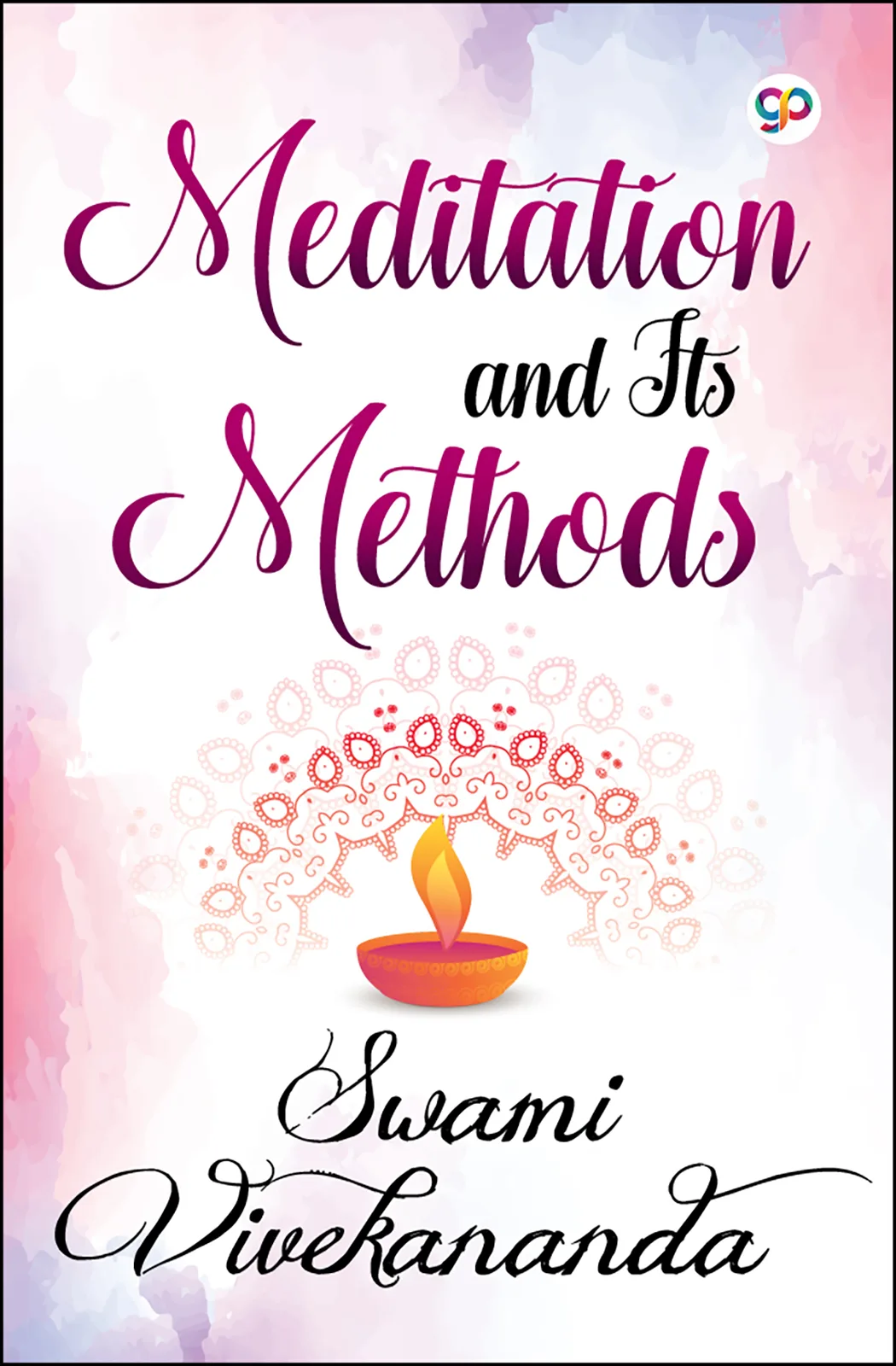
Download Cover Image
Do you want to download the full cover image for Meditation and Its Methods?