
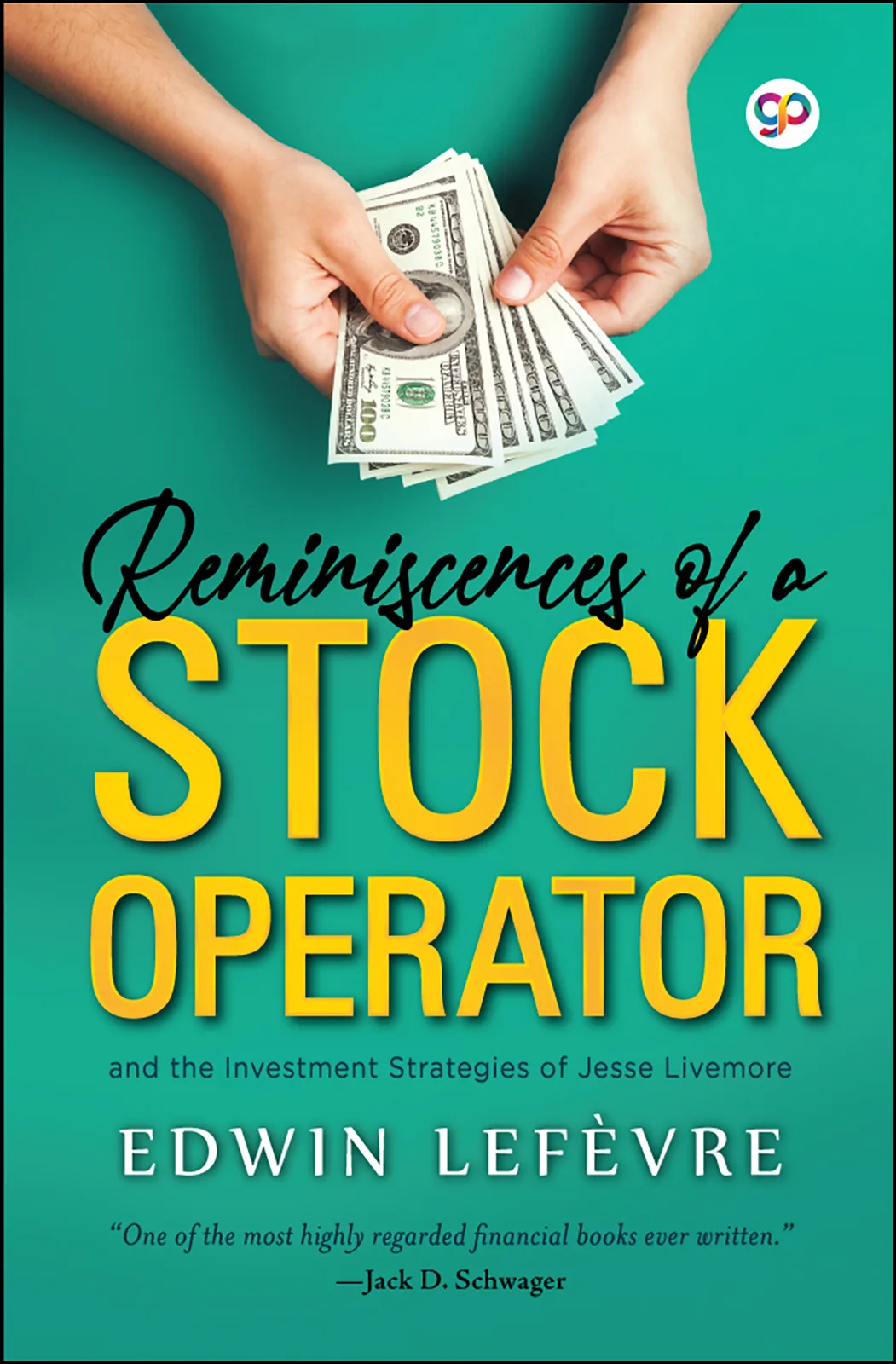
Reminiscences of a Stock Operator
Hardcover
• 304 Pages
• INR 595.00
• English
• 9789390492244
No ratings yet
| Publisher | General Press |
|---|---|
| ISBN13 | 9789390492244 |
| ASIN/SKU | 9390492246 |
| Book Format | Hardcover |
| Language | English |
| Pages | 304 |
| List Price | INR 595.00 |
| Subject Code | BUS036060, BUS050020, BIO003000 |
| Publishing Date | 07/07/2021 |
| Dimensions | 8.25 x 5.25 x 1.0 inches |
| Book Code | BD00068125 |
Buy this Book
Amazon Stores
Ebook Stores
Other Stores
Discover Reminiscences of a Stock Operator by Edwin Lefevre. This book is published by General Press in Hardcover format, ISBN 9789390492244, ASIN 9390492246, under Business and Money, Memoirs, Investing.
Book Description
Edwin Lefèvre’s "Reminiscences of a Stock Operator" is a timeless, deeply human portrait of the financial markets, disguised as the fictionalized biography of Larry Livingston. Based on the real-life trading legend Jesse Livermore, the novel takes us on a thrilling, roller-coaster journey through the life of a man obsessed with understanding the heartbeat of the stock market.
Livingston begins as a young quotation-board boy in small-town bucket shops. He quickly discovers an uncanny talent for recognizing numerical patterns and price movements. However, his journey from a teenage prodigy to a Wall Street titan is far from smooth. He makes staggering fortunes and loses them just as quickly, repeatedly humbled by his own ego, impulsive decisions, and the unpredictable forces of Wall Street.
What makes this book so universally beloved is its profound exploration of human psychology. Lefèvre writes with striking clarity, revealing that the market is not simply a machine of numbers, but a living reflection of human fear, greed, and hope. Through Livingston’s relentless trials, we learn that true mastery of speculation requires conquering oneself. He must learn patience, the courage to cut his losses, and the discipline to ignore the noise of the crowd.
Ultimately, 'Reminiscences' is more than a financial guide; it is a lucid, empathetic study of ambition and resilience. It reminds us that behind every trade is a person battling their own nature, striving to find wisdom in the chaotic currents of life.
Livingston begins as a young quotation-board boy in small-town bucket shops. He quickly discovers an uncanny talent for recognizing numerical patterns and price movements. However, his journey from a teenage prodigy to a Wall Street titan is far from smooth. He makes staggering fortunes and loses them just as quickly, repeatedly humbled by his own ego, impulsive decisions, and the unpredictable forces of Wall Street.
What makes this book so universally beloved is its profound exploration of human psychology. Lefèvre writes with striking clarity, revealing that the market is not simply a machine of numbers, but a living reflection of human fear, greed, and hope. Through Livingston’s relentless trials, we learn that true mastery of speculation requires conquering oneself. He must learn patience, the courage to cut his losses, and the discipline to ignore the noise of the crowd.
Ultimately, 'Reminiscences' is more than a financial guide; it is a lucid, empathetic study of ambition and resilience. It reminds us that behind every trade is a person battling their own nature, striving to find wisdom in the chaotic currents of life.
Author Biography
Edwin Lefevre was trained as a mining engineer, but became a journalist at age nineteen. He produced eight books, including The Making of a Stockbroker, during his fifty-three-year writing career. He was a celebrated finance author made most famous by his publication of the fictionalized story of Jesse Livermore, which first appeared in the Saturday Evening Post in 1922. He worked for the New York Sun, served as financial editor of Harper's Weekly, and wrote for the Saturday Evening Post.
Editorial Reviews
"Although Reminiscences...was first published some seventy years ago, its take on crowd psychology and market timing is as timely as last summer's frenzy on the foreign exchange markets." –Worth magazine
"The most entertaining book written on investing is Reminiscences of a Stock Operator, by Edwin Lefèvre, first published in 1923." –The Seattle Times
"After twenty years and many re-reads, Reminiscences is still one of my all-time favourites." –Kenneth L. Fisher, Forbes
"A must-read classic for all investors, whether brand-new or experienced." –William O'Neil, founder and Chairman, Investor's Business Daily
"Whilst stock market tomes have come and gone, this remains popular and in print eighty years on." –GQ Magazine
"The most entertaining book written on investing is Reminiscences of a Stock Operator, by Edwin Lefèvre, first published in 1923." –The Seattle Times
"After twenty years and many re-reads, Reminiscences is still one of my all-time favourites." –Kenneth L. Fisher, Forbes
"A must-read classic for all investors, whether brand-new or experienced." –William O'Neil, founder and Chairman, Investor's Business Daily
"Whilst stock market tomes have come and gone, this remains popular and in print eighty years on." –GQ Magazine
Book Summary
"Reminiscences of a Stock Operator" by Edwin Lefèvre is one of the most respected books ever written about the stock market and the psychology of investing. Although presented as a novel, it is largely based on the life and trading career of the legendary speculator Jesse Livermore. Rather than offering technical formulas or investment strategies, the book explores the mindset, discipline, emotions, and hard-earned lessons that shape a successful trader. Through a series of personal experiences, triumphs, and failures, it reveals that mastering the financial markets is as much about understanding human nature as it is about understanding numbers. More than a century after its publication, the book continues to be regarded as an essential read for investors, traders, and anyone interested in decision-making under uncertainty.
The story begins with Larry Livingston, the fictional version of Jesse Livermore, who discovers his talent for reading price movements while working as a quotation board boy in a brokerage office. Fascinated by the patterns of stock prices, he quickly learns to anticipate short-term market movements simply by observing how prices behave. His remarkable ability allows him to make consistent profits in bucket shops, establishments where traders could speculate on stock prices without actually buying or selling shares. Livingston earns money rapidly, but his repeated success leads many bucket shops to ban him because they can no longer profit from his trades. These early experiences teach him that careful observation, patience, and discipline are far more valuable than luck or excitement.
Determined to succeed on a larger stage, Livingston moves to Wall Street, believing that his success in bucket shops will naturally continue in the real stock market. Instead, he quickly discovers that trading large markets is far more challenging than he expected. Influenced by rumors, tips, and the opinions of others, he begins making costly mistakes. He realizes that real markets are driven by countless forces that cannot be mastered through instinct alone. Several painful losses wipe out much of his capital, forcing him to accept that knowledge without discipline is dangerous. These setbacks become valuable lessons, showing him that every trader must learn from failure before achieving lasting success.
As Livingston gains experience, he begins to develop a more mature philosophy of speculation. He comes to understand that the market is never wrong; only the trader's judgment can be mistaken. He learns that the greatest profits often come not from constant buying and selling but from identifying a major trend and patiently staying with it. Instead of reacting to every small fluctuation, he waits for clear opportunities and acts only when the odds strongly favor him. This approach requires emotional control, confidence, and the willingness to ignore popular opinion. Through repeated successes, Livingston proves that patience is one of the most powerful tools available to an investor.
The novel also explores the many psychological traps that prevent traders from succeeding. Livingston repeatedly observes how fear causes investors to sell promising positions too early, while greed encourages them to hold losing trades in the hope that prices will recover. He notices that people often chase market trends after they have already peaked or refuse to admit when they are wrong. These emotional weaknesses are presented as universal aspects of human behavior rather than flaws unique to finance. Lefèvre suggests that successful speculation depends less on intelligence than on self-control. A trader who can remain calm, disciplined, and objective has a significant advantage over those who allow emotions to guide their decisions.
Throughout his career, Livingston enjoys extraordinary financial success, earning fortunes that seem almost unimaginable. Yet his victories are frequently followed by devastating losses. Overconfidence, excessive risk-taking, and failure to follow his own principles occasionally lead him into disastrous situations where years of profits disappear in a short time. Despite these setbacks, he never abandons his determination to learn and improve. Each financial collapse forces him to examine his mistakes honestly, strengthening his understanding of market behavior. His resilience demonstrates that failure is not the end of success but often an essential part of achieving it.
Another important aspect of the book is its insight into the larger forces that influence financial markets. Livingston studies economic conditions, business cycles, public sentiment, and the behavior of large institutional investors. He recognizes that markets reflect collective human emotions as much as economic facts. News, rumors, optimism, and panic all influence price movements, often causing investors to behave irrationally. Rather than attempting to predict every event, Livingston focuses on interpreting the market's actual response to changing conditions. He believes that price movements themselves reveal the most reliable information, making the market the ultimate judge of every opinion and forecast.
The book also presents an honest picture of the ethical and practical challenges that existed in the financial markets of the early twentieth century. Livingston encounters market manipulation, insider information, dishonest operators, and influential financiers capable of moving prices for their own benefit. Although these conditions create obstacles, he learns that complaining about unfairness serves no purpose. Instead, he adapts to the realities of the marketplace by relying on careful observation and disciplined decision-making. His experiences reinforce the idea that markets may never be perfectly fair, but consistent success is still possible for those who remain patient, prepared, and emotionally balanced.
By the end of the book, Livingston has achieved wisdom that extends far beyond investing. He understands that success comes from continuous learning, humility, perseverance, and the ability to accept mistakes without losing confidence. The story leaves readers with the impression that financial markets constantly change, but human nature remains remarkably consistent. Fear, greed, hope, impatience, and overconfidence continue to influence investors across generations. 'Reminiscences of a Stock Operator' therefore remains much more than a book about buying and selling stocks. It is a timeless study of human psychology, disciplined thinking, and personal growth, offering lessons that are equally valuable in business, investing, and everyday life. Even today, its practical insights continue to inspire traders and investors who seek lasting success in the unpredictable world of financial markets.
The story begins with Larry Livingston, the fictional version of Jesse Livermore, who discovers his talent for reading price movements while working as a quotation board boy in a brokerage office. Fascinated by the patterns of stock prices, he quickly learns to anticipate short-term market movements simply by observing how prices behave. His remarkable ability allows him to make consistent profits in bucket shops, establishments where traders could speculate on stock prices without actually buying or selling shares. Livingston earns money rapidly, but his repeated success leads many bucket shops to ban him because they can no longer profit from his trades. These early experiences teach him that careful observation, patience, and discipline are far more valuable than luck or excitement.
Determined to succeed on a larger stage, Livingston moves to Wall Street, believing that his success in bucket shops will naturally continue in the real stock market. Instead, he quickly discovers that trading large markets is far more challenging than he expected. Influenced by rumors, tips, and the opinions of others, he begins making costly mistakes. He realizes that real markets are driven by countless forces that cannot be mastered through instinct alone. Several painful losses wipe out much of his capital, forcing him to accept that knowledge without discipline is dangerous. These setbacks become valuable lessons, showing him that every trader must learn from failure before achieving lasting success.
As Livingston gains experience, he begins to develop a more mature philosophy of speculation. He comes to understand that the market is never wrong; only the trader's judgment can be mistaken. He learns that the greatest profits often come not from constant buying and selling but from identifying a major trend and patiently staying with it. Instead of reacting to every small fluctuation, he waits for clear opportunities and acts only when the odds strongly favor him. This approach requires emotional control, confidence, and the willingness to ignore popular opinion. Through repeated successes, Livingston proves that patience is one of the most powerful tools available to an investor.
The novel also explores the many psychological traps that prevent traders from succeeding. Livingston repeatedly observes how fear causes investors to sell promising positions too early, while greed encourages them to hold losing trades in the hope that prices will recover. He notices that people often chase market trends after they have already peaked or refuse to admit when they are wrong. These emotional weaknesses are presented as universal aspects of human behavior rather than flaws unique to finance. Lefèvre suggests that successful speculation depends less on intelligence than on self-control. A trader who can remain calm, disciplined, and objective has a significant advantage over those who allow emotions to guide their decisions.
Throughout his career, Livingston enjoys extraordinary financial success, earning fortunes that seem almost unimaginable. Yet his victories are frequently followed by devastating losses. Overconfidence, excessive risk-taking, and failure to follow his own principles occasionally lead him into disastrous situations where years of profits disappear in a short time. Despite these setbacks, he never abandons his determination to learn and improve. Each financial collapse forces him to examine his mistakes honestly, strengthening his understanding of market behavior. His resilience demonstrates that failure is not the end of success but often an essential part of achieving it.
Another important aspect of the book is its insight into the larger forces that influence financial markets. Livingston studies economic conditions, business cycles, public sentiment, and the behavior of large institutional investors. He recognizes that markets reflect collective human emotions as much as economic facts. News, rumors, optimism, and panic all influence price movements, often causing investors to behave irrationally. Rather than attempting to predict every event, Livingston focuses on interpreting the market's actual response to changing conditions. He believes that price movements themselves reveal the most reliable information, making the market the ultimate judge of every opinion and forecast.
The book also presents an honest picture of the ethical and practical challenges that existed in the financial markets of the early twentieth century. Livingston encounters market manipulation, insider information, dishonest operators, and influential financiers capable of moving prices for their own benefit. Although these conditions create obstacles, he learns that complaining about unfairness serves no purpose. Instead, he adapts to the realities of the marketplace by relying on careful observation and disciplined decision-making. His experiences reinforce the idea that markets may never be perfectly fair, but consistent success is still possible for those who remain patient, prepared, and emotionally balanced.
By the end of the book, Livingston has achieved wisdom that extends far beyond investing. He understands that success comes from continuous learning, humility, perseverance, and the ability to accept mistakes without losing confidence. The story leaves readers with the impression that financial markets constantly change, but human nature remains remarkably consistent. Fear, greed, hope, impatience, and overconfidence continue to influence investors across generations. 'Reminiscences of a Stock Operator' therefore remains much more than a book about buying and selling stocks. It is a timeless study of human psychology, disciplined thinking, and personal growth, offering lessons that are equally valuable in business, investing, and everyday life. Even today, its practical insights continue to inspire traders and investors who seek lasting success in the unpredictable world of financial markets.
Sample Chapters
Chapter 1
I went to work when I was just out of grammar school. I got a job as quotation-board boy in a stock-brokerage office. I was quick at figures. At school I did three years of arithmetic in one. I was particularly good at mental arithmetic. As quotation-board boy I posted the numbers on the big board in the customers’ room. One of the customers usually sat by the ticker and called out the prices. They couldn’t come too fast for me. I have always remembered figures. No trouble at all.
There were plenty of other employes in that office. Of course I made friends with the other fellows, but the work I did, if the market was active, kept me too busy from ten A.M. to three P.M. to let me do much talking. I don’t care for it, anyhow, during business hours.
But a busy market did not keep me from thinking about the work. Those quotations did not represent prices of stocks to me, so many dollars per share. They were numbers. Of course, they meant something. They were always changing. It was all I had to be interested in—the changes. Why did they change? I didn’t know. I didn’t care. I didn’t think about that. I simply saw that they changed. That was all I had to think about five hours every day and two on Saturdays: that they were always changing.
That is how I first came to be interested in the behaviour of prices. I had a very good memory for figures. I could remember in detail how the prices had acted on the previous day, just before they went up or down. My fondness for mental arithmetic came in very handy.
I noticed that in advances as well as declines, stock prices were apt to show certain habits, so to speak. There was no end of parallel cases and these made precedents to guide me. I was only fourteen, but after I had taken hundreds of observations in my mind I found myself testing their accuracy, comparing the behaviour of stocks to-day with other days. It was not long before I was anticipating movements in prices. My only guide, as I say, was their past performances. I carried the “dope sheets” in my mind. I looked for stock prices to run on form. I had “clocked” them. You know what I mean.
You can spot, for instance, where the buying is only a trifle better than the selling. A battle goes on in the stock market and the tape is your telescope. You can depend upon it seven out of ten cases.
Another lesson I learned early is that there is nothing new in Wall Street. There can’t be because speculation is as old as the hills. Whatever happens in the stock market to-day has happened before and will happen again. I’ve never forgotten that. I suppose I really manage to remember when and how it happened. The fact that I remember that way is my way of capitalizing experience.
I got so interested in my game and so anxious to anticipate advances and declines in all the active stocks that I got a little book. I put down my observations in it. It was not a record of imaginary transactions such as so many people keep merely to make or lose millions of dollars without getting the swelled head or going to the poorhouse. It was rather a sort of record of my hits and misses, and next to the determination of probable movements I was most interested in verifying whether I had observed accurately; in other words, whether I was right.
Say that after studying every fluctuation of the day in an active stock I would conclude that it was behaving as it always did before it broke eight or ten points. Well, I would jot down the stock and the price on Monday, and remembering past performances I would write down what it ought to do on Tuesday and Wednesday. Later I would check up with actual transcriptions from the tape.
That is how I first came to take an interest in the message of the tape. The fluctuations were from the first associated in my mind with upward or downward movements. Of course there is always a reason for fluctuations, but the tape does not concern itself with the why and wherefore. It doesn’t go into explanations. I didn’t ask the tape why when I was fourteen, and I don’t ask it to-day, at forty. The reason for what a certain stock does to-day may not be known for two or three days, or weeks, or months. But what the dickens does that matter? Your business with the tape is now—not to-morrow. The reason can wait. But you must act instantly or be left. Time and again I see this happen. You’ll remember that Hollow Tube went down three points the other day while the rest of the market rallied sharply. That was the fact. On the following Monday you saw that the directors passed the dividend. That was the reason. They knew what they were going to do, and even if they didn’t sell the stock themselves they at least didn’t buy it. There was no inside buying; no reason why it should not break.
Well, I kept up my little memorandum book perhaps six months. Instead of leaving for home the moment I was through with my work, I’d jot down the figures I wanted and would study the changes, always looking for the repetitions and parallelisms of behaviour—learning to read the tape, although I was not aware of it at the time.
One day one of the office boys—he was older than I—came to me where I was eating my lunch and asked me on the quiet if I had any money.
“Why do you want to know?” I said.
“Well,” he said, “I’ve got a dandy tip on Burlington. I’m going to play it if I can get somebody to go in with me.”
“How do you mean, play it?” I asked. To me the only people who played or could play tips were the customers—old jiggers with oodles of dough. Why, it cost hundreds, even thousands of dollars, to get into the game. It was like owning your private carriage and having a coachman who wore a silk hat.
“That’s what I mean; play it!” he said. “How much you got?”
“How much you need?”
“Well, I can trade in five shares by putting up $5.”
“How are you going to play it?”
“I’m going to buy all the Burlington the bucket shop will let me carry with the money I give him for margin,” he said. “It’s going up sure. It’s like picking up money. We’ll double ours in a jiffy.”
“Hold on!” I said to him, and pulled out my little dope book.
I wasn’t interested in doubling my money, but in his saying that Burlington was going up. If it was, my note-book ought to show it. I looked. Sure enough, Burlington, according to my figuring, was acting as it usually did before it went up. I had never bought or sold anything in my life, and I never gambled with the other boys. But all I could see was that this was a grand chance to test the accuracy of my work, of my hobby. It struck me at once that if my dope didn’t work in practice there was nothing in the theory of it to interest anybody. So I gave him all I had, and with our pooled resources he went to one of the near-by bucket shops and bought some Burlington. Two days later we cashed in. I made a profit of $3.12.
After that first trade, I got to speculating on my own hook in the bucket shops. I’d go during my lunch hour and buy or sell—it never made any difference to me. I was playing a system and not a favorite stock or backing opinions. All I knew was the arithmetic of it. As a matter of fact, mine was the ideal way to operate in a bucket shop, where all that a trader does is to bet on fluctuations as they are printed by the ticker on the tape.
It was not long before I was taking much more money out of the bucket shops than I was pulling down from my job in the brokerage office. So I gave up my position. My folks objected, but they couldn’t say much when they saw what I was making. I was only a kid and office-boy wages were not very high. I did mighty well on my own hook.
I was fifteen when I had my first thousand and laid the cash in front of my mother—all made in the bucket shops in a few months, besides what I had taken home. My mother carried on something awful. She wanted me to put it away in the savings bank out of reach of temptation. She said it was more money than she ever heard any boy of fifteen had made, starting with nothing. She didn’t quite believe it was real money. She used to worry and fret about it. But I didn’t think of anything except that I could keep on proving my figuring was right. That’s all the fun there is—being right by using your head. If I was right when I tested my convictions with ten shares I would be ten times more right if I traded in a hundred shares. That is all that having more margin meant to me—I was right more emphatically. More courage? No! No difference! If all I have is ten dollars and I risk it, I am much braver than when I risk a million, if I have another million salted away.
Anyhow, at fifteen I was making a good living out of the stock market. I began in the smaller bucket shops, where the man who traded in twenty shares at a clip was suspected of being John W. Gates in disguise or J. P. Morgan traveling incognito. Bucket shops in those days seldom lay down on their customers. They didn’t have to. There were other ways of parting customers from their money, even when they guessed right. The business was tremendously profitable. When it was conducted legitimately—I mean straight, as far as the bucket shop went—the fluctuations took care of the shoestrings. It doesn’t take much of a reaction to wipe out a margin of only three quarters of a point. Also, no welsher could ever get back in the game. Wouldn’t have any trade.
I didn’t have a following. I kept my business to myself. It was a one-man business, anyhow. It was my head, wasn’t it? Prices either were going the way I doped them out, without any help from friends or partners, or they were going the other way, and nobody could stop them out of kindness to me. I couldn’t see where I needed to tell my business to anybody else. I’ve got friends, of course, but my business has always been the same—a one-man affair. That is why I have always played a lone hand.
As it was, it didn’t take long for the bucket shops to get sore on me for beating them. I’d walk in and plank down my margin, but they’d look at it without making a move to grab it. They’d tell me there was nothing doing. That was the time they got to calling me the Boy Plunger. I had to be changing brokers all the time, going from one bucket shop to another. It got so that I had to give a fictitious name. I’d begin light, only fifteen or twenty shares. At times, when they got suspicious, I’d lose on purpose at first and then sting them proper. Of course after a while they’d find me too expensive and they’d tell me to take myself and my business elsewhere and not interfere with the owners’ dividends.
Once, when the big concern I’d been trading with for months shut down on me I made up my mind to take a little more of their money away from them. That bucket shop had branches all over the city, in hotel lobbies, and in near-by towns. I went to one of the hotel branches and asked the manager a few questions and finally got to trading. But as soon as I played an active stock my especial way he began to get messages from the head office asking who it was that was operating. The manager told me what they asked him and I told him my name was Edward Robinson, of Cambridge. He telephoned the glad news to the big chief. But the other end wanted to know what I looked like. When the manager told me that I said to him, “Tell him I am a short fat man with dark hair and a bushy beard!” But he described me instead, and then he listened and his face got red and he hung up and told me to beat it.
“What did they say to you?” I asked him politely.
“They said, ‘You blankety-blank fool, didn’t we tell you to take no business from Larry Livingston? And you deliberately let him trim us out of $700!’” He didn’t say what else they told him.
I tried the other branches one after another, but they all got to know me, and my money wasn’t any good in any of their offices. I couldn’t even go in to look at the quotations without some of the clerks making cracks at me. I tried to get them to let me trade at long intervals by dividing my visits among them all. But that didn’t work.
Finally there was only one left to me and that was the biggest and richest of all—the Cosmopolitan Stock Brokerage Company.
The Cosmopolitan was rated as A-1 and did an enormous business. It had branches in every manufacturing town in New England. They took my trading all right, and I bought and sold stocks and made and lost money for months, but in the end it happened with them as usual. They didn’t refuse my business point-blank, as the small concerns had. Oh, not because it wasn’t sportsmanship, but because they knew it would give them a black eye to publish the news that they wouldn’t take a fellow’s business just because that fellow happened to make a little money. But they did the next worse thing—that is, they made me put up a three-point margin and compelled me to pay a premium at first of a half point, then a point, and finally, a point and a half. Some handicap, that! How? Easy! Suppose Steel was selling at 90 and you bought it. Your ticket read, normally: “Bot ten Steel at 90⅛.” If you put up a point margin it meant that if it broke 89¼ you were wiped out automatically. In a bucket shop the customer is not importuned for more margin or put to the painful necessity of telling his broker to sell for anything he can get.
But when the Cosmopolitan tacked on that premium they were hitting below the belt. It meant that if the price was 90 when I bought, instead of making my ticket: “Bot Steel at 90⅛,” it read: “Bot Steel at 91⅛.” Why, that stock could advance a point and a quarter after I bought it and I’d still be losing money if I closed the trade. And by also insisting that I put up a three-point margin at the very start they reduced my trading capacity by two-thirds. Still, that was the only bucket shop that would take my business at all, and I had to accept their terms or quit trading.
Of course I had my ups and downs, but was a winner on balance. However, the Cosmopolitan people were not satisfied with the awful handicap they had tacked on me, which should have been enough to beat anybody. They tried to double-cross me. They didn’t get me. I escaped because of one of my hunches.
The Cosmopolitan, as I said, was my last resort. It was the richest bucket shop in New England, and as a rule they put no limit on a trade. I think I was the heaviest individual trader they had—that is, of the steady, every-day customers. They had a fine office and the largest and completest quotation board I have ever seen anywhere. It ran along the whole length of the big room and every imaginable thing was quoted. I mean stocks dealt in on the New York and Boston Stock Exchanges, cotton, wheat, provisions, metals—everything that was bought and sold in New York, Chicago, Boston and Liverpool.
You know how they traded in bucket shops. You gave your money to a clerk and told him what you wished to buy or sell. He looked at the tape or the quotation board and took the price from there—the last one, of course. He also put down the time on the ticket so that it almost read like a regular broker’s report—that is, that they had bought or sold for you so many shares of such a stock at such a price at such a time on such a day and how much money they received from you. When you wished to close your trade you went to the clerk—the same or another, it depended on the shop—and you told him. He took the last price or if the stock had not been active he waited for the next quotation that came out on the tape. He wrote that price and the time on your ticket, O.K.’d it and gave it back to you, and then you went to the cashier and got whatever cash it called for. Of course, when the market went against you and the price went beyond the limit set by your margin, your trade automatically closed itself and your ticket became one more scrap of paper.
In the humbler bucket shops, where people were allowed to trade in as little as five shares, the tickets were little slips—different colors for buying and selling—and at times, as for instance in boiling bull markets, the shops would be hard hit because all the customers were bulls and happened to be right. Then the bucket shop would deduct both buying and selling commissions and if you bought a stock at 20 the ticket would read 20¼. You thus had only ¾, of a point’s run for your money.
But the Cosmopolitan was the finest in New England. It had thousands of patrons and I really think I was the only man they were afraid of. Neither the killing premium nor the three-point margin they made me put up reduced my trading much. I kept on buying and selling as much as they’d let me. I sometimes had a line of 5000 shares.
Well, on the day the thing happened that I am going to tell you, I was short thirty-five hundred shares of Sugar. I had seven big pink tickets for five hundred shares each. The Cosmopolitan used big slips with a blank space on them where they could write down additional margin. Of course, the bucket shops never ask for more margin. The thinner the shoestring the better for them, for their profit lies in your being wiped. In the smaller shops if you wanted to margin your trade still further they’d make out a new ticket, so they could charge you the buying commission and only give you a run of ¾ of a point on each point’s decline, for they figured the selling commission also exactly as if it were a new trade.
Well, this day I remember I had up over $10,000 in margins.
I was only twenty when I first accumulated ten thousand dollars in cash. And you ought to have heard my mother. You’d have thought that ten thousand dollars in cash was more than anybody carried around except old John D., and she used to tell me to be satisfied and go into some regular business. I had a hard time convincing her that I was not gambling, but making money by figuring. But all she could see was that ten thousand dollars was a lot of money and all I could see was more margin.
I had put out my 3500 shares of Sugar at 105¼. There was another fellow in the room, Henry Williams, who was short 2500 shares. I used to sit by the ticker and call out the quotations for the board boy. The price behaved as I thought it would. It promptly went down a couple of points and paused a little to get its breath before taking another dip. The general market was pretty soft and everything looked promising. Then all of a sudden I didn’t like the way Sugar was doing its hesitating. I began to feel uncomfortable. I thought I ought to get out of the market. Then it sold at 103—that was low for the day—but instead of feeling more confident I felt more uncertain. I knew something was wrong somewhere, but I couldn’t spot it exactly. But if something was coming and I didn’t know where from, I couldn’t be on my guard against it. That being the case I’d better be out of the market.
You know, I don’t do things blindly. I don’t like to. I never did. Even as a kid I had to know why I should do certain things. But this time I had no definite reason to give to myself, and yet I was so uncomfortable that I couldn’t stand it. I called to a fellow I knew, Dave Wyman, and said to him: “Dave, you take my place here. I want you to do something for me. Wait a little before you call out the next price of Sugar, will you?”
I went to work when I was just out of grammar school. I got a job as quotation-board boy in a stock-brokerage office. I was quick at figures. At school I did three years of arithmetic in one. I was particularly good at mental arithmetic. As quotation-board boy I posted the numbers on the big board in the customers’ room. One of the customers usually sat by the ticker and called out the prices. They couldn’t come too fast for me. I have always remembered figures. No trouble at all.
There were plenty of other employes in that office. Of course I made friends with the other fellows, but the work I did, if the market was active, kept me too busy from ten A.M. to three P.M. to let me do much talking. I don’t care for it, anyhow, during business hours.
But a busy market did not keep me from thinking about the work. Those quotations did not represent prices of stocks to me, so many dollars per share. They were numbers. Of course, they meant something. They were always changing. It was all I had to be interested in—the changes. Why did they change? I didn’t know. I didn’t care. I didn’t think about that. I simply saw that they changed. That was all I had to think about five hours every day and two on Saturdays: that they were always changing.
That is how I first came to be interested in the behaviour of prices. I had a very good memory for figures. I could remember in detail how the prices had acted on the previous day, just before they went up or down. My fondness for mental arithmetic came in very handy.
I noticed that in advances as well as declines, stock prices were apt to show certain habits, so to speak. There was no end of parallel cases and these made precedents to guide me. I was only fourteen, but after I had taken hundreds of observations in my mind I found myself testing their accuracy, comparing the behaviour of stocks to-day with other days. It was not long before I was anticipating movements in prices. My only guide, as I say, was their past performances. I carried the “dope sheets” in my mind. I looked for stock prices to run on form. I had “clocked” them. You know what I mean.
You can spot, for instance, where the buying is only a trifle better than the selling. A battle goes on in the stock market and the tape is your telescope. You can depend upon it seven out of ten cases.
Another lesson I learned early is that there is nothing new in Wall Street. There can’t be because speculation is as old as the hills. Whatever happens in the stock market to-day has happened before and will happen again. I’ve never forgotten that. I suppose I really manage to remember when and how it happened. The fact that I remember that way is my way of capitalizing experience.
I got so interested in my game and so anxious to anticipate advances and declines in all the active stocks that I got a little book. I put down my observations in it. It was not a record of imaginary transactions such as so many people keep merely to make or lose millions of dollars without getting the swelled head or going to the poorhouse. It was rather a sort of record of my hits and misses, and next to the determination of probable movements I was most interested in verifying whether I had observed accurately; in other words, whether I was right.
Say that after studying every fluctuation of the day in an active stock I would conclude that it was behaving as it always did before it broke eight or ten points. Well, I would jot down the stock and the price on Monday, and remembering past performances I would write down what it ought to do on Tuesday and Wednesday. Later I would check up with actual transcriptions from the tape.
That is how I first came to take an interest in the message of the tape. The fluctuations were from the first associated in my mind with upward or downward movements. Of course there is always a reason for fluctuations, but the tape does not concern itself with the why and wherefore. It doesn’t go into explanations. I didn’t ask the tape why when I was fourteen, and I don’t ask it to-day, at forty. The reason for what a certain stock does to-day may not be known for two or three days, or weeks, or months. But what the dickens does that matter? Your business with the tape is now—not to-morrow. The reason can wait. But you must act instantly or be left. Time and again I see this happen. You’ll remember that Hollow Tube went down three points the other day while the rest of the market rallied sharply. That was the fact. On the following Monday you saw that the directors passed the dividend. That was the reason. They knew what they were going to do, and even if they didn’t sell the stock themselves they at least didn’t buy it. There was no inside buying; no reason why it should not break.
Well, I kept up my little memorandum book perhaps six months. Instead of leaving for home the moment I was through with my work, I’d jot down the figures I wanted and would study the changes, always looking for the repetitions and parallelisms of behaviour—learning to read the tape, although I was not aware of it at the time.
One day one of the office boys—he was older than I—came to me where I was eating my lunch and asked me on the quiet if I had any money.
“Why do you want to know?” I said.
“Well,” he said, “I’ve got a dandy tip on Burlington. I’m going to play it if I can get somebody to go in with me.”
“How do you mean, play it?” I asked. To me the only people who played or could play tips were the customers—old jiggers with oodles of dough. Why, it cost hundreds, even thousands of dollars, to get into the game. It was like owning your private carriage and having a coachman who wore a silk hat.
“That’s what I mean; play it!” he said. “How much you got?”
“How much you need?”
“Well, I can trade in five shares by putting up $5.”
“How are you going to play it?”
“I’m going to buy all the Burlington the bucket shop will let me carry with the money I give him for margin,” he said. “It’s going up sure. It’s like picking up money. We’ll double ours in a jiffy.”
“Hold on!” I said to him, and pulled out my little dope book.
I wasn’t interested in doubling my money, but in his saying that Burlington was going up. If it was, my note-book ought to show it. I looked. Sure enough, Burlington, according to my figuring, was acting as it usually did before it went up. I had never bought or sold anything in my life, and I never gambled with the other boys. But all I could see was that this was a grand chance to test the accuracy of my work, of my hobby. It struck me at once that if my dope didn’t work in practice there was nothing in the theory of it to interest anybody. So I gave him all I had, and with our pooled resources he went to one of the near-by bucket shops and bought some Burlington. Two days later we cashed in. I made a profit of $3.12.
After that first trade, I got to speculating on my own hook in the bucket shops. I’d go during my lunch hour and buy or sell—it never made any difference to me. I was playing a system and not a favorite stock or backing opinions. All I knew was the arithmetic of it. As a matter of fact, mine was the ideal way to operate in a bucket shop, where all that a trader does is to bet on fluctuations as they are printed by the ticker on the tape.
It was not long before I was taking much more money out of the bucket shops than I was pulling down from my job in the brokerage office. So I gave up my position. My folks objected, but they couldn’t say much when they saw what I was making. I was only a kid and office-boy wages were not very high. I did mighty well on my own hook.
I was fifteen when I had my first thousand and laid the cash in front of my mother—all made in the bucket shops in a few months, besides what I had taken home. My mother carried on something awful. She wanted me to put it away in the savings bank out of reach of temptation. She said it was more money than she ever heard any boy of fifteen had made, starting with nothing. She didn’t quite believe it was real money. She used to worry and fret about it. But I didn’t think of anything except that I could keep on proving my figuring was right. That’s all the fun there is—being right by using your head. If I was right when I tested my convictions with ten shares I would be ten times more right if I traded in a hundred shares. That is all that having more margin meant to me—I was right more emphatically. More courage? No! No difference! If all I have is ten dollars and I risk it, I am much braver than when I risk a million, if I have another million salted away.
Anyhow, at fifteen I was making a good living out of the stock market. I began in the smaller bucket shops, where the man who traded in twenty shares at a clip was suspected of being John W. Gates in disguise or J. P. Morgan traveling incognito. Bucket shops in those days seldom lay down on their customers. They didn’t have to. There were other ways of parting customers from their money, even when they guessed right. The business was tremendously profitable. When it was conducted legitimately—I mean straight, as far as the bucket shop went—the fluctuations took care of the shoestrings. It doesn’t take much of a reaction to wipe out a margin of only three quarters of a point. Also, no welsher could ever get back in the game. Wouldn’t have any trade.
I didn’t have a following. I kept my business to myself. It was a one-man business, anyhow. It was my head, wasn’t it? Prices either were going the way I doped them out, without any help from friends or partners, or they were going the other way, and nobody could stop them out of kindness to me. I couldn’t see where I needed to tell my business to anybody else. I’ve got friends, of course, but my business has always been the same—a one-man affair. That is why I have always played a lone hand.
As it was, it didn’t take long for the bucket shops to get sore on me for beating them. I’d walk in and plank down my margin, but they’d look at it without making a move to grab it. They’d tell me there was nothing doing. That was the time they got to calling me the Boy Plunger. I had to be changing brokers all the time, going from one bucket shop to another. It got so that I had to give a fictitious name. I’d begin light, only fifteen or twenty shares. At times, when they got suspicious, I’d lose on purpose at first and then sting them proper. Of course after a while they’d find me too expensive and they’d tell me to take myself and my business elsewhere and not interfere with the owners’ dividends.
Once, when the big concern I’d been trading with for months shut down on me I made up my mind to take a little more of their money away from them. That bucket shop had branches all over the city, in hotel lobbies, and in near-by towns. I went to one of the hotel branches and asked the manager a few questions and finally got to trading. But as soon as I played an active stock my especial way he began to get messages from the head office asking who it was that was operating. The manager told me what they asked him and I told him my name was Edward Robinson, of Cambridge. He telephoned the glad news to the big chief. But the other end wanted to know what I looked like. When the manager told me that I said to him, “Tell him I am a short fat man with dark hair and a bushy beard!” But he described me instead, and then he listened and his face got red and he hung up and told me to beat it.
“What did they say to you?” I asked him politely.
“They said, ‘You blankety-blank fool, didn’t we tell you to take no business from Larry Livingston? And you deliberately let him trim us out of $700!’” He didn’t say what else they told him.
I tried the other branches one after another, but they all got to know me, and my money wasn’t any good in any of their offices. I couldn’t even go in to look at the quotations without some of the clerks making cracks at me. I tried to get them to let me trade at long intervals by dividing my visits among them all. But that didn’t work.
Finally there was only one left to me and that was the biggest and richest of all—the Cosmopolitan Stock Brokerage Company.
The Cosmopolitan was rated as A-1 and did an enormous business. It had branches in every manufacturing town in New England. They took my trading all right, and I bought and sold stocks and made and lost money for months, but in the end it happened with them as usual. They didn’t refuse my business point-blank, as the small concerns had. Oh, not because it wasn’t sportsmanship, but because they knew it would give them a black eye to publish the news that they wouldn’t take a fellow’s business just because that fellow happened to make a little money. But they did the next worse thing—that is, they made me put up a three-point margin and compelled me to pay a premium at first of a half point, then a point, and finally, a point and a half. Some handicap, that! How? Easy! Suppose Steel was selling at 90 and you bought it. Your ticket read, normally: “Bot ten Steel at 90⅛.” If you put up a point margin it meant that if it broke 89¼ you were wiped out automatically. In a bucket shop the customer is not importuned for more margin or put to the painful necessity of telling his broker to sell for anything he can get.
But when the Cosmopolitan tacked on that premium they were hitting below the belt. It meant that if the price was 90 when I bought, instead of making my ticket: “Bot Steel at 90⅛,” it read: “Bot Steel at 91⅛.” Why, that stock could advance a point and a quarter after I bought it and I’d still be losing money if I closed the trade. And by also insisting that I put up a three-point margin at the very start they reduced my trading capacity by two-thirds. Still, that was the only bucket shop that would take my business at all, and I had to accept their terms or quit trading.
Of course I had my ups and downs, but was a winner on balance. However, the Cosmopolitan people were not satisfied with the awful handicap they had tacked on me, which should have been enough to beat anybody. They tried to double-cross me. They didn’t get me. I escaped because of one of my hunches.
The Cosmopolitan, as I said, was my last resort. It was the richest bucket shop in New England, and as a rule they put no limit on a trade. I think I was the heaviest individual trader they had—that is, of the steady, every-day customers. They had a fine office and the largest and completest quotation board I have ever seen anywhere. It ran along the whole length of the big room and every imaginable thing was quoted. I mean stocks dealt in on the New York and Boston Stock Exchanges, cotton, wheat, provisions, metals—everything that was bought and sold in New York, Chicago, Boston and Liverpool.
You know how they traded in bucket shops. You gave your money to a clerk and told him what you wished to buy or sell. He looked at the tape or the quotation board and took the price from there—the last one, of course. He also put down the time on the ticket so that it almost read like a regular broker’s report—that is, that they had bought or sold for you so many shares of such a stock at such a price at such a time on such a day and how much money they received from you. When you wished to close your trade you went to the clerk—the same or another, it depended on the shop—and you told him. He took the last price or if the stock had not been active he waited for the next quotation that came out on the tape. He wrote that price and the time on your ticket, O.K.’d it and gave it back to you, and then you went to the cashier and got whatever cash it called for. Of course, when the market went against you and the price went beyond the limit set by your margin, your trade automatically closed itself and your ticket became one more scrap of paper.
In the humbler bucket shops, where people were allowed to trade in as little as five shares, the tickets were little slips—different colors for buying and selling—and at times, as for instance in boiling bull markets, the shops would be hard hit because all the customers were bulls and happened to be right. Then the bucket shop would deduct both buying and selling commissions and if you bought a stock at 20 the ticket would read 20¼. You thus had only ¾, of a point’s run for your money.
But the Cosmopolitan was the finest in New England. It had thousands of patrons and I really think I was the only man they were afraid of. Neither the killing premium nor the three-point margin they made me put up reduced my trading much. I kept on buying and selling as much as they’d let me. I sometimes had a line of 5000 shares.
Well, on the day the thing happened that I am going to tell you, I was short thirty-five hundred shares of Sugar. I had seven big pink tickets for five hundred shares each. The Cosmopolitan used big slips with a blank space on them where they could write down additional margin. Of course, the bucket shops never ask for more margin. The thinner the shoestring the better for them, for their profit lies in your being wiped. In the smaller shops if you wanted to margin your trade still further they’d make out a new ticket, so they could charge you the buying commission and only give you a run of ¾ of a point on each point’s decline, for they figured the selling commission also exactly as if it were a new trade.
Well, this day I remember I had up over $10,000 in margins.
I was only twenty when I first accumulated ten thousand dollars in cash. And you ought to have heard my mother. You’d have thought that ten thousand dollars in cash was more than anybody carried around except old John D., and she used to tell me to be satisfied and go into some regular business. I had a hard time convincing her that I was not gambling, but making money by figuring. But all she could see was that ten thousand dollars was a lot of money and all I could see was more margin.
I had put out my 3500 shares of Sugar at 105¼. There was another fellow in the room, Henry Williams, who was short 2500 shares. I used to sit by the ticker and call out the quotations for the board boy. The price behaved as I thought it would. It promptly went down a couple of points and paused a little to get its breath before taking another dip. The general market was pretty soft and everything looked promising. Then all of a sudden I didn’t like the way Sugar was doing its hesitating. I began to feel uncomfortable. I thought I ought to get out of the market. Then it sold at 103—that was low for the day—but instead of feeling more confident I felt more uncertain. I knew something was wrong somewhere, but I couldn’t spot it exactly. But if something was coming and I didn’t know where from, I couldn’t be on my guard against it. That being the case I’d better be out of the market.
You know, I don’t do things blindly. I don’t like to. I never did. Even as a kid I had to know why I should do certain things. But this time I had no definite reason to give to myself, and yet I was so uncomfortable that I couldn’t stand it. I called to a fellow I knew, Dave Wyman, and said to him: “Dave, you take my place here. I want you to do something for me. Wait a little before you call out the next price of Sugar, will you?”
Reader Reviews
No reviews yet.
Reminiscences of a Stock Operator
Download Cover Image
Do you want to download the full cover image for Reminiscences of a Stock Operator?