
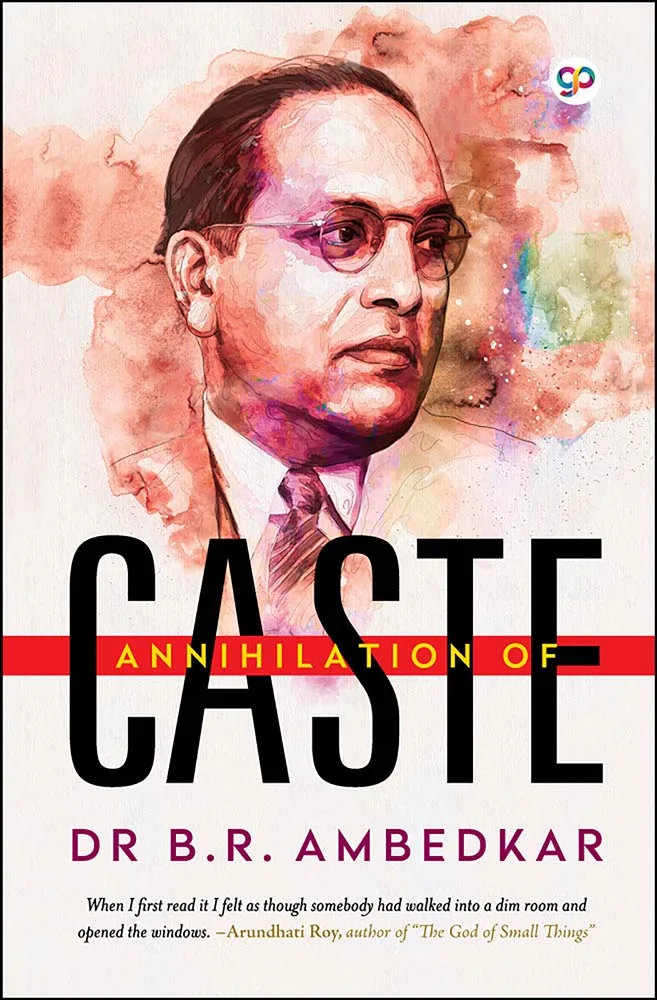
Annihilation of Caste
Hardcover
• 144 Pages
• INR 395.00
• English
• 9789390492756
No ratings yet
| Publisher | General Press |
|---|---|
| ISBN13 | 9789390492756 |
| ASIN/SKU | 9390492750 |
| Book Format | Hardcover |
| Language | English |
| Pages | 144 |
| List Price | INR 395.00 |
| Subject Code | SOC031000, SOC050000, HIS062000 |
| Publishing Date | 07/10/2021 |
| Dimensions | 8.25 x 5.25 x 1.0 inches |
| Book Code | BD00068140 |
Buy this Book
Amazon Stores
Ebook Stores
Other Stores
Discover Annihilation of Caste by B.R. Ambedkar. This book is published by General Press in Hardcover format, ISBN 9789390492756, ASIN 9390492750, under History, Cultural Anthropology, History of Civilization and Culture.
Book Description
Dr. B.R. Ambedkar’s 'Annihilation of Caste' is a blistering yet profoundly compassionate manifesto that strikes at the very heart of social inequality in India. Originally written in 1936 as a speech that was ultimately deemed too radical to be delivered, this vital text is much more than a political critique; it is an impassioned plea for human dignity.
With striking lucidity and unyielding logic, Ambedkar dismantles the oppressive structure of the Hindu caste system. He argues that caste is not merely a benign division of labor, but a cruel and unnatural division of laborers. It traps individuals in a rigid hierarchy of birth, stripping them of personal agency, stifling human potential, and destroying the natural bonds of empathy that should exist between people.
Ambedkar’s vision extends far beyond superficial social reforms. He courageously asserts that true equality cannot be achieved through political freedom alone, nor through mere tolerance. Instead, it requires a complete intellectual and spiritual revolution—a radical rejection of the religious scriptures that sanction such deep-seated discrimination.
'Annihilation of Caste' is a deeply humane work driven by a desire to see a society rebuilt on the foundational pillars of liberty, equality, and fraternity. Ambedkar’s words resonate as a timeless call to conscience, reminding us that no society can truly call itself civilized as long as it systematically denies the basic humanity and worth of any of its people.
With striking lucidity and unyielding logic, Ambedkar dismantles the oppressive structure of the Hindu caste system. He argues that caste is not merely a benign division of labor, but a cruel and unnatural division of laborers. It traps individuals in a rigid hierarchy of birth, stripping them of personal agency, stifling human potential, and destroying the natural bonds of empathy that should exist between people.
Ambedkar’s vision extends far beyond superficial social reforms. He courageously asserts that true equality cannot be achieved through political freedom alone, nor through mere tolerance. Instead, it requires a complete intellectual and spiritual revolution—a radical rejection of the religious scriptures that sanction such deep-seated discrimination.
'Annihilation of Caste' is a deeply humane work driven by a desire to see a society rebuilt on the foundational pillars of liberty, equality, and fraternity. Ambedkar’s words resonate as a timeless call to conscience, reminding us that no society can truly call itself civilized as long as it systematically denies the basic humanity and worth of any of its people.
Author Biography
Bhimrao Ramji Ambedkar (14 April 1891 – 6 December 1956), popularly known as Babasaheb, was an Indian jurist, economist, politician and social reformer who inspired the Modern Buddhist Movement and campaigned against social discrimination in India, striving for equal social rights or Dalits, women and labour. He was independent India's first law minister and the principal architect of the Constitution of India. Ambedkar was a prolific student, earning a law degree and various doctorates from Columbia University and the London School of Economics, and gained a reputation as a scholar for his research in law, economics and political science. In his early career he was an economist, professor, and lawyer. His later life was marked by his political activities, where he became involved in the negotiations for India's independence campaigning by publishing journals advocating political rights and social freedom for untouchables and contributing significantly to the establishment of the stat
Editorial Reviews
Editorial Reviews will be added soon…
Book Summary
"Annihilation of Caste" by B.R. Ambedkar is one of the most influential and thought-provoking works on social justice, equality, and human dignity in modern India. Originally written in 1936 as a speech that Ambedkar was invited to deliver before a reformist Hindu organization, the address was never presented because its organizers objected to his uncompromising criticism of the caste system and Hindu religious texts. Rather than dilute his arguments, Ambedkar chose to publish the speech independently, allowing it to reach a much wider audience. The book remains a landmark critique of caste-based discrimination and a powerful call for social transformation. Combining logical reasoning, historical evidence, and moral conviction, Ambedkar argues that no society can claim to be civilized while denying equality and dignity to a large section of its people.
At the heart of the book is Ambedkar’s assertion that caste is not merely a social custom but a deeply rooted system of inequality that shapes every aspect of life. He explains that caste divides society into rigid, hereditary groups, preventing people from interacting freely and denying them equal opportunities. Instead of promoting unity, it encourages separation, prejudice, and discrimination. Ambedkar emphasizes that caste destroys the idea of fraternity, making it impossible for people to develop genuine respect and compassion for one another. According to him, political freedom alone is meaningless if social structures continue to oppress millions. Without equality in everyday life, democracy becomes little more than an empty promise.
Ambedkar carefully challenges the belief that the caste system can be reformed through small adjustments while leaving its foundations intact. He argues that caste survives because it is supported by religious beliefs and sacred texts that assign different duties and privileges to different groups of people. As long as these religious justifications remain unquestioned, he believes, caste will continue to exist regardless of legal reforms or good intentions. He encourages readers to examine traditions critically instead of accepting them simply because they have existed for centuries. For Ambedkar, true reform requires the courage to reject customs and beliefs that violate the principles of justice, equality, and human dignity.
The book also presents a sharp critique of those social reformers who focused on superficial improvements without addressing the underlying causes of discrimination. Ambedkar argues that efforts such as promoting kindness between castes or improving living conditions are valuable but insufficient if the caste hierarchy itself remains untouched. He insists that genuine reform must aim to eliminate the entire system rather than soften its harshest effects. He repeatedly reminds readers that a society built on inherited inequality cannot produce lasting harmony or progress. Instead, meaningful change requires a complete rethinking of social values and institutions.
One of the most compelling aspects of Annihilation of Caste is Ambedkar’s discussion of morality and reason. He believes that no religious doctrine or cultural tradition should be accepted unquestioningly if it conflicts with basic human values. Religion, in his view, should promote liberty, equality, and fraternity rather than reinforce discrimination. He encourages individuals to use reason as their guide and to judge every belief according to its impact on human welfare. This emphasis on rational thinking reflects Ambedkar’s broader vision of a society where people are valued for their character and abilities instead of their birth. His arguments challenge readers to think independently and to question long-held assumptions that perpetuate injustice.
Ambedkar also addresses the relationship between social reform and political progress. He argues that political rights cannot flourish in a society where social inequality remains deeply entrenched. Even if democratic institutions are established, they cannot function effectively when people continue to be divided by rigid social barriers. He believes that democracy is not simply a form of government but a way of life based on mutual respect, equal opportunity, and shared responsibility. Without these values, elections and constitutions alone cannot guarantee justice. This insight gives the book a relevance that extends far beyond its original historical context.
Another important dimension of the book is Ambedkar’s fearless engagement with contemporary leaders and prevailing public opinion. While he acknowledges the efforts of various reformers, he does not hesitate to criticize those whom he believes underestimate the seriousness of caste discrimination. He insists that moral courage requires speaking uncomfortable truths, even when they challenge respected figures or popular beliefs. His writing reflects a deep commitment to intellectual honesty, and he consistently prioritizes principles over public approval. This unwavering dedication to justice has made the book an enduring source of inspiration for movements advocating equality and human rights around the world.
Throughout the work, Ambedkar combines careful scholarship with passionate advocacy. He supports his arguments with references to history, religion, and social practices while maintaining a clear and accessible style. Although the subject matter is complex and often controversial, his reasoning remains systematic and persuasive. He invites readers not only to understand the origins and consequences of caste but also to imagine a society where every individual enjoys equal respect regardless of birth. His vision is both practical and deeply ethical, emphasizing that social progress depends on changing attitudes as much as changing laws.
In the end, "Annihilation of Caste" is far more than a critique of an unjust social system; it is a powerful appeal for the creation of a more humane and equitable society. Ambedkar’s central message is that lasting freedom cannot exist without social equality, and that true civilization is measured by the way it treats its most marginalized members. His arguments continue to resonate because they address universal questions about justice, dignity, and the responsibilities individuals owe to one another. Decades after its publication, the book remains an essential text for anyone seeking to understand the roots of social inequality and the enduring struggle to build a society founded on liberty, equality, and fraternity.
At the heart of the book is Ambedkar’s assertion that caste is not merely a social custom but a deeply rooted system of inequality that shapes every aspect of life. He explains that caste divides society into rigid, hereditary groups, preventing people from interacting freely and denying them equal opportunities. Instead of promoting unity, it encourages separation, prejudice, and discrimination. Ambedkar emphasizes that caste destroys the idea of fraternity, making it impossible for people to develop genuine respect and compassion for one another. According to him, political freedom alone is meaningless if social structures continue to oppress millions. Without equality in everyday life, democracy becomes little more than an empty promise.
Ambedkar carefully challenges the belief that the caste system can be reformed through small adjustments while leaving its foundations intact. He argues that caste survives because it is supported by religious beliefs and sacred texts that assign different duties and privileges to different groups of people. As long as these religious justifications remain unquestioned, he believes, caste will continue to exist regardless of legal reforms or good intentions. He encourages readers to examine traditions critically instead of accepting them simply because they have existed for centuries. For Ambedkar, true reform requires the courage to reject customs and beliefs that violate the principles of justice, equality, and human dignity.
The book also presents a sharp critique of those social reformers who focused on superficial improvements without addressing the underlying causes of discrimination. Ambedkar argues that efforts such as promoting kindness between castes or improving living conditions are valuable but insufficient if the caste hierarchy itself remains untouched. He insists that genuine reform must aim to eliminate the entire system rather than soften its harshest effects. He repeatedly reminds readers that a society built on inherited inequality cannot produce lasting harmony or progress. Instead, meaningful change requires a complete rethinking of social values and institutions.
One of the most compelling aspects of Annihilation of Caste is Ambedkar’s discussion of morality and reason. He believes that no religious doctrine or cultural tradition should be accepted unquestioningly if it conflicts with basic human values. Religion, in his view, should promote liberty, equality, and fraternity rather than reinforce discrimination. He encourages individuals to use reason as their guide and to judge every belief according to its impact on human welfare. This emphasis on rational thinking reflects Ambedkar’s broader vision of a society where people are valued for their character and abilities instead of their birth. His arguments challenge readers to think independently and to question long-held assumptions that perpetuate injustice.
Ambedkar also addresses the relationship between social reform and political progress. He argues that political rights cannot flourish in a society where social inequality remains deeply entrenched. Even if democratic institutions are established, they cannot function effectively when people continue to be divided by rigid social barriers. He believes that democracy is not simply a form of government but a way of life based on mutual respect, equal opportunity, and shared responsibility. Without these values, elections and constitutions alone cannot guarantee justice. This insight gives the book a relevance that extends far beyond its original historical context.
Another important dimension of the book is Ambedkar’s fearless engagement with contemporary leaders and prevailing public opinion. While he acknowledges the efforts of various reformers, he does not hesitate to criticize those whom he believes underestimate the seriousness of caste discrimination. He insists that moral courage requires speaking uncomfortable truths, even when they challenge respected figures or popular beliefs. His writing reflects a deep commitment to intellectual honesty, and he consistently prioritizes principles over public approval. This unwavering dedication to justice has made the book an enduring source of inspiration for movements advocating equality and human rights around the world.
Throughout the work, Ambedkar combines careful scholarship with passionate advocacy. He supports his arguments with references to history, religion, and social practices while maintaining a clear and accessible style. Although the subject matter is complex and often controversial, his reasoning remains systematic and persuasive. He invites readers not only to understand the origins and consequences of caste but also to imagine a society where every individual enjoys equal respect regardless of birth. His vision is both practical and deeply ethical, emphasizing that social progress depends on changing attitudes as much as changing laws.
In the end, "Annihilation of Caste" is far more than a critique of an unjust social system; it is a powerful appeal for the creation of a more humane and equitable society. Ambedkar’s central message is that lasting freedom cannot exist without social equality, and that true civilization is measured by the way it treats its most marginalized members. His arguments continue to resonate because they address universal questions about justice, dignity, and the responsibilities individuals owe to one another. Decades after its publication, the book remains an essential text for anyone seeking to understand the roots of social inequality and the enduring struggle to build a society founded on liberty, equality, and fraternity.
Sample Chapters
Chapter 1 : Introduction
Why I am an Unlikely President for this Conference
Friends,
I am really sorry for the members of the Jat-Pat-Todak Mandal who have so very kindly invited me to preside over this Conference. I am sure they will be asked many questions for having selected me as the President. The Mandal will be asked to explain as to why it has imported a man from Bombay to preside over a function which is held in Lahore. I believe the Mandal could easily have found someone better qualified than myself to preside on the occasion. I have criticised the Hindus. I have questioned the authority of the Mahatma whom they revere. They hate me. To them I am a snake in their garden. The Mandal will no doubt be asked by the politically-minded Hindus to explain why it has called me to fill this place of honour. It is an act of great daring. I shall not be surprized if some political Hindus regard it as an insult. This selection of me certainly cannot please the ordinary religiously-minded Hindus.
The Mandal may be asked to explain why it has disobeyed the Shastric injunction in selecting the President. According to the Shastras, the Brahmin is appointed to be the Guru for the three Varnas, varnanam bramhano garu, is a direction of the Shastras. The Mandal therefore knows from whom a Hindu should take his lessons and from whom he should not. The Shastras do not permit a Hindu to accept anyone as his Guru merely because he is well-versed. This is made very clear by Ramdas, a Brahmin saint from Maharashtra, who is alleged to have inspired Shivaji to establish a Hindu Raj. In his Dasbodh, a socio-politico-religious treatise in Marathi verse, Ramdas asks, addressing the Hindus, can we accept an Antyaja to be our Guru because he is a Pandit (i.e. learned)? He gives an answer in the negative.
What replies to give to these questions is a matter which I must leave to the Mandal. The Mandal knows best the reasons which led it to travel to Bombay to select a president, to fix upon a man so repugnant to the Hindus, and to descend so low in the scale as to select an Antyaja – an untouchable – to address an audience of the Savarnas. As for myself, you will allow me to say that I have accepted the invitation much against my will, and also against the will of many of my fellow untouchables. I know that the Hindus are sick of me. I know that I am not a persona grata [=someone welcome] with them. Knowing all this, I have deliberately kept myself away from them. I have no desire to inflict myself upon them. I have been giving expression to my views from my own platform. This has already caused a great deal of heart-burning and irritation.
I have no desire to ascend the platform of the Hindus, to do within their sight what I have been doing within their hearing. If I am here it is because of your choice and not because of my wish. Yours is a cause of social reform. That cause has always made an appeal to me, and it is because of this that I felt I ought not to refuse an opportunity of helping the cause – especially when you think that I can help it. Whether what I am going to say today will help you in any way to solve the problem you are grappling with, is for you to judge. All I hope to do is to place before you my views on the problem.
Chapter 2 : Why Social Reform is Necessary for Political Reform
The path of social reform, like the path to heaven (at any rate, in India), is strewn with many difficulties. Social reform in India has few friends and many critics. The critics fall into two distinct classes. One class consists of political reformers, and the other of the Socialists.
It was at one time recognized that without social efficiency, no permanent progress in the other fields of activity was possible; that owing to mischief wrought by evil customs, Hindu Society was not in a state of efficiency; and that ceaseless efforts must be made to eradicate these evils. It was due to the recognition of this fact that the birth of the National Congress was accompanied by the foundation of the Social Conference. While the Congress was concerned with defining the weak points in the political organisation of the country, the Social Conference was engaged in removing the weak points in the social organisation of the Hindu Society. For some time the Congress and the Conference worked as two wings of one common activity, and they held their annual sessions in the same pandal.
But soon the two wings developed into two parties, a ‘political reform party’ and a ‘social reform party’, between whom there raged a fierce controversy. The ‘political reform party’ supported the National Congress, and the ‘social reform party’ supported the Social Conference. The two bodies thus became two hostile camps. The point at issue was whether social reform should precede political reform. For a decade the forces were evenly balanced, and the battle was fought without victory to either side.
‘It was, however, evident that the fortunes of the Social Conference were ebbing fast. The gentlemen who presided over the sessions of the Social Conference lamented that the majority of the educated Hindus were for political advancement and indifferent to social reform; and that while the number of those who attended the Congress was very large, and the number who did not attend but who sympathized with it was even larger, the number of those who attended the Social Conference was very much smaller.
This indifference, this thinning of its ranks, was soon followed by active hostility from the politicians. Under the leadership of the late Mr. Tilak, the courtesy with which the Congress allowed the Social Conference the use of its pandal was withdrawn, and the spirit of enmity went to such a pitch that when the Social Conference desired to erect its own pandal, a threat to burn the pandal was held out by its opponents. Thus in the course of time the party in favour of political reform won, and the Social Conference vanished and was forgotten.
The speech delivered by Mr. W. C. Bonnerji in 1892 at Allahabad, as President of the eighth session of the Congress, sounds like a funeral oration on the death of the Social Conference, and is so typical of the Congress attitude that I venture to quote from it the following extract. Mr. Bonnerji said:
“I for one have no patience with those who say we shall not be fit for political reform until we reform our social system. I fail to see any connection between the two... Are we not fit (for political reform) because our widows remain unmarried and our girls are given in marriage earlier than in other countries? because our wives and daughters do not drive about with us visiting our friends? because we do not send our daughters to Oxford and Cambridge?” (Cheers [from the audience])
I have stated the case for political reform as put by Mr. Bonnerji. There were many who were happy that the victory went to the Congress. But those who believe in the importance of social reform may ask, is an argument such as that of Mr. Bonnerji final? Does it prove that the victory went to those who were in the right? Does it prove conclusively that social reform has no bearing on political reform? It will help us to understand the matter if I state the other side of the case. I will draw upon the treatment of the untouchables for my facts.
Under the rule of the Peshwas in the Maratha country, the untouchable was not allowed to use the public streets if a Hindu was coming along, lest he should pollute the Hindu by his shadow. The untouchable was required to have a black thread either on his wrist or around his neck, as a sign or a mark to prevent the Hindus from getting themselves polluted by his touch by mistake. In Poona, the capital of the Peshwa, the untouchable was required to carry, strung from his waist, a broom to sweep away from behind himself the dust he trod on, lest a Hindu walking on the same dust should be polluted. In Poona, the untouchable was required to carry an earthen pot hung around his neck wherever he went – for holding his spit, lest his spit falling on the earth should pollute a Hindu who might unknowingly happen to tread on it.
Let me take more recent facts. The tyranny practised by the Hindus upon the Balais, an untouchable community in Central India, will serve my purpose. You will find a report of this in the Times of India of 4th January 1928. The correspondent of the Times of India reported that high-caste Hindus—viz., Kalotas, Rajputs and Brahmins, including the Patels and Patwaris of the villages of Kanaria, Bicholi-Hafsi, Bicholi-Mardana, and about 15 other villages in the Indore district (of the Indore State) – informed the Balais of their respective villages that if they wished to live among them, they must conform to the following rules:
1. Balais must not wear gold-lace-bordered pugrees.
2. They must not wear dhotis with coloured or fancy borders.
3. They must convey intimation [=information] of the death of any Hindu to relatives of the deceased – no matter how far away these relatives may be living.
4. In all Hindu marriages, Balais must play music before the processions and during the marriage.
5. Balai women must not wear gold or silver ornaments; they must not wear fancy gowns or jackets.
6. Balai women must attend all cases of confinement [= childbirth] of Hindu women.
7. Balais must render services without demanding remuneration, and must accept whatever a Hindu is pleased to give.
8. If the Balais do not agree to abide by these terms, they must clear out of the villages.
The Balais refused to comply; and the Hindu element proceeded against them. Balais were not allowed to get water from the village wells; they were not allowed to let go their cattle to graze. Balais were prohibited from passing through land owned by a Hindu, so that if the field of a Balai was surrounded by fields owned by Hindus, the Balai could have no access to his own field. The Hindus also let their cattle graze down the fields of Balais. The Balais submitted petitions to the Darbar[= Court of Indore] against these persecutions; but as they could get no timely relief, and the oppression continued, hundreds of Balais with their wives and children were obliged to abandon their homes – in which their ancestors had lived for generations – and to migrate to adjoining States: that is, to villages in Dhar, Dewas, Bagli, Bhopal, Gwalior and other States. What happened to them in their new homes may for the present be left out of our consideration.
The incident at Kavitha in Gujarat happened only last year. The Hindus of Kavitha ordered the untouchables not to insist upon sending their children to the common village school maintained by Government. What sufferings the untouchables of Kavitha had to undergo, for daring to exercise a civic right against the wishes of the Hindus, is too well known to need detailed description. Another instance occurred in the village of Zanu, in the Ahmedabad district of Gujarat. In November 1935 some untouchable women of well-to-do families started fetching water in metal pots. The Hindus looked upon the use of metal pots by untouchables as an affront to their dignity, and assaulted the untouchable women for their impudence.
A most recent event is reported from the village of Chakwara in Jaipur State. It seems from the reports that have appeared in the newspapers that an untouchable of Chakwara who had returned from a pilgrimage had arranged to give a dinner to his fellow untouchables of the village, as an act of religious piety. The host desired to treat the guests to a sumptuous meal, and the items served included ghee (butter) also. But while the assembly of untouchables was engaged in partaking of the food, the Hindus in their hundreds, armed with lathis, rushed to the scene, despoiled the food, and belaboured the untouchables – who left the food they had been served with and ran away for their lives. And why was this murderous assault committed on defenceless untouchables? The reason given is that the untouchable host was impudent enough to serve ghee, and his untouchable guests were foolish enough to taste it. Ghee is undoubtedly a luxury for the rich. But no one would think that consumption of ghee was a mark of high social status. The Hindus of Chakwara thought otherwise, and in righteous indignation avenged themselves for the wrong done to them by the untouchables, who insulted them by treating ghee as an item of their food – which they ought to have known could not be theirs, consistently with the dignity of the Hindus. This means that an untouchable must not use ghee, even if he can afford to buy it, since it is an act of arrogance towards the Hindus. This happened on or about the 1st of April 1936!
Having stated the facts, let me now state the case for social reform. In doing this, I will follow Mr. Bonnerji as nearly as I can, and ask the political-minded Hindus, “Are you fit for political power even though you do not allow a large class of your own countrymen like the untouchables to use public schools? Are you fit for political power even though you do not allow them the use of public wells? Are you fit for political power even though you do not allow them the use of public streets? Are you fit for political power even though you do not allow them to wear what apparel or ornaments they like? Are you fit for political power even though you do not allow them to eat any food they like?” I can ask a string of such questions. But these will suffice.
I wonder what would have been the reply of Mr. Bonnerji. I am sure no sensible man will have the courage to give an affirmative answer. Every Congressman who repeats the dogma of Mill that one country is not fit to rule another country, must admit that one class is not fit to rule another class. How is it then that the ‘social reform party’ lost the battle? To understand this correctly it is necessary to take note of the kind of social reform which the reformers were agitating for. In this connection it is necessary to make a distinction between social reform in the sense of the reform of the Hindu family, and social reform in the sense of the reorganization and reconstruction of the Hindu Society. The former has a relation to widow remarriage, child marriage, etc., while the latter relates to the abolition of the Caste System.
The Social Conference was a body which mainly concerned itself with the reform of the high-caste Hindu family. It consisted mostly of enlightened high-caste Hindus who did not feel the necessity for agitating for the abolition of Caste, or had not the courage to agitate for it. They felt quite naturally a greater urge to remove such evils as enforced widowhood, child marriages, etc. – evils which prevailed among them and which were personally felt by them. They did not stand up for the reform of the Hindu Society. The battle that was fought centered round the question of the reform of the family. It did not relate to social reform in the sense of the break-up of the Caste System. It [=the break-up of the Caste System] was never put in issue by the reformers. That is the reason why the Social Reform Party lost.
I am aware that this argument cannot alter the fact that political reform did in fact gain precedence over social reform. But the argument has this much value (if not more): it explains why social reformers lost the battle. It also helps us to understand how limited was the victory which the ‘political reform party’ obtained over the ‘social reform party’, and to understand that the view that social reform need not precede political reform is a view which may stand only when by social reform is meant the reform of the family. That political reform cannot with impunity take precedence over social reform in the sense of the reconstruction of society, is a thesis which I am sure cannot be controverted.
That the makers of political constitutions must take account of social forces is a fact which is recognized by no less a person than Ferdinand Lassalle, the friend and co-worker of Karl Marx. In addressing a Prussian audience in 1862, Lassalle said:
The constitutional questions are in the first instance not questions of right but questions of might. The actual constitution of a country has its existence only in the actual condition of force which exists in the country: hence political constitutions have value and permanence only when they accurately express those conditions of forces which exist in practice within a society.
But it is not necessary to go to Prussia. There is evidence at home. What is the significance of the Communal Award, with its allocation of political power in defined proportions to diverse classes and communities? In my view, its significance lies in this: that political constitution must take note of social organisation. It shows that the politicians who denied that the social problem in India had any bearing on the political problem were forced to reckon with the social problem in devising the Constitution. The Communal Award is, so to say, the nemesis following upon the indifference to and neglect of social reform. It is a victory for the Social Reform Party which shows that, though defeated, they were in the right in insisting upon the importance of social reform. Many, I know, will not accept this finding. The view is current – and it is pleasant to believe in it – that the Communal Award is unnatural and that it is the result of an unholy alliance between the minorities and the bureaucracy. I do not wish to rely on the Communal Award as a piece of evidence to support my contention, if it is said that it is not good evidence.
Let us turn to Ireland. What does the history of Irish Home Rule show? It is well-known that in the course of the negotiations between the representatives of Ulster and Southern Ireland, Mr. Redmond, the representative of Southern Ireland, in order to bring Ulster into a Home Rule Constitution common to the whole of Ireland, said to the representatives of Ulster: “Ask any political safeguards you like and you shall have them.” What was the reply that Ulstermen gave? Their reply was, “Damn your safeguards, we don’t want to be ruled by you on any terms.” People who blame the minorities in India ought to consider what would have happened to the political aspirations of the majority, if the minorities had taken the attitude which Ulster took. Judged by the attitude of Ulster to Irish Home Rule, is it nothing that the minorities agreed to be ruled by the majority (which has not shown much sense of statesmanship), provided some safeguards were devised for them? But this is only incidental. The main question is, why did Ulster take this attitude? The only answer I can give is that there was a social problem between Ulster and Southern Ireland: the problem between Catholics and Protestants, which is essentially a problem of Caste. That Home Rule in Ireland would be Rome Rule was the way in which the Ulstermen had framed their answer. But that is only another way of stating that it was the social problem of Caste between the Catholics and Protestants which prevented the solution of the political problem. This evidence again is sure to be challenged. It will be urged that here too the hand of the Imperialist was at work.
Why I am an Unlikely President for this Conference
Friends,
I am really sorry for the members of the Jat-Pat-Todak Mandal who have so very kindly invited me to preside over this Conference. I am sure they will be asked many questions for having selected me as the President. The Mandal will be asked to explain as to why it has imported a man from Bombay to preside over a function which is held in Lahore. I believe the Mandal could easily have found someone better qualified than myself to preside on the occasion. I have criticised the Hindus. I have questioned the authority of the Mahatma whom they revere. They hate me. To them I am a snake in their garden. The Mandal will no doubt be asked by the politically-minded Hindus to explain why it has called me to fill this place of honour. It is an act of great daring. I shall not be surprized if some political Hindus regard it as an insult. This selection of me certainly cannot please the ordinary religiously-minded Hindus.
The Mandal may be asked to explain why it has disobeyed the Shastric injunction in selecting the President. According to the Shastras, the Brahmin is appointed to be the Guru for the three Varnas, varnanam bramhano garu, is a direction of the Shastras. The Mandal therefore knows from whom a Hindu should take his lessons and from whom he should not. The Shastras do not permit a Hindu to accept anyone as his Guru merely because he is well-versed. This is made very clear by Ramdas, a Brahmin saint from Maharashtra, who is alleged to have inspired Shivaji to establish a Hindu Raj. In his Dasbodh, a socio-politico-religious treatise in Marathi verse, Ramdas asks, addressing the Hindus, can we accept an Antyaja to be our Guru because he is a Pandit (i.e. learned)? He gives an answer in the negative.
What replies to give to these questions is a matter which I must leave to the Mandal. The Mandal knows best the reasons which led it to travel to Bombay to select a president, to fix upon a man so repugnant to the Hindus, and to descend so low in the scale as to select an Antyaja – an untouchable – to address an audience of the Savarnas. As for myself, you will allow me to say that I have accepted the invitation much against my will, and also against the will of many of my fellow untouchables. I know that the Hindus are sick of me. I know that I am not a persona grata [=someone welcome] with them. Knowing all this, I have deliberately kept myself away from them. I have no desire to inflict myself upon them. I have been giving expression to my views from my own platform. This has already caused a great deal of heart-burning and irritation.
I have no desire to ascend the platform of the Hindus, to do within their sight what I have been doing within their hearing. If I am here it is because of your choice and not because of my wish. Yours is a cause of social reform. That cause has always made an appeal to me, and it is because of this that I felt I ought not to refuse an opportunity of helping the cause – especially when you think that I can help it. Whether what I am going to say today will help you in any way to solve the problem you are grappling with, is for you to judge. All I hope to do is to place before you my views on the problem.
Chapter 2 : Why Social Reform is Necessary for Political Reform
The path of social reform, like the path to heaven (at any rate, in India), is strewn with many difficulties. Social reform in India has few friends and many critics. The critics fall into two distinct classes. One class consists of political reformers, and the other of the Socialists.
It was at one time recognized that without social efficiency, no permanent progress in the other fields of activity was possible; that owing to mischief wrought by evil customs, Hindu Society was not in a state of efficiency; and that ceaseless efforts must be made to eradicate these evils. It was due to the recognition of this fact that the birth of the National Congress was accompanied by the foundation of the Social Conference. While the Congress was concerned with defining the weak points in the political organisation of the country, the Social Conference was engaged in removing the weak points in the social organisation of the Hindu Society. For some time the Congress and the Conference worked as two wings of one common activity, and they held their annual sessions in the same pandal.
But soon the two wings developed into two parties, a ‘political reform party’ and a ‘social reform party’, between whom there raged a fierce controversy. The ‘political reform party’ supported the National Congress, and the ‘social reform party’ supported the Social Conference. The two bodies thus became two hostile camps. The point at issue was whether social reform should precede political reform. For a decade the forces were evenly balanced, and the battle was fought without victory to either side.
‘It was, however, evident that the fortunes of the Social Conference were ebbing fast. The gentlemen who presided over the sessions of the Social Conference lamented that the majority of the educated Hindus were for political advancement and indifferent to social reform; and that while the number of those who attended the Congress was very large, and the number who did not attend but who sympathized with it was even larger, the number of those who attended the Social Conference was very much smaller.
This indifference, this thinning of its ranks, was soon followed by active hostility from the politicians. Under the leadership of the late Mr. Tilak, the courtesy with which the Congress allowed the Social Conference the use of its pandal was withdrawn, and the spirit of enmity went to such a pitch that when the Social Conference desired to erect its own pandal, a threat to burn the pandal was held out by its opponents. Thus in the course of time the party in favour of political reform won, and the Social Conference vanished and was forgotten.
The speech delivered by Mr. W. C. Bonnerji in 1892 at Allahabad, as President of the eighth session of the Congress, sounds like a funeral oration on the death of the Social Conference, and is so typical of the Congress attitude that I venture to quote from it the following extract. Mr. Bonnerji said:
“I for one have no patience with those who say we shall not be fit for political reform until we reform our social system. I fail to see any connection between the two... Are we not fit (for political reform) because our widows remain unmarried and our girls are given in marriage earlier than in other countries? because our wives and daughters do not drive about with us visiting our friends? because we do not send our daughters to Oxford and Cambridge?” (Cheers [from the audience])
I have stated the case for political reform as put by Mr. Bonnerji. There were many who were happy that the victory went to the Congress. But those who believe in the importance of social reform may ask, is an argument such as that of Mr. Bonnerji final? Does it prove that the victory went to those who were in the right? Does it prove conclusively that social reform has no bearing on political reform? It will help us to understand the matter if I state the other side of the case. I will draw upon the treatment of the untouchables for my facts.
Under the rule of the Peshwas in the Maratha country, the untouchable was not allowed to use the public streets if a Hindu was coming along, lest he should pollute the Hindu by his shadow. The untouchable was required to have a black thread either on his wrist or around his neck, as a sign or a mark to prevent the Hindus from getting themselves polluted by his touch by mistake. In Poona, the capital of the Peshwa, the untouchable was required to carry, strung from his waist, a broom to sweep away from behind himself the dust he trod on, lest a Hindu walking on the same dust should be polluted. In Poona, the untouchable was required to carry an earthen pot hung around his neck wherever he went – for holding his spit, lest his spit falling on the earth should pollute a Hindu who might unknowingly happen to tread on it.
Let me take more recent facts. The tyranny practised by the Hindus upon the Balais, an untouchable community in Central India, will serve my purpose. You will find a report of this in the Times of India of 4th January 1928. The correspondent of the Times of India reported that high-caste Hindus—viz., Kalotas, Rajputs and Brahmins, including the Patels and Patwaris of the villages of Kanaria, Bicholi-Hafsi, Bicholi-Mardana, and about 15 other villages in the Indore district (of the Indore State) – informed the Balais of their respective villages that if they wished to live among them, they must conform to the following rules:
1. Balais must not wear gold-lace-bordered pugrees.
2. They must not wear dhotis with coloured or fancy borders.
3. They must convey intimation [=information] of the death of any Hindu to relatives of the deceased – no matter how far away these relatives may be living.
4. In all Hindu marriages, Balais must play music before the processions and during the marriage.
5. Balai women must not wear gold or silver ornaments; they must not wear fancy gowns or jackets.
6. Balai women must attend all cases of confinement [= childbirth] of Hindu women.
7. Balais must render services without demanding remuneration, and must accept whatever a Hindu is pleased to give.
8. If the Balais do not agree to abide by these terms, they must clear out of the villages.
The Balais refused to comply; and the Hindu element proceeded against them. Balais were not allowed to get water from the village wells; they were not allowed to let go their cattle to graze. Balais were prohibited from passing through land owned by a Hindu, so that if the field of a Balai was surrounded by fields owned by Hindus, the Balai could have no access to his own field. The Hindus also let their cattle graze down the fields of Balais. The Balais submitted petitions to the Darbar[= Court of Indore] against these persecutions; but as they could get no timely relief, and the oppression continued, hundreds of Balais with their wives and children were obliged to abandon their homes – in which their ancestors had lived for generations – and to migrate to adjoining States: that is, to villages in Dhar, Dewas, Bagli, Bhopal, Gwalior and other States. What happened to them in their new homes may for the present be left out of our consideration.
The incident at Kavitha in Gujarat happened only last year. The Hindus of Kavitha ordered the untouchables not to insist upon sending their children to the common village school maintained by Government. What sufferings the untouchables of Kavitha had to undergo, for daring to exercise a civic right against the wishes of the Hindus, is too well known to need detailed description. Another instance occurred in the village of Zanu, in the Ahmedabad district of Gujarat. In November 1935 some untouchable women of well-to-do families started fetching water in metal pots. The Hindus looked upon the use of metal pots by untouchables as an affront to their dignity, and assaulted the untouchable women for their impudence.
A most recent event is reported from the village of Chakwara in Jaipur State. It seems from the reports that have appeared in the newspapers that an untouchable of Chakwara who had returned from a pilgrimage had arranged to give a dinner to his fellow untouchables of the village, as an act of religious piety. The host desired to treat the guests to a sumptuous meal, and the items served included ghee (butter) also. But while the assembly of untouchables was engaged in partaking of the food, the Hindus in their hundreds, armed with lathis, rushed to the scene, despoiled the food, and belaboured the untouchables – who left the food they had been served with and ran away for their lives. And why was this murderous assault committed on defenceless untouchables? The reason given is that the untouchable host was impudent enough to serve ghee, and his untouchable guests were foolish enough to taste it. Ghee is undoubtedly a luxury for the rich. But no one would think that consumption of ghee was a mark of high social status. The Hindus of Chakwara thought otherwise, and in righteous indignation avenged themselves for the wrong done to them by the untouchables, who insulted them by treating ghee as an item of their food – which they ought to have known could not be theirs, consistently with the dignity of the Hindus. This means that an untouchable must not use ghee, even if he can afford to buy it, since it is an act of arrogance towards the Hindus. This happened on or about the 1st of April 1936!
Having stated the facts, let me now state the case for social reform. In doing this, I will follow Mr. Bonnerji as nearly as I can, and ask the political-minded Hindus, “Are you fit for political power even though you do not allow a large class of your own countrymen like the untouchables to use public schools? Are you fit for political power even though you do not allow them the use of public wells? Are you fit for political power even though you do not allow them the use of public streets? Are you fit for political power even though you do not allow them to wear what apparel or ornaments they like? Are you fit for political power even though you do not allow them to eat any food they like?” I can ask a string of such questions. But these will suffice.
I wonder what would have been the reply of Mr. Bonnerji. I am sure no sensible man will have the courage to give an affirmative answer. Every Congressman who repeats the dogma of Mill that one country is not fit to rule another country, must admit that one class is not fit to rule another class. How is it then that the ‘social reform party’ lost the battle? To understand this correctly it is necessary to take note of the kind of social reform which the reformers were agitating for. In this connection it is necessary to make a distinction between social reform in the sense of the reform of the Hindu family, and social reform in the sense of the reorganization and reconstruction of the Hindu Society. The former has a relation to widow remarriage, child marriage, etc., while the latter relates to the abolition of the Caste System.
The Social Conference was a body which mainly concerned itself with the reform of the high-caste Hindu family. It consisted mostly of enlightened high-caste Hindus who did not feel the necessity for agitating for the abolition of Caste, or had not the courage to agitate for it. They felt quite naturally a greater urge to remove such evils as enforced widowhood, child marriages, etc. – evils which prevailed among them and which were personally felt by them. They did not stand up for the reform of the Hindu Society. The battle that was fought centered round the question of the reform of the family. It did not relate to social reform in the sense of the break-up of the Caste System. It [=the break-up of the Caste System] was never put in issue by the reformers. That is the reason why the Social Reform Party lost.
I am aware that this argument cannot alter the fact that political reform did in fact gain precedence over social reform. But the argument has this much value (if not more): it explains why social reformers lost the battle. It also helps us to understand how limited was the victory which the ‘political reform party’ obtained over the ‘social reform party’, and to understand that the view that social reform need not precede political reform is a view which may stand only when by social reform is meant the reform of the family. That political reform cannot with impunity take precedence over social reform in the sense of the reconstruction of society, is a thesis which I am sure cannot be controverted.
That the makers of political constitutions must take account of social forces is a fact which is recognized by no less a person than Ferdinand Lassalle, the friend and co-worker of Karl Marx. In addressing a Prussian audience in 1862, Lassalle said:
The constitutional questions are in the first instance not questions of right but questions of might. The actual constitution of a country has its existence only in the actual condition of force which exists in the country: hence political constitutions have value and permanence only when they accurately express those conditions of forces which exist in practice within a society.
But it is not necessary to go to Prussia. There is evidence at home. What is the significance of the Communal Award, with its allocation of political power in defined proportions to diverse classes and communities? In my view, its significance lies in this: that political constitution must take note of social organisation. It shows that the politicians who denied that the social problem in India had any bearing on the political problem were forced to reckon with the social problem in devising the Constitution. The Communal Award is, so to say, the nemesis following upon the indifference to and neglect of social reform. It is a victory for the Social Reform Party which shows that, though defeated, they were in the right in insisting upon the importance of social reform. Many, I know, will not accept this finding. The view is current – and it is pleasant to believe in it – that the Communal Award is unnatural and that it is the result of an unholy alliance between the minorities and the bureaucracy. I do not wish to rely on the Communal Award as a piece of evidence to support my contention, if it is said that it is not good evidence.
Let us turn to Ireland. What does the history of Irish Home Rule show? It is well-known that in the course of the negotiations between the representatives of Ulster and Southern Ireland, Mr. Redmond, the representative of Southern Ireland, in order to bring Ulster into a Home Rule Constitution common to the whole of Ireland, said to the representatives of Ulster: “Ask any political safeguards you like and you shall have them.” What was the reply that Ulstermen gave? Their reply was, “Damn your safeguards, we don’t want to be ruled by you on any terms.” People who blame the minorities in India ought to consider what would have happened to the political aspirations of the majority, if the minorities had taken the attitude which Ulster took. Judged by the attitude of Ulster to Irish Home Rule, is it nothing that the minorities agreed to be ruled by the majority (which has not shown much sense of statesmanship), provided some safeguards were devised for them? But this is only incidental. The main question is, why did Ulster take this attitude? The only answer I can give is that there was a social problem between Ulster and Southern Ireland: the problem between Catholics and Protestants, which is essentially a problem of Caste. That Home Rule in Ireland would be Rome Rule was the way in which the Ulstermen had framed their answer. But that is only another way of stating that it was the social problem of Caste between the Catholics and Protestants which prevented the solution of the political problem. This evidence again is sure to be challenged. It will be urged that here too the hand of the Imperialist was at work.
Reader Reviews
No reviews yet.
Annihilation of Caste
Download Cover Image
Do you want to download the full cover image for Annihilation of Caste?