
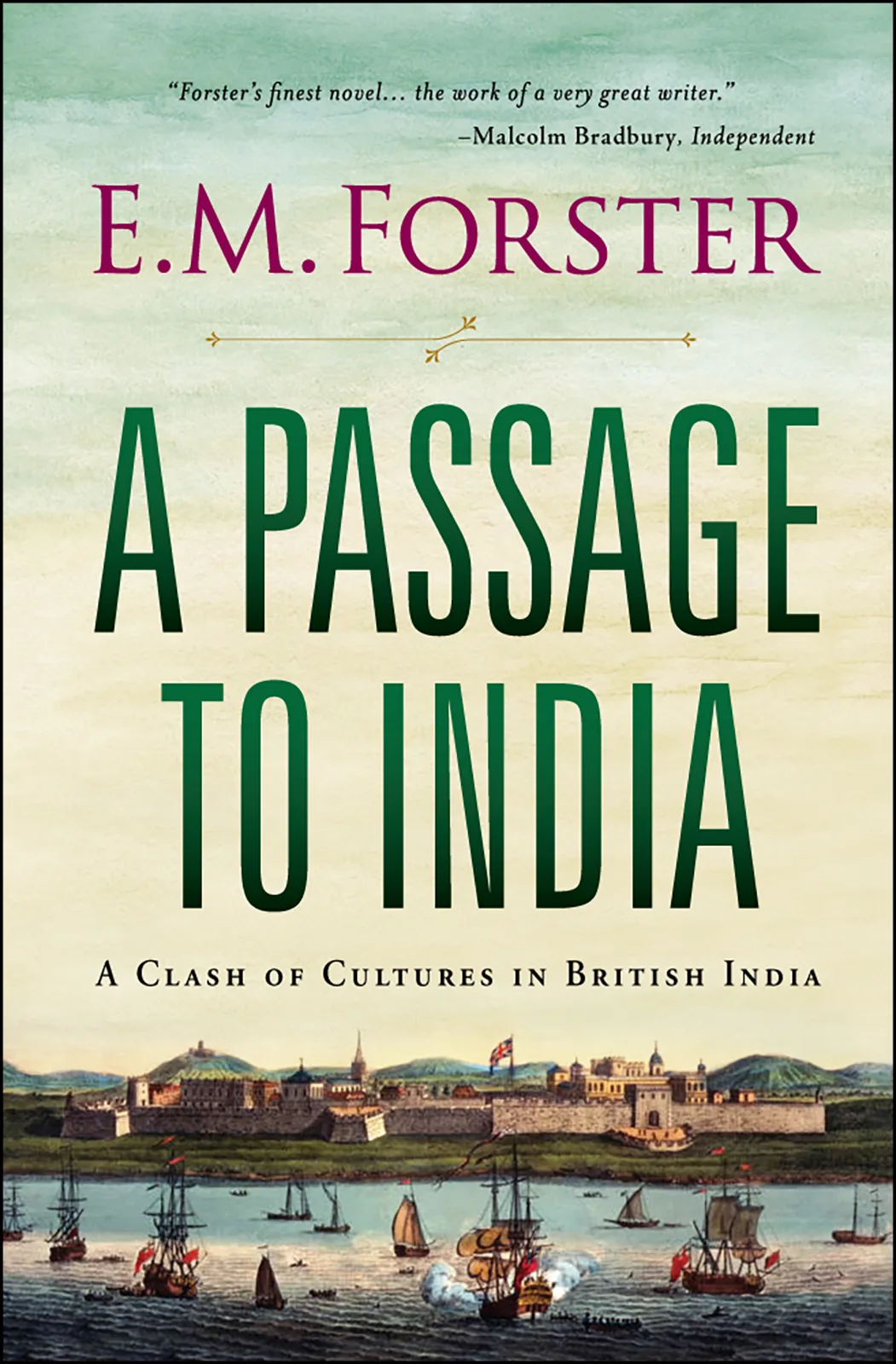
A Passage to India
Hardcover
• 344 Pages
• INR 595.00
• English
• 9789391181772
No ratings yet
| Publisher | General Press |
|---|---|
| ISBN13 | 9789391181772 |
| ASIN/SKU | 9391181775 |
| Book Format | Hardcover |
| Language | English |
| Pages | 344 |
| List Price | INR 595.00 |
| Subject Code | FIC004000, FIC014000, FIC105000 |
| Publishing Date | 15/09/2021 |
| Dimensions | 8.25 x 5.25 x 1.0 inches |
| Book Code | BD00068156 |
Buy this Book
Amazon Stores
Ebook Stores
Other Stores
Discover A Passage to India by E.M. Forster. This book is published by General Press in Hardcover format, ISBN 9789391181772, ASIN 9391181775, under Literature and Fiction, Classics, Historical Fiction.
Book Description
'A Passage to India' by E.M. Forster is a masterpiece of literary fiction that has lost none of its power since it was first published in 1924 — a novel that uses the sun-baked landscape of colonial India as the backdrop for one of literature's most searching explorations of misunderstanding, prejudice, and the painful limits of human connection. From its very first pages, it pulls you into a world where every conversation carries an undercurrent of tension, and where the gulf between people is measured not just in culture or race, but in the subtler distances of fear, assumption, and pride.
The story is set in the fictional city of Chandrapore during the height of the British Raj, where the English colonizers and the Indian population live in carefully maintained separation, each regarding the other through a lens thick with suspicion and misreading. Into this charged atmosphere arrive two Englishwomen — the elderly Mrs. Moore and the curious, open-hearted Adela Quested — who come to India with genuine goodwill and a desire to see the "real" country beyond the stuffy confines of the British social club. They befriend Dr. Aziz, a warm and enthusiastic Indian physician who is touched by their sincerity and eager to show them the India he loves. He arranges an excursion to the famous Marabar Caves — and it is there, in those ancient, echo-filled chambers, that something happens which nobody can fully explain, and which sets off a chain of events that tears lives apart.
Forster handles that central mystery with extraordinary restraint. He is far more interested in what the episode reveals about his characters and the society around them than in resolving it neatly. The novel becomes a devastating portrait of how a system built on power and racial hierarchy corrodes everyone it touches — the colonizer and the colonized alike.
What lingers long after the final page is Forster's quietly aching question: can people from vastly different worlds ever truly know one another — and if not, what does that mean for the possibility of justice, friendship, and love?
The story is set in the fictional city of Chandrapore during the height of the British Raj, where the English colonizers and the Indian population live in carefully maintained separation, each regarding the other through a lens thick with suspicion and misreading. Into this charged atmosphere arrive two Englishwomen — the elderly Mrs. Moore and the curious, open-hearted Adela Quested — who come to India with genuine goodwill and a desire to see the "real" country beyond the stuffy confines of the British social club. They befriend Dr. Aziz, a warm and enthusiastic Indian physician who is touched by their sincerity and eager to show them the India he loves. He arranges an excursion to the famous Marabar Caves — and it is there, in those ancient, echo-filled chambers, that something happens which nobody can fully explain, and which sets off a chain of events that tears lives apart.
Forster handles that central mystery with extraordinary restraint. He is far more interested in what the episode reveals about his characters and the society around them than in resolving it neatly. The novel becomes a devastating portrait of how a system built on power and racial hierarchy corrodes everyone it touches — the colonizer and the colonized alike.
What lingers long after the final page is Forster's quietly aching question: can people from vastly different worlds ever truly know one another — and if not, what does that mean for the possibility of justice, friendship, and love?
Author Biography
Edward Morgan Forster, generally published as E.M. Forster, was an novelist, essayist, and short story writer. He is known best for his ironic and well-plotted novels examining class difference and hypocrisy in early 20th-century British society. His humanistic impulse toward understanding and sympathy may be aptly summed up in the epigraph to his 1910 novel Howards End: "Only connect".
He had five novels published in his lifetime, achieving his greatest success with A Passage to India (1924) which takes as its subject the relationship between East and West, seen through the lens of India in the later days of the British Raj.
Forster's views as a secular humanist are at the heart of his work, which often depicts the pursuit of personal connections in spite of the restrictions of contemporary society. He is noted for his use of symbolism as a technique in his novels, and he has been criticised for his attachment to mysticism. His other works include Where Angels Fear to Tread (1905), The Longest Journey (1907), A Room with a View (1908) and Maurice (1971), his posthumously published novel which tells of the coming of age of an explicitly gay male character.
He had five novels published in his lifetime, achieving his greatest success with A Passage to India (1924) which takes as its subject the relationship between East and West, seen through the lens of India in the later days of the British Raj.
Forster's views as a secular humanist are at the heart of his work, which often depicts the pursuit of personal connections in spite of the restrictions of contemporary society. He is noted for his use of symbolism as a technique in his novels, and he has been criticised for his attachment to mysticism. His other works include Where Angels Fear to Tread (1905), The Longest Journey (1907), A Room with a View (1908) and Maurice (1971), his posthumously published novel which tells of the coming of age of an explicitly gay male character.
Editorial Reviews
Editorial Reviews will be added soon…
Book Summary
E. M. Forster’s A Passage to India is a thoughtful and deeply humane novel about friendship, cultural misunderstanding, colonial power, and the difficulty of truly knowing another person. Set in British-ruled India during the early twentieth century, the story follows a small group of British and Indian characters whose lives become entangled after an apparently innocent excursion to the Marabar Caves ends in a disturbing and ambiguous incident. Through their experiences, Forster examines how prejudice, fear, social pressure, and political inequality can destroy relationships that might otherwise have developed into genuine human connections.
The novel begins in the fictional Indian city of Chandrapore, where the British colonial community lives separately from the Indian population. The British occupy a privileged social position and generally have little interest in understanding Indian life. Dr. Aziz, a young Indian Muslim physician, works at a local hospital. He is intelligent, emotional, generous, and proud, but he is also sensitive to the humiliations imposed on Indians by colonial rule.
One evening, Aziz meets Mrs. Moore, an elderly Englishwoman who has recently arrived in India to visit her son, Ronny Heaslop, a British magistrate. Unlike many of the British residents, Mrs. Moore is genuinely curious about India and treats Aziz with warmth and respect. The two immediately form a personal connection. Their meeting gives Aziz hope that an English person might see him as an equal human being rather than simply as a colonial subject.
Mrs. Moore’s companion, Adela Quested, is also visiting India. Adela is engaged to Ronny, but she is uncertain about whether she truly wants to marry him. She has come partly because she wants to see the “real India” before making such an important decision. However, her desire to understand India is complicated by the limitations of her own cultural assumptions.
Cyril Fielding, the principal of the Government College, is another important character. Fielding is English but unusually independent-minded. He does not share the rigid prejudices of the Anglo-Indian community and is willing to form friendships with Indians. He becomes particularly friendly with Aziz.
An invitation is eventually arranged for Aziz, Mrs. Moore, and Adela to visit the Marabar Caves. Aziz wants to make the excursion special because he values the friendship he has developed with the two women. The caves are ancient, mysterious, and difficult to understand. They are not beautiful in the conventional sense; instead, they possess an unsettling emptiness.
The journey to the caves initially seems successful, but the atmosphere gradually becomes strange and oppressive. Inside one of the caves, Mrs. Moore experiences a disturbing echo. Everything she says comes back as a meaningless repetition, reducing words and emotions to the same hollow sound. The experience deeply unsettles her. She begins to feel that the universe itself may be indifferent to human distinctions between good and evil, love and hatred, or meaning and meaninglessness.
Adela later enters another cave with Aziz. What exactly happens there is never made completely clear. Adela emerges frightened and returns to the British community claiming that Aziz attempted to assault her.
Aziz is arrested.
The accusation immediately becomes a political crisis. Most of the British residents instinctively believe Adela and assume Aziz is guilty. The incident confirms their existing prejudices about Indians. They become more hostile toward the Indian population, treating Aziz's alleged crime as proof that Indians cannot be trusted.
Fielding refuses to accept this conclusion without evidence. He believes Aziz is innocent and openly supports him. His position isolates him from many of his British colleagues. The case therefore becomes more than a question of individual guilt: it becomes a test of whether friendship and justice can survive the pressures of colonial society.
The trial attracts enormous attention. Indians gather in support of Aziz, while the British community expects his conviction. During the proceedings, Adela begins to question her own memory. She realizes that she may have misunderstood what happened inside the cave. When she is asked to identify Aziz as the man who attacked her, she cannot do so. She withdraws the accusation.
Aziz is released.
The withdrawal shocks the British community. Adela is immediately rejected by many of the people who had previously supported her. Ronny breaks off their relationship, and Adela finds herself emotionally isolated. Fielding, however, helps her despite the hostility surrounding her.
Although Aziz is legally cleared, the damage caused by the accusation cannot easily be repaired. He feels deeply betrayed by the British and becomes increasingly distrustful of English people. His friendship with Fielding begins to deteriorate, even though Fielding was one of the few Englishmen who supported him.
Mrs. Moore, meanwhile, has already left India. Her experience at the caves has profoundly changed her. She becomes detached from the practical concerns of the trial and increasingly troubled by the echo she encountered. Her death during the journey back to England further emphasizes the novel's sense of uncertainty and mortality.
The novel then moves toward the question of whether genuine friendship between Indians and British people is possible under colonial rule. Fielding eventually returns to India and meets Aziz again. The two men still care about each other, but the political circumstances separating them have become stronger than their personal affection.
Aziz has adopted a more openly nationalist position. He no longer wants to maintain close friendships with English people while India remains under British control. Fielding, although sympathetic to Indian aspirations, still represents the colonial world Aziz has come to distrust.
During a later meeting, the two men ride together through the countryside. They discuss their friendship and the possibility of remaining close. Yet the landscape itself seems to prevent a final reconciliation. Their paths literally and symbolically begin to separate.
Forster does not end the novel by declaring that friendship is impossible in every circumstance. Instead, he suggests that friendship between individuals may be sincere, but colonialism makes such friendship extremely difficult to sustain. Political inequality enters personal relationships whether people want it to or not.
The title, A Passage to India, therefore carries several meanings. Adela wants to make a “passage” into India by understanding its people and culture, but she discovers that the country cannot be easily understood through observation alone. Fielding attempts to cross the cultural divide through friendship, while Aziz initially welcomes that possibility but eventually recognizes the political barriers surrounding it. The caves themselves become a symbol of India's mysteriousness and of the limits of Western attempts to impose simple explanations on unfamiliar experiences.
One of the novel's central themes is the difference between sympathy and true understanding. The British characters often believe they understand India while remaining separated from Indian society. Their assumptions are shaped by colonial hierarchy. Aziz, meanwhile, has his own assumptions about the British, formed through years of humiliation and unequal treatment. Forster shows that misunderstanding can arise on both sides, but the colonial system makes the imbalance of power especially important.
The novel also examines the destructive power of fear. Adela's uncertainty becomes a serious accusation, and that accusation quickly turns into collective hostility. Instead of waiting for truth, the British community chooses the explanation that confirms what it already believes.
Ultimately, A Passage to India is not simply a novel about British India. It is a meditation on how difficult it can be for human beings to cross boundaries created by culture, politics, religion, and power. Forster's most hopeful idea is that genuine human connection is possible, as shown by the friendship between Aziz and Fielding. His darker insight is that such connection may not survive when society itself is built upon inequality.
The novel remains powerful because it refuses easy answers. It recognizes the beauty of friendship while acknowledging how fragile friendship becomes when people do not meet as equals. In the end, Forster suggests that understanding another human being requires more than curiosity or good intentions. It requires humility, trust, freedom, and equality—conditions that colonialism makes extraordinarily difficult to achieve.
The novel begins in the fictional Indian city of Chandrapore, where the British colonial community lives separately from the Indian population. The British occupy a privileged social position and generally have little interest in understanding Indian life. Dr. Aziz, a young Indian Muslim physician, works at a local hospital. He is intelligent, emotional, generous, and proud, but he is also sensitive to the humiliations imposed on Indians by colonial rule.
One evening, Aziz meets Mrs. Moore, an elderly Englishwoman who has recently arrived in India to visit her son, Ronny Heaslop, a British magistrate. Unlike many of the British residents, Mrs. Moore is genuinely curious about India and treats Aziz with warmth and respect. The two immediately form a personal connection. Their meeting gives Aziz hope that an English person might see him as an equal human being rather than simply as a colonial subject.
Mrs. Moore’s companion, Adela Quested, is also visiting India. Adela is engaged to Ronny, but she is uncertain about whether she truly wants to marry him. She has come partly because she wants to see the “real India” before making such an important decision. However, her desire to understand India is complicated by the limitations of her own cultural assumptions.
Cyril Fielding, the principal of the Government College, is another important character. Fielding is English but unusually independent-minded. He does not share the rigid prejudices of the Anglo-Indian community and is willing to form friendships with Indians. He becomes particularly friendly with Aziz.
An invitation is eventually arranged for Aziz, Mrs. Moore, and Adela to visit the Marabar Caves. Aziz wants to make the excursion special because he values the friendship he has developed with the two women. The caves are ancient, mysterious, and difficult to understand. They are not beautiful in the conventional sense; instead, they possess an unsettling emptiness.
The journey to the caves initially seems successful, but the atmosphere gradually becomes strange and oppressive. Inside one of the caves, Mrs. Moore experiences a disturbing echo. Everything she says comes back as a meaningless repetition, reducing words and emotions to the same hollow sound. The experience deeply unsettles her. She begins to feel that the universe itself may be indifferent to human distinctions between good and evil, love and hatred, or meaning and meaninglessness.
Adela later enters another cave with Aziz. What exactly happens there is never made completely clear. Adela emerges frightened and returns to the British community claiming that Aziz attempted to assault her.
Aziz is arrested.
The accusation immediately becomes a political crisis. Most of the British residents instinctively believe Adela and assume Aziz is guilty. The incident confirms their existing prejudices about Indians. They become more hostile toward the Indian population, treating Aziz's alleged crime as proof that Indians cannot be trusted.
Fielding refuses to accept this conclusion without evidence. He believes Aziz is innocent and openly supports him. His position isolates him from many of his British colleagues. The case therefore becomes more than a question of individual guilt: it becomes a test of whether friendship and justice can survive the pressures of colonial society.
The trial attracts enormous attention. Indians gather in support of Aziz, while the British community expects his conviction. During the proceedings, Adela begins to question her own memory. She realizes that she may have misunderstood what happened inside the cave. When she is asked to identify Aziz as the man who attacked her, she cannot do so. She withdraws the accusation.
Aziz is released.
The withdrawal shocks the British community. Adela is immediately rejected by many of the people who had previously supported her. Ronny breaks off their relationship, and Adela finds herself emotionally isolated. Fielding, however, helps her despite the hostility surrounding her.
Although Aziz is legally cleared, the damage caused by the accusation cannot easily be repaired. He feels deeply betrayed by the British and becomes increasingly distrustful of English people. His friendship with Fielding begins to deteriorate, even though Fielding was one of the few Englishmen who supported him.
Mrs. Moore, meanwhile, has already left India. Her experience at the caves has profoundly changed her. She becomes detached from the practical concerns of the trial and increasingly troubled by the echo she encountered. Her death during the journey back to England further emphasizes the novel's sense of uncertainty and mortality.
The novel then moves toward the question of whether genuine friendship between Indians and British people is possible under colonial rule. Fielding eventually returns to India and meets Aziz again. The two men still care about each other, but the political circumstances separating them have become stronger than their personal affection.
Aziz has adopted a more openly nationalist position. He no longer wants to maintain close friendships with English people while India remains under British control. Fielding, although sympathetic to Indian aspirations, still represents the colonial world Aziz has come to distrust.
During a later meeting, the two men ride together through the countryside. They discuss their friendship and the possibility of remaining close. Yet the landscape itself seems to prevent a final reconciliation. Their paths literally and symbolically begin to separate.
Forster does not end the novel by declaring that friendship is impossible in every circumstance. Instead, he suggests that friendship between individuals may be sincere, but colonialism makes such friendship extremely difficult to sustain. Political inequality enters personal relationships whether people want it to or not.
The title, A Passage to India, therefore carries several meanings. Adela wants to make a “passage” into India by understanding its people and culture, but she discovers that the country cannot be easily understood through observation alone. Fielding attempts to cross the cultural divide through friendship, while Aziz initially welcomes that possibility but eventually recognizes the political barriers surrounding it. The caves themselves become a symbol of India's mysteriousness and of the limits of Western attempts to impose simple explanations on unfamiliar experiences.
One of the novel's central themes is the difference between sympathy and true understanding. The British characters often believe they understand India while remaining separated from Indian society. Their assumptions are shaped by colonial hierarchy. Aziz, meanwhile, has his own assumptions about the British, formed through years of humiliation and unequal treatment. Forster shows that misunderstanding can arise on both sides, but the colonial system makes the imbalance of power especially important.
The novel also examines the destructive power of fear. Adela's uncertainty becomes a serious accusation, and that accusation quickly turns into collective hostility. Instead of waiting for truth, the British community chooses the explanation that confirms what it already believes.
Ultimately, A Passage to India is not simply a novel about British India. It is a meditation on how difficult it can be for human beings to cross boundaries created by culture, politics, religion, and power. Forster's most hopeful idea is that genuine human connection is possible, as shown by the friendship between Aziz and Fielding. His darker insight is that such connection may not survive when society itself is built upon inequality.
The novel remains powerful because it refuses easy answers. It recognizes the beauty of friendship while acknowledging how fragile friendship becomes when people do not meet as equals. In the end, Forster suggests that understanding another human being requires more than curiosity or good intentions. It requires humility, trust, freedom, and equality—conditions that colonialism makes extraordinarily difficult to achieve.
Sample Chapters
Chapter 1
Except for the Marabar Caves—and they are twenty miles off—the city of Chandrapore presents nothing extraordinary. Edged rather than washed by the river Ganges, it trails for a couple of miles along the bank, scarcely distinguishable from the rubbish it deposits so freely. There are no bathing-steps on the river front, as the Ganges happens not to be holy here; indeed there is no river front, and bazaars shut out the wide and shifting panorama of the stream. The streets are mean, the temples ineffective, and though a few fine houses exist they are hidden away in gardens or down alleys whose filth deters all but the invited guest. Chandrapore was never large or beautiful, but two hundred years ago it lay on the road between Upper India, then imperial, and the sea, and the fine houses date from that period. The zest for decoration stopped in the eighteenth century, nor was it ever democratic. There is no painting and scarcely any carving in the bazaars. The very wood seems made of mud, the inhabitants of mud moving. So abased, so monotonous is everything that meets the eye, that when the Ganges comes down it might be expected to wash the excrescence back into the soil. Houses do fall, people are drowned and left rotting, but the general outline of the town persists, swelling here, shrinking there, like some low but indestructible form of life.
Inland, the prospect alters. There is an oval Maidan, and a long sallow hospital. Houses belonging to Eurasians stand on the high ground by the railway station. Beyond the railway—which runs parallel to the river—the land sinks, then rises again rather steeply. On the second rise is laid out the little civil station, and viewed hence Chandrapore appears to be a totally different place. It is a city of gardens. It is no city, but a forest sparsely scattered with huts. It is a tropical pleasaunce washed by a noble river. The toddy palms and neem trees and mangoes and pepul that were hidden behind the bazaars now become visible and in their turn hide the bazaars. They rise from the gardens where ancient tanks nourish them, they burst out of stifling purlieus and unconsidered temples. Seeking, light and air, and endowed with more strength than man or his works, they soar above the lower deposit to greet one another with branches and beckoning leaves, and to build a city for the birds. Especially after the rains do they screen what passes below, but at all times, even when scorched or leafless, they glorify the city to the English people who inhabit the rise, so that new-comers cannot believe it to be as meagre as it is described, and have to be driven down to acquire disillusionment. As for the civil station itself, it provokes no emotion. It charms not, neither does it repel. It is sensibly planned, with a red-brick club on its brow, and farther back a grocer’s and a cemetery, and the bungalows are disposed along roads that intersect at right angles. It has nothing hideous in it, and only the view is beautiful; it shares nothing with the city except the overarching sky.
The sky too has its changes, but they are less marked than those of the vegetation and the river. Clouds map it up at times, but it is normally a dome of blending tints, and the main tint blue. By day the blue will pale down into white where it touches the white of the land, after sunset it has a new circumference—orange, melting upwards into tenderest purple. But the core of blue persists, and so it is by night. Then the stars hang like lamps from the immense vault. The distance between the vault and them is as nothing to the distance behind them, and that farther distance, though beyond colour, last freed itself from blue.
The sky settles everything—not only climates and seasons but when the earth shall be beautiful. By herself she can do little—only feeble outbursts of flowers. But when the sky chooses, glory can rain into the Chandrapore bazaars or a benediction pass from horizon to horizon. The sky can do this because it is so strong and so enormous. Strength comes from the sun, infused in it daily, size from the prostrate earth. No mountains infringe on the curve. League after league the earth lies flat, heaves a little, is flat again. Only in the south, where a group of fists and fingers are thrust up through the soil, is the endless expanse interrupted. These fists and fingers are the Marabar Hills, containing the extraordinary caves.
Chapter 2
Abandoning his bicycle, which fell before a servant could catch it, the young man sprang up on to the verandah. He was all animation. “Hamidullah, Hamidullah! am I late?” he cried.
“Do not apologize,” said his host. “You are always late.”
“Kindly answer my question. Am I late? Has Mahmoud Ali eaten all the food? If so I go elsewhere. Mr. Mahmoud Ali, how are you?”
“Thank you, Dr. Aziz, I am dying.”
“Dying before your dinner? Oh, poor Mahmoud Ali!”
“Hamidullah here is actually dead. He passed away just as you rode up on your bike.”
“Yes, that is so,” said the other. “Imagine us both as addressing you from another and a happier world.”
“Does there happen to be such a thing as a hookah in that happier world of yours?”
“Aziz, don’t chatter. We are having a very sad talk.”
The hookah had been packed too tight, as was usual in his friend’s house, and bubbled sulkily. He coaxed it. Yielding at last, the tobacco jetted up into his lungs and nostrils, driving out the smoke of burning cow dung that had filled them as he rode through the bazaar. It was delicious. He lay in a trance, sensuous but healthy, through which the talk of the two others did not seem particularly sad—they were discussing as to whether or no it is possible to be friends with an Englishman. Mahmoud Ali argued that it was not, Hamidullah disagreed, but with so many reservations that there was no friction between them. Delicious indeed to lie on the broad verandah with the moon rising in front and the servants preparing dinner behind, and no trouble happening.
“Well, look at my own experience this morning.”
“I only contend that it is possible in England,” replied Hamidullah, who had been to that country long ago, before the big rush, and had received a cordial welcome at Cambridge.
“It is impossible here. Aziz! The red-nosed boy has again insulted me in Court. I do not blame him. He was told that he ought to insult me. Until lately he was quite a nice boy, but the others have got hold of him.”
“Yes, they have no chance here, that is my point. They come out intending to be gentlemen, and are told it will not do. Look at Lesley, look at Blakiston, now it is your red-nosed boy, and Fielding will go next. Why, I remember when Turton came out first. It was in another part of the Province. You fellows will not believe me, but I have driven with Turton in his carriage—Turton! Oh yes, we were once quite intimate. He has shown me his stamp collection.”
“He would expect you to steal it now. Turton! But red-nosed boy will be far worse than Turton!”
“I do not think so. They all become exactly the same, not worse, not better. I give any Englishman two years, be he Turton or Burton. It is only the difference of a letter. And I give any Englishwoman six months. All are exactly alike. Do you not agree with me?”
“I do not,” replied Mahmoud Ali, entering into the bitter fun, and feeling both pain and amusement at each word that was uttered. “For my own part I find such profound differences among our rulers. Red-nose mumbles, Turton talks distinctly, Mrs. Turton takes bribes, Mrs. Red-nose does not and cannot, because so far there is no Mrs. Red-nose.”
“Bribes?”
“Did you not know that when they were lent to Central India over a Canal Scheme, some Rajah or other gave her a sewing machine in solid gold so that the water should run through his state.”
“And does it?”
“No, that is where Mrs. Turton is so skilful. When we poor blacks take bribes, we perform what we are bribed to perform, and the law discovers us in consequence. The English take and do nothing. I admire them.”
“We all admire them. Aziz, please pass me the hookah.”
“Oh, not yet—hookah is so jolly now.”
“You are a very selfish boy.” He raised his voice suddenly, and shouted for dinner. Servants shouted back that it was ready. They meant that they wished it was ready, and were so understood, for nobody moved. Then Hamidullah continued, but with changed manner and evident emotion.
“But take my case—the case of young Hugh Bannister. Here is the son of my dear, my dead friends, the Reverend and Mrs. Bannister, whose goodness to me in England I shall never forget or describe. They were father and mother to me, I talked to them as I do now. In the vacations their Rectory became my home. They entrusted all their children to me—I often carried little Hugh about—I took him up to the Funeral of Queen Victoria, and held him in my arms above the crowd.”
“Queen Victoria was different,” murmured Mahmoud Ali.
“I learn now that this boy is in business as a leather merchant at Cawnpore. Imagine how I long to see him and to pay his fare that this house may be his home. But it is useless. The other Anglo-Indians will have got hold of him long ago. He will probably think that I want something, and I cannot face that from the son of my old friends. Oh, what in this country has gone wrong with everything, Vakil Sahib? I ask you.”
Aziz joined in. “Why talk about the English? Brrrr...! Why be either friends with the fellows or not friends? Let us shut them out and be jolly. Queen Victoria and Mrs. Bannister were the only exceptions, and they’re dead.”
“No, no, I do not admit that, I have met others.”
“So have I,” said Mahmoud Ali, unexpectedly veering. “All ladies are far from alike.” Their mood was changed, and they recalled little kindnesses and courtesies. “She said ‘Thank you so much’ in the most natural way.” “She offered me a lozenge when the dust irritated my throat.” Hamidullah could remember more important examples of angelic ministration, but the other, who only knew Anglo-India, had to ransack his memory for scraps, and it was not surprising that he should return to “But of course all this is exceptional. The exception does not prove the rule. The average woman is like Mrs. Turton, and, Aziz, you know what she is.” Aziz did not know, but said he did. He too generalized from his disappointments—it is difficult for members of a subject race to do otherwise. Granted the exceptions, he agreed that all Englishwomen are haughty and venal. The gleam passed from the conversation, whose wintry surface unrolled and expanded interminably.
A servant announced dinner. They ignored him. The elder men had reached their eternal politics, Aziz drifted into the garden. The trees smelt sweet—green-blossomed champak—and scraps of Persian poetry came into his head. Dinner, dinner, dinner... but when he returned to the house for it, Mahmoud Ali had drifted away in his turn, to speak to his sais. “Come and see my wife a little then,” said Hamidullah, and they spent twenty minutes behind the purdah. Hamidullah Begum was a distant aunt of Aziz, and the only female relative he had in Chandrapore, and she had much to say to him on this occasion about a family circumcision that had been celebrated with imperfect pomp. It was difficult to get away, because until they had had their dinner she would not begin hers, and consequently prolonged her remarks in case they should suppose she was impatient. Having censured the circumcision, she bethought her of kindred topics, and asked Aziz when he was going to be married.
Respectful but irritated, he answered, “Once is enough.”
“Yes, he has done his duty,” said Hamidullah. “Do not tease him so. He carries on his family, two boys and their sister.”
“Aunt, they live most comfortably with my wife’s mother, where she was living when she died. I can see them whenever I like. They are such very, very small children.”
“And he sends them the whole of his salary and lives like a low-grade clerk, and tells no one the reason. What more do you require him to do?”
But this was not Hamidullah Begum’s point, and having courteously changed the conversation for a few moments she returned and made it. She said, “What is to become of all our daughters if men refuse to marry? They will marry beneath them, or——” And she began the oft-told tale of a lady of Imperial descent who could find no husband in the narrow circle where her pride permitted her to mate, and had lived on unwed, her age now thirty, and would die unwed, for no one would have her now. While the tale was in progress, it convinced the two men, the tragedy seemed a slur on the whole community; better polygamy almost, than that a woman should die without the joys God has intended her to receive. Wedlock, motherhood, power in the house—for what else is she born, and how can the man who has denied them to her stand up to face her creator and his own at the last day? Aziz took his leave saying “Perhaps... but later...”—his invariable reply to such an appeal.
“You mustn’t put off what you think right,” said Hamidullah. “That is why India is in such a plight, because we put off things.” But seeing that his young relative looked worried, he added a few soothing words, and thus wiped out any impression that his wife might have made.
During their absence, Mahmoud Ali had gone off in his carriage leaving a message that he should be back in five minutes, but they were on no account to wait. They sat down to meat with a distant cousin of the house, Mohammed Latif, who lived on Hamidullah’s bounty and who occupied the position neither of a servant nor of an equal. He did not speak unless spoken to, and since no one spoke kept unoffended silence. Now and then he belched, in compliment to the richness of the food. A gentle, happy and dishonest old man; all his life he had never done a stroke of work. So long as some one of his relatives had a house he was sure of a home, and it was unlikely that so large a family would all go bankrupt. His wife led a similar existence some hundreds of miles away—he did not visit her, owing to the expense of the railway ticket. Presently Aziz chaffed him, also the servants, and then began quoting poetry, Persian, Urdu, a little Arabic. His memory was good, and for so young a man he had read largely; the themes he preferred were the decay of Islam and the brevity of love. They listened delighted, for they took the public view of poetry, not the private which obtains in England. It never bored them to hear words, words; they breathed them with the cool night air, never stopping to analyse; the name of the poet, Hafiz, Hali, Iqbal, was sufficient guarantee. India—a hundred Indias—whispered outside beneath the indifferent moon, but for the time India seemed one and their own, and they regained their departed greatness by hearing its departure lamented, they felt young again because reminded that youth must fly. A servant in scarlet interrupted him; he was the chuprassi of the Civil Surgeon, and he handed Aziz a note.
“Old Callendar wants to see me at his bungalow,” he said, not rising. “He might have the politeness to say why.”
“Some case, I daresay.”
“I daresay not, I daresay nothing. He has found out our dinner hour, that’s all, and chooses to interrupt us every time, in order to show his power.”
“On the one hand he always does this, on the other it may be a serious case, and you cannot know,” said Hamidullah, considerately paving the way towards obedience. “Had you not better clean your teeth after pan?”
“If my teeth are to be cleaned, I don’t go at all. I am an Indian, it is an Indian habit to take pan. The Civil Surgeon must put up with it. Mohammed Latif, my bike, please.”
The poor relation got up. Slightly immersed in the realms of matter, he laid his hand on the bicycle’s saddle, while a servant did the actual wheeling. Between them they took it over a tintack. Aziz held his hands under the ewer, dried them, fitted on his green felt hat, and then with unexpected energy whizzed out of Hamidullah’s compound.
“Aziz, Aziz, imprudent boy...” But he was far down the bazaar, riding furiously. He had neither light nor bell nor had he a brake, but what use are such adjuncts in a land where the cyclist’s only hope is to coast from face to face, and just before he collides with each it vanishes? And the city was fairly empty at this hour. When his tyre went flat, he leapt off and shouted for a tonga.
He did not at first find one, and he had also to dispose of his bicycle at a friend’s house. He dallied furthermore to clean his teeth. But at last he was rattling towards the civil lines, with a vivid sense of speed. As he entered their arid tidiness, depression suddenly seized him. The roads, named after victorious generals and intersecting at right angles, were symbolic of the net Great Britain had thrown over India. He felt caught in their meshes. When he turned into Major Callendar’s compound he could with difficulty restrain himself from getting down from the tonga and approaching the bungalow on foot, and this not because his soul was servile but because his feelings—the sensitive edges of him—feared a gross snub. There had been a “case” last year—an Indian gentleman had driven up to an official’s house and been turned back by the servants and been told to approach more suitably—only one case among thousands of visits to hundreds of officials, but its fame spread wide. The young man shrank from a repetition of it. He compromised, and stopped the driver just outside the flood of light that fell across the verandah.
The Civil Surgeon was out.
“But the sahib has left me some message?”
Except for the Marabar Caves—and they are twenty miles off—the city of Chandrapore presents nothing extraordinary. Edged rather than washed by the river Ganges, it trails for a couple of miles along the bank, scarcely distinguishable from the rubbish it deposits so freely. There are no bathing-steps on the river front, as the Ganges happens not to be holy here; indeed there is no river front, and bazaars shut out the wide and shifting panorama of the stream. The streets are mean, the temples ineffective, and though a few fine houses exist they are hidden away in gardens or down alleys whose filth deters all but the invited guest. Chandrapore was never large or beautiful, but two hundred years ago it lay on the road between Upper India, then imperial, and the sea, and the fine houses date from that period. The zest for decoration stopped in the eighteenth century, nor was it ever democratic. There is no painting and scarcely any carving in the bazaars. The very wood seems made of mud, the inhabitants of mud moving. So abased, so monotonous is everything that meets the eye, that when the Ganges comes down it might be expected to wash the excrescence back into the soil. Houses do fall, people are drowned and left rotting, but the general outline of the town persists, swelling here, shrinking there, like some low but indestructible form of life.
Inland, the prospect alters. There is an oval Maidan, and a long sallow hospital. Houses belonging to Eurasians stand on the high ground by the railway station. Beyond the railway—which runs parallel to the river—the land sinks, then rises again rather steeply. On the second rise is laid out the little civil station, and viewed hence Chandrapore appears to be a totally different place. It is a city of gardens. It is no city, but a forest sparsely scattered with huts. It is a tropical pleasaunce washed by a noble river. The toddy palms and neem trees and mangoes and pepul that were hidden behind the bazaars now become visible and in their turn hide the bazaars. They rise from the gardens where ancient tanks nourish them, they burst out of stifling purlieus and unconsidered temples. Seeking, light and air, and endowed with more strength than man or his works, they soar above the lower deposit to greet one another with branches and beckoning leaves, and to build a city for the birds. Especially after the rains do they screen what passes below, but at all times, even when scorched or leafless, they glorify the city to the English people who inhabit the rise, so that new-comers cannot believe it to be as meagre as it is described, and have to be driven down to acquire disillusionment. As for the civil station itself, it provokes no emotion. It charms not, neither does it repel. It is sensibly planned, with a red-brick club on its brow, and farther back a grocer’s and a cemetery, and the bungalows are disposed along roads that intersect at right angles. It has nothing hideous in it, and only the view is beautiful; it shares nothing with the city except the overarching sky.
The sky too has its changes, but they are less marked than those of the vegetation and the river. Clouds map it up at times, but it is normally a dome of blending tints, and the main tint blue. By day the blue will pale down into white where it touches the white of the land, after sunset it has a new circumference—orange, melting upwards into tenderest purple. But the core of blue persists, and so it is by night. Then the stars hang like lamps from the immense vault. The distance between the vault and them is as nothing to the distance behind them, and that farther distance, though beyond colour, last freed itself from blue.
The sky settles everything—not only climates and seasons but when the earth shall be beautiful. By herself she can do little—only feeble outbursts of flowers. But when the sky chooses, glory can rain into the Chandrapore bazaars or a benediction pass from horizon to horizon. The sky can do this because it is so strong and so enormous. Strength comes from the sun, infused in it daily, size from the prostrate earth. No mountains infringe on the curve. League after league the earth lies flat, heaves a little, is flat again. Only in the south, where a group of fists and fingers are thrust up through the soil, is the endless expanse interrupted. These fists and fingers are the Marabar Hills, containing the extraordinary caves.
Chapter 2
Abandoning his bicycle, which fell before a servant could catch it, the young man sprang up on to the verandah. He was all animation. “Hamidullah, Hamidullah! am I late?” he cried.
“Do not apologize,” said his host. “You are always late.”
“Kindly answer my question. Am I late? Has Mahmoud Ali eaten all the food? If so I go elsewhere. Mr. Mahmoud Ali, how are you?”
“Thank you, Dr. Aziz, I am dying.”
“Dying before your dinner? Oh, poor Mahmoud Ali!”
“Hamidullah here is actually dead. He passed away just as you rode up on your bike.”
“Yes, that is so,” said the other. “Imagine us both as addressing you from another and a happier world.”
“Does there happen to be such a thing as a hookah in that happier world of yours?”
“Aziz, don’t chatter. We are having a very sad talk.”
The hookah had been packed too tight, as was usual in his friend’s house, and bubbled sulkily. He coaxed it. Yielding at last, the tobacco jetted up into his lungs and nostrils, driving out the smoke of burning cow dung that had filled them as he rode through the bazaar. It was delicious. He lay in a trance, sensuous but healthy, through which the talk of the two others did not seem particularly sad—they were discussing as to whether or no it is possible to be friends with an Englishman. Mahmoud Ali argued that it was not, Hamidullah disagreed, but with so many reservations that there was no friction between them. Delicious indeed to lie on the broad verandah with the moon rising in front and the servants preparing dinner behind, and no trouble happening.
“Well, look at my own experience this morning.”
“I only contend that it is possible in England,” replied Hamidullah, who had been to that country long ago, before the big rush, and had received a cordial welcome at Cambridge.
“It is impossible here. Aziz! The red-nosed boy has again insulted me in Court. I do not blame him. He was told that he ought to insult me. Until lately he was quite a nice boy, but the others have got hold of him.”
“Yes, they have no chance here, that is my point. They come out intending to be gentlemen, and are told it will not do. Look at Lesley, look at Blakiston, now it is your red-nosed boy, and Fielding will go next. Why, I remember when Turton came out first. It was in another part of the Province. You fellows will not believe me, but I have driven with Turton in his carriage—Turton! Oh yes, we were once quite intimate. He has shown me his stamp collection.”
“He would expect you to steal it now. Turton! But red-nosed boy will be far worse than Turton!”
“I do not think so. They all become exactly the same, not worse, not better. I give any Englishman two years, be he Turton or Burton. It is only the difference of a letter. And I give any Englishwoman six months. All are exactly alike. Do you not agree with me?”
“I do not,” replied Mahmoud Ali, entering into the bitter fun, and feeling both pain and amusement at each word that was uttered. “For my own part I find such profound differences among our rulers. Red-nose mumbles, Turton talks distinctly, Mrs. Turton takes bribes, Mrs. Red-nose does not and cannot, because so far there is no Mrs. Red-nose.”
“Bribes?”
“Did you not know that when they were lent to Central India over a Canal Scheme, some Rajah or other gave her a sewing machine in solid gold so that the water should run through his state.”
“And does it?”
“No, that is where Mrs. Turton is so skilful. When we poor blacks take bribes, we perform what we are bribed to perform, and the law discovers us in consequence. The English take and do nothing. I admire them.”
“We all admire them. Aziz, please pass me the hookah.”
“Oh, not yet—hookah is so jolly now.”
“You are a very selfish boy.” He raised his voice suddenly, and shouted for dinner. Servants shouted back that it was ready. They meant that they wished it was ready, and were so understood, for nobody moved. Then Hamidullah continued, but with changed manner and evident emotion.
“But take my case—the case of young Hugh Bannister. Here is the son of my dear, my dead friends, the Reverend and Mrs. Bannister, whose goodness to me in England I shall never forget or describe. They were father and mother to me, I talked to them as I do now. In the vacations their Rectory became my home. They entrusted all their children to me—I often carried little Hugh about—I took him up to the Funeral of Queen Victoria, and held him in my arms above the crowd.”
“Queen Victoria was different,” murmured Mahmoud Ali.
“I learn now that this boy is in business as a leather merchant at Cawnpore. Imagine how I long to see him and to pay his fare that this house may be his home. But it is useless. The other Anglo-Indians will have got hold of him long ago. He will probably think that I want something, and I cannot face that from the son of my old friends. Oh, what in this country has gone wrong with everything, Vakil Sahib? I ask you.”
Aziz joined in. “Why talk about the English? Brrrr...! Why be either friends with the fellows or not friends? Let us shut them out and be jolly. Queen Victoria and Mrs. Bannister were the only exceptions, and they’re dead.”
“No, no, I do not admit that, I have met others.”
“So have I,” said Mahmoud Ali, unexpectedly veering. “All ladies are far from alike.” Their mood was changed, and they recalled little kindnesses and courtesies. “She said ‘Thank you so much’ in the most natural way.” “She offered me a lozenge when the dust irritated my throat.” Hamidullah could remember more important examples of angelic ministration, but the other, who only knew Anglo-India, had to ransack his memory for scraps, and it was not surprising that he should return to “But of course all this is exceptional. The exception does not prove the rule. The average woman is like Mrs. Turton, and, Aziz, you know what she is.” Aziz did not know, but said he did. He too generalized from his disappointments—it is difficult for members of a subject race to do otherwise. Granted the exceptions, he agreed that all Englishwomen are haughty and venal. The gleam passed from the conversation, whose wintry surface unrolled and expanded interminably.
A servant announced dinner. They ignored him. The elder men had reached their eternal politics, Aziz drifted into the garden. The trees smelt sweet—green-blossomed champak—and scraps of Persian poetry came into his head. Dinner, dinner, dinner... but when he returned to the house for it, Mahmoud Ali had drifted away in his turn, to speak to his sais. “Come and see my wife a little then,” said Hamidullah, and they spent twenty minutes behind the purdah. Hamidullah Begum was a distant aunt of Aziz, and the only female relative he had in Chandrapore, and she had much to say to him on this occasion about a family circumcision that had been celebrated with imperfect pomp. It was difficult to get away, because until they had had their dinner she would not begin hers, and consequently prolonged her remarks in case they should suppose she was impatient. Having censured the circumcision, she bethought her of kindred topics, and asked Aziz when he was going to be married.
Respectful but irritated, he answered, “Once is enough.”
“Yes, he has done his duty,” said Hamidullah. “Do not tease him so. He carries on his family, two boys and their sister.”
“Aunt, they live most comfortably with my wife’s mother, where she was living when she died. I can see them whenever I like. They are such very, very small children.”
“And he sends them the whole of his salary and lives like a low-grade clerk, and tells no one the reason. What more do you require him to do?”
But this was not Hamidullah Begum’s point, and having courteously changed the conversation for a few moments she returned and made it. She said, “What is to become of all our daughters if men refuse to marry? They will marry beneath them, or——” And she began the oft-told tale of a lady of Imperial descent who could find no husband in the narrow circle where her pride permitted her to mate, and had lived on unwed, her age now thirty, and would die unwed, for no one would have her now. While the tale was in progress, it convinced the two men, the tragedy seemed a slur on the whole community; better polygamy almost, than that a woman should die without the joys God has intended her to receive. Wedlock, motherhood, power in the house—for what else is she born, and how can the man who has denied them to her stand up to face her creator and his own at the last day? Aziz took his leave saying “Perhaps... but later...”—his invariable reply to such an appeal.
“You mustn’t put off what you think right,” said Hamidullah. “That is why India is in such a plight, because we put off things.” But seeing that his young relative looked worried, he added a few soothing words, and thus wiped out any impression that his wife might have made.
During their absence, Mahmoud Ali had gone off in his carriage leaving a message that he should be back in five minutes, but they were on no account to wait. They sat down to meat with a distant cousin of the house, Mohammed Latif, who lived on Hamidullah’s bounty and who occupied the position neither of a servant nor of an equal. He did not speak unless spoken to, and since no one spoke kept unoffended silence. Now and then he belched, in compliment to the richness of the food. A gentle, happy and dishonest old man; all his life he had never done a stroke of work. So long as some one of his relatives had a house he was sure of a home, and it was unlikely that so large a family would all go bankrupt. His wife led a similar existence some hundreds of miles away—he did not visit her, owing to the expense of the railway ticket. Presently Aziz chaffed him, also the servants, and then began quoting poetry, Persian, Urdu, a little Arabic. His memory was good, and for so young a man he had read largely; the themes he preferred were the decay of Islam and the brevity of love. They listened delighted, for they took the public view of poetry, not the private which obtains in England. It never bored them to hear words, words; they breathed them with the cool night air, never stopping to analyse; the name of the poet, Hafiz, Hali, Iqbal, was sufficient guarantee. India—a hundred Indias—whispered outside beneath the indifferent moon, but for the time India seemed one and their own, and they regained their departed greatness by hearing its departure lamented, they felt young again because reminded that youth must fly. A servant in scarlet interrupted him; he was the chuprassi of the Civil Surgeon, and he handed Aziz a note.
“Old Callendar wants to see me at his bungalow,” he said, not rising. “He might have the politeness to say why.”
“Some case, I daresay.”
“I daresay not, I daresay nothing. He has found out our dinner hour, that’s all, and chooses to interrupt us every time, in order to show his power.”
“On the one hand he always does this, on the other it may be a serious case, and you cannot know,” said Hamidullah, considerately paving the way towards obedience. “Had you not better clean your teeth after pan?”
“If my teeth are to be cleaned, I don’t go at all. I am an Indian, it is an Indian habit to take pan. The Civil Surgeon must put up with it. Mohammed Latif, my bike, please.”
The poor relation got up. Slightly immersed in the realms of matter, he laid his hand on the bicycle’s saddle, while a servant did the actual wheeling. Between them they took it over a tintack. Aziz held his hands under the ewer, dried them, fitted on his green felt hat, and then with unexpected energy whizzed out of Hamidullah’s compound.
“Aziz, Aziz, imprudent boy...” But he was far down the bazaar, riding furiously. He had neither light nor bell nor had he a brake, but what use are such adjuncts in a land where the cyclist’s only hope is to coast from face to face, and just before he collides with each it vanishes? And the city was fairly empty at this hour. When his tyre went flat, he leapt off and shouted for a tonga.
He did not at first find one, and he had also to dispose of his bicycle at a friend’s house. He dallied furthermore to clean his teeth. But at last he was rattling towards the civil lines, with a vivid sense of speed. As he entered their arid tidiness, depression suddenly seized him. The roads, named after victorious generals and intersecting at right angles, were symbolic of the net Great Britain had thrown over India. He felt caught in their meshes. When he turned into Major Callendar’s compound he could with difficulty restrain himself from getting down from the tonga and approaching the bungalow on foot, and this not because his soul was servile but because his feelings—the sensitive edges of him—feared a gross snub. There had been a “case” last year—an Indian gentleman had driven up to an official’s house and been turned back by the servants and been told to approach more suitably—only one case among thousands of visits to hundreds of officials, but its fame spread wide. The young man shrank from a repetition of it. He compromised, and stopped the driver just outside the flood of light that fell across the verandah.
The Civil Surgeon was out.
“But the sahib has left me some message?”
Reader Reviews
No reviews yet.
A Passage to India
Download Cover Image
Do you want to download the full cover image for A Passage to India?