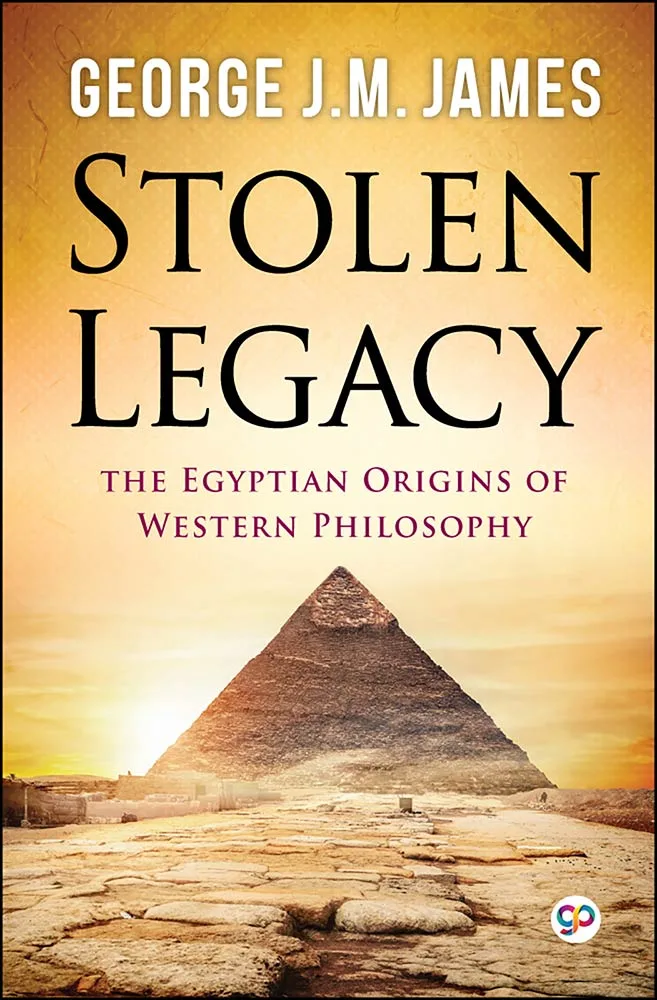
Stolen Legacy
Hardcover
• 200 Pages
• INR 395.00
• English
• 9789354994753
No ratings yet
| Publisher | General Press |
|---|---|
| ISBN13 | 9789354994753 |
| ASIN/SKU | 935499475X |
| Book Format | Hardcover |
| Language | English |
| Pages | 200 |
| List Price | INR 395.00 |
| Subject Code | PHI005000, HIS010000, SOC053000 |
| Publishing Date | 22/09/2022 |
| Dimensions | 8.25 x 5.25 x 1.0 inches |
| Book Code | BD00068180 |
Buy this Book
Amazon Stores
Ebook Stores
Other Stores
Discover Stolen Legacy by George J.M. James. This book is published by General Press in Hardcover format, ISBN 9789354994753, ASIN 935499475X, under History, Ancient, Civilization and Culture.
Book Description
Originally published in 1954, ‘Stolen Legacy’ by George J.M. James is a bold and uncompromising book. James argues that the ‘Greek Philosophy’ in which nearly all of Western culture has its roots actually originated in ancient Egypt Drawing on careful historical research and a radical rethinking of the conventional narrative of Greek history. He asserts that our celebration of the ancient Greeks as the creators of Western civilization and philosophy is misattributed.
Furthermore, this massive intellectual and cultural theft has helped lend credence to the damaging notion that the entire continent of Africa has contributed nothing to world civilization. It is indeed surprising how, for centuries, the Greeks have been praised by the Western World for intellectual accomplishments which belong without a doubt to the Egyptians or the peoples of North Africa. An important book for understanding the history of philosophy, culture, and race in the modern world, this book is not to be missed.
Furthermore, this massive intellectual and cultural theft has helped lend credence to the damaging notion that the entire continent of Africa has contributed nothing to world civilization. It is indeed surprising how, for centuries, the Greeks have been praised by the Western World for intellectual accomplishments which belong without a doubt to the Egyptians or the peoples of North Africa. An important book for understanding the history of philosophy, culture, and race in the modern world, this book is not to be missed.
Author Biography
Dr. George G. M. James was a Guyanese author and historian. He received his PhD from Columbia University in New York and went on to be a professor of mathematics, logic, Greek, and Latin.
Editorial Reviews
Editorial Reviews will be added soon…
Book Summary
Stolen Legacy by George G. M. James is a provocative and controversial work of intellectual history first published in 1954. Its central argument is stated boldly in its subtitle: the philosophical tradition commonly called “Greek philosophy,” James argues, was not originally created by the Greeks but was derived largely from the intellectual and religious traditions of ancient Egypt. The book seeks to challenge the conventional history of Western philosophy and restore what James regards as the neglected African contribution to world civilization. Rather than presenting Egypt merely as an ancient culture that influenced Greece, James makes a much stronger claim: that the Egyptian Mystery System was the original source of many ideas later associated with Greek philosophers and that the credit given to Greece represents a historical misattribution.
The importance of Stolen Legacy lies not only in its historical claims but also in the reason James wrote it. He was concerned about the widespread idea that Africa had contributed little to philosophy, science, literature, and civilization. According to James, this distorted version of history helped support racist assumptions about African intellectual capacity. His project is therefore partly historical and partly corrective. He wants readers to reconsider the traditional story in which Greece appears as the almost spontaneous birthplace of Western philosophy. James argues that if African intellectual achievements were deliberately or unintentionally removed from the story, then recovering those achievements becomes an important step toward correcting a larger historical injustice. A scholarly review of the book likewise identifies improving race relations and restoring recognition of Africa’s intellectual contribution as central purposes of James’s project.
James begins by challenging the very phrase “Greek philosophy.” In his view, the label gives the impression that the major philosophical ideas associated with the ancient Mediterranean world were created independently by Greek thinkers. He instead presents ancient Egyptian thought as the deeper source. At the center of his reconstruction is what he calls the Egyptian Mystery System. James describes this as a highly developed religious, philosophical, ethical, and educational system in which human beings sought liberation from ignorance and spiritual limitation. According to his interpretation, the system combined religious teachings with disciplines that included the arts and sciences. Its ultimate goal was a transformation of the individual—from an ordinary mortal condition toward a higher spiritual state.
For James, the Egyptian Mystery System is particularly important because he believes it contained the essential principles later expressed in Greek philosophy. He interprets Egyptian teachings concerning the soul, knowledge, ethics, reality, and human perfection as predecessors of doctrines associated with Pythagoras, Plato, Aristotle, and other Greek thinkers. The Egyptians, in his account, did not merely possess religious rituals; they possessed an organized intellectual tradition that educated initiates through a carefully structured system. Because this knowledge was guarded by secrecy and communicated through initiation, James argues that its written historical record is much less straightforward than the record of later Greek philosophy. This becomes one of his explanations for why Egypt’s contribution is less visible in conventional histories.
A major part of James’s argument concerns the movement of knowledge from Egypt into the Greek world. He proposes a chain of transmission in which Egyptian teachings traveled through locations such as Samos, Croton, and Elea before reaching Athens. Pythagoras is particularly important in this account. James argues that Pythagoras acquired significant knowledge through education in Egypt and later transmitted it to the Greek-speaking world. He similarly connects the Eleatic philosophers and other early thinkers with Egyptian intellectual traditions. In James’s reconstruction, Greek philosophy did not suddenly appear in Athens through purely Greek invention; it developed through the movement and transformation of older Egyptian knowledge.
The figure of Pythagoras therefore becomes central to James’s explanation of the origins of Greek philosophy. Conventional histories recognize Pythagoras for his mathematical and philosophical teachings, particularly the intellectual tradition associated with the Pythagorean school. James argues that his importance should instead be understood partly through his contact with Egyptian education. Pythagoras, in this interpretation, was not an isolated genius inventing a new philosophical system from nothing. He was an intermediary who received knowledge from an older civilization and helped transmit it elsewhere. James uses this model to reinterpret other early Greek philosophers as well, suggesting that their apparently original doctrines should be examined in the context of earlier Egyptian traditions.
James then turns to the question of whether Greek philosophy was compatible with Greek social and political conditions. He argues that it was strangely alien to the ordinary conditions of Greek life. The Greek city-states, in his presentation, were characterized by warfare, rivalry, political instability, and competition. Against this background, James asks how such a sophisticated philosophical and ethical system could have emerged as an entirely independent product of Greek society. He believes the answer is that the philosophy came from somewhere else. The Egyptian Mystery System, with its long educational tradition and spiritual emphasis, therefore becomes the source James believes best explains the sudden appearance of philosophical ideas in Greece.
This argument leads to one of the book’s most controversial themes: the alleged suppression and appropriation of Egyptian knowledge. James claims that Greek thinkers adopted Egyptian teachings and eventually presented them as their own. He places particular emphasis on the later history of philosophical writing and compilation. Aristotle occupies a crucial position because of the enormous body of works traditionally attributed to him and because of his role in organizing philosophical knowledge. James questions how such a large intellectual corpus could have been produced by one person within a single lifetime and suggests that the Aristotelian tradition involved the collection and organization of knowledge accumulated by others. He connects this process to the Alexandrian intellectual world and to what he describes as the appropriation of Egyptian learning.
James’s treatment of Aristotle is therefore much more radical than the conventional account. Instead of seeing Aristotle primarily as the culminating figure of classical Greek philosophy, James portrays him as an important agent in the compilation and transmission of knowledge that had deeper Egyptian origins. The Aristotelian school becomes, in James’s narrative, part of a historical process through which older knowledge was reorganized and given a Greek intellectual identity. This is one of the reasons Stolen Legacy remains controversial: James is not simply arguing that Egypt influenced Greece. He is questioning the authorship and ownership of a large portion of what later became known as Western philosophy.
The book also discusses the Athenian philosophers, including Socrates and Plato. James argues that philosophy was not always welcomed in Athens and points to the persecution or difficulties experienced by philosophers as evidence that philosophical teaching could be regarded as foreign or threatening. Socrates’ execution is particularly significant in this context. James interprets such episodes as evidence of a tension between philosophical ideas and the conventional political culture of Athens. He also discusses figures such as Anaxagoras, who faced prosecution and exile, and Aristotle, who left Athens after political and legal difficulties. In James’s interpretation, these cases demonstrate the complicated position of philosophy within Greek society.
Plato receives particular attention because of the striking similarities James sees between Platonic philosophy and Egyptian religious ideas. Concepts involving the soul, moral purification, higher knowledge, and the relationship between the visible and invisible worlds are treated as evidence of an older Egyptian foundation. James’s approach is comparative: rather than accepting Greek philosophical terminology as proof of Greek originality, he looks for what he believes are earlier parallels in Egyptian thought. His larger purpose is to reverse the normal direction of influence. Instead of asking how Egyptian civilization might have been influenced by Greece, he repeatedly asks what Greece may have received from Egypt.
The Egyptian Mystery System also provides James with an explanation for the educational character of philosophy. In his interpretation, the Egyptian system was not merely a collection of myths. It involved disciplined study and progressive initiation. Students were expected to undergo intellectual and moral development rather than simply memorize information. James connects this educational model with the later philosophical schools of the Greek world. The idea that philosophy is a way of life, rather than merely an academic subject, therefore becomes another supposed link between Egypt and Greece. For James, the true purpose of knowledge is transformation: the learner should become wiser, more disciplined, and more spiritually developed.
One of the most distinctive sections of Stolen Legacy examines the curriculum of the Egyptian Mystery System. James presents the system as encompassing subjects that later became central to philosophical and scientific education. The arts and sciences are not treated as separate from spiritual development. Knowledge of the external world and knowledge of the self belong to the same educational journey. This integrated conception of education helps explain why James sees the Egyptian system as the ancestor of Greek philosophy rather than simply an Egyptian religion.
James also gives special attention to the Memphite Theology. He interprets the ancient Egyptian theological tradition associated with Ptah as containing philosophical principles that anticipate later Greek ideas. The Memphite conception of creation, thought, speech, and divine ordering becomes, in James’s reading, evidence that Egyptians were developing abstract philosophical concepts long before the classical Greek period. He uses these parallels to argue that philosophical reflection existed in Africa before it received its familiar Greek names and formulations.
The book’s final chapters move beyond historical reconstruction and toward what James calls a “New Philosophy of African Redemption.” This is where the political and social purpose of Stolen Legacy becomes especially clear. James does not want readers merely to acknowledge that Egypt was important. He wants the restoration of African intellectual history to have consequences for education and social consciousness. If generations have been taught that philosophy and civilization are essentially European achievements, then correcting that narrative can help challenge feelings of inferiority and racist assumptions. Education becomes a major instrument for this transformation. James advocates spreading knowledge of African intellectual achievement through schools, families, religious institutions, and communities.
The idea of “redemption” in James’s title is therefore intellectual as much as historical. He believes that Africa needs to be restored to a position of dignity within the story of world civilization. The purpose is not merely to replace one racial hierarchy with another, but to challenge the assumption that intellectual greatness belongs naturally to one civilization or race. In James’s presentation, recognizing Egyptian contributions can expose the artificiality of narratives that divide civilization into supposedly creative Europe and supposedly passive Africa.
At the same time, it is important for readers to distinguish between James’s thesis and the conclusions of contemporary historical scholarship. Stolen Legacy has had substantial influence on Afrocentric thought, but its central historical claims have also been strongly criticized. Historians and classicists have challenged James’s evidence, his chronology, his interpretation of ancient Egyptian sources, and his account of Alexandria and Aristotle. Critics have argued, among other things, that the Library of Alexandria was established after Alexander’s conquest and was not simply a repository of ancient Egyptian writings waiting to be looted; that some Egyptian texts James uses as evidence of predecessors to Greek philosophy were actually composed in the Hellenistic period; and that similarities between Greek and Egyptian religious or philosophical ideas do not by themselves establish direct borrowing.
This scholarly controversy is important when reading Stolen Legacy today. The book is best understood as a forceful Afrocentric reinterpretation of ancient intellectual history rather than as an uncontested account of the origins of Greek philosophy. Its value for many readers lies partly in the questions it raises about cultural transmission, historical memory, colonial-era scholarship, and whose achievements receive recognition. Its conclusions should be evaluated critically alongside modern scholarship on ancient Egypt, Greece, and the Mediterranean world.
Ultimately, Stolen Legacy is a book about intellectual ownership and historical memory. George G. M. James asks readers to reconsider one of the foundational stories of Western civilization: the story that philosophy began with the Greeks and then passed from Greece to Rome and eventually to modern Europe. His alternative narrative places ancient Egypt at the beginning of that intellectual lineage and portrays Greek philosophers as recipients, interpreters, and transmitters of knowledge that originated in Africa. Whether or not one accepts James’s strongest claims, the book forces attention toward an important broader question: how are civilizations remembered, and how do power, race, education, and historical interpretation determine whose contributions become part of the official story?
For readers searching for a Stolen Legacy summary, analysis, themes, or explanation of George G. M. James’s argument, the book can be understood as both a historical challenge and an intellectual manifesto. Its central message is that Africa should not be treated as a marginal participant in the development of world civilization. James seeks to restore ancient Egypt to a central place in the history of philosophy and to use that restoration as a means of challenging racial prejudice and intellectual stereotypes. The book remains controversial because its historical thesis goes far beyond the mainstream scholarly consensus, but its influence on Afrocentric thought and debates about the origins of Western philosophy is undeniable. At its deepest level, Stolen Legacy asks readers to examine not only what history says happened, but also who wrote that history, whose achievements were preserved, and what may have been lost when one civilization’s intellectual inheritance was credited to another.
The importance of Stolen Legacy lies not only in its historical claims but also in the reason James wrote it. He was concerned about the widespread idea that Africa had contributed little to philosophy, science, literature, and civilization. According to James, this distorted version of history helped support racist assumptions about African intellectual capacity. His project is therefore partly historical and partly corrective. He wants readers to reconsider the traditional story in which Greece appears as the almost spontaneous birthplace of Western philosophy. James argues that if African intellectual achievements were deliberately or unintentionally removed from the story, then recovering those achievements becomes an important step toward correcting a larger historical injustice. A scholarly review of the book likewise identifies improving race relations and restoring recognition of Africa’s intellectual contribution as central purposes of James’s project.
James begins by challenging the very phrase “Greek philosophy.” In his view, the label gives the impression that the major philosophical ideas associated with the ancient Mediterranean world were created independently by Greek thinkers. He instead presents ancient Egyptian thought as the deeper source. At the center of his reconstruction is what he calls the Egyptian Mystery System. James describes this as a highly developed religious, philosophical, ethical, and educational system in which human beings sought liberation from ignorance and spiritual limitation. According to his interpretation, the system combined religious teachings with disciplines that included the arts and sciences. Its ultimate goal was a transformation of the individual—from an ordinary mortal condition toward a higher spiritual state.
For James, the Egyptian Mystery System is particularly important because he believes it contained the essential principles later expressed in Greek philosophy. He interprets Egyptian teachings concerning the soul, knowledge, ethics, reality, and human perfection as predecessors of doctrines associated with Pythagoras, Plato, Aristotle, and other Greek thinkers. The Egyptians, in his account, did not merely possess religious rituals; they possessed an organized intellectual tradition that educated initiates through a carefully structured system. Because this knowledge was guarded by secrecy and communicated through initiation, James argues that its written historical record is much less straightforward than the record of later Greek philosophy. This becomes one of his explanations for why Egypt’s contribution is less visible in conventional histories.
A major part of James’s argument concerns the movement of knowledge from Egypt into the Greek world. He proposes a chain of transmission in which Egyptian teachings traveled through locations such as Samos, Croton, and Elea before reaching Athens. Pythagoras is particularly important in this account. James argues that Pythagoras acquired significant knowledge through education in Egypt and later transmitted it to the Greek-speaking world. He similarly connects the Eleatic philosophers and other early thinkers with Egyptian intellectual traditions. In James’s reconstruction, Greek philosophy did not suddenly appear in Athens through purely Greek invention; it developed through the movement and transformation of older Egyptian knowledge.
The figure of Pythagoras therefore becomes central to James’s explanation of the origins of Greek philosophy. Conventional histories recognize Pythagoras for his mathematical and philosophical teachings, particularly the intellectual tradition associated with the Pythagorean school. James argues that his importance should instead be understood partly through his contact with Egyptian education. Pythagoras, in this interpretation, was not an isolated genius inventing a new philosophical system from nothing. He was an intermediary who received knowledge from an older civilization and helped transmit it elsewhere. James uses this model to reinterpret other early Greek philosophers as well, suggesting that their apparently original doctrines should be examined in the context of earlier Egyptian traditions.
James then turns to the question of whether Greek philosophy was compatible with Greek social and political conditions. He argues that it was strangely alien to the ordinary conditions of Greek life. The Greek city-states, in his presentation, were characterized by warfare, rivalry, political instability, and competition. Against this background, James asks how such a sophisticated philosophical and ethical system could have emerged as an entirely independent product of Greek society. He believes the answer is that the philosophy came from somewhere else. The Egyptian Mystery System, with its long educational tradition and spiritual emphasis, therefore becomes the source James believes best explains the sudden appearance of philosophical ideas in Greece.
This argument leads to one of the book’s most controversial themes: the alleged suppression and appropriation of Egyptian knowledge. James claims that Greek thinkers adopted Egyptian teachings and eventually presented them as their own. He places particular emphasis on the later history of philosophical writing and compilation. Aristotle occupies a crucial position because of the enormous body of works traditionally attributed to him and because of his role in organizing philosophical knowledge. James questions how such a large intellectual corpus could have been produced by one person within a single lifetime and suggests that the Aristotelian tradition involved the collection and organization of knowledge accumulated by others. He connects this process to the Alexandrian intellectual world and to what he describes as the appropriation of Egyptian learning.
James’s treatment of Aristotle is therefore much more radical than the conventional account. Instead of seeing Aristotle primarily as the culminating figure of classical Greek philosophy, James portrays him as an important agent in the compilation and transmission of knowledge that had deeper Egyptian origins. The Aristotelian school becomes, in James’s narrative, part of a historical process through which older knowledge was reorganized and given a Greek intellectual identity. This is one of the reasons Stolen Legacy remains controversial: James is not simply arguing that Egypt influenced Greece. He is questioning the authorship and ownership of a large portion of what later became known as Western philosophy.
The book also discusses the Athenian philosophers, including Socrates and Plato. James argues that philosophy was not always welcomed in Athens and points to the persecution or difficulties experienced by philosophers as evidence that philosophical teaching could be regarded as foreign or threatening. Socrates’ execution is particularly significant in this context. James interprets such episodes as evidence of a tension between philosophical ideas and the conventional political culture of Athens. He also discusses figures such as Anaxagoras, who faced prosecution and exile, and Aristotle, who left Athens after political and legal difficulties. In James’s interpretation, these cases demonstrate the complicated position of philosophy within Greek society.
Plato receives particular attention because of the striking similarities James sees between Platonic philosophy and Egyptian religious ideas. Concepts involving the soul, moral purification, higher knowledge, and the relationship between the visible and invisible worlds are treated as evidence of an older Egyptian foundation. James’s approach is comparative: rather than accepting Greek philosophical terminology as proof of Greek originality, he looks for what he believes are earlier parallels in Egyptian thought. His larger purpose is to reverse the normal direction of influence. Instead of asking how Egyptian civilization might have been influenced by Greece, he repeatedly asks what Greece may have received from Egypt.
The Egyptian Mystery System also provides James with an explanation for the educational character of philosophy. In his interpretation, the Egyptian system was not merely a collection of myths. It involved disciplined study and progressive initiation. Students were expected to undergo intellectual and moral development rather than simply memorize information. James connects this educational model with the later philosophical schools of the Greek world. The idea that philosophy is a way of life, rather than merely an academic subject, therefore becomes another supposed link between Egypt and Greece. For James, the true purpose of knowledge is transformation: the learner should become wiser, more disciplined, and more spiritually developed.
One of the most distinctive sections of Stolen Legacy examines the curriculum of the Egyptian Mystery System. James presents the system as encompassing subjects that later became central to philosophical and scientific education. The arts and sciences are not treated as separate from spiritual development. Knowledge of the external world and knowledge of the self belong to the same educational journey. This integrated conception of education helps explain why James sees the Egyptian system as the ancestor of Greek philosophy rather than simply an Egyptian religion.
James also gives special attention to the Memphite Theology. He interprets the ancient Egyptian theological tradition associated with Ptah as containing philosophical principles that anticipate later Greek ideas. The Memphite conception of creation, thought, speech, and divine ordering becomes, in James’s reading, evidence that Egyptians were developing abstract philosophical concepts long before the classical Greek period. He uses these parallels to argue that philosophical reflection existed in Africa before it received its familiar Greek names and formulations.
The book’s final chapters move beyond historical reconstruction and toward what James calls a “New Philosophy of African Redemption.” This is where the political and social purpose of Stolen Legacy becomes especially clear. James does not want readers merely to acknowledge that Egypt was important. He wants the restoration of African intellectual history to have consequences for education and social consciousness. If generations have been taught that philosophy and civilization are essentially European achievements, then correcting that narrative can help challenge feelings of inferiority and racist assumptions. Education becomes a major instrument for this transformation. James advocates spreading knowledge of African intellectual achievement through schools, families, religious institutions, and communities.
The idea of “redemption” in James’s title is therefore intellectual as much as historical. He believes that Africa needs to be restored to a position of dignity within the story of world civilization. The purpose is not merely to replace one racial hierarchy with another, but to challenge the assumption that intellectual greatness belongs naturally to one civilization or race. In James’s presentation, recognizing Egyptian contributions can expose the artificiality of narratives that divide civilization into supposedly creative Europe and supposedly passive Africa.
At the same time, it is important for readers to distinguish between James’s thesis and the conclusions of contemporary historical scholarship. Stolen Legacy has had substantial influence on Afrocentric thought, but its central historical claims have also been strongly criticized. Historians and classicists have challenged James’s evidence, his chronology, his interpretation of ancient Egyptian sources, and his account of Alexandria and Aristotle. Critics have argued, among other things, that the Library of Alexandria was established after Alexander’s conquest and was not simply a repository of ancient Egyptian writings waiting to be looted; that some Egyptian texts James uses as evidence of predecessors to Greek philosophy were actually composed in the Hellenistic period; and that similarities between Greek and Egyptian religious or philosophical ideas do not by themselves establish direct borrowing.
This scholarly controversy is important when reading Stolen Legacy today. The book is best understood as a forceful Afrocentric reinterpretation of ancient intellectual history rather than as an uncontested account of the origins of Greek philosophy. Its value for many readers lies partly in the questions it raises about cultural transmission, historical memory, colonial-era scholarship, and whose achievements receive recognition. Its conclusions should be evaluated critically alongside modern scholarship on ancient Egypt, Greece, and the Mediterranean world.
Ultimately, Stolen Legacy is a book about intellectual ownership and historical memory. George G. M. James asks readers to reconsider one of the foundational stories of Western civilization: the story that philosophy began with the Greeks and then passed from Greece to Rome and eventually to modern Europe. His alternative narrative places ancient Egypt at the beginning of that intellectual lineage and portrays Greek philosophers as recipients, interpreters, and transmitters of knowledge that originated in Africa. Whether or not one accepts James’s strongest claims, the book forces attention toward an important broader question: how are civilizations remembered, and how do power, race, education, and historical interpretation determine whose contributions become part of the official story?
For readers searching for a Stolen Legacy summary, analysis, themes, or explanation of George G. M. James’s argument, the book can be understood as both a historical challenge and an intellectual manifesto. Its central message is that Africa should not be treated as a marginal participant in the development of world civilization. James seeks to restore ancient Egypt to a central place in the history of philosophy and to use that restoration as a means of challenging racial prejudice and intellectual stereotypes. The book remains controversial because its historical thesis goes far beyond the mainstream scholarly consensus, but its influence on Afrocentric thought and debates about the origins of Western philosophy is undeniable. At its deepest level, Stolen Legacy asks readers to examine not only what history says happened, but also who wrote that history, whose achievements were preserved, and what may have been lost when one civilization’s intellectual inheritance was credited to another.
Sample Chapters
Sample Chapters will be added soon…
Reader Reviews
No reviews yet.
Stolen Legacy