
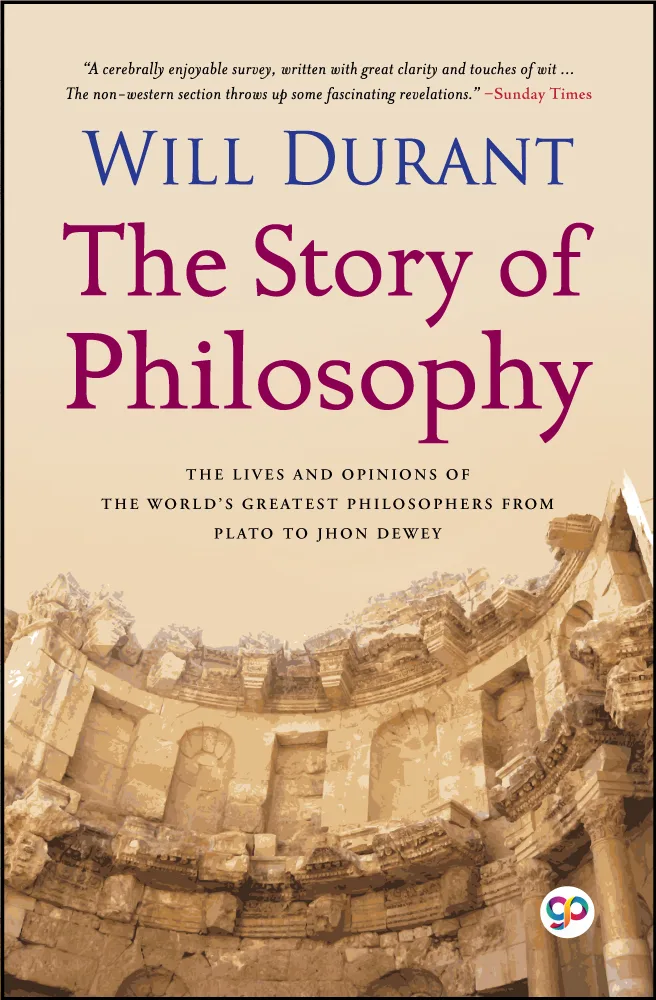
The Story of Philosophy
Paperback
• 536 Pages
• INR 675.00
• English
• 9789354996375
No ratings yet
| Publisher | General Press |
|---|---|
| ISBN13 | 9789354996375 |
| ASIN/SKU | 935499637X |
| Book Format | Paperback |
| Language | English |
| Pages | 536 |
| List Price | INR 675.00 |
| Subject Code | PHI009000, PHI002000, PHI016000 |
| Dimensions | 8.25 x 5.25 x 1.0 inches |
| Book Code | BD00068190 |
Buy this Book
Amazon Stores
Ebook Stores
Other Stores
Discover The Story of Philosophy by Will Durant. This book is published by General Press in Paperback format, ISBN 9789354996375, ASIN 935499637X, under Non Fiction, History of Philosophy and Schools of Thought, Individual Philosophers.
Book Description
Will Durant’s 'The Story of Philosophy' is a masterful and deeply human journey through the history of Western thought. Rather than presenting philosophy as a dry collection of abstract theories, Durant brings it vividly to life by focusing on the flesh-and-blood thinkers behind the ideas. From the foundational wisdom of Plato and Aristotle to the bold inquiries of Spinoza, Voltaire, Kant, and Nietzsche, the book explores how these brilliant minds grappled with the very same questions that keep us awake at night: What is truth? How should we live? What is the meaning of it all?
Durant possesses a rare gift for translating dense, complex concepts into clear, beautifully accessible prose. He seamlessly weaves together the personal struggles, historical contexts, and profound insights of each philosopher. By showing us the fragile, flawed individuals behind the academic monuments, he proves that philosophy is not an ivory-tower exercise but an urgent, deeply personal quest to make sense of the human condition.
Ultimately, 'The Story of Philosophy' serves as a warm, inviting bridge between everyday readers and the greatest minds in history. It reminds us that behind every great philosophy is simply a human being trying to understand their place in the universe. Durant offers more than just a historical overview; he provides a comforting companion for our own search for wisdom, making this classic work an enduring, deeply rewarding read for anyone seeking meaning in their life.
Durant possesses a rare gift for translating dense, complex concepts into clear, beautifully accessible prose. He seamlessly weaves together the personal struggles, historical contexts, and profound insights of each philosopher. By showing us the fragile, flawed individuals behind the academic monuments, he proves that philosophy is not an ivory-tower exercise but an urgent, deeply personal quest to make sense of the human condition.
Ultimately, 'The Story of Philosophy' serves as a warm, inviting bridge between everyday readers and the greatest minds in history. It reminds us that behind every great philosophy is simply a human being trying to understand their place in the universe. Durant offers more than just a historical overview; he provides a comforting companion for our own search for wisdom, making this classic work an enduring, deeply rewarding read for anyone seeking meaning in their life.
Author Biography
William James Durant was a prolific American writer, historian, and philosopher. He is best known for the 11-volume The Story of Civilization, written in collaboration with his wife Ariel and published between 1935 and 1975. He was earlier noted for his book, The Story of Philosophy, written in 1926, which was considered "a groundbreaking work that helped to popularize philosophy."
They were awarded the Pulitzer Prize for literature in 1967 and the Presidential Medal of Freedom in 1977.
They were awarded the Pulitzer Prize for literature in 1967 and the Presidential Medal of Freedom in 1977.
Editorial Reviews
• The New York Times (1926):
The publication famously reviewed the work upon its release as "a delight". It praised Durant's rare ability to take the dense, traditionally inaccessible world of academic philosophy and make it lively, comprehensible, and entertaining for the general public.
• Will Durant (The Author's Self-Critique):
In a rare move, Durant reviewed his own book in the foreword to its second edition in 1933. While acknowledging that the complaints of his academic critics were often "disagreeably just," he wrote that his harshest critique was actually his own: "No critic pointed out a much more culpable omission: the Story said not a word about Chinese and Indian philosophy".
• H.L. Mencken (American Journalist and Critic):
Mencken, a prominent and cynical cultural critic of the 1920s, heavily championed Durant's work. He appreciated that Durant stripped away the specialized jargon and "priestly humbug" of academic philosophers, providing a clear and vigorous popularization of Western thought for the everyday reader.
• John Dewey (American Philosopher):
Dewey, who was featured as the final living philosopher in the book's conclusion, represented the pragmatist view that philosophy should not be isolated in ivory towers. The book's massive success validated Dewey's own belief that philosophical ideas must be connected to everyday life and social problems.
• James Harvey Robinson (Historian):
The book was celebrated by progressive scholars like Robinson as the ultimate triumph in the "humanization of knowledge". Durant's work directly answered Robinson's famous call to break down the barriers of isolated, monastic academic terminology so that everyday people could access history and human wisdom.
• Mortimer Adler (American Philosopher and Educator):
Adler was one of the book's fiercest critics. He argued that Durant sacrificed intellectual rigor for mass appeal, complaining that the book was overly superficial and watered down complex philosophical systems into bite-sized, biographical anecdotes.
• Academic Critics (The ‘Snob Movement’):
As Durant noted in his later reflections, the book's unprecedented success quickly spawned an undertow of resentment among university professors. Critics complained heavily about its massive chronological leaps—most notably, the fact that Durant skipped the entire era of Medieval philosophy, jumping directly from Aristotle to Francis Bacon.
• Contemporary Academic Reviewers (Modern Retrospective):
Modern philosophy scholars often critique the book's methodology, noting that it treats philosophers merely as pundits. Critics point out that Durant psychoanalyzes his subjects rather than rigorously arguing their logic, failing to convey how the actual art of philosophical argumentation works.
• Simon & Schuster (Editorial Review):
In modern retrospectives, the publisher continues to praise the book as "a groundbreaking work that helped to popularize philosophy". They highlight that its enduring genius lies in how Durant chronicles not just the theories, but "the economic and intellectual environments which influenced them, and the personal traits and adventures out of which each philosophy grew".
• The Book's Stance on Epistemology (Critical Assessment):
A common point of critical review is Durant's outright dismissal of epistemology. Durant blatantly stated in the book that "epistemology has kidnapped modern philosophy, and well nigh ruined it," arguing that the mechanics of knowledge belong to psychology, while philosophy should return to synthesizing wisdom. Modern academic critics often cite this as the book's fatal flaw.
The publication famously reviewed the work upon its release as "a delight". It praised Durant's rare ability to take the dense, traditionally inaccessible world of academic philosophy and make it lively, comprehensible, and entertaining for the general public.
• Will Durant (The Author's Self-Critique):
In a rare move, Durant reviewed his own book in the foreword to its second edition in 1933. While acknowledging that the complaints of his academic critics were often "disagreeably just," he wrote that his harshest critique was actually his own: "No critic pointed out a much more culpable omission: the Story said not a word about Chinese and Indian philosophy".
• H.L. Mencken (American Journalist and Critic):
Mencken, a prominent and cynical cultural critic of the 1920s, heavily championed Durant's work. He appreciated that Durant stripped away the specialized jargon and "priestly humbug" of academic philosophers, providing a clear and vigorous popularization of Western thought for the everyday reader.
• John Dewey (American Philosopher):
Dewey, who was featured as the final living philosopher in the book's conclusion, represented the pragmatist view that philosophy should not be isolated in ivory towers. The book's massive success validated Dewey's own belief that philosophical ideas must be connected to everyday life and social problems.
• James Harvey Robinson (Historian):
The book was celebrated by progressive scholars like Robinson as the ultimate triumph in the "humanization of knowledge". Durant's work directly answered Robinson's famous call to break down the barriers of isolated, monastic academic terminology so that everyday people could access history and human wisdom.
• Mortimer Adler (American Philosopher and Educator):
Adler was one of the book's fiercest critics. He argued that Durant sacrificed intellectual rigor for mass appeal, complaining that the book was overly superficial and watered down complex philosophical systems into bite-sized, biographical anecdotes.
• Academic Critics (The ‘Snob Movement’):
As Durant noted in his later reflections, the book's unprecedented success quickly spawned an undertow of resentment among university professors. Critics complained heavily about its massive chronological leaps—most notably, the fact that Durant skipped the entire era of Medieval philosophy, jumping directly from Aristotle to Francis Bacon.
• Contemporary Academic Reviewers (Modern Retrospective):
Modern philosophy scholars often critique the book's methodology, noting that it treats philosophers merely as pundits. Critics point out that Durant psychoanalyzes his subjects rather than rigorously arguing their logic, failing to convey how the actual art of philosophical argumentation works.
• Simon & Schuster (Editorial Review):
In modern retrospectives, the publisher continues to praise the book as "a groundbreaking work that helped to popularize philosophy". They highlight that its enduring genius lies in how Durant chronicles not just the theories, but "the economic and intellectual environments which influenced them, and the personal traits and adventures out of which each philosophy grew".
• The Book's Stance on Epistemology (Critical Assessment):
A common point of critical review is Durant's outright dismissal of epistemology. Durant blatantly stated in the book that "epistemology has kidnapped modern philosophy, and well nigh ruined it," arguing that the mechanics of knowledge belong to psychology, while philosophy should return to synthesizing wisdom. Modern academic critics often cite this as the book's fatal flaw.
Book Summary
"The Story of Philosophy" by Will Durant is a celebrated introduction to the history of Western philosophy that brings the lives and ideas of some of history's greatest thinkers to a broad audience. Rather than presenting philosophy as a collection of abstract theories, Durant tells the story of philosophers as individuals whose ideas emerged from the challenges, societies, and personal experiences of their time. Covering influential figures from ancient Greece to the early twentieth century, the book explores how philosophical thought has shaped politics, ethics, religion, science, education, and human understanding. Written in an engaging and accessible style, it demonstrates that philosophy is not merely an academic discipline but an ongoing conversation about how people should live, think, and understand the world around them.
The journey begins with the ancient Greek philosophers, particularly Plato and Aristotle, whose ideas laid the foundation for much of Western thought. Durant explains how Plato imagined a world in which eternal truths exist beyond physical reality and argued that justice, wisdom, and knowledge should guide society. His vision of the ideal state and his belief in the importance of education continue to influence political and philosophical discussions. Aristotle, Plato's student, approached knowledge from a different perspective, emphasising observation, logic, and practical experience. Rather than seeking ideal forms alone, Aristotle examined the natural world, human behaviour, ethics, and government with remarkable depth. Durant shows how these two thinkers established contrasting yet complementary traditions that shaped centuries of intellectual development.
The book then moves through the philosophical transformations that accompanied the rise of modern Europe. Francis Bacon argues that knowledge should be built upon careful observation and experimentation rather than unquestioned tradition, laying important foundations for the scientific method. René Descartes begins with radical doubt, seeking certainty through reason and becoming one of the leading figures of rational philosophy. Baruch Spinoza presents a vision of reality in which nature and the divine are inseparably connected, while Gottfried Wilhelm Leibniz offers an optimistic understanding of a universe governed by harmony and rational order. Durant explains these complex ideas in clear language, showing how each philosopher sought to answer fundamental questions about existence, truth, and the nature of reality.
As philosophy develops further, attention turns to the relationship between knowledge and human experience. John Locke argues that the human mind begins as a blank slate and acquires knowledge through experience, an idea that greatly influences education and political thought. George Berkeley challenges conventional assumptions about material reality, proposing that perception plays a central role in existence. David Hume introduces a deeply sceptical approach, questioning certainty, causation, and many traditional philosophical assumptions. Durant presents these thinkers not as isolated figures but as participants in an evolving dialogue, with each philosopher responding to the strengths and limitations of those who came before.
One of the book's most significant chapters examines the philosophy of Immanuel Kant, whose work transformed modern philosophy by attempting to reconcile rationalism and empiricism. Kant argues that while knowledge begins with experience, the human mind actively shapes how reality is understood. He explores morality, freedom, duty, and the limits of human reason, proposing that ethical behaviour should be guided by universal principles rather than personal desires. Durant acknowledges the complexity of Kant's ideas while explaining their importance in a way that remains accessible to general readers. Through Kant, philosophy becomes not only a search for knowledge but also a guide to moral responsibility and human dignity.
The nineteenth century introduces powerful new perspectives through philosophers such as Georg Wilhelm Friedrich Hegel, Arthur Schopenhauer, Herbert Spencer, and Friedrich Nietzsche. Hegel views history as a dynamic process driven by the development of ideas and human freedom. Schopenhauer presents a more pessimistic philosophy, arguing that much of human suffering arises from endless desire and striving. Spencer applies evolutionary concepts to society and human progress, while Nietzsche challenges conventional morality, urging individuals to overcome conformity and create their own values. Durant carefully explains the historical context surrounding these thinkers, illustrating how their ideas reflected the political, social, and cultural changes of their era.
The book concludes with influential modern philosophers whose work addressed the rapidly changing world of the late nineteenth and early twentieth centuries. Henri Bergson emphasises intuition, creativity, and the continuous flow of life, arguing that reality cannot always be fully understood through logic alone. William James develops the philosophy of pragmatism, suggesting that ideas should be judged by their practical consequences rather than abstract perfection. Durant explores how these thinkers shifted philosophical attention towards human experience, psychology, and action, demonstrating that philosophy continued to evolve alongside advances in science, democracy, and modern society. Their contributions show that philosophical inquiry remains relevant because it continually adapts to new questions and changing circumstances.
Throughout the book, Durant does far more than summarise philosophical systems. He places each philosopher within the context of their personal life, historical environment, and intellectual struggles, helping readers understand why particular ideas emerged when they did. He often discusses the influence of politics, religion, economics, literature, and scientific discovery on philosophical thought, revealing that philosophy develops through constant interaction with the wider world. Rather than presenting philosophers as distant scholars, Durant portrays them as passionate individuals seeking answers to universal questions about happiness, justice, freedom, knowledge, and the purpose of human life. This narrative approach makes even difficult concepts feel approachable and meaningful.
Ultimately, "The Story of Philosophy" is both an introduction to Western philosophy and a celebration of humanity's enduring search for wisdom. Will Durant demonstrates that philosophy is not confined to classrooms or academic debate but belongs to anyone who asks thoughtful questions about life, morality, society, and existence. By tracing the evolution of ideas across centuries, he reveals how each generation builds upon, challenges, or refines the thinking of those who came before. Rich in historical insight, intellectual curiosity, and engaging storytelling, the book encourages readers to think critically, remain open to different perspectives, and appreciate the profound influence philosophical ideas have had on civilisation. More than a history of great thinkers, it is an invitation to participate in the timeless pursuit of understanding ourselves, others, and the world we share.
The journey begins with the ancient Greek philosophers, particularly Plato and Aristotle, whose ideas laid the foundation for much of Western thought. Durant explains how Plato imagined a world in which eternal truths exist beyond physical reality and argued that justice, wisdom, and knowledge should guide society. His vision of the ideal state and his belief in the importance of education continue to influence political and philosophical discussions. Aristotle, Plato's student, approached knowledge from a different perspective, emphasising observation, logic, and practical experience. Rather than seeking ideal forms alone, Aristotle examined the natural world, human behaviour, ethics, and government with remarkable depth. Durant shows how these two thinkers established contrasting yet complementary traditions that shaped centuries of intellectual development.
The book then moves through the philosophical transformations that accompanied the rise of modern Europe. Francis Bacon argues that knowledge should be built upon careful observation and experimentation rather than unquestioned tradition, laying important foundations for the scientific method. René Descartes begins with radical doubt, seeking certainty through reason and becoming one of the leading figures of rational philosophy. Baruch Spinoza presents a vision of reality in which nature and the divine are inseparably connected, while Gottfried Wilhelm Leibniz offers an optimistic understanding of a universe governed by harmony and rational order. Durant explains these complex ideas in clear language, showing how each philosopher sought to answer fundamental questions about existence, truth, and the nature of reality.
As philosophy develops further, attention turns to the relationship between knowledge and human experience. John Locke argues that the human mind begins as a blank slate and acquires knowledge through experience, an idea that greatly influences education and political thought. George Berkeley challenges conventional assumptions about material reality, proposing that perception plays a central role in existence. David Hume introduces a deeply sceptical approach, questioning certainty, causation, and many traditional philosophical assumptions. Durant presents these thinkers not as isolated figures but as participants in an evolving dialogue, with each philosopher responding to the strengths and limitations of those who came before.
One of the book's most significant chapters examines the philosophy of Immanuel Kant, whose work transformed modern philosophy by attempting to reconcile rationalism and empiricism. Kant argues that while knowledge begins with experience, the human mind actively shapes how reality is understood. He explores morality, freedom, duty, and the limits of human reason, proposing that ethical behaviour should be guided by universal principles rather than personal desires. Durant acknowledges the complexity of Kant's ideas while explaining their importance in a way that remains accessible to general readers. Through Kant, philosophy becomes not only a search for knowledge but also a guide to moral responsibility and human dignity.
The nineteenth century introduces powerful new perspectives through philosophers such as Georg Wilhelm Friedrich Hegel, Arthur Schopenhauer, Herbert Spencer, and Friedrich Nietzsche. Hegel views history as a dynamic process driven by the development of ideas and human freedom. Schopenhauer presents a more pessimistic philosophy, arguing that much of human suffering arises from endless desire and striving. Spencer applies evolutionary concepts to society and human progress, while Nietzsche challenges conventional morality, urging individuals to overcome conformity and create their own values. Durant carefully explains the historical context surrounding these thinkers, illustrating how their ideas reflected the political, social, and cultural changes of their era.
The book concludes with influential modern philosophers whose work addressed the rapidly changing world of the late nineteenth and early twentieth centuries. Henri Bergson emphasises intuition, creativity, and the continuous flow of life, arguing that reality cannot always be fully understood through logic alone. William James develops the philosophy of pragmatism, suggesting that ideas should be judged by their practical consequences rather than abstract perfection. Durant explores how these thinkers shifted philosophical attention towards human experience, psychology, and action, demonstrating that philosophy continued to evolve alongside advances in science, democracy, and modern society. Their contributions show that philosophical inquiry remains relevant because it continually adapts to new questions and changing circumstances.
Throughout the book, Durant does far more than summarise philosophical systems. He places each philosopher within the context of their personal life, historical environment, and intellectual struggles, helping readers understand why particular ideas emerged when they did. He often discusses the influence of politics, religion, economics, literature, and scientific discovery on philosophical thought, revealing that philosophy develops through constant interaction with the wider world. Rather than presenting philosophers as distant scholars, Durant portrays them as passionate individuals seeking answers to universal questions about happiness, justice, freedom, knowledge, and the purpose of human life. This narrative approach makes even difficult concepts feel approachable and meaningful.
Ultimately, "The Story of Philosophy" is both an introduction to Western philosophy and a celebration of humanity's enduring search for wisdom. Will Durant demonstrates that philosophy is not confined to classrooms or academic debate but belongs to anyone who asks thoughtful questions about life, morality, society, and existence. By tracing the evolution of ideas across centuries, he reveals how each generation builds upon, challenges, or refines the thinking of those who came before. Rich in historical insight, intellectual curiosity, and engaging storytelling, the book encourages readers to think critically, remain open to different perspectives, and appreciate the profound influence philosophical ideas have had on civilisation. More than a history of great thinkers, it is an invitation to participate in the timeless pursuit of understanding ourselves, others, and the world we share.
Sample Chapters
Chapter 1: Plato
I. The Context of Plato
If you look at a map of Europe you will observe that Greece is a skeleton-like hand stretching its crooked fingers out into the Mediterranean Sea. South of it lies the great island of Crete, from which those grasping fingers captured, in the second millennium before Christ, the beginnings of civilization and culture. To the east, across the Ægean Sea, lies Asia Minor, quiet and apathetic now, but throbbing, in pre-Platonic days, with industry, commerce and speculation. To the west, across the Ionian, Italy stands, like a leaning tower in the sea, and Sicily and Spain, each in those days with thriving Greek colonies; and at the end, the “Pillars of Hercules” (which we call Gibraltar), that sombre portal through which not many an ancient mariner dared to pass. And on the north those still untamed and half-barbaric regions, then named Thessaly and Epirus and Macedonia, from which or through which the vigorous bands had come which fathered the geniuses of Homeric and Periclean Greece.
Look again at the map, and you see countless indentations of coast and elevations of land; everywhere gulfs and bays and the intrusive sea; and all the earth tumbled and tossed into mountains and hills. Greece was broken into isolated fragments by these natural barriers of sea and soil; travel and communication were far more difficult and dangerous then than now; every valley therefore developed its own self-sufficient economic life, its own sovereign government, its own institutions and dialect and religion and culture. In each case one or two cities, and around them, stretching up the mountainslopes, an agricultural hinterland: such were the “city-states” of Eubœa, and Locris, and Ætolia, and Phocis, and Bœotia, and Achæa, and Argolis, and Elis, and Arcadia, and Messenia, and Laconia—with its Sparta, and Attica—with its Athens.
Look at the map a last time, and observe the position of Athens: it is the farthest east of the larger cities of Greece. It was favorably placed to be the door through which the Greeks passed out to the busy cities of Asia Minor, and through which those elder cities sent their luxuries and their culture to adolescent Greece. It had an admirable port, Piræus, where countless vessels might find a haven from the rough waters of the sea. And it had a great maritime fleet.
In 490–470 B.C. Sparta and Athens, forgetting their jealousies and joining their forces, fought off the effort of the Persians under Darius and Xerxes to turn Greece into a colony of an Asiatic empire. In this struggle of youthful Europe against the senile East, Sparta provided the army and Athens the navy. The war over, Sparta demobilized her troops, and suffered the economic disturbances natural to that process; while Athens turned her navy into a merchant fleet, and became one of the greatest trading cities of the ancient world. Sparta relapsed into agricultural seclusion and stagnation, while Athens became a busy mart and port, the meeting place of many races of men and of diverse cults and customs, whose contact and rivalry begot comparison, analysis and thought.
Traditions and dogmas rub one another down to a minimum in such centers of varied intercourse; where there are a thousand faiths we are apt to become sceptical of them all. Probably the traders were the first sceptics; they had seen too much to believe too much; and the general disposition of merchants to classify all men as either fools or knaves inclined them to question every creed. Gradually, too, they were developing science; mathematics grew with the increasing complexity of exchange, astronomy with the increasing audacity of navigation. The growth of wealth brought the leisure and security which are the prerequisite of research and speculation; men now asked the stars not only for guidance on the seas but as well for an answer to the riddles of the universe; the first Greek philosophers were astronomers. “Proud of their achievements,” says Aristotle, “men pushed farther afield after the Persian wars; they took all knowledge for their province, and sought ever wider studies.” Men grew bold enough to attempt natural explanations of processes and events before attributed to supernatural agencies and powers; magic and ritual slowly gave way to science and control; and philosophy began.
At first this philosophy was physical; it looked out upon the material world and asked what was the final and irreducible constituent of things. The natural termination of this line of thought was the materialism of Democritus (460–360 B.C.)—“in reality there is nothing but atoms and space.” This was one of the main streams of Greek speculation; it passed underground for a time in Plato’s day, but emerged in Epicurus (342–270), and became a torrent of eloquence in Lucretius (98–55 B.C.). But the most characteristic and fertile developments of Greek philosophy took form with the Sophists, travelling teachers of wisdom, who looked within upon their own thought and nature, rather than out upon the world of things. They were all clever men (Gorgias and Hippias, for example), and many of them were profound (Protagoras, Prodicus); there is hardly a problem or a solution in our current philosophy of mind and conduct which they did not realize and discuss. They asked questions about anything; they stood unafraid in the presence of religious or political taboos; and boldly subpoenaed every creed and institution to appear before the judgment-seat of reason. In politics they divided into two schools. One, like Rousseau, argued that nature is good, and civilization bad; that by nature all men are equal, becoming unequal only by class-made institutions; and that law is an invention of the strong to chain and rule the weak. Another school, like Nietzsche, claimed that nature is beyond good and evil; that by nature all men are unequal; that morality is an invention of the weak to limit and deter the strong; that power is the supreme virtue, and the supreme desire of man; and that of all forms of government the wisest and most natural is aristocracy.
No doubt this attack on democracy reflected the rise of a wealthy minority at Athens which called itself the Oligarchical Party, and denounced democracy as an incompetent sham. In a sense there was not much democracy to denounce; for of the 400,000 inhabitants of Athens 250,000 were slaves, without political rights of any kind: and of the 150,000 freemen or citizens only a small number presented themselves at the Ecclesia, or general assembly, where the policies of the state were discussed and determined. Yet what democracy they had was as thorough as never since the general assembly was the supreme power; and the highest official body, the Dikasteria, or supreme court, consisted of over a thousand members (to make bribery expensive), selected by alphabetical rote from the roll of all the citizens. No institution could have been more democratic, nor, said its opponents, more absurd.
During the great generation-long Peloponnesian war (430–400 B.C.), in which the military power of Sparta fought and at last defeated the naval power of Athens, the Athenian oligarchic party, led by Critias, advocated the abandonment of democracy on the score of its inefficiency in war, and secretly lauded the aristocratic government of Sparta. Many of the oligarchic leaders were exiled: but when at last Athens surrendered, one of the peace conditions imposed by Sparta was the recall of these exiled aristocrats. They had hardly returned when, with Critias at their head, they declared a rich man’s revolution against the “democratic” party that had ruled during the disastrous war. The revolution failed, and Critias was killed on the field of battle.
Now Critias was a pupil of Socrates, and an uncle of Plato.
II. Socrates
If we may judge from the bust that has come down to us as part of the ruins of ancient sculpture, Socrates was as far from being handsome as even a philosopher can be. A bald head, a great round face, deep-set staring eyes, a broad and flowery nose that gave vivid testimony to many a Symposium—it was rather the head of a porter than that of the most famous of philosophers. But if we look again we see, through the crudity of the stone, something of that human kindliness and unassuming simplicity which made this homely thinker a teacher beloved of the finest youths in Athens. We know so little about him, and yet we know him so much more intimately than the aristocratic Plato or the reserved and scholarly Aristotle. Across two thousand three hundred years we can yet see his ungainly figure, clad always in the same rumpled tunic, walking leisurely through the agora, undisturbed by the bedlam of politics, buttonholing his prey, gathering the young and the learned about him, luring them into some shady nook of the temple porticos, and asking them to define their terms.
They were a motley crowd, these youths who flocked about him and helped him to create European philosophy. There were rich young men like Plato and Alcibiades, who relished his satirical analysis of Athenian democracy; there were socialists like Antisthenes, who liked the master’s careless poverty, and made a religion of it; there was even an anarchist or two among them, like Aristippus, who aspired to a world in which there would be neither masters nor slaves, and all would be as worrilessly free as Socrates. All the problems that agitate human society to-day, and provide the material of youth’s endless debate, agitated as well that little band of thinkers and talkers, who felt, with their teacher, that life without discourse would be unworthy of a man. Every school of social thought had there its representative, and perhaps its origin.
How the master lived hardly anybody knew. He never worked, and he took no thought of the morrow. He ate when his disciples asked him to honor their tables; they must have liked his company, for he gave every indication of physiological prosperity. He was not so welcome at home, for he neglected his wife and children; and from Xanthippe’s point of view he was a good-for-nothing idler who brought to his family more notoriety than bread. Xanthippe liked to talk almost as much as Socrates did; and they seem to have had some dialogues which Plato failed to record. Yet she, too, loved him, and could not contentedly see him die even after three-score years and ten.
Why did his pupils reverence him so? Perhaps because he was a man as well as a philosopher: he had at great risk saved the life of Alcibiades in battle; and he could drink like a gentleman—without fear and without excess. But no doubt they liked best in him the modesty of his wisdom: he did not claim to have wisdom, but only to seek it lovingly; he was wisdom’s amateur, not its professional. It was said that the oracle at Delphi, with unusual good sense, had pronounced him the wisest of the Greeks; and he had interpreted this as an approval of the agnosticism which was the starting-point of his philosophy—“One thing only I know, and that is that I know nothing.” Philosophy begins when one learns to doubt—particularly to doubt one’s cherished beliefs, one’s dogmas and one’s axioms. Who knows how these cherished beliefs became certainties with us, and whether some secret wish did not furtively beget them, clothing desire in the dress of thought? There is no real philosophy until the mind turns round and examines itself. Gnothi seauton, said Socrates: Know thyself.
There had been philosophers before him, of course: strong men like Thales and Heraclitus, subtle men like Parmenides and Zeno of Elea, seers like Pythagoras and Empedocles; but for the most part they had been physical philosophers; they had sought for the physis or nature of external things, the laws and constituents of the material and measurable world. That is very good, said Socrates; but there is an infinitely worthier subject for philosophers than all these trees and stones, and even all those stars; there is the mind of man. What is man, and what can he become?
So he went about prying into the human soul, uncovering assumptions and questioning certainties. If men discoursed too readily of justice, he asked them, quietly, tò tí?—what is it? What do you mean by these abstract words with which you so easily settle the problems of life and death? What do you mean by honor, virtue, morality, patriotism? What do you mean by yourself? It was with such moral and psychological questions that Socrates loved to deal. Some who suffered from this “Socratic method,” this demand for accurate definitions, and clear thinking, and exact analysis, objected that he asked more than he answered, and left men’s minds more confused than before. Nevertheless he bequeathed to philosophy two very definite answers to two of our most difficult problems—What is the meaning of virtue? and What is the best state?
No topics could have been more vital than these to the young Athenians of that generation. The Sophists had destroyed the faith these youths had once had in the gods and goddesses of Olympus, and in the moral code that had taken its sanction so largely from the fear men had for these ubiquitous and innumerable deities; apparently there was no reason now why a man should not do as he pleased, so long as he remained within the law. A disintegrating individualism had weakened the Athenian character, and left the city a prey at last to the sternly-nurtured Spartans. And as for the state, what could have been more ridiculous than this mob-led, passion-ridden democracy, this government by a debating-society, this precipitate selection and dismissal and execution of generals, this unchoice choice of simple farmers and tradesmen, in alphabetical rotation, as members of the supreme court of the land? How could a new and natural morality be developed in Athens, and how could the state be saved?
It was his reply to these questions that gave Socrates death and immortality. The older citizens would have honored him had he tried to restore the ancient polytheistic faith; if he had led his band of emancipated souls to the temples and the sacred groves, and bade them sacrifice again to the gods of their fathers. But he felt that that was a hopeless and suicidal policy, a progress backward, into and not “over the tombs.” He had his own religious faith: he believed in one God, and hoped in his modest way that death would not quite destroy him; but he knew that a lasting moral code could not be based upon so uncertain a theology. If one could build a system of morality absolutely independent of religious doctrine, as valid for the atheist as for the pietist, then theologies might come and go without loosening the moral cement that makes of willful individuals the peaceful citizens of a community.
If, for example, good meant intelligent, and virtue meant wisdom; if men could be taught to see clearly their real interests, to see afar the distant results of their deeds, to criticize and coördinate their desires out of a self-cancelling chaos into a purposive and creative harmony—this, perhaps, would provide for the educated and sophisticated man the morality which in the unlettered relies on reiterated precepts and external control. Perhaps all sin is error, partial vision, foolishness? The intelligent man may have the same violent and unsocial impulses as the ignorant man, but surely he will control them better, and slip less often into imitation of the beast. And in an intelligently administered society—one that returned to the individual, in widened powers, more than it took from him in restricted liberty—the advantage of every man would lie in social and loyal conduct, and only clear sight would be needed to ensure peace and order and good will.
But if the government itself is a chaos and an absurdity, if it rules without helping, and commands without leading,—how can we persuade the individual, in such a state, to obey the laws and confine his self-seeking within the circle of the total good? No wonder an Alcibiades turns against a state that distrusts ability, and reverences number more than knowledge. No wonder there is chaos where there is no thought, and the crowd decides in haste and ignorance, to repent at leisure and in desolation. Is it not a base superstition that mere numbers will give wisdom? On the contrary is it not universally seen that men in crowds are more foolish and more violent and more cruel than men separate and alone? Is it not shameful that men should be ruled by orators, who “go ringing on in long harangues, like brazen pots which, when struck, continue to sound till a hand is put upon them”? Surely the management of a state is a matter for which men cannot be too intelligent, a matter that needs the unhindered thought of the finest minds. How can a society be saved, or be strong, except it be led by its wisest men?
Imagine the reaction of the popular party at Athens to this aristocratic gospel at a time when war seemed to require the silencing of all criticism, and when the wealthy and lettered minority were plotting a revolution. Consider the feelings of Anytus, the democratic leader whose son had become a pupil of Socrates, and had then turned against the gods of his father, and laughed in his father’s face. Had not Aristophanes predicted precisely such a result from this specious replacement of the old virtues by unsocial intelligence?
Then the revolution came, and men fought for it and against, bitterly and to the death. When the democracy won, the fate of Socrates was decided: he was the intellectual leader of the revolting party, however pacific he might himself have been; he was the source of the hated aristocratic philosophy; he was the corrupter of youths drunk with debate. It would be better, said Anytus and Meletus, that Socrates should die.
I. The Context of Plato
If you look at a map of Europe you will observe that Greece is a skeleton-like hand stretching its crooked fingers out into the Mediterranean Sea. South of it lies the great island of Crete, from which those grasping fingers captured, in the second millennium before Christ, the beginnings of civilization and culture. To the east, across the Ægean Sea, lies Asia Minor, quiet and apathetic now, but throbbing, in pre-Platonic days, with industry, commerce and speculation. To the west, across the Ionian, Italy stands, like a leaning tower in the sea, and Sicily and Spain, each in those days with thriving Greek colonies; and at the end, the “Pillars of Hercules” (which we call Gibraltar), that sombre portal through which not many an ancient mariner dared to pass. And on the north those still untamed and half-barbaric regions, then named Thessaly and Epirus and Macedonia, from which or through which the vigorous bands had come which fathered the geniuses of Homeric and Periclean Greece.
Look again at the map, and you see countless indentations of coast and elevations of land; everywhere gulfs and bays and the intrusive sea; and all the earth tumbled and tossed into mountains and hills. Greece was broken into isolated fragments by these natural barriers of sea and soil; travel and communication were far more difficult and dangerous then than now; every valley therefore developed its own self-sufficient economic life, its own sovereign government, its own institutions and dialect and religion and culture. In each case one or two cities, and around them, stretching up the mountainslopes, an agricultural hinterland: such were the “city-states” of Eubœa, and Locris, and Ætolia, and Phocis, and Bœotia, and Achæa, and Argolis, and Elis, and Arcadia, and Messenia, and Laconia—with its Sparta, and Attica—with its Athens.
Look at the map a last time, and observe the position of Athens: it is the farthest east of the larger cities of Greece. It was favorably placed to be the door through which the Greeks passed out to the busy cities of Asia Minor, and through which those elder cities sent their luxuries and their culture to adolescent Greece. It had an admirable port, Piræus, where countless vessels might find a haven from the rough waters of the sea. And it had a great maritime fleet.
In 490–470 B.C. Sparta and Athens, forgetting their jealousies and joining their forces, fought off the effort of the Persians under Darius and Xerxes to turn Greece into a colony of an Asiatic empire. In this struggle of youthful Europe against the senile East, Sparta provided the army and Athens the navy. The war over, Sparta demobilized her troops, and suffered the economic disturbances natural to that process; while Athens turned her navy into a merchant fleet, and became one of the greatest trading cities of the ancient world. Sparta relapsed into agricultural seclusion and stagnation, while Athens became a busy mart and port, the meeting place of many races of men and of diverse cults and customs, whose contact and rivalry begot comparison, analysis and thought.
Traditions and dogmas rub one another down to a minimum in such centers of varied intercourse; where there are a thousand faiths we are apt to become sceptical of them all. Probably the traders were the first sceptics; they had seen too much to believe too much; and the general disposition of merchants to classify all men as either fools or knaves inclined them to question every creed. Gradually, too, they were developing science; mathematics grew with the increasing complexity of exchange, astronomy with the increasing audacity of navigation. The growth of wealth brought the leisure and security which are the prerequisite of research and speculation; men now asked the stars not only for guidance on the seas but as well for an answer to the riddles of the universe; the first Greek philosophers were astronomers. “Proud of their achievements,” says Aristotle, “men pushed farther afield after the Persian wars; they took all knowledge for their province, and sought ever wider studies.” Men grew bold enough to attempt natural explanations of processes and events before attributed to supernatural agencies and powers; magic and ritual slowly gave way to science and control; and philosophy began.
At first this philosophy was physical; it looked out upon the material world and asked what was the final and irreducible constituent of things. The natural termination of this line of thought was the materialism of Democritus (460–360 B.C.)—“in reality there is nothing but atoms and space.” This was one of the main streams of Greek speculation; it passed underground for a time in Plato’s day, but emerged in Epicurus (342–270), and became a torrent of eloquence in Lucretius (98–55 B.C.). But the most characteristic and fertile developments of Greek philosophy took form with the Sophists, travelling teachers of wisdom, who looked within upon their own thought and nature, rather than out upon the world of things. They were all clever men (Gorgias and Hippias, for example), and many of them were profound (Protagoras, Prodicus); there is hardly a problem or a solution in our current philosophy of mind and conduct which they did not realize and discuss. They asked questions about anything; they stood unafraid in the presence of religious or political taboos; and boldly subpoenaed every creed and institution to appear before the judgment-seat of reason. In politics they divided into two schools. One, like Rousseau, argued that nature is good, and civilization bad; that by nature all men are equal, becoming unequal only by class-made institutions; and that law is an invention of the strong to chain and rule the weak. Another school, like Nietzsche, claimed that nature is beyond good and evil; that by nature all men are unequal; that morality is an invention of the weak to limit and deter the strong; that power is the supreme virtue, and the supreme desire of man; and that of all forms of government the wisest and most natural is aristocracy.
No doubt this attack on democracy reflected the rise of a wealthy minority at Athens which called itself the Oligarchical Party, and denounced democracy as an incompetent sham. In a sense there was not much democracy to denounce; for of the 400,000 inhabitants of Athens 250,000 were slaves, without political rights of any kind: and of the 150,000 freemen or citizens only a small number presented themselves at the Ecclesia, or general assembly, where the policies of the state were discussed and determined. Yet what democracy they had was as thorough as never since the general assembly was the supreme power; and the highest official body, the Dikasteria, or supreme court, consisted of over a thousand members (to make bribery expensive), selected by alphabetical rote from the roll of all the citizens. No institution could have been more democratic, nor, said its opponents, more absurd.
During the great generation-long Peloponnesian war (430–400 B.C.), in which the military power of Sparta fought and at last defeated the naval power of Athens, the Athenian oligarchic party, led by Critias, advocated the abandonment of democracy on the score of its inefficiency in war, and secretly lauded the aristocratic government of Sparta. Many of the oligarchic leaders were exiled: but when at last Athens surrendered, one of the peace conditions imposed by Sparta was the recall of these exiled aristocrats. They had hardly returned when, with Critias at their head, they declared a rich man’s revolution against the “democratic” party that had ruled during the disastrous war. The revolution failed, and Critias was killed on the field of battle.
Now Critias was a pupil of Socrates, and an uncle of Plato.
II. Socrates
If we may judge from the bust that has come down to us as part of the ruins of ancient sculpture, Socrates was as far from being handsome as even a philosopher can be. A bald head, a great round face, deep-set staring eyes, a broad and flowery nose that gave vivid testimony to many a Symposium—it was rather the head of a porter than that of the most famous of philosophers. But if we look again we see, through the crudity of the stone, something of that human kindliness and unassuming simplicity which made this homely thinker a teacher beloved of the finest youths in Athens. We know so little about him, and yet we know him so much more intimately than the aristocratic Plato or the reserved and scholarly Aristotle. Across two thousand three hundred years we can yet see his ungainly figure, clad always in the same rumpled tunic, walking leisurely through the agora, undisturbed by the bedlam of politics, buttonholing his prey, gathering the young and the learned about him, luring them into some shady nook of the temple porticos, and asking them to define their terms.
They were a motley crowd, these youths who flocked about him and helped him to create European philosophy. There were rich young men like Plato and Alcibiades, who relished his satirical analysis of Athenian democracy; there were socialists like Antisthenes, who liked the master’s careless poverty, and made a religion of it; there was even an anarchist or two among them, like Aristippus, who aspired to a world in which there would be neither masters nor slaves, and all would be as worrilessly free as Socrates. All the problems that agitate human society to-day, and provide the material of youth’s endless debate, agitated as well that little band of thinkers and talkers, who felt, with their teacher, that life without discourse would be unworthy of a man. Every school of social thought had there its representative, and perhaps its origin.
How the master lived hardly anybody knew. He never worked, and he took no thought of the morrow. He ate when his disciples asked him to honor their tables; they must have liked his company, for he gave every indication of physiological prosperity. He was not so welcome at home, for he neglected his wife and children; and from Xanthippe’s point of view he was a good-for-nothing idler who brought to his family more notoriety than bread. Xanthippe liked to talk almost as much as Socrates did; and they seem to have had some dialogues which Plato failed to record. Yet she, too, loved him, and could not contentedly see him die even after three-score years and ten.
Why did his pupils reverence him so? Perhaps because he was a man as well as a philosopher: he had at great risk saved the life of Alcibiades in battle; and he could drink like a gentleman—without fear and without excess. But no doubt they liked best in him the modesty of his wisdom: he did not claim to have wisdom, but only to seek it lovingly; he was wisdom’s amateur, not its professional. It was said that the oracle at Delphi, with unusual good sense, had pronounced him the wisest of the Greeks; and he had interpreted this as an approval of the agnosticism which was the starting-point of his philosophy—“One thing only I know, and that is that I know nothing.” Philosophy begins when one learns to doubt—particularly to doubt one’s cherished beliefs, one’s dogmas and one’s axioms. Who knows how these cherished beliefs became certainties with us, and whether some secret wish did not furtively beget them, clothing desire in the dress of thought? There is no real philosophy until the mind turns round and examines itself. Gnothi seauton, said Socrates: Know thyself.
There had been philosophers before him, of course: strong men like Thales and Heraclitus, subtle men like Parmenides and Zeno of Elea, seers like Pythagoras and Empedocles; but for the most part they had been physical philosophers; they had sought for the physis or nature of external things, the laws and constituents of the material and measurable world. That is very good, said Socrates; but there is an infinitely worthier subject for philosophers than all these trees and stones, and even all those stars; there is the mind of man. What is man, and what can he become?
So he went about prying into the human soul, uncovering assumptions and questioning certainties. If men discoursed too readily of justice, he asked them, quietly, tò tí?—what is it? What do you mean by these abstract words with which you so easily settle the problems of life and death? What do you mean by honor, virtue, morality, patriotism? What do you mean by yourself? It was with such moral and psychological questions that Socrates loved to deal. Some who suffered from this “Socratic method,” this demand for accurate definitions, and clear thinking, and exact analysis, objected that he asked more than he answered, and left men’s minds more confused than before. Nevertheless he bequeathed to philosophy two very definite answers to two of our most difficult problems—What is the meaning of virtue? and What is the best state?
No topics could have been more vital than these to the young Athenians of that generation. The Sophists had destroyed the faith these youths had once had in the gods and goddesses of Olympus, and in the moral code that had taken its sanction so largely from the fear men had for these ubiquitous and innumerable deities; apparently there was no reason now why a man should not do as he pleased, so long as he remained within the law. A disintegrating individualism had weakened the Athenian character, and left the city a prey at last to the sternly-nurtured Spartans. And as for the state, what could have been more ridiculous than this mob-led, passion-ridden democracy, this government by a debating-society, this precipitate selection and dismissal and execution of generals, this unchoice choice of simple farmers and tradesmen, in alphabetical rotation, as members of the supreme court of the land? How could a new and natural morality be developed in Athens, and how could the state be saved?
It was his reply to these questions that gave Socrates death and immortality. The older citizens would have honored him had he tried to restore the ancient polytheistic faith; if he had led his band of emancipated souls to the temples and the sacred groves, and bade them sacrifice again to the gods of their fathers. But he felt that that was a hopeless and suicidal policy, a progress backward, into and not “over the tombs.” He had his own religious faith: he believed in one God, and hoped in his modest way that death would not quite destroy him; but he knew that a lasting moral code could not be based upon so uncertain a theology. If one could build a system of morality absolutely independent of religious doctrine, as valid for the atheist as for the pietist, then theologies might come and go without loosening the moral cement that makes of willful individuals the peaceful citizens of a community.
If, for example, good meant intelligent, and virtue meant wisdom; if men could be taught to see clearly their real interests, to see afar the distant results of their deeds, to criticize and coördinate their desires out of a self-cancelling chaos into a purposive and creative harmony—this, perhaps, would provide for the educated and sophisticated man the morality which in the unlettered relies on reiterated precepts and external control. Perhaps all sin is error, partial vision, foolishness? The intelligent man may have the same violent and unsocial impulses as the ignorant man, but surely he will control them better, and slip less often into imitation of the beast. And in an intelligently administered society—one that returned to the individual, in widened powers, more than it took from him in restricted liberty—the advantage of every man would lie in social and loyal conduct, and only clear sight would be needed to ensure peace and order and good will.
But if the government itself is a chaos and an absurdity, if it rules without helping, and commands without leading,—how can we persuade the individual, in such a state, to obey the laws and confine his self-seeking within the circle of the total good? No wonder an Alcibiades turns against a state that distrusts ability, and reverences number more than knowledge. No wonder there is chaos where there is no thought, and the crowd decides in haste and ignorance, to repent at leisure and in desolation. Is it not a base superstition that mere numbers will give wisdom? On the contrary is it not universally seen that men in crowds are more foolish and more violent and more cruel than men separate and alone? Is it not shameful that men should be ruled by orators, who “go ringing on in long harangues, like brazen pots which, when struck, continue to sound till a hand is put upon them”? Surely the management of a state is a matter for which men cannot be too intelligent, a matter that needs the unhindered thought of the finest minds. How can a society be saved, or be strong, except it be led by its wisest men?
Imagine the reaction of the popular party at Athens to this aristocratic gospel at a time when war seemed to require the silencing of all criticism, and when the wealthy and lettered minority were plotting a revolution. Consider the feelings of Anytus, the democratic leader whose son had become a pupil of Socrates, and had then turned against the gods of his father, and laughed in his father’s face. Had not Aristophanes predicted precisely such a result from this specious replacement of the old virtues by unsocial intelligence?
Then the revolution came, and men fought for it and against, bitterly and to the death. When the democracy won, the fate of Socrates was decided: he was the intellectual leader of the revolting party, however pacific he might himself have been; he was the source of the hated aristocratic philosophy; he was the corrupter of youths drunk with debate. It would be better, said Anytus and Meletus, that Socrates should die.
Reader Reviews
No reviews yet.
The Story of Philosophy
Download Cover Image
Do you want to download the full cover image for The Story of Philosophy?