
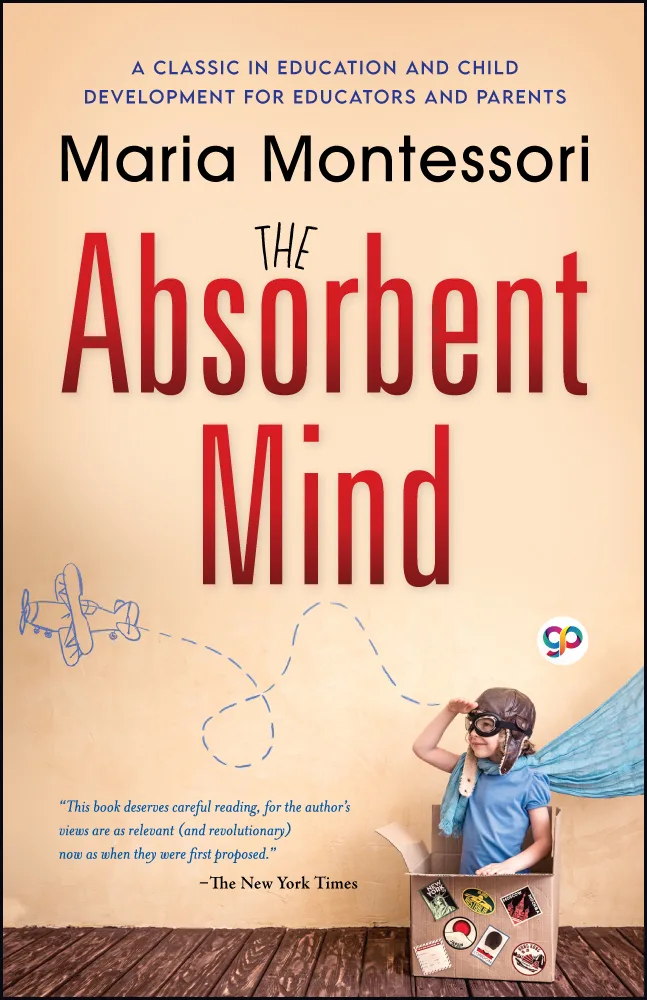
The Absorbent Mind
Hardcover
• 312 Pages
• INR 475.00
• English
• 9789354997525
No ratings yet
| Publisher | General Press |
|---|---|
| ISBN13 | 9789354997525 |
| ASIN/SKU | 935499752X |
| Book Format | Hardcover |
| Language | English |
| Pages | 312 |
| List Price | INR 475.00 |
| Subject Code | EDU029000, EDU029100, EDU009000 |
| Dimensions | 8.25 x 5.25 x 1.0 inches |
| Book Code | BD00068195 |
Buy this Book
Amazon Stores
Ebook Stores
Other Stores
Discover The Absorbent Mind by Maria Montessori. This book is published by General Press in Hardcover format, ISBN 9789354997525, ASIN 935499752X, under Reference, Psychology, Education and Teaching.
Book Description
Few books have reshaped how we think about early childhood quite like 'The Absorbent Mind' by Maria Montessori, a landmark work of developmental education that continues to feel startlingly relevant decades after it was first written. What if the most powerful learning a human being ever does happens not in a classroom, but in the first six years of life — quietly, effortlessly, and almost entirely without conscious effort? That is the breathtaking premise at the heart of this book, and Montessori makes it impossible to dismiss.
Drawing on years of direct observation with young children, Montessori argues that the infant and toddler mind operates in a fundamentally different way from the adult mind. Rather than learning by being taught, young children absorb their environment — its language, its rhythms, its emotional textures — the way a sponge takes in water. This isn't a metaphor she uses lightly. She builds a careful, well-reasoned case that the child's unconscious mind is doing astonishing cognitive and emotional work long before anyone thinks to give it credit.
The book moves through the stages of early development with both scientific precision and genuine wonder. Montessori explores how children acquire language without instruction, develop a sense of order and identity, and build the inner architecture that will shape them for the rest of their lives. Along the way, she challenges parents and educators to rethink their role — not as directors of learning, but as thoughtful preparers of the environment in which learning naturally unfolds.
What makes this book so enduring is Montessori's deep respect for the child as a full human being, not a blank slate waiting to be written on. Her tone is warm and urgent in equal measure, and her insights carry the weight of someone who spent a lifetime watching children and truly listening to what they revealed. If you've ever wondered why the earliest years matter so much — and what we might be getting wrong — this book will leave you thinking differently about everything.
Drawing on years of direct observation with young children, Montessori argues that the infant and toddler mind operates in a fundamentally different way from the adult mind. Rather than learning by being taught, young children absorb their environment — its language, its rhythms, its emotional textures — the way a sponge takes in water. This isn't a metaphor she uses lightly. She builds a careful, well-reasoned case that the child's unconscious mind is doing astonishing cognitive and emotional work long before anyone thinks to give it credit.
The book moves through the stages of early development with both scientific precision and genuine wonder. Montessori explores how children acquire language without instruction, develop a sense of order and identity, and build the inner architecture that will shape them for the rest of their lives. Along the way, she challenges parents and educators to rethink their role — not as directors of learning, but as thoughtful preparers of the environment in which learning naturally unfolds.
What makes this book so enduring is Montessori's deep respect for the child as a full human being, not a blank slate waiting to be written on. Her tone is warm and urgent in equal measure, and her insights carry the weight of someone who spent a lifetime watching children and truly listening to what they revealed. If you've ever wondered why the earliest years matter so much — and what we might be getting wrong — this book will leave you thinking differently about everything.
Author Biography
Maria Montessori was a woman who transformed the way the world thinks about childhood and education. An Italian physician, educator, and influential writer on education and child development, Maria Montessori became best known for works such as 'The Montessori Method', 'The Absorbent Mind', and 'The Secret of Childhood'. Her ideas placed children, rather than rigid classroom systems, at the center of learning.
Born on August 31, 1870, in Chiaravalle, Italy, Montessori grew up at a time when higher education and professional careers were largely closed to women. She nevertheless pursued medicine and became one of Italy’s first female physicians, graduating from the University of Rome in 1896. Her early work with children, particularly those with developmental and educational difficulties, convinced her that children could learn remarkably well when given freedom, appropriate materials, and a supportive environment.
In 1907, she opened the first 'Casa dei Bambini', or Children’s House, in Rome. There she developed what became known as the Montessori Method, an educational approach based on independence, hands-on learning, concentration, observation, and respect for a child’s natural development. Her classrooms encouraged children to choose activities, work at their own pace, and learn through carefully designed materials rather than constant instruction from adults.
Montessori’s writing was practical, thoughtful, and deeply rooted in her observations of children. Books such as 'The Montessori Method', 'The Secret of Childhood', and 'The Absorbent Mind' explained her belief that education should nurture the whole child and help develop curiosity, confidence, discipline, and independence. Her approach spread far beyond Italy, inspiring schools and educators across the world.
Maria Montessori died in 1952, but her educational philosophy remains highly influential. Her lasting legacy is a vision of childhood that continues to remind educators and parents that children are not simply students to be taught, but individuals capable of discovering, creating, and shaping their own understanding of the world.
Born on August 31, 1870, in Chiaravalle, Italy, Montessori grew up at a time when higher education and professional careers were largely closed to women. She nevertheless pursued medicine and became one of Italy’s first female physicians, graduating from the University of Rome in 1896. Her early work with children, particularly those with developmental and educational difficulties, convinced her that children could learn remarkably well when given freedom, appropriate materials, and a supportive environment.
In 1907, she opened the first 'Casa dei Bambini', or Children’s House, in Rome. There she developed what became known as the Montessori Method, an educational approach based on independence, hands-on learning, concentration, observation, and respect for a child’s natural development. Her classrooms encouraged children to choose activities, work at their own pace, and learn through carefully designed materials rather than constant instruction from adults.
Montessori’s writing was practical, thoughtful, and deeply rooted in her observations of children. Books such as 'The Montessori Method', 'The Secret of Childhood', and 'The Absorbent Mind' explained her belief that education should nurture the whole child and help develop curiosity, confidence, discipline, and independence. Her approach spread far beyond Italy, inspiring schools and educators across the world.
Maria Montessori died in 1952, but her educational philosophy remains highly influential. Her lasting legacy is a vision of childhood that continues to remind educators and parents that children are not simply students to be taught, but individuals capable of discovering, creating, and shaping their own understanding of the world.
Editorial Reviews
Editorial Reviews will be added soon…
Book Summary
Maria Montessori’s seminal work, "The Absorbent Mind", stands as a profound exploration of human development and a revolutionary treatise on early childhood education. Based on lectures she delivered in India during the 1940s, the book fundamentally challenges traditional educational paradigms that view the child as an empty vessel waiting to be filled by adult instruction. Instead, Montessori presents the child as a dynamic, self-directed builder of the human being. At the heart of her philosophy is the recognition that the first six years of life are the most crucial, a period during which the child’s brain operates in a way completely alien to the adult mind. She argues that society must shift its focus from direct teaching to scientific observation, advocating for an educational approach that aligns with the natural laws of human growth rather than fighting against them.
The titular concept of the "absorbent mind" refers to the unique psychological state of the young child, who possesses a sponge-like capacity to effortlessly soak up information, cultural norms, language, and behaviors. Montessori divides this period into two distinct phases. From birth to age three, the child possesses an unconscious absorbent mind. During this time, they do not consciously choose what to learn; rather, they literally incarnate their surroundings, constructing their memory, intellect, and personality out of thin air based on what they observe. From ages three to six, the mind transitions to a conscious absorbent state. Here, the child begins to interact intentionally with their environment, using their hands and senses to categorize, refine, and make sense of the vast impressions they unconsciously gathered during their first three years.
A cornerstone of this developmental journey is the concept of "sensitive periods." Montessori observed that children pass through transient, highly focused windows of time where they are biologically driven to acquire specific skills. During a sensitive period for language, order, movement, or social behavior, learning happens with astonishing ease and intense joy. A child might obsessively repeat a seemingly mundane task, driven by a deep inner need to master a particular cognitive or physical function. However, these windows are strictly temporary. If a child is prevented from fulfilling this inner urge, the opportunity passes, and acquiring that same skill later in life will require arduous, conscious effort rather than natural assimilation. Recognizing and supporting these fleeting phases is therefore essential to facilitating optimal development.
To support the absorbent mind and capitalize on these sensitive periods, Montessori introduces the absolute necessity of the "prepared environment." Because the child constructs themselves from what they find in their immediate surroundings, that environment must be meticulously curated. A prepared environment is physically scaled to the child, featuring child-sized furniture, accessible shelving, and real, functioning tools rather than passive, plastic toys. It must be aesthetically pleasing, orderly, and calm, providing a vital sense of security. Crucially, the environment must offer freedom. Within the boundaries of this carefully designed space, children are free to choose their own activities, work at their own pace, and follow their intrinsic interests, which allows them to independently answer the inner promptings of their sensitive periods.
In this setting, the role of the adult is radically redefined. The traditional teacher who stands at the front of a room dictating standardized lessons is replaced by a silent observer and a gentle guide. Montessori emphasizes that the adult must undergo a spiritual preparation, actively shedding their ego, pride, and the innate adult desire to control or mold the child. The adult’s primary responsibility is to prepare and maintain the environment, observe the children to identify their specific needs, and connect them with appropriate materials at exactly the right time. The guide must then step back and allow the child to work independently, intervening only when strictly necessary. By removing themselves as the focal point of the classroom, the adult allows the child’s natural developmental timeline to take center stage.
A revolutionary aspect of The Absorbent Mind is its exploration of the intricate relationship between physical movement and cognitive development. Traditional education often separates the mind from the body, expecting children to absorb knowledge while sitting perfectly still at desks. Montessori vehemently opposed this separation, arguing that movement is deeply and inextricably intertwined with human intelligence. She famously described the hand as the "instrument of man’s intelligence." When a child manipulates objects, sorts shapes, or pours water, they are not merely playing; they are doing the vital work of building complex neurological connections. Through purposeful movement, the child gains mastery over their physical body and develops the internal ability to sustain focus, organize their thoughts, and execute complex sequences of actions.
To illustrate this point, Montessori points to the miracle of language acquisition as the ultimate proof of the absorbent mind in action. Without formal instruction, grammar lessons, or textbooks, a toddler effortlessly masters the complex syntax, vocabulary, and phonetic nuances of their mother tongue simply by living in an environment where it is spoken. The child does not analyze the language logically; they absorb it entirely and perfectly. This astonishing feat, which adults struggle to replicate even with years of intensive, conscious study, highlights the unparalleled power of the young brain. Montessori points out that this linguistic explosion is not the result of direct teaching, but a natural unfolding of human potential facilitated by immersion.
Through the freedom to choose engaging, purposeful work, the child eventually achieves a state Montessori calls "normalization." This is perhaps one of the most misunderstood concepts in early education. Normalization does not mean forcing a child to conform to rigid adult standards of obedience or compliance. Rather, it is the natural emergence of the child's true, positive nature when their developmental needs are adequately met. When a child finds a piece of work that deeply captures their interest, they enter a state of profound, uninterrupted concentration. Emerging from this deep focus, the child appears rested, peaceful, and joyful. True discipline, therefore, is not imposed externally through behavioral rewards or punishments, but arises internally as a natural byproduct of concentrated work.
This inner discipline naturally extends outward, fostering genuine social harmony and moral development. In an authentic Montessori environment, children of mixed ages interact freely on a daily basis. Because they are not competing for a single teacher’s attention or vying for artificial grades, a natural, supportive community forms. Older children spontaneously assist younger ones, solidifying their own knowledge, while younger children look up to their older peers for inspiration. Through navigating shared spaces, waiting patiently for a desired material to become available, and respecting the quiet concentration of others, children organically learn empathy and social responsibility. Montessori saw this microcosm of peaceful coexistence as a blueprint for society at large, believing deeply that early education was the most viable path to lasting global peace.
Ultimately, The Absorbent Mind is much more than a practical educational manual; it is a profound philosophical plea to respect the inherent dignity and immense potential of the young child. Montessori challenges us to recognize that the infant and the toddler are engaged in the most monumental task known to humanity: the actual creation of the adult. By understanding the unique, fleeting mechanics of the absorbent mind, respecting the urgency of sensitive periods, and providing a nurturing, scientifically prepared environment, we can remove the arbitrary obstacles that hinder natural development. Her enduring message is one of hope and immense responsibility, reminding us that by radically changing our approach to the first six years of life, we possess the power to elevate the entire trajectory of the human race.
The titular concept of the "absorbent mind" refers to the unique psychological state of the young child, who possesses a sponge-like capacity to effortlessly soak up information, cultural norms, language, and behaviors. Montessori divides this period into two distinct phases. From birth to age three, the child possesses an unconscious absorbent mind. During this time, they do not consciously choose what to learn; rather, they literally incarnate their surroundings, constructing their memory, intellect, and personality out of thin air based on what they observe. From ages three to six, the mind transitions to a conscious absorbent state. Here, the child begins to interact intentionally with their environment, using their hands and senses to categorize, refine, and make sense of the vast impressions they unconsciously gathered during their first three years.
A cornerstone of this developmental journey is the concept of "sensitive periods." Montessori observed that children pass through transient, highly focused windows of time where they are biologically driven to acquire specific skills. During a sensitive period for language, order, movement, or social behavior, learning happens with astonishing ease and intense joy. A child might obsessively repeat a seemingly mundane task, driven by a deep inner need to master a particular cognitive or physical function. However, these windows are strictly temporary. If a child is prevented from fulfilling this inner urge, the opportunity passes, and acquiring that same skill later in life will require arduous, conscious effort rather than natural assimilation. Recognizing and supporting these fleeting phases is therefore essential to facilitating optimal development.
To support the absorbent mind and capitalize on these sensitive periods, Montessori introduces the absolute necessity of the "prepared environment." Because the child constructs themselves from what they find in their immediate surroundings, that environment must be meticulously curated. A prepared environment is physically scaled to the child, featuring child-sized furniture, accessible shelving, and real, functioning tools rather than passive, plastic toys. It must be aesthetically pleasing, orderly, and calm, providing a vital sense of security. Crucially, the environment must offer freedom. Within the boundaries of this carefully designed space, children are free to choose their own activities, work at their own pace, and follow their intrinsic interests, which allows them to independently answer the inner promptings of their sensitive periods.
In this setting, the role of the adult is radically redefined. The traditional teacher who stands at the front of a room dictating standardized lessons is replaced by a silent observer and a gentle guide. Montessori emphasizes that the adult must undergo a spiritual preparation, actively shedding their ego, pride, and the innate adult desire to control or mold the child. The adult’s primary responsibility is to prepare and maintain the environment, observe the children to identify their specific needs, and connect them with appropriate materials at exactly the right time. The guide must then step back and allow the child to work independently, intervening only when strictly necessary. By removing themselves as the focal point of the classroom, the adult allows the child’s natural developmental timeline to take center stage.
A revolutionary aspect of The Absorbent Mind is its exploration of the intricate relationship between physical movement and cognitive development. Traditional education often separates the mind from the body, expecting children to absorb knowledge while sitting perfectly still at desks. Montessori vehemently opposed this separation, arguing that movement is deeply and inextricably intertwined with human intelligence. She famously described the hand as the "instrument of man’s intelligence." When a child manipulates objects, sorts shapes, or pours water, they are not merely playing; they are doing the vital work of building complex neurological connections. Through purposeful movement, the child gains mastery over their physical body and develops the internal ability to sustain focus, organize their thoughts, and execute complex sequences of actions.
To illustrate this point, Montessori points to the miracle of language acquisition as the ultimate proof of the absorbent mind in action. Without formal instruction, grammar lessons, or textbooks, a toddler effortlessly masters the complex syntax, vocabulary, and phonetic nuances of their mother tongue simply by living in an environment where it is spoken. The child does not analyze the language logically; they absorb it entirely and perfectly. This astonishing feat, which adults struggle to replicate even with years of intensive, conscious study, highlights the unparalleled power of the young brain. Montessori points out that this linguistic explosion is not the result of direct teaching, but a natural unfolding of human potential facilitated by immersion.
Through the freedom to choose engaging, purposeful work, the child eventually achieves a state Montessori calls "normalization." This is perhaps one of the most misunderstood concepts in early education. Normalization does not mean forcing a child to conform to rigid adult standards of obedience or compliance. Rather, it is the natural emergence of the child's true, positive nature when their developmental needs are adequately met. When a child finds a piece of work that deeply captures their interest, they enter a state of profound, uninterrupted concentration. Emerging from this deep focus, the child appears rested, peaceful, and joyful. True discipline, therefore, is not imposed externally through behavioral rewards or punishments, but arises internally as a natural byproduct of concentrated work.
This inner discipline naturally extends outward, fostering genuine social harmony and moral development. In an authentic Montessori environment, children of mixed ages interact freely on a daily basis. Because they are not competing for a single teacher’s attention or vying for artificial grades, a natural, supportive community forms. Older children spontaneously assist younger ones, solidifying their own knowledge, while younger children look up to their older peers for inspiration. Through navigating shared spaces, waiting patiently for a desired material to become available, and respecting the quiet concentration of others, children organically learn empathy and social responsibility. Montessori saw this microcosm of peaceful coexistence as a blueprint for society at large, believing deeply that early education was the most viable path to lasting global peace.
Ultimately, The Absorbent Mind is much more than a practical educational manual; it is a profound philosophical plea to respect the inherent dignity and immense potential of the young child. Montessori challenges us to recognize that the infant and the toddler are engaged in the most monumental task known to humanity: the actual creation of the adult. By understanding the unique, fleeting mechanics of the absorbent mind, respecting the urgency of sensitive periods, and providing a nurturing, scientifically prepared environment, we can remove the arbitrary obstacles that hinder natural development. Her enduring message is one of hope and immense responsibility, reminding us that by radically changing our approach to the first six years of life, we possess the power to elevate the entire trajectory of the human race.
Sample Chapters
Chapter 1: The Child and the World Reconstructed
In modern times the psychic life in the new-born child has called forth great interest. Many scientists and psychologists have made observations of children from 3 hours to the 5th day from birth. Others, after having studied children carefully, have come to the conclusion that the first two years are the most important of life. Education during this period must be intended as a help to the development of the psychic powers inherent in the human individual. This cannot be attained by teaching because the child could not understand what a teacher would say.
Unexploited Riches
Observation, very general and wide-spread, has shown that small children are endowed with a special psychic nature. This shows us a new way of imparting education! A different form which concerns humanity itself and which has never been taken into consideration. The real constructive energy, alive and dynamic, of children, remained unknown for thousands of years. Just as men trod upon the earth first and cultivated its surface in later times, without knowing of or caring for the immense riches that lay hidden in the depth, so is man now-a-days progressing in civilization without knowing of the riches that lie buried inside the psychic world of the child and indeed, for thousands of years, from the very beginning of humanity itself, man has continued repressing these energies and grinding them into the dust. It is only today that a few have begun to suspect their existence. Humanity has begun to realize the importance of these riches which have never been exploited something more precious than gold; the very soul of man.
These first two years of life furnish a new light that shows the laws of psychic construction. These laws were hitherto unknown. It is the outer expression of the child that has revealed their existence. It shows a type of psychology completely different from that of the adult. So here begins the new path. It is not the professor who applies psychology to children, it is the children themselves who teach psychology to the professor. This may seem obscure but it will become immediately clear if we go somewhat more into detail: the child has a type of mind that absorbs knowledge and instructs himself. A superficial observation will be sufficient to show this. The child of two speaks the language of his parents. The learning of a language is a great intellectual acquisition. Now who has taught the child of two this language? Is it the teacher? Everyone knows that that is not so, and yet the child knows to perfection the names of things, he knows the verbs, the adjectives etc. If anyone studies the phenomenon he will find it marvellous to follow the development of language. All who have done so agree that the child begins to use words and names at a certain period of life. It is as if he had a particular time-table. Indeed, he follows faithfully a severe syllabus which has been imposed by nature and with such exactitude that even the most pains-taking school would suffer in comparison. And following this time-table the child learns all the irregularities and different syntactical constructions of the language with exacting diligence.
The Vital Years
Within a child there is a very scrupulous teacher. It is he who achieves these results in every child, no matter in what region he is found. The only language that man learns perfectly is acquired at this period of childhood when no one can teach him. Not only that, but no matter what help and assistance he will get later in life if he tries to learn a new language, he will not be able to speak it with the same exactitude as he does the one acquired in childhood. There is a psychic power in the child that helps him. It is not merely a question of language. At two years he is able to recognize all the things and persons in his environment. The more one thinks about it the more it becomes evident that the construction the child achieves is immense: for all that we possess has been constructed by the child we once were, and the most important faculties are built in the first two years of life. It is not merely a question of recognizing what it is around us or understanding and dealing with our environment. It is the whole of our intelligence, our religious sentiment, our special feelings of patriotism and caste that are built during this period of life when no one can teach the child. It is as though nature had safeguarded each child from the influence of human intelligence in order to give the inner teacher that dictates within, the possibility of making a complete psychic construction before the human intelligence can come in contact with the spirit and influence it.
At three years of age the child has already laid the foundations of the human personality and needs the special help of education in the school. The acquisitions he has made are such that we can say the child who enters school at three is an old man. Psychologists say that if we compare our ability as adults to that of the child it would require us 60 years of hard work to achieve what a child has achieved in these first three years. And they express themselves by the strange words that I have mentioned above: at three a child is already an old man. Even then this strange ability of the child to absorb from the environment is not finished. In our first schools the children came at three years of age; no one could teach them because they were not receptive. But they gave striking revelations of the greatness of the human mind. Our school is not a real school; it is a house of children, i.e., an environment specially prepared for the children where the children absorb whatever culture is spread in the environment without any one teaching them. In our first school the children who attended came from the lowest class of people; the parents were quite illiterate. Yet these children at 4 years knew how to read and write. Nobody had taught them. Visitors were surprised to see children of so tender an age writing and reading. “Who has taught you how to write?” they asked and the children would look up in wonder and answer, “Taught? no one has taught me,” This seemed at the time a miracle. That children so small could write was in itself wonderful, but that they should do so without having received any teaching seemed impossible. The press began to speak about spontaneous acquisition of culture, Psychologists thought that these children were special children and we shared this opinion for a long time. It was only after some years that we perceived that all children have this power of absorbing culture. If this is so, we reasoned, if culture can be taken in without fatigue then let us put different items of culture for them to absorb. So the children absorbed much more than reading and writing, subjects like botany, zoology, mathematics, geography and so on were taken with the same ease, spontaneously, without any fatigue.
So we found that education is not what the teacher gives: education is a natural process spontaneously carried out by the human individual. It is acquired not by listening to words, but by experiences upon the environment. The task of the teacher then becomes not one of talking, but one of preparing a series of motives of cultural activity spread in a specially prepared environment. My experiences have lasted for 40 years now and as the children developed, here and there, in different nations, parents asked me to continue the education for older children and so we found that individual activity is the only means of development: that this is true for the preschool child as well as for the young people in primary and other schools.
The New Man Arises
In front of our eyes arose a new figure. It was not a school or education. It was Man that rose; Man who revealed his true character as he developed freely; who showed his greatness when no mental oppression was there to restrict his soul. And so I say that any reform of education must be based upon the development of the human personality. Man himself should become the centre of education. And it must be remembered that man does not develop only at the university: man starts his development from birth and before birth. The greatest development is achieved during the first years of life, and therefore it is then that the greatest care should be taken. If this is done, then the child does not become a burden; he will reveal himself as the greatest marvel of nature. We shall be confronted by a child not as he was considered before a powerless being an empty vessel that must be filled with our wisdom. His dignity will arise in its fullness in front of our eyes as he reveals himself as the constructor of our intelligence, as the being who, guided by the inner teacher, in joy and happiness works indefatigably, following a strict time-table, to the construction of that marvel of nature: Man. We, the human teachers, can only help the great work that is being done, as servants help the master. If we do so, we shall be witnesses to the unfolding of the human soul, to the rising of a New Man who will not be the victim of events, but who will have the clarity of vision to direct and shape the future of human society.
Chapter 2: Education for Life
The School and Social Life
It is necessary from the very beginning to have an idea of what we intend by an education for life that starts from birth and even before birth. It is necessary to go into detail about this question, because recently, for the first time, a leader of the people has formulated the necessity not only of extending education to the whole course of life, but also of making ‘defense of life’ the centre of education. I say for the first time when I refer to a political and spiritual leader, because science has not only expressed the necessity of it, but from the beginning of this century it has given positive contributions which show that the conception of extending education to the whole life can be done with certainty of success. Education, as a help and protection to life, is an idea which certainly has not entered the field of action of any ministry of education, neither in America North or South nor in Europe. Education as conceived up to today is rich in methods, in social aims and finalities, but it takes hardly into any consideration whatever life itself. There are many official methods of education adopted by different countries, but no official system of education considers life itself or sets out to protect development and help the individual from birth. If education is protection to life, you will realize that it is necessary that education accompany life during its whole course. Education as conceived today prescinds from both biological and social life. If we stop to think about the question we soon realize that all those who are undergoing education are isolated from society. Students must follow the rules established by each institution and adapt themselves to the syllabus recommended by the ministry of education. If we think about it we find also that in these schools no consideration is given to life itself. If the high school student for instance has not enough food, that is no concern of the school. In the recent past if there were children who were partly deaf, they were marked out by their receiving lower marks because they were unable to hear what the teacher said, but the defects of the child were not taken into consideration. If a child was defective in sight he also received bad marks because he could not write as beautifully as other children. Physical defects have not been taken into consideration until very lately and when this was done, it was from the point of view of hygiene. Even now, however, no one worries about the danger there is for the mind of the student, danger due to defects in the methods of education adopted. What school worries about the kind of civilization the children are forced to live in? The only thing officialdom is bothered about is whether or not the syllabus has been followed. There are social deficiencies apt to strike the spirit of young men attending the university and which do strike them, but what is the official admonition? “You students should not concern yourselves with politics. You must attend to your studies and after you have formed yourselves, then go into the world,” Yes. That is quite so, but education today does not form an intelligence capable of visualizing the epoch and the problems of the times in which they live. Scholastic mechanisms are foreign to the social life of the times: its study does not enter the realm of education. Who has ever heard of any ministry of education that is called upon to solve any social problem acutely felt in the country? Never has such a case occurred because the world of education is a sort of retreat where the individuals, for the whole of their scholastic life, remain isolated from the problems of the world. They prepare themselves for life by remaining outside of life.
There may be, for instance, a university student who dies of tuberculosis. That is very sad indeed. But as a university, what can be done? At the most it can provide to be represented at the funeral. There are many individuals who are extremely nervous; when they go into the world, they will be useless not only to themselves, but will be a cause of trouble to their family and to their friends. That may be so, but I, as authority, am not concerned with peculiarities of psychology. I am only concerned with studies and examinations. Who passes them will receive a diploma or a degree. That is as far as the schools of our times go. Those who study sociology or problems of society have said that the people who come from school or university are not prepared for life, not only that, but most are diminished in their possibilities. Sociologists have compiled statistics and have found that there are many criminals, many mad and many more who are considered ‘strange’: they conclude by saying that the schools must do something to remedy this.
This is a fact. The school is a world apart and if there are social problems the school is expected to ignore them. It is the sociologists who say that schools must do something, but the school itself has not the possibility of doing so, because the school is a social institution of long standing and its rules cannot be modified unless there is some outside power which enforces this modification. These are some of the deficiencies that accompany education and therefore the life of all who go to school.
The Pre-School Age
What about the child from birth to the seventh year, or of the child before its birth? It is taken into no consideration whatever by the school. This age is called pre-scholastic and this means it falls outside the concern of the school. And as to people who are just born what could the school do about them? Wherever institutions have been created for children of pre-school age, these are hardly ever governed by the ministry of education. They are controlled by municipalities or private institutions who dictate their own rules and regulations. Who is concerned as a social problem with the protection of the life of the small child? No one! Society says that small children belong to the family and not to the state. Today great importance is given to the first years of life. But what is it that is being recommended? A modification of the family, a modification in the sense that mothers must be educated. Now, the family does not form a part of school, but of society. So we see how the human personality or the care of the human personality is broken into pieces. On one side there is a family which is one part of society, but is generally isolated from society, from social care. On the other the school, also kept apart from society, and then the university. There is no Unitarian conception of the social care of life. There is one piece here, one piece there and each one ignores the other. Even those new sciences that reveal the harm of this isolation such as social psychology and sociology are themselves isolated from the school. So nowhere is there a reliable system of help for the development of life. When a statesman says that education must be a help to life, we realize the importance of it. It is, as I mentioned before, nothing new to abstract science, but socially it is something that does not yet exist. It is the next step to be taken by civilization. Everything is prepared however: criticism has revealed the errors of the existing conditions, others have shown the remedy to be applied at different stages of life. Everything is ready for the construction. The contributions of science may be compared to the stones cut and ready for the building, but what is necessary is someone who takes the stones and puts them together to make the new building necessary for civilization. That is why the resolution of this Indian leader is of such great importance. It is a step that will permit civilization to rise higher and it is to the building of this step, that in the field of applied science, we strive and work.
The Task of Education and Society
What is the conception of education that takes life as the centre of its own function? It is a conception that alters all previous ideas about education. Education must no longer be based upon a syllabus but upon the knowledge of human life. Now, if this is so and it has to be so the education of the new-born acquires a sudden great importance. It is true that the new – born cannot do anything, cannot be taught in the ordinary sense, it can only be observed, it can be studied so as to find out what are the needs of the new – born life. Observation has been carried out by us with a view of discovering what are the laws of life, because if we wish to help life the first thing we must do is to know the laws governing life. Not- only this, because if it were merely knowledge that we sought then we would remain in the field of psychology; but if we are concerned with education our action cannot be limited merely to knowledge. This knowledge must be spread, for all must know what is the psychic development of the child. Education then acquires a new dignity, a new authority, because education will then tell society: “These are the laws of life. You cannot disregard them and you must act in this way.”
In modern times the psychic life in the new-born child has called forth great interest. Many scientists and psychologists have made observations of children from 3 hours to the 5th day from birth. Others, after having studied children carefully, have come to the conclusion that the first two years are the most important of life. Education during this period must be intended as a help to the development of the psychic powers inherent in the human individual. This cannot be attained by teaching because the child could not understand what a teacher would say.
Unexploited Riches
Observation, very general and wide-spread, has shown that small children are endowed with a special psychic nature. This shows us a new way of imparting education! A different form which concerns humanity itself and which has never been taken into consideration. The real constructive energy, alive and dynamic, of children, remained unknown for thousands of years. Just as men trod upon the earth first and cultivated its surface in later times, without knowing of or caring for the immense riches that lay hidden in the depth, so is man now-a-days progressing in civilization without knowing of the riches that lie buried inside the psychic world of the child and indeed, for thousands of years, from the very beginning of humanity itself, man has continued repressing these energies and grinding them into the dust. It is only today that a few have begun to suspect their existence. Humanity has begun to realize the importance of these riches which have never been exploited something more precious than gold; the very soul of man.
These first two years of life furnish a new light that shows the laws of psychic construction. These laws were hitherto unknown. It is the outer expression of the child that has revealed their existence. It shows a type of psychology completely different from that of the adult. So here begins the new path. It is not the professor who applies psychology to children, it is the children themselves who teach psychology to the professor. This may seem obscure but it will become immediately clear if we go somewhat more into detail: the child has a type of mind that absorbs knowledge and instructs himself. A superficial observation will be sufficient to show this. The child of two speaks the language of his parents. The learning of a language is a great intellectual acquisition. Now who has taught the child of two this language? Is it the teacher? Everyone knows that that is not so, and yet the child knows to perfection the names of things, he knows the verbs, the adjectives etc. If anyone studies the phenomenon he will find it marvellous to follow the development of language. All who have done so agree that the child begins to use words and names at a certain period of life. It is as if he had a particular time-table. Indeed, he follows faithfully a severe syllabus which has been imposed by nature and with such exactitude that even the most pains-taking school would suffer in comparison. And following this time-table the child learns all the irregularities and different syntactical constructions of the language with exacting diligence.
The Vital Years
Within a child there is a very scrupulous teacher. It is he who achieves these results in every child, no matter in what region he is found. The only language that man learns perfectly is acquired at this period of childhood when no one can teach him. Not only that, but no matter what help and assistance he will get later in life if he tries to learn a new language, he will not be able to speak it with the same exactitude as he does the one acquired in childhood. There is a psychic power in the child that helps him. It is not merely a question of language. At two years he is able to recognize all the things and persons in his environment. The more one thinks about it the more it becomes evident that the construction the child achieves is immense: for all that we possess has been constructed by the child we once were, and the most important faculties are built in the first two years of life. It is not merely a question of recognizing what it is around us or understanding and dealing with our environment. It is the whole of our intelligence, our religious sentiment, our special feelings of patriotism and caste that are built during this period of life when no one can teach the child. It is as though nature had safeguarded each child from the influence of human intelligence in order to give the inner teacher that dictates within, the possibility of making a complete psychic construction before the human intelligence can come in contact with the spirit and influence it.
At three years of age the child has already laid the foundations of the human personality and needs the special help of education in the school. The acquisitions he has made are such that we can say the child who enters school at three is an old man. Psychologists say that if we compare our ability as adults to that of the child it would require us 60 years of hard work to achieve what a child has achieved in these first three years. And they express themselves by the strange words that I have mentioned above: at three a child is already an old man. Even then this strange ability of the child to absorb from the environment is not finished. In our first schools the children came at three years of age; no one could teach them because they were not receptive. But they gave striking revelations of the greatness of the human mind. Our school is not a real school; it is a house of children, i.e., an environment specially prepared for the children where the children absorb whatever culture is spread in the environment without any one teaching them. In our first school the children who attended came from the lowest class of people; the parents were quite illiterate. Yet these children at 4 years knew how to read and write. Nobody had taught them. Visitors were surprised to see children of so tender an age writing and reading. “Who has taught you how to write?” they asked and the children would look up in wonder and answer, “Taught? no one has taught me,” This seemed at the time a miracle. That children so small could write was in itself wonderful, but that they should do so without having received any teaching seemed impossible. The press began to speak about spontaneous acquisition of culture, Psychologists thought that these children were special children and we shared this opinion for a long time. It was only after some years that we perceived that all children have this power of absorbing culture. If this is so, we reasoned, if culture can be taken in without fatigue then let us put different items of culture for them to absorb. So the children absorbed much more than reading and writing, subjects like botany, zoology, mathematics, geography and so on were taken with the same ease, spontaneously, without any fatigue.
So we found that education is not what the teacher gives: education is a natural process spontaneously carried out by the human individual. It is acquired not by listening to words, but by experiences upon the environment. The task of the teacher then becomes not one of talking, but one of preparing a series of motives of cultural activity spread in a specially prepared environment. My experiences have lasted for 40 years now and as the children developed, here and there, in different nations, parents asked me to continue the education for older children and so we found that individual activity is the only means of development: that this is true for the preschool child as well as for the young people in primary and other schools.
The New Man Arises
In front of our eyes arose a new figure. It was not a school or education. It was Man that rose; Man who revealed his true character as he developed freely; who showed his greatness when no mental oppression was there to restrict his soul. And so I say that any reform of education must be based upon the development of the human personality. Man himself should become the centre of education. And it must be remembered that man does not develop only at the university: man starts his development from birth and before birth. The greatest development is achieved during the first years of life, and therefore it is then that the greatest care should be taken. If this is done, then the child does not become a burden; he will reveal himself as the greatest marvel of nature. We shall be confronted by a child not as he was considered before a powerless being an empty vessel that must be filled with our wisdom. His dignity will arise in its fullness in front of our eyes as he reveals himself as the constructor of our intelligence, as the being who, guided by the inner teacher, in joy and happiness works indefatigably, following a strict time-table, to the construction of that marvel of nature: Man. We, the human teachers, can only help the great work that is being done, as servants help the master. If we do so, we shall be witnesses to the unfolding of the human soul, to the rising of a New Man who will not be the victim of events, but who will have the clarity of vision to direct and shape the future of human society.
Chapter 2: Education for Life
The School and Social Life
It is necessary from the very beginning to have an idea of what we intend by an education for life that starts from birth and even before birth. It is necessary to go into detail about this question, because recently, for the first time, a leader of the people has formulated the necessity not only of extending education to the whole course of life, but also of making ‘defense of life’ the centre of education. I say for the first time when I refer to a political and spiritual leader, because science has not only expressed the necessity of it, but from the beginning of this century it has given positive contributions which show that the conception of extending education to the whole life can be done with certainty of success. Education, as a help and protection to life, is an idea which certainly has not entered the field of action of any ministry of education, neither in America North or South nor in Europe. Education as conceived up to today is rich in methods, in social aims and finalities, but it takes hardly into any consideration whatever life itself. There are many official methods of education adopted by different countries, but no official system of education considers life itself or sets out to protect development and help the individual from birth. If education is protection to life, you will realize that it is necessary that education accompany life during its whole course. Education as conceived today prescinds from both biological and social life. If we stop to think about the question we soon realize that all those who are undergoing education are isolated from society. Students must follow the rules established by each institution and adapt themselves to the syllabus recommended by the ministry of education. If we think about it we find also that in these schools no consideration is given to life itself. If the high school student for instance has not enough food, that is no concern of the school. In the recent past if there were children who were partly deaf, they were marked out by their receiving lower marks because they were unable to hear what the teacher said, but the defects of the child were not taken into consideration. If a child was defective in sight he also received bad marks because he could not write as beautifully as other children. Physical defects have not been taken into consideration until very lately and when this was done, it was from the point of view of hygiene. Even now, however, no one worries about the danger there is for the mind of the student, danger due to defects in the methods of education adopted. What school worries about the kind of civilization the children are forced to live in? The only thing officialdom is bothered about is whether or not the syllabus has been followed. There are social deficiencies apt to strike the spirit of young men attending the university and which do strike them, but what is the official admonition? “You students should not concern yourselves with politics. You must attend to your studies and after you have formed yourselves, then go into the world,” Yes. That is quite so, but education today does not form an intelligence capable of visualizing the epoch and the problems of the times in which they live. Scholastic mechanisms are foreign to the social life of the times: its study does not enter the realm of education. Who has ever heard of any ministry of education that is called upon to solve any social problem acutely felt in the country? Never has such a case occurred because the world of education is a sort of retreat where the individuals, for the whole of their scholastic life, remain isolated from the problems of the world. They prepare themselves for life by remaining outside of life.
There may be, for instance, a university student who dies of tuberculosis. That is very sad indeed. But as a university, what can be done? At the most it can provide to be represented at the funeral. There are many individuals who are extremely nervous; when they go into the world, they will be useless not only to themselves, but will be a cause of trouble to their family and to their friends. That may be so, but I, as authority, am not concerned with peculiarities of psychology. I am only concerned with studies and examinations. Who passes them will receive a diploma or a degree. That is as far as the schools of our times go. Those who study sociology or problems of society have said that the people who come from school or university are not prepared for life, not only that, but most are diminished in their possibilities. Sociologists have compiled statistics and have found that there are many criminals, many mad and many more who are considered ‘strange’: they conclude by saying that the schools must do something to remedy this.
This is a fact. The school is a world apart and if there are social problems the school is expected to ignore them. It is the sociologists who say that schools must do something, but the school itself has not the possibility of doing so, because the school is a social institution of long standing and its rules cannot be modified unless there is some outside power which enforces this modification. These are some of the deficiencies that accompany education and therefore the life of all who go to school.
The Pre-School Age
What about the child from birth to the seventh year, or of the child before its birth? It is taken into no consideration whatever by the school. This age is called pre-scholastic and this means it falls outside the concern of the school. And as to people who are just born what could the school do about them? Wherever institutions have been created for children of pre-school age, these are hardly ever governed by the ministry of education. They are controlled by municipalities or private institutions who dictate their own rules and regulations. Who is concerned as a social problem with the protection of the life of the small child? No one! Society says that small children belong to the family and not to the state. Today great importance is given to the first years of life. But what is it that is being recommended? A modification of the family, a modification in the sense that mothers must be educated. Now, the family does not form a part of school, but of society. So we see how the human personality or the care of the human personality is broken into pieces. On one side there is a family which is one part of society, but is generally isolated from society, from social care. On the other the school, also kept apart from society, and then the university. There is no Unitarian conception of the social care of life. There is one piece here, one piece there and each one ignores the other. Even those new sciences that reveal the harm of this isolation such as social psychology and sociology are themselves isolated from the school. So nowhere is there a reliable system of help for the development of life. When a statesman says that education must be a help to life, we realize the importance of it. It is, as I mentioned before, nothing new to abstract science, but socially it is something that does not yet exist. It is the next step to be taken by civilization. Everything is prepared however: criticism has revealed the errors of the existing conditions, others have shown the remedy to be applied at different stages of life. Everything is ready for the construction. The contributions of science may be compared to the stones cut and ready for the building, but what is necessary is someone who takes the stones and puts them together to make the new building necessary for civilization. That is why the resolution of this Indian leader is of such great importance. It is a step that will permit civilization to rise higher and it is to the building of this step, that in the field of applied science, we strive and work.
The Task of Education and Society
What is the conception of education that takes life as the centre of its own function? It is a conception that alters all previous ideas about education. Education must no longer be based upon a syllabus but upon the knowledge of human life. Now, if this is so and it has to be so the education of the new-born acquires a sudden great importance. It is true that the new – born cannot do anything, cannot be taught in the ordinary sense, it can only be observed, it can be studied so as to find out what are the needs of the new – born life. Observation has been carried out by us with a view of discovering what are the laws of life, because if we wish to help life the first thing we must do is to know the laws governing life. Not- only this, because if it were merely knowledge that we sought then we would remain in the field of psychology; but if we are concerned with education our action cannot be limited merely to knowledge. This knowledge must be spread, for all must know what is the psychic development of the child. Education then acquires a new dignity, a new authority, because education will then tell society: “These are the laws of life. You cannot disregard them and you must act in this way.”
Reader Reviews
No reviews yet.
The Absorbent Mind
Download Cover Image
Do you want to download the full cover image for The Absorbent Mind?