
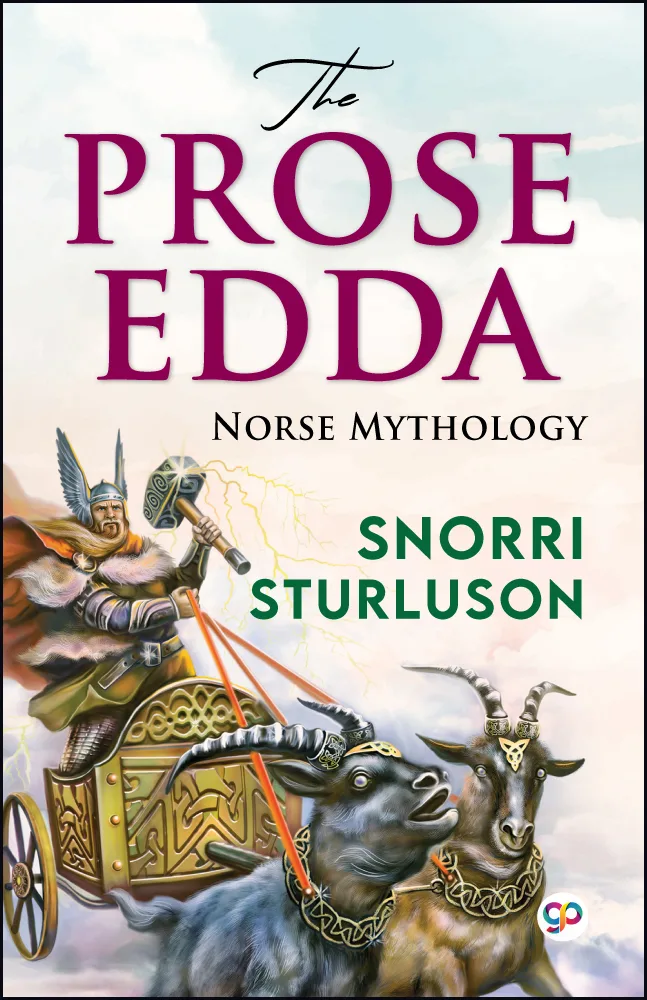
The Prose Edda: Norse Mythology
Hardcover
• 244 Pages
• INR 375.00
• English
• 9789354997662
No ratings yet
| Publisher | General Press |
|---|---|
| ISBN13 | 9789354997662 |
| ASIN/SKU | 935499766X |
| Book Format | Hardcover |
| Language | English |
| Pages | 244 |
| List Price | INR 375.00 |
| Subject Code | LIT011000, FIC010000, FIC004000 |
| Dimensions | 8.25 x 5.25 x 1.0 inches |
| Book Code | BD00068196 |
Buy this Book
Amazon Stores
Ebook Stores
Other Stores
Discover The Prose Edda: Norse Mythology by Snorri Sturluson. This book is published by General Press in Hardcover format, ISBN 9789354997662, ASIN 935499766X, under Religion and Spirituality, Classics, Mythology.
Book Description
Written in Iceland a century after the close of the Viking Age, ‘The Prose Edda’ is an Old Norse language Icelandic collection of four sections interspersed with excerpts from earlier skaldic and Eddic poetry, containing tales from Norse mythology. Its stories are peopled by giants, dwarves, elves, superhuman heroes, and indomitable warrior queens. Its gods live with the tragic knowledge of their own impending destruction in the cataclysmic battle of Ragnarok. Its time scale spans the eons from the world’s creation to its violent end. This robust new translation captures the magisterial sweep and startling psychological complexity of the Old Icelandic original.
Snorri Sturluson was an Icelandic historian, poet, and politician. He was twice elected law speaker at the Icelandic parliament, the Althing. He was also the author of the Heimskringla, a history of the Norwegian kings that begins with legendary material in the Ynglinga saga and moves through to early medieval Scandinavian history.
Snorri Sturluson was an Icelandic historian, poet, and politician. He was twice elected law speaker at the Icelandic parliament, the Althing. He was also the author of the Heimskringla, a history of the Norwegian kings that begins with legendary material in the Ynglinga saga and moves through to early medieval Scandinavian history.
Author Biography
Snorri Sturluson (also spelled Snorre Sturlason) was an Icelandic historian, poet and politician. He was twice elected lawspeaker at the Icelandic parliament, the Althing. He was the author of the Prose Edda or Younger Edda, which consists of Gylfaginning ("the fooling of Gylfi"), a narrative of Norse mythology, the Skáldskaparmál, a book of poetic language, and the Háttatal, a list of verse forms. He was also the author of the Heimskringla, a history of the Norwegian kings that begins with legendary material in Ynglinga saga and moves through to early medieval Scandinavian history. For stylistic and methodological reasons, Snorri is often taken to be the author of Egils saga.
Editorial Reviews
Editorial Reviews will be added soon…
Book Summary
The Prose Edda, also known as Snorri’s Edda or the Younger Edda, is one of the most important surviving works for understanding Norse mythology, Old Norse poetry, and the imaginative world of medieval Scandinavia. Traditionally attributed to the Icelandic historian, poet, and political figure Snorri Sturluson, the work was composed in Iceland in the early thirteenth century, around 1220. It is not simply a collection of Viking myths. At its core, it is a handbook for poets, designed to preserve the mythological knowledge and poetic techniques that younger skalds needed in order to understand and compose traditional Norse poetry. For modern readers, however, its greatest importance is that it preserves an extraordinarily rich account of Norse gods, creation myths, cosmology, heroic stories, and Ragnarök. Stories of Odin, Thor, Loki, Baldr, Freyja, Freyr, Heimdall, Yggdrasil, the giants, and the Nine Worlds have reached modern audiences largely through sources such as Snorri’s Edda.
The book begins with a Prologue that is very different in tone from the mythology that follows. Snorri was a Christian writing centuries after Iceland and Scandinavia had formally converted to Christianity, so he presents the old pagan gods through a rationalized historical framework. The gods are portrayed not straightforwardly as divine beings but as extraordinary human rulers and warriors whose stories became distorted into mythology over time. The Prologue connects these figures with Troy and ancient history, reflecting medieval European traditions that attempted to connect contemporary peoples with the legendary world of classical antiquity. This framing is important because it reminds readers that The Prose Edda is not a pagan religious scripture written by a Viking worshipper. It is a medieval Christian intellectual’s attempt to preserve an older mythology and poetic tradition. The Prologue therefore establishes a complicated relationship between Christianity, history, literature, and the surviving memory of Norse paganism.
The heart of the work is Gylfaginning, usually translated as “The Tricking of Gylfi,” “The Deluding of Gylfi,” or “The Fooling of Gylfi.” It takes the form of a question-and-answer dialogue between the Swedish king Gylfi, traveling under the name Gangleri, and three mysterious figures seated on thrones: High, Just-as-High, and Third. Gylfi has become curious about the powers and origins of the Æsir gods and journeys to learn their secrets. When he reaches their hall, the three figures answer his questions about the beginning of the world, the gods, the structure of the cosmos, the origin of humanity, famous mythological events, and ultimately the destruction and renewal of the world. The questioning structure makes Gylfaginning particularly accessible because the mythology unfolds as a gradual discovery rather than as a disconnected list of legends.
The creation story begins before the ordered world exists. There is a primordial emptiness known as Ginnungagap, bordered by the icy realm of Niflheim and the fiery realm of Muspelheim. When the forces of ice and fire meet, the first living being, the giant Ymir, comes into existence. Ymir becomes the ancestor of the frost giants, while the cosmic cow Auðhumla sustains him with her milk. As the mythology develops, the gods Odin, Vili, and Vé emerge and eventually kill Ymir. From his enormous body they create the physical universe: his flesh becomes the earth, his blood becomes the seas, his bones become mountains, his teeth and bones become rocks, and his skull becomes the sky. His hair becomes trees, while sparks from Muspelheim help illuminate the heavens. This creation myth presents the universe as something constructed from the body of a primordial being, giving the Norse cosmos a distinctly physical and dramatic character.
The gods then establish order within this newly created universe. The mythology describes different realms connected by the immense cosmic tree Yggdrasil. This world tree stands at the center of existence and connects different regions inhabited by gods, humans, giants, and other supernatural beings. Asgard is the home of the Æsir gods, while Midgard is the world of humanity. Other realms include places associated with giants, the dead, elves, and dwarfs. Yggdrasil therefore functions as more than a geographical feature. It is an image of cosmic interconnectedness, showing that gods, humans, monsters, nature, life, and death all belong to one enormous structure. The world is not presented as stable or eternal, however. Even Yggdrasil is threatened by forces of decay, suggesting from the beginning that everything in the cosmos exists under the shadow of eventual destruction.
Among the gods, Odin occupies a central position. He is a god of wisdom, war, poetry, magic, kingship, and knowledge, and his character is defined by an extraordinary willingness to sacrifice for wisdom. One of the best-known examples is his sacrifice of an eye in exchange for deeper knowledge. He also undergoes a terrifying ordeal upon the world tree in order to gain knowledge of the runes. Odin is therefore not portrayed as an uncomplicated heroic father figure. He is mysterious, calculating, restless, and often willing to use deception. His pursuit of knowledge is inseparable from his awareness of destiny. He knows that terrible events are coming, yet he continues seeking wisdom even though knowledge cannot ultimately save him from his fate.
Thor provides a striking contrast to Odin. Thor is the great defender of the gods and humanity, famous for his hammer Mjölnir, extraordinary strength, and battles against giants and monsters. His adventures often combine comedy with genuine danger. In one famous episode, Thor attempts to catch the Midgard Serpent, Jörmungandr, while fishing with the giant Hymir. The enormous serpent is so powerful that it represents one of the greatest threats to the cosmic order. Thor’s confrontation with it anticipates the final battle of Ragnarök, when the thunder god and the serpent will meet again. Other stories show Thor encountering giants who manipulate perception and illusion, revealing that even his immense physical strength has limits. These episodes make Thor one of the most memorable figures in Norse mythology because he represents courage and physical power while also showing the vulnerability of even the strongest gods.
Loki is perhaps the most complex character in the entire Prose Edda. Initially he appears as a clever trickster whose intelligence frequently helps the gods escape problems that he himself has caused. He is capable of deception, shape-shifting, and extraordinary ingenuity. Yet Loki’s relationship with the gods gradually deteriorates. His schemes become increasingly destructive, and his involvement in the death of Baldr marks a decisive turning point. Through Loki, Snorri presents intelligence without loyalty as a dangerous force. Loki is neither simply good nor simply evil in the manner of a conventional villain. His unpredictability is precisely what makes him so important to the mythology. He can save the gods one moment and help bring about their destruction later.
The death of Baldr is one of the most tragic stories in Gylfaginning. Baldr, the beloved son of Odin and Frigg, begins experiencing ominous dreams that seem to predict his death. Frigg attempts to protect him by obtaining promises from nearly everything in existence that it will not harm him. Because the mistletoe is overlooked, however, it remains capable of injuring Baldr. Loki discovers this weakness and uses it to orchestrate Baldr’s death. The gods are devastated, and the death of Baldr becomes one of the clearest signs that Ragnarök is approaching. The episode is especially important because it reveals a central characteristic of Norse mythology: fate cannot simply be escaped. Even the gods’ greatest efforts to prevent disaster may become part of the process that leads toward it.
The mythology then moves toward Ragnarök, the catastrophic destiny of the gods. Ragnarök is not simply an apocalypse in which the world ends and nothing remains. It is a cosmic cycle of destruction followed by renewal. The great wolf Fenrir breaks free, Jörmungandr rises from the sea, Loki escapes his punishment, and the forces of chaos gather against the gods. Odin is destined to be killed by Fenrir. Thor defeats Jörmungandr but dies from the serpent’s poison shortly afterward. Loki and Heimdall kill one another, while the gods and their enemies destroy each other in a final battle. The world is consumed by fire and overwhelmed by catastrophe.
Yet destruction is not the final word. After Ragnarök, the world rises again. The surviving gods return to a renewed earth, and Líf and Lífþrasir, two human survivors who have sheltered through the catastrophe, emerge to repopulate the world. The sun is replaced by a daughter who follows her mother’s path, and the new world is fertile and beautiful. This ending gives Norse mythology an important sense of renewal. The gods may die, the old order may collapse, and the cosmos may be destroyed, but existence continues. The story therefore combines fatalism with hope: destiny cannot be avoided, but destruction can lead to regeneration.
The third major section, Skáldskaparmál, changes the purpose of the book. Instead of concentrating primarily on the structure of the cosmos, Snorri turns to the art of poetry. The section takes the form of a dialogue involving Ægir and Bragi and explains how skaldic poets use specialized vocabulary, metaphors, and traditional poetic expressions. One of the most important concepts is the kenning, a compact metaphorical expression that replaces an ordinary noun with an evocative description. A poet might refer to the sea through an image such as the “whale-road.” Understanding such expressions requires knowledge of the myths behind them. A poet who calls a sword by a particular mythological name or describes gold through a reference to an old legend expects the audience to recognize the story behind the metaphor.
This is why mythology is so important to Snorri’s poetic handbook. A skald cannot understand traditional Norse poetry without knowing the myths that supply its imagery. Skáldskaparmál therefore contains many stories involving gods, giants, magical objects, and legendary heroes, alongside discussions of poetic language. Stories concerning the mead of poetry, Iðunn’s apples, Loki, Baldr, and other mythological figures appear partly because they explain the origins of particular poetic expressions. The section is consequently both a mythology source and a linguistic guide to Old Norse poetry.
The final major section, Háttatal, is even more technical. Its title means “List of Verse Forms,” and it consists of 102 stanzas composed by Snorri himself, accompanied by prose explanations of the poetic structures and techniques being demonstrated. Rather than providing another collection of Norse myths, this section demonstrates how traditional skaldic poetry works. Its inclusion clarifies the overall purpose of the Edda. Snorri was not simply trying to preserve entertaining stories about Thor and Odin. He was attempting to preserve a sophisticated literary tradition that younger poets might otherwise no longer understand.
This makes The Prose Edda much more than a Norse mythology book. It is simultaneously a mythology handbook, a poetic manual, a cultural preservation project, and a medieval interpretation of a pre-Christian Scandinavian past. Its Christian context also matters enormously. Snorri lived after Iceland’s conversion to Christianity, meaning that the myths he records were already part of an older religious world. Consequently, modern readers must be careful not to assume that every detail in the Prose Edda represents an unchanged record of Viking Age beliefs. Snorri organized, interpreted, and sometimes reshaped traditional material for literary and educational purposes.
The enduring power of The Prose Edda lies in the extraordinary world it preserves. Odin’s relentless search for knowledge, Thor’s battles against giants and monsters, Loki’s dangerous cleverness, Baldr’s tragic death, Yggdrasil’s cosmic connections, and Ragnarök’s destruction and rebirth form one of the most compelling mythological traditions in world literature. At the same time, the work repeatedly explores universal themes: the search for wisdom, the cost of power, the inevitability of death, the conflict between order and chaos, the consequences of deception, loyalty between companions, and the possibility of renewal after catastrophe. For readers searching for a detailed summary of The Prose Edda, an introduction to Norse mythology, an explanation of Odin, Thor, Loki, Yggdrasil, or Ragnarök, Snorri’s work remains indispensable. It is both a window into the mythological imagination of medieval Scandinavia and a remarkable reminder that stories can preserve a culture long after the world that created them has disappeared.
The book begins with a Prologue that is very different in tone from the mythology that follows. Snorri was a Christian writing centuries after Iceland and Scandinavia had formally converted to Christianity, so he presents the old pagan gods through a rationalized historical framework. The gods are portrayed not straightforwardly as divine beings but as extraordinary human rulers and warriors whose stories became distorted into mythology over time. The Prologue connects these figures with Troy and ancient history, reflecting medieval European traditions that attempted to connect contemporary peoples with the legendary world of classical antiquity. This framing is important because it reminds readers that The Prose Edda is not a pagan religious scripture written by a Viking worshipper. It is a medieval Christian intellectual’s attempt to preserve an older mythology and poetic tradition. The Prologue therefore establishes a complicated relationship between Christianity, history, literature, and the surviving memory of Norse paganism.
The heart of the work is Gylfaginning, usually translated as “The Tricking of Gylfi,” “The Deluding of Gylfi,” or “The Fooling of Gylfi.” It takes the form of a question-and-answer dialogue between the Swedish king Gylfi, traveling under the name Gangleri, and three mysterious figures seated on thrones: High, Just-as-High, and Third. Gylfi has become curious about the powers and origins of the Æsir gods and journeys to learn their secrets. When he reaches their hall, the three figures answer his questions about the beginning of the world, the gods, the structure of the cosmos, the origin of humanity, famous mythological events, and ultimately the destruction and renewal of the world. The questioning structure makes Gylfaginning particularly accessible because the mythology unfolds as a gradual discovery rather than as a disconnected list of legends.
The creation story begins before the ordered world exists. There is a primordial emptiness known as Ginnungagap, bordered by the icy realm of Niflheim and the fiery realm of Muspelheim. When the forces of ice and fire meet, the first living being, the giant Ymir, comes into existence. Ymir becomes the ancestor of the frost giants, while the cosmic cow Auðhumla sustains him with her milk. As the mythology develops, the gods Odin, Vili, and Vé emerge and eventually kill Ymir. From his enormous body they create the physical universe: his flesh becomes the earth, his blood becomes the seas, his bones become mountains, his teeth and bones become rocks, and his skull becomes the sky. His hair becomes trees, while sparks from Muspelheim help illuminate the heavens. This creation myth presents the universe as something constructed from the body of a primordial being, giving the Norse cosmos a distinctly physical and dramatic character.
The gods then establish order within this newly created universe. The mythology describes different realms connected by the immense cosmic tree Yggdrasil. This world tree stands at the center of existence and connects different regions inhabited by gods, humans, giants, and other supernatural beings. Asgard is the home of the Æsir gods, while Midgard is the world of humanity. Other realms include places associated with giants, the dead, elves, and dwarfs. Yggdrasil therefore functions as more than a geographical feature. It is an image of cosmic interconnectedness, showing that gods, humans, monsters, nature, life, and death all belong to one enormous structure. The world is not presented as stable or eternal, however. Even Yggdrasil is threatened by forces of decay, suggesting from the beginning that everything in the cosmos exists under the shadow of eventual destruction.
Among the gods, Odin occupies a central position. He is a god of wisdom, war, poetry, magic, kingship, and knowledge, and his character is defined by an extraordinary willingness to sacrifice for wisdom. One of the best-known examples is his sacrifice of an eye in exchange for deeper knowledge. He also undergoes a terrifying ordeal upon the world tree in order to gain knowledge of the runes. Odin is therefore not portrayed as an uncomplicated heroic father figure. He is mysterious, calculating, restless, and often willing to use deception. His pursuit of knowledge is inseparable from his awareness of destiny. He knows that terrible events are coming, yet he continues seeking wisdom even though knowledge cannot ultimately save him from his fate.
Thor provides a striking contrast to Odin. Thor is the great defender of the gods and humanity, famous for his hammer Mjölnir, extraordinary strength, and battles against giants and monsters. His adventures often combine comedy with genuine danger. In one famous episode, Thor attempts to catch the Midgard Serpent, Jörmungandr, while fishing with the giant Hymir. The enormous serpent is so powerful that it represents one of the greatest threats to the cosmic order. Thor’s confrontation with it anticipates the final battle of Ragnarök, when the thunder god and the serpent will meet again. Other stories show Thor encountering giants who manipulate perception and illusion, revealing that even his immense physical strength has limits. These episodes make Thor one of the most memorable figures in Norse mythology because he represents courage and physical power while also showing the vulnerability of even the strongest gods.
Loki is perhaps the most complex character in the entire Prose Edda. Initially he appears as a clever trickster whose intelligence frequently helps the gods escape problems that he himself has caused. He is capable of deception, shape-shifting, and extraordinary ingenuity. Yet Loki’s relationship with the gods gradually deteriorates. His schemes become increasingly destructive, and his involvement in the death of Baldr marks a decisive turning point. Through Loki, Snorri presents intelligence without loyalty as a dangerous force. Loki is neither simply good nor simply evil in the manner of a conventional villain. His unpredictability is precisely what makes him so important to the mythology. He can save the gods one moment and help bring about their destruction later.
The death of Baldr is one of the most tragic stories in Gylfaginning. Baldr, the beloved son of Odin and Frigg, begins experiencing ominous dreams that seem to predict his death. Frigg attempts to protect him by obtaining promises from nearly everything in existence that it will not harm him. Because the mistletoe is overlooked, however, it remains capable of injuring Baldr. Loki discovers this weakness and uses it to orchestrate Baldr’s death. The gods are devastated, and the death of Baldr becomes one of the clearest signs that Ragnarök is approaching. The episode is especially important because it reveals a central characteristic of Norse mythology: fate cannot simply be escaped. Even the gods’ greatest efforts to prevent disaster may become part of the process that leads toward it.
The mythology then moves toward Ragnarök, the catastrophic destiny of the gods. Ragnarök is not simply an apocalypse in which the world ends and nothing remains. It is a cosmic cycle of destruction followed by renewal. The great wolf Fenrir breaks free, Jörmungandr rises from the sea, Loki escapes his punishment, and the forces of chaos gather against the gods. Odin is destined to be killed by Fenrir. Thor defeats Jörmungandr but dies from the serpent’s poison shortly afterward. Loki and Heimdall kill one another, while the gods and their enemies destroy each other in a final battle. The world is consumed by fire and overwhelmed by catastrophe.
Yet destruction is not the final word. After Ragnarök, the world rises again. The surviving gods return to a renewed earth, and Líf and Lífþrasir, two human survivors who have sheltered through the catastrophe, emerge to repopulate the world. The sun is replaced by a daughter who follows her mother’s path, and the new world is fertile and beautiful. This ending gives Norse mythology an important sense of renewal. The gods may die, the old order may collapse, and the cosmos may be destroyed, but existence continues. The story therefore combines fatalism with hope: destiny cannot be avoided, but destruction can lead to regeneration.
The third major section, Skáldskaparmál, changes the purpose of the book. Instead of concentrating primarily on the structure of the cosmos, Snorri turns to the art of poetry. The section takes the form of a dialogue involving Ægir and Bragi and explains how skaldic poets use specialized vocabulary, metaphors, and traditional poetic expressions. One of the most important concepts is the kenning, a compact metaphorical expression that replaces an ordinary noun with an evocative description. A poet might refer to the sea through an image such as the “whale-road.” Understanding such expressions requires knowledge of the myths behind them. A poet who calls a sword by a particular mythological name or describes gold through a reference to an old legend expects the audience to recognize the story behind the metaphor.
This is why mythology is so important to Snorri’s poetic handbook. A skald cannot understand traditional Norse poetry without knowing the myths that supply its imagery. Skáldskaparmál therefore contains many stories involving gods, giants, magical objects, and legendary heroes, alongside discussions of poetic language. Stories concerning the mead of poetry, Iðunn’s apples, Loki, Baldr, and other mythological figures appear partly because they explain the origins of particular poetic expressions. The section is consequently both a mythology source and a linguistic guide to Old Norse poetry.
The final major section, Háttatal, is even more technical. Its title means “List of Verse Forms,” and it consists of 102 stanzas composed by Snorri himself, accompanied by prose explanations of the poetic structures and techniques being demonstrated. Rather than providing another collection of Norse myths, this section demonstrates how traditional skaldic poetry works. Its inclusion clarifies the overall purpose of the Edda. Snorri was not simply trying to preserve entertaining stories about Thor and Odin. He was attempting to preserve a sophisticated literary tradition that younger poets might otherwise no longer understand.
This makes The Prose Edda much more than a Norse mythology book. It is simultaneously a mythology handbook, a poetic manual, a cultural preservation project, and a medieval interpretation of a pre-Christian Scandinavian past. Its Christian context also matters enormously. Snorri lived after Iceland’s conversion to Christianity, meaning that the myths he records were already part of an older religious world. Consequently, modern readers must be careful not to assume that every detail in the Prose Edda represents an unchanged record of Viking Age beliefs. Snorri organized, interpreted, and sometimes reshaped traditional material for literary and educational purposes.
The enduring power of The Prose Edda lies in the extraordinary world it preserves. Odin’s relentless search for knowledge, Thor’s battles against giants and monsters, Loki’s dangerous cleverness, Baldr’s tragic death, Yggdrasil’s cosmic connections, and Ragnarök’s destruction and rebirth form one of the most compelling mythological traditions in world literature. At the same time, the work repeatedly explores universal themes: the search for wisdom, the cost of power, the inevitability of death, the conflict between order and chaos, the consequences of deception, loyalty between companions, and the possibility of renewal after catastrophe. For readers searching for a detailed summary of The Prose Edda, an introduction to Norse mythology, an explanation of Odin, Thor, Loki, Yggdrasil, or Ragnarök, Snorri’s work remains indispensable. It is both a window into the mythological imagination of medieval Scandinavia and a remarkable reminder that stories can preserve a culture long after the world that created them has disappeared.
Sample Chapters
Sample Chapters will be added soon…
Reader Reviews
No reviews yet.
The Prose Edda: Norse Mythology
Download Cover Image
Do you want to download the full cover image for The Prose Edda: Norse Mythology?