
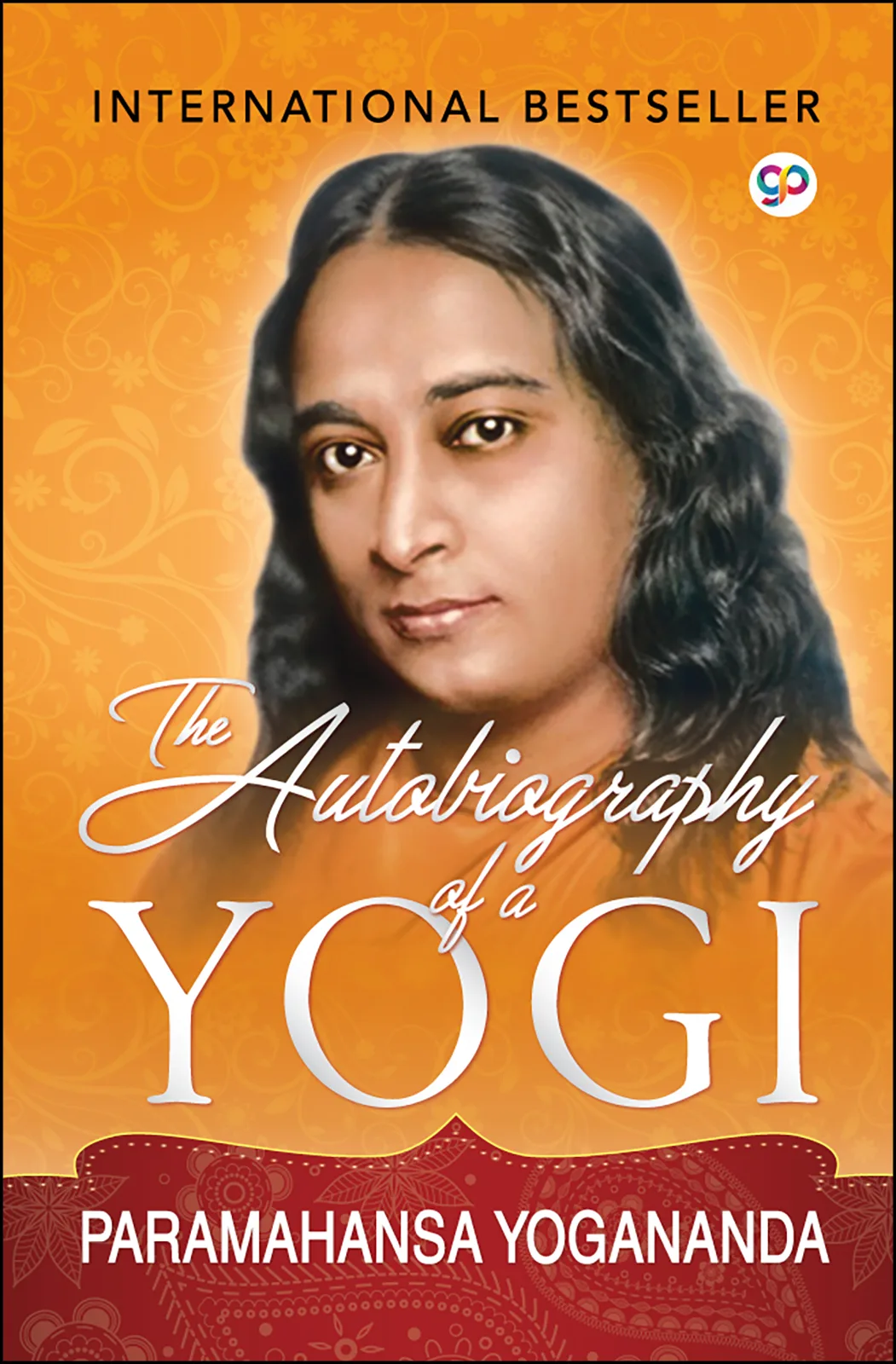
The Autobiography of a Yogi
Hardcover
• 406 Pages
• INR 795.00
• English
• 9789387669192
No ratings yet
| Publisher | General Press |
|---|---|
| ISBN13 | 9789387669192 |
| ASIN/SKU | 938766919X |
| Book Format | Hardcover |
| Language | English |
| Pages | 406 |
| List Price | INR 795.00 |
| Subject Code | BIO018000, REL062000, BIO026000 |
| Publishing Date | 03/02/2018 |
| Dimensions | 8.25 x 5.25 x 1.0 inches |
| Book Code | BD00068207 |
Buy this Book
Amazon Stores
Ebook Stores
Other Stores
Discover The Autobiography of a Yogi by Paramahansa Yogananda. This book is published by General Press in Hardcover format, ISBN 9789387669192, ASIN 938766919X, under Biographies and Memoirs, Religious Leader Biographies, Hinduism.
Book Description
'The Autobiography of a Yogi' by Paramahansa Yogananda is a spiritual memoir that has inspired millions of readers around the world with its profound insights into the nature of the soul, meditation, and the search for divine truth. Blending personal experiences with timeless spiritual wisdom, the book chronicles Yogananda’s extraordinary journey from his childhood in India to his mission of introducing the ancient science of yoga and meditation to the Western world.
The narrative follows Yogananda’s lifelong quest for enlightenment as he encounters remarkable saints, mystics, and spiritual masters whose lives reflect deep faith, compassion, and extraordinary inner power. Central to the story is his relationship with his revered guru, Swami Sri Yukteswar, whose guidance shapes his understanding of self-realization and the universal principles that unite all religions. Through vivid storytelling, Yogananda shares miraculous events, inspiring encounters, and valuable lessons that encourage readers to look beyond material success and seek lasting inner peace.
More than an autobiography, the book is an invitation to explore the limitless potential of the human spirit. Yogananda explains spiritual concepts with warmth and clarity, making complex ideas accessible to both devoted seekers and curious newcomers. His message emphasizes that true happiness comes from experiencing a direct connection with the Divine through disciplined practice, love, and self-awareness.
Rich in wisdom, humility, and hope, 'The Autobiography of a Yogi' remains one of the most influential spiritual classics of the twentieth century. It continues to inspire readers of every background to embark on a journey of self-discovery, inner transformation, and a deeper understanding of life's spiritual purpose.
The narrative follows Yogananda’s lifelong quest for enlightenment as he encounters remarkable saints, mystics, and spiritual masters whose lives reflect deep faith, compassion, and extraordinary inner power. Central to the story is his relationship with his revered guru, Swami Sri Yukteswar, whose guidance shapes his understanding of self-realization and the universal principles that unite all religions. Through vivid storytelling, Yogananda shares miraculous events, inspiring encounters, and valuable lessons that encourage readers to look beyond material success and seek lasting inner peace.
More than an autobiography, the book is an invitation to explore the limitless potential of the human spirit. Yogananda explains spiritual concepts with warmth and clarity, making complex ideas accessible to both devoted seekers and curious newcomers. His message emphasizes that true happiness comes from experiencing a direct connection with the Divine through disciplined practice, love, and self-awareness.
Rich in wisdom, humility, and hope, 'The Autobiography of a Yogi' remains one of the most influential spiritual classics of the twentieth century. It continues to inspire readers of every background to embark on a journey of self-discovery, inner transformation, and a deeper understanding of life's spiritual purpose.
Author Biography
Paramahansa Yogananda was born in as Mukunda Lal Ghosh. He was an Indian yogi and guru.
Some of the books written by him are Karma and Reincarnation, How To Have Courage, Calmness, And Confidence: The Wisdom Of Yogananda 1st Edition, The Bhagavad Gita 1st Edition, and Whispers From Eternity 1st Edition.
At the age of 17, in the year 1910, he found his guru Swami Yukteswar Giri. Yogananda graduated with a B.A. from the Serampore College, and in 1915 took vows to join the Swami Order. Here, he was given the name Swami Yogananda Giri. The Yogi established the Yogoda Satsanga Society of India in Ranchi. In 1920, he was sent to Boston to attend the International Congress of Religious Liberals. He lived in America for the next thirty years (1920-1952), and taught the soul-awakening techniques of Kriya Yoga to many people. Yogananda visited India in 1935, where he was given the monastic title of Paramahansa, which represents the highest spiritual attainment. The Yogi passed away in 1952, and his funeral service was attended by with hundreds of people in Los Angeles. On his twenty-fifth death anniversary, the Indian government issued a special commemorative stamp in his honour.
Some of the books written by him are Karma and Reincarnation, How To Have Courage, Calmness, And Confidence: The Wisdom Of Yogananda 1st Edition, The Bhagavad Gita 1st Edition, and Whispers From Eternity 1st Edition.
At the age of 17, in the year 1910, he found his guru Swami Yukteswar Giri. Yogananda graduated with a B.A. from the Serampore College, and in 1915 took vows to join the Swami Order. Here, he was given the name Swami Yogananda Giri. The Yogi established the Yogoda Satsanga Society of India in Ranchi. In 1920, he was sent to Boston to attend the International Congress of Religious Liberals. He lived in America for the next thirty years (1920-1952), and taught the soul-awakening techniques of Kriya Yoga to many people. Yogananda visited India in 1935, where he was given the monastic title of Paramahansa, which represents the highest spiritual attainment. The Yogi passed away in 1952, and his funeral service was attended by with hundreds of people in Los Angeles. On his twenty-fifth death anniversary, the Indian government issued a special commemorative stamp in his honour.
Editorial Reviews
Editorial Reviews will be added soon…
Book Summary
Paramahansa Yogananda’s "The Autobiography of a Yogi", published in 1946, is widely regarded as one of the most important spiritual texts of the twentieth century. Unlike typical memoirs that focus heavily on the external events of a person's life, this book is primarily an exploration of the internal, spiritual universe. It served as a groundbreaking bridge between the East and the West, introducing millions of Western readers to the ancient Indian science of yoga and meditation. Yogananda’s narrative demystifies the mystical, presenting spiritual realization not as a vague religious hope, but as an exact, verifiable science capable of unlocking the highest potential of the human mind and soul.
The narrative begins with Yogananda’s childhood in late nineteenth-century India, where he was born as Mukunda Lal Ghosh into a devout, affluent Bengali family. From an incredibly young age, Mukunda exhibited a profound, almost desperate spiritual yearning that set him apart from his peers. He experienced intense visions, possessed a deep longing for the divine, and spent his youth tirelessly seeking out saints, ascetics, and miracle workers across India. His early life was marked by a series of extraordinary events, including the miraculous materialization of a protective amulet, which fueled his unshakeable conviction that a higher, hidden reality governed the material world. His singular obsession became the search for his destined spiritual master.
This search culminated in his late teens when he finally met Swami Sri Yukteswar Giri in a vibrant marketplace in Benares. The connection was instantaneous and deeply karmic. Sri Yukteswar was a strict, profoundly disciplined, and intellectually brilliant Jnana yogi who ran an ashram in Serampore. Under his intense tutelage, the young Mukunda underwent a rigorous process of spiritual refinement. Sri Yukteswar did not coddle his disciple; instead, he used blunt wisdom and strict discipline to systematically shatter Mukunda's ego and worldly attachments. Despite the harshness of the training, their relationship was rooted in a profound, unconditional love, perfectly balancing Mukunda's emotional devotion with sharp intellectual clarity.
A central pillar of the autobiography is its detailed exposition of the Kriya Yoga lineage. Yogananda introduces the reader to the modern origins of this ancient practice, tracing it back to the deathless Himalayan master, Mahavatar Babaji. According to the text, Babaji revived the lost art of Kriya Yoga in the nineteenth century and imparted it to Lahiri Mahasaya, who in turn became the guru of Sri Yukteswar. Kriya Yoga is described as a highly advanced psychophysiological method of life-force control. By consciously circulating energy up and down the spine, the yogi can dramatically accelerate their spiritual evolution, bypassing millions of years of natural development to achieve God-realization within a single lifetime.
Throughout his training, Yogananda recounts experiencing profound states of cosmic consciousness, where the boundaries of his physical body dissolved, and his awareness expanded to encompass the entire universe. It is through this elevated lens that the book approaches the concept of miracles. The autobiography is famously replete with astonishing accounts of yogis who can bi-locate, materialize objects out of thin air, read minds, and survive for decades without food. However, Yogananda painstakingly argues that these occurrences are not supernatural violations of logic, but rather the operation of higher, subtle laws of nature that remain undiscovered by modern science. To a fully realized master who understands that matter is merely condensed light and energy, manipulating physical reality is a natural, effortless byproduct of deep spiritual focus.
After completing his university education, a requirement insisted upon by Sri Yukteswar, Yogananda took the vows of a monk and founded a pioneering school for boys in Ranchi. The school uniquely combined traditional academic curricula with yoga, meditation, and physical training. It was during his time at Ranchi that Yogananda experienced a powerful, fateful vision. While sitting in a storeroom, he saw a multitude of Western faces passing before his mind's eye, signaling that his true life’s mission lay across the ocean. This calling was subsequently confirmed by an incredibly rare personal visit from Mahavatar Babaji himself, who blessed Yogananda and commanded him to carry the science of Kriya Yoga to the West.
In 1920, Yogananda sailed for America to attend a religious congress in Boston, marking the beginning of his monumental work in the West. He spent the next three decades establishing the Self-Realization Fellowship, traveling extensively across the United States, and delivering packed lectures in major auditoriums. His teachings resonated deeply with the American public because he masterfully translated ancient Vedic philosophy into a modern, accessible language. He frequently drew striking parallels between the teachings of Jesus Christ in the New Testament and the doctrines of the Bhagavad Gita, emphasizing the underlying unity of all major religions and promoting a direct, personal experience of God over dogmatic belief.
The autobiography is also heavily enriched by Yogananda's fascinating encounters with prominent historical and scientific figures of his era. He sought out the great minds who were probing the boundaries of human knowledge and spiritual understanding. He details profound conversations with the Nobel Prize-winning poet Rabindranath Tagore, the pioneering botanist Luther Burbank (to whom the book is dedicated), and the revolutionary scientist Jagadish Chandra Bose, who invented instruments proving that plants possess a nervous system and respond to stimuli. In Europe, he visited the deeply devout Catholic stigmatic Therese Neumann, who famously survived without eating any food, further validating his claims about the human body's ability to be sustained purely by cosmic energy.
In 1935, Yogananda made a highly anticipated return to India, a trip necessitated by the declining health of his beloved guru. During this journey, he met with Mahatma Gandhi at his ashram in Wardha, a historic encounter where the political leader requested and received initiation into Kriya Yoga from Yogananda. Shortly after this, Sri Yukteswar passed away, an event that plunged Yogananda into deep mourning. However, this sorrow was famously followed by one of the most astonishing chapters in the book: the physical resurrection of Sri Yukteswar. In a brightly lit hotel room in Bombay, the fully materialized master appeared to Yogananda to deliver a breathtakingly detailed discourse on the nature of the astral world and life after death.
Ultimately, "The Autobiography of a Yogi" endures because it offers an irresistibly optimistic and expansive view of human existence. It continues to inspire generations of seekers—famously including Steve Jobs, who requested that a copy be given to everyone who attended his memorial service. Yogananda’s life story stands as a compelling invitation to look beyond the chaotic, surface-level illusions of the material world. Through his eloquent prose and astonishing life experiences, he left behind a permanent blueprint for spiritual seekers, proving that the highest states of divine consciousness are not relics of a mythical past, but an ever-present, attainable reality for anyone willing to embark on the inner journey.
The narrative begins with Yogananda’s childhood in late nineteenth-century India, where he was born as Mukunda Lal Ghosh into a devout, affluent Bengali family. From an incredibly young age, Mukunda exhibited a profound, almost desperate spiritual yearning that set him apart from his peers. He experienced intense visions, possessed a deep longing for the divine, and spent his youth tirelessly seeking out saints, ascetics, and miracle workers across India. His early life was marked by a series of extraordinary events, including the miraculous materialization of a protective amulet, which fueled his unshakeable conviction that a higher, hidden reality governed the material world. His singular obsession became the search for his destined spiritual master.
This search culminated in his late teens when he finally met Swami Sri Yukteswar Giri in a vibrant marketplace in Benares. The connection was instantaneous and deeply karmic. Sri Yukteswar was a strict, profoundly disciplined, and intellectually brilliant Jnana yogi who ran an ashram in Serampore. Under his intense tutelage, the young Mukunda underwent a rigorous process of spiritual refinement. Sri Yukteswar did not coddle his disciple; instead, he used blunt wisdom and strict discipline to systematically shatter Mukunda's ego and worldly attachments. Despite the harshness of the training, their relationship was rooted in a profound, unconditional love, perfectly balancing Mukunda's emotional devotion with sharp intellectual clarity.
A central pillar of the autobiography is its detailed exposition of the Kriya Yoga lineage. Yogananda introduces the reader to the modern origins of this ancient practice, tracing it back to the deathless Himalayan master, Mahavatar Babaji. According to the text, Babaji revived the lost art of Kriya Yoga in the nineteenth century and imparted it to Lahiri Mahasaya, who in turn became the guru of Sri Yukteswar. Kriya Yoga is described as a highly advanced psychophysiological method of life-force control. By consciously circulating energy up and down the spine, the yogi can dramatically accelerate their spiritual evolution, bypassing millions of years of natural development to achieve God-realization within a single lifetime.
Throughout his training, Yogananda recounts experiencing profound states of cosmic consciousness, where the boundaries of his physical body dissolved, and his awareness expanded to encompass the entire universe. It is through this elevated lens that the book approaches the concept of miracles. The autobiography is famously replete with astonishing accounts of yogis who can bi-locate, materialize objects out of thin air, read minds, and survive for decades without food. However, Yogananda painstakingly argues that these occurrences are not supernatural violations of logic, but rather the operation of higher, subtle laws of nature that remain undiscovered by modern science. To a fully realized master who understands that matter is merely condensed light and energy, manipulating physical reality is a natural, effortless byproduct of deep spiritual focus.
After completing his university education, a requirement insisted upon by Sri Yukteswar, Yogananda took the vows of a monk and founded a pioneering school for boys in Ranchi. The school uniquely combined traditional academic curricula with yoga, meditation, and physical training. It was during his time at Ranchi that Yogananda experienced a powerful, fateful vision. While sitting in a storeroom, he saw a multitude of Western faces passing before his mind's eye, signaling that his true life’s mission lay across the ocean. This calling was subsequently confirmed by an incredibly rare personal visit from Mahavatar Babaji himself, who blessed Yogananda and commanded him to carry the science of Kriya Yoga to the West.
In 1920, Yogananda sailed for America to attend a religious congress in Boston, marking the beginning of his monumental work in the West. He spent the next three decades establishing the Self-Realization Fellowship, traveling extensively across the United States, and delivering packed lectures in major auditoriums. His teachings resonated deeply with the American public because he masterfully translated ancient Vedic philosophy into a modern, accessible language. He frequently drew striking parallels between the teachings of Jesus Christ in the New Testament and the doctrines of the Bhagavad Gita, emphasizing the underlying unity of all major religions and promoting a direct, personal experience of God over dogmatic belief.
The autobiography is also heavily enriched by Yogananda's fascinating encounters with prominent historical and scientific figures of his era. He sought out the great minds who were probing the boundaries of human knowledge and spiritual understanding. He details profound conversations with the Nobel Prize-winning poet Rabindranath Tagore, the pioneering botanist Luther Burbank (to whom the book is dedicated), and the revolutionary scientist Jagadish Chandra Bose, who invented instruments proving that plants possess a nervous system and respond to stimuli. In Europe, he visited the deeply devout Catholic stigmatic Therese Neumann, who famously survived without eating any food, further validating his claims about the human body's ability to be sustained purely by cosmic energy.
In 1935, Yogananda made a highly anticipated return to India, a trip necessitated by the declining health of his beloved guru. During this journey, he met with Mahatma Gandhi at his ashram in Wardha, a historic encounter where the political leader requested and received initiation into Kriya Yoga from Yogananda. Shortly after this, Sri Yukteswar passed away, an event that plunged Yogananda into deep mourning. However, this sorrow was famously followed by one of the most astonishing chapters in the book: the physical resurrection of Sri Yukteswar. In a brightly lit hotel room in Bombay, the fully materialized master appeared to Yogananda to deliver a breathtakingly detailed discourse on the nature of the astral world and life after death.
Ultimately, "The Autobiography of a Yogi" endures because it offers an irresistibly optimistic and expansive view of human existence. It continues to inspire generations of seekers—famously including Steve Jobs, who requested that a copy be given to everyone who attended his memorial service. Yogananda’s life story stands as a compelling invitation to look beyond the chaotic, surface-level illusions of the material world. Through his eloquent prose and astonishing life experiences, he left behind a permanent blueprint for spiritual seekers, proving that the highest states of divine consciousness are not relics of a mythical past, but an ever-present, attainable reality for anyone willing to embark on the inner journey.
Sample Chapters
Chapter 1 : My Parents and Early Life
The characteristic features of Indian culture have long been a search for ultimate verities and the concomitant disciple-guru relationship. My own path led me to a Christ-like sage whose beautiful life was chiselled for the ages. He was one of the great masters who are India’s sole remaining wealth. Emerging in every generation, they have bulwarked their land against the fate of Babylon and Egypt.
I find my earliest memories covering the anachronistic features of a previous incarnation. Clear recollections came to me of a distant life, a yogi amidst the Himalayan snows. These glimpses of the past, by some dimensionless link, also afforded me a glimpse of the future.
The helpless humiliations of infancy are not banished from my mind. I was resentfully conscious of not being able to walk or express myself freely. Prayerful surges arose within me as I realised my bodily impotence. My strong emotional life took silent form as words in many languages. Among the inward confusion of tongues, my ear gradually accustomed itself to the circumambient Bengali syllables of my people. The beguiling scope of an infant’s mind! Adultly considered limited to toys and toes.
Psychological ferment and my unresponsive body brought me to many obstinate crying spells. I recall the general family bewilderment at my distress. Happier memories, too, crowd in on me: my mother’s caresses, and my first attempts at lisping phrase and toddling step. These early triumphs, usually forgotten quickly, are yet a natural basis of self-confidence.
My far-reaching memories are not unique. Many yogis are known to have retained their self-consciousness without interruption by the dramatic transition to and from ‘life’ and ‘death’. If man be solely a body, its loss indeed places the final period to identity. But if prophets down the millenniums spake with truth, man is essentially of incorporeal nature. The persistent core of human egoity is only temporarily allied with sense perception.
Although odd, clear memories of infancy are not extremely rare. During travels in numerous lands, I have listened to early recollections from the lips of veracious men and women.
I was born in the last decade of the nineteenth century and passed my first eight years at Gorakhpur. This was my birthplace in the United Provinces of northeastern India. We were eight children: four boys and four girls. I, Mukunda Lal Ghosh, was the second son and the fourth child.
Father and Mother were Bengalis, of the Kshatriya caste. Both were blessed with saintly nature. Their mutual love, tranquil and dignified, never expressed itself frivolously. A perfect parental harmony was the calm centre for the revolving tumult of eight young lives.
Father, Bhagabati Charan Ghosh, was kind, grave, at times stern. Loving him dearly, we children yet observed a certain reverential distance. An outstanding mathematician and logician, he was guided principally by his intellect. But Mother was a queen of hearts, and taught us only through love. After her death, Father displayed more of his inner tenderness. I noticed then that his gaze often metamorphosed into my mother’s.
In Mother’s presence we tasted our earliest bitter-sweet acquaintance with the scriptures. Tales from the Mahabharata and Ramayana were resourcefully summoned to meet the exigencies of discipline. Instruction and chastisement went hand in hand.
A daily gesture of respect to Father was given by Mother’s dressing us carefully in the afternoons to welcome him home from the office. His position was similar to that of a vice-president, in the Bengal-Nagpur Railway, one of India’s large companies. His work involved travelling, and our family lived in several cities during my childhood.
Mother held an open hand toward the needy. Father was also kindly disposed, but his respect for law and order extended to the budget. One fortnight Mother spent, in feeding the poor, more than Father’s monthly income.
“All I ask, please, is to keep your charities within a reasonable limit.” Even a gentle rebuke from her husband was grievous to Mother. She ordered a hackney carriage, not hinting to the children at any disagreement.
“Goodbye; I am going away to my mother’s home.” Ancient ultimatum!
We broke into astounded lamentations. Our maternal uncle arrived opportunely; he whispered to Father some sage counsel, garnered no doubt from the ages. After Father had made a few conciliatory remarks, Mother happily dismissed the cab. Thus ended the only trouble I ever noticed between my parents. But I recall a characteristic discussion.
“Please give me ten rupees for a hapless woman who has just arrived at the house.” Mother’s smile had its own persuasion.
“Why ten rupees? One is enough.” Father added a justification: “When my father and grandparents died suddenly, I had my first taste of poverty. My only breakfast, before walking miles to my school, was a small banana. Later, at the university, I was in such need that I applied to a wealthy judge for aid of one rupee per month. He declined, remarking that even a rupee is important.”
“How bitterly you recall the denial of that rupee!” Mother’s heart had an instant logic. “Do you want this woman also to remember painfully your refusal of ten rupees which she needs urgently?”
“You win!” With the immemorial gesture of vanquished husbands, he opened his wallet. “Here is a ten-rupee note. Give it to her with my goodwill.”
My Father
BHAGABATI CHARAN GHOSH
A Disciple of Lahiri Mahasaya
Father tended to first say ‘No’ to any new proposal. His attitude towards the strange woman who so readily enlisted Mother’s sympathy was an example of his customary caution. Aversion to instant acceptance—typical of the French mind in the West—is really only honouring the principle of ‘due reflection’. I always found Father reasonable and evenly balanced in his judgements. If I could bolster up my numerous requests with one or two good arguments, he invariably put the coveted goal within my reach, whether it were a vacation trip or a new motorcycle.
Father was a strict disciplinarian to his children in their early years, but his attitude towards himself was truly Spartan. He never visited the theatre, for instance, but sought his recreation in various spiritual practices and in reading the Bhagavad Gita. Shunning all luxuries, he would cling to one old pair of shoes until they were useless. His sons bought automobiles after they came into popular use, but Father was always content with the trolley car for his daily ride to the office. The accumulation of money for the sake of power was alien to his nature. Once, after organising the Calcutta Urban Bank, he refused to benefit himself by holding any of its shares. He had simply wished to perform a civic duty in his spare time.
Several years after Father had retired on a pension, an English accountant arrived to examine the books of the Bengal-Nagpur Railway Company. The amazed investigator discovered that Father had never applied for overdue bonuses.
“He did the work of three men!” the accountant told the company. “He has rupees 125,000 (about $41,250.) owing to him as back compensation.” The officials presented Father with a check for this amount. He thought so little about it that he overlooked any mention to the family. Much later he was questioned by my youngest brother Bishnu, who noticed the large deposit on a bank statement.
“Why be elated by material profit?” Father replied. “The one who pursues a goal of evenmindedness is neither jubilant with gain nor depressed by loss. He knows that man arrives penniless in this world and departs without a single rupee.”
Early in their married life, my parents became disciples of a great master, Lahiri Mahasaya of Benares. This contact strengthened Father’s naturally ascetical temperament. Mother made a remarkable admission to my eldest sister Roma: “Your father and myself live together as man and wife only once a year, for the purpose of having children.”
Father first met Lahiri Mahasaya through Abinash Babu, an employee in the Gorakhpur office of the Bengal-Nagpur Railway. Abinash instructed my young ears with engrossing tales of many Indian saints. He invariably concluded with a tribute to the superior glories of his own guru.
“Did you ever hear of the extraordinary circumstances under which your father became a disciple of Lahiri Mahasaya?”
It was on a lazy summer afternoon, as Abinash and I sat together in the compound of my home, that he put this intriguing question. I shook my head with a smile of anticipation.
“Years ago, before you were born, I asked my superior officer—your father—to give me a week’s leave from my Gorakhpur duties in order to visit my guru in Benares. Your father ridiculed my plan.
“‘Are you going to become a religious fanatic?’ he inquired. ‘Concentrate on your office work if you want to forge ahead.’
“Sadly walking home along a woodland path that day, I met your father in a palanquin. He dismissed his servants and conveyance, and fell into step beside me. Seeking to console me, he pointed out the advantages of striving for worldly success. But I heard him listlessly. My heart was repeating: ‘Lahiri Mahasaya! I cannot live without seeing you!’
“Our path took us to the edge of a tranquil field, where the rays of the late afternoon sun were still crowning the tall ripple of the wild grass. We paused in admiration. There in the field, only a few yards from us, the form of my great guru suddenly appeared!
“‘Bhagabati, you are too hard on your employee!’ His voice was resonant in our astounded ears. He vanished as mysteriously as he had come. On my knees I was exclaiming, ‘Lahiri Mahasaya! Lahiri Mahasaya!’ Your father was motionless with stupefaction for a few moments.
“‘Abinash, not only do I give you leave, but I give myself leave to start for Benares tomorrow. I must know this great Lahiri Mahasaya, who is able to materialise himself at will in order to intercede for you! I will take my wife and ask this master to initiate us in his spiritual path. Will you guide us to him?’
“‘Of course.’ Joy filled me at the miraculous answer to my prayer, and the quick, favourable turn of events.
“The next evening your parents and I entrained for Benares. We took a horse cart the following day, and then had to walk through narrow lanes to my guru’s secluded home. Entering his little parlour, we bowed before the master, enlocked in his habitual lotus posture. He blinked his piercing eyes and levelled them on your father.
“‘Bhagabati, you are too hard on your employee!’ His words were the same as those he had used two days before in the Gorakhpur field. He added, ‘I am glad that you have allowed Abinash to visit me, and that you and your wife have accompanied him.’
“To their joy, he initiated your parents in the spiritual practice of kriya yoga. Your father and I, as brother disciples, have been close friends since the memorable day of the vision. Lahiri Mahasaya took a definite interest in your own birth. Your life shall surely be linked with his own: the master’s blessing never fails.”
Lahiri Mahasaya left this world shortly after I had entered it. His picture, in an ornate frame, always graced our family altar in the various cities to which Father was transferred by his office. Many a morning and evening found Mother and me meditating before an improvised shrine, offering flowers dipped in fragrant sandalwood paste. With frankincense and myrrh as well as our united devotions, we honoured the divinity which had found full expression in Lahiri Mahasaya.
His picture had a surpassing influence over my life. As I grew, the thought of the master grew with me. In meditation I would often see his photographic image emerge from its small frame and, taking a living form, sit before me. When I attempted to touch the feet of his luminous body, it would change and again become the picture. As childhood slipped into boyhood, I found Lahiri Mahasaya transformed in my mind from a little image, cribbed in a frame, to a living, enlightening presence. I frequently prayed to him in moments of trial or confusion, finding within me his solacing direction. At first I grieved because he was no longer physically living. As I began to discover his secret omnipresence, I lamented no more. He had often written to those of his disciples who were over-anxious to see him: “Why come to view my bones and flesh, when I am ever within range of your kutastha (spiritual sight)?”
I was blessed about the age of eight with a wonderful healing through the photograph of Lahiri Mahasaya. This experience gave intensification to my love. While at our family estate in Ichapur, Bengal, I was stricken with Asiatic cholera. My life was despaired of; the doctors could do nothing. At my bedside, Mother frantically motioned me to look at Lahiri Mahasaya’s picture on the wall above my head.
“Bow to him mentally!” She knew I was too feeble even to lift my hands in salutation. “If you really show your devotion and inwardly kneel before him, your life will be spared!”
I gazed at his photograph and saw there a blinding light, enveloping my body and the entire room. My nausea and other uncontrollable symptoms disappeared; I was well. At once I felt strong enough to bend over and touch Mother’s feet in appreciation of her immeasurable faith in her guru. Mother pressed her head repeatedly against the little picture.
“O Omnipresent Master, I thank thee that thy light hath healed my son!”
I realised that she too had witnessed the luminous blaze through which I had instantly recovered from a usually fatal disease.
One of my most precious possessions is that same photograph. Given to Father by Lahiri Mahasaya himself, it carries a holy vibration. The picture had a miraculous origin. I heard the story from Father’s brother-disciple, Kali Kumar Roy.
It appears that the master had an aversion to being photographed. Over his protest, a group picture was once taken of him with a cluster of devotees, including Kali Kumar Roy. It was an amazed photographer who discovered that the plate which had clear images of all the disciples, revealed nothing more than a blank space in the centre where he had reasonably expected to find the outlines of Lahiri Mahasaya. The phenomenon was widely discussed.
A certain student and expert photographer, Ganga Dhar Babu, boasted that the fugitive figure would not escape him. The next morning, as the guru sat in lotus posture on a wooden bench with a screen behind him, Ganga Dhar Babu arrived with his equipment. Taking every precaution for success, he greedily exposed twelve plates. On each one he soon found the imprint of the wooden bench and screen, but once again the master’s form was missing.
With tears and shattered pride, Ganga Dhar Babu sought out his guru. It was many hours before Lahiri Mahasaya broke his silence with a pregnant comment:
“I am Spirit. Can your camera reflect the omnipresent Invisible?”
“I see it cannot! But, Holy Sir, I lovingly desire a picture of the bodily temple where alone, to my narrow vision, that Spirit appears fully to dwell.”
“Come, then, tomorrow morning. I will pose for you.”
Again the photographer focused his camera. This time the sacred figure, not cloaked with mysterious imperceptibility, was sharp on the plate. The master never posed for another picture; at least, I have seen none.
The photograph is reproduced in this book. Lahiri Mahasaya’s fair features, of a universal cast, hardly suggest to what race he belonged. His intense joy of God-communion is slightly revealed in a somewhat enigmatic smile. His eyes, half open to denote a nominal direction on the outer world, are half closed also. Completely oblivious to the poor lures of the earth, he was fully awake at all times to the spiritual problems of seekers who approached for his bounty.
Shortly after my healing through the potency of the guru’s picture, I had an influential spiritual vision. Sitting on my bed one morning, I fell into a deep reverie.
“What is behind the darkness of closed eyes?” This probing thought came powerfully into my mind. An immense flash of light at once manifested to my inward gaze. Divine shapes of saints, sitting in meditation posture in mountain caves, formed like miniature cinema pictures on the large screen of radiance within my forehead.
“Who are you?” I spoke aloud.
“We are the Himalayan yogis.” The celestial response is difficult to describe; my heart was thrilled.
“Ah, I long to go to the Himalayas and become like you!” The vision vanished, but the silvery beams expanded in ever-widening circles to infinity.
“What is this wondrous glow?”
“I am Iswara. I am Light.” The voice was as murmuring clouds.
“I want to be one with Thee!”
Out of the slow dwindling of my divine ecstasy, I salvaged a permanent legacy of inspiration to seek God. “He is eternal, ever-new Joy!” This memory persisted long after the day of rapture.
Another early recollection is outstanding; and literally so, for I bear the scar to this day. My elder sister Uma and I were seated in the early morning under a neem tree in our Gorakhpur compound. She was helping me with a Bengali primer, what time I could spare my gaze from the nearby parrots eating ripe margosa fruit. Uma complained of a boil on her leg, and fetched a jar of ointment. I smeared a bit of the salve on my forearm.
“Why do you use medicine on a healthy arm?”
“Well, Sis, I feel I am going to have a boil tomorrow. I am testing your ointment on the spot where the boil will appear.”
“You little liar!”
“Sis, don’t call me a liar until you see what happens in the morning.” Indignation filled me.
Uma was unimpressed, and thrice repeated her taunt. An adamant resolution sounded in my voice as I made a slow reply.
“By the power of will in me, I say that tomorrow I shall have a fairly large boil in this exact place on my arm; and your boil shall swell to twice its present size!”
Morning found me with a stalwart boil on the indicated spot; the dimensions of Uma’s boil had doubled. With a shriek, my sister rushed to Mother. “Mukunda has become a necromancer!” Gravely, Mother instructed me never to use the power of words for doing harm. I have always remembered her counsel and followed it.
My boil was surgically treated. A noticeable scar, left by the doctor’s incision, is present today. On my right forearm is a constant reminder of the power in man’s sheer word.
Those simple and apparently harmless phrases to Uma, spoken with deep concentration, had possessed sufficient hidden force to explode like bombs and produce definite, though injurious, effects. I understood, later, that the explosive vibratory power in speech could be wisely directed to free one’s life from difficulties and thus operate without scar or rebuke.
Our family moved to Lahore in the Punjab. There I acquired a picture of the Divine Mother in the form of the Goddess Kali. It sanctified a small informal shrine on the balcony of our home. An unequivocal conviction came over me that fulfilment would crown any of my prayers uttered in that sacred spot. Standing there with Uma one day, I watched two kites flying over the roofs of the buildings on the opposite side of the very narrow lane.
“Why are you so quiet?” Uma pushed me playfully.
“I am just thinking how wonderful it is that Divine Mother gives me whatever I ask.”
“I suppose She would give you those two kites!” My sister laughed derisively.
“Why not?” I began silent prayers for their possession.
The characteristic features of Indian culture have long been a search for ultimate verities and the concomitant disciple-guru relationship. My own path led me to a Christ-like sage whose beautiful life was chiselled for the ages. He was one of the great masters who are India’s sole remaining wealth. Emerging in every generation, they have bulwarked their land against the fate of Babylon and Egypt.
I find my earliest memories covering the anachronistic features of a previous incarnation. Clear recollections came to me of a distant life, a yogi amidst the Himalayan snows. These glimpses of the past, by some dimensionless link, also afforded me a glimpse of the future.
The helpless humiliations of infancy are not banished from my mind. I was resentfully conscious of not being able to walk or express myself freely. Prayerful surges arose within me as I realised my bodily impotence. My strong emotional life took silent form as words in many languages. Among the inward confusion of tongues, my ear gradually accustomed itself to the circumambient Bengali syllables of my people. The beguiling scope of an infant’s mind! Adultly considered limited to toys and toes.
Psychological ferment and my unresponsive body brought me to many obstinate crying spells. I recall the general family bewilderment at my distress. Happier memories, too, crowd in on me: my mother’s caresses, and my first attempts at lisping phrase and toddling step. These early triumphs, usually forgotten quickly, are yet a natural basis of self-confidence.
My far-reaching memories are not unique. Many yogis are known to have retained their self-consciousness without interruption by the dramatic transition to and from ‘life’ and ‘death’. If man be solely a body, its loss indeed places the final period to identity. But if prophets down the millenniums spake with truth, man is essentially of incorporeal nature. The persistent core of human egoity is only temporarily allied with sense perception.
Although odd, clear memories of infancy are not extremely rare. During travels in numerous lands, I have listened to early recollections from the lips of veracious men and women.
I was born in the last decade of the nineteenth century and passed my first eight years at Gorakhpur. This was my birthplace in the United Provinces of northeastern India. We were eight children: four boys and four girls. I, Mukunda Lal Ghosh, was the second son and the fourth child.
Father and Mother were Bengalis, of the Kshatriya caste. Both were blessed with saintly nature. Their mutual love, tranquil and dignified, never expressed itself frivolously. A perfect parental harmony was the calm centre for the revolving tumult of eight young lives.
Father, Bhagabati Charan Ghosh, was kind, grave, at times stern. Loving him dearly, we children yet observed a certain reverential distance. An outstanding mathematician and logician, he was guided principally by his intellect. But Mother was a queen of hearts, and taught us only through love. After her death, Father displayed more of his inner tenderness. I noticed then that his gaze often metamorphosed into my mother’s.
In Mother’s presence we tasted our earliest bitter-sweet acquaintance with the scriptures. Tales from the Mahabharata and Ramayana were resourcefully summoned to meet the exigencies of discipline. Instruction and chastisement went hand in hand.
A daily gesture of respect to Father was given by Mother’s dressing us carefully in the afternoons to welcome him home from the office. His position was similar to that of a vice-president, in the Bengal-Nagpur Railway, one of India’s large companies. His work involved travelling, and our family lived in several cities during my childhood.
Mother held an open hand toward the needy. Father was also kindly disposed, but his respect for law and order extended to the budget. One fortnight Mother spent, in feeding the poor, more than Father’s monthly income.
“All I ask, please, is to keep your charities within a reasonable limit.” Even a gentle rebuke from her husband was grievous to Mother. She ordered a hackney carriage, not hinting to the children at any disagreement.
“Goodbye; I am going away to my mother’s home.” Ancient ultimatum!
We broke into astounded lamentations. Our maternal uncle arrived opportunely; he whispered to Father some sage counsel, garnered no doubt from the ages. After Father had made a few conciliatory remarks, Mother happily dismissed the cab. Thus ended the only trouble I ever noticed between my parents. But I recall a characteristic discussion.
“Please give me ten rupees for a hapless woman who has just arrived at the house.” Mother’s smile had its own persuasion.
“Why ten rupees? One is enough.” Father added a justification: “When my father and grandparents died suddenly, I had my first taste of poverty. My only breakfast, before walking miles to my school, was a small banana. Later, at the university, I was in such need that I applied to a wealthy judge for aid of one rupee per month. He declined, remarking that even a rupee is important.”
“How bitterly you recall the denial of that rupee!” Mother’s heart had an instant logic. “Do you want this woman also to remember painfully your refusal of ten rupees which she needs urgently?”
“You win!” With the immemorial gesture of vanquished husbands, he opened his wallet. “Here is a ten-rupee note. Give it to her with my goodwill.”
My Father
BHAGABATI CHARAN GHOSH
A Disciple of Lahiri Mahasaya
Father tended to first say ‘No’ to any new proposal. His attitude towards the strange woman who so readily enlisted Mother’s sympathy was an example of his customary caution. Aversion to instant acceptance—typical of the French mind in the West—is really only honouring the principle of ‘due reflection’. I always found Father reasonable and evenly balanced in his judgements. If I could bolster up my numerous requests with one or two good arguments, he invariably put the coveted goal within my reach, whether it were a vacation trip or a new motorcycle.
Father was a strict disciplinarian to his children in their early years, but his attitude towards himself was truly Spartan. He never visited the theatre, for instance, but sought his recreation in various spiritual practices and in reading the Bhagavad Gita. Shunning all luxuries, he would cling to one old pair of shoes until they were useless. His sons bought automobiles after they came into popular use, but Father was always content with the trolley car for his daily ride to the office. The accumulation of money for the sake of power was alien to his nature. Once, after organising the Calcutta Urban Bank, he refused to benefit himself by holding any of its shares. He had simply wished to perform a civic duty in his spare time.
Several years after Father had retired on a pension, an English accountant arrived to examine the books of the Bengal-Nagpur Railway Company. The amazed investigator discovered that Father had never applied for overdue bonuses.
“He did the work of three men!” the accountant told the company. “He has rupees 125,000 (about $41,250.) owing to him as back compensation.” The officials presented Father with a check for this amount. He thought so little about it that he overlooked any mention to the family. Much later he was questioned by my youngest brother Bishnu, who noticed the large deposit on a bank statement.
“Why be elated by material profit?” Father replied. “The one who pursues a goal of evenmindedness is neither jubilant with gain nor depressed by loss. He knows that man arrives penniless in this world and departs without a single rupee.”
Early in their married life, my parents became disciples of a great master, Lahiri Mahasaya of Benares. This contact strengthened Father’s naturally ascetical temperament. Mother made a remarkable admission to my eldest sister Roma: “Your father and myself live together as man and wife only once a year, for the purpose of having children.”
Father first met Lahiri Mahasaya through Abinash Babu, an employee in the Gorakhpur office of the Bengal-Nagpur Railway. Abinash instructed my young ears with engrossing tales of many Indian saints. He invariably concluded with a tribute to the superior glories of his own guru.
“Did you ever hear of the extraordinary circumstances under which your father became a disciple of Lahiri Mahasaya?”
It was on a lazy summer afternoon, as Abinash and I sat together in the compound of my home, that he put this intriguing question. I shook my head with a smile of anticipation.
“Years ago, before you were born, I asked my superior officer—your father—to give me a week’s leave from my Gorakhpur duties in order to visit my guru in Benares. Your father ridiculed my plan.
“‘Are you going to become a religious fanatic?’ he inquired. ‘Concentrate on your office work if you want to forge ahead.’
“Sadly walking home along a woodland path that day, I met your father in a palanquin. He dismissed his servants and conveyance, and fell into step beside me. Seeking to console me, he pointed out the advantages of striving for worldly success. But I heard him listlessly. My heart was repeating: ‘Lahiri Mahasaya! I cannot live without seeing you!’
“Our path took us to the edge of a tranquil field, where the rays of the late afternoon sun were still crowning the tall ripple of the wild grass. We paused in admiration. There in the field, only a few yards from us, the form of my great guru suddenly appeared!
“‘Bhagabati, you are too hard on your employee!’ His voice was resonant in our astounded ears. He vanished as mysteriously as he had come. On my knees I was exclaiming, ‘Lahiri Mahasaya! Lahiri Mahasaya!’ Your father was motionless with stupefaction for a few moments.
“‘Abinash, not only do I give you leave, but I give myself leave to start for Benares tomorrow. I must know this great Lahiri Mahasaya, who is able to materialise himself at will in order to intercede for you! I will take my wife and ask this master to initiate us in his spiritual path. Will you guide us to him?’
“‘Of course.’ Joy filled me at the miraculous answer to my prayer, and the quick, favourable turn of events.
“The next evening your parents and I entrained for Benares. We took a horse cart the following day, and then had to walk through narrow lanes to my guru’s secluded home. Entering his little parlour, we bowed before the master, enlocked in his habitual lotus posture. He blinked his piercing eyes and levelled them on your father.
“‘Bhagabati, you are too hard on your employee!’ His words were the same as those he had used two days before in the Gorakhpur field. He added, ‘I am glad that you have allowed Abinash to visit me, and that you and your wife have accompanied him.’
“To their joy, he initiated your parents in the spiritual practice of kriya yoga. Your father and I, as brother disciples, have been close friends since the memorable day of the vision. Lahiri Mahasaya took a definite interest in your own birth. Your life shall surely be linked with his own: the master’s blessing never fails.”
Lahiri Mahasaya left this world shortly after I had entered it. His picture, in an ornate frame, always graced our family altar in the various cities to which Father was transferred by his office. Many a morning and evening found Mother and me meditating before an improvised shrine, offering flowers dipped in fragrant sandalwood paste. With frankincense and myrrh as well as our united devotions, we honoured the divinity which had found full expression in Lahiri Mahasaya.
His picture had a surpassing influence over my life. As I grew, the thought of the master grew with me. In meditation I would often see his photographic image emerge from its small frame and, taking a living form, sit before me. When I attempted to touch the feet of his luminous body, it would change and again become the picture. As childhood slipped into boyhood, I found Lahiri Mahasaya transformed in my mind from a little image, cribbed in a frame, to a living, enlightening presence. I frequently prayed to him in moments of trial or confusion, finding within me his solacing direction. At first I grieved because he was no longer physically living. As I began to discover his secret omnipresence, I lamented no more. He had often written to those of his disciples who were over-anxious to see him: “Why come to view my bones and flesh, when I am ever within range of your kutastha (spiritual sight)?”
I was blessed about the age of eight with a wonderful healing through the photograph of Lahiri Mahasaya. This experience gave intensification to my love. While at our family estate in Ichapur, Bengal, I was stricken with Asiatic cholera. My life was despaired of; the doctors could do nothing. At my bedside, Mother frantically motioned me to look at Lahiri Mahasaya’s picture on the wall above my head.
“Bow to him mentally!” She knew I was too feeble even to lift my hands in salutation. “If you really show your devotion and inwardly kneel before him, your life will be spared!”
I gazed at his photograph and saw there a blinding light, enveloping my body and the entire room. My nausea and other uncontrollable symptoms disappeared; I was well. At once I felt strong enough to bend over and touch Mother’s feet in appreciation of her immeasurable faith in her guru. Mother pressed her head repeatedly against the little picture.
“O Omnipresent Master, I thank thee that thy light hath healed my son!”
I realised that she too had witnessed the luminous blaze through which I had instantly recovered from a usually fatal disease.
One of my most precious possessions is that same photograph. Given to Father by Lahiri Mahasaya himself, it carries a holy vibration. The picture had a miraculous origin. I heard the story from Father’s brother-disciple, Kali Kumar Roy.
It appears that the master had an aversion to being photographed. Over his protest, a group picture was once taken of him with a cluster of devotees, including Kali Kumar Roy. It was an amazed photographer who discovered that the plate which had clear images of all the disciples, revealed nothing more than a blank space in the centre where he had reasonably expected to find the outlines of Lahiri Mahasaya. The phenomenon was widely discussed.
A certain student and expert photographer, Ganga Dhar Babu, boasted that the fugitive figure would not escape him. The next morning, as the guru sat in lotus posture on a wooden bench with a screen behind him, Ganga Dhar Babu arrived with his equipment. Taking every precaution for success, he greedily exposed twelve plates. On each one he soon found the imprint of the wooden bench and screen, but once again the master’s form was missing.
With tears and shattered pride, Ganga Dhar Babu sought out his guru. It was many hours before Lahiri Mahasaya broke his silence with a pregnant comment:
“I am Spirit. Can your camera reflect the omnipresent Invisible?”
“I see it cannot! But, Holy Sir, I lovingly desire a picture of the bodily temple where alone, to my narrow vision, that Spirit appears fully to dwell.”
“Come, then, tomorrow morning. I will pose for you.”
Again the photographer focused his camera. This time the sacred figure, not cloaked with mysterious imperceptibility, was sharp on the plate. The master never posed for another picture; at least, I have seen none.
The photograph is reproduced in this book. Lahiri Mahasaya’s fair features, of a universal cast, hardly suggest to what race he belonged. His intense joy of God-communion is slightly revealed in a somewhat enigmatic smile. His eyes, half open to denote a nominal direction on the outer world, are half closed also. Completely oblivious to the poor lures of the earth, he was fully awake at all times to the spiritual problems of seekers who approached for his bounty.
Shortly after my healing through the potency of the guru’s picture, I had an influential spiritual vision. Sitting on my bed one morning, I fell into a deep reverie.
“What is behind the darkness of closed eyes?” This probing thought came powerfully into my mind. An immense flash of light at once manifested to my inward gaze. Divine shapes of saints, sitting in meditation posture in mountain caves, formed like miniature cinema pictures on the large screen of radiance within my forehead.
“Who are you?” I spoke aloud.
“We are the Himalayan yogis.” The celestial response is difficult to describe; my heart was thrilled.
“Ah, I long to go to the Himalayas and become like you!” The vision vanished, but the silvery beams expanded in ever-widening circles to infinity.
“What is this wondrous glow?”
“I am Iswara. I am Light.” The voice was as murmuring clouds.
“I want to be one with Thee!”
Out of the slow dwindling of my divine ecstasy, I salvaged a permanent legacy of inspiration to seek God. “He is eternal, ever-new Joy!” This memory persisted long after the day of rapture.
Another early recollection is outstanding; and literally so, for I bear the scar to this day. My elder sister Uma and I were seated in the early morning under a neem tree in our Gorakhpur compound. She was helping me with a Bengali primer, what time I could spare my gaze from the nearby parrots eating ripe margosa fruit. Uma complained of a boil on her leg, and fetched a jar of ointment. I smeared a bit of the salve on my forearm.
“Why do you use medicine on a healthy arm?”
“Well, Sis, I feel I am going to have a boil tomorrow. I am testing your ointment on the spot where the boil will appear.”
“You little liar!”
“Sis, don’t call me a liar until you see what happens in the morning.” Indignation filled me.
Uma was unimpressed, and thrice repeated her taunt. An adamant resolution sounded in my voice as I made a slow reply.
“By the power of will in me, I say that tomorrow I shall have a fairly large boil in this exact place on my arm; and your boil shall swell to twice its present size!”
Morning found me with a stalwart boil on the indicated spot; the dimensions of Uma’s boil had doubled. With a shriek, my sister rushed to Mother. “Mukunda has become a necromancer!” Gravely, Mother instructed me never to use the power of words for doing harm. I have always remembered her counsel and followed it.
My boil was surgically treated. A noticeable scar, left by the doctor’s incision, is present today. On my right forearm is a constant reminder of the power in man’s sheer word.
Those simple and apparently harmless phrases to Uma, spoken with deep concentration, had possessed sufficient hidden force to explode like bombs and produce definite, though injurious, effects. I understood, later, that the explosive vibratory power in speech could be wisely directed to free one’s life from difficulties and thus operate without scar or rebuke.
Our family moved to Lahore in the Punjab. There I acquired a picture of the Divine Mother in the form of the Goddess Kali. It sanctified a small informal shrine on the balcony of our home. An unequivocal conviction came over me that fulfilment would crown any of my prayers uttered in that sacred spot. Standing there with Uma one day, I watched two kites flying over the roofs of the buildings on the opposite side of the very narrow lane.
“Why are you so quiet?” Uma pushed me playfully.
“I am just thinking how wonderful it is that Divine Mother gives me whatever I ask.”
“I suppose She would give you those two kites!” My sister laughed derisively.
“Why not?” I began silent prayers for their possession.
Reader Reviews
No reviews yet.
The Autobiography of a Yogi
Download Cover Image
Do you want to download the full cover image for The Autobiography of a Yogi?