
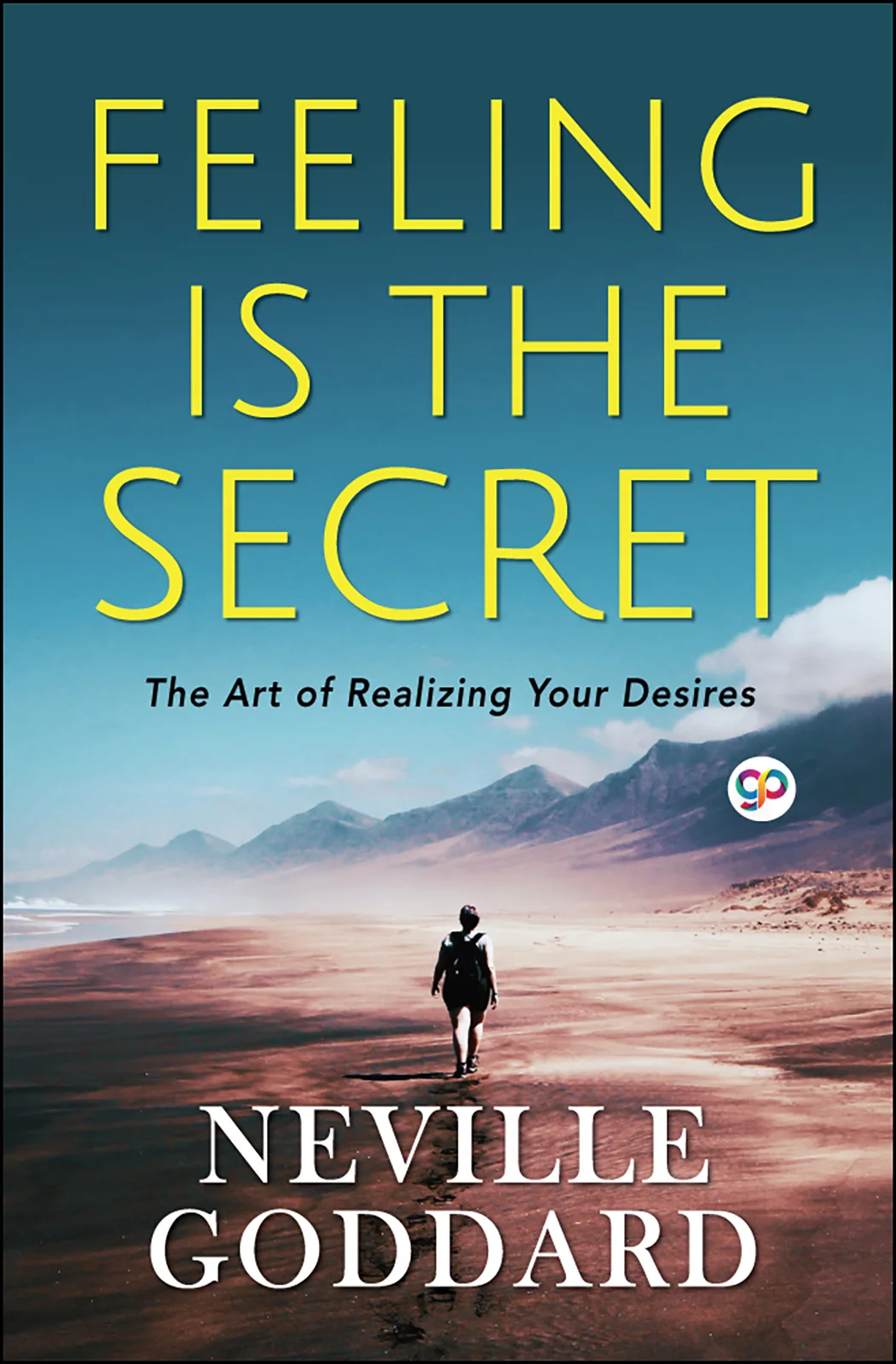
Feeling is the Secret
Hardcover
• 56 Pages
• INR 345.00
• English
• 9789389157208
No ratings yet
| Publisher | General Press |
|---|---|
| ISBN13 | 9789389157208 |
| ASIN/SKU | 938915720X |
| Book Format | Hardcover |
| Language | English |
| Pages | 56 |
| List Price | INR 345.00 |
| Subject Code | OCC014000, OCC019000, SEL021000 |
| Publishing Date | 27/05/2019 |
| Dimensions | 8.25 x 5.25 x 1.0 inches |
| Book Code | BD00068215 |
Buy this Book
Amazon Stores
Ebook Stores
Other Stores
Discover Feeling is the Secret by Neville Goddard. This book is published by General Press in Hardcover format, ISBN 9789389157208, ASIN 938915720X, under Self-Help, New Age and Spirituality, Motivational Self-Help.
Book Description
'Feeling is the Secret' by Neville Goddard is a classic work on the power of imagination, belief, and emotion in shaping one's life. In this concise yet thought-provoking book, Goddard presents the idea that feelings are the true driving force behind the realization of our desires. He argues that while thoughts begin the process of creation, it is the emotional conviction behind those thoughts that ultimately influences our experiences and outcomes.
The book explains that the subconscious mind accepts as true whatever is impressed upon it through repeated feeling and vivid imagination. Goddard encourages readers to mentally experience their goals as though they have already been achieved, believing that this inner state gradually shapes external reality. Rather than dwelling on doubt, fear, or limitation, he urges people to cultivate confidence, gratitude, and certainty, allowing these emotions to become the foundation of their daily lives.
One of the book’s central themes is the importance of the moments before sleep, which Goddard considers especially powerful for planting positive impressions in the subconscious. Through practical guidance and simple mental exercises, he demonstrates how conscious awareness and focused feeling can help individuals align themselves with the life they wish to create.
'Feeling is the Secret' has inspired generations of readers interested in personal growth, visualization, and the connection between mind and experience. Its timeless message encourages readers to take responsibility for their inner world, suggesting that lasting transformation begins not with external circumstances but with the feelings they consistently choose to embrace.
The book explains that the subconscious mind accepts as true whatever is impressed upon it through repeated feeling and vivid imagination. Goddard encourages readers to mentally experience their goals as though they have already been achieved, believing that this inner state gradually shapes external reality. Rather than dwelling on doubt, fear, or limitation, he urges people to cultivate confidence, gratitude, and certainty, allowing these emotions to become the foundation of their daily lives.
One of the book’s central themes is the importance of the moments before sleep, which Goddard considers especially powerful for planting positive impressions in the subconscious. Through practical guidance and simple mental exercises, he demonstrates how conscious awareness and focused feeling can help individuals align themselves with the life they wish to create.
'Feeling is the Secret' has inspired generations of readers interested in personal growth, visualization, and the connection between mind and experience. Its timeless message encourages readers to take responsibility for their inner world, suggesting that lasting transformation begins not with external circumstances but with the feelings they consistently choose to embrace.
Author Biography
Neville Lancelot Goddard (1905–1972) was a prominent and highly influential teacher in the New Thought movement, best known for his philosophy on the creative power of the human imagination. Born in St. Michael, Barbados, Goddard moved to New York City in 1922 to study drama. While working as a dancer and actor, his interests shifted toward mysticism after meeting an eccentric Ethiopian rabbi named Abdullah, who mentored him in Kabbalah, esoteric Christianity, and the psychological interpretation of scripture.
Leaving the theater behind, Neville dedicated his life to teaching what he termed "The Law of Assumption"—the principle that one can manifest their desires by vividly assuming the feeling of the wish fulfilled. Unlike many of his contemporaries, he taught that the Bible was not a historical record but a psychological drama mapping the evolution of human consciousness, asserting that the divine creator is the human imagination itself.
Throughout the mid-20th century, he delivered hundreds of unscripted lectures across the United States and authored foundational metaphysical classics, including Feeling is the Secret and The Power of Awareness. Today, Goddard’s visionary teachings continue to experience a massive resurgence, profoundly shaping modern self-help, spirituality, and manifestation philosophies.
Leaving the theater behind, Neville dedicated his life to teaching what he termed "The Law of Assumption"—the principle that one can manifest their desires by vividly assuming the feeling of the wish fulfilled. Unlike many of his contemporaries, he taught that the Bible was not a historical record but a psychological drama mapping the evolution of human consciousness, asserting that the divine creator is the human imagination itself.
Throughout the mid-20th century, he delivered hundreds of unscripted lectures across the United States and authored foundational metaphysical classics, including Feeling is the Secret and The Power of Awareness. Today, Goddard’s visionary teachings continue to experience a massive resurgence, profoundly shaping modern self-help, spirituality, and manifestation philosophies.
Editorial Reviews
Editorial Reviews will be added soon…
Book Summary
"Feeling is the Secret" by Neville Goddard is a masterclass in the profound yet beautifully simple mechanics of creating one's own reality. At its core, the book strips away the complexities of traditional mysticism and personal development to reveal a singular, fundamental truth: consciousness is the one and only reality. Goddard proposes that the physical world we navigate every day is nothing more than a mirror, flawlessly reflecting the internal landscape of our thoughts and, most importantly, our emotions. Rather than viewing ourselves as victims of circumstance or passengers on a predetermined ride, the book invites us to recognize our inherent creative power, a power that is activated not through physical exertion or sheer willpower, but through the mastery of our internal emotional states.
To understand how this creation process works, Goddard divides human consciousness into two distinct yet deeply intertwined spheres: the conscious and the subconscious mind. He uses the metaphor of the male and female principles to explain their relationship. The conscious mind is objective, analytical, and selective. It is the part of us that observes the external world, processes information, and decides what we want to experience. It is the generator of ideas. However, the conscious mind alone cannot bring these ideas into physical existence. That monumental task belongs to the subconscious mind, which Goddard describes as the deep, non-selective, and subjective female principle of consciousness. The subconscious does not argue, reason, or judge; it simply accepts whatever is given to it as absolute truth and sets about materializing it in the physical world.
The true secret, as the title boldly states, lies in the bridge between these two minds: feeling. Ideas and thoughts generated by the conscious mind are essentially lifeless on their own. They are like seeds resting on dry concrete. For an idea to take root and grow into physical reality, it must be planted in the fertile soil of the subconscious mind, and the only language the subconscious understands is the language of feeling. Goddard emphasizes that a thought must be deeply felt to be accepted by the subconscious. When an idea is saturated with emotion, it bypasses the critical filters of the conscious mind and is impressed directly onto the subconscious. The subconscious then unconditionally accepts this felt reality and immediately begins orchestrating the events, circumstances, and coincidences necessary to objectify it in the waking world.
Because the subconscious mind is utterly indiscriminate, Goddard issues a profound warning about the necessity of emotional discipline. If the subconscious accepts any deeply felt emotion as a command to create, then indulging in negative emotions like fear, anxiety, anger, or despair is a dangerous game. When we obsess over our fears and truly feel the dread of them, we are effectively commanding our subconscious to bring those exact fears to life. The subconscious does not distinguish between a feeling of joy and a feeling of terror; it only registers the intensity of the feeling and works to manifest its physical equivalent. Therefore, mastering one's life requires the vigilant guarding of one's emotional state, actively refusing to entertain feelings that do not align with the life one wishes to create.
This brings us to Goddard’s central practical instruction: the necessity of living in the feeling of the wish fulfilled. Most people approach their desires from a state of lack. They hope, wish, and yearn for a better future, but the very act of hoping implies that they do not currently have what they want. Because the subconscious mind only manifests what we feel to be true right now, feeling a sense of lack only creates more lack. Instead, Goddard teaches that we must mentally and emotionally leap over the process of getting to the destination and immerse ourselves entirely in the feeling of having already arrived. If you desire wealth, you must cultivate the exact emotional state of already being wealthy. You must wear the feeling of success as naturally as you wear your own skin, tricking your psyche into believing the desire is a present fact rather than a distant dream.
To achieve this profound internal shift, Goddard points to a natural, daily phenomenon that serves as our greatest tool: sleep. Sleep is the gateway to the subconscious mind. During our waking hours, the conscious mind is highly active, constantly filtering information and often rejecting new ideas that contradict our current reality. However, as we drift into sleep, the conscious mind essentially powers down, leaving the door to the subconscious wide open and unguarded. It is during this transitional phase, the twilight zone between waking and sleeping, that the subconscious is most receptive to new impressions. Therefore, the emotional state in which we fall asleep is arguably the most important factor in determining the trajectory of our lives.
Goddard advises a strict pre-sleep routine for anyone looking to change their reality. Taking the worries, frustrations, and anxieties of the day to bed is a recipe for manifesting more of the same the following day. Instead, he instructs us to use the moments just before sleep to consciously cultivate the feeling of our wish fulfilled. As you lie in bed, you are to imagine your desire as a present reality. You must engage your imagination to feel the joy, the relief, and the naturalness of having already achieved your goal. You hold onto this specific, positive feeling, allowing it to envelop you completely as you cross the threshold into unconsciousness. By doing this, you are effectively planting a deeply felt instruction into the most fertile soil of your mind right before it begins its nightly work of creation.
Beyond sleep, Goddard also completely redefines the concept of prayer. In his philosophy, prayer is not an act of begging or petitioning an external deity for favors. True prayer is a psychological act of uniting with the state you desire. To pray effectively, one must enter a state akin to sleep—a deeply relaxed, meditative state where the physical world fades away and the internal world of imagination becomes vivid and real. In this state, you mentally experience the reality of your answered prayer. You don't ask for healing; you feel the vitality of perfect health. You don't ask for a new home; you mentally walk through its halls and feel the texture of its walls. Prayer is the act of yielding to the feeling of the wish fulfilled until it carries the total conviction of reality.
A crucial aspect of this entire process is the absolute relinquishment of effort. Goddard teaches that creation is already finished; all possible realities exist right now in the realm of consciousness. Therefore, we do not need to force the universe to bend to our will, nor do we need to exhaust ourselves figuring out the "how" of our manifestations. In fact, applying sheer willpower often backfires because it inherently stems from a belief that the desire is difficult to achieve, thereby reinforcing a feeling of struggle. The process must be entirely effortless. It is not about forcing things to happen, but about yielding to the assumption that they already have. The subconscious mind possesses a wisdom and power far beyond the conscious intellect, and once it is impressed with a feeling, it will find its own perfect, frictionless ways to bring it into being.
Ultimately, "Feeling is the Secret" is an empowering manifesto that places the keys to the universe squarely in our own hands. It strips away excuses and demands radical self-responsibility, teaching that there is no one to change but self. If our external world is displeasing, fighting the external world is as futile as trying to change our reflection by smashing the mirror. The only effective point of change is within. By mastering our imagination, guarding our emotions, and consciously choosing to dwell in the feeling of our desires as present facts, we become the deliberate architects of our destiny. Goddard’s timeless message is that we are intimately connected to the creative fabric of the universe, and by simply mastering the art of feeling, we can gently and beautifully mold our lives into masterpieces.
To understand how this creation process works, Goddard divides human consciousness into two distinct yet deeply intertwined spheres: the conscious and the subconscious mind. He uses the metaphor of the male and female principles to explain their relationship. The conscious mind is objective, analytical, and selective. It is the part of us that observes the external world, processes information, and decides what we want to experience. It is the generator of ideas. However, the conscious mind alone cannot bring these ideas into physical existence. That monumental task belongs to the subconscious mind, which Goddard describes as the deep, non-selective, and subjective female principle of consciousness. The subconscious does not argue, reason, or judge; it simply accepts whatever is given to it as absolute truth and sets about materializing it in the physical world.
The true secret, as the title boldly states, lies in the bridge between these two minds: feeling. Ideas and thoughts generated by the conscious mind are essentially lifeless on their own. They are like seeds resting on dry concrete. For an idea to take root and grow into physical reality, it must be planted in the fertile soil of the subconscious mind, and the only language the subconscious understands is the language of feeling. Goddard emphasizes that a thought must be deeply felt to be accepted by the subconscious. When an idea is saturated with emotion, it bypasses the critical filters of the conscious mind and is impressed directly onto the subconscious. The subconscious then unconditionally accepts this felt reality and immediately begins orchestrating the events, circumstances, and coincidences necessary to objectify it in the waking world.
Because the subconscious mind is utterly indiscriminate, Goddard issues a profound warning about the necessity of emotional discipline. If the subconscious accepts any deeply felt emotion as a command to create, then indulging in negative emotions like fear, anxiety, anger, or despair is a dangerous game. When we obsess over our fears and truly feel the dread of them, we are effectively commanding our subconscious to bring those exact fears to life. The subconscious does not distinguish between a feeling of joy and a feeling of terror; it only registers the intensity of the feeling and works to manifest its physical equivalent. Therefore, mastering one's life requires the vigilant guarding of one's emotional state, actively refusing to entertain feelings that do not align with the life one wishes to create.
This brings us to Goddard’s central practical instruction: the necessity of living in the feeling of the wish fulfilled. Most people approach their desires from a state of lack. They hope, wish, and yearn for a better future, but the very act of hoping implies that they do not currently have what they want. Because the subconscious mind only manifests what we feel to be true right now, feeling a sense of lack only creates more lack. Instead, Goddard teaches that we must mentally and emotionally leap over the process of getting to the destination and immerse ourselves entirely in the feeling of having already arrived. If you desire wealth, you must cultivate the exact emotional state of already being wealthy. You must wear the feeling of success as naturally as you wear your own skin, tricking your psyche into believing the desire is a present fact rather than a distant dream.
To achieve this profound internal shift, Goddard points to a natural, daily phenomenon that serves as our greatest tool: sleep. Sleep is the gateway to the subconscious mind. During our waking hours, the conscious mind is highly active, constantly filtering information and often rejecting new ideas that contradict our current reality. However, as we drift into sleep, the conscious mind essentially powers down, leaving the door to the subconscious wide open and unguarded. It is during this transitional phase, the twilight zone between waking and sleeping, that the subconscious is most receptive to new impressions. Therefore, the emotional state in which we fall asleep is arguably the most important factor in determining the trajectory of our lives.
Goddard advises a strict pre-sleep routine for anyone looking to change their reality. Taking the worries, frustrations, and anxieties of the day to bed is a recipe for manifesting more of the same the following day. Instead, he instructs us to use the moments just before sleep to consciously cultivate the feeling of our wish fulfilled. As you lie in bed, you are to imagine your desire as a present reality. You must engage your imagination to feel the joy, the relief, and the naturalness of having already achieved your goal. You hold onto this specific, positive feeling, allowing it to envelop you completely as you cross the threshold into unconsciousness. By doing this, you are effectively planting a deeply felt instruction into the most fertile soil of your mind right before it begins its nightly work of creation.
Beyond sleep, Goddard also completely redefines the concept of prayer. In his philosophy, prayer is not an act of begging or petitioning an external deity for favors. True prayer is a psychological act of uniting with the state you desire. To pray effectively, one must enter a state akin to sleep—a deeply relaxed, meditative state where the physical world fades away and the internal world of imagination becomes vivid and real. In this state, you mentally experience the reality of your answered prayer. You don't ask for healing; you feel the vitality of perfect health. You don't ask for a new home; you mentally walk through its halls and feel the texture of its walls. Prayer is the act of yielding to the feeling of the wish fulfilled until it carries the total conviction of reality.
A crucial aspect of this entire process is the absolute relinquishment of effort. Goddard teaches that creation is already finished; all possible realities exist right now in the realm of consciousness. Therefore, we do not need to force the universe to bend to our will, nor do we need to exhaust ourselves figuring out the "how" of our manifestations. In fact, applying sheer willpower often backfires because it inherently stems from a belief that the desire is difficult to achieve, thereby reinforcing a feeling of struggle. The process must be entirely effortless. It is not about forcing things to happen, but about yielding to the assumption that they already have. The subconscious mind possesses a wisdom and power far beyond the conscious intellect, and once it is impressed with a feeling, it will find its own perfect, frictionless ways to bring it into being.
Ultimately, "Feeling is the Secret" is an empowering manifesto that places the keys to the universe squarely in our own hands. It strips away excuses and demands radical self-responsibility, teaching that there is no one to change but self. If our external world is displeasing, fighting the external world is as futile as trying to change our reflection by smashing the mirror. The only effective point of change is within. By mastering our imagination, guarding our emotions, and consciously choosing to dwell in the feeling of our desires as present facts, we become the deliberate architects of our destiny. Goddard’s timeless message is that we are intimately connected to the creative fabric of the universe, and by simply mastering the art of feeling, we can gently and beautifully mold our lives into masterpieces.
Sample Chapters
Chapter 1 : Law and Its Operation
The world, and all within it, is man’s conditioned consciousness objectified. Consciousness is the cause as well as the substance of the entire world. So it is to consciousness that we must turn if we would discover the secret of creation.
Knowledge of the law of consciousness and the method of operating this law will enable you to accomplish all you desire in life. Armed with a working knowledge of this law, you can build and maintain an ideal world.
Consciousness is the one and only reality, not figuratively but actually. This reality may for the sake of clarity be likened unto a stream which is divided into two parts, the conscious and the subconscious. In order to intelligently operate the law of consciousness, it is necessary to understand the relationship between the conscious and the subconscious. The conscious is personal and selective; the subconscious is impersonal and non-selective. The conscious is the realm of effect; the subconscious is the realm of cause. These two aspects are the male and female divisions of consciousness. The conscious is male; the subconscious is female.
The conscious generates ideas and impresses these ideas on the subconscious; the subconscious receives ideas and gives form and expression to them.
By this law first conceiving an idea and then impressing the idea conceived on the subconscious – all things evolve out of consciousness; and without this sequence, there is not anything made that is made. The conscious impresses the subconscious, while the subconscious expresses all that is impressed upon it.
The subconscious does not originate ideas, but accepts as true those which the conscious mind feels to be true and, in a way known only to it-self, objectifies the accepted ideas. Therefore, through his power to imagine and feel and his freedom to choose the idea he will entertain, man has control over creation. Control of the subconscious is accomplished through control of your ideas and feelings.
The mechanism of creation is hidden in the very depth of the subconscious, the female aspect or womb of creation. The subconscious transcends reason and is independent of induction. It contemplates a feeling as a fact existing within itself and on this assumption proceeds to give expression to it. The creative process begins with an idea and its cycle runs its course as a feeling and ends in a volition to act.
Ideas are impressed on the subconscious through the medium of feeling. No idea can be impressed on the subconscious until it is felt, but once felt – be it good, bad or indifferent – it must be expressed. Feeling is the one and only medium through which ideas are conveyed to the subconscious. Therefore, the man who does not control his feeling may easily impress the subconscious with undesirable states. By control of feeling is not meant restraint or suppression of your feeling, but rather the disciplining of self to imagine and entertain only such feeling as contributes to your happiness. Control of your feeling is all important to a full and happy life. Never entertain an undesirable feeling, nor think sympathetically about wrong in any shape or form. Do not dwell on the imperfection of yourself or others. To do so is to impress the subconscious with these limitations. What you do not want done unto you, do not feel that it is done unto you or another. This is the whole law of a full and happy life. Everything else is commentary.
Every feeling makes a subconscious impression and, unless it is counteracted by a more powerful feeling of an opposite nature, must be expressed. The dominant of two feelings is the one expressed. I am healthy is a stronger feeling than I will be healthy. To feel I will be is to confess I am not; I am is stronger than I am not. What you feel you are always dominates what you feel you would like to be; therefore, to be realized, the wish must be felt as a state that is rather than a state that is not. Sensation precedes manifestation and is the foundation upon which all manifestation rests. Be careful of your moods and feelings, for there is an unbroken connection between your feelings and your visible world. Your body is an emotional filter and bears the unmistakable marks of your prevalent emotions. Emotional disturbances, especially suppressed emotions, are the causes of all disease. To feel intensely about a wrong with-out voicing or expressing that feeling is the beginning of disease – disease in both body and environment. Do not entertain the feeling of regret or failure for frustration or detachment from your objective results in disease.
Think feelingly only of the state you desire to realize. Feeling the reality of the state sought and living and acting on that conviction is the way of all seeming miracles. All changes of expression are brought about through a change of feeling. A change of feeling is a change of destiny. All creation occurs in the domain of the subconscious. What you must acquire, then, is a reflective control of the operation of the subconscious, that is, control of your ideas and feelings.
Chance or accident is not responsible for the things that happen to you, nor is predestined fate the author of your fortune or misfortune. Your subconscious impressions determine the conditions of your world. The subconscious is not selective; it is impersonal and no respecter of persons [Acts 10:34; Romans 2:11]. The subconscious is not concerned with the truth or falsity of your feeling. It always accepts as true that which you feel to be true. Feeling is the assent of the subconscious to the truth of that which is declared to be true. Because of this quality of the subconscious there is nothing impossible to man. Whatever the mind of man can conceive and feel as true, the subconscious can and must objectify. Your feelings create the pattern from which your world is fashioned, and a change of feeling is a change of pattern.
The subconscious never fails to express that which has been impressed upon it. The moment it receives an impression, it begins to work out the ways of its expression. It accepts the feeling impressed upon it, you’re feeling, as a fact existing within itself and immediately sets about to produce in the outer or objective world the exact likeness of that feeling. The subconscious never alters the accepted beliefs of man. It out-pictures them to the last detail whether or not they are beneficial.
To impress the subconscious with the desirable state, you must assume the feeling that would be yours had you already realized your wish. In defining your objective, you must be concerned only with the objective itself. The manner of expression or the difficulties involved are not to be considered by you. To think feelingly on any state impresses it on the sub-conscious. Therefore, if you dwell on difficulties, barriers or delay, the subconscious, by its very non-selective nature, accepts the feeling of difficulties and obstacles as your request and proceeds to produce them in your outer world. The subconscious is the womb of creation. It receives the idea unto itself through the feelings of man. It never changes the idea received, but always gives it form. Hence the subconscious out-pictures the idea in the image and likeness of the feeling received. To feel a state as hopeless or impossible is to impress the subconscious with the idea of failure.
Although the subconscious faithfully serves man, it must not be inferred that the relation is that of a servant to a master as was anciently conceived. The ancient prophets called it the slave and servant of man. St. Paul personified it as a “woman” and said: “The woman should be subject to man in everything” [Ephesians 5:24; also, 1Corinthians 14:34, Ephesians 5:22, Colossians 3:18, 1Peter 3:1]. The subconscious does serve man and faithfully gives form to his feelings. However, the subconscious has a distinct distaste for compulsion and responds to persuasion rather than to command; consequently, it resembles the beloved wife more than the servant.
“The husband is head of the wife,” Ephesians 5[:23], may not be true of man and woman in their earthly relationship, but it is true of the conscious and the subconscious, or the male and female aspects of consciousness. The mystery to which Paul referred when he wrote, “This is a great mystery [5:32]... He that loveth his wife loveth himself [5:28]... And they two shall be one flesh [5:31]”, is simply the mystery of consciousness. Consciousness is really one and undivided but for creation’s sake it appears to be divided into two.
The conscious (objective) or male aspect truly is the head and dominates the subconscious (subjective) or female aspect. However, this leadership is not that of the tyrant, but of the lover. So, by assuming the feeling that would be yours were you already in possession of your objective, the sub-conscious is moved to build the exact likeness of your assumption. Your desires are not subconsciously accepted until you assume the feeling of their reality, for only through feeling is an idea subconsciously accepted and only through this subconscious acceptance is it ever expressed.
It is easier to ascribe your feeling to events in the world than to admit that the conditions of the world reflect your feeling. However, it is eternally true that the outside mirrors the inside. “As within, so without” [“As above, so below; as below, so above; as within, so without; as without, so within”, “Correspondence”, the second of The Seven Principles of Hermes Trismegistus]. “A man can receive nothing unless it is given him from heaven” [John 3:27] and “The kingdom of heaven is within you” [Luke17:21]. Nothing comes from without; all things come from within – from the subconscious. It is impossible for you to see other than the con-tents of your consciousness. Your world in its every detail is your consciousness objectified. Objective states bear witness of subconscious impressions. A change of impression results in a change of expression.
The subconscious accepts as true that which you feel as true, and because creation is the result of subconscious impressions, you, by your feeling, determine creation. You are already that which you want to be, and your refusal to believe this is the only reason you do not see it. To seek on the outside for that which you do not feel you are is to seek in vain, for we never find that which we want; we find only that which we are. In short, you express and have only that which you are conscious of being or possessing. “To him that hath it is given” [Matthew 13:12; 25:29; Mark 4:25; Luke 8:18; 19:26]. Denying the evidence of the senses and appropriating the feeling of the wish fulfilled is the way to the realization of your desire.
Mastery of self-control of your thoughts and feelings is your highest achievement. However, until perfect self-control is attained, so that, in spite of appearances, you feel all that you want to feel, use sleep and prayer to aid you in realizing your desired states. These are the two gate-ways into the subconscious.
The world, and all within it, is man’s conditioned consciousness objectified. Consciousness is the cause as well as the substance of the entire world. So it is to consciousness that we must turn if we would discover the secret of creation.
Knowledge of the law of consciousness and the method of operating this law will enable you to accomplish all you desire in life. Armed with a working knowledge of this law, you can build and maintain an ideal world.
Consciousness is the one and only reality, not figuratively but actually. This reality may for the sake of clarity be likened unto a stream which is divided into two parts, the conscious and the subconscious. In order to intelligently operate the law of consciousness, it is necessary to understand the relationship between the conscious and the subconscious. The conscious is personal and selective; the subconscious is impersonal and non-selective. The conscious is the realm of effect; the subconscious is the realm of cause. These two aspects are the male and female divisions of consciousness. The conscious is male; the subconscious is female.
The conscious generates ideas and impresses these ideas on the subconscious; the subconscious receives ideas and gives form and expression to them.
By this law first conceiving an idea and then impressing the idea conceived on the subconscious – all things evolve out of consciousness; and without this sequence, there is not anything made that is made. The conscious impresses the subconscious, while the subconscious expresses all that is impressed upon it.
The subconscious does not originate ideas, but accepts as true those which the conscious mind feels to be true and, in a way known only to it-self, objectifies the accepted ideas. Therefore, through his power to imagine and feel and his freedom to choose the idea he will entertain, man has control over creation. Control of the subconscious is accomplished through control of your ideas and feelings.
The mechanism of creation is hidden in the very depth of the subconscious, the female aspect or womb of creation. The subconscious transcends reason and is independent of induction. It contemplates a feeling as a fact existing within itself and on this assumption proceeds to give expression to it. The creative process begins with an idea and its cycle runs its course as a feeling and ends in a volition to act.
Ideas are impressed on the subconscious through the medium of feeling. No idea can be impressed on the subconscious until it is felt, but once felt – be it good, bad or indifferent – it must be expressed. Feeling is the one and only medium through which ideas are conveyed to the subconscious. Therefore, the man who does not control his feeling may easily impress the subconscious with undesirable states. By control of feeling is not meant restraint or suppression of your feeling, but rather the disciplining of self to imagine and entertain only such feeling as contributes to your happiness. Control of your feeling is all important to a full and happy life. Never entertain an undesirable feeling, nor think sympathetically about wrong in any shape or form. Do not dwell on the imperfection of yourself or others. To do so is to impress the subconscious with these limitations. What you do not want done unto you, do not feel that it is done unto you or another. This is the whole law of a full and happy life. Everything else is commentary.
Every feeling makes a subconscious impression and, unless it is counteracted by a more powerful feeling of an opposite nature, must be expressed. The dominant of two feelings is the one expressed. I am healthy is a stronger feeling than I will be healthy. To feel I will be is to confess I am not; I am is stronger than I am not. What you feel you are always dominates what you feel you would like to be; therefore, to be realized, the wish must be felt as a state that is rather than a state that is not. Sensation precedes manifestation and is the foundation upon which all manifestation rests. Be careful of your moods and feelings, for there is an unbroken connection between your feelings and your visible world. Your body is an emotional filter and bears the unmistakable marks of your prevalent emotions. Emotional disturbances, especially suppressed emotions, are the causes of all disease. To feel intensely about a wrong with-out voicing or expressing that feeling is the beginning of disease – disease in both body and environment. Do not entertain the feeling of regret or failure for frustration or detachment from your objective results in disease.
Think feelingly only of the state you desire to realize. Feeling the reality of the state sought and living and acting on that conviction is the way of all seeming miracles. All changes of expression are brought about through a change of feeling. A change of feeling is a change of destiny. All creation occurs in the domain of the subconscious. What you must acquire, then, is a reflective control of the operation of the subconscious, that is, control of your ideas and feelings.
Chance or accident is not responsible for the things that happen to you, nor is predestined fate the author of your fortune or misfortune. Your subconscious impressions determine the conditions of your world. The subconscious is not selective; it is impersonal and no respecter of persons [Acts 10:34; Romans 2:11]. The subconscious is not concerned with the truth or falsity of your feeling. It always accepts as true that which you feel to be true. Feeling is the assent of the subconscious to the truth of that which is declared to be true. Because of this quality of the subconscious there is nothing impossible to man. Whatever the mind of man can conceive and feel as true, the subconscious can and must objectify. Your feelings create the pattern from which your world is fashioned, and a change of feeling is a change of pattern.
The subconscious never fails to express that which has been impressed upon it. The moment it receives an impression, it begins to work out the ways of its expression. It accepts the feeling impressed upon it, you’re feeling, as a fact existing within itself and immediately sets about to produce in the outer or objective world the exact likeness of that feeling. The subconscious never alters the accepted beliefs of man. It out-pictures them to the last detail whether or not they are beneficial.
To impress the subconscious with the desirable state, you must assume the feeling that would be yours had you already realized your wish. In defining your objective, you must be concerned only with the objective itself. The manner of expression or the difficulties involved are not to be considered by you. To think feelingly on any state impresses it on the sub-conscious. Therefore, if you dwell on difficulties, barriers or delay, the subconscious, by its very non-selective nature, accepts the feeling of difficulties and obstacles as your request and proceeds to produce them in your outer world. The subconscious is the womb of creation. It receives the idea unto itself through the feelings of man. It never changes the idea received, but always gives it form. Hence the subconscious out-pictures the idea in the image and likeness of the feeling received. To feel a state as hopeless or impossible is to impress the subconscious with the idea of failure.
Although the subconscious faithfully serves man, it must not be inferred that the relation is that of a servant to a master as was anciently conceived. The ancient prophets called it the slave and servant of man. St. Paul personified it as a “woman” and said: “The woman should be subject to man in everything” [Ephesians 5:24; also, 1Corinthians 14:34, Ephesians 5:22, Colossians 3:18, 1Peter 3:1]. The subconscious does serve man and faithfully gives form to his feelings. However, the subconscious has a distinct distaste for compulsion and responds to persuasion rather than to command; consequently, it resembles the beloved wife more than the servant.
“The husband is head of the wife,” Ephesians 5[:23], may not be true of man and woman in their earthly relationship, but it is true of the conscious and the subconscious, or the male and female aspects of consciousness. The mystery to which Paul referred when he wrote, “This is a great mystery [5:32]... He that loveth his wife loveth himself [5:28]... And they two shall be one flesh [5:31]”, is simply the mystery of consciousness. Consciousness is really one and undivided but for creation’s sake it appears to be divided into two.
The conscious (objective) or male aspect truly is the head and dominates the subconscious (subjective) or female aspect. However, this leadership is not that of the tyrant, but of the lover. So, by assuming the feeling that would be yours were you already in possession of your objective, the sub-conscious is moved to build the exact likeness of your assumption. Your desires are not subconsciously accepted until you assume the feeling of their reality, for only through feeling is an idea subconsciously accepted and only through this subconscious acceptance is it ever expressed.
It is easier to ascribe your feeling to events in the world than to admit that the conditions of the world reflect your feeling. However, it is eternally true that the outside mirrors the inside. “As within, so without” [“As above, so below; as below, so above; as within, so without; as without, so within”, “Correspondence”, the second of The Seven Principles of Hermes Trismegistus]. “A man can receive nothing unless it is given him from heaven” [John 3:27] and “The kingdom of heaven is within you” [Luke17:21]. Nothing comes from without; all things come from within – from the subconscious. It is impossible for you to see other than the con-tents of your consciousness. Your world in its every detail is your consciousness objectified. Objective states bear witness of subconscious impressions. A change of impression results in a change of expression.
The subconscious accepts as true that which you feel as true, and because creation is the result of subconscious impressions, you, by your feeling, determine creation. You are already that which you want to be, and your refusal to believe this is the only reason you do not see it. To seek on the outside for that which you do not feel you are is to seek in vain, for we never find that which we want; we find only that which we are. In short, you express and have only that which you are conscious of being or possessing. “To him that hath it is given” [Matthew 13:12; 25:29; Mark 4:25; Luke 8:18; 19:26]. Denying the evidence of the senses and appropriating the feeling of the wish fulfilled is the way to the realization of your desire.
Mastery of self-control of your thoughts and feelings is your highest achievement. However, until perfect self-control is attained, so that, in spite of appearances, you feel all that you want to feel, use sleep and prayer to aid you in realizing your desired states. These are the two gate-ways into the subconscious.
Reader Reviews
No reviews yet.
Feeling is the Secret
Download Cover Image
Do you want to download the full cover image for Feeling is the Secret?