
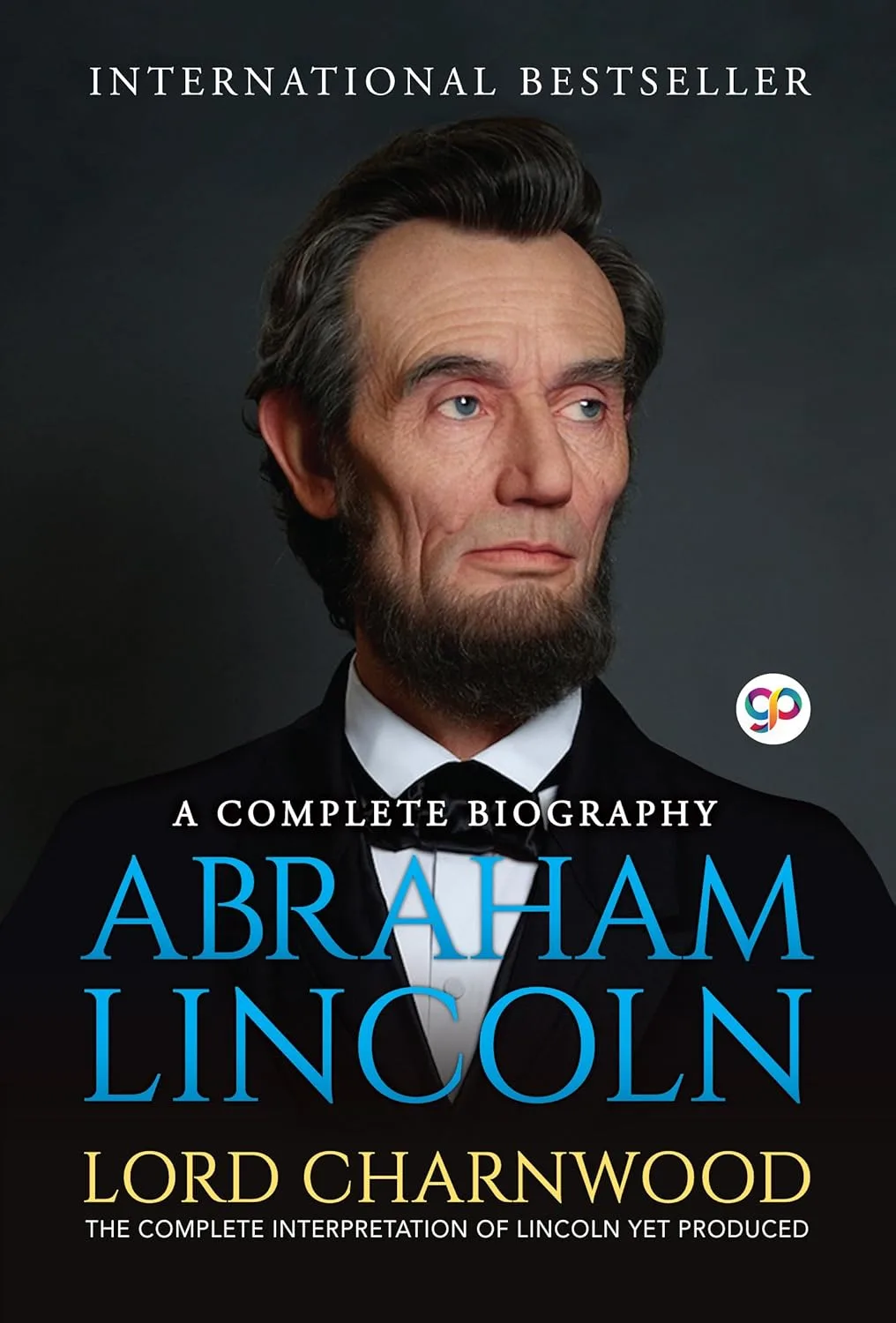
Abraham Lincoln: A Complete Biography
eBook
• INR 199.00
• English
No ratings yet
| Publisher | General Press |
|---|---|
| ASIN/SKU | B00QZ8LXOS |
| Book Format | eBook |
| Language | English |
| List Price | INR 199.00 |
| Subject Code | BIO011000, BIO010000, BIO006000 |
| Book Code | BD00068223 |
Buy this Book
Amazon Stores
Ebook Stores
Other Stores
Discover Abraham Lincoln: A Complete Biography by Lord Charnwood. This book is published by General Press in eBook format, ASIN B00QZ8LXOS, under Biographies and Memoirs, Presidents and Heads of State Biographies, Political Leader Biographies.
Book Description
Lord Charnwood’s "Abraham Lincoln: A Complete Biography" is a deeply moving and perceptive exploration of one of America’s greatest presidents. Written by an Englishman just fifty years after Lincoln’s assassination, this classic work offers a uniquely objective yet profoundly empathetic portrait of a man tasked with saving a fractured nation.
Charnwood traces Lincoln’s life from his humble, rugged beginnings in a Kentucky log cabin to his tragic end in Washington. But this is not merely a timeline of events; it is a thoughtful study of character. The book vividly captures Lincoln’s evolution from a self-taught prairie lawyer into a master statesman. Charnwood highlights Lincoln’s melancholic spirit, his wry humor, and, most importantly, his unwavering moral clarity regarding the deep-rooted evil of slavery.
At the heart of the biography is the American Civil War. Charnwood masterfully details how Lincoln navigated intense political rivalries, agonizing military defeats, and the crushing weight of human suffering. Through it all, Lincoln is depicted as a deeply human figure—flawed and burdened, yet possessing extraordinary patience and magnanimity. He is a leader who guided his country through its darkest hour not with tyrannical force, but with a profound belief in democratic ideals and human equality.
Ultimately, Charnwood’s biography stands as a timeless tribute to Lincoln’s legacy. It presents him not as an untouchable mythological hero, but as a deeply compassionate, resilient man whose spiritual and political genius preserved the Union and redefined American freedom forever.
Charnwood traces Lincoln’s life from his humble, rugged beginnings in a Kentucky log cabin to his tragic end in Washington. But this is not merely a timeline of events; it is a thoughtful study of character. The book vividly captures Lincoln’s evolution from a self-taught prairie lawyer into a master statesman. Charnwood highlights Lincoln’s melancholic spirit, his wry humor, and, most importantly, his unwavering moral clarity regarding the deep-rooted evil of slavery.
At the heart of the biography is the American Civil War. Charnwood masterfully details how Lincoln navigated intense political rivalries, agonizing military defeats, and the crushing weight of human suffering. Through it all, Lincoln is depicted as a deeply human figure—flawed and burdened, yet possessing extraordinary patience and magnanimity. He is a leader who guided his country through its darkest hour not with tyrannical force, but with a profound belief in democratic ideals and human equality.
Ultimately, Charnwood’s biography stands as a timeless tribute to Lincoln’s legacy. It presents him not as an untouchable mythological hero, but as a deeply compassionate, resilient man whose spiritual and political genius preserved the Union and redefined American freedom forever.
Author Biography
Lord Charnwood, whose full name was Godfrey Rathbone Benson, 1st Baron Charnwood (1864–1945), was a distinguished British author, historian, politician, and public servant. He is best remembered for his thoughtful and elegantly written biographies, particularly Abraham Lincoln, which is widely regarded as one of the finest studies of the American president. Combining careful historical research with graceful prose, Charnwood earned a lasting reputation as a writer who brought great historical figures to life with fairness, insight, and humanity.
He was born on July 6, 1864, in Alresford, Hampshire, England, into a family deeply involved in politics and public affairs. His father, William Rathbone Benson, was a judge, and his mother came from the influential Rathbone family, known for its commitment to social reform. Charnwood received his education at Eton College and later at Trinity College, Cambridge, where he developed a strong interest in history, literature, philosophy, and public service.
Alongside his literary career, Charnwood was active in British politics. He served as a Liberal Member of Parliament from 1892 to 1895 and remained interested in public affairs throughout his life. In 1911, he was raised to the peerage as Baron Charnwood, recognizing his contributions to public life. He also worked with several educational and charitable organizations, reflecting his belief that scholarship and public service should go hand in hand.
Although Charnwood wrote on a variety of historical and political subjects, his greatest achievement came with the publication of Abraham Lincoln in 1916. The biography was praised for its balanced judgment, literary elegance, and deep understanding of Lincoln's character. Rather than focusing only on political events, Charnwood portrayed Lincoln as a compassionate, thoughtful, and morally courageous leader. The book quickly became a classic and continues to be admired by historians and general readers alike.
Lord Charnwood died on August 27, 1945, at the age of eighty-one. Today, he is remembered as one of Britain's finest biographers and a gifted interpreter of history. His works remain valued for their clarity, fairness, and enduring human insight, demonstrating that great biography is not merely about recording events but about understanding the character and ideals that shape remarkable lives.
He was born on July 6, 1864, in Alresford, Hampshire, England, into a family deeply involved in politics and public affairs. His father, William Rathbone Benson, was a judge, and his mother came from the influential Rathbone family, known for its commitment to social reform. Charnwood received his education at Eton College and later at Trinity College, Cambridge, where he developed a strong interest in history, literature, philosophy, and public service.
Alongside his literary career, Charnwood was active in British politics. He served as a Liberal Member of Parliament from 1892 to 1895 and remained interested in public affairs throughout his life. In 1911, he was raised to the peerage as Baron Charnwood, recognizing his contributions to public life. He also worked with several educational and charitable organizations, reflecting his belief that scholarship and public service should go hand in hand.
Although Charnwood wrote on a variety of historical and political subjects, his greatest achievement came with the publication of Abraham Lincoln in 1916. The biography was praised for its balanced judgment, literary elegance, and deep understanding of Lincoln's character. Rather than focusing only on political events, Charnwood portrayed Lincoln as a compassionate, thoughtful, and morally courageous leader. The book quickly became a classic and continues to be admired by historians and general readers alike.
Lord Charnwood died on August 27, 1945, at the age of eighty-one. Today, he is remembered as one of Britain's finest biographers and a gifted interpreter of history. His works remain valued for their clarity, fairness, and enduring human insight, demonstrating that great biography is not merely about recording events but about understanding the character and ideals that shape remarkable lives.
Editorial Reviews
"Lord Charnwood has given us the most complete interpretation of Lincoln as yet produced, and he has presented it in such artistic form that it may well become a classic". –American Historical Review
"This book is bound to take first rank in the literature of Lincoln, and in many respects it may be pronounced the best of the biographies". –The Nation
"Lord Charnwood’s remains the best Lincoln biography". –The Weekly Standard
"This book is bound to take first rank in the literature of Lincoln, and in many respects it may be pronounced the best of the biographies". –The Nation
"Lord Charnwood’s remains the best Lincoln biography". –The Weekly Standard
Book Summary
Lord Charnwood's "Abraham Lincoln: A Complete Biography" is a thoughtful and deeply respectful account of one of America's greatest presidents. Rather than presenting Lincoln as a flawless hero, Charnwood portrays him as a humble, thoughtful, and determined man whose extraordinary character was shaped by hardship, self-education, and an unwavering commitment to justice. The biography follows Lincoln's remarkable journey from a poor frontier childhood to the White House, where he guided the United States through its greatest national crisis. Written with clarity and insight, the book not only recounts the events of Lincoln's life but also explores the qualities that made him an exceptional leader during a time of division and uncertainty.
Lincoln was born in a simple log cabin in Kentucky in 1809 to a family of modest means. His early years were marked by poverty, hard physical labor, and limited access to formal education. His mother died when he was still a young boy, a loss that deeply affected him. Despite these difficult circumstances, Lincoln developed an extraordinary love for reading. He borrowed books whenever he could and educated himself through determination rather than schooling. As his family moved westward into Indiana and later Illinois, Lincoln gained firsthand experience of the challenges faced by ordinary settlers. Charnwood emphasizes that these humble beginnings gave Lincoln a lifelong understanding of common people, shaping his empathy, honesty, and practical outlook on life.
As a young man, Lincoln worked in many different occupations, including farm laborer, store clerk, rail splitter, surveyor, and postmaster. These varied experiences brought him into contact with people from all walks of life and helped him develop the communication skills for which he later became famous. His natural intelligence and remarkable memory encouraged him to study law independently. After qualifying as a lawyer, he established a successful legal practice in Illinois, earning a reputation for fairness, integrity, and persuasive reasoning. Charnwood presents Lincoln's legal career as an important training ground where he learned patience, careful analysis, and respect for justice—qualities that would later define his presidency.
Lincoln's growing interest in public affairs gradually drew him into politics. He served in the Illinois legislature before being elected to the United States Congress. Although his early political career included setbacks and disappointments, he never abandoned his belief that public service should be guided by moral principles rather than personal ambition. One issue increasingly dominated national politics: the expansion of slavery into new territories. While Lincoln initially focused on preserving the Union, he became convinced that slavery was morally wrong and threatened the nation's future. His debates with Senator Stephen A. Douglas displayed his exceptional ability to explain complex political ideas with clarity and honesty. Charnwood regards these debates as a turning point that established Lincoln as a national leader capable of addressing the country's deepest divisions.
The presidential election of 1860 brought Lincoln to the nation's highest office at an extraordinarily dangerous moment. His victory triggered the secession of several Southern states, leading to the outbreak of the American Civil War. Charnwood carefully examines Lincoln's early months as president, showing how he faced enormous challenges with remarkable calmness. Many doubted his experience and ability, yet Lincoln demonstrated patience, resilience, and a willingness to listen to differing opinions before making difficult decisions. Throughout the war, he balanced military necessity with constitutional responsibility while striving to preserve the Union. Rather than seeking revenge against those who opposed him, Lincoln consistently looked for solutions that would eventually reunite the nation.
As the Civil War continued, Lincoln's views on slavery evolved into a stronger commitment to emancipation. Charnwood explains that Lincoln recognized that ending slavery had become both a moral necessity and a strategic step toward saving the Union. This conviction led to the Emancipation Proclamation, which declared freedom for enslaved people in Confederate-held territories. Although the proclamation did not immediately end slavery everywhere, it fundamentally changed the purpose of the war and inspired millions who longed for freedom. Lincoln continued to support the eventual adoption of the Thirteenth Amendment, which permanently abolished slavery throughout the United States. Charnwood portrays these actions as the result of careful moral reflection rather than political calculation alone.
The biography also offers valuable insight into Lincoln's personality beyond politics. Charnwood describes him as a man of remarkable humility, compassion, and emotional depth. He possessed a quiet sense of humor that helped him endure immense personal and political pressure. At the same time, he experienced frequent periods of sadness and carried the burdens of leadership with great seriousness. His marriage to Mary Todd Lincoln was often complicated by personal tragedy and public scrutiny, yet Lincoln remained devoted to his family despite the many hardships they endured, including the deaths of two of their sons. Charnwood presents these personal experiences as reminders that Lincoln's greatness was rooted not in perfection but in his humanity.
As the war approached its conclusion, Lincoln increasingly focused on healing the nation rather than punishing its former enemies. His Second Inaugural Address reflected his belief that lasting peace could only be achieved through forgiveness, charity, and reconciliation. Charnwood admires Lincoln's refusal to encourage bitterness, even after years of devastating conflict. Tragically, only days after the Confederate surrender, Lincoln was assassinated by John Wilkes Booth while attending a play at Ford's Theatre in April 1865. His sudden death shocked the nation and transformed him into a symbol of sacrifice and national unity. Charnwood presents this tragic ending as one of history's greatest losses, occurring just as Lincoln prepared to guide the country through reconstruction.
Throughout the biography, Lord Charnwood argues that Abraham Lincoln's true greatness lay not simply in his political achievements but in his moral character. He was a leader who combined firmness with kindness, intelligence with humility, and determination with compassion. His ability to remain patient during conflict, to grow in understanding as circumstances changed, and to place the welfare of the nation above personal interests made him one of history's most admired statesmen. More than a record of historical events, Abraham Lincoln: A Complete Biography is a study of leadership, integrity, and human resilience. It reminds readers that genuine greatness is built through honesty, perseverance, empathy, and an unwavering commitment to justice, leaving Lincoln's legacy as an enduring source of inspiration for people across generations.
Lincoln was born in a simple log cabin in Kentucky in 1809 to a family of modest means. His early years were marked by poverty, hard physical labor, and limited access to formal education. His mother died when he was still a young boy, a loss that deeply affected him. Despite these difficult circumstances, Lincoln developed an extraordinary love for reading. He borrowed books whenever he could and educated himself through determination rather than schooling. As his family moved westward into Indiana and later Illinois, Lincoln gained firsthand experience of the challenges faced by ordinary settlers. Charnwood emphasizes that these humble beginnings gave Lincoln a lifelong understanding of common people, shaping his empathy, honesty, and practical outlook on life.
As a young man, Lincoln worked in many different occupations, including farm laborer, store clerk, rail splitter, surveyor, and postmaster. These varied experiences brought him into contact with people from all walks of life and helped him develop the communication skills for which he later became famous. His natural intelligence and remarkable memory encouraged him to study law independently. After qualifying as a lawyer, he established a successful legal practice in Illinois, earning a reputation for fairness, integrity, and persuasive reasoning. Charnwood presents Lincoln's legal career as an important training ground where he learned patience, careful analysis, and respect for justice—qualities that would later define his presidency.
Lincoln's growing interest in public affairs gradually drew him into politics. He served in the Illinois legislature before being elected to the United States Congress. Although his early political career included setbacks and disappointments, he never abandoned his belief that public service should be guided by moral principles rather than personal ambition. One issue increasingly dominated national politics: the expansion of slavery into new territories. While Lincoln initially focused on preserving the Union, he became convinced that slavery was morally wrong and threatened the nation's future. His debates with Senator Stephen A. Douglas displayed his exceptional ability to explain complex political ideas with clarity and honesty. Charnwood regards these debates as a turning point that established Lincoln as a national leader capable of addressing the country's deepest divisions.
The presidential election of 1860 brought Lincoln to the nation's highest office at an extraordinarily dangerous moment. His victory triggered the secession of several Southern states, leading to the outbreak of the American Civil War. Charnwood carefully examines Lincoln's early months as president, showing how he faced enormous challenges with remarkable calmness. Many doubted his experience and ability, yet Lincoln demonstrated patience, resilience, and a willingness to listen to differing opinions before making difficult decisions. Throughout the war, he balanced military necessity with constitutional responsibility while striving to preserve the Union. Rather than seeking revenge against those who opposed him, Lincoln consistently looked for solutions that would eventually reunite the nation.
As the Civil War continued, Lincoln's views on slavery evolved into a stronger commitment to emancipation. Charnwood explains that Lincoln recognized that ending slavery had become both a moral necessity and a strategic step toward saving the Union. This conviction led to the Emancipation Proclamation, which declared freedom for enslaved people in Confederate-held territories. Although the proclamation did not immediately end slavery everywhere, it fundamentally changed the purpose of the war and inspired millions who longed for freedom. Lincoln continued to support the eventual adoption of the Thirteenth Amendment, which permanently abolished slavery throughout the United States. Charnwood portrays these actions as the result of careful moral reflection rather than political calculation alone.
The biography also offers valuable insight into Lincoln's personality beyond politics. Charnwood describes him as a man of remarkable humility, compassion, and emotional depth. He possessed a quiet sense of humor that helped him endure immense personal and political pressure. At the same time, he experienced frequent periods of sadness and carried the burdens of leadership with great seriousness. His marriage to Mary Todd Lincoln was often complicated by personal tragedy and public scrutiny, yet Lincoln remained devoted to his family despite the many hardships they endured, including the deaths of two of their sons. Charnwood presents these personal experiences as reminders that Lincoln's greatness was rooted not in perfection but in his humanity.
As the war approached its conclusion, Lincoln increasingly focused on healing the nation rather than punishing its former enemies. His Second Inaugural Address reflected his belief that lasting peace could only be achieved through forgiveness, charity, and reconciliation. Charnwood admires Lincoln's refusal to encourage bitterness, even after years of devastating conflict. Tragically, only days after the Confederate surrender, Lincoln was assassinated by John Wilkes Booth while attending a play at Ford's Theatre in April 1865. His sudden death shocked the nation and transformed him into a symbol of sacrifice and national unity. Charnwood presents this tragic ending as one of history's greatest losses, occurring just as Lincoln prepared to guide the country through reconstruction.
Throughout the biography, Lord Charnwood argues that Abraham Lincoln's true greatness lay not simply in his political achievements but in his moral character. He was a leader who combined firmness with kindness, intelligence with humility, and determination with compassion. His ability to remain patient during conflict, to grow in understanding as circumstances changed, and to place the welfare of the nation above personal interests made him one of history's most admired statesmen. More than a record of historical events, Abraham Lincoln: A Complete Biography is a study of leadership, integrity, and human resilience. It reminds readers that genuine greatness is built through honesty, perseverance, empathy, and an unwavering commitment to justice, leaving Lincoln's legacy as an enduring source of inspiration for people across generations.
Sample Chapters
Chapter 1 : Boyhood of Lincoln
The subject of this memoir is revered by multitudes of his countrymen as the preserver of their commonwealth. This reverence has grown with the lapse of time and the accumulation of evidence. It is blended with a peculiar affection, seldom bestowed upon the memory of statesmen. It is shared today by many who remember with no less affection how their own fathers fought against him. He died with every circumstance of tragedy, yet it is not the accident of his death but the purpose of his life that is remembered.
Readers of history in another country cannot doubt that the praise so given is rightly given; yet, any bare record of the American Civil War may leave them wondering why it has been so unquestioningly accorded. The position and task of the American President in that crisis cannot be understood from those of other historic rulers or historic leaders of a people; and it may seem as if, after that tremendous conflict in which there was no lack of heroes, some perverse whim had made men single out for glory the puzzled civil magistrate who sat by. Thus, when an English writer tells again this tale, which has been well told already and in which there can remain no important new facts to disclose, he must endeavour to make clear to Englishmen the circumstances and conditions which are familiar to Americans. He will incur the certainty that here and there his own perspective of American affairs and persons will be false, or his own touch unsympathetic. He had better do this than chronicle sayings and doings which to him and to those for whom he writes have no significance. Nor should the writer shrink too timidly from the display of a partisanship which, on one side or the other, it would be insensate not to feel. The true obligation of impartiality is that he should conceal no fact which, in his own mind, tells against his views.
Abraham Lincoln, the sixteenth President of the United States of America, was born on February 12, 1809, in a log cabin on a barren farm in the backwoods of Kentucky, about three miles west of a place called Hodgenville in what is now La Rue County.
Fifty years later when he was nominated for the presidency, he was asked for material for an account of his early life. “Why”, he said, “it is a great folly to attempt to make anything out of me or my early life. It can all be condensed into a single sentence, and that sentence you will find in Gray’s Elegy—
“‘The short and simple annals of the poor’. That’s my life, and that’s all you or anyone else can make out of it”.
His other references to early days were rare. He would repeat queer reminiscences of the backwoods to illustrate questions of the State, but of his own part in that old life, he spoke reluctantly and sadly. Nevertheless, there was once extracted from him an awkward autobiographical fragment, and his friends have collected and recorded concerning his earlier years quite as much as is common in great men’s biographies or can as a rule be reproduced with its true associations. Thus there are tales enough of the untaught student’s perseverance, and of the boy giant’s gentleness and prowess; tales, too, more than enough in proportion, of the fun which varied but did not pervade his existence, and of the young rustic’s occasional and somewhat oafish pranks. But, in any conception we may form as to the growth of his mind and character, this fact must have its place, that to the man himself the thought of his early life was unattractive, void of self-content over the difficulties which he had conquered, and void of romantic fondness for vanished joys of youth.
Much the same may be said of his ancestry and family connections. Contempt for lowly beginnings, abhorrent as it is to any honest mind, would to Lincoln’s mind have probably been inconceivable, but he lacked that interest in ancestry which is generally marked in his countrymen, and from talks of his nearer progenitors, he seems to have shrunk with a positive sadness of which some causes will soon be apparent. Since his death it has been ascertained that in 1638, one Samuel Lincoln of Norwich emigrated to Massachusetts. Descent from him could be claimed by a prosperous family in Virginia, several of whom fought on the Southern side in the Civil War. One Abraham Lincoln, grandfather of the President and apparently a grandson of Samuel, crossed the mountains from Virginia in 1780 and settled his family in Kentucky, of which the nearer portions had recently been explored. One morning, four years later, he was at work near his cabin with his sons Mordecai, Josiah, and Thomas, when a shot from the bushes nearby brought him down. Mordecai ran to the house; Josiah to a fort, which was close to them. Thomas, aged six, stayed by his father’s body. Mordecai seized a gun and looking through the window, saw an Indian in war-paint stooping to pick up Thomas. He fired and killed the savage, and, when Thomas had run into the cabin, continued firing at others who appeared among the bushes. Shortly Josiah returned with soldiers from the fort, and the Indians ran off, leaving Abraham, the elder, dead. Mordecai, his heir-at-law, prospered. We hear of him long after as an old man of substance and repute in western Illinois. He had decided views about Indians. The sight of a red skin would move him to a strange excitement; he would disappear into the bushes with his gun, and his conscience as a son and a sportsman would not be satisfied till he had stalked and shot him. We are further informed that he was a ‘good old man’. Josiah also moved to Illinois, and it is pleasant to learn that he also was a good old man, and, as became a good old man, prospered pretty well. But President Lincoln and his sister knew neither these excellent elders nor any other of their father’s kin.
And those with whom the story of his own first twenty-one years is bound up invite almost as summary a treatment. Thomas Lincoln never prospered like Mordecai and Josiah, and never seems to have left the impress of his goodness or of anything else on any man. But, while learning to carpenter under one Joseph Hanks, he married his employer’s niece Nancy, and by her became the father first of a daughter Sarah, and four years later, at the farm near Hodgenville aforesaid, of Abraham, the future President. In 1816, after several migrations, he transported his household down the Ohio to a spot on the Indiana shore, near which the village of Gentryville soon sprang up. There he abode till Abraham was nearly twenty-one. When the boy was eight years old, his mother died, leaving him in his sister’s care, but after a year or so Thomas went back alone to Kentucky and, after brief wooing, brought back a wife, Sarah, the widow of one Mr. Johnston, whom he had courted vainly before her first marriage. He brought with her some useful additions to his household gear, and her rather useless son John Johnston. Relatives of Abraham’s mother and other old neighbours—in particular John and Dennis Hanks—accompanied all the family’s migrations. Ultimately, in 1830, they all moved further west into Illinois. Meanwhile, Abraham from an early age did such various tasks for his father or for neighbouring farmers as from time to time suited the father. As an older lad, he was put for a while in charge of a ferry boat, and this led to the two great adventures of his early days—voyages with a cargo boat and two mates down by river to New Orleans. The second and most memorable of these voyages was just after the migration to Illinois. He returned from it to a place called New Salem, in Illinois, some distance from his father’s new farm, in expectation of work in a store which was about to be opened. Abraham, by this time, was of age, and in accordance with custom had been set free to shift for himself.
Each of these migrations was effected with great labour in transportation of baggage (sometimes in home-made boats), clearing of timber, and building; and Thomas Lincoln could not have been wanting in the capacity for great exertions. But historians have been inclined to be hard on him. He seems to have been without sustained industry; in any case, he had not much money sense and could not turn his industry to much account. Some hint that he drank, but it is admitted that most Kentucky men drank more. There are indications that he was a dutiful but ineffective father, chastising not too often or too much, but generally on the wrong occasion. He was no scholar and did not encourage his son that way, but he had a great liking for stories. He was of a peaceable and inoffensive temper, but on great provocation would turn into a bully with surprising and dire consequences. Old Thomas, after Abraham was turned loose, continued a migrant, always towards a supposed better farm further west, always with a mortgage on him. Abraham, when he was a struggling professional man, helped him with money as well as he could. We have his letter to the old man on his death-bed, a letter of genuine but mild affection with due words of piety. He explains that illness in his own household makes it impossible for him to pay a last visit to his father, and then, with that curious directness which is common in the families of the poor and has as a rule no sting, he remarks that an interview, if it had been possible, might have given more pain than pleasure to both. Everybody has insisted from the first how little Abraham took after his father, but more than one of the traits attributed to Thomas will certainly reappear.
Abraham, as a man, when for once he spoke of his mother, whom he very seldom mentioned, spoke with intense feeling for her motherly care. “I owe”, he said, “everything that I am to her”. It pleased him in this talk to explain by inheritance from her the mental qualities which distinguished him from the house of Lincoln, and from others of the house of Hanks. She was, he said, the illegitimate daughter of a Virginian gentleman, whose name he did not know, but from whom, as he guessed, the peculiar gifts, of which he could not fail to be conscious, were derived.
Sarah, his sister, was married at Gentryville to one Mr. Grigsby. The Grigsbys were rather great people, as people went in Gentryville. It is said to have become fixed in the boy’s mind that the Grigsbys had not treated Sarah well; and this was the beginning of certain woes.
Sarah Bush Lincoln, his stepmother, was good to him and he to her. Above all, she encouraged him in his early studies, to which a fretful housewife could have opposed such terrible obstacles. She lived to hope that he might not be elected President for fear that enemies should kill him, and she lived to have her fear fulfilled. His affectionate care over her continued to the end. She lived latterly with her son John Johnston. Abraham’s later letters to this companion of his youth deserve to be looked up in the eight large volumes called Collected Works of Abraham Lincoln, for it is hard to see how a man could speak or act better to an impecunious friend who would not face his own troubles squarely. It is sad that the ‘ever your affectionate brother’ of the earlier letters declined to ‘yours sincerely’ in the last, but it is an honest decline of affection, for the man had proved to be cheating his mother, and Abraham had to stop it.
Two of the cousinhood, Dennis Hanks, a character of comedy, and John Hanks, the serious and steady character of the connection, deserve mention. They and John Johnston make momentary reappearances again. Otherwise the whole of Abraham Lincoln’s kindred are now out of the story. They have been disposed of thus hastily at the outset, not because they were discreditable or slight people, but because Lincoln himself, when he began to find his footing in the world, seems to have felt sadly that his family was just so much to him and no more. The dearest of his recollections attached to premature death; the next to chronic failure. Rightly or wrongly (and we know enough about heredity now to expect any guess as to its working in a particular case to be wrong) he attributed the best that he had inherited to a licentious connection and a nameless progenitor. Quite early he must have been intensely ambitious, and discovered in himself intellectual power, but from his twelfth year to his twenty-first, there was hardly a soul to comprehend that side of him. This chill upon his memory unmistakably influenced the particular complexion of his melancholy. Unmistakably too he early learnt to think that he was odd, that his oddity was connected with his strength, that he might be destined to stand alone and capable of so standing.
The life of the farming pioneer in what was then the Far West afforded a fair prospect of laborious independence. But at least till Lincoln was grown up, when a time of rapid growth and change set in, it offered no hope of quickly gotten wealth, and it imposed severe hardship on all. The country was thickly wooded; the settler had before him at the outset heavy toil in clearing the ground and in building some rude shelter—a house or just a ‘half-faced camp’, that is, a shed with one side open to the weather such as that in which the Lincoln family passed their first winter near Gentryville. The site once chosen and the clearing once made, there was no such ease of cultivation or such certain fertility as later settlers found yet further west when the development of railways, of agricultural machinery, and of eastern or European markets had opened out to cultivation the enormous stretches of level grass plain beyond the Mississippi.
Till population had grown a good deal, pioneer families were largely occupied in producing for themselves with their own hands what, in their hardy if not always frugal view, were the necessities and comforts of life. They had no eastern market for their produce, for railways did not begin to be made till 1840, and it was many years before they crossed the eastern mountains. An occasional cargo was taken on a flat-bottomed boat down the nearest creek, as a stream is called in America, into the Ohio and so by the innumerable windings of the Mississippi to New Orleans, but no return cargo could be brought upstream. Knives and axes were the most precious objects to be gained by trade; woollen fabrics were rare in the West, when Lincoln was born, and the white man and woman, like the red whom they had displaced, were chiefly dressed in deer skins. The woods abounded in game, and in the early stages of the development of the West, a man could largely support himself by his gun. The cold of every winter there is great, and an occasional winter made itself long remembered, like the ‘winter of the deep snow’ in Illinois, by the havoc of its sudden onset and the suffering of its long duration. The settling of a forest country was accompanied here as elsewhere by the occasional ravages of strange and destructive pestilences and the constant presence of malaria. Population was soon thick enough for occasional gatherings, convivial or religious, and in either case apt to be wild, but for long it was not thick enough for the life of most settlers to be other than lonely as well as hard.
Abraham Lincoln in his teens grew very fast, and by nineteen he was nearly six foot four. His weight was never quite proportionate to this. His ungainly figure, with long arms and large hands and relatively small development of chest, and the strange deep-cut lineaments of his face were perhaps the evidence of unfit (sometimes insufficient) food in these years of growth. But his muscular strength was great, and startling statistical tales are told of the weight he could lift and the force of his blows with a mallet or an axe. To a gentle and thoughtful boy with secret ambition in him such strength is a great gift, and in such surroundings most obviously so. Lincoln as a lad was a valuable workman at the varied tasks that came his way, without needing that intense application to manual pursuits which the bent of his mind made irksome to him. And he was a person of high consideration among the lads of his age and company. The manners of the people then settling in Indiana and Illinois had not the extreme ferocity for which Kentucky had earlier been famous, and which crops up here and there in frontier life elsewhere. All the same, as might naturally be supposed, they shared Plato’s opinion that the youth and men in the prime of life should settle their differences with their fists. Young Lincoln’s few serious combats were satisfactorily decisive, and neither they nor his friendly wrestling bouts ended in the quarrels which were too common among his neighbours. Thus, for all his originality and oddity, he early grew accustomed to mix in the sort of company he was likely to meet, without either inward shrinking or the need of conscious self-assertion.
In one thing he stood aloof from the sports of his fellows. Most backwoodsmen were bred to the gun; he has told us that he shot a turkey when he was eight and never afterwards shot at all. There is an early tale of his protests against an aimless slaughter of mud turtles; and it may be guessed that the dislike of all killing, which gave him sore trouble later, began when he was young. Tales survive of his kindness to helpless men and animals. It marks the real hardness of his surroundings, and their hardening effect on many, that his exertions in saving a drunken man from death in the snow are related with apparent surprise. Some tales of his helping a pig stuck in a bog or a dog on an ice floe and the like seem to indicate a curious and lasting trait. These things seem not to have been done spontaneously, but on mature reflection after he had passed unheeding by. He grew to be a man of prompt action in circumstances of certain kinds; but generally his impulse was slow and not very sure. Taste and the minor sensibilities were a little deficient in him. As a lady once candidly explained to him, he was not ready with little gracious acts. But rare occasions, such as can arouse a passionate sense of justice, would kindle his slow, kind nature with a sudden fire.
The subject of this memoir is revered by multitudes of his countrymen as the preserver of their commonwealth. This reverence has grown with the lapse of time and the accumulation of evidence. It is blended with a peculiar affection, seldom bestowed upon the memory of statesmen. It is shared today by many who remember with no less affection how their own fathers fought against him. He died with every circumstance of tragedy, yet it is not the accident of his death but the purpose of his life that is remembered.
Readers of history in another country cannot doubt that the praise so given is rightly given; yet, any bare record of the American Civil War may leave them wondering why it has been so unquestioningly accorded. The position and task of the American President in that crisis cannot be understood from those of other historic rulers or historic leaders of a people; and it may seem as if, after that tremendous conflict in which there was no lack of heroes, some perverse whim had made men single out for glory the puzzled civil magistrate who sat by. Thus, when an English writer tells again this tale, which has been well told already and in which there can remain no important new facts to disclose, he must endeavour to make clear to Englishmen the circumstances and conditions which are familiar to Americans. He will incur the certainty that here and there his own perspective of American affairs and persons will be false, or his own touch unsympathetic. He had better do this than chronicle sayings and doings which to him and to those for whom he writes have no significance. Nor should the writer shrink too timidly from the display of a partisanship which, on one side or the other, it would be insensate not to feel. The true obligation of impartiality is that he should conceal no fact which, in his own mind, tells against his views.
Abraham Lincoln, the sixteenth President of the United States of America, was born on February 12, 1809, in a log cabin on a barren farm in the backwoods of Kentucky, about three miles west of a place called Hodgenville in what is now La Rue County.
Fifty years later when he was nominated for the presidency, he was asked for material for an account of his early life. “Why”, he said, “it is a great folly to attempt to make anything out of me or my early life. It can all be condensed into a single sentence, and that sentence you will find in Gray’s Elegy—
“‘The short and simple annals of the poor’. That’s my life, and that’s all you or anyone else can make out of it”.
His other references to early days were rare. He would repeat queer reminiscences of the backwoods to illustrate questions of the State, but of his own part in that old life, he spoke reluctantly and sadly. Nevertheless, there was once extracted from him an awkward autobiographical fragment, and his friends have collected and recorded concerning his earlier years quite as much as is common in great men’s biographies or can as a rule be reproduced with its true associations. Thus there are tales enough of the untaught student’s perseverance, and of the boy giant’s gentleness and prowess; tales, too, more than enough in proportion, of the fun which varied but did not pervade his existence, and of the young rustic’s occasional and somewhat oafish pranks. But, in any conception we may form as to the growth of his mind and character, this fact must have its place, that to the man himself the thought of his early life was unattractive, void of self-content over the difficulties which he had conquered, and void of romantic fondness for vanished joys of youth.
Much the same may be said of his ancestry and family connections. Contempt for lowly beginnings, abhorrent as it is to any honest mind, would to Lincoln’s mind have probably been inconceivable, but he lacked that interest in ancestry which is generally marked in his countrymen, and from talks of his nearer progenitors, he seems to have shrunk with a positive sadness of which some causes will soon be apparent. Since his death it has been ascertained that in 1638, one Samuel Lincoln of Norwich emigrated to Massachusetts. Descent from him could be claimed by a prosperous family in Virginia, several of whom fought on the Southern side in the Civil War. One Abraham Lincoln, grandfather of the President and apparently a grandson of Samuel, crossed the mountains from Virginia in 1780 and settled his family in Kentucky, of which the nearer portions had recently been explored. One morning, four years later, he was at work near his cabin with his sons Mordecai, Josiah, and Thomas, when a shot from the bushes nearby brought him down. Mordecai ran to the house; Josiah to a fort, which was close to them. Thomas, aged six, stayed by his father’s body. Mordecai seized a gun and looking through the window, saw an Indian in war-paint stooping to pick up Thomas. He fired and killed the savage, and, when Thomas had run into the cabin, continued firing at others who appeared among the bushes. Shortly Josiah returned with soldiers from the fort, and the Indians ran off, leaving Abraham, the elder, dead. Mordecai, his heir-at-law, prospered. We hear of him long after as an old man of substance and repute in western Illinois. He had decided views about Indians. The sight of a red skin would move him to a strange excitement; he would disappear into the bushes with his gun, and his conscience as a son and a sportsman would not be satisfied till he had stalked and shot him. We are further informed that he was a ‘good old man’. Josiah also moved to Illinois, and it is pleasant to learn that he also was a good old man, and, as became a good old man, prospered pretty well. But President Lincoln and his sister knew neither these excellent elders nor any other of their father’s kin.
And those with whom the story of his own first twenty-one years is bound up invite almost as summary a treatment. Thomas Lincoln never prospered like Mordecai and Josiah, and never seems to have left the impress of his goodness or of anything else on any man. But, while learning to carpenter under one Joseph Hanks, he married his employer’s niece Nancy, and by her became the father first of a daughter Sarah, and four years later, at the farm near Hodgenville aforesaid, of Abraham, the future President. In 1816, after several migrations, he transported his household down the Ohio to a spot on the Indiana shore, near which the village of Gentryville soon sprang up. There he abode till Abraham was nearly twenty-one. When the boy was eight years old, his mother died, leaving him in his sister’s care, but after a year or so Thomas went back alone to Kentucky and, after brief wooing, brought back a wife, Sarah, the widow of one Mr. Johnston, whom he had courted vainly before her first marriage. He brought with her some useful additions to his household gear, and her rather useless son John Johnston. Relatives of Abraham’s mother and other old neighbours—in particular John and Dennis Hanks—accompanied all the family’s migrations. Ultimately, in 1830, they all moved further west into Illinois. Meanwhile, Abraham from an early age did such various tasks for his father or for neighbouring farmers as from time to time suited the father. As an older lad, he was put for a while in charge of a ferry boat, and this led to the two great adventures of his early days—voyages with a cargo boat and two mates down by river to New Orleans. The second and most memorable of these voyages was just after the migration to Illinois. He returned from it to a place called New Salem, in Illinois, some distance from his father’s new farm, in expectation of work in a store which was about to be opened. Abraham, by this time, was of age, and in accordance with custom had been set free to shift for himself.
Each of these migrations was effected with great labour in transportation of baggage (sometimes in home-made boats), clearing of timber, and building; and Thomas Lincoln could not have been wanting in the capacity for great exertions. But historians have been inclined to be hard on him. He seems to have been without sustained industry; in any case, he had not much money sense and could not turn his industry to much account. Some hint that he drank, but it is admitted that most Kentucky men drank more. There are indications that he was a dutiful but ineffective father, chastising not too often or too much, but generally on the wrong occasion. He was no scholar and did not encourage his son that way, but he had a great liking for stories. He was of a peaceable and inoffensive temper, but on great provocation would turn into a bully with surprising and dire consequences. Old Thomas, after Abraham was turned loose, continued a migrant, always towards a supposed better farm further west, always with a mortgage on him. Abraham, when he was a struggling professional man, helped him with money as well as he could. We have his letter to the old man on his death-bed, a letter of genuine but mild affection with due words of piety. He explains that illness in his own household makes it impossible for him to pay a last visit to his father, and then, with that curious directness which is common in the families of the poor and has as a rule no sting, he remarks that an interview, if it had been possible, might have given more pain than pleasure to both. Everybody has insisted from the first how little Abraham took after his father, but more than one of the traits attributed to Thomas will certainly reappear.
Abraham, as a man, when for once he spoke of his mother, whom he very seldom mentioned, spoke with intense feeling for her motherly care. “I owe”, he said, “everything that I am to her”. It pleased him in this talk to explain by inheritance from her the mental qualities which distinguished him from the house of Lincoln, and from others of the house of Hanks. She was, he said, the illegitimate daughter of a Virginian gentleman, whose name he did not know, but from whom, as he guessed, the peculiar gifts, of which he could not fail to be conscious, were derived.
Sarah, his sister, was married at Gentryville to one Mr. Grigsby. The Grigsbys were rather great people, as people went in Gentryville. It is said to have become fixed in the boy’s mind that the Grigsbys had not treated Sarah well; and this was the beginning of certain woes.
Sarah Bush Lincoln, his stepmother, was good to him and he to her. Above all, she encouraged him in his early studies, to which a fretful housewife could have opposed such terrible obstacles. She lived to hope that he might not be elected President for fear that enemies should kill him, and she lived to have her fear fulfilled. His affectionate care over her continued to the end. She lived latterly with her son John Johnston. Abraham’s later letters to this companion of his youth deserve to be looked up in the eight large volumes called Collected Works of Abraham Lincoln, for it is hard to see how a man could speak or act better to an impecunious friend who would not face his own troubles squarely. It is sad that the ‘ever your affectionate brother’ of the earlier letters declined to ‘yours sincerely’ in the last, but it is an honest decline of affection, for the man had proved to be cheating his mother, and Abraham had to stop it.
Two of the cousinhood, Dennis Hanks, a character of comedy, and John Hanks, the serious and steady character of the connection, deserve mention. They and John Johnston make momentary reappearances again. Otherwise the whole of Abraham Lincoln’s kindred are now out of the story. They have been disposed of thus hastily at the outset, not because they were discreditable or slight people, but because Lincoln himself, when he began to find his footing in the world, seems to have felt sadly that his family was just so much to him and no more. The dearest of his recollections attached to premature death; the next to chronic failure. Rightly or wrongly (and we know enough about heredity now to expect any guess as to its working in a particular case to be wrong) he attributed the best that he had inherited to a licentious connection and a nameless progenitor. Quite early he must have been intensely ambitious, and discovered in himself intellectual power, but from his twelfth year to his twenty-first, there was hardly a soul to comprehend that side of him. This chill upon his memory unmistakably influenced the particular complexion of his melancholy. Unmistakably too he early learnt to think that he was odd, that his oddity was connected with his strength, that he might be destined to stand alone and capable of so standing.
The life of the farming pioneer in what was then the Far West afforded a fair prospect of laborious independence. But at least till Lincoln was grown up, when a time of rapid growth and change set in, it offered no hope of quickly gotten wealth, and it imposed severe hardship on all. The country was thickly wooded; the settler had before him at the outset heavy toil in clearing the ground and in building some rude shelter—a house or just a ‘half-faced camp’, that is, a shed with one side open to the weather such as that in which the Lincoln family passed their first winter near Gentryville. The site once chosen and the clearing once made, there was no such ease of cultivation or such certain fertility as later settlers found yet further west when the development of railways, of agricultural machinery, and of eastern or European markets had opened out to cultivation the enormous stretches of level grass plain beyond the Mississippi.
Till population had grown a good deal, pioneer families were largely occupied in producing for themselves with their own hands what, in their hardy if not always frugal view, were the necessities and comforts of life. They had no eastern market for their produce, for railways did not begin to be made till 1840, and it was many years before they crossed the eastern mountains. An occasional cargo was taken on a flat-bottomed boat down the nearest creek, as a stream is called in America, into the Ohio and so by the innumerable windings of the Mississippi to New Orleans, but no return cargo could be brought upstream. Knives and axes were the most precious objects to be gained by trade; woollen fabrics were rare in the West, when Lincoln was born, and the white man and woman, like the red whom they had displaced, were chiefly dressed in deer skins. The woods abounded in game, and in the early stages of the development of the West, a man could largely support himself by his gun. The cold of every winter there is great, and an occasional winter made itself long remembered, like the ‘winter of the deep snow’ in Illinois, by the havoc of its sudden onset and the suffering of its long duration. The settling of a forest country was accompanied here as elsewhere by the occasional ravages of strange and destructive pestilences and the constant presence of malaria. Population was soon thick enough for occasional gatherings, convivial or religious, and in either case apt to be wild, but for long it was not thick enough for the life of most settlers to be other than lonely as well as hard.
Abraham Lincoln in his teens grew very fast, and by nineteen he was nearly six foot four. His weight was never quite proportionate to this. His ungainly figure, with long arms and large hands and relatively small development of chest, and the strange deep-cut lineaments of his face were perhaps the evidence of unfit (sometimes insufficient) food in these years of growth. But his muscular strength was great, and startling statistical tales are told of the weight he could lift and the force of his blows with a mallet or an axe. To a gentle and thoughtful boy with secret ambition in him such strength is a great gift, and in such surroundings most obviously so. Lincoln as a lad was a valuable workman at the varied tasks that came his way, without needing that intense application to manual pursuits which the bent of his mind made irksome to him. And he was a person of high consideration among the lads of his age and company. The manners of the people then settling in Indiana and Illinois had not the extreme ferocity for which Kentucky had earlier been famous, and which crops up here and there in frontier life elsewhere. All the same, as might naturally be supposed, they shared Plato’s opinion that the youth and men in the prime of life should settle their differences with their fists. Young Lincoln’s few serious combats were satisfactorily decisive, and neither they nor his friendly wrestling bouts ended in the quarrels which were too common among his neighbours. Thus, for all his originality and oddity, he early grew accustomed to mix in the sort of company he was likely to meet, without either inward shrinking or the need of conscious self-assertion.
In one thing he stood aloof from the sports of his fellows. Most backwoodsmen were bred to the gun; he has told us that he shot a turkey when he was eight and never afterwards shot at all. There is an early tale of his protests against an aimless slaughter of mud turtles; and it may be guessed that the dislike of all killing, which gave him sore trouble later, began when he was young. Tales survive of his kindness to helpless men and animals. It marks the real hardness of his surroundings, and their hardening effect on many, that his exertions in saving a drunken man from death in the snow are related with apparent surprise. Some tales of his helping a pig stuck in a bog or a dog on an ice floe and the like seem to indicate a curious and lasting trait. These things seem not to have been done spontaneously, but on mature reflection after he had passed unheeding by. He grew to be a man of prompt action in circumstances of certain kinds; but generally his impulse was slow and not very sure. Taste and the minor sensibilities were a little deficient in him. As a lady once candidly explained to him, he was not ready with little gracious acts. But rare occasions, such as can arouse a passionate sense of justice, would kindle his slow, kind nature with a sudden fire.
Reader Reviews
No reviews yet.
Abraham Lincoln: A Complete Biography
Download Cover Image
Do you want to download the full cover image for Abraham Lincoln: A Complete Biography?