
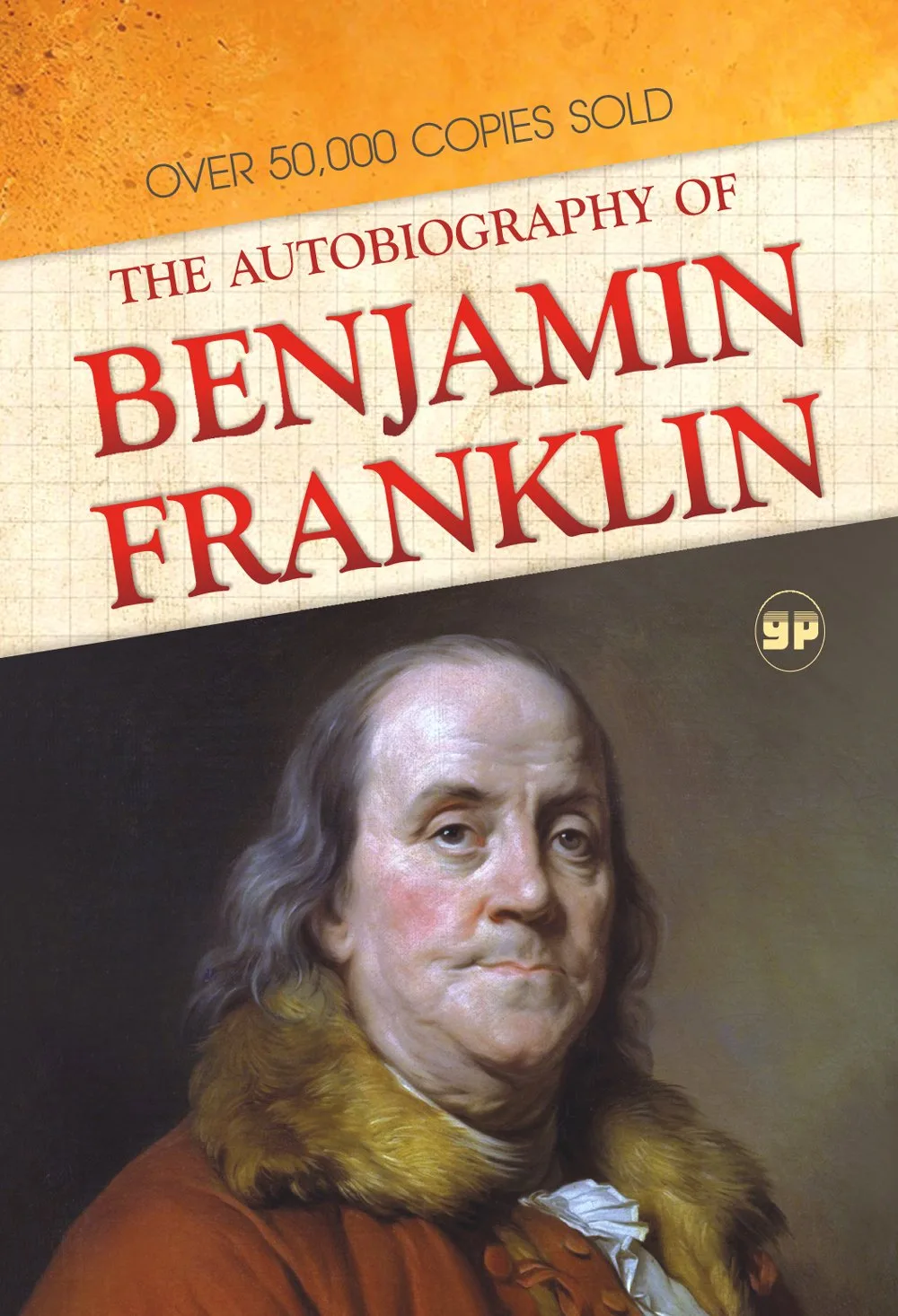
The Autobiography of Benjamin Franklin
eBook
• INR 199.00
• English
No ratings yet
| Publisher | General Press |
|---|---|
| ASIN/SKU | B00TM6TTF0 |
| Book Format | eBook |
| Language | English |
| List Price | INR 199.00 |
| Subject Code | BIO006000, BIO010000, HIS036000 |
| Book Code | BD00068228 |
Buy this Book
Amazon Stores
Ebook Stores
Other Stores
Discover The Autobiography of Benjamin Franklin by Benjamin Franklin. This book is published by General Press in eBook format, ASIN B00TM6TTF0, under Biographies and Memoirs, Historical Biographies, United States History.
Book Description
"The Autobiography of Benjamin Franklin" is a profoundly personal and enduringly relevant glimpse into the mind of one of America’s founding fathers. Written initially as a letter to his son, William, the narrative unfolds as a remarkably candid account of a self-made man. Franklin traces his journey from a humble printer’s apprentice in Boston to a celebrated inventor, writer, and statesman in Philadelphia and beyond.
What makes this memoir so deeply humane is Franklin’s charming honesty about his own flaws and his relentless drive for self-improvement. He famously details his ambitious attempt to achieve moral perfection through a strict tracking of thirteen virtues—including temperance, industry, and humility. While he humorously admits to falling short of perfection, his journey underscores a profound belief in the power of discipline and education.
The book is more than a historical record; it is a lively tapestry of eighteenth-century life, colored by Franklin’s wit and pragmatism. He shares practical wisdom on business, human nature, and the importance of civic duty, all delivered in a conversational, highly accessible tone. Through his triumphs and trials, Franklin presents a life built not on inherited privilege, but on curiosity, hard work, and a genuine desire to be useful to others. Ultimately, it remains a surprisingly modern and inspiring blueprint for a well-lived life, inviting readers to reflect on their own capacity for growth and self-discovery.
What makes this memoir so deeply humane is Franklin’s charming honesty about his own flaws and his relentless drive for self-improvement. He famously details his ambitious attempt to achieve moral perfection through a strict tracking of thirteen virtues—including temperance, industry, and humility. While he humorously admits to falling short of perfection, his journey underscores a profound belief in the power of discipline and education.
The book is more than a historical record; it is a lively tapestry of eighteenth-century life, colored by Franklin’s wit and pragmatism. He shares practical wisdom on business, human nature, and the importance of civic duty, all delivered in a conversational, highly accessible tone. Through his triumphs and trials, Franklin presents a life built not on inherited privilege, but on curiosity, hard work, and a genuine desire to be useful to others. Ultimately, it remains a surprisingly modern and inspiring blueprint for a well-lived life, inviting readers to reflect on their own capacity for growth and self-discovery.
Author Biography
Benjamin Franklin (1706–1790) was one of the most remarkable figures in American history, celebrated as a statesman, inventor, scientist, author, printer, publisher, diplomat, and philosopher. His extraordinary curiosity and practical wisdom enabled him to make lasting contributions to science, politics, literature, and public life. As one of the Founding Fathers of the United States, Franklin played a pivotal role in shaping the nation's ideals of liberty, education, and civic responsibility. His life remains a powerful example of how knowledge, hard work, and public service can leave a lasting impact on society.
Franklin was born on January 17, 1706, in Boston, Massachusetts, into a large family of modest means. Although his formal education ended at the age of ten, he developed a lifelong passion for reading and self-improvement. As a young apprentice in his brother's printing business, he honed his writing skills before moving to Philadelphia, where he established himself as one of the colonies' most successful printers and publishers. His newspaper, The Pennsylvania Gazette, and his annual publication, Poor Richard's Almanack, became immensely popular for their wit, practical advice, and memorable sayings.
Beyond publishing, Franklin devoted himself to scientific discovery. His pioneering experiments with electricity, including the famous kite experiment, demonstrated that lightning is an electrical phenomenon. He invented the lightning rod, bifocal glasses, the Franklin stove, and several other practical devices. Notably, he chose not to patent his inventions, believing that scientific knowledge should benefit everyone.
Franklin also made extraordinary contributions to public life. He helped establish libraries, hospitals, educational institutions, and civic organizations, reflecting his belief that communities flourish through cooperation and shared responsibility. During the American Revolution, he served as a diplomat in France, where his efforts were instrumental in securing French support for the American cause. He also helped draft both the Declaration of Independence and the United States Constitution, playing a central role in the birth of the nation.
Benjamin Franklin passed away in Philadelphia in 1790 at the age of eighty-four. By then, he had earned international admiration as a scientist, thinker, and statesman. Today, he is remembered not only for his political achievements and scientific innovations but also for his enduring commitment to learning, public service, and human progress. His writings, inventions, and example continue to inspire generations, making him one of the most influential and respected figures in world history.
Franklin was born on January 17, 1706, in Boston, Massachusetts, into a large family of modest means. Although his formal education ended at the age of ten, he developed a lifelong passion for reading and self-improvement. As a young apprentice in his brother's printing business, he honed his writing skills before moving to Philadelphia, where he established himself as one of the colonies' most successful printers and publishers. His newspaper, The Pennsylvania Gazette, and his annual publication, Poor Richard's Almanack, became immensely popular for their wit, practical advice, and memorable sayings.
Beyond publishing, Franklin devoted himself to scientific discovery. His pioneering experiments with electricity, including the famous kite experiment, demonstrated that lightning is an electrical phenomenon. He invented the lightning rod, bifocal glasses, the Franklin stove, and several other practical devices. Notably, he chose not to patent his inventions, believing that scientific knowledge should benefit everyone.
Franklin also made extraordinary contributions to public life. He helped establish libraries, hospitals, educational institutions, and civic organizations, reflecting his belief that communities flourish through cooperation and shared responsibility. During the American Revolution, he served as a diplomat in France, where his efforts were instrumental in securing French support for the American cause. He also helped draft both the Declaration of Independence and the United States Constitution, playing a central role in the birth of the nation.
Benjamin Franklin passed away in Philadelphia in 1790 at the age of eighty-four. By then, he had earned international admiration as a scientist, thinker, and statesman. Today, he is remembered not only for his political achievements and scientific innovations but also for his enduring commitment to learning, public service, and human progress. His writings, inventions, and example continue to inspire generations, making him one of the most influential and respected figures in world history.
Editorial Reviews
Editorial Reviews will be added soon…
Book Summary
Benjamin Franklin’s Autobiography is one of the most influential accounts of an ordinary person deliberately shaping himself into a useful, educated, disciplined, and respected individual. Written over several years and left unfinished, the book combines personal memories, practical advice, moral reflection, and a fascinating picture of eighteenth-century American life. Franklin does not present himself as a flawless hero. Instead, he describes how he built his character through hard work, self-education, careful habits, practical intelligence, and a lifelong desire for improvement.
Franklin begins by describing his family background. He was born in Boston in 1706 into a large family. His father, Josiah Franklin, was a hardworking tradesman and a thoughtful man who valued learning and useful conversation. Benjamin showed an early interest in reading, but his family could not afford a long formal education. He therefore left school while still young and entered his brother James’s printing business. This early experience became extremely important because it introduced him to books, writing, publishing, and the world of ideas.
Franklin's relationship with his older brother was difficult. James became the publisher of The New-England Courant, and Benjamin secretly contributed articles to the newspaper under the name “Silence Dogood.” The articles were humorous and clever, and they attracted attention. Franklin enjoyed the success but eventually revealed his identity. The experience taught him an important lesson about writing, public opinion, and independence. His disagreement with James eventually led him to leave Boston and travel to Philadelphia.
His arrival in Philadelphia marks one of the most memorable episodes of the autobiography. Franklin arrived with little money and few possessions, yet he soon found work as a printer. He describes his early appearance in the city with humor, including the famous image of himself walking through the streets carrying bread under his arms. He gradually built relationships, gained employment, and established himself as a printer. His story demonstrates one of the book's central ideas: a person can begin with very little and gradually improve his circumstances through persistence and good judgment.
Franklin eventually established his own printing business and became the publisher of the Pennsylvania Gazette. His success did not come from luck alone. He cultivated habits of reliability, industry, frugality, and careful planning. He understood that reputation was an important form of capital. If people believed that he was honest, hardworking, and dependable, they were more likely to trust him with business and public responsibilities.
One of the most famous sections of the autobiography concerns Franklin's thirteen virtues. He wanted to develop a systematic method for improving his character. The virtues included temperance, silence, order, resolution, frugality, industry, sincerity, justice, moderation, cleanliness, tranquility, chastity, and humility. Rather than merely admiring these qualities, Franklin created a practical system for practicing them.
He kept a small chart in which he marked failures in particular virtues each day. His goal was to concentrate on one virtue at a time while continuing to work on all the others. This experiment reflects Franklin's practical approach to morality. He treated character development almost like a personal project that could be measured, examined, and improved.
Yet Franklin admits that perfection remained difficult. He discovered that even when he succeeded in becoming more disciplined, new weaknesses appeared. He also humorously acknowledges that his attempt to become perfectly orderly created a problem because life itself is unpredictable. His reflections make the book appealing because they reveal a person who sincerely wanted to improve but understood that human beings rarely achieve complete perfection.
Franklin's self-improvement was closely connected to his love of learning. Because he had little formal education, he educated himself through reading and conversation. He studied subjects ranging from science and philosophy to history and practical affairs. He also developed a method of improving his writing by studying essays and attempting to reproduce their structure from memory. When he compared his versions with the originals, he could identify his weaknesses and improve his style.
Franklin believed strongly in the value of useful knowledge. Learning was not merely a way to display intelligence. Knowledge should help people solve problems and improve society. This practical attitude shaped many of his later activities. He helped establish the Junto, a discussion group in Philadelphia where members exchanged ideas and considered ways of improving their community. From this spirit grew several important civic institutions, including the Library Company of Philadelphia.
The autobiography also describes Franklin's involvement in public service. He became interested in practical improvements such as fire protection, street lighting, road maintenance, and public safety. He helped organize a volunteer fire company and supported the creation of educational and civic institutions. His philosophy was that citizens should not simply complain about problems; they should cooperate to solve them.
Another important theme is frugality and financial independence. Franklin argues that money should be used intelligently rather than wasted on appearances. His famous principles of industry and frugality are not presented merely as methods for becoming rich. Financial independence gives a person greater freedom to pursue meaningful work and public service. He understood that uncontrolled consumption could create dependence, while disciplined living could create opportunity.
Franklin also discusses his rise into public life and science. His experiments with electricity made him internationally famous, but he presents scientific investigation in the same practical spirit that guided his business and civic work. He was curious about the natural world and interested in discovering knowledge that could have useful applications.
The autobiography's unfinished nature is significant. Franklin never completes the story of his later life, and therefore the work feels less like a final monument and more like an ongoing record of self-development. He leaves the reader with the sense that a person's character is never completely finished.
Ultimately, Franklin's Autobiography is a book about self-creation. Franklin begins with modest circumstances and limited formal education, yet through reading, discipline, work, experimentation, and public-mindedness, he gradually creates a remarkable life. His greatest lesson is not simply “work hard and become successful.” It is that human beings possess a remarkable ability to shape themselves through conscious habits and choices.
Franklin's life demonstrates that education can continue outside the classroom, that character can be deliberately cultivated, and that personal success becomes more meaningful when it contributes to the common good. His autobiography remains powerful because it speaks to a universal hope: that we can examine our weaknesses honestly, improve ourselves patiently, and use whatever abilities we possess to make both our own lives and the lives of others better.
Franklin begins by describing his family background. He was born in Boston in 1706 into a large family. His father, Josiah Franklin, was a hardworking tradesman and a thoughtful man who valued learning and useful conversation. Benjamin showed an early interest in reading, but his family could not afford a long formal education. He therefore left school while still young and entered his brother James’s printing business. This early experience became extremely important because it introduced him to books, writing, publishing, and the world of ideas.
Franklin's relationship with his older brother was difficult. James became the publisher of The New-England Courant, and Benjamin secretly contributed articles to the newspaper under the name “Silence Dogood.” The articles were humorous and clever, and they attracted attention. Franklin enjoyed the success but eventually revealed his identity. The experience taught him an important lesson about writing, public opinion, and independence. His disagreement with James eventually led him to leave Boston and travel to Philadelphia.
His arrival in Philadelphia marks one of the most memorable episodes of the autobiography. Franklin arrived with little money and few possessions, yet he soon found work as a printer. He describes his early appearance in the city with humor, including the famous image of himself walking through the streets carrying bread under his arms. He gradually built relationships, gained employment, and established himself as a printer. His story demonstrates one of the book's central ideas: a person can begin with very little and gradually improve his circumstances through persistence and good judgment.
Franklin eventually established his own printing business and became the publisher of the Pennsylvania Gazette. His success did not come from luck alone. He cultivated habits of reliability, industry, frugality, and careful planning. He understood that reputation was an important form of capital. If people believed that he was honest, hardworking, and dependable, they were more likely to trust him with business and public responsibilities.
One of the most famous sections of the autobiography concerns Franklin's thirteen virtues. He wanted to develop a systematic method for improving his character. The virtues included temperance, silence, order, resolution, frugality, industry, sincerity, justice, moderation, cleanliness, tranquility, chastity, and humility. Rather than merely admiring these qualities, Franklin created a practical system for practicing them.
He kept a small chart in which he marked failures in particular virtues each day. His goal was to concentrate on one virtue at a time while continuing to work on all the others. This experiment reflects Franklin's practical approach to morality. He treated character development almost like a personal project that could be measured, examined, and improved.
Yet Franklin admits that perfection remained difficult. He discovered that even when he succeeded in becoming more disciplined, new weaknesses appeared. He also humorously acknowledges that his attempt to become perfectly orderly created a problem because life itself is unpredictable. His reflections make the book appealing because they reveal a person who sincerely wanted to improve but understood that human beings rarely achieve complete perfection.
Franklin's self-improvement was closely connected to his love of learning. Because he had little formal education, he educated himself through reading and conversation. He studied subjects ranging from science and philosophy to history and practical affairs. He also developed a method of improving his writing by studying essays and attempting to reproduce their structure from memory. When he compared his versions with the originals, he could identify his weaknesses and improve his style.
Franklin believed strongly in the value of useful knowledge. Learning was not merely a way to display intelligence. Knowledge should help people solve problems and improve society. This practical attitude shaped many of his later activities. He helped establish the Junto, a discussion group in Philadelphia where members exchanged ideas and considered ways of improving their community. From this spirit grew several important civic institutions, including the Library Company of Philadelphia.
The autobiography also describes Franklin's involvement in public service. He became interested in practical improvements such as fire protection, street lighting, road maintenance, and public safety. He helped organize a volunteer fire company and supported the creation of educational and civic institutions. His philosophy was that citizens should not simply complain about problems; they should cooperate to solve them.
Another important theme is frugality and financial independence. Franklin argues that money should be used intelligently rather than wasted on appearances. His famous principles of industry and frugality are not presented merely as methods for becoming rich. Financial independence gives a person greater freedom to pursue meaningful work and public service. He understood that uncontrolled consumption could create dependence, while disciplined living could create opportunity.
Franklin also discusses his rise into public life and science. His experiments with electricity made him internationally famous, but he presents scientific investigation in the same practical spirit that guided his business and civic work. He was curious about the natural world and interested in discovering knowledge that could have useful applications.
The autobiography's unfinished nature is significant. Franklin never completes the story of his later life, and therefore the work feels less like a final monument and more like an ongoing record of self-development. He leaves the reader with the sense that a person's character is never completely finished.
Ultimately, Franklin's Autobiography is a book about self-creation. Franklin begins with modest circumstances and limited formal education, yet through reading, discipline, work, experimentation, and public-mindedness, he gradually creates a remarkable life. His greatest lesson is not simply “work hard and become successful.” It is that human beings possess a remarkable ability to shape themselves through conscious habits and choices.
Franklin's life demonstrates that education can continue outside the classroom, that character can be deliberately cultivated, and that personal success becomes more meaningful when it contributes to the common good. His autobiography remains powerful because it speaks to a universal hope: that we can examine our weaknesses honestly, improve ourselves patiently, and use whatever abilities we possess to make both our own lives and the lives of others better.
Sample Chapters
Sample Chapters will be added soon…
Reader Reviews
No reviews yet.
The Autobiography of Benjamin Franklin
Download Cover Image
Do you want to download the full cover image for The Autobiography of Benjamin Franklin?