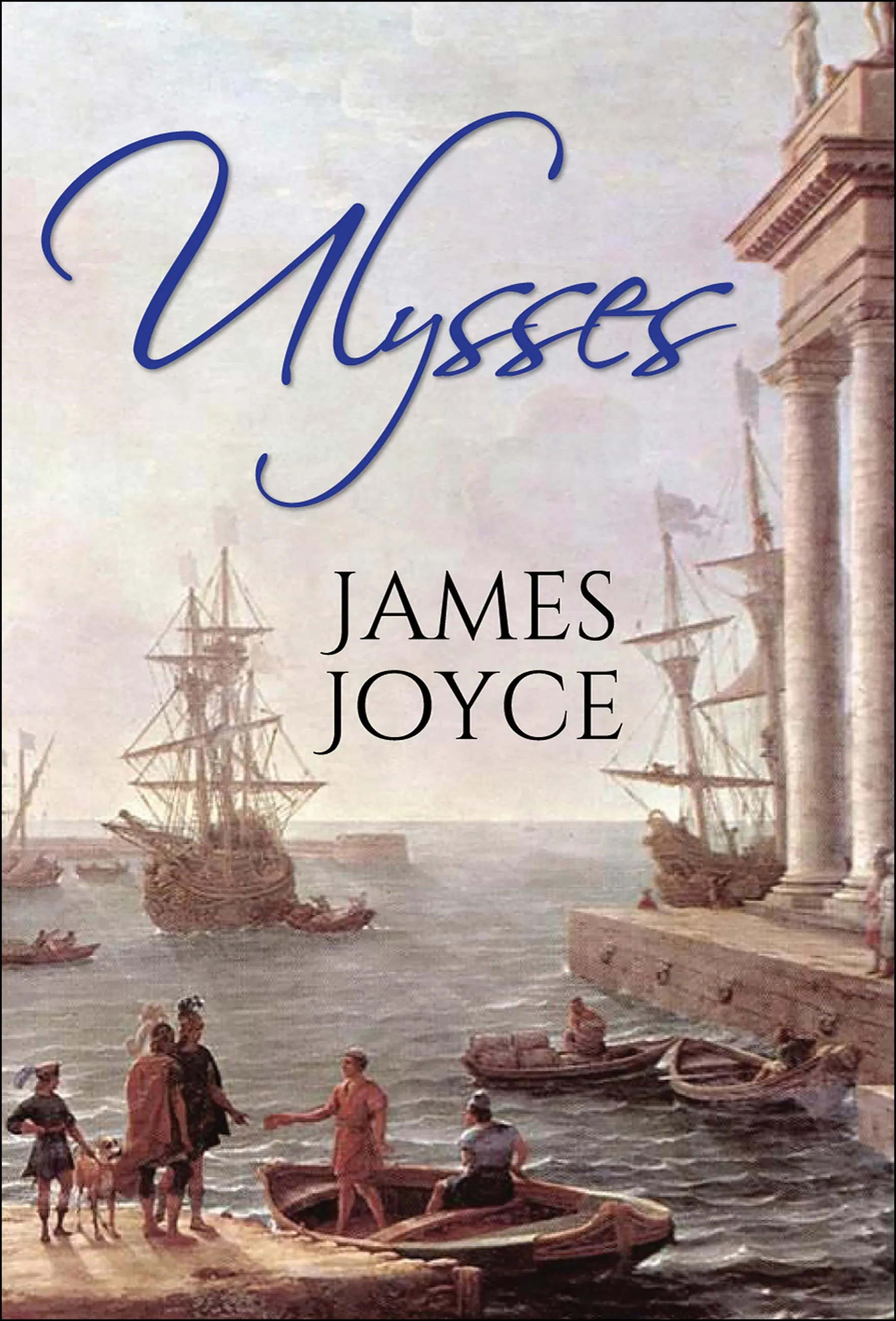
Ulysses
eBook
• INR 70.00
• English
• 9788180320996
No ratings yet
| Publisher | General Press |
|---|---|
| ISBN13 | 9788180320996 |
| ASIN/SKU | B01FND2RBI |
| Book Format | eBook |
| Language | English |
| List Price | INR 70.00 |
| Subject Code | FIC004000, FIC014000 |
| Book Code | BD00068237 |
Buy this Book
Amazon Stores
Ebook Stores
Other Stores
Discover Ulysses by James Joyce. This book is published by General Press in eBook format, ISBN 9788180320996, ASIN B01FND2RBI, under Literature and Fiction, Literary Fiction, Literary Criticism and Theory.
Book Description
Ulysses' is a novel by Irish writer James Joyce. It was first serialised in parts in the American journal 'The Little Review' from March 1918 to December 1920, and then published in its entirety by Sylvia Beach in February 1922, in Paris.
'Ulysses' has survived bowdlerization, legal action and bitter controversy. Capturing a single day in the life of Dubliner Leopold Bloom, his friends Buck Mulligan and Stephen Dedalus, his wife Molly, and a scintillating cast of supporting characters, Joyce pushes Celtic lyricism and vulgarity to splendid extremes. An undisputed modernist classic, its ceaseless verbal inventiveness and astonishingly wide-ranging allusions confirm its standing as an imperishable monument to the human condition.
It takes readers into the inner realms of human consciousness using the interior monologue style that came to be called stream of consciousness. In addition to this psychological characteristic, it gives a realistic portrait of the life of ordinary people living in Dublin, Ireland, on June 16, 1904. The novel was the subject of a famous obscenity trial in 1933, but was found by a U.S. district court in New York to be a work of art. The furor over the novel made Joyce a celebrity. In the long run, the work placed him at the forefront of the modern period of the early 1900s when literary works, primarily in the first two decades, explored interior lives and subjective reality in a new idiom, attempting to probe the human psyche in order to understand the human condition.
This richly-allusive novel, revolutionary in its modernistic experimentalism, was hailed as a work of genius by W.B. Yeats, T.S. Eliot and Ernest Hemingway. Scandalously frank, wittily erudite, mercurially eloquent, resourcefully comic and generously humane, 'Ulysses' offers the reader a life-changing experience.
'Ulysses' has survived bowdlerization, legal action and bitter controversy. Capturing a single day in the life of Dubliner Leopold Bloom, his friends Buck Mulligan and Stephen Dedalus, his wife Molly, and a scintillating cast of supporting characters, Joyce pushes Celtic lyricism and vulgarity to splendid extremes. An undisputed modernist classic, its ceaseless verbal inventiveness and astonishingly wide-ranging allusions confirm its standing as an imperishable monument to the human condition.
It takes readers into the inner realms of human consciousness using the interior monologue style that came to be called stream of consciousness. In addition to this psychological characteristic, it gives a realistic portrait of the life of ordinary people living in Dublin, Ireland, on June 16, 1904. The novel was the subject of a famous obscenity trial in 1933, but was found by a U.S. district court in New York to be a work of art. The furor over the novel made Joyce a celebrity. In the long run, the work placed him at the forefront of the modern period of the early 1900s when literary works, primarily in the first two decades, explored interior lives and subjective reality in a new idiom, attempting to probe the human psyche in order to understand the human condition.
This richly-allusive novel, revolutionary in its modernistic experimentalism, was hailed as a work of genius by W.B. Yeats, T.S. Eliot and Ernest Hemingway. Scandalously frank, wittily erudite, mercurially eloquent, resourcefully comic and generously humane, 'Ulysses' offers the reader a life-changing experience.
Author Biography
James Augustine Aloysius Joyce (2 February 1882 – 13 January 1941) was an Irish novelist and poet. He contributed to the modernist avant-garde and is regarded as one of the most influential and important authors of the 20th century.
Joyce is best known for Ulysses (1922), a landmark work in which the episodes of Homer's Odyssey are paralleled in an array of contrasting literary styles, perhaps most prominent among these the stream of consciousness technique he utilised. Other well-known works are the short-story collection Dubliners (1914), and the novels A Portrait of the Artist as a Young Man (1916) and Finnegans Wake (1939). His other writings include three books of poetry, a play, occasional journalism and his published letters.
Joyce was born in 41 Brighton Square, Rathgar, Dublin—about half a mile from his mother's birthplace in Terenure—into a middle-class family on the way down. A brilliant student, he excelled at the Jesuit schools Clongowes and Belvedere, despite the chaotic family life imposed by his father's alcoholism and unpredictable finances. He went on to attend University College Dublin.
In 1904, in his early twenties, Joyce emigrated permanently to continental Europe with his partner (and later wife) Nora Barnacle. They lived in Trieste, Paris and Zurich. Though most of his adult life was spent abroad, Joyce's fictional universe centres on Dublin, and is populated largely by characters who closely resemble family members, enemies and friends from his time there. Ulysses in particular is set with precision in the streets and alleyways of the city. Shortly after the publication of Ulysses, he elucidated this preoccupation somewhat, saying, "For myself, I always write about Dublin, because if I can get to the heart of Dublin I can get to the heart of all the cities of the world. In the particular is contained the universal."
Joyce is best known for Ulysses (1922), a landmark work in which the episodes of Homer's Odyssey are paralleled in an array of contrasting literary styles, perhaps most prominent among these the stream of consciousness technique he utilised. Other well-known works are the short-story collection Dubliners (1914), and the novels A Portrait of the Artist as a Young Man (1916) and Finnegans Wake (1939). His other writings include three books of poetry, a play, occasional journalism and his published letters.
Joyce was born in 41 Brighton Square, Rathgar, Dublin—about half a mile from his mother's birthplace in Terenure—into a middle-class family on the way down. A brilliant student, he excelled at the Jesuit schools Clongowes and Belvedere, despite the chaotic family life imposed by his father's alcoholism and unpredictable finances. He went on to attend University College Dublin.
In 1904, in his early twenties, Joyce emigrated permanently to continental Europe with his partner (and later wife) Nora Barnacle. They lived in Trieste, Paris and Zurich. Though most of his adult life was spent abroad, Joyce's fictional universe centres on Dublin, and is populated largely by characters who closely resemble family members, enemies and friends from his time there. Ulysses in particular is set with precision in the streets and alleyways of the city. Shortly after the publication of Ulysses, he elucidated this preoccupation somewhat, saying, "For myself, I always write about Dublin, because if I can get to the heart of Dublin I can get to the heart of all the cities of the world. In the particular is contained the universal."
Editorial Reviews
Editorial Reviews will be added soon…
Book Summary
James Joyce’s Ulysses is one of the most influential and challenging novels in modern literature. Published in book form in 1922, the novel takes place almost entirely in Dublin on a single day, June 16, 1904. Its central characters are Leopold Bloom, an ordinary advertising canvasser; Stephen Dedalus, a young intellectual struggling with grief, alienation, and questions of identity; and Molly Bloom, Leopold’s wife. Although the basic plot is relatively simple, Joyce transforms this ordinary day into an enormous exploration of human consciousness, memory, sexuality, marriage, family, religion, politics, language, art, and modern urban life. The title refers to Homer’s Odyssey, and the novel deliberately parallels the adventures of Homer’s Odysseus with Bloom’s apparently mundane journey through Dublin. A Ulysses summary, therefore, is best understood not simply as a description of what happens but as an explanation of how Joyce turns everyday experiences into an epic.
The novel opens with Stephen Dedalus, who was also the central character of Joyce’s earlier novel A Portrait of the Artist as a Young Man. Stephen is living in a tower near Dublin with Buck Mulligan, a confident and somewhat mocking medical student, and an Englishman named Haines. Stephen is still deeply affected by the recent death of his mother. He feels guilty because, according to his own memory, he refused to kneel and pray beside her when she was dying. This guilt has contributed to his alienation from his family, his religion, and his surroundings. He has returned to Dublin after spending time abroad, but he does not feel at home there. His intellectual ambitions are also accompanied by insecurity and frustration. The opening chapters establish Stephen as brilliant but isolated, someone who thinks deeply yet struggles to establish meaningful relationships with other people.
After leaving the tower, Stephen goes to the school where he works as a teacher. There he teaches history and literature but feels increasingly dissatisfied with his position. His conversation with the headmaster, Mr. Deasy, reveals Stephen’s complicated attitude toward Ireland, nationalism, history, and English authority. Mr. Deasy is proud of his conservative views and believes that history has a clear moral pattern. Stephen, however, sees history differently. For him, history is not a simple record of progress but something that continually traps people in inherited conflicts. His famous description of history as a “nightmare” captures his sense that the past continues to control the present. Stephen’s intellectual isolation is therefore not merely personal; it reflects his difficulty finding a place in Irish society.
The narrative then shifts toward Leopold Bloom, the ordinary Dublin man who becomes the novel’s central figure. Bloom begins his day by preparing breakfast and thinking about food, domestic life, and his wife Molly. His thoughts are practical, curious, and often humorous. Unlike the intensely intellectual Stephen, Bloom pays attention to the small physical details of life. He notices smells, advertisements, newspapers, food, clothing, streets, and people. His consciousness moves freely between immediate sensations and memories. Joyce uses this apparently ordinary mind to demonstrate that an everyday person possesses an extraordinarily rich inner life.
Bloom’s relationship with Molly is one of the emotional centers of Ulysses. They have been married for many years, but their marriage has become distant, particularly after the death of their young son Rudy. Bloom and Molly have not been emotionally close for some time, and Bloom knows that Molly is planning to have an affair with Blazes Boylan, a theatrical promoter who is visiting their home later that afternoon. Bloom does not openly confront Molly or Boylan. Instead, he moves through Dublin carrying his private knowledge, sadness, jealousy, and resignation. His response to marital betrayal is complex: he experiences pain, but he also continues to think about Molly with affection and desire. Joyce presents marriage not as a simple division between faithfulness and betrayal but as a complicated network of memory, intimacy, disappointment, habit, and longing.
As Bloom travels through Dublin, apparently ordinary errands become opportunities for reflection. He attends a funeral, visits various businesses, encounters acquaintances, reads newspapers, thinks about advertising, and observes the city around him. The funeral of Paddy Dignam forces him to contemplate death and mortality. Bloom is especially conscious of his own Jewish identity in a predominantly Catholic Irish society, and his experiences throughout the day repeatedly bring questions of prejudice and belonging to the surface. Although Bloom is gentle and generally tolerant, he encounters people who treat him as an outsider. His Jewishness becomes an important part of the novel’s exploration of nationalism and identity.
One of the most important episodes occurs in the newspaper office, where Bloom is trying to place an advertisement. The scene becomes a lively debate about journalism, rhetoric, nationalism, and political identity. The Citizen, an aggressive Irish nationalist, attacks Bloom and eventually turns his hostility toward Bloom’s Jewish identity. Bloom attempts to argue for tolerance and peaceful coexistence, but the discussion becomes increasingly hostile. The episode recalls the encounter between Odysseus and the Cyclops in Homer’s Odyssey. The Citizen represents a kind of narrow, violent nationalism, while Bloom represents a more cosmopolitan understanding of identity. Joyce uses their confrontation to question the idea that national identity must be based on exclusion.
Another important feature of Ulysses is its representation of Dublin itself. The city is not merely a background for the characters; it is almost a character in its own right. Joyce carefully maps streets, pubs, shops, bridges, offices, churches, schools, and homes. Bloom’s movements create a detailed portrait of Dublin at the beginning of the twentieth century. The novel’s epic quality comes partly from this transformation of the ordinary city into a literary world. Joyce suggests that an apparently insignificant day can contain as much complexity as an ancient heroic adventure.
The Homeric structure becomes increasingly important as the novel continues. Joyce does not simply retell the Odyssey. Instead, he creates ironic parallels between Homer’s epic journey and Bloom’s urban wandering. Odysseus travels through dangerous seas and encounters monsters, temptations, and supernatural forces; Bloom travels through Dublin and encounters social hostility, sexual anxiety, loneliness, drunkenness, and memory. Stephen functions in part as a modern Telemachus, the son whom Bloom does not have with him. Bloom, meanwhile, becomes a modern Odysseus: not a warrior or king, but an ordinary man whose journey through daily life becomes quietly heroic.
Stephen and Bloom eventually come together in the novel’s famous “Circe” episode, which takes place in the Nighttown district of Dublin. The episode is written like a surreal theatrical script. Reality becomes unstable, and the characters’ fears, fantasies, memories, and desires appear as dramatic events. Bloom experiences humiliations and bizarre transformations, while Stephen confronts his anxieties about sexuality, authority, and his dead mother. The episode is difficult but essential because it externalizes the hidden contents of the characters’ minds. Joyce demonstrates that consciousness itself can be theatrical: people carry private fantasies and fears that are often stranger than anything happening in the physical world.
The relationship between Bloom and Stephen becomes the emotional heart of the latter part of the novel. Stephen has been searching, consciously or unconsciously, for a form of father figure, while Bloom has lost his son Rudy and lacks a meaningful relationship with Stephen’s generation. Their meeting is therefore symbolically important. Bloom sees something of his lost son in Stephen, while Stephen, despite remaining skeptical and emotionally distant, accepts Bloom’s companionship for a time. Neither man becomes a conventional father or son, but their encounter creates a fragile human connection. In a novel filled with isolation, this moment of companionship is deeply significant.
After the chaos of Nighttown, Bloom and Stephen walk together. Their conversation ranges across religion, philosophy, literature, language, music, and personal experience. They do not completely understand one another, and Stephen eventually chooses to leave. Bloom returns home alone, but his relationship with Stephen has nevertheless altered the emotional meaning of his day. He has briefly experienced companionship beyond the narrow boundaries of his marriage and daily routine. The scene is deliberately understated. There is no dramatic revelation or sentimental reconciliation. Joyce finds significance in the simple fact that two lonely men spend part of a night together.
The final section of Ulysses belongs to Molly Bloom. “Penelope,” the concluding episode, is famously written as an extended stream of consciousness without conventional punctuation. Molly lies in bed thinking about her life, her husband, her lovers, her past, her body, marriage, pregnancy, sexuality, Gibraltar, and the many men she has known. Her thoughts move freely through memories and associations. The episode is often regarded as one of the great experiments in representing the human mind because Molly’s consciousness does not follow a neat logical structure. It circles back, jumps forward, changes direction, remembers fragments, and combines physical sensations with emotional memories.
Molly’s thoughts also complicate the reader’s understanding of Leopold Bloom. Throughout the novel, Bloom has been presented as a lonely and sometimes passive husband, but Molly’s memories reveal the history and complexity of their relationship. She remembers their courtship, their intimacy, their conflicts, and their shared life. Her thoughts also reveal that she is not simply the unfaithful wife described by Bloom’s anxiety. She possesses her own desires, frustrations, memories, and sense of self. Joyce gives her a powerful interior voice that refuses to reduce her to the role of wife or adulteress.
The famous final movement of Molly’s monologue gradually becomes a meditation on affirmation. Her memories of Bloom lead her back to the beginning of their relationship and to her acceptance of his proposal. The repeated “yes” at the end of the novel has become one of the most famous endings in modern literature. It can be interpreted as an affirmation of life, sexuality, memory, love, and existence itself. Yet it is not a simple happy ending. Molly’s marriage remains complicated, and her affair has not been erased. The power of the ending lies precisely in its ability to embrace contradiction.
One of the defining themes of Ulysses is the relationship between the ordinary and the extraordinary. Joyce takes a single day involving meals, work, errands, conversations, sexual thoughts, arguments, walks, and domestic concerns and gives it the scale of an epic. Bloom is not a traditional hero. He does not defeat monsters or return from a great war. His heroism lies in endurance, tolerance, curiosity, and his ability to continue living despite loneliness and disappointment. By placing Bloom beside Homer’s Odysseus, Joyce suggests that modern life deserves the same literary seriousness once reserved for heroic adventures.
Another central theme is the complexity of consciousness. Joyce pioneered techniques that allow readers to experience thought rather than simply receive information about characters. Through stream of consciousness, interior monologue, free association, shifting styles, and linguistic experimentation, the novel attempts to reproduce the unpredictable movement of the mind. Thoughts about food can lead to memories of childhood; a street advertisement can trigger a sexual association; a conversation can suddenly become connected to religion or death. This makes Ulysses demanding, but it also makes it extraordinarily intimate.
Language itself is another major theme. Joyce continually changes his writing style to reflect different subjects, characters, historical periods, and states of consciousness. Some episodes imitate newspaper prose, others resemble dramatic scripts, sermons, scientific writing, romantic fiction, or ancient literary forms. The novel ultimately becomes an exploration of what language can do. It can describe reality, distort reality, imitate thought, create comedy, reveal prejudice, and produce beauty. Joyce treats language not simply as a transparent tool but as one of the central subjects of the novel.
Religion, nationalism, colonialism, sexuality, and Irish identity also run throughout Ulysses. Stephen’s rejection of Catholic authority contrasts with Bloom’s complicated relationship to religion and identity. Political arguments reveal the tensions surrounding Irish nationalism and British rule. Bloom’s Jewish identity allows Joyce to examine what it means to be regarded as an outsider in a society that defines belonging narrowly. Sexuality is treated with unusual openness, particularly for the period in which the novel was written. Joyce does not present human desire as clean or easily categorized; instead, he shows it as deeply connected to memory, imagination, shame, pleasure, and loneliness.
Ultimately, the meaning of Ulysses lies less in a conventional plot than in its extraordinary transformation of everyday experience. Stephen begins the day as a lonely young intellectual struggling with grief and alienation. Bloom moves through Dublin carrying the quiet pain of a damaged marriage and the memory of his dead son. Molly remains at home, but her final monologue reveals an inner world as extensive as the city itself. By the end of the day, the characters have not solved every problem, but they have encountered one another and, briefly, broken through their isolation.
For anyone seeking a Ulysses by James Joyce summary, Ulysses plot analysis, Ulysses characters, or an explanation of its themes, the novel can ultimately be understood as Joyce’s attempt to make an ordinary human day feel as immense and meaningful as an ancient epic. Its true subject is not simply what happens to Bloom, Stephen, and Molly, but what it means to be human: to remember, desire, worry, work, imagine, suffer, connect, misunderstand, and continue. Joyce turns Dublin into an epic landscape and an ordinary man into an unlikely modern hero. The result is a novel that can be difficult, playful, confusing, comic, sensual, philosophical, and profoundly humane—all at once.
The novel opens with Stephen Dedalus, who was also the central character of Joyce’s earlier novel A Portrait of the Artist as a Young Man. Stephen is living in a tower near Dublin with Buck Mulligan, a confident and somewhat mocking medical student, and an Englishman named Haines. Stephen is still deeply affected by the recent death of his mother. He feels guilty because, according to his own memory, he refused to kneel and pray beside her when she was dying. This guilt has contributed to his alienation from his family, his religion, and his surroundings. He has returned to Dublin after spending time abroad, but he does not feel at home there. His intellectual ambitions are also accompanied by insecurity and frustration. The opening chapters establish Stephen as brilliant but isolated, someone who thinks deeply yet struggles to establish meaningful relationships with other people.
After leaving the tower, Stephen goes to the school where he works as a teacher. There he teaches history and literature but feels increasingly dissatisfied with his position. His conversation with the headmaster, Mr. Deasy, reveals Stephen’s complicated attitude toward Ireland, nationalism, history, and English authority. Mr. Deasy is proud of his conservative views and believes that history has a clear moral pattern. Stephen, however, sees history differently. For him, history is not a simple record of progress but something that continually traps people in inherited conflicts. His famous description of history as a “nightmare” captures his sense that the past continues to control the present. Stephen’s intellectual isolation is therefore not merely personal; it reflects his difficulty finding a place in Irish society.
The narrative then shifts toward Leopold Bloom, the ordinary Dublin man who becomes the novel’s central figure. Bloom begins his day by preparing breakfast and thinking about food, domestic life, and his wife Molly. His thoughts are practical, curious, and often humorous. Unlike the intensely intellectual Stephen, Bloom pays attention to the small physical details of life. He notices smells, advertisements, newspapers, food, clothing, streets, and people. His consciousness moves freely between immediate sensations and memories. Joyce uses this apparently ordinary mind to demonstrate that an everyday person possesses an extraordinarily rich inner life.
Bloom’s relationship with Molly is one of the emotional centers of Ulysses. They have been married for many years, but their marriage has become distant, particularly after the death of their young son Rudy. Bloom and Molly have not been emotionally close for some time, and Bloom knows that Molly is planning to have an affair with Blazes Boylan, a theatrical promoter who is visiting their home later that afternoon. Bloom does not openly confront Molly or Boylan. Instead, he moves through Dublin carrying his private knowledge, sadness, jealousy, and resignation. His response to marital betrayal is complex: he experiences pain, but he also continues to think about Molly with affection and desire. Joyce presents marriage not as a simple division between faithfulness and betrayal but as a complicated network of memory, intimacy, disappointment, habit, and longing.
As Bloom travels through Dublin, apparently ordinary errands become opportunities for reflection. He attends a funeral, visits various businesses, encounters acquaintances, reads newspapers, thinks about advertising, and observes the city around him. The funeral of Paddy Dignam forces him to contemplate death and mortality. Bloom is especially conscious of his own Jewish identity in a predominantly Catholic Irish society, and his experiences throughout the day repeatedly bring questions of prejudice and belonging to the surface. Although Bloom is gentle and generally tolerant, he encounters people who treat him as an outsider. His Jewishness becomes an important part of the novel’s exploration of nationalism and identity.
One of the most important episodes occurs in the newspaper office, where Bloom is trying to place an advertisement. The scene becomes a lively debate about journalism, rhetoric, nationalism, and political identity. The Citizen, an aggressive Irish nationalist, attacks Bloom and eventually turns his hostility toward Bloom’s Jewish identity. Bloom attempts to argue for tolerance and peaceful coexistence, but the discussion becomes increasingly hostile. The episode recalls the encounter between Odysseus and the Cyclops in Homer’s Odyssey. The Citizen represents a kind of narrow, violent nationalism, while Bloom represents a more cosmopolitan understanding of identity. Joyce uses their confrontation to question the idea that national identity must be based on exclusion.
Another important feature of Ulysses is its representation of Dublin itself. The city is not merely a background for the characters; it is almost a character in its own right. Joyce carefully maps streets, pubs, shops, bridges, offices, churches, schools, and homes. Bloom’s movements create a detailed portrait of Dublin at the beginning of the twentieth century. The novel’s epic quality comes partly from this transformation of the ordinary city into a literary world. Joyce suggests that an apparently insignificant day can contain as much complexity as an ancient heroic adventure.
The Homeric structure becomes increasingly important as the novel continues. Joyce does not simply retell the Odyssey. Instead, he creates ironic parallels between Homer’s epic journey and Bloom’s urban wandering. Odysseus travels through dangerous seas and encounters monsters, temptations, and supernatural forces; Bloom travels through Dublin and encounters social hostility, sexual anxiety, loneliness, drunkenness, and memory. Stephen functions in part as a modern Telemachus, the son whom Bloom does not have with him. Bloom, meanwhile, becomes a modern Odysseus: not a warrior or king, but an ordinary man whose journey through daily life becomes quietly heroic.
Stephen and Bloom eventually come together in the novel’s famous “Circe” episode, which takes place in the Nighttown district of Dublin. The episode is written like a surreal theatrical script. Reality becomes unstable, and the characters’ fears, fantasies, memories, and desires appear as dramatic events. Bloom experiences humiliations and bizarre transformations, while Stephen confronts his anxieties about sexuality, authority, and his dead mother. The episode is difficult but essential because it externalizes the hidden contents of the characters’ minds. Joyce demonstrates that consciousness itself can be theatrical: people carry private fantasies and fears that are often stranger than anything happening in the physical world.
The relationship between Bloom and Stephen becomes the emotional heart of the latter part of the novel. Stephen has been searching, consciously or unconsciously, for a form of father figure, while Bloom has lost his son Rudy and lacks a meaningful relationship with Stephen’s generation. Their meeting is therefore symbolically important. Bloom sees something of his lost son in Stephen, while Stephen, despite remaining skeptical and emotionally distant, accepts Bloom’s companionship for a time. Neither man becomes a conventional father or son, but their encounter creates a fragile human connection. In a novel filled with isolation, this moment of companionship is deeply significant.
After the chaos of Nighttown, Bloom and Stephen walk together. Their conversation ranges across religion, philosophy, literature, language, music, and personal experience. They do not completely understand one another, and Stephen eventually chooses to leave. Bloom returns home alone, but his relationship with Stephen has nevertheless altered the emotional meaning of his day. He has briefly experienced companionship beyond the narrow boundaries of his marriage and daily routine. The scene is deliberately understated. There is no dramatic revelation or sentimental reconciliation. Joyce finds significance in the simple fact that two lonely men spend part of a night together.
The final section of Ulysses belongs to Molly Bloom. “Penelope,” the concluding episode, is famously written as an extended stream of consciousness without conventional punctuation. Molly lies in bed thinking about her life, her husband, her lovers, her past, her body, marriage, pregnancy, sexuality, Gibraltar, and the many men she has known. Her thoughts move freely through memories and associations. The episode is often regarded as one of the great experiments in representing the human mind because Molly’s consciousness does not follow a neat logical structure. It circles back, jumps forward, changes direction, remembers fragments, and combines physical sensations with emotional memories.
Molly’s thoughts also complicate the reader’s understanding of Leopold Bloom. Throughout the novel, Bloom has been presented as a lonely and sometimes passive husband, but Molly’s memories reveal the history and complexity of their relationship. She remembers their courtship, their intimacy, their conflicts, and their shared life. Her thoughts also reveal that she is not simply the unfaithful wife described by Bloom’s anxiety. She possesses her own desires, frustrations, memories, and sense of self. Joyce gives her a powerful interior voice that refuses to reduce her to the role of wife or adulteress.
The famous final movement of Molly’s monologue gradually becomes a meditation on affirmation. Her memories of Bloom lead her back to the beginning of their relationship and to her acceptance of his proposal. The repeated “yes” at the end of the novel has become one of the most famous endings in modern literature. It can be interpreted as an affirmation of life, sexuality, memory, love, and existence itself. Yet it is not a simple happy ending. Molly’s marriage remains complicated, and her affair has not been erased. The power of the ending lies precisely in its ability to embrace contradiction.
One of the defining themes of Ulysses is the relationship between the ordinary and the extraordinary. Joyce takes a single day involving meals, work, errands, conversations, sexual thoughts, arguments, walks, and domestic concerns and gives it the scale of an epic. Bloom is not a traditional hero. He does not defeat monsters or return from a great war. His heroism lies in endurance, tolerance, curiosity, and his ability to continue living despite loneliness and disappointment. By placing Bloom beside Homer’s Odysseus, Joyce suggests that modern life deserves the same literary seriousness once reserved for heroic adventures.
Another central theme is the complexity of consciousness. Joyce pioneered techniques that allow readers to experience thought rather than simply receive information about characters. Through stream of consciousness, interior monologue, free association, shifting styles, and linguistic experimentation, the novel attempts to reproduce the unpredictable movement of the mind. Thoughts about food can lead to memories of childhood; a street advertisement can trigger a sexual association; a conversation can suddenly become connected to religion or death. This makes Ulysses demanding, but it also makes it extraordinarily intimate.
Language itself is another major theme. Joyce continually changes his writing style to reflect different subjects, characters, historical periods, and states of consciousness. Some episodes imitate newspaper prose, others resemble dramatic scripts, sermons, scientific writing, romantic fiction, or ancient literary forms. The novel ultimately becomes an exploration of what language can do. It can describe reality, distort reality, imitate thought, create comedy, reveal prejudice, and produce beauty. Joyce treats language not simply as a transparent tool but as one of the central subjects of the novel.
Religion, nationalism, colonialism, sexuality, and Irish identity also run throughout Ulysses. Stephen’s rejection of Catholic authority contrasts with Bloom’s complicated relationship to religion and identity. Political arguments reveal the tensions surrounding Irish nationalism and British rule. Bloom’s Jewish identity allows Joyce to examine what it means to be regarded as an outsider in a society that defines belonging narrowly. Sexuality is treated with unusual openness, particularly for the period in which the novel was written. Joyce does not present human desire as clean or easily categorized; instead, he shows it as deeply connected to memory, imagination, shame, pleasure, and loneliness.
Ultimately, the meaning of Ulysses lies less in a conventional plot than in its extraordinary transformation of everyday experience. Stephen begins the day as a lonely young intellectual struggling with grief and alienation. Bloom moves through Dublin carrying the quiet pain of a damaged marriage and the memory of his dead son. Molly remains at home, but her final monologue reveals an inner world as extensive as the city itself. By the end of the day, the characters have not solved every problem, but they have encountered one another and, briefly, broken through their isolation.
For anyone seeking a Ulysses by James Joyce summary, Ulysses plot analysis, Ulysses characters, or an explanation of its themes, the novel can ultimately be understood as Joyce’s attempt to make an ordinary human day feel as immense and meaningful as an ancient epic. Its true subject is not simply what happens to Bloom, Stephen, and Molly, but what it means to be human: to remember, desire, worry, work, imagine, suffer, connect, misunderstand, and continue. Joyce turns Dublin into an epic landscape and an ordinary man into an unlikely modern hero. The result is a novel that can be difficult, playful, confusing, comic, sensual, philosophical, and profoundly humane—all at once.
Sample Chapters
Sample Chapters will be added soon…
Reader Reviews
No reviews yet.
Ulysses