
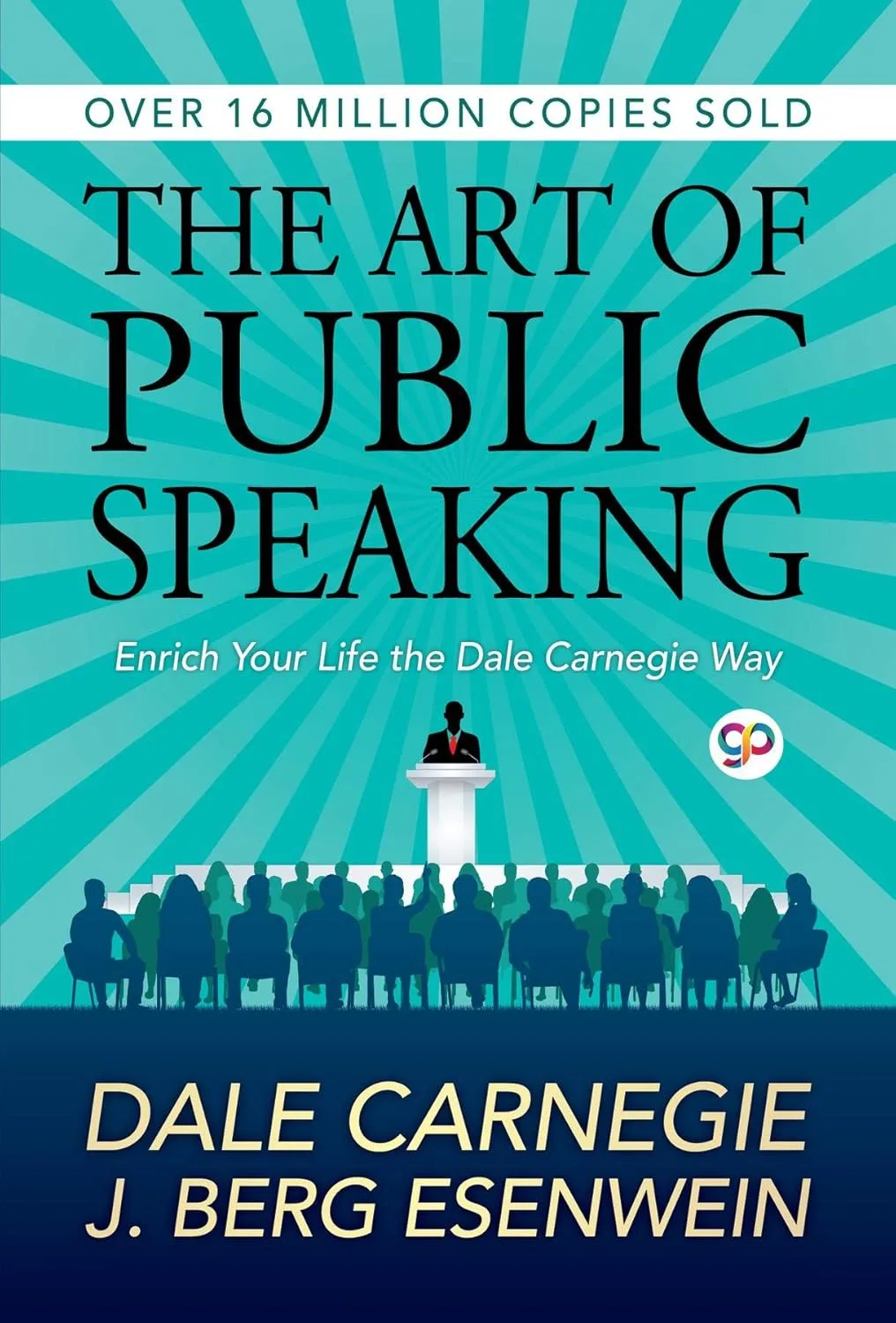
The Art of Public Speaking
eBook
• INR 260.00
• English
No ratings yet
| Publisher | General Press |
|---|---|
| ASIN/SKU | B01K8NYU4A |
| Book Format | eBook |
| Language | English |
| List Price | INR 260.00 |
| Subject Code | LAN008000, SEL021000, SEL027000, LAN009030 |
| Book Code | BD00068244 |
Buy this Book
Amazon Stores
Ebook Stores
Other Stores
Discover The Art of Public Speaking by Dale Carnegie. This book is published by General Press in eBook format, ASIN B01K8NYU4A, under Self-Help, Personal Transformation, Nonfiction.
Book Description
Most people would rather do almost anything than stand up and speak in front of a crowd — and Dale Carnegie knew that better than most. 'The Art of Public Speaking', the self-help and communication classic that helped launch his extraordinary career as one of America's most beloved educators, is built on a simple but powerful belief: that confident, compelling public speaking is not a gift you're born with, but a skill anyone can learn.
Carnegie doesn't open with theory or abstract principles. He meets the reader exactly where they are — nervous, uncertain, maybe even convinced they'll never be good at this — and walks alongside them from the very first page. The book is grounded in practical technique, covering everything from how to organize your thoughts before you speak, to how to use your voice, your body, and your pauses to hold an audience's attention. But what sets it apart from a dry how-to manual is Carnegie's warmth. He writes the way he must have spoken — with energy, humor, and the kind of encouragement that makes you feel like he's personally invested in your success.
One of the book's central themes is the relationship between preparation and confidence. Carnegie is convincing on the point that fear doesn't come from some deep personal flaw — it comes from not being ready. When you know your material deeply, when you've practiced and internalized what you want to say, something shifts. The anxiety doesn't vanish entirely, but it transforms into energy you can actually use.
He also spends considerable time on the art of connecting with an audience — not performing at them, but genuinely engaging with them. Sincerity, he argues, is more persuasive than any rhetorical trick, and authenticity will carry a speaker further than a polished but hollow delivery ever could. Whether you're preparing for a big presentation, dreading a wedding toast, or simply want to express yourself more clearly in everyday life, this book has a quiet way of making you believe you can.
Carnegie doesn't open with theory or abstract principles. He meets the reader exactly where they are — nervous, uncertain, maybe even convinced they'll never be good at this — and walks alongside them from the very first page. The book is grounded in practical technique, covering everything from how to organize your thoughts before you speak, to how to use your voice, your body, and your pauses to hold an audience's attention. But what sets it apart from a dry how-to manual is Carnegie's warmth. He writes the way he must have spoken — with energy, humor, and the kind of encouragement that makes you feel like he's personally invested in your success.
One of the book's central themes is the relationship between preparation and confidence. Carnegie is convincing on the point that fear doesn't come from some deep personal flaw — it comes from not being ready. When you know your material deeply, when you've practiced and internalized what you want to say, something shifts. The anxiety doesn't vanish entirely, but it transforms into energy you can actually use.
He also spends considerable time on the art of connecting with an audience — not performing at them, but genuinely engaging with them. Sincerity, he argues, is more persuasive than any rhetorical trick, and authenticity will carry a speaker further than a polished but hollow delivery ever could. Whether you're preparing for a big presentation, dreading a wedding toast, or simply want to express yourself more clearly in everyday life, this book has a quiet way of making you believe you can.
Author Biography
Dale Carnegie (1888–1955) was a pioneering American writer, lecturer, and developer of world-renowned courses in self-improvement, salesmanship, corporate training, public speaking, and interpersonal skills. Born into poverty on a farm in Maryville, Missouri, Carnegie sought a way out of his early struggles through education. He attended State Teachers College in Warrensburg, where he discovered a profound natural talent for debate and public speaking. After graduating, he worked various rigorous sales jobs—including selling bacon, soap, and lard for Armour and Company—before moving to New York City to briefly pursue a career in acting.
In 1912, recognizing a widespread need among professionals for improved communication skills, Carnegie convinced a local YMCA manager to let him teach a public speaking class in exchange for a percentage of the proceeds. The class was a massive, immediate success, ultimately leading to the establishment of the Dale Carnegie Institute. His core teaching philosophy centered on the idea that success in business and life depends far more on one's ability to communicate effectively, build self-confidence, and interact positively with others than on purely technical knowledge.
Carnegie’s monumental breakthrough occurred in 1936 with the publication of How to Win Friends and Influence People. Originally intended merely as a supplemental textbook for his courses, the book became an unprecedented overnight sensation. It offered practical, highly accessible advice on handling people, winning them over to your way of thinking, and leading without arousing resentment. It has since sold tens of millions of copies worldwide, fundamentally shaping the modern self-help genre.
Carnegie later authored several other influential works, including How to Stop Worrying and Start Living (1948). His pragmatic wisdom, rooted in genuine appreciation and empathy for others, continues to transform lives, cementing his enduring legacy as a titan of personal development.
In 1912, recognizing a widespread need among professionals for improved communication skills, Carnegie convinced a local YMCA manager to let him teach a public speaking class in exchange for a percentage of the proceeds. The class was a massive, immediate success, ultimately leading to the establishment of the Dale Carnegie Institute. His core teaching philosophy centered on the idea that success in business and life depends far more on one's ability to communicate effectively, build self-confidence, and interact positively with others than on purely technical knowledge.
Carnegie’s monumental breakthrough occurred in 1936 with the publication of How to Win Friends and Influence People. Originally intended merely as a supplemental textbook for his courses, the book became an unprecedented overnight sensation. It offered practical, highly accessible advice on handling people, winning them over to your way of thinking, and leading without arousing resentment. It has since sold tens of millions of copies worldwide, fundamentally shaping the modern self-help genre.
Carnegie later authored several other influential works, including How to Stop Worrying and Start Living (1948). His pragmatic wisdom, rooted in genuine appreciation and empathy for others, continues to transform lives, cementing his enduring legacy as a titan of personal development.
Editorial Reviews
Editorial Reviews will be added soon…
Book Summary
The Art of Public Speaking by Dale Carnegie is a practical and encouraging guide to becoming a confident, effective, and engaging speaker. Carnegie approaches public speaking not as a mysterious talent possessed by a gifted few, but as a skill that ordinary people can develop through practice, preparation, courage, and genuine interest in others. His central message is reassuring: fear of speaking before an audience is natural, but it does not have to control us. With experience, even a nervous speaker can learn to communicate ideas with confidence and influence.
Carnegie begins with the problem that troubles most beginners: fear. Many people become anxious when they have to stand before an audience. They worry about forgetting their words, making mistakes, being judged, or appearing foolish. Carnegie argues that much of this fear comes from excessive self-consciousness. The speaker becomes so concerned about how he or she looks that attention is taken away from the actual message. The solution is not to wait until fear disappears, but to speak despite it. Repeated experience gradually reduces nervousness and builds confidence.
Preparation is one of Carnegie's strongest recommendations. A speaker should never assume that confidence can replace knowledge. The more thoroughly a person understands a subject, the easier it becomes to speak naturally about it. Carnegie encourages speakers to choose subjects they genuinely know or care about. Personal experiences, observations, convictions, and lessons learned from life often provide better material than information gathered merely to fill a speech.
At the same time, Carnegie warns against memorizing speeches word for word. Complete memorization can make a speaker rigid and frightened of forgetting a sentence. Instead, he encourages speakers to understand their ideas clearly and organize them in a logical sequence. A speaker who knows what he wants to say can express himself in a more natural manner. Notes and key points may provide support, but the speech should feel like communication rather than recitation.
Another important principle is practice. Carnegie repeatedly emphasizes that confidence comes through doing. Reading about public speaking can provide useful knowledge, but it cannot replace actual speaking. The beginner must stand up, speak, make mistakes, learn from them, and speak again. Every successful attempt strengthens self-belief. What initially feels frightening gradually becomes familiar.
Carnegie also places great importance on choosing a clear purpose. A good speech should have something meaningful to accomplish. The speaker may want to inform, persuade, inspire, entertain, or encourage an audience, but the purpose should be understood before the speech begins. Without a clear objective, a speaker can easily wander from one idea to another and lose the attention of listeners.
The structure of a speech is equally important. Carnegie advocates simplicity and organization. A speaker should know the central idea and build the speech around a few major points. Strong openings are useful because they immediately capture attention. The body should develop the main message through explanations, examples, stories, and evidence. A memorable conclusion should leave the audience with a clear final thought. Good organization makes it easier for listeners to follow and remember what has been said.
One of Carnegie's most effective techniques is the use of stories and personal experiences. Facts may inform people, but stories often make them care. A speaker who describes a real experience can make an abstract idea vivid and human. Personal stories also create authenticity because the speaker is sharing something personally understood rather than simply repeating information. Carnegie therefore encourages speakers to draw material from their own lives.
The book also teaches that successful speaking depends heavily on knowing and understanding the audience. A speech should not be designed solely around what the speaker wants to say. It should consider what listeners need, value, understand, and care about. The best speaker mentally places himself in the audience's position. When people feel that a speaker understands them, they are much more willing to listen.
Carnegie gives particular attention to enthusiasm. A technically perfect speech can still fail if it is delivered without energy or feeling. Genuine enthusiasm communicates conviction. If a speaker truly believes in an idea, that belief can reach the audience through voice, expression, movement, and choice of words. Carnegie does not mean exaggerated theatrical performance. Rather, he encourages speakers to let sincere interest naturally enter their delivery.
Delivery itself matters greatly. A speaker's voice, pace, gestures, posture, and facial expression can strengthen or weaken the spoken message. Carnegie encourages speakers to vary their voices rather than speaking in a flat, mechanical tone. Pauses can give important ideas greater weight. Appropriate gestures can add emphasis, while natural movement can help a speaker appear relaxed. Yet these elements should support the message rather than become artificial performances.
Another major lesson is the importance of simplicity and clarity. Speakers sometimes use complicated words because they want to sound intelligent. Carnegie takes the opposite approach. The goal is not to impress listeners with vocabulary but to make an idea understandable. Simple language, concrete examples, and direct sentences often communicate more powerfully than elaborate expressions. A speaker should aim to be understood, not admired for sounding sophisticated.
Carnegie also emphasizes persuasion through connection rather than pressure. People rarely change their opinions simply because someone talks forcefully at them. Effective persuasion begins by understanding another person's viewpoint. A speaker should respect listeners rather than treating them as opponents. By connecting an idea with the audience's interests and experiences, the speaker makes acceptance more natural.
Underlying the entire book is Carnegie's belief in genuine human connection. Public speaking is ultimately not about standing on a stage and displaying oneself. It is about reaching other human beings. A speaker becomes effective when he stops thinking, “How am I performing?” and begins thinking, “How can I help these people understand this?” This shift from self-consciousness to service is one of Carnegie's most valuable insights.
Ultimately, The Art of Public Speaking presents public speaking as a form of personal growth. Learning to speak before others teaches courage, discipline, clarity, self-knowledge, and empathy. The nervous beginner does not need extraordinary talent. He or she needs something much more attainable: a worthwhile idea, careful preparation, repeated practice, and the willingness to face discomfort.
Carnegie's lasting message is therefore simple and humane: confidence is not something we must possess before we begin speaking; it is something we develop by speaking. The effective speaker is not necessarily the most educated, sophisticated, or naturally gifted person in the room. It is often the person who knows what he wants to say, cares about his subject, understands his audience, and has the courage to communicate sincerely. Public speaking, in Carnegie's view, is ultimately the art of making one human mind and heart reach another.
Carnegie begins with the problem that troubles most beginners: fear. Many people become anxious when they have to stand before an audience. They worry about forgetting their words, making mistakes, being judged, or appearing foolish. Carnegie argues that much of this fear comes from excessive self-consciousness. The speaker becomes so concerned about how he or she looks that attention is taken away from the actual message. The solution is not to wait until fear disappears, but to speak despite it. Repeated experience gradually reduces nervousness and builds confidence.
Preparation is one of Carnegie's strongest recommendations. A speaker should never assume that confidence can replace knowledge. The more thoroughly a person understands a subject, the easier it becomes to speak naturally about it. Carnegie encourages speakers to choose subjects they genuinely know or care about. Personal experiences, observations, convictions, and lessons learned from life often provide better material than information gathered merely to fill a speech.
At the same time, Carnegie warns against memorizing speeches word for word. Complete memorization can make a speaker rigid and frightened of forgetting a sentence. Instead, he encourages speakers to understand their ideas clearly and organize them in a logical sequence. A speaker who knows what he wants to say can express himself in a more natural manner. Notes and key points may provide support, but the speech should feel like communication rather than recitation.
Another important principle is practice. Carnegie repeatedly emphasizes that confidence comes through doing. Reading about public speaking can provide useful knowledge, but it cannot replace actual speaking. The beginner must stand up, speak, make mistakes, learn from them, and speak again. Every successful attempt strengthens self-belief. What initially feels frightening gradually becomes familiar.
Carnegie also places great importance on choosing a clear purpose. A good speech should have something meaningful to accomplish. The speaker may want to inform, persuade, inspire, entertain, or encourage an audience, but the purpose should be understood before the speech begins. Without a clear objective, a speaker can easily wander from one idea to another and lose the attention of listeners.
The structure of a speech is equally important. Carnegie advocates simplicity and organization. A speaker should know the central idea and build the speech around a few major points. Strong openings are useful because they immediately capture attention. The body should develop the main message through explanations, examples, stories, and evidence. A memorable conclusion should leave the audience with a clear final thought. Good organization makes it easier for listeners to follow and remember what has been said.
One of Carnegie's most effective techniques is the use of stories and personal experiences. Facts may inform people, but stories often make them care. A speaker who describes a real experience can make an abstract idea vivid and human. Personal stories also create authenticity because the speaker is sharing something personally understood rather than simply repeating information. Carnegie therefore encourages speakers to draw material from their own lives.
The book also teaches that successful speaking depends heavily on knowing and understanding the audience. A speech should not be designed solely around what the speaker wants to say. It should consider what listeners need, value, understand, and care about. The best speaker mentally places himself in the audience's position. When people feel that a speaker understands them, they are much more willing to listen.
Carnegie gives particular attention to enthusiasm. A technically perfect speech can still fail if it is delivered without energy or feeling. Genuine enthusiasm communicates conviction. If a speaker truly believes in an idea, that belief can reach the audience through voice, expression, movement, and choice of words. Carnegie does not mean exaggerated theatrical performance. Rather, he encourages speakers to let sincere interest naturally enter their delivery.
Delivery itself matters greatly. A speaker's voice, pace, gestures, posture, and facial expression can strengthen or weaken the spoken message. Carnegie encourages speakers to vary their voices rather than speaking in a flat, mechanical tone. Pauses can give important ideas greater weight. Appropriate gestures can add emphasis, while natural movement can help a speaker appear relaxed. Yet these elements should support the message rather than become artificial performances.
Another major lesson is the importance of simplicity and clarity. Speakers sometimes use complicated words because they want to sound intelligent. Carnegie takes the opposite approach. The goal is not to impress listeners with vocabulary but to make an idea understandable. Simple language, concrete examples, and direct sentences often communicate more powerfully than elaborate expressions. A speaker should aim to be understood, not admired for sounding sophisticated.
Carnegie also emphasizes persuasion through connection rather than pressure. People rarely change their opinions simply because someone talks forcefully at them. Effective persuasion begins by understanding another person's viewpoint. A speaker should respect listeners rather than treating them as opponents. By connecting an idea with the audience's interests and experiences, the speaker makes acceptance more natural.
Underlying the entire book is Carnegie's belief in genuine human connection. Public speaking is ultimately not about standing on a stage and displaying oneself. It is about reaching other human beings. A speaker becomes effective when he stops thinking, “How am I performing?” and begins thinking, “How can I help these people understand this?” This shift from self-consciousness to service is one of Carnegie's most valuable insights.
Ultimately, The Art of Public Speaking presents public speaking as a form of personal growth. Learning to speak before others teaches courage, discipline, clarity, self-knowledge, and empathy. The nervous beginner does not need extraordinary talent. He or she needs something much more attainable: a worthwhile idea, careful preparation, repeated practice, and the willingness to face discomfort.
Carnegie's lasting message is therefore simple and humane: confidence is not something we must possess before we begin speaking; it is something we develop by speaking. The effective speaker is not necessarily the most educated, sophisticated, or naturally gifted person in the room. It is often the person who knows what he wants to say, cares about his subject, understands his audience, and has the courage to communicate sincerely. Public speaking, in Carnegie's view, is ultimately the art of making one human mind and heart reach another.
Sample Chapters
Chapter 1 : Acquiring Confidence before an Audience
There is a strange sensation often experienced in the presence of an audience. It may proceed from the gaze of the many eyes that turn upon the speaker, especially if he permits himself to steadily return that gaze. Most speakers have been conscious of this in a nameless thrill, a real something, pervading the atmosphere, tangible, evanescent, indescribable. All writers have borne testimony to the power of a speaker’s eye in impressing an audience. This influence which we are now considering is the reverse of that picture—the power their eyes may exert upon him, especially before he begins to speak: after the inward fires of oratory are fanned into flame the eyes of the audience lose all terror.
William Pittenger
Extempore Speech
Students of public speaking continually ask, “How can I overcome self-consciousness and the fear that paralyzes me before an audience?”
Did you ever notice in looking from a train window that some horses feed near the track and never even pause to look up at the thundering cars, while just ahead at the next railroad crossing a farmer’s wife will be nervously trying to quiet her scared horse as the train goes by?
How would you cure a horse that is afraid of cars—graze him in a back-woods lot where he would never see steam-engines or automobiles, or drive or pasture him where he would frequently see the machines?
Apply horse-sense to ridding yourself of self-consciousness and fear: face an audience as frequently as you can, and you will soon stop shying. You can never attain freedom from stage-fright by reading a treatise. A book may give you excellent suggestions on how best to conduct yourself in the water, but sooner or later you must get wet, perhaps even strangle and be “half scared to death.” There are a great many “wetless” bathing suits worn at the seashore, but no one ever learns to swim in them. To plunge is the only way.
Practise, practise, practise in speaking before an audience will tend to remove all fear of audiences, just as practise in swimming will lead to confidence and facility in the water. You must learn to speak by speaking.
The Apostle Paul tells us that every man must work out his own salvation. All we can do here is to offer you suggestions as to how best to prepare for your plunge. The real plunge no one can take for you. A doctor may prescribe, but you must take the medicine.
Do not be disheartened if at first you suffer from stage-fright. Dan Patch was more susceptible to suffering than a superannuated dray horse would be. It never hurts a fool to appear before an audience, for his capacity is not a capacity for feeling. A blow that would kill a civilised man soon heals on a savage. The higher we go in the scale of life, the greater is the capacity for suffering.
For one reason or another, some master-speakers never entirely overcome stage-fright, but it will pay you to spare no pains to conquer it. Daniel Webster failed in his first appearance and had to take his seat without finishing his speech because he was nervous. Gladstone was often troubled with self-consciousness in the beginning of an address. Beecher was always perturbed before talking in public.
Blacksmiths sometimes twist a rope tight around the nose of a horse, and by thus inflicting a little pain they distract his attention from the shoeing process. One way to get air out of a glass is to pour in water.
Be Absorbed by Your Subject
Apply the blacksmith’s homely principle when you are speaking. If you feel deeply about your subject you will be able to think of little else. Concentration is a process of distraction from less important matters. It is too late to think about the cut of your coat when once you are upon the platform, so centre your interest on what you are about to say—fill your mind with your speech-material and, like the infilling water in the glass, it will drive out your unsubstantial fears.
Self-consciousness is undue consciousness of self, and, for the purpose of delivery, self is secondary to your subject, not only in the opinion of the audience, but, if you are wise, in your own. To hold any other view is to regard yourself as an exhibit instead of as a messenger with a message worth delivering. Do you remember Elbert Hubbard’s tremendous little tract, “A Message to Garcia”? The youth subordinated himself to the message he bore. So must you, by all the determination you can muster. It is sheer egotism to fill your mind with thoughts of self when a greater thing is there—Truth. Say this to yourself sternly, and shame your self-consciousness into quiescence. If the theater caught fire you could rush to the stage and shout directions to the audience without any self-consciousness, for the importance of what you were saying would drive all fear-thoughts out of your mind.
Far worse than self-consciousness through fear of doing poorly is self-consciousness through assumption of doing well. The first sign of greatness is when a man does not attempt to look and act great. Before you can call yourself a man at all, Kipling assures us, you must “not look too good nor talk too wise.”
Nothing advertises itself so thoroughly as conceit. One may be so full of self as to be empty. Voltaire said, “We must conceal self-love.” But that cannot be done. You know this to be true, for you have recognised overweening self-love in others. If you have it, others are seeing it in you. There are things in this world bigger than self, and in working for them self will be forgotten, or—what is better—remembered only so as to help us win toward higher things.
Have Something to Say
The trouble with many speakers is that they go before an audience with their minds a blank. It is no wonder that nature, abhorring a vacuum, fills them with the nearest thing handy, which generally happens to be, “I wonder if I am doing this right! How does my hair look? I know I shall fail.” Their prophetic souls are sure to be right.
It is not enough to be absorbed by your subject—to acquire self-confidence you must have something in which to be confident. If you go before an audience without any preparation, or previous knowledge of your subject, you ought to be self-conscious—you ought to be ashamed to steal the time of your audience. Prepare yourself. Know what you are going to talk about, and, in general, how you are going to say it. Have the first few sentences worked out completely so that you may not be troubled in the beginning to find words. Know your subject better than your hearers know it, and you have nothing to fear.
After Preparing for Success, Expect It
Let your bearing be modestly confident, but most of all is modestly confident within. Over-confidence is bad, but to tolerate premonitions of failure is worse, for a bold man may win attention by his very bearing, while a rabbit-hearted coward invites disaster.
Humility is not the personal discount that we must offer in the presence of others—against this old interpretation there has been a most healthy modern reaction. True humility any man who thoroughly knows himself must feel; but it is not a humility that assumes a worm-like meekness; it is rather a strong, vibrant prayer for greater power for service—a prayer that Uriah Heep could never have uttered.
Washington Irving once introduced Charles Dickens at a dinner given in the latter’s honor. In the middle of his speech Irving hesitated, became embarrassed, and sat down awkwardly. Turning to a friend beside him he remarked, “There, I told you I would fail, and I did.”
If you believe you will fail, there is no hope for you. You will.
Rid yourself of this I-am-a-poor-worm-in-the-dust idea. You are a god, with infinite capabilities. “All things are ready if the mind be so.” The eagle looks the cloudless sun in the face.
Assume Mastery over Your Audience
In public speech, as in electricity, there is a positive and a negative force. Either you or your audience are going to possess the positive factor. If you assume it you can almost invariably make it yours. If you assume the negative you are sure to be negative. Assuming a virtue or a vice vitalizes it. Summon all your power of self-direction, and remember that though your audience is infinitely more important than you, the truth is more important than both of you, because it is eternal. If your mind falters in its leadership the sword will drop from your hands. Your assumption of being able to instruct or lead or inspire a multitude or even a small group of people may appall you as being colossal impudence—as indeed it may be; but having once essayed to speak, be courageous. BE courageous—it lies within you to be what you will. Make yourself be calm and confident.
Reflect that your audience will not hurt you. If Beecher in Liverpool had spoken behind a wire screen he would have invited the audience to throw the over-ripe missiles with which they were loaded; but he was a man, confronted his hostile hearers fearlessly—and won them.
In facing your audience, pause a moment and look them over—a hundred chances to one they want you to succeed, for what man is so foolish as to spend his time, perhaps his money, in the hope that you will waste his investment by talking dully?
Concluding Hints
Do not make haste to begin—haste shows lack of control.
Do not apologize. It ought not to be necessary; and if it is, it will not help. Go straight ahead.
Take a deep breath, relax, and begin in a quiet conversational tone as though you were speaking to one large friend. You will not find it half so bad as you imagined; really, it is like taking a cold plunge: after you are in, the water is fine. In fact, having spoken a few times you will even anticipate the plunge with exhilaration. To stand before an audience and make them think your thoughts after you is one of the greatest pleasures you can ever know. Instead of fearing it, you ought to be as anxious as the fox hounds straining at their leashes, or the race horses tugging at their reins.
So cast out fear, for fear is cowardly—when it is not mastered. The bravest know fear, but they do not yield to it. Face your audience pluckily—if your knees quake, make them stop. In your audience lies some victory for you and the cause you represent. Go win it. Suppose Charles Martell had been afraid to hammer the Saracen at Tours; suppose Columbus had feared to venture out into the unknown West; suppose our forefathers had been too timid to oppose the tyranny of George the Third; suppose that any man who ever did anything worthwhile had been a coward! The world owes its progress to the men who have dared, and you must dare to speak the effective word that is in your heart to speak—for often it requires courage to utter a single sentence. But remember that men erect no monuments and weave no laurels for those who fear to do what they can.
Is all this unsympathetic, do you say?
Man, what you need is not sympathy, but a push. No one doubts that temperament and nerves and illness and even praiseworthy modesty may, singly or combined, cause the speaker’s cheek to blanch before an audience, but neither can anyone doubt that coddling will magnify this weakness. The victory lies in a fearless frame of mind. Prof. Walter Dill Scott says: “Success or failure in business is caused more by mental attitude even than by mental capacity.” Banish the fear-attitude; acquire the confident attitude. And remember that the only way to acquire it is—to acquire it.
In this foundation chapter we have tried to strike the tone of much that is to follow. Many of these ideas will be amplified and enforced in a more specific way; but through all these chapters on an art which Mr. Gladstone believed to be more powerful than the public press, the note of justifiable self-confidence must sound again and again.
Questions and Exercises
1. What is the cause of self-consciousness?
2. Why are animals free from it?
3. What is your observation regarding self-consciousness in children?
4. Why are you free from it under the stress of unusual excitement?
5. How does moderate excitement affect you?
6. What are the two fundamental requisites for the acquiring of self-confidence? Which is the more important?
7. What effect does confidence on the part of the speaker have on the audience?
8. Write out a two-minute speech on “Confidence and Cowardice.”
9. What effect do habits of thought have on confidence? In this connection read the chapter on “Right Thinking and Personality.”
10. Write out very briefly any experience you may have had involving the teachings of this chapter.
11. Give a three-minute talk on “Stage-Fright,” including a (kindly) imitation of two or more victims.
Chapter 2 : The Sin of Monotony
One day Ennui was born from Uniformity.
Motte
Our English has changed with the years so that many words now connote more than they did originally. This is true of the word monotonous. From “having but one tone,” it has come to mean more broadly, “lack of variation.”
The monotonous speaker not only drones along in the same volume and pitch of tone but uses always the same emphasis, the same speed, the same thoughts—or dispenses with thought altogether.
Monotony, the cardinal and most common sin of the public speaker, is not a transgression—it is rather a sin of omission, for it consists in living up to the confession of the Prayer Book: “We have left undone those things we ought to have done.”
Emerson says, “The virtue of art lies in detachment, in sequestering one object from the embarrassing variety.” That is just what the monotonous speaker fails to do—he does not detach one thought or phrase from another, they are all expressed in the same manner.
To tell you that your speech is monotonous may mean very little to you, so let us look at the nature—and the curse—of monotony in other spheres of life, then we shall appreciate more fully how it will blight an otherwise good speech.
If the Victrola in the adjoining apartment grinds out just three selections over and over again, it is pretty safe to assume that your neighbor has no other records. If a speaker uses only a few of his powers, it points very plainly to the fact that the rest of his powers are not developed. Monotony reveals our limitations.
In its effect on its victim, monotony is actually deadly—it will drive the bloom from the cheek and the lustre from the eye as quickly as sin, and often leads to viciousness. The worst punishment that human ingenuity has ever been able to invent is extreme monotony—solitary confinement. Lay a marble on the table and do nothing eighteen hours of the day but change that marble from one point to another and back again, and you will go insane if you continue long enough.
So this thing that shortens life, and is used as the most cruel of punishments in our prisons, is the thing that will destroy all the life and force of a speech. Avoid it as you would shun a deadly dull bore. The “idle rich” can have half-a-dozen homes, command all the varieties of foods gathered from the four corners of the earth, and sail for Africa or Alaska at their pleasure; but the poverty-stricken man must walk or take a street car—he does not have the choice of yacht, auto, or special train. He must spend the most of his life in labor and be content with the staples of the food-market. Monotony is poverty, whether in speech or in life. Strive to increase the variety of your speech as the business man labors to augment his wealth.
Bird-songs, forest glens, and mountains are not monotonous—it is the long rows of brown-stone fronts and the miles of paved streets that are so terribly same. Nature in her wealth gives us endless variety; man with his limitations is often monotonous. Get back to nature in your methods of speech-making.
The power of variety lies in its pleasure-giving quality. The great truths of the world have often been couched in fascinating stories—”Les Miserables,” for instance. If you wish to teach or influence men, you must please them, first or last. Strike the same note on the piano over and over again. This will give you some idea of the displeasing, jarring effect monotony has on the ear. The dictionary defines “monotonous” as being synonymous with “wearisome.” That is putting it mildly. It is maddening. The department-store prince does not disgust the public by playing only the one tune, “Come Buy My Wares!” He gives recitals on a $125,000 organ, and the pleased people naturally slip into a buying mood.
How to Conquer Monotony
We obviate monotony in dress by replenishing our wardrobes. We avoid monotony in speech by multiplying our powers of speech. We multiply our powers of speech by increasing our tools.
The carpenter has special implements with which to construct the several parts of a building. The organist has certain keys and stops which he manipulates to produce his harmonies and effects. In like manner the speaker has certain instruments and tools at his command by which he builds his argument, plays on the feelings, and guides the beliefs of his audience. To give you a conception of these instruments, and practical help in learning to use them, are the purposes of the immediately following chapters.
Why did not the Children of Israel whirl through the desert in limousines, and why did not Noah have moving-picture entertainments and talking machines on the Ark? The laws that enable us to operate an automobile, produce moving-pictures, or music on the Victrola, would have worked just as well then as they do today. It was ignorance of law that for ages deprived humanity of our modern conveniences. Many speakers still use ox-cart methods in their speech instead of employing automobile or overland-express methods. They are ignorant of laws that make for efficiency in speaking. Just to the extent that you regard and use the laws that we are about to examine and learn how to use will you have efficiency and force in your speaking; and just to the extent that you disregard them will your speaking be feeble and ineffective. We cannot impress too thoroughly upon you the necessity for a real working mastery of these principles. They are the very foundations of successful speaking. “Get your principles right,” said Napoleon, “and the rest is a matter of detail.”
It is useless to shoe a dead horse, and all the sound principles in Christendom will never make a live speech out of a dead one. So let it be understood that public speaking is not a matter of mastering a few dead rules; the most important law of public speech is the necessity for truth, force, feeling, and life. Forget all else, but not this.
When you have mastered the mechanics of speech outlined in the next few chapters you will no longer be troubled with monotony. The complete knowledge of these principles and the ability to apply them will give you great variety in your powers of expression. But they cannot be mastered and applied by thinking or reading about them—you must practise, practise, PRACTISE. If no one else will listen to you, listen to yourself—you must always be your own best critic, and the severest one of all.
The technical principles that we lay down in the following chapters are not arbitrary creations of our own. They are all founded on the practices that good speakers and actors adopt—either naturally and unconsciously or under instruction—in getting their effects.
There is a strange sensation often experienced in the presence of an audience. It may proceed from the gaze of the many eyes that turn upon the speaker, especially if he permits himself to steadily return that gaze. Most speakers have been conscious of this in a nameless thrill, a real something, pervading the atmosphere, tangible, evanescent, indescribable. All writers have borne testimony to the power of a speaker’s eye in impressing an audience. This influence which we are now considering is the reverse of that picture—the power their eyes may exert upon him, especially before he begins to speak: after the inward fires of oratory are fanned into flame the eyes of the audience lose all terror.
William Pittenger
Extempore Speech
Students of public speaking continually ask, “How can I overcome self-consciousness and the fear that paralyzes me before an audience?”
Did you ever notice in looking from a train window that some horses feed near the track and never even pause to look up at the thundering cars, while just ahead at the next railroad crossing a farmer’s wife will be nervously trying to quiet her scared horse as the train goes by?
How would you cure a horse that is afraid of cars—graze him in a back-woods lot where he would never see steam-engines or automobiles, or drive or pasture him where he would frequently see the machines?
Apply horse-sense to ridding yourself of self-consciousness and fear: face an audience as frequently as you can, and you will soon stop shying. You can never attain freedom from stage-fright by reading a treatise. A book may give you excellent suggestions on how best to conduct yourself in the water, but sooner or later you must get wet, perhaps even strangle and be “half scared to death.” There are a great many “wetless” bathing suits worn at the seashore, but no one ever learns to swim in them. To plunge is the only way.
Practise, practise, practise in speaking before an audience will tend to remove all fear of audiences, just as practise in swimming will lead to confidence and facility in the water. You must learn to speak by speaking.
The Apostle Paul tells us that every man must work out his own salvation. All we can do here is to offer you suggestions as to how best to prepare for your plunge. The real plunge no one can take for you. A doctor may prescribe, but you must take the medicine.
Do not be disheartened if at first you suffer from stage-fright. Dan Patch was more susceptible to suffering than a superannuated dray horse would be. It never hurts a fool to appear before an audience, for his capacity is not a capacity for feeling. A blow that would kill a civilised man soon heals on a savage. The higher we go in the scale of life, the greater is the capacity for suffering.
For one reason or another, some master-speakers never entirely overcome stage-fright, but it will pay you to spare no pains to conquer it. Daniel Webster failed in his first appearance and had to take his seat without finishing his speech because he was nervous. Gladstone was often troubled with self-consciousness in the beginning of an address. Beecher was always perturbed before talking in public.
Blacksmiths sometimes twist a rope tight around the nose of a horse, and by thus inflicting a little pain they distract his attention from the shoeing process. One way to get air out of a glass is to pour in water.
Be Absorbed by Your Subject
Apply the blacksmith’s homely principle when you are speaking. If you feel deeply about your subject you will be able to think of little else. Concentration is a process of distraction from less important matters. It is too late to think about the cut of your coat when once you are upon the platform, so centre your interest on what you are about to say—fill your mind with your speech-material and, like the infilling water in the glass, it will drive out your unsubstantial fears.
Self-consciousness is undue consciousness of self, and, for the purpose of delivery, self is secondary to your subject, not only in the opinion of the audience, but, if you are wise, in your own. To hold any other view is to regard yourself as an exhibit instead of as a messenger with a message worth delivering. Do you remember Elbert Hubbard’s tremendous little tract, “A Message to Garcia”? The youth subordinated himself to the message he bore. So must you, by all the determination you can muster. It is sheer egotism to fill your mind with thoughts of self when a greater thing is there—Truth. Say this to yourself sternly, and shame your self-consciousness into quiescence. If the theater caught fire you could rush to the stage and shout directions to the audience without any self-consciousness, for the importance of what you were saying would drive all fear-thoughts out of your mind.
Far worse than self-consciousness through fear of doing poorly is self-consciousness through assumption of doing well. The first sign of greatness is when a man does not attempt to look and act great. Before you can call yourself a man at all, Kipling assures us, you must “not look too good nor talk too wise.”
Nothing advertises itself so thoroughly as conceit. One may be so full of self as to be empty. Voltaire said, “We must conceal self-love.” But that cannot be done. You know this to be true, for you have recognised overweening self-love in others. If you have it, others are seeing it in you. There are things in this world bigger than self, and in working for them self will be forgotten, or—what is better—remembered only so as to help us win toward higher things.
Have Something to Say
The trouble with many speakers is that they go before an audience with their minds a blank. It is no wonder that nature, abhorring a vacuum, fills them with the nearest thing handy, which generally happens to be, “I wonder if I am doing this right! How does my hair look? I know I shall fail.” Their prophetic souls are sure to be right.
It is not enough to be absorbed by your subject—to acquire self-confidence you must have something in which to be confident. If you go before an audience without any preparation, or previous knowledge of your subject, you ought to be self-conscious—you ought to be ashamed to steal the time of your audience. Prepare yourself. Know what you are going to talk about, and, in general, how you are going to say it. Have the first few sentences worked out completely so that you may not be troubled in the beginning to find words. Know your subject better than your hearers know it, and you have nothing to fear.
After Preparing for Success, Expect It
Let your bearing be modestly confident, but most of all is modestly confident within. Over-confidence is bad, but to tolerate premonitions of failure is worse, for a bold man may win attention by his very bearing, while a rabbit-hearted coward invites disaster.
Humility is not the personal discount that we must offer in the presence of others—against this old interpretation there has been a most healthy modern reaction. True humility any man who thoroughly knows himself must feel; but it is not a humility that assumes a worm-like meekness; it is rather a strong, vibrant prayer for greater power for service—a prayer that Uriah Heep could never have uttered.
Washington Irving once introduced Charles Dickens at a dinner given in the latter’s honor. In the middle of his speech Irving hesitated, became embarrassed, and sat down awkwardly. Turning to a friend beside him he remarked, “There, I told you I would fail, and I did.”
If you believe you will fail, there is no hope for you. You will.
Rid yourself of this I-am-a-poor-worm-in-the-dust idea. You are a god, with infinite capabilities. “All things are ready if the mind be so.” The eagle looks the cloudless sun in the face.
Assume Mastery over Your Audience
In public speech, as in electricity, there is a positive and a negative force. Either you or your audience are going to possess the positive factor. If you assume it you can almost invariably make it yours. If you assume the negative you are sure to be negative. Assuming a virtue or a vice vitalizes it. Summon all your power of self-direction, and remember that though your audience is infinitely more important than you, the truth is more important than both of you, because it is eternal. If your mind falters in its leadership the sword will drop from your hands. Your assumption of being able to instruct or lead or inspire a multitude or even a small group of people may appall you as being colossal impudence—as indeed it may be; but having once essayed to speak, be courageous. BE courageous—it lies within you to be what you will. Make yourself be calm and confident.
Reflect that your audience will not hurt you. If Beecher in Liverpool had spoken behind a wire screen he would have invited the audience to throw the over-ripe missiles with which they were loaded; but he was a man, confronted his hostile hearers fearlessly—and won them.
In facing your audience, pause a moment and look them over—a hundred chances to one they want you to succeed, for what man is so foolish as to spend his time, perhaps his money, in the hope that you will waste his investment by talking dully?
Concluding Hints
Do not make haste to begin—haste shows lack of control.
Do not apologize. It ought not to be necessary; and if it is, it will not help. Go straight ahead.
Take a deep breath, relax, and begin in a quiet conversational tone as though you were speaking to one large friend. You will not find it half so bad as you imagined; really, it is like taking a cold plunge: after you are in, the water is fine. In fact, having spoken a few times you will even anticipate the plunge with exhilaration. To stand before an audience and make them think your thoughts after you is one of the greatest pleasures you can ever know. Instead of fearing it, you ought to be as anxious as the fox hounds straining at their leashes, or the race horses tugging at their reins.
So cast out fear, for fear is cowardly—when it is not mastered. The bravest know fear, but they do not yield to it. Face your audience pluckily—if your knees quake, make them stop. In your audience lies some victory for you and the cause you represent. Go win it. Suppose Charles Martell had been afraid to hammer the Saracen at Tours; suppose Columbus had feared to venture out into the unknown West; suppose our forefathers had been too timid to oppose the tyranny of George the Third; suppose that any man who ever did anything worthwhile had been a coward! The world owes its progress to the men who have dared, and you must dare to speak the effective word that is in your heart to speak—for often it requires courage to utter a single sentence. But remember that men erect no monuments and weave no laurels for those who fear to do what they can.
Is all this unsympathetic, do you say?
Man, what you need is not sympathy, but a push. No one doubts that temperament and nerves and illness and even praiseworthy modesty may, singly or combined, cause the speaker’s cheek to blanch before an audience, but neither can anyone doubt that coddling will magnify this weakness. The victory lies in a fearless frame of mind. Prof. Walter Dill Scott says: “Success or failure in business is caused more by mental attitude even than by mental capacity.” Banish the fear-attitude; acquire the confident attitude. And remember that the only way to acquire it is—to acquire it.
In this foundation chapter we have tried to strike the tone of much that is to follow. Many of these ideas will be amplified and enforced in a more specific way; but through all these chapters on an art which Mr. Gladstone believed to be more powerful than the public press, the note of justifiable self-confidence must sound again and again.
Questions and Exercises
1. What is the cause of self-consciousness?
2. Why are animals free from it?
3. What is your observation regarding self-consciousness in children?
4. Why are you free from it under the stress of unusual excitement?
5. How does moderate excitement affect you?
6. What are the two fundamental requisites for the acquiring of self-confidence? Which is the more important?
7. What effect does confidence on the part of the speaker have on the audience?
8. Write out a two-minute speech on “Confidence and Cowardice.”
9. What effect do habits of thought have on confidence? In this connection read the chapter on “Right Thinking and Personality.”
10. Write out very briefly any experience you may have had involving the teachings of this chapter.
11. Give a three-minute talk on “Stage-Fright,” including a (kindly) imitation of two or more victims.
Chapter 2 : The Sin of Monotony
One day Ennui was born from Uniformity.
Motte
Our English has changed with the years so that many words now connote more than they did originally. This is true of the word monotonous. From “having but one tone,” it has come to mean more broadly, “lack of variation.”
The monotonous speaker not only drones along in the same volume and pitch of tone but uses always the same emphasis, the same speed, the same thoughts—or dispenses with thought altogether.
Monotony, the cardinal and most common sin of the public speaker, is not a transgression—it is rather a sin of omission, for it consists in living up to the confession of the Prayer Book: “We have left undone those things we ought to have done.”
Emerson says, “The virtue of art lies in detachment, in sequestering one object from the embarrassing variety.” That is just what the monotonous speaker fails to do—he does not detach one thought or phrase from another, they are all expressed in the same manner.
To tell you that your speech is monotonous may mean very little to you, so let us look at the nature—and the curse—of monotony in other spheres of life, then we shall appreciate more fully how it will blight an otherwise good speech.
If the Victrola in the adjoining apartment grinds out just three selections over and over again, it is pretty safe to assume that your neighbor has no other records. If a speaker uses only a few of his powers, it points very plainly to the fact that the rest of his powers are not developed. Monotony reveals our limitations.
In its effect on its victim, monotony is actually deadly—it will drive the bloom from the cheek and the lustre from the eye as quickly as sin, and often leads to viciousness. The worst punishment that human ingenuity has ever been able to invent is extreme monotony—solitary confinement. Lay a marble on the table and do nothing eighteen hours of the day but change that marble from one point to another and back again, and you will go insane if you continue long enough.
So this thing that shortens life, and is used as the most cruel of punishments in our prisons, is the thing that will destroy all the life and force of a speech. Avoid it as you would shun a deadly dull bore. The “idle rich” can have half-a-dozen homes, command all the varieties of foods gathered from the four corners of the earth, and sail for Africa or Alaska at their pleasure; but the poverty-stricken man must walk or take a street car—he does not have the choice of yacht, auto, or special train. He must spend the most of his life in labor and be content with the staples of the food-market. Monotony is poverty, whether in speech or in life. Strive to increase the variety of your speech as the business man labors to augment his wealth.
Bird-songs, forest glens, and mountains are not monotonous—it is the long rows of brown-stone fronts and the miles of paved streets that are so terribly same. Nature in her wealth gives us endless variety; man with his limitations is often monotonous. Get back to nature in your methods of speech-making.
The power of variety lies in its pleasure-giving quality. The great truths of the world have often been couched in fascinating stories—”Les Miserables,” for instance. If you wish to teach or influence men, you must please them, first or last. Strike the same note on the piano over and over again. This will give you some idea of the displeasing, jarring effect monotony has on the ear. The dictionary defines “monotonous” as being synonymous with “wearisome.” That is putting it mildly. It is maddening. The department-store prince does not disgust the public by playing only the one tune, “Come Buy My Wares!” He gives recitals on a $125,000 organ, and the pleased people naturally slip into a buying mood.
How to Conquer Monotony
We obviate monotony in dress by replenishing our wardrobes. We avoid monotony in speech by multiplying our powers of speech. We multiply our powers of speech by increasing our tools.
The carpenter has special implements with which to construct the several parts of a building. The organist has certain keys and stops which he manipulates to produce his harmonies and effects. In like manner the speaker has certain instruments and tools at his command by which he builds his argument, plays on the feelings, and guides the beliefs of his audience. To give you a conception of these instruments, and practical help in learning to use them, are the purposes of the immediately following chapters.
Why did not the Children of Israel whirl through the desert in limousines, and why did not Noah have moving-picture entertainments and talking machines on the Ark? The laws that enable us to operate an automobile, produce moving-pictures, or music on the Victrola, would have worked just as well then as they do today. It was ignorance of law that for ages deprived humanity of our modern conveniences. Many speakers still use ox-cart methods in their speech instead of employing automobile or overland-express methods. They are ignorant of laws that make for efficiency in speaking. Just to the extent that you regard and use the laws that we are about to examine and learn how to use will you have efficiency and force in your speaking; and just to the extent that you disregard them will your speaking be feeble and ineffective. We cannot impress too thoroughly upon you the necessity for a real working mastery of these principles. They are the very foundations of successful speaking. “Get your principles right,” said Napoleon, “and the rest is a matter of detail.”
It is useless to shoe a dead horse, and all the sound principles in Christendom will never make a live speech out of a dead one. So let it be understood that public speaking is not a matter of mastering a few dead rules; the most important law of public speech is the necessity for truth, force, feeling, and life. Forget all else, but not this.
When you have mastered the mechanics of speech outlined in the next few chapters you will no longer be troubled with monotony. The complete knowledge of these principles and the ability to apply them will give you great variety in your powers of expression. But they cannot be mastered and applied by thinking or reading about them—you must practise, practise, PRACTISE. If no one else will listen to you, listen to yourself—you must always be your own best critic, and the severest one of all.
The technical principles that we lay down in the following chapters are not arbitrary creations of our own. They are all founded on the practices that good speakers and actors adopt—either naturally and unconsciously or under instruction—in getting their effects.
Reader Reviews
No reviews yet.
The Art of Public Speaking
Download Cover Image
Do you want to download the full cover image for The Art of Public Speaking?