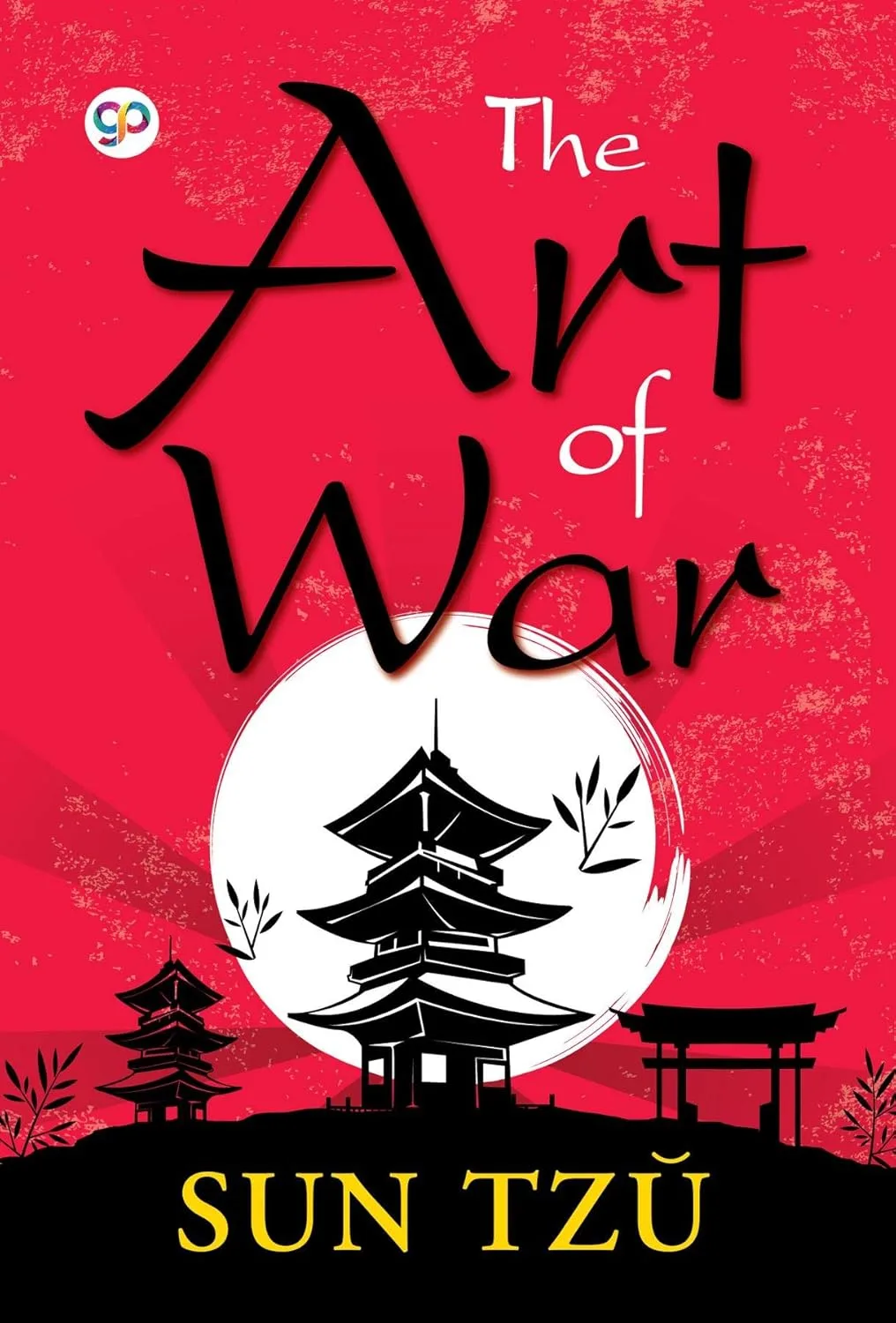
The Art of War
eBook
• INR 257.00
• English
No ratings yet
| Publisher | General Press |
|---|---|
| ASIN/SKU | B01KU77XCA |
| Book Format | eBook |
| Language | English |
| List Price | INR 257.00 |
| Subject Code | PHI003000, HIS027060, BUS071000 |
| Book Code | BD00068246 |
Buy this Book
Amazon Stores
Ebook Stores
Other Stores
Discover The Art of War by Sun Tzu. This book is published by General Press in eBook format, ASIN B01KU77XCA, under Non Fiction, Military Strategy History, Leadership and Motivation.
Book Description
'The Art of War' by Sun Tzu is one of the oldest and most influential books on strategy ever written. Composed more than two thousand years ago, this timeless Chinese classic offers practical wisdom on leadership, planning, decision-making, and conflict. Although originally intended as a military guide, its principles have found lasting relevance in business, politics, sports, and everyday life.
The book is organized into concise chapters, each exploring a different aspect of strategy. Sun Tzu explains that true victory is achieved not through brute force but through careful preparation, sound judgment, and a deep understanding of both oneself and one's opponent. He stresses the importance of gathering accurate information, adapting to changing circumstances, choosing the right moment to act, and avoiding unnecessary battles. According to his philosophy, the greatest triumph is one that is won with minimal conflict and loss.
Throughout the work, Sun Tzu emphasizes discipline, patience, flexibility, and foresight. He encourages leaders to remain calm under pressure, make thoughtful decisions, and inspire confidence among those they lead. Rather than promoting aggression, the book advocates intelligence, restraint, and strategic thinking as the keys to lasting success.
Despite its ancient origins, 'The Art of War' continues to influence readers around the world. Its insights extend far beyond the battlefield, offering valuable lessons for navigating competition, solving problems, managing relationships, and achieving long-term goals. Clear, concise, and remarkably timeless, this classic remains an essential read for anyone seeking to think more strategically and lead with wisdom and confidence.
The book is organized into concise chapters, each exploring a different aspect of strategy. Sun Tzu explains that true victory is achieved not through brute force but through careful preparation, sound judgment, and a deep understanding of both oneself and one's opponent. He stresses the importance of gathering accurate information, adapting to changing circumstances, choosing the right moment to act, and avoiding unnecessary battles. According to his philosophy, the greatest triumph is one that is won with minimal conflict and loss.
Throughout the work, Sun Tzu emphasizes discipline, patience, flexibility, and foresight. He encourages leaders to remain calm under pressure, make thoughtful decisions, and inspire confidence among those they lead. Rather than promoting aggression, the book advocates intelligence, restraint, and strategic thinking as the keys to lasting success.
Despite its ancient origins, 'The Art of War' continues to influence readers around the world. Its insights extend far beyond the battlefield, offering valuable lessons for navigating competition, solving problems, managing relationships, and achieving long-term goals. Clear, concise, and remarkably timeless, this classic remains an essential read for anyone seeking to think more strategically and lead with wisdom and confidence.
Author Biography
Sun Tzu (also spelled Sunzi) was an ancient Chinese military strategist, philosopher, and writer who is traditionally regarded as the author of The Art of War, one of the most influential books on military strategy ever written. Although little is known with certainty about his life, his ideas have shaped not only warfare but also leadership, politics, business, diplomacy, and personal decision-making for more than two thousand years. His emphasis on wisdom, preparation, and understanding human nature continues to inspire readers across the world.
According to traditional historical accounts, Sun Tzu lived during the late Spring and Autumn Period of Chinese history, around the fifth century BCE. He is believed to have served as a military general under King Helü of the State of Wu. Ancient historian Sima Qian described him as a brilliant strategist whose military expertise helped Wu achieve important victories over rival states. However, because reliable historical records from that era are limited, some aspects of his life remain uncertain, and scholars continue to debate the exact details of his biography.
Sun Tzu's enduring fame rests on The Art of War, a concise but remarkably profound work consisting of thirteen chapters on military strategy and leadership. Rather than glorifying conflict, the book teaches that the highest form of victory is achieved through careful planning, intelligence, diplomacy, and avoiding unnecessary battles. It emphasizes self-discipline, adaptability, understanding both oneself and one's opponent, and making wise decisions based on changing circumstances. These timeless principles have made the work relevant far beyond the battlefield.
Over the centuries, The Art of War spread throughout Asia and eventually around the world. It has been translated into numerous languages and is widely studied not only by military leaders but also by executives, political leaders, athletes, educators, and students of strategy. Its insights into planning, negotiation, and leadership continue to influence many fields of modern life.
Although much about Sun Tzu's personal life remains a mystery, his intellectual legacy is undeniable. He is remembered as one of history's greatest strategic thinkers, whose teachings transcend time and culture. His work reminds readers that true strength lies not merely in force but in wisdom, patience, preparation, and the ability to understand both human nature and the ever-changing challenges of the world.
According to traditional historical accounts, Sun Tzu lived during the late Spring and Autumn Period of Chinese history, around the fifth century BCE. He is believed to have served as a military general under King Helü of the State of Wu. Ancient historian Sima Qian described him as a brilliant strategist whose military expertise helped Wu achieve important victories over rival states. However, because reliable historical records from that era are limited, some aspects of his life remain uncertain, and scholars continue to debate the exact details of his biography.
Sun Tzu's enduring fame rests on The Art of War, a concise but remarkably profound work consisting of thirteen chapters on military strategy and leadership. Rather than glorifying conflict, the book teaches that the highest form of victory is achieved through careful planning, intelligence, diplomacy, and avoiding unnecessary battles. It emphasizes self-discipline, adaptability, understanding both oneself and one's opponent, and making wise decisions based on changing circumstances. These timeless principles have made the work relevant far beyond the battlefield.
Over the centuries, The Art of War spread throughout Asia and eventually around the world. It has been translated into numerous languages and is widely studied not only by military leaders but also by executives, political leaders, athletes, educators, and students of strategy. Its insights into planning, negotiation, and leadership continue to influence many fields of modern life.
Although much about Sun Tzu's personal life remains a mystery, his intellectual legacy is undeniable. He is remembered as one of history's greatest strategic thinkers, whose teachings transcend time and culture. His work reminds readers that true strength lies not merely in force but in wisdom, patience, preparation, and the ability to understand both human nature and the ever-changing challenges of the world.
Editorial Reviews
Editorial Reviews will be added soon…
Book Summary
Sun Tzu’s "The Art of War", composed in ancient China during the turbulent Spring and Autumn period, remains the most influential military treatise in history. Written over two and a half millennia ago, this remarkably concise text transcends the specific mechanics of ancient combat, offering a timeless philosophy of conflict, strategy, and leadership. Unlike Western military epics that often glorify the brutal clash of armies and heroic bloodshed, Sun Tzu approaches warfare with a profound sense of caution and pragmatism. He immediately establishes that warfare is a matter of life and death, a road either to safety or to ruin, and must therefore be studied with the utmost seriousness. For Sun Tzu, the supreme art of war is not to win a hundred victories in a hundred battles, but rather to subdue the enemy entirely without fighting.
The foundation of Sun Tzu’s strategic philosophy rests upon five fundamental factors that a commander must meticulously evaluate before ever taking to the field. The first and most vital is the Moral Law, or the Tao, which represents the complete harmony and trust between the ruler and the people, ensuring that soldiers will follow their commander to the death without fear. The remaining factors include Heaven, which dictates the weather and time; Earth, which encompasses distances and the nature of the terrain; the Commander, who must possess the virtues of wisdom, sincerity, benevolence, courage, and strictness; and finally, Method and Discipline, which involves army organization, logistics, and the management of resources. By calculating these five elements, a general can reliably predict the outcome of a conflict before a single sword is drawn.
Central to the execution of any strategy is the principle of deception. Sun Tzu famously asserts that all warfare is based on deception. When an army is capable of attacking, it must appear incapable; when deploying forces, it must appear inactive. If the enemy is close, the commander must make them believe he is far away; if far away, he must make them believe he is near. This psychological manipulation is designed to keep the adversary in a perpetual state of confusion and miscalculation. By feigning weakness to encourage the enemy’s arrogance, or by creating the illusion of chaos to mask a highly disciplined formation, a skilled general ensures that the enemy is always reacting to false information, entirely unable to adequately prepare or defend themselves.
Economic pragmatism heavily influences Sun Tzu’s approach to armed conflict. He starkly warns against prolonged military campaigns, arguing that there is no instance of a country having benefited from prolonged warfare. War is an incredibly expensive endeavor that rapidly depletes the resources of the state, impoverishes the peasantry, and exhausts the army. Therefore, speed and efficiency are paramount. If an army must fight, the objective should be a swift, decisive victory. A brilliant commander ensures that his troops forage on the enemy, essentially using the opponent's resources to sustain his own forces. The ultimate goal is to capture the enemy's state, army, and resources as intact as possible, recognizing that destroyed infrastructure and dead adversaries yield no lasting benefit to the victor.
Because of the catastrophic costs of battle, Sun Tzu delineates a strict hierarchy of strategic objectives. The highest form of generalship is to actively thwart the enemy's strategy before it can even be implemented. If this is impossible, the next best approach is to disrupt the enemy's alliances, isolating them diplomatically and strategically. The third and significantly less desirable option is to attack the enemy's army in the field. The absolute worst strategy, to be undertaken only when no other choice exists, is to besiege walled cities. Sieges require immense preparation, drain resources for months, and often result in devastating casualties. True brilliance lies in outmaneuvering the enemy so completely that they recognize the futility of resistance and surrender without a physical clash.
To achieve this level of mastery, absolute knowledge is required. Perhaps the most quoted maxim from the text states that if you know the enemy and know yourself, you need not fear the result of a hundred battles. If you know yourself but not the enemy, for every victory gained you will also suffer a defeat. If you know neither the enemy nor yourself, you will succumb in every single battle. This necessitates a brutal, objective assessment of one's own strengths and weaknesses, alongside an exhaustive understanding of the opponent's leadership, morale, and capabilities. Victory belongs to the commander who possesses superior information and uses it to exploit the asymmetrical vulnerabilities of their opponent.
On the battlefield, Sun Tzu describes the dynamic interplay of energy, momentum, and tactics using the concepts of orthodox and unorthodox forces. Orthodox forces are used to engage the enemy, establish the battle line, and hold their attention. Unorthodox forces, however, are the unexpected, highly mobile elements used to strike at vulnerable flanks or rear echelons, delivering the decisive blow that secures victory. The combination of these forces creates a boundless array of tactical maneuvers. A master commander controls the momentum of the battle, creating a force that Sun Tzu compares to the kinetic energy of a rushing torrent that can even roll boulders along its course. The strategic positioning is the drawn crossbow, and the exact timing of the attack is the release of the trigger.
The management of terrain is also critical to this strategic calculus. Sun Tzu provides exhaustive categorizations of different geographical environments—such as accessible, entangled, or enclosed terrains—and prescribes specific rules of engagement for each. A wise general uses the terrain as an active ally, never fighting uphill or against the current of a river. Most crucially, Sun Tzu introduces the psychological concept of death ground. When an army is placed in a situation where there is absolutely no possibility of retreat, the soldiers will fight with desperate, ferocious courage because their only alternative is annihilation. By manipulating positioning, a commander can extract maximum effort from his troops while simultaneously pushing the enemy onto disadvantageous ground.
To acquire the vital intelligence necessary for all these maneuvers, Sun Tzu dedicates his final chapters to the absolute necessity of espionage. He views the employment of spies not as an honorable luxury, but as an indispensable requirement for state survival. He categorizes five types of spies—local, inward, converted, doomed, and surviving—who must be woven into an intricate intelligence network. It is the height of unpardonable folly, he argues, to grudge the relatively small financial cost of paying spies when the fate of thousands of lives and the entire state hangs in the balance. Only the most sagacious, humane, and subtle leaders are capable of successfully managing spies to acquire the foreknowledge that guarantees victory.
Ultimately, "The Art of War" endures because it is fundamentally a treatise on human psychology, rational calculation, and the management of conflict. Sun Tzu stripped warfare of its romanticism and mythology, presenting it instead as a highly logical, almost scientific endeavor. His profound insights into the nature of power, the necessity of flexibility, and the supreme value of intelligence have allowed the text to cross centuries and cultural boundaries. Today, its principles are passionately studied not only by military academies but also by business leaders, legal strategists, and athletes worldwide, serving as an eternal guide for anyone seeking to navigate competitive environments and achieve victory with maximum efficiency and minimum destruction.
The foundation of Sun Tzu’s strategic philosophy rests upon five fundamental factors that a commander must meticulously evaluate before ever taking to the field. The first and most vital is the Moral Law, or the Tao, which represents the complete harmony and trust between the ruler and the people, ensuring that soldiers will follow their commander to the death without fear. The remaining factors include Heaven, which dictates the weather and time; Earth, which encompasses distances and the nature of the terrain; the Commander, who must possess the virtues of wisdom, sincerity, benevolence, courage, and strictness; and finally, Method and Discipline, which involves army organization, logistics, and the management of resources. By calculating these five elements, a general can reliably predict the outcome of a conflict before a single sword is drawn.
Central to the execution of any strategy is the principle of deception. Sun Tzu famously asserts that all warfare is based on deception. When an army is capable of attacking, it must appear incapable; when deploying forces, it must appear inactive. If the enemy is close, the commander must make them believe he is far away; if far away, he must make them believe he is near. This psychological manipulation is designed to keep the adversary in a perpetual state of confusion and miscalculation. By feigning weakness to encourage the enemy’s arrogance, or by creating the illusion of chaos to mask a highly disciplined formation, a skilled general ensures that the enemy is always reacting to false information, entirely unable to adequately prepare or defend themselves.
Economic pragmatism heavily influences Sun Tzu’s approach to armed conflict. He starkly warns against prolonged military campaigns, arguing that there is no instance of a country having benefited from prolonged warfare. War is an incredibly expensive endeavor that rapidly depletes the resources of the state, impoverishes the peasantry, and exhausts the army. Therefore, speed and efficiency are paramount. If an army must fight, the objective should be a swift, decisive victory. A brilliant commander ensures that his troops forage on the enemy, essentially using the opponent's resources to sustain his own forces. The ultimate goal is to capture the enemy's state, army, and resources as intact as possible, recognizing that destroyed infrastructure and dead adversaries yield no lasting benefit to the victor.
Because of the catastrophic costs of battle, Sun Tzu delineates a strict hierarchy of strategic objectives. The highest form of generalship is to actively thwart the enemy's strategy before it can even be implemented. If this is impossible, the next best approach is to disrupt the enemy's alliances, isolating them diplomatically and strategically. The third and significantly less desirable option is to attack the enemy's army in the field. The absolute worst strategy, to be undertaken only when no other choice exists, is to besiege walled cities. Sieges require immense preparation, drain resources for months, and often result in devastating casualties. True brilliance lies in outmaneuvering the enemy so completely that they recognize the futility of resistance and surrender without a physical clash.
To achieve this level of mastery, absolute knowledge is required. Perhaps the most quoted maxim from the text states that if you know the enemy and know yourself, you need not fear the result of a hundred battles. If you know yourself but not the enemy, for every victory gained you will also suffer a defeat. If you know neither the enemy nor yourself, you will succumb in every single battle. This necessitates a brutal, objective assessment of one's own strengths and weaknesses, alongside an exhaustive understanding of the opponent's leadership, morale, and capabilities. Victory belongs to the commander who possesses superior information and uses it to exploit the asymmetrical vulnerabilities of their opponent.
On the battlefield, Sun Tzu describes the dynamic interplay of energy, momentum, and tactics using the concepts of orthodox and unorthodox forces. Orthodox forces are used to engage the enemy, establish the battle line, and hold their attention. Unorthodox forces, however, are the unexpected, highly mobile elements used to strike at vulnerable flanks or rear echelons, delivering the decisive blow that secures victory. The combination of these forces creates a boundless array of tactical maneuvers. A master commander controls the momentum of the battle, creating a force that Sun Tzu compares to the kinetic energy of a rushing torrent that can even roll boulders along its course. The strategic positioning is the drawn crossbow, and the exact timing of the attack is the release of the trigger.
The management of terrain is also critical to this strategic calculus. Sun Tzu provides exhaustive categorizations of different geographical environments—such as accessible, entangled, or enclosed terrains—and prescribes specific rules of engagement for each. A wise general uses the terrain as an active ally, never fighting uphill or against the current of a river. Most crucially, Sun Tzu introduces the psychological concept of death ground. When an army is placed in a situation where there is absolutely no possibility of retreat, the soldiers will fight with desperate, ferocious courage because their only alternative is annihilation. By manipulating positioning, a commander can extract maximum effort from his troops while simultaneously pushing the enemy onto disadvantageous ground.
To acquire the vital intelligence necessary for all these maneuvers, Sun Tzu dedicates his final chapters to the absolute necessity of espionage. He views the employment of spies not as an honorable luxury, but as an indispensable requirement for state survival. He categorizes five types of spies—local, inward, converted, doomed, and surviving—who must be woven into an intricate intelligence network. It is the height of unpardonable folly, he argues, to grudge the relatively small financial cost of paying spies when the fate of thousands of lives and the entire state hangs in the balance. Only the most sagacious, humane, and subtle leaders are capable of successfully managing spies to acquire the foreknowledge that guarantees victory.
Ultimately, "The Art of War" endures because it is fundamentally a treatise on human psychology, rational calculation, and the management of conflict. Sun Tzu stripped warfare of its romanticism and mythology, presenting it instead as a highly logical, almost scientific endeavor. His profound insights into the nature of power, the necessity of flexibility, and the supreme value of intelligence have allowed the text to cross centuries and cultural boundaries. Today, its principles are passionately studied not only by military academies but also by business leaders, legal strategists, and athletes worldwide, serving as an eternal guide for anyone seeking to navigate competitive environments and achieve victory with maximum efficiency and minimum destruction.
Sample Chapters
Chapter 1 : Laying Plans
1. Sun Tzu said: The art of war is of vital importance to the State.
2. It is a matter of life and death, a road either to safety or to ruin. Hence it is a subject of inquiry which can on no account be neglected.
3. The art of war, then, is governed by five constant factors, to be taken into account in one’s deliberations, when seeking to determine the conditions obtaining in the field.
4. These are: (1) The Moral Law; (2) Heaven; (3) Earth; (4) The Commander; (5) Method and discipline.
5, 6. The Moral Law causes the people to be in complete accord with their ruler, so that they will follow him regardless of their lives, undismayed by any danger.
7. Heaven signifies night and day, cold and heat, times and seasons.
8. Earth comprises distances, great and small; danger and security; open ground and narrow passes; the chances of life and death.
9. The Commander stands for the virtues of wisdom, sincerity, benevolence, courage and strictness.
The five cardinal virtues of the Chinese are
(1) humanity or benevolence; (2) uprightness of mind; (3) self-respect, self-control, or ‘proper feeling’;
(4) wisdom; (5) sincerity or good faith.
10. By Method and discipline are to be understood the marshalling of the army in its proper subdivisions, the gradations of rank among the officers, the maintenance of roads by which supplies may reach the army, and the control of military expenditure.
11. These five heads should be familiar to every general: he who knows them will be victorious; he who knows them will not fail.
12. Therefore, in your deliberations, when seeking to determine the military conditions, let them be made the basis of a comparison, in this wise.
13. (1) Which of the two sovereigns is imbued with the Moral law?
(2) Which of the two generals has most ability?
(3) With whom lie the advantages derived from Heaven and Earth?
(4) On which side is discipline most rigorously enforced?
Tu Mu alludes to the remarkable story of Ts‘ao Ts‘ao (A.D. 155-220), who was such a strict disciplinarian that once, in accordance with his own severe regulations against injury to standing crops, he condemned himself to death for having allowed his horse to stay into a field of corn! However, in lieu of losing his head, he was persuaded to satisfy his sense of justice by cutting off his hair. ‘When you lay down a law, see that it is not disobeyed; if it is disobeyed, the offender must be put to death.’
(5) Which army is the stronger?
(6) On which side are officers and men more highly trained?
‘Without constant practice, the officers will be nervous and undecided when mustering for battle; without constant practice, the general will be wavering and irresolute when the crisis is at hand.’
(7) In which army is there the greater constancy both in reward and punishment?
That is, on which side is there the most absolute certainty that merit will be properly rewarded and misdeeds summarily punished?
14. By means of these seven considerations I can forecast victory or defeat.
15. The general that hearkens to my counsel and acts upon it, will conquer—let such a one be retained in command! The general that hearkens not to my counsel nor acts upon it, will suffer defeat—let such a one be dismissed!
16. While heeding the profit of my counsel, avail yourself also of any helpful circumstances over and beyond the ordinary rules.
17. According to circumstances that are favourable, one should modify one’s plans.
Sun Tzu, as a practical soldier, cautions us here not to pin our faith to abstract principles; ‘for,’ as Chang Yü puts it, ‘while the main laws of strategy can be stated clearly enough for the benefit of all and sundry, you must be guided by the actions of the enemy in attempting to secure a favourable position in actual warfare.’ On the eve of the battle of Waterloo, Lord Uxbridge, commanding the cavalry, went to the Duke of Wellington in order to learn what his plans and calculations were for the morrow, because, as he explained, he might suddenly find himself Commander-in-chief and would be unable to frame new plans in a critical moment. The Duke listened quietly and then said: ‘Who will attack the first tomorrow – I or Bonaparte?’ ‘Bonaparte,’ replied Lord Uxbridge. ‘Well,’ continued the Duke, ‘Bonaparte has not given me any idea of his projects; and as my plans will depend upon his, how can you expect me to tell you what mine are?’
18. All warfare is based on deception.
The truth of this pithy and profound saying will be admitted by every soldier. Wellington, great in so many military qualities, was especially distinguished by ‘the extraordinary skill with which he concealed his movements and deceived both friend and foe.’
19. Hence, when able to attack, we must seem unable; when using our forces, we must seem inactive; when we are near, we must make the enemy believe we are far away; when far away, we must make him believe we are near.
20. Hold out baits to entice the enemy. Feign disorder, and crush him.
21. If he is secure at all points, be prepared for him. If he is in superior strength, evade him.
22. If your opponent is of choleric temper, seek to irritate him. Pretend to be weak, so that he may grow arrogant.
The good tactician plays with his adversary as a cat plays with a mouse, first feigning weakness and immobility, and then suddenly pouncing upon him.
23. If he is taking his ease, give him no rest. If his forces are united, separate them.
24. Attack him where he is unprepared, appear where you are not expected.
25. These military devices, leading to victory, must not be divulged beforehand.
26. Now the general who wins a battle makes many calculations in his temple ere the battle is fought. The general who loses a battle makes but few calculations beforehand. Thus do many calculations lead to victory, and few calculations to defeat: how much more no calculation at all! It is by attention to this point that I can foresee who is likely to win or lose.
Chapter 2 : Waging War
‘He who wishes to fight must first count the cost,’ which prepares us for the discovery that the subject of the chapter is not what we might expect from the title, but is primarily a consideration of ways and means.
1. Sun Tzu said: In the operations of war, where there are thousand swift chariots in the field, so many heavy chariots, and a hundred thousand mail-clad soldiers, with provisions enough to carry them a thousand li, the expenditure at home and at the front, including entertainment of guests, small items such as glue and paint, and sums spent on chariots and armour, will reach the total of a thousand ounces of silver per day. Such is the cost of raising an army of 100,000 men.
2. When you engage in actual fighting, if victory is long in coming, the men’s weapons will grow dull and their ardour will be damped. If you lay siege to a town, you will exhaust your strength.
3. Again, if the campaign is protracted, the resources of the State will not be equal to the strain.
4. Now, when your weapons are dulled, your ardour damped, your strength exhausted and your treasure spent, other chieftains will spring up to take advantage of your extremity. Then no man, however wise, will be able to avert the consequences that must ensue.
5. Thus, though we have heard of stupid haste in war, cleverness has never been seen associated with long delays.
6. There is no instance of a country having benefited from prolonged warfare.
7. It is only one who is thoroughly acquainted with the evils of war can only thoroughly understand the profitable way of carrying it on.
That is, with rapidity. Only one who knows the disastrous effects of a long war can realise the supreme importance of rapidity in bringing it to a close.
8. The skilful soldier does not raise a second levy, neither are his supply-waggons loaded more than twice.
Once war is declared, he will not waste precious time in waiting for reinforcements, nor will he turn his army back for fresh supplies, but crosses the enemy’s frontier without delay. This may seem an audacious policy to recommend, but with all great strategists, from Julius Caesar to Napoleon Bonaparte, the value of time—that is, being a little ahead of your opponent—has counted for more than either numerical superiority or the nicest calculations with regard to commissariat.
9. Bring war material with you from home, but forage on the enemy. Thus the army will have food enough for its needs.
10. Poverty of the State exchequer causes an army to be maintained by contributions from a distance. Contributing to maintain an army at a distance causes the people to be impoverished.
11. On the other hand, the proximity of an army causes prices to go up; and high prices cause the people’s substance to be drained away.
12. When their substance is drained away, the peasantry will be afflicted by heavy exactions.
13, 14. With this loss of substance and exhaustion of strength, the homes of the people will be stripped bare, and three-tenths of their incomes will be dissipated; while Government expenses for broken chariots, worn-out horses, breast-plates and helmets, bows and arrows, spears and shields, protective mantlets, draught-oxen and heavy waggons, will amount to four-tenths of its total revenue.
‘The people being regarded as the essential part of the State, and food as the people’s heaven, is it not right that those in authority should value and be careful of both?’
15. Hence a wise general makes a point of foraging on the enemy. One cartload of the enemy’s provisions is equivalent to twenty of one’s own, and likewise a single picul of his provender is equivalent to twenty from one’s own store.
Because twenty cartloads will be consumed in the process of transporting one cartload to the front.
16. Now in order to kill the enemy, our men must be roused to anger; that there may be advantage from defeating the enemy, they must have their rewards.
‘Rewards are necessary in order to make the soldiers see the advantage of beating the enemy; thus, when you capture spoils from the enemy, they must be used as rewards, so that all your men may have a keen desire to fight, each on his own account.’
17. Therefore in chariot fighting, when ten or more chariots have been taken, those should be rewarded who took the first. Our own flags should be substituted for those of the enemy, and the chariots mingled and used in conjunction with ours. The captured soldiers should be kindly treated and kept.
18. This is called, using the conquered foe to augment one’s own strength.
19. In war, then, let your great object be victory, not lengthy campaigns.
‘War is not a thing to be trifled with.’
1. Sun Tzu said: The art of war is of vital importance to the State.
2. It is a matter of life and death, a road either to safety or to ruin. Hence it is a subject of inquiry which can on no account be neglected.
3. The art of war, then, is governed by five constant factors, to be taken into account in one’s deliberations, when seeking to determine the conditions obtaining in the field.
4. These are: (1) The Moral Law; (2) Heaven; (3) Earth; (4) The Commander; (5) Method and discipline.
5, 6. The Moral Law causes the people to be in complete accord with their ruler, so that they will follow him regardless of their lives, undismayed by any danger.
7. Heaven signifies night and day, cold and heat, times and seasons.
8. Earth comprises distances, great and small; danger and security; open ground and narrow passes; the chances of life and death.
9. The Commander stands for the virtues of wisdom, sincerity, benevolence, courage and strictness.
The five cardinal virtues of the Chinese are
(1) humanity or benevolence; (2) uprightness of mind; (3) self-respect, self-control, or ‘proper feeling’;
(4) wisdom; (5) sincerity or good faith.
10. By Method and discipline are to be understood the marshalling of the army in its proper subdivisions, the gradations of rank among the officers, the maintenance of roads by which supplies may reach the army, and the control of military expenditure.
11. These five heads should be familiar to every general: he who knows them will be victorious; he who knows them will not fail.
12. Therefore, in your deliberations, when seeking to determine the military conditions, let them be made the basis of a comparison, in this wise.
13. (1) Which of the two sovereigns is imbued with the Moral law?
(2) Which of the two generals has most ability?
(3) With whom lie the advantages derived from Heaven and Earth?
(4) On which side is discipline most rigorously enforced?
Tu Mu alludes to the remarkable story of Ts‘ao Ts‘ao (A.D. 155-220), who was such a strict disciplinarian that once, in accordance with his own severe regulations against injury to standing crops, he condemned himself to death for having allowed his horse to stay into a field of corn! However, in lieu of losing his head, he was persuaded to satisfy his sense of justice by cutting off his hair. ‘When you lay down a law, see that it is not disobeyed; if it is disobeyed, the offender must be put to death.’
(5) Which army is the stronger?
(6) On which side are officers and men more highly trained?
‘Without constant practice, the officers will be nervous and undecided when mustering for battle; without constant practice, the general will be wavering and irresolute when the crisis is at hand.’
(7) In which army is there the greater constancy both in reward and punishment?
That is, on which side is there the most absolute certainty that merit will be properly rewarded and misdeeds summarily punished?
14. By means of these seven considerations I can forecast victory or defeat.
15. The general that hearkens to my counsel and acts upon it, will conquer—let such a one be retained in command! The general that hearkens not to my counsel nor acts upon it, will suffer defeat—let such a one be dismissed!
16. While heeding the profit of my counsel, avail yourself also of any helpful circumstances over and beyond the ordinary rules.
17. According to circumstances that are favourable, one should modify one’s plans.
Sun Tzu, as a practical soldier, cautions us here not to pin our faith to abstract principles; ‘for,’ as Chang Yü puts it, ‘while the main laws of strategy can be stated clearly enough for the benefit of all and sundry, you must be guided by the actions of the enemy in attempting to secure a favourable position in actual warfare.’ On the eve of the battle of Waterloo, Lord Uxbridge, commanding the cavalry, went to the Duke of Wellington in order to learn what his plans and calculations were for the morrow, because, as he explained, he might suddenly find himself Commander-in-chief and would be unable to frame new plans in a critical moment. The Duke listened quietly and then said: ‘Who will attack the first tomorrow – I or Bonaparte?’ ‘Bonaparte,’ replied Lord Uxbridge. ‘Well,’ continued the Duke, ‘Bonaparte has not given me any idea of his projects; and as my plans will depend upon his, how can you expect me to tell you what mine are?’
18. All warfare is based on deception.
The truth of this pithy and profound saying will be admitted by every soldier. Wellington, great in so many military qualities, was especially distinguished by ‘the extraordinary skill with which he concealed his movements and deceived both friend and foe.’
19. Hence, when able to attack, we must seem unable; when using our forces, we must seem inactive; when we are near, we must make the enemy believe we are far away; when far away, we must make him believe we are near.
20. Hold out baits to entice the enemy. Feign disorder, and crush him.
21. If he is secure at all points, be prepared for him. If he is in superior strength, evade him.
22. If your opponent is of choleric temper, seek to irritate him. Pretend to be weak, so that he may grow arrogant.
The good tactician plays with his adversary as a cat plays with a mouse, first feigning weakness and immobility, and then suddenly pouncing upon him.
23. If he is taking his ease, give him no rest. If his forces are united, separate them.
24. Attack him where he is unprepared, appear where you are not expected.
25. These military devices, leading to victory, must not be divulged beforehand.
26. Now the general who wins a battle makes many calculations in his temple ere the battle is fought. The general who loses a battle makes but few calculations beforehand. Thus do many calculations lead to victory, and few calculations to defeat: how much more no calculation at all! It is by attention to this point that I can foresee who is likely to win or lose.
Chapter 2 : Waging War
‘He who wishes to fight must first count the cost,’ which prepares us for the discovery that the subject of the chapter is not what we might expect from the title, but is primarily a consideration of ways and means.
1. Sun Tzu said: In the operations of war, where there are thousand swift chariots in the field, so many heavy chariots, and a hundred thousand mail-clad soldiers, with provisions enough to carry them a thousand li, the expenditure at home and at the front, including entertainment of guests, small items such as glue and paint, and sums spent on chariots and armour, will reach the total of a thousand ounces of silver per day. Such is the cost of raising an army of 100,000 men.
2. When you engage in actual fighting, if victory is long in coming, the men’s weapons will grow dull and their ardour will be damped. If you lay siege to a town, you will exhaust your strength.
3. Again, if the campaign is protracted, the resources of the State will not be equal to the strain.
4. Now, when your weapons are dulled, your ardour damped, your strength exhausted and your treasure spent, other chieftains will spring up to take advantage of your extremity. Then no man, however wise, will be able to avert the consequences that must ensue.
5. Thus, though we have heard of stupid haste in war, cleverness has never been seen associated with long delays.
6. There is no instance of a country having benefited from prolonged warfare.
7. It is only one who is thoroughly acquainted with the evils of war can only thoroughly understand the profitable way of carrying it on.
That is, with rapidity. Only one who knows the disastrous effects of a long war can realise the supreme importance of rapidity in bringing it to a close.
8. The skilful soldier does not raise a second levy, neither are his supply-waggons loaded more than twice.
Once war is declared, he will not waste precious time in waiting for reinforcements, nor will he turn his army back for fresh supplies, but crosses the enemy’s frontier without delay. This may seem an audacious policy to recommend, but with all great strategists, from Julius Caesar to Napoleon Bonaparte, the value of time—that is, being a little ahead of your opponent—has counted for more than either numerical superiority or the nicest calculations with regard to commissariat.
9. Bring war material with you from home, but forage on the enemy. Thus the army will have food enough for its needs.
10. Poverty of the State exchequer causes an army to be maintained by contributions from a distance. Contributing to maintain an army at a distance causes the people to be impoverished.
11. On the other hand, the proximity of an army causes prices to go up; and high prices cause the people’s substance to be drained away.
12. When their substance is drained away, the peasantry will be afflicted by heavy exactions.
13, 14. With this loss of substance and exhaustion of strength, the homes of the people will be stripped bare, and three-tenths of their incomes will be dissipated; while Government expenses for broken chariots, worn-out horses, breast-plates and helmets, bows and arrows, spears and shields, protective mantlets, draught-oxen and heavy waggons, will amount to four-tenths of its total revenue.
‘The people being regarded as the essential part of the State, and food as the people’s heaven, is it not right that those in authority should value and be careful of both?’
15. Hence a wise general makes a point of foraging on the enemy. One cartload of the enemy’s provisions is equivalent to twenty of one’s own, and likewise a single picul of his provender is equivalent to twenty from one’s own store.
Because twenty cartloads will be consumed in the process of transporting one cartload to the front.
16. Now in order to kill the enemy, our men must be roused to anger; that there may be advantage from defeating the enemy, they must have their rewards.
‘Rewards are necessary in order to make the soldiers see the advantage of beating the enemy; thus, when you capture spoils from the enemy, they must be used as rewards, so that all your men may have a keen desire to fight, each on his own account.’
17. Therefore in chariot fighting, when ten or more chariots have been taken, those should be rewarded who took the first. Our own flags should be substituted for those of the enemy, and the chariots mingled and used in conjunction with ours. The captured soldiers should be kindly treated and kept.
18. This is called, using the conquered foe to augment one’s own strength.
19. In war, then, let your great object be victory, not lengthy campaigns.
‘War is not a thing to be trifled with.’
Reader Reviews
No reviews yet.
The Art of War