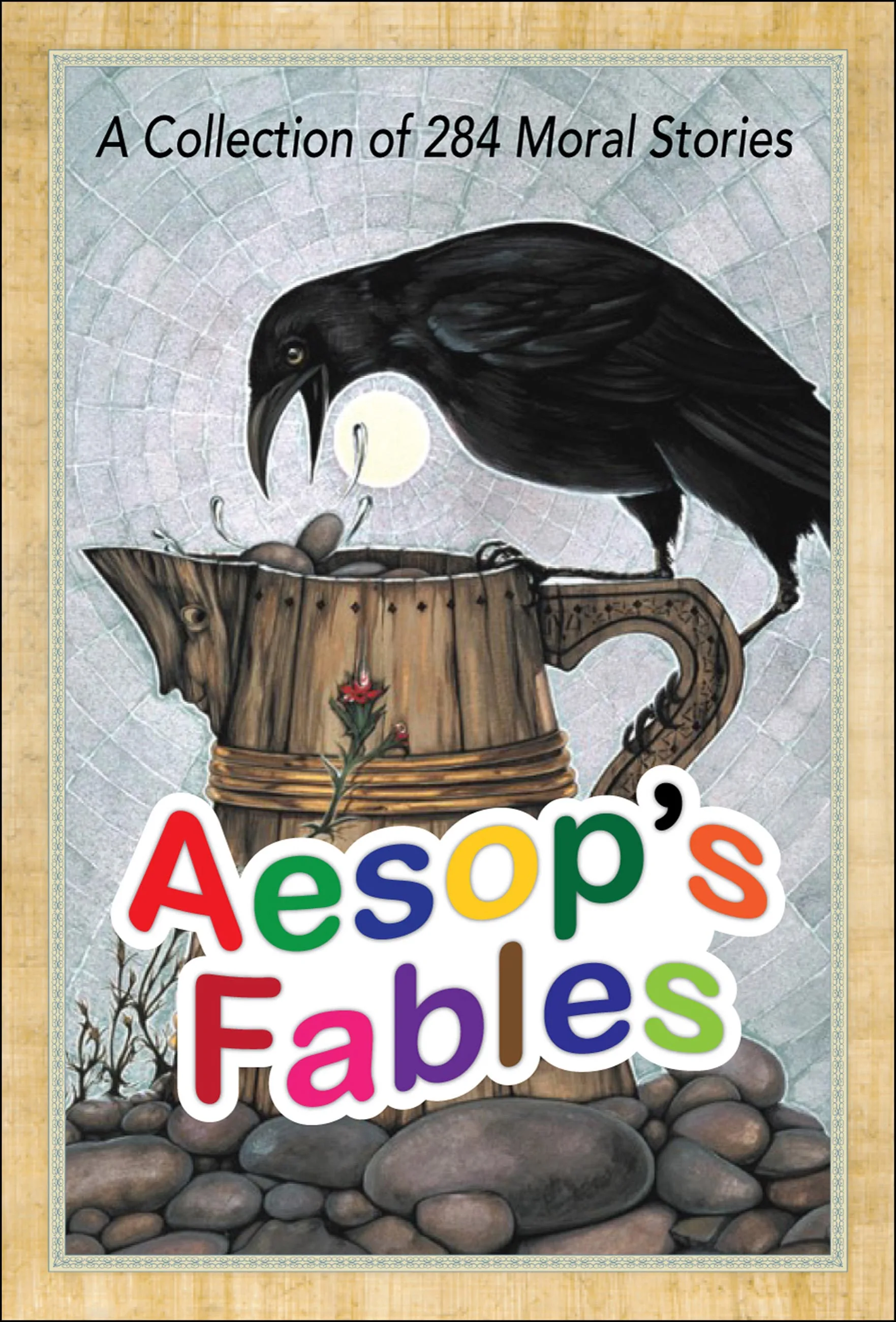
Aesop's Fables
eBook
• INR 70.00
• English
• 9788180320705
No ratings yet
| Publisher | General Press |
|---|---|
| ISBN13 | 9788180320705 |
| ASIN/SKU | B01LZ31KVO |
| Book Format | eBook |
| Language | English |
| List Price | INR 70.00 |
| Subject Code | JUV012000, FIC004000 |
| Book Code | BD00068253 |
Buy this Book
Amazon Stores
Ebook Stores
Other Stores
Discover Aesop's Fables by Aesop. This book is published by General Press in eBook format, ISBN 9788180320705, ASIN B01LZ31KVO, under Children's Books, Children's Classics, Short Stories.
Book Description
Meet a jealous donkey, a tortoise who wants to fly, a very special goose and many other animals in this collection of tales, retold especially for children. Aesop’s fables are the perfect way to learn important lessons about life through the adventures of some unforgettable animal friends.
For centuries, children and adults have treasured the stories handed down by Aesop, a slave who lived in ancient Greece approximately six centuries B.C. Known for their charm and simplicity, these simple tales feature brief adventures of animals, birds, and beasts — with a message hidden in each narrative. With infamous vignettes, such as the race between the hare and the tortoise, the vain jackdaw, and the wolf in sheep’s clothing, the themes of the fables remain as fresh today as when they were first told and give an insight into the Ancient Greek world.
For centuries, children and adults have treasured the stories handed down by Aesop, a slave who lived in ancient Greece approximately six centuries B.C. Known for their charm and simplicity, these simple tales feature brief adventures of animals, birds, and beasts — with a message hidden in each narrative. With infamous vignettes, such as the race between the hare and the tortoise, the vain jackdaw, and the wolf in sheep’s clothing, the themes of the fables remain as fresh today as when they were first told and give an insight into the Ancient Greek world.
Author Biography
Aesop is one of the most celebrated storytellers in history, though very little is known with certainty about his life. He is traditionally believed to have lived in ancient Greece during the sixth century BCE, and many historical accounts describe him as having been born into slavery before eventually gaining his freedom. While the details of his life remain uncertain and are often mixed with legend, the enduring collection of stories attributed to him has made Aesop a timeless figure whose wisdom continues to inspire readers of all ages.
According to ancient tradition, Aesop possessed remarkable intelligence, wit, and a gift for storytelling. Rather than delivering long speeches or philosophical arguments, he used short, memorable tales featuring animals with human qualities to illustrate important truths about life. Foxes, lions, crows, tortoises, hares, wolves, and many other creatures became the voices through which he explored human nature, exposing pride, greed, dishonesty, kindness, patience, and wisdom. These simple yet powerful narratives allowed listeners to understand complex moral lessons with ease.
Although Aesop himself is not believed to have written down his fables, they were preserved through oral tradition for generations before being collected and recorded by later writers. Over the centuries, these stories spread across Europe, Asia, and eventually the rest of the world. Classics such as The Tortoise and the Hare, The Boy Who Cried Wolf, The Fox and the Grapes, and The Lion and the Mouse have become an essential part of children's literature while also offering meaningful lessons for adults. Their universal themes have allowed them to remain relevant for more than two thousand years.
The influence of Aesop extends far beyond literature. His fables have shaped education, ethics, and storytelling traditions across countless cultures. Writers, teachers, philosophers, and artists have repeatedly drawn upon his work to communicate moral values and practical wisdom. Because the stories focus on universal aspects of human behavior rather than specific times or places, they continue to resonate with readers from every generation.
Though the true details of Aesop's life may never be fully known, his legacy is unquestionable. Through a collection of simple yet profound fables, he created a body of work that has educated, entertained, and inspired millions of people around the world, making him one of history's most enduring and beloved storytellers.
According to ancient tradition, Aesop possessed remarkable intelligence, wit, and a gift for storytelling. Rather than delivering long speeches or philosophical arguments, he used short, memorable tales featuring animals with human qualities to illustrate important truths about life. Foxes, lions, crows, tortoises, hares, wolves, and many other creatures became the voices through which he explored human nature, exposing pride, greed, dishonesty, kindness, patience, and wisdom. These simple yet powerful narratives allowed listeners to understand complex moral lessons with ease.
Although Aesop himself is not believed to have written down his fables, they were preserved through oral tradition for generations before being collected and recorded by later writers. Over the centuries, these stories spread across Europe, Asia, and eventually the rest of the world. Classics such as The Tortoise and the Hare, The Boy Who Cried Wolf, The Fox and the Grapes, and The Lion and the Mouse have become an essential part of children's literature while also offering meaningful lessons for adults. Their universal themes have allowed them to remain relevant for more than two thousand years.
The influence of Aesop extends far beyond literature. His fables have shaped education, ethics, and storytelling traditions across countless cultures. Writers, teachers, philosophers, and artists have repeatedly drawn upon his work to communicate moral values and practical wisdom. Because the stories focus on universal aspects of human behavior rather than specific times or places, they continue to resonate with readers from every generation.
Though the true details of Aesop's life may never be fully known, his legacy is unquestionable. Through a collection of simple yet profound fables, he created a body of work that has educated, entertained, and inspired millions of people around the world, making him one of history's most enduring and beloved storytellers.
Editorial Reviews
Editorial Reviews will be added soon…
Book Summary
Aesop’s Fables is a timeless collection of short moral stories traditionally attributed to Aesop, an ancient Greek storyteller believed to have lived around the sixth century BCE. Unlike a conventional novel, the book does not follow one continuous plot or a single group of characters. Instead, it brings together many brief tales in which animals, people, and sometimes objects behave like human beings. Through these simple stories, Aesop explores pride, greed, kindness, dishonesty, wisdom, foolishness, patience, hard work, friendship, and the consequences of our choices. The language of the fables is usually simple, but the lessons behind them remain surprisingly deep and relevant.
A central feature of the collection is its use of animals to reflect human behavior. Foxes, lions, wolves, donkeys, mice, crows, tortoises, hares, ants, and other creatures speak, argue, deceive, cooperate, compete, and make decisions much like people do. By placing human weaknesses in the animal world, Aesop makes moral lessons easier to understand. Readers can recognize themselves in the characters without feeling that they are being directly lectured. A proud person may appear as a peacock, a clever manipulator as a fox, a foolish creature as a donkey, and a powerful but careless ruler as a lion.
One of the best-known fables is “The Tortoise and the Hare.” The hare is extremely confident in his speed and mocks the tortoise for being slow. The tortoise accepts the challenge to a race, and the hare quickly takes the lead. Believing that victory is guaranteed, he becomes careless and stops to rest. The tortoise continues moving steadily and eventually reaches the finish line first. The lesson is clear: natural ability is not enough if it is combined with arrogance and laziness. Consistent effort can defeat talent when talent is not supported by discipline.
Another famous story, “The Boy Who Cried Wolf,” examines the destructive effects of lying. A young shepherd repeatedly tricks villagers by pretending that a wolf is attacking the sheep. Each time, the villagers rush to help, only to discover that the boy has lied. Eventually, a real wolf appears, but nobody believes him. The story shows that trust is difficult to build and easy to destroy. A person who repeatedly lies may eventually find that even the truth is ignored.
“The Fox and the Grapes” offers a different kind of psychological insight. A fox sees some grapes hanging high above him and desperately tries to reach them. After several unsuccessful attempts, he walks away and declares that the grapes were probably sour anyway. The phrase “sour grapes” has become part of everyday language because the fable captures a common human tendency: when we cannot obtain something we want, we sometimes pretend that we never wanted it. The story is a small but sharp observation about pride and self-deception.
In “The Lion and the Mouse,” Aesop challenges the assumption that strength determines worth. A lion catches a tiny mouse but decides to spare its life. Later, the lion becomes trapped in a hunter’s net. The mouse hears the lion’s cries and gnaws through the ropes, freeing him. The story teaches that even the smallest and weakest creature can be valuable. Kindness can return unexpectedly, and no one should assume that another person is too insignificant to matter.
The importance of preparation and foresight appears strongly in “The Ant and the Grasshopper.” The ant spends the warm months working and storing food for winter, while the grasshopper spends the time singing and enjoying himself. When winter arrives, the grasshopper has nothing to eat and asks the ant for help. The fable traditionally praises diligence and preparation while warning against living only for immediate pleasure. Its deeper message is about balance: freedom and enjoyment are valuable, but they become dangerous when they completely replace responsibility.
Aesop also repeatedly warns readers about greed. In “The Dog and the Shadow,” a dog carrying a piece of meat sees his reflection in water. Believing that the reflection belongs to another dog with another piece of meat, he opens his mouth to seize it. His own meat falls into the water and disappears. His desire for more causes him to lose what he already possesses. The story captures a familiar human mistake: dissatisfaction can make people sacrifice something real for the possibility of something greater.
“The Goose That Laid the Golden Eggs” develops the same theme. A man discovers that his goose produces a golden egg every day. Instead of being satisfied with this steady wealth, he becomes impatient and kills the goose, hoping to obtain all the gold at once. He discovers that there is nothing inside the goose that can provide the fortune he imagined. His greed destroys the very source of his prosperity. The lesson is particularly powerful because it applies not only to money but to relationships, work, nature, and any situation in which impatience can destroy long-term value.
The collection also contains many stories about deception. The fox frequently appears as a clever character who uses intelligence to manipulate others. However, Aesop does not always present cleverness as admirable. Intelligence without morality can become dangerous. The wolf, too, often represents aggression and selfishness, while the lamb frequently appears as an innocent victim. These repeated patterns help readers quickly understand the moral conflicts within the stories.
Some fables focus on the dangers of trusting appearances. In “The Wolf in Sheep’s Clothing,” a wolf disguises himself as a sheep so that he can approach the flock without being recognized. The disguise allows him to deceive those around him. The story reminds readers that appearances can hide intentions. A person may look harmless while secretly planning to take advantage of others.
Aesop’s stories are not always gentle. Many contain violence, betrayal, death, and punishment. This reflects the realistic moral world of the fables, where actions often have immediate consequences. The stories do not suggest that goodness always guarantees success or that cleverness always wins. Instead, they encourage readers to recognize the dangers present in ordinary life and to think carefully about human behavior.
The moral lessons are usually stated directly or become obvious from the outcome, but the stories themselves are what make those lessons memorable. A child may remember the tortoise and hare long after forgetting an abstract lesson about perseverance. An adult may recognize the psychological truth behind the fox and the grapes or the dog and his reflection. This is one reason the fables have survived for centuries: their simplicity allows different generations to discover new meanings in them.
At the same time, the collection is not merely a book for children. Its short stories offer a compact study of human nature. Aesop repeatedly shows that the same weaknesses appear across different situations: pride makes people careless, greed makes them blind, dishonesty destroys trust, impatience produces loss, and kindness can return in unexpected ways. His animals are fictional, but the emotions they represent are unmistakably human.
Ultimately, Aesop’s Fables is a collection about choices and consequences. Its world is simple enough for a young reader to understand but rich enough for adults to revisit throughout life. The stories encourage qualities such as patience, honesty, humility, generosity, preparation, and good judgment while warning against arrogance, greed, deception, laziness, and envy. Their enduring power comes from Aesop’s ability to turn complicated truths about human behavior into small, memorable stories. Each fable may take only a few minutes to read, but its lesson can remain in the mind for years.
A central feature of the collection is its use of animals to reflect human behavior. Foxes, lions, wolves, donkeys, mice, crows, tortoises, hares, ants, and other creatures speak, argue, deceive, cooperate, compete, and make decisions much like people do. By placing human weaknesses in the animal world, Aesop makes moral lessons easier to understand. Readers can recognize themselves in the characters without feeling that they are being directly lectured. A proud person may appear as a peacock, a clever manipulator as a fox, a foolish creature as a donkey, and a powerful but careless ruler as a lion.
One of the best-known fables is “The Tortoise and the Hare.” The hare is extremely confident in his speed and mocks the tortoise for being slow. The tortoise accepts the challenge to a race, and the hare quickly takes the lead. Believing that victory is guaranteed, he becomes careless and stops to rest. The tortoise continues moving steadily and eventually reaches the finish line first. The lesson is clear: natural ability is not enough if it is combined with arrogance and laziness. Consistent effort can defeat talent when talent is not supported by discipline.
Another famous story, “The Boy Who Cried Wolf,” examines the destructive effects of lying. A young shepherd repeatedly tricks villagers by pretending that a wolf is attacking the sheep. Each time, the villagers rush to help, only to discover that the boy has lied. Eventually, a real wolf appears, but nobody believes him. The story shows that trust is difficult to build and easy to destroy. A person who repeatedly lies may eventually find that even the truth is ignored.
“The Fox and the Grapes” offers a different kind of psychological insight. A fox sees some grapes hanging high above him and desperately tries to reach them. After several unsuccessful attempts, he walks away and declares that the grapes were probably sour anyway. The phrase “sour grapes” has become part of everyday language because the fable captures a common human tendency: when we cannot obtain something we want, we sometimes pretend that we never wanted it. The story is a small but sharp observation about pride and self-deception.
In “The Lion and the Mouse,” Aesop challenges the assumption that strength determines worth. A lion catches a tiny mouse but decides to spare its life. Later, the lion becomes trapped in a hunter’s net. The mouse hears the lion’s cries and gnaws through the ropes, freeing him. The story teaches that even the smallest and weakest creature can be valuable. Kindness can return unexpectedly, and no one should assume that another person is too insignificant to matter.
The importance of preparation and foresight appears strongly in “The Ant and the Grasshopper.” The ant spends the warm months working and storing food for winter, while the grasshopper spends the time singing and enjoying himself. When winter arrives, the grasshopper has nothing to eat and asks the ant for help. The fable traditionally praises diligence and preparation while warning against living only for immediate pleasure. Its deeper message is about balance: freedom and enjoyment are valuable, but they become dangerous when they completely replace responsibility.
Aesop also repeatedly warns readers about greed. In “The Dog and the Shadow,” a dog carrying a piece of meat sees his reflection in water. Believing that the reflection belongs to another dog with another piece of meat, he opens his mouth to seize it. His own meat falls into the water and disappears. His desire for more causes him to lose what he already possesses. The story captures a familiar human mistake: dissatisfaction can make people sacrifice something real for the possibility of something greater.
“The Goose That Laid the Golden Eggs” develops the same theme. A man discovers that his goose produces a golden egg every day. Instead of being satisfied with this steady wealth, he becomes impatient and kills the goose, hoping to obtain all the gold at once. He discovers that there is nothing inside the goose that can provide the fortune he imagined. His greed destroys the very source of his prosperity. The lesson is particularly powerful because it applies not only to money but to relationships, work, nature, and any situation in which impatience can destroy long-term value.
The collection also contains many stories about deception. The fox frequently appears as a clever character who uses intelligence to manipulate others. However, Aesop does not always present cleverness as admirable. Intelligence without morality can become dangerous. The wolf, too, often represents aggression and selfishness, while the lamb frequently appears as an innocent victim. These repeated patterns help readers quickly understand the moral conflicts within the stories.
Some fables focus on the dangers of trusting appearances. In “The Wolf in Sheep’s Clothing,” a wolf disguises himself as a sheep so that he can approach the flock without being recognized. The disguise allows him to deceive those around him. The story reminds readers that appearances can hide intentions. A person may look harmless while secretly planning to take advantage of others.
Aesop’s stories are not always gentle. Many contain violence, betrayal, death, and punishment. This reflects the realistic moral world of the fables, where actions often have immediate consequences. The stories do not suggest that goodness always guarantees success or that cleverness always wins. Instead, they encourage readers to recognize the dangers present in ordinary life and to think carefully about human behavior.
The moral lessons are usually stated directly or become obvious from the outcome, but the stories themselves are what make those lessons memorable. A child may remember the tortoise and hare long after forgetting an abstract lesson about perseverance. An adult may recognize the psychological truth behind the fox and the grapes or the dog and his reflection. This is one reason the fables have survived for centuries: their simplicity allows different generations to discover new meanings in them.
At the same time, the collection is not merely a book for children. Its short stories offer a compact study of human nature. Aesop repeatedly shows that the same weaknesses appear across different situations: pride makes people careless, greed makes them blind, dishonesty destroys trust, impatience produces loss, and kindness can return in unexpected ways. His animals are fictional, but the emotions they represent are unmistakably human.
Ultimately, Aesop’s Fables is a collection about choices and consequences. Its world is simple enough for a young reader to understand but rich enough for adults to revisit throughout life. The stories encourage qualities such as patience, honesty, humility, generosity, preparation, and good judgment while warning against arrogance, greed, deception, laziness, and envy. Their enduring power comes from Aesop’s ability to turn complicated truths about human behavior into small, memorable stories. Each fable may take only a few minutes to read, but its lesson can remain in the mind for years.
Sample Chapters
Sample Chapters will be added soon…
Reader Reviews
No reviews yet.
Aesop's Fables