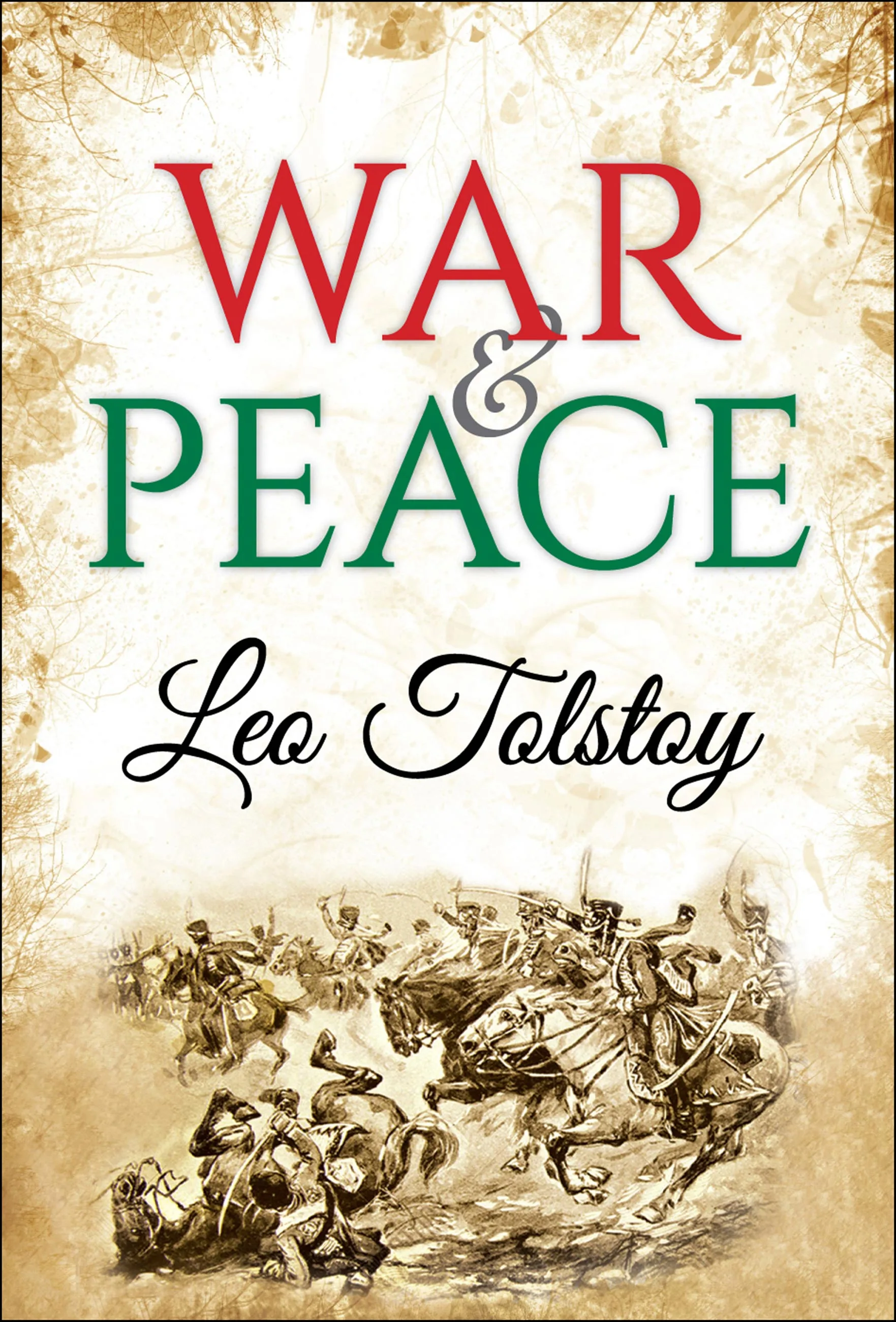
War and Peace
eBook
• INR 51.00
• English
• 9788180320026
No ratings yet
| Publisher | General Press |
|---|---|
| ISBN13 | 9788180320026 |
| ASIN/SKU | B01M10X02E |
| Book Format | eBook |
| Language | English |
| List Price | INR 51.00 |
| Subject Code | FIC004000, FIC014000 |
| Publishing Date | 24/05/2016 |
| Book Code | BD00068255 |
Buy this Book
Amazon Stores
Ebook Stores
Other Stores
Discover War and Peace by Leo Tolstoy. This book is published by General Press in eBook format, ISBN 9788180320026, ASIN B01M10X02E, under Literature and Fiction, War and Military, Classics.
Book Description
The most famous and perhaps greatest novel of all time, Tolstoy's 'War and Peace' tells the story of five families struggling for survival during Napoleon's invasion of Russia in 1812.
As Napoleon's army invades, Tolstoy brilliantly follows characters from diverse backgrounds—peasants and nobility, civilians and soldiers—as they struggle with the problems unique to their era, their history, and their culture. And as the novel progresses, these characters transcend their specificity, becoming some of the most moving—and human—figures in world literature.
Among its many unforgettable characters is Prince Andrey Bolkonsky, a proud, dashing man who, despising the artifice of high society, joins the army to achieve glory. Badly wounded at Austerlitz, he begins to discover the emptiness of everything to which he has devoted himself. His death scene is considered one of the greatest passages in Russian literature.
The novel's other hero, the bumbling Pierre Bezukhov, tries to find meaning in life through a series of philosophical systems that promise to resolve all questions. He at last discovers the Tolstoyan truth that wisdom is to be found not in systems but in the ordinary processes of daily life, especially in his marriage to the novel's most memorable heroine, Natasha.
Both an intimate study of individual passions and an epic history of Russia and its people, 'War and Peace' is nothing more or less than a complete portrait of human existence.
As Napoleon's army invades, Tolstoy brilliantly follows characters from diverse backgrounds—peasants and nobility, civilians and soldiers—as they struggle with the problems unique to their era, their history, and their culture. And as the novel progresses, these characters transcend their specificity, becoming some of the most moving—and human—figures in world literature.
Among its many unforgettable characters is Prince Andrey Bolkonsky, a proud, dashing man who, despising the artifice of high society, joins the army to achieve glory. Badly wounded at Austerlitz, he begins to discover the emptiness of everything to which he has devoted himself. His death scene is considered one of the greatest passages in Russian literature.
The novel's other hero, the bumbling Pierre Bezukhov, tries to find meaning in life through a series of philosophical systems that promise to resolve all questions. He at last discovers the Tolstoyan truth that wisdom is to be found not in systems but in the ordinary processes of daily life, especially in his marriage to the novel's most memorable heroine, Natasha.
Both an intimate study of individual passions and an epic history of Russia and its people, 'War and Peace' is nothing more or less than a complete portrait of human existence.
Author Biography
Leo Tolstoy (1828–1910) was a renowned Russian novelist, philosopher, and moral thinker, widely regarded as one of the greatest writers in world literature. Born into a noble family on September 9, 1828, at Yasnaya Polyana, Russia, he was orphaned at a young age and raised by relatives. After a brief stint at university and time in the military, Tolstoy turned to writing. His early works, such as Childhood, Boyhood, and Youth, drew on his own experiences and established him as a promising literary voice.
Tolstoy’s masterpieces War and Peace (1869) and Anna Karenina (1877) are towering achievements of realist fiction, blending history, philosophy, and deep psychological insight. In middle life, he underwent a profound spiritual crisis and rejected materialism, embracing a life of Christian-based simplicity, pacifism, and ethical living.
During this period, he wrote philosophical and religious texts including The Kingdom of God Is Within You and the inspiring A Calendar of Wisdom—a daily guide to moral and spiritual reflection compiled from global wisdom traditions.
His radical beliefs brought him into conflict with both the Church and State. Tolstoy died on November 20, 1910, after leaving his estate in search of solitude. His works continue to influence literature, ethics, and global thought.
Tolstoy’s masterpieces War and Peace (1869) and Anna Karenina (1877) are towering achievements of realist fiction, blending history, philosophy, and deep psychological insight. In middle life, he underwent a profound spiritual crisis and rejected materialism, embracing a life of Christian-based simplicity, pacifism, and ethical living.
During this period, he wrote philosophical and religious texts including The Kingdom of God Is Within You and the inspiring A Calendar of Wisdom—a daily guide to moral and spiritual reflection compiled from global wisdom traditions.
His radical beliefs brought him into conflict with both the Church and State. Tolstoy died on November 20, 1910, after leaving his estate in search of solitude. His works continue to influence literature, ethics, and global thought.
Editorial Reviews
Editorial Reviews will be added soon…
Book Summary
Leo Tolstoy’s War and Peace is one of the greatest novels ever written and one of the most ambitious works of historical fiction in world literature. Published in its complete form in 1869, the novel follows several Russian aristocratic families during the turbulent years surrounding the Napoleonic Wars. At its heart are the lives of Pierre Bezukhov, Prince Andrei Bolkonsky, Natasha Rostova, and their families, whose personal hopes, romances, losses, and spiritual struggles unfold against the enormous backdrop of European history. A War and Peace summary is therefore not simply a story about war or a traditional historical novel. Tolstoy combines family drama, romance, philosophy, social observation, and military history to ask profound questions about love, death, free will, ambition, happiness, and what actually drives the course of history.
The novel begins in the fashionable world of early nineteenth-century Russian aristocracy. Much of the opening takes place in St. Petersburg and introduces readers to a society obsessed with status, marriage, politics, money, and appearances. Among the important figures is Pierre Bezukhov, the illegitimate son of the wealthy Count Bezukhov. Pierre is intelligent and kind but socially awkward, inexperienced, and uncertain about his purpose in life. He has recently returned from abroad and does not fit comfortably into the polished society around him. His friend Prince Andrei Bolkonsky is almost his opposite. Andrei is intelligent, disciplined, proud, and dissatisfied with the emptiness of aristocratic life. He is married to the pleasant but superficial Lise, yet he longs for a more meaningful existence and dreams of achieving greatness.
Another major family is the Rostovs, a warm and affectionate aristocratic household. Count Rostov and his wife are generous, emotional, and devoted to their children, even though the family’s finances are unstable. Their daughter Natasha Rostova is one of the novel’s most memorable characters. She begins as a lively, impulsive, innocent young girl and gradually matures into a woman shaped by love, disappointment, suffering, and family responsibility. Her brother Nikolai Rostov is enthusiastic, patriotic, and eager to become a successful soldier. Their cousin Sonya, who lives with the family, loves Nikolai deeply but faces an uncertain future because of her lack of wealth and social position.
Pierre’s life changes dramatically when his father dies and Pierre unexpectedly inherits a vast fortune. Almost overnight, the awkward young man becomes one of the richest people in Russia. His new wealth brings him status but does not solve his deeper confusion. He is pushed into marriage with the beautiful and socially admired Hélène Kuragin, the daughter of Prince Vasily Kuragin. Hélène is sophisticated and attractive, but their marriage is emotionally empty. Pierre soon realizes that wealth and social prestige cannot provide the meaning he is looking for. His dissatisfaction leads him toward philosophical and religious questions, and eventually toward Freemasonry, which he hopes will give his life moral direction.
Meanwhile, Prince Andrei leaves his pregnant wife behind and joins the Russian army during the campaign against Napoleon. He is eager to escape the shallow social world of St. Petersburg and prove himself through military achievement. At the Battle of Austerlitz, Andrei experiences one of the novel’s first great spiritual transformations. He goes into battle dreaming of personal glory, inspired by the heroic image of Napoleon. But after being seriously wounded and lying on the battlefield beneath an enormous sky, he suddenly realizes how small his ambitions are. Napoleon himself, whom Andrei once admired, appears insignificant. The experience destroys his romantic belief in military glory and begins a profound change in his understanding of life.
Andrei returns home only to discover that his wife has died giving birth to their son. Her death leaves him devastated and emotionally withdrawn. He becomes convinced that personal happiness is impossible and retreats into a quiet life focused on managing his estate and raising his child. Pierre, meanwhile, struggles with his own failed marriage and his search for moral certainty. These two men become central philosophical figures in the novel because each is searching for an answer to the same basic question: how should a person live in a world filled with suffering, uncertainty, and death?
The Rostov family provides a contrasting vision of life. Natasha grows from childhood into adolescence and begins to experience romantic love. At a grand ball, she meets Prince Andrei, who is captivated by her youthful energy and sincerity. Unlike the artificial social environment he has known, Natasha seems completely alive. Their relationship develops into one of the novel’s most important love stories. Andrei proposes marriage, but because he is still emotionally cautious, he asks Natasha to wait for a year before they marry. This period of separation becomes a test of their relationship.
During Andrei’s absence, Natasha is vulnerable to the influence of Anatole Kuragin, Hélène’s reckless and morally irresponsible brother. Anatole is charming but selfish and already secretly married. He becomes fascinated by Natasha and persuades her that he intends to elope with her. Natasha, overwhelmed by romantic excitement and unable to see the danger clearly, agrees to run away with him. The plan is discovered before it can succeed, but the damage is enormous. Andrei feels betrayed, and their engagement collapses. Natasha is overcome with shame and despair. She has lost the man she loves and begins to understand how easily passion and illusion can lead to terrible consequences.
Pierre becomes one of Natasha’s unexpected sources of emotional support. He has always cared about her, and during her crisis he recognizes her goodness despite her mistakes. His compassion is important because Tolstoy does not treat Natasha’s error as proof that she is morally worthless. Instead, the experience becomes part of her maturation. She begins to move away from youthful romantic fantasy toward a deeper understanding of love, responsibility, and suffering.
The political and military world grows increasingly dangerous as Napoleon invades Russia in 1812. Tolstoy’s treatment of the war is deliberately different from traditional heroic histories. He questions the idea that great leaders single-handedly control historical events. Napoleon may appear powerful, but Tolstoy argues that enormous historical movements result from countless individual actions, decisions, accidents, fears, and social forces. The invasion of Russia therefore becomes not merely a military conflict but an enormous demonstration of the limits of individual power.
Pierre becomes increasingly fascinated by the approaching war. Although he is not a professional soldier, he travels toward the Battle of Borodino and witnesses the horrifying reality of combat. The experience strips away many of his abstract philosophical ideas. He sees ordinary soldiers facing death with courage and discovers a kind of dignity in their simple acceptance of life. The battle itself is presented not as a clean sequence of heroic maneuvers but as chaos, confusion, exhaustion, fear, and violence. Tolstoy emphasizes that soldiers often cannot see the larger strategy and that commanders have far less control than historical accounts suggest.
Prince Andrei also returns to military service. At Borodino, he is badly wounded. His suffering forces him to confront death again, but this time his transformation is deeper. He begins to let go of resentment and hatred, especially toward Anatole Kuragin, who happens to be brought into the same hospital after being wounded. Seeing Anatole helpless and suffering, Andrei feels compassion rather than revenge. This moment represents one of the novel’s most important spiritual developments: the movement from pride and judgment toward forgiveness and universal love.
As Napoleon’s forces advance, the Russian army abandons Moscow. The city is eventually occupied and partially destroyed. The Rostovs are preparing to flee and initially plan to use their wagons to transport possessions. Natasha insists that the wagons instead be used to carry wounded soldiers. This decision reflects her growing maturity and compassion. Among the wounded is Andrei, though she does not initially know that he is there. When she discovers him, she returns to his side and cares for him. Their reunion is deeply emotional because Andrei, now close to death, recognizes that his love for Natasha has survived his anger.
Pierre, meanwhile, remains in Moscow during the occupation and becomes obsessed with the idea of killing Napoleon. His plan is confused and unrealistic, but it reflects his desperate desire to do something meaningful. Instead, he is arrested by the French and experiences imprisonment. His time as a prisoner becomes another major turning point. Stripped of wealth, social status, and comfort, Pierre encounters ordinary people and learns to appreciate the simplest aspects of existence. A peasant prisoner named Platon Karataev profoundly influences him. Karataev embodies acceptance, kindness, simplicity, and a deep connection to life. Through him, Pierre discovers that happiness may not come from intellectual theories but from living compassionately and accepting the present moment.
Andrei’s condition continues to deteriorate. Although Natasha’s care brings emotional reconciliation, he eventually dies. His death is one of the most moving episodes in the novel because it represents the completion of his spiritual journey. The proud young man who once dreamed of military glory has gradually learned to value love, forgiveness, and compassion. His death leaves Natasha devastated, but it also contributes to her emotional transformation.
The Rostov family suffers another terrible loss when the young Petya Rostov joins the army and is killed. Petya’s death is particularly painful because he represents youthful enthusiasm and innocence. His loss, combined with Andrei’s death and the destruction caused by the war, changes Natasha permanently. She becomes quieter and more compassionate, increasingly devoted to her family.
Eventually, the French retreat from Russia. Napoleon’s grand invasion collapses, and the Russian people emerge from the catastrophe profoundly changed. Pierre is liberated from captivity and returns to civilian life. He has lost much of his former uncertainty. His experiences have taught him that happiness is not found in wealth, intellectual speculation, or social approval but in connection with other people and acceptance of life. He eventually marries Natasha. Their relationship is not presented as a glamorous romantic fantasy but as a mature partnership built on shared experience, affection, family, and understanding.
Nikolai Rostov also undergoes an important transformation. His early enthusiasm for military glory becomes more complicated as he witnesses the reality of war and financial difficulties within his family. He eventually marries Princess Marya Bolkonskaya, Andrei’s sister. Marya is deeply religious, compassionate, and devoted to duty. Their marriage brings together two families that have suffered enormously and creates another form of renewal after the devastation of war.
The ending of War and Peace moves beyond the conventional conclusion of a romance. Tolstoy includes an extended epilogue that follows the characters into family life and reflects on the meaning of historical change. Pierre and Natasha are married and have children. Natasha has become a devoted mother, and the passionate young girl from the early chapters has been transformed into a woman whose priorities center on family and emotional connection. Pierre remains intellectually curious but is also more grounded and purposeful. Nikolai and Marya build a stable household of their own. The surviving characters are not simply “happy” in a fairy-tale sense; they have reached a more mature form of happiness shaped by everything they have lost.
One of the central themes of War and Peace is the contrast between war and peace, but Tolstoy treats these concepts in a broader sense. War represents not only battlefield violence but also ambition, pride, nationalism, hatred, and the desire to control others. Peace represents family life, ordinary work, compassion, love, and the acceptance of human limitations. Yet the two worlds constantly overlap. Even during war, people experience friendship and love, while peaceful society contains jealousy, ambition, conflict, and cruelty.
Another major theme is the search for meaning. Pierre, Andrei, and Natasha each undergo a different journey toward understanding life. Pierre searches through wealth, marriage, philosophy, Freemasonry, political action, and imprisonment before discovering a simpler form of happiness. Andrei seeks glory, then becomes disillusioned with it, and eventually discovers the importance of love and forgiveness. Natasha begins with romantic idealism and gradually learns that genuine love requires compassion, loyalty, and responsibility. Their journeys form the emotional foundation of the novel.
Tolstoy also challenges conventional ideas about historical greatness. His discussions of Napoleon and the Russian military leadership argue that history cannot be explained simply by the intentions of famous individuals. Millions of people contribute, knowingly and unknowingly, to historical events. Napoleon may believe himself to be directing history, but Tolstoy portrays him as one small part of a vast movement he cannot control. This philosophy is central to the novel’s meaning and distinguishes War and Peace from a conventional historical epic.
Ultimately, War and Peace is a vast meditation on what makes life meaningful. Its battles, political conflicts, romances, family celebrations, deaths, marriages, and philosophical reflections all return to one fundamental idea: human beings cannot control everything that happens to them, but they can choose how they respond to life. Tolstoy’s greatest heroes are not necessarily those who win battles or achieve fame. They are people who learn to love, forgive, accept uncertainty, care for others, and recognize the value of ordinary existence.
For anyone looking for a War and Peace summary, War and Peace plot analysis, War and Peace characters, or an explanation of the novel’s major themes, the book can ultimately be understood as both an epic story and an intimate portrait of human life. Pierre’s search for happiness, Andrei’s journey from ambition to spiritual acceptance, Natasha’s transformation from impulsive girl to mature woman, and the suffering and resilience of the Rostov and Bolkonsky families show how personal lives continue even when history seems overwhelming. Tolstoy makes war enormous but never allows it to erase the individual human being. In the end, War and Peace suggests that the deepest forms of meaning are found not in fame, power, or historical glory, but in love, family, compassion, forgiveness, and the simple act of living fully in the present.
The novel begins in the fashionable world of early nineteenth-century Russian aristocracy. Much of the opening takes place in St. Petersburg and introduces readers to a society obsessed with status, marriage, politics, money, and appearances. Among the important figures is Pierre Bezukhov, the illegitimate son of the wealthy Count Bezukhov. Pierre is intelligent and kind but socially awkward, inexperienced, and uncertain about his purpose in life. He has recently returned from abroad and does not fit comfortably into the polished society around him. His friend Prince Andrei Bolkonsky is almost his opposite. Andrei is intelligent, disciplined, proud, and dissatisfied with the emptiness of aristocratic life. He is married to the pleasant but superficial Lise, yet he longs for a more meaningful existence and dreams of achieving greatness.
Another major family is the Rostovs, a warm and affectionate aristocratic household. Count Rostov and his wife are generous, emotional, and devoted to their children, even though the family’s finances are unstable. Their daughter Natasha Rostova is one of the novel’s most memorable characters. She begins as a lively, impulsive, innocent young girl and gradually matures into a woman shaped by love, disappointment, suffering, and family responsibility. Her brother Nikolai Rostov is enthusiastic, patriotic, and eager to become a successful soldier. Their cousin Sonya, who lives with the family, loves Nikolai deeply but faces an uncertain future because of her lack of wealth and social position.
Pierre’s life changes dramatically when his father dies and Pierre unexpectedly inherits a vast fortune. Almost overnight, the awkward young man becomes one of the richest people in Russia. His new wealth brings him status but does not solve his deeper confusion. He is pushed into marriage with the beautiful and socially admired Hélène Kuragin, the daughter of Prince Vasily Kuragin. Hélène is sophisticated and attractive, but their marriage is emotionally empty. Pierre soon realizes that wealth and social prestige cannot provide the meaning he is looking for. His dissatisfaction leads him toward philosophical and religious questions, and eventually toward Freemasonry, which he hopes will give his life moral direction.
Meanwhile, Prince Andrei leaves his pregnant wife behind and joins the Russian army during the campaign against Napoleon. He is eager to escape the shallow social world of St. Petersburg and prove himself through military achievement. At the Battle of Austerlitz, Andrei experiences one of the novel’s first great spiritual transformations. He goes into battle dreaming of personal glory, inspired by the heroic image of Napoleon. But after being seriously wounded and lying on the battlefield beneath an enormous sky, he suddenly realizes how small his ambitions are. Napoleon himself, whom Andrei once admired, appears insignificant. The experience destroys his romantic belief in military glory and begins a profound change in his understanding of life.
Andrei returns home only to discover that his wife has died giving birth to their son. Her death leaves him devastated and emotionally withdrawn. He becomes convinced that personal happiness is impossible and retreats into a quiet life focused on managing his estate and raising his child. Pierre, meanwhile, struggles with his own failed marriage and his search for moral certainty. These two men become central philosophical figures in the novel because each is searching for an answer to the same basic question: how should a person live in a world filled with suffering, uncertainty, and death?
The Rostov family provides a contrasting vision of life. Natasha grows from childhood into adolescence and begins to experience romantic love. At a grand ball, she meets Prince Andrei, who is captivated by her youthful energy and sincerity. Unlike the artificial social environment he has known, Natasha seems completely alive. Their relationship develops into one of the novel’s most important love stories. Andrei proposes marriage, but because he is still emotionally cautious, he asks Natasha to wait for a year before they marry. This period of separation becomes a test of their relationship.
During Andrei’s absence, Natasha is vulnerable to the influence of Anatole Kuragin, Hélène’s reckless and morally irresponsible brother. Anatole is charming but selfish and already secretly married. He becomes fascinated by Natasha and persuades her that he intends to elope with her. Natasha, overwhelmed by romantic excitement and unable to see the danger clearly, agrees to run away with him. The plan is discovered before it can succeed, but the damage is enormous. Andrei feels betrayed, and their engagement collapses. Natasha is overcome with shame and despair. She has lost the man she loves and begins to understand how easily passion and illusion can lead to terrible consequences.
Pierre becomes one of Natasha’s unexpected sources of emotional support. He has always cared about her, and during her crisis he recognizes her goodness despite her mistakes. His compassion is important because Tolstoy does not treat Natasha’s error as proof that she is morally worthless. Instead, the experience becomes part of her maturation. She begins to move away from youthful romantic fantasy toward a deeper understanding of love, responsibility, and suffering.
The political and military world grows increasingly dangerous as Napoleon invades Russia in 1812. Tolstoy’s treatment of the war is deliberately different from traditional heroic histories. He questions the idea that great leaders single-handedly control historical events. Napoleon may appear powerful, but Tolstoy argues that enormous historical movements result from countless individual actions, decisions, accidents, fears, and social forces. The invasion of Russia therefore becomes not merely a military conflict but an enormous demonstration of the limits of individual power.
Pierre becomes increasingly fascinated by the approaching war. Although he is not a professional soldier, he travels toward the Battle of Borodino and witnesses the horrifying reality of combat. The experience strips away many of his abstract philosophical ideas. He sees ordinary soldiers facing death with courage and discovers a kind of dignity in their simple acceptance of life. The battle itself is presented not as a clean sequence of heroic maneuvers but as chaos, confusion, exhaustion, fear, and violence. Tolstoy emphasizes that soldiers often cannot see the larger strategy and that commanders have far less control than historical accounts suggest.
Prince Andrei also returns to military service. At Borodino, he is badly wounded. His suffering forces him to confront death again, but this time his transformation is deeper. He begins to let go of resentment and hatred, especially toward Anatole Kuragin, who happens to be brought into the same hospital after being wounded. Seeing Anatole helpless and suffering, Andrei feels compassion rather than revenge. This moment represents one of the novel’s most important spiritual developments: the movement from pride and judgment toward forgiveness and universal love.
As Napoleon’s forces advance, the Russian army abandons Moscow. The city is eventually occupied and partially destroyed. The Rostovs are preparing to flee and initially plan to use their wagons to transport possessions. Natasha insists that the wagons instead be used to carry wounded soldiers. This decision reflects her growing maturity and compassion. Among the wounded is Andrei, though she does not initially know that he is there. When she discovers him, she returns to his side and cares for him. Their reunion is deeply emotional because Andrei, now close to death, recognizes that his love for Natasha has survived his anger.
Pierre, meanwhile, remains in Moscow during the occupation and becomes obsessed with the idea of killing Napoleon. His plan is confused and unrealistic, but it reflects his desperate desire to do something meaningful. Instead, he is arrested by the French and experiences imprisonment. His time as a prisoner becomes another major turning point. Stripped of wealth, social status, and comfort, Pierre encounters ordinary people and learns to appreciate the simplest aspects of existence. A peasant prisoner named Platon Karataev profoundly influences him. Karataev embodies acceptance, kindness, simplicity, and a deep connection to life. Through him, Pierre discovers that happiness may not come from intellectual theories but from living compassionately and accepting the present moment.
Andrei’s condition continues to deteriorate. Although Natasha’s care brings emotional reconciliation, he eventually dies. His death is one of the most moving episodes in the novel because it represents the completion of his spiritual journey. The proud young man who once dreamed of military glory has gradually learned to value love, forgiveness, and compassion. His death leaves Natasha devastated, but it also contributes to her emotional transformation.
The Rostov family suffers another terrible loss when the young Petya Rostov joins the army and is killed. Petya’s death is particularly painful because he represents youthful enthusiasm and innocence. His loss, combined with Andrei’s death and the destruction caused by the war, changes Natasha permanently. She becomes quieter and more compassionate, increasingly devoted to her family.
Eventually, the French retreat from Russia. Napoleon’s grand invasion collapses, and the Russian people emerge from the catastrophe profoundly changed. Pierre is liberated from captivity and returns to civilian life. He has lost much of his former uncertainty. His experiences have taught him that happiness is not found in wealth, intellectual speculation, or social approval but in connection with other people and acceptance of life. He eventually marries Natasha. Their relationship is not presented as a glamorous romantic fantasy but as a mature partnership built on shared experience, affection, family, and understanding.
Nikolai Rostov also undergoes an important transformation. His early enthusiasm for military glory becomes more complicated as he witnesses the reality of war and financial difficulties within his family. He eventually marries Princess Marya Bolkonskaya, Andrei’s sister. Marya is deeply religious, compassionate, and devoted to duty. Their marriage brings together two families that have suffered enormously and creates another form of renewal after the devastation of war.
The ending of War and Peace moves beyond the conventional conclusion of a romance. Tolstoy includes an extended epilogue that follows the characters into family life and reflects on the meaning of historical change. Pierre and Natasha are married and have children. Natasha has become a devoted mother, and the passionate young girl from the early chapters has been transformed into a woman whose priorities center on family and emotional connection. Pierre remains intellectually curious but is also more grounded and purposeful. Nikolai and Marya build a stable household of their own. The surviving characters are not simply “happy” in a fairy-tale sense; they have reached a more mature form of happiness shaped by everything they have lost.
One of the central themes of War and Peace is the contrast between war and peace, but Tolstoy treats these concepts in a broader sense. War represents not only battlefield violence but also ambition, pride, nationalism, hatred, and the desire to control others. Peace represents family life, ordinary work, compassion, love, and the acceptance of human limitations. Yet the two worlds constantly overlap. Even during war, people experience friendship and love, while peaceful society contains jealousy, ambition, conflict, and cruelty.
Another major theme is the search for meaning. Pierre, Andrei, and Natasha each undergo a different journey toward understanding life. Pierre searches through wealth, marriage, philosophy, Freemasonry, political action, and imprisonment before discovering a simpler form of happiness. Andrei seeks glory, then becomes disillusioned with it, and eventually discovers the importance of love and forgiveness. Natasha begins with romantic idealism and gradually learns that genuine love requires compassion, loyalty, and responsibility. Their journeys form the emotional foundation of the novel.
Tolstoy also challenges conventional ideas about historical greatness. His discussions of Napoleon and the Russian military leadership argue that history cannot be explained simply by the intentions of famous individuals. Millions of people contribute, knowingly and unknowingly, to historical events. Napoleon may believe himself to be directing history, but Tolstoy portrays him as one small part of a vast movement he cannot control. This philosophy is central to the novel’s meaning and distinguishes War and Peace from a conventional historical epic.
Ultimately, War and Peace is a vast meditation on what makes life meaningful. Its battles, political conflicts, romances, family celebrations, deaths, marriages, and philosophical reflections all return to one fundamental idea: human beings cannot control everything that happens to them, but they can choose how they respond to life. Tolstoy’s greatest heroes are not necessarily those who win battles or achieve fame. They are people who learn to love, forgive, accept uncertainty, care for others, and recognize the value of ordinary existence.
For anyone looking for a War and Peace summary, War and Peace plot analysis, War and Peace characters, or an explanation of the novel’s major themes, the book can ultimately be understood as both an epic story and an intimate portrait of human life. Pierre’s search for happiness, Andrei’s journey from ambition to spiritual acceptance, Natasha’s transformation from impulsive girl to mature woman, and the suffering and resilience of the Rostov and Bolkonsky families show how personal lives continue even when history seems overwhelming. Tolstoy makes war enormous but never allows it to erase the individual human being. In the end, War and Peace suggests that the deepest forms of meaning are found not in fame, power, or historical glory, but in love, family, compassion, forgiveness, and the simple act of living fully in the present.
Sample Chapters
Sample Chapters will be added soon…
Reader Reviews
No reviews yet.
War and Peace