
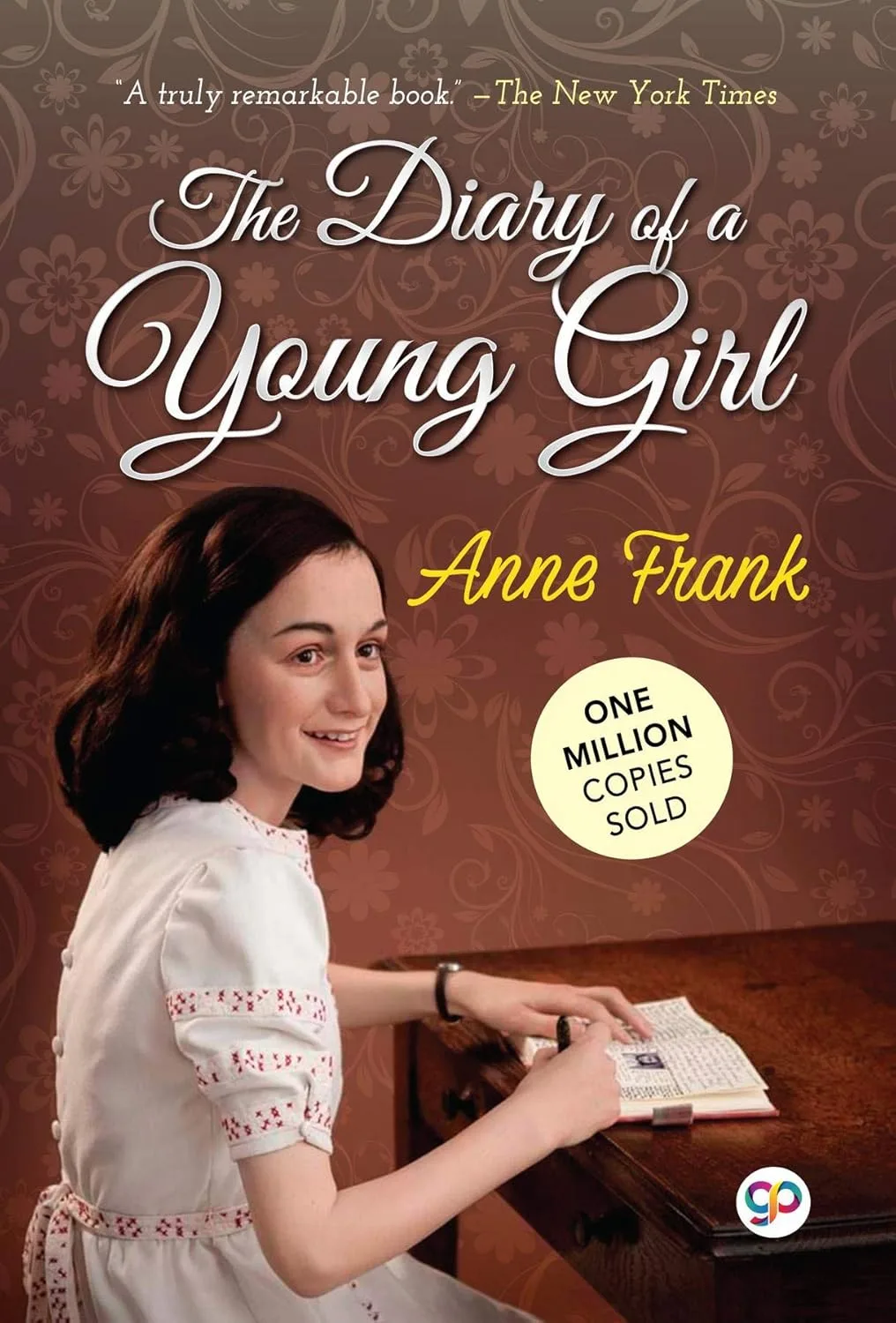
The Diary of a Young Girl
eBook
• INR 173.00
• English
No ratings yet
| Publisher | General Press |
|---|---|
| ASIN/SKU | B01N0QWB10 |
| Book Format | eBook |
| Language | English |
| List Price | INR 173.00 |
| Subject Code | BIO026000, HIS027100, BIO022000 |
| Book Code | BD00068257 |
Buy this Book
Amazon Stores
Ebook Stores
Other Stores
Discover The Diary of a Young Girl by Anne Frank. This book is published by General Press in eBook format, ASIN B01N0QWB10, under Biographies and Memoirs, Memoirs, Holocaust.
Book Description
What does it mean to grow up when the world outside your window is becoming more dangerous every day? 'The Diary of a Young Girl' by Anne Frank is a deeply moving historical memoir and diary that captures one young girl's hopes, fears, dreams, frustrations, and observations while she and her family live in hiding during the Nazi occupation of the Netherlands.
Anne Frank begins writing in her diary as an ordinary teenage girl, recording her thoughts about school, friendships, family life, and the challenges of adolescence. But as persecution of Jewish people intensifies during World War II, her life changes dramatically. Anne and her family are forced into hiding in a concealed section of a building in Amsterdam, where they share a confined and uncertain existence with other people seeking safety. Cut off from the freedom of the outside world, Anne turns to her diary as her closest companion and gives it the name “Kitty.”
Inside the hiding place, everyday life becomes a delicate balance of silence, fear, boredom, arguments, laughter, and hope. Anne describes the personalities of those around her with remarkable honesty, while also reflecting on her changing relationship with her parents, her growing independence, and her complicated feelings about love and friendship. Her writing gradually reveals a thoughtful young woman struggling to understand herself and the world around her.
What makes the diary especially powerful is Anne's ability to find beauty and possibility even in circumstances filled with uncertainty. Her reflections on human nature, morality, war, identity, and the future reach far beyond her own experience. Written with surprising maturity, humor, vulnerability, and emotional honesty, her words allow readers to see history not simply as a collection of dates and events, but through the eyes of a real young person living through it.
'The Diary of a Young Girl' remains one of the most widely read books about the Holocaust and an unforgettable portrait of courage, adolescence, and hope. Anne's voice continues to feel remarkably personal and immediate, inviting readers to open her diary and discover the young woman behind one of history's most enduring stories.
Anne Frank begins writing in her diary as an ordinary teenage girl, recording her thoughts about school, friendships, family life, and the challenges of adolescence. But as persecution of Jewish people intensifies during World War II, her life changes dramatically. Anne and her family are forced into hiding in a concealed section of a building in Amsterdam, where they share a confined and uncertain existence with other people seeking safety. Cut off from the freedom of the outside world, Anne turns to her diary as her closest companion and gives it the name “Kitty.”
Inside the hiding place, everyday life becomes a delicate balance of silence, fear, boredom, arguments, laughter, and hope. Anne describes the personalities of those around her with remarkable honesty, while also reflecting on her changing relationship with her parents, her growing independence, and her complicated feelings about love and friendship. Her writing gradually reveals a thoughtful young woman struggling to understand herself and the world around her.
What makes the diary especially powerful is Anne's ability to find beauty and possibility even in circumstances filled with uncertainty. Her reflections on human nature, morality, war, identity, and the future reach far beyond her own experience. Written with surprising maturity, humor, vulnerability, and emotional honesty, her words allow readers to see history not simply as a collection of dates and events, but through the eyes of a real young person living through it.
'The Diary of a Young Girl' remains one of the most widely read books about the Holocaust and an unforgettable portrait of courage, adolescence, and hope. Anne's voice continues to feel remarkably personal and immediate, inviting readers to open her diary and discover the young woman behind one of history's most enduring stories.
Author Biography
Anne Frank (1929–1945) was a German-born Jewish diarist whose personal writings became one of the most powerful and enduring testimonies of the Holocaust. Through her diary, she gave a deeply human voice to the millions of innocent people who suffered under Nazi persecution during the Second World War. Although her life was tragically cut short, her words continue to inspire readers around the world with their honesty, courage, hope, and unwavering belief in humanity.
Anne was born on June 12, 1929, in Frankfurt, Germany, to Otto and Edith Frank. As the Nazi Party rose to power and anti-Jewish discrimination intensified, her family fled to Amsterdam in the Netherlands in 1933, hoping to find safety and a better future. For several years, Anne enjoyed a relatively normal childhood, attending school, making friends, and developing a love for reading and writing. However, after Germany occupied the Netherlands in 1940, Jewish families faced increasingly harsh restrictions that dramatically changed their lives.
On her thirteenth birthday, Anne received a diary that would become one of history's most treasured books. In July 1942, the Frank family went into hiding in a concealed section of Otto Frank's business premises, later known as the Secret Annex. Along with four other people, they lived in hiding for more than two years. During this time, Anne filled her diary with reflections on daily life, family relationships, fear, loneliness, and her dreams of becoming a writer. She also displayed remarkable emotional maturity, expressing hope and compassion even in the darkest circumstances.
In August 1944, the hiding place was discovered, and the occupants were arrested and deported to Nazi concentration camps. Anne was eventually sent to the Bergen-Belsen concentration camp, where she died of typhus in early 1945, just weeks before the camp was liberated. She was only fifteen years old. Her father, Otto Frank, was the sole surviving member of the family.
After the war, Otto Frank fulfilled Anne's dream by publishing her diary as The Diary of a Young Girl. The book has since been translated into dozens of languages and has touched millions of readers across generations. Anne Frank's legacy extends far beyond literature; she has become a universal symbol of resilience, the importance of human rights, and the devastating consequences of hatred and intolerance. Her words continue to remind the world of the enduring value of hope, dignity, and compassion in the face of unimaginable adversity.
Anne was born on June 12, 1929, in Frankfurt, Germany, to Otto and Edith Frank. As the Nazi Party rose to power and anti-Jewish discrimination intensified, her family fled to Amsterdam in the Netherlands in 1933, hoping to find safety and a better future. For several years, Anne enjoyed a relatively normal childhood, attending school, making friends, and developing a love for reading and writing. However, after Germany occupied the Netherlands in 1940, Jewish families faced increasingly harsh restrictions that dramatically changed their lives.
On her thirteenth birthday, Anne received a diary that would become one of history's most treasured books. In July 1942, the Frank family went into hiding in a concealed section of Otto Frank's business premises, later known as the Secret Annex. Along with four other people, they lived in hiding for more than two years. During this time, Anne filled her diary with reflections on daily life, family relationships, fear, loneliness, and her dreams of becoming a writer. She also displayed remarkable emotional maturity, expressing hope and compassion even in the darkest circumstances.
In August 1944, the hiding place was discovered, and the occupants were arrested and deported to Nazi concentration camps. Anne was eventually sent to the Bergen-Belsen concentration camp, where she died of typhus in early 1945, just weeks before the camp was liberated. She was only fifteen years old. Her father, Otto Frank, was the sole surviving member of the family.
After the war, Otto Frank fulfilled Anne's dream by publishing her diary as The Diary of a Young Girl. The book has since been translated into dozens of languages and has touched millions of readers across generations. Anne Frank's legacy extends far beyond literature; she has become a universal symbol of resilience, the importance of human rights, and the devastating consequences of hatred and intolerance. Her words continue to remind the world of the enduring value of hope, dignity, and compassion in the face of unimaginable adversity.
Editorial Reviews
Editorial Reviews will be added soon…
Book Summary
The Diary of a Young Girl by Anne Frank is one of the most powerful personal accounts to emerge from the Holocaust. Written by Anne Frank while she and her family were hiding from the Nazis during the Second World War, the diary records the experiences, fears, hopes, frustrations, and dreams of a young girl growing up under extraordinary circumstances. What makes the book so moving is that Anne does not write only about war and persecution. She also writes about friendship, family disagreements, loneliness, love, school, growing up, and her desire to become a writer. Through her ordinary thoughts within an extraordinary situation, readers are able to understand the human cost of war and the importance of preserving individual dignity.
Anne begins her diary in June 1942, shortly after her thirteenth birthday. She receives the diary as a birthday present and decides to treat it as a close friend. She names it “Kitty” and begins addressing her entries to it as though she were writing letters to a trusted companion. At first, her diary describes school, classmates, teachers, friendships, and everyday teenage concerns. Anne is lively, intelligent, outspoken, and sometimes impatient. She has a strong personality and often reflects honestly on her own behavior. These early entries are important because they establish Anne as a normal young girl whose life is about to be transformed by persecution.
Anne’s family is Jewish, and Nazi persecution of Jews has already begun to affect their lives. Jews are forced to wear identifying stars and face restrictions on where they can go, what they can do, and whom they can meet. Eventually, Anne’s older sister Margot receives a call-up notice from the authorities. Fearing that Margot will be deported, the Frank family decides to go into hiding earlier than planned. They move into a concealed section of Otto Frank’s business building, which Anne calls the “Secret Annex.”
The Secret Annex becomes the center of Anne’s life for more than two years. The Frank family—Anne, her parents Otto and Edith, and her sister Margot—are joined by the Van Pels family and later by Fritz Pfeffer, a dentist. The group must remain almost completely silent during working hours because employees and visitors in the building below must not discover them. They cannot go outside, open windows freely, or make ordinary noises. Their entire existence depends on secrecy.
Anne describes the difficulties of living in such confined conditions with remarkable honesty. The people in hiding care about one another, but they also argue constantly. Small habits become major sources of irritation because everyone is forced to live so closely together. Anne often feels misunderstood by the adults, especially her mother. She believes her father understands her better and admires his calm and kindness. Her relationship with her mother is more complicated, and Anne openly records her frustrations while also gradually becoming more reflective about them.
The diary also provides detailed glimpses of daily life in hiding. Food is scarce and repetitive, and the group worries about shortages. They listen anxiously to news broadcasts about the war and the progress of Allied forces. The people helping them from outside risk their own safety to bring food, clothing, books, and other necessities. Anne understands that without these helpers, survival in the Annex would be nearly impossible. Their courage becomes an important reminder that even during a period of terrible cruelty, people can still choose kindness and resistance.
As the months pass, Anne becomes increasingly aware of the danger surrounding them. They hear about arrests, deportations, shootings, and the treatment of Jewish people in occupied Europe. Yet the diary does not become simply a record of horror. Anne continues to think about her future. She reads extensively, studies languages and history, and develops a strong desire to become a writer. Writing becomes one of the ways she preserves her sense of identity. She does not want to be remembered merely as a victim of persecution; she wants her words and ideas to survive.
One of the most important developments in the diary is Anne’s emotional growth. She begins as a young girl who often judges others quickly and struggles to understand her parents and the people around her. Over time, she becomes more thoughtful about herself. She recognizes that there is a difference between the person she appears to be and the person she feels herself to be inside. She wants to become more mature, independent, and morally serious. Her reflections on her own character are unusually honest for someone so young.
Anne’s relationship with Peter van Pels also becomes significant. At first, she finds Peter awkward and uninteresting, but as time passes they begin spending more time together. Their friendship develops into a romantic relationship. Anne treasures the moments they share because they provide companionship and emotional comfort in an otherwise frightening environment. She writes about affection, attraction, uncertainty, and her growing understanding of love. These passages remind readers that even in the middle of war, adolescence continues. Anne is still a young person discovering herself.
The diary also contains Anne’s reflections on women, marriage, sexuality, family, and the expectations placed upon girls. She wants more from life than simply becoming a wife and mother. She dreams of doing meaningful work and leaving something behind. She realizes that she has an inner life and intellectual ambitions that others may not fully recognize. Her determination to write becomes increasingly strong.
At the same time, Anne follows the war closely and hopes for liberation. The invasion of Normandy in June 1944 gives the people in hiding renewed hope that the war may soon end. Anne begins imagining life after the war. She wants to return to school, travel, and become a writer. She also dreams of publishing a book based on her experiences in the Secret Annex. Tragically, she will never know how important her writing would become.
The diary ends suddenly on August 1, 1944. Three days later, the people hiding in the Annex are discovered and arrested. Anne and Margot are eventually deported to the Bergen-Belsen concentration camp, where they die in early 1945. Otto Frank is the only member of the Annex to survive the war. After returning to the Netherlands, he discovers Anne’s diary and later helps arrange its publication.
The lasting power of The Diary of a Young Girl comes from the contrast between Anne’s youthful voice and the terrible historical reality surrounding her. She writes about ordinary teenage emotions while living under the threat of death. Her diary therefore makes history deeply personal. The Holocaust is not presented only through statistics or political events but through the thoughts of one girl who wanted to live, learn, love, and write.
Anne’s final importance lies in the fact that her voice survived even though she did not. Her diary reveals both the vulnerability and strength of a young person facing circumstances no child should have experienced. It also demonstrates the extraordinary value of writing. Anne could not control the war or determine her fate, but she could observe, reflect, and put her thoughts into words. Her writing gave meaning to her experience and allowed her inner world to endure.
Ultimately, The Diary of a Young Girl is a story about much more than hiding during wartime. It is a portrait of adolescence, family, fear, hope, moral growth, and the human desire to be remembered. Anne’s circumstances were tragic, but her voice remains remarkably alive. Her diary continues to remind readers that behind every historical tragedy are individual lives, dreams, relationships, and unfinished futures. Anne Frank’s greatest legacy is therefore not simply that she documented suffering, but that she continued to believe in the importance of life, humanity, and the power of words even when the world around her was becoming increasingly cruel.
Anne begins her diary in June 1942, shortly after her thirteenth birthday. She receives the diary as a birthday present and decides to treat it as a close friend. She names it “Kitty” and begins addressing her entries to it as though she were writing letters to a trusted companion. At first, her diary describes school, classmates, teachers, friendships, and everyday teenage concerns. Anne is lively, intelligent, outspoken, and sometimes impatient. She has a strong personality and often reflects honestly on her own behavior. These early entries are important because they establish Anne as a normal young girl whose life is about to be transformed by persecution.
Anne’s family is Jewish, and Nazi persecution of Jews has already begun to affect their lives. Jews are forced to wear identifying stars and face restrictions on where they can go, what they can do, and whom they can meet. Eventually, Anne’s older sister Margot receives a call-up notice from the authorities. Fearing that Margot will be deported, the Frank family decides to go into hiding earlier than planned. They move into a concealed section of Otto Frank’s business building, which Anne calls the “Secret Annex.”
The Secret Annex becomes the center of Anne’s life for more than two years. The Frank family—Anne, her parents Otto and Edith, and her sister Margot—are joined by the Van Pels family and later by Fritz Pfeffer, a dentist. The group must remain almost completely silent during working hours because employees and visitors in the building below must not discover them. They cannot go outside, open windows freely, or make ordinary noises. Their entire existence depends on secrecy.
Anne describes the difficulties of living in such confined conditions with remarkable honesty. The people in hiding care about one another, but they also argue constantly. Small habits become major sources of irritation because everyone is forced to live so closely together. Anne often feels misunderstood by the adults, especially her mother. She believes her father understands her better and admires his calm and kindness. Her relationship with her mother is more complicated, and Anne openly records her frustrations while also gradually becoming more reflective about them.
The diary also provides detailed glimpses of daily life in hiding. Food is scarce and repetitive, and the group worries about shortages. They listen anxiously to news broadcasts about the war and the progress of Allied forces. The people helping them from outside risk their own safety to bring food, clothing, books, and other necessities. Anne understands that without these helpers, survival in the Annex would be nearly impossible. Their courage becomes an important reminder that even during a period of terrible cruelty, people can still choose kindness and resistance.
As the months pass, Anne becomes increasingly aware of the danger surrounding them. They hear about arrests, deportations, shootings, and the treatment of Jewish people in occupied Europe. Yet the diary does not become simply a record of horror. Anne continues to think about her future. She reads extensively, studies languages and history, and develops a strong desire to become a writer. Writing becomes one of the ways she preserves her sense of identity. She does not want to be remembered merely as a victim of persecution; she wants her words and ideas to survive.
One of the most important developments in the diary is Anne’s emotional growth. She begins as a young girl who often judges others quickly and struggles to understand her parents and the people around her. Over time, she becomes more thoughtful about herself. She recognizes that there is a difference between the person she appears to be and the person she feels herself to be inside. She wants to become more mature, independent, and morally serious. Her reflections on her own character are unusually honest for someone so young.
Anne’s relationship with Peter van Pels also becomes significant. At first, she finds Peter awkward and uninteresting, but as time passes they begin spending more time together. Their friendship develops into a romantic relationship. Anne treasures the moments they share because they provide companionship and emotional comfort in an otherwise frightening environment. She writes about affection, attraction, uncertainty, and her growing understanding of love. These passages remind readers that even in the middle of war, adolescence continues. Anne is still a young person discovering herself.
The diary also contains Anne’s reflections on women, marriage, sexuality, family, and the expectations placed upon girls. She wants more from life than simply becoming a wife and mother. She dreams of doing meaningful work and leaving something behind. She realizes that she has an inner life and intellectual ambitions that others may not fully recognize. Her determination to write becomes increasingly strong.
At the same time, Anne follows the war closely and hopes for liberation. The invasion of Normandy in June 1944 gives the people in hiding renewed hope that the war may soon end. Anne begins imagining life after the war. She wants to return to school, travel, and become a writer. She also dreams of publishing a book based on her experiences in the Secret Annex. Tragically, she will never know how important her writing would become.
The diary ends suddenly on August 1, 1944. Three days later, the people hiding in the Annex are discovered and arrested. Anne and Margot are eventually deported to the Bergen-Belsen concentration camp, where they die in early 1945. Otto Frank is the only member of the Annex to survive the war. After returning to the Netherlands, he discovers Anne’s diary and later helps arrange its publication.
The lasting power of The Diary of a Young Girl comes from the contrast between Anne’s youthful voice and the terrible historical reality surrounding her. She writes about ordinary teenage emotions while living under the threat of death. Her diary therefore makes history deeply personal. The Holocaust is not presented only through statistics or political events but through the thoughts of one girl who wanted to live, learn, love, and write.
Anne’s final importance lies in the fact that her voice survived even though she did not. Her diary reveals both the vulnerability and strength of a young person facing circumstances no child should have experienced. It also demonstrates the extraordinary value of writing. Anne could not control the war or determine her fate, but she could observe, reflect, and put her thoughts into words. Her writing gave meaning to her experience and allowed her inner world to endure.
Ultimately, The Diary of a Young Girl is a story about much more than hiding during wartime. It is a portrait of adolescence, family, fear, hope, moral growth, and the human desire to be remembered. Anne’s circumstances were tragic, but her voice remains remarkably alive. Her diary continues to remind readers that behind every historical tragedy are individual lives, dreams, relationships, and unfinished futures. Anne Frank’s greatest legacy is therefore not simply that she documented suffering, but that she continued to believe in the importance of life, humanity, and the power of words even when the world around her was becoming increasingly cruel.
Sample Chapters
Sunday, 14 June, 1942
On Friday, June 12th, I woke up at six o’clock and no wonder; it was my birthday. But of course I was not allowed to get up at that hour, so I had to control my curiosity until a quarter to seven. Then I could bear it no longer, and went to the dining room, where I received a warm welcome from Moortje (the cat).
Soon after seven I went to Mummy and Daddy and then to the sitting room to undo my presents. The first to greet me was you, possibly the nicest of all. Then on the table there were a bunch of roses, a plant, and some peonies, and more arrived during the day.
I got masses of things from Mummy and Daddy, and was thoroughly spoiled by various friends. Among other things I was given Camera Obscura, a party game, lots of sweets, chocolates, a puzzle, a brooch, Tales and Legends of the Netherlands by Joseph Cohen, Daisy’s Mountain Holiday (a terrific book), and some money. Now I can buy The Myths of Greece and Rome—grand!
Then Lies called for me and we went to school. During recess I treated everyone to sweet biscuits, and then we had to go back to our lessons.
Now I must stop. Bye-bye, we’re going to be great pals!
Monday, 15 June, 1942
I had my birthday party on Sunday afternoon. We showed a film The Lighthouse Keeper with Rin-Tin-Tin, which my school friends thoroughly enjoyed. We had a lovely time. There were lots of girls and boys. Mummy always wants to know whom I’m going to marry. Little does she guess that it’s Peter Wessel; one day I managed, without blushing or flickering an eyelid, to get that idea right out of her mind. For years Lies Goosens and Sanne Houtman have been my best friends. Since then, I’ve got to know Jopie de Waal at the Jewish Secondary School. We are together a lot and she is now my best girl friend. Lies is more friendly with another girl, and Sanne goes to a different school, where she has made new friends.
Saturday, 20 June, 1942
I haven’t written for a few days, because I wanted first of all to think about my diary. It’s an odd idea for someone like me to keep a diary, not only because I have never done so before, but because it seems to me that neither I—nor for that matter anyone else—will be interested in the unbosomings of a thirteen-year-old schoolgirl. Still, what does that matter? I want to write, but more than that, I want to bring out all kinds of things that lie buried deep in my heart.
There is a saying that “paper is more patient than man”; it came back to me on one of my slightly melancholy days, while I sat chin in hand, feeling too bored and limp even to make up my mind whether to go out or stay at home. Yes, there is no doubt that paper is patient and as I don’t intend to show this cardboard-covered notebook, bearing the proud name of “diary”, to anyone, unless I find a real friend, boy or girl, probably nobody cares. And now I come to the root of the matter, the reason for my starting a diary: it is that I have no such real friend.
Let me put it more clearly, since no one will believe that a girl of thirteen feels herself quite alone in the world, nor is it so. I have darling parents and a sister of sixteen. I know about thirty people whom one might call friends—I have strings of boy friends, anxious to catch a glimpse of me and who, failing that, peep at me through mirrors in class. I have relations, aunts and uncles, who are darlings too, a good home, no—I don’t seem to lack anything. But it’s the same with all my friends, just fun and joking, nothing more. I can never bring myself to talk of anything outside the common round. We don’t seem to be able to get any closer, that is the root of the trouble. Perhaps I lack confidence, but anyway, there it is, a stubborn fact and I don’t seem to be able to do anything about it.
Hence, this diary. In order to enhance in my mind’s eye the picture of the friend for whom I have waited so long, I don’t want to set down a series of bald facts in a diary like most people do, but I want this diary itself to be my friend, and I shall call my friend Kitty. No one will grasp what I’m talking about if I begin my letters to Kitty just out of the blue, so, albeit unwillingly, I will start by sketching in brief the story of my life.
My father was thirty-six when he married my mother, who was then twenty-five. My sister Margot was born in 1926 in Frankfort-on-Main, I followed on June 12, 1929, and, as we are Jewish, we emigrated to Holland in 1933, where my father was appointed Managing Director of Travies N.V. This firm is in close relationship with the firm of Kolen & Co. in the same building, of which my father is a partner.
The rest of our family, however, felt the full impact of Hitler’s anti-Jewish laws, so life was filled with anxiety. In 1938 after the pogroms, my two uncles (my mother’s brothers) escaped to the U.S.A. My old grandmother came to us, she was then seventy-three. After May 1940 good times rapidly fled: first the war, then the capitulation, followed by the arrival of the Germans, which is when the sufferings of us Jews really began. Anti-Jewish decrees followed each other in quick succession. Jews must wear a yellow star, Jews must hand in their bicycles, Jews are banned from trams and are forbidden to drive. Jews are only allowed to do their shopping between three and five o’clock and then only in shops which bear the placard “Jewish shop”. Jews must be indoors by eight o’clock and cannot even sit in their own gardens after that hour. Jews are forbidden to visit theatres, cinemas, and other places of entertainment. Jews may not take part in public sports. Swimming baths, tennis courts, hockey fields, and other sports grounds are all prohibited to them. Jews may not visit Christians. Jews must go to Jewish schools, and many more restrictions of a similar kind.
So we could not do this and were forbidden to do that. But life went on in spite of it all. Jopie used to say to me, “You’re scared to do anything, because it may be forbidden.” Our freedom was strictly limited. Yet things were still bearable.
Granny died in January 1942; no one will ever know how much she is present in my thoughts and how much I love her still.
In 1934 I went to school at the Montessori Kindergarden and continued there. It was at the end of the school year, I was in form 6B, when I had to say good-bye to Mrs. K. We both wept, it was very sad. In 1941 I went, with my sister Margot, to the Jewish Secondary School, she into the fourth form and I into the first.
So far everything is all right with the four of us and here I come to the present day.
Saturday, 20 June, 1942
Dear Kitty,
I’ll start straight away. It is so peaceful at the moment, Mummy and Daddy are out and Margot has gone to play ping-pong with some friends.
I’ve been playing ping-pong a lot myself lately. We ping-pongers are very partial to an ice cream, especially in summer, when one gets warm at the game, so we usually finish up with a visit to the nearest ice-cream shop, Delphi or Oasis, where Jews are allowed. We’ve given up scrounging for extra pocket money. Oasis is usually full and among our large circle of friends we always manage to find some kindhearted gentleman or boy friend, who presents us with more ice cream than we could devour in a week.
I expect you will be rather surprised at the fact that I should talk of boy friends at my age. Alas, one simply can’t seem to avoid it at our school. As soon as a boy asks if he may bicycle home with me and we get into conversation, nine out of ten times I can be sure that he will fall head over heels in love immediately and simply won’t allow me out of his sight. After a while it cools down of course, especially as I take little notice of ardent looks and pedal blithely on.
If it gets so far that they begin about “asking Father” I swerve slightly on my bicycle, my satchel falls, the young man is bound to get off and hand it to me, by which time I have introduced a new topic of conversation.
These are the most innocent types; you get some who blow kisses or try to get hold of your arm, but then they are definitely knocking at the wrong door. I get off my bicycle and refuse to go further in their company, or I pretend to be insulted and tell them in no uncertain terms to clear off.
There, the foundation of our friendship is laid, till tomorrow!
Yours, Anne
Sunday, 21 June, 1942
Dear Kitty,
Our whole class B, is trembling, the reason is that the teachers’ meeting is to be held soon. There is much speculation as to who will move up and who will stay put. Miep de Jong and I are highly amused at Wim and Jacques, the two boys behind us. They won’t have a florin left for the holidays; it will all be gone on betting. “You’ll move up,” “Shan’t,” “Shall,” from morning till night. Even Miep pleads for silence and my angry outbursts don’t calm them.
According to me, a quarter of the class should stay where they are; there are some absolute cuckoos, but teachers are the greatest freaks on earth, so perhaps they will be freakish in the right way for once.
I’m not afraid about my girl friends and myself; we’ll squeeze through somehow, though I’m not too certain about my math. Still we can but wait patiently. Till then, we cheer each other along.
I get along quite well with all my teachers, nine in all, seven masters and two mistresses. Mr. Keptor, the old math master, was very annoyed with me for a long time because I chatter so much. So I had to write a composition with “A Chatterbox” as the subject. A chatterbox! Whatever could one write? However, deciding I would puzzle that out later, I wrote it in my notebook, and tried to keep quiet.
That evening, when I’d finished my other homework, my eyes fell on the title in my notebook. I pondered, while chewing the end of my fountain pen, that anyone can scribble some nonsense in large letters with the words well spaced but the difficulty was to prove beyond doubt the necessity of talking. I thought and thought and then, suddenly having an idea, filled my three allotted sides and felt completely satisfied. My arguments were that talking is a feminine characteristic and that I would do my best to keep it under control, but I should never be cured, for my mother talked as much as I, probably more, and what can one do about inherited qualities? Mr. Keptor had to laugh at my arguments, but when I continued to hold forth in the next lesson, another composition followed. This time it was “Incurable Chatterbox”, I handed this in and Keptor made no complaints for two whole lessons. But in the third lesson it was too much for him again. “Anne, as punishment for talking, will do a composition entitled ‘Quack, quack, quack, says Mrs. Natterbeak.’” Shouts of laughter from the class. I had to laugh too, although I felt that my inventiveness on this subject was exhausted. I had to think of something else, something entirely original. I was in luck, as my friend Sanne writes good poetry and offered to help by doing the whole composition in verse. I jumped for joy. Keptor wanted to make a fool of me with this absurd theme, I would get my own back and make him the laughingstock of the whole class. The poem was finished and was perfect. It was about a mother duck and a father swan who had three baby ducklings. The baby ducklings were bitten to death by Father because they chattered too much. Luckily Keptor saw the joke, he read the poem out loud to the class, with comments, and also to various other classes.
Since then I am allowed to talk, never get extra work; in fact Keptor always jokes about it.
Yours, Anne
Wednesday, 24 June, 1942
Dear Kitty,
It is boiling hot, we are all positively melting, and in this heat I have to walk everywhere. Now I can fully appreciate how nice a tram is, but that is a forbidden luxury for Jews—shank’s mare is good enough for us. I had to visit the dentist in the Jan Luykenstraat in the lunch hour yesterday. It is a long way from our school in the Stadstimmertuinen, I nearly fell asleep in school that afternoon. Luckily, the dentist’s assistant was very kind and gave me a drink—she’s a good sort.
We are allowed on the ferry and that is about all. There is a little boat from the Josef Israelskade, the man there took us at once when we asked him. It is not the Dutch people’s fault that we are having such a miserable time.
I do wish I didn’t have to go to school, as my bicycle was stolen in the Easter holidays and Daddy has given Mummy’s to a Christian family for safekeeping. But thank goodness, the holidays are nearly here; one more week and the agony is over. Something amusing happened yesterday, I was passing the bicycle sheds when someone called out to me. I looked around and there was the nice-looking boy I met on the previous evening, at my girl friend Eva’s home. He came shyly towards me and introduced himself as Harry Goldberg. I was rather surprised and wondered what he wanted, but I didn’t have to wait long. He asked if I would allow him to accompany me to school. “As you’re going my way in any case, I will,” I replied and so we went together. Harry is sixteen and can tell all kinds of amusing stories. He was waiting for me again this morning and I expect he will from now on.
Yours, Anne
Tuesday, 30 June, 1942
Dear Kitty,
I’ve not had a moment to write to you until today. I was with friends all day on Thursday. On Friday we had visitors, and so it went on until today. Harry and I have got to know each other well in a week, and he has told me a lot about his life; he came to Holland alone, and is living with his grandparents. His parents are in Belgium.
Harry had a girl friend called Fanny. I know her too, a very soft, dull creature. Now that he has met me, he realizes that he was just daydreaming in Fanny’s presence. I seem to act as a stimulant to keep him awake. You see we all have our uses, and queer ones too at times!
Jopie slept here on Saturday night, but she went to Lies on Sunday and I was bored stiff. Harry was to have come in the evening, but he rang up at 6 p.m. I went to the telephone, he said, “Harry Goldberg here, please may I speak to Anne?”
“Yes, Harry, Anne speaking.”
“Hello, Anne, how are you?”
“Very well, thank you.”
“I’m terribly sorry I can’t come this evening, but I would like to just speak to you; is it all right if I come in ten minutes?”
“Yes, that’s fine, good-bye!”
“Good-bye, I’ll be with you soon.”
Receiver down.
I quickly changed into another frock and smartened up my hair a bit. Then I stood nervously at the window watching for him. At last I saw him coming. It was a wonder I didn’t dash down at once; instead I waited patiently until he rang. Then I went down and he positively burst in when I opened the door. “Anne, my grandmother thinks you are too young to go out regularly with me, and that I should go to the Leurs, but perhaps you know that I am not going out with Fanny any more!”
“No, why is that? Have you quarreled?”
“No, not at all. I told Fanny that we didn’t get on well together, so it was better for us not to go out together any more, but she was always welcome in our home, and I hope I should be in hers. You see, I thought Fanny had been going out with another boy and treated her accordingly. But that was quite untrue. And now my uncle says I should apologize to Fanny, but of course I didn’t want to do that so I finished the whole affair. That was just one of the many reasons. My grandmother would rather I went with Fanny than you, but I shan’t; old people have such terribly old-fashioned ideas at times, but I just can’t fall into line. I need my grandparents, but in a sense they need me too. From now on I shall be free on Wednesday evenings. Officially I go to wood-carving lessons to please my grandparents; in actual fact I go to a meeting of the Zionist Movement. I’m not supposed to, because my grandparents are very much against the Zionists. I’m by no means a fanatic, but I have a leaning that way and find it interesting. But lately it has become such a mess there that I’m going to quit, so next Wednesday will be my last time. Then I shall be able to see you on Wednesday evening, Saturday afternoon, Sunday afternoon, and perhaps more.”
“But your grandparents are against it; you can’t do it behind their backs!”
“Love finds a way.”
Then we passed the bookshop on the corner, and there stood Peter Wessel with two other boys; he said “Hello”— it’s the first time he has spoken to me for ages, I was really pleased.
Harry and I walked on and on and the end of it all was that I should meet him at five minutes to seven in the front of his house next evening.
Yours, Anne
Friday, 3 July, 1942
Dear Kitty,
Harry visited us yesterday to meet my parents. I had bought a cream cake, sweets, tea, and fancy biscuits, quite a spread, but neither Harry nor I felt like sitting stiffly side by side indefinitely, so we went for a walk, and it was already ten past eight when he brought me home. Daddy was very cross, and thought it was very wrong of me because it is dangerous for Jews to be out after eight o’clock, and I had to promise to be in ten to eight in future.
Tomorrow I’ve been invited to his house. My girl friend Jopie teases me the whole time about Harry. I’m honestly not in love, oh, no, I can surely have boy friends—no one thinks anything of that—but one boy friend, or beau, as Mother calls him, seems to be quite different.
Harry went to see Eva one evening and she told me that she asked him, “Who do you like best, Fanny or Anne?” He said, “It’s nothing to do with you!” But when he left (they hadn’t chatted together any more the whole evening), “Now listen, it’s Anne, so long, and don’t tell a soul.” And like a flash he was gone.
It’s easy to see that Harry is in love with me, rather fun for a change. Margot would say, “Harry is a decent lad.” I agree, but he is more than that. Mummy is full of praise: a good-looking boy, a well-behaved, nice boy. I’m glad that the whole family approve of him. He likes them too, but he thinks my girl friends are very childish, and he’s quite right.
Yours, Anne
On Friday, June 12th, I woke up at six o’clock and no wonder; it was my birthday. But of course I was not allowed to get up at that hour, so I had to control my curiosity until a quarter to seven. Then I could bear it no longer, and went to the dining room, where I received a warm welcome from Moortje (the cat).
Soon after seven I went to Mummy and Daddy and then to the sitting room to undo my presents. The first to greet me was you, possibly the nicest of all. Then on the table there were a bunch of roses, a plant, and some peonies, and more arrived during the day.
I got masses of things from Mummy and Daddy, and was thoroughly spoiled by various friends. Among other things I was given Camera Obscura, a party game, lots of sweets, chocolates, a puzzle, a brooch, Tales and Legends of the Netherlands by Joseph Cohen, Daisy’s Mountain Holiday (a terrific book), and some money. Now I can buy The Myths of Greece and Rome—grand!
Then Lies called for me and we went to school. During recess I treated everyone to sweet biscuits, and then we had to go back to our lessons.
Now I must stop. Bye-bye, we’re going to be great pals!
Monday, 15 June, 1942
I had my birthday party on Sunday afternoon. We showed a film The Lighthouse Keeper with Rin-Tin-Tin, which my school friends thoroughly enjoyed. We had a lovely time. There were lots of girls and boys. Mummy always wants to know whom I’m going to marry. Little does she guess that it’s Peter Wessel; one day I managed, without blushing or flickering an eyelid, to get that idea right out of her mind. For years Lies Goosens and Sanne Houtman have been my best friends. Since then, I’ve got to know Jopie de Waal at the Jewish Secondary School. We are together a lot and she is now my best girl friend. Lies is more friendly with another girl, and Sanne goes to a different school, where she has made new friends.
Saturday, 20 June, 1942
I haven’t written for a few days, because I wanted first of all to think about my diary. It’s an odd idea for someone like me to keep a diary, not only because I have never done so before, but because it seems to me that neither I—nor for that matter anyone else—will be interested in the unbosomings of a thirteen-year-old schoolgirl. Still, what does that matter? I want to write, but more than that, I want to bring out all kinds of things that lie buried deep in my heart.
There is a saying that “paper is more patient than man”; it came back to me on one of my slightly melancholy days, while I sat chin in hand, feeling too bored and limp even to make up my mind whether to go out or stay at home. Yes, there is no doubt that paper is patient and as I don’t intend to show this cardboard-covered notebook, bearing the proud name of “diary”, to anyone, unless I find a real friend, boy or girl, probably nobody cares. And now I come to the root of the matter, the reason for my starting a diary: it is that I have no such real friend.
Let me put it more clearly, since no one will believe that a girl of thirteen feels herself quite alone in the world, nor is it so. I have darling parents and a sister of sixteen. I know about thirty people whom one might call friends—I have strings of boy friends, anxious to catch a glimpse of me and who, failing that, peep at me through mirrors in class. I have relations, aunts and uncles, who are darlings too, a good home, no—I don’t seem to lack anything. But it’s the same with all my friends, just fun and joking, nothing more. I can never bring myself to talk of anything outside the common round. We don’t seem to be able to get any closer, that is the root of the trouble. Perhaps I lack confidence, but anyway, there it is, a stubborn fact and I don’t seem to be able to do anything about it.
Hence, this diary. In order to enhance in my mind’s eye the picture of the friend for whom I have waited so long, I don’t want to set down a series of bald facts in a diary like most people do, but I want this diary itself to be my friend, and I shall call my friend Kitty. No one will grasp what I’m talking about if I begin my letters to Kitty just out of the blue, so, albeit unwillingly, I will start by sketching in brief the story of my life.
My father was thirty-six when he married my mother, who was then twenty-five. My sister Margot was born in 1926 in Frankfort-on-Main, I followed on June 12, 1929, and, as we are Jewish, we emigrated to Holland in 1933, where my father was appointed Managing Director of Travies N.V. This firm is in close relationship with the firm of Kolen & Co. in the same building, of which my father is a partner.
The rest of our family, however, felt the full impact of Hitler’s anti-Jewish laws, so life was filled with anxiety. In 1938 after the pogroms, my two uncles (my mother’s brothers) escaped to the U.S.A. My old grandmother came to us, she was then seventy-three. After May 1940 good times rapidly fled: first the war, then the capitulation, followed by the arrival of the Germans, which is when the sufferings of us Jews really began. Anti-Jewish decrees followed each other in quick succession. Jews must wear a yellow star, Jews must hand in their bicycles, Jews are banned from trams and are forbidden to drive. Jews are only allowed to do their shopping between three and five o’clock and then only in shops which bear the placard “Jewish shop”. Jews must be indoors by eight o’clock and cannot even sit in their own gardens after that hour. Jews are forbidden to visit theatres, cinemas, and other places of entertainment. Jews may not take part in public sports. Swimming baths, tennis courts, hockey fields, and other sports grounds are all prohibited to them. Jews may not visit Christians. Jews must go to Jewish schools, and many more restrictions of a similar kind.
So we could not do this and were forbidden to do that. But life went on in spite of it all. Jopie used to say to me, “You’re scared to do anything, because it may be forbidden.” Our freedom was strictly limited. Yet things were still bearable.
Granny died in January 1942; no one will ever know how much she is present in my thoughts and how much I love her still.
In 1934 I went to school at the Montessori Kindergarden and continued there. It was at the end of the school year, I was in form 6B, when I had to say good-bye to Mrs. K. We both wept, it was very sad. In 1941 I went, with my sister Margot, to the Jewish Secondary School, she into the fourth form and I into the first.
So far everything is all right with the four of us and here I come to the present day.
Saturday, 20 June, 1942
Dear Kitty,
I’ll start straight away. It is so peaceful at the moment, Mummy and Daddy are out and Margot has gone to play ping-pong with some friends.
I’ve been playing ping-pong a lot myself lately. We ping-pongers are very partial to an ice cream, especially in summer, when one gets warm at the game, so we usually finish up with a visit to the nearest ice-cream shop, Delphi or Oasis, where Jews are allowed. We’ve given up scrounging for extra pocket money. Oasis is usually full and among our large circle of friends we always manage to find some kindhearted gentleman or boy friend, who presents us with more ice cream than we could devour in a week.
I expect you will be rather surprised at the fact that I should talk of boy friends at my age. Alas, one simply can’t seem to avoid it at our school. As soon as a boy asks if he may bicycle home with me and we get into conversation, nine out of ten times I can be sure that he will fall head over heels in love immediately and simply won’t allow me out of his sight. After a while it cools down of course, especially as I take little notice of ardent looks and pedal blithely on.
If it gets so far that they begin about “asking Father” I swerve slightly on my bicycle, my satchel falls, the young man is bound to get off and hand it to me, by which time I have introduced a new topic of conversation.
These are the most innocent types; you get some who blow kisses or try to get hold of your arm, but then they are definitely knocking at the wrong door. I get off my bicycle and refuse to go further in their company, or I pretend to be insulted and tell them in no uncertain terms to clear off.
There, the foundation of our friendship is laid, till tomorrow!
Yours, Anne
Sunday, 21 June, 1942
Dear Kitty,
Our whole class B, is trembling, the reason is that the teachers’ meeting is to be held soon. There is much speculation as to who will move up and who will stay put. Miep de Jong and I are highly amused at Wim and Jacques, the two boys behind us. They won’t have a florin left for the holidays; it will all be gone on betting. “You’ll move up,” “Shan’t,” “Shall,” from morning till night. Even Miep pleads for silence and my angry outbursts don’t calm them.
According to me, a quarter of the class should stay where they are; there are some absolute cuckoos, but teachers are the greatest freaks on earth, so perhaps they will be freakish in the right way for once.
I’m not afraid about my girl friends and myself; we’ll squeeze through somehow, though I’m not too certain about my math. Still we can but wait patiently. Till then, we cheer each other along.
I get along quite well with all my teachers, nine in all, seven masters and two mistresses. Mr. Keptor, the old math master, was very annoyed with me for a long time because I chatter so much. So I had to write a composition with “A Chatterbox” as the subject. A chatterbox! Whatever could one write? However, deciding I would puzzle that out later, I wrote it in my notebook, and tried to keep quiet.
That evening, when I’d finished my other homework, my eyes fell on the title in my notebook. I pondered, while chewing the end of my fountain pen, that anyone can scribble some nonsense in large letters with the words well spaced but the difficulty was to prove beyond doubt the necessity of talking. I thought and thought and then, suddenly having an idea, filled my three allotted sides and felt completely satisfied. My arguments were that talking is a feminine characteristic and that I would do my best to keep it under control, but I should never be cured, for my mother talked as much as I, probably more, and what can one do about inherited qualities? Mr. Keptor had to laugh at my arguments, but when I continued to hold forth in the next lesson, another composition followed. This time it was “Incurable Chatterbox”, I handed this in and Keptor made no complaints for two whole lessons. But in the third lesson it was too much for him again. “Anne, as punishment for talking, will do a composition entitled ‘Quack, quack, quack, says Mrs. Natterbeak.’” Shouts of laughter from the class. I had to laugh too, although I felt that my inventiveness on this subject was exhausted. I had to think of something else, something entirely original. I was in luck, as my friend Sanne writes good poetry and offered to help by doing the whole composition in verse. I jumped for joy. Keptor wanted to make a fool of me with this absurd theme, I would get my own back and make him the laughingstock of the whole class. The poem was finished and was perfect. It was about a mother duck and a father swan who had three baby ducklings. The baby ducklings were bitten to death by Father because they chattered too much. Luckily Keptor saw the joke, he read the poem out loud to the class, with comments, and also to various other classes.
Since then I am allowed to talk, never get extra work; in fact Keptor always jokes about it.
Yours, Anne
Wednesday, 24 June, 1942
Dear Kitty,
It is boiling hot, we are all positively melting, and in this heat I have to walk everywhere. Now I can fully appreciate how nice a tram is, but that is a forbidden luxury for Jews—shank’s mare is good enough for us. I had to visit the dentist in the Jan Luykenstraat in the lunch hour yesterday. It is a long way from our school in the Stadstimmertuinen, I nearly fell asleep in school that afternoon. Luckily, the dentist’s assistant was very kind and gave me a drink—she’s a good sort.
We are allowed on the ferry and that is about all. There is a little boat from the Josef Israelskade, the man there took us at once when we asked him. It is not the Dutch people’s fault that we are having such a miserable time.
I do wish I didn’t have to go to school, as my bicycle was stolen in the Easter holidays and Daddy has given Mummy’s to a Christian family for safekeeping. But thank goodness, the holidays are nearly here; one more week and the agony is over. Something amusing happened yesterday, I was passing the bicycle sheds when someone called out to me. I looked around and there was the nice-looking boy I met on the previous evening, at my girl friend Eva’s home. He came shyly towards me and introduced himself as Harry Goldberg. I was rather surprised and wondered what he wanted, but I didn’t have to wait long. He asked if I would allow him to accompany me to school. “As you’re going my way in any case, I will,” I replied and so we went together. Harry is sixteen and can tell all kinds of amusing stories. He was waiting for me again this morning and I expect he will from now on.
Yours, Anne
Tuesday, 30 June, 1942
Dear Kitty,
I’ve not had a moment to write to you until today. I was with friends all day on Thursday. On Friday we had visitors, and so it went on until today. Harry and I have got to know each other well in a week, and he has told me a lot about his life; he came to Holland alone, and is living with his grandparents. His parents are in Belgium.
Harry had a girl friend called Fanny. I know her too, a very soft, dull creature. Now that he has met me, he realizes that he was just daydreaming in Fanny’s presence. I seem to act as a stimulant to keep him awake. You see we all have our uses, and queer ones too at times!
Jopie slept here on Saturday night, but she went to Lies on Sunday and I was bored stiff. Harry was to have come in the evening, but he rang up at 6 p.m. I went to the telephone, he said, “Harry Goldberg here, please may I speak to Anne?”
“Yes, Harry, Anne speaking.”
“Hello, Anne, how are you?”
“Very well, thank you.”
“I’m terribly sorry I can’t come this evening, but I would like to just speak to you; is it all right if I come in ten minutes?”
“Yes, that’s fine, good-bye!”
“Good-bye, I’ll be with you soon.”
Receiver down.
I quickly changed into another frock and smartened up my hair a bit. Then I stood nervously at the window watching for him. At last I saw him coming. It was a wonder I didn’t dash down at once; instead I waited patiently until he rang. Then I went down and he positively burst in when I opened the door. “Anne, my grandmother thinks you are too young to go out regularly with me, and that I should go to the Leurs, but perhaps you know that I am not going out with Fanny any more!”
“No, why is that? Have you quarreled?”
“No, not at all. I told Fanny that we didn’t get on well together, so it was better for us not to go out together any more, but she was always welcome in our home, and I hope I should be in hers. You see, I thought Fanny had been going out with another boy and treated her accordingly. But that was quite untrue. And now my uncle says I should apologize to Fanny, but of course I didn’t want to do that so I finished the whole affair. That was just one of the many reasons. My grandmother would rather I went with Fanny than you, but I shan’t; old people have such terribly old-fashioned ideas at times, but I just can’t fall into line. I need my grandparents, but in a sense they need me too. From now on I shall be free on Wednesday evenings. Officially I go to wood-carving lessons to please my grandparents; in actual fact I go to a meeting of the Zionist Movement. I’m not supposed to, because my grandparents are very much against the Zionists. I’m by no means a fanatic, but I have a leaning that way and find it interesting. But lately it has become such a mess there that I’m going to quit, so next Wednesday will be my last time. Then I shall be able to see you on Wednesday evening, Saturday afternoon, Sunday afternoon, and perhaps more.”
“But your grandparents are against it; you can’t do it behind their backs!”
“Love finds a way.”
Then we passed the bookshop on the corner, and there stood Peter Wessel with two other boys; he said “Hello”— it’s the first time he has spoken to me for ages, I was really pleased.
Harry and I walked on and on and the end of it all was that I should meet him at five minutes to seven in the front of his house next evening.
Yours, Anne
Friday, 3 July, 1942
Dear Kitty,
Harry visited us yesterday to meet my parents. I had bought a cream cake, sweets, tea, and fancy biscuits, quite a spread, but neither Harry nor I felt like sitting stiffly side by side indefinitely, so we went for a walk, and it was already ten past eight when he brought me home. Daddy was very cross, and thought it was very wrong of me because it is dangerous for Jews to be out after eight o’clock, and I had to promise to be in ten to eight in future.
Tomorrow I’ve been invited to his house. My girl friend Jopie teases me the whole time about Harry. I’m honestly not in love, oh, no, I can surely have boy friends—no one thinks anything of that—but one boy friend, or beau, as Mother calls him, seems to be quite different.
Harry went to see Eva one evening and she told me that she asked him, “Who do you like best, Fanny or Anne?” He said, “It’s nothing to do with you!” But when he left (they hadn’t chatted together any more the whole evening), “Now listen, it’s Anne, so long, and don’t tell a soul.” And like a flash he was gone.
It’s easy to see that Harry is in love with me, rather fun for a change. Margot would say, “Harry is a decent lad.” I agree, but he is more than that. Mummy is full of praise: a good-looking boy, a well-behaved, nice boy. I’m glad that the whole family approve of him. He likes them too, but he thinks my girl friends are very childish, and he’s quite right.
Yours, Anne
Reader Reviews
No reviews yet.
The Diary of a Young Girl
Download Cover Image
Do you want to download the full cover image for The Diary of a Young Girl?