
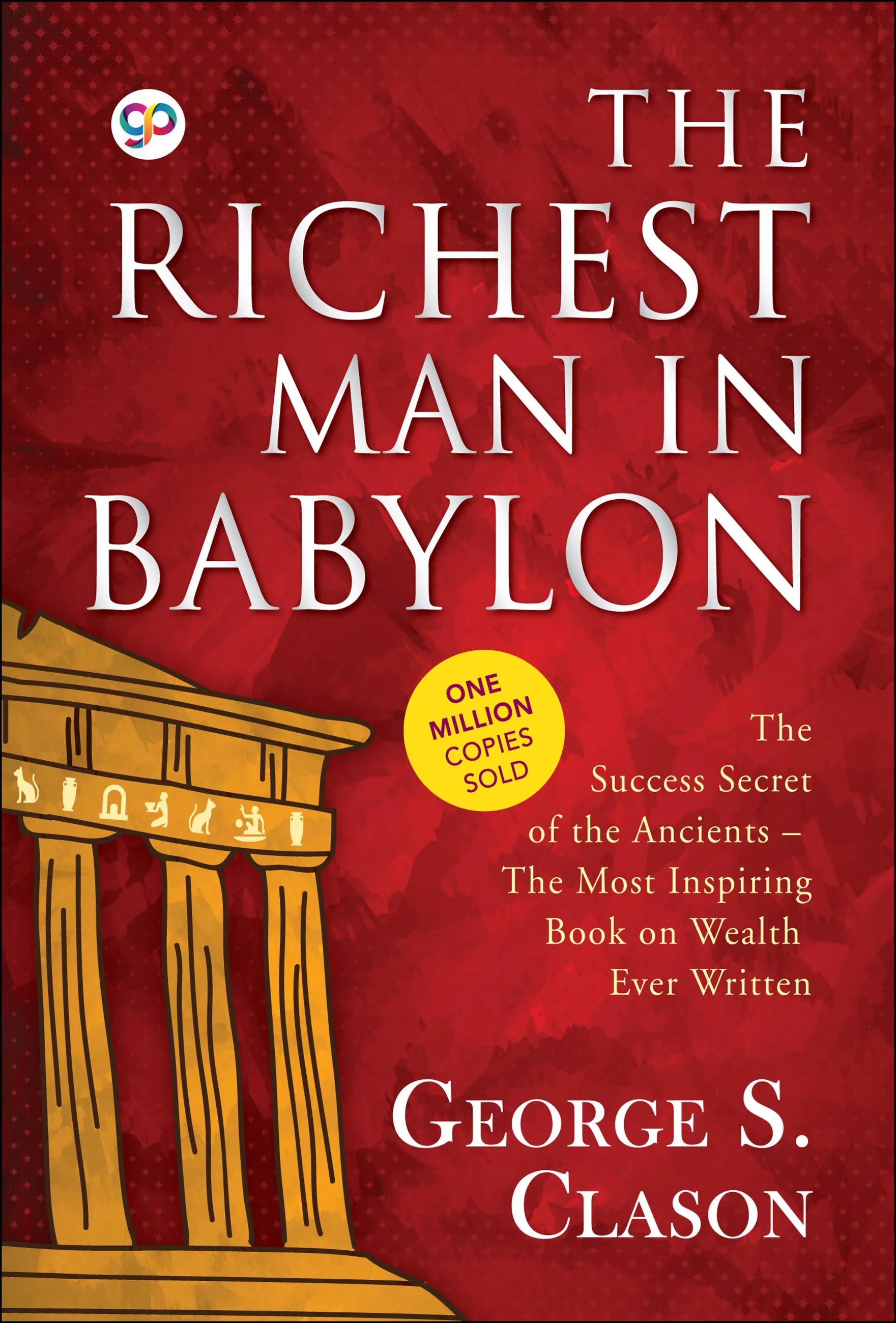
The Richest Man in Babylon
eBook
• INR 51.00
• English
• 9789387669383
No ratings yet
| Publisher | General Press |
|---|---|
| ISBN13 | 9789387669383 |
| ASIN/SKU | B07BB5N17S |
| Book Format | eBook |
| Language | English |
| List Price | INR 51.00 |
| Subject Code | BUS050030, BUS050020, SEL027000 |
| Publishing Date | 14/09/2018 |
| Book Code | BD00068281 |
Buy this Book
Amazon Stores
Ebook Stores
Other Stores
Discover The Richest Man in Babylon by George S. Clason. This book is published by General Press in eBook format, ISBN 9789387669383, ASIN B07BB5N17S, under Business and Money, Budgeting and Money Management, Investing.
Book Description
'The Richest Man in Babylon' by George S. Clason is a timeless personal finance classic that presents practical lessons on wealth, saving, and financial discipline through engaging parables set in the ancient city of Babylon. Rather than offering complex financial theories, the book uses simple stories and memorable characters to demonstrate that the principles of building wealth remain the same across generations.
At the heart of the book is Arkad, the richest man in Babylon, who shares the habits and wisdom that transformed him from an ordinary citizen into a wealthy and respected figure. Through his teachings, readers learn the importance of paying themselves first, living below their means, investing wisely, avoiding unnecessary debt, and seeking sound financial advice. Clason emphasizes that wealth is not created by luck or inheritance but through consistent saving, careful planning, and disciplined decision-making.
Each chapter introduces valuable life lessons that extend beyond money. The stories encourage readers to cultivate patience, responsibility, perseverance, and a willingness to keep learning. The book reminds us that financial freedom is built gradually through small, sensible actions repeated over time, rather than through shortcuts or risky schemes.
Written in a warm and accessible style, 'The Richest Man in Babylon' continues to inspire readers more than a century after its publication. Its enduring wisdom makes it an essential guide for anyone looking to develop healthy financial habits, achieve long-term prosperity, and build a secure future. Whether you are just beginning your financial journey or seeking to strengthen your money management skills, the book offers timeless advice that remains as relevant today as ever.
At the heart of the book is Arkad, the richest man in Babylon, who shares the habits and wisdom that transformed him from an ordinary citizen into a wealthy and respected figure. Through his teachings, readers learn the importance of paying themselves first, living below their means, investing wisely, avoiding unnecessary debt, and seeking sound financial advice. Clason emphasizes that wealth is not created by luck or inheritance but through consistent saving, careful planning, and disciplined decision-making.
Each chapter introduces valuable life lessons that extend beyond money. The stories encourage readers to cultivate patience, responsibility, perseverance, and a willingness to keep learning. The book reminds us that financial freedom is built gradually through small, sensible actions repeated over time, rather than through shortcuts or risky schemes.
Written in a warm and accessible style, 'The Richest Man in Babylon' continues to inspire readers more than a century after its publication. Its enduring wisdom makes it an essential guide for anyone looking to develop healthy financial habits, achieve long-term prosperity, and build a secure future. Whether you are just beginning your financial journey or seeking to strengthen your money management skills, the book offers timeless advice that remains as relevant today as ever.
Author Biography
George Samuel Clason was born in Louisiana, Missouri, on November 7, 1874. He attended the University of Nebraska and served in the United States Army during the Spanish-American War. Beginning a long career in publishing, he founded the Clason Map Company of Denver, Colorado, and published the first road atlas of the United States and Canada. In 1926, he issued the first of a famous series of pamphlets on thrift and financial success, using parables set in ancient Babylon to make each of his points. These were distributed in large quantities by banks and insurance companies and became familiar to millions, the most famous being 'The Richest Man in Babylon', the parable from which the present volume takes its title. These 'Babylonian parables' have become a modern inspirational classic.
Editorial Reviews
Editorial Reviews will be added soon…
Book Summary
George S. Clason’s "The Richest Man in Babylon" is a timeless classic in the realm of personal finance, unique because it bypasses dry financial jargon in favor of engaging, ancient parables. Set in the historically opulent city of Babylon, a place known for its immense wealth despite having few natural resources, the book illustrates that financial prosperity is born from disciplined human effort rather than geographic luck. The narrative begins with two struggling friends, Bansir the chariot builder and Kobbi the musician, who realize that despite years of hard labor, they have nothing to show for it. Frustrated by their perpetual poverty, they seek out their childhood friend, Arkad, who has inexplicably grown to become the richest man in all of Babylon. Arkad willingly shares his knowledge, explaining that wealth is not a matter of divine favoritism or luck, but a strict adherence to fundamental laws of money that anyone can learn and apply to their own lives.
Arkad’s very first and most critical lesson to his friends is the simple but profound mandate: "A part of all you earn is yours to keep." This translates to the modern financial cornerstone of paying yourself first. Arkad explains that most people eagerly pay the butcher, the garment maker, and the landlord, but leave absolutely nothing for themselves at the end of the month. He challenges them to save exactly one-tenth of everything they earn, regardless of how meager their initial income might be. This ten percent is not to be touched for daily expenses; it is the vital seed from which a tree of wealth will eventually grow. The psychological shift here is monumental. By treating one's own financial future as the ultimate priority and securing that tenth before any other obligation is met, a person transforms from a mere conduit of money into an actual builder of wealth. Arkad assures them that they will quickly adapt to living on the remaining ninety percent.
Once the habit of saving is firmly established, Arkad moves to the next logical steps: controlling expenditures and making the accumulated gold multiply. To control expenditures, he advises strict budgeting, forcing his listeners to brutally differentiate between absolute necessities and temporary desires. Human desires are infinite, but our resources are finite, and living strictly within one's means is essential to ensure the ten percent is successfully saved. However, simply hoarding coins in a purse will never make a person truly wealthy. Arkad teaches that money must be put to work. Every saved coin must become a "golden slave" that works relentlessly to earn more coins, and the children of those coins must also work. This is Clason's beautiful, ancient metaphor for compound interest and strategic investing. The true magic of wealth building occurs when your savings generate a passive income stream that flows continuously, whether you are working, traveling, or sleeping.
With the promise of growing wealth comes the severe risk of losing it, which leads to the crucial principle of guarding one's treasures from loss. Arkad warns his friends about the seductive trap of get-rich-quick schemes and the allure of unusually high returns, which almost always mask extraordinarily high risks. The primary rule of investing is the absolute protection of the principal amount. To do this, one must rigorously consult with wise individuals who are experienced in handling money. Arkad shares his own early mistake of trusting a brickmaker to buy rare jewels, an endeavor that predictably ended in the loss of his savings when the brickmaker was sold worthless glass. The lesson is incredibly clear: if you want advice about jewels, go to a jeweler; if you want advice about money, seek out those who have successfully built and managed wealth, entirely avoiding the reckless arrogance of inexperienced investing.
Beyond the raw accumulation and protection of money, the book emphasizes securing one's standard of living and future peace of mind. Arkad advises the citizens of Babylon to make their dwelling a profitable investment by owning their own homes. Paying rent merely enriches the landlord, whereas owning a home builds equity, reduces the ultimate cost of living over time, and instills a deep sense of pride and stability in a family. Furthermore, Arkad implores his students to insure a future income. He recognizes the harsh reality of aging and the inevitability of death, arguing that a wise person prepares financially for the days when they can no longer work, while also ensuring that their family will be provided for if they pass away prematurely. In the modern world, this ancient advice directly translates to the necessity of retirement accounts, life insurance, and long-term estate planning.
The final, and perhaps most empowering, of Arkad's teachings is the mandate to continuously increase one's ability to earn. Wealth is not a static game; it requires relentless personal growth. Arkad stresses that the more wisdom and skill a person acquires, the more they can command in the marketplace. He encourages individuals to perfect their crafts, study their trades, and become the absolute best in their respective fields. Alongside skill development, the book tackles the psychological barrier of procrastination. Clason personifies procrastination as the "enemy of opportunity," a silent thief that steals our chances for success. Many people wait for a mythical stroke of good luck to change their fortunes, but the book argues that the Goddess of Luck only smiles upon those who are men and women of action. True luck is created by recognizing opportunities and moving decisively to seize them, rather than delaying out of fear.
While Arkad’s lessons focus on building new wealth, Clason also brilliantly addresses the crushing reality of pre-existing debt through the story of Dabasir, the camel trader. Dabasir's tale is a masterclass in financial redemption. Having ruined himself through reckless spending and borrowing, he actually became a slave before deciding to fight his way back to dignity. Dabasir introduces a strict, practical mathematical formula to escape the chains of debt: he continues to live on seventy percent of his income, saves ten percent for his own future, and strictly dedicates the remaining twenty percent to slowly and systematically paying off his creditors. He faced the people he owed, explained his plan, and diligently executed it. Dabasir's journey proves that the psychological weight of debt can be lifted by a structured plan and unwavering discipline, embodying the book's resounding mantra: "Where there is a determination, the way can be found."
Ultimately, "The Richest Man in Babylon" endures because it strips away the terrifying complexities of modern finance and reveals the naked, unchangeable truths of wealth creation. It does not promise overnight millions, secret loopholes, or effortless prosperity; instead, it offers a stark, honest blueprint based on frugality, discipline, continuous learning, and time. By framing these financial principles as ancient Babylonian laws, Clason gives them a weight and universality that transcends eras and economic shifts. The book serves as a gentle but firm reminder that taking control of one's financial destiny is an entirely personal responsibility. Whether in an ancient desert empire or a modern digital economy, the rules of money remain stubbornly the same. Those who refuse to learn these rules will forever labor for others, but those who master them can slowly but surely build an unshakeable foundation of true freedom.
Arkad’s very first and most critical lesson to his friends is the simple but profound mandate: "A part of all you earn is yours to keep." This translates to the modern financial cornerstone of paying yourself first. Arkad explains that most people eagerly pay the butcher, the garment maker, and the landlord, but leave absolutely nothing for themselves at the end of the month. He challenges them to save exactly one-tenth of everything they earn, regardless of how meager their initial income might be. This ten percent is not to be touched for daily expenses; it is the vital seed from which a tree of wealth will eventually grow. The psychological shift here is monumental. By treating one's own financial future as the ultimate priority and securing that tenth before any other obligation is met, a person transforms from a mere conduit of money into an actual builder of wealth. Arkad assures them that they will quickly adapt to living on the remaining ninety percent.
Once the habit of saving is firmly established, Arkad moves to the next logical steps: controlling expenditures and making the accumulated gold multiply. To control expenditures, he advises strict budgeting, forcing his listeners to brutally differentiate between absolute necessities and temporary desires. Human desires are infinite, but our resources are finite, and living strictly within one's means is essential to ensure the ten percent is successfully saved. However, simply hoarding coins in a purse will never make a person truly wealthy. Arkad teaches that money must be put to work. Every saved coin must become a "golden slave" that works relentlessly to earn more coins, and the children of those coins must also work. This is Clason's beautiful, ancient metaphor for compound interest and strategic investing. The true magic of wealth building occurs when your savings generate a passive income stream that flows continuously, whether you are working, traveling, or sleeping.
With the promise of growing wealth comes the severe risk of losing it, which leads to the crucial principle of guarding one's treasures from loss. Arkad warns his friends about the seductive trap of get-rich-quick schemes and the allure of unusually high returns, which almost always mask extraordinarily high risks. The primary rule of investing is the absolute protection of the principal amount. To do this, one must rigorously consult with wise individuals who are experienced in handling money. Arkad shares his own early mistake of trusting a brickmaker to buy rare jewels, an endeavor that predictably ended in the loss of his savings when the brickmaker was sold worthless glass. The lesson is incredibly clear: if you want advice about jewels, go to a jeweler; if you want advice about money, seek out those who have successfully built and managed wealth, entirely avoiding the reckless arrogance of inexperienced investing.
Beyond the raw accumulation and protection of money, the book emphasizes securing one's standard of living and future peace of mind. Arkad advises the citizens of Babylon to make their dwelling a profitable investment by owning their own homes. Paying rent merely enriches the landlord, whereas owning a home builds equity, reduces the ultimate cost of living over time, and instills a deep sense of pride and stability in a family. Furthermore, Arkad implores his students to insure a future income. He recognizes the harsh reality of aging and the inevitability of death, arguing that a wise person prepares financially for the days when they can no longer work, while also ensuring that their family will be provided for if they pass away prematurely. In the modern world, this ancient advice directly translates to the necessity of retirement accounts, life insurance, and long-term estate planning.
The final, and perhaps most empowering, of Arkad's teachings is the mandate to continuously increase one's ability to earn. Wealth is not a static game; it requires relentless personal growth. Arkad stresses that the more wisdom and skill a person acquires, the more they can command in the marketplace. He encourages individuals to perfect their crafts, study their trades, and become the absolute best in their respective fields. Alongside skill development, the book tackles the psychological barrier of procrastination. Clason personifies procrastination as the "enemy of opportunity," a silent thief that steals our chances for success. Many people wait for a mythical stroke of good luck to change their fortunes, but the book argues that the Goddess of Luck only smiles upon those who are men and women of action. True luck is created by recognizing opportunities and moving decisively to seize them, rather than delaying out of fear.
While Arkad’s lessons focus on building new wealth, Clason also brilliantly addresses the crushing reality of pre-existing debt through the story of Dabasir, the camel trader. Dabasir's tale is a masterclass in financial redemption. Having ruined himself through reckless spending and borrowing, he actually became a slave before deciding to fight his way back to dignity. Dabasir introduces a strict, practical mathematical formula to escape the chains of debt: he continues to live on seventy percent of his income, saves ten percent for his own future, and strictly dedicates the remaining twenty percent to slowly and systematically paying off his creditors. He faced the people he owed, explained his plan, and diligently executed it. Dabasir's journey proves that the psychological weight of debt can be lifted by a structured plan and unwavering discipline, embodying the book's resounding mantra: "Where there is a determination, the way can be found."
Ultimately, "The Richest Man in Babylon" endures because it strips away the terrifying complexities of modern finance and reveals the naked, unchangeable truths of wealth creation. It does not promise overnight millions, secret loopholes, or effortless prosperity; instead, it offers a stark, honest blueprint based on frugality, discipline, continuous learning, and time. By framing these financial principles as ancient Babylonian laws, Clason gives them a weight and universality that transcends eras and economic shifts. The book serves as a gentle but firm reminder that taking control of one's financial destiny is an entirely personal responsibility. Whether in an ancient desert empire or a modern digital economy, the rules of money remain stubbornly the same. Those who refuse to learn these rules will forever labor for others, but those who master them can slowly but surely build an unshakeable foundation of true freedom.
Sample Chapters
1. A Historical Sketch of Babylon
In the pages of history, there lives no city more enchanting than Babylon. Its very name conjures visions of wealth and splendor. Its treasures of gold and jewels were fabulous. One naturally pictures such a wealthy city as located in a suitable setting of tropical luxury, surrounded by rich natural resources of forests, and mines. But that was not the case. It was located beside the Euphrates River, in a flat, arid valley. It had no forests, no mines, and not even stone for building. It was not even located upon a natural trade route. The rainfall was insufficient to raise crops.
Babylon is an outstanding example of man’s ability to achieve great objectives, using whatever means are at his disposal. All of the resources supporting this large city were man-developed. All of its riches were man-made.
Babylon possessed just two natural resources—fertile soil and water in the river. With one of the greatest engineering accomplishments of this or any other day, Babylonian engineers diverted the waters from the river by means of dams and immense irrigation canals. Far out across that arid valley went these canals to pour the life-giving waters over the fertile soil. This ranks among the first engineering feats known in history. Abundant crops were the reward of this irrigation system the world had never seen before.
Fortunately, during its long existence, Babylon was ruled by successive lines of kings to whom conquest and plunder were but incidental. While it engaged in many wars, most of these were local or defensive against ambitious conquerors from other countries who coveted the fabulous treasures of Babylon. The outstanding rulers of Babylon live in history because of their wisdom, enterprise, and justice. Babylon produced no strutting monarchs who sought to conquer the known world that all nations might pay homage to their egotism.
As a city, Babylon exists no more. When those energizing human forces that built and maintained the city for thousands of years were withdrawn, it soon became a deserted ruin. The site of the city is in Asia about six hundred miles east of the Suez Canal, just north of the Persian Gulf. The latitude is about thirty degrees above the Equator, practically the same as that of Yuma, Arizona. It possessed a climate similar to that of this American city, hot and dry.
Today, this valley of the Euphrates, once a populous irrigated farming district, is again a wind-swept arid waste. Scant grass and desert shrubs strive for existence against the windblown sands. Gone are the fertile fields, the mammoth cities and the long caravans of rich merchandise. Nomadic bands of Arabs, securing a scant living by tending small herds, are the only inhabitants. It has been since about the beginning of the Christian era.
Dotting this valley are earthen hills. For centuries, they were considered by travelers to be nothing else. The attention of archaeologists were finally attracted to them because of broken pieces of pottery and brick washed down by the occasional rain storms. Expeditions financed by European and American museums, were sent here to excavate and see what could be found. Picks and shovels soon proved these hills to be ancient cities. City graves, they might as well be called.
Babylon was one of these. The winds had scattered the desert dust over it for twenty centuries. All exposed walls that were originally built of brick, had disintegrated and gone back to earth once more. Such is Babylon, the wealthy city, today. A heap of dirt, so long abandoned that no living person even knew its name until it was discovered by carefully removing the refuse of centuries from the streets and the fallen wreckage of its noble temples and palaces.
Many scientists consider the civilization of Babylon and other cities in this valley to be the oldest of which there is a definite record. Positive dates have been proved reaching back 8000 years. An interesting fact in this connection is the means used to determine these dates. Uncovered in the ruins of Babylon were descriptions of an eclipse of the sun. Modern astronomers readily computed the time when such an eclipse, visible in Babylon, occurred and thus established a known relationship between their calendar and our own.
In this way, we have proved that 8000 years ago, the Sumerites, who inhabited Babylon, were living in walled cities. One can only conjecture for how many centuries previous such cities had existed. Their inhabitants were not mere barbarians living within protecting walls. They were educated and enlightened people. So far as written history goes, they were the first engineers, the first astronomers, the first mathematicians, the first financiers and the first people to have a written language.
The mention has already been made of the irrigation systems which transformed the arid valley into an agricultural paradise. The remains of these canals can still be traced, although they are mostly filled with accumulated sand. Some of them were of such size that, when empty of water, a dozen horses could be ridden abreast along their bottoms. In size they compare favorably with the largest canals in Colorado and Utah.
In addition to irrigating the valley lands, Babylonian engineers completed another project of similar magnitude. By means of an elaborate drainage system they reclaimed an immense area of swamp land at the mouths of the Euphrates and Tigris Rivers and put this also under cultivation.
Herodotus, the Greek traveler and historian, visited Babylon while it was in its prime and has given us the only known description by an outsider. His writings have given a graphic description of the city and some of the unusual customs of its people. He mentions the remarkable fertility of the soil and the bountiful harvest of wheat and barley which they produced.
The glory of Babylon has faded but its wisdom has been preserved for us. For this we are indebted to their form of records. In that distant day, the use of paper had not been invented. Instead, they laboriously engraved their writing upon tablets of moist clay. When completed, these were baked and became hard tile. In size, they were about six by eight inches, and an inch in thickness.
These clay tablets, as they are commonly called, were used much as we use modern forms of writing. Upon them were engraved legends, poetry, history, transcriptions of royal decrees, the laws of the land, titles to property, promissory notes and even letters which were dispatched by messengers to distant cities. From these clay tablets, we are permitted an insight into the intimate, personal affairs of the people. For example, one tablet, evidently from the records of a country storekeeper, relates that upon the given date a certain customer bought a cow and exchanged it for seven sacks of wheat, three being delivered at the time and the other four to await the customer’s pleasure.
Safely buried in the wrecked cities, archaeologists have recovered entire libraries of these tablets, hundreds of thousands of them.
One of the outstanding wonders of Babylon was the immense walls surrounding the city. The ancients ranked them with the great pyramid of Egypt as belonging to the “seven wonders of the world.” Queen Semiramis is credited with having erected the first walls during the early history of the city. Modern excavators have been unable to find any trace of the original walls. Nor is their exact height known. From mention made by the early writers, it is estimated they were about fifty to sixty feet high, faced on the outer side with burnt brick and further protected by a deep moat of water.
The later and more famous walls were started about six hundred years before the time of Christ by king Nabopolassar. Upon such a gigantic scale he planned the reconstruction, he did not live to see the finished work. This was left to his son, Nebuchadnezzar, whose name is familiar in Biblical history.
The height and length of these later walls staggers belief. They are reported upon reliable authority to have been about one hundred and sixty feet high, the equivalent of the height of a modern fifteen story office building. The total length is estimated as between nine and eleven miles. So wide was the top that a six-horse chariot could be driven around them. Of this tremendous structure, little now remains except portions of the foundations and the moat. In addition to the ravages of the elements, the Arabs completed the destruction by quarrying the brick for building purposes elsewhere.
Against the walls of Babylon marched, in turn, the victorious armies of almost every conqueror of that age of wars of conquest. A host of kings laid siege to Babylon, but always in vain. Invading armies of that day were not considered lightly. Historians speak of such units as 10,000 horsemen, 25,000 chariots, 1200 regiments of foot soldiers with 1000 men to the regiment. Often two or three years of preparation would be required to assemble war materials and depots of food along the proposed line of march.
The city of Babylon was organized much like a modern city. There were streets and shops. Peddlers offered their wares through residential districts. Priests officiated in magnificent temples. Within the city was an inner enclosure for the royal palaces. The walls were said to have been higher than those of the city.
The Babylonians were skilled in the arts. These included sculpture, painting, weaving, gold working and the manufacture of metal weapons and agricultural implements. Their Jewelers created most artistic jewellery. Many samples have been recovered from the graves of its wealthy citizens and are now on exhibition in the leading museums of the world.
At an early period, when the rest of the world was still hacking at trees with stone-headed axes, or hunting and fighting with flint-pointed spears and arrows, the Babylonians were using axes, spears and arrows with metal heads.
The Babylonians were clever financiers and traders. So far as we know, they were the original inventors of money as a means of exchange, of promissory notes and written titles to property.
Babylon was never entered by hostile armies until about 540 years before the birth of Christ. Even then the walls were not captured. The story of the fall of Babylon is most unusual. Cyrus, one of the great conquerors of that period, intended to attack the city and hoped to take its impregnable walls. Advisors of Nabonidus, the king of Babylon, persuaded him to go forth to meet Cyrus and give him battle without waiting for the city to be besieged. In the succeeding defeat to the Babylonian army, it fled away from the city. Thereupon, Cyrus entered the open gates and took possession without resistance.
Thereafter the power and prestige of the city gradually waned until, in the course of a few hundred years, it was eventually abandoned, deserted, left for the winds and storms to level once again to that desert earth from which its grandeur had originally been built. Babylon had fallen, never to rise again, but civilization owes much to it.
The eons of time have crumbled to dust the proud walls of its temples, but the wisdom of Babylon endures.
Money is the medium by which earthly success is measured.
Money makes possible the enjoyment of the best the earth affords.
Money is plentiful for those who understand the simple laws which govern its acquisition.
Money is governed today by the same laws which controlled it, when prosperous men thronged the streets of Babylon, six thousand years ago.
2. The Man Who Desired Gold
Bansir, the chariot builder of Babylon, was thoroughly discouraged. From his seat upon the low wall surrounding his property, he gazed sadly at his simple home and the open workshop in which stood a partially completed chariot.
His wife frequently appeared at the open door. Her furtive glances in his direction reminded him that the meal bag was almost empty and he should be at work finishing the chariot, hammering and hewing, polishing and painting, stretching taut the leather over the wheel rims, preparing it for delivery so he could collect from his wealthy customer.
Nevertheless, his fat, muscular body sat stolidly upon the wall. His slow mind was struggling patiently with a problem for which he could not answer. The hot, tropical sun, so typical of this valley of the Euphrates, beat down upon him mercilessly. Beads of perspiration formed upon his brow and trickled down unnoticed to lose themselves in the hairy jungle on his chest.
Beyond his home towered the high terraced wall surrounding the king’s palace. Nearby, cleaving the blue heavens, was the painted tower of the Temple of Bel. In the shadow of such grandeur was his simple home and many others far less neat and well cared for. Babylon was like a mixture of grandeur and squalor, of dazzling wealth and direst poverty, crowded together without plan or system within the protecting walls of the city.
Behind him, had he cared to turn and look, the noisy chariots of the rich jostled and crowded aside the sandaled tradesmen as well as the barefooted beggars. Even the rich were forced to turn into the gutters to clear the way for the long lines of slave water carriers, on the “king’s Business,” each bearing a heavy goatskin of water to be poured upon the hanging gardens.
Bansir was too engrossed in his own problem to hear or heed the confused hubbub of the busy city. It was the unexpected twanging of the strings from a familiar lyre that aroused him from his reverie. He turned and looked into the sensitive, smiling face of his best friend Kobbi, who was a musician.
“May the gods bless thee with great liberality, my good friend,” began Kobbi with an elaborate salute. “Yet, it does appear they have already been so generous thou needest not to labor. I rejoice with thee in thy good fortune. Moreover, I would even share it with thee. Pray, from thy purse which must be bulging else thou wouldst be busy in your shop, extract but two humble shekels and lend them to me until after the nobleman's feast this night. Thou wilt not miss them ere they are returned.”
“If I did have two shekels,”Bansir responded gloomily, “to no one could I lend them—not even to you, my best of friends; for they would be my fortune—my entire fortune. No one lends his entire fortune, not even to his best friend.”
“What!” exclaimed Kobbi with genuine surprise, “Thou hast not one shekel in thy purse, yet sit like a statue upon a wall! Why not complete that chariot? How else can thou provide for thy noble appetite? This is not like thee, my friend. Where is thy endless energy? Does something distress thee? Have the gods brought to thee troubles?”
“It must be a torment from the gods,”Bansir agreed. “It began with a dream, a senseless dream, in which I thought I was a man of means. From my belt hung a handsome purse, heavy with coins. There were shekels which I cast with careless freedom to the beggars; there were pieces of silver with which I bought finery for my wife and whatever I desired for myself; there were pieces of gold which made me feel assured of the future and unafraid to spend the silver. A glorious feeling of contentment was within me! You would not have known me for thy hard-working friend. Nor wouldst have known my wife, her face was free of wrinkles and shining with happiness. She was again the smiling maiden of our early married days.”
“A pleasant dream, indeed,” commented Kobbi, “but why should such pleasant feelings as it aroused turn thee into a glum statue upon the wall?”
“Why? Indeed! Because when I awoke and remembered how empty my purse was, a feeling of rebellion swept over me. Let us talk it over together, for, as the sailors do say, we ride in the same boat, we two. As youngsters, we went together to the priests to learn wisdom. As young men, we shared each other’s pleasures. As grown up men, we have always been close friends. We have been content with subjects of our kind. We have been satisfied to work long hours and spend our earnings freely. We have earned much coin in the years that have passed, yet to know the joys that come from wealth, we must dream about them. Bah! Are we more than dumb sheep? We live in the richest city in the world. The travelers do say none equals it in wealth. About us is much display of wealth, but of it we ourselves have naught. After half a lifetime of hard labor, thou, my best of friends, hast an empty purse and sayest to me, “May I borrow such a trifle as two shekels until after the nobleman's feast this night?” Then, what do I reply? Do I say, “Here is my purse; its contents will I gladly share?” No, I admit that my purse is as empty as thine. What is the matter? Why cannot we acquire silver and gold—more than enough for food and robes?
“Consider, also, our sons,”Bansir continued, “Are they not following in the footsteps of their fathers? Need they and their families and their sons and their sons’ families live all their lives in the midst of such treasurers of gold, and yet, like us, be content to banquet upon sour goat’s milk and porridge?”
“Never, in all the years of our friendship, didst thou talk like this before, Bansir.”Kobbi was puzzled.
“Never in all those years did I think like this before. From early dawn, until darkness stopped me, I have labored to build the finest chariots any man could make, soft-heartedly hoping someday the Gods would recognize my worthy deeds and bestow upon me great prosperity. This they have never done. At last, I realized that they will never do it. Therefore, my heart is sad. I wish to be a man of means. I wish to own lands and cattle, to have fine robes and coins in my purse. I am willing to work for these things with all the strength in my back, with all the skill in my hands, with all the cunning in my mind, but I wish my labors to be fairly rewarded. What is the matter with us? Again, I ask you! Why cannot we have our just share of the good things so plentiful for those who have the gold with which to buy them?”
“Would I know an answer!”Kobbi replied. “No better than thou am I satisfied. My earnings from my lyre are quickly gone. Often, I must plan and scheme so that my family will not be hungry. Also, within my breast is a deep longing for a lyre large enough that it may truly sing the strains of music that do surge through my mind. With such an instrument I could make music finer than even the king has heard before.”
“Such a lyre thou shouldst have. No man in all Babylon could make it sing more sweetly; could make it sing so sweetly, not only the king but the gods themselves would be delighted. But how mayest thou secure it while we both are as poor as the king’s slaves? Listen to the bell! Here they come.” He pointed to the long column of half naked, sweating water bearers plodding laboriously up the narrow street from the river. Five abreast they marched, each bent under a heavy goatskin of water.
“A fine figure of a man, he who doth lead them.”Kobbi indicated the wearer of the bell who marched in front without a load. “A prominent man in his own country, ‘tis easy to see.”
“There are many good figures in the line,”Bansir agreed, “as good men as we. Tall, blond men from the north, laughing black men from the south, little brown men from the nearby countries. All marching together from the river to the gardens, back and forth, day after day, year after year. Naught of happiness to look forward to. Beds of straw upon which to sleep—hard grain porridge to eat. Pity the poor brutes, Kobbi!”
“I do pity them. Yet, thou dost make me see how little better off we are, free men though we call ourselves.”
That is the truth, Kobbi, unpleasant thought though it be. We do not wish to go on year after year living slavish lives. Working, working, working! Getting nowhere.”
In the pages of history, there lives no city more enchanting than Babylon. Its very name conjures visions of wealth and splendor. Its treasures of gold and jewels were fabulous. One naturally pictures such a wealthy city as located in a suitable setting of tropical luxury, surrounded by rich natural resources of forests, and mines. But that was not the case. It was located beside the Euphrates River, in a flat, arid valley. It had no forests, no mines, and not even stone for building. It was not even located upon a natural trade route. The rainfall was insufficient to raise crops.
Babylon is an outstanding example of man’s ability to achieve great objectives, using whatever means are at his disposal. All of the resources supporting this large city were man-developed. All of its riches were man-made.
Babylon possessed just two natural resources—fertile soil and water in the river. With one of the greatest engineering accomplishments of this or any other day, Babylonian engineers diverted the waters from the river by means of dams and immense irrigation canals. Far out across that arid valley went these canals to pour the life-giving waters over the fertile soil. This ranks among the first engineering feats known in history. Abundant crops were the reward of this irrigation system the world had never seen before.
Fortunately, during its long existence, Babylon was ruled by successive lines of kings to whom conquest and plunder were but incidental. While it engaged in many wars, most of these were local or defensive against ambitious conquerors from other countries who coveted the fabulous treasures of Babylon. The outstanding rulers of Babylon live in history because of their wisdom, enterprise, and justice. Babylon produced no strutting monarchs who sought to conquer the known world that all nations might pay homage to their egotism.
As a city, Babylon exists no more. When those energizing human forces that built and maintained the city for thousands of years were withdrawn, it soon became a deserted ruin. The site of the city is in Asia about six hundred miles east of the Suez Canal, just north of the Persian Gulf. The latitude is about thirty degrees above the Equator, practically the same as that of Yuma, Arizona. It possessed a climate similar to that of this American city, hot and dry.
Today, this valley of the Euphrates, once a populous irrigated farming district, is again a wind-swept arid waste. Scant grass and desert shrubs strive for existence against the windblown sands. Gone are the fertile fields, the mammoth cities and the long caravans of rich merchandise. Nomadic bands of Arabs, securing a scant living by tending small herds, are the only inhabitants. It has been since about the beginning of the Christian era.
Dotting this valley are earthen hills. For centuries, they were considered by travelers to be nothing else. The attention of archaeologists were finally attracted to them because of broken pieces of pottery and brick washed down by the occasional rain storms. Expeditions financed by European and American museums, were sent here to excavate and see what could be found. Picks and shovels soon proved these hills to be ancient cities. City graves, they might as well be called.
Babylon was one of these. The winds had scattered the desert dust over it for twenty centuries. All exposed walls that were originally built of brick, had disintegrated and gone back to earth once more. Such is Babylon, the wealthy city, today. A heap of dirt, so long abandoned that no living person even knew its name until it was discovered by carefully removing the refuse of centuries from the streets and the fallen wreckage of its noble temples and palaces.
Many scientists consider the civilization of Babylon and other cities in this valley to be the oldest of which there is a definite record. Positive dates have been proved reaching back 8000 years. An interesting fact in this connection is the means used to determine these dates. Uncovered in the ruins of Babylon were descriptions of an eclipse of the sun. Modern astronomers readily computed the time when such an eclipse, visible in Babylon, occurred and thus established a known relationship between their calendar and our own.
In this way, we have proved that 8000 years ago, the Sumerites, who inhabited Babylon, were living in walled cities. One can only conjecture for how many centuries previous such cities had existed. Their inhabitants were not mere barbarians living within protecting walls. They were educated and enlightened people. So far as written history goes, they were the first engineers, the first astronomers, the first mathematicians, the first financiers and the first people to have a written language.
The mention has already been made of the irrigation systems which transformed the arid valley into an agricultural paradise. The remains of these canals can still be traced, although they are mostly filled with accumulated sand. Some of them were of such size that, when empty of water, a dozen horses could be ridden abreast along their bottoms. In size they compare favorably with the largest canals in Colorado and Utah.
In addition to irrigating the valley lands, Babylonian engineers completed another project of similar magnitude. By means of an elaborate drainage system they reclaimed an immense area of swamp land at the mouths of the Euphrates and Tigris Rivers and put this also under cultivation.
Herodotus, the Greek traveler and historian, visited Babylon while it was in its prime and has given us the only known description by an outsider. His writings have given a graphic description of the city and some of the unusual customs of its people. He mentions the remarkable fertility of the soil and the bountiful harvest of wheat and barley which they produced.
The glory of Babylon has faded but its wisdom has been preserved for us. For this we are indebted to their form of records. In that distant day, the use of paper had not been invented. Instead, they laboriously engraved their writing upon tablets of moist clay. When completed, these were baked and became hard tile. In size, they were about six by eight inches, and an inch in thickness.
These clay tablets, as they are commonly called, were used much as we use modern forms of writing. Upon them were engraved legends, poetry, history, transcriptions of royal decrees, the laws of the land, titles to property, promissory notes and even letters which were dispatched by messengers to distant cities. From these clay tablets, we are permitted an insight into the intimate, personal affairs of the people. For example, one tablet, evidently from the records of a country storekeeper, relates that upon the given date a certain customer bought a cow and exchanged it for seven sacks of wheat, three being delivered at the time and the other four to await the customer’s pleasure.
Safely buried in the wrecked cities, archaeologists have recovered entire libraries of these tablets, hundreds of thousands of them.
One of the outstanding wonders of Babylon was the immense walls surrounding the city. The ancients ranked them with the great pyramid of Egypt as belonging to the “seven wonders of the world.” Queen Semiramis is credited with having erected the first walls during the early history of the city. Modern excavators have been unable to find any trace of the original walls. Nor is their exact height known. From mention made by the early writers, it is estimated they were about fifty to sixty feet high, faced on the outer side with burnt brick and further protected by a deep moat of water.
The later and more famous walls were started about six hundred years before the time of Christ by king Nabopolassar. Upon such a gigantic scale he planned the reconstruction, he did not live to see the finished work. This was left to his son, Nebuchadnezzar, whose name is familiar in Biblical history.
The height and length of these later walls staggers belief. They are reported upon reliable authority to have been about one hundred and sixty feet high, the equivalent of the height of a modern fifteen story office building. The total length is estimated as between nine and eleven miles. So wide was the top that a six-horse chariot could be driven around them. Of this tremendous structure, little now remains except portions of the foundations and the moat. In addition to the ravages of the elements, the Arabs completed the destruction by quarrying the brick for building purposes elsewhere.
Against the walls of Babylon marched, in turn, the victorious armies of almost every conqueror of that age of wars of conquest. A host of kings laid siege to Babylon, but always in vain. Invading armies of that day were not considered lightly. Historians speak of such units as 10,000 horsemen, 25,000 chariots, 1200 regiments of foot soldiers with 1000 men to the regiment. Often two or three years of preparation would be required to assemble war materials and depots of food along the proposed line of march.
The city of Babylon was organized much like a modern city. There were streets and shops. Peddlers offered their wares through residential districts. Priests officiated in magnificent temples. Within the city was an inner enclosure for the royal palaces. The walls were said to have been higher than those of the city.
The Babylonians were skilled in the arts. These included sculpture, painting, weaving, gold working and the manufacture of metal weapons and agricultural implements. Their Jewelers created most artistic jewellery. Many samples have been recovered from the graves of its wealthy citizens and are now on exhibition in the leading museums of the world.
At an early period, when the rest of the world was still hacking at trees with stone-headed axes, or hunting and fighting with flint-pointed spears and arrows, the Babylonians were using axes, spears and arrows with metal heads.
The Babylonians were clever financiers and traders. So far as we know, they were the original inventors of money as a means of exchange, of promissory notes and written titles to property.
Babylon was never entered by hostile armies until about 540 years before the birth of Christ. Even then the walls were not captured. The story of the fall of Babylon is most unusual. Cyrus, one of the great conquerors of that period, intended to attack the city and hoped to take its impregnable walls. Advisors of Nabonidus, the king of Babylon, persuaded him to go forth to meet Cyrus and give him battle without waiting for the city to be besieged. In the succeeding defeat to the Babylonian army, it fled away from the city. Thereupon, Cyrus entered the open gates and took possession without resistance.
Thereafter the power and prestige of the city gradually waned until, in the course of a few hundred years, it was eventually abandoned, deserted, left for the winds and storms to level once again to that desert earth from which its grandeur had originally been built. Babylon had fallen, never to rise again, but civilization owes much to it.
The eons of time have crumbled to dust the proud walls of its temples, but the wisdom of Babylon endures.
Money is the medium by which earthly success is measured.
Money makes possible the enjoyment of the best the earth affords.
Money is plentiful for those who understand the simple laws which govern its acquisition.
Money is governed today by the same laws which controlled it, when prosperous men thronged the streets of Babylon, six thousand years ago.
2. The Man Who Desired Gold
Bansir, the chariot builder of Babylon, was thoroughly discouraged. From his seat upon the low wall surrounding his property, he gazed sadly at his simple home and the open workshop in which stood a partially completed chariot.
His wife frequently appeared at the open door. Her furtive glances in his direction reminded him that the meal bag was almost empty and he should be at work finishing the chariot, hammering and hewing, polishing and painting, stretching taut the leather over the wheel rims, preparing it for delivery so he could collect from his wealthy customer.
Nevertheless, his fat, muscular body sat stolidly upon the wall. His slow mind was struggling patiently with a problem for which he could not answer. The hot, tropical sun, so typical of this valley of the Euphrates, beat down upon him mercilessly. Beads of perspiration formed upon his brow and trickled down unnoticed to lose themselves in the hairy jungle on his chest.
Beyond his home towered the high terraced wall surrounding the king’s palace. Nearby, cleaving the blue heavens, was the painted tower of the Temple of Bel. In the shadow of such grandeur was his simple home and many others far less neat and well cared for. Babylon was like a mixture of grandeur and squalor, of dazzling wealth and direst poverty, crowded together without plan or system within the protecting walls of the city.
Behind him, had he cared to turn and look, the noisy chariots of the rich jostled and crowded aside the sandaled tradesmen as well as the barefooted beggars. Even the rich were forced to turn into the gutters to clear the way for the long lines of slave water carriers, on the “king’s Business,” each bearing a heavy goatskin of water to be poured upon the hanging gardens.
Bansir was too engrossed in his own problem to hear or heed the confused hubbub of the busy city. It was the unexpected twanging of the strings from a familiar lyre that aroused him from his reverie. He turned and looked into the sensitive, smiling face of his best friend Kobbi, who was a musician.
“May the gods bless thee with great liberality, my good friend,” began Kobbi with an elaborate salute. “Yet, it does appear they have already been so generous thou needest not to labor. I rejoice with thee in thy good fortune. Moreover, I would even share it with thee. Pray, from thy purse which must be bulging else thou wouldst be busy in your shop, extract but two humble shekels and lend them to me until after the nobleman's feast this night. Thou wilt not miss them ere they are returned.”
“If I did have two shekels,”Bansir responded gloomily, “to no one could I lend them—not even to you, my best of friends; for they would be my fortune—my entire fortune. No one lends his entire fortune, not even to his best friend.”
“What!” exclaimed Kobbi with genuine surprise, “Thou hast not one shekel in thy purse, yet sit like a statue upon a wall! Why not complete that chariot? How else can thou provide for thy noble appetite? This is not like thee, my friend. Where is thy endless energy? Does something distress thee? Have the gods brought to thee troubles?”
“It must be a torment from the gods,”Bansir agreed. “It began with a dream, a senseless dream, in which I thought I was a man of means. From my belt hung a handsome purse, heavy with coins. There were shekels which I cast with careless freedom to the beggars; there were pieces of silver with which I bought finery for my wife and whatever I desired for myself; there were pieces of gold which made me feel assured of the future and unafraid to spend the silver. A glorious feeling of contentment was within me! You would not have known me for thy hard-working friend. Nor wouldst have known my wife, her face was free of wrinkles and shining with happiness. She was again the smiling maiden of our early married days.”
“A pleasant dream, indeed,” commented Kobbi, “but why should such pleasant feelings as it aroused turn thee into a glum statue upon the wall?”
“Why? Indeed! Because when I awoke and remembered how empty my purse was, a feeling of rebellion swept over me. Let us talk it over together, for, as the sailors do say, we ride in the same boat, we two. As youngsters, we went together to the priests to learn wisdom. As young men, we shared each other’s pleasures. As grown up men, we have always been close friends. We have been content with subjects of our kind. We have been satisfied to work long hours and spend our earnings freely. We have earned much coin in the years that have passed, yet to know the joys that come from wealth, we must dream about them. Bah! Are we more than dumb sheep? We live in the richest city in the world. The travelers do say none equals it in wealth. About us is much display of wealth, but of it we ourselves have naught. After half a lifetime of hard labor, thou, my best of friends, hast an empty purse and sayest to me, “May I borrow such a trifle as two shekels until after the nobleman's feast this night?” Then, what do I reply? Do I say, “Here is my purse; its contents will I gladly share?” No, I admit that my purse is as empty as thine. What is the matter? Why cannot we acquire silver and gold—more than enough for food and robes?
“Consider, also, our sons,”Bansir continued, “Are they not following in the footsteps of their fathers? Need they and their families and their sons and their sons’ families live all their lives in the midst of such treasurers of gold, and yet, like us, be content to banquet upon sour goat’s milk and porridge?”
“Never, in all the years of our friendship, didst thou talk like this before, Bansir.”Kobbi was puzzled.
“Never in all those years did I think like this before. From early dawn, until darkness stopped me, I have labored to build the finest chariots any man could make, soft-heartedly hoping someday the Gods would recognize my worthy deeds and bestow upon me great prosperity. This they have never done. At last, I realized that they will never do it. Therefore, my heart is sad. I wish to be a man of means. I wish to own lands and cattle, to have fine robes and coins in my purse. I am willing to work for these things with all the strength in my back, with all the skill in my hands, with all the cunning in my mind, but I wish my labors to be fairly rewarded. What is the matter with us? Again, I ask you! Why cannot we have our just share of the good things so plentiful for those who have the gold with which to buy them?”
“Would I know an answer!”Kobbi replied. “No better than thou am I satisfied. My earnings from my lyre are quickly gone. Often, I must plan and scheme so that my family will not be hungry. Also, within my breast is a deep longing for a lyre large enough that it may truly sing the strains of music that do surge through my mind. With such an instrument I could make music finer than even the king has heard before.”
“Such a lyre thou shouldst have. No man in all Babylon could make it sing more sweetly; could make it sing so sweetly, not only the king but the gods themselves would be delighted. But how mayest thou secure it while we both are as poor as the king’s slaves? Listen to the bell! Here they come.” He pointed to the long column of half naked, sweating water bearers plodding laboriously up the narrow street from the river. Five abreast they marched, each bent under a heavy goatskin of water.
“A fine figure of a man, he who doth lead them.”Kobbi indicated the wearer of the bell who marched in front without a load. “A prominent man in his own country, ‘tis easy to see.”
“There are many good figures in the line,”Bansir agreed, “as good men as we. Tall, blond men from the north, laughing black men from the south, little brown men from the nearby countries. All marching together from the river to the gardens, back and forth, day after day, year after year. Naught of happiness to look forward to. Beds of straw upon which to sleep—hard grain porridge to eat. Pity the poor brutes, Kobbi!”
“I do pity them. Yet, thou dost make me see how little better off we are, free men though we call ourselves.”
That is the truth, Kobbi, unpleasant thought though it be. We do not wish to go on year after year living slavish lives. Working, working, working! Getting nowhere.”
Reader Reviews
No reviews yet.
The Richest Man in Babylon
Download Cover Image
Do you want to download the full cover image for The Richest Man in Babylon?