
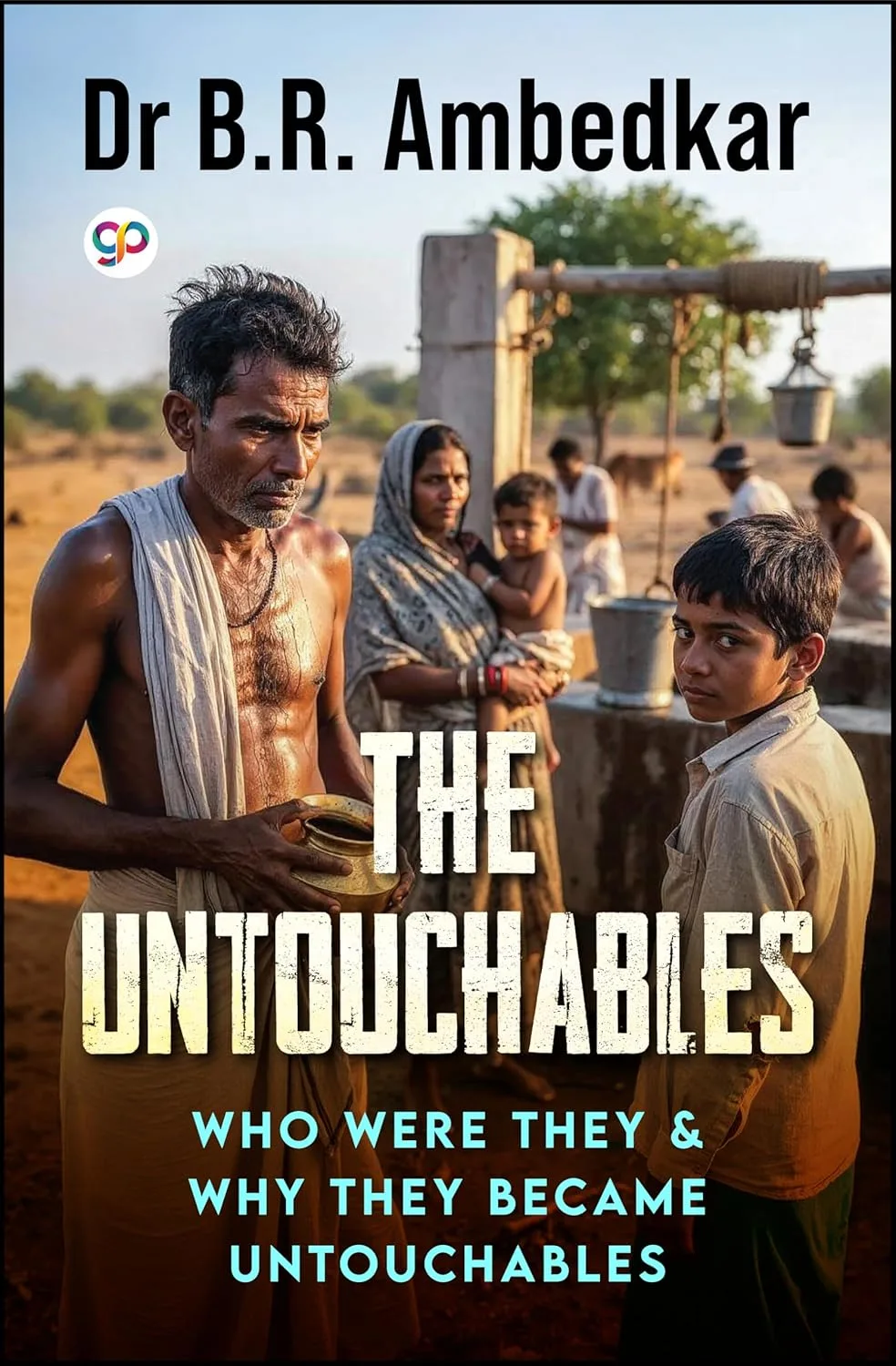
The Untouchables: Who Were They and Why They Became Untouchables
eBook
• INR 99.00
• English
• 9788199107380
No ratings yet
| Publisher | General Press |
|---|---|
| ISBN13 | 9788199107380 |
| ASIN/SKU | B0G1TMT3LK |
| Book Format | eBook |
| Language | English |
| List Price | INR 99.00 |
| Subject Code | SOC054000, SOC031000, HIS062000 |
| Book Code | BD00068418 |
Buy this Book
Amazon Stores
Ebook Stores
Other Stores
Discover The Untouchables: Who Were They and Why They Became Untouchables by Dr. B.R. Ambedkar. This book is published by General Press in eBook format, ISBN 9788199107380, ASIN B0G1TMT3LK, under History, Ancient India, Cultural Anthropology.
Book Description
“The book is a work of art even more than of history.” —India Today, Dilip Menon
“The evil of caste system.” —The Tribune
First published in 1948, “The Untouchables: Who Were They and Why They Became Untouchables” by Dr. B.R. Ambedkar is a powerful work of historical analysis and social critique that examines the origins and persistence of untouchability in Indian society. Dr. Ambedkar—jurist, social reformer, and chief architect of the Indian Constitution—wrote this book as part of his lifelong mission to expose and dismantle caste-based oppression.
In this meticulously researched work, Ambedkar challenges traditional Hindu explanations of caste and untouchability, offering a bold and original thesis. He argues that the Untouchables, or Dalits, were originally Buddhists and independent social groups who resisted Brahmanical dominance and priestly authority. Their refusal to conform to Vedic rituals and their adherence to different religious practices led to their social exclusion and eventual stigmatization as “untouchables.”
Ambedkar explores religious, economic, and political factors behind this marginalization, using historical records and logical reasoning to construct a compelling argument. His clear, direct prose makes complex ideas accessible, while his passion for justice gives the work moral force.
The Untouchables remains a foundational text in Dalit studies, Indian sociology, and anti-caste literature, offering critical insight into the roots of inequality and the enduring struggle for dignity and human rights in India.
“The evil of caste system.” —The Tribune
First published in 1948, “The Untouchables: Who Were They and Why They Became Untouchables” by Dr. B.R. Ambedkar is a powerful work of historical analysis and social critique that examines the origins and persistence of untouchability in Indian society. Dr. Ambedkar—jurist, social reformer, and chief architect of the Indian Constitution—wrote this book as part of his lifelong mission to expose and dismantle caste-based oppression.
In this meticulously researched work, Ambedkar challenges traditional Hindu explanations of caste and untouchability, offering a bold and original thesis. He argues that the Untouchables, or Dalits, were originally Buddhists and independent social groups who resisted Brahmanical dominance and priestly authority. Their refusal to conform to Vedic rituals and their adherence to different religious practices led to their social exclusion and eventual stigmatization as “untouchables.”
Ambedkar explores religious, economic, and political factors behind this marginalization, using historical records and logical reasoning to construct a compelling argument. His clear, direct prose makes complex ideas accessible, while his passion for justice gives the work moral force.
The Untouchables remains a foundational text in Dalit studies, Indian sociology, and anti-caste literature, offering critical insight into the roots of inequality and the enduring struggle for dignity and human rights in India.
Author Biography
Dr. Bhimrao Ramji Ambedkar (1891–1956) was a towering Indian jurist, economist, social reformer, and political leader who served as the chief architect of the Indian Constitution. Born into the marginalized Mahar caste in Mhow, Madhya Pradesh, Ambedkar faced severe socio-economic discrimination from a young age due to the oppressive practice of untouchability. Despite these immense barriers, his exceptional intellect propelled him to become one of the most highly educated Indians of his time, earning doctorates in economics from both Columbia University and the London School of Economics.
Returning to India, Ambedkar dedicated his life to dismantling the rigid Hindu caste system and fighting for the civil liberties of Dalits and other oppressed communities. He led powerful grassroots movements, such as the Mahad Satyagraha in 1927, advocating for equal access to public resources. When India gained independence in 1947, he was appointed as the nation’s first Law Minister and selected to chair the Constitution Drafting Committee. Under his visionary leadership, the newly framed Constitution guaranteed fundamental rights, formally outlawed untouchability, and established affirmative action policies to uplift disadvantaged groups.
Beyond his monumental political legacy, Ambedkar was a prolific author and relentless public intellectual. His most famous work, Annihilation of Caste (1936), remains a seminal, blistering critique of social hierarchy and religious orthodoxy. Other major scholarly contributions include Who Were the Shudras? and The Problem of the Rupee, which heavily influenced the establishment of the Reserve Bank of India. Disillusioned with the entrenched inequalities of Hinduism, Ambedkar converted to Buddhism just weeks before his death in 1956, initiating a mass conversion movement among his followers. Posthumously awarded the Bharat Ratna, India’s highest civilian honor, Dr. Ambedkar’s profound legacy continues to inspire global movements for social justice, equality, and human rights.
Returning to India, Ambedkar dedicated his life to dismantling the rigid Hindu caste system and fighting for the civil liberties of Dalits and other oppressed communities. He led powerful grassroots movements, such as the Mahad Satyagraha in 1927, advocating for equal access to public resources. When India gained independence in 1947, he was appointed as the nation’s first Law Minister and selected to chair the Constitution Drafting Committee. Under his visionary leadership, the newly framed Constitution guaranteed fundamental rights, formally outlawed untouchability, and established affirmative action policies to uplift disadvantaged groups.
Beyond his monumental political legacy, Ambedkar was a prolific author and relentless public intellectual. His most famous work, Annihilation of Caste (1936), remains a seminal, blistering critique of social hierarchy and religious orthodoxy. Other major scholarly contributions include Who Were the Shudras? and The Problem of the Rupee, which heavily influenced the establishment of the Reserve Bank of India. Disillusioned with the entrenched inequalities of Hinduism, Ambedkar converted to Buddhism just weeks before his death in 1956, initiating a mass conversion movement among his followers. Posthumously awarded the Bharat Ratna, India’s highest civilian honor, Dr. Ambedkar’s profound legacy continues to inspire global movements for social justice, equality, and human rights.
Editorial Reviews
Editorial Reviews will be added soon…
Book Summary
Dr. B. R. Ambedkar’s The Untouchables: Who Were They and Why They Became Untouchables is one of the most challenging and important works on the historical origins of untouchability in India. Written as a sequel to his earlier study Who Were the Shudras?, the book asks a deceptively simple question: Who were the people who came to be treated as “Untouchables,” and how did this extreme form of social exclusion arise? Ambedkar does not accept the traditional explanation that untouchability was simply an ancient, permanent feature of Indian society. Instead, he investigates it as a historical development, examining caste, village organization, religious conflict, food practices, social prejudice, and the changing status of Buddhism and Brahmanism. The book’s argument is deliberately provocative, because Ambedkar wants readers to stop treating untouchability as a natural or timeless fact and instead understand it as a social institution created through historical circumstances. The official Ambedkar writings describe the work as a sequel to The Shudras, and its central concern is the neglected historical problem of the Untouchables.
The first major strength of the book is Ambedkar’s refusal to accept inherited assumptions. He begins with the problem of terminology and social classification, asking whether people who were later regarded as Untouchables had always occupied that position. For Ambedkar, this distinction is crucial. If untouchability existed from the beginning of Indian civilization in exactly the form in which it later became known, then there would be little need for a historical explanation. But if communities once lived in a different social condition and were only later transformed into Untouchables, then the origins of that transformation must be investigated. Ambedkar therefore approaches untouchability not merely as a religious rule but as a process of social change. The table of contents of the work reflects this progression: he examines untouchability among Hindus and non-Hindus, the settlement of Untouchables outside villages, the idea of “Broken Men,” occupational explanations, Buddhism, beef-eating, the distinction between impurity and untouchability, and finally the question of when Broken Men became Untouchables.
One of Ambedkar’s most important concepts is the idea of “Broken Men.” He proposes that many communities who eventually became Untouchables may have originated as people whose tribes or communities had been defeated, dispersed, or broken apart. In the unstable conditions of early village society, these displaced groups needed somewhere to live and some means of survival. They therefore came to settle on the outskirts of established villages rather than becoming fully integrated into the settled communities. This physical separation, Ambedkar argues, originally did not necessarily mean ritual untouchability. The Broken Men could have had relationships of service, protection, labor, and exchange with the settled population while remaining socially distinct. In other words, living outside the village and being considered ritually polluted were not necessarily the same thing. Ambedkar’s theory attempts to explain how a relatively ordinary form of social separation could eventually become an extreme system of exclusion.
This argument leads to one of the book’s most significant questions: Why did the Untouchables live outside the village? Ambedkar does not regard this arrangement simply as evidence that they were naturally inferior. Instead, he interprets it as part of a historical settlement pattern. The settled community occupied the central village, while Broken Men lived on its margins. Their position could have been functional rather than purely religious. They might perform particular duties, provide services, or offer protection while remaining outside the main social settlement. Over time, however, a social boundary can become a moral boundary. What begins as geographical separation may develop into rules governing food, marriage, residence, physical contact, occupation, and religious participation. Ambedkar’s broader point is that institutions of exclusion often become so old and deeply rooted that later generations mistake them for eternal truths.
Ambedkar then examines and rejects explanations based simply on occupation. One common theory of caste-based untouchability is that certain communities became Untouchable because they performed occupations regarded as dirty or polluting, such as handling dead animals, removing waste, tanning leather, or performing other forms of manual labor that upper-caste society considered degrading. Ambedkar recognizes the connection between occupation and social status but argues that occupation alone cannot explain the origin of untouchability. His question is essentially this: if an occupation is considered impure, why should the people who perform it become permanently and hereditarily Untouchable? And why did particular occupations acquire their supposedly polluting character in the first place? The explanation must therefore go deeper than economics or division of labor. It must account for the historical creation of the idea of pollution itself.
A central turning point in Ambedkar’s investigation is his discussion of Buddhism and Brahmanism. He argues that the conflict between Buddhist communities and Brahmanical society played an important role in the historical development of untouchability. According to his theory, groups associated with Buddhism experienced hostility and contempt as Brahmanical influence revived. But Ambedkar recognizes that hostility toward Buddhists by itself cannot fully explain why only certain communities became Untouchable. His argument therefore introduces another factor: the continuing practice of eating beef among the Broken Men. Modern scholarship describing Ambedkar’s thesis summarizes it as the claim that outcaste communities were connected with Buddhism and that their continued consumption of beef became particularly stigmatized as attitudes toward the cow changed.
This brings the book to its most famous and controversial argument: beef-eating as a major root of untouchability. Ambedkar challenges the widespread assumption that Hindus had always regarded cow slaughter and beef consumption as unacceptable. He investigates religious texts and historical practices to argue that ancient Indian society was not uniformly opposed to eating beef. This is essential to his reasoning. If beef-eating had always been universally condemned, it could not explain why untouchability emerged at a particular historical moment. But if beef had once been consumed by sections of society and later became taboo, then the social consequences of that change become historically significant. Ambedkar’s official writings explicitly frame this as a series of questions: whether Hindus always avoided beef, why non-Brahmins abandoned it, what caused Brahmins to become vegetarian, why beef-eating became associated with untouchability, and when untouchability itself emerged.
Ambedkar’s argument about vegetarianism is particularly important because he does not simply treat dietary practices as private choices. He interprets them as part of a larger struggle for social status and religious authority. His thesis is that Brahmins, who had historically participated in practices involving animal sacrifice and meat consumption, eventually adopted vegetarianism and intensified reverence for the cow. Ambedkar connects this transformation with competition between Brahmanism and Buddhism. In his interpretation, Brahmanism responded to Buddhist influence by adopting or emphasizing values associated with nonviolence and vegetarianism, thereby strengthening its own moral authority. The cow consequently became an increasingly powerful symbol, while communities that continued to eat beef could be marked as morally and ritually degraded.
The crucial point is that Ambedkar does not argue that every person who ate beef automatically became Untouchable. His theory is more specific. The Broken Men were already socially separated from settled communities and, in his interpretation, had a particular relationship with Buddhism. When the broader social attitude toward beef changed, their continued consumption of it became an additional reason for contempt. Ambedkar writes that contempt for Buddhists was too general by itself to explain why Broken Men specifically became Untouchable; beef-eating provided the additional factor that intensified their exclusion. This is the heart of the book’s thesis: untouchability resulted from the interaction of social separation, religious conflict, and changing attitudes toward beef-eating, rather than from an eternal religious command.
Another important part of the book is Ambedkar’s distinction between “the impure” and “the Untouchables.” He argues that ritual impurity and untouchability should not simply be treated as identical concepts. A person or group can be considered ceremonially impure in a particular context without being permanently excluded from society. Untouchability, by contrast, involves a much more comprehensive form of social rejection. It affects residence, physical contact, access to public resources, social interaction, religious participation, and everyday human dignity. Ambedkar therefore wants readers to understand untouchability as something qualitatively more severe than ordinary notions of ritual impurity.
The final chapters address the difficult question of when untouchability actually began. Ambedkar is careful to admit that it is impossible to provide an exact date. Untouchability, he says, developed gradually as a form of social psychology rather than appearing suddenly through a single decree. The official text describes it as something that grew over time and emphasizes the difficulty of fixing a precise date for its birth. Ambedkar nevertheless tries to establish an approximate historical period by identifying a time when communities described in early sources were not necessarily treated as Untouchable and comparing it with later evidence of established untouchability. His larger conclusion is that the institution should be understood as a historical development rather than as an unchanging feature of Indian society.
What makes The Untouchables especially powerful is the way Ambedkar turns history into an argument about human dignity. He is not studying the subject merely because he wants to solve an academic puzzle. He is trying to expose the historical mechanisms through which millions of people were denied equality. His scholarship is therefore connected to his larger political and moral philosophy. If untouchability was historically created, then it can also be historically destroyed. If it was not an eternal law of nature, there is no justification for preserving it.
At the same time, modern readers should recognize that Ambedkar’s theory is a historical thesis, and some aspects of it have been debated by later scholars. A contemporary scholarly edition describes his account as a deductive and sometimes speculative genealogy of untouchability, while presenting the “Broken Men,” Buddhism, Brahmanical revival, and beef-eating as the central elements of his proposed explanation. This does not diminish the importance of the book. Rather, it helps readers approach it in the right way: as an ambitious attempt by one of modern India’s most important thinkers to reconstruct a suppressed social history and challenge conventional explanations.
Ultimately, the central message of The Untouchables is that social oppression has a history. Ambedkar asks us to look behind customs and examine how they were formed, who benefited from them, and how they became accepted as normal. His theory of Broken Men, his examination of the decline of beef-eating among sections of Hindu society, his analysis of Brahmanical vegetarianism, and his discussion of Buddhist-Brahmanical conflict all serve one larger purpose: to demonstrate that untouchability was not an inevitable expression of human difference. It was a constructed social relationship that hardened over centuries.
For readers searching for an accessible explanation of Dr. B. R. Ambedkar’s The Untouchables, the book is best understood as a historical investigation into the origins of Dalit marginalization, caste discrimination, untouchability, the Broken Men theory, Buddhism and Brahmanism, and the historical significance of beef-eating in India. Its most enduring lesson is not merely the specific theory Ambedkar proposes, but the method behind it. He refuses to accept social hierarchy as natural simply because it is old. He insists that every institution of inequality must be questioned, investigated, and historically explained. That insistence makes The Untouchables far more than a book about the past. It is an intellectual challenge to anyone who believes that tradition, by itself, is sufficient justification for inequality. In Ambedkar’s hands, history becomes a tool for recovering dignity: by understanding how untouchability was made, society can begin to understand how it might finally be unmade.
The first major strength of the book is Ambedkar’s refusal to accept inherited assumptions. He begins with the problem of terminology and social classification, asking whether people who were later regarded as Untouchables had always occupied that position. For Ambedkar, this distinction is crucial. If untouchability existed from the beginning of Indian civilization in exactly the form in which it later became known, then there would be little need for a historical explanation. But if communities once lived in a different social condition and were only later transformed into Untouchables, then the origins of that transformation must be investigated. Ambedkar therefore approaches untouchability not merely as a religious rule but as a process of social change. The table of contents of the work reflects this progression: he examines untouchability among Hindus and non-Hindus, the settlement of Untouchables outside villages, the idea of “Broken Men,” occupational explanations, Buddhism, beef-eating, the distinction between impurity and untouchability, and finally the question of when Broken Men became Untouchables.
One of Ambedkar’s most important concepts is the idea of “Broken Men.” He proposes that many communities who eventually became Untouchables may have originated as people whose tribes or communities had been defeated, dispersed, or broken apart. In the unstable conditions of early village society, these displaced groups needed somewhere to live and some means of survival. They therefore came to settle on the outskirts of established villages rather than becoming fully integrated into the settled communities. This physical separation, Ambedkar argues, originally did not necessarily mean ritual untouchability. The Broken Men could have had relationships of service, protection, labor, and exchange with the settled population while remaining socially distinct. In other words, living outside the village and being considered ritually polluted were not necessarily the same thing. Ambedkar’s theory attempts to explain how a relatively ordinary form of social separation could eventually become an extreme system of exclusion.
This argument leads to one of the book’s most significant questions: Why did the Untouchables live outside the village? Ambedkar does not regard this arrangement simply as evidence that they were naturally inferior. Instead, he interprets it as part of a historical settlement pattern. The settled community occupied the central village, while Broken Men lived on its margins. Their position could have been functional rather than purely religious. They might perform particular duties, provide services, or offer protection while remaining outside the main social settlement. Over time, however, a social boundary can become a moral boundary. What begins as geographical separation may develop into rules governing food, marriage, residence, physical contact, occupation, and religious participation. Ambedkar’s broader point is that institutions of exclusion often become so old and deeply rooted that later generations mistake them for eternal truths.
Ambedkar then examines and rejects explanations based simply on occupation. One common theory of caste-based untouchability is that certain communities became Untouchable because they performed occupations regarded as dirty or polluting, such as handling dead animals, removing waste, tanning leather, or performing other forms of manual labor that upper-caste society considered degrading. Ambedkar recognizes the connection between occupation and social status but argues that occupation alone cannot explain the origin of untouchability. His question is essentially this: if an occupation is considered impure, why should the people who perform it become permanently and hereditarily Untouchable? And why did particular occupations acquire their supposedly polluting character in the first place? The explanation must therefore go deeper than economics or division of labor. It must account for the historical creation of the idea of pollution itself.
A central turning point in Ambedkar’s investigation is his discussion of Buddhism and Brahmanism. He argues that the conflict between Buddhist communities and Brahmanical society played an important role in the historical development of untouchability. According to his theory, groups associated with Buddhism experienced hostility and contempt as Brahmanical influence revived. But Ambedkar recognizes that hostility toward Buddhists by itself cannot fully explain why only certain communities became Untouchable. His argument therefore introduces another factor: the continuing practice of eating beef among the Broken Men. Modern scholarship describing Ambedkar’s thesis summarizes it as the claim that outcaste communities were connected with Buddhism and that their continued consumption of beef became particularly stigmatized as attitudes toward the cow changed.
This brings the book to its most famous and controversial argument: beef-eating as a major root of untouchability. Ambedkar challenges the widespread assumption that Hindus had always regarded cow slaughter and beef consumption as unacceptable. He investigates religious texts and historical practices to argue that ancient Indian society was not uniformly opposed to eating beef. This is essential to his reasoning. If beef-eating had always been universally condemned, it could not explain why untouchability emerged at a particular historical moment. But if beef had once been consumed by sections of society and later became taboo, then the social consequences of that change become historically significant. Ambedkar’s official writings explicitly frame this as a series of questions: whether Hindus always avoided beef, why non-Brahmins abandoned it, what caused Brahmins to become vegetarian, why beef-eating became associated with untouchability, and when untouchability itself emerged.
Ambedkar’s argument about vegetarianism is particularly important because he does not simply treat dietary practices as private choices. He interprets them as part of a larger struggle for social status and religious authority. His thesis is that Brahmins, who had historically participated in practices involving animal sacrifice and meat consumption, eventually adopted vegetarianism and intensified reverence for the cow. Ambedkar connects this transformation with competition between Brahmanism and Buddhism. In his interpretation, Brahmanism responded to Buddhist influence by adopting or emphasizing values associated with nonviolence and vegetarianism, thereby strengthening its own moral authority. The cow consequently became an increasingly powerful symbol, while communities that continued to eat beef could be marked as morally and ritually degraded.
The crucial point is that Ambedkar does not argue that every person who ate beef automatically became Untouchable. His theory is more specific. The Broken Men were already socially separated from settled communities and, in his interpretation, had a particular relationship with Buddhism. When the broader social attitude toward beef changed, their continued consumption of it became an additional reason for contempt. Ambedkar writes that contempt for Buddhists was too general by itself to explain why Broken Men specifically became Untouchable; beef-eating provided the additional factor that intensified their exclusion. This is the heart of the book’s thesis: untouchability resulted from the interaction of social separation, religious conflict, and changing attitudes toward beef-eating, rather than from an eternal religious command.
Another important part of the book is Ambedkar’s distinction between “the impure” and “the Untouchables.” He argues that ritual impurity and untouchability should not simply be treated as identical concepts. A person or group can be considered ceremonially impure in a particular context without being permanently excluded from society. Untouchability, by contrast, involves a much more comprehensive form of social rejection. It affects residence, physical contact, access to public resources, social interaction, religious participation, and everyday human dignity. Ambedkar therefore wants readers to understand untouchability as something qualitatively more severe than ordinary notions of ritual impurity.
The final chapters address the difficult question of when untouchability actually began. Ambedkar is careful to admit that it is impossible to provide an exact date. Untouchability, he says, developed gradually as a form of social psychology rather than appearing suddenly through a single decree. The official text describes it as something that grew over time and emphasizes the difficulty of fixing a precise date for its birth. Ambedkar nevertheless tries to establish an approximate historical period by identifying a time when communities described in early sources were not necessarily treated as Untouchable and comparing it with later evidence of established untouchability. His larger conclusion is that the institution should be understood as a historical development rather than as an unchanging feature of Indian society.
What makes The Untouchables especially powerful is the way Ambedkar turns history into an argument about human dignity. He is not studying the subject merely because he wants to solve an academic puzzle. He is trying to expose the historical mechanisms through which millions of people were denied equality. His scholarship is therefore connected to his larger political and moral philosophy. If untouchability was historically created, then it can also be historically destroyed. If it was not an eternal law of nature, there is no justification for preserving it.
At the same time, modern readers should recognize that Ambedkar’s theory is a historical thesis, and some aspects of it have been debated by later scholars. A contemporary scholarly edition describes his account as a deductive and sometimes speculative genealogy of untouchability, while presenting the “Broken Men,” Buddhism, Brahmanical revival, and beef-eating as the central elements of his proposed explanation. This does not diminish the importance of the book. Rather, it helps readers approach it in the right way: as an ambitious attempt by one of modern India’s most important thinkers to reconstruct a suppressed social history and challenge conventional explanations.
Ultimately, the central message of The Untouchables is that social oppression has a history. Ambedkar asks us to look behind customs and examine how they were formed, who benefited from them, and how they became accepted as normal. His theory of Broken Men, his examination of the decline of beef-eating among sections of Hindu society, his analysis of Brahmanical vegetarianism, and his discussion of Buddhist-Brahmanical conflict all serve one larger purpose: to demonstrate that untouchability was not an inevitable expression of human difference. It was a constructed social relationship that hardened over centuries.
For readers searching for an accessible explanation of Dr. B. R. Ambedkar’s The Untouchables, the book is best understood as a historical investigation into the origins of Dalit marginalization, caste discrimination, untouchability, the Broken Men theory, Buddhism and Brahmanism, and the historical significance of beef-eating in India. Its most enduring lesson is not merely the specific theory Ambedkar proposes, but the method behind it. He refuses to accept social hierarchy as natural simply because it is old. He insists that every institution of inequality must be questioned, investigated, and historically explained. That insistence makes The Untouchables far more than a book about the past. It is an intellectual challenge to anyone who believes that tradition, by itself, is sufficient justification for inequality. In Ambedkar’s hands, history becomes a tool for recovering dignity: by understanding how untouchability was made, society can begin to understand how it might finally be unmade.
Sample Chapters
Sample Chapters will be added soon…
Reader Reviews
No reviews yet.
The Untouchables: Who Were They and Why They Became Untouchables
Download Cover Image
Do you want to download the full cover image for The Untouchables: Who Were They and Why They Became Untouchables?