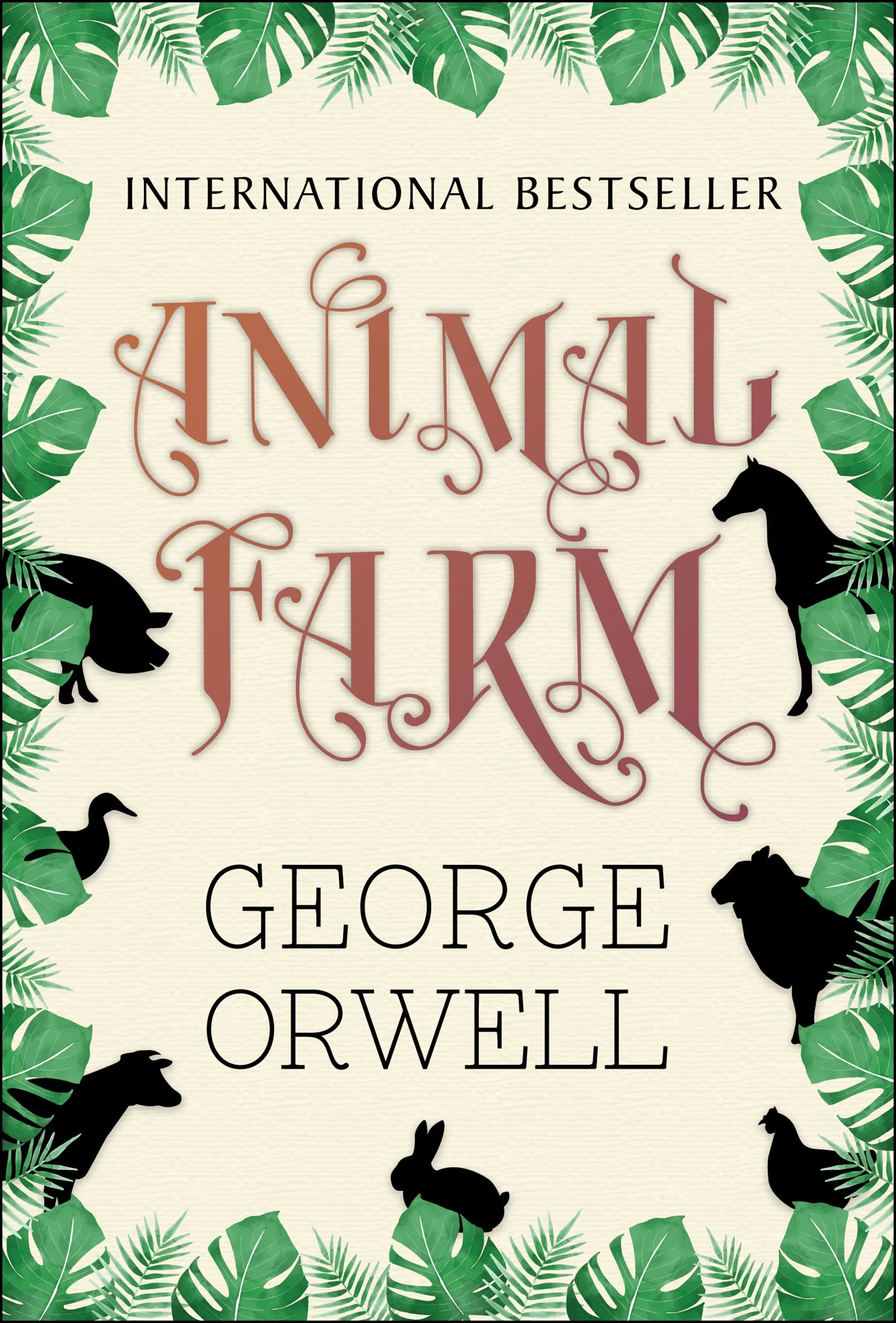
Animal Farm
eBook
• 102 Pages
• INR 51.00
• English
• 9789387669611
No ratings yet
| Publisher | General Press |
|---|---|
| ISBN13 | 9789387669611 |
| ASIN/SKU | B07D3FJLDB |
| Book Format | eBook |
| Language | English |
| Pages | 102 |
| List Price | INR 51.00 |
| Subject Code | FIC000000, FIC004000, FIC014000 |
| Publishing Date | 28/09/2018 |
| Book Code | BD00068438 |
Buy this Book
Amazon Stores
Ebook Stores
Other Stores
Discover Animal Farm by George Orwell. This book is published by General Press in eBook format, ISBN 9789387669611, ASIN B07D3FJLDB, under Literature and Fiction, Classics, Satire.
Book Description
'Animal Farm' by George Orwell is a short but staggeringly powerful work of political satire and allegorical fiction, first published in 1945, that manages to say more about power, corruption, and the betrayal of idealism in under a hundred pages than most political treatises achieve in several hundred. It is the kind of book that reads like a simple fable on the surface and leaves you with a deeply unsettled feeling long after you have closed the cover.
The story begins on a farm in the English countryside, where the animals live under the thumb of a neglectful, drunken farmer named Mr. Jones. One night, a prize-winning boar named Old Major gathers all the animals together and delivers a stirring speech about the misery of their lives and the dream of a future where animals rule themselves, free from human exploitation. His vision is intoxicating, and when he dies shortly afterward, the seeds he has planted begin to grow. The animals revolt, drive Mr. Jones off the farm, and declare themselves free. They rename the property Animal Farm and set about building the equal, fair society Old Major described.
What follows is one of the most precise and devastating portrayals of how revolutions go wrong ever committed to the page. The pigs, being the cleverest animals, naturally take on the role of leaders and organizers. Among them, Napoleon and Snowball emerge as the dominant figures — but their visions for Animal Farm are not the same, and the tension between them crackles with foreboding. As time passes, the principles the animals fought for begin to shift in ways so gradual and so cunningly managed that most of them barely notice until it is too late.
Orwell wrote this book as a direct response to the Soviet Union under Stalin, but its genius lies in how completely it transcends that specific moment. Every generation finds fresh and uncomfortable relevance in its pages because the pattern it describes — the slow, almost invisible transformation of liberators into oppressors — is not unique to any one time or place.
If you want to understand how power corrupts, and how ordinary people and creatures find themselves living in a world almost opposite to the one they were promised, this lean and merciless little book will show you exactly how it happens.
The story begins on a farm in the English countryside, where the animals live under the thumb of a neglectful, drunken farmer named Mr. Jones. One night, a prize-winning boar named Old Major gathers all the animals together and delivers a stirring speech about the misery of their lives and the dream of a future where animals rule themselves, free from human exploitation. His vision is intoxicating, and when he dies shortly afterward, the seeds he has planted begin to grow. The animals revolt, drive Mr. Jones off the farm, and declare themselves free. They rename the property Animal Farm and set about building the equal, fair society Old Major described.
What follows is one of the most precise and devastating portrayals of how revolutions go wrong ever committed to the page. The pigs, being the cleverest animals, naturally take on the role of leaders and organizers. Among them, Napoleon and Snowball emerge as the dominant figures — but their visions for Animal Farm are not the same, and the tension between them crackles with foreboding. As time passes, the principles the animals fought for begin to shift in ways so gradual and so cunningly managed that most of them barely notice until it is too late.
Orwell wrote this book as a direct response to the Soviet Union under Stalin, but its genius lies in how completely it transcends that specific moment. Every generation finds fresh and uncomfortable relevance in its pages because the pattern it describes — the slow, almost invisible transformation of liberators into oppressors — is not unique to any one time or place.
If you want to understand how power corrupts, and how ordinary people and creatures find themselves living in a world almost opposite to the one they were promised, this lean and merciless little book will show you exactly how it happens.
Author Biography
Eric Arthur Blair (1903–1950), universally known by his pen name George Orwell, was an English novelist, essayist, and critic famous for his lucid prose and fierce opposition to totalitarianism. Born in Motihari, India, where his father worked for the British civil service, he was sent to England for his education, eventually attending Eton College. Rather than pursuing a university degree, he joined the Indian Imperial Police in Burma in 1922, an experience that cultivated his lifelong hatred of imperialism and authority.
Resigning from the police force in 1927, Blair returned to Europe determined to become a writer. To truly understand the lives of the destitute, he deliberately lived in poverty in London and Paris, documenting his experiences in his first published book, Down and Out in Paris and London (1933). It was for this publication that he adopted the pseudonym George Orwell. He continued to write novels and journalistic pieces throughout the 1930s, heavily focused on class divides and social injustice.
A defining moment in Orwell’s life occurred in 1936 when he traveled to Spain to fight against fascism in the Spanish Civil War. Serving with a Republican militia, he witnessed firsthand the brutal suppression of political dissent by Stalinist factions, which profoundly shaped his anti-Stalinist worldview. A sniper's bullet to the throat nearly killed him, forcing his return to England and inspiring his autobiographical account, Homage to Catalonia.
Orwell’s enduring global fame rests largely on his two final masterpieces. Animal Farm (1945), a brilliant anti-Soviet satire, brought him his first significant financial success. He followed this with the dystopian triumph 1984 (1949), introducing enduring concepts like "Big Brother," "Thought Police," and "doublethink" into the cultural lexicon.
Tragically, Orwell did not live long enough to witness the full impact of his final novel. Battling tuberculosis for years, he died in London in 1950 at the age of 46. Today, his name remains synonymous with the defense of democratic socialism and the unrelenting critique of oppressive state surveillance.
Resigning from the police force in 1927, Blair returned to Europe determined to become a writer. To truly understand the lives of the destitute, he deliberately lived in poverty in London and Paris, documenting his experiences in his first published book, Down and Out in Paris and London (1933). It was for this publication that he adopted the pseudonym George Orwell. He continued to write novels and journalistic pieces throughout the 1930s, heavily focused on class divides and social injustice.
A defining moment in Orwell’s life occurred in 1936 when he traveled to Spain to fight against fascism in the Spanish Civil War. Serving with a Republican militia, he witnessed firsthand the brutal suppression of political dissent by Stalinist factions, which profoundly shaped his anti-Stalinist worldview. A sniper's bullet to the throat nearly killed him, forcing his return to England and inspiring his autobiographical account, Homage to Catalonia.
Orwell’s enduring global fame rests largely on his two final masterpieces. Animal Farm (1945), a brilliant anti-Soviet satire, brought him his first significant financial success. He followed this with the dystopian triumph 1984 (1949), introducing enduring concepts like "Big Brother," "Thought Police," and "doublethink" into the cultural lexicon.
Tragically, Orwell did not live long enough to witness the full impact of his final novel. Battling tuberculosis for years, he died in London in 1950 at the age of 46. Today, his name remains synonymous with the defense of democratic socialism and the unrelenting critique of oppressive state surveillance.
Editorial Reviews
Editorial Reviews will be added soon…
Book Summary
George Orwell’s Animal Farm is a powerful and deeply human story about revolution, equality, power, propaganda, and the corruption of political ideals. Published in 1945, the novel uses the animals of an English farm to tell an allegorical story about how a movement that begins with dreams of freedom and justice can gradually become another form of oppression. Although the book is often read as a political satire, its deeper message is universal: whenever power becomes concentrated and people stop questioning those who control it, freedom can slowly disappear.
The story begins at Manor Farm, owned by Mr. Jones, a careless and cruel farmer. The animals work hard but receive little food, comfort, or consideration. One night, an elderly pig named Old Major gathers all the animals together and describes his vision of a world without human exploitation. He argues that humans produce nothing themselves but take the fruits of the animals’ labor. He dreams of a society in which animals will control their own lives and enjoy the rewards of their work.
Old Major teaches the animals a revolutionary song, “Beasts of England,” which expresses their hope for freedom. He dies soon afterward, but his ideas inspire the animals. The pigs, especially Snowball and Napoleon, develop his teachings into a political philosophy called Animalism.
The opportunity for rebellion arrives when Mr. Jones neglects to feed the animals. Driven by hunger, they break into the food store. Jones and his men try to stop them, but the animals fight back and drive the humans from the farm. The revolution succeeds, and Manor Farm is renamed Animal Farm.
The animals are filled with hope. They destroy objects associated with their former oppression and establish seven commandments designed to guarantee equality. The most important principle is that all animals are equal. For a while, the farm seems to belong genuinely to its inhabitants. The animals work for themselves and feel proud that their labor now benefits their own community.
However, inequality begins almost immediately. The pigs gradually take control because they are considered the most intelligent animals. They keep the milk and apples for themselves, explaining that their work requires special nourishment. Squealer, a clever and persuasive pig, convinces the other animals that these privileges are necessary for everyone's benefit.
The conflict between Snowball and Napoleon soon becomes the central political struggle. Snowball is energetic and imaginative. He proposes building a windmill that will generate electricity, reduce labor, and improve life on the farm. Napoleon opposes the plan and secretly raises a group of fierce dogs.
During a meeting, Snowball makes an enthusiastic speech about the windmill. Napoleon suddenly commands the dogs to attack him. Snowball escapes from the farm, and Napoleon declares himself the unquestioned leader. From this point onward, the animals lose their ability to participate meaningfully in their own government.
Ironically, Napoleon later adopts Snowball's windmill idea. Whenever anything goes wrong, Snowball is blamed. The animals are told that he is a traitor who secretly works with humans. Even events that have nothing to do with him are attributed to his supposed conspiracy.
Squealer becomes essential to Napoleon's rule. Through carefully chosen words, false statistics, and manipulation of memory, he persuades the animals that their lives are actually improving. Whenever they remember that the revolution promised something different, Squealer tells them that they must be remembering incorrectly.
The animals gradually become poorer and more exhausted. They work harder, particularly on the windmill, while the pigs enjoy increasing privileges. The pigs move into the farmhouse, sleep in beds, drink alcohol, and begin trading with human beings. These actions clearly violate the original principles of the revolution, but the commandments are quietly altered to make the changes appear legitimate.
One of the most moving characters is Boxer, a huge and hardworking horse. Boxer is loyal, strong, and completely devoted to the revolution. His personal motto is “I will work harder.” When problems arise, he assumes that more effort will solve them. Later, he adopts another belief: “Napoleon is always right.”
Boxer represents ordinary workers who sincerely believe in a cause and give everything they have to it. His goodness is genuine, but his inability to question authority makes him vulnerable. Napoleon benefits enormously from Boxer's labor while giving little thought to his well-being.
As Napoleon's power increases, fear replaces hope. The dogs become his private police force, intimidating anyone who might challenge him. Several animals are forced to confess to crimes they did not commit and are then executed. The farm becomes a place where obedience is more important than truth.
The fate of Boxer demonstrates the complete betrayal of the revolution. After years of exhausting labor, Boxer becomes injured and too weak to continue working. The animals believe Napoleon will care for him. Instead, Boxer is sold to a slaughterhouse. Squealer later lies and claims that Boxer was taken to a veterinary hospital, but Benjamin, the old donkey, recognizes the truth.
Boxer's death is especially tragic because he trusted the system completely. He gave his strength to the farm, believing that his sacrifice was helping create a better society. In the end, the leaders treat him as something useful only while he can work.
As time passes, the pigs become increasingly similar to the humans they once overthrew. They walk on two legs, wear clothes, carry whips, and drink with neighboring farmers. The animals are horrified because these were precisely the behaviors they once identified with human oppression.
When the animals look at the commandments, they discover that nearly all of them have disappeared. Only one remains:
“All animals are equal, but some animals are more equal than others.”
The statement is deliberately absurd. It exposes the complete destruction of the original idea of equality.
The final scene brings the novel's message into sharp focus. The pigs invite human farmers into the farmhouse, where they eat, drink, and discuss business. Napoleon announces that Animal Farm will once again be called Manor Farm.
The animals watch through the window. They look at the pigs and then at the humans, but they can no longer tell the difference between them.
This ending shows that the revolution has come full circle. The animals removed one ruling class only to create another. The pigs have become the very oppressors they once condemned.
The central theme of Animal Farm is therefore the corruption of power. Orwell shows that political ideals can be destroyed when leaders gain unchecked authority. The pigs do not simply abandon the revolution; they gradually rewrite its meaning until exploitation becomes acceptable.
Another major theme is propaganda. Squealer demonstrates how language can be used to manipulate people. If citizens are repeatedly told that failure is success, oppression is protection, and privilege is sacrifice, they may eventually lose the confidence to trust their own experiences.
Orwell also emphasizes the importance of education and independent thought. Many animals cannot read well enough to verify the commandments themselves. Because they depend on the pigs for information, they become easy to deceive. Their inability to preserve an accurate memory of the past allows the leadership to rewrite history.
Ultimately, Animal Farm is not simply a story about animals or one particular political revolution. It is a warning about human nature and political power. Orwell suggests that freedom requires constant attention. People must be willing to question leaders, protect truth, remember history, and resist the gradual normalization of injustice.
The tragedy of the animals is that their original dream was sincere. They wanted a world in which everyone would be treated fairly. Their failure does not make the dream of equality meaningless. Instead, it shows how easily noble ideals can be destroyed when people surrender their judgment to those who claim to represent them.
At its heart, Animal Farm delivers a simple but enduring lesson: a society cannot remain free merely because it begins with good intentions. Freedom must be protected by independent thought, honest information, accountability, and the courage to challenge those who abuse power. The animals' inability to do this allows their revolution to become the very system of oppression they once fought to destroy.
The story begins at Manor Farm, owned by Mr. Jones, a careless and cruel farmer. The animals work hard but receive little food, comfort, or consideration. One night, an elderly pig named Old Major gathers all the animals together and describes his vision of a world without human exploitation. He argues that humans produce nothing themselves but take the fruits of the animals’ labor. He dreams of a society in which animals will control their own lives and enjoy the rewards of their work.
Old Major teaches the animals a revolutionary song, “Beasts of England,” which expresses their hope for freedom. He dies soon afterward, but his ideas inspire the animals. The pigs, especially Snowball and Napoleon, develop his teachings into a political philosophy called Animalism.
The opportunity for rebellion arrives when Mr. Jones neglects to feed the animals. Driven by hunger, they break into the food store. Jones and his men try to stop them, but the animals fight back and drive the humans from the farm. The revolution succeeds, and Manor Farm is renamed Animal Farm.
The animals are filled with hope. They destroy objects associated with their former oppression and establish seven commandments designed to guarantee equality. The most important principle is that all animals are equal. For a while, the farm seems to belong genuinely to its inhabitants. The animals work for themselves and feel proud that their labor now benefits their own community.
However, inequality begins almost immediately. The pigs gradually take control because they are considered the most intelligent animals. They keep the milk and apples for themselves, explaining that their work requires special nourishment. Squealer, a clever and persuasive pig, convinces the other animals that these privileges are necessary for everyone's benefit.
The conflict between Snowball and Napoleon soon becomes the central political struggle. Snowball is energetic and imaginative. He proposes building a windmill that will generate electricity, reduce labor, and improve life on the farm. Napoleon opposes the plan and secretly raises a group of fierce dogs.
During a meeting, Snowball makes an enthusiastic speech about the windmill. Napoleon suddenly commands the dogs to attack him. Snowball escapes from the farm, and Napoleon declares himself the unquestioned leader. From this point onward, the animals lose their ability to participate meaningfully in their own government.
Ironically, Napoleon later adopts Snowball's windmill idea. Whenever anything goes wrong, Snowball is blamed. The animals are told that he is a traitor who secretly works with humans. Even events that have nothing to do with him are attributed to his supposed conspiracy.
Squealer becomes essential to Napoleon's rule. Through carefully chosen words, false statistics, and manipulation of memory, he persuades the animals that their lives are actually improving. Whenever they remember that the revolution promised something different, Squealer tells them that they must be remembering incorrectly.
The animals gradually become poorer and more exhausted. They work harder, particularly on the windmill, while the pigs enjoy increasing privileges. The pigs move into the farmhouse, sleep in beds, drink alcohol, and begin trading with human beings. These actions clearly violate the original principles of the revolution, but the commandments are quietly altered to make the changes appear legitimate.
One of the most moving characters is Boxer, a huge and hardworking horse. Boxer is loyal, strong, and completely devoted to the revolution. His personal motto is “I will work harder.” When problems arise, he assumes that more effort will solve them. Later, he adopts another belief: “Napoleon is always right.”
Boxer represents ordinary workers who sincerely believe in a cause and give everything they have to it. His goodness is genuine, but his inability to question authority makes him vulnerable. Napoleon benefits enormously from Boxer's labor while giving little thought to his well-being.
As Napoleon's power increases, fear replaces hope. The dogs become his private police force, intimidating anyone who might challenge him. Several animals are forced to confess to crimes they did not commit and are then executed. The farm becomes a place where obedience is more important than truth.
The fate of Boxer demonstrates the complete betrayal of the revolution. After years of exhausting labor, Boxer becomes injured and too weak to continue working. The animals believe Napoleon will care for him. Instead, Boxer is sold to a slaughterhouse. Squealer later lies and claims that Boxer was taken to a veterinary hospital, but Benjamin, the old donkey, recognizes the truth.
Boxer's death is especially tragic because he trusted the system completely. He gave his strength to the farm, believing that his sacrifice was helping create a better society. In the end, the leaders treat him as something useful only while he can work.
As time passes, the pigs become increasingly similar to the humans they once overthrew. They walk on two legs, wear clothes, carry whips, and drink with neighboring farmers. The animals are horrified because these were precisely the behaviors they once identified with human oppression.
When the animals look at the commandments, they discover that nearly all of them have disappeared. Only one remains:
“All animals are equal, but some animals are more equal than others.”
The statement is deliberately absurd. It exposes the complete destruction of the original idea of equality.
The final scene brings the novel's message into sharp focus. The pigs invite human farmers into the farmhouse, where they eat, drink, and discuss business. Napoleon announces that Animal Farm will once again be called Manor Farm.
The animals watch through the window. They look at the pigs and then at the humans, but they can no longer tell the difference between them.
This ending shows that the revolution has come full circle. The animals removed one ruling class only to create another. The pigs have become the very oppressors they once condemned.
The central theme of Animal Farm is therefore the corruption of power. Orwell shows that political ideals can be destroyed when leaders gain unchecked authority. The pigs do not simply abandon the revolution; they gradually rewrite its meaning until exploitation becomes acceptable.
Another major theme is propaganda. Squealer demonstrates how language can be used to manipulate people. If citizens are repeatedly told that failure is success, oppression is protection, and privilege is sacrifice, they may eventually lose the confidence to trust their own experiences.
Orwell also emphasizes the importance of education and independent thought. Many animals cannot read well enough to verify the commandments themselves. Because they depend on the pigs for information, they become easy to deceive. Their inability to preserve an accurate memory of the past allows the leadership to rewrite history.
Ultimately, Animal Farm is not simply a story about animals or one particular political revolution. It is a warning about human nature and political power. Orwell suggests that freedom requires constant attention. People must be willing to question leaders, protect truth, remember history, and resist the gradual normalization of injustice.
The tragedy of the animals is that their original dream was sincere. They wanted a world in which everyone would be treated fairly. Their failure does not make the dream of equality meaningless. Instead, it shows how easily noble ideals can be destroyed when people surrender their judgment to those who claim to represent them.
At its heart, Animal Farm delivers a simple but enduring lesson: a society cannot remain free merely because it begins with good intentions. Freedom must be protected by independent thought, honest information, accountability, and the courage to challenge those who abuse power. The animals' inability to do this allows their revolution to become the very system of oppression they once fought to destroy.
Sample Chapters
Chapter 1
Mr Jones, of Manor Farm, had locked the hen-houses for the night, but was too drunk to remember to shut the pop-holes. With the ring of light from his lantern dancing from side to side, he lurched across the yard, kicking off his boots at the back door, drew himself a last glass of beer from the barrel in the scullery, and made his way up to bed, where Mrs Jones was already snoring.
As soon as the light in the bedroom went out there was a stirring and a fluttering all through the farm buildings. Word had gone round during the day that old Major, the prize Middle White boar, had had a strange dream on the previous night and wished to communicate it to the other animals. It had been agreed that they should all meet in the big barn as soon as Mr Jones was safely out of the way. Old Major (so he was always called, though the name under which he had been exhibited was Willingdon Beauty) was so highly regarded on the farm that everyone was quite ready to lose an hour’s sleep in order to hear what he had to say.
At one end of the big barn, on a sort of raised platform, Major was already ensconced on his bed of straw, under a lantern which hung from a beam. He was twelve years old and had lately grown rather stout, but he was still a majestic-looking pig, with a wise and benevolent appearance in spite of the fact that his tushes had never been cut. Before long, the other animals began to arrive and make themselves comfortable after their different fashions. First came the three dogs, Bluebell, Jessie, and Pitcher, and then the pigs who settled down in the straw immediately in front of the platform. The hens perched themselves on the window-sills, the pigeons fluttered up to the rafters, the sheep and cows lay down behind the pigs and began to chew the cud. The two cart-horses, Boxer and Clover, came in together, walking very slowly and setting down their vast hairy hoofs with great care lest there should be some small animal concealed in the straw. Clover was a stout motherly mare approaching middle life, who had never quite got her figure back after her fourth foal. Boxer was an enormous beast, nearly eighteen hands high, and as strong as any two ordinary horses put together. A white stripe down his nose gave him a somewhat stupid appearance, and in fact he was not of first-rate intelligence, but he was universally respected for his steadiness of character and tremendous powers of work. After the horses came Muriel, the white goat, and Benjamin, the donkey. Benjamin was the oldest animal on the farm, and the worst tempered. He seldom talked, and when he did it was usually to make some cynical remark – for instance, he would say that God had given him a tail to keep the flies off, but that he would sooner have had no tail and no flies. Alone among the animals on the farm he never laughed. If asked why, he would say that he saw nothing to laugh at. Nevertheless, without openly admitting it, he was devoted to Boxer; the two of them usually spent their Sundays together in the small paddock beyond the orchard, grazing side by side and never speaking.
The two horses had just lain down when a brood of ducklings, which had lost their mother, filed into the barn, chewing feebly and wandering from side to side to find some place where they would not be trodden on. Clover made a sort of wall round them with her great foreleg, and the ducklings nestled down inside it, and promptly fell asleep. At the last moment Mollie, the foolish, pretty white mare who drew Mr Jones’s trap, came mincing daintily in, chewing at a lump of sugar. She took a place near the front and began flirting with her white mane, hoping to draw attention to the red ribbons it was plaited with. Last of all came the cat, who looked round, as usual, for the warmest place, and finally squeezed herself in between Boxer and Clover; there she purred contentedly throughout Major’s speech without listening to a word of what he was saying.
All the animals were now present except Moses, the tame raven, who slept on a perch behind the back door. When Major saw that they had all made themselves comfortable and were waiting attentively, he cleared his throat and began:
‘Comrades, you have heard already about the strange dream that I had last night. But I will come to the dream later. I have something else to say first. I do not think, comrades, that I shall be with you for many months longer, and before I die, I feel it my duty to pass on to you such wisdom as I have acquired. I have had a long life, I have had much time for thought as I lay alone in my stall, and I think I may say that I understand the nature of life on this earth as well as any animal now living. It is about this that I wish to speak to you.
‘Now, comrades, what is the nature of this life of ours? Let us face it: our lives are miserable, laborious, and short. We are born, we are given just so much food that will keep the breath in our bodies, and those of us who are capable of it are forced to work to the last atom of our strength; and the very instant that our usefulness has come to an end we are slaughtered with hideous cruelty. No animal in England knows the meaning of happiness or leisure after he is a year old. No animal in England is free. The life of an animal is misery and slavery: that is the plain truth.
‘But is this simply part of the order of nature? Is it because this land of ours is so poor that it cannot afford a decent life to those who dwell upon it? No, comrades, a thousand times no! The soil of England is fertile, its climate is good, it is capable of affording food in abundance to an enormously greater number of animals than now inhabit it. This single farm of ours would support a dozen horses, twenty cows, hundreds of sheep – and all of them living in comfort and dignity that are now almost beyond our imagination. Why then do we continue in this miserable condition? Because nearly all of the produce of our labour is stolen from us by human beings. There, comrades, is the answer to all our problems. It is summed up in a single word – Man. Man is the only real enemy we have. Remove Man from the scene, and the root cause of hunger and overwork is abolished forever.
‘Man is the only creature that consumes without producing. He does not give milk, he does not lay eggs, he is too weak to pull the plough, he cannot run fast enough to catch rabbits. Yet he is lord of all the animals. He sets them to work, he gives back to them the bare minimum that will prevent them from starving, and the rest he keeps for himself. Our labour tills the soil, our dung fertilizes it, and yet there is not one of us that owns more than his bare skin. You cows that I see before me, how many thousands of gallons of milk have you given during this last year? And what has happened to that milk which should have been breeding up sturdy calves? Every drop of it has gone down the throats of our enemies. And you hens, how many eggs have you laid this last year, and how many of those eggs ever hatch into chickens? The rest have all gone to market to bring in money for Jones and his men. And you, Clover, where are those four foals you bore, who should have been the support and pleasure of your old age? Each was sold at a year old – you will never see one of them again. In return for your four confinements and all your labour in the field, what have you ever had except your bare rations and a stall?
‘And even the miserable lives we lead are not allowed to reach their natural span. For myself I do not grumble, for I am one of the lucky ones. I am twelve years old and have had over four hundred children. Such is the natural life of a pig. But no animal escapes the cruel knife in the end. You young porkers who are sitting in front of me, every one of you will scream your lives out at the block within a year. To that horror we all must come – cows, pigs, hens, sheep, everyone. Even the horses and the dogs have no better fate. You, Boxer, the very day that those great muscles of yours lose their power, Jones will sell you to the knacker, who will cut your throat and boil you down for the foxhounds. As for the dogs, when they grow old and toothless, Jones ties a brick round their necks and drowns them in the nearest pond.
‘Is it not crystal clear, comrades, that all the evils of this life of ours spring from the tyranny of human beings? Only get rid of Man, and the produce of our labour would be our own. Almost overnight we would become rich and free. What then must we do? Why, work night and day, body and soul, for the overthrow of the human race! That is my message to you, comrades: Rebellion! I do not know when that Rebellion will come, it might be in a week or in a hundred years, but I know, as surely as I see this straw beneath my feet, that sooner or later justice will be done. Fix your eyes on that, comrades, throughout the short remainder of your lives! And above all, pass on this message of mine to those who come after you, so that future generations shall carry on the struggle until it is victorious.
And remember, comrades, your resolution must never falter. No argument must lead you astray. Never listen when they tell you that Man and the animals have a common interest, that the prosperity of one is the prosperity of the others. It is all lies. Man serves the interests of no creature except himself. And among us animals let there be perfect unity, perfect comradeship in the struggle. All men are enemies. All animals are comrades.’
At this moment there was a tremendous uproar. While Major was speaking four large rats had crept out of their holes and were sitting on their hindquarters listening to him. The dogs had suddenly caught sight of them, and it was only by a swift dash for their holes that the rats saved their lives. Major raised his trotter for silence.
‘Comrades,’ he said, ‘here is a point that must be settled. The wild creatures, such as rats and rabbits – are they our friends or our enemies? Let us put it to the vote. I propose this question to the meeting: Are rats comrades?’
The vote was taken at once, and it was agreed by an overwhelming majority that rats were comrades. There were only four dissidents, the three dogs and the cat, who was afterwards discovered to have voted on both sides. Major continued:
‘I have little more to say. I merely repeat, remember always your duty of enmity towards Man and all his ways. Whatever goes upon two legs, is an enemy. Whatever goes upon four legs, or has wings, is a friend. And remember also that in fighting against Man, we must not come to resemble him. Even when you have conquered him, do not adopt his vices. No animal must ever live in a house, or sleep in a bed, or wear clothes, or drink alcohol, or smoke tobacco, or touch money, or engage in trade. All the habits of Man are evil. And, above all, no animal must ever tyrannize over his own kind. Weak or strong, clever or simple, we are all brothers. No animal must ever kill any other animal. All animals are equal.
‘And now, comrades, I will tell you about my dream of last night. I cannot describe that dream to you. It was a dream of the earth as it will be when Man has vanished. But it reminded me of something that I had long forgotten. Many years ago, when I was a little pig, my mother and the other sows used to sing an old song of which they knew only the tune and the first three words. I had known that tune in my infancy, but it had long since passed out of my mind. Last night, however, it came back to me in my dream. And what is more, the words of the song also came back – words, I am certain, which were sung by the animals of long ago and have been lost to memory for generations. I will sing you that song now, comrades. I am old and my voice is hoarse, but when I have taught you the tune, you can sing it better for yourselves. It is called “Beasts of England”.’
Old Major cleared his throat and began to sing. As he had said, his voice was hoarse, but he sang well enough, and it was a stirring tune, something between ‘Clementine’ and ‘La Cucaracha’. The words ran:
Beasts of England, beasts of Ireland,
Beasts of every land and clime,
Hearken to my joyful tidings
Of the golden future time.
Soon or late the day is coming,
Tyrant Man shall be o’erthrown,
And the fruitful fields of England
Shall be trod by beasts alone.
Rings shall vanish from our noses,
And the harness from our back,
Bit and spur shall rust forever,
Cruel whips no more shall crack.
Riches more than mind can picture,
Wheat and barley, oats and hay,
Clover, beans, and mangel-wurzels
Shall be ours upon that day.
Bright will shine the fields of England,
Purer shall its waters be,
Sweeter yet shall blow its breezes
On the day that sets us free.
For that day we all must labour,
Though we die before it break;
Cows and horses, geese and turkeys,
All must toil for freedom’s sake.
Beasts of England, beasts of Ireland,
Beasts of every land and clime,
Hearken well and spread my tidings
Of the golden future time.
The singing of this song threw the animals into the wildest excitement. Almost before Major had reached the end, they had begun singing it for themselves. Even the stupidest of them had already picked up the tune and a few of the words, and as for the clever ones, such as the pigs and dogs, they had the entire song by heart within a few minutes. And then, after a few preliminary tries, the whole farm burst out into ‘Beasts of England’ in tremendous unison. The cows lowered it, the dogs whined it, the sheep bleated it, the horses whinnied it, the ducks quacked it. They were so delighted with the song that they sang it right through five times in succession, and might have continued singing it all night if they had not been interrupted.
Unfortunately, the uproar awoke Mr Jones, who sprang out of bed, making sure that there was a fox in the yard. He seized the gun which always stood in a corner of his bedroom, and let fly a charge of number 6 shot into the darkness. The pellets buried themselves in the wall of the barn and the meeting broke up hurriedly. Everyone fled to his own sleeping place. The birds jumped on to their perches, the animals settled down in the straw, and the whole farm was asleep in a moment.
Mr Jones, of Manor Farm, had locked the hen-houses for the night, but was too drunk to remember to shut the pop-holes. With the ring of light from his lantern dancing from side to side, he lurched across the yard, kicking off his boots at the back door, drew himself a last glass of beer from the barrel in the scullery, and made his way up to bed, where Mrs Jones was already snoring.
As soon as the light in the bedroom went out there was a stirring and a fluttering all through the farm buildings. Word had gone round during the day that old Major, the prize Middle White boar, had had a strange dream on the previous night and wished to communicate it to the other animals. It had been agreed that they should all meet in the big barn as soon as Mr Jones was safely out of the way. Old Major (so he was always called, though the name under which he had been exhibited was Willingdon Beauty) was so highly regarded on the farm that everyone was quite ready to lose an hour’s sleep in order to hear what he had to say.
At one end of the big barn, on a sort of raised platform, Major was already ensconced on his bed of straw, under a lantern which hung from a beam. He was twelve years old and had lately grown rather stout, but he was still a majestic-looking pig, with a wise and benevolent appearance in spite of the fact that his tushes had never been cut. Before long, the other animals began to arrive and make themselves comfortable after their different fashions. First came the three dogs, Bluebell, Jessie, and Pitcher, and then the pigs who settled down in the straw immediately in front of the platform. The hens perched themselves on the window-sills, the pigeons fluttered up to the rafters, the sheep and cows lay down behind the pigs and began to chew the cud. The two cart-horses, Boxer and Clover, came in together, walking very slowly and setting down their vast hairy hoofs with great care lest there should be some small animal concealed in the straw. Clover was a stout motherly mare approaching middle life, who had never quite got her figure back after her fourth foal. Boxer was an enormous beast, nearly eighteen hands high, and as strong as any two ordinary horses put together. A white stripe down his nose gave him a somewhat stupid appearance, and in fact he was not of first-rate intelligence, but he was universally respected for his steadiness of character and tremendous powers of work. After the horses came Muriel, the white goat, and Benjamin, the donkey. Benjamin was the oldest animal on the farm, and the worst tempered. He seldom talked, and when he did it was usually to make some cynical remark – for instance, he would say that God had given him a tail to keep the flies off, but that he would sooner have had no tail and no flies. Alone among the animals on the farm he never laughed. If asked why, he would say that he saw nothing to laugh at. Nevertheless, without openly admitting it, he was devoted to Boxer; the two of them usually spent their Sundays together in the small paddock beyond the orchard, grazing side by side and never speaking.
The two horses had just lain down when a brood of ducklings, which had lost their mother, filed into the barn, chewing feebly and wandering from side to side to find some place where they would not be trodden on. Clover made a sort of wall round them with her great foreleg, and the ducklings nestled down inside it, and promptly fell asleep. At the last moment Mollie, the foolish, pretty white mare who drew Mr Jones’s trap, came mincing daintily in, chewing at a lump of sugar. She took a place near the front and began flirting with her white mane, hoping to draw attention to the red ribbons it was plaited with. Last of all came the cat, who looked round, as usual, for the warmest place, and finally squeezed herself in between Boxer and Clover; there she purred contentedly throughout Major’s speech without listening to a word of what he was saying.
All the animals were now present except Moses, the tame raven, who slept on a perch behind the back door. When Major saw that they had all made themselves comfortable and were waiting attentively, he cleared his throat and began:
‘Comrades, you have heard already about the strange dream that I had last night. But I will come to the dream later. I have something else to say first. I do not think, comrades, that I shall be with you for many months longer, and before I die, I feel it my duty to pass on to you such wisdom as I have acquired. I have had a long life, I have had much time for thought as I lay alone in my stall, and I think I may say that I understand the nature of life on this earth as well as any animal now living. It is about this that I wish to speak to you.
‘Now, comrades, what is the nature of this life of ours? Let us face it: our lives are miserable, laborious, and short. We are born, we are given just so much food that will keep the breath in our bodies, and those of us who are capable of it are forced to work to the last atom of our strength; and the very instant that our usefulness has come to an end we are slaughtered with hideous cruelty. No animal in England knows the meaning of happiness or leisure after he is a year old. No animal in England is free. The life of an animal is misery and slavery: that is the plain truth.
‘But is this simply part of the order of nature? Is it because this land of ours is so poor that it cannot afford a decent life to those who dwell upon it? No, comrades, a thousand times no! The soil of England is fertile, its climate is good, it is capable of affording food in abundance to an enormously greater number of animals than now inhabit it. This single farm of ours would support a dozen horses, twenty cows, hundreds of sheep – and all of them living in comfort and dignity that are now almost beyond our imagination. Why then do we continue in this miserable condition? Because nearly all of the produce of our labour is stolen from us by human beings. There, comrades, is the answer to all our problems. It is summed up in a single word – Man. Man is the only real enemy we have. Remove Man from the scene, and the root cause of hunger and overwork is abolished forever.
‘Man is the only creature that consumes without producing. He does not give milk, he does not lay eggs, he is too weak to pull the plough, he cannot run fast enough to catch rabbits. Yet he is lord of all the animals. He sets them to work, he gives back to them the bare minimum that will prevent them from starving, and the rest he keeps for himself. Our labour tills the soil, our dung fertilizes it, and yet there is not one of us that owns more than his bare skin. You cows that I see before me, how many thousands of gallons of milk have you given during this last year? And what has happened to that milk which should have been breeding up sturdy calves? Every drop of it has gone down the throats of our enemies. And you hens, how many eggs have you laid this last year, and how many of those eggs ever hatch into chickens? The rest have all gone to market to bring in money for Jones and his men. And you, Clover, where are those four foals you bore, who should have been the support and pleasure of your old age? Each was sold at a year old – you will never see one of them again. In return for your four confinements and all your labour in the field, what have you ever had except your bare rations and a stall?
‘And even the miserable lives we lead are not allowed to reach their natural span. For myself I do not grumble, for I am one of the lucky ones. I am twelve years old and have had over four hundred children. Such is the natural life of a pig. But no animal escapes the cruel knife in the end. You young porkers who are sitting in front of me, every one of you will scream your lives out at the block within a year. To that horror we all must come – cows, pigs, hens, sheep, everyone. Even the horses and the dogs have no better fate. You, Boxer, the very day that those great muscles of yours lose their power, Jones will sell you to the knacker, who will cut your throat and boil you down for the foxhounds. As for the dogs, when they grow old and toothless, Jones ties a brick round their necks and drowns them in the nearest pond.
‘Is it not crystal clear, comrades, that all the evils of this life of ours spring from the tyranny of human beings? Only get rid of Man, and the produce of our labour would be our own. Almost overnight we would become rich and free. What then must we do? Why, work night and day, body and soul, for the overthrow of the human race! That is my message to you, comrades: Rebellion! I do not know when that Rebellion will come, it might be in a week or in a hundred years, but I know, as surely as I see this straw beneath my feet, that sooner or later justice will be done. Fix your eyes on that, comrades, throughout the short remainder of your lives! And above all, pass on this message of mine to those who come after you, so that future generations shall carry on the struggle until it is victorious.
And remember, comrades, your resolution must never falter. No argument must lead you astray. Never listen when they tell you that Man and the animals have a common interest, that the prosperity of one is the prosperity of the others. It is all lies. Man serves the interests of no creature except himself. And among us animals let there be perfect unity, perfect comradeship in the struggle. All men are enemies. All animals are comrades.’
At this moment there was a tremendous uproar. While Major was speaking four large rats had crept out of their holes and were sitting on their hindquarters listening to him. The dogs had suddenly caught sight of them, and it was only by a swift dash for their holes that the rats saved their lives. Major raised his trotter for silence.
‘Comrades,’ he said, ‘here is a point that must be settled. The wild creatures, such as rats and rabbits – are they our friends or our enemies? Let us put it to the vote. I propose this question to the meeting: Are rats comrades?’
The vote was taken at once, and it was agreed by an overwhelming majority that rats were comrades. There were only four dissidents, the three dogs and the cat, who was afterwards discovered to have voted on both sides. Major continued:
‘I have little more to say. I merely repeat, remember always your duty of enmity towards Man and all his ways. Whatever goes upon two legs, is an enemy. Whatever goes upon four legs, or has wings, is a friend. And remember also that in fighting against Man, we must not come to resemble him. Even when you have conquered him, do not adopt his vices. No animal must ever live in a house, or sleep in a bed, or wear clothes, or drink alcohol, or smoke tobacco, or touch money, or engage in trade. All the habits of Man are evil. And, above all, no animal must ever tyrannize over his own kind. Weak or strong, clever or simple, we are all brothers. No animal must ever kill any other animal. All animals are equal.
‘And now, comrades, I will tell you about my dream of last night. I cannot describe that dream to you. It was a dream of the earth as it will be when Man has vanished. But it reminded me of something that I had long forgotten. Many years ago, when I was a little pig, my mother and the other sows used to sing an old song of which they knew only the tune and the first three words. I had known that tune in my infancy, but it had long since passed out of my mind. Last night, however, it came back to me in my dream. And what is more, the words of the song also came back – words, I am certain, which were sung by the animals of long ago and have been lost to memory for generations. I will sing you that song now, comrades. I am old and my voice is hoarse, but when I have taught you the tune, you can sing it better for yourselves. It is called “Beasts of England”.’
Old Major cleared his throat and began to sing. As he had said, his voice was hoarse, but he sang well enough, and it was a stirring tune, something between ‘Clementine’ and ‘La Cucaracha’. The words ran:
Beasts of England, beasts of Ireland,
Beasts of every land and clime,
Hearken to my joyful tidings
Of the golden future time.
Soon or late the day is coming,
Tyrant Man shall be o’erthrown,
And the fruitful fields of England
Shall be trod by beasts alone.
Rings shall vanish from our noses,
And the harness from our back,
Bit and spur shall rust forever,
Cruel whips no more shall crack.
Riches more than mind can picture,
Wheat and barley, oats and hay,
Clover, beans, and mangel-wurzels
Shall be ours upon that day.
Bright will shine the fields of England,
Purer shall its waters be,
Sweeter yet shall blow its breezes
On the day that sets us free.
For that day we all must labour,
Though we die before it break;
Cows and horses, geese and turkeys,
All must toil for freedom’s sake.
Beasts of England, beasts of Ireland,
Beasts of every land and clime,
Hearken well and spread my tidings
Of the golden future time.
The singing of this song threw the animals into the wildest excitement. Almost before Major had reached the end, they had begun singing it for themselves. Even the stupidest of them had already picked up the tune and a few of the words, and as for the clever ones, such as the pigs and dogs, they had the entire song by heart within a few minutes. And then, after a few preliminary tries, the whole farm burst out into ‘Beasts of England’ in tremendous unison. The cows lowered it, the dogs whined it, the sheep bleated it, the horses whinnied it, the ducks quacked it. They were so delighted with the song that they sang it right through five times in succession, and might have continued singing it all night if they had not been interrupted.
Unfortunately, the uproar awoke Mr Jones, who sprang out of bed, making sure that there was a fox in the yard. He seized the gun which always stood in a corner of his bedroom, and let fly a charge of number 6 shot into the darkness. The pellets buried themselves in the wall of the barn and the meeting broke up hurriedly. Everyone fled to his own sleeping place. The birds jumped on to their perches, the animals settled down in the straw, and the whole farm was asleep in a moment.
Reader Reviews
No reviews yet.
Animal Farm