
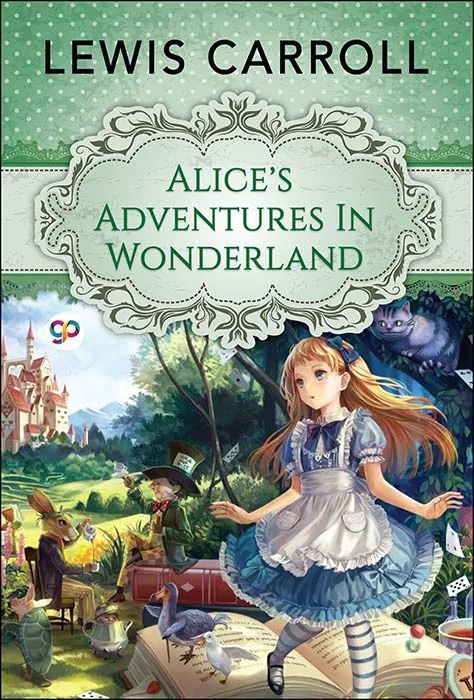
Alice's Adventures in Wonderland
eBook
• 49 Pages
• INR 51.00
• English
• 9789387669796
No ratings yet
| Publisher | General Press |
|---|---|
| ISBN13 | 9789387669796 |
| ASIN/SKU | B07DMRSW65 |
| Book Format | eBook |
| Language | English |
| Pages | 49 |
| List Price | INR 51.00 |
| Subject Code | JUV007000, JUV000000, FIC004000, FIC098030 |
| Publishing Date | 09/06/2018 |
| Book Code | BD00068457 |
Buy this Book
Amazon Stores
Ebook Stores
Other Stores
Discover Alice's Adventures in Wonderland by Lewis Carroll. This book is published by General Press in eBook format, ISBN 9789387669796, ASIN B07DMRSW65, under Children's Books, Children's Classics, Fantasy and Magic.
Book Description
Written by Lewis Carroll in 1865, this story remains a well-known classic to this day. It is the tale of a girl named Alice who falls down a rabbit hole and meets extraordinary creatures. Intended for young readers but enjoyed equally by adults, the fantastic tale transformed children's literature. As Alice explores a bizarre underground world, she encounters a cast of strange characters and fanciful beasts: the White Rabbit, March Hare, and Mad Hatter; the sleepy Dormouse and grinning Cheshire Cat; the Mock Turtle, the dreadful Queen of Hearts, and a host of other extraordinary personalities.
Author Biography
Lewis Carroll was the pen name of Charles Lutwidge Dodgson who was born 27 January 1832. He was an English writer, mathematician, logician, Anglican deacon and photographer. His most famous writings are Alice's Adventures in Wonderland and its sequel Through the Looking-Glass, as well as the poems "The Hunting of the Snark" and "Jabberwocky", all examples of the genre of literary nonsense. He is noted for his facility at word play, logic, and fantasy, and there are societies in many parts of the world (including the United Kingdom, Japan, the United States, and New Zealand dedicated to the enjoyment and promotion of his works and the investigation of his life. He died – 14 January 1898.
Editorial Reviews
Editorial Reviews will be added soon…
Book Summary
Lewis Carroll’s Alice’s Adventures in Wonderland is a wonderfully strange and imaginative story about childhood, curiosity, identity, and the absurdity of a world where ordinary rules no longer apply. First published in 1865, the novel follows Alice, a curious young girl who falls down a rabbit hole and enters a fantastic world inhabited by talking animals, eccentric creatures, mysterious objects, and characters who constantly challenge her understanding of logic. Beneath its playful nonsense, the story explores the confusion of growing up and the difficulty of trying to understand a world that often seems irrational.
The story begins with Alice sitting beside her sister on a warm afternoon. She is bored and has nothing to do. Suddenly, she notices a White Rabbit wearing a waistcoat and carrying a pocket watch. What makes the rabbit extraordinary is not simply that it can speak, but that it seems deeply concerned about being late.
Alice follows the Rabbit down a rabbit hole and falls for what seems like an impossibly long time. Eventually, she lands safely in a strange underground passage. There she discovers a series of doors, including a tiny door leading to a beautiful garden. Alice desperately wants to enter it, but she is too large to pass through.
She discovers a bottle labeled “DRINK ME.” After drinking from it, she shrinks. She then finds a cake marked “EAT ME,” which causes her to grow enormously. Alice quickly realizes that Wonderland does not operate according to the ordinary rules of the world she knows. Size, identity, language, and even logic can change without warning.
Alice eventually finds herself crying so much that she creates a large pool of tears. When she becomes small again, she falls into the pool and meets various creatures, including a Mouse. The animals attempt to dry themselves through a strange “Caucus Race,” in which everyone runs in different directions and everyone wins.
Alice then encounters the White Rabbit again. He mistakes her for his servant and sends her to retrieve some belongings from his house. Inside the house, Alice eats another mysterious cake and grows so large that she becomes trapped inside. The Rabbit and other creatures outside try to remove her. Eventually, Alice manages to escape and returns to the forest.
In the forest, she encounters a Caterpillar sitting on a mushroom and smoking a hookah. The Caterpillar asks Alice a simple but unsettling question: “Who are you?” Alice struggles to answer. Since arriving in Wonderland, her body has repeatedly changed size, and these physical changes have made her uncertain about her own identity.
The Caterpillar explains that different parts of the mushroom can make Alice larger or smaller. Alice uses the mushroom to control her size and eventually manages to return to a more manageable height.
Alice next comes across the Duchess, whose house is filled with chaos. The Duchess has a baby that she treats roughly, while a cook throws objects around the kitchen and prepares an extremely peppery soup. Alice takes the baby outside, but it eventually transforms into a pig and runs away.
Alice then encounters the Cheshire Cat, one of the most memorable characters in Wonderland. The Cat appears and disappears at will and speaks in riddles. When Alice asks which direction she should take, the Cat explains that the answer depends on where she wants to go. Since Wonderland has no clear destination, almost any direction can make sense.
The Cheshire Cat also tells Alice that everyone in Wonderland is mad, including himself. His statement captures one of the central ideas of the book: madness in Wonderland is not an exception—it is part of the normal order of the place.
Alice next arrives at a strange tea party hosted by the Mad Hatter, the March Hare, and a sleepy Dormouse. Time has become confused, and the participants are trapped in an endless tea party. They constantly move around the table, argue over riddles, tell nonsensical stories, and misunderstand one another.
The Mad Hatter asks Alice a famous riddle: “Why is a raven like a writing desk?” No satisfactory answer is provided. The riddle illustrates Wonderland's playful rejection of conventional logic. Questions do not necessarily need answers, and conversations do not necessarily need to make sense.
Alice eventually leaves the tea party and enters the strange world of the Queen of Hearts. The Queen is one of the most frightening and ridiculous figures in the book. She constantly shouts “Off with their heads!” whenever someone displeases her.
The Queen's kingdom is filled with playing-card soldiers. Alice encounters the King and Queen of Hearts and is invited—or rather forced—to participate in a bizarre game of croquet. The mallets are flamingos, the balls are hedgehogs, and the game is impossible to play fairly because the equipment refuses to cooperate.
Alice gradually becomes less frightened by the Queen. At first, Wonderland's strange rules make her feel powerless. But as she gains confidence, she begins to recognize that the Queen's authority is largely based on noise and intimidation.
The Queen later accuses Alice of interfering with the court and orders her to attend a trial. The accused is the Knave of Hearts, who is charged with stealing the Queen's tarts.
The trial quickly becomes another exercise in absurdity. The witnesses give confusing evidence, the rules are constantly changed, and the Queen seems to have decided the verdict before hearing the facts. Alice begins to realize that the entire legal system is ridiculous.
During the trial, Alice suddenly begins growing larger. She realizes that she no longer needs to be frightened by the Queen and her court. When the Queen orders her execution, Alice dismisses the threat. The playing cards then rise up and fly toward her.
Alice wakes up beside her sister on the riverbank. She discovers that the entire adventure has been a dream. Her sister listens to Alice's extraordinary story and then imagines the kind of woman Alice might become as she grows older.
The ending returns the reader to ordinary reality, but Wonderland has clearly changed Alice. She has experienced a world where adults, rules, language, authority, and identity can all become unstable. She has also learned to question what appears to be unquestionable.
One of the novel's central themes is identity. Alice repeatedly asks herself who she is because her changing size and strange experiences make her uncertain. Her question reflects the experience of childhood itself. Growing up involves physical, emotional, and intellectual changes, and children often feel that adults expect them to become someone they do not yet understand.
Another major theme is language and logic. Carroll delights in twisting words, meanings, riddles, poems, and conversations. Characters often use grammatically correct language to express ideas that are completely irrational. Through this playful misuse of language, Carroll shows how easily words can confuse rather than clarify.
The novel also gently mocks adult authority. Teachers, parents, judges, monarchs, and other authority figures often behave irrationally in Wonderland. The Queen of Hearts is powerful but childish; the legal system is formal but meaningless; and supposedly intelligent adults are frequently less sensible than Alice.
Ultimately, Alice’s Adventures in Wonderland is a celebration of curiosity and imagination. Alice does not simply accept Wonderland as it is. She questions its rules, challenges its characters, and tries to understand what is happening. Her curiosity is what carries her through the adventure.
The enduring charm of the book comes from its ability to speak to both children and adults. For children, it is a thrilling journey into a world of talking animals, magic, riddles, and absurd adventures. For adults, it offers a witty reflection on growing up, social conventions, language, authority, and the strange contradictions of everyday life.
At its heart, Alice’s Adventures in Wonderland suggests that the world does not always make sense—and that perhaps we should not be afraid of that fact. Sometimes confusion can lead to discovery, nonsense can reveal truth, and imagination can help us see ordinary life differently. Alice enters Wonderland as a bored child following a strange rabbit and emerges with something more valuable: the confidence to question the world around her and to trust her own sense of reality.
The story begins with Alice sitting beside her sister on a warm afternoon. She is bored and has nothing to do. Suddenly, she notices a White Rabbit wearing a waistcoat and carrying a pocket watch. What makes the rabbit extraordinary is not simply that it can speak, but that it seems deeply concerned about being late.
Alice follows the Rabbit down a rabbit hole and falls for what seems like an impossibly long time. Eventually, she lands safely in a strange underground passage. There she discovers a series of doors, including a tiny door leading to a beautiful garden. Alice desperately wants to enter it, but she is too large to pass through.
She discovers a bottle labeled “DRINK ME.” After drinking from it, she shrinks. She then finds a cake marked “EAT ME,” which causes her to grow enormously. Alice quickly realizes that Wonderland does not operate according to the ordinary rules of the world she knows. Size, identity, language, and even logic can change without warning.
Alice eventually finds herself crying so much that she creates a large pool of tears. When she becomes small again, she falls into the pool and meets various creatures, including a Mouse. The animals attempt to dry themselves through a strange “Caucus Race,” in which everyone runs in different directions and everyone wins.
Alice then encounters the White Rabbit again. He mistakes her for his servant and sends her to retrieve some belongings from his house. Inside the house, Alice eats another mysterious cake and grows so large that she becomes trapped inside. The Rabbit and other creatures outside try to remove her. Eventually, Alice manages to escape and returns to the forest.
In the forest, she encounters a Caterpillar sitting on a mushroom and smoking a hookah. The Caterpillar asks Alice a simple but unsettling question: “Who are you?” Alice struggles to answer. Since arriving in Wonderland, her body has repeatedly changed size, and these physical changes have made her uncertain about her own identity.
The Caterpillar explains that different parts of the mushroom can make Alice larger or smaller. Alice uses the mushroom to control her size and eventually manages to return to a more manageable height.
Alice next comes across the Duchess, whose house is filled with chaos. The Duchess has a baby that she treats roughly, while a cook throws objects around the kitchen and prepares an extremely peppery soup. Alice takes the baby outside, but it eventually transforms into a pig and runs away.
Alice then encounters the Cheshire Cat, one of the most memorable characters in Wonderland. The Cat appears and disappears at will and speaks in riddles. When Alice asks which direction she should take, the Cat explains that the answer depends on where she wants to go. Since Wonderland has no clear destination, almost any direction can make sense.
The Cheshire Cat also tells Alice that everyone in Wonderland is mad, including himself. His statement captures one of the central ideas of the book: madness in Wonderland is not an exception—it is part of the normal order of the place.
Alice next arrives at a strange tea party hosted by the Mad Hatter, the March Hare, and a sleepy Dormouse. Time has become confused, and the participants are trapped in an endless tea party. They constantly move around the table, argue over riddles, tell nonsensical stories, and misunderstand one another.
The Mad Hatter asks Alice a famous riddle: “Why is a raven like a writing desk?” No satisfactory answer is provided. The riddle illustrates Wonderland's playful rejection of conventional logic. Questions do not necessarily need answers, and conversations do not necessarily need to make sense.
Alice eventually leaves the tea party and enters the strange world of the Queen of Hearts. The Queen is one of the most frightening and ridiculous figures in the book. She constantly shouts “Off with their heads!” whenever someone displeases her.
The Queen's kingdom is filled with playing-card soldiers. Alice encounters the King and Queen of Hearts and is invited—or rather forced—to participate in a bizarre game of croquet. The mallets are flamingos, the balls are hedgehogs, and the game is impossible to play fairly because the equipment refuses to cooperate.
Alice gradually becomes less frightened by the Queen. At first, Wonderland's strange rules make her feel powerless. But as she gains confidence, she begins to recognize that the Queen's authority is largely based on noise and intimidation.
The Queen later accuses Alice of interfering with the court and orders her to attend a trial. The accused is the Knave of Hearts, who is charged with stealing the Queen's tarts.
The trial quickly becomes another exercise in absurdity. The witnesses give confusing evidence, the rules are constantly changed, and the Queen seems to have decided the verdict before hearing the facts. Alice begins to realize that the entire legal system is ridiculous.
During the trial, Alice suddenly begins growing larger. She realizes that she no longer needs to be frightened by the Queen and her court. When the Queen orders her execution, Alice dismisses the threat. The playing cards then rise up and fly toward her.
Alice wakes up beside her sister on the riverbank. She discovers that the entire adventure has been a dream. Her sister listens to Alice's extraordinary story and then imagines the kind of woman Alice might become as she grows older.
The ending returns the reader to ordinary reality, but Wonderland has clearly changed Alice. She has experienced a world where adults, rules, language, authority, and identity can all become unstable. She has also learned to question what appears to be unquestionable.
One of the novel's central themes is identity. Alice repeatedly asks herself who she is because her changing size and strange experiences make her uncertain. Her question reflects the experience of childhood itself. Growing up involves physical, emotional, and intellectual changes, and children often feel that adults expect them to become someone they do not yet understand.
Another major theme is language and logic. Carroll delights in twisting words, meanings, riddles, poems, and conversations. Characters often use grammatically correct language to express ideas that are completely irrational. Through this playful misuse of language, Carroll shows how easily words can confuse rather than clarify.
The novel also gently mocks adult authority. Teachers, parents, judges, monarchs, and other authority figures often behave irrationally in Wonderland. The Queen of Hearts is powerful but childish; the legal system is formal but meaningless; and supposedly intelligent adults are frequently less sensible than Alice.
Ultimately, Alice’s Adventures in Wonderland is a celebration of curiosity and imagination. Alice does not simply accept Wonderland as it is. She questions its rules, challenges its characters, and tries to understand what is happening. Her curiosity is what carries her through the adventure.
The enduring charm of the book comes from its ability to speak to both children and adults. For children, it is a thrilling journey into a world of talking animals, magic, riddles, and absurd adventures. For adults, it offers a witty reflection on growing up, social conventions, language, authority, and the strange contradictions of everyday life.
At its heart, Alice’s Adventures in Wonderland suggests that the world does not always make sense—and that perhaps we should not be afraid of that fact. Sometimes confusion can lead to discovery, nonsense can reveal truth, and imagination can help us see ordinary life differently. Alice enters Wonderland as a bored child following a strange rabbit and emerges with something more valuable: the confidence to question the world around her and to trust her own sense of reality.
Sample Chapters
Chapter One : Down the Rabbit-Hole
Alice was beginning to get very tired of sitting by her sister on the bank, and of having nothing to do: once or twice she had peeped into the book her sister was reading, but it had no pictures or conversations in it, ‘and what is the use of a book,’ Thought Alice, ‘without pictures or conversations?’
So she was considering, in her own mind (as well as she could, for the hot day made her feel very sleepy and stupid), whether the pleasure of making a daisy-chain would be worth the trouble of getting up and picking the daisies, when suddenly a white rabbit with pink eyes ran close by her.
There was nothing so very remarkable in that; nor did Alice think it so very much out of the way to hear the rabbit say to itself, ‘Oh dear! Oh dear! I shall be too late!’ (when she thought it over afterwards, it occurred to her that she ought to have wondered, but at the time it all seemed quite natural); ‘but, when the Rabbit actually took a watch out of its waistcoat-pocket, and looked at it, and then hurried on, Alice started to her feet, for it flashed across her mind that she had never before seen a rabbit with either a waistcoat-pocket, or a watch to take out of it, and, burning with curiosity, she ran across the field after it, and was just in time to see it pop down a large rabbit-hole under the hedge.
In another moment down went Alice after it, never once considering how in the world she was to get out again.
The rabbit-hole went straight on like tunnel for some way, and then dipped suddenly down, so suddenly that Alice had not a moment to think about stopping herself before she found herself falling down what seemed to be a very deep well.
Either the well was very deep, or she fell very slowly, for she had plenty of time as she went down to look about her, and to wonder what was going to happen next. First, she tried to look down and make out what she was coming to, but it was to dark to see anything: then she looked at the sides of the well, and noticed that they were filled with cupboards and book-shelves: here and there she saw maps and pictures hung upon pegs. She took down a jar from one of the shelves as she passed: it was labeled ‘ORANGE MARMALADE’, but to her great disappointment it was empty; she did not like to drop the jar, for fear of killing somebody underneath, so managed to put it into one of the cupboards as she fell past it.
‘Well!’ thought Alice to herself. ‘After such a fall as this, I shall think nothing of tumbling down-stairs! How brave they’ll all think me at home! Why, I wouldn’t say anything about it, even if I fell off the top of the house!’ (Which was very likely true.)
Down, down, down. Would the fall never come to an end? ‘I wonder how many miles I’ve fallen by this time?’ she said aloud. ‘I must be getting somewhere near the centre of the earth. Let me see: that would be four thousand miles down, I think –’ (for, you see, Alice had learnt several things of this sort in her lessons in the school-room, and though this was not a very good opportunity for showing off her knowledge, as there was no one to listen to her, still it was good practice to say it over) ‘– yes, that’s about the right distance – but then I wonder what Latitude or Longitude I’ve got to?’ (Alice had not the slightest idea what Latitude was, or Longitude either, but she thought they were nice grand words to say.)
Presently she began again. ‘I wonder if I shall fall right through the earth! How funny it’ll seem to come out among the people that walk with their heads downwards! The Antipathies, I think –’ (she was rather glad there was no one listening, this time, as it didn’t sound at all the right word) ‘– but I shall have to ask them what the name of the country is, you know. Please, Ma’am, is this New Zealand? Or Australia?’ (and she tried to curtsey as she spoke – fancy curtseying as you’re falling through the air! Do you think you could manage it?) ‘And what an ignorant little girl she’ll think me for asking! No, it’ll never do to ask: perhaps I shall see it written up somewhere.’
Down, down, down. There was nothing else to do, so Alice soon began talking again. ‘Dinah’ll miss me very much to-night, I should think!’ (Dinah was the cat.) ‘I hope they’ll remember her saucer of milk at tea-time. Dinah, my dear! I wish you were down here with me! There are no mice in the air, I’m afraid, but you might catch a bat, and that’s very like a mouse, you know. But do cats eat bats, I wonder?’ And here Alice began to get rather sleepy, and went on saying to herself, in a dreamy sort of way, ‘Do cats eat bats? Do cats eat bats?’ and sometimes, ‘Do bats eat cats?’, for, you see, as she couldn’t answer either question, it didn’t much matter which way she put it. She felt that she was dozing off, and had just begun to dream that she was walking hand in hand with Dinah, and saying to her, very earnestly, ‘Now, Dinah, tell me the truth: did you ever eat a bat?’ when suddenly, thump! thump! down she came upon a heap of stricks and dry leaves, and the fall was over.
Alice was not a bit hurt, and she jumped up on to her feet in a moment: she looked up, but it was all dark overhead: before her was another long passage, and the White Rabbit was still in sight, hurrying down it. There was not a moment to be lost: away went Alice like the wind, and was just in time to hear it say, as it turned a corner, ‘Oh my ears and whiskers, how late it’s getting!’ She was close behind it when she turned the corner, but the Rabbit was no longer to be seen: she found herself in a long, low hall, which was lit up by a row of lamps hanging from the roof.
There were doors all round the hall, but they were all locked; and when Alice had been all the way down one side and up the other, trying every door, she walked sadly down the middle, wondering how she was ever to get out again.
Suddenly she came upon a little three-legged table, all made of solid glass: there was nothing on it but a tiny golden key, and Alice’s first idea was that this might belong to one of the doors of the hall; but, alas! either the locks were too large, or the key was too small, but at any rate it would not open any of them. However, on the second time round, she came upon a low curtain she had not noticed before, and behind it was a little door about fifteen inches high: she tried the little golden key in the lock, and to her great delight it fitted!
Alice opened the door and found that it led into a small passage, not much larger than a rat-hole: she knelt down and looked along the passage into the loveliest garden you ever saw. How she longed to get out of that dark hall, and wander about among those beds of bright flowers and those cool fountains, but she could not even get her head through the doorway; ‘and even if my head would go through,’ thought poor Alice, ‘it would be of very little use without my shoulders. Oh, how I wish I could shut up like a telescope! I think I could, If I only knew how to begin.’ For, you see, so many out-of-the-way things had happened lately, that Alice had begun to think that very few things indeed were really impossible.
There seemed to be no use in waiting by the little door, so she went back to the table, half hoping she might find another key on it, or at any rate a book of rules for shutting people up like telescope: this time she found a little bottle on it (‘which certainly was not here before,’ said Alice) and tied round the neck of the bottle was a paper label, with the words ‘DRINK ME’ beautifully printed on it in large letters.
It was all very well to say ‘Drink me,’ but the wise little Alice was not going to do that in a hurry. ‘No, I’ll look first,’ she said, ‘and see whether it’s marked “poison” or not,’ for she had read several nice little stories about children who had got burnt, and eaten up by wild beasts, and many other unpleasant things, all because they would not remember the simple rules their friends had taught them: such as, that a red-hot poker will burn you if you hold it too long; and that, if you cut your finger very deeply with a knife, it usually bleeds; and she had never forgotten that, if you drink much from a bottle marked ‘poison’, it is almost certain to disagree with you, sooner or later.
However, this bottle was not marked ‘poison’, so Alice ventured to taste it, and, finding it very nice (it had, in fact, a sort of mixed flavour of cherry-tart, custard, pine-apple, roast turkey, toffy, and hot buttered toast), she very soon finished it off.
* * *
‘What a curious feeling!’ said Alice. ‘I must be shutting up like a telescope.’
And so it was indeed: she was now only ten inches high, and her face brightened up at the thought that she was now the right size for going through the little door into that lovely garden. First, however, she waited for a few minutes to see if she was going to shrink any further: she felt a little nervous about this; ‘for it might end, you know,’ said Alice, ‘in my going out altogether, like a candle. I wonder what I should be like then?’ And she tried to fancy what the flame of a candle is like after it is blown out, for she could not remember ever having seen such a thing.
After a while, finding that nothing more happened, she decided on going into the garden at once; but, alas for poor Alice! When she got to the door, she found she had forgotten the little golden key, and when she went back to the table for it, she found she could not possibly reach it: she could see it quite plainly through the glass, and she tried her best to climb up one of the table, but it was too slippery; and when she had tired herself out with trying, the poor little thing sat down and cried.
‘Come, there’s no use in crying like that!’ said Alice to herself rather sharply. ‘I advise you to leave off this minute!’ She generally gave herself very good advice (though she very seldom followed it), and sometimes she scolded herself so severely as to bring tears into her eyes; and once she remembered trying to box her own ears for having cheated herself in a game of croquet she was playing against herself, for this curious child was very fond of pretending to be two people. ‘But it’s no use now,’ thought poor Alice, ‘to pretend to be two people! Why, there’s hardly enough of me left to make one respectable person!’
Soon her eye fell on a little glass box that was lying under the table: she opened it, and found in it a very small cake, on which the words ‘EAT ME’ were beautifully marked in currants. ‘Well, I’ll eat it,’ said Alice, ‘and if it makes me grow larger, I can reach the key; and if it makes me grow smaller, I can creep under the door: so either way I’ll get into the garden, and I don’t care which happens!’
She ate a little bit, and said anxiously to herself, ‘which way? Which way?’ holding her hand on the top of her head to feel which way it was growing; and she was quite surprised to find that she remained the same size. To be sure, this is what generally happens when one eats cake; but Alice had got so much into the way of expecting nothing but out-of-the-way things to happen, that it seemed quite dull and stupid for life to go on in the common way.
So she set to work, and very soon finished off the cake.
Alice was beginning to get very tired of sitting by her sister on the bank, and of having nothing to do: once or twice she had peeped into the book her sister was reading, but it had no pictures or conversations in it, ‘and what is the use of a book,’ Thought Alice, ‘without pictures or conversations?’
So she was considering, in her own mind (as well as she could, for the hot day made her feel very sleepy and stupid), whether the pleasure of making a daisy-chain would be worth the trouble of getting up and picking the daisies, when suddenly a white rabbit with pink eyes ran close by her.
There was nothing so very remarkable in that; nor did Alice think it so very much out of the way to hear the rabbit say to itself, ‘Oh dear! Oh dear! I shall be too late!’ (when she thought it over afterwards, it occurred to her that she ought to have wondered, but at the time it all seemed quite natural); ‘but, when the Rabbit actually took a watch out of its waistcoat-pocket, and looked at it, and then hurried on, Alice started to her feet, for it flashed across her mind that she had never before seen a rabbit with either a waistcoat-pocket, or a watch to take out of it, and, burning with curiosity, she ran across the field after it, and was just in time to see it pop down a large rabbit-hole under the hedge.
In another moment down went Alice after it, never once considering how in the world she was to get out again.
The rabbit-hole went straight on like tunnel for some way, and then dipped suddenly down, so suddenly that Alice had not a moment to think about stopping herself before she found herself falling down what seemed to be a very deep well.
Either the well was very deep, or she fell very slowly, for she had plenty of time as she went down to look about her, and to wonder what was going to happen next. First, she tried to look down and make out what she was coming to, but it was to dark to see anything: then she looked at the sides of the well, and noticed that they were filled with cupboards and book-shelves: here and there she saw maps and pictures hung upon pegs. She took down a jar from one of the shelves as she passed: it was labeled ‘ORANGE MARMALADE’, but to her great disappointment it was empty; she did not like to drop the jar, for fear of killing somebody underneath, so managed to put it into one of the cupboards as she fell past it.
‘Well!’ thought Alice to herself. ‘After such a fall as this, I shall think nothing of tumbling down-stairs! How brave they’ll all think me at home! Why, I wouldn’t say anything about it, even if I fell off the top of the house!’ (Which was very likely true.)
Down, down, down. Would the fall never come to an end? ‘I wonder how many miles I’ve fallen by this time?’ she said aloud. ‘I must be getting somewhere near the centre of the earth. Let me see: that would be four thousand miles down, I think –’ (for, you see, Alice had learnt several things of this sort in her lessons in the school-room, and though this was not a very good opportunity for showing off her knowledge, as there was no one to listen to her, still it was good practice to say it over) ‘– yes, that’s about the right distance – but then I wonder what Latitude or Longitude I’ve got to?’ (Alice had not the slightest idea what Latitude was, or Longitude either, but she thought they were nice grand words to say.)
Presently she began again. ‘I wonder if I shall fall right through the earth! How funny it’ll seem to come out among the people that walk with their heads downwards! The Antipathies, I think –’ (she was rather glad there was no one listening, this time, as it didn’t sound at all the right word) ‘– but I shall have to ask them what the name of the country is, you know. Please, Ma’am, is this New Zealand? Or Australia?’ (and she tried to curtsey as she spoke – fancy curtseying as you’re falling through the air! Do you think you could manage it?) ‘And what an ignorant little girl she’ll think me for asking! No, it’ll never do to ask: perhaps I shall see it written up somewhere.’
Down, down, down. There was nothing else to do, so Alice soon began talking again. ‘Dinah’ll miss me very much to-night, I should think!’ (Dinah was the cat.) ‘I hope they’ll remember her saucer of milk at tea-time. Dinah, my dear! I wish you were down here with me! There are no mice in the air, I’m afraid, but you might catch a bat, and that’s very like a mouse, you know. But do cats eat bats, I wonder?’ And here Alice began to get rather sleepy, and went on saying to herself, in a dreamy sort of way, ‘Do cats eat bats? Do cats eat bats?’ and sometimes, ‘Do bats eat cats?’, for, you see, as she couldn’t answer either question, it didn’t much matter which way she put it. She felt that she was dozing off, and had just begun to dream that she was walking hand in hand with Dinah, and saying to her, very earnestly, ‘Now, Dinah, tell me the truth: did you ever eat a bat?’ when suddenly, thump! thump! down she came upon a heap of stricks and dry leaves, and the fall was over.
Alice was not a bit hurt, and she jumped up on to her feet in a moment: she looked up, but it was all dark overhead: before her was another long passage, and the White Rabbit was still in sight, hurrying down it. There was not a moment to be lost: away went Alice like the wind, and was just in time to hear it say, as it turned a corner, ‘Oh my ears and whiskers, how late it’s getting!’ She was close behind it when she turned the corner, but the Rabbit was no longer to be seen: she found herself in a long, low hall, which was lit up by a row of lamps hanging from the roof.
There were doors all round the hall, but they were all locked; and when Alice had been all the way down one side and up the other, trying every door, she walked sadly down the middle, wondering how she was ever to get out again.
Suddenly she came upon a little three-legged table, all made of solid glass: there was nothing on it but a tiny golden key, and Alice’s first idea was that this might belong to one of the doors of the hall; but, alas! either the locks were too large, or the key was too small, but at any rate it would not open any of them. However, on the second time round, she came upon a low curtain she had not noticed before, and behind it was a little door about fifteen inches high: she tried the little golden key in the lock, and to her great delight it fitted!
Alice opened the door and found that it led into a small passage, not much larger than a rat-hole: she knelt down and looked along the passage into the loveliest garden you ever saw. How she longed to get out of that dark hall, and wander about among those beds of bright flowers and those cool fountains, but she could not even get her head through the doorway; ‘and even if my head would go through,’ thought poor Alice, ‘it would be of very little use without my shoulders. Oh, how I wish I could shut up like a telescope! I think I could, If I only knew how to begin.’ For, you see, so many out-of-the-way things had happened lately, that Alice had begun to think that very few things indeed were really impossible.
There seemed to be no use in waiting by the little door, so she went back to the table, half hoping she might find another key on it, or at any rate a book of rules for shutting people up like telescope: this time she found a little bottle on it (‘which certainly was not here before,’ said Alice) and tied round the neck of the bottle was a paper label, with the words ‘DRINK ME’ beautifully printed on it in large letters.
It was all very well to say ‘Drink me,’ but the wise little Alice was not going to do that in a hurry. ‘No, I’ll look first,’ she said, ‘and see whether it’s marked “poison” or not,’ for she had read several nice little stories about children who had got burnt, and eaten up by wild beasts, and many other unpleasant things, all because they would not remember the simple rules their friends had taught them: such as, that a red-hot poker will burn you if you hold it too long; and that, if you cut your finger very deeply with a knife, it usually bleeds; and she had never forgotten that, if you drink much from a bottle marked ‘poison’, it is almost certain to disagree with you, sooner or later.
However, this bottle was not marked ‘poison’, so Alice ventured to taste it, and, finding it very nice (it had, in fact, a sort of mixed flavour of cherry-tart, custard, pine-apple, roast turkey, toffy, and hot buttered toast), she very soon finished it off.
* * *
‘What a curious feeling!’ said Alice. ‘I must be shutting up like a telescope.’
And so it was indeed: she was now only ten inches high, and her face brightened up at the thought that she was now the right size for going through the little door into that lovely garden. First, however, she waited for a few minutes to see if she was going to shrink any further: she felt a little nervous about this; ‘for it might end, you know,’ said Alice, ‘in my going out altogether, like a candle. I wonder what I should be like then?’ And she tried to fancy what the flame of a candle is like after it is blown out, for she could not remember ever having seen such a thing.
After a while, finding that nothing more happened, she decided on going into the garden at once; but, alas for poor Alice! When she got to the door, she found she had forgotten the little golden key, and when she went back to the table for it, she found she could not possibly reach it: she could see it quite plainly through the glass, and she tried her best to climb up one of the table, but it was too slippery; and when she had tired herself out with trying, the poor little thing sat down and cried.
‘Come, there’s no use in crying like that!’ said Alice to herself rather sharply. ‘I advise you to leave off this minute!’ She generally gave herself very good advice (though she very seldom followed it), and sometimes she scolded herself so severely as to bring tears into her eyes; and once she remembered trying to box her own ears for having cheated herself in a game of croquet she was playing against herself, for this curious child was very fond of pretending to be two people. ‘But it’s no use now,’ thought poor Alice, ‘to pretend to be two people! Why, there’s hardly enough of me left to make one respectable person!’
Soon her eye fell on a little glass box that was lying under the table: she opened it, and found in it a very small cake, on which the words ‘EAT ME’ were beautifully marked in currants. ‘Well, I’ll eat it,’ said Alice, ‘and if it makes me grow larger, I can reach the key; and if it makes me grow smaller, I can creep under the door: so either way I’ll get into the garden, and I don’t care which happens!’
She ate a little bit, and said anxiously to herself, ‘which way? Which way?’ holding her hand on the top of her head to feel which way it was growing; and she was quite surprised to find that she remained the same size. To be sure, this is what generally happens when one eats cake; but Alice had got so much into the way of expecting nothing but out-of-the-way things to happen, that it seemed quite dull and stupid for life to go on in the common way.
So she set to work, and very soon finished off the cake.
Reader Reviews
No reviews yet.
Alice's Adventures in Wonderland
Download Cover Image
Do you want to download the full cover image for Alice's Adventures in Wonderland?