
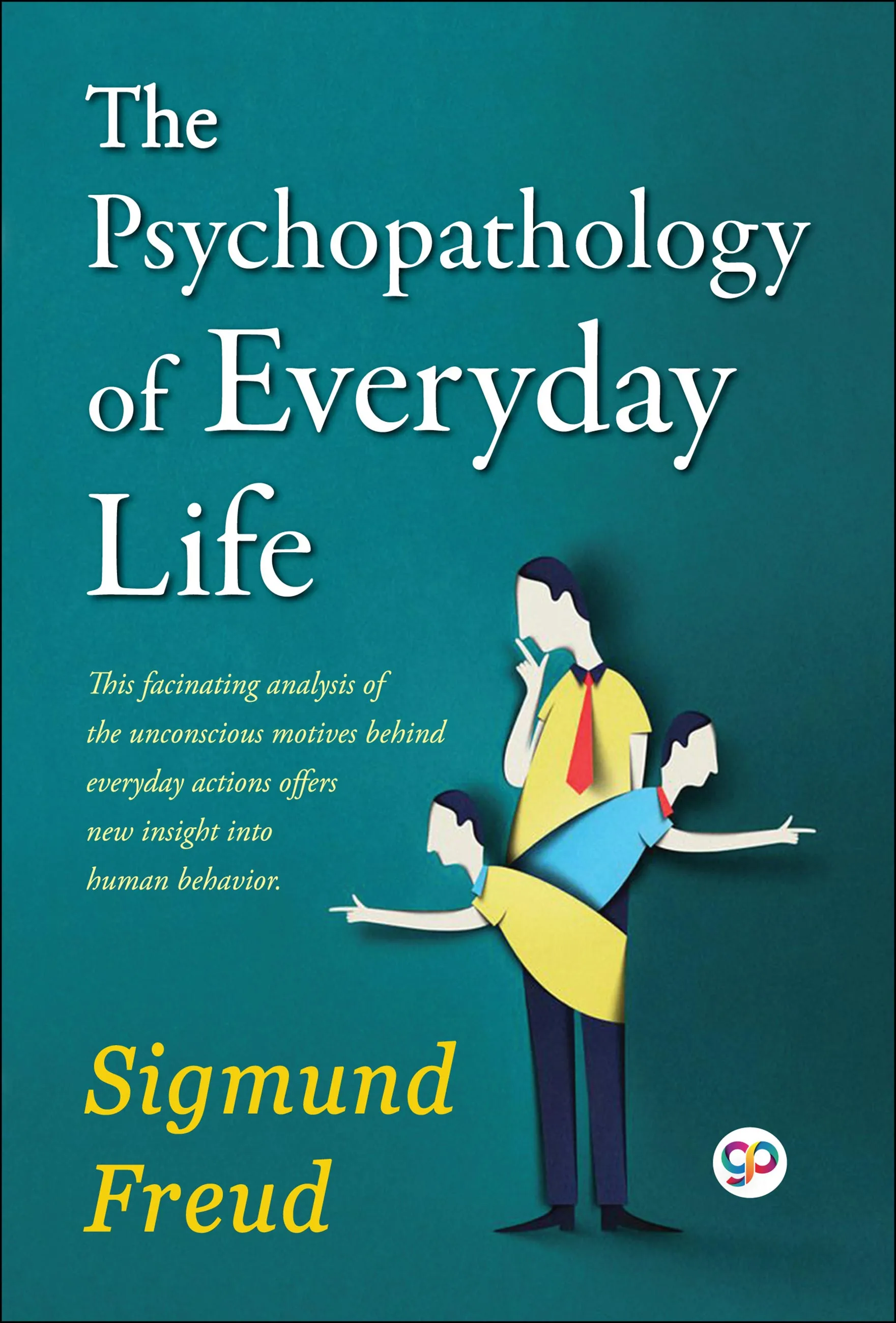
The Psychopathology of Everyday Life
eBook
• 103 Pages
• INR 70.00
• English
• 9789388118026
No ratings yet
| Publisher | General Press |
|---|---|
| ISBN13 | 9789388118026 |
| ASIN/SKU | B07DYXJMXR |
| Book Format | eBook |
| Language | English |
| Pages | 103 |
| List Price | INR 70.00 |
| Subject Code | PSY022000, PSY000000, PHI005000, REF000000 |
| Publishing Date | 23/06/2018 |
| Book Code | BD00068469 |
Buy this Book
Amazon Stores
Ebook Stores
Other Stores
Discover The Psychopathology of Everyday Life by Sigmund Freud. This book is published by General Press in eBook format, ISBN 9789388118026, ASIN B07DYXJMXR, under Reference, Philosophy, Psychology.
Book Description
Have you ever forgotten someone's name at exactly the wrong moment, or slipped and said something you immediately wished you could take back — and then told yourself it was just an accident? Sigmund Freud would gently but firmly disagree. 'The Psychopathology of Everyday Life' is one of his most accessible and widely read works of psychological nonfiction, and its central argument is as provocative today as it was when it first appeared: there are no true accidents of the mind.
Freud builds his case through a remarkable collection of small, ordinary moments — forgotten names, misplaced objects, slips of the tongue, bungled actions, and superstitious beliefs — and subjects each one to careful, probing analysis. What he finds, again and again, is that these apparent mistakes are not random. They are, he argues, the fingerprints of the unconscious mind, brief and unguarded moments when repressed thoughts, feelings, and desires manage to surface despite our best efforts to keep them buried.
The book is structured as a kind of extended clinical observation, moving through different categories of what Freud called "parapraxes" — the technical term for these revealing slips and errors. He draws on his own experiences as well as those of his patients and colleagues, and his examples range from the mildly amusing to the genuinely unsettling. What makes the reading experience so compelling is the cumulative effect: by the time you've followed his reasoning through dozens of cases, it becomes very difficult to look at your own small daily errors with the same comfortable dismissiveness.
Freud's prose here is notably more relaxed and conversational than in some of his denser theoretical works, making this an ideal entry point for readers who are curious about psychoanalytic thought but haven't known where to start. He wears his erudition lightly, and there is even a dry wit running through many of his observations. After spending time with this book, you may find yourself pausing the next time you forget a word — and wondering, with a new kind of curiosity, exactly what you might be trying not to say.
Freud builds his case through a remarkable collection of small, ordinary moments — forgotten names, misplaced objects, slips of the tongue, bungled actions, and superstitious beliefs — and subjects each one to careful, probing analysis. What he finds, again and again, is that these apparent mistakes are not random. They are, he argues, the fingerprints of the unconscious mind, brief and unguarded moments when repressed thoughts, feelings, and desires manage to surface despite our best efforts to keep them buried.
The book is structured as a kind of extended clinical observation, moving through different categories of what Freud called "parapraxes" — the technical term for these revealing slips and errors. He draws on his own experiences as well as those of his patients and colleagues, and his examples range from the mildly amusing to the genuinely unsettling. What makes the reading experience so compelling is the cumulative effect: by the time you've followed his reasoning through dozens of cases, it becomes very difficult to look at your own small daily errors with the same comfortable dismissiveness.
Freud's prose here is notably more relaxed and conversational than in some of his denser theoretical works, making this an ideal entry point for readers who are curious about psychoanalytic thought but haven't known where to start. He wears his erudition lightly, and there is even a dry wit running through many of his observations. After spending time with this book, you may find yourself pausing the next time you forget a word — and wondering, with a new kind of curiosity, exactly what you might be trying not to say.
Author Biography
Born Sigismund Schlomo Freud in 1856 in Freiberg, Moravia, he moved with his family to Vienna, Austria, at a young age. A brilliant student, Freud entered the University of Vienna at seventeen to study medicine. Initially focusing on neurology and zoology, he conducted significant research on the nervous systems of marine life. After earning his medical degree, he began working at the Vienna General Hospital, where his fascination with the complex workings of the human brain gradually shifted his focus from the physical structures of nerves to the realm of psychological disorders.
Freud's pivotal transition occurred in the 1880s following his collaboration with physician Josef Breuer and his studies under French neurologist Jean-Martin Charcot. Intrigued by the treatment of hysteria through hypnosis, Freud began developing a revolutionary clinical method centered on dialogue. He posited that unexpressed, deeply repressed traumatic memories in the unconscious mind were the root cause of psychological distress. By encouraging patients to speak freely about their dreams, memories, and childhood experiences—a technique known as free association—Freud established the foundational framework of psychoanalysis.
In 1899, Freud published his seminal work, The Interpretation of Dreams, introducing the concept of the unconscious mind and arguing that dreams are disguised fulfillments of repressed wishes. This was followed by a series of highly influential and controversial publications outlining his theories on psychosexual development, the Oedipus complex, and the tripartite structure of the psyche: the id, ego, and superego. Although his ideas frequently scandalized the conservative Victorian medical establishment, they eventually attracted a dedicated circle of followers, transforming psychoanalysis into an international movement.
Despite battling painful jaw cancer for the last sixteen years of his life, Freud remained a remarkably prolific writer and clinician. In 1938, the Nazi annexation of Austria forced the eighty-two-year-old Freud, who was of Jewish descent, to flee Vienna for London to escape persecution. He died there the following year. While many of his specific clinical theories have been heavily criticized or discarded by modern psychiatry, Freud's profound cultural impact is undeniable. He forever altered the way humanity understands the subconscious, shaping not just psychology, but literature, art, and modern thought.
Freud's pivotal transition occurred in the 1880s following his collaboration with physician Josef Breuer and his studies under French neurologist Jean-Martin Charcot. Intrigued by the treatment of hysteria through hypnosis, Freud began developing a revolutionary clinical method centered on dialogue. He posited that unexpressed, deeply repressed traumatic memories in the unconscious mind were the root cause of psychological distress. By encouraging patients to speak freely about their dreams, memories, and childhood experiences—a technique known as free association—Freud established the foundational framework of psychoanalysis.
In 1899, Freud published his seminal work, The Interpretation of Dreams, introducing the concept of the unconscious mind and arguing that dreams are disguised fulfillments of repressed wishes. This was followed by a series of highly influential and controversial publications outlining his theories on psychosexual development, the Oedipus complex, and the tripartite structure of the psyche: the id, ego, and superego. Although his ideas frequently scandalized the conservative Victorian medical establishment, they eventually attracted a dedicated circle of followers, transforming psychoanalysis into an international movement.
Despite battling painful jaw cancer for the last sixteen years of his life, Freud remained a remarkably prolific writer and clinician. In 1938, the Nazi annexation of Austria forced the eighty-two-year-old Freud, who was of Jewish descent, to flee Vienna for London to escape persecution. He died there the following year. While many of his specific clinical theories have been heavily criticized or discarded by modern psychiatry, Freud's profound cultural impact is undeniable. He forever altered the way humanity understands the subconscious, shaping not just psychology, but literature, art, and modern thought.
Editorial Reviews
Editorial Reviews will be added soon…
Book Summary
Sigmund Freud’s The Psychopathology of Everyday Life is one of the most accessible and revealing books in the history of psychoanalysis because it takes an extraordinary idea and applies it to ordinary moments. Published in its original form in 1901 and later expanded through several editions, the book asks a deceptively simple question: What if the little mistakes we make every day are not really mistakes at all? What if forgetting a person’s name, saying the wrong word, losing an object, misreading a sentence, forgetting an appointment, or carrying out an action differently from what we intended can tell us something about what is happening inside our minds? Freud’s answer is provocative. He argues that many such events are psychologically meaningful expressions of unconscious thoughts, wishes, conflicts, fears, and memories. The book develops this argument across twelve chapters dealing with forgotten names, foreign words, childhood memories, slips of speech, mistakes in reading and writing, forgotten intentions, bungled actions, errors, and the relationship between chance and psychological determinism.
At the heart of The Psychopathology of Everyday Life is Freud’s belief in the unconscious mind. Freud had already explored the unconscious through dreams and through his work with psychological disorders. Here, however, he makes a much more ambitious move: he brings the unconscious into ordinary daily life. You do not have to suffer from a serious psychological disorder, Freud suggests, to experience unconscious conflict. Everyone forgets things, makes slips, misplaces possessions, makes strange errors, or suddenly finds that a particular name has disappeared from memory. These experiences may look insignificant, but Freud believes they can reveal the same basic mental mechanisms that appear more dramatically in neurosis. In this sense, the book tries to erase the sharp boundary between the psychologically “normal” person and the psychologically troubled person. The mechanisms of repression and unconscious conflict exist, according to Freud, in everyday people as well.
One of Freud’s most famous examples concerns forgetting a proper name. He describes his inability to remember the name of the Renaissance painter Signorelli while instead recalling substitute names such as Botticelli and Boltraffio. At first, this looks like an ordinary memory failure. Freud, however, investigates what was happening around the forgotten name. He connects the episode to an earlier conversation involving disturbing themes of death and sexuality. His argument is that the name “Signorelli” did not simply vanish because his memory system malfunctioned. Rather, an emotionally uncomfortable chain of associations interfered with his ability to recall it. The substitute names were not meaningless either; they were connected through associations to the forgotten material. This episode becomes a model for Freud’s larger theory: a forgotten word may be displaced rather than destroyed. Something unconscious interferes with conscious recall, and another thought or word takes its place.
This idea becomes particularly important because Freud does not treat memory as a simple storage system. For him, forgetting can be psychologically motivated. We often imagine memory as something mechanical: information enters the brain, remains there, and is retrieved when needed. Freud proposes a more complicated picture. What we remember and what we fail to remember may be influenced by emotional significance. If a thought, person, experience, or subject is connected with embarrassment, anxiety, resentment, guilt, disappointment, or another uncomfortable feeling, the mind may resist bringing it into consciousness. Forgetting therefore becomes a kind of psychological compromise. The conscious mind has one intention, while another part of the mind has a competing interest. The resulting failure may satisfy both sides partially: the conscious intention is interrupted, but the hidden conflict finds an indirect expression.
Freud extends this principle to slips of the tongue, the phenomenon that later became popularly known as the “Freudian slip.” Imagine intending to say one thing but accidentally saying another. In ordinary conversation, we usually laugh, correct ourselves, and move on. Freud encourages us to stop and ask why that particular word appeared. His theory is not that every verbal mistake necessarily reveals a profound secret. Rather, he argues that certain mistakes can emerge when two intentions collide. One intention is conscious and socially acceptable; another may be unconscious and emotionally charged. The spoken error becomes a compromise between them. The mistake therefore “fails” at the level of conscious communication while potentially succeeding at expressing something that the speaker was not fully willing to acknowledge. The chapters on speech, reading, and writing develop this idea through numerous examples.
The same reasoning applies to mistakes in reading and writing. A person may read a word incorrectly even though the printed word is perfectly clear, or write a different word from the one intended. Freud sees these errors as potentially significant because perception and action are not completely independent of emotion. If a particular word has personal associations, conflicts, or uncomfortable meanings attached to it, unconscious material may influence how it is perceived or reproduced. This is part of Freud’s larger argument that consciousness is not the sole director of mental life. Even when we believe we are acting deliberately, other psychological processes may be operating underneath the surface.
Another fascinating part of the book concerns forgetting intentions. People sometimes forget to make a phone call, send a message, pay a bill, attend an appointment, or complete an apparently simple task. Freud asks whether such failures are always accidental. His answer is again deliberately unsettling. Sometimes, he suggests, forgetting an intention may express a hidden reluctance to carry it out. We may consciously believe that we want to do something while unconsciously resisting it. Forgetting becomes a compromise: instead of openly saying “I do not want to do this,” the mind simply fails to complete the task. Freud is particularly interested in situations where the forgotten obligation carries emotional tension. The more psychologically meaningful the task, the more interesting the forgetting becomes.
The book also examines misplaced objects and bungled actions. Losing a key, putting something in the wrong place, breaking an object, knocking something over, or performing a familiar action incorrectly may appear to be simple clumsiness. Freud, however, distinguishes between genuinely accidental events and what he calls psychologically meaningful faulty actions. He suggests that people may sometimes “lose” something because they unconsciously wish to distance themselves from it, or mishandle an object because of feelings associated with it. The important concept here is parapraxis, Freud’s term for these everyday faulty actions. The German concept Fehlleistung refers broadly to an action that does not accomplish its conscious purpose but may express another purpose beneath the surface.
Freud’s discussion of childhood memories is equally important. He challenges the assumption that our earliest memories are necessarily straightforward recordings of what actually happened. Some memories from childhood remain unusually vivid, while other apparently important experiences disappear completely. Freud is interested in what he calls concealing memories: apparently trivial childhood memories that survive because they are psychologically connected with more significant material. A memory of a small event—a meal, an object, an encounter, a seemingly meaningless scene—may remain vivid because it has become associated with an emotion or experience that was more important than the remembered event itself. In this way, memory becomes selective and symbolic rather than purely photographic.
One of the book’s deepest themes is therefore repression. Freud believes that human beings often encounter thoughts and feelings that are unacceptable to their conscious self-image. These may involve sexuality, jealousy, anger, rivalry, shame, ambition, resentment, fear, or other uncomfortable emotions. Rather than consciously confronting such material, the mind may push it out of awareness. But repression does not necessarily eliminate the underlying thought. Instead, the repressed material may return indirectly through dreams, symptoms, slips, forgetfulness, jokes, errors, or other everyday behavior. The Psychopathology of Everyday Life is essentially an attempt to demonstrate this process in miniature.
This is why Freud repeatedly returns to the idea that there is no such thing as a completely meaningless mental accident. His principle of psychic determinism is one of the book’s central arguments. Freud rejects the idea that mental events are simply random. If a person repeatedly forgets a particular name, makes a particular kind of error, or misplaces the same kind of object, Freud wants us to investigate the associations behind the behavior. An apparently accidental event may have a psychological cause even when the person experiencing it has no conscious awareness of that cause. The unconscious does not announce itself directly; it appears through indirect signs.
The final chapters bring this argument into a broader discussion of chance, determinism, and superstition. Freud is especially interested in the human tendency to believe that certain coincidences or accidental events have special meaning. He does not simply endorse superstition. Instead, he asks why people are so inclined to interpret coincidences psychologically. If we unconsciously invest certain events with emotional significance, we may become more attentive to them and more likely to connect them with our private thoughts. His larger point is that human beings are uncomfortable with the idea that their inner lives are chaotic. We constantly search for patterns and causes. Freud turns that instinct inward, suggesting that the most important patterns may be hidden inside our own behavior.
What makes the book particularly memorable is Freud’s use of ordinary examples rather than abstract theory alone. He draws heavily from his own experiences as well as those of patients, acquaintances, and professional colleagues. This gives the work an unusually personal quality. Freud is not presenting himself as someone standing outside the psychological phenomena he describes. He examines his own forgetfulness, mistakes, associations, and experiences. Modern commentary has noted how autobiographical the work can be, including its references to professional disappointments, family concerns, rivalries, attractions, and ordinary frustrations.
At the same time, modern readers should approach Freud’s explanations with some caution. The book is historically important, but many of Freud’s specific interpretations are not accepted as established scientific explanations today. Contemporary psychology recognizes that memory failures, slips, attention errors, and accidents can arise from many causes, including fatigue, divided attention, interference, stress, habit, and ordinary cognitive limitations. Freud sometimes interprets individual examples with a level of certainty that modern empirical psychology would not accept. His lasting contribution is therefore not that every forgotten name or verbal slip contains a hidden sexual desire or repressed wish. His greater contribution is the question he taught generations of readers to ask: could behavior contain meanings that we ourselves do not consciously recognize?
Ultimately, The Psychopathology of Everyday Life is a book about the uncomfortable distance between who we think we are and what may be happening inside us. Freud invites readers to look differently at the tiny failures of daily existence. Forgetting a name, making a verbal mistake, losing an object, or failing to keep a promise may sometimes be nothing more than an ordinary error. But sometimes, he argues, such moments expose tensions that consciousness prefers to keep hidden. The everyday world becomes a psychological landscape filled with clues.
The enduring appeal of the book lies in this change of perspective. Freud takes experiences that most people dismiss without thought and turns them into objects of curiosity. His central message is not simply that people make mistakes, but that the mind is more complicated than conscious intention suggests. We can sincerely believe one thing and feel another; consciously pursue one goal while unconsciously resisting it; remember something trivial while forgetting something important; and speak words that surprise even ourselves. Whether or not one accepts Freud’s interpretations, the book remains a fascinating exploration of hidden motivation, memory, repression, and human self-deception. It helped make the unconscious part of popular culture and psychology, and it gave the world the enduring idea that even an ordinary “Freudian slip” might tell a story.
In the end, The Psychopathology of Everyday Life is best understood not as a manual for decoding every mistake but as an invitation to become more curious about our own minds. Freud asks us to slow down and notice the moments we usually ignore. Why did I forget that name? Why did I say that word? Why did I avoid that task? Why did I suddenly misplace something I needed? Sometimes the answer will be completely ordinary. But Freud’s revolutionary suggestion is that sometimes the answer may lead somewhere deeper. Our everyday mistakes can become windows into the unconscious—and the unconscious, for Freud, is not a distant corner of the mind but an active force quietly participating in everyday life.
At the heart of The Psychopathology of Everyday Life is Freud’s belief in the unconscious mind. Freud had already explored the unconscious through dreams and through his work with psychological disorders. Here, however, he makes a much more ambitious move: he brings the unconscious into ordinary daily life. You do not have to suffer from a serious psychological disorder, Freud suggests, to experience unconscious conflict. Everyone forgets things, makes slips, misplaces possessions, makes strange errors, or suddenly finds that a particular name has disappeared from memory. These experiences may look insignificant, but Freud believes they can reveal the same basic mental mechanisms that appear more dramatically in neurosis. In this sense, the book tries to erase the sharp boundary between the psychologically “normal” person and the psychologically troubled person. The mechanisms of repression and unconscious conflict exist, according to Freud, in everyday people as well.
One of Freud’s most famous examples concerns forgetting a proper name. He describes his inability to remember the name of the Renaissance painter Signorelli while instead recalling substitute names such as Botticelli and Boltraffio. At first, this looks like an ordinary memory failure. Freud, however, investigates what was happening around the forgotten name. He connects the episode to an earlier conversation involving disturbing themes of death and sexuality. His argument is that the name “Signorelli” did not simply vanish because his memory system malfunctioned. Rather, an emotionally uncomfortable chain of associations interfered with his ability to recall it. The substitute names were not meaningless either; they were connected through associations to the forgotten material. This episode becomes a model for Freud’s larger theory: a forgotten word may be displaced rather than destroyed. Something unconscious interferes with conscious recall, and another thought or word takes its place.
This idea becomes particularly important because Freud does not treat memory as a simple storage system. For him, forgetting can be psychologically motivated. We often imagine memory as something mechanical: information enters the brain, remains there, and is retrieved when needed. Freud proposes a more complicated picture. What we remember and what we fail to remember may be influenced by emotional significance. If a thought, person, experience, or subject is connected with embarrassment, anxiety, resentment, guilt, disappointment, or another uncomfortable feeling, the mind may resist bringing it into consciousness. Forgetting therefore becomes a kind of psychological compromise. The conscious mind has one intention, while another part of the mind has a competing interest. The resulting failure may satisfy both sides partially: the conscious intention is interrupted, but the hidden conflict finds an indirect expression.
Freud extends this principle to slips of the tongue, the phenomenon that later became popularly known as the “Freudian slip.” Imagine intending to say one thing but accidentally saying another. In ordinary conversation, we usually laugh, correct ourselves, and move on. Freud encourages us to stop and ask why that particular word appeared. His theory is not that every verbal mistake necessarily reveals a profound secret. Rather, he argues that certain mistakes can emerge when two intentions collide. One intention is conscious and socially acceptable; another may be unconscious and emotionally charged. The spoken error becomes a compromise between them. The mistake therefore “fails” at the level of conscious communication while potentially succeeding at expressing something that the speaker was not fully willing to acknowledge. The chapters on speech, reading, and writing develop this idea through numerous examples.
The same reasoning applies to mistakes in reading and writing. A person may read a word incorrectly even though the printed word is perfectly clear, or write a different word from the one intended. Freud sees these errors as potentially significant because perception and action are not completely independent of emotion. If a particular word has personal associations, conflicts, or uncomfortable meanings attached to it, unconscious material may influence how it is perceived or reproduced. This is part of Freud’s larger argument that consciousness is not the sole director of mental life. Even when we believe we are acting deliberately, other psychological processes may be operating underneath the surface.
Another fascinating part of the book concerns forgetting intentions. People sometimes forget to make a phone call, send a message, pay a bill, attend an appointment, or complete an apparently simple task. Freud asks whether such failures are always accidental. His answer is again deliberately unsettling. Sometimes, he suggests, forgetting an intention may express a hidden reluctance to carry it out. We may consciously believe that we want to do something while unconsciously resisting it. Forgetting becomes a compromise: instead of openly saying “I do not want to do this,” the mind simply fails to complete the task. Freud is particularly interested in situations where the forgotten obligation carries emotional tension. The more psychologically meaningful the task, the more interesting the forgetting becomes.
The book also examines misplaced objects and bungled actions. Losing a key, putting something in the wrong place, breaking an object, knocking something over, or performing a familiar action incorrectly may appear to be simple clumsiness. Freud, however, distinguishes between genuinely accidental events and what he calls psychologically meaningful faulty actions. He suggests that people may sometimes “lose” something because they unconsciously wish to distance themselves from it, or mishandle an object because of feelings associated with it. The important concept here is parapraxis, Freud’s term for these everyday faulty actions. The German concept Fehlleistung refers broadly to an action that does not accomplish its conscious purpose but may express another purpose beneath the surface.
Freud’s discussion of childhood memories is equally important. He challenges the assumption that our earliest memories are necessarily straightforward recordings of what actually happened. Some memories from childhood remain unusually vivid, while other apparently important experiences disappear completely. Freud is interested in what he calls concealing memories: apparently trivial childhood memories that survive because they are psychologically connected with more significant material. A memory of a small event—a meal, an object, an encounter, a seemingly meaningless scene—may remain vivid because it has become associated with an emotion or experience that was more important than the remembered event itself. In this way, memory becomes selective and symbolic rather than purely photographic.
One of the book’s deepest themes is therefore repression. Freud believes that human beings often encounter thoughts and feelings that are unacceptable to their conscious self-image. These may involve sexuality, jealousy, anger, rivalry, shame, ambition, resentment, fear, or other uncomfortable emotions. Rather than consciously confronting such material, the mind may push it out of awareness. But repression does not necessarily eliminate the underlying thought. Instead, the repressed material may return indirectly through dreams, symptoms, slips, forgetfulness, jokes, errors, or other everyday behavior. The Psychopathology of Everyday Life is essentially an attempt to demonstrate this process in miniature.
This is why Freud repeatedly returns to the idea that there is no such thing as a completely meaningless mental accident. His principle of psychic determinism is one of the book’s central arguments. Freud rejects the idea that mental events are simply random. If a person repeatedly forgets a particular name, makes a particular kind of error, or misplaces the same kind of object, Freud wants us to investigate the associations behind the behavior. An apparently accidental event may have a psychological cause even when the person experiencing it has no conscious awareness of that cause. The unconscious does not announce itself directly; it appears through indirect signs.
The final chapters bring this argument into a broader discussion of chance, determinism, and superstition. Freud is especially interested in the human tendency to believe that certain coincidences or accidental events have special meaning. He does not simply endorse superstition. Instead, he asks why people are so inclined to interpret coincidences psychologically. If we unconsciously invest certain events with emotional significance, we may become more attentive to them and more likely to connect them with our private thoughts. His larger point is that human beings are uncomfortable with the idea that their inner lives are chaotic. We constantly search for patterns and causes. Freud turns that instinct inward, suggesting that the most important patterns may be hidden inside our own behavior.
What makes the book particularly memorable is Freud’s use of ordinary examples rather than abstract theory alone. He draws heavily from his own experiences as well as those of patients, acquaintances, and professional colleagues. This gives the work an unusually personal quality. Freud is not presenting himself as someone standing outside the psychological phenomena he describes. He examines his own forgetfulness, mistakes, associations, and experiences. Modern commentary has noted how autobiographical the work can be, including its references to professional disappointments, family concerns, rivalries, attractions, and ordinary frustrations.
At the same time, modern readers should approach Freud’s explanations with some caution. The book is historically important, but many of Freud’s specific interpretations are not accepted as established scientific explanations today. Contemporary psychology recognizes that memory failures, slips, attention errors, and accidents can arise from many causes, including fatigue, divided attention, interference, stress, habit, and ordinary cognitive limitations. Freud sometimes interprets individual examples with a level of certainty that modern empirical psychology would not accept. His lasting contribution is therefore not that every forgotten name or verbal slip contains a hidden sexual desire or repressed wish. His greater contribution is the question he taught generations of readers to ask: could behavior contain meanings that we ourselves do not consciously recognize?
Ultimately, The Psychopathology of Everyday Life is a book about the uncomfortable distance between who we think we are and what may be happening inside us. Freud invites readers to look differently at the tiny failures of daily existence. Forgetting a name, making a verbal mistake, losing an object, or failing to keep a promise may sometimes be nothing more than an ordinary error. But sometimes, he argues, such moments expose tensions that consciousness prefers to keep hidden. The everyday world becomes a psychological landscape filled with clues.
The enduring appeal of the book lies in this change of perspective. Freud takes experiences that most people dismiss without thought and turns them into objects of curiosity. His central message is not simply that people make mistakes, but that the mind is more complicated than conscious intention suggests. We can sincerely believe one thing and feel another; consciously pursue one goal while unconsciously resisting it; remember something trivial while forgetting something important; and speak words that surprise even ourselves. Whether or not one accepts Freud’s interpretations, the book remains a fascinating exploration of hidden motivation, memory, repression, and human self-deception. It helped make the unconscious part of popular culture and psychology, and it gave the world the enduring idea that even an ordinary “Freudian slip” might tell a story.
In the end, The Psychopathology of Everyday Life is best understood not as a manual for decoding every mistake but as an invitation to become more curious about our own minds. Freud asks us to slow down and notice the moments we usually ignore. Why did I forget that name? Why did I say that word? Why did I avoid that task? Why did I suddenly misplace something I needed? Sometimes the answer will be completely ordinary. But Freud’s revolutionary suggestion is that sometimes the answer may lead somewhere deeper. Our everyday mistakes can become windows into the unconscious—and the unconscious, for Freud, is not a distant corner of the mind but an active force quietly participating in everyday life.
Sample Chapters
Chapter 1 : Forgetting of Proper Names
During the year 1898 I published a short essay On the Psychic Mechanism of Forgetfulness. I shall now repeat its contents and take it as a starting-point for further discussion. I have there undertaken a psychologic analysis of a common case of temporary forgetfulness of proper names, and from a pregnant example of my own observation I have reached the conclusion that this frequent and practically unimportant occurrence of a failure of a psychic function – of memory – admits an explanation which goes beyond the customary utilization of this phenomenon.
If an average psychologist sho uld be asked to explain how it happens that we often fail to recall a name which we are sure we know, he would probably content himself with the answer that proper names are more apt to be forgotten than any other content of memory. He might give plausible reasons for this “forgetting preference” for proper names, but he would not assume any deep determinant for the process.
I was led to examine exhaustively the phenomenon of temporary forgetfulness through the observation of certain peculiarities, which, although not general, can, nevertheless, be seen clearly in some cases. In these there is not only forgetfulness, but also false recollection: he who strives for the escaped name brings to consciousness others – substitutive names – which, although immediately recognized as false, nevertheless obtrude themselves with great tenacity. The process which should lead to the reproduction of the lost name is, as it were, displaced, and thus brings one to an incorrect substitute.
Now it is my assumption that the displacement is not left to psychic arbitrariness, but that it follows lawful and rational paths. In other words, I assume that the substitutive name (or names) stands in direct relation to the lost name, and I hope, if I succeed in demonstrating this connection, to throw light on the origin of the forgetting of names.
In the example which I selected for analysis in 1898 I vainly strove to recall the name of the master who made the imposing frescoes of the “Last Judgment” in the dome of Orvieto. Instead of the lost name – Signorelli – two other names of artists – Botticelli and Boltraffio – obtruded themselves, names which my judgment immediately and definitely rejected as being incorrect. When the correct name was imparted to me by an outsider I recognized it at once without any hesitation. The examination of the influence and association paths which caused the displacement from Signorelli to Botticelli and Boltraffio led to the following results :–
(a) The reason for the escape of the name Signorelli is neither to be sought in the strangeness in itself of this name nor in the psychologic character of the connection in which it was inserted. The forgotten name was just as familiar to me as one of the substitutive names – Botticelli – and somewhat more familiar than the other substitute – Boltraffio – of the possessor of which I could hardly say more than that he belonged to the Milanese School. The connection, too, in which the forgetting of the name took place appeared to me harmless, and led to no further explanation. I journeyed by carriage with a stranger from Ragusa, Dalmatia, to a station in Herzegovina. Our conversation drifted to travelling in Italy, and I asked my companion whether he had been in Orvieto and had seen there the famous frescoes of –
(b) The forgetting of the name could not be explained until after I had recalled the theme discussed immediately before this conversation. This forgetting then made itself known as a disturbance of the newly emerging theme caused by the theme preceding it. In brief, before I asked my travelling companion if he had been in Orvieto we had been discussing the customs of the Turks living in Bosnia and Herzegovina. I had related what I heard from a colleague who was practicing medicine among them, namely, that they show full confidence in the physician and complete submission to fate. When one is compelled to inform them that there is no help for the patient, they answer: “Sir (Herr), what can I say? I know that if he could be saved you would save him.” In these sentences alone we can find the words and names: Bosnia, Herzegovina, and Herr (sir), which may be inserted in an association series between Signorelli, Botticelli, and Boltraffio.
(c) I assume that the stream of thoughts concerning the customs of the Turks in Bosnia, etc., was able to disturb the next thought, because I withdrew my attention from it before it came to an end. For I recalled that I wished to relate a second anecdote which was next to the first in my memory. These Turks value the sexual pleasure above all else, and at sexual disturbances merge into an utter despair which strangely contrasts with their resignation at the peril of losing their lives. One of my colleague’s patients once told him: “For you know, sir (Herr), if that ceases, life no longer has any charm.”
I refrained from imparting this characteristic feature because I did not wish to touch upon such a delicate theme in conversation with a stranger. But I went still further; I also deflected my attention from the continuation of the thought which might have associated itself in me with the theme “Death and Sexuality.” I was at that time under the after-effects of a message which I had received a few weeks before, during a brief sojourn in Trafoi. A patient on whom I had spent much effort had ended his life on account of an incurable sexual disturbance. I know positively that this sad event, and everything connected with it, did not come to my conscious recollection on that trip in Herzegovina. However, the agreement between Trafoi and Boltraffio forces me to assume that this reminiscence was at that time brought to activity despite all the intentional deviation of my attention.
(d) I can no longer conceive the forgetting of the name Signorelli as an accidental occurrence. I must recognize in this process the influence of a motive. There were motives which actuated the interruption in the communication of my thoughts (concerning the customs of the Turks, etc.), and which later influenced me to exclude from my consciousness the thought connected with them, and which might have led to the message concerning the incident in Trafoi – that is, I wanted to forget something, I repressed something. To be sure, I wished to forget something other than the name of the master of Orvieto; but this other thought brought about an associative connection between itself and this name, so that my act of volition missed the aim, and I forgot the one against my will, while I intentionally wished to forget the other. The disinclination to recall directed itself against the one content; the inability to remember appeared in another. The case would have been obviously simpler if this disinclination and the inability to remember had concerned the same content. The substitutive names no longer seem so thoroughly justified as they were before this explanation. They remind me (after the form of a compromise) as much of what I wished to forget as of what I wished to remember, and show me that my object to forget something was neither a perfect success nor a failure.
(e) The nature of the association formed between the lost name and the repressed theme (death and sexuality, etc.), containing the names of Bosnia, Herzegovina, and Trafoi, is also very strange. In the scheme inserted here, which originally appeared in 1898, an attempt is made to graphically represent these associations.
The name Signorelli was thus divided into two parts. One pair of syllables (elli) returned unchanged in one of the substitutions, while the other had gained, through the translation of signor (sir, Herr), many and diverse relations to the name contained in the repressed theme, but was lost through it in the reproduction. Its substitution was formed in a way to suggest that a displacement took place along the same associations – “Herzegovina and Bosnia” – regardless of the sense and acoustic demarcation. The names were therefore treated in this process like the written pictures of a sentence which is to be transformed into a picture-puzzle (rebus). No information was given to consciousness concerning the whole process, which, instead of the name Signorelli, was thus changed to the substitutive names. At first sight no relation is apparent between the theme that contained the name Signorelli and the repressed one which immediately preceded it.
Perhaps it is not superfluous to remark that the given explanation does not contradict the conditions of memory reproduction and forgetting assumed by other psychologists, which they seek in certain relations and dispositions. Only in certain cases have we added another motive to the factors long recognized as causative in forgetting names, and have thus laid bare the mechanism of faulty memory. The assumed dispositions are indispensable also in our case, in order to make it possible for the repressed element to associatively gain control over the desired name and take it along into the repression. Perhaps this would not have occurred in another name having more favorable conditions of reproduction. For it is quite probable that a suppressed element continually strives to assert itself in some other way, but attains this success only where it meets with suitable conditions. At other times the suppression succeeds without disturbance of function, or, as we may justly say, without symptoms.
When we recapitulate the conditions for forgetting a name with faulty recollection we find:
(1) a certain disposition to forget the same; (2) a process of suppression which has taken place shortly before; and (3) the possibility of establishing an outer association between the concerned name and the element previously suppressed. The last condition will probably not have to be much overrated, for the slightest claim on the association is apt in most cases to bring it about. But it is a different and farther-reaching question whether such outer association can really furnish the proper condition to enable the suppressed element to disturb the reproduction of the desired name, or whether after all a more intimate connection between the two themes is not necessarily required. On superficial consideration one may be willing to reject the latter requirement and consider the temporal meeting in perfectly dissimilar contents as sufficient. But on more thorough examination one finds more and more frequently that the two elements (the repressed and the new one) connected by an outer association, possess besides a connection in content, and this can also be demonstrated in the example Signorelli.
The value of the understanding gained through the analysis of the example Signorelli naturally depends on whether we must explain this case as a typical or as an isolated process. I must now maintain that the forgetting of a name associated with faulty recollection uncommonly often follows the same process as was demonstrated in the case of Signorelli. Almost every time that I observed this phenomenon in myself I was able to explain it in the manner indicated above as being motivated by repression.
I must mention still another view-point in favour of the typical nature of our analysis. I believe that one is not justified in separating the cases of name-forgetting with faulty recollection from those in which incorrect substitutive names have not obtruded themselves. These substitutive names occur spontaneously in a number of cases; in other cases, where they do not come spontaneously, they can be brought to the surface by concentration of attention, and they then show the same relation to the repressed element and the lost name as those that come spontaneously. Two factors seem to play a part in bringing to consciousness the substitutive names: first, the effort of attention, and second, and inner determinant which adheres to the psychic material. I could find the latter in the greater or lesser facility which forms the required outer associations between the two elements. A great many of the cases of name-forgetting without faulty recollection therefore belong to the cases with substitutive name formation, the mechanism of which corresponds to the one in the example Signorelli. But I surely shall not venture to assert that all cases of name-forgetting belong to the same group. There is no doubt that there are cases of name-forgetting that proceed in a much simpler way. We shall represent this state of affairs carefully enough if we assert that besides the simple forgetting of proper names there is another forgetting which is motivated by repression.
Chapter 2 : Forgetting of Foreign Words
The ordinary vocabulary of our own language seems to be protected against forgetting within the limits of normal function, but it is quite different with words from a foreign language. The tendency to forget such words extends to all parts of speech. In fact, depending on our own general state and the degree of fatigue, the first manifestation of functional disturbance evinces itself in the irregularity of our control over foreign vocabulary. In a series of cases this forgetting follows the same mechanism as the one revealed in the example Signorelli. As a demonstration of this I shall report a single analysis, characterized, however, by valuable features, concerning the forgetting of a word, not a noun, from a Latin quotation. Before proceeding, allow me to give a full and clear account of this little episode.
Last summer, while journeying on my vacation, I renewed the acquaintance of a young man of academic education, who, as I soon noticed, was conversant with some of my works. In our conversation we drifted – I no longer remember how – to the social position of the race to which we both belonged. He, being ambitious, bemoaned the fact that his generation, as he expressed it, was destined to grow crippled, that it was prevented from developing its talents and from gratifying its desires. He concluded his passionately felt speech with the familiar verse from Virgil: Exoriare... in which the unhappy Dido leaves her vengeance upon Æneas to posterity. Instead of “concluded,” I should have said “wished to conclude,” for he could not bring the quotation to an end, and attempted to conceal the open gap in his memory by transposing the words: –
“Exoriar(e) ex nostris ossibus ultor!”
He finally became piqued and said: “Please don’t make such a mocking face, as if you were gloating over my embarrassment, but help me. There is something missing in this verse. How does it read in its complete form?”
“With pleasure,” I answered, and cited it correctly :–
“Exoriar(e) aliquis nostris ex ossibus ultor!”
“It is too stupid to forget such a word,” he said. “By the way, I understand you claim that forgetting is not without its reasons; I should be very curious to find out how I came to forget this indefinite pronoun ‘aliquis.’”
I gladly accepted the challenge, as I hoped to get an addition to my collection, and said, “We can easily do this, but I must ask you to tell me frankly and without any criticism everything that occurs to your mind after you focus your attention, without any particular intention, on the forgotten word.”
“Very well, the ridiculous idea comes to me to divide the word in the following way: a and liquis.”
“What does that mean?”
“I don’t know.”
“What else does that recall to you?”
“The thought goes on to reliques – liquidation – liquidity – fluid.”
“Does that mean anything to you now?”
“No, not by a long shot.”
“Just go ahead.”
“I now think,” he said, laughing sarcastically, “of Simon of Trent, whose relics I saw two years ago in a church in Trent. I think of the old accusation which has been brought against the Jews again, and of the work of Kleinpaul, who sees in these supposed sacrifices reincarnations or revivals, so to speak, of the Saviour.”
“This stream of thoughts has some connection with the theme which we discussed before the Latin word escaped you.”
“You are right. I now think of an article in an Italian journal which I have recently read. I believe it was entitled: ‘What St. Augustine said Concerning Women.’ What can you do with this?”
I waited.
“Now I think of something which surely has no connection with the theme.”
“Oh, please abstain from all criticism, and –”
“Oh, I know! I recall a handsome old gentleman whom I met on my journey last week. He was really an original type. He looked like a big bird of prey. His name, if you care to know, is Benedict.”
“Well, at least you give a grouping of saints and Church fathers: St. Simon, St. Augustine, and St. Benedict. I believe that there was a Church father named Origines. Three of these, moreover, are Christian names, like Paul in the name Kleinpaul.”
“Now I think of St. Januarius and his blood miracle – I find that the thoughts are running mechanically.”
“Just stop a moment; both St. Januarius and St. Augustine have something to do with the calendar. Will you recall to me the blood miracle?”
“Don’t you know about it? The blood of St. Januarius is preserved in a phial in a church in Naples, and on a certain holiday a miracle takes place causing it to liquefy. The people think a great deal of this miracle, and become very excited if the liquefying process is retarded, as happened once during the French occupation. The General in command – or Garibaldi, if I am not mistaken – then took the priest aside, and with a very significant gesture pointed out to him the soldiers arrayed without, and expressed his hope that the miracle would soon take place. And it actually took place...”
“Well, what else comes to your mind? Why do you hesitate?”
“Something really occurred to me... but it is too intimate a matter to impart... besides, I see no connection and no necessity for telling it.”
“I will take care of the connection. Of course I cannot compel you to reveal what is disagreeable to you, but then you should not have demanded that I tell you why you forgot the word ‘aliquis.’”
“Really? Do you think so? Well, I suddenly thought of a woman from whom I could easily get a message that would be very annoying to us both.”
“That she missed her courses?”
“How could you guess such a thing?”
“That was not very difficult. You prepared me for it long enough. Just think of the saints of the calendar, the liquefying of the blood on a certain day, the excitement if the event does not take place, and the distinct threat that the miracle must take place... Indeed, you have elaborated the miracle of St. Januarius into a clever allusion to the courses of the woman.”
“It was surely without my knowledge. And do you really believe that my inability to reproduce the word ‘aliquis’ was due to this anxious expectation?”
“That appears to me absolutely certain. Don’t you recall dividing it into a-liquis and the associations: reliques, liquidation, fluid? Shall I also add to this connection the fact that St. Simon, to whom you got by way of the reliques, was sacrificed as a child?”
“Please stop. I hope you do not take these thoughts – if I really entertained them – seriously. I will, however, confess to you that the lady is Italian, and that I visited Naples in her company. But may not all this be coincidental?”
“I must leave to your own judgment whether you can explain all these connections through the assumption of coincidence. I will tell you, however, that every similar case that you analyze will lead you to just such remarkable ‘coincidences!’”
During the year 1898 I published a short essay On the Psychic Mechanism of Forgetfulness. I shall now repeat its contents and take it as a starting-point for further discussion. I have there undertaken a psychologic analysis of a common case of temporary forgetfulness of proper names, and from a pregnant example of my own observation I have reached the conclusion that this frequent and practically unimportant occurrence of a failure of a psychic function – of memory – admits an explanation which goes beyond the customary utilization of this phenomenon.
If an average psychologist sho uld be asked to explain how it happens that we often fail to recall a name which we are sure we know, he would probably content himself with the answer that proper names are more apt to be forgotten than any other content of memory. He might give plausible reasons for this “forgetting preference” for proper names, but he would not assume any deep determinant for the process.
I was led to examine exhaustively the phenomenon of temporary forgetfulness through the observation of certain peculiarities, which, although not general, can, nevertheless, be seen clearly in some cases. In these there is not only forgetfulness, but also false recollection: he who strives for the escaped name brings to consciousness others – substitutive names – which, although immediately recognized as false, nevertheless obtrude themselves with great tenacity. The process which should lead to the reproduction of the lost name is, as it were, displaced, and thus brings one to an incorrect substitute.
Now it is my assumption that the displacement is not left to psychic arbitrariness, but that it follows lawful and rational paths. In other words, I assume that the substitutive name (or names) stands in direct relation to the lost name, and I hope, if I succeed in demonstrating this connection, to throw light on the origin of the forgetting of names.
In the example which I selected for analysis in 1898 I vainly strove to recall the name of the master who made the imposing frescoes of the “Last Judgment” in the dome of Orvieto. Instead of the lost name – Signorelli – two other names of artists – Botticelli and Boltraffio – obtruded themselves, names which my judgment immediately and definitely rejected as being incorrect. When the correct name was imparted to me by an outsider I recognized it at once without any hesitation. The examination of the influence and association paths which caused the displacement from Signorelli to Botticelli and Boltraffio led to the following results :–
(a) The reason for the escape of the name Signorelli is neither to be sought in the strangeness in itself of this name nor in the psychologic character of the connection in which it was inserted. The forgotten name was just as familiar to me as one of the substitutive names – Botticelli – and somewhat more familiar than the other substitute – Boltraffio – of the possessor of which I could hardly say more than that he belonged to the Milanese School. The connection, too, in which the forgetting of the name took place appeared to me harmless, and led to no further explanation. I journeyed by carriage with a stranger from Ragusa, Dalmatia, to a station in Herzegovina. Our conversation drifted to travelling in Italy, and I asked my companion whether he had been in Orvieto and had seen there the famous frescoes of –
(b) The forgetting of the name could not be explained until after I had recalled the theme discussed immediately before this conversation. This forgetting then made itself known as a disturbance of the newly emerging theme caused by the theme preceding it. In brief, before I asked my travelling companion if he had been in Orvieto we had been discussing the customs of the Turks living in Bosnia and Herzegovina. I had related what I heard from a colleague who was practicing medicine among them, namely, that they show full confidence in the physician and complete submission to fate. When one is compelled to inform them that there is no help for the patient, they answer: “Sir (Herr), what can I say? I know that if he could be saved you would save him.” In these sentences alone we can find the words and names: Bosnia, Herzegovina, and Herr (sir), which may be inserted in an association series between Signorelli, Botticelli, and Boltraffio.
(c) I assume that the stream of thoughts concerning the customs of the Turks in Bosnia, etc., was able to disturb the next thought, because I withdrew my attention from it before it came to an end. For I recalled that I wished to relate a second anecdote which was next to the first in my memory. These Turks value the sexual pleasure above all else, and at sexual disturbances merge into an utter despair which strangely contrasts with their resignation at the peril of losing their lives. One of my colleague’s patients once told him: “For you know, sir (Herr), if that ceases, life no longer has any charm.”
I refrained from imparting this characteristic feature because I did not wish to touch upon such a delicate theme in conversation with a stranger. But I went still further; I also deflected my attention from the continuation of the thought which might have associated itself in me with the theme “Death and Sexuality.” I was at that time under the after-effects of a message which I had received a few weeks before, during a brief sojourn in Trafoi. A patient on whom I had spent much effort had ended his life on account of an incurable sexual disturbance. I know positively that this sad event, and everything connected with it, did not come to my conscious recollection on that trip in Herzegovina. However, the agreement between Trafoi and Boltraffio forces me to assume that this reminiscence was at that time brought to activity despite all the intentional deviation of my attention.
(d) I can no longer conceive the forgetting of the name Signorelli as an accidental occurrence. I must recognize in this process the influence of a motive. There were motives which actuated the interruption in the communication of my thoughts (concerning the customs of the Turks, etc.), and which later influenced me to exclude from my consciousness the thought connected with them, and which might have led to the message concerning the incident in Trafoi – that is, I wanted to forget something, I repressed something. To be sure, I wished to forget something other than the name of the master of Orvieto; but this other thought brought about an associative connection between itself and this name, so that my act of volition missed the aim, and I forgot the one against my will, while I intentionally wished to forget the other. The disinclination to recall directed itself against the one content; the inability to remember appeared in another. The case would have been obviously simpler if this disinclination and the inability to remember had concerned the same content. The substitutive names no longer seem so thoroughly justified as they were before this explanation. They remind me (after the form of a compromise) as much of what I wished to forget as of what I wished to remember, and show me that my object to forget something was neither a perfect success nor a failure.
(e) The nature of the association formed between the lost name and the repressed theme (death and sexuality, etc.), containing the names of Bosnia, Herzegovina, and Trafoi, is also very strange. In the scheme inserted here, which originally appeared in 1898, an attempt is made to graphically represent these associations.
The name Signorelli was thus divided into two parts. One pair of syllables (elli) returned unchanged in one of the substitutions, while the other had gained, through the translation of signor (sir, Herr), many and diverse relations to the name contained in the repressed theme, but was lost through it in the reproduction. Its substitution was formed in a way to suggest that a displacement took place along the same associations – “Herzegovina and Bosnia” – regardless of the sense and acoustic demarcation. The names were therefore treated in this process like the written pictures of a sentence which is to be transformed into a picture-puzzle (rebus). No information was given to consciousness concerning the whole process, which, instead of the name Signorelli, was thus changed to the substitutive names. At first sight no relation is apparent between the theme that contained the name Signorelli and the repressed one which immediately preceded it.
Perhaps it is not superfluous to remark that the given explanation does not contradict the conditions of memory reproduction and forgetting assumed by other psychologists, which they seek in certain relations and dispositions. Only in certain cases have we added another motive to the factors long recognized as causative in forgetting names, and have thus laid bare the mechanism of faulty memory. The assumed dispositions are indispensable also in our case, in order to make it possible for the repressed element to associatively gain control over the desired name and take it along into the repression. Perhaps this would not have occurred in another name having more favorable conditions of reproduction. For it is quite probable that a suppressed element continually strives to assert itself in some other way, but attains this success only where it meets with suitable conditions. At other times the suppression succeeds without disturbance of function, or, as we may justly say, without symptoms.
When we recapitulate the conditions for forgetting a name with faulty recollection we find:
(1) a certain disposition to forget the same; (2) a process of suppression which has taken place shortly before; and (3) the possibility of establishing an outer association between the concerned name and the element previously suppressed. The last condition will probably not have to be much overrated, for the slightest claim on the association is apt in most cases to bring it about. But it is a different and farther-reaching question whether such outer association can really furnish the proper condition to enable the suppressed element to disturb the reproduction of the desired name, or whether after all a more intimate connection between the two themes is not necessarily required. On superficial consideration one may be willing to reject the latter requirement and consider the temporal meeting in perfectly dissimilar contents as sufficient. But on more thorough examination one finds more and more frequently that the two elements (the repressed and the new one) connected by an outer association, possess besides a connection in content, and this can also be demonstrated in the example Signorelli.
The value of the understanding gained through the analysis of the example Signorelli naturally depends on whether we must explain this case as a typical or as an isolated process. I must now maintain that the forgetting of a name associated with faulty recollection uncommonly often follows the same process as was demonstrated in the case of Signorelli. Almost every time that I observed this phenomenon in myself I was able to explain it in the manner indicated above as being motivated by repression.
I must mention still another view-point in favour of the typical nature of our analysis. I believe that one is not justified in separating the cases of name-forgetting with faulty recollection from those in which incorrect substitutive names have not obtruded themselves. These substitutive names occur spontaneously in a number of cases; in other cases, where they do not come spontaneously, they can be brought to the surface by concentration of attention, and they then show the same relation to the repressed element and the lost name as those that come spontaneously. Two factors seem to play a part in bringing to consciousness the substitutive names: first, the effort of attention, and second, and inner determinant which adheres to the psychic material. I could find the latter in the greater or lesser facility which forms the required outer associations between the two elements. A great many of the cases of name-forgetting without faulty recollection therefore belong to the cases with substitutive name formation, the mechanism of which corresponds to the one in the example Signorelli. But I surely shall not venture to assert that all cases of name-forgetting belong to the same group. There is no doubt that there are cases of name-forgetting that proceed in a much simpler way. We shall represent this state of affairs carefully enough if we assert that besides the simple forgetting of proper names there is another forgetting which is motivated by repression.
Chapter 2 : Forgetting of Foreign Words
The ordinary vocabulary of our own language seems to be protected against forgetting within the limits of normal function, but it is quite different with words from a foreign language. The tendency to forget such words extends to all parts of speech. In fact, depending on our own general state and the degree of fatigue, the first manifestation of functional disturbance evinces itself in the irregularity of our control over foreign vocabulary. In a series of cases this forgetting follows the same mechanism as the one revealed in the example Signorelli. As a demonstration of this I shall report a single analysis, characterized, however, by valuable features, concerning the forgetting of a word, not a noun, from a Latin quotation. Before proceeding, allow me to give a full and clear account of this little episode.
Last summer, while journeying on my vacation, I renewed the acquaintance of a young man of academic education, who, as I soon noticed, was conversant with some of my works. In our conversation we drifted – I no longer remember how – to the social position of the race to which we both belonged. He, being ambitious, bemoaned the fact that his generation, as he expressed it, was destined to grow crippled, that it was prevented from developing its talents and from gratifying its desires. He concluded his passionately felt speech with the familiar verse from Virgil: Exoriare... in which the unhappy Dido leaves her vengeance upon Æneas to posterity. Instead of “concluded,” I should have said “wished to conclude,” for he could not bring the quotation to an end, and attempted to conceal the open gap in his memory by transposing the words: –
“Exoriar(e) ex nostris ossibus ultor!”
He finally became piqued and said: “Please don’t make such a mocking face, as if you were gloating over my embarrassment, but help me. There is something missing in this verse. How does it read in its complete form?”
“With pleasure,” I answered, and cited it correctly :–
“Exoriar(e) aliquis nostris ex ossibus ultor!”
“It is too stupid to forget such a word,” he said. “By the way, I understand you claim that forgetting is not without its reasons; I should be very curious to find out how I came to forget this indefinite pronoun ‘aliquis.’”
I gladly accepted the challenge, as I hoped to get an addition to my collection, and said, “We can easily do this, but I must ask you to tell me frankly and without any criticism everything that occurs to your mind after you focus your attention, without any particular intention, on the forgotten word.”
“Very well, the ridiculous idea comes to me to divide the word in the following way: a and liquis.”
“What does that mean?”
“I don’t know.”
“What else does that recall to you?”
“The thought goes on to reliques – liquidation – liquidity – fluid.”
“Does that mean anything to you now?”
“No, not by a long shot.”
“Just go ahead.”
“I now think,” he said, laughing sarcastically, “of Simon of Trent, whose relics I saw two years ago in a church in Trent. I think of the old accusation which has been brought against the Jews again, and of the work of Kleinpaul, who sees in these supposed sacrifices reincarnations or revivals, so to speak, of the Saviour.”
“This stream of thoughts has some connection with the theme which we discussed before the Latin word escaped you.”
“You are right. I now think of an article in an Italian journal which I have recently read. I believe it was entitled: ‘What St. Augustine said Concerning Women.’ What can you do with this?”
I waited.
“Now I think of something which surely has no connection with the theme.”
“Oh, please abstain from all criticism, and –”
“Oh, I know! I recall a handsome old gentleman whom I met on my journey last week. He was really an original type. He looked like a big bird of prey. His name, if you care to know, is Benedict.”
“Well, at least you give a grouping of saints and Church fathers: St. Simon, St. Augustine, and St. Benedict. I believe that there was a Church father named Origines. Three of these, moreover, are Christian names, like Paul in the name Kleinpaul.”
“Now I think of St. Januarius and his blood miracle – I find that the thoughts are running mechanically.”
“Just stop a moment; both St. Januarius and St. Augustine have something to do with the calendar. Will you recall to me the blood miracle?”
“Don’t you know about it? The blood of St. Januarius is preserved in a phial in a church in Naples, and on a certain holiday a miracle takes place causing it to liquefy. The people think a great deal of this miracle, and become very excited if the liquefying process is retarded, as happened once during the French occupation. The General in command – or Garibaldi, if I am not mistaken – then took the priest aside, and with a very significant gesture pointed out to him the soldiers arrayed without, and expressed his hope that the miracle would soon take place. And it actually took place...”
“Well, what else comes to your mind? Why do you hesitate?”
“Something really occurred to me... but it is too intimate a matter to impart... besides, I see no connection and no necessity for telling it.”
“I will take care of the connection. Of course I cannot compel you to reveal what is disagreeable to you, but then you should not have demanded that I tell you why you forgot the word ‘aliquis.’”
“Really? Do you think so? Well, I suddenly thought of a woman from whom I could easily get a message that would be very annoying to us both.”
“That she missed her courses?”
“How could you guess such a thing?”
“That was not very difficult. You prepared me for it long enough. Just think of the saints of the calendar, the liquefying of the blood on a certain day, the excitement if the event does not take place, and the distinct threat that the miracle must take place... Indeed, you have elaborated the miracle of St. Januarius into a clever allusion to the courses of the woman.”
“It was surely without my knowledge. And do you really believe that my inability to reproduce the word ‘aliquis’ was due to this anxious expectation?”
“That appears to me absolutely certain. Don’t you recall dividing it into a-liquis and the associations: reliques, liquidation, fluid? Shall I also add to this connection the fact that St. Simon, to whom you got by way of the reliques, was sacrificed as a child?”
“Please stop. I hope you do not take these thoughts – if I really entertained them – seriously. I will, however, confess to you that the lady is Italian, and that I visited Naples in her company. But may not all this be coincidental?”
“I must leave to your own judgment whether you can explain all these connections through the assumption of coincidence. I will tell you, however, that every similar case that you analyze will lead you to just such remarkable ‘coincidences!’”
Reader Reviews
No reviews yet.
The Psychopathology of Everyday Life
Download Cover Image
Do you want to download the full cover image for The Psychopathology of Everyday Life?