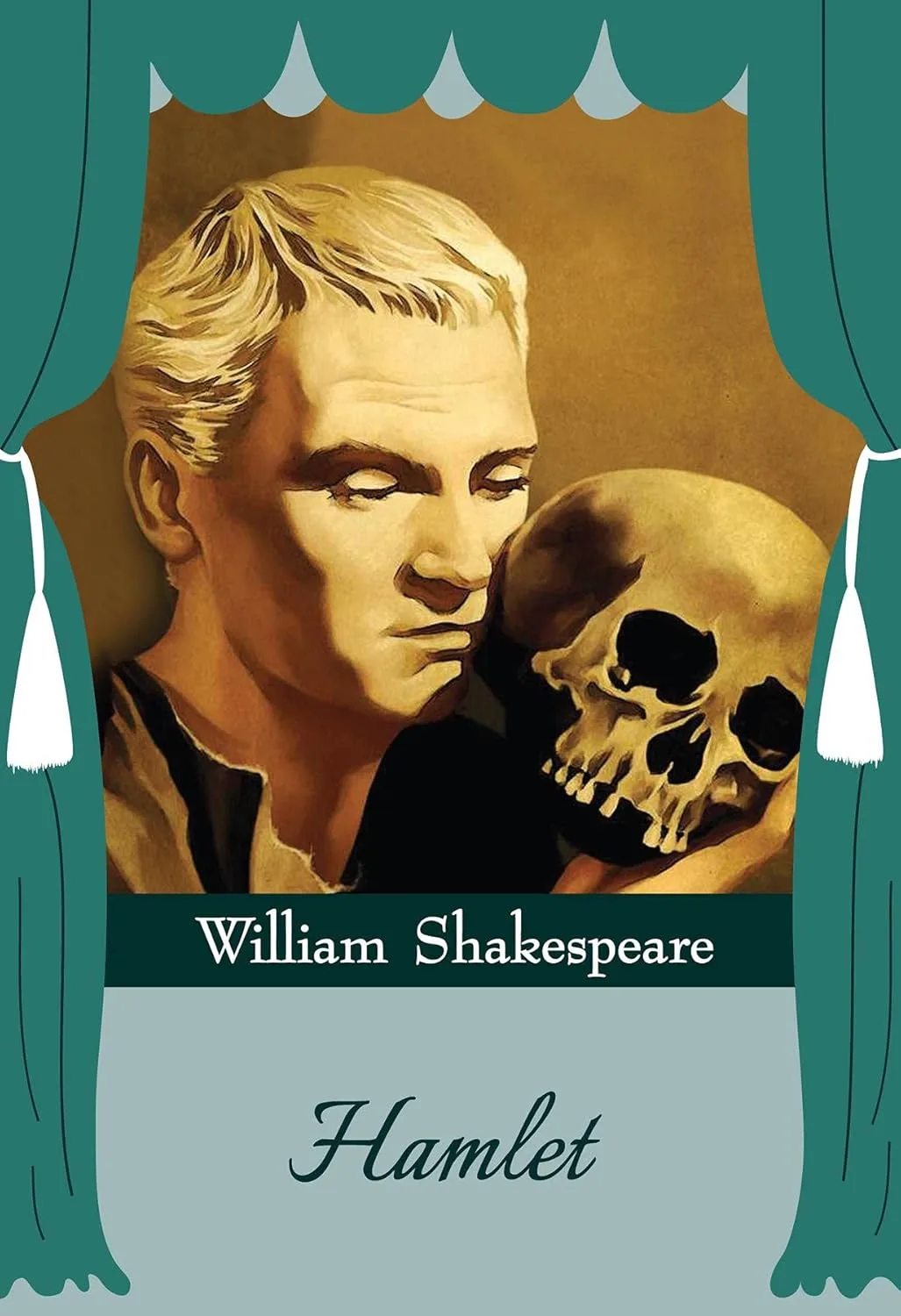
Hamlet
eBook
• INR 86.00
• English
No ratings yet
| Publisher | General Press |
|---|---|
| ASIN/SKU | B07F3JL2MZ |
| Book Format | eBook |
| Language | English |
| List Price | INR 86.00 |
| Subject Code | DRA003000, DRA004000, DRA010000, FIC004000 |
| Book Code | BD00068491 |
Buy this Book
Amazon Stores
Ebook Stores
Other Stores
Discover Hamlet by William Shakespeare. This book is published by General Press in eBook format, ASIN B07F3JL2MZ, under Literature and Fiction, Classics.
Book Description
Hamlet by William Shakespeare is one of the greatest tragedies in English literature, exploring the complexities of revenge, justice, morality, and the human mind. Set in the royal court of Denmark, the play follows Prince Hamlet, whose life is shattered after the sudden death of his father, the king. When the ghost of the late king reveals that he was murdered by his own brother, Claudius, who has since seized the throne and married Hamlet's mother, Queen Gertrude, the young prince is consumed by grief and the burden of avenging his father's death.
As Hamlet struggles to determine the truth and carry out his revenge, he becomes trapped in a web of doubt, anger, and moral conflict. His tendency to question every decision leads to delays that bring suffering not only to himself but also to those around him, including the innocent Ophelia and his loyal friend Horatio. Political intrigue, betrayal, madness—both real and feigned—and hidden motives shape the course of the story, driving it toward an unforgettable and devastating conclusion.
Written with extraordinary psychological depth, Hamlet examines timeless questions about life, death, conscience, destiny, and the consequences of human choices. Shakespeare's rich language and unforgettable characters continue to resonate with readers and audiences across the world. More than a tale of revenge, the play is a profound meditation on the struggles of the human spirit, revealing how ambition, guilt, love, and loss can shape the course of individual lives and entire kingdoms.
As Hamlet struggles to determine the truth and carry out his revenge, he becomes trapped in a web of doubt, anger, and moral conflict. His tendency to question every decision leads to delays that bring suffering not only to himself but also to those around him, including the innocent Ophelia and his loyal friend Horatio. Political intrigue, betrayal, madness—both real and feigned—and hidden motives shape the course of the story, driving it toward an unforgettable and devastating conclusion.
Written with extraordinary psychological depth, Hamlet examines timeless questions about life, death, conscience, destiny, and the consequences of human choices. Shakespeare's rich language and unforgettable characters continue to resonate with readers and audiences across the world. More than a tale of revenge, the play is a profound meditation on the struggles of the human spirit, revealing how ambition, guilt, love, and loss can shape the course of individual lives and entire kingdoms.
Author Biography
William Shakespeare (baptised 26 April 1564) was an English poet and playwright, widely regarded as the greatest writer in the English language and the world's pre-eminent dramatist. He is often called England's national poet and the 'Bard of Avon' (or simply "The Bard"). His surviving works consist of 37 plays, 154 sonnets, two long narrative poems, and several other poems. His plays have been translated into every major living language.
Shakespeare was born and raised in Stratford-upon-Avon. Scholars believe that he died on his fifty-second birthday, coinciding with St George’s Day. At the age of 18 he married Anne Hathaway, who bore him three children: Susanna, twins Hamnet and Judith. Between 1585 and 1592 he began a successful career in London as an actor, writer, and part owner of the playing company the Lord Chamberlain's Men, later known as the King's Men. He appears to have retired to Stratford around 1613, where he died three years later.
Shakespeare produced most of his known work between 1590 and 1613. His early plays were mainly comedies and histories, genres he raised to the peak of sophistication and artistry by the end of the sixteenth century. Next he wrote mainly tragedies until about 1608. He was a respected poet and playwright in his own day, but his reputation did not rise to its present heights until the nineteenth century. The Romantics, in particular, acclaimed Shakespeare's genius, and the Victorians hero-worshipped Shakespeare. In the twentieth century, his work was repeatedly adopted and rediscovered by new movements in scholarship and performance. His plays remain highly popular today and are consistently performed and reinterpreted in diverse cultural and political contexts throughout the world.
Shakespeare was born and raised in Stratford-upon-Avon. Scholars believe that he died on his fifty-second birthday, coinciding with St George’s Day. At the age of 18 he married Anne Hathaway, who bore him three children: Susanna, twins Hamnet and Judith. Between 1585 and 1592 he began a successful career in London as an actor, writer, and part owner of the playing company the Lord Chamberlain's Men, later known as the King's Men. He appears to have retired to Stratford around 1613, where he died three years later.
Shakespeare produced most of his known work between 1590 and 1613. His early plays were mainly comedies and histories, genres he raised to the peak of sophistication and artistry by the end of the sixteenth century. Next he wrote mainly tragedies until about 1608. He was a respected poet and playwright in his own day, but his reputation did not rise to its present heights until the nineteenth century. The Romantics, in particular, acclaimed Shakespeare's genius, and the Victorians hero-worshipped Shakespeare. In the twentieth century, his work was repeatedly adopted and rediscovered by new movements in scholarship and performance. His plays remain highly popular today and are consistently performed and reinterpreted in diverse cultural and political contexts throughout the world.
Editorial Reviews
Editorial Reviews will be added soon…
Book Summary
William Shakespeare’s Hamlet is one of the most profound tragedies ever written. At its center is Prince Hamlet of Denmark, a young man devastated by his father’s death and disturbed by his mother’s rapid remarriage to his uncle Claudius. When Hamlet learns that his father may have been murdered, he becomes obsessed with discovering the truth and taking revenge. Yet the play is not simply a story about revenge. It is a deep exploration of grief, betrayal, madness, morality, death, uncertainty, and the difficulty of knowing what is true.
The tragedy begins at Elsinore Castle, where guards have seen the ghost of Hamlet’s dead father, the former King of Denmark. Hamlet is eventually confronted by the spirit, who tells him a shocking story: Claudius, Hamlet’s uncle, murdered him by pouring poison into his ear while he slept. Claudius then took the throne and married Gertrude, Hamlet’s mother. The ghost demands that Hamlet avenge the murder but warns him not to harm Gertrude.
Hamlet is horrified by what he hears. He promises to remember his father and seek revenge, but he does not immediately act. Instead, he decides to pretend to be mad so that he can investigate Claudius without revealing his intentions. This decision introduces one of the play’s central questions: is Hamlet truly becoming mentally unstable, or is his madness only an elaborate performance?
As Hamlet investigates, he becomes increasingly isolated. He behaves strangely toward Ophelia, the daughter of Polonius, a royal adviser. Hamlet and Ophelia appear to have loved each other, but Hamlet now treats her harshly. His grief and obsession make genuine affection difficult for him to sustain.
Meanwhile, Claudius becomes suspicious of Hamlet’s behavior. He sends Hamlet’s former friends, Rosencrantz and Guildenstern, to discover what is troubling him. Hamlet quickly realizes that they are being used to spy on him. His growing distrust reinforces his sense that almost everyone around him is hiding something.
Hamlet’s uncertainty reaches its height when a group of traveling actors arrives at the castle. He asks them to perform a play depicting a murder resembling the story told by the ghost. Hamlet hopes to observe Claudius during the performance. If Claudius reacts with guilt, Hamlet will have evidence that the ghost was telling the truth.
The plan works. During the play, Claudius becomes deeply disturbed and abruptly leaves. Hamlet now has strong reason to believe that Claudius murdered his father. Yet even after gaining this evidence, Hamlet hesitates. He struggles with the moral consequences of killing another human being and with the possibility that revenge itself may corrupt him.
One of the play’s most famous moments occurs when Hamlet encounters Claudius praying. Hamlet has the opportunity to kill him, but he stops himself. He reasons that if Claudius dies while praying, he might go to heaven, whereas Hamlet wants his revenge to be complete. This scene reveals the destructive complexity of revenge: Hamlet is no longer simply seeking justice but thinking about how to punish his enemy.
Shortly afterward, Hamlet confronts his mother in her private chamber. Polonius secretly listens from behind a curtain. When Hamlet hears a noise, he assumes Claudius is hiding there and strikes through the curtain, accidentally killing Polonius instead. This mistake changes everything. Hamlet’s revenge has now produced an innocent victim.
Polonius’s death devastates Ophelia. Already emotionally distressed by Hamlet’s rejection and her father’s death, she loses her grip on reality and eventually drowns. Her death becomes one of the play’s most heartbreaking consequences of the violence and deception surrounding the royal family.
Claudius now sees Hamlet as a serious threat. He sends him to England with Rosencrantz and Guildenstern, secretly carrying instructions for Hamlet to be executed. Hamlet discovers the plot and alters the documents so that Rosencrantz and Guildenstern are executed instead. He eventually returns to Denmark, but by then the situation has become even more dangerous.
Ophelia’s brother, Laertes, returns furious over his father’s death. Claudius manipulates Laertes into joining a plan to kill Hamlet. They arrange a fencing match in which Laertes will use a poisoned sword. As a backup, Claudius prepares a poisoned cup of wine for Hamlet.
Before the final confrontation, Hamlet encounters a group of laborers digging a grave. Holding the skull of Yorick, a court jester he remembers from childhood, Hamlet reflects on mortality. This scene, especially the famous contemplation of death, shows how far his thinking has developed. Earlier, death frightened and confused him; now he recognizes that death ultimately reduces everyone to the same condition, regardless of wealth, beauty, or social rank.
At the fencing match, the carefully prepared plan collapses into tragedy. Gertrude accidentally drinks from the poisoned cup intended for Hamlet and dies. Laertes wounds Hamlet with the poisoned sword, but during the struggle they exchange weapons, and Laertes is also wounded. Before dying, Laertes confesses the plot and reveals Claudius’s guilt. Hamlet finally turns on Claudius and kills him, forcing him to drink the remaining poisoned wine.
Hamlet himself is dying. With his final strength, he asks Horatio, his loyal friend, to tell the truth about what has happened. Hamlet dies just as Fortinbras, the Prince of Norway, arrives. Fortinbras takes control of Denmark, while Horatio remains behind to tell Hamlet’s story.
The tragedy of Hamlet lies not simply in the number of deaths but in the destruction caused by secrecy, suspicion, revenge, and moral paralysis. Hamlet wants justice, but his inability to act decisively allows events to spiral beyond his control. Claudius’s original crime creates a chain of deception and violence that eventually destroys nearly everyone around him.
Yet Hamlet is not merely a hesitant revenge hero. He is a deeply thoughtful human being struggling to act in a world where certainty is almost impossible. He questions appearances, morality, religion, love, friendship, and death. His famous reflections reveal a mind searching desperately for meaning.
Ultimately, Hamlet suggests that evil rarely remains contained within a single act. One murder leads to lies, lies lead to suspicion, suspicion leads to further violence, and revenge ultimately destroys both the guilty and the innocent. Shakespeare’s tragedy therefore remains timeless because Hamlet’s questions are universal: How can we know what is true? How should we respond to betrayal? Is revenge ever truly just? And how should a human being live when life itself is uncertain and temporary?
In the end, Hamlet’s story is the tragedy of a man seeking truth and justice in a world where almost every relationship has become contaminated by deception. His struggle reminds us that the hardest battles are often not fought with swords, but within the human mind and conscience.
The tragedy begins at Elsinore Castle, where guards have seen the ghost of Hamlet’s dead father, the former King of Denmark. Hamlet is eventually confronted by the spirit, who tells him a shocking story: Claudius, Hamlet’s uncle, murdered him by pouring poison into his ear while he slept. Claudius then took the throne and married Gertrude, Hamlet’s mother. The ghost demands that Hamlet avenge the murder but warns him not to harm Gertrude.
Hamlet is horrified by what he hears. He promises to remember his father and seek revenge, but he does not immediately act. Instead, he decides to pretend to be mad so that he can investigate Claudius without revealing his intentions. This decision introduces one of the play’s central questions: is Hamlet truly becoming mentally unstable, or is his madness only an elaborate performance?
As Hamlet investigates, he becomes increasingly isolated. He behaves strangely toward Ophelia, the daughter of Polonius, a royal adviser. Hamlet and Ophelia appear to have loved each other, but Hamlet now treats her harshly. His grief and obsession make genuine affection difficult for him to sustain.
Meanwhile, Claudius becomes suspicious of Hamlet’s behavior. He sends Hamlet’s former friends, Rosencrantz and Guildenstern, to discover what is troubling him. Hamlet quickly realizes that they are being used to spy on him. His growing distrust reinforces his sense that almost everyone around him is hiding something.
Hamlet’s uncertainty reaches its height when a group of traveling actors arrives at the castle. He asks them to perform a play depicting a murder resembling the story told by the ghost. Hamlet hopes to observe Claudius during the performance. If Claudius reacts with guilt, Hamlet will have evidence that the ghost was telling the truth.
The plan works. During the play, Claudius becomes deeply disturbed and abruptly leaves. Hamlet now has strong reason to believe that Claudius murdered his father. Yet even after gaining this evidence, Hamlet hesitates. He struggles with the moral consequences of killing another human being and with the possibility that revenge itself may corrupt him.
One of the play’s most famous moments occurs when Hamlet encounters Claudius praying. Hamlet has the opportunity to kill him, but he stops himself. He reasons that if Claudius dies while praying, he might go to heaven, whereas Hamlet wants his revenge to be complete. This scene reveals the destructive complexity of revenge: Hamlet is no longer simply seeking justice but thinking about how to punish his enemy.
Shortly afterward, Hamlet confronts his mother in her private chamber. Polonius secretly listens from behind a curtain. When Hamlet hears a noise, he assumes Claudius is hiding there and strikes through the curtain, accidentally killing Polonius instead. This mistake changes everything. Hamlet’s revenge has now produced an innocent victim.
Polonius’s death devastates Ophelia. Already emotionally distressed by Hamlet’s rejection and her father’s death, she loses her grip on reality and eventually drowns. Her death becomes one of the play’s most heartbreaking consequences of the violence and deception surrounding the royal family.
Claudius now sees Hamlet as a serious threat. He sends him to England with Rosencrantz and Guildenstern, secretly carrying instructions for Hamlet to be executed. Hamlet discovers the plot and alters the documents so that Rosencrantz and Guildenstern are executed instead. He eventually returns to Denmark, but by then the situation has become even more dangerous.
Ophelia’s brother, Laertes, returns furious over his father’s death. Claudius manipulates Laertes into joining a plan to kill Hamlet. They arrange a fencing match in which Laertes will use a poisoned sword. As a backup, Claudius prepares a poisoned cup of wine for Hamlet.
Before the final confrontation, Hamlet encounters a group of laborers digging a grave. Holding the skull of Yorick, a court jester he remembers from childhood, Hamlet reflects on mortality. This scene, especially the famous contemplation of death, shows how far his thinking has developed. Earlier, death frightened and confused him; now he recognizes that death ultimately reduces everyone to the same condition, regardless of wealth, beauty, or social rank.
At the fencing match, the carefully prepared plan collapses into tragedy. Gertrude accidentally drinks from the poisoned cup intended for Hamlet and dies. Laertes wounds Hamlet with the poisoned sword, but during the struggle they exchange weapons, and Laertes is also wounded. Before dying, Laertes confesses the plot and reveals Claudius’s guilt. Hamlet finally turns on Claudius and kills him, forcing him to drink the remaining poisoned wine.
Hamlet himself is dying. With his final strength, he asks Horatio, his loyal friend, to tell the truth about what has happened. Hamlet dies just as Fortinbras, the Prince of Norway, arrives. Fortinbras takes control of Denmark, while Horatio remains behind to tell Hamlet’s story.
The tragedy of Hamlet lies not simply in the number of deaths but in the destruction caused by secrecy, suspicion, revenge, and moral paralysis. Hamlet wants justice, but his inability to act decisively allows events to spiral beyond his control. Claudius’s original crime creates a chain of deception and violence that eventually destroys nearly everyone around him.
Yet Hamlet is not merely a hesitant revenge hero. He is a deeply thoughtful human being struggling to act in a world where certainty is almost impossible. He questions appearances, morality, religion, love, friendship, and death. His famous reflections reveal a mind searching desperately for meaning.
Ultimately, Hamlet suggests that evil rarely remains contained within a single act. One murder leads to lies, lies lead to suspicion, suspicion leads to further violence, and revenge ultimately destroys both the guilty and the innocent. Shakespeare’s tragedy therefore remains timeless because Hamlet’s questions are universal: How can we know what is true? How should we respond to betrayal? Is revenge ever truly just? And how should a human being live when life itself is uncertain and temporary?
In the end, Hamlet’s story is the tragedy of a man seeking truth and justice in a world where almost every relationship has become contaminated by deception. His struggle reminds us that the hardest battles are often not fought with swords, but within the human mind and conscience.
Sample Chapters
Sample Chapters will be added soon…
Reader Reviews
No reviews yet.
Hamlet