
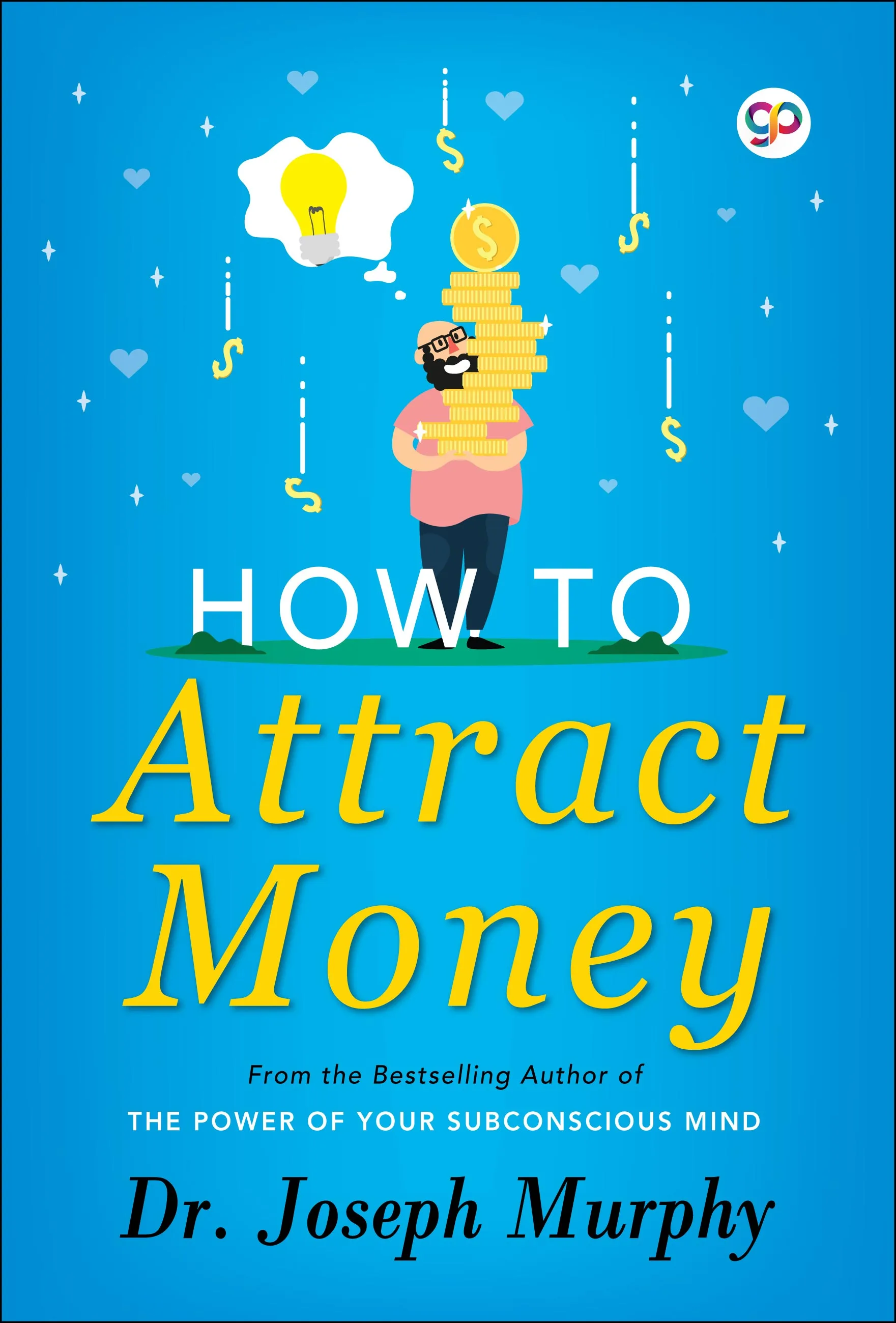
How to Attract Money
eBook
• 216 Pages
• INR 51.00
• English
• 9789388118415
No ratings yet
| Publisher | General Press |
|---|---|
| ISBN13 | 9789388118415 |
| ASIN/SKU | B07GY3QFVS |
| Book Format | eBook |
| Language | English |
| Pages | 216 |
| List Price | INR 51.00 |
| Subject Code | BUS050000, OCC036010, REL062000 |
| Publishing Date | 29/08/2018 |
| Book Code | BD00068509 |
Buy this Book
Amazon Stores
Ebook Stores
Other Stores
Discover How to Attract Money by Joseph Murphy. This book is published by General Press in eBook format, ISBN 9789388118415, ASIN B07GY3QFVS, under Self-Help, Personal Transformation, Motivational and Inspirational.
Book Description
What if changing the way you think about money could change the way you experience abundance? 'How to Attract Money' by Joseph Murphy is a personal development and spiritual self-help book that explores the power of the subconscious mind, positive thinking, and faith in creating greater financial prosperity. Rather than presenting wealth as something reserved for the lucky or privileged, Murphy encourages readers to examine the beliefs and mental patterns that may be quietly limiting their sense of possibility.
At the heart of the book is Murphy’s belief that the subconscious mind has enormous influence over our circumstances, choices, confidence, and behavior. He explains how repeated thoughts, expectations, fears, and assumptions can become deeply rooted within the mind and affect the way a person approaches money and opportunity. If someone constantly thinks of scarcity, failure, debt, or financial insecurity, those ideas can become psychological barriers that make it harder to recognize possibilities or act with confidence. Murphy therefore shifts attention from simply pursuing money outwardly to transforming the inner attitudes that shape a person’s relationship with prosperity.
The book introduces practical mental techniques centered on affirmation, visualization, faith, gratitude, and constructive thought. Murphy encourages readers to replace negative financial beliefs with more positive and abundant patterns of thinking. His approach suggests that prosperity begins with accepting the possibility of abundance rather than allowing fear and doubt to dominate the imagination. Along the way, he discusses the importance of persistence and emotional conviction, emphasizing that merely repeating words is not enough if the underlying mind remains filled with anxiety and disbelief.
'How to Attract Money' is ultimately less about money as a material possession and more about developing a mindset that welcomes opportunity, confidence, and abundance. Joseph Murphy’s accessible ideas make the book especially appealing to readers interested in the law of attraction, subconscious mind techniques, spiritual prosperity, and personal transformation. Whether approached as practical psychology, spiritual guidance, or motivational reading, the book invites readers to question their assumptions about wealth and consider what might become possible when their inner world begins to change. Its ideas may leave you wondering how much your own thoughts about money have been influencing your financial life—and what could happen if you learned to think differently.
At the heart of the book is Murphy’s belief that the subconscious mind has enormous influence over our circumstances, choices, confidence, and behavior. He explains how repeated thoughts, expectations, fears, and assumptions can become deeply rooted within the mind and affect the way a person approaches money and opportunity. If someone constantly thinks of scarcity, failure, debt, or financial insecurity, those ideas can become psychological barriers that make it harder to recognize possibilities or act with confidence. Murphy therefore shifts attention from simply pursuing money outwardly to transforming the inner attitudes that shape a person’s relationship with prosperity.
The book introduces practical mental techniques centered on affirmation, visualization, faith, gratitude, and constructive thought. Murphy encourages readers to replace negative financial beliefs with more positive and abundant patterns of thinking. His approach suggests that prosperity begins with accepting the possibility of abundance rather than allowing fear and doubt to dominate the imagination. Along the way, he discusses the importance of persistence and emotional conviction, emphasizing that merely repeating words is not enough if the underlying mind remains filled with anxiety and disbelief.
'How to Attract Money' is ultimately less about money as a material possession and more about developing a mindset that welcomes opportunity, confidence, and abundance. Joseph Murphy’s accessible ideas make the book especially appealing to readers interested in the law of attraction, subconscious mind techniques, spiritual prosperity, and personal transformation. Whether approached as practical psychology, spiritual guidance, or motivational reading, the book invites readers to question their assumptions about wealth and consider what might become possible when their inner world begins to change. Its ideas may leave you wondering how much your own thoughts about money have been influencing your financial life—and what could happen if you learned to think differently.
Author Biography
Born in 1898 in County Cork, Ireland, Joseph Murphy was raised in a devout Catholic family and initially studied for the priesthood within the Jesuit order. However, his expanding intellectual curiosity soon led him to question traditional orthodox teachings. In his early twenties, he made the pivotal decision to leave the seminary and emigrate to the United States, arriving in New York City with very little money. There, he worked as a pharmacist while continuing his intense spiritual and philosophical explorations.
In America, Murphy became deeply immersed in the New Thought movement, studying under prominent spiritual teachers like Ernest Holmes and Emmet Fox. His unyielding quest for spiritual understanding also took him to India, where he spent significant time studying Eastern religions and Hindu philosophy. This diverse theological education allowed him to uniquely synthesize Eastern spiritual traditions with Western psychological concepts, forming the bedrock of his later teachings on the power of the human mind.
Upon returning to the United States, Murphy relocated to Los Angeles and became an ordained minister of the Church of Divine Science. Over the next several decades, he built one of the largest New Thought congregations in the country. His dynamic weekly Sunday lectures attracted thousands of attendees, and his popular radio broadcasts reached millions globally, establishing him as a premier voice in the mid-twentieth century self-help and human potential movements.
Murphy's enduring legacy was firmly cemented in 1963 with the publication of his masterpiece, The Power of Your Subconscious Mind. The book elegantly combined spiritual wisdom with practical psychological techniques, arguing that individuals can dramatically alter their reality, health, and success by reprogramming their subconscious beliefs. It quickly became a massive international bestseller and remains a foundational text in modern personal development literature, continuing to inspire countless readers long after Murphy's death in 1981.
In America, Murphy became deeply immersed in the New Thought movement, studying under prominent spiritual teachers like Ernest Holmes and Emmet Fox. His unyielding quest for spiritual understanding also took him to India, where he spent significant time studying Eastern religions and Hindu philosophy. This diverse theological education allowed him to uniquely synthesize Eastern spiritual traditions with Western psychological concepts, forming the bedrock of his later teachings on the power of the human mind.
Upon returning to the United States, Murphy relocated to Los Angeles and became an ordained minister of the Church of Divine Science. Over the next several decades, he built one of the largest New Thought congregations in the country. His dynamic weekly Sunday lectures attracted thousands of attendees, and his popular radio broadcasts reached millions globally, establishing him as a premier voice in the mid-twentieth century self-help and human potential movements.
Murphy's enduring legacy was firmly cemented in 1963 with the publication of his masterpiece, The Power of Your Subconscious Mind. The book elegantly combined spiritual wisdom with practical psychological techniques, arguing that individuals can dramatically alter their reality, health, and success by reprogramming their subconscious beliefs. It quickly became a massive international bestseller and remains a foundational text in modern personal development literature, continuing to inspire countless readers long after Murphy's death in 1981.
Editorial Reviews
Editorial Reviews will be added soon…
Book Summary
Joseph Murphy’s How to Attract Money presents a spiritual and psychological approach to wealth, prosperity, and personal success. Rather than treating money simply as something that comes from hard work, business ability, or favorable circumstances, Murphy argues that our financial lives are strongly influenced by our thoughts, beliefs, expectations, and attitudes toward abundance. The central idea of the book is that the subconscious mind plays a powerful role in shaping our experiences, and that changing our inner beliefs can help us become more receptive to prosperity.
Murphy’s philosophy is rooted in the idea that the mind has two interacting levels: the conscious mind and the subconscious mind. The conscious mind reasons, chooses, judges, and decides what to believe. The subconscious mind, however, accepts the ideas repeatedly impressed upon it and works according to those patterns. Murphy believes that many people unconsciously program themselves for financial limitation through fear, doubt, negative expectations, and deeply held beliefs that money is difficult to obtain or that wealth is somehow morally wrong.
For Murphy, the first step toward attracting money is therefore not merely finding a new job, starting a business, or making a financial plan. It is changing the mental picture one carries about money. If a person constantly thinks, “I will never have enough,” “Money is always scarce,” or “I am unlucky financially,” these thoughts can become deeply embedded in the subconscious. The individual may then behave in ways that reinforce the original belief. Murphy encourages readers to replace such thinking with constructive expectations of abundance.
The word “attract” in Murphy’s philosophy is closely connected with the power of belief. He suggests that what we repeatedly think about and emotionally accept can influence our behavior, choices, confidence, and perception of opportunities. A person who believes that success is possible is more likely to recognize possibilities, act with confidence, persist after setbacks, and develop useful relationships. Someone dominated by fear may overlook opportunities because the mind is constantly searching for evidence of failure.
Murphy therefore places great importance on affirmations. An affirmation is a positive statement repeatedly accepted by the mind. Instead of continually saying that money is scarce or that financial difficulties are unavoidable, readers are encouraged to affirm ideas such as abundance, prosperity, success, and financial security. The purpose is not simply to repeat words mechanically. Murphy believes that the affirmation should gradually become a sincere mental and emotional conviction.
The subconscious mind, in his view, does not critically debate every idea that is repeatedly impressed upon it. This makes repetition important. Just as negative financial beliefs can become habitual, positive beliefs can also become habitual. When a person repeatedly thinks about prosperity with confidence and calmness, Murphy believes that the subconscious begins to work in harmony with that expectation.
An important part of the book is Murphy’s discussion of fear. Fear of poverty can become so powerful that it dominates a person’s entire financial life. Someone may earn money but remain constantly worried about losing it. Another person may refuse reasonable opportunities because of fear of failure. A third may spend excessively in an attempt to prove that scarcity does not exist. Murphy argues that prosperity requires freedom from this mental obsession with lack.
He does not suggest that people should ignore practical realities. Rather, he emphasizes that fear should not be allowed to control decision-making. A calm and constructive mind is better equipped to think clearly, plan intelligently, work effectively, and respond to financial problems. In this sense, Murphy’s spiritual language often overlaps with a psychological lesson: beliefs affect behavior, and behavior affects results.
Murphy also challenges the idea that money is inherently evil. Some people, because of religious or cultural conditioning, may unconsciously associate wealth with greed, selfishness, or corruption. Such beliefs can create an inner conflict. A person may consciously desire financial success while subconsciously believing that rich people are bad or that wanting money is spiritually inferior. Murphy argues that this contradiction can prevent people from comfortably accepting prosperity.
His solution is to view money as a means rather than as an ultimate purpose. Money can provide security, education, comfort, opportunities, and the ability to help others. The problem, according to Murphy, is not money itself but the attitude with which it is used. Wealth becomes harmful when it is treated as the measure of human worth or pursued through greed and exploitation. Properly understood, money is simply a form of exchange and a tool that can be used constructively.
Another important theme is gratitude. Murphy encourages readers to cultivate an attitude of appreciation rather than constantly focusing on what they lack. Gratitude changes attention. When people appreciate what they already possess, they become less consumed by fear and dissatisfaction. This does not mean that they should stop wanting improvement. Instead, gratitude provides a healthier emotional foundation from which to pursue greater prosperity.
The book also emphasizes the importance of imagination. Murphy encourages readers to form a mental picture of the financial conditions they desire. Visualization allows the mind to experience success inwardly before it becomes an external reality. A person might imagine being free from debt, having a comfortable home, succeeding in a chosen profession, or possessing enough money to meet important responsibilities.
For Murphy, the emotional quality of this visualization matters. Imagining prosperity while simultaneously thinking, “This can never happen to me,” defeats the purpose. The reader is encouraged to imagine the desired result with confidence, peace, and gratitude. The subconscious is gradually given a new picture of what the individual considers possible.
Murphy also argues that people should avoid excessive obsession with exactly where their money will come from. When someone becomes fixated on a single solution, disappointment can easily turn into anxiety. Instead, Murphy encourages trust in the mind’s creative possibilities. Opportunities may appear through unexpected channels: a new job, a business idea, a useful connection, an overlooked skill, or a solution to an existing problem.
This is one of the book’s more optimistic messages. Prosperity does not necessarily arrive in the form a person originally imagines. The important task is to develop the mental attitude that allows one to recognize and act upon opportunities.
At the same time, Murphy repeatedly emphasizes the importance of constructive action. His philosophy should not be understood simply as sitting quietly and expecting money to appear. Positive thinking is valuable because it prepares the mind for purposeful action. A person who develops confidence and optimism may become more willing to learn, work, negotiate, create, invest effort, and pursue opportunities that previously seemed frightening.
Murphy’s approach therefore combines spiritual faith with personal responsibility. He asks readers to believe that abundance is possible while also developing the attitudes and habits that support success. Persistence is particularly important. Financial circumstances do not always change immediately, and discouragement can easily revive old beliefs about scarcity. Murphy encourages readers to continue cultivating constructive thoughts rather than allowing temporary setbacks to define their expectations.
The book also stresses the importance of giving. Murphy presents generosity as compatible with prosperity. When people give freely and sincerely, they reinforce a sense of abundance rather than fearfully holding on to everything they possess. The deeper principle is that prosperity should circulate rather than become an instrument of selfishness.
Ultimately, How to Attract Money is less a conventional financial guide than a book about the mental and spiritual foundations people bring to their financial lives. It does not teach budgeting, accounting, investment analysis, or detailed business strategy. Instead, it asks readers to examine the beliefs that may be influencing their relationship with money.
The lasting appeal of Murphy’s message comes from its emphasis on personal possibility. He wants readers to stop treating poverty, limitation, and failure as permanent identities. By changing habitual thoughts, strengthening faith, practicing affirmations, imagining desirable outcomes, overcoming fear, and acting with confidence, people can begin to create different patterns in their lives.
The deepest lesson of the book is that prosperity begins, in Murphy’s view, with a change in consciousness. External circumstances certainly matter, but the way a person interprets those circumstances can profoundly influence what happens next. A mind dominated by scarcity sees obstacles everywhere; a mind trained to expect possibilities is more likely to notice openings and act upon them.
In the end, How to Attract Money offers a hopeful philosophy: money should not be approached with fear, shame, or desperation. It should be regarded as one of the resources available for creating a meaningful and useful life. Murphy’s central invitation is to replace the inner language of scarcity with a stronger sense of possibility. Whether one accepts all of his claims about the subconscious mind or views them primarily as psychological principles, his message remains clear: our beliefs matter, our habitual thoughts influence our actions, and a healthier relationship with money begins with changing the way we think about abundance, possibility, and our own capacity for success.
Murphy’s philosophy is rooted in the idea that the mind has two interacting levels: the conscious mind and the subconscious mind. The conscious mind reasons, chooses, judges, and decides what to believe. The subconscious mind, however, accepts the ideas repeatedly impressed upon it and works according to those patterns. Murphy believes that many people unconsciously program themselves for financial limitation through fear, doubt, negative expectations, and deeply held beliefs that money is difficult to obtain or that wealth is somehow morally wrong.
For Murphy, the first step toward attracting money is therefore not merely finding a new job, starting a business, or making a financial plan. It is changing the mental picture one carries about money. If a person constantly thinks, “I will never have enough,” “Money is always scarce,” or “I am unlucky financially,” these thoughts can become deeply embedded in the subconscious. The individual may then behave in ways that reinforce the original belief. Murphy encourages readers to replace such thinking with constructive expectations of abundance.
The word “attract” in Murphy’s philosophy is closely connected with the power of belief. He suggests that what we repeatedly think about and emotionally accept can influence our behavior, choices, confidence, and perception of opportunities. A person who believes that success is possible is more likely to recognize possibilities, act with confidence, persist after setbacks, and develop useful relationships. Someone dominated by fear may overlook opportunities because the mind is constantly searching for evidence of failure.
Murphy therefore places great importance on affirmations. An affirmation is a positive statement repeatedly accepted by the mind. Instead of continually saying that money is scarce or that financial difficulties are unavoidable, readers are encouraged to affirm ideas such as abundance, prosperity, success, and financial security. The purpose is not simply to repeat words mechanically. Murphy believes that the affirmation should gradually become a sincere mental and emotional conviction.
The subconscious mind, in his view, does not critically debate every idea that is repeatedly impressed upon it. This makes repetition important. Just as negative financial beliefs can become habitual, positive beliefs can also become habitual. When a person repeatedly thinks about prosperity with confidence and calmness, Murphy believes that the subconscious begins to work in harmony with that expectation.
An important part of the book is Murphy’s discussion of fear. Fear of poverty can become so powerful that it dominates a person’s entire financial life. Someone may earn money but remain constantly worried about losing it. Another person may refuse reasonable opportunities because of fear of failure. A third may spend excessively in an attempt to prove that scarcity does not exist. Murphy argues that prosperity requires freedom from this mental obsession with lack.
He does not suggest that people should ignore practical realities. Rather, he emphasizes that fear should not be allowed to control decision-making. A calm and constructive mind is better equipped to think clearly, plan intelligently, work effectively, and respond to financial problems. In this sense, Murphy’s spiritual language often overlaps with a psychological lesson: beliefs affect behavior, and behavior affects results.
Murphy also challenges the idea that money is inherently evil. Some people, because of religious or cultural conditioning, may unconsciously associate wealth with greed, selfishness, or corruption. Such beliefs can create an inner conflict. A person may consciously desire financial success while subconsciously believing that rich people are bad or that wanting money is spiritually inferior. Murphy argues that this contradiction can prevent people from comfortably accepting prosperity.
His solution is to view money as a means rather than as an ultimate purpose. Money can provide security, education, comfort, opportunities, and the ability to help others. The problem, according to Murphy, is not money itself but the attitude with which it is used. Wealth becomes harmful when it is treated as the measure of human worth or pursued through greed and exploitation. Properly understood, money is simply a form of exchange and a tool that can be used constructively.
Another important theme is gratitude. Murphy encourages readers to cultivate an attitude of appreciation rather than constantly focusing on what they lack. Gratitude changes attention. When people appreciate what they already possess, they become less consumed by fear and dissatisfaction. This does not mean that they should stop wanting improvement. Instead, gratitude provides a healthier emotional foundation from which to pursue greater prosperity.
The book also emphasizes the importance of imagination. Murphy encourages readers to form a mental picture of the financial conditions they desire. Visualization allows the mind to experience success inwardly before it becomes an external reality. A person might imagine being free from debt, having a comfortable home, succeeding in a chosen profession, or possessing enough money to meet important responsibilities.
For Murphy, the emotional quality of this visualization matters. Imagining prosperity while simultaneously thinking, “This can never happen to me,” defeats the purpose. The reader is encouraged to imagine the desired result with confidence, peace, and gratitude. The subconscious is gradually given a new picture of what the individual considers possible.
Murphy also argues that people should avoid excessive obsession with exactly where their money will come from. When someone becomes fixated on a single solution, disappointment can easily turn into anxiety. Instead, Murphy encourages trust in the mind’s creative possibilities. Opportunities may appear through unexpected channels: a new job, a business idea, a useful connection, an overlooked skill, or a solution to an existing problem.
This is one of the book’s more optimistic messages. Prosperity does not necessarily arrive in the form a person originally imagines. The important task is to develop the mental attitude that allows one to recognize and act upon opportunities.
At the same time, Murphy repeatedly emphasizes the importance of constructive action. His philosophy should not be understood simply as sitting quietly and expecting money to appear. Positive thinking is valuable because it prepares the mind for purposeful action. A person who develops confidence and optimism may become more willing to learn, work, negotiate, create, invest effort, and pursue opportunities that previously seemed frightening.
Murphy’s approach therefore combines spiritual faith with personal responsibility. He asks readers to believe that abundance is possible while also developing the attitudes and habits that support success. Persistence is particularly important. Financial circumstances do not always change immediately, and discouragement can easily revive old beliefs about scarcity. Murphy encourages readers to continue cultivating constructive thoughts rather than allowing temporary setbacks to define their expectations.
The book also stresses the importance of giving. Murphy presents generosity as compatible with prosperity. When people give freely and sincerely, they reinforce a sense of abundance rather than fearfully holding on to everything they possess. The deeper principle is that prosperity should circulate rather than become an instrument of selfishness.
Ultimately, How to Attract Money is less a conventional financial guide than a book about the mental and spiritual foundations people bring to their financial lives. It does not teach budgeting, accounting, investment analysis, or detailed business strategy. Instead, it asks readers to examine the beliefs that may be influencing their relationship with money.
The lasting appeal of Murphy’s message comes from its emphasis on personal possibility. He wants readers to stop treating poverty, limitation, and failure as permanent identities. By changing habitual thoughts, strengthening faith, practicing affirmations, imagining desirable outcomes, overcoming fear, and acting with confidence, people can begin to create different patterns in their lives.
The deepest lesson of the book is that prosperity begins, in Murphy’s view, with a change in consciousness. External circumstances certainly matter, but the way a person interprets those circumstances can profoundly influence what happens next. A mind dominated by scarcity sees obstacles everywhere; a mind trained to expect possibilities is more likely to notice openings and act upon them.
In the end, How to Attract Money offers a hopeful philosophy: money should not be approached with fear, shame, or desperation. It should be regarded as one of the resources available for creating a meaningful and useful life. Murphy’s central invitation is to replace the inner language of scarcity with a stronger sense of possibility. Whether one accepts all of his claims about the subconscious mind or views them primarily as psychological principles, his message remains clear: our beliefs matter, our habitual thoughts influence our actions, and a healthier relationship with money begins with changing the way we think about abundance, possibility, and our own capacity for success.
Sample Chapters
Sample Chapters will be added soon…
Reader Reviews
No reviews yet.
How to Attract Money
Download Cover Image
Do you want to download the full cover image for How to Attract Money?