
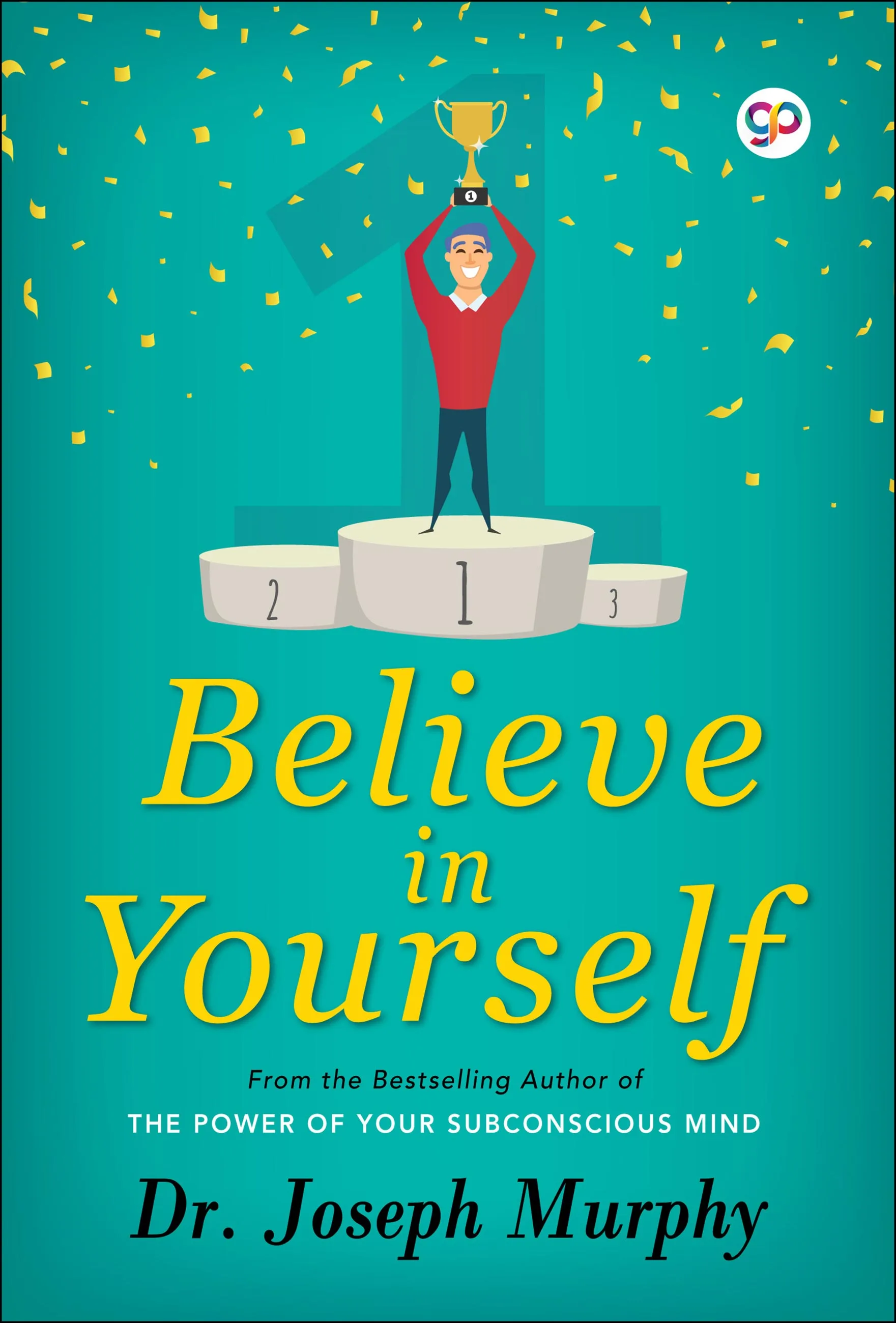
Believe in Yourself
eBook
• 50 Pages
• INR 51.00
• English
• 9789388118392
No ratings yet
| Publisher | General Press |
|---|---|
| ISBN13 | 9789388118392 |
| ASIN/SKU | B07GY3QGJH |
| Book Format | eBook |
| Language | English |
| Pages | 50 |
| List Price | INR 51.00 |
| Subject Code | SEL027000, SEL021000, SEL031000 |
| Publishing Date | 29/08/2018 |
| Book Code | BD00068510 |
Buy this Book
Amazon Stores
Ebook Stores
Other Stores
Discover Believe in Yourself by Joseph Murphy. This book is published by General Press in eBook format, ISBN 9789388118392, ASIN B07GY3QGJH, under Self-Help, Motivational, Personal Transformation.
Book Description
'Believe in Yourself' by Joseph Murphy is a classic self-help and personal development book that explores the powerful connection between self-belief, the subconscious mind, and the life we create through our thoughts. With its practical approach to spiritual psychology and positive thinking, the book encourages readers to move beyond fear, doubt, and limiting beliefs and discover the confidence already within them.
Joseph Murphy’s central message is simple but deeply motivating: the way we think about ourselves can strongly influence the way we live. Many people struggle not because they lack ability, but because they have unconsciously accepted ideas of failure, insecurity, or unworthiness. Murphy explains how these negative patterns can become deeply rooted in the subconscious mind, shaping decisions, habits, relationships, and responses to life’s challenges. By becoming more aware of these mental patterns, readers can begin replacing them with constructive beliefs that support confidence, courage, and personal growth.
Throughout the book, Murphy presents the subconscious mind as a powerful inner resource rather than something mysterious or inaccessible. He describes how repeated thoughts, mental images, affirmations, and expectations can gradually influence a person’s outlook and behavior. Instead of allowing past disappointments or other people’s opinions to define their potential, readers are encouraged to cultivate a stronger inner conviction and deliberately focus their minds on the possibilities they want to pursue.
The book also addresses common obstacles such as fear of failure, lack of confidence, anxiety, negative self-talk, and the tendency to underestimate one’s abilities. Murphy’s warm and reassuring style makes his ideas accessible, presenting self-belief not as empty optimism but as a habit that can be strengthened through conscious practice. His emphasis on faith, imagination, and the subconscious gives the book a distinctly spiritual dimension while keeping its broader lessons relevant to anyone seeking greater confidence and direction.
'Believe in Yourself' ultimately invites readers to reconsider the beliefs they carry about themselves and their future. It offers an encouraging reminder that meaningful change often begins with a change in the inner conversation we have with ourselves. For anyone interested in self-improvement, positive thinking, subconscious mind techniques, and personal transformation, this book offers ideas worth reflecting on—and perhaps the most important question is what might become possible once you genuinely begin to believe in yourself.
Joseph Murphy’s central message is simple but deeply motivating: the way we think about ourselves can strongly influence the way we live. Many people struggle not because they lack ability, but because they have unconsciously accepted ideas of failure, insecurity, or unworthiness. Murphy explains how these negative patterns can become deeply rooted in the subconscious mind, shaping decisions, habits, relationships, and responses to life’s challenges. By becoming more aware of these mental patterns, readers can begin replacing them with constructive beliefs that support confidence, courage, and personal growth.
Throughout the book, Murphy presents the subconscious mind as a powerful inner resource rather than something mysterious or inaccessible. He describes how repeated thoughts, mental images, affirmations, and expectations can gradually influence a person’s outlook and behavior. Instead of allowing past disappointments or other people’s opinions to define their potential, readers are encouraged to cultivate a stronger inner conviction and deliberately focus their minds on the possibilities they want to pursue.
The book also addresses common obstacles such as fear of failure, lack of confidence, anxiety, negative self-talk, and the tendency to underestimate one’s abilities. Murphy’s warm and reassuring style makes his ideas accessible, presenting self-belief not as empty optimism but as a habit that can be strengthened through conscious practice. His emphasis on faith, imagination, and the subconscious gives the book a distinctly spiritual dimension while keeping its broader lessons relevant to anyone seeking greater confidence and direction.
'Believe in Yourself' ultimately invites readers to reconsider the beliefs they carry about themselves and their future. It offers an encouraging reminder that meaningful change often begins with a change in the inner conversation we have with ourselves. For anyone interested in self-improvement, positive thinking, subconscious mind techniques, and personal transformation, this book offers ideas worth reflecting on—and perhaps the most important question is what might become possible once you genuinely begin to believe in yourself.
Author Biography
Born in 1898 in County Cork, Ireland, Joseph Murphy was raised in a devout Catholic family and initially studied for the priesthood within the Jesuit order. However, his expanding intellectual curiosity soon led him to question traditional orthodox teachings. In his early twenties, he made the pivotal decision to leave the seminary and emigrate to the United States, arriving in New York City with very little money. There, he worked as a pharmacist while continuing his intense spiritual and philosophical explorations.
In America, Murphy became deeply immersed in the New Thought movement, studying under prominent spiritual teachers like Ernest Holmes and Emmet Fox. His unyielding quest for spiritual understanding also took him to India, where he spent significant time studying Eastern religions and Hindu philosophy. This diverse theological education allowed him to uniquely synthesize Eastern spiritual traditions with Western psychological concepts, forming the bedrock of his later teachings on the power of the human mind.
Upon returning to the United States, Murphy relocated to Los Angeles and became an ordained minister of the Church of Divine Science. Over the next several decades, he built one of the largest New Thought congregations in the country. His dynamic weekly Sunday lectures attracted thousands of attendees, and his popular radio broadcasts reached millions globally, establishing him as a premier voice in the mid-twentieth century self-help and human potential movements.
Murphy's enduring legacy was firmly cemented in 1963 with the publication of his masterpiece, The Power of Your Subconscious Mind. The book elegantly combined spiritual wisdom with practical psychological techniques, arguing that individuals can dramatically alter their reality, health, and success by reprogramming their subconscious beliefs. It quickly became a massive international bestseller and remains a foundational text in modern personal development literature, continuing to inspire countless readers long after Murphy's death in 1981.
In America, Murphy became deeply immersed in the New Thought movement, studying under prominent spiritual teachers like Ernest Holmes and Emmet Fox. His unyielding quest for spiritual understanding also took him to India, where he spent significant time studying Eastern religions and Hindu philosophy. This diverse theological education allowed him to uniquely synthesize Eastern spiritual traditions with Western psychological concepts, forming the bedrock of his later teachings on the power of the human mind.
Upon returning to the United States, Murphy relocated to Los Angeles and became an ordained minister of the Church of Divine Science. Over the next several decades, he built one of the largest New Thought congregations in the country. His dynamic weekly Sunday lectures attracted thousands of attendees, and his popular radio broadcasts reached millions globally, establishing him as a premier voice in the mid-twentieth century self-help and human potential movements.
Murphy's enduring legacy was firmly cemented in 1963 with the publication of his masterpiece, The Power of Your Subconscious Mind. The book elegantly combined spiritual wisdom with practical psychological techniques, arguing that individuals can dramatically alter their reality, health, and success by reprogramming their subconscious beliefs. It quickly became a massive international bestseller and remains a foundational text in modern personal development literature, continuing to inspire countless readers long after Murphy's death in 1981.
Editorial Reviews
Editorial Reviews will be added soon…
Book Summary
Joseph Murphy's "Believe in Yourself" is an inspiring guide to unlocking the hidden power of the human mind. Drawing on principles of positive thinking, faith, and the subconscious mind, Murphy explains that every individual possesses an immense inner potential that often remains untapped because of fear, doubt, and negative beliefs. The book encourages readers to replace limiting thoughts with confidence and optimism, arguing that success begins not with external circumstances but with the way a person thinks about themselves. Through practical advice, real-life examples, and simple mental exercises, Murphy shows that self-belief is the foundation for achieving happiness, prosperity, health, and personal fulfillment.
At the heart of the book is the idea that the subconscious mind faithfully accepts whatever thoughts are repeatedly impressed upon it. Murphy explains that whether a person constantly thinks of success or failure, confidence or fear, abundance or lack, the subconscious works to bring those beliefs into reality. This is why he emphasizes the importance of maintaining constructive and encouraging thoughts. According to him, every individual has the ability to shape their future by consciously directing their thinking. Instead of allowing past failures or present difficulties to define them, readers are encouraged to cultivate a mindset that expects positive outcomes and believes in their own abilities. Murphy argues that true transformation begins when people recognize that their thoughts are creative forces capable of influencing their lives.
A significant portion of the book focuses on overcoming fear and self-doubt, which Murphy identifies as the greatest obstacles to success. He explains that many people unknowingly sabotage themselves because they believe they are not talented enough, intelligent enough, or deserving of happiness. These limiting beliefs often originate from childhood experiences, criticism, or repeated disappointments. Murphy advises readers to challenge such negative mental patterns by replacing them with affirmations of confidence, strength, and possibility. He insists that fear loses its power when people consciously refuse to dwell on it and instead focus their attention on courage, faith, and positive expectations. Through consistent practice, these healthier beliefs gradually become part of one's subconscious mind, leading to greater self-confidence and emotional resilience.
Murphy also emphasizes the close relationship between belief and action. While he strongly advocates positive thinking, he makes it clear that genuine belief naturally inspires constructive effort. A confident mind becomes more willing to take opportunities, solve problems, and persist despite setbacks. Rather than waiting for perfect conditions, readers are encouraged to begin acting with the resources they already possess. Murphy explains that self-confidence grows through experience, and every small achievement strengthens the belief that greater success is possible. He reminds readers that setbacks are temporary and should be viewed as lessons rather than permanent defeats. By maintaining faith in themselves while continuing to work toward their goals, individuals gradually build the habits and character needed for lasting achievement.
The book further explores the importance of visualization and affirmations as practical tools for personal growth. Murphy recommends regularly imagining desired outcomes as though they have already become reality. Whether the goal is improved health, career success, financial security, or harmonious relationships, he believes that vivid mental pictures influence the subconscious and help align thoughts with positive results. Similarly, he encourages the use of simple affirmations that reinforce confidence and optimism. Repeating statements such as believing in one's own abilities or expecting favorable outcomes gradually replaces deeply rooted negative beliefs. Murphy stresses that these techniques should be practiced with sincerity and consistency, allowing the mind to develop new patterns that support rather than hinder success.
Another major theme in the book is the role of faith in achieving peace and fulfillment. Murphy views faith not merely as religious belief but as deep confidence in the universal principles that govern life. He argues that people who trust in the goodness of life and in their own inner potential experience less anxiety and greater emotional stability. Instead of becoming overwhelmed by uncertainty, they approach challenges with calmness and hope. Murphy encourages readers to let go of resentment, jealousy, and bitterness because such emotions create mental conflict that blocks personal growth. Forgiveness, gratitude, and goodwill, on the other hand, help maintain inner harmony and open the mind to creative solutions and positive experiences.
Murphy illustrates his teachings with numerous stories of individuals who transformed their lives by changing the way they thought about themselves. These examples include people who overcame financial hardship, restored broken relationships, recovered from emotional struggles, or achieved professional success after adopting a more positive mental attitude. While each story is different, they all reinforce the central message that lasting change begins within the mind. Murphy uses these experiences to show that ordinary people, regardless of their background or circumstances, can reshape their lives by developing confidence, maintaining constructive beliefs, and refusing to surrender to fear or discouragement. These practical illustrations make the book's ideas feel accessible and encourage readers to apply the principles in their own lives.
Throughout the book, Murphy repeatedly reminds readers that every person possesses unique talents and abilities waiting to be expressed. Comparing oneself with others only creates insecurity and distracts from personal growth. Instead, individuals should focus on discovering their own strengths and using them with confidence and purpose. He believes that success is not reserved for a fortunate few but is available to anyone willing to develop self-belief, discipline, and persistence. Murphy encourages readers to trust their intuition, remain open to new opportunities, and approach life with enthusiasm rather than hesitation. This mindset, he argues, leads not only to external achievements but also to greater inner satisfaction and peace.
In the end, 'Believe in Yourself' is much more than a motivational book—it is a practical philosophy for living with confidence, optimism, and purpose. Joseph Murphy presents the timeless idea that our beliefs shape our actions, our attitudes influence our experiences, and our thoughts play a powerful role in determining the direction of our lives. Through clear explanations, encouraging advice, and simple mental practices, he inspires readers to release fear, strengthen faith, and embrace their true potential. The lasting message of the book is that genuine success begins from within. When people learn to trust themselves, cultivate positive beliefs, and act with confidence, they become capable of creating richer, happier, and more meaningful lives while overcoming obstacles that once seemed impossible.
At the heart of the book is the idea that the subconscious mind faithfully accepts whatever thoughts are repeatedly impressed upon it. Murphy explains that whether a person constantly thinks of success or failure, confidence or fear, abundance or lack, the subconscious works to bring those beliefs into reality. This is why he emphasizes the importance of maintaining constructive and encouraging thoughts. According to him, every individual has the ability to shape their future by consciously directing their thinking. Instead of allowing past failures or present difficulties to define them, readers are encouraged to cultivate a mindset that expects positive outcomes and believes in their own abilities. Murphy argues that true transformation begins when people recognize that their thoughts are creative forces capable of influencing their lives.
A significant portion of the book focuses on overcoming fear and self-doubt, which Murphy identifies as the greatest obstacles to success. He explains that many people unknowingly sabotage themselves because they believe they are not talented enough, intelligent enough, or deserving of happiness. These limiting beliefs often originate from childhood experiences, criticism, or repeated disappointments. Murphy advises readers to challenge such negative mental patterns by replacing them with affirmations of confidence, strength, and possibility. He insists that fear loses its power when people consciously refuse to dwell on it and instead focus their attention on courage, faith, and positive expectations. Through consistent practice, these healthier beliefs gradually become part of one's subconscious mind, leading to greater self-confidence and emotional resilience.
Murphy also emphasizes the close relationship between belief and action. While he strongly advocates positive thinking, he makes it clear that genuine belief naturally inspires constructive effort. A confident mind becomes more willing to take opportunities, solve problems, and persist despite setbacks. Rather than waiting for perfect conditions, readers are encouraged to begin acting with the resources they already possess. Murphy explains that self-confidence grows through experience, and every small achievement strengthens the belief that greater success is possible. He reminds readers that setbacks are temporary and should be viewed as lessons rather than permanent defeats. By maintaining faith in themselves while continuing to work toward their goals, individuals gradually build the habits and character needed for lasting achievement.
The book further explores the importance of visualization and affirmations as practical tools for personal growth. Murphy recommends regularly imagining desired outcomes as though they have already become reality. Whether the goal is improved health, career success, financial security, or harmonious relationships, he believes that vivid mental pictures influence the subconscious and help align thoughts with positive results. Similarly, he encourages the use of simple affirmations that reinforce confidence and optimism. Repeating statements such as believing in one's own abilities or expecting favorable outcomes gradually replaces deeply rooted negative beliefs. Murphy stresses that these techniques should be practiced with sincerity and consistency, allowing the mind to develop new patterns that support rather than hinder success.
Another major theme in the book is the role of faith in achieving peace and fulfillment. Murphy views faith not merely as religious belief but as deep confidence in the universal principles that govern life. He argues that people who trust in the goodness of life and in their own inner potential experience less anxiety and greater emotional stability. Instead of becoming overwhelmed by uncertainty, they approach challenges with calmness and hope. Murphy encourages readers to let go of resentment, jealousy, and bitterness because such emotions create mental conflict that blocks personal growth. Forgiveness, gratitude, and goodwill, on the other hand, help maintain inner harmony and open the mind to creative solutions and positive experiences.
Murphy illustrates his teachings with numerous stories of individuals who transformed their lives by changing the way they thought about themselves. These examples include people who overcame financial hardship, restored broken relationships, recovered from emotional struggles, or achieved professional success after adopting a more positive mental attitude. While each story is different, they all reinforce the central message that lasting change begins within the mind. Murphy uses these experiences to show that ordinary people, regardless of their background or circumstances, can reshape their lives by developing confidence, maintaining constructive beliefs, and refusing to surrender to fear or discouragement. These practical illustrations make the book's ideas feel accessible and encourage readers to apply the principles in their own lives.
Throughout the book, Murphy repeatedly reminds readers that every person possesses unique talents and abilities waiting to be expressed. Comparing oneself with others only creates insecurity and distracts from personal growth. Instead, individuals should focus on discovering their own strengths and using them with confidence and purpose. He believes that success is not reserved for a fortunate few but is available to anyone willing to develop self-belief, discipline, and persistence. Murphy encourages readers to trust their intuition, remain open to new opportunities, and approach life with enthusiasm rather than hesitation. This mindset, he argues, leads not only to external achievements but also to greater inner satisfaction and peace.
In the end, 'Believe in Yourself' is much more than a motivational book—it is a practical philosophy for living with confidence, optimism, and purpose. Joseph Murphy presents the timeless idea that our beliefs shape our actions, our attitudes influence our experiences, and our thoughts play a powerful role in determining the direction of our lives. Through clear explanations, encouraging advice, and simple mental practices, he inspires readers to release fear, strengthen faith, and embrace their true potential. The lasting message of the book is that genuine success begins from within. When people learn to trust themselves, cultivate positive beliefs, and act with confidence, they become capable of creating richer, happier, and more meaningful lives while overcoming obstacles that once seemed impossible.
Sample Chapters
Chapter 1 : Make Your Dreams Come True
“Now Israel loved Joseph more than all his children, because he was the son of his old age: and he made him a coat of many colours.
“And when his brethren saw that their father loved him more than all his brethren, they hated him, and could not speak peaceably unto him.
“And Joseph dreamed a dream, and he told it his brethren: and they hated him all the more.
“And he said unto them, Hear; I pray you, this dream which I have dreamed:
“For; behold, we were binding sheaves in the field, and, lo, my sheaf arose, and also stood upright; and, behold, your sheaves stood round about, and made obeisance to my sheaf.
“And his brethren said to him, Shall thou indeed reign over us? or shall thou indeed have dominion over us? And they hated him yet the more for his dream, and for his words.
“And he dreamed yet another dream, and told it his brethren, and said, Behold, I have dreamed a dream more; and behold, the sun and the moon and the eleven stars made obeisance to me.
“And he told it to his father; and his brethren: and his father rebuked him, and said unto him, What is this dream that thou hast dreamed? Shall I and thy mother and thy brethren indeed come to bow down to thee to the earth?” (Genesis 37:3-10.)
Joseph in the Bible means disciplined or controlled imagination. It is one of the primal faculties of mind, and has the power to project and clothe your ideas, giving them visibility on the screen of space.
Israel loved Joseph. Israel is the spiritually awakened man who knows the power of controlled imagination. It is called the son of his old age. Son means expression. Old age infers wisdom and knowledge of the laws of mind. When you become familiar with the power of imagination, you will call it “the son of your old age.”
Age is not the flight of years; it is really the dawn of wisdom and Divine knowledge in you. Imagination is the mighty instrument used by great scientists, artists, physicists, inventors, architects, and mystics. When the world said, “It is impossible. It can’t be done,” the man with imagination said, “It is done!” Through your imagination you can also penetrate the depths of reality, and reveal the secrets of nature.
A great industrialist told me one time how he started in a small store. He said that I used to dream (Joseph was a dreamer) of a large corporation with branches all over the country. He added that regularly and systematically he pictured in his mind the giant building, offices, factories, and stores, knowing that through the alchemy of the mind, he could weave the fabric out of which his dreams would be clothed. He prospered, and began to attract to himself by a universal law of attraction the ideas, personnel, friends, money, and everything needed for the unfoldment of his ideal. He truly exercised and cultivated his imagination, and lived with these mental patterns in his mind until imagination clothed them in form.
I liked particularly one comment which he made as follows, “It is just as easy to imagine yourself successful, as it is to imagine failure, and far more interesting.”
Joseph is a dreamer, and a dreamer of dreams; this means he has visions, images, and ideals in his mind, and knows that there is a Creative Power which responds to his mental pictures. The mental images we hold are developed in feeling. It is wisely said that all our senses are modifications of the one-sense-feeling. Troward says, “Feeling is the law, and the law is the feeling,” Feeling is the fountain-head of power. We must charge our mental pictures with feeling in order to get results.
We are told, “Joseph dreamed a dream, and told it to his brethren, and they hated him,” Perhaps as you read this, you have a dream, an ideal, a plan, or purpose that you would like to accomplish. To hate is to reject in Bible language. The thoughts, feelings, beliefs, and opinions in your mind are your brethren which challenge you, belittle your dreams, and say to you, “You can’t; it is impossible,” “Forget it!” Perhaps other thoughts come into your mind which scoff at your plan or ambition. You discover there is a quarrel in your mind with your own brethren; opposition sets in. The way to handle the opposition in your mind is to detach your attention from sense evidence and appearance of things, and begin to think clearly and with interest about your goal or objective. When your mind is engaged on your goal or objective, you are using the creative law of mind, and it will come to pass.
“Lo, my sheaf arose, and also stood upright; and, behold, your sheaves stood round about, and made obeisance to my sheaf,” Lift your ideal or desire up in consciousness. Exalt it. Commit yourself whole-heartedly to it. Praise it; give your attention, love, and devotion to your ideal, and as you continue to do this, all the fearful thoughts will make obeisance to your exalted state of mind; i.e., they will lose their power, and disappear from the mind. Through your faculty to imagine the end result, you have control over any circumstance or condition. If you wish to bring about the realization of any wish, desire, or idea, form a mental picture of fulfillment in your mind; constantly imagine the reality of your desire. In this way you will actually compel it into being. What you imagine as true already exists in the next dimension of mind, and if you remain faithful to your ideal, it will one day objectify itself. The master-architect within you will project on the screen of visibility what you impress on your mind.
Joseph (imagination) wears a coat of many colors. A coat in the Bible is a psychological covering. Your psychological garments are the mental attitudes, moods, and feelings you entertain. The coat of many colors represent the many facets of the diamond, or your capacity to clothe any idea in form. You can imagine your friend who is poor living in the lap of luxury. You can see his face light up with joy, see his expression change, and a broad smile cross his lips. You can hear him tell you what you want to hear. You can see him exactly as you wish to see him—i.e., he is radiant, happy, prosperous, and successful. Your imagination is the coat of many colors; it can clothe and objectify any idea or desire. You can imagine abundance where lack is; peace where discord is; health where sickness is.
“His brethren said to him, Shalt thou indeed reign over us?” Imagination is the first faculty, and takes precedence over all the other powers or elements of consciousness. You have twelve faculties or brethren, but your imagination when disciplined enables you to collapse time and space and rise above all limitations. When you keep your imagination busy with noble, God-like concepts and ideas, you will find it is the most effective of all faculties in your spiritual ongoing.
The phrase, “Joseph is sold into Egypt—” means that your concept or desire must be subjectified (Egypt) first before it becomes objectified. Every concept must go “down into Egypt”—meaning into the subjective where the birth of ideas takes place.
“Out of Egypt have I called my son—” Joseph is commander of Egypt which tells you that imagination controls the whole conceptive realm. Whatever prison you may be in, whether it is the prison of fear, sickness, lack, or limitation of any kind, remember that Joseph is the commander in prison, and can deliver you. You can imagine your freedom, and continue to do so until it is subjectified; then after gestation in the darkness the manifestation comes—your prayer is answered.
Consider for a moment a distinguished, talented architect; he can build a beautiful, modern, twentieth century city in his mind, complete with super highways, swimming pools, aquariums, parks, etc. He can construct in his mind the most beautiful palace that eye has ever seen. He can see the building in its entirety completely erected before he ever gives his plan to the builders. Where was the building? It was in his imagination.
With your imagination you can actually hear the invisible voice of your mother even though she lives 10,000 miles from here. You can also see her clearly, and as vividly as if she were present; this is the wonderful power you possess. You can develop and cultivate this power, and become successful and prosperous.
Haven’t you heard the sales manager say, “I have to let John go, because his attitude is wrong?” The business world knows the importance of “right attitude.”
I remember many years ago having printed a small article on Reincarnation. These pamphlets were on display on a book counter of a church where I lectured. In the beginning very few of them were sold, because the salesgirl was violently opposed to its contents.
I explained to her the Biblical meaning of Reincarnation, the origin of the story, and what it was all about. She understood the contents of the drama, and became enthusiastic about the booklets; they were all sold before my lecture series was completed. This was an instance of the importance of the right, mental attitude.
Your mental attitude means your mental reaction to people, circumstances, conditions, and objects in space. What is your relationship with your co-workers? Are you friendly with people, with animals, and with the universe in general? Do you think the universe is hostile, and that the world owes you a living? In short what is your attitude?
The emotional reaction of the above mentioned girl was one of deep-seated prejudice. That was the wrong attitude in selling books; she was biased toward the book and the writer.
You can develop the right, mental attitude when you realize that nothing externally can upset you or hurt you without your mental consent. You are the only thinker in your world; consequently nothing can move you to anger, grief, or sorrow without your mental consent. The suggestions that come to you from the outside have no power whatsoever, except you permit them to move you in thought negatively. Realize you are master of your thought-world. Emotions follow thought; hence you are supreme in your own orbit. Do you permit others to influence you? Do you allow the headlines in the newspapers, or the gossip, or criticism of others to upset you, or bring about mental depression? If you do, you must admit you are the cause of your own mood; you created your emotional reaction. Your attitude is wrong.
Do you imagine evil of others? If you do, notice the emotion generated in your deeper self; it is negative and destructive to your health and prosperity. Circumstances can affect you only as you permit them. You can voluntarily and definitely change your attitude toward life and all things. You can become master of your fate, and captain of your soul (subconscious mind). Through disciplined, directed, and controlled imagination you can dominate and master your emotions and mental attitude in general.
If you imagine, for example, that the other is mean, dishonest, and jealous, notice the emotion you evoked within yourself. Now reverse the situation. Begin to imagine the same girl or boy is honest, sincere, loving, and kind; notice the reaction it calls forth in you. Are you not, therefore, master of your attitudes? In reality the truth of the whole matter is that it is your real concept of God which determines your Whole attitude toward life in general. Your dominant idea about God is your idea of life; for God is Life. If you have the dominant idea or attitude that God is the Spiritual Power within you responsive to your thought, and that, therefore, since your habitual thinking is constructive and harmonious, this Power is guiding and prospering you in all ways; this dominant attitude will color everything. You will be looking at the world through the positive, affirmative attitude of mind. Your outlook will be positive, and you will have a joyous expectancy of the best.
Many people have a gloomy, despondent outlook on life. They are sour, cynical, and cantankerous; this is due to the dominant, mental attitude which directs their reaction to everything.
A person’s mood of joy is usually short-lived who is constantly singing the blues when something wonderful comes into his experience or that of his family.
A young boy of sixteen years going to high school said to me, “I am getting very poor grades. My memory is failing. I do not know what is the matter” The only thing wrong was his attitude. He adopted a new, mental attitude by realizing how important his studies were in gaining entrance grades to college in order to become a lawyer. He began to pray scientifically, which is one of the quickest ways to change the mentality.
In scientific prayer we deal with a principle which responds to thought. This young man realized there was a Spiritual Power within him, and that It was the only Cause and Power. Furthermore he began to claim that his memory was perfect, and that Infinite Intelligence constantly revealed to him everything he needed to know at all tunes everywhere. He began to radiate Love and goodwill to the teachers and fellow students. This young man is now enjoying a greater freedom than he had known for several years. He constantly imagines the teachers and his mother congratulating him on all “A’s.” It is imagining the desired results that have followed this change of attitude toward his studies.
We have said previously that all our mental attitudes are conditioned by imagination. If you imagine: It is going to be a black day today; business is going to be very poor; that it is raining; no customers will come into your store; they have no money, etc., you will experience the result of your negative imagery.
One time Troward was walking the streets of London, and he imagined he saw a snake on the street. Fear caused him to become semi-paralyzed. What he saw looked like a snake, but Troward had the same mental and emotional reaction as if it were a snake.
Imagine whatsoever things are lovely, noble, and of good report, and your entire emotional attitude toward life will change. What do you imagine about life? Is it going to be a happy life for you? Or is it one long series of frustrations? “Choose ye whom ye will serve.”
You mold, fashion, and shape your outer world of experience according to the mental images you habitually dwell on. Imagine conditions and circumstances in life which dignify, elevate, please, and satisfy. If you imagine life is cold, cruel, hard, bitter, and that struggle and pain are inevitable, you are making life miserable for yourself.
Imagine yourself on the golf course. You are free, relaxed, full of enthusiasm, and energy. Your joy is in overcoming all the difficulties presented by the golf course. The thrill is in surmounting all the obstacles.
Now let us take this scene: Imagine yourself going into a funeral parlor. Notice the different, emotional response brought forward as you picture yourself in each of the above mentioned situations. In the funeral chapel you can rejoice in the person’s new birthday. You can imagine the loved one surrounded by his or her friends in the midst of indescribable beauty and love. You can imagine God’s river of peace flooding the minds and hearts of all present. You can actually ascend the heavens of your own mind wherever you are; this is the Power of your imagination.
“And he dreamed yet another dream, and told it his brethren, and said, Behold, I have dreamed a dream more; and behold, the sun and the moon and the eleven stars made obeisance to me.”
In ancient symbology, the sun and the moon represent the conscious and subconscious mind. The eleven stars represent the eleven powers in addition to imagination. Here again the inspired writers are telling you that disciplined imagination takes precedence over all other faculties of the mind, and controls the direction of the conscious and subconscious mind. Imagination is first and foremost; it can be scientifically directed.
I was examining one of the Round Towers of Ireland with my father over fifty years ago. He said nothing for one hour, but remained passive and receptive, seeming to be in a pensive mood. I asked him what was he meditating on? This is the essence of his answer: He pointed out that it is only by dwelling on the great, wonderful ideas of the world that we grow and expand. He contemplated the age of the stones in the tower; then his imagination took him back to the quarries where stones were first formed. His imagination unclothed the stones. He saw with the interior eye the structure, the geological formation, the composition of the stone, and reduced it to the formless state; finally he imagined the oneness of the stones with all stones and with all life. He realized in his Divine imagery that it was possible to reconstruct the history of the Irish race from looking at the Round Tower!
Through the imaginative faculty this teacher was able to see the invisible men living in the Tower and to hear their voices. The whole place became alive to him in his imagination. Through this power he was able to go back in time when there was no Round Tower there. In his mind he began to weave a drama of the place from which stones originated, who brought them, the purpose of the structure, and the history connected with it. As he said to me, “I am able to almost feel the touch, and hear the sound of steps that vanished thousands of years ago.”
The subjective mind permeates all things; it is in all things, and is the substance from which they are made. The treasure-house of eternity is in the very stones comprising a building. There is nothing inanimate; all is life in its varied manifestations. (The sun and the moon make obeisance to Joseph—imagination.) Truly through your faculty of imagination you can imagine the invisible secrets of nature are revealed to you; you will find that you can plumb the very depths of consciousness calling things that be not as though they were, and the unseen becomes seen.
The other night I sat in a park, and looked at the setting sun. Suddenly I began to think that the sun is like a house in the City of Los Angeles; there is a greater sun behind our sun, and so on to Infinity. It staggers the imagination to ponder and meditate on the myriads of suns and solar galaxies extending into infinity beyond the Milky Way. This world is only a grain of sand in the infinite seashore. Instead of seeing the parts, let us look at the wholeness, the unity of all things. We are, as the poet said, “All parts of one stupendous whole, whose body nature is, and God the soul.”
It is really out of the imaginative mind of man all religions are born. Is it not out of the realm of imagination television, radio, radar, super jets, and all other modern inventions came? Your imagination is the treasure-house of Infinity, which releases to you all the precious jewels of music, art, poetry, and inventions. You can look at some ancient ruin, an old temple, or pyramid, and re-construct the records of the dead past. In the ruins of an old church yard you can also see a modern city resurrected in all its beauty and glory. You may be in a prison of want, lack, or behind stone bars, but in your imagination you can find an undreamed of measure of freedom.
How Chico, the Parisian sewer cleaner, imagined and lived in a paradisiacal state of mind called the seventh heaven even though he never saw the light of day.
“Now Israel loved Joseph more than all his children, because he was the son of his old age: and he made him a coat of many colours.
“And when his brethren saw that their father loved him more than all his brethren, they hated him, and could not speak peaceably unto him.
“And Joseph dreamed a dream, and he told it his brethren: and they hated him all the more.
“And he said unto them, Hear; I pray you, this dream which I have dreamed:
“For; behold, we were binding sheaves in the field, and, lo, my sheaf arose, and also stood upright; and, behold, your sheaves stood round about, and made obeisance to my sheaf.
“And his brethren said to him, Shall thou indeed reign over us? or shall thou indeed have dominion over us? And they hated him yet the more for his dream, and for his words.
“And he dreamed yet another dream, and told it his brethren, and said, Behold, I have dreamed a dream more; and behold, the sun and the moon and the eleven stars made obeisance to me.
“And he told it to his father; and his brethren: and his father rebuked him, and said unto him, What is this dream that thou hast dreamed? Shall I and thy mother and thy brethren indeed come to bow down to thee to the earth?” (Genesis 37:3-10.)
Joseph in the Bible means disciplined or controlled imagination. It is one of the primal faculties of mind, and has the power to project and clothe your ideas, giving them visibility on the screen of space.
Israel loved Joseph. Israel is the spiritually awakened man who knows the power of controlled imagination. It is called the son of his old age. Son means expression. Old age infers wisdom and knowledge of the laws of mind. When you become familiar with the power of imagination, you will call it “the son of your old age.”
Age is not the flight of years; it is really the dawn of wisdom and Divine knowledge in you. Imagination is the mighty instrument used by great scientists, artists, physicists, inventors, architects, and mystics. When the world said, “It is impossible. It can’t be done,” the man with imagination said, “It is done!” Through your imagination you can also penetrate the depths of reality, and reveal the secrets of nature.
A great industrialist told me one time how he started in a small store. He said that I used to dream (Joseph was a dreamer) of a large corporation with branches all over the country. He added that regularly and systematically he pictured in his mind the giant building, offices, factories, and stores, knowing that through the alchemy of the mind, he could weave the fabric out of which his dreams would be clothed. He prospered, and began to attract to himself by a universal law of attraction the ideas, personnel, friends, money, and everything needed for the unfoldment of his ideal. He truly exercised and cultivated his imagination, and lived with these mental patterns in his mind until imagination clothed them in form.
I liked particularly one comment which he made as follows, “It is just as easy to imagine yourself successful, as it is to imagine failure, and far more interesting.”
Joseph is a dreamer, and a dreamer of dreams; this means he has visions, images, and ideals in his mind, and knows that there is a Creative Power which responds to his mental pictures. The mental images we hold are developed in feeling. It is wisely said that all our senses are modifications of the one-sense-feeling. Troward says, “Feeling is the law, and the law is the feeling,” Feeling is the fountain-head of power. We must charge our mental pictures with feeling in order to get results.
We are told, “Joseph dreamed a dream, and told it to his brethren, and they hated him,” Perhaps as you read this, you have a dream, an ideal, a plan, or purpose that you would like to accomplish. To hate is to reject in Bible language. The thoughts, feelings, beliefs, and opinions in your mind are your brethren which challenge you, belittle your dreams, and say to you, “You can’t; it is impossible,” “Forget it!” Perhaps other thoughts come into your mind which scoff at your plan or ambition. You discover there is a quarrel in your mind with your own brethren; opposition sets in. The way to handle the opposition in your mind is to detach your attention from sense evidence and appearance of things, and begin to think clearly and with interest about your goal or objective. When your mind is engaged on your goal or objective, you are using the creative law of mind, and it will come to pass.
“Lo, my sheaf arose, and also stood upright; and, behold, your sheaves stood round about, and made obeisance to my sheaf,” Lift your ideal or desire up in consciousness. Exalt it. Commit yourself whole-heartedly to it. Praise it; give your attention, love, and devotion to your ideal, and as you continue to do this, all the fearful thoughts will make obeisance to your exalted state of mind; i.e., they will lose their power, and disappear from the mind. Through your faculty to imagine the end result, you have control over any circumstance or condition. If you wish to bring about the realization of any wish, desire, or idea, form a mental picture of fulfillment in your mind; constantly imagine the reality of your desire. In this way you will actually compel it into being. What you imagine as true already exists in the next dimension of mind, and if you remain faithful to your ideal, it will one day objectify itself. The master-architect within you will project on the screen of visibility what you impress on your mind.
Joseph (imagination) wears a coat of many colors. A coat in the Bible is a psychological covering. Your psychological garments are the mental attitudes, moods, and feelings you entertain. The coat of many colors represent the many facets of the diamond, or your capacity to clothe any idea in form. You can imagine your friend who is poor living in the lap of luxury. You can see his face light up with joy, see his expression change, and a broad smile cross his lips. You can hear him tell you what you want to hear. You can see him exactly as you wish to see him—i.e., he is radiant, happy, prosperous, and successful. Your imagination is the coat of many colors; it can clothe and objectify any idea or desire. You can imagine abundance where lack is; peace where discord is; health where sickness is.
“His brethren said to him, Shalt thou indeed reign over us?” Imagination is the first faculty, and takes precedence over all the other powers or elements of consciousness. You have twelve faculties or brethren, but your imagination when disciplined enables you to collapse time and space and rise above all limitations. When you keep your imagination busy with noble, God-like concepts and ideas, you will find it is the most effective of all faculties in your spiritual ongoing.
The phrase, “Joseph is sold into Egypt—” means that your concept or desire must be subjectified (Egypt) first before it becomes objectified. Every concept must go “down into Egypt”—meaning into the subjective where the birth of ideas takes place.
“Out of Egypt have I called my son—” Joseph is commander of Egypt which tells you that imagination controls the whole conceptive realm. Whatever prison you may be in, whether it is the prison of fear, sickness, lack, or limitation of any kind, remember that Joseph is the commander in prison, and can deliver you. You can imagine your freedom, and continue to do so until it is subjectified; then after gestation in the darkness the manifestation comes—your prayer is answered.
Consider for a moment a distinguished, talented architect; he can build a beautiful, modern, twentieth century city in his mind, complete with super highways, swimming pools, aquariums, parks, etc. He can construct in his mind the most beautiful palace that eye has ever seen. He can see the building in its entirety completely erected before he ever gives his plan to the builders. Where was the building? It was in his imagination.
With your imagination you can actually hear the invisible voice of your mother even though she lives 10,000 miles from here. You can also see her clearly, and as vividly as if she were present; this is the wonderful power you possess. You can develop and cultivate this power, and become successful and prosperous.
Haven’t you heard the sales manager say, “I have to let John go, because his attitude is wrong?” The business world knows the importance of “right attitude.”
I remember many years ago having printed a small article on Reincarnation. These pamphlets were on display on a book counter of a church where I lectured. In the beginning very few of them were sold, because the salesgirl was violently opposed to its contents.
I explained to her the Biblical meaning of Reincarnation, the origin of the story, and what it was all about. She understood the contents of the drama, and became enthusiastic about the booklets; they were all sold before my lecture series was completed. This was an instance of the importance of the right, mental attitude.
Your mental attitude means your mental reaction to people, circumstances, conditions, and objects in space. What is your relationship with your co-workers? Are you friendly with people, with animals, and with the universe in general? Do you think the universe is hostile, and that the world owes you a living? In short what is your attitude?
The emotional reaction of the above mentioned girl was one of deep-seated prejudice. That was the wrong attitude in selling books; she was biased toward the book and the writer.
You can develop the right, mental attitude when you realize that nothing externally can upset you or hurt you without your mental consent. You are the only thinker in your world; consequently nothing can move you to anger, grief, or sorrow without your mental consent. The suggestions that come to you from the outside have no power whatsoever, except you permit them to move you in thought negatively. Realize you are master of your thought-world. Emotions follow thought; hence you are supreme in your own orbit. Do you permit others to influence you? Do you allow the headlines in the newspapers, or the gossip, or criticism of others to upset you, or bring about mental depression? If you do, you must admit you are the cause of your own mood; you created your emotional reaction. Your attitude is wrong.
Do you imagine evil of others? If you do, notice the emotion generated in your deeper self; it is negative and destructive to your health and prosperity. Circumstances can affect you only as you permit them. You can voluntarily and definitely change your attitude toward life and all things. You can become master of your fate, and captain of your soul (subconscious mind). Through disciplined, directed, and controlled imagination you can dominate and master your emotions and mental attitude in general.
If you imagine, for example, that the other is mean, dishonest, and jealous, notice the emotion you evoked within yourself. Now reverse the situation. Begin to imagine the same girl or boy is honest, sincere, loving, and kind; notice the reaction it calls forth in you. Are you not, therefore, master of your attitudes? In reality the truth of the whole matter is that it is your real concept of God which determines your Whole attitude toward life in general. Your dominant idea about God is your idea of life; for God is Life. If you have the dominant idea or attitude that God is the Spiritual Power within you responsive to your thought, and that, therefore, since your habitual thinking is constructive and harmonious, this Power is guiding and prospering you in all ways; this dominant attitude will color everything. You will be looking at the world through the positive, affirmative attitude of mind. Your outlook will be positive, and you will have a joyous expectancy of the best.
Many people have a gloomy, despondent outlook on life. They are sour, cynical, and cantankerous; this is due to the dominant, mental attitude which directs their reaction to everything.
A person’s mood of joy is usually short-lived who is constantly singing the blues when something wonderful comes into his experience or that of his family.
A young boy of sixteen years going to high school said to me, “I am getting very poor grades. My memory is failing. I do not know what is the matter” The only thing wrong was his attitude. He adopted a new, mental attitude by realizing how important his studies were in gaining entrance grades to college in order to become a lawyer. He began to pray scientifically, which is one of the quickest ways to change the mentality.
In scientific prayer we deal with a principle which responds to thought. This young man realized there was a Spiritual Power within him, and that It was the only Cause and Power. Furthermore he began to claim that his memory was perfect, and that Infinite Intelligence constantly revealed to him everything he needed to know at all tunes everywhere. He began to radiate Love and goodwill to the teachers and fellow students. This young man is now enjoying a greater freedom than he had known for several years. He constantly imagines the teachers and his mother congratulating him on all “A’s.” It is imagining the desired results that have followed this change of attitude toward his studies.
We have said previously that all our mental attitudes are conditioned by imagination. If you imagine: It is going to be a black day today; business is going to be very poor; that it is raining; no customers will come into your store; they have no money, etc., you will experience the result of your negative imagery.
One time Troward was walking the streets of London, and he imagined he saw a snake on the street. Fear caused him to become semi-paralyzed. What he saw looked like a snake, but Troward had the same mental and emotional reaction as if it were a snake.
Imagine whatsoever things are lovely, noble, and of good report, and your entire emotional attitude toward life will change. What do you imagine about life? Is it going to be a happy life for you? Or is it one long series of frustrations? “Choose ye whom ye will serve.”
You mold, fashion, and shape your outer world of experience according to the mental images you habitually dwell on. Imagine conditions and circumstances in life which dignify, elevate, please, and satisfy. If you imagine life is cold, cruel, hard, bitter, and that struggle and pain are inevitable, you are making life miserable for yourself.
Imagine yourself on the golf course. You are free, relaxed, full of enthusiasm, and energy. Your joy is in overcoming all the difficulties presented by the golf course. The thrill is in surmounting all the obstacles.
Now let us take this scene: Imagine yourself going into a funeral parlor. Notice the different, emotional response brought forward as you picture yourself in each of the above mentioned situations. In the funeral chapel you can rejoice in the person’s new birthday. You can imagine the loved one surrounded by his or her friends in the midst of indescribable beauty and love. You can imagine God’s river of peace flooding the minds and hearts of all present. You can actually ascend the heavens of your own mind wherever you are; this is the Power of your imagination.
“And he dreamed yet another dream, and told it his brethren, and said, Behold, I have dreamed a dream more; and behold, the sun and the moon and the eleven stars made obeisance to me.”
In ancient symbology, the sun and the moon represent the conscious and subconscious mind. The eleven stars represent the eleven powers in addition to imagination. Here again the inspired writers are telling you that disciplined imagination takes precedence over all other faculties of the mind, and controls the direction of the conscious and subconscious mind. Imagination is first and foremost; it can be scientifically directed.
I was examining one of the Round Towers of Ireland with my father over fifty years ago. He said nothing for one hour, but remained passive and receptive, seeming to be in a pensive mood. I asked him what was he meditating on? This is the essence of his answer: He pointed out that it is only by dwelling on the great, wonderful ideas of the world that we grow and expand. He contemplated the age of the stones in the tower; then his imagination took him back to the quarries where stones were first formed. His imagination unclothed the stones. He saw with the interior eye the structure, the geological formation, the composition of the stone, and reduced it to the formless state; finally he imagined the oneness of the stones with all stones and with all life. He realized in his Divine imagery that it was possible to reconstruct the history of the Irish race from looking at the Round Tower!
Through the imaginative faculty this teacher was able to see the invisible men living in the Tower and to hear their voices. The whole place became alive to him in his imagination. Through this power he was able to go back in time when there was no Round Tower there. In his mind he began to weave a drama of the place from which stones originated, who brought them, the purpose of the structure, and the history connected with it. As he said to me, “I am able to almost feel the touch, and hear the sound of steps that vanished thousands of years ago.”
The subjective mind permeates all things; it is in all things, and is the substance from which they are made. The treasure-house of eternity is in the very stones comprising a building. There is nothing inanimate; all is life in its varied manifestations. (The sun and the moon make obeisance to Joseph—imagination.) Truly through your faculty of imagination you can imagine the invisible secrets of nature are revealed to you; you will find that you can plumb the very depths of consciousness calling things that be not as though they were, and the unseen becomes seen.
The other night I sat in a park, and looked at the setting sun. Suddenly I began to think that the sun is like a house in the City of Los Angeles; there is a greater sun behind our sun, and so on to Infinity. It staggers the imagination to ponder and meditate on the myriads of suns and solar galaxies extending into infinity beyond the Milky Way. This world is only a grain of sand in the infinite seashore. Instead of seeing the parts, let us look at the wholeness, the unity of all things. We are, as the poet said, “All parts of one stupendous whole, whose body nature is, and God the soul.”
It is really out of the imaginative mind of man all religions are born. Is it not out of the realm of imagination television, radio, radar, super jets, and all other modern inventions came? Your imagination is the treasure-house of Infinity, which releases to you all the precious jewels of music, art, poetry, and inventions. You can look at some ancient ruin, an old temple, or pyramid, and re-construct the records of the dead past. In the ruins of an old church yard you can also see a modern city resurrected in all its beauty and glory. You may be in a prison of want, lack, or behind stone bars, but in your imagination you can find an undreamed of measure of freedom.
How Chico, the Parisian sewer cleaner, imagined and lived in a paradisiacal state of mind called the seventh heaven even though he never saw the light of day.
Reader Reviews
No reviews yet.
Believe in Yourself
Download Cover Image
Do you want to download the full cover image for Believe in Yourself?