
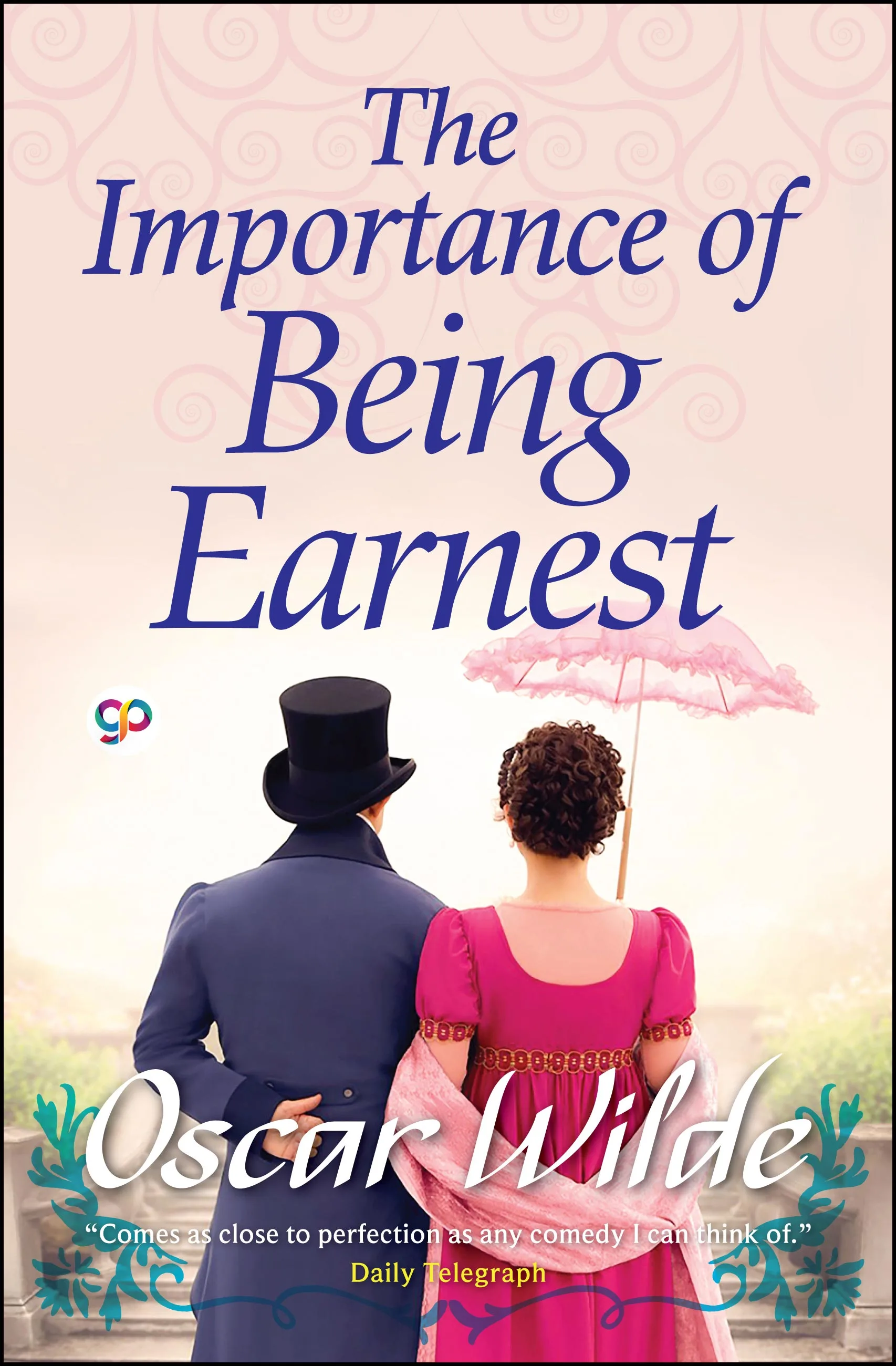
The Importance of Being Earnest
eBook
• INR 51.00
• English
• 9789388118866
No ratings yet
| Publisher | General Press |
|---|---|
| ISBN13 | 9789388118866 |
| ASIN/SKU | B07L41GDXV |
| Book Format | eBook |
| Language | English |
| List Price | INR 51.00 |
| Subject Code | DRA000000, FIC004000 |
| Publishing Date | 27/11/2018 |
| Book Code | BD00068520 |
Buy this Book
Amazon Stores
Ebook Stores
Other Stores
Discover The Importance of Being Earnest by Oscar Wilde. This book is published by General Press in eBook format, ISBN 9789388118866, ASIN B07L41GDXV, under Literature and Fiction, Classics, Drama and Plays.
Book Description
The Importance of Being Earnest' is a comedy in three acts, written by Oscar Wilde and first published in 1895. A great classic for every person interested in Oscar Wilde and his legacy. Wilde wrote it quickly, but then extensively revised and shortened this work to create a gem. Despite its apparent humour, the play addresses the state of Victorian society; indeed, it is subtitled 'A Trivial Comedy for Serious People.'
Author Biography
Oscar Fingall O'Flahertie Wills Wilde was born in Dublin in 1854. He was educated at Trinity College, Dublin and Magdalen College, Oxford where, a disciple of Pater, he founded an aesthetic cult. In 1884 he married Constance Lloyd, and his two sons were born in 1885 and 1886.
His novel, The Picture of Dorian Gray (1891), and social comedies Lady Windermere's Fan (1892), A Woman of No Importance (1893), An Ideal Husband (1895), and The Importance of Being Earnest (1895), established his reputation. In 1895, following his libel action against the Marquess of Queesberry, Wilde was sentenced to two years' imprisonment for homosexual conduct, as a result of which he wrote The Ballad of Reading Gaol (1898), and his confessional letter De Profundis (1905). On his release from prison in 1897 he lived in obscurity in Europe, and died in Paris in 1900.
His novel, The Picture of Dorian Gray (1891), and social comedies Lady Windermere's Fan (1892), A Woman of No Importance (1893), An Ideal Husband (1895), and The Importance of Being Earnest (1895), established his reputation. In 1895, following his libel action against the Marquess of Queesberry, Wilde was sentenced to two years' imprisonment for homosexual conduct, as a result of which he wrote The Ballad of Reading Gaol (1898), and his confessional letter De Profundis (1905). On his release from prison in 1897 he lived in obscurity in Europe, and died in Paris in 1900.
Editorial Reviews
Editorial Reviews will be added soon…
Book Summary
Oscar Wilde’s The Importance of Being Earnest: A Trivial Comedy for Serious People is one of the most celebrated comedies in English literature and perhaps the clearest expression of Wilde’s extraordinary talent for wit, satire, paradox, and social observation. First performed in London in 1895, the play turns the respectable world of Victorian England upside down by presenting characters who lie constantly while claiming to value honesty, pursue marriage while mocking its conventions, and judge people more by their names, families, money, and manners than by their character. Beneath its lighthearted surface, The Importance of Being Earnest is a sharp criticism of a society in which appearance often matters more than reality. Its central characters create false identities to escape social responsibilities, but their deceptions eventually become tangled with love, marriage, family history, and social status. The result is a fast-moving comedy of mistaken identity that remains remarkably entertaining because Wilde makes serious social criticism feel effortless and delightfully absurd.
The story begins in London at the elegant home of Algernon Moncrieff, a wealthy and charming young bachelor. Algernon is clever, lazy, pleasure-loving, and deeply skeptical of conventional morality. He is waiting for his aunt, Lady Bracknell, and his cousin, Gwendolen Fairfax, when his friend Jack Worthing arrives. Jack is known to Algernon as Ernest Worthing, but almost immediately the audience discovers that “Ernest” is not actually his real name. Jack lives a double life. In the countryside, he is known as Jack and behaves as a responsible landowner and guardian to his young ward, Cecily Cardew. In London, however, he becomes Ernest, a supposedly irresponsible younger brother whose troublesome behavior provides Jack with an excuse to leave the country and enjoy himself.
Jack’s imaginary brother is therefore not simply a lie for entertainment. Ernest is Jack’s escape route. Whenever Jack wants to visit London, he can claim that he has come to rescue or supervise his supposedly wayward brother. Once in London, he is free from the responsibilities and expectations associated with his respectable country identity. The irony is that Jack presents himself as morally superior to Ernest even though he is Ernest. His respectable personality and his supposedly disreputable personality are simply two versions of the same man. Wilde uses this double identity to expose the artificial nature of Victorian respectability. Jack is not necessarily dishonest because he is unusually immoral; he is dishonest because society has made it difficult for him to live freely while maintaining his respectable image.
Algernon, however, quickly discovers Jack’s secret. He finds a cigarette case that contains a message from Cecily addressed to “Uncle Jack.” This makes it impossible for Jack to maintain his story. Algernon forces him to explain the contradiction, and Jack finally admits that he invented Ernest. Algernon finds the entire arrangement fascinating because he has created a similar escape mechanism of his own. He has invented a fictional invalid named Bunbury, whose supposed illnesses allow Algernon to avoid boring social obligations whenever he wishes. He calls this practice “Bunburying.” The two men are therefore essentially doing the same thing. Both create imaginary identities or circumstances that allow them to escape the restrictions of respectable society.
The plot becomes more complicated when Gwendolen Fairfax arrives with Lady Bracknell. Jack is deeply in love with Gwendolen and intends to propose to her. His proposal is successful, but there is an immediate problem: Gwendolen has developed an extraordinary romantic attachment to the name “Ernest.” She believes that the name itself conveys reliability and character. Jack is delighted because he is pretending to be Ernest, but his happiness is short-lived. Gwendolen’s obsession with his name means that revealing his real identity could destroy the relationship. Wilde turns the ordinary romantic idea of falling in love with someone into a joke about falling in love with a word. Gwendolen is attracted not simply to Jack but to what she imagines the name Ernest represents.
Lady Bracknell then conducts one of the play’s most famous comic interviews. She treats Jack’s marriage proposal as though it were a business transaction or an examination for membership in an exclusive institution. She asks questions about his income, property, family connections, and social background. When Jack explains that he was discovered as a baby inside a handbag at Victoria Station and that he does not know his biological parents, Lady Bracknell is horrified. To her, the problem is not whether Jack is kind, intelligent, or genuinely in love with Gwendolen. The problem is that his family background is uncertain.
This scene establishes one of Wilde’s central targets: the Victorian obsession with social class and respectable ancestry. Lady Bracknell represents a society in which marriage is not simply a private relationship between two people. It is an arrangement involving wealth, family reputation, inheritance, and social position. Jack’s mysterious origins make him unacceptable despite his considerable wealth and apparently respectable behavior. Wilde makes the situation absurd because the audience can see that Lady Bracknell’s standards are fundamentally arbitrary. A person found in a handbag may be perfectly honorable, while a person from a prestigious family may be selfish or ridiculous. Yet Victorian society often judged people by precisely these external qualifications.
After Lady Bracknell rejects the marriage, Jack returns to his country estate. Meanwhile, Algernon becomes fascinated by Cecily after hearing Jack describe her. He decides to visit Jack’s country home while pretending to be Ernest. This creates a wonderful reversal: Jack invented Ernest so that he could escape his responsibilities, but now Algernon uses Ernest’s identity to enter Jack’s world. When Jack arrives home, he has decided that the imaginary Ernest has become too troublesome and announces that his brother has died. But he discovers Algernon already pretending to be Ernest. Jack is furious, but he cannot expose Algernon without exposing his own deception. He is trapped by his own lie.
Algernon quickly falls in love with Cecily. Like Gwendolen, Cecily is already fascinated by the name Ernest. In fact, she has created an imaginary romantic relationship with Jack’s supposed brother before even meeting him. She has written herself into a detailed fantasy in which she and Ernest are already engaged. When Algernon appears claiming to be Ernest, he finds that Cecily has essentially done the imaginative work for him. Their courtship becomes another parody of romantic conventions. Both Cecily and Gwendolen appear to value the name Ernest almost as much as the man himself. The joke becomes increasingly obvious: the women associate a particular name with honesty and reliability, while the men using that name are lying constantly.
The central confrontation occurs when Gwendolen arrives at Jack’s country estate. She believes she is visiting Ernest, while Cecily believes she is engaged to Ernest. When the two women discover that they are supposedly engaged to the same man, they initially behave politely, but their conversation quickly becomes competitive. Their famous tea-table confrontation turns social manners into weapons. They remain outwardly civilized while insulting each other through carefully chosen language. Wilde’s comedy is especially sharp here because the women are not simply arguing; they are performing the rituals of politeness that Victorian society expects from them while using those same rituals to express hostility.
The arrival of Jack and Algernon finally exposes the truth. Both men admit that neither is actually named Ernest. Gwendolen and Cecily are furious, but the situation becomes even more ridiculous when the men decide that the simplest solution is to have themselves officially christened Ernest. They are willing to undergo a religious ceremony merely to satisfy the romantic preferences of the women they love. This is one of Wilde’s funniest inversions. The men have spent the entire play using the name Ernest to escape seriousness, and now they are prepared to change their identities permanently because the women take the name so seriously.
At this point, however, the plot introduces its final and most improbable revelation. Lady Bracknell recognizes Miss Prism, Cecily’s governess, as the woman who disappeared from her family’s service many years earlier. Under questioning, Miss Prism explains that she once accidentally left a baby in a handbag at Victoria Station. She had intended to put the manuscript of a novel into the handbag but mistakenly placed the baby there instead. The handbag was eventually discovered, and Jack suddenly realizes that the mysterious child in the handbag was himself.
The revelation completely changes Jack’s identity. He is not an unknown orphan after all. He is actually Lady Bracknell’s nephew and Algernon’s older brother. Even more importantly, his real birth name was Ernest John. This means that the entire central deception of the play turns into a paradoxical truth. Jack has spent years pretending to be Ernest, but Ernest was actually his name all along. His imaginary brother was fake, but he really does have a younger brother—and that brother is Algernon. In the final comic twist, Jack discovers that he has been telling the truth without knowing it.
The ending provides the perfect explanation for the title. Jack declares that he has finally realized “the vital Importance of Being Earnest.” The word “earnest” carries two meanings: it can describe someone who is sincere and serious, but it is also the name Ernest. Wilde deliberately refuses to decide which meaning matters more. Jack has technically been “Ernest” all along, but that does not mean he has consistently behaved earnestly. The ending therefore preserves the play’s central joke: a society that claims to value sincerity may actually care more about names, appearances, and social credentials.
One of the most important themes in The Importance of Being Earnest is identity. Jack and Algernon both create alternative identities because they want freedom from social expectations. Their behavior suggests that respectable Victorian life is itself a performance. People are expected to act appropriately, speak appropriately, marry appropriately, and associate with appropriate families. Wilde asks what happens when people become tired of performing those roles. His answer is not a solemn philosophical argument but an elaborate comedy in which almost everyone creates some kind of fiction.
The theme of deception is closely connected with this idea. Jack and Algernon lie constantly, yet they are not necessarily the most dishonest characters in the play. Lady Bracknell, for example, may be more socially respectable, but her obsession with money and family background reveals a different kind of dishonesty. She pretends that marriage should be governed by moral and social principles while treating it almost entirely as a calculation of status. Wilde therefore contrasts personal deception with institutional hypocrisy. The men lie about their names, but society itself lies about what it considers important.
Marriage is another major theme. Wilde satirizes the Victorian idea that marriage should be carefully arranged according to class, wealth, family, and reputation. Lady Bracknell represents this attitude most clearly. She treats Gwendolen’s marriage prospects as a matter requiring investigation and approval. Her reaction to Jack’s unknown parentage reveals that social origins can matter more than personal character. At the same time, Gwendolen and Cecily parody romantic idealism because both become attached to the name Ernest rather than the actual personality of the men they supposedly love.
The title itself is therefore the key to understanding the entire play. Wilde takes the Victorian ideal of earnestness—seriousness, sincerity, moral responsibility—and turns it into a pun. His characters talk about serious subjects in ridiculous ways and treat trivial matters with extraordinary seriousness. This inversion is exactly what Wilde described when discussing the play’s philosophy: trivial things should be treated seriously while serious things can be approached with deliberate triviality.
Food, manners, clothing, money, and social etiquette also become comic symbols of the characters’ priorities. Algernon’s famous concern with food is an example of Wilde’s broader technique: characters often become passionate about trivial details while ignoring genuinely important moral questions. The result is a world in which sandwiches, cucumber sandwiches, tea, names, engagements, and family backgrounds can become matters of life-or-death importance. This deliberate exaggeration exposes the absurdity of a society that confuses appearances with values.
For readers searching for a The Importance of Being Earnest summary, The Importance of Being Earnest ending explained, Oscar Wilde play summary, Jack and Algernon character analysis, themes of The Importance of Being Earnest, or an explanation of Wilde’s satire of Victorian society, the play offers an unusually rich combination of comedy and social criticism. It is a short work, but its ideas about identity, marriage, class, deception, reputation, and social performance are much larger than its deliberately ridiculous plot.
Ultimately, The Importance of Being Earnest is funny because its characters are absurd, but it remains a classic because the absurdity has a purpose. Wilde exposes the gap between what society claims to value and what it actually rewards. His characters say they want honesty while rewarding appearances. They claim marriage is sacred while treating it as a social transaction. They demand respectable identities while secretly creating alternative lives. They judge people according to names and family backgrounds rather than character. Yet Wilde never turns the play into a heavy moral lecture. Instead, he gives readers sparkling dialogue, ridiculous coincidences, romantic confusion, and some of the most memorable comic characters in English drama.
The final irony is that Jack’s complicated journey toward discovering his true identity does not necessarily make him a morally transformed man. Instead, it gives him the social credentials he needs to marry Gwendolen. He discovers that the identity society rejected—an orphan with uncertain origins—was unacceptable, while the identity society celebrates—a respectable aristocratic family connection—is suddenly perfect. His name Ernest turns out to be genuine, but the larger joke remains intact. Wilde leaves readers laughing at the idea that a name could determine a person's worth. In that sense, The Importance of Being Earnest is not really about the importance of being serious at all. It is about the absurdity of a world that takes the wrong things seriously—and the liberating comedy that appears when people stop pretending that those things matter as much as society says they do.
The story begins in London at the elegant home of Algernon Moncrieff, a wealthy and charming young bachelor. Algernon is clever, lazy, pleasure-loving, and deeply skeptical of conventional morality. He is waiting for his aunt, Lady Bracknell, and his cousin, Gwendolen Fairfax, when his friend Jack Worthing arrives. Jack is known to Algernon as Ernest Worthing, but almost immediately the audience discovers that “Ernest” is not actually his real name. Jack lives a double life. In the countryside, he is known as Jack and behaves as a responsible landowner and guardian to his young ward, Cecily Cardew. In London, however, he becomes Ernest, a supposedly irresponsible younger brother whose troublesome behavior provides Jack with an excuse to leave the country and enjoy himself.
Jack’s imaginary brother is therefore not simply a lie for entertainment. Ernest is Jack’s escape route. Whenever Jack wants to visit London, he can claim that he has come to rescue or supervise his supposedly wayward brother. Once in London, he is free from the responsibilities and expectations associated with his respectable country identity. The irony is that Jack presents himself as morally superior to Ernest even though he is Ernest. His respectable personality and his supposedly disreputable personality are simply two versions of the same man. Wilde uses this double identity to expose the artificial nature of Victorian respectability. Jack is not necessarily dishonest because he is unusually immoral; he is dishonest because society has made it difficult for him to live freely while maintaining his respectable image.
Algernon, however, quickly discovers Jack’s secret. He finds a cigarette case that contains a message from Cecily addressed to “Uncle Jack.” This makes it impossible for Jack to maintain his story. Algernon forces him to explain the contradiction, and Jack finally admits that he invented Ernest. Algernon finds the entire arrangement fascinating because he has created a similar escape mechanism of his own. He has invented a fictional invalid named Bunbury, whose supposed illnesses allow Algernon to avoid boring social obligations whenever he wishes. He calls this practice “Bunburying.” The two men are therefore essentially doing the same thing. Both create imaginary identities or circumstances that allow them to escape the restrictions of respectable society.
The plot becomes more complicated when Gwendolen Fairfax arrives with Lady Bracknell. Jack is deeply in love with Gwendolen and intends to propose to her. His proposal is successful, but there is an immediate problem: Gwendolen has developed an extraordinary romantic attachment to the name “Ernest.” She believes that the name itself conveys reliability and character. Jack is delighted because he is pretending to be Ernest, but his happiness is short-lived. Gwendolen’s obsession with his name means that revealing his real identity could destroy the relationship. Wilde turns the ordinary romantic idea of falling in love with someone into a joke about falling in love with a word. Gwendolen is attracted not simply to Jack but to what she imagines the name Ernest represents.
Lady Bracknell then conducts one of the play’s most famous comic interviews. She treats Jack’s marriage proposal as though it were a business transaction or an examination for membership in an exclusive institution. She asks questions about his income, property, family connections, and social background. When Jack explains that he was discovered as a baby inside a handbag at Victoria Station and that he does not know his biological parents, Lady Bracknell is horrified. To her, the problem is not whether Jack is kind, intelligent, or genuinely in love with Gwendolen. The problem is that his family background is uncertain.
This scene establishes one of Wilde’s central targets: the Victorian obsession with social class and respectable ancestry. Lady Bracknell represents a society in which marriage is not simply a private relationship between two people. It is an arrangement involving wealth, family reputation, inheritance, and social position. Jack’s mysterious origins make him unacceptable despite his considerable wealth and apparently respectable behavior. Wilde makes the situation absurd because the audience can see that Lady Bracknell’s standards are fundamentally arbitrary. A person found in a handbag may be perfectly honorable, while a person from a prestigious family may be selfish or ridiculous. Yet Victorian society often judged people by precisely these external qualifications.
After Lady Bracknell rejects the marriage, Jack returns to his country estate. Meanwhile, Algernon becomes fascinated by Cecily after hearing Jack describe her. He decides to visit Jack’s country home while pretending to be Ernest. This creates a wonderful reversal: Jack invented Ernest so that he could escape his responsibilities, but now Algernon uses Ernest’s identity to enter Jack’s world. When Jack arrives home, he has decided that the imaginary Ernest has become too troublesome and announces that his brother has died. But he discovers Algernon already pretending to be Ernest. Jack is furious, but he cannot expose Algernon without exposing his own deception. He is trapped by his own lie.
Algernon quickly falls in love with Cecily. Like Gwendolen, Cecily is already fascinated by the name Ernest. In fact, she has created an imaginary romantic relationship with Jack’s supposed brother before even meeting him. She has written herself into a detailed fantasy in which she and Ernest are already engaged. When Algernon appears claiming to be Ernest, he finds that Cecily has essentially done the imaginative work for him. Their courtship becomes another parody of romantic conventions. Both Cecily and Gwendolen appear to value the name Ernest almost as much as the man himself. The joke becomes increasingly obvious: the women associate a particular name with honesty and reliability, while the men using that name are lying constantly.
The central confrontation occurs when Gwendolen arrives at Jack’s country estate. She believes she is visiting Ernest, while Cecily believes she is engaged to Ernest. When the two women discover that they are supposedly engaged to the same man, they initially behave politely, but their conversation quickly becomes competitive. Their famous tea-table confrontation turns social manners into weapons. They remain outwardly civilized while insulting each other through carefully chosen language. Wilde’s comedy is especially sharp here because the women are not simply arguing; they are performing the rituals of politeness that Victorian society expects from them while using those same rituals to express hostility.
The arrival of Jack and Algernon finally exposes the truth. Both men admit that neither is actually named Ernest. Gwendolen and Cecily are furious, but the situation becomes even more ridiculous when the men decide that the simplest solution is to have themselves officially christened Ernest. They are willing to undergo a religious ceremony merely to satisfy the romantic preferences of the women they love. This is one of Wilde’s funniest inversions. The men have spent the entire play using the name Ernest to escape seriousness, and now they are prepared to change their identities permanently because the women take the name so seriously.
At this point, however, the plot introduces its final and most improbable revelation. Lady Bracknell recognizes Miss Prism, Cecily’s governess, as the woman who disappeared from her family’s service many years earlier. Under questioning, Miss Prism explains that she once accidentally left a baby in a handbag at Victoria Station. She had intended to put the manuscript of a novel into the handbag but mistakenly placed the baby there instead. The handbag was eventually discovered, and Jack suddenly realizes that the mysterious child in the handbag was himself.
The revelation completely changes Jack’s identity. He is not an unknown orphan after all. He is actually Lady Bracknell’s nephew and Algernon’s older brother. Even more importantly, his real birth name was Ernest John. This means that the entire central deception of the play turns into a paradoxical truth. Jack has spent years pretending to be Ernest, but Ernest was actually his name all along. His imaginary brother was fake, but he really does have a younger brother—and that brother is Algernon. In the final comic twist, Jack discovers that he has been telling the truth without knowing it.
The ending provides the perfect explanation for the title. Jack declares that he has finally realized “the vital Importance of Being Earnest.” The word “earnest” carries two meanings: it can describe someone who is sincere and serious, but it is also the name Ernest. Wilde deliberately refuses to decide which meaning matters more. Jack has technically been “Ernest” all along, but that does not mean he has consistently behaved earnestly. The ending therefore preserves the play’s central joke: a society that claims to value sincerity may actually care more about names, appearances, and social credentials.
One of the most important themes in The Importance of Being Earnest is identity. Jack and Algernon both create alternative identities because they want freedom from social expectations. Their behavior suggests that respectable Victorian life is itself a performance. People are expected to act appropriately, speak appropriately, marry appropriately, and associate with appropriate families. Wilde asks what happens when people become tired of performing those roles. His answer is not a solemn philosophical argument but an elaborate comedy in which almost everyone creates some kind of fiction.
The theme of deception is closely connected with this idea. Jack and Algernon lie constantly, yet they are not necessarily the most dishonest characters in the play. Lady Bracknell, for example, may be more socially respectable, but her obsession with money and family background reveals a different kind of dishonesty. She pretends that marriage should be governed by moral and social principles while treating it almost entirely as a calculation of status. Wilde therefore contrasts personal deception with institutional hypocrisy. The men lie about their names, but society itself lies about what it considers important.
Marriage is another major theme. Wilde satirizes the Victorian idea that marriage should be carefully arranged according to class, wealth, family, and reputation. Lady Bracknell represents this attitude most clearly. She treats Gwendolen’s marriage prospects as a matter requiring investigation and approval. Her reaction to Jack’s unknown parentage reveals that social origins can matter more than personal character. At the same time, Gwendolen and Cecily parody romantic idealism because both become attached to the name Ernest rather than the actual personality of the men they supposedly love.
The title itself is therefore the key to understanding the entire play. Wilde takes the Victorian ideal of earnestness—seriousness, sincerity, moral responsibility—and turns it into a pun. His characters talk about serious subjects in ridiculous ways and treat trivial matters with extraordinary seriousness. This inversion is exactly what Wilde described when discussing the play’s philosophy: trivial things should be treated seriously while serious things can be approached with deliberate triviality.
Food, manners, clothing, money, and social etiquette also become comic symbols of the characters’ priorities. Algernon’s famous concern with food is an example of Wilde’s broader technique: characters often become passionate about trivial details while ignoring genuinely important moral questions. The result is a world in which sandwiches, cucumber sandwiches, tea, names, engagements, and family backgrounds can become matters of life-or-death importance. This deliberate exaggeration exposes the absurdity of a society that confuses appearances with values.
For readers searching for a The Importance of Being Earnest summary, The Importance of Being Earnest ending explained, Oscar Wilde play summary, Jack and Algernon character analysis, themes of The Importance of Being Earnest, or an explanation of Wilde’s satire of Victorian society, the play offers an unusually rich combination of comedy and social criticism. It is a short work, but its ideas about identity, marriage, class, deception, reputation, and social performance are much larger than its deliberately ridiculous plot.
Ultimately, The Importance of Being Earnest is funny because its characters are absurd, but it remains a classic because the absurdity has a purpose. Wilde exposes the gap between what society claims to value and what it actually rewards. His characters say they want honesty while rewarding appearances. They claim marriage is sacred while treating it as a social transaction. They demand respectable identities while secretly creating alternative lives. They judge people according to names and family backgrounds rather than character. Yet Wilde never turns the play into a heavy moral lecture. Instead, he gives readers sparkling dialogue, ridiculous coincidences, romantic confusion, and some of the most memorable comic characters in English drama.
The final irony is that Jack’s complicated journey toward discovering his true identity does not necessarily make him a morally transformed man. Instead, it gives him the social credentials he needs to marry Gwendolen. He discovers that the identity society rejected—an orphan with uncertain origins—was unacceptable, while the identity society celebrates—a respectable aristocratic family connection—is suddenly perfect. His name Ernest turns out to be genuine, but the larger joke remains intact. Wilde leaves readers laughing at the idea that a name could determine a person's worth. In that sense, The Importance of Being Earnest is not really about the importance of being serious at all. It is about the absurdity of a world that takes the wrong things seriously—and the liberating comedy that appears when people stop pretending that those things matter as much as society says they do.
Sample Chapters
Sample Chapters will be added soon…
Reader Reviews
No reviews yet.
The Importance of Being Earnest
Download Cover Image
Do you want to download the full cover image for The Importance of Being Earnest?