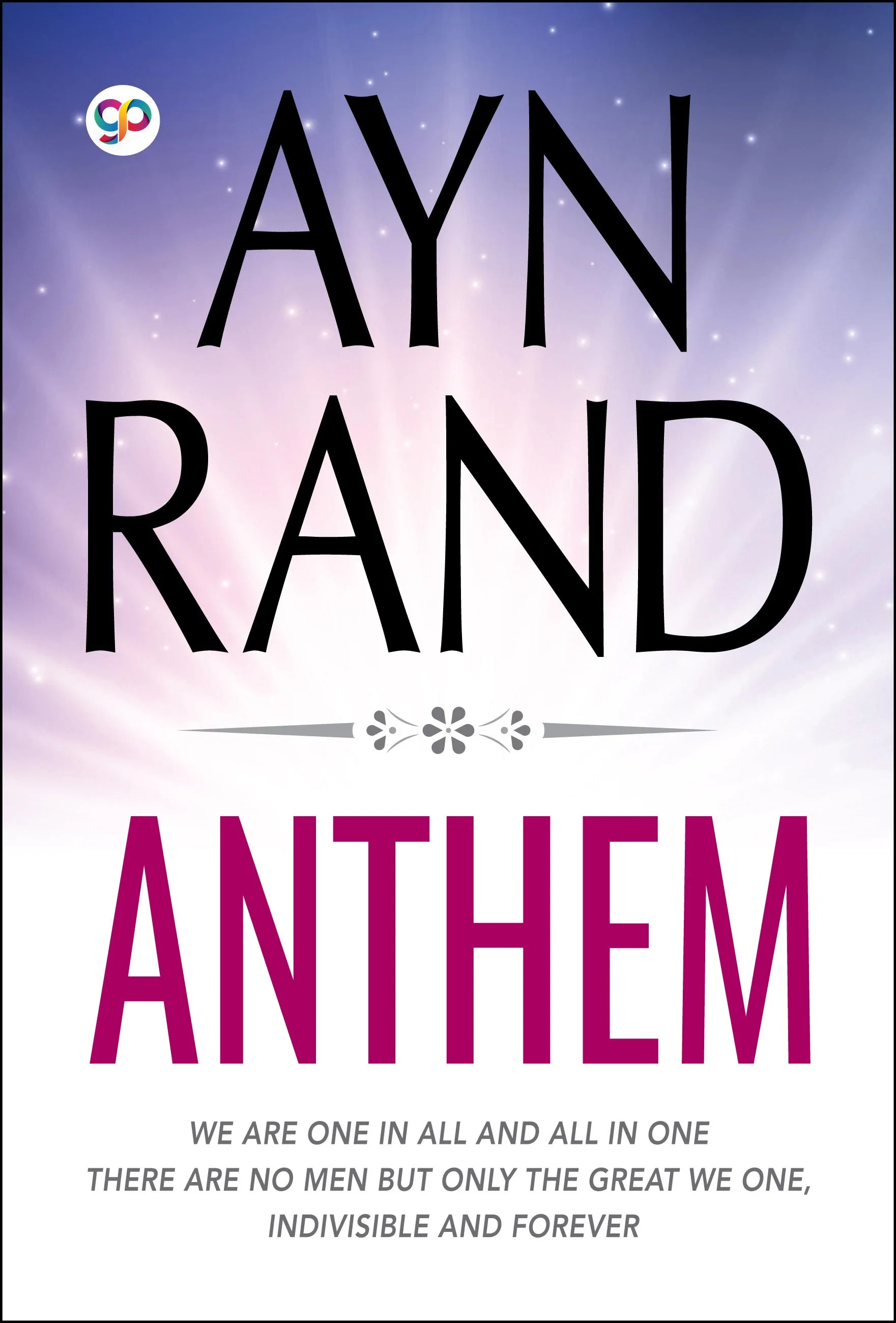
Anthem
eBook
• INR 51.00
• English
• 9789388118989
No ratings yet
| Publisher | General Press |
|---|---|
| ISBN13 | 9789388118989 |
| ASIN/SKU | B07LB7WHT7 |
| Book Format | eBook |
| Language | English |
| List Price | INR 51.00 |
| Subject Code | FIC037000, FIC028000, FIC052000, FIC004000 |
| Publishing Date | 11/12/2018 |
| Book Code | BD00068525 |
Buy this Book
Amazon Stores
Ebook Stores
Other Stores
Discover Anthem by Ayn Rand. This book is published by General Press in eBook format, ISBN 9789388118989, ASIN B07LB7WHT7, under Literature and Fiction, Classics, Science Fiction.
Book Description
Anthem is a dystopian fiction novella by Ayn Rand, written in 1937, and first published in 1938 in England. The story unfolds within a society in which all traces of individualism have been eliminated from every aspect of life—use of the word 'I' is a capital offense. The hero, a rebel who discovers that man's greatest moral duty is the pursuit of his own happiness, embodies the values the author embraced in her personal philosophy of objectivism—reason, ethics, volition, and individualism.
Hailed by The New York Times as "a compelling dystopian look at paranoia from one of the most unique and perceptive writers of our time," this brief, captivating novel offers a cautionary tale.
Hailed by The New York Times as "a compelling dystopian look at paranoia from one of the most unique and perceptive writers of our time," this brief, captivating novel offers a cautionary tale.
Author Biography
Ayn Rand was an American novelist, philosopher, playwright, and screenwriter. She is known for her two best-selling novels, The Fountainhead and Atlas Shrugged, and for developing a philosophical system she called Objectivism. Born and educated in Russia, Rand moved to the United States in 1926. She had a play produced on Broadway in 1935-1936. After two early novels that were initially unsuccessful in America, she achieved fame with her 1943 novel, 'The Fountainhead'. In 1957, she published her best-known work, the novel Atlas Shrugged. Afterward, she turned to non-fiction to promote her philosophy, publishing her own magazines and releasing several collections of essays until her death in 1982. Rand advocated reason as the only means of acquiring knowledge and rejected faith and religion. She supported rational and ethical egoism, and rejected altruism. In politics, she condemned the initiation of force as immoral and opposed collectivism and statism as well as anarchism, instead supporting laissez-faire capitalism, which she defined as the system based on recognizing individual rights. In art, Rand promoted romantic realism.
Editorial Reviews
Editorial Reviews will be added soon…
Book Summary
Ayn Rand’s Anthem is a short but powerful dystopian novella about individuality, freedom, independent thought, and the human desire to create. Published in 1938, the story imagines a future society where individual identity has almost completely disappeared. People are not allowed to choose their professions, own private property, form relationships freely, or even think of themselves as separate individuals. Everyone lives for the collective, and the word “I” has disappeared from the language. Through the journey of a young man named Equality 7-2521, Rand explores what happens when someone begins to question a society that demands complete obedience.
The story is narrated by Equality 7-2521, a young man who has always felt different from the people around him. He is unusually intelligent and curious, but his society considers individual intelligence and ambition dangerous. Children are raised together rather than by individual families, and people are assigned numbers instead of personal names. From childhood, they are taught that the group is more important than the individual.
Equality wants to become a scholar, but society does not allow people to choose their occupations. He is assigned the job of Street Sweeper. He accepts the assignment outwardly, but inwardly he remains dissatisfied. He knows that he has a strong desire to learn and discover, and he begins secretly pursuing knowledge despite the rules.
While working, Equality discovers an abandoned underground tunnel that appears to have been built by people from an earlier civilization. He secretly turns it into a laboratory. There, away from the authorities, he conducts experiments and studies science. His actions are forbidden because people are not supposed to work privately or pursue knowledge without permission.
Eventually, Equality makes an extraordinary discovery: electricity. He creates a working electric light, realizing that his invention could transform the lives of millions of people. He feels proud, not because society has praised him, but because he has created something through his own intelligence and effort.
Equality decides to take his invention to the World Council of Scholars. He believes that the scholars will understand its importance and use it to improve society. However, his confidence in the system is misplaced. Before he can present his invention, he is arrested for leaving his assigned work.
Equality escapes from prison and takes the electric light with him. He enters the meeting of the scholars and presents his invention. Instead of celebrating the discovery, the scholars react with fear and anger. They are disturbed that Equality created something independently. They care more about preserving the collective system than about the potential benefits of his invention.
They threaten to destroy the electric light.
At this moment, Equality finally understands how deeply his society has rejected individual creativity. The system cannot tolerate an achievement that comes from one person's independent mind. He realizes that the problem is not simply that the authorities misunderstand his invention. The entire society has been designed to prevent people from thinking independently.
Equality escapes into the wilderness.
For the first time in his life, he experiences genuine freedom. No one tells him where to go, what to think, or what work to perform. He can make decisions for himself. The wilderness therefore becomes a symbol of independence and the possibility of creating a new life.
Equality is not completely alone. He has long been attracted to Liberty 5-3000, a young woman whom he calls the Golden One. Their society does not allow individuals to choose romantic partners freely, but the two are drawn to one another. Their relationship develops naturally, outside the rules of the collective.
Liberty eventually joins Equality in the wilderness. Together, they discover a house belonging to people from the distant past. Inside, they find objects and books that reveal a civilization in which individuals once possessed personal identities and freedom.
The most important discovery is not an object but a word.
Equality finds the word “I.”
This single word transforms his understanding of human existence. He realizes that he is not merely part of a collective. He is an individual consciousness with his own mind, desires, abilities, and choices. The society's constant use of “we” had prevented people from recognizing their separate identities.
Equality begins to understand that the individual is capable of creating values, discovering knowledge, loving another person, and choosing a personal purpose. He sees his own invention of electricity in a new light: it was possible precisely because he was willing to think independently.
He gives himself a new name, Prometheus, inspired by the mythological figure who brought fire to humanity. Liberty chooses the name Gaea. These new names symbolize their rejection of the identities imposed upon them and their decision to define themselves.
Prometheus begins imagining a new society based on individual freedom. People, he believes, should be able to choose their professions according to their abilities and interests. They should be free to own property, pursue knowledge, form relationships voluntarily, and create according to their own judgment.
He also rejects the moral teaching that individuals exist primarily to serve the collective. Instead, he believes that each person has the right to pursue his or her own happiness. A healthy society, in his view, should protect the individual's freedom rather than demand self-sacrifice.
One of the most important themes in Anthem is therefore individual identity. Equality's transformation from “we” to “I” represents his movement from obedience to self-awareness. His greatest discovery is ultimately not electricity but himself.
The novella also emphasizes the relationship between freedom and creativity. Equality's invention becomes possible because he is curious and willing to experiment outside the boundaries established by society. Rand argues that progress depends upon individuals being free to question accepted ideas and pursue original possibilities.
Another important theme is the power of language. By eliminating the word “I,” the society attempts to eliminate the concept of individual identity itself. The recovery of the word becomes an act of liberation. Language, Rand suggests, shapes the way people understand themselves and the world around them.
The story also explores the difference between conformity and genuine morality. Equality initially believes that obedience is morally good because society has taught him so. Eventually, he realizes that blindly following rules does not make an action right. Moral responsibility requires an individual to think and judge independently.
At the end of the novella, Prometheus prepares to return to the world he escaped from. He plans to build a new civilization based on reason, individual rights, private property, voluntary relationships, and freedom of thought. He believes that others may eventually rediscover the value of individuality.
Ultimately, Anthem is a story about awakening. Equality begins as someone who has been taught to suppress his intelligence, desires, and identity. Through curiosity, rebellion, scientific discovery, love, and solitude, he gradually discovers the value of his own mind.
The central message of the novel is clear: a human being cannot live fully without the freedom to think, choose, create, and pursue personal happiness. Rand portrays individuality not as a defect or a form of selfishness, but as the foundation of human dignity and achievement.
Equality's discovery of the word “I” is therefore the climax of his journey. It represents the moment when he finally understands that he is not merely one voice in a collective. He is a unique human being, capable of reason, creativity, love, responsibility, and choice.
In this sense, Anthem is ultimately a celebration of the individual mind. Its most important lesson is that freedom begins when a person learns to think for himself or herself and recognizes the right to live according to reason rather than surrendering that right to the demands of the crowd.
The story is narrated by Equality 7-2521, a young man who has always felt different from the people around him. He is unusually intelligent and curious, but his society considers individual intelligence and ambition dangerous. Children are raised together rather than by individual families, and people are assigned numbers instead of personal names. From childhood, they are taught that the group is more important than the individual.
Equality wants to become a scholar, but society does not allow people to choose their occupations. He is assigned the job of Street Sweeper. He accepts the assignment outwardly, but inwardly he remains dissatisfied. He knows that he has a strong desire to learn and discover, and he begins secretly pursuing knowledge despite the rules.
While working, Equality discovers an abandoned underground tunnel that appears to have been built by people from an earlier civilization. He secretly turns it into a laboratory. There, away from the authorities, he conducts experiments and studies science. His actions are forbidden because people are not supposed to work privately or pursue knowledge without permission.
Eventually, Equality makes an extraordinary discovery: electricity. He creates a working electric light, realizing that his invention could transform the lives of millions of people. He feels proud, not because society has praised him, but because he has created something through his own intelligence and effort.
Equality decides to take his invention to the World Council of Scholars. He believes that the scholars will understand its importance and use it to improve society. However, his confidence in the system is misplaced. Before he can present his invention, he is arrested for leaving his assigned work.
Equality escapes from prison and takes the electric light with him. He enters the meeting of the scholars and presents his invention. Instead of celebrating the discovery, the scholars react with fear and anger. They are disturbed that Equality created something independently. They care more about preserving the collective system than about the potential benefits of his invention.
They threaten to destroy the electric light.
At this moment, Equality finally understands how deeply his society has rejected individual creativity. The system cannot tolerate an achievement that comes from one person's independent mind. He realizes that the problem is not simply that the authorities misunderstand his invention. The entire society has been designed to prevent people from thinking independently.
Equality escapes into the wilderness.
For the first time in his life, he experiences genuine freedom. No one tells him where to go, what to think, or what work to perform. He can make decisions for himself. The wilderness therefore becomes a symbol of independence and the possibility of creating a new life.
Equality is not completely alone. He has long been attracted to Liberty 5-3000, a young woman whom he calls the Golden One. Their society does not allow individuals to choose romantic partners freely, but the two are drawn to one another. Their relationship develops naturally, outside the rules of the collective.
Liberty eventually joins Equality in the wilderness. Together, they discover a house belonging to people from the distant past. Inside, they find objects and books that reveal a civilization in which individuals once possessed personal identities and freedom.
The most important discovery is not an object but a word.
Equality finds the word “I.”
This single word transforms his understanding of human existence. He realizes that he is not merely part of a collective. He is an individual consciousness with his own mind, desires, abilities, and choices. The society's constant use of “we” had prevented people from recognizing their separate identities.
Equality begins to understand that the individual is capable of creating values, discovering knowledge, loving another person, and choosing a personal purpose. He sees his own invention of electricity in a new light: it was possible precisely because he was willing to think independently.
He gives himself a new name, Prometheus, inspired by the mythological figure who brought fire to humanity. Liberty chooses the name Gaea. These new names symbolize their rejection of the identities imposed upon them and their decision to define themselves.
Prometheus begins imagining a new society based on individual freedom. People, he believes, should be able to choose their professions according to their abilities and interests. They should be free to own property, pursue knowledge, form relationships voluntarily, and create according to their own judgment.
He also rejects the moral teaching that individuals exist primarily to serve the collective. Instead, he believes that each person has the right to pursue his or her own happiness. A healthy society, in his view, should protect the individual's freedom rather than demand self-sacrifice.
One of the most important themes in Anthem is therefore individual identity. Equality's transformation from “we” to “I” represents his movement from obedience to self-awareness. His greatest discovery is ultimately not electricity but himself.
The novella also emphasizes the relationship between freedom and creativity. Equality's invention becomes possible because he is curious and willing to experiment outside the boundaries established by society. Rand argues that progress depends upon individuals being free to question accepted ideas and pursue original possibilities.
Another important theme is the power of language. By eliminating the word “I,” the society attempts to eliminate the concept of individual identity itself. The recovery of the word becomes an act of liberation. Language, Rand suggests, shapes the way people understand themselves and the world around them.
The story also explores the difference between conformity and genuine morality. Equality initially believes that obedience is morally good because society has taught him so. Eventually, he realizes that blindly following rules does not make an action right. Moral responsibility requires an individual to think and judge independently.
At the end of the novella, Prometheus prepares to return to the world he escaped from. He plans to build a new civilization based on reason, individual rights, private property, voluntary relationships, and freedom of thought. He believes that others may eventually rediscover the value of individuality.
Ultimately, Anthem is a story about awakening. Equality begins as someone who has been taught to suppress his intelligence, desires, and identity. Through curiosity, rebellion, scientific discovery, love, and solitude, he gradually discovers the value of his own mind.
The central message of the novel is clear: a human being cannot live fully without the freedom to think, choose, create, and pursue personal happiness. Rand portrays individuality not as a defect or a form of selfishness, but as the foundation of human dignity and achievement.
Equality's discovery of the word “I” is therefore the climax of his journey. It represents the moment when he finally understands that he is not merely one voice in a collective. He is a unique human being, capable of reason, creativity, love, responsibility, and choice.
In this sense, Anthem is ultimately a celebration of the individual mind. Its most important lesson is that freedom begins when a person learns to think for himself or herself and recognizes the right to live according to reason rather than surrendering that right to the demands of the crowd.
Sample Chapters
Sample Chapters will be added soon…
Reader Reviews
No reviews yet.
Anthem