
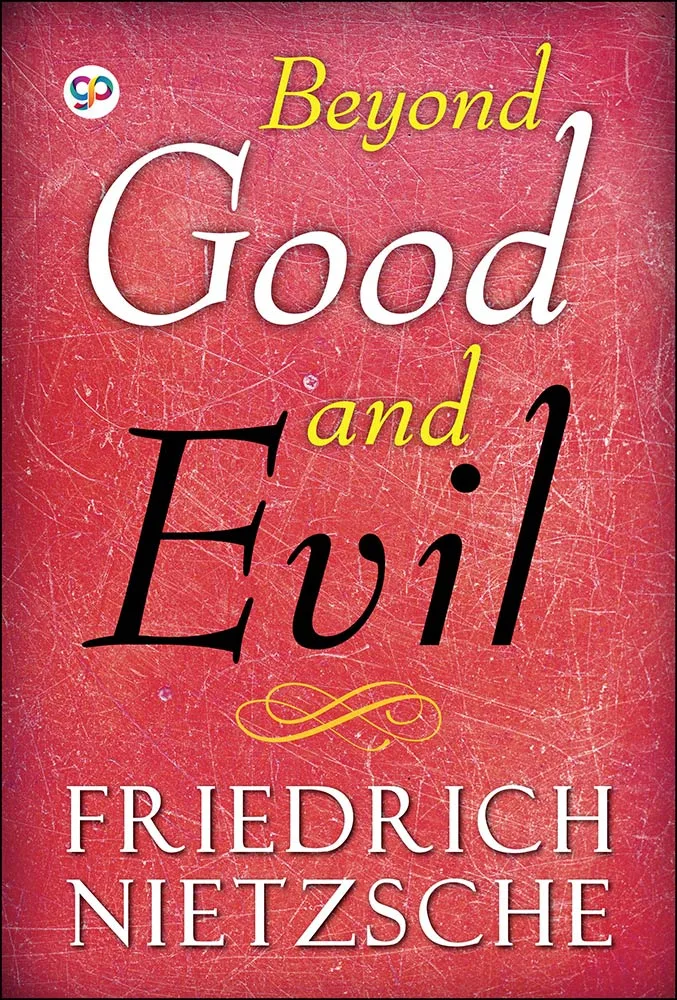
Beyond Good and Evil
eBook
• 163 Pages
• INR 51.00
• English
• 9789388760171
No ratings yet
| Publisher | General Press |
|---|---|
| ISBN13 | 9789388760171 |
| ASIN/SKU | B07MG8FMR2 |
| Book Format | eBook |
| Language | English |
| Pages | 163 |
| List Price | INR 51.00 |
| Subject Code | POL011000, POL030000, PHI016000, PHI022000 |
| Publishing Date | 10/01/2019 |
| Book Code | BD00068532 |
Buy this Book
Amazon Stores
Ebook Stores
Other Stores
Discover Beyond Good and Evil by Friedrich Nietzsche. This book is published by General Press in eBook format, ISBN 9789388760171, ASIN B07MG8FMR2, under Non Fiction, Social Science, Philosophy.
Book Description
'Beyond Good and Evil' by Friedrich Nietzsche is a philosophical classic and a major work of modern philosophy that challenges readers to question the moral beliefs, assumptions, and values they have accepted without examination. What if the ideas we call “good” and “evil” are not timeless truths, but products of history, culture, power, and human psychology? Nietzsche explores this unsettling question with sharp wit, provocative arguments, and a willingness to challenge conventional morality.
Rather than following a traditional plot, Beyond Good and Evil unfolds as a wide-ranging philosophical investigation into truth, morality, religion, human nature, and the motives that shape our judgments. Nietzsche examines the limitations of traditional philosophers, arguing that many thinkers have allowed their personal prejudices and moral assumptions to influence what they present as objective truth. He questions the foundations of Christian morality and other systems that divide human behavior neatly into good and evil, suggesting that such categories can conceal more complicated instincts and motivations.
A central theme of the book is Nietzsche’s idea that genuine intellectual freedom requires the courage to move beyond inherited moral frameworks. He considers the relationship between reason and instinct, the role of suffering in human development, the psychology of belief, and the qualities needed by individuals capable of creating new values. His reflections on power, independence, human weakness, and the “free spirit” remain challenging because they refuse to offer easy answers.
Although written in a dense and sometimes deliberately provocative style, Beyond Good and Evil can be rewarding for general readers interested in philosophy, psychology, ethics, religion, and the nature of human behavior. Nietzsche does not simply ask readers to accept his conclusions; he pushes them to think more critically about why they believe what they believe. The result is a provocative philosophical journey that continues to raise difficult questions long after the final page—and invites readers to discover what lies beyond the moral boundaries they thought they understood.
Rather than following a traditional plot, Beyond Good and Evil unfolds as a wide-ranging philosophical investigation into truth, morality, religion, human nature, and the motives that shape our judgments. Nietzsche examines the limitations of traditional philosophers, arguing that many thinkers have allowed their personal prejudices and moral assumptions to influence what they present as objective truth. He questions the foundations of Christian morality and other systems that divide human behavior neatly into good and evil, suggesting that such categories can conceal more complicated instincts and motivations.
A central theme of the book is Nietzsche’s idea that genuine intellectual freedom requires the courage to move beyond inherited moral frameworks. He considers the relationship between reason and instinct, the role of suffering in human development, the psychology of belief, and the qualities needed by individuals capable of creating new values. His reflections on power, independence, human weakness, and the “free spirit” remain challenging because they refuse to offer easy answers.
Although written in a dense and sometimes deliberately provocative style, Beyond Good and Evil can be rewarding for general readers interested in philosophy, psychology, ethics, religion, and the nature of human behavior. Nietzsche does not simply ask readers to accept his conclusions; he pushes them to think more critically about why they believe what they believe. The result is a provocative philosophical journey that continues to raise difficult questions long after the final page—and invites readers to discover what lies beyond the moral boundaries they thought they understood.
Author Biography
Friedrich Wilhelm Nietzsche (1844–1900) was a profound and highly provocative German philosopher, cultural critic, and classical scholar whose ideas radically reshaped modern intellectual history. Born in the Prussian Province of Saxony, he initially studied theology and classical philology. In 1869, at the exceptionally young age of 24, he was appointed to the Chair of Classical Philology at the University of Basel in Switzerland, though severe health issues forced his early resignation a decade later.
For the next ten years, Nietzsche lived a nomadic existence across Europe, battling chronic illness while producing his most revolutionary writings. His work famously declared that "God is dead," a diagnostic statement regarding the collapse of traditional religious frameworks in the wake of the Enlightenment. To combat the ensuing threat of nihilism, Nietzsche introduced concepts like the Übermensch (Overman), who creates his own values, and the "Will to Power," a fundamental drive for self-overcoming and creative excellence.
Writing in a fiercely independent and aphoristic style, he authored several monumental texts, including Thus Spoke Zarathustra and Beyond Good and Evil. He rigorously challenged traditional Christian morality and the philosophical dogmas of his time, urging individuals to embrace life in its entirety and affirm human existence without relying on otherworldly comforts.
In 1889, Nietzsche suffered a total mental collapse in Turin, Italy, spending his final eleven years completely incapacitated. During this time, his sister, Elisabeth, gained control of his unpublished manuscripts and severely manipulated his work to align with German nationalist and anti-Semitic ideologies—views Nietzsche himself vehemently despised.
It took decades for scholars to rehabilitate his true legacy, rightfully restoring him as a visionary thinker who profoundly influenced existentialism, psychoanalysis, and modern literature.
For the next ten years, Nietzsche lived a nomadic existence across Europe, battling chronic illness while producing his most revolutionary writings. His work famously declared that "God is dead," a diagnostic statement regarding the collapse of traditional religious frameworks in the wake of the Enlightenment. To combat the ensuing threat of nihilism, Nietzsche introduced concepts like the Übermensch (Overman), who creates his own values, and the "Will to Power," a fundamental drive for self-overcoming and creative excellence.
Writing in a fiercely independent and aphoristic style, he authored several monumental texts, including Thus Spoke Zarathustra and Beyond Good and Evil. He rigorously challenged traditional Christian morality and the philosophical dogmas of his time, urging individuals to embrace life in its entirety and affirm human existence without relying on otherworldly comforts.
In 1889, Nietzsche suffered a total mental collapse in Turin, Italy, spending his final eleven years completely incapacitated. During this time, his sister, Elisabeth, gained control of his unpublished manuscripts and severely manipulated his work to align with German nationalist and anti-Semitic ideologies—views Nietzsche himself vehemently despised.
It took decades for scholars to rehabilitate his true legacy, rightfully restoring him as a visionary thinker who profoundly influenced existentialism, psychoanalysis, and modern literature.
Editorial Reviews
Editorial Reviews will be added soon…
Book Summary
Friedrich Nietzsche’s Beyond Good and Evil, published in 1886, is one of the most provocative works of modern philosophy. Written in a sharp, often ironic style, the book challenges the moral assumptions that Western society had inherited from Christianity, traditional philosophy, and conventional ideas about truth. Nietzsche does not simply ask whether particular moral rules are right or wrong. He asks a more disturbing question: Where did our ideas of good and evil come from, and what kind of human being do they produce?
The book begins with an attack on traditional philosophers and their confidence that they are discovering objective truth. Nietzsche argues that philosophers often pretend to be impartial seekers of truth when, in reality, their philosophies are shaped by their personalities, desires, fears, social positions, and moral preferences. Even apparently abstract philosophical systems may therefore conceal personal prejudices.
For Nietzsche, the desire for truth itself needs to be examined. Why should human beings always prefer truth to illusion? Are there circumstances in which an illusion might be more useful or life-enhancing than an uncomfortable truth? Instead of accepting the value of truth as self-evident, Nietzsche treats it as a problem. This becomes one of the central themes of the book: philosophy must investigate not only what people believe, but why they need to believe it.
Nietzsche then turns to the traditional opposition between good and evil. He argues that morality is not a universal system that descended from heaven or exists independently of human history. Moral values have been created by human beings under particular social and psychological conditions. Different groups have therefore developed different ideas about what deserves admiration and what deserves condemnation.
He is especially critical of Christian morality and the moral traditions influenced by it. Nietzsche believes that Christianity strongly emphasizes humility, obedience, pity, self-denial, meekness, and equality. Traditional Christianity often presents these qualities as inherently good while treating pride, strength, ambition, sensuality, independence, and the pursuit of power with suspicion.
Nietzsche does not simply say that Christian morality is false. His deeper criticism is that it may have developed as a response to weakness and suffering. People who are unable to exercise power directly may transform their frustration into moral condemnation of the powerful. In this way, qualities that once represented strength can be reinterpreted as evil, while weakness can be transformed into a virtue.
This argument connects with Nietzsche’s distinction between master morality and slave morality. Master morality originates among people who experience themselves as strong, powerful, noble, and capable. They tend to call what they admire “good”: courage, excellence, confidence, strength, generosity, and vitality. “Bad” simply refers to what is low, ordinary, or unimpressive.
Slave morality develops differently. Nietzsche associates it with people who feel oppressed or powerless. Unable to act directly against those who dominate them, they reverse the existing value system. The powerful become “evil,” while the qualities associated with the weak—humility, patience, obedience, pity, and endurance—become “good.” Nietzsche calls the psychological force behind this reversal ressentiment, a deep and accumulated resentment that transforms frustration into moral judgment.
However, Nietzsche is not advocating a simple return to aristocratic domination. His interest is in understanding how values are created and whether human beings can create better ones. He wants individuals capable of examining inherited morality instead of automatically accepting it.
This leads to his discussion of the free spirit. The free spirit is someone courageous enough to question established beliefs, including beliefs that provide emotional comfort. Such a person does not merely replace one rigid doctrine with another. Instead, the free spirit accepts uncertainty, complexity, contradiction, and intellectual risk.
Nietzsche is particularly suspicious of the idea that all human beings should be treated as fundamentally identical in every respect. He argues that human beings differ greatly in temperament, ability, ambition, intelligence, and creative potential. His concern is that excessive emphasis on equality can encourage mediocrity by making exceptional individuals feel guilty for being different.
The philosopher therefore places enormous importance on rank and hierarchy, especially intellectual and spiritual hierarchy. He imagines a future in which superior individuals are able to overcome inherited moral limitations and develop new values. These individuals are not merely wealthy, politically powerful, or socially privileged. What matters to Nietzsche is their capacity for self-mastery, intellectual courage, creativity, discipline, and personal transformation.
One of Nietzsche’s most important ideas is that human beings should not simply discover themselves but create themselves. The individual should become capable of shaping his or her character rather than being passively determined by social expectations. This requires overcoming one's own weaknesses, contradictions, fears, and inherited assumptions.
Nietzsche also examines the relationship between consciousness and instinct. Traditional philosophy often treats reason as the highest part of human nature and instinct as something inferior. Nietzsche reverses this assumption. He argues that much of human behavior originates in unconscious drives and instincts, while conscious reasoning often comes afterward to justify what we already desire.
Consequently, understanding a person requires looking beneath their stated beliefs. A philosopher who claims to have arrived at a theory through pure reason may actually be expressing deeper psychological needs. Philosophy, Nietzsche suggests, is often a disguised form of autobiography.
The book also contains Nietzsche’s famous reflections on perspectivism. He challenges the idea that human beings can easily access a completely neutral, universal viewpoint. Every observer approaches reality from a particular perspective. This does not mean that all interpretations are equally good or that truth does not exist. Rather, it means that knowledge is always connected to a particular position, set of experiences, and mode of interpretation.
Nietzsche consequently calls for philosophers of the future who are more adventurous than the traditional philosophers of his time. These thinkers will not merely defend established moral systems. They will become creators and experimenters, willing to question the values that have shaped European civilization.
Toward the end of the book, Nietzsche discusses Europe and the possibility of a new European identity. He criticizes nationalism and narrow patriotism, suggesting that great intellectual development requires individuals to move beyond tribal loyalties. He imagines a future European culture in which intellectual and cultural exchange produces something more sophisticated than rigid national identities.
The book concludes with a mixture of intellectual confidence and deliberate ambiguity. Nietzsche does not provide a new moral code that everyone should follow. That would contradict his entire project. Instead, he leaves the reader with a challenge: Do not accept values merely because society calls them good. Investigate their origins, examine what they accomplish, and ask whether they strengthen or diminish human life.
Ultimately, Beyond Good and Evil is not simply an attack on morality. It is an invitation to examine the psychological foundations of morality itself. Nietzsche wants human beings to become more courageous in their thinking, more honest about their motives, and more willing to create values rather than merely inherit them.
The title captures his central ambition. To go “beyond good and evil” does not mean becoming immoral or believing that everything is permitted. It means moving beyond the simplistic moral categories inherited from the past and developing the intellectual strength to evaluate values from a deeper perspective. For Nietzsche, the highest human achievement is not obedience to an established moral system but the difficult, lifelong process of self-overcoming, self-creation, and the affirmation of life.
The book begins with an attack on traditional philosophers and their confidence that they are discovering objective truth. Nietzsche argues that philosophers often pretend to be impartial seekers of truth when, in reality, their philosophies are shaped by their personalities, desires, fears, social positions, and moral preferences. Even apparently abstract philosophical systems may therefore conceal personal prejudices.
For Nietzsche, the desire for truth itself needs to be examined. Why should human beings always prefer truth to illusion? Are there circumstances in which an illusion might be more useful or life-enhancing than an uncomfortable truth? Instead of accepting the value of truth as self-evident, Nietzsche treats it as a problem. This becomes one of the central themes of the book: philosophy must investigate not only what people believe, but why they need to believe it.
Nietzsche then turns to the traditional opposition between good and evil. He argues that morality is not a universal system that descended from heaven or exists independently of human history. Moral values have been created by human beings under particular social and psychological conditions. Different groups have therefore developed different ideas about what deserves admiration and what deserves condemnation.
He is especially critical of Christian morality and the moral traditions influenced by it. Nietzsche believes that Christianity strongly emphasizes humility, obedience, pity, self-denial, meekness, and equality. Traditional Christianity often presents these qualities as inherently good while treating pride, strength, ambition, sensuality, independence, and the pursuit of power with suspicion.
Nietzsche does not simply say that Christian morality is false. His deeper criticism is that it may have developed as a response to weakness and suffering. People who are unable to exercise power directly may transform their frustration into moral condemnation of the powerful. In this way, qualities that once represented strength can be reinterpreted as evil, while weakness can be transformed into a virtue.
This argument connects with Nietzsche’s distinction between master morality and slave morality. Master morality originates among people who experience themselves as strong, powerful, noble, and capable. They tend to call what they admire “good”: courage, excellence, confidence, strength, generosity, and vitality. “Bad” simply refers to what is low, ordinary, or unimpressive.
Slave morality develops differently. Nietzsche associates it with people who feel oppressed or powerless. Unable to act directly against those who dominate them, they reverse the existing value system. The powerful become “evil,” while the qualities associated with the weak—humility, patience, obedience, pity, and endurance—become “good.” Nietzsche calls the psychological force behind this reversal ressentiment, a deep and accumulated resentment that transforms frustration into moral judgment.
However, Nietzsche is not advocating a simple return to aristocratic domination. His interest is in understanding how values are created and whether human beings can create better ones. He wants individuals capable of examining inherited morality instead of automatically accepting it.
This leads to his discussion of the free spirit. The free spirit is someone courageous enough to question established beliefs, including beliefs that provide emotional comfort. Such a person does not merely replace one rigid doctrine with another. Instead, the free spirit accepts uncertainty, complexity, contradiction, and intellectual risk.
Nietzsche is particularly suspicious of the idea that all human beings should be treated as fundamentally identical in every respect. He argues that human beings differ greatly in temperament, ability, ambition, intelligence, and creative potential. His concern is that excessive emphasis on equality can encourage mediocrity by making exceptional individuals feel guilty for being different.
The philosopher therefore places enormous importance on rank and hierarchy, especially intellectual and spiritual hierarchy. He imagines a future in which superior individuals are able to overcome inherited moral limitations and develop new values. These individuals are not merely wealthy, politically powerful, or socially privileged. What matters to Nietzsche is their capacity for self-mastery, intellectual courage, creativity, discipline, and personal transformation.
One of Nietzsche’s most important ideas is that human beings should not simply discover themselves but create themselves. The individual should become capable of shaping his or her character rather than being passively determined by social expectations. This requires overcoming one's own weaknesses, contradictions, fears, and inherited assumptions.
Nietzsche also examines the relationship between consciousness and instinct. Traditional philosophy often treats reason as the highest part of human nature and instinct as something inferior. Nietzsche reverses this assumption. He argues that much of human behavior originates in unconscious drives and instincts, while conscious reasoning often comes afterward to justify what we already desire.
Consequently, understanding a person requires looking beneath their stated beliefs. A philosopher who claims to have arrived at a theory through pure reason may actually be expressing deeper psychological needs. Philosophy, Nietzsche suggests, is often a disguised form of autobiography.
The book also contains Nietzsche’s famous reflections on perspectivism. He challenges the idea that human beings can easily access a completely neutral, universal viewpoint. Every observer approaches reality from a particular perspective. This does not mean that all interpretations are equally good or that truth does not exist. Rather, it means that knowledge is always connected to a particular position, set of experiences, and mode of interpretation.
Nietzsche consequently calls for philosophers of the future who are more adventurous than the traditional philosophers of his time. These thinkers will not merely defend established moral systems. They will become creators and experimenters, willing to question the values that have shaped European civilization.
Toward the end of the book, Nietzsche discusses Europe and the possibility of a new European identity. He criticizes nationalism and narrow patriotism, suggesting that great intellectual development requires individuals to move beyond tribal loyalties. He imagines a future European culture in which intellectual and cultural exchange produces something more sophisticated than rigid national identities.
The book concludes with a mixture of intellectual confidence and deliberate ambiguity. Nietzsche does not provide a new moral code that everyone should follow. That would contradict his entire project. Instead, he leaves the reader with a challenge: Do not accept values merely because society calls them good. Investigate their origins, examine what they accomplish, and ask whether they strengthen or diminish human life.
Ultimately, Beyond Good and Evil is not simply an attack on morality. It is an invitation to examine the psychological foundations of morality itself. Nietzsche wants human beings to become more courageous in their thinking, more honest about their motives, and more willing to create values rather than merely inherit them.
The title captures his central ambition. To go “beyond good and evil” does not mean becoming immoral or believing that everything is permitted. It means moving beyond the simplistic moral categories inherited from the past and developing the intellectual strength to evaluate values from a deeper perspective. For Nietzsche, the highest human achievement is not obedience to an established moral system but the difficult, lifelong process of self-overcoming, self-creation, and the affirmation of life.
Sample Chapters
Chapter 1 : Prejudices of Philosophers
The Will to Truth, which is to tempt us to many a hazardous enterprise, the famous Truthfulness of which all philosophers have hitherto spoken with respect, what questions has this Will to Truth not laid before us! What strange, perplexing, questionable questions! It is already a long story; yet it seems as if it were hardly commenced. Is it any wonder if we at last grow distrustful, lose patience, and turn impatiently away? That this Sphinx teaches us at last to ask questions ourselves? WHO is it really that puts questions to us here? WHAT really is this “Will to Truth” in us? In fact we made a long halt at the question as to the origin of this Will—until at last we came to an absolute standstill before a yet more fundamental question. We inquired about the VALUE of this Will. Granted that we want the truth: WHY NOT RATHER untruth? And uncertainty? Even ignorance? The problem of the value of truth presented itself before us—or was it we who presented ourselves before the problem? Which of us is the Oedipus here? Which the Sphinx? It would seem to be a rendezvous of questions and notes of interrogation. And could it be believed that it at last seems to us as if the problem had never been propounded before, as if we were the first to discern it, get a sight of it, and RISK RAISING it? For there is risk in raising it, perhaps there is no greater risk.
“HOW COULD anything originate out of its opposite? For example, truth out of error? or the Will to Truth out of the will to deception? or the generous deed out of selfishness? or the pure sun-bright vision of the wise man out of covetousness? Such genesis is impossible; whoever dreams of it is a fool, nay, worse than a fool; things of the highest value must have a different origin, an origin of THEIR own—in this transitory, seductive, illusory, paltry world, in this turmoil of delusion and cupidity, they cannot have their source. But rather in the lap of Being, in the intransitory, in the concealed God, in the ‘Thing-in-itself—THERE must be their source, and nowhere else!”—This mode of reasoning discloses the typical prejudice by which metaphysicians of all times can be recognized, this mode of valuation is at the back of all their logical procedure; through this “belief” of theirs, they exert themselves for their “knowledge,” for something that is in the end solemnly christened “the Truth.” The fundamental belief of metaphysicians is THE BELIEF IN ANTITHESES OF VALUES.
It never occurred even to the wariest of them to doubt here on the very threshold (where doubt, however, was most necessary); though they had made a solemn vow, “DE OMNIBUS DUBITANDUM.” For it may be doubted, firstly, whether antitheses exist at all; and secondly, whether the popular valuations and antitheses of value upon which metaphysicians have set their seal, are not perhaps merely superficial estimates, merely provisional perspectives, besides being probably made from some corner, perhaps from below—“frog perspectives,” as it were, to borrow an expression current among painters. In spite of all the value which may belong to the true, the positive, and the unselfish, it might be possible that a higher and more fundamental value for life generally should be assigned to pretence, to the will to delusion, to selfishness, and cupidity. It might even be possible that WHAT constitutes the value of those good and respected things, consists precisely in their being insidiously related, knotted, and crocheted to these evil and apparently opposed things—perhaps even in being essentially identical with them. Perhaps! But who wishes to concern himself with such dangerous “Perhapses”! For that investigation one must await the advent of a new order of philosophers, such as will have other tastes and inclinations, the reverse of those hitherto prevalent—philosophers of the dangerous “Perhaps” in every sense of the term. And to speak in all seriousness, I see such new philosophers beginning to appear.
Having kept a sharp eye on philosophers, and having read between their lines long enough, I now say to myself that the greater part of conscious thinking must be counted among the instinctive functions, and it is so even in the case of philosophical thinking; one has here to learn a new, as one learned anew about heredity and “innateness.” As little as the act of birth comes into consideration in the whole process and procedure of heredity, just as little is “being-conscious” OPPOSED to the instinctive in any decisive sense; the greater part of the conscious thinking of a philosopher is secretly influenced by his instincts, and forced into definite channels. And behind all logic and its seeming sovereignty of movement, there are valuations, or to speak more plainly, physiological demands, for the maintenance of a definite mode of life For example, that the certain is worth more than the uncertain, that illusion is less valuable than “truth” such valuations, in spite of their regulative importance for US, might notwithstanding be only superficial valuations, special kinds of niaiserie, such as may be necessary for the maintenance of beings such as ourselves. Supposing, in effect, that man is not just the “measure of things.”
The falseness of an opinion is not for us any objection to it: it is here, perhaps, that our new language sounds most strangely. The question is, how far an opinion is life-furthering, life-preserving, species-preserving, perhaps species-rearing, and we are fundamentally inclined to maintain that the falsest opinions (to which the synthetic judgments a priori belong), are the most indispensable to us, that without a recognition of logical fictions, without a comparison of reality with the purely IMAGINED world of the absolute and immutable, without a constant counterfeiting of the world by means of numbers, man could not live—that the renunciation of false opinions would be a renunciation of life, a negation of life. TO RECOGNISE UNTRUTH AS A CONDITION OF LIFE; that is certainly to impugn the traditional ideas of value in a dangerous manner, and a philosophy which ventures to do so, has thereby alone placed itself beyond good and evil.
That which causes philosophers to be regarded half-distrustfully and half-mockingly, is not the oft-repeated discovery how innocent they are—how often and easily they make mistakes and lose their way, in short, how childish and childlike they are,—but that there is not enough honest dealing with them, whereas they all raise a loud and virtuous outcry when the problem of truthfulness is even hinted at in the remotest manner. They all pose as though their real opinions had been discovered and attained through the self-evolving of a cold, pure, divinely indifferent dialectic (in contrast to all sorts of mystics, who, fairer and foolisher, talk of “inspiration”), whereas, in fact, a prejudiced proposition, idea, or “suggestion,” which is generally their heart’s desire abstracted and refined, is defended by them with arguments sought out after the event. They are all advocates who do not wish to be regarded as such, generally astute defenders, also, of their prejudices, which they dub “truths,”—and VERY far from having the conscience which bravely admits this to itself, very far from having the good taste of the courage which goes so far as to let this be understood, perhaps to warn friend or foe, or in cheerful confidence and self-ridicule. The spectacle of the Tartuffery of old Kant, equally stiff and decent, with which he entices us into the dialectic by-ways that lead (more correctly mislead) to his “categorical imperative”—makes us fastidious ones smile, we who find no small amusement in spying out the subtle tricks of old moralists and ethical preachers. Or, still more so, the hocus-pocus in mathematical form, by means of which Spinoza has, as it were, clad his philosophy in mail and mask—in fact, the “love of HIS wisdom,” to translate the term fairly and squarely—in order thereby to strike terror at once into the heart of the assailant who should dare to cast a glance on that invincible maiden, that Pallas Athene:—how much of personal timidity and vulnerability does this masquerade of a sickly recluse betray!
It has gradually become clear to me what every great philosophy up till now has consisted of—namely, the confession of its originator, and a species of involuntary and unconscious auto-biography; and moreover that the moral (or immoral) purpose in every philosophy has constituted the true vital germ out of which the entire plant has always grown. Indeed, to understand how the abstrusest metaphysical assertions of a philosopher have been arrived at, it is always well (and wise) to first ask oneself: “What morality do they (or does he) aim at?” Accordingly, I do not believe that an “impulse to knowledge” is the father of philosophy; but that another impulse, here as elsewhere, has only made use of knowledge (and mistaken knowledge!) as an instrument. But whoever considers the fundamental impulses of man with a view to determining how far they may have here acted as INSPIRING GENII (or as demons and cobolds), will find that they have all practiced philosophy at one time or another, and that each one of them would have been only too glad to look upon itself as the ultimate end of existence and the legitimate LORD over all the other impulses.
For every impulse is imperious, and as SUCH, attempts to philosophize. To be sure, in the case of scholars, in the case of really scientific men, it may be otherwise—“better,” if you will; there may really be such a thing as an “impulse to knowledge,” some kind of small, independent clock-work, which, when well wound up, works away industriously to that end, WITHOUT the rest of the scholarly impulses taking any material part therein. The actual “interests” of the scholar, therefore, are generally in quite another direction—in the family, perhaps, or in money-making, or in politics; it is, in fact, almost indifferent at what point of research his little machine is placed, and whether the hopeful young worker becomes a good philologist, a mushroom specialist, or a chemist; he is not CHARACTERISED by becoming this or that. In the philosopher, on the contrary, there is absolutely nothing impersonal; and above all, his morality furnishes a decided and decisive testimony as to WHO HE IS,—that is to say, in what order the deepest impulses of his nature stand to each other.
How malicious philosophers can be! I know of nothing more stinging than the joke Epicurus took the liberty of making on Plato and the Platonists; he called them Dionysiokolakes. In its original sense, and on the face of it, the word signifies “Flatterers of Dionysius”—consequently, tyrants’ accessories and lick-spittles; besides this, however, it is as much as to say, “They are all ACTORS, there is nothing genuine about them” (for Dionysiokolax was a popular name for an actor). And the latter is really the malignant reproach that Epicurus cast upon Plato: he was annoyed by the grandiose manner, the mise en scene style of which Plato and his scholars were masters—of which Epicurus was not a master! He, the old school-teacher of Samos, who sat concealed in his little garden at Athens, and wrote three hundred books, perhaps out of rage and ambitious envy of Plato, who knows! Greece took a hundred years to find out who the garden-god Epicurus really was. Did she ever find out?
There is a point in every philosophy at which the “conviction” of the philosopher appears on the scene; or, to put it in the words of an ancient mystery:
Adventavit asinus, Pulcher et fortissimus.
You desire to LIVE “according to Nature”? Oh, you noble Stoics, what fraud of words! Imagine to yourselves a being like Nature, boundlessly extravagant, boundlessly indifferent, without purpose or consideration, without pity or justice, at once fruitful and barren and uncertain: imagine to yourselves INDIFFERENCE as a power—how COULD you live in accordance with such indifference? To live—is not that just endeavouring to be otherwise than this Nature? Is not living valuing, preferring, being unjust, being limited, endeavouring to be different? And granted that your imperative, “living according to Nature,” means actually the same as “living according to life”—how could you do DIFFERENTLY? Why should you make a principle out of what you yourselves are, and must be? In reality, however, it is quite otherwise with you: while you pretend to read with rapture the canon of your law in Nature, you want something quite the contrary, you extraordinary stage-players and self-deluders! In your pride you wish to dictate your morals and ideals to Nature, to Nature herself, and to incorporate them therein; you insist that it shall be Nature “according to the Stoa,” and would like everything to be made after your own image, as a vast, eternal glorification and generalism of Stoicism! With all your love for truth, you have forced yourselves so long, so persistently, and with such hypnotic rigidity to see Nature FALSELY, that is to say, Stoically, that you are no longer able to see it otherwise—and to crown all, some unfathomable superciliousness gives you the Bedlamite hope that BECAUSE you are able to tyrannize over yourselves—Stoicism is self-tyranny—Nature will also allow herself to be tyrannized over: is not the Stoic a PART of Nature?... But this is an old and everlasting story: what happened in old times with the Stoics still happens today, as soon as ever a philosophy begins to believe in itself. It always creates the world in its own image; it cannot do otherwise; philosophy is this tyrannical impulse itself, the most spiritual Will to Power, the will to “creation of the world,” the will to the cause prima.
The eagerness and subtlety, I should even say craftiness, with which the problem of “the real and the apparent world” is dealt with at present throughout Europe, furnishes food for thought and attention; and he who hears only a “Will to Truth” in the background, and nothing else, cannot certainly boast of the sharpest ears. In rare and isolated cases, it may really have happened that such a Will to Truth—a certain extravagant and adventurous pluck, a metaphysician’s ambition of the forlorn hope—has participated therein: that which in the end always prefers a handful of “certainty” to a whole cartload of beautiful possibilities; there may even be puritanical fanatics of conscience, who prefer to put their last trust in a sure nothing, rather than in an uncertain something. But that is Nihilism, and the sign of a despairing, mortally wearied soul, notwithstanding the courageous bearing such a virtue may display. It seems, however, to be otherwise with stronger and livelier thinkers who are still eager for life. In that they side AGAINST appearance, and speak superciliously of “perspective,” in that they rank the credibility of their own bodies about as low as the credibility of the ocular evidence that “the earth stands still,” and thus, apparently, allowing with complacency their securest possession to escape (for what does one at present believe in more firmly than in one’s body?),—who knows if they are not really trying to win back something which was formerly an even securer possession, something of the old domain of the faith of former times, perhaps the “immortal soul,” perhaps “the old God,” in short, ideas by which they could live better, that is to say, more vigorously and more joyously, than by “modern ideas”?
There is DISTRUST of these modern ideas in this mode of looking at things, a disbelief in all that has been constructed yesterday and today; there is perhaps some slight admixture of satiety and scorn, which can no longer endure the BRIC-A-BRAC of ideas of the most varied origin, such as so-called Positivism at present throws on the market; a disgust of the more refined taste at the village-fair motleyness and patchiness of all these reality-philosophasters, in whom there is nothing either new or true, except this motleyness. Therein it seems to me that we should agree with those skeptical anti-realists and knowledge-microscopists of the present day; their instinct, which repels them from MODERN reality, is unrefuted... what do their retrograde by-paths concern us! The main thing about them is NOT that they wish to go “back,” but that they wish to get AWAY there from. A little MORE strength, swing, courage, and artistic power, and they would be OFF—and not back!
It seems to me that there is everywhere an attempt at present to divert attention from the actual influence which Kant exercised on German philosophy, and especially to ignore prudently the value which he set upon himself. Kant was first and foremost proud of his Table of Categories; with it in his hand he said: “This is the most difficult thing that could ever be undertaken on behalf of metaphysics.” Let us only understand this “could be”! He was proud of having DISCOVERED a new faculty in man, the faculty of synthetic judgment a priori. Granting that he deceived himself in this matter; the development and rapid flourishing of German philosophy depended nevertheless on his pride, and on the eager rivalry of the younger generation to discover if possible something—at all events “new faculties”—of which to be still prouder!—But let us reflect for a moment—it is high time to do so. “How are synthetic judgments a priori POSSIBLE?” Kant asks himself—and what is really his answer? “BY MEANS OF A MEANS (faculty)”—but unfortunately not in five words, but so circumstantially, imposingly, and with such display of German profundity and verbal flourishes, that one altogether loses sight of the comical niaiserie allemande involved in such an answer. People were beside themselves with delight over this new faculty, and the jubilation reached its climax when Kant further discovered a moral faculty in man—for at that time Germans were still moral, not yet dabbling in the “Politics of hard fact.” Then came the honeymoon of German philosophy. All the young theologians of the Tubingen institution went immediately into the groves—all seeking for “faculties.”
The Will to Truth, which is to tempt us to many a hazardous enterprise, the famous Truthfulness of which all philosophers have hitherto spoken with respect, what questions has this Will to Truth not laid before us! What strange, perplexing, questionable questions! It is already a long story; yet it seems as if it were hardly commenced. Is it any wonder if we at last grow distrustful, lose patience, and turn impatiently away? That this Sphinx teaches us at last to ask questions ourselves? WHO is it really that puts questions to us here? WHAT really is this “Will to Truth” in us? In fact we made a long halt at the question as to the origin of this Will—until at last we came to an absolute standstill before a yet more fundamental question. We inquired about the VALUE of this Will. Granted that we want the truth: WHY NOT RATHER untruth? And uncertainty? Even ignorance? The problem of the value of truth presented itself before us—or was it we who presented ourselves before the problem? Which of us is the Oedipus here? Which the Sphinx? It would seem to be a rendezvous of questions and notes of interrogation. And could it be believed that it at last seems to us as if the problem had never been propounded before, as if we were the first to discern it, get a sight of it, and RISK RAISING it? For there is risk in raising it, perhaps there is no greater risk.
“HOW COULD anything originate out of its opposite? For example, truth out of error? or the Will to Truth out of the will to deception? or the generous deed out of selfishness? or the pure sun-bright vision of the wise man out of covetousness? Such genesis is impossible; whoever dreams of it is a fool, nay, worse than a fool; things of the highest value must have a different origin, an origin of THEIR own—in this transitory, seductive, illusory, paltry world, in this turmoil of delusion and cupidity, they cannot have their source. But rather in the lap of Being, in the intransitory, in the concealed God, in the ‘Thing-in-itself—THERE must be their source, and nowhere else!”—This mode of reasoning discloses the typical prejudice by which metaphysicians of all times can be recognized, this mode of valuation is at the back of all their logical procedure; through this “belief” of theirs, they exert themselves for their “knowledge,” for something that is in the end solemnly christened “the Truth.” The fundamental belief of metaphysicians is THE BELIEF IN ANTITHESES OF VALUES.
It never occurred even to the wariest of them to doubt here on the very threshold (where doubt, however, was most necessary); though they had made a solemn vow, “DE OMNIBUS DUBITANDUM.” For it may be doubted, firstly, whether antitheses exist at all; and secondly, whether the popular valuations and antitheses of value upon which metaphysicians have set their seal, are not perhaps merely superficial estimates, merely provisional perspectives, besides being probably made from some corner, perhaps from below—“frog perspectives,” as it were, to borrow an expression current among painters. In spite of all the value which may belong to the true, the positive, and the unselfish, it might be possible that a higher and more fundamental value for life generally should be assigned to pretence, to the will to delusion, to selfishness, and cupidity. It might even be possible that WHAT constitutes the value of those good and respected things, consists precisely in their being insidiously related, knotted, and crocheted to these evil and apparently opposed things—perhaps even in being essentially identical with them. Perhaps! But who wishes to concern himself with such dangerous “Perhapses”! For that investigation one must await the advent of a new order of philosophers, such as will have other tastes and inclinations, the reverse of those hitherto prevalent—philosophers of the dangerous “Perhaps” in every sense of the term. And to speak in all seriousness, I see such new philosophers beginning to appear.
Having kept a sharp eye on philosophers, and having read between their lines long enough, I now say to myself that the greater part of conscious thinking must be counted among the instinctive functions, and it is so even in the case of philosophical thinking; one has here to learn a new, as one learned anew about heredity and “innateness.” As little as the act of birth comes into consideration in the whole process and procedure of heredity, just as little is “being-conscious” OPPOSED to the instinctive in any decisive sense; the greater part of the conscious thinking of a philosopher is secretly influenced by his instincts, and forced into definite channels. And behind all logic and its seeming sovereignty of movement, there are valuations, or to speak more plainly, physiological demands, for the maintenance of a definite mode of life For example, that the certain is worth more than the uncertain, that illusion is less valuable than “truth” such valuations, in spite of their regulative importance for US, might notwithstanding be only superficial valuations, special kinds of niaiserie, such as may be necessary for the maintenance of beings such as ourselves. Supposing, in effect, that man is not just the “measure of things.”
The falseness of an opinion is not for us any objection to it: it is here, perhaps, that our new language sounds most strangely. The question is, how far an opinion is life-furthering, life-preserving, species-preserving, perhaps species-rearing, and we are fundamentally inclined to maintain that the falsest opinions (to which the synthetic judgments a priori belong), are the most indispensable to us, that without a recognition of logical fictions, without a comparison of reality with the purely IMAGINED world of the absolute and immutable, without a constant counterfeiting of the world by means of numbers, man could not live—that the renunciation of false opinions would be a renunciation of life, a negation of life. TO RECOGNISE UNTRUTH AS A CONDITION OF LIFE; that is certainly to impugn the traditional ideas of value in a dangerous manner, and a philosophy which ventures to do so, has thereby alone placed itself beyond good and evil.
That which causes philosophers to be regarded half-distrustfully and half-mockingly, is not the oft-repeated discovery how innocent they are—how often and easily they make mistakes and lose their way, in short, how childish and childlike they are,—but that there is not enough honest dealing with them, whereas they all raise a loud and virtuous outcry when the problem of truthfulness is even hinted at in the remotest manner. They all pose as though their real opinions had been discovered and attained through the self-evolving of a cold, pure, divinely indifferent dialectic (in contrast to all sorts of mystics, who, fairer and foolisher, talk of “inspiration”), whereas, in fact, a prejudiced proposition, idea, or “suggestion,” which is generally their heart’s desire abstracted and refined, is defended by them with arguments sought out after the event. They are all advocates who do not wish to be regarded as such, generally astute defenders, also, of their prejudices, which they dub “truths,”—and VERY far from having the conscience which bravely admits this to itself, very far from having the good taste of the courage which goes so far as to let this be understood, perhaps to warn friend or foe, or in cheerful confidence and self-ridicule. The spectacle of the Tartuffery of old Kant, equally stiff and decent, with which he entices us into the dialectic by-ways that lead (more correctly mislead) to his “categorical imperative”—makes us fastidious ones smile, we who find no small amusement in spying out the subtle tricks of old moralists and ethical preachers. Or, still more so, the hocus-pocus in mathematical form, by means of which Spinoza has, as it were, clad his philosophy in mail and mask—in fact, the “love of HIS wisdom,” to translate the term fairly and squarely—in order thereby to strike terror at once into the heart of the assailant who should dare to cast a glance on that invincible maiden, that Pallas Athene:—how much of personal timidity and vulnerability does this masquerade of a sickly recluse betray!
It has gradually become clear to me what every great philosophy up till now has consisted of—namely, the confession of its originator, and a species of involuntary and unconscious auto-biography; and moreover that the moral (or immoral) purpose in every philosophy has constituted the true vital germ out of which the entire plant has always grown. Indeed, to understand how the abstrusest metaphysical assertions of a philosopher have been arrived at, it is always well (and wise) to first ask oneself: “What morality do they (or does he) aim at?” Accordingly, I do not believe that an “impulse to knowledge” is the father of philosophy; but that another impulse, here as elsewhere, has only made use of knowledge (and mistaken knowledge!) as an instrument. But whoever considers the fundamental impulses of man with a view to determining how far they may have here acted as INSPIRING GENII (or as demons and cobolds), will find that they have all practiced philosophy at one time or another, and that each one of them would have been only too glad to look upon itself as the ultimate end of existence and the legitimate LORD over all the other impulses.
For every impulse is imperious, and as SUCH, attempts to philosophize. To be sure, in the case of scholars, in the case of really scientific men, it may be otherwise—“better,” if you will; there may really be such a thing as an “impulse to knowledge,” some kind of small, independent clock-work, which, when well wound up, works away industriously to that end, WITHOUT the rest of the scholarly impulses taking any material part therein. The actual “interests” of the scholar, therefore, are generally in quite another direction—in the family, perhaps, or in money-making, or in politics; it is, in fact, almost indifferent at what point of research his little machine is placed, and whether the hopeful young worker becomes a good philologist, a mushroom specialist, or a chemist; he is not CHARACTERISED by becoming this or that. In the philosopher, on the contrary, there is absolutely nothing impersonal; and above all, his morality furnishes a decided and decisive testimony as to WHO HE IS,—that is to say, in what order the deepest impulses of his nature stand to each other.
How malicious philosophers can be! I know of nothing more stinging than the joke Epicurus took the liberty of making on Plato and the Platonists; he called them Dionysiokolakes. In its original sense, and on the face of it, the word signifies “Flatterers of Dionysius”—consequently, tyrants’ accessories and lick-spittles; besides this, however, it is as much as to say, “They are all ACTORS, there is nothing genuine about them” (for Dionysiokolax was a popular name for an actor). And the latter is really the malignant reproach that Epicurus cast upon Plato: he was annoyed by the grandiose manner, the mise en scene style of which Plato and his scholars were masters—of which Epicurus was not a master! He, the old school-teacher of Samos, who sat concealed in his little garden at Athens, and wrote three hundred books, perhaps out of rage and ambitious envy of Plato, who knows! Greece took a hundred years to find out who the garden-god Epicurus really was. Did she ever find out?
There is a point in every philosophy at which the “conviction” of the philosopher appears on the scene; or, to put it in the words of an ancient mystery:
Adventavit asinus, Pulcher et fortissimus.
You desire to LIVE “according to Nature”? Oh, you noble Stoics, what fraud of words! Imagine to yourselves a being like Nature, boundlessly extravagant, boundlessly indifferent, without purpose or consideration, without pity or justice, at once fruitful and barren and uncertain: imagine to yourselves INDIFFERENCE as a power—how COULD you live in accordance with such indifference? To live—is not that just endeavouring to be otherwise than this Nature? Is not living valuing, preferring, being unjust, being limited, endeavouring to be different? And granted that your imperative, “living according to Nature,” means actually the same as “living according to life”—how could you do DIFFERENTLY? Why should you make a principle out of what you yourselves are, and must be? In reality, however, it is quite otherwise with you: while you pretend to read with rapture the canon of your law in Nature, you want something quite the contrary, you extraordinary stage-players and self-deluders! In your pride you wish to dictate your morals and ideals to Nature, to Nature herself, and to incorporate them therein; you insist that it shall be Nature “according to the Stoa,” and would like everything to be made after your own image, as a vast, eternal glorification and generalism of Stoicism! With all your love for truth, you have forced yourselves so long, so persistently, and with such hypnotic rigidity to see Nature FALSELY, that is to say, Stoically, that you are no longer able to see it otherwise—and to crown all, some unfathomable superciliousness gives you the Bedlamite hope that BECAUSE you are able to tyrannize over yourselves—Stoicism is self-tyranny—Nature will also allow herself to be tyrannized over: is not the Stoic a PART of Nature?... But this is an old and everlasting story: what happened in old times with the Stoics still happens today, as soon as ever a philosophy begins to believe in itself. It always creates the world in its own image; it cannot do otherwise; philosophy is this tyrannical impulse itself, the most spiritual Will to Power, the will to “creation of the world,” the will to the cause prima.
The eagerness and subtlety, I should even say craftiness, with which the problem of “the real and the apparent world” is dealt with at present throughout Europe, furnishes food for thought and attention; and he who hears only a “Will to Truth” in the background, and nothing else, cannot certainly boast of the sharpest ears. In rare and isolated cases, it may really have happened that such a Will to Truth—a certain extravagant and adventurous pluck, a metaphysician’s ambition of the forlorn hope—has participated therein: that which in the end always prefers a handful of “certainty” to a whole cartload of beautiful possibilities; there may even be puritanical fanatics of conscience, who prefer to put their last trust in a sure nothing, rather than in an uncertain something. But that is Nihilism, and the sign of a despairing, mortally wearied soul, notwithstanding the courageous bearing such a virtue may display. It seems, however, to be otherwise with stronger and livelier thinkers who are still eager for life. In that they side AGAINST appearance, and speak superciliously of “perspective,” in that they rank the credibility of their own bodies about as low as the credibility of the ocular evidence that “the earth stands still,” and thus, apparently, allowing with complacency their securest possession to escape (for what does one at present believe in more firmly than in one’s body?),—who knows if they are not really trying to win back something which was formerly an even securer possession, something of the old domain of the faith of former times, perhaps the “immortal soul,” perhaps “the old God,” in short, ideas by which they could live better, that is to say, more vigorously and more joyously, than by “modern ideas”?
There is DISTRUST of these modern ideas in this mode of looking at things, a disbelief in all that has been constructed yesterday and today; there is perhaps some slight admixture of satiety and scorn, which can no longer endure the BRIC-A-BRAC of ideas of the most varied origin, such as so-called Positivism at present throws on the market; a disgust of the more refined taste at the village-fair motleyness and patchiness of all these reality-philosophasters, in whom there is nothing either new or true, except this motleyness. Therein it seems to me that we should agree with those skeptical anti-realists and knowledge-microscopists of the present day; their instinct, which repels them from MODERN reality, is unrefuted... what do their retrograde by-paths concern us! The main thing about them is NOT that they wish to go “back,” but that they wish to get AWAY there from. A little MORE strength, swing, courage, and artistic power, and they would be OFF—and not back!
It seems to me that there is everywhere an attempt at present to divert attention from the actual influence which Kant exercised on German philosophy, and especially to ignore prudently the value which he set upon himself. Kant was first and foremost proud of his Table of Categories; with it in his hand he said: “This is the most difficult thing that could ever be undertaken on behalf of metaphysics.” Let us only understand this “could be”! He was proud of having DISCOVERED a new faculty in man, the faculty of synthetic judgment a priori. Granting that he deceived himself in this matter; the development and rapid flourishing of German philosophy depended nevertheless on his pride, and on the eager rivalry of the younger generation to discover if possible something—at all events “new faculties”—of which to be still prouder!—But let us reflect for a moment—it is high time to do so. “How are synthetic judgments a priori POSSIBLE?” Kant asks himself—and what is really his answer? “BY MEANS OF A MEANS (faculty)”—but unfortunately not in five words, but so circumstantially, imposingly, and with such display of German profundity and verbal flourishes, that one altogether loses sight of the comical niaiserie allemande involved in such an answer. People were beside themselves with delight over this new faculty, and the jubilation reached its climax when Kant further discovered a moral faculty in man—for at that time Germans were still moral, not yet dabbling in the “Politics of hard fact.” Then came the honeymoon of German philosophy. All the young theologians of the Tubingen institution went immediately into the groves—all seeking for “faculties.”
Reader Reviews
No reviews yet.
Beyond Good and Evil
Download Cover Image
Do you want to download the full cover image for Beyond Good and Evil?