
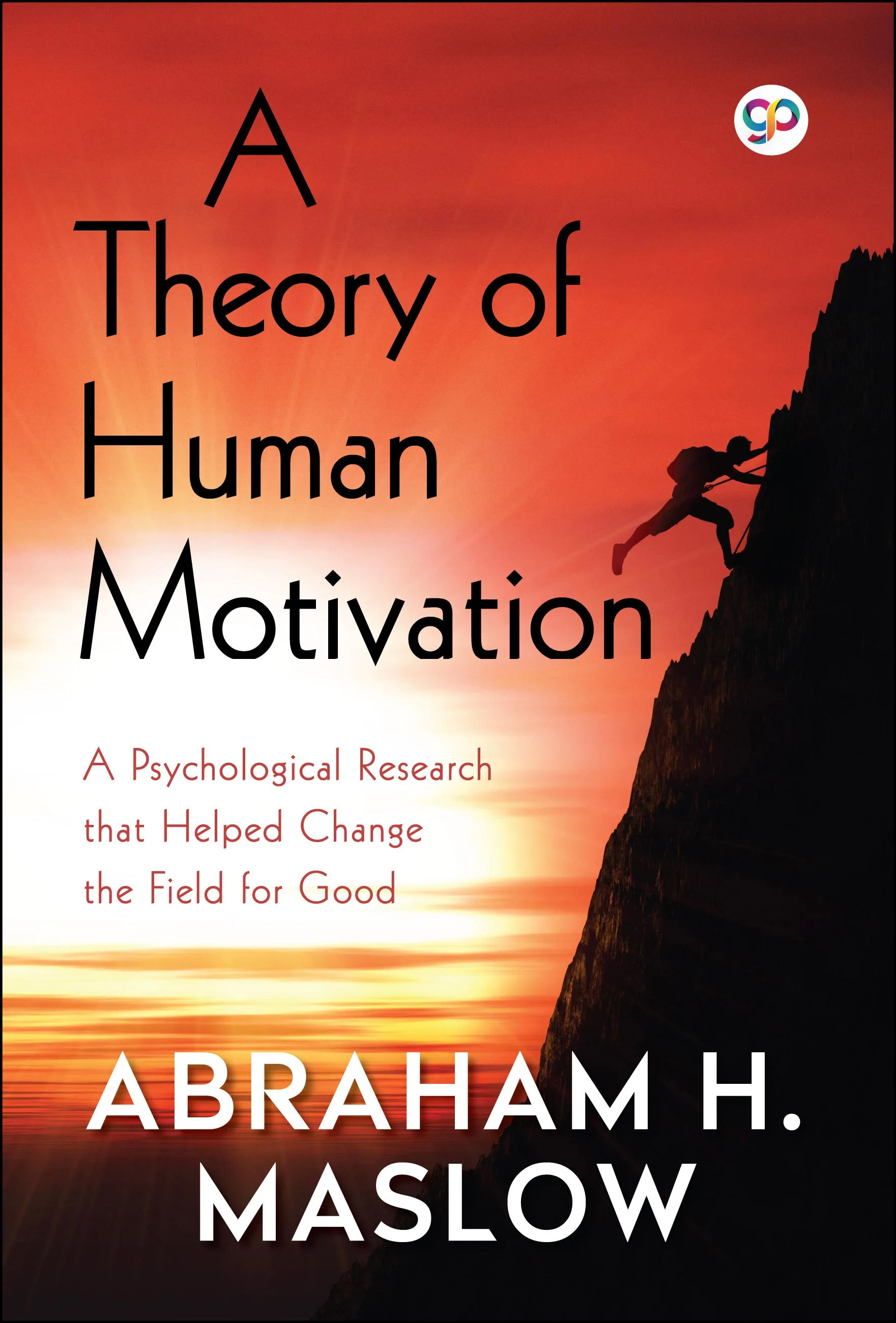
A Theory of Human Motivation
eBook
• INR 86.00
• English
• 9789388760317
No ratings yet
| Publisher | General Press |
|---|---|
| ISBN13 | 9789388760317 |
| ASIN/SKU | B07NLKT3QP |
| Book Format | eBook |
| Language | English |
| List Price | INR 86.00 |
| Subject Code | PSY000000, SEL000000, EDU000000, BUS107000 |
| Publishing Date | 11/02/2019 |
| Book Code | BD00068558 |
Buy this Book
Amazon Stores
Ebook Stores
Other Stores
Discover A Theory of Human Motivation by Abraham H. Maslow. This book is published by General Press in eBook format, ISBN 9789388760317, ASIN B07NLKT3QP, under Self-Help, Motivational, Psychology.
Book Description
'A Theory of Human Motivation' by Abraham H. Maslow is one of the most influential works in the history of psychology — a compact but profound piece of academic non-fiction that first appeared as a journal paper in 1943 and went on to reshape how educators, managers, therapists, and everyday people think about what drives human behavior. Few ideas in modern psychology have traveled as far or sunk as deep into popular culture as the framework Maslow introduces here, and reading the original text reveals just how carefully and humanely it was constructed.
Maslow begins from a deceptively simple premise: that human beings are motivated by needs, and that those needs are not all equal. Rather than treating motivation as a single force, he proposes that our needs are arranged in a hierarchy — a layered structure where more basic needs must be reasonably satisfied before higher ones begin to exert their pull. At the foundation sit the purely physical needs: food, water, shelter, sleep. Above those rise safety and security, then the need for love and belonging, then esteem and recognition. And at the very top of the pyramid sits what Maslow calls self-actualization — the deeply human drive to become fully what one is capable of being.
What makes the paper so enduring is not just the elegance of the framework but the warmth and curiosity behind it. Maslow writes as someone genuinely fascinated by human potential rather than human pathology. At a time when psychology was dominated by the study of disorder and dysfunction, he turned his attention toward flourishing — toward understanding what people look like when things go right, not just when they go wrong.
He is also careful to acknowledge the messiness of real human life. The hierarchy is not a rigid ladder, he reminds us, and most people are simultaneously motivated by needs at several levels at once. The model is a lens, not a formula. Reading this foundational text today, you realize that the question Maslow was really asking is one that never goes out of date: what does it actually mean to live a fully human life — and what gets in the way?
Maslow begins from a deceptively simple premise: that human beings are motivated by needs, and that those needs are not all equal. Rather than treating motivation as a single force, he proposes that our needs are arranged in a hierarchy — a layered structure where more basic needs must be reasonably satisfied before higher ones begin to exert their pull. At the foundation sit the purely physical needs: food, water, shelter, sleep. Above those rise safety and security, then the need for love and belonging, then esteem and recognition. And at the very top of the pyramid sits what Maslow calls self-actualization — the deeply human drive to become fully what one is capable of being.
What makes the paper so enduring is not just the elegance of the framework but the warmth and curiosity behind it. Maslow writes as someone genuinely fascinated by human potential rather than human pathology. At a time when psychology was dominated by the study of disorder and dysfunction, he turned his attention toward flourishing — toward understanding what people look like when things go right, not just when they go wrong.
He is also careful to acknowledge the messiness of real human life. The hierarchy is not a rigid ladder, he reminds us, and most people are simultaneously motivated by needs at several levels at once. The model is a lens, not a formula. Reading this foundational text today, you realize that the question Maslow was really asking is one that never goes out of date: what does it actually mean to live a fully human life — and what gets in the way?
Author Biography
Abraham Harold Maslow was an American psychologist who was best known for creating Maslow's hierarchy of needs, a theory of psychological health predicated on fulfilling innate human needs in priority, culminating in self-actualization. He stressed the importance of focusing on the positive qualities in people.
Editorial Reviews
Editorial Reviews will be added soon…
Book Summary
Abraham H. Maslow’s A Theory of Human Motivation, first published in 1943, is one of the most influential works in modern psychology. Although often treated as a short book, it was originally an academic paper in which Maslow proposed a new way of understanding why human beings behave as they do. Instead of explaining people mainly through fear, conflict, conditioning, or instinct, Maslow argued that human behavior is driven by a series of needs. These needs range from basic physical requirements, such as food and sleep, to higher aspirations involving love, self-respect, creativity, and personal fulfillment.
Maslow’s central idea is that human beings are motivated by unmet needs. When an important need is not satisfied, it becomes a powerful source of motivation. Once that need is reasonably fulfilled, attention can shift toward other needs. This creates a progression from basic survival toward psychological and personal development.
Maslow begins by criticizing approaches to psychology that attempt to explain human motivation through a single principle. Human behavior, he argues, is much more complicated. People may act because they are hungry, afraid, lonely, ambitious, curious, or eager to create something meaningful. Several motives can operate at the same time, and the same behavior may satisfy different needs.
He also emphasizes that motivation is often hierarchical. Some needs generally become more urgent when lower-level needs have not been satisfied. A starving person, for example, is likely to think primarily about finding food rather than about artistic achievement or social recognition. This does not mean that higher needs disappear when lower needs are threatened, but their relative importance can change dramatically.
At the foundation of Maslow’s theory are physiological needs. These include food, water, oxygen, sleep, warmth, and other conditions necessary for physical survival. When these needs are severely deprived, they can dominate a person's entire psychological life. A person who is desperately hungry may find it difficult to concentrate on relationships, achievement, morality, or long-term goals.
Once physiological needs are reasonably satisfied, safety needs become more important. Human beings seek protection, stability, order, predictability, and freedom from danger. Children particularly demonstrate this need because they depend heavily on adults for security. Adults also seek safety through stable employment, financial security, familiar surroundings, laws, social institutions, and protection from physical or emotional threats.
The next level involves love and belongingness needs. Human beings are social creatures, and satisfying physical and safety needs is not enough for a fulfilling life. People want friendship, affection, family relationships, intimacy, and a sense of belonging. They want to love and to be loved.
Maslow argues that modern societies can create conditions in which people experience profound loneliness despite material comfort. A person may have food, housing, and security yet still feel psychologically deprived because they lack meaningful relationships. This explains why rejection, isolation, and the loss of important relationships can have such a powerful effect on human well-being.
After belonging comes esteem. People generally want to feel that they are capable, valuable, and worthy of respect. Maslow divides esteem into two broad forms. One involves an internal sense of competence, achievement, independence, and mastery. The other involves the desire for recognition, appreciation, status, and respect from other people.
Healthy esteem is not simply about receiving praise. It involves developing genuine confidence based on real abilities and accomplishments. When esteem needs are frustrated, people may experience feelings of weakness, helplessness, inferiority, or worthlessness. When they are reasonably satisfied, individuals are more likely to feel capable of dealing with life's challenges.
Above these needs lies what Maslow calls self-actualization. This is perhaps the most famous part of his theory. Self-actualization refers to the desire to become what one is capable of becoming—to realize one's potential and live in accordance with one's deepest abilities and values.
For Maslow, self-actualization can take many forms. An artist may need to create art, a scientist may need to discover and understand, a teacher may need to educate, and a person with a strong moral calling may need to contribute to society. Self-actualization is therefore not one specific achievement. It is the process of becoming more fully oneself.
Maslow famously describes the self-actualizing person as someone who is able to use their abilities creatively and meaningfully rather than merely seeking approval or security. Such people are not necessarily perfect. They still have weaknesses, conflicts, and ordinary human problems. What distinguishes them is that they are more concerned with fulfilling meaningful purposes than with simply satisfying lower-level desires.
An important part of Maslow’s argument is that needs do not operate like rigid steps on a staircase. The hierarchy is better understood as a general pattern than as an absolute rule. People can experience love while they are poor, create art while suffering, or sacrifice personal safety for a deeply held principle. Human beings are complicated, and higher motivations can sometimes become stronger even when lower needs remain unsatisfied.
Maslow also distinguishes between basic or deficiency needs and higher forms of motivation. Physiological, safety, love, and esteem needs are often called deficiency needs because their absence creates tension that motivates a person to obtain what is missing. Once reasonably satisfied, these needs become less dominant.
Self-actualization works differently. It is a growth need. Rather than becoming weaker when satisfied, the desire to develop one's abilities can become stronger. The more a person learns, creates, understands, or contributes, the more possibilities they may see for further growth.
This distinction leads to one of Maslow’s most optimistic ideas: human beings are not motivated only by what they lack. They can also be motivated by the desire to grow, create, understand, and become better versions of themselves.
Maslow also discusses cognitive needs, particularly the desire to know and understand. Human beings naturally seek knowledge, meaning, explanation, and order. Curiosity is therefore not merely a luxury. It is part of human motivation. Maslow suggests that the desire to understand can become especially important once more basic needs have been sufficiently satisfied.
He also recognizes the importance of aesthetic needs. People often seek beauty, order, balance, and harmony. Art, nature, music, design, and beautiful surroundings can contribute to psychological well-being. This suggests that human beings need more than physical survival and social acceptance; they also seek experiences that enrich the senses and imagination.
Maslow's theory ultimately presents human development as a movement from survival toward fulfillment. A person begins life heavily dependent on basic needs but can gradually develop more complex psychological motivations. The ideal is not simply to accumulate wealth or social status but to create the conditions in which one's deeper capacities can emerge.
The theory also has an important social implication. If people are constantly struggling for food, safety, shelter, or acceptance, it becomes harder for them to develop their higher potential. A healthy society, therefore, should not only protect people from physical deprivation but also provide opportunities for education, meaningful relationships, creativity, dignity, and personal growth.
At its heart, A Theory of Human Motivation offers a hopeful view of human nature. Maslow does not see people as driven exclusively by selfish impulses or fear. He believes that, under supportive conditions, human beings possess an inherent tendency toward development and fulfillment.
The lasting importance of Maslow’s theory lies in this broader vision. Human beings want to survive, but they also want to belong, to matter, to understand, to create, and ultimately to become fully themselves. Maslow reminds us that a person cannot be understood simply by asking what they currently do. We must also ask what they need, what they value, what they are missing, and what they might become if given the opportunity to grow.
The central message of the essay is therefore both psychological and deeply human: motivation is not merely the struggle to satisfy immediate needs; it is also the lifelong movement toward meaning, capability, creativity, and the realization of one's potential.
Maslow’s central idea is that human beings are motivated by unmet needs. When an important need is not satisfied, it becomes a powerful source of motivation. Once that need is reasonably fulfilled, attention can shift toward other needs. This creates a progression from basic survival toward psychological and personal development.
Maslow begins by criticizing approaches to psychology that attempt to explain human motivation through a single principle. Human behavior, he argues, is much more complicated. People may act because they are hungry, afraid, lonely, ambitious, curious, or eager to create something meaningful. Several motives can operate at the same time, and the same behavior may satisfy different needs.
He also emphasizes that motivation is often hierarchical. Some needs generally become more urgent when lower-level needs have not been satisfied. A starving person, for example, is likely to think primarily about finding food rather than about artistic achievement or social recognition. This does not mean that higher needs disappear when lower needs are threatened, but their relative importance can change dramatically.
At the foundation of Maslow’s theory are physiological needs. These include food, water, oxygen, sleep, warmth, and other conditions necessary for physical survival. When these needs are severely deprived, they can dominate a person's entire psychological life. A person who is desperately hungry may find it difficult to concentrate on relationships, achievement, morality, or long-term goals.
Once physiological needs are reasonably satisfied, safety needs become more important. Human beings seek protection, stability, order, predictability, and freedom from danger. Children particularly demonstrate this need because they depend heavily on adults for security. Adults also seek safety through stable employment, financial security, familiar surroundings, laws, social institutions, and protection from physical or emotional threats.
The next level involves love and belongingness needs. Human beings are social creatures, and satisfying physical and safety needs is not enough for a fulfilling life. People want friendship, affection, family relationships, intimacy, and a sense of belonging. They want to love and to be loved.
Maslow argues that modern societies can create conditions in which people experience profound loneliness despite material comfort. A person may have food, housing, and security yet still feel psychologically deprived because they lack meaningful relationships. This explains why rejection, isolation, and the loss of important relationships can have such a powerful effect on human well-being.
After belonging comes esteem. People generally want to feel that they are capable, valuable, and worthy of respect. Maslow divides esteem into two broad forms. One involves an internal sense of competence, achievement, independence, and mastery. The other involves the desire for recognition, appreciation, status, and respect from other people.
Healthy esteem is not simply about receiving praise. It involves developing genuine confidence based on real abilities and accomplishments. When esteem needs are frustrated, people may experience feelings of weakness, helplessness, inferiority, or worthlessness. When they are reasonably satisfied, individuals are more likely to feel capable of dealing with life's challenges.
Above these needs lies what Maslow calls self-actualization. This is perhaps the most famous part of his theory. Self-actualization refers to the desire to become what one is capable of becoming—to realize one's potential and live in accordance with one's deepest abilities and values.
For Maslow, self-actualization can take many forms. An artist may need to create art, a scientist may need to discover and understand, a teacher may need to educate, and a person with a strong moral calling may need to contribute to society. Self-actualization is therefore not one specific achievement. It is the process of becoming more fully oneself.
Maslow famously describes the self-actualizing person as someone who is able to use their abilities creatively and meaningfully rather than merely seeking approval or security. Such people are not necessarily perfect. They still have weaknesses, conflicts, and ordinary human problems. What distinguishes them is that they are more concerned with fulfilling meaningful purposes than with simply satisfying lower-level desires.
An important part of Maslow’s argument is that needs do not operate like rigid steps on a staircase. The hierarchy is better understood as a general pattern than as an absolute rule. People can experience love while they are poor, create art while suffering, or sacrifice personal safety for a deeply held principle. Human beings are complicated, and higher motivations can sometimes become stronger even when lower needs remain unsatisfied.
Maslow also distinguishes between basic or deficiency needs and higher forms of motivation. Physiological, safety, love, and esteem needs are often called deficiency needs because their absence creates tension that motivates a person to obtain what is missing. Once reasonably satisfied, these needs become less dominant.
Self-actualization works differently. It is a growth need. Rather than becoming weaker when satisfied, the desire to develop one's abilities can become stronger. The more a person learns, creates, understands, or contributes, the more possibilities they may see for further growth.
This distinction leads to one of Maslow’s most optimistic ideas: human beings are not motivated only by what they lack. They can also be motivated by the desire to grow, create, understand, and become better versions of themselves.
Maslow also discusses cognitive needs, particularly the desire to know and understand. Human beings naturally seek knowledge, meaning, explanation, and order. Curiosity is therefore not merely a luxury. It is part of human motivation. Maslow suggests that the desire to understand can become especially important once more basic needs have been sufficiently satisfied.
He also recognizes the importance of aesthetic needs. People often seek beauty, order, balance, and harmony. Art, nature, music, design, and beautiful surroundings can contribute to psychological well-being. This suggests that human beings need more than physical survival and social acceptance; they also seek experiences that enrich the senses and imagination.
Maslow's theory ultimately presents human development as a movement from survival toward fulfillment. A person begins life heavily dependent on basic needs but can gradually develop more complex psychological motivations. The ideal is not simply to accumulate wealth or social status but to create the conditions in which one's deeper capacities can emerge.
The theory also has an important social implication. If people are constantly struggling for food, safety, shelter, or acceptance, it becomes harder for them to develop their higher potential. A healthy society, therefore, should not only protect people from physical deprivation but also provide opportunities for education, meaningful relationships, creativity, dignity, and personal growth.
At its heart, A Theory of Human Motivation offers a hopeful view of human nature. Maslow does not see people as driven exclusively by selfish impulses or fear. He believes that, under supportive conditions, human beings possess an inherent tendency toward development and fulfillment.
The lasting importance of Maslow’s theory lies in this broader vision. Human beings want to survive, but they also want to belong, to matter, to understand, to create, and ultimately to become fully themselves. Maslow reminds us that a person cannot be understood simply by asking what they currently do. We must also ask what they need, what they value, what they are missing, and what they might become if given the opportunity to grow.
The central message of the essay is therefore both psychological and deeply human: motivation is not merely the struggle to satisfy immediate needs; it is also the lifelong movement toward meaning, capability, creativity, and the realization of one's potential.
Sample Chapters
Sample Chapters will be added soon…
Reader Reviews
No reviews yet.
A Theory of Human Motivation
Download Cover Image
Do you want to download the full cover image for A Theory of Human Motivation?