
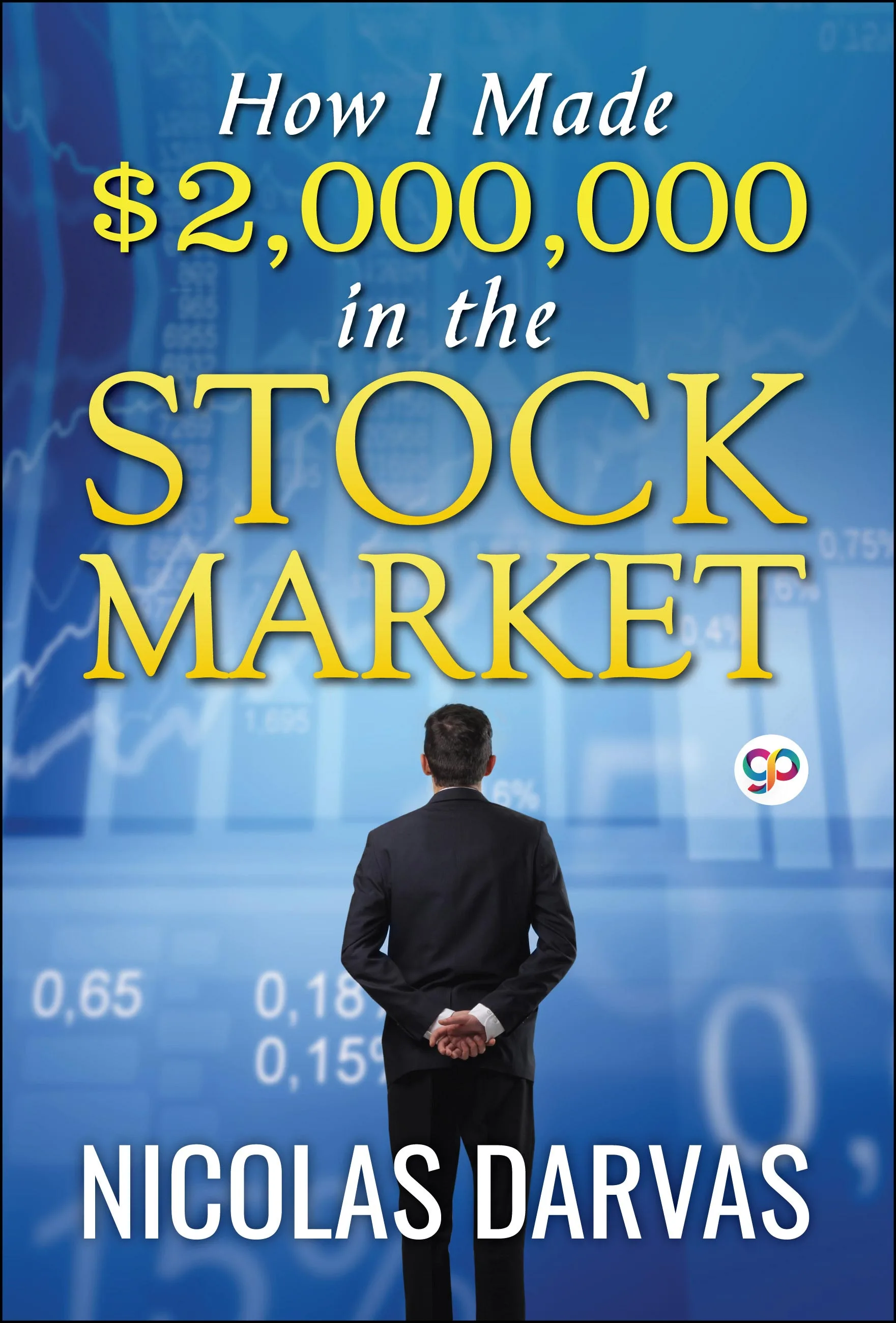
How I Made $2,000,000 in the Stock Market
eBook
• INR 51.00
• English
• 9789389157697
No ratings yet
| Publisher | General Press |
|---|---|
| ISBN13 | 9789389157697 |
| ASIN/SKU | B07VB5ND9F |
| Book Format | eBook |
| Language | English |
| List Price | INR 51.00 |
| Subject Code | BUS036060, BUS036070, BUS050020 |
| Publishing Date | 16/07/2019 |
| Book Code | BD00068603 |
Buy this Book
Amazon Stores
Ebook Stores
Other Stores
Discover How I Made $2,000,000 in the Stock Market by Nicolas Darvas. This book is published by General Press in eBook format, ISBN 9789389157697, ASIN B07VB5ND9F, under Business and Money, Stock Market Investing, Investment Analysis and Strategy.
Book Description
'How I Made $2,000,000 in the Stock Market' by Nicolas Darvas is a remarkable blend of autobiography, investing guide, and personal success story. First published in 1960, the book chronicles how Darvas, a professional dancer with no formal background in finance, transformed himself into one of the most successful stock market investors of his time. Through careful observation, disciplined decision-making, and continuous learning, he turned a modest investment into a fortune worth two million dollars.
Rather than relying on tips, rumors, or emotional reactions, Darvas developed his own systematic approach to investing, later known as the "Box Theory." He learned to identify stocks that were steadily rising in price and breaking through established trading ranges, believing that strong price movements often reflected growing business strength. Equally important, he emphasized protecting his capital by using strict stop-loss orders and exiting trades when the market proved his judgment wrong.
Throughout the book, Darvas openly shares both his costly mistakes and his greatest successes, making his journey relatable and authentic. He explains how patience, discipline, and emotional control are far more valuable than attempting to predict every market movement. His experiences demonstrate that successful investing depends on following a well-tested strategy rather than chasing excitement or quick profits.
Written in a straightforward and engaging style, 'How I Made $2,000,000 in the Stock Market' remains a timeless classic for investors. Its lessons on risk management, independent thinking, and disciplined execution continue to inspire readers seeking long-term success in the ever-changing world of the stock market.
Rather than relying on tips, rumors, or emotional reactions, Darvas developed his own systematic approach to investing, later known as the "Box Theory." He learned to identify stocks that were steadily rising in price and breaking through established trading ranges, believing that strong price movements often reflected growing business strength. Equally important, he emphasized protecting his capital by using strict stop-loss orders and exiting trades when the market proved his judgment wrong.
Throughout the book, Darvas openly shares both his costly mistakes and his greatest successes, making his journey relatable and authentic. He explains how patience, discipline, and emotional control are far more valuable than attempting to predict every market movement. His experiences demonstrate that successful investing depends on following a well-tested strategy rather than chasing excitement or quick profits.
Written in a straightforward and engaging style, 'How I Made $2,000,000 in the Stock Market' remains a timeless classic for investors. Its lessons on risk management, independent thinking, and disciplined execution continue to inspire readers seeking long-term success in the ever-changing world of the stock market.
Author Biography
Before emigrating to America, Darvas studied economics at the University of Budapest. Arriving in the US in 1951, Darvas trained with his half-sister, Julia, to be a ballroom dancer, becoming extremely succesful and touring the world by 1956. He discovered investing in 1952, when a Toronto nightclub, unable to pay him in cash, instead paid him with shares. It was on a two-year tour of the world that he initially developed his 'Darvas Box' method of screening stocks - a method of picking stocks based on the stock's price and volume - and later went on to refine this to remove any human element from his trading to susbtantial success. Nicolas Darvas is regarded as one of the best traders in the history of the market and his method, whilst complicated and difficult to master, has been rigorously tested and has been found to be one of the best trading systems yet developed.
Editorial Reviews
Editorial Reviews will be added soon…
Book Summary
Nicolas Darvas’s "How I Made $2,000,000 in the Stock Market" is a seminal classic in financial literature, offering a remarkably candid and autobiographical account of a complete amateur’s triumph over Wall Street. Published in 1960, the book does not read like a dense financial textbook, but rather as an engaging, fast-paced memoir. Darvas was not a financial analyst, an economist, or a seasoned trader; he was one half of the highest-paid ballroom dancing duo in the world. His journey from an oblivious outsider who did not know the difference between a stock and a bond to a multi-millionaire trader is a masterclass in independent thinking, relentless self-correction, and emotional discipline.
Darvas’s introduction to the stock market was entirely accidental, beginning with a fortuitous tip. A Canadian nightclub owner paid him in stock for a performance, giving him shares of a mining company called Brilund. Darvas promptly forgot about the shares for several months, only to discover later that they had dramatically increased in value, netting him a swift and effortless profit of nearly $8,000. This accidental windfall infected him with the speculative virus. He immediately entered what he later called his "gambler" phase, treating the stock market like a casino. He subscribed to tip sheets, listened to the breathless rumors of fellow dancers and stagehands, and followed the well-meaning but deeply flawed advice of brokers.
Unsurprisingly, the initial gambler's luck quickly evaporated, and Darvas steadily lost his capital. Refusing to accept defeat, he concluded that relying on tips was foolish and decided he needed a more professional, educated approach. He pivoted to purely fundamental analysis. Darvas began studying corporate balance sheets, analyzing price-to-earnings ratios, evaluating dividend yields, and reading the financial reports of the companies he invested in. He assumed that by buying historically strong, fundamentally sound companies, he would guarantee his success. However, he soon suffered a crushing realization during a trade with Jones & Laughlin Steel: even when a company reports record-breaking earnings, the stock price can still plummet. He learned the hard way that Wall Street often prices in fundamental news long before the public receives it.
Disillusioned with fundamental analysis, Darvas underwent a radical shift in his thinking, abandoning corporate reports entirely in favor of studying pure price action and volume. By tracking the daily movements of individual stocks, he began to notice distinct, rhythmic patterns. He realized that a stock with strong upward momentum did not travel in a straight, uninterrupted line; instead, it moved in a series of steps, or what he famously coined as "boxes." A stock would surge to a new high (the top of the box), retreat slightly to a new support level (the bottom of the box), and bounce between these two limits for a period of time before breaking out again. This visual framework became his legendary Box Theory.
The application of the Box Theory required immense patience and strict observational discipline. Darvas trained himself to identify a stock that was establishing a clear box pattern, particularly one experiencing a sudden, unexplained surge in trading volume. He would not attempt to buy at the bottom of the box to guess the absolute low. Instead, he waited for absolute confirmation of strength. His buy signal was triggered only when the stock's price definitively broke through the top of its established box on high volume. This breakout indicated that institutional accumulation was taking place and that the stock was ready to advance to a higher, more profitable box.
However, Darvas understood that even the most promising breakout could be a false alarm, and his most profound revelation was the absolute necessity of risk management. Whenever he initiated a purchase, he immediately placed a mechanical, automatic stop-loss order just a fraction of a point below his purchase price, or just below the floor of the newly established box. If the stock broke downward, violating the pattern, his broker would automatically sell his shares. Darvas accepted these small, frequent losses as simply the cost of doing business. By ruthlessly cutting his losses short, he removed ego and emotion from his failures, ensuring that a single bad trade could never devastate his portfolio.
While the technical Box Theory and the strict stop-loss protected his capital, Darvas eventually refined his system into a hybrid approach he called "techno-fundamentalism." He realized that the greatest, most explosive stock market winners possessed both technical strength and a compelling fundamental narrative. He stopped looking at mundane, established companies and started hunting for stocks in entirely new, disruptive industries—companies developing revolutionary products, cutting-edge electronics, or new rocket fuels. His ideal trade became a company that possessed a highly anticipated, future-focused fundamental story, but he would only buy it if its stock price and volume technically confirmed that story by breaking into higher boxes.
The ultimate test of Darvas’s system, however, was not analytical, but psychological. He discovered that his greatest enemy was the constant, chaotic noise of Wall Street itself. Whenever he visited a brokerage office, the ticker tape, the frantic rumors, and the persuasive opinions of brokers invariably clouded his judgment, causing him to abandon his rules and trade impulsively. To conquer this, Darvas imposed a state of strict isolation. While traveling the globe on world tours, he required his broker to send him a simple daily telegram containing nothing but the closing prices and volume of a few selected stocks. Stripped of all news, opinions, and emotional panic, he could view the market with cold, objective clarity.
This combination of the Box Theory, the trailing stop-loss, the techno-fundamental filter, and absolute psychological isolation paved the way for his monumental success during the bull market of the late 1950s. He confidently rode massive, historic trends in companies like Lorillard, Diners Club, and Texas Instruments. Crucially, as these stocks entered higher and higher boxes, he did not cash out to secure a quick profit; instead, he aggressively pyramided his positions, buying more shares while continually raising his stop-loss to lock in his gains. He allowed his winners to run to their absolute maximum potential, ultimately compounding his initial, modest stakes into a fortune of over two million dollars.
Today, "How I Made $2,000,000 in the Stock Market" remains required reading for traders and investors of all levels, not necessarily because the Box Theory is a magical formula, but because the psychological framework Darvas built is timeless. The book is an enduring testament to the power of a disciplined, mechanical system over human emotion. Darvas proved that sustained success in the markets does not require inside information, a degree in finance, or the ability to predict the future. Instead, it requires the humility to accept when you are wrong, the discipline to cut losses immediately, the courage to let winning trades run, and the wisdom to entirely ignore the noise of the crowd.
Darvas’s introduction to the stock market was entirely accidental, beginning with a fortuitous tip. A Canadian nightclub owner paid him in stock for a performance, giving him shares of a mining company called Brilund. Darvas promptly forgot about the shares for several months, only to discover later that they had dramatically increased in value, netting him a swift and effortless profit of nearly $8,000. This accidental windfall infected him with the speculative virus. He immediately entered what he later called his "gambler" phase, treating the stock market like a casino. He subscribed to tip sheets, listened to the breathless rumors of fellow dancers and stagehands, and followed the well-meaning but deeply flawed advice of brokers.
Unsurprisingly, the initial gambler's luck quickly evaporated, and Darvas steadily lost his capital. Refusing to accept defeat, he concluded that relying on tips was foolish and decided he needed a more professional, educated approach. He pivoted to purely fundamental analysis. Darvas began studying corporate balance sheets, analyzing price-to-earnings ratios, evaluating dividend yields, and reading the financial reports of the companies he invested in. He assumed that by buying historically strong, fundamentally sound companies, he would guarantee his success. However, he soon suffered a crushing realization during a trade with Jones & Laughlin Steel: even when a company reports record-breaking earnings, the stock price can still plummet. He learned the hard way that Wall Street often prices in fundamental news long before the public receives it.
Disillusioned with fundamental analysis, Darvas underwent a radical shift in his thinking, abandoning corporate reports entirely in favor of studying pure price action and volume. By tracking the daily movements of individual stocks, he began to notice distinct, rhythmic patterns. He realized that a stock with strong upward momentum did not travel in a straight, uninterrupted line; instead, it moved in a series of steps, or what he famously coined as "boxes." A stock would surge to a new high (the top of the box), retreat slightly to a new support level (the bottom of the box), and bounce between these two limits for a period of time before breaking out again. This visual framework became his legendary Box Theory.
The application of the Box Theory required immense patience and strict observational discipline. Darvas trained himself to identify a stock that was establishing a clear box pattern, particularly one experiencing a sudden, unexplained surge in trading volume. He would not attempt to buy at the bottom of the box to guess the absolute low. Instead, he waited for absolute confirmation of strength. His buy signal was triggered only when the stock's price definitively broke through the top of its established box on high volume. This breakout indicated that institutional accumulation was taking place and that the stock was ready to advance to a higher, more profitable box.
However, Darvas understood that even the most promising breakout could be a false alarm, and his most profound revelation was the absolute necessity of risk management. Whenever he initiated a purchase, he immediately placed a mechanical, automatic stop-loss order just a fraction of a point below his purchase price, or just below the floor of the newly established box. If the stock broke downward, violating the pattern, his broker would automatically sell his shares. Darvas accepted these small, frequent losses as simply the cost of doing business. By ruthlessly cutting his losses short, he removed ego and emotion from his failures, ensuring that a single bad trade could never devastate his portfolio.
While the technical Box Theory and the strict stop-loss protected his capital, Darvas eventually refined his system into a hybrid approach he called "techno-fundamentalism." He realized that the greatest, most explosive stock market winners possessed both technical strength and a compelling fundamental narrative. He stopped looking at mundane, established companies and started hunting for stocks in entirely new, disruptive industries—companies developing revolutionary products, cutting-edge electronics, or new rocket fuels. His ideal trade became a company that possessed a highly anticipated, future-focused fundamental story, but he would only buy it if its stock price and volume technically confirmed that story by breaking into higher boxes.
The ultimate test of Darvas’s system, however, was not analytical, but psychological. He discovered that his greatest enemy was the constant, chaotic noise of Wall Street itself. Whenever he visited a brokerage office, the ticker tape, the frantic rumors, and the persuasive opinions of brokers invariably clouded his judgment, causing him to abandon his rules and trade impulsively. To conquer this, Darvas imposed a state of strict isolation. While traveling the globe on world tours, he required his broker to send him a simple daily telegram containing nothing but the closing prices and volume of a few selected stocks. Stripped of all news, opinions, and emotional panic, he could view the market with cold, objective clarity.
This combination of the Box Theory, the trailing stop-loss, the techno-fundamental filter, and absolute psychological isolation paved the way for his monumental success during the bull market of the late 1950s. He confidently rode massive, historic trends in companies like Lorillard, Diners Club, and Texas Instruments. Crucially, as these stocks entered higher and higher boxes, he did not cash out to secure a quick profit; instead, he aggressively pyramided his positions, buying more shares while continually raising his stop-loss to lock in his gains. He allowed his winners to run to their absolute maximum potential, ultimately compounding his initial, modest stakes into a fortune of over two million dollars.
Today, "How I Made $2,000,000 in the Stock Market" remains required reading for traders and investors of all levels, not necessarily because the Box Theory is a magical formula, but because the psychological framework Darvas built is timeless. The book is an enduring testament to the power of a disciplined, mechanical system over human emotion. Darvas proved that sustained success in the markets does not require inside information, a degree in finance, or the ability to predict the future. Instead, it requires the humility to accept when you are wrong, the discipline to cut losses immediately, the courage to let winning trades run, and the wisdom to entirely ignore the noise of the crowd.
Sample Chapters
The Gambler
Chapter 1 : Canadian Period
It was November 1952. I was playing in Manhattan’s “Latin Quarter” in New York when my agent telephoned. He had received an offer for me and my dancing partner, Julia, to appear in a Toronto nightclub. This was owned by twin brothers, Al and Harry Smith, who made me a very unusual proposition. They offered to pay me in stock instead of money. I have had some strange experiences in show business, but this was a new one.
I made further inquiries and found they were prepared to give me 6,000 shares in a company called BRILUND. This was a Canadian mining firm in which they were interested. The stock at that time was quoted at 50 cents a share.
I knew stocks went up and down—that was about all I did know—so I asked the Smith brothers if they would give me the following guarantee: if the stock went below 50 cents, they would make up the difference. They agreed to do this for a period of six months.
It so happened that I could not keep that Toronto date. I felt badly about letting the brothers down, so I offered to buy the stock as a gesture. I sent them a check for $3,000 and received 6,000 shares of BRILUND stock.
I thought no more about it until one day, two months later, I idly glanced at the stock’s price in the paper. I shot upright in my chair. My 50-cent BRILUND stock was quoted at $1.90. I sold it at once and made a profit of close to $8,000.
At first I could not believe it. It was like magic to me. I felt like the man who went to the races for the first time and with beginner’s luck backed every winner. Cashing his winnings he simply inquired: “How long has this been going on?”
I decided I had been missing a good thing all my life. I made up my mind to go into the stock market. I have never gone back on this decision, but little did I know what problems I would encounter in this unknown jungle.
I knew absolutely nothing about the stock market. I was not even aware, for instance, that there was one in New York. All I had heard about were Canadian stocks, particularly mining shares. As they had been very good to me, obviously the smart thing to do was to stay with them.
But how to start? How to find what stocks to buy? You could not pick them out with a pin. You must have information. That was my major problem: how to obtain it. I now realize that this is, in fact, impossible for the ordinary man, but then I thought I had only to ask enough people to learn the great secret. I thought if I asked often enough I would get acquainted with people in the know. I asked everybody I met if they had any stock market information. Working in nightclubs I meet rich people. Rich people must know.
So I asked them. The question was always on my lips: “Do you know a good stock?” Oddly enough, everybody did seem to know one. It was surprising. Apparently I was the only man in America who did not have his own first-hand stock market information. I listened eagerly to what they had to say and religiously followed their tips. Whatever I was told to buy, I bought. It took me a long time to discover that this is one method that never works.
I was the perfect pattern of the optimistic, clueless small operator who plunges repeatedly in and out of the market. I bought stock in companies whose names I could not pronounce. What they did and where they came from, I had no idea. Someone told someone who told me. There could have been no more slaphappy, ignorant buyer than I was. All I knew was what the last headwaiter in the last nightclub I had performed in had told me was good.
Early in 1953 I was performing in Toronto. Because of my first extraordinary $8,000 break with BRILUND, Canada was the land of financial milk and honey as far as I was concerned, so I decided this was a good place to go looking for a “hot tip.” I asked several people if they knew a good, reliable broker, and eventually I was recommended to one.
I must admit I was startled and disappointed when I found his office. It was a tiny, dingy, prison-like room full of books, with strange scrawls on the walls. Later I found out that these are called “charts.” There did not seem much smell of success or efficiency. Sitting at a rolltop desk was a busy little man poring over statistics and books. When I asked him if he knew a good stock he reacted at once.
He smiled and pulled out of his pocket a dividend check bearing the name of a famous gold company, KERR-ADDISON.
He stood up and said: “My friend, take a good look at that. That dividend check is worth five times what my father paid for the original stock. That is the sort of stock everyone looks for.”
A dividend five times the price of the original stock! This excited me as it would any man. The dividend was 80 cents so his father must have paid only 16 cents for the stock. It looked beautiful to me. I did not realize he had probably been holding his father’s stock for thirty-five years.
The little man described to me how he had been looking for that kind of stock for years. In view of his father’s success he felt the answer must be in gold mines. He confided to me that he had at last found it. It was called EASTERN MALARTIC. Working with his production figures, estimates and financial information, he reckoned that these gold mines were capable of twice their present gold production, therefore five dollars invested in their stock would soon be worth ten dollars.
On this piece of erudite information I immediately bought 1,000 shares of EASTERN MALARTIC at 290 cents. As I watched anxiously, it went to 270 cents, then to 260. Within weeks it was down to 241 cents, and I hastily sold my stock. I decided this painstaking, statistically minded broker did not have the answer to making a fortune.
Yet the whole thing continued to fascinate me. I went on following any tip but I seldom made money. If I did, it was immediately offset by my losses.
I was such a novice that I did not even understand about broker’s commission and transfer taxes. For instance, I bought KAYRAND MINES in January 1953. It was a 10-cent stock, and I bought 10,000 shares.
I watched the market like a cat and when next day KAYRAND went to 11 cents per share, I called my broker and told him to sell. By my reckoning I had made $100 in 24 hours, and I thought I was being smart by taking a quick small profit.
When I talked to my broker again he said: “Why did you decide to take a loss?”—“A loss?” I had made a hundred dollars!
He gently explained to me that the broker’s commission for buying 10,000 shares was $50, and for reselling the shares next day it was another $50. In addition, there were transfer taxes on the sale. KAYRAND was just one of the many strange stocks I owned at that time. Others included MOGUL MINES, CONSOLIDATED SUDBURY BASIN MINES, QUEBEC SMELTING, REXSPAR, JAYE EXPLORATION. I made money on none of them.
Yet I spent a happy year on this Canadian buying and selling. I felt I was the successful businessman, the big stock market operator. I jumped in and out of the market like a grasshopper. I was delighted if I made two points. I often owned 25 to 30 stocks at one time, all in small parcels.
For some of them I acquired a special liking. This came about for different reasons. Sometimes it was because they were given to me by a good friend of mine—other times, because I had started by making money with them. This led me to prefer these stocks more than others, and before I knew what I was doing I had started to keep “pets.”
I thought of them as something belonging to me, like members of my family. I praised their virtues day and night. I talked about them as one talks about his children. It did not bother me that no one else could see any special virtue in my pet stocks to distinguish them from any other stocks. This state of mind lasted until I realized that my pet stocks were causing me my heaviest losses.
In a few months my record of transactions looked like the trading record of a small-scale stock exchange. I felt I was doing all right. I appeared to be ahead. If I had carefully studied my statements I would not have felt quite so happy. I would have realized that, like a horse player, I was buoyed up and excited by small gains, and overlooked my losses. I completely ignored the fact that I was holding a lot of stock which was standing well below the price I had paid for it and looked like staying there.
It was a period of wild, foolish gambling with no effort to find the reasons for my operations. I followed “hunches.” I went by god-sent names, rumors of uranium-finds, oil strikes, anything anyone told me. When there were constant losses an occasional small gain gave me hope, like the carrot before the donkey’s nose.
Then one day, after I had been buying and selling for about seven months, I decided to go over my books. When I added up the values of the bad stocks I was holding I found I had lost almost $3,000.
It was on that day that I began to suspect there was something wrong with my moneymaking scheme. A ghost at the back of my mind began to whisper to me that, in fact, I had no idea what I was doing.
Yet I was still ahead. I consoled myself that I had not touched the $3,000 I had originally paid for BRILUND, and I had about $5,000 of my profit from that transaction besides. But, if I continued like this, how much longer would I keep it?
Here is just one page from my profit-and-loss accounting. It tells the whole sad story of defeat in microcosm.
OLD SMOKY GAS & OILS
Bought at 19 cents
Sold at 10 cents
KAYRAND MINES
Bought at 12 cents
Sold at 8 cents
REXSPAR
Bought at 130 cents
Sold at 110 cents
QUEBEC SMELTING & REFINING
Bought at 22 cents
Sold at 14 cents
Obsessed by my carrot-before-the-nose gains, I had not noticed I was losing an average of a hundred dollars a week.
It was my first stock market dilemma. The market had several much more serious dilemmas in store for me in the next six years but this one was in some ways the worst. On my decision at this point depended whether I would continue to operate in the market.
I decided to stay and have another try.
The next problem was what to do. There must be a different way. Could I improve my approach? It had been proved to me that it was wrong to listen to nightclub customers, headwaiters, stage-hands. They were only amateurs like myself and, however confidently they offered their tips, they did not know any more than I did.
I gazed at page after page of my brokerage statements, which said: Bought 90 cents, sold 82... Bought 65 cents, sold 48...
Who could help me to discover the secrets of the stock market? I had started to read Canadian financial publications as well as Canadian stock tables. I had begun increasingly to glance at advisory newssheets, which gave tips about stocks listed on the Toronto Stock Exchange.
I had already decided that if I were to go on, I would need professional help, so I subscribed to some advisory services, which gave financial information. After all, I reasoned, these were the experts. I would follow their professional advice and quit buying stock on the odd tip from a stranger or an amateur stock-fancier like myself. If I followed their skilled, sensible teaching, I must succeed.
There were financial advisory services that offered a trial subscription of four copies of their information-sheets for one dollar. You could have these as a goodwill taste before you began seriously to buy their valuable service.
I put down a dozen or so dollars for trial subscriptions and eagerly read the sheets they sent me.
In New York, there are reputable financial services, but the Canadian sheets that I bought were strictly for the sucker trade. How was I to know this? These financial advice sheets delighted and excited me. They made stock market speculation sound so urgent and easy. They would come out with huge headlines saying:
“Buy this stock now before it is too late!”
“Buy to the full extent of your resources!”
“If your broker advises you against it, get rid of your broker!”
“This stock will give you a profit of 100% or more!”
This, of course, seemed like real, red-hot information. This was much more authentic than the odd tip picked up in a restaurant. I read these promotion sheets eagerly. They were always filled with much unselfishness and brotherly love. One of them said:
“For the first time in the history of Canadian finance the little fellow will have the fantastic opportunity of getting in on the ground floor of a brilliant new development.
“The plutocrats of Wall Street have been trying to acquire all the stock in our company, but in clear defiance of the evil traditions we are only interested in the participation of investors of moderate means. People like you... “But this was me! They understood my position exactly. I was the typical little fellow to be pitied for the way he was pushed around by the Wall Street plutocrats. I should only have been pitied for my stupidity.
I would rush to the telephone to buy the stock they recommended. It invariably went down. I could not understand this but I was not the slightest bit worried. They must know what they were talking about. The next stock must go up. It seldom did.
I did not know it but I was already coming up against one of the great pitfalls of the small operator—the almost insoluble problem of when to enter the market. These sudden drops immediately after he has invested his money are one of the most mystifying phenomena facing the amateur. It took me years to realize that when these financial tipsters advise the small operator to buy a stock, those professionals who have bought the stock much earlier on inside information are selling.
Simultaneously with the withdrawal of the inside-track money, the small sucker money is coming in. They are not firstest with the mostest, but lastest with the leastest. They are far too late, and their money is always too small to support the stock at its false high point once the professionals are out.
I know this now, but at that time I had no idea why stocks behaved like that. I thought it was just bad luck that they dropped after I bought them. When I look back I know that I was all set at this period to lose everything I had.
When I did invest $100 I almost always lost $20 or $30 at once. But a few stocks did go up and I was comparatively happy. Even when I had to go to New York I continued to telephone my orders to brokers in Toronto.
I did that because I did not even know you could transact Canadian stock exchange business through a New York broker. The Toronto brokers would telephone tips and I always bought the stock they or the Canadian financial advisory services suggested. Like all small hit-and-miss operators, I put down my losses to bad luck. I knew—I was certain—that one day I would have good luck. I was not wrong all the time—in some ways it would have been better if I had been. Once in a while I made a few dollars. It was always a complete accident.
Here is an example. The Canadian stock tables had become obsessive reading with me. One day when I was looking through them I saw a stock called CALDER BOUSQUET. I still do not know what it was or what the company produces. But it was such a pretty name. I liked the sound of it, so I bought 5,000 shares at 18 cents, for a total of $900.
Then I had to fly to Madrid on a dancing engagement. One month later when I came back I opened the paper and looked for the name. It had gone up to 36 cents. That was double the price I had paid. I sold it—and made $900. It was just blind luck.
It was doubly blind luck because not only had it gone up for no good reason but if I had not been dancing in Spain I would certainly have sold the stock when it rose to 22 cents. I could not get Canadian stock quotations while I was in Spain so I was saved from selling too soon by being in blissful ignorance concerning the stock’s movements.
This was a strange, mad period, but it only seems so in retrospect. At that time I felt I was really beginning to be a big-time operator. I was proud of myself because I was working on tips of a more educated nature than my previous headwaiter, dressing-room information. My Canadian brokers called me, my financial services advised me, and if I did get a tip I felt I was getting it from the source. I cultivated more and more the society of prosperous businessmen in cocktail lounges who told me about oil companies which were going to strike it rich. They whispered where there was uranium in Alaska; they confided about sensational developments in Quebec. All these were guaranteed to make a great fortune in the future if you could only get into the stocks now. I did, but they did not make me any money.
By the end of 1953, when I returned to New York, my $11,000 was down to $5,800. Once again I had to reconsider my position. The businessmen’s tips did not produce the Eldorado they promised. The advisory services did not provide the information, which enables you to make money in the stock market. Their stocks tended much more to go down than up. I could not get quotes for some of my Canadian stocks in the New York newspapers, yet stock quotations fascinated me so much that I began to read the financial columns in papers like The New York Times, the New York Herald Tribune, and The Wall Street Journal. I did not buy any of the stocks that the New York exchanges quoted, but I still remember the impact of the beautiful names of some of the stocks and the appeal of some of the mysterious phrases like “over the counter.”
The more I read, the more I became interested in the New York market. I decided to sell all my Canadian stock except for OLD SMOKY GAS & OILS—and I kept this one because the man who gave me the stock in the first place advised me that fantastic developments were expected. As usual, no fantastic developments took place, and after five months in New York I gave up the unequal struggle. I sold my last Canadian stock, which I had bought for 19 cents, for 10 cents. In the meantime I had begun to wonder if the bigger jungle nearer home, the New York Stock Exchange, would not be easier to assail. I called a friend of mine, a New York theatrical agent, Eddie Elkort, and asked him if he knew a New York broker. He gave me the name of a man whom I will call Lou Keller.
Chapter 1 : Canadian Period
It was November 1952. I was playing in Manhattan’s “Latin Quarter” in New York when my agent telephoned. He had received an offer for me and my dancing partner, Julia, to appear in a Toronto nightclub. This was owned by twin brothers, Al and Harry Smith, who made me a very unusual proposition. They offered to pay me in stock instead of money. I have had some strange experiences in show business, but this was a new one.
I made further inquiries and found they were prepared to give me 6,000 shares in a company called BRILUND. This was a Canadian mining firm in which they were interested. The stock at that time was quoted at 50 cents a share.
I knew stocks went up and down—that was about all I did know—so I asked the Smith brothers if they would give me the following guarantee: if the stock went below 50 cents, they would make up the difference. They agreed to do this for a period of six months.
It so happened that I could not keep that Toronto date. I felt badly about letting the brothers down, so I offered to buy the stock as a gesture. I sent them a check for $3,000 and received 6,000 shares of BRILUND stock.
I thought no more about it until one day, two months later, I idly glanced at the stock’s price in the paper. I shot upright in my chair. My 50-cent BRILUND stock was quoted at $1.90. I sold it at once and made a profit of close to $8,000.
At first I could not believe it. It was like magic to me. I felt like the man who went to the races for the first time and with beginner’s luck backed every winner. Cashing his winnings he simply inquired: “How long has this been going on?”
I decided I had been missing a good thing all my life. I made up my mind to go into the stock market. I have never gone back on this decision, but little did I know what problems I would encounter in this unknown jungle.
I knew absolutely nothing about the stock market. I was not even aware, for instance, that there was one in New York. All I had heard about were Canadian stocks, particularly mining shares. As they had been very good to me, obviously the smart thing to do was to stay with them.
But how to start? How to find what stocks to buy? You could not pick them out with a pin. You must have information. That was my major problem: how to obtain it. I now realize that this is, in fact, impossible for the ordinary man, but then I thought I had only to ask enough people to learn the great secret. I thought if I asked often enough I would get acquainted with people in the know. I asked everybody I met if they had any stock market information. Working in nightclubs I meet rich people. Rich people must know.
So I asked them. The question was always on my lips: “Do you know a good stock?” Oddly enough, everybody did seem to know one. It was surprising. Apparently I was the only man in America who did not have his own first-hand stock market information. I listened eagerly to what they had to say and religiously followed their tips. Whatever I was told to buy, I bought. It took me a long time to discover that this is one method that never works.
I was the perfect pattern of the optimistic, clueless small operator who plunges repeatedly in and out of the market. I bought stock in companies whose names I could not pronounce. What they did and where they came from, I had no idea. Someone told someone who told me. There could have been no more slaphappy, ignorant buyer than I was. All I knew was what the last headwaiter in the last nightclub I had performed in had told me was good.
Early in 1953 I was performing in Toronto. Because of my first extraordinary $8,000 break with BRILUND, Canada was the land of financial milk and honey as far as I was concerned, so I decided this was a good place to go looking for a “hot tip.” I asked several people if they knew a good, reliable broker, and eventually I was recommended to one.
I must admit I was startled and disappointed when I found his office. It was a tiny, dingy, prison-like room full of books, with strange scrawls on the walls. Later I found out that these are called “charts.” There did not seem much smell of success or efficiency. Sitting at a rolltop desk was a busy little man poring over statistics and books. When I asked him if he knew a good stock he reacted at once.
He smiled and pulled out of his pocket a dividend check bearing the name of a famous gold company, KERR-ADDISON.
He stood up and said: “My friend, take a good look at that. That dividend check is worth five times what my father paid for the original stock. That is the sort of stock everyone looks for.”
A dividend five times the price of the original stock! This excited me as it would any man. The dividend was 80 cents so his father must have paid only 16 cents for the stock. It looked beautiful to me. I did not realize he had probably been holding his father’s stock for thirty-five years.
The little man described to me how he had been looking for that kind of stock for years. In view of his father’s success he felt the answer must be in gold mines. He confided to me that he had at last found it. It was called EASTERN MALARTIC. Working with his production figures, estimates and financial information, he reckoned that these gold mines were capable of twice their present gold production, therefore five dollars invested in their stock would soon be worth ten dollars.
On this piece of erudite information I immediately bought 1,000 shares of EASTERN MALARTIC at 290 cents. As I watched anxiously, it went to 270 cents, then to 260. Within weeks it was down to 241 cents, and I hastily sold my stock. I decided this painstaking, statistically minded broker did not have the answer to making a fortune.
Yet the whole thing continued to fascinate me. I went on following any tip but I seldom made money. If I did, it was immediately offset by my losses.
I was such a novice that I did not even understand about broker’s commission and transfer taxes. For instance, I bought KAYRAND MINES in January 1953. It was a 10-cent stock, and I bought 10,000 shares.
I watched the market like a cat and when next day KAYRAND went to 11 cents per share, I called my broker and told him to sell. By my reckoning I had made $100 in 24 hours, and I thought I was being smart by taking a quick small profit.
When I talked to my broker again he said: “Why did you decide to take a loss?”—“A loss?” I had made a hundred dollars!
He gently explained to me that the broker’s commission for buying 10,000 shares was $50, and for reselling the shares next day it was another $50. In addition, there were transfer taxes on the sale. KAYRAND was just one of the many strange stocks I owned at that time. Others included MOGUL MINES, CONSOLIDATED SUDBURY BASIN MINES, QUEBEC SMELTING, REXSPAR, JAYE EXPLORATION. I made money on none of them.
Yet I spent a happy year on this Canadian buying and selling. I felt I was the successful businessman, the big stock market operator. I jumped in and out of the market like a grasshopper. I was delighted if I made two points. I often owned 25 to 30 stocks at one time, all in small parcels.
For some of them I acquired a special liking. This came about for different reasons. Sometimes it was because they were given to me by a good friend of mine—other times, because I had started by making money with them. This led me to prefer these stocks more than others, and before I knew what I was doing I had started to keep “pets.”
I thought of them as something belonging to me, like members of my family. I praised their virtues day and night. I talked about them as one talks about his children. It did not bother me that no one else could see any special virtue in my pet stocks to distinguish them from any other stocks. This state of mind lasted until I realized that my pet stocks were causing me my heaviest losses.
In a few months my record of transactions looked like the trading record of a small-scale stock exchange. I felt I was doing all right. I appeared to be ahead. If I had carefully studied my statements I would not have felt quite so happy. I would have realized that, like a horse player, I was buoyed up and excited by small gains, and overlooked my losses. I completely ignored the fact that I was holding a lot of stock which was standing well below the price I had paid for it and looked like staying there.
It was a period of wild, foolish gambling with no effort to find the reasons for my operations. I followed “hunches.” I went by god-sent names, rumors of uranium-finds, oil strikes, anything anyone told me. When there were constant losses an occasional small gain gave me hope, like the carrot before the donkey’s nose.
Then one day, after I had been buying and selling for about seven months, I decided to go over my books. When I added up the values of the bad stocks I was holding I found I had lost almost $3,000.
It was on that day that I began to suspect there was something wrong with my moneymaking scheme. A ghost at the back of my mind began to whisper to me that, in fact, I had no idea what I was doing.
Yet I was still ahead. I consoled myself that I had not touched the $3,000 I had originally paid for BRILUND, and I had about $5,000 of my profit from that transaction besides. But, if I continued like this, how much longer would I keep it?
Here is just one page from my profit-and-loss accounting. It tells the whole sad story of defeat in microcosm.
OLD SMOKY GAS & OILS
Bought at 19 cents
Sold at 10 cents
KAYRAND MINES
Bought at 12 cents
Sold at 8 cents
REXSPAR
Bought at 130 cents
Sold at 110 cents
QUEBEC SMELTING & REFINING
Bought at 22 cents
Sold at 14 cents
Obsessed by my carrot-before-the-nose gains, I had not noticed I was losing an average of a hundred dollars a week.
It was my first stock market dilemma. The market had several much more serious dilemmas in store for me in the next six years but this one was in some ways the worst. On my decision at this point depended whether I would continue to operate in the market.
I decided to stay and have another try.
The next problem was what to do. There must be a different way. Could I improve my approach? It had been proved to me that it was wrong to listen to nightclub customers, headwaiters, stage-hands. They were only amateurs like myself and, however confidently they offered their tips, they did not know any more than I did.
I gazed at page after page of my brokerage statements, which said: Bought 90 cents, sold 82... Bought 65 cents, sold 48...
Who could help me to discover the secrets of the stock market? I had started to read Canadian financial publications as well as Canadian stock tables. I had begun increasingly to glance at advisory newssheets, which gave tips about stocks listed on the Toronto Stock Exchange.
I had already decided that if I were to go on, I would need professional help, so I subscribed to some advisory services, which gave financial information. After all, I reasoned, these were the experts. I would follow their professional advice and quit buying stock on the odd tip from a stranger or an amateur stock-fancier like myself. If I followed their skilled, sensible teaching, I must succeed.
There were financial advisory services that offered a trial subscription of four copies of their information-sheets for one dollar. You could have these as a goodwill taste before you began seriously to buy their valuable service.
I put down a dozen or so dollars for trial subscriptions and eagerly read the sheets they sent me.
In New York, there are reputable financial services, but the Canadian sheets that I bought were strictly for the sucker trade. How was I to know this? These financial advice sheets delighted and excited me. They made stock market speculation sound so urgent and easy. They would come out with huge headlines saying:
“Buy this stock now before it is too late!”
“Buy to the full extent of your resources!”
“If your broker advises you against it, get rid of your broker!”
“This stock will give you a profit of 100% or more!”
This, of course, seemed like real, red-hot information. This was much more authentic than the odd tip picked up in a restaurant. I read these promotion sheets eagerly. They were always filled with much unselfishness and brotherly love. One of them said:
“For the first time in the history of Canadian finance the little fellow will have the fantastic opportunity of getting in on the ground floor of a brilliant new development.
“The plutocrats of Wall Street have been trying to acquire all the stock in our company, but in clear defiance of the evil traditions we are only interested in the participation of investors of moderate means. People like you... “But this was me! They understood my position exactly. I was the typical little fellow to be pitied for the way he was pushed around by the Wall Street plutocrats. I should only have been pitied for my stupidity.
I would rush to the telephone to buy the stock they recommended. It invariably went down. I could not understand this but I was not the slightest bit worried. They must know what they were talking about. The next stock must go up. It seldom did.
I did not know it but I was already coming up against one of the great pitfalls of the small operator—the almost insoluble problem of when to enter the market. These sudden drops immediately after he has invested his money are one of the most mystifying phenomena facing the amateur. It took me years to realize that when these financial tipsters advise the small operator to buy a stock, those professionals who have bought the stock much earlier on inside information are selling.
Simultaneously with the withdrawal of the inside-track money, the small sucker money is coming in. They are not firstest with the mostest, but lastest with the leastest. They are far too late, and their money is always too small to support the stock at its false high point once the professionals are out.
I know this now, but at that time I had no idea why stocks behaved like that. I thought it was just bad luck that they dropped after I bought them. When I look back I know that I was all set at this period to lose everything I had.
When I did invest $100 I almost always lost $20 or $30 at once. But a few stocks did go up and I was comparatively happy. Even when I had to go to New York I continued to telephone my orders to brokers in Toronto.
I did that because I did not even know you could transact Canadian stock exchange business through a New York broker. The Toronto brokers would telephone tips and I always bought the stock they or the Canadian financial advisory services suggested. Like all small hit-and-miss operators, I put down my losses to bad luck. I knew—I was certain—that one day I would have good luck. I was not wrong all the time—in some ways it would have been better if I had been. Once in a while I made a few dollars. It was always a complete accident.
Here is an example. The Canadian stock tables had become obsessive reading with me. One day when I was looking through them I saw a stock called CALDER BOUSQUET. I still do not know what it was or what the company produces. But it was such a pretty name. I liked the sound of it, so I bought 5,000 shares at 18 cents, for a total of $900.
Then I had to fly to Madrid on a dancing engagement. One month later when I came back I opened the paper and looked for the name. It had gone up to 36 cents. That was double the price I had paid. I sold it—and made $900. It was just blind luck.
It was doubly blind luck because not only had it gone up for no good reason but if I had not been dancing in Spain I would certainly have sold the stock when it rose to 22 cents. I could not get Canadian stock quotations while I was in Spain so I was saved from selling too soon by being in blissful ignorance concerning the stock’s movements.
This was a strange, mad period, but it only seems so in retrospect. At that time I felt I was really beginning to be a big-time operator. I was proud of myself because I was working on tips of a more educated nature than my previous headwaiter, dressing-room information. My Canadian brokers called me, my financial services advised me, and if I did get a tip I felt I was getting it from the source. I cultivated more and more the society of prosperous businessmen in cocktail lounges who told me about oil companies which were going to strike it rich. They whispered where there was uranium in Alaska; they confided about sensational developments in Quebec. All these were guaranteed to make a great fortune in the future if you could only get into the stocks now. I did, but they did not make me any money.
By the end of 1953, when I returned to New York, my $11,000 was down to $5,800. Once again I had to reconsider my position. The businessmen’s tips did not produce the Eldorado they promised. The advisory services did not provide the information, which enables you to make money in the stock market. Their stocks tended much more to go down than up. I could not get quotes for some of my Canadian stocks in the New York newspapers, yet stock quotations fascinated me so much that I began to read the financial columns in papers like The New York Times, the New York Herald Tribune, and The Wall Street Journal. I did not buy any of the stocks that the New York exchanges quoted, but I still remember the impact of the beautiful names of some of the stocks and the appeal of some of the mysterious phrases like “over the counter.”
The more I read, the more I became interested in the New York market. I decided to sell all my Canadian stock except for OLD SMOKY GAS & OILS—and I kept this one because the man who gave me the stock in the first place advised me that fantastic developments were expected. As usual, no fantastic developments took place, and after five months in New York I gave up the unequal struggle. I sold my last Canadian stock, which I had bought for 19 cents, for 10 cents. In the meantime I had begun to wonder if the bigger jungle nearer home, the New York Stock Exchange, would not be easier to assail. I called a friend of mine, a New York theatrical agent, Eddie Elkort, and asked him if he knew a New York broker. He gave me the name of a man whom I will call Lou Keller.
Reader Reviews
No reviews yet.
How I Made $2,000,000 in the Stock Market
Download Cover Image
Do you want to download the full cover image for How I Made $2,000,000 in the Stock Market?