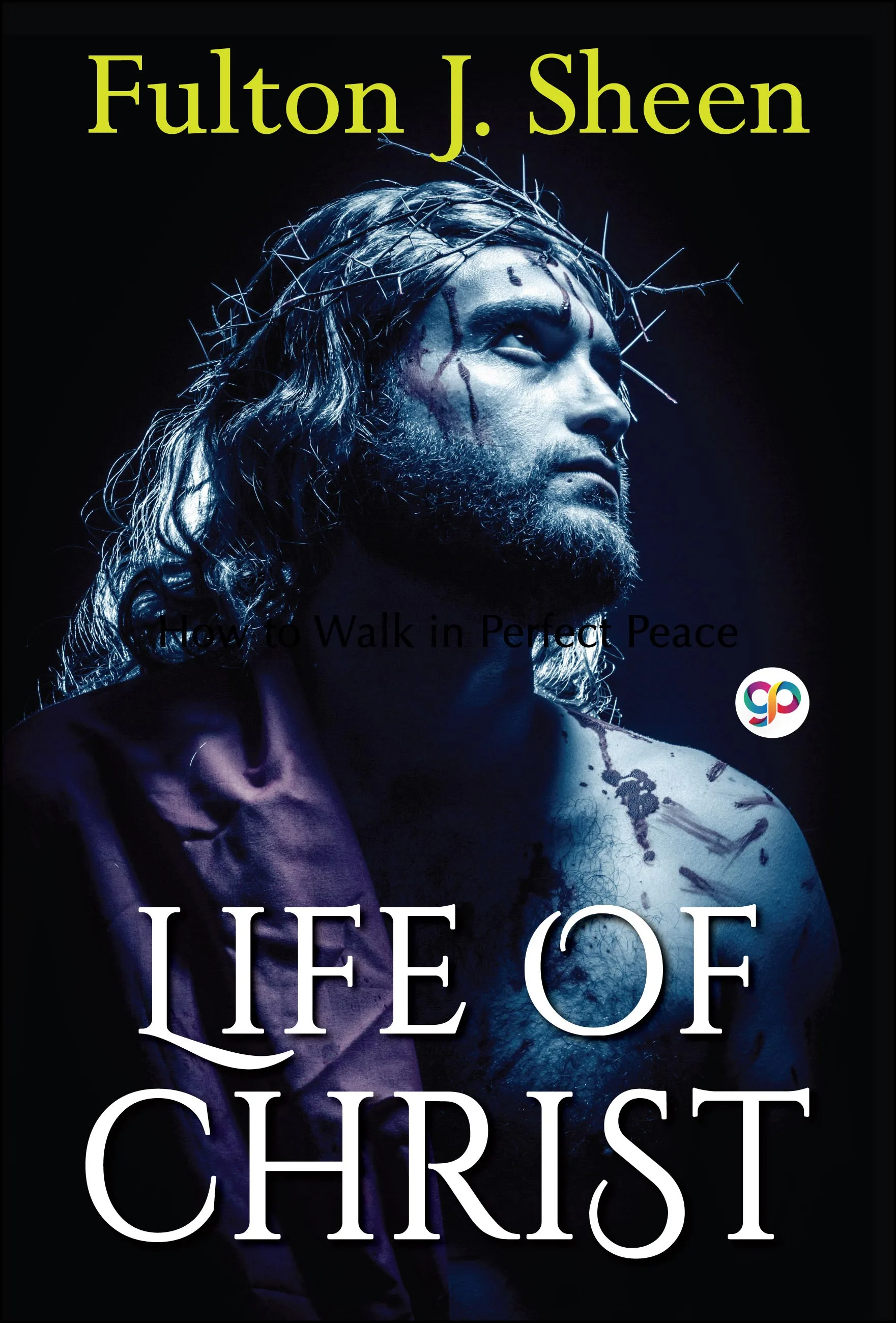
Life of Christ
eBook
• 690 Pages
• INR 51.00
• English
• 9789389157710
No ratings yet
| Publisher | General Press |
|---|---|
| ISBN13 | 9789389157710 |
| ASIN/SKU | B07VKDWV6R |
| Book Format | eBook |
| Language | English |
| Pages | 690 |
| List Price | INR 51.00 |
| Subject Code | REL006040, REL006710 |
| Publishing Date | 18/07/2019 |
| Book Code | BD00068611 |
Buy this Book
Amazon Stores
Ebook Stores
Other Stores
Discover Life of Christ by Fulton J. Sheen. This book is published by General Press in eBook format, ISBN 9789389157710, ASIN B07VKDWV6R, under Christian Books and Bibles, Biographies, Religion.
Book Description
What if the greatest story ever told could be seen not simply as a story, but as a deeply human journey of love, sacrifice, suffering, and hope? 'Life of Christ' by Fulton J. Sheen is a classic Christian biography and religious nonfiction work that presents the life of Jesus Christ with warmth, insight, and profound spiritual reflection. Rather than offering only a chronological account of Christ’s earthly life, Sheen invites readers to look beneath familiar Gospel events and consider what they reveal about the human heart and the nature of divine love.
Beginning with the world into which Jesus was born, Sheen explores the circumstances surrounding His coming, His hidden years, His public ministry, and His encounters with ordinary people. The narrative brings familiar moments from the Gospels to life, including Christ’s preaching, miracles, friendships, temptations, and growing conflict with those who opposed His message. Sheen pays particular attention to the way Jesus spoke to people who were searching, suffering, rejected, or spiritually lost, showing how His compassion reached beyond social boundaries and personal failures.
One of the book’s greatest strengths is the way Fulton J. Sheen connects the events of Christ’s life with universal human experiences. His reflections explore love and loneliness, pride and humility, freedom and responsibility, suffering and redemption. The familiar figures surrounding Jesus are also given renewed significance, allowing readers to see the Gospel story through fresh emotional and spiritual perspectives. Sheen’s writing is thoughtful but accessible, making the book suitable for both committed Christians and general readers interested in understanding the person of Jesus more deeply.
As the narrative moves toward the most dramatic and painful moments of Christ’s earthly mission, Sheen examines the meaning behind His suffering and sacrifice without reducing them to historical events alone. 'Life of Christ' ultimately becomes an invitation to encounter Jesus as a living spiritual presence rather than merely a figure from the past. For anyone seeking a thoughtful, moving, and deeply reflective account of Jesus Christ, this book offers a perspective that can transform familiar stories into something surprisingly personal—and may leave readers wanting to explore the life of Christ for themselves.
Beginning with the world into which Jesus was born, Sheen explores the circumstances surrounding His coming, His hidden years, His public ministry, and His encounters with ordinary people. The narrative brings familiar moments from the Gospels to life, including Christ’s preaching, miracles, friendships, temptations, and growing conflict with those who opposed His message. Sheen pays particular attention to the way Jesus spoke to people who were searching, suffering, rejected, or spiritually lost, showing how His compassion reached beyond social boundaries and personal failures.
One of the book’s greatest strengths is the way Fulton J. Sheen connects the events of Christ’s life with universal human experiences. His reflections explore love and loneliness, pride and humility, freedom and responsibility, suffering and redemption. The familiar figures surrounding Jesus are also given renewed significance, allowing readers to see the Gospel story through fresh emotional and spiritual perspectives. Sheen’s writing is thoughtful but accessible, making the book suitable for both committed Christians and general readers interested in understanding the person of Jesus more deeply.
As the narrative moves toward the most dramatic and painful moments of Christ’s earthly mission, Sheen examines the meaning behind His suffering and sacrifice without reducing them to historical events alone. 'Life of Christ' ultimately becomes an invitation to encounter Jesus as a living spiritual presence rather than merely a figure from the past. For anyone seeking a thoughtful, moving, and deeply reflective account of Jesus Christ, this book offers a perspective that can transform familiar stories into something surprisingly personal—and may leave readers wanting to explore the life of Christ for themselves.
Author Biography
FULTON J. SHEEN (1895 – 1979) was one of the most prominent Catholic leaders in American history. He was bishop of Rochester, national director of the Society for the Propagation of the Faith, and television’s first religious broadcaster, hosting “Life is Worth Living” on the ABC network. Sheen’s cause for canonization is currently under consideration.
Editorial Reviews
Editorial Reviews will be added soon…
Book Summary
Fulton J. Sheen’s Life of Christ is much more than a chronological account of Jesus’ birth, ministry, death, and resurrection. It is a deeply theological and personal meditation on who Christ was, why He came into the world, and what His life means for humanity. Sheen presents Jesus not simply as a great teacher or moral reformer, but as the God-Man whose entire earthly existence moves toward the Cross and the redemption of humanity. The book combines Scripture, theology, history, philosophy, and psychological insight, while continually inviting the reader to look beyond the familiar Gospel stories and discover their deeper meaning.
Sheen begins by asking what makes Jesus different from every other religious figure. His answer rests especially on the Incarnation and on the prophecies that, in Christian understanding, anticipated Christ’s coming. Jesus does not merely appear in history and then make a claim about Himself; His coming is presented as the fulfillment of a long preparation. Sheen examines the expectations surrounding a coming Savior and argues that the Old Testament provides a framework for understanding Christ’s birth, mission, suffering, and death. For him, history is therefore not a collection of disconnected events. It is a story moving toward Christ.
At the center of Sheen’s understanding is the Incarnation: God entering human history in the person of Jesus Christ. The birth of Jesus is consequently not treated as a sentimental Christmas story but as a mystery of enormous significance. The eternal becomes temporal; the divine takes on human nature; the Creator enters His own creation. Mary’s role is particularly important because Sheen emphasizes her willing cooperation in this mystery. Christ’s humanity is real, yet His identity is divine. This union of divinity and humanity becomes the foundation for everything that follows in the book.
Jesus’ hidden years also have meaning. Before His public ministry begins, He lives an apparently ordinary human life, showing that holiness is not confined to dramatic public achievements. Then comes His baptism by John the Baptist and His retreat into the wilderness. Sheen sees Christ’s forty days of fasting and prayer as preparation for His mission. The temptations that follow reveal the nature of His struggle. Satan offers forms of power, spectacle, and worldly satisfaction, but Jesus refuses to achieve His mission by abandoning the Father’s will. The Cross, rather than worldly success, will define His victory.
When Jesus begins His public ministry, He calls disciples and gradually forms a community that will continue His work. Sheen pays particular attention to the calling of the Twelve Apostles and to Peter’s special role. Christ does not simply leave behind a collection of ideas; He establishes a living community through which His teaching and mission will continue. The Apostles are imperfect, often confused and weak, yet Christ entrusts them with an extraordinary responsibility. Their weakness makes the later transformation of these ordinary men into courageous witnesses even more striking.
One of the book’s most memorable sections concerns the Sermon on the Mount and the Beatitudes. Sheen treats Christ’s teaching as a direct challenge to the values of ordinary society. The world tends to admire wealth, power, pleasure, aggression, and self-assertion. Jesus instead blesses the poor in spirit, the meek, the merciful, the pure in heart, the peacemakers, and those who suffer for righteousness. Sheen argues that Christianity is not merely a nicer version of conventional morality. It is a radical transformation of the way a person understands happiness, success, suffering, love, and human greatness.
Sheen repeatedly emphasizes that Jesus did not present Himself merely as a teacher pointing toward truth. He presented Himself as the Truth. Other teachers could say, in effect, “Follow my teaching”; Christ says that the way to God is inseparable from Himself. This makes Jesus’ claims uniquely demanding. If He is only an ordinary man, His claims become extraordinary and even impossible; if He is truly divine, then His words cannot be treated as optional advice. Sheen therefore asks the reader to make a personal response to Christ rather than simply admire Him from a distance.
As the story develops, opposition to Jesus grows. His compassion attracts ordinary people, but His teachings expose hypocrisy and challenge established religious and social expectations. Sheen portrays the conflict as a struggle between genuine spiritual transformation and the desire to preserve power, reputation, and control. Jesus does not seek suffering for its own sake, yet He accepts it when faithfulness to His mission requires it. Increasingly, His public ministry points toward Jerusalem and the Cross.
The Passion is therefore not an accidental tragedy at the end of Christ’s life. For Sheen, it is the destination toward which the entire earthly mission of Jesus has been moving. Christ repeatedly speaks about His coming suffering and death, and His final journey reveals that He accepts the Cross freely. The Last Supper becomes especially important because Jesus gives Himself sacramentally to His disciples before giving Himself physically on Calvary. The Eucharist connects the Last Supper with the sacrifice of the Cross and makes Christ’s self-offering central to Christian worship.
Sheen’s treatment of the Crucifixion is deeply reflective. He does not reduce the Cross to the story of an innocent man suffering because of political injustice. Jesus certainly experiences rejection, humiliation, physical pain, abandonment, and cruelty, but Sheen sees something deeper: the innocent Christ freely offering Himself for sinners. The Cross reveals both the seriousness of sin and the immeasurable depth of divine love. Christ does not conquer humanity through force. He conquers through self-giving love.
The Resurrection then changes the meaning of everything that came before it. The Cross, which appeared to be defeat, becomes victory. Death does not have the final word. Christ rises, demonstrating that sin, suffering, and death cannot ultimately destroy the life of God. The Resurrection is therefore not merely a happy conclusion to a tragic story; it is the foundation of Christian hope. Christ’s followers are called not simply to remember a dead teacher but to live in relationship with the risen Lord.
In the final movement of the book, Sheen connects Christ’s earthly mission with the continuing mission of the Church. Jesus does not leave His followers alone. The promise of the Holy Spirit gives them the courage and grace to continue His work. The Eucharist, the Church, the Apostles, and the Spirit all point toward a living Christianity in which Christ’s presence continues beyond the historical events of His earthly life.
Ultimately, Life of Christ is a book about transformation. Sheen wants the reader to understand that Christianity cannot remain merely an intellectual belief about Jesus. To encounter Christ is to be challenged to reconsider one’s priorities, ambitions, relationships, suffering, and understanding of love. Jesus appears throughout the book as teacher, healer, servant, sacrifice, Savior, and risen Lord. Sheen’s central message is that Christ’s life makes sense only when viewed as one unified act of divine love: God enters human history, shares human suffering, accepts the Cross, defeats death, and opens the way for humanity to return to God. The book’s enduring power lies in this invitation—not simply to study the life of Christ, but to recognize that His life demands a response from every human heart.
Sheen begins by asking what makes Jesus different from every other religious figure. His answer rests especially on the Incarnation and on the prophecies that, in Christian understanding, anticipated Christ’s coming. Jesus does not merely appear in history and then make a claim about Himself; His coming is presented as the fulfillment of a long preparation. Sheen examines the expectations surrounding a coming Savior and argues that the Old Testament provides a framework for understanding Christ’s birth, mission, suffering, and death. For him, history is therefore not a collection of disconnected events. It is a story moving toward Christ.
At the center of Sheen’s understanding is the Incarnation: God entering human history in the person of Jesus Christ. The birth of Jesus is consequently not treated as a sentimental Christmas story but as a mystery of enormous significance. The eternal becomes temporal; the divine takes on human nature; the Creator enters His own creation. Mary’s role is particularly important because Sheen emphasizes her willing cooperation in this mystery. Christ’s humanity is real, yet His identity is divine. This union of divinity and humanity becomes the foundation for everything that follows in the book.
Jesus’ hidden years also have meaning. Before His public ministry begins, He lives an apparently ordinary human life, showing that holiness is not confined to dramatic public achievements. Then comes His baptism by John the Baptist and His retreat into the wilderness. Sheen sees Christ’s forty days of fasting and prayer as preparation for His mission. The temptations that follow reveal the nature of His struggle. Satan offers forms of power, spectacle, and worldly satisfaction, but Jesus refuses to achieve His mission by abandoning the Father’s will. The Cross, rather than worldly success, will define His victory.
When Jesus begins His public ministry, He calls disciples and gradually forms a community that will continue His work. Sheen pays particular attention to the calling of the Twelve Apostles and to Peter’s special role. Christ does not simply leave behind a collection of ideas; He establishes a living community through which His teaching and mission will continue. The Apostles are imperfect, often confused and weak, yet Christ entrusts them with an extraordinary responsibility. Their weakness makes the later transformation of these ordinary men into courageous witnesses even more striking.
One of the book’s most memorable sections concerns the Sermon on the Mount and the Beatitudes. Sheen treats Christ’s teaching as a direct challenge to the values of ordinary society. The world tends to admire wealth, power, pleasure, aggression, and self-assertion. Jesus instead blesses the poor in spirit, the meek, the merciful, the pure in heart, the peacemakers, and those who suffer for righteousness. Sheen argues that Christianity is not merely a nicer version of conventional morality. It is a radical transformation of the way a person understands happiness, success, suffering, love, and human greatness.
Sheen repeatedly emphasizes that Jesus did not present Himself merely as a teacher pointing toward truth. He presented Himself as the Truth. Other teachers could say, in effect, “Follow my teaching”; Christ says that the way to God is inseparable from Himself. This makes Jesus’ claims uniquely demanding. If He is only an ordinary man, His claims become extraordinary and even impossible; if He is truly divine, then His words cannot be treated as optional advice. Sheen therefore asks the reader to make a personal response to Christ rather than simply admire Him from a distance.
As the story develops, opposition to Jesus grows. His compassion attracts ordinary people, but His teachings expose hypocrisy and challenge established religious and social expectations. Sheen portrays the conflict as a struggle between genuine spiritual transformation and the desire to preserve power, reputation, and control. Jesus does not seek suffering for its own sake, yet He accepts it when faithfulness to His mission requires it. Increasingly, His public ministry points toward Jerusalem and the Cross.
The Passion is therefore not an accidental tragedy at the end of Christ’s life. For Sheen, it is the destination toward which the entire earthly mission of Jesus has been moving. Christ repeatedly speaks about His coming suffering and death, and His final journey reveals that He accepts the Cross freely. The Last Supper becomes especially important because Jesus gives Himself sacramentally to His disciples before giving Himself physically on Calvary. The Eucharist connects the Last Supper with the sacrifice of the Cross and makes Christ’s self-offering central to Christian worship.
Sheen’s treatment of the Crucifixion is deeply reflective. He does not reduce the Cross to the story of an innocent man suffering because of political injustice. Jesus certainly experiences rejection, humiliation, physical pain, abandonment, and cruelty, but Sheen sees something deeper: the innocent Christ freely offering Himself for sinners. The Cross reveals both the seriousness of sin and the immeasurable depth of divine love. Christ does not conquer humanity through force. He conquers through self-giving love.
The Resurrection then changes the meaning of everything that came before it. The Cross, which appeared to be defeat, becomes victory. Death does not have the final word. Christ rises, demonstrating that sin, suffering, and death cannot ultimately destroy the life of God. The Resurrection is therefore not merely a happy conclusion to a tragic story; it is the foundation of Christian hope. Christ’s followers are called not simply to remember a dead teacher but to live in relationship with the risen Lord.
In the final movement of the book, Sheen connects Christ’s earthly mission with the continuing mission of the Church. Jesus does not leave His followers alone. The promise of the Holy Spirit gives them the courage and grace to continue His work. The Eucharist, the Church, the Apostles, and the Spirit all point toward a living Christianity in which Christ’s presence continues beyond the historical events of His earthly life.
Ultimately, Life of Christ is a book about transformation. Sheen wants the reader to understand that Christianity cannot remain merely an intellectual belief about Jesus. To encounter Christ is to be challenged to reconsider one’s priorities, ambitions, relationships, suffering, and understanding of love. Jesus appears throughout the book as teacher, healer, servant, sacrifice, Savior, and risen Lord. Sheen’s central message is that Christ’s life makes sense only when viewed as one unified act of divine love: God enters human history, shares human suffering, accepts the Cross, defeats death, and opens the way for humanity to return to God. The book’s enduring power lies in this invitation—not simply to study the life of Christ, but to recognize that His life demands a response from every human heart.
Sample Chapters
One : The Only Person Ever Pre-Announced
History is full of men who have claimed that they came from God, or that they were gods, or that they bore messages from God—Buddha, Mohammed, Confucius, Christ, Lao-tze, and thousands of others, right down to the person who founded a new religion this very day. Each of them has a right to be heard and considered. But as a yardstick external to and outside of whatever is to be measured is needed, so there must be some permanent tests available to all men, all civilizations, and all ages, by which they can decide whether any one of these claimants, or all of them, are justified in their claims. These tests are of two kinds: reason and history. Reason, because everyone has it, even those without faith; history, because everyone lives in it and should know something about it.
Reason dictates that if any one of these men actually came from God, the least thing that God could do to support His claim would be to pre-announce His coming. Automobile manufacturers tell their customers when to expect a new model. If God sent anyone from Himself, or if He came Himself with a vitally important message for all men, it would seem reasonable that He would first let men know when His messenger was coming, where He would be born, where He would live, the doctrine He would teach, the enemies He would make, the program He would adopt for the future, and the manner of His death. By the extent to which the messenger conformed with these announcements, one could judge the validity of his claims.
Reason further assures us that if God did not do this, then there would be nothing to prevent any impostor from appearing in history and saying, “I come from God,” or “An angel appeared to me in the desert and gave me this message.” In such cases there would be no objective, historical way of testing the messenger. We would have only his word for it, and of course he could be wrong.
If a visitor came from a foreign country to Washington and said he was a diplomat, the government would ask him for his passport and other documents testifying that he represented a certain government. His papers would have to antedate his coming. If such proofs of identity are asked from delegates of other countries, reason certainly ought to do so with messengers who claim to have come from God. To each claimant reason says, “What record was there before you were born that you were coming?”
With this test one can evaluate the claimants. (And at this preliminary stage, Christ is no greater than the others.) Socrates had no one to foretell his birth. Buddha had no one to pre-announce him and his message or tell the day when he would sit under the tree. Confucius did not have the name of his mother and his birthplace recorded, nor were they given to men centuries before he arrived so that when he did come, men would know he was a messenger from God. But, with Christ it was different. Because of the Old Testament prophecies, His coming was not unexpected. There were no predictions about Buddha, Confucius, Lao-tze, Mohammed, or anyone else; but there were predictions about Christ. Others just came and said, “Here I am, believe me.” They were, therefore, only men among men and not the Divine in the human. Christ alone stepped out of that line saying, “Search the writings of the Jewish people and the related history of the Babylonians, Persians, Greeks, and Romans.” (For the moment, pagan writings and even the Old Testament may be regarded only as historical documents, not as inspired works.)
It is true that the prophecies of the Old Testament can be best understood in the light of their fulfillment. The language of prophecy does not have the exactness of mathematics. Yet if one searches out the various Messianic currents in the Old Testament, and compares the resulting picture with the life and work of Christ, can one doubt that the ancient predictions point to Jesus and the kingdom which he established? God’s promise to the patriarchs that through them all the nations of the earth would be blessed; the prediction that the tribe of Juda would be supreme among the other Hebrew tribes until the coming of Him Whom all nations would obey; the strange yet undeniable fact that in the Bible of the Alexandrian Jews, the Septuagint, one finds clearly predicted the virgin birth of the Messias; the prophecy of Isaias 53 about the patient sufferer, the Servant of the Lord, who will lay down his life as a guilt-offering for his people’s offenses; the perspectives of the glorious, everlasting kingdom of the House of David—in whom but Christ have these prophecies found their fulfillment? From an historical point of view alone, here is uniqueness which sets Christ apart from all other founders of world religions. And once the fulfillment of these prophecies did historically take place in the person of Christ, not only did all prophecies cease in Israel, but there was discontinuance of sacrifices when the true Paschal Lamb was sacrificed.
Turn to pagan testimony. Tacitus, speaking for the ancient Romans, says, “People were generally persuaded in the faith of the ancient prophecies, that the East was to prevail, and that from Judea was to come the Master and Ruler of the world.” Suetonius, in his account of the life of Vespasian, recounts the Roman tradition thus, “It was an old and constant belief throughout the East, that by indubitably certain prophecies, the Jews were to attain the highest power.”
China had the same expectation; but because it was on the other side of the world, it believed that the great Wise Man would be born in the West. The Annals of the Celestial Empire contain the statement:
In the 24th year of Tchao-Wang of the dynasty of the Tcheou, on the 8th day of the 4th moon, a light appeared in the Southwest which illumined the king’s palace. The monarch, struck by its splendor, interrogated the sages. They showed him books in which this prodigy signified the appearance of the great Saint of the West whose religion was to be introduced into their country.
The Greeks expected Him, for Aeschylus in his Prometheus six centuries before His coming, wrote, “Look not for any end, moreover, to this curse until God appears, to accept upon His Head the pangs of thy own sins vicarious.”
How did the Magi of the East know of His coming? Probably from the many prophecies circulated through the world by the Jews as well as through the prophecy made to the Gentiles by Daniel centuries before His birth.
Cicero, after recounting the sayings of the ancient oracles and the Sibyls about a “King whom we must recognize to be saved,” asked in expectation, “To what man and to what period of time do these predictions point?” The Fourth Eclogue of Virgil recounted the same ancient tradition and spoke of “a chaste woman, smiling on her infant boy, with whom the iron age would pass away.”
Suetonius quoted a contemporary author to the effect that the Romans were so fearful about a king who would rule the world that they ordered all children born that year to be killed—an order that was not fulfilled, except by Herod.
Not only were the Jews expecting the birth of a Great King, a Wise Man and a Savior, but Plato and Socrates also spoke of the Logos and of the Universal Wise Man “yet to come.” Confucius spoke of “the Saint” the Sibyls, of a “Universal King” the Greek dramatist, of a savior and redeemer to unloose man from the “primal eldest curse.” All these were on the Gentile side of the expectation. What separates Christ from all men is that first He was expected; even the Gentiles had a longing for a deliverer, or redeemer. This fact alone distinguishes Him from all other religious leaders.
A second distinguishing fact is that once He appeared, He struck history with such impact that He split it in two, dividing it into two periods: one before His coming, the other after it. Buddha did not do this, nor any of the great Indian philosophers. Even those who deny God must date their attacks upon Him, A.D. so and so, or so many years after His coming.
A third fact separating Him from all the others is this: every other person who ever came into this world came into it to live. He came into it to die. Death was a stumbling block to Socrates—it interrupted his teaching. But to Christ, death was the goal and fulfillment of His life, the gold that He was seeking. Few of His words or actions are intelligible without reference to His Cross. He presented Himself as a Savior rather than merely as a Teacher. It meant nothing to teach men to be good unless He also gave them the power to be good, after rescuing them from the frustration of guilt.
The story of every human life begins with birth and ends with death. In the Person of Christ, however, it was His death that was first and His life that was last. The scripture describes Him as “the Lamb slain as it were, from the beginning of the world.” He was slain in intention by the first sin and rebellion against God. It was not so much that His birth cast a shadow on His life and thus led to His death; it was rather that the Cross was first, and cast its shadow back to His birth. His has been the only life in the world that was ever lived backward. As the flower in the crannied wall tells the poet of nature, and as the atom is the miniature of the solar system, so too, His birth tells the mystery of the gibbet. He went from the known to the known, from the reason of His coming manifested by His name “Jesus” or “Savior” to the fulfillment of His coming, namely, His death on the Cross.
John gives us His eternal prehistory; Matthew, His temporal prehistory, by way of His genealogy. It is significant how much His temporal ancestry was connected with sinners and foreigners! These blots on the escutcheon of His human lineage suggest a pity for the sinful and for the strangers to the Covenant. Both these aspects of His compassion would later on be hurled against Him as accusations: “He is a friend of sinners” “He is a Samaritan.” But the shadow of a stained past foretells His future love for the stained. Born of a woman, He was a man and could be one with all humanity; born of a Virgin, who was overshadowed by the Spirit and “full of grace,” He would also be outside that current of sin which infected all men.
Two : Early Life of Christ
A fourth distinguishing fact is that He does not fit, as the other world teachers do, into the established category of a good man. Good men do not lie. But if Christ was not all that He said He was, namely, the Son of the living God, the Word of God in the flesh, then He was not “just a good man” then He was a knave, a liar, a charlatan and the greatest deceiver who ever lived. If He was not what He said He was, the Christ, the Son of God, He was the anti-Christ! If He was only a man, then He was not even a “good” man.
But He was not only a man. He would have us either worship Him or despise Him—despise Him as a mere man, or worship Him as true God and true man. That is the alternative He presents. It may very well be that the Communists, who are so anti-Christ, are closer to Him than those who see Him as a sentimentalist and a vague moral reformer. The Communists have at least decided that if He wins, they lose; the others are afraid to consider Him either as winning or losing, because they are not prepared to meet the moral demands which this victory would make on their souls.
If He is what He claimed to be, a Savior, a Redeemer, then we have a virile Christ and a leader worth following in these terrible times; One Who will step into the breach of death, crushing sin, gloom and despair; a leader to Whom we can make totalitarian sacrifice without losing, but gaining freedom, and Whom we can love even unto death. We need a Christ today Who will make cords and drive the buyers and sellers from our new temples; Who will blast the unfruitful fig-trees; Who will talk of crosses and sacrifices and Whose voice will be like the voice of the raging sea. But He will not allow us to pick and choose among His words, discarding the hard ones, and accepting the ones that please our fancy. We need a Christ Who will restore moral indignation, Who will make us hate evil with a passionate intensity, and love goodness to a point where we can drink death like water.
The Annunciation
Every civilization has had a tradition of a golden age in the past. A more precise Jewish record tells of a fall from a state of innocence and happiness through a woman tempting a man. If a woman played such a role in the fall of mankind, should she not play a great role in its restoration? And if there was a lost Paradise in which the first nuptials of man and woman were celebrated, might there not be a new Paradise in which the nuptials of God and man would be celebrated?
In the fullness of time an Angel of Light came down from the great Throne of Light to a Virgin kneeling in prayer, to ask her if she was willing to give God a human nature. Her answer was that she “knew not man” and, therefore, could not be the mother of the “Expected of the Nations.”
There never can be a birth without love. In this the maiden was right. The begetting of new life requires the fires of love. But besides the human passion which begets life, there is the “passionless passion and wild tranquility” of the Holy Spirit; and it was this that overshadowed the woman and begot in her Emmanuel or “God with us.” At the moment that Mary pronounced Fiat or “Be it done,” something greater happened than the Fiat lux (Let there be light) of creation; for the light that was now made was not the sun, but the Son of God in the flesh. By pronouncing Fiat Mary achieved the full role of womanhood, namely, to be the bearer of God’s gifts to man. There is a passive receptiveness in which woman says Fiat to the cosmos as she shares its rhythm, Fiat to a man’s love as she receives it, and Fiat to God as she receives the Spirit.
Children come into the world not always as a result of a distinct act of love of man and woman. Though the love between the two be willed, the fruit of their love, which is the child, is not willed in the same way as their love one for another. There is an undetermined element in human love. The parents do not know whether the child will be a boy or a girl, or the exact time of its birth, for conception is lost in some unknown night of love. Children are later accepted and loved by their parents, but they were never directly willed into being by them. But in the Annunciation, the Child was not accepted in any unforeseen way; the Child was willed. There was a collaboration between a woman and the Spirit of Divine Love. The consent was voluntary under the Fiat; the physical cooperation was freely offered by the same word. Other mothers become conscious of motherhood through physical changes within them; Mary became conscious through a spiritual change wrought by the Holy Spirit. She probably received a spiritual ecstasy far greater than that given to man and woman in their unifying act of love.
As the fall of man was a free act, so too the Redemption had to be free. What is called the Annunciation was actually God asking the free consent of a creature to help Him to be incorporated into humanity.
Suppose a musician in an orchestra freely strikes a sour note. The conductor is competent, the music is correctly scored and easy to play, but the musician still exercises his freedom by introducing a discord which immediately passes out into space. The director can do one of two things: he can either order the selection to be replayed, or he can ignore the discord. Fundamentally, it makes no difference which he does, for that false note is travelling out into space at the rate of more than a thousand feet per second; and as long as time endures, there will be discord in the universe.
Is there any way to restore harmony to the world? It can be done only by someone coming in from eternity and stopping the note in its wild flight. But will it still be a false note? The harmony can be destroyed on one condition only. If that note is made the first note in a new melody, then it will become harmonious.
This is precisely what happened when Christ was born. There had been a false note of moral discord introduced by the first man which infected all humanity. God could have ignored it, but it would have been a violation of justice for Him to do so, which is, of course, unthinkable. What He did, therefore, was to ask a woman, representing humanity, freely to give Him a human nature with which He would start a new humanity. As there was an old humanity in Adam, so there would be a new humanity in Christ, Who was God made man through the free agency of a human mother. When the angel appeared to Mary, God was announcing this love for the new humanity. It was the beginning of a new earth, and Mary became “a flesh-girt Paradise to be gardened by the Adam new.” As in the first garden Eve brought destruction, so in the garden of her womb, Mary would now bring Redemption.
For the nine months that He was cloistered within her, all the food, the wheat, the grapes that she consumed served as a kind of natural Eucharist, passing into Him Who later on was to declare that He was the Bread and the Wine of Life. After her nine months were over, the fitting place for Him to be born was Bethlehem, which meant “House of Bread.” Later on He would say:
God’s gift of bread comes down from heaven
And gives life to the whole world.
John 6:23
It is I Who am the Bread of Life;
He who comes to Me will never be hungry.
John 6:35
When the Divine Child was conceived, Mary’s humanity gave Him hands and feet, eyes and ears, and a body with which to suffer. Just as the petals of a rose after a dew close on the dew as if to absorb its energies, so too, Mary as the Mystical Rose closed upon Him Whom the Old Testament had described as a dew descending upon the earth. When finally she did give Him birth, it was as if a great ciborium had opened, and she was holding in her fingers the Guest Who was also the Host of the world, as if to say, “Look, this is the Lamb of God; look, this is He Who takes away the sins of the world.”
The Visitation
Mary was given a sign that she would conceive by the Holy Ghost. Her elderly cousin Elizabeth had already conceived a son in her old age, and was now in her sixth month.
Mary, now bearing the Divine Secret within her, journeyed several days from Nazareth to the city of Hebron, which, according to tradition, rested over the ashes of the founders of the people of God—Abraham, Isaac, and Jacob. Elizabeth, in some mysterious way, knew that Mary was bearing within herself the Messias. She asked:
How have I deserved to be
Thus visited by the Mother of My Lord?
Luke 1:43
This salutation came from the mother of the herald to the mother of the King Whose path the herald was destined to prepare. John the Baptist, still cloistered in his mother’s womb, on his mother’s testimony leaped with joy at the mother who brought the Christ to her home.
Mary’s response to this salutation is called the Magnificat, a song of joy celebrating what God had done for her. She looked back over history, back to Abraham; she saw the activity of God preparing for this moment from generation to generation, she looked also into an indefinite future when all peoples and all generations would call her “Blessed.” Israel’s Messias was on His way, and God was about to manifest Himself on earth and in the flesh. She even prophesied the qualities of the Son Who was to be born of her as full of justice and mercy. Her poem ends by acclaiming the revolution He will inaugurate with the unseating of the mighty and the exaltation of the humble.
History is full of men who have claimed that they came from God, or that they were gods, or that they bore messages from God—Buddha, Mohammed, Confucius, Christ, Lao-tze, and thousands of others, right down to the person who founded a new religion this very day. Each of them has a right to be heard and considered. But as a yardstick external to and outside of whatever is to be measured is needed, so there must be some permanent tests available to all men, all civilizations, and all ages, by which they can decide whether any one of these claimants, or all of them, are justified in their claims. These tests are of two kinds: reason and history. Reason, because everyone has it, even those without faith; history, because everyone lives in it and should know something about it.
Reason dictates that if any one of these men actually came from God, the least thing that God could do to support His claim would be to pre-announce His coming. Automobile manufacturers tell their customers when to expect a new model. If God sent anyone from Himself, or if He came Himself with a vitally important message for all men, it would seem reasonable that He would first let men know when His messenger was coming, where He would be born, where He would live, the doctrine He would teach, the enemies He would make, the program He would adopt for the future, and the manner of His death. By the extent to which the messenger conformed with these announcements, one could judge the validity of his claims.
Reason further assures us that if God did not do this, then there would be nothing to prevent any impostor from appearing in history and saying, “I come from God,” or “An angel appeared to me in the desert and gave me this message.” In such cases there would be no objective, historical way of testing the messenger. We would have only his word for it, and of course he could be wrong.
If a visitor came from a foreign country to Washington and said he was a diplomat, the government would ask him for his passport and other documents testifying that he represented a certain government. His papers would have to antedate his coming. If such proofs of identity are asked from delegates of other countries, reason certainly ought to do so with messengers who claim to have come from God. To each claimant reason says, “What record was there before you were born that you were coming?”
With this test one can evaluate the claimants. (And at this preliminary stage, Christ is no greater than the others.) Socrates had no one to foretell his birth. Buddha had no one to pre-announce him and his message or tell the day when he would sit under the tree. Confucius did not have the name of his mother and his birthplace recorded, nor were they given to men centuries before he arrived so that when he did come, men would know he was a messenger from God. But, with Christ it was different. Because of the Old Testament prophecies, His coming was not unexpected. There were no predictions about Buddha, Confucius, Lao-tze, Mohammed, or anyone else; but there were predictions about Christ. Others just came and said, “Here I am, believe me.” They were, therefore, only men among men and not the Divine in the human. Christ alone stepped out of that line saying, “Search the writings of the Jewish people and the related history of the Babylonians, Persians, Greeks, and Romans.” (For the moment, pagan writings and even the Old Testament may be regarded only as historical documents, not as inspired works.)
It is true that the prophecies of the Old Testament can be best understood in the light of their fulfillment. The language of prophecy does not have the exactness of mathematics. Yet if one searches out the various Messianic currents in the Old Testament, and compares the resulting picture with the life and work of Christ, can one doubt that the ancient predictions point to Jesus and the kingdom which he established? God’s promise to the patriarchs that through them all the nations of the earth would be blessed; the prediction that the tribe of Juda would be supreme among the other Hebrew tribes until the coming of Him Whom all nations would obey; the strange yet undeniable fact that in the Bible of the Alexandrian Jews, the Septuagint, one finds clearly predicted the virgin birth of the Messias; the prophecy of Isaias 53 about the patient sufferer, the Servant of the Lord, who will lay down his life as a guilt-offering for his people’s offenses; the perspectives of the glorious, everlasting kingdom of the House of David—in whom but Christ have these prophecies found their fulfillment? From an historical point of view alone, here is uniqueness which sets Christ apart from all other founders of world religions. And once the fulfillment of these prophecies did historically take place in the person of Christ, not only did all prophecies cease in Israel, but there was discontinuance of sacrifices when the true Paschal Lamb was sacrificed.
Turn to pagan testimony. Tacitus, speaking for the ancient Romans, says, “People were generally persuaded in the faith of the ancient prophecies, that the East was to prevail, and that from Judea was to come the Master and Ruler of the world.” Suetonius, in his account of the life of Vespasian, recounts the Roman tradition thus, “It was an old and constant belief throughout the East, that by indubitably certain prophecies, the Jews were to attain the highest power.”
China had the same expectation; but because it was on the other side of the world, it believed that the great Wise Man would be born in the West. The Annals of the Celestial Empire contain the statement:
In the 24th year of Tchao-Wang of the dynasty of the Tcheou, on the 8th day of the 4th moon, a light appeared in the Southwest which illumined the king’s palace. The monarch, struck by its splendor, interrogated the sages. They showed him books in which this prodigy signified the appearance of the great Saint of the West whose religion was to be introduced into their country.
The Greeks expected Him, for Aeschylus in his Prometheus six centuries before His coming, wrote, “Look not for any end, moreover, to this curse until God appears, to accept upon His Head the pangs of thy own sins vicarious.”
How did the Magi of the East know of His coming? Probably from the many prophecies circulated through the world by the Jews as well as through the prophecy made to the Gentiles by Daniel centuries before His birth.
Cicero, after recounting the sayings of the ancient oracles and the Sibyls about a “King whom we must recognize to be saved,” asked in expectation, “To what man and to what period of time do these predictions point?” The Fourth Eclogue of Virgil recounted the same ancient tradition and spoke of “a chaste woman, smiling on her infant boy, with whom the iron age would pass away.”
Suetonius quoted a contemporary author to the effect that the Romans were so fearful about a king who would rule the world that they ordered all children born that year to be killed—an order that was not fulfilled, except by Herod.
Not only were the Jews expecting the birth of a Great King, a Wise Man and a Savior, but Plato and Socrates also spoke of the Logos and of the Universal Wise Man “yet to come.” Confucius spoke of “the Saint” the Sibyls, of a “Universal King” the Greek dramatist, of a savior and redeemer to unloose man from the “primal eldest curse.” All these were on the Gentile side of the expectation. What separates Christ from all men is that first He was expected; even the Gentiles had a longing for a deliverer, or redeemer. This fact alone distinguishes Him from all other religious leaders.
A second distinguishing fact is that once He appeared, He struck history with such impact that He split it in two, dividing it into two periods: one before His coming, the other after it. Buddha did not do this, nor any of the great Indian philosophers. Even those who deny God must date their attacks upon Him, A.D. so and so, or so many years after His coming.
A third fact separating Him from all the others is this: every other person who ever came into this world came into it to live. He came into it to die. Death was a stumbling block to Socrates—it interrupted his teaching. But to Christ, death was the goal and fulfillment of His life, the gold that He was seeking. Few of His words or actions are intelligible without reference to His Cross. He presented Himself as a Savior rather than merely as a Teacher. It meant nothing to teach men to be good unless He also gave them the power to be good, after rescuing them from the frustration of guilt.
The story of every human life begins with birth and ends with death. In the Person of Christ, however, it was His death that was first and His life that was last. The scripture describes Him as “the Lamb slain as it were, from the beginning of the world.” He was slain in intention by the first sin and rebellion against God. It was not so much that His birth cast a shadow on His life and thus led to His death; it was rather that the Cross was first, and cast its shadow back to His birth. His has been the only life in the world that was ever lived backward. As the flower in the crannied wall tells the poet of nature, and as the atom is the miniature of the solar system, so too, His birth tells the mystery of the gibbet. He went from the known to the known, from the reason of His coming manifested by His name “Jesus” or “Savior” to the fulfillment of His coming, namely, His death on the Cross.
John gives us His eternal prehistory; Matthew, His temporal prehistory, by way of His genealogy. It is significant how much His temporal ancestry was connected with sinners and foreigners! These blots on the escutcheon of His human lineage suggest a pity for the sinful and for the strangers to the Covenant. Both these aspects of His compassion would later on be hurled against Him as accusations: “He is a friend of sinners” “He is a Samaritan.” But the shadow of a stained past foretells His future love for the stained. Born of a woman, He was a man and could be one with all humanity; born of a Virgin, who was overshadowed by the Spirit and “full of grace,” He would also be outside that current of sin which infected all men.
Two : Early Life of Christ
A fourth distinguishing fact is that He does not fit, as the other world teachers do, into the established category of a good man. Good men do not lie. But if Christ was not all that He said He was, namely, the Son of the living God, the Word of God in the flesh, then He was not “just a good man” then He was a knave, a liar, a charlatan and the greatest deceiver who ever lived. If He was not what He said He was, the Christ, the Son of God, He was the anti-Christ! If He was only a man, then He was not even a “good” man.
But He was not only a man. He would have us either worship Him or despise Him—despise Him as a mere man, or worship Him as true God and true man. That is the alternative He presents. It may very well be that the Communists, who are so anti-Christ, are closer to Him than those who see Him as a sentimentalist and a vague moral reformer. The Communists have at least decided that if He wins, they lose; the others are afraid to consider Him either as winning or losing, because they are not prepared to meet the moral demands which this victory would make on their souls.
If He is what He claimed to be, a Savior, a Redeemer, then we have a virile Christ and a leader worth following in these terrible times; One Who will step into the breach of death, crushing sin, gloom and despair; a leader to Whom we can make totalitarian sacrifice without losing, but gaining freedom, and Whom we can love even unto death. We need a Christ today Who will make cords and drive the buyers and sellers from our new temples; Who will blast the unfruitful fig-trees; Who will talk of crosses and sacrifices and Whose voice will be like the voice of the raging sea. But He will not allow us to pick and choose among His words, discarding the hard ones, and accepting the ones that please our fancy. We need a Christ Who will restore moral indignation, Who will make us hate evil with a passionate intensity, and love goodness to a point where we can drink death like water.
The Annunciation
Every civilization has had a tradition of a golden age in the past. A more precise Jewish record tells of a fall from a state of innocence and happiness through a woman tempting a man. If a woman played such a role in the fall of mankind, should she not play a great role in its restoration? And if there was a lost Paradise in which the first nuptials of man and woman were celebrated, might there not be a new Paradise in which the nuptials of God and man would be celebrated?
In the fullness of time an Angel of Light came down from the great Throne of Light to a Virgin kneeling in prayer, to ask her if she was willing to give God a human nature. Her answer was that she “knew not man” and, therefore, could not be the mother of the “Expected of the Nations.”
There never can be a birth without love. In this the maiden was right. The begetting of new life requires the fires of love. But besides the human passion which begets life, there is the “passionless passion and wild tranquility” of the Holy Spirit; and it was this that overshadowed the woman and begot in her Emmanuel or “God with us.” At the moment that Mary pronounced Fiat or “Be it done,” something greater happened than the Fiat lux (Let there be light) of creation; for the light that was now made was not the sun, but the Son of God in the flesh. By pronouncing Fiat Mary achieved the full role of womanhood, namely, to be the bearer of God’s gifts to man. There is a passive receptiveness in which woman says Fiat to the cosmos as she shares its rhythm, Fiat to a man’s love as she receives it, and Fiat to God as she receives the Spirit.
Children come into the world not always as a result of a distinct act of love of man and woman. Though the love between the two be willed, the fruit of their love, which is the child, is not willed in the same way as their love one for another. There is an undetermined element in human love. The parents do not know whether the child will be a boy or a girl, or the exact time of its birth, for conception is lost in some unknown night of love. Children are later accepted and loved by their parents, but they were never directly willed into being by them. But in the Annunciation, the Child was not accepted in any unforeseen way; the Child was willed. There was a collaboration between a woman and the Spirit of Divine Love. The consent was voluntary under the Fiat; the physical cooperation was freely offered by the same word. Other mothers become conscious of motherhood through physical changes within them; Mary became conscious through a spiritual change wrought by the Holy Spirit. She probably received a spiritual ecstasy far greater than that given to man and woman in their unifying act of love.
As the fall of man was a free act, so too the Redemption had to be free. What is called the Annunciation was actually God asking the free consent of a creature to help Him to be incorporated into humanity.
Suppose a musician in an orchestra freely strikes a sour note. The conductor is competent, the music is correctly scored and easy to play, but the musician still exercises his freedom by introducing a discord which immediately passes out into space. The director can do one of two things: he can either order the selection to be replayed, or he can ignore the discord. Fundamentally, it makes no difference which he does, for that false note is travelling out into space at the rate of more than a thousand feet per second; and as long as time endures, there will be discord in the universe.
Is there any way to restore harmony to the world? It can be done only by someone coming in from eternity and stopping the note in its wild flight. But will it still be a false note? The harmony can be destroyed on one condition only. If that note is made the first note in a new melody, then it will become harmonious.
This is precisely what happened when Christ was born. There had been a false note of moral discord introduced by the first man which infected all humanity. God could have ignored it, but it would have been a violation of justice for Him to do so, which is, of course, unthinkable. What He did, therefore, was to ask a woman, representing humanity, freely to give Him a human nature with which He would start a new humanity. As there was an old humanity in Adam, so there would be a new humanity in Christ, Who was God made man through the free agency of a human mother. When the angel appeared to Mary, God was announcing this love for the new humanity. It was the beginning of a new earth, and Mary became “a flesh-girt Paradise to be gardened by the Adam new.” As in the first garden Eve brought destruction, so in the garden of her womb, Mary would now bring Redemption.
For the nine months that He was cloistered within her, all the food, the wheat, the grapes that she consumed served as a kind of natural Eucharist, passing into Him Who later on was to declare that He was the Bread and the Wine of Life. After her nine months were over, the fitting place for Him to be born was Bethlehem, which meant “House of Bread.” Later on He would say:
God’s gift of bread comes down from heaven
And gives life to the whole world.
John 6:23
It is I Who am the Bread of Life;
He who comes to Me will never be hungry.
John 6:35
When the Divine Child was conceived, Mary’s humanity gave Him hands and feet, eyes and ears, and a body with which to suffer. Just as the petals of a rose after a dew close on the dew as if to absorb its energies, so too, Mary as the Mystical Rose closed upon Him Whom the Old Testament had described as a dew descending upon the earth. When finally she did give Him birth, it was as if a great ciborium had opened, and she was holding in her fingers the Guest Who was also the Host of the world, as if to say, “Look, this is the Lamb of God; look, this is He Who takes away the sins of the world.”
The Visitation
Mary was given a sign that she would conceive by the Holy Ghost. Her elderly cousin Elizabeth had already conceived a son in her old age, and was now in her sixth month.
Mary, now bearing the Divine Secret within her, journeyed several days from Nazareth to the city of Hebron, which, according to tradition, rested over the ashes of the founders of the people of God—Abraham, Isaac, and Jacob. Elizabeth, in some mysterious way, knew that Mary was bearing within herself the Messias. She asked:
How have I deserved to be
Thus visited by the Mother of My Lord?
Luke 1:43
This salutation came from the mother of the herald to the mother of the King Whose path the herald was destined to prepare. John the Baptist, still cloistered in his mother’s womb, on his mother’s testimony leaped with joy at the mother who brought the Christ to her home.
Mary’s response to this salutation is called the Magnificat, a song of joy celebrating what God had done for her. She looked back over history, back to Abraham; she saw the activity of God preparing for this moment from generation to generation, she looked also into an indefinite future when all peoples and all generations would call her “Blessed.” Israel’s Messias was on His way, and God was about to manifest Himself on earth and in the flesh. She even prophesied the qualities of the Son Who was to be born of her as full of justice and mercy. Her poem ends by acclaiming the revolution He will inaugurate with the unseating of the mighty and the exaltation of the humble.
Reader Reviews
No reviews yet.
Life of Christ