
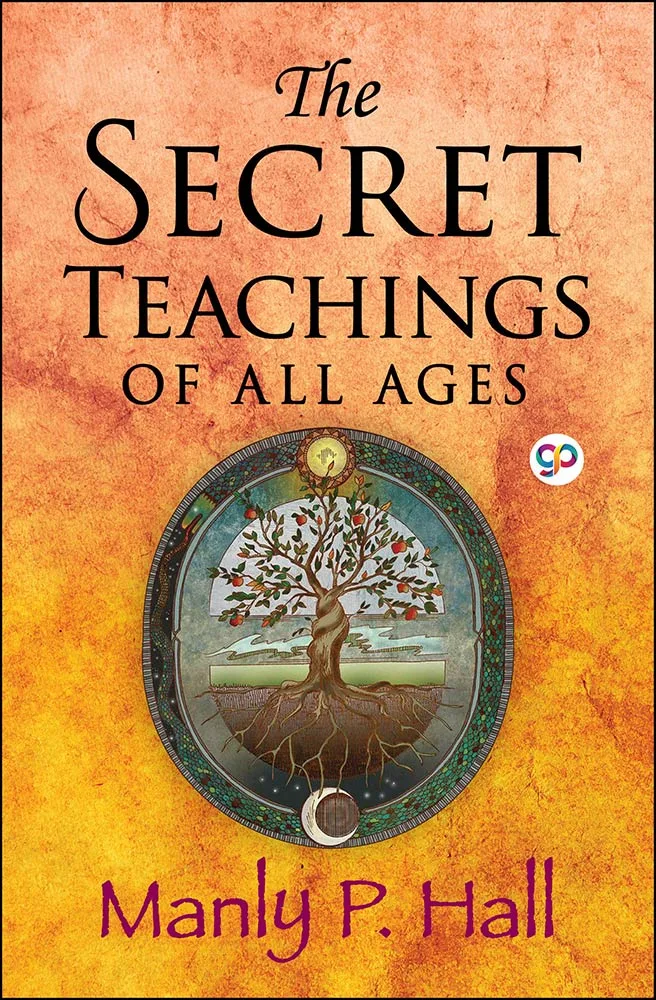
The Secret Teachings of All Ages
eBook
• 676 Pages
• INR 51.00
• English
• 9789389440362
No ratings yet
| Publisher | General Press |
|---|---|
| ISBN13 | 9789389440362 |
| ASIN/SKU | B07XTSHXYR |
| Book Format | eBook |
| Language | English |
| Pages | 676 |
| List Price | INR 51.00 |
| Subject Code | OCC012000, REL047000, OCC036030 |
| Publishing Date | 05/09/2019 |
| Book Code | BD00068631 |
Buy this Book
Amazon Stores
Ebook Stores
Other Stores
Discover The Secret Teachings of All Ages by Manly P. Hall. This book is published by General Press in eBook format, ISBN 9789389440362, ASIN B07XTSHXYR, under Self-Help, Nonfiction, Spirituality.
Book Description
What if the myths, symbols, rituals, and philosophies of ancient civilizations were all pieces of a much larger puzzle about human existence? 'The Secret Teachings of All Ages' by Manly P. Hall is a landmark work of esoteric philosophy and occult literature that explores the hidden ideas believed to lie beneath the world’s religious, philosophical, and mystical traditions.
Rather than following a conventional plot, the book takes readers on an extraordinary intellectual journey through the symbolic and spiritual traditions of the past. Hall examines subjects ranging from ancient mystery schools and Greek philosophy to alchemy, astrology, Kabbalah, Freemasonry, Rosicrucianism, mythology, sacred geometry, symbolism, and comparative religion. His central idea is that many apparently unrelated traditions may preserve fragments of an ancient body of wisdom concerning humanity, nature, morality, and the search for higher knowledge.
One of the book’s most fascinating qualities is the way Hall encourages readers to look beyond the literal meaning of familiar stories and symbols. Gods, temples, ceremonies, numbers, geometric forms, myths, and philosophical teachings become clues that may reveal deeper ideas about consciousness and the relationship between the visible and invisible worlds. The book does not simply present these subjects as historical curiosities; it invites readers to consider why similar themes appear across cultures separated by geography and time.
Written with the curiosity of a lifelong student of mysticism, Hall brings together an enormous range of material in an attempt to show how spiritual knowledge has been preserved, transformed, and sometimes concealed throughout history. Some passages are scholarly and detailed, while others are richly imaginative, making the work especially appealing to readers interested in ancient wisdom, occult traditions, symbolism, mythology, and spiritual philosophy.
More than a reference book, 'The Secret Teachings of All Ages' is an invitation to question what lies beneath the surface of history and human belief. For anyone fascinated by forgotten philosophies and the possibility of a deeper meaning behind the symbols of civilization, this mysterious classic offers a journey that may leave you wondering what secrets remain undiscovered.
Rather than following a conventional plot, the book takes readers on an extraordinary intellectual journey through the symbolic and spiritual traditions of the past. Hall examines subjects ranging from ancient mystery schools and Greek philosophy to alchemy, astrology, Kabbalah, Freemasonry, Rosicrucianism, mythology, sacred geometry, symbolism, and comparative religion. His central idea is that many apparently unrelated traditions may preserve fragments of an ancient body of wisdom concerning humanity, nature, morality, and the search for higher knowledge.
One of the book’s most fascinating qualities is the way Hall encourages readers to look beyond the literal meaning of familiar stories and symbols. Gods, temples, ceremonies, numbers, geometric forms, myths, and philosophical teachings become clues that may reveal deeper ideas about consciousness and the relationship between the visible and invisible worlds. The book does not simply present these subjects as historical curiosities; it invites readers to consider why similar themes appear across cultures separated by geography and time.
Written with the curiosity of a lifelong student of mysticism, Hall brings together an enormous range of material in an attempt to show how spiritual knowledge has been preserved, transformed, and sometimes concealed throughout history. Some passages are scholarly and detailed, while others are richly imaginative, making the work especially appealing to readers interested in ancient wisdom, occult traditions, symbolism, mythology, and spiritual philosophy.
More than a reference book, 'The Secret Teachings of All Ages' is an invitation to question what lies beneath the surface of history and human belief. For anyone fascinated by forgotten philosophies and the possibility of a deeper meaning behind the symbols of civilization, this mysterious classic offers a journey that may leave you wondering what secrets remain undiscovered.
Author Biography
Manly P. Hall (1901-1990) founded the Philosophical Research Society in 1934, a non-profit organization dedicated to the dissemination of useful knowledge in the fields of philosophy, comparative religion and psychology. In his long career, spanning more than 70 years of dynamic public activity, Mr. Hall delivered over 8,000 lectures in the United States and abroad, authored over 150 books and essays, and wrote countless magazine articles.
Editorial Reviews
Editorial Reviews will be added soon…
Book Summary
Manly P. Hall’s The Secret Teachings of All Ages is an enormous survey of the world’s mystical, philosophical, religious, and symbolic traditions. First published in 1928, the book attempts to uncover the deeper ideas hidden beneath the rituals, myths, symbols, and teachings of ancient cultures. Hall’s central belief is that many civilizations, despite being separated by geography and time, were searching for the same fundamental truths: What is the nature of the universe? What is the purpose of human life? What is the relationship between the human being and the divine? And how can a person develop wisdom, virtue, and spiritual understanding?
Rather than presenting one religious doctrine as the final answer, Hall brings together ideas from many traditions. His work discusses ancient Egypt, Greece, Rome, India, Judaism, Christianity, Islam, Hermeticism, alchemy, astrology, Pythagorean philosophy, Kabbalah, Freemasonry, Rosicrucianism, ceremonial magic, mythology, and numerous other systems of thought. The result is not a conventional history of religion but an encyclopedic exploration of what Hall regarded as the hidden or esoteric wisdom underlying civilization.
One of the most important ideas in the book is that ancient symbols often contain several layers of meaning. Hall believes that a symbol should not be understood merely as an artistic decoration or religious object. A circle, triangle, serpent, sun, temple, tree, or geometric figure can represent profound ideas about nature, consciousness, morality, and the structure of the universe. To understand ancient cultures, therefore, one must learn to interpret their symbols rather than simply describe them.
Hall repeatedly presents the ancient world as possessing forms of wisdom that modern society may have forgotten. Ancient temples, mystery schools, philosophical communities, and initiation ceremonies are treated as institutions through which knowledge was preserved and passed from teacher to student. According to Hall, some teachings were deliberately expressed through allegory and symbolism because they were considered too profound, sacred, or potentially dangerous to be given casually to everyone. This distinction between public teachings and deeper teachings is central to his interpretation of esoteric traditions.
A major section of the book examines the ancient mystery traditions. Hall discusses the mysteries associated with figures such as Osiris, Isis, Dionysus, and other symbolic deities. These stories, in his interpretation, are not simply myths about supernatural beings. They represent processes within the human soul. Death and resurrection, darkness and light, descent and ascent, and separation and reunion can symbolize the transformation of an imperfect person into a more conscious and spiritually awakened individual.
This idea of inner transformation connects many apparently unrelated subjects throughout the book. Hall often interprets mythology psychologically and philosophically. A heroic journey may represent the individual’s struggle against ignorance. The defeat of a monster may symbolize mastery over destructive impulses. A descent into darkness may represent the experience of confusion or spiritual crisis before greater understanding emerges. In this way, ancient stories become maps of human development.
Pythagorean philosophy receives particular attention because Hall sees mathematics and number symbolism as important keys to understanding reality. Numbers are not treated merely as quantities but as principles associated with harmony, proportion, order, and cosmic structure. Music, geometry, astronomy, and mathematics become interconnected expressions of an underlying order. Hall’s treatment of Pythagorean thought reflects his broader conviction that the universe is not random but possesses patterns that can be understood through disciplined study.
Alchemy is another major subject. Hall presents alchemy as more than the popular image of medieval experimenters trying to turn ordinary metals into gold. He acknowledges the physical and laboratory aspects of alchemical tradition but places special emphasis on its symbolic meaning. The transformation of base metal into gold can be understood as an image of the transformation of the human personality. The “gold” sought by the true seeker is therefore spiritual perfection: the purification of character, the development of wisdom, and the awakening of higher consciousness.
Astrology is similarly presented as a symbolic language connecting human life with the larger cosmos. Hall explores planetary symbolism and the traditional associations between celestial bodies, human qualities, and cycles of nature. His approach reflects the worldview of the traditions he studies, in which the universe is understood as an interconnected whole. Modern scientific astronomy and traditional astrology are fundamentally different systems, but Hall’s interest lies primarily in astrology’s philosophical and symbolic significance.
The book also devotes considerable attention to Kabbalistic and Hermetic ideas. Hall describes systems in which the visible universe is understood as an expression of deeper spiritual principles. The human being is portrayed as a miniature reflection of the cosmos—a “microcosm” corresponding in some way to the “macrocosm.” This concept becomes one of the recurring threads of the book. By studying the universe, a person may gain insight into themselves; by understanding their own nature, they may gain insight into the larger order of existence.
Christian symbolism is also interpreted through an esoteric lens. Hall does not simply examine Christian teachings as matters of historical theology. He searches for symbolic meanings in stories, numbers, sacred objects, rituals, and architectural forms. The life of Christ, for example, can be read as an image of spiritual transformation, sacrifice, death of the lower nature, and renewal. His approach reflects his belief that religious stories can contain universal psychological and spiritual principles beneath their literal forms.
Freemasonry and Rosicrucian traditions occupy a particularly prominent place in Hall’s work. He examines their symbols, rituals, architecture, and philosophical ideals, attempting to trace connections with older mystery traditions. The temple, the builder, the tools of the craft, light, initiation, and geometric forms are interpreted as symbols of moral and spiritual development. Hall often suggests that the true purpose of initiation is not membership in an organization but the gradual construction of a better human being.
Despite the richness of the material, the book should be approached with some caution. Hall was an enthusiastic interpreter of esoteric traditions rather than a modern academic historian, and some of his historical connections, claims of continuity, and interpretations are speculative or no longer accepted by specialists. His work is best understood as a twentieth-century synthesis of occult and comparative religious thought rather than as a definitive scholarly history of ancient wisdom. Readers who approach the book expecting modern academic standards of evidence may therefore find parts of it difficult to accept literally.
Yet the lasting significance of The Secret Teachings of All Ages lies in its ambition. Hall tries to show that humanity’s spiritual history is a vast conversation across cultures. Different civilizations may have used different names, symbols, and rituals, but many were concerned with similar questions about consciousness, morality, knowledge, death, and the meaning of existence.
Ultimately, the book presents life as a journey from ignorance toward wisdom. The true “secret teaching” is not merely a hidden piece of information but the possibility of transforming oneself through knowledge, discipline, self-understanding, and ethical living. Hall encourages readers to look beneath appearances and approach ancient traditions with curiosity. Whether one accepts his interpretations literally or reads them as imaginative philosophical explorations, The Secret Teachings of All Ages remains a fascinating invitation to explore the symbolic language through which generations of human beings have tried to understand the mystery of existence.
Rather than presenting one religious doctrine as the final answer, Hall brings together ideas from many traditions. His work discusses ancient Egypt, Greece, Rome, India, Judaism, Christianity, Islam, Hermeticism, alchemy, astrology, Pythagorean philosophy, Kabbalah, Freemasonry, Rosicrucianism, ceremonial magic, mythology, and numerous other systems of thought. The result is not a conventional history of religion but an encyclopedic exploration of what Hall regarded as the hidden or esoteric wisdom underlying civilization.
One of the most important ideas in the book is that ancient symbols often contain several layers of meaning. Hall believes that a symbol should not be understood merely as an artistic decoration or religious object. A circle, triangle, serpent, sun, temple, tree, or geometric figure can represent profound ideas about nature, consciousness, morality, and the structure of the universe. To understand ancient cultures, therefore, one must learn to interpret their symbols rather than simply describe them.
Hall repeatedly presents the ancient world as possessing forms of wisdom that modern society may have forgotten. Ancient temples, mystery schools, philosophical communities, and initiation ceremonies are treated as institutions through which knowledge was preserved and passed from teacher to student. According to Hall, some teachings were deliberately expressed through allegory and symbolism because they were considered too profound, sacred, or potentially dangerous to be given casually to everyone. This distinction between public teachings and deeper teachings is central to his interpretation of esoteric traditions.
A major section of the book examines the ancient mystery traditions. Hall discusses the mysteries associated with figures such as Osiris, Isis, Dionysus, and other symbolic deities. These stories, in his interpretation, are not simply myths about supernatural beings. They represent processes within the human soul. Death and resurrection, darkness and light, descent and ascent, and separation and reunion can symbolize the transformation of an imperfect person into a more conscious and spiritually awakened individual.
This idea of inner transformation connects many apparently unrelated subjects throughout the book. Hall often interprets mythology psychologically and philosophically. A heroic journey may represent the individual’s struggle against ignorance. The defeat of a monster may symbolize mastery over destructive impulses. A descent into darkness may represent the experience of confusion or spiritual crisis before greater understanding emerges. In this way, ancient stories become maps of human development.
Pythagorean philosophy receives particular attention because Hall sees mathematics and number symbolism as important keys to understanding reality. Numbers are not treated merely as quantities but as principles associated with harmony, proportion, order, and cosmic structure. Music, geometry, astronomy, and mathematics become interconnected expressions of an underlying order. Hall’s treatment of Pythagorean thought reflects his broader conviction that the universe is not random but possesses patterns that can be understood through disciplined study.
Alchemy is another major subject. Hall presents alchemy as more than the popular image of medieval experimenters trying to turn ordinary metals into gold. He acknowledges the physical and laboratory aspects of alchemical tradition but places special emphasis on its symbolic meaning. The transformation of base metal into gold can be understood as an image of the transformation of the human personality. The “gold” sought by the true seeker is therefore spiritual perfection: the purification of character, the development of wisdom, and the awakening of higher consciousness.
Astrology is similarly presented as a symbolic language connecting human life with the larger cosmos. Hall explores planetary symbolism and the traditional associations between celestial bodies, human qualities, and cycles of nature. His approach reflects the worldview of the traditions he studies, in which the universe is understood as an interconnected whole. Modern scientific astronomy and traditional astrology are fundamentally different systems, but Hall’s interest lies primarily in astrology’s philosophical and symbolic significance.
The book also devotes considerable attention to Kabbalistic and Hermetic ideas. Hall describes systems in which the visible universe is understood as an expression of deeper spiritual principles. The human being is portrayed as a miniature reflection of the cosmos—a “microcosm” corresponding in some way to the “macrocosm.” This concept becomes one of the recurring threads of the book. By studying the universe, a person may gain insight into themselves; by understanding their own nature, they may gain insight into the larger order of existence.
Christian symbolism is also interpreted through an esoteric lens. Hall does not simply examine Christian teachings as matters of historical theology. He searches for symbolic meanings in stories, numbers, sacred objects, rituals, and architectural forms. The life of Christ, for example, can be read as an image of spiritual transformation, sacrifice, death of the lower nature, and renewal. His approach reflects his belief that religious stories can contain universal psychological and spiritual principles beneath their literal forms.
Freemasonry and Rosicrucian traditions occupy a particularly prominent place in Hall’s work. He examines their symbols, rituals, architecture, and philosophical ideals, attempting to trace connections with older mystery traditions. The temple, the builder, the tools of the craft, light, initiation, and geometric forms are interpreted as symbols of moral and spiritual development. Hall often suggests that the true purpose of initiation is not membership in an organization but the gradual construction of a better human being.
Despite the richness of the material, the book should be approached with some caution. Hall was an enthusiastic interpreter of esoteric traditions rather than a modern academic historian, and some of his historical connections, claims of continuity, and interpretations are speculative or no longer accepted by specialists. His work is best understood as a twentieth-century synthesis of occult and comparative religious thought rather than as a definitive scholarly history of ancient wisdom. Readers who approach the book expecting modern academic standards of evidence may therefore find parts of it difficult to accept literally.
Yet the lasting significance of The Secret Teachings of All Ages lies in its ambition. Hall tries to show that humanity’s spiritual history is a vast conversation across cultures. Different civilizations may have used different names, symbols, and rituals, but many were concerned with similar questions about consciousness, morality, knowledge, death, and the meaning of existence.
Ultimately, the book presents life as a journey from ignorance toward wisdom. The true “secret teaching” is not merely a hidden piece of information but the possibility of transforming oneself through knowledge, discipline, self-understanding, and ethical living. Hall encourages readers to look beneath appearances and approach ancient traditions with curiosity. Whether one accepts his interpretations literally or reads them as imaginative philosophical explorations, The Secret Teachings of All Ages remains a fascinating invitation to explore the symbolic language through which generations of human beings have tried to understand the mystery of existence.
Sample Chapters
The Ancient Mysteries and Secret Societies
Which Have Influenced Modern Masonic Symbolism
When confronted with a problem involving the use of the reasoning faculties, individuals of strong intellect keep their poise, and seek to reach a solution by obtaining facts bearing upon the question. Those of immature mentality, on the other hand, when similarly confronted, are overwhelmed. While the former may be qualified to solve the riddle of their own destiny, the latter must be led like a flock of sheep and taught in simple language. They depend almost entirely upon the ministrations of the shepherd. The Apostle Paul said that these little ones must be fed with milk, but that meat is the food of strong men. Thoughtlessness is almost synonymous with childishness, while thoughtfulness is symbolic of maturity.
There are, however, but few mature minds in the world; and thus it was that the philosophic-religious doctrines of the pagans were divided to meet the needs of these two fundamental groups of human intellect – one philosophic, the other incapable of appreciating the deeper mysteries of life. To the discerning few were revealed the esoteric, or spiritual, teachings, while the unqualified many received only the literal, or exoteric, interpretations. In order to make simple the great truths of Nature and the abstract principles of natural law, the vital forces of the universe were personified, becoming the gods and goddesses of the ancient mythologies. While the ignorant multitudes brought their offerings to the altars of Priapus and Pan (deities representing the procreative energies), the wise recognized in these marble statues only symbolic concretions of great abstract truths.
In all cities of the ancient world were temples for public worship and offering. In every community also were philosophers and mystics, deeply versed in Nature’s lore. These individuals were usually banded together, forming seclusive philosophic and religious schools. The more important of these groups were known as the Mysteries. Many of the great minds of antiquity were initiated into these secret fraternities by strange and mysterious rites, some of which were extremely cruel. Alexander Wilder defines the Mysteries as “Sacred dramas performed at stated periods. The most celebrated were those of Isis, Sabazius, Cybele, and Eleusis.” After being admitted, the initiates were instructed in the secret wisdom which had been preserved for ages. Plato, an initiate of one of these sacred orders, was severely criticized because in his writings he revealed to the public many of the secret philosophic principles of the Mysteries.
Every pagan nation had (and has) not only its state religion, but another into which the philosophic elect alone have gained entrance. Many of these ancient cults vanished from the earth without revealing their secrets, but a few have survived the test of ages and their mysterious symbols are still preserved. Much of the ritualism of Freemasonry is based on the trials to which candidates were subjected by the ancient hierophants before the keys of wisdom were entrusted to them.
Few realize the extent to which the ancient secret schools influenced contemporary intellects and, through those minds, posterity. Robert Macoy, 33°, in his General History of Freemasonry, pays a magnificent tribute to the part played by the ancient Mysteries in the rearing of the edifice of human culture. He says, in part: “It appears that all the perfection of civilization, and all the advancement made in philosophy, science, and art among the ancients are due to those institutions which, under the veil of mystery, sought to illustrate the sublimest truths of religion, morality, and virtue, and impress them on the hearts of their disciples. (...) Their chief object was to teach the doctrine of one God, the resurrection of man to eternal life, the dignity of the human soul, and to lead the people to see the shadow of the deity, in the beauty, magnificence, and splendor of the universe.”
With the decline of virtue, which has preceded the destruction of every nation of history, the Mysteries became perverted. Sorcery took the place of the divine magic. Indescribable practices (such as the Bacchanalia) were introduced, and perversion ruled supreme; for no institution can be any better than the members of which it is composed. In despair, the few who were true sought to preserve the secret doctrines from oblivion. In some cases they succeeded, but more often the arcanum was lost and only the empty shell of the Mysteries remained.
Thomas Taylor has written, “Man is naturally a religious animal.” From the earliest dawning of his consciousness, man has worshiped and revered things as symbolic of the invisible, omnipresent, indescribable Thing, concerning which he could discover practically nothing. The pagan Mysteries opposed the Christians during the early centuries of their church, declaring that the new faith (Christianity) did not demand virtue and integrity as requisites for salvation. Celsus expressed himself on the subject in the following caustic terms:
“That I do not, however, accuse the Christians more bitterly than truth compels, may be conjectured from hence, that the cryers who call men to other mysteries proclaim as follows: ‘Let him approach whose hands are pure, and whose words are wise.’ And again, others proclaim: ‘Let him approach who is pure from all wickedness, whose soul is not conscious of any evil, and who leads a just and upright life.’ And these things are proclaimed by those who promise a purification from error. Let us now hear who those are that are called to the Christian mysteries: Whoever is a sinner, whoever is unwise, whoever is a fool, and whoever, in short, is miserable, him the kingdom of God will receive. Do you not, therefore, call a sinner, an unjust man, a thief, a housebreaker, a wizard, one who is sacrilegious, and a robber of sepulchres? What other persons would the cryer nominate, who should call robbers together?”
It was not the true faith of the early Christian mystics that Celsus attacked, but the false forms that were creeping in even during his day. The ideals of early Christianity were based upon the high moral standards of the pagan Mysteries, and the first Christians who met under the city of Rome used as their places of worship the subterranean temples of Mithras, from whose cult has been borrowed much of the sacerdotalism of the modem church.
The ancient philosophers believed that no man could live intelligently who did not have a fundamental knowledge of Nature and her laws. Before man can obey, he must understand, and the Mysteries were devoted to instructing man concerning the operation of divine law in the terrestrial sphere. Few of the early cults actually worshiped anthropomorphic deities, although their symbolism might lead one to believe they did. They were moralistic rather than religionistic; philosophic rather than theologic. They taught man to use his faculties more intelligently, to be patient in the face of adversity, to be courageous when confronted by danger, to be true in the midst of temptation, and, most of all, to view a worthy life as the most acceptable sacrifice to God, and his body as an altar sacred to the Deity.
A FEMALE HIEROPHANT OF THE MYSTERIES.
From Montfaucon’s Antiquities.
This illustration shows Cybele, here called the Syrian Goddess, in the robes of a hierophant. Montfaucon describes the figure as follows: “Upon her head is an episcopal mitre, adorned on the lower part with towers and pinnacles; over the gate of the city is a crescent, and beneath the circuit of the walls a crown of rays. The Goddess wears a sort of surplice, exactly like the surplice of a priest or bishop; and upon the surplice a tunic, which falls down to the legs; and overall an episcopal cope, with the twelve signs of the Zodiac wrought on the borders. The figure hath a lion on each side, and holds in its left hand a Tympanum, a Sistrum, a Distaff, a Caduceus, and another instrument. In her right hand she holds with her middle finger a thunderbolt, and upon the same am animals, insects, and, as far as we may guess, flowers, fruit, a bow, a quiver, a torch, and a scythe.” The whereabouts of the statue is unknown, the copy reproduced by Montfaucon being from drawings by Pirro Ligorio.
Sun worship played an important part in nearly all the early pagan Mysteries. This indicates the probability of their Atlantean origin, for the people of Atlantis were sun worshipers. The Solar Deity was usually personified as a beautiful youth, with long golden hair to symbolize the rays of the sun. This golden Sun God was slain by wicked ruffians, who personified the evil principle of the universe. By means of certain rituals and ceremonies, symbolic of purification and regeneration, this wonderful God of Good was brought back to life and became the Savior of His people. The secret processes whereby He was resurrected symbolized those cultures by means of which man is able to overcome his lower nature, master his appetites, and give expression to the higher side of himself. The Mysteries were organized for the purpose of assisting the struggling human creature to reawaken the spiritual powers which, surrounded by the flaming ring of lust and degeneracy, lay asleep within his soul. In other words, man was offered a way by which he could regain his lost estate. (See Wagner’s Siegfried.)
In the ancient world, nearly all the secret societies were philosophic and religious. During the mediæval centuries, they were chiefly religious and political, although a few philosophic schools remained. In modern times, secret societies, in the Occidental countries, are largely political or fraternal, although in a few of them, as in Masonry, the ancient religious and philosophic principles still survive.
Space prohibits a detailed discussion of the secret schools. There were literally scores of these ancient cults, with branches in all parts of the Eastern and Western worlds. Some, such as those of Pythagoras and the Hermetists, show a decided Oriental influence, while the Rosicrucians, according to their own proclamations, gained much of their wisdom from Arabian mystics. Although the Mystery schools are usually associated with civilization, there is evidence that the most uncivilized peoples of prehistoric times had a knowledge of them. Natives of distant islands, many in the lowest forms of savagery, have mystic rituals and secret practices which, although primitive, are of a decided Masonic tinge.
The Druidic Mysteries of Britain and Gaul
“The original and primitive inhabitants of Britain, at some remote period, revived and reformed their national institutes. Their priest, or instructor, had hitherto been simply named Gwydd, but it was considered to have become necessary to divide this office between the national, or superior, priest and another whose influence [would] be more limited. From henceforth the former became Der-Wydd (Druid), or superior instructor, and [the latter] Go-Wydd, or O-Vydd (Ovate), sub-ordinate instructor; and both went by the general name of Beirdd (Bards), or teachers of wisdom. As the system matured and augmented, the Bardic Order consisted of three classes, the Druids, Beirdd Braint, or privileged Bards, and Ovates.” (See Samuel Meyrick and Charles Smith, The Costume of The Original Inhabitants of The British Islands.)
The origin of the word Druid is under dispute. Max Müller believes that, like the Irish word Drui, it means “the men of the oak trees.” He further draws attention to the fact that the forest gods and tree deities of the Greeks were called dryades. Some believe the word to be of Teutonic origin; others ascribe it to the Welsh. A few trace it to the Gaelic druidh, which means “a wise man” or “a sorcerer.” In Sanskrit the word dru means “timber.”
At the time of the Roman conquest, the Druids were thoroughly ensconced in Britain and Gaul. Their power over the people was unquestioned, and there were instances in which armies, about to attack each other, sheathed their swords when ordered to do so by the white-robed Druids. No undertaking of great importance was scatted without the assistance of these patriarchs, who stood as mediators between the gods and men. The Druidic Order is deservedly credited with having had a deep understanding of Nature and her laws. The Encyclopædia Britannica states that geography, physical science, natural theology, and astrology were their favourite studies. The Druids had a fundamental knowledge of medicine, especially the use of herbs and simples. Crude surgical instruments also have been found in England and Ireland. An odd treatise on early British medicine states that every practitioner was expected to have a garden or back yard for the growing of certain herbs necessary to his profession. Eliphas Levi, the celebrated transcendentalist, makes the following significant statement:
“The Druids were priests and physicians, curing by magnetism and charging amylets with their fluidic influence. Their universal remedies were mistletoe and serpents’ eggs, because these substances attract the astral light in a special manner. The solemnity with which mistletoe was cut down drew upon this plant the popular confidence and rendered it powerfully magnetic. (...) The progress of magnetism will someday reveal to us the absorbing properties of mistletoe. We shall then understand the secret of those spongy growths which drew the unused virtues of plants and become surcharged with tinctures and savors. Mushrooms, truffles, gall on trees, and the different kinds of mistletoe will be employed with understanding by a medical science, which will be new because it is old (...) but one must not move quicker than science, which recedes that it may advance the further. (See The History of Magic.)
Not only was the mistletoe sacred as symbolic of the universal medicine, or panacea, but also because of the fact that it grew upon the oak tree. Through the symbol of the oak, the Druids worshiped the Supreme Deity; therefore, anything growing upon that tree was sacred to Him. At certain seasons, according to the positions of the sun, moon, and stars, the Arch-Druid climbed the oak tree and cut the mistletoe with a golden sickle consecrated for that service. The parasitic growth was caught in white cloths provided for the purpose, lest it touch the earth and be polluted by terrestrial vibrations. Usually a sacrifice of a white bull was made under the tree.
The Druids were initiates of a secret school that existed in their midst. This school, which closely resembled the Bacchic and Eleusinian Mysteries of Greece or the Egyptian rites of Isis and Osiris, is justly designated the Druidic Mysteries. There has been much speculation concerning the secret wisdom that the Druids claimed to possess. Their secret teachings were never written, but were communicated orally to specially prepared candidates. Robert Brown, 32°, is of the opinion that the British priests secured their information from Tyrian and Phœnician navigators who, thousands of years before the Christian Era, established colonies in Britain and Gaul while searching for tin. Thomas Maurice, in his Indian Antiquities, discourses at length on Phœnician, Carthaginian, and Greek expeditions to the British Isles for the purpose of procuring tin. Others are of the opinion that the Mysteries as celebrated by the Druids were of Oriental origin, possibly Buddhistic.
The proximity of the British Isles to the lost Atlantis may account for the sun worship which plays an important part in the rituals of Druidism. According to Artemidorus, Ceres and Persephone were worshiped on an island close to Britain with rites and ceremonies similar to those of Samothrace. There is no doubt that the Druidic Pantheon includes a large number of Greek and Roman deities. This greatly amazed Cæsar during his conquest of Britain and Gaul, and caused him to affirm that these tribes adored Mercury, Apollo, Mars, and Jupiter, in a manner similar to that of the Latin countries. It is almost certain that the Druidic Mysteries were not indigenous to Britain or Gaul, but migrated from one of the more ancient civilizations.
The school of the Druids was divided into three distinct parts, and the secret teachings embodied therein are practically the same as the mysteries concealed under the allegories of Blue Lodge Masonry. The lowest of the three divisions was that of Ovate (Ovydd). This was an honorary degree, requiring no special purification or preparation. The Ovates dressed in green, the Druidic color of learning, and were expected to know something about medicine, astronomy, poetry if possible, and sometimes music. An Ovate was an individual admitted to the Druidic Order because of his general excellence and superior knowledge concerning the problems of life.
The second division was that of Bard (Beirdd). Its members were robed in sky-blue, to represent harmony and truth, and to them was assigned the labor of memorizing, at least in part, the twenty thousand verses of Druidic sacred poetry. They were often pictured with the primitive British or Irish harp – an instrument strung with human hair, and having as many strings as there were ribs on one side of the human body. These Bards were often chosen as teachers of candidates seeking entrance into the Druidic Mysteries. Neophytes wore striped robes of blue, green, and white, these being the three sacred colors of the Druidic Order.
The third division was that of Druid (Derwyddon). Its particular labor was to minister to the religious needs of the people. To reach this dignity, the candidate must first become a Bard Braint. The Druids always dressed in white – symbolic of their purity, and the color used by them to symbolize the sun.
In order to reach the exalted position of Arch-Druid, or spiritual head of the organization, it was necessary for a priest to pass through the six successive degrees of the Druidic Order. (The members of the different degrees were differentiated by the colors of their sashes, for all of them wore robes of white.) Some writers are of the opinion that the title of Arch-Druid was hereditary, descending from father to son, but it is more probable that the honor was conferred by ballot election. Its recipient was chosen for his virtues and integrity from the most learned members of the higher Druidic degrees.
According to James Gardner, there were usually two Arch-Druids in Britain, one residing on the Isle of Anglesea and the other on the Isle of Man. Presumably there were others in Gaul. These dignitaries generally carried golden scepters and were crowned with wreaths of oak leaves, symbolic of their authority. The younger members of the Druidic Order were clean-shaven and modestly dressed, but the more aged had long gray beards and wore magnificent golden ornaments. The educational system of the Druids in Britain was superior to that of their colleagues on the Continent, and consequently many of the Gallic youths were sent to the Druidic colleges in Britain for their philosophical instruction and training.
Which Have Influenced Modern Masonic Symbolism
When confronted with a problem involving the use of the reasoning faculties, individuals of strong intellect keep their poise, and seek to reach a solution by obtaining facts bearing upon the question. Those of immature mentality, on the other hand, when similarly confronted, are overwhelmed. While the former may be qualified to solve the riddle of their own destiny, the latter must be led like a flock of sheep and taught in simple language. They depend almost entirely upon the ministrations of the shepherd. The Apostle Paul said that these little ones must be fed with milk, but that meat is the food of strong men. Thoughtlessness is almost synonymous with childishness, while thoughtfulness is symbolic of maturity.
There are, however, but few mature minds in the world; and thus it was that the philosophic-religious doctrines of the pagans were divided to meet the needs of these two fundamental groups of human intellect – one philosophic, the other incapable of appreciating the deeper mysteries of life. To the discerning few were revealed the esoteric, or spiritual, teachings, while the unqualified many received only the literal, or exoteric, interpretations. In order to make simple the great truths of Nature and the abstract principles of natural law, the vital forces of the universe were personified, becoming the gods and goddesses of the ancient mythologies. While the ignorant multitudes brought their offerings to the altars of Priapus and Pan (deities representing the procreative energies), the wise recognized in these marble statues only symbolic concretions of great abstract truths.
In all cities of the ancient world were temples for public worship and offering. In every community also were philosophers and mystics, deeply versed in Nature’s lore. These individuals were usually banded together, forming seclusive philosophic and religious schools. The more important of these groups were known as the Mysteries. Many of the great minds of antiquity were initiated into these secret fraternities by strange and mysterious rites, some of which were extremely cruel. Alexander Wilder defines the Mysteries as “Sacred dramas performed at stated periods. The most celebrated were those of Isis, Sabazius, Cybele, and Eleusis.” After being admitted, the initiates were instructed in the secret wisdom which had been preserved for ages. Plato, an initiate of one of these sacred orders, was severely criticized because in his writings he revealed to the public many of the secret philosophic principles of the Mysteries.
Every pagan nation had (and has) not only its state religion, but another into which the philosophic elect alone have gained entrance. Many of these ancient cults vanished from the earth without revealing their secrets, but a few have survived the test of ages and their mysterious symbols are still preserved. Much of the ritualism of Freemasonry is based on the trials to which candidates were subjected by the ancient hierophants before the keys of wisdom were entrusted to them.
Few realize the extent to which the ancient secret schools influenced contemporary intellects and, through those minds, posterity. Robert Macoy, 33°, in his General History of Freemasonry, pays a magnificent tribute to the part played by the ancient Mysteries in the rearing of the edifice of human culture. He says, in part: “It appears that all the perfection of civilization, and all the advancement made in philosophy, science, and art among the ancients are due to those institutions which, under the veil of mystery, sought to illustrate the sublimest truths of religion, morality, and virtue, and impress them on the hearts of their disciples. (...) Their chief object was to teach the doctrine of one God, the resurrection of man to eternal life, the dignity of the human soul, and to lead the people to see the shadow of the deity, in the beauty, magnificence, and splendor of the universe.”
With the decline of virtue, which has preceded the destruction of every nation of history, the Mysteries became perverted. Sorcery took the place of the divine magic. Indescribable practices (such as the Bacchanalia) were introduced, and perversion ruled supreme; for no institution can be any better than the members of which it is composed. In despair, the few who were true sought to preserve the secret doctrines from oblivion. In some cases they succeeded, but more often the arcanum was lost and only the empty shell of the Mysteries remained.
Thomas Taylor has written, “Man is naturally a religious animal.” From the earliest dawning of his consciousness, man has worshiped and revered things as symbolic of the invisible, omnipresent, indescribable Thing, concerning which he could discover practically nothing. The pagan Mysteries opposed the Christians during the early centuries of their church, declaring that the new faith (Christianity) did not demand virtue and integrity as requisites for salvation. Celsus expressed himself on the subject in the following caustic terms:
“That I do not, however, accuse the Christians more bitterly than truth compels, may be conjectured from hence, that the cryers who call men to other mysteries proclaim as follows: ‘Let him approach whose hands are pure, and whose words are wise.’ And again, others proclaim: ‘Let him approach who is pure from all wickedness, whose soul is not conscious of any evil, and who leads a just and upright life.’ And these things are proclaimed by those who promise a purification from error. Let us now hear who those are that are called to the Christian mysteries: Whoever is a sinner, whoever is unwise, whoever is a fool, and whoever, in short, is miserable, him the kingdom of God will receive. Do you not, therefore, call a sinner, an unjust man, a thief, a housebreaker, a wizard, one who is sacrilegious, and a robber of sepulchres? What other persons would the cryer nominate, who should call robbers together?”
It was not the true faith of the early Christian mystics that Celsus attacked, but the false forms that were creeping in even during his day. The ideals of early Christianity were based upon the high moral standards of the pagan Mysteries, and the first Christians who met under the city of Rome used as their places of worship the subterranean temples of Mithras, from whose cult has been borrowed much of the sacerdotalism of the modem church.
The ancient philosophers believed that no man could live intelligently who did not have a fundamental knowledge of Nature and her laws. Before man can obey, he must understand, and the Mysteries were devoted to instructing man concerning the operation of divine law in the terrestrial sphere. Few of the early cults actually worshiped anthropomorphic deities, although their symbolism might lead one to believe they did. They were moralistic rather than religionistic; philosophic rather than theologic. They taught man to use his faculties more intelligently, to be patient in the face of adversity, to be courageous when confronted by danger, to be true in the midst of temptation, and, most of all, to view a worthy life as the most acceptable sacrifice to God, and his body as an altar sacred to the Deity.
A FEMALE HIEROPHANT OF THE MYSTERIES.
From Montfaucon’s Antiquities.
This illustration shows Cybele, here called the Syrian Goddess, in the robes of a hierophant. Montfaucon describes the figure as follows: “Upon her head is an episcopal mitre, adorned on the lower part with towers and pinnacles; over the gate of the city is a crescent, and beneath the circuit of the walls a crown of rays. The Goddess wears a sort of surplice, exactly like the surplice of a priest or bishop; and upon the surplice a tunic, which falls down to the legs; and overall an episcopal cope, with the twelve signs of the Zodiac wrought on the borders. The figure hath a lion on each side, and holds in its left hand a Tympanum, a Sistrum, a Distaff, a Caduceus, and another instrument. In her right hand she holds with her middle finger a thunderbolt, and upon the same am animals, insects, and, as far as we may guess, flowers, fruit, a bow, a quiver, a torch, and a scythe.” The whereabouts of the statue is unknown, the copy reproduced by Montfaucon being from drawings by Pirro Ligorio.
Sun worship played an important part in nearly all the early pagan Mysteries. This indicates the probability of their Atlantean origin, for the people of Atlantis were sun worshipers. The Solar Deity was usually personified as a beautiful youth, with long golden hair to symbolize the rays of the sun. This golden Sun God was slain by wicked ruffians, who personified the evil principle of the universe. By means of certain rituals and ceremonies, symbolic of purification and regeneration, this wonderful God of Good was brought back to life and became the Savior of His people. The secret processes whereby He was resurrected symbolized those cultures by means of which man is able to overcome his lower nature, master his appetites, and give expression to the higher side of himself. The Mysteries were organized for the purpose of assisting the struggling human creature to reawaken the spiritual powers which, surrounded by the flaming ring of lust and degeneracy, lay asleep within his soul. In other words, man was offered a way by which he could regain his lost estate. (See Wagner’s Siegfried.)
In the ancient world, nearly all the secret societies were philosophic and religious. During the mediæval centuries, they were chiefly religious and political, although a few philosophic schools remained. In modern times, secret societies, in the Occidental countries, are largely political or fraternal, although in a few of them, as in Masonry, the ancient religious and philosophic principles still survive.
Space prohibits a detailed discussion of the secret schools. There were literally scores of these ancient cults, with branches in all parts of the Eastern and Western worlds. Some, such as those of Pythagoras and the Hermetists, show a decided Oriental influence, while the Rosicrucians, according to their own proclamations, gained much of their wisdom from Arabian mystics. Although the Mystery schools are usually associated with civilization, there is evidence that the most uncivilized peoples of prehistoric times had a knowledge of them. Natives of distant islands, many in the lowest forms of savagery, have mystic rituals and secret practices which, although primitive, are of a decided Masonic tinge.
The Druidic Mysteries of Britain and Gaul
“The original and primitive inhabitants of Britain, at some remote period, revived and reformed their national institutes. Their priest, or instructor, had hitherto been simply named Gwydd, but it was considered to have become necessary to divide this office between the national, or superior, priest and another whose influence [would] be more limited. From henceforth the former became Der-Wydd (Druid), or superior instructor, and [the latter] Go-Wydd, or O-Vydd (Ovate), sub-ordinate instructor; and both went by the general name of Beirdd (Bards), or teachers of wisdom. As the system matured and augmented, the Bardic Order consisted of three classes, the Druids, Beirdd Braint, or privileged Bards, and Ovates.” (See Samuel Meyrick and Charles Smith, The Costume of The Original Inhabitants of The British Islands.)
The origin of the word Druid is under dispute. Max Müller believes that, like the Irish word Drui, it means “the men of the oak trees.” He further draws attention to the fact that the forest gods and tree deities of the Greeks were called dryades. Some believe the word to be of Teutonic origin; others ascribe it to the Welsh. A few trace it to the Gaelic druidh, which means “a wise man” or “a sorcerer.” In Sanskrit the word dru means “timber.”
At the time of the Roman conquest, the Druids were thoroughly ensconced in Britain and Gaul. Their power over the people was unquestioned, and there were instances in which armies, about to attack each other, sheathed their swords when ordered to do so by the white-robed Druids. No undertaking of great importance was scatted without the assistance of these patriarchs, who stood as mediators between the gods and men. The Druidic Order is deservedly credited with having had a deep understanding of Nature and her laws. The Encyclopædia Britannica states that geography, physical science, natural theology, and astrology were their favourite studies. The Druids had a fundamental knowledge of medicine, especially the use of herbs and simples. Crude surgical instruments also have been found in England and Ireland. An odd treatise on early British medicine states that every practitioner was expected to have a garden or back yard for the growing of certain herbs necessary to his profession. Eliphas Levi, the celebrated transcendentalist, makes the following significant statement:
“The Druids were priests and physicians, curing by magnetism and charging amylets with their fluidic influence. Their universal remedies were mistletoe and serpents’ eggs, because these substances attract the astral light in a special manner. The solemnity with which mistletoe was cut down drew upon this plant the popular confidence and rendered it powerfully magnetic. (...) The progress of magnetism will someday reveal to us the absorbing properties of mistletoe. We shall then understand the secret of those spongy growths which drew the unused virtues of plants and become surcharged with tinctures and savors. Mushrooms, truffles, gall on trees, and the different kinds of mistletoe will be employed with understanding by a medical science, which will be new because it is old (...) but one must not move quicker than science, which recedes that it may advance the further. (See The History of Magic.)
Not only was the mistletoe sacred as symbolic of the universal medicine, or panacea, but also because of the fact that it grew upon the oak tree. Through the symbol of the oak, the Druids worshiped the Supreme Deity; therefore, anything growing upon that tree was sacred to Him. At certain seasons, according to the positions of the sun, moon, and stars, the Arch-Druid climbed the oak tree and cut the mistletoe with a golden sickle consecrated for that service. The parasitic growth was caught in white cloths provided for the purpose, lest it touch the earth and be polluted by terrestrial vibrations. Usually a sacrifice of a white bull was made under the tree.
The Druids were initiates of a secret school that existed in their midst. This school, which closely resembled the Bacchic and Eleusinian Mysteries of Greece or the Egyptian rites of Isis and Osiris, is justly designated the Druidic Mysteries. There has been much speculation concerning the secret wisdom that the Druids claimed to possess. Their secret teachings were never written, but were communicated orally to specially prepared candidates. Robert Brown, 32°, is of the opinion that the British priests secured their information from Tyrian and Phœnician navigators who, thousands of years before the Christian Era, established colonies in Britain and Gaul while searching for tin. Thomas Maurice, in his Indian Antiquities, discourses at length on Phœnician, Carthaginian, and Greek expeditions to the British Isles for the purpose of procuring tin. Others are of the opinion that the Mysteries as celebrated by the Druids were of Oriental origin, possibly Buddhistic.
The proximity of the British Isles to the lost Atlantis may account for the sun worship which plays an important part in the rituals of Druidism. According to Artemidorus, Ceres and Persephone were worshiped on an island close to Britain with rites and ceremonies similar to those of Samothrace. There is no doubt that the Druidic Pantheon includes a large number of Greek and Roman deities. This greatly amazed Cæsar during his conquest of Britain and Gaul, and caused him to affirm that these tribes adored Mercury, Apollo, Mars, and Jupiter, in a manner similar to that of the Latin countries. It is almost certain that the Druidic Mysteries were not indigenous to Britain or Gaul, but migrated from one of the more ancient civilizations.
The school of the Druids was divided into three distinct parts, and the secret teachings embodied therein are practically the same as the mysteries concealed under the allegories of Blue Lodge Masonry. The lowest of the three divisions was that of Ovate (Ovydd). This was an honorary degree, requiring no special purification or preparation. The Ovates dressed in green, the Druidic color of learning, and were expected to know something about medicine, astronomy, poetry if possible, and sometimes music. An Ovate was an individual admitted to the Druidic Order because of his general excellence and superior knowledge concerning the problems of life.
The second division was that of Bard (Beirdd). Its members were robed in sky-blue, to represent harmony and truth, and to them was assigned the labor of memorizing, at least in part, the twenty thousand verses of Druidic sacred poetry. They were often pictured with the primitive British or Irish harp – an instrument strung with human hair, and having as many strings as there were ribs on one side of the human body. These Bards were often chosen as teachers of candidates seeking entrance into the Druidic Mysteries. Neophytes wore striped robes of blue, green, and white, these being the three sacred colors of the Druidic Order.
The third division was that of Druid (Derwyddon). Its particular labor was to minister to the religious needs of the people. To reach this dignity, the candidate must first become a Bard Braint. The Druids always dressed in white – symbolic of their purity, and the color used by them to symbolize the sun.
In order to reach the exalted position of Arch-Druid, or spiritual head of the organization, it was necessary for a priest to pass through the six successive degrees of the Druidic Order. (The members of the different degrees were differentiated by the colors of their sashes, for all of them wore robes of white.) Some writers are of the opinion that the title of Arch-Druid was hereditary, descending from father to son, but it is more probable that the honor was conferred by ballot election. Its recipient was chosen for his virtues and integrity from the most learned members of the higher Druidic degrees.
According to James Gardner, there were usually two Arch-Druids in Britain, one residing on the Isle of Anglesea and the other on the Isle of Man. Presumably there were others in Gaul. These dignitaries generally carried golden scepters and were crowned with wreaths of oak leaves, symbolic of their authority. The younger members of the Druidic Order were clean-shaven and modestly dressed, but the more aged had long gray beards and wore magnificent golden ornaments. The educational system of the Druids in Britain was superior to that of their colleagues on the Continent, and consequently many of the Gallic youths were sent to the Druidic colleges in Britain for their philosophical instruction and training.
Reader Reviews
No reviews yet.
The Secret Teachings of All Ages
Download Cover Image
Do you want to download the full cover image for The Secret Teachings of All Ages?