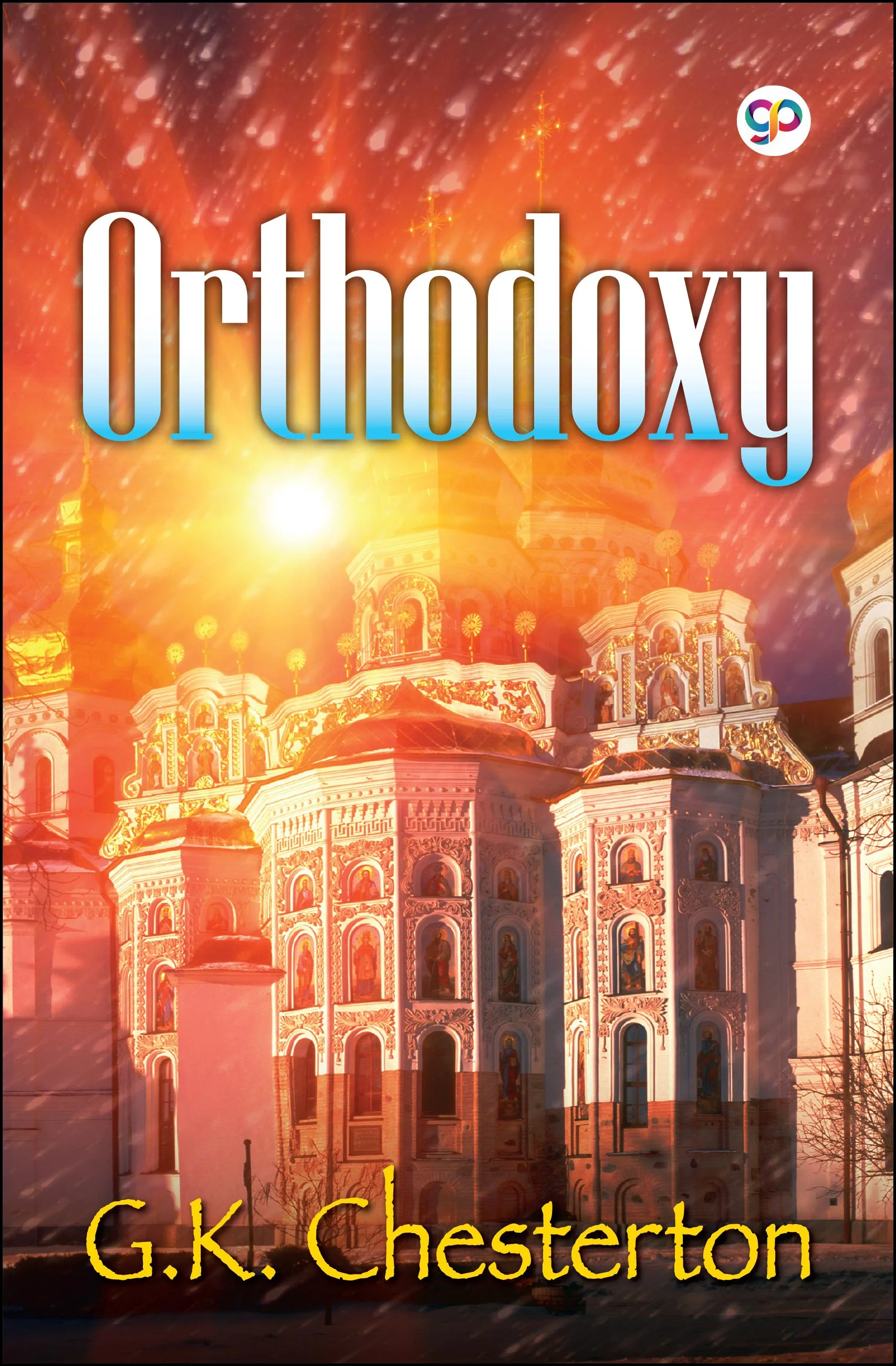
Orthodoxy
eBook
• INR 70.00
• English
• 9789389716115
No ratings yet
| Publisher | General Press |
|---|---|
| ISBN13 | 9789389716115 |
| ASIN/SKU | B084BNGQCX |
| Book Format | eBook |
| Language | English |
| List Price | INR 70.00 |
| Subject Code | REL067030, REL051000 |
| Publishing Date | 29/01/2020 |
| Book Code | BD00068657 |
Buy this Book
Amazon Stores
Ebook Stores
Other Stores
Discover Orthodoxy by G.K. Chesterton. This book is published by General Press in eBook format, ISBN 9789389716115, ASIN B084BNGQCX, under Christian Books and Bibles, Christian Theology, Christian Philosophy.
Book Description
One of the twentieth century's most admired and influential authors, G.K. Chesterton (1874–1936) created an enduring body of work that encompasses journalism, poetry, plays, history, biography, apologetics, and detective fiction.
Through this book Chesterton leads us on a literary journey toward truth. A unique book, ‘Orthodoxy’ addresses our faith struggles and how we communicate our faith to others. In this timeless classic, G.K. Chesterton, one of the literary giants of the twentieth century, presents a logical and personal reasoning for Christianity in model apologetic form. ‘Orthodoxy’ bridges the centuries and appeals to today's readers who face the same challenges of materialism, self-centeredness, and progress.
Through this book Chesterton leads us on a literary journey toward truth. A unique book, ‘Orthodoxy’ addresses our faith struggles and how we communicate our faith to others. In this timeless classic, G.K. Chesterton, one of the literary giants of the twentieth century, presents a logical and personal reasoning for Christianity in model apologetic form. ‘Orthodoxy’ bridges the centuries and appeals to today's readers who face the same challenges of materialism, self-centeredness, and progress.
Author Biography
Gilbert Keith Chesterton was born in London, England, in 1874. He began his education at St Paul's School, and later went on to study art at the Slade School, and literature at University College in London. Chesterton wrote a great deal of poetry, as well as works of social and literary criticism. Among his most notable books are ‘The Man Who Was Thursday’, a metaphysical thriller, and ‘The Everlasting Man’, a history of humankind's spiritual progress. After Chesterton converted to Catholicism in 1922, he wrote mainly on religious topics. Chesterton is most known for creating the famous priest-detective character Father Brown, who first appeared in ‘The Innocence of Father Brown.’ Chesterton died in 1936 at the age of 62.
Editorial Reviews
Editorial Reviews will be added soon…
Book Summary
Orthodoxy by G.K. Chesterton is a lively, paradoxical, and deeply personal defense of Christian belief in which G.K. Chesterton explains how he came to accept Christianity after years of questioning, skepticism, and intellectual exploration. First published in 1908, the book is not a conventional theological treatise. Instead, Chesterton presents what he calls his own “philosophy of life,” explaining why he believes Christianity provides the most coherent account of reality, human nature, morality, suffering, wonder, freedom, and hope. The title Orthodoxy might suggest a rigid defense of established doctrine, but Chesterton's approach is imaginative and conversational. He uses paradox, humor, storytelling, comparisons, and unexpected arguments to show why Christian ideas that may initially appear strange can actually provide a remarkably balanced understanding of human existence.
The book begins with Chesterton explaining that he did not set out simply to prove Christianity from the beginning. He describes himself as a person who followed different philosophical ideas and eventually discovered that many of the alternatives he encountered were internally unstable. The book is therefore partly an intellectual autobiography. Chesterton wants to explain not merely what he believes but why he came to believe it. His argument is built around the idea that modern people often reject Christianity because they assume its doctrines are irrational or oppressive, yet when those same doctrines are examined carefully, they may turn out to preserve truths about human nature that modern philosophies neglect.
One of the most famous ideas in Orthodoxy appears early in the book: Chesterton says that the book is a kind of “spiritual autobiography,” but unlike a conventional autobiography, it focuses on the intellectual path that led him to Christian belief. He compares his journey to a man who discovers that the supposed prison from which he escaped was actually his home. This reversal captures one of the book's central methods. Chesterton repeatedly argues that the things modern people consider restrictive may actually protect freedom, while ideas that appear liberating may produce new forms of slavery.
In “The Maniac,” Chesterton begins examining the relationship between reason and sanity. He argues that rationality alone does not guarantee a healthy philosophy of life. A person can construct an elaborate logical system around a very narrow or distorted understanding of reality. Chesterton compares the perfectly rational madman with the person whose understanding of the world is broader and more balanced. The madman may be extremely logical within his own assumptions, but the assumptions themselves can be dangerously limited.
This distinction becomes important throughout the book. Chesterton is not attacking reason. On the contrary, he believes reason is essential. His criticism is directed at philosophies that make reason the only acceptable source of knowledge while ignoring imagination, mystery, moral intuition, spiritual experience, and the complexity of human life. A philosophy that explains only one part of reality may be logically consistent but still fail as a philosophy of life.
Chesterton then turns to “The Suicide of Thought,” where he argues that excessive skepticism can eventually destroy the possibility of rational thought itself. If a person doubts every form of knowledge, including the reliability of reason, then there is no longer a stable foundation from which to make arguments. Chesterton is concerned about intellectual movements that pride themselves on questioning everything but never establish anything positive in its place.
This leads to one of his recurring arguments: Christianity preserves a balance between extremes. Human beings need reason, but they also need faith. They need freedom, but they also need moral boundaries. They need humility, but they also need confidence in human dignity. They need seriousness, but they also need joy. Chesterton believes Christianity has survived intellectually because it holds together truths that competing philosophies often separate.
The chapter “The Ethics of Elfland” is among the most charming sections of the book. Chesterton uses fairy tales to explain why wonder matters. He argues that fairy stories teach children to recognize the world as mysterious and valuable. A child does not need every event to have a scientific explanation before finding it wonderful. The ordinary existence of trees, stars, animals, and human beings can itself become astonishing when viewed with fresh eyes.
For Chesterton, this sense of wonder is not childish escapism. It is a philosophical attitude. The world is strange enough to deserve gratitude. The fact that anything exists at all is remarkable. Chesterton argues that people become spiritually impoverished when they assume that only unusual or extraordinary experiences are worthy of wonder. The everyday world can be miraculous simply because it exists.
This idea connects with Chesterton's famous reflections on gratitude. He imagines a person who wakes each morning surprised that the world is still there. That sense of surprise produces thankfulness. Modern people, by contrast, can become so accustomed to existence that they stop noticing how mysterious it is. Chesterton believes Christianity restores this sense of astonishment by presenting creation as something received rather than something that simply happens to be there.
The chapter “The Flag of the World” develops this idea further. Chesterton argues that the world is good but also incomplete and damaged. Christianity allows him to hold these two truths together. The world is worthy of love, yet it is not perfect. Human beings should celebrate creation without pretending that everything within it is already as it should be.
This balance becomes particularly important in Chesterton's discussion of human nature. He rejects both extreme optimism and extreme pessimism. Human beings are neither naturally perfect nor completely worthless. They possess enormous dignity because they are capable of reason, love, creativity, courage, and moral choice, but they are also capable of selfishness, cruelty, pride, and destruction. Christianity's doctrine of original sin, in Chesterton's interpretation, explains this strange combination.
The doctrine of original sin becomes one of the book's most important examples of an apparently pessimistic Christian teaching that Chesterton considers psychologically realistic. The idea that human beings are morally wounded may sound negative, but Chesterton argues that it explains something people observe constantly: individuals recognize moral standards while repeatedly failing to live up to them. Humanity is capable of extraordinary goodness and extraordinary evil. Christianity acknowledges both rather than reducing human nature to one extreme.
Chesterton is particularly critical of modern philosophies that promise to perfect humanity through political or intellectual systems. He believes these philosophies underestimate the persistence of selfishness and pride. Changing institutions may be necessary, but no political system can completely eliminate the flaws of human nature. A society can become unjust even while claiming to be perfectly rational or progressive.
In “The Romance of Orthodoxy,” Chesterton argues that Christian doctrine contains a surprising combination of apparently contradictory ideas. Christianity says that human beings are both noble and fallen, that humility can lead to greatness, that weakness can become strength, and that sacrifice can produce joy. Chesterton calls this a kind of balance achieved through paradox. Instead of choosing one side of a contradiction, Christianity preserves both truths.
This is perhaps the defining characteristic of Chesterton's defense of Christianity. He believes Christianity has succeeded because it avoids the extremes that destroy other philosophies. A philosophy may emphasize reason until it becomes sterile, freedom until it becomes chaotic, discipline until it becomes oppressive, or pessimism until life loses meaning. Christianity, according to Chesterton, places limits on each tendency without completely rejecting it.
The chapter “The Paradoxes of Christianity” develops this argument directly. Chesterton insists that Christianity appears contradictory because reality itself contains tensions that cannot be resolved by choosing one extreme. Christianity teaches humility but also insists upon the dignity of the individual. It teaches obedience but also celebrates freedom. It teaches self-denial but also promises joy. It teaches that the world is good while insisting that it is fallen. For Chesterton, these are not logical defects but signs that Christianity has successfully held together truths that human beings often separate.
Chesterton's treatment of freedom is especially important. He argues that genuine freedom requires boundaries. A completely unrestricted person may actually become less free because he is controlled by impulse, addiction, fear, fashion, or social pressure. Moral rules can therefore function not simply as restrictions but as structures that make meaningful freedom possible.
This idea also appears in his discussion of tradition. Chesterton does not see tradition as blind obedience to the past. Instead, he describes it as giving ordinary people a voice in shaping society. Tradition prevents the living generation from behaving as though it possesses complete wisdom. The accumulated experience of previous generations becomes a resource against intellectual arrogance.
One of the most memorable chapters, “The Romance of Orthodoxy,” also emphasizes the relationship between Christianity and adventure. Chesterton rejects the idea that traditional Christianity is dull or unimaginative. He argues that Christian belief creates an extraordinary adventure because it tells human beings that their actions matter, that moral choices are real, and that the world contains mysteries worth exploring.
The final chapter, “The Authority of the First Principles,” brings Chesterton's argument toward a conclusion. He explains why he believes Christian orthodoxy provides a stable framework for understanding life. He does not claim that every Christian has perfect answers to every question. Rather, he argues that Christianity gives humanity a framework in which the major truths of existence can coexist: reason and mystery, freedom and responsibility, joy and suffering, individuality and community, humility and dignity.
The ending of Orthodoxy is therefore not a simple intellectual proof. It is a declaration that Chesterton has found Christianity to be the philosophy that best explains the strange combination of beauty and brokenness he sees in the world. He believes Christianity does not solve every mystery by explaining it away. Instead, it gives people a way of living within mystery without surrendering reason.
The book's enduring appeal also comes from Chesterton's writing style. His prose is energetic, humorous, paradoxical, and often deliberately surprising. He does not write like a detached academic philosopher. He writes as someone trying to make readers see familiar ideas differently. His arguments frequently take the form of reversals: what looks like a limitation may create freedom; what appears pessimistic may protect hope; what seems irrational may actually preserve a larger rationality. These reversals make Orthodoxy both intellectually stimulating and entertaining.
Ultimately, Orthodoxy by G.K. Chesterton is a defense of Christianity built around the idea that human beings need a philosophy capable of respecting the full complexity of life. Chesterton argues that Christianity succeeds because it avoids destructive extremes. It recognizes human dignity without denying human sinfulness, values reason without reducing reality to reason alone, celebrates freedom without rejecting moral responsibility, and embraces wonder without abandoning truth.
For readers searching for an Orthodoxy by G.K. Chesterton summary, Orthodoxy analysis, G.K. Chesterton's philosophy, Chesterton's arguments for Christianity, Christian apologetics, original sin in Orthodoxy, Christian paradoxes, the meaning of orthodoxy, or an explanation of Chesterton's worldview, the book's deepest message is that a healthy philosophy of life must be large enough to contain apparently opposing truths. Chesterton's journey toward Christianity is ultimately a journey toward intellectual and spiritual balance. He comes to believe that Christianity does not imprison human thought but gives it a framework in which reason, imagination, morality, freedom, wonder, and faith can work together. Orthodoxy remains compelling because Chesterton does not ask readers merely to accept Christianity as inherited tradition; he asks them to reconsider the assumptions behind modern life and to see whether the Christian worldview might explain the strange mixture of joy, suffering, beauty, absurdity, freedom, and limitation that defines human existence.
The book begins with Chesterton explaining that he did not set out simply to prove Christianity from the beginning. He describes himself as a person who followed different philosophical ideas and eventually discovered that many of the alternatives he encountered were internally unstable. The book is therefore partly an intellectual autobiography. Chesterton wants to explain not merely what he believes but why he came to believe it. His argument is built around the idea that modern people often reject Christianity because they assume its doctrines are irrational or oppressive, yet when those same doctrines are examined carefully, they may turn out to preserve truths about human nature that modern philosophies neglect.
One of the most famous ideas in Orthodoxy appears early in the book: Chesterton says that the book is a kind of “spiritual autobiography,” but unlike a conventional autobiography, it focuses on the intellectual path that led him to Christian belief. He compares his journey to a man who discovers that the supposed prison from which he escaped was actually his home. This reversal captures one of the book's central methods. Chesterton repeatedly argues that the things modern people consider restrictive may actually protect freedom, while ideas that appear liberating may produce new forms of slavery.
In “The Maniac,” Chesterton begins examining the relationship between reason and sanity. He argues that rationality alone does not guarantee a healthy philosophy of life. A person can construct an elaborate logical system around a very narrow or distorted understanding of reality. Chesterton compares the perfectly rational madman with the person whose understanding of the world is broader and more balanced. The madman may be extremely logical within his own assumptions, but the assumptions themselves can be dangerously limited.
This distinction becomes important throughout the book. Chesterton is not attacking reason. On the contrary, he believes reason is essential. His criticism is directed at philosophies that make reason the only acceptable source of knowledge while ignoring imagination, mystery, moral intuition, spiritual experience, and the complexity of human life. A philosophy that explains only one part of reality may be logically consistent but still fail as a philosophy of life.
Chesterton then turns to “The Suicide of Thought,” where he argues that excessive skepticism can eventually destroy the possibility of rational thought itself. If a person doubts every form of knowledge, including the reliability of reason, then there is no longer a stable foundation from which to make arguments. Chesterton is concerned about intellectual movements that pride themselves on questioning everything but never establish anything positive in its place.
This leads to one of his recurring arguments: Christianity preserves a balance between extremes. Human beings need reason, but they also need faith. They need freedom, but they also need moral boundaries. They need humility, but they also need confidence in human dignity. They need seriousness, but they also need joy. Chesterton believes Christianity has survived intellectually because it holds together truths that competing philosophies often separate.
The chapter “The Ethics of Elfland” is among the most charming sections of the book. Chesterton uses fairy tales to explain why wonder matters. He argues that fairy stories teach children to recognize the world as mysterious and valuable. A child does not need every event to have a scientific explanation before finding it wonderful. The ordinary existence of trees, stars, animals, and human beings can itself become astonishing when viewed with fresh eyes.
For Chesterton, this sense of wonder is not childish escapism. It is a philosophical attitude. The world is strange enough to deserve gratitude. The fact that anything exists at all is remarkable. Chesterton argues that people become spiritually impoverished when they assume that only unusual or extraordinary experiences are worthy of wonder. The everyday world can be miraculous simply because it exists.
This idea connects with Chesterton's famous reflections on gratitude. He imagines a person who wakes each morning surprised that the world is still there. That sense of surprise produces thankfulness. Modern people, by contrast, can become so accustomed to existence that they stop noticing how mysterious it is. Chesterton believes Christianity restores this sense of astonishment by presenting creation as something received rather than something that simply happens to be there.
The chapter “The Flag of the World” develops this idea further. Chesterton argues that the world is good but also incomplete and damaged. Christianity allows him to hold these two truths together. The world is worthy of love, yet it is not perfect. Human beings should celebrate creation without pretending that everything within it is already as it should be.
This balance becomes particularly important in Chesterton's discussion of human nature. He rejects both extreme optimism and extreme pessimism. Human beings are neither naturally perfect nor completely worthless. They possess enormous dignity because they are capable of reason, love, creativity, courage, and moral choice, but they are also capable of selfishness, cruelty, pride, and destruction. Christianity's doctrine of original sin, in Chesterton's interpretation, explains this strange combination.
The doctrine of original sin becomes one of the book's most important examples of an apparently pessimistic Christian teaching that Chesterton considers psychologically realistic. The idea that human beings are morally wounded may sound negative, but Chesterton argues that it explains something people observe constantly: individuals recognize moral standards while repeatedly failing to live up to them. Humanity is capable of extraordinary goodness and extraordinary evil. Christianity acknowledges both rather than reducing human nature to one extreme.
Chesterton is particularly critical of modern philosophies that promise to perfect humanity through political or intellectual systems. He believes these philosophies underestimate the persistence of selfishness and pride. Changing institutions may be necessary, but no political system can completely eliminate the flaws of human nature. A society can become unjust even while claiming to be perfectly rational or progressive.
In “The Romance of Orthodoxy,” Chesterton argues that Christian doctrine contains a surprising combination of apparently contradictory ideas. Christianity says that human beings are both noble and fallen, that humility can lead to greatness, that weakness can become strength, and that sacrifice can produce joy. Chesterton calls this a kind of balance achieved through paradox. Instead of choosing one side of a contradiction, Christianity preserves both truths.
This is perhaps the defining characteristic of Chesterton's defense of Christianity. He believes Christianity has succeeded because it avoids the extremes that destroy other philosophies. A philosophy may emphasize reason until it becomes sterile, freedom until it becomes chaotic, discipline until it becomes oppressive, or pessimism until life loses meaning. Christianity, according to Chesterton, places limits on each tendency without completely rejecting it.
The chapter “The Paradoxes of Christianity” develops this argument directly. Chesterton insists that Christianity appears contradictory because reality itself contains tensions that cannot be resolved by choosing one extreme. Christianity teaches humility but also insists upon the dignity of the individual. It teaches obedience but also celebrates freedom. It teaches self-denial but also promises joy. It teaches that the world is good while insisting that it is fallen. For Chesterton, these are not logical defects but signs that Christianity has successfully held together truths that human beings often separate.
Chesterton's treatment of freedom is especially important. He argues that genuine freedom requires boundaries. A completely unrestricted person may actually become less free because he is controlled by impulse, addiction, fear, fashion, or social pressure. Moral rules can therefore function not simply as restrictions but as structures that make meaningful freedom possible.
This idea also appears in his discussion of tradition. Chesterton does not see tradition as blind obedience to the past. Instead, he describes it as giving ordinary people a voice in shaping society. Tradition prevents the living generation from behaving as though it possesses complete wisdom. The accumulated experience of previous generations becomes a resource against intellectual arrogance.
One of the most memorable chapters, “The Romance of Orthodoxy,” also emphasizes the relationship between Christianity and adventure. Chesterton rejects the idea that traditional Christianity is dull or unimaginative. He argues that Christian belief creates an extraordinary adventure because it tells human beings that their actions matter, that moral choices are real, and that the world contains mysteries worth exploring.
The final chapter, “The Authority of the First Principles,” brings Chesterton's argument toward a conclusion. He explains why he believes Christian orthodoxy provides a stable framework for understanding life. He does not claim that every Christian has perfect answers to every question. Rather, he argues that Christianity gives humanity a framework in which the major truths of existence can coexist: reason and mystery, freedom and responsibility, joy and suffering, individuality and community, humility and dignity.
The ending of Orthodoxy is therefore not a simple intellectual proof. It is a declaration that Chesterton has found Christianity to be the philosophy that best explains the strange combination of beauty and brokenness he sees in the world. He believes Christianity does not solve every mystery by explaining it away. Instead, it gives people a way of living within mystery without surrendering reason.
The book's enduring appeal also comes from Chesterton's writing style. His prose is energetic, humorous, paradoxical, and often deliberately surprising. He does not write like a detached academic philosopher. He writes as someone trying to make readers see familiar ideas differently. His arguments frequently take the form of reversals: what looks like a limitation may create freedom; what appears pessimistic may protect hope; what seems irrational may actually preserve a larger rationality. These reversals make Orthodoxy both intellectually stimulating and entertaining.
Ultimately, Orthodoxy by G.K. Chesterton is a defense of Christianity built around the idea that human beings need a philosophy capable of respecting the full complexity of life. Chesterton argues that Christianity succeeds because it avoids destructive extremes. It recognizes human dignity without denying human sinfulness, values reason without reducing reality to reason alone, celebrates freedom without rejecting moral responsibility, and embraces wonder without abandoning truth.
For readers searching for an Orthodoxy by G.K. Chesterton summary, Orthodoxy analysis, G.K. Chesterton's philosophy, Chesterton's arguments for Christianity, Christian apologetics, original sin in Orthodoxy, Christian paradoxes, the meaning of orthodoxy, or an explanation of Chesterton's worldview, the book's deepest message is that a healthy philosophy of life must be large enough to contain apparently opposing truths. Chesterton's journey toward Christianity is ultimately a journey toward intellectual and spiritual balance. He comes to believe that Christianity does not imprison human thought but gives it a framework in which reason, imagination, morality, freedom, wonder, and faith can work together. Orthodoxy remains compelling because Chesterton does not ask readers merely to accept Christianity as inherited tradition; he asks them to reconsider the assumptions behind modern life and to see whether the Christian worldview might explain the strange mixture of joy, suffering, beauty, absurdity, freedom, and limitation that defines human existence.
Sample Chapters
Sample Chapters will be added soon…
Reader Reviews
No reviews yet.
Orthodoxy