
The Jefferson Bible
eBook
• INR 70.00
• English
• 9789389716214
No ratings yet
| Publisher | General Press |
|---|---|
| ISBN13 | 9789389716214 |
| ASIN/SKU | B086VTYKM2 |
| Book Format | eBook |
| Language | English |
| List Price | INR 70.00 |
| Subject Code | REL012040, REL023000 |
| Publishing Date | 07/04/2020 |
| Book Code | BD00068680 |
Buy this Book
Amazon Stores
Ebook Stores
Other Stores
Discover The Jefferson Bible by Thomas Jefferson. This book is published by General Press in eBook format, ISBN 9789389716214, ASIN B086VTYKM2, under Christian Books and Bibles, Christian Theology, History of Christianity.
Book Description
‘The Jefferson Bible’ as it is formally titled was a book constructed by Thomas Jefferson in the latter years of his life by cutting and pasting numerous sections from various Bibles as extractions of the doctrine of Jesus. Jefferson, who had no desire to preach, refused to let his Bible beyond a circle of close friends, and it remained unpublished until 1895. Today, it is one of the most astonishing – if oblique – works of cultural and theological criticism. He was an author, statesman and third president of the United States – a deist, a believer in at best, a watchmaker god, one who did not take a personal interest in the goings-on of humanity.
Author Biography
Thomas Jefferson (1743–1826) was an American statesman, political philosopher, architect, lawyer, and author who played a central role in the founding of the United States. Best known as the principal author of the Declaration of Independence, he served as the nation's third President and helped shape the ideals of liberty, democracy, and religious freedom. At the same time, historians continue to examine the contradictions between his advocacy of human equality and his lifelong ownership of enslaved people, making his legacy both influential and deeply complex.
Jefferson was born on April 13, 1743, at Shadwell Plantation in Virginia. Raised in a prosperous family, he received an excellent education and developed a lifelong passion for books, science, music, architecture, and philosophy. He studied at the College of William & Mary before training as a lawyer. Influenced by Enlightenment thinkers such as John Locke and Francis Bacon, Jefferson came to believe that reason, education, and individual rights were essential to a just society.
In 1776, Jefferson drafted the Declaration of Independence, whose assertion that "all men are created equal" became one of the defining statements of democratic government. After American independence, he served as Governor of Virginia, the first United States Secretary of State under President George Washington, Vice President under John Adams, and President from 1801 to 1809. During his presidency, he oversaw the Louisiana Purchase, which doubled the size of the United States, and supported the Lewis and Clark Expedition to explore the newly acquired western territories.
Beyond politics, Jefferson was a gifted writer and an accomplished architect. He designed his home, Monticello, as well as several notable public buildings, blending classical European influences with American ideals. He also founded the University of Virginia, believing that education was the foundation of a free and informed society. His extensive correspondence and writings covered subjects ranging from government and religion to science, agriculture, and philosophy.
Thomas Jefferson died on July 4, 1826, exactly fifty years after the adoption of the Declaration of Independence. Today, he is remembered as one of America's most influential Founding Fathers, whose ideas continue to shape democratic thought around the world. At the same time, his legacy is understood through both his remarkable contributions to liberty and the enduring historical realities of slavery, inviting ongoing reflection on the complexities of the nation's founding.
Jefferson was born on April 13, 1743, at Shadwell Plantation in Virginia. Raised in a prosperous family, he received an excellent education and developed a lifelong passion for books, science, music, architecture, and philosophy. He studied at the College of William & Mary before training as a lawyer. Influenced by Enlightenment thinkers such as John Locke and Francis Bacon, Jefferson came to believe that reason, education, and individual rights were essential to a just society.
In 1776, Jefferson drafted the Declaration of Independence, whose assertion that "all men are created equal" became one of the defining statements of democratic government. After American independence, he served as Governor of Virginia, the first United States Secretary of State under President George Washington, Vice President under John Adams, and President from 1801 to 1809. During his presidency, he oversaw the Louisiana Purchase, which doubled the size of the United States, and supported the Lewis and Clark Expedition to explore the newly acquired western territories.
Beyond politics, Jefferson was a gifted writer and an accomplished architect. He designed his home, Monticello, as well as several notable public buildings, blending classical European influences with American ideals. He also founded the University of Virginia, believing that education was the foundation of a free and informed society. His extensive correspondence and writings covered subjects ranging from government and religion to science, agriculture, and philosophy.
Thomas Jefferson died on July 4, 1826, exactly fifty years after the adoption of the Declaration of Independence. Today, he is remembered as one of America's most influential Founding Fathers, whose ideas continue to shape democratic thought around the world. At the same time, his legacy is understood through both his remarkable contributions to liberty and the enduring historical realities of slavery, inviting ongoing reflection on the complexities of the nation's founding.
Editorial Reviews
Editorial Reviews will be added soon…
Book Summary
Thomas Jefferson’s The Jefferson Bible, formally titled The Life and Morals of Jesus of Nazareth, is one of the most unusual religious and historical works associated with an American president. Created around 1820, the book is Thomas Jefferson’s personal attempt to extract what he believed were the authentic moral teachings of Jesus Christ from the four Gospels. It is important to understand from the beginning that Jefferson did not intend to create a replacement for the Christian Bible. He created a private book for his own reading and reflection, selecting passages that he considered morally valuable while removing miracles, supernatural events, and theological claims that he believed could not be reconciled with reason. The Smithsonian describes the work as an effort to distill Jesus’ ethical teachings from what Jefferson regarded as later distortions or additions to the Gospel accounts. The resulting volume is therefore best understood as both a religious interpretation and a fascinating record of Jefferson’s Enlightenment-era approach to Christianity.
The central idea behind The Jefferson Bible is simple but radical: Jefferson believed that Jesus’ greatest importance lay in his moral teachings rather than in supernatural claims about his identity. Jefferson was a Deist who believed in a Creator but did not accept the orthodox Christian belief that Jesus was divine. Instead, he considered Jesus an extraordinary moral teacher whose principles of love, compassion, forgiveness, justice, and service represented an exceptionally high ethical standard. The Smithsonian notes that Jefferson believed he could distinguish Jesus’ original message from later additions by using reason as a guide. This philosophy determines virtually every editorial choice in the book. Jefferson does not ask the reader simply to accept everything contained in the Gospels. He asks what remains when the Gospel narratives are examined critically and the teachings that he considers genuinely moral and rational are separated from the miraculous.
The story of the book itself begins long before Jefferson physically assembled the final volume. His interest in Jesus and Christianity developed over many years. Jefferson had a lifelong fascination with religion, morality, philosophy, and the relationship between reason and faith. He was not indifferent to Christianity; rather, he was deeply interested in separating what he considered genuine Christian morality from doctrines he regarded as irrational or historically questionable. By the time he created the final version of The Life and Morals of Jesus of Nazareth, he had spent years thinking about how Jesus’ teachings could be understood without accepting supernatural theology. The finished book was consequently not a spontaneous attack on Christianity but the product of a long intellectual project.
Jefferson’s method was remarkably literal. He did not simply summarize the Gospels in his own words. He purchased printed New Testaments in several languages, physically cut out passages with a razor, and pasted selected excerpts into a new volume. The final work uses passages from Matthew, Mark, Luke, and John and places versions in Greek, Latin, French, and English side by side. This physical construction is important because it reveals how seriously Jefferson approached the task. He was effectively editing the Gospels by hand, selecting what he considered valuable and removing what he believed did not belong in his reconstruction of Jesus’ authentic life and teachings.
The resulting book resembles a carefully constructed scrapbook, although it is far more systematic than that description might suggest. Jefferson arranged the selected passages into a chronological narrative so that the reader could follow the life of Jesus from his birth through his teachings, ministry, crucifixion, and burial. The Smithsonian describes it as an 84-page assemblage created from passages in the first four books of the New Testament. Jefferson's use of multiple languages also allowed him to compare versions of the Gospel texts and decide which wording best expressed the moral ideas he wanted to preserve. The result is therefore simultaneously a religious book, a literary editing project, a historical artifact, and an expression of Jefferson's philosophy.
The opening of Jefferson’s version immediately reveals how different it is from the canonical Gospels. He begins with selected material from Luke but removes the supernatural account of the Annunciation. The Library of Congress explains that Jefferson began with the second chapter of Luke and omitted the earlier passage in which the angel Gabriel announces the miraculous conception of Jesus. He also removes the angelic appearance to the shepherds. These omissions are not accidental. They demonstrate Jefferson’s basic rule: preserve the human and moral story while excluding events that depend upon supernatural belief.
This approach continues throughout the book. Jefferson removes miracles, supernatural manifestations, and theological claims concerning Jesus’ divinity. He retains teachings, conversations, parables, ethical instructions, and examples of Jesus’ interactions with people. In this version, Jesus emerges primarily as a teacher of morality. The emphasis is not on proving that Jesus is the Son of God but on understanding what Jesus taught people about how they should live. Jefferson believed these teachings represented an extraordinarily elevated moral system, describing them as the most sublime and benevolent moral code offered to humanity.
Because Jefferson removes so much of the supernatural material, the emotional and philosophical character of the Gospel story changes. The canonical Gospels present Jesus as both teacher and divine figure, and his miracles are deeply connected to his identity and mission. Jefferson’s Jesus is different. He heals no one through supernatural power, performs no miracles, and does not rise from the dead. His authority comes from the quality of his moral teaching rather than from divine signs. For Jefferson, this makes Jesus no less remarkable. In fact, it may make the ethical challenge more direct because readers are asked to consider the teachings themselves rather than relying upon miracles to establish their importance.
The teachings that Jefferson preserves center on love and service. His reconstructed Jesus emphasizes compassion toward others, forgiveness, humility, repentance, moral responsibility, and resistance to hypocrisy. The book therefore highlights the ethical dimension of Christianity. A person’s faith is meaningful insofar as it affects conduct. How people treat one another becomes more important than religious labels or theological arguments. Jefferson was particularly interested in Jesus’ teachings about universal moral obligations, including the command to love others and to forgive those who have caused harm.
The emphasis on forgiveness is particularly significant. Jefferson’s selection presents Jesus as someone who challenges ordinary human instincts toward revenge and resentment. Instead of responding to wrongdoing with retaliation, people are called toward mercy. This is one reason the book remains relevant even outside a strictly religious context. Jefferson was attempting to preserve a universal ethical vision that he believed could be appreciated by people who approached religion through reason rather than doctrine.
Another major theme is the criticism of hypocrisy. Jefferson’s Jesus is deeply concerned with the difference between outward religious behavior and genuine moral character. Rituals and public displays of piety are less important than what happens within a person’s heart and how that person treats others. This fits naturally with Jefferson’s own emphasis on individual conscience. He believed religious belief should not simply be inherited or imposed by institutions; it should be examined personally and rationally.
The absence of the resurrection is perhaps the most famous feature of The Jefferson Bible. The canonical Gospels culminate in Jesus’ resurrection, which is central to Christian theology. Jefferson deliberately excludes it. The Library of Congress confirms that his narrative ends with the crucifixion and burial, without any resurrection appearance. This means that Jefferson’s Jesus does not achieve victory through a supernatural resurrection. Instead, his legacy rests entirely upon his teachings and example.
That ending changes the meaning of Jesus’ life. In traditional Christianity, the crucifixion is followed by resurrection and becomes part of a larger theological story about salvation, sin, death, and redemption. Jefferson removes that theological framework. What remains is a human teacher whose moral vision survives his death. The power of Jesus therefore lies in the ideas he leaves behind. Jefferson effectively asks readers to imagine Christianity without the supernatural foundation and to consider whether Jesus’ ethical teachings are powerful enough to stand on their own.
This is also why The Jefferson Bible should not be confused with an ordinary biography of Jesus. Jefferson is not attempting to reconstruct the historical Jesus according to modern historical methods. He is constructing a version of Jesus according to his own philosophical criteria. His work tells us as much about Thomas Jefferson as it does about Jesus. Every passage that Jefferson retains represents his judgment about what matters, while every passage he removes represents something he considers unreliable, unnecessary, or contrary to reason.
This tension makes the book particularly fascinating. Jefferson believed he was recovering the authentic moral teachings of Jesus, but the process was necessarily subjective. He had to decide which passages were genuine and which were later additions or misunderstandings. The Smithsonian explains that Jefferson believed the apostles and Gospel writers had introduced distortions that could be separated from Jesus’ true message through reason. Modern readers may agree or disagree with that assumption, but the book makes the assumption visible. Jefferson’s Bible is therefore not only a religious interpretation but also an example of how readers reshape ancient texts according to their own intellectual frameworks.
The four languages used in the book are another important part of Jefferson’s approach. The English, French, Greek, and Latin texts are placed alongside one another, allowing Jefferson to compare the wording. The Smithsonian records that he used six source copies—two in English, two in French, and two containing Greek and Latin—and physically cut passages from them to construct the finished work. This demonstrates Jefferson’s attention to textual detail. He was not simply selecting passages randomly. He wanted to examine the Gospel accounts closely and create what he considered the clearest possible presentation of Jesus’ moral philosophy.
The physical construction of the book is almost as fascinating as its contents. Jefferson created it from paper folios onto which the selected passages were pasted. The clippings were arranged carefully enough that the pages initially appear to have been printed as continuous text. The work was eventually bound in leather, but its origins as a cut-and-paste manuscript remain visible to historians and conservators. The book is therefore a direct physical record of Jefferson’s intellectual process. His scissors, razor, printed Bibles, blank paper, and careful arrangement became tools for constructing a personal philosophy of Jesus.
Jefferson’s private intentions are equally important. He did not plan to publish The Life and Morals of Jesus of Nazareth during his lifetime. The Smithsonian states that the book was intended solely for his own reading and reflection, and Jefferson knew that his religious views could offend religious authorities and be used against him by political opponents. This explains why the book was so different from a public political statement. Jefferson was not trying to establish a new denomination or persuade Americans to adopt his interpretation. He was engaging in private intellectual inquiry.
This privacy also connects with Jefferson’s broader belief in religious freedom. He believed religious convictions belonged to individual conscience and should not be controlled by government. His decision to keep this unusual religious project private is therefore consistent with his belief that individuals should have room to explore questions of faith without political interference. The Jefferson Bible represents that principle in personal form: a powerful public figure privately examining one of the central religious traditions of his society according to his own conscience and reason.
The later history of the book is almost as dramatic as its creation. Jefferson’s volume remained in his family for decades after his death. His great-granddaughter, Carolina Randolph, eventually sold it to Smithsonian librarian Cyrus Adler in 1895. Once the book became known publicly, it attracted considerable attention because of the combination of its famous creator and controversial religious content. Congress eventually authorized its publication, and a government edition appeared in 1904. A work intended as a private reading exercise had therefore become a significant American historical document.
The book’s public reputation also explains why the phrase “Jefferson Bible” can be misleading. Jefferson himself did not give it that name. He called it The Life and Morals of Jesus of Nazareth. The popular title arose later. The Smithsonian notes that many editions have subsequently carried the title “The Jefferson Bible,” even though Jefferson himself never used it. Calling it a “Bible” can suggest that Jefferson intended it to function as Scripture, which he did not. It is more accurately understood as Jefferson’s edited compilation of passages from the Gospels.
For readers searching for a Jefferson Bible summary, The Life and Morals of Jesus of Nazareth explained, Thomas Jefferson’s religious beliefs, the meaning of the Jefferson Bible, or an explanation of why Jefferson removed miracles and the resurrection, the most important point is that the work represents an attempt to separate Christian ethics from supernatural theology. Jefferson wanted to preserve what he believed was the essential moral teaching of Jesus while rejecting claims that depended upon revelation or miracles. His project was therefore deeply shaped by Enlightenment rationalism.
At the same time, The Jefferson Bible is not simply a rejection of Christianity. Jefferson admired Jesus profoundly. He considered Jesus’ moral teachings extraordinary and believed that their ethical power deserved recognition. The Smithsonian describes his goal as distilling Jesus’ ethical teachings and notes Jefferson’s belief that these teachings constituted an exceptionally elevated moral code. His criticism was directed primarily toward supernatural theology and what he regarded as later distortions, not toward Jesus’ ethical message.
Ultimately, The Jefferson Bible is best understood as a conversation between Christianity and Enlightenment reason. Jefferson takes the Gospel narratives and asks what they might mean when examined through a rational, skeptical, morally focused lens. The answer is a Jesus who teaches love, mercy, forgiveness, humility, service, repentance, and moral responsibility, but who is stripped of the supernatural elements central to orthodox Christian belief.
The lasting importance of The Jefferson Bible lies in this tension. It is not authoritative Scripture, and it should not be treated as an accurate substitute for the canonical Gospels. Instead, it is a remarkable historical document showing how one of the most influential figures in American history wrestled with faith, reason, morality, and tradition. Jefferson literally cut the Gospels apart and reconstructed them according to what he believed was essential. In doing so, he created a portrait of Jesus that was deeply human, intensely moral, and unmistakably shaped by the intellectual world of the Enlightenment.
In the end, The Jefferson Bible is as much a book about Thomas Jefferson as it is about Jesus Christ. It reveals a man unwilling to accept inherited beliefs without examination, yet deeply impressed by the ethical teachings of Christianity. Jefferson’s experiment raises a question that remains relevant today: if religious tradition is stripped of everything supernatural, what moral wisdom remains? His answer is clear. What remains, in his view, is a powerful vision of love, compassion, forgiveness, service, and human responsibility. Whether readers find his method convincing or profoundly flawed, the work remains an extraordinary example of personal religious inquiry—and one of the most revealing windows into the complicated relationship between faith and reason in early American history.
The central idea behind The Jefferson Bible is simple but radical: Jefferson believed that Jesus’ greatest importance lay in his moral teachings rather than in supernatural claims about his identity. Jefferson was a Deist who believed in a Creator but did not accept the orthodox Christian belief that Jesus was divine. Instead, he considered Jesus an extraordinary moral teacher whose principles of love, compassion, forgiveness, justice, and service represented an exceptionally high ethical standard. The Smithsonian notes that Jefferson believed he could distinguish Jesus’ original message from later additions by using reason as a guide. This philosophy determines virtually every editorial choice in the book. Jefferson does not ask the reader simply to accept everything contained in the Gospels. He asks what remains when the Gospel narratives are examined critically and the teachings that he considers genuinely moral and rational are separated from the miraculous.
The story of the book itself begins long before Jefferson physically assembled the final volume. His interest in Jesus and Christianity developed over many years. Jefferson had a lifelong fascination with religion, morality, philosophy, and the relationship between reason and faith. He was not indifferent to Christianity; rather, he was deeply interested in separating what he considered genuine Christian morality from doctrines he regarded as irrational or historically questionable. By the time he created the final version of The Life and Morals of Jesus of Nazareth, he had spent years thinking about how Jesus’ teachings could be understood without accepting supernatural theology. The finished book was consequently not a spontaneous attack on Christianity but the product of a long intellectual project.
Jefferson’s method was remarkably literal. He did not simply summarize the Gospels in his own words. He purchased printed New Testaments in several languages, physically cut out passages with a razor, and pasted selected excerpts into a new volume. The final work uses passages from Matthew, Mark, Luke, and John and places versions in Greek, Latin, French, and English side by side. This physical construction is important because it reveals how seriously Jefferson approached the task. He was effectively editing the Gospels by hand, selecting what he considered valuable and removing what he believed did not belong in his reconstruction of Jesus’ authentic life and teachings.
The resulting book resembles a carefully constructed scrapbook, although it is far more systematic than that description might suggest. Jefferson arranged the selected passages into a chronological narrative so that the reader could follow the life of Jesus from his birth through his teachings, ministry, crucifixion, and burial. The Smithsonian describes it as an 84-page assemblage created from passages in the first four books of the New Testament. Jefferson's use of multiple languages also allowed him to compare versions of the Gospel texts and decide which wording best expressed the moral ideas he wanted to preserve. The result is therefore simultaneously a religious book, a literary editing project, a historical artifact, and an expression of Jefferson's philosophy.
The opening of Jefferson’s version immediately reveals how different it is from the canonical Gospels. He begins with selected material from Luke but removes the supernatural account of the Annunciation. The Library of Congress explains that Jefferson began with the second chapter of Luke and omitted the earlier passage in which the angel Gabriel announces the miraculous conception of Jesus. He also removes the angelic appearance to the shepherds. These omissions are not accidental. They demonstrate Jefferson’s basic rule: preserve the human and moral story while excluding events that depend upon supernatural belief.
This approach continues throughout the book. Jefferson removes miracles, supernatural manifestations, and theological claims concerning Jesus’ divinity. He retains teachings, conversations, parables, ethical instructions, and examples of Jesus’ interactions with people. In this version, Jesus emerges primarily as a teacher of morality. The emphasis is not on proving that Jesus is the Son of God but on understanding what Jesus taught people about how they should live. Jefferson believed these teachings represented an extraordinarily elevated moral system, describing them as the most sublime and benevolent moral code offered to humanity.
Because Jefferson removes so much of the supernatural material, the emotional and philosophical character of the Gospel story changes. The canonical Gospels present Jesus as both teacher and divine figure, and his miracles are deeply connected to his identity and mission. Jefferson’s Jesus is different. He heals no one through supernatural power, performs no miracles, and does not rise from the dead. His authority comes from the quality of his moral teaching rather than from divine signs. For Jefferson, this makes Jesus no less remarkable. In fact, it may make the ethical challenge more direct because readers are asked to consider the teachings themselves rather than relying upon miracles to establish their importance.
The teachings that Jefferson preserves center on love and service. His reconstructed Jesus emphasizes compassion toward others, forgiveness, humility, repentance, moral responsibility, and resistance to hypocrisy. The book therefore highlights the ethical dimension of Christianity. A person’s faith is meaningful insofar as it affects conduct. How people treat one another becomes more important than religious labels or theological arguments. Jefferson was particularly interested in Jesus’ teachings about universal moral obligations, including the command to love others and to forgive those who have caused harm.
The emphasis on forgiveness is particularly significant. Jefferson’s selection presents Jesus as someone who challenges ordinary human instincts toward revenge and resentment. Instead of responding to wrongdoing with retaliation, people are called toward mercy. This is one reason the book remains relevant even outside a strictly religious context. Jefferson was attempting to preserve a universal ethical vision that he believed could be appreciated by people who approached religion through reason rather than doctrine.
Another major theme is the criticism of hypocrisy. Jefferson’s Jesus is deeply concerned with the difference between outward religious behavior and genuine moral character. Rituals and public displays of piety are less important than what happens within a person’s heart and how that person treats others. This fits naturally with Jefferson’s own emphasis on individual conscience. He believed religious belief should not simply be inherited or imposed by institutions; it should be examined personally and rationally.
The absence of the resurrection is perhaps the most famous feature of The Jefferson Bible. The canonical Gospels culminate in Jesus’ resurrection, which is central to Christian theology. Jefferson deliberately excludes it. The Library of Congress confirms that his narrative ends with the crucifixion and burial, without any resurrection appearance. This means that Jefferson’s Jesus does not achieve victory through a supernatural resurrection. Instead, his legacy rests entirely upon his teachings and example.
That ending changes the meaning of Jesus’ life. In traditional Christianity, the crucifixion is followed by resurrection and becomes part of a larger theological story about salvation, sin, death, and redemption. Jefferson removes that theological framework. What remains is a human teacher whose moral vision survives his death. The power of Jesus therefore lies in the ideas he leaves behind. Jefferson effectively asks readers to imagine Christianity without the supernatural foundation and to consider whether Jesus’ ethical teachings are powerful enough to stand on their own.
This is also why The Jefferson Bible should not be confused with an ordinary biography of Jesus. Jefferson is not attempting to reconstruct the historical Jesus according to modern historical methods. He is constructing a version of Jesus according to his own philosophical criteria. His work tells us as much about Thomas Jefferson as it does about Jesus. Every passage that Jefferson retains represents his judgment about what matters, while every passage he removes represents something he considers unreliable, unnecessary, or contrary to reason.
This tension makes the book particularly fascinating. Jefferson believed he was recovering the authentic moral teachings of Jesus, but the process was necessarily subjective. He had to decide which passages were genuine and which were later additions or misunderstandings. The Smithsonian explains that Jefferson believed the apostles and Gospel writers had introduced distortions that could be separated from Jesus’ true message through reason. Modern readers may agree or disagree with that assumption, but the book makes the assumption visible. Jefferson’s Bible is therefore not only a religious interpretation but also an example of how readers reshape ancient texts according to their own intellectual frameworks.
The four languages used in the book are another important part of Jefferson’s approach. The English, French, Greek, and Latin texts are placed alongside one another, allowing Jefferson to compare the wording. The Smithsonian records that he used six source copies—two in English, two in French, and two containing Greek and Latin—and physically cut passages from them to construct the finished work. This demonstrates Jefferson’s attention to textual detail. He was not simply selecting passages randomly. He wanted to examine the Gospel accounts closely and create what he considered the clearest possible presentation of Jesus’ moral philosophy.
The physical construction of the book is almost as fascinating as its contents. Jefferson created it from paper folios onto which the selected passages were pasted. The clippings were arranged carefully enough that the pages initially appear to have been printed as continuous text. The work was eventually bound in leather, but its origins as a cut-and-paste manuscript remain visible to historians and conservators. The book is therefore a direct physical record of Jefferson’s intellectual process. His scissors, razor, printed Bibles, blank paper, and careful arrangement became tools for constructing a personal philosophy of Jesus.
Jefferson’s private intentions are equally important. He did not plan to publish The Life and Morals of Jesus of Nazareth during his lifetime. The Smithsonian states that the book was intended solely for his own reading and reflection, and Jefferson knew that his religious views could offend religious authorities and be used against him by political opponents. This explains why the book was so different from a public political statement. Jefferson was not trying to establish a new denomination or persuade Americans to adopt his interpretation. He was engaging in private intellectual inquiry.
This privacy also connects with Jefferson’s broader belief in religious freedom. He believed religious convictions belonged to individual conscience and should not be controlled by government. His decision to keep this unusual religious project private is therefore consistent with his belief that individuals should have room to explore questions of faith without political interference. The Jefferson Bible represents that principle in personal form: a powerful public figure privately examining one of the central religious traditions of his society according to his own conscience and reason.
The later history of the book is almost as dramatic as its creation. Jefferson’s volume remained in his family for decades after his death. His great-granddaughter, Carolina Randolph, eventually sold it to Smithsonian librarian Cyrus Adler in 1895. Once the book became known publicly, it attracted considerable attention because of the combination of its famous creator and controversial religious content. Congress eventually authorized its publication, and a government edition appeared in 1904. A work intended as a private reading exercise had therefore become a significant American historical document.
The book’s public reputation also explains why the phrase “Jefferson Bible” can be misleading. Jefferson himself did not give it that name. He called it The Life and Morals of Jesus of Nazareth. The popular title arose later. The Smithsonian notes that many editions have subsequently carried the title “The Jefferson Bible,” even though Jefferson himself never used it. Calling it a “Bible” can suggest that Jefferson intended it to function as Scripture, which he did not. It is more accurately understood as Jefferson’s edited compilation of passages from the Gospels.
For readers searching for a Jefferson Bible summary, The Life and Morals of Jesus of Nazareth explained, Thomas Jefferson’s religious beliefs, the meaning of the Jefferson Bible, or an explanation of why Jefferson removed miracles and the resurrection, the most important point is that the work represents an attempt to separate Christian ethics from supernatural theology. Jefferson wanted to preserve what he believed was the essential moral teaching of Jesus while rejecting claims that depended upon revelation or miracles. His project was therefore deeply shaped by Enlightenment rationalism.
At the same time, The Jefferson Bible is not simply a rejection of Christianity. Jefferson admired Jesus profoundly. He considered Jesus’ moral teachings extraordinary and believed that their ethical power deserved recognition. The Smithsonian describes his goal as distilling Jesus’ ethical teachings and notes Jefferson’s belief that these teachings constituted an exceptionally elevated moral code. His criticism was directed primarily toward supernatural theology and what he regarded as later distortions, not toward Jesus’ ethical message.
Ultimately, The Jefferson Bible is best understood as a conversation between Christianity and Enlightenment reason. Jefferson takes the Gospel narratives and asks what they might mean when examined through a rational, skeptical, morally focused lens. The answer is a Jesus who teaches love, mercy, forgiveness, humility, service, repentance, and moral responsibility, but who is stripped of the supernatural elements central to orthodox Christian belief.
The lasting importance of The Jefferson Bible lies in this tension. It is not authoritative Scripture, and it should not be treated as an accurate substitute for the canonical Gospels. Instead, it is a remarkable historical document showing how one of the most influential figures in American history wrestled with faith, reason, morality, and tradition. Jefferson literally cut the Gospels apart and reconstructed them according to what he believed was essential. In doing so, he created a portrait of Jesus that was deeply human, intensely moral, and unmistakably shaped by the intellectual world of the Enlightenment.
In the end, The Jefferson Bible is as much a book about Thomas Jefferson as it is about Jesus Christ. It reveals a man unwilling to accept inherited beliefs without examination, yet deeply impressed by the ethical teachings of Christianity. Jefferson’s experiment raises a question that remains relevant today: if religious tradition is stripped of everything supernatural, what moral wisdom remains? His answer is clear. What remains, in his view, is a powerful vision of love, compassion, forgiveness, service, and human responsibility. Whether readers find his method convincing or profoundly flawed, the work remains an extraordinary example of personal religious inquiry—and one of the most revealing windows into the complicated relationship between faith and reason in early American history.
Sample Chapters
Sample Chapters will be added soon…
Reader Reviews
No reviews yet.
The Jefferson Bible
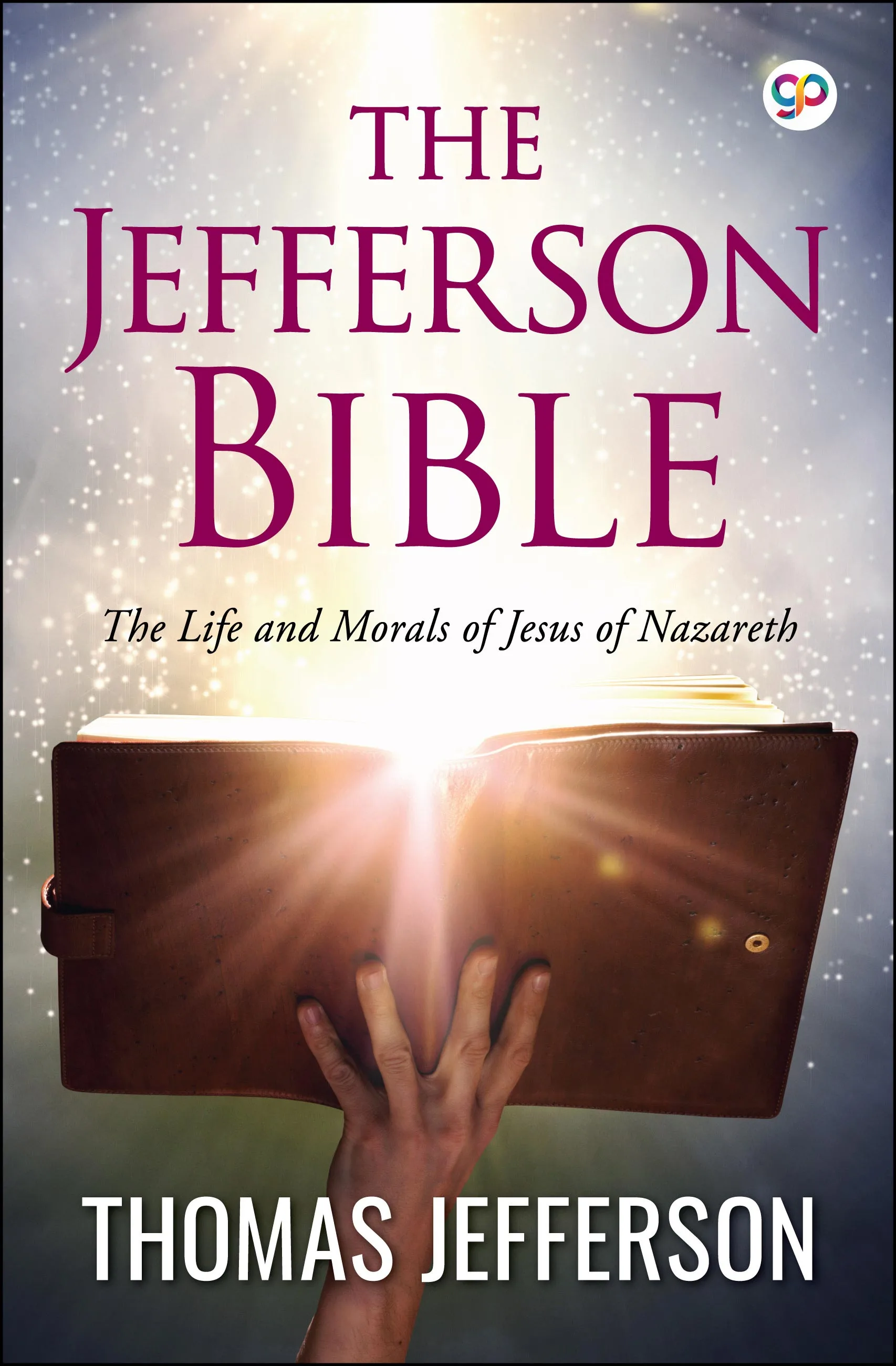
Download Cover Image
Do you want to download the full cover image for The Jefferson Bible?