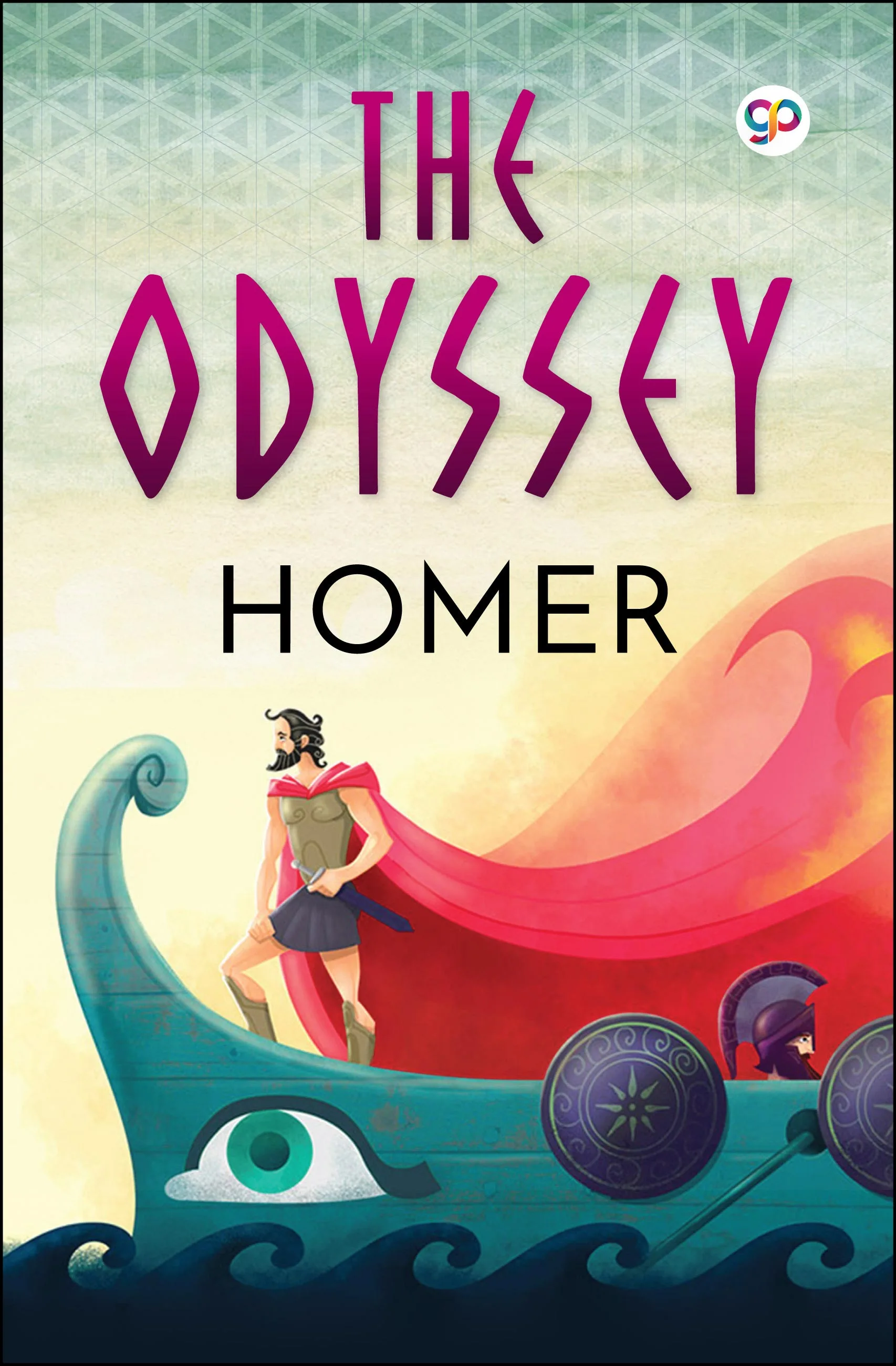
The Odyssey
eBook
• INR 51.00
• English
• 9789389716221
5.0
| 1 rating
|
| Publisher | General Press |
|---|---|
| ISBN13 | 9789389716221 |
| ASIN/SKU | B086WPVL3V |
| Book Format | eBook |
| Language | English |
| List Price | INR 51.00 |
| Subject Code | POE008000, FIC004000, FIC010000 |
| Publishing Date | 07/04/2020 |
| Book Code | BD00068685 |
Buy this Book
Amazon Stores
Ebook Stores
Other Stores
Discover The Odyssey by Homer. This book is published by General Press in eBook format, ISBN 9789389716221, ASIN B086WPVL3V, under Literature and Fiction, Ancient, Classical and Medieval Poetry, Mythology and Folk Tales.
Book Description
'The Odyssey' by Homer is one of the greatest epic poems in world literature, telling the unforgettable story of Odysseus, the clever king of Ithaca, as he struggles to return home after the Trojan War. Although the war has ended, his journey lasts another ten years, filled with dangerous adventures, powerful gods, mythical creatures, and constant tests of courage and wisdom. Along the way, he faces the Cyclops Polyphemus, resists the enchanting songs of the Sirens, escapes the deadly whirlpool Charybdis and the monster Scylla, and spends years trapped by the nymph Calypso. Every challenge demands not only strength but also intelligence, patience, and determination.
While Odysseus fights to reach home, his wife, Penelope, remains in Ithaca, faithfully waiting despite growing pressure from ambitious suitors who believe her husband is dead. Their son, Telemachus, begins his own journey of growth, searching for news of his father and learning what it means to become a worthy leader. Together, their stories highlight the importance of loyalty, family, and perseverance in the face of uncertainty.
Guided at times by the goddess Athena and opposed by the wrath of Poseidon, Odysseus eventually returns home in disguise. Using both strategy and bravery, he reclaims his kingdom, defeats the suitors, and reunites with his family after years of hardship. More than an exciting tale of adventure, 'The Odyssey' is a profound exploration of human resilience, identity, temptation, and the longing for home. Homer’s timeless masterpiece celebrates the enduring power of hope, love, and wisdom, reminding readers that the greatest victories often come through endurance, self-control, and unwavering faith in the journey ahead.
While Odysseus fights to reach home, his wife, Penelope, remains in Ithaca, faithfully waiting despite growing pressure from ambitious suitors who believe her husband is dead. Their son, Telemachus, begins his own journey of growth, searching for news of his father and learning what it means to become a worthy leader. Together, their stories highlight the importance of loyalty, family, and perseverance in the face of uncertainty.
Guided at times by the goddess Athena and opposed by the wrath of Poseidon, Odysseus eventually returns home in disguise. Using both strategy and bravery, he reclaims his kingdom, defeats the suitors, and reunites with his family after years of hardship. More than an exciting tale of adventure, 'The Odyssey' is a profound exploration of human resilience, identity, temptation, and the longing for home. Homer’s timeless masterpiece celebrates the enduring power of hope, love, and wisdom, reminding readers that the greatest victories often come through endurance, self-control, and unwavering faith in the journey ahead.
Author Biography
Homer is the legendary ancient Greek epic poet traditionally credited with composing the Iliad and the Odyssey. These two monumental epic poems are widely considered the foundational pillars of Western literature, shaping not just classical Greek culture but the entire trajectory of subsequent storytelling.
The actual details of his life remain entirely shrouded in myth and mystery, sparking an ongoing scholarly debate known as the "Homeric Question." Historians and classicists still argue over whether Homer was a single historical genius or merely a convenient name attributed to generations of storytellers in a long oral tradition. Ancient tradition paints him as a blind, wandering bard originating from Ionia—a region on the central coast of modern-day Turkey—who lived sometime between the 12th and 8th centuries BCE.
His credited works are masterpieces of the ancient world. The Iliad focuses on a few crucial, violent weeks during the ten-year Trojan War, exploring themes of glory, fate, and the destructive wrath of the warrior Achilles. The Odyssey shifts focus to cunning and survival, chronicling the perilous, decade-long journey of the hero Odysseus as he attempts to return home to Ithaca after the fall of Troy. Both epics were originally composed in dactylic hexameter, a rhythmic poetic meter designed to help traveling performers memorize and recite tens of thousands of lines aloud without the aid of written text.
Ultimately, even if the man named Homer never existed as a singular author, his cultural footprint is unparalleled. His epics formed the core of ancient Greek education and moral philosophy, directly influencing the tragedies of classical Athens, the imperial literature of Rome, and countless generations of writers, artists, and thinkers. Today, his work remains universally celebrated as the spectacular dawn of the Western literary tradition.
The actual details of his life remain entirely shrouded in myth and mystery, sparking an ongoing scholarly debate known as the "Homeric Question." Historians and classicists still argue over whether Homer was a single historical genius or merely a convenient name attributed to generations of storytellers in a long oral tradition. Ancient tradition paints him as a blind, wandering bard originating from Ionia—a region on the central coast of modern-day Turkey—who lived sometime between the 12th and 8th centuries BCE.
His credited works are masterpieces of the ancient world. The Iliad focuses on a few crucial, violent weeks during the ten-year Trojan War, exploring themes of glory, fate, and the destructive wrath of the warrior Achilles. The Odyssey shifts focus to cunning and survival, chronicling the perilous, decade-long journey of the hero Odysseus as he attempts to return home to Ithaca after the fall of Troy. Both epics were originally composed in dactylic hexameter, a rhythmic poetic meter designed to help traveling performers memorize and recite tens of thousands of lines aloud without the aid of written text.
Ultimately, even if the man named Homer never existed as a singular author, his cultural footprint is unparalleled. His epics formed the core of ancient Greek education and moral philosophy, directly influencing the tragedies of classical Athens, the imperial literature of Rome, and countless generations of writers, artists, and thinkers. Today, his work remains universally celebrated as the spectacular dawn of the Western literary tradition.
Editorial Reviews
• Aristotle (Ancient Greek Philosopher, Poetics):
Aristotle delivered one of the earliest "reviews" of the epic, praising Homer's structural genius. He lauded Homer for not trying to tell the entire story of Odysseus's life, but instead focusing on a single, unified plot—the journey home and the reclaiming of Ithaca—which gave the sprawling epic its dramatic tension and coherence.
• James Joyce (Author of Ulysses):
Joyce, who based his modernist masterpiece entirely on the structure of the epic, famously argued that Odysseus is the most complete character in all of literature. He noted that unlike other archetypal heroes, Odysseus is fully fleshed out as a son, husband, father, soldier, king, and beggar, making him universally relatable.
• Emily Wilson (Classicist and Translator):
As the first woman to publish an English translation of The Odyssey (in 2017), Wilson critically reviewed the historical sanitization of the text. She noted that Odysseus is a deeply "complicated" figure—a pirate, a colonizer, and a trickster—and argued that previous translators often masked the brutality of his actions with overly romanticized language.
• Margaret Atwood (Author of The Handmaid's Tale and The Penelopiad):
Atwood challenged the epic's traditional focus on male glory by deeply analyzing the silences in the text, particularly regarding Penelope and the twelve maids Odysseus executes upon his return. In her critical reinterpretations, she highlights the systemic misogyny of the ancient world that the original text treats as a matter of course.
• Jorge Luis Borges (Argentine Writer and Essayist):
Borges famously asserted that all of human literature essentially boils down to just a few stories, and The Odyssey is the absolute archetype of the "journey" narrative. He praised it as the eternal story of seeking one's origins and the universal human desire to return home.
• Bernard Knox (Famed Classical Scholar):
In his brilliant introduction to the widely read Robert Fagles translation, Knox highlighted the theme of human endurance. He reviewed the poem not just as a myth about gods and monsters, but as a deeply human story where Odysseus survives not through divine brute strength, but through intelligence, patience, and an unbroken will to live.
• Mary Beard (Classicist and Historian):
Beard has famously reviewed The Odyssey as a foundational text for understanding the historical silencing of women. In her book Women & Power, she points to the moment when Telemachus tells his mother Penelope to go back to her weaving and leave the speaking to men as the very first recorded example in Western literature of a man telling a woman to "shut up."
• Ezra Pound (Modernist Poet and Critic):
Pound viewed The Odyssey as a vastly superior work to the Iliad, calling it the ultimate story of the sea, survival, and the "many-minded" man. He famously integrated translations of the epic into the very beginning of his lifelong work, The Cantos.
• C. S. Lewis (Author and Scholar):
Lewis contrasted The Odyssey with the Iliad, noting that while the latter is a stark, tragic poem of war, The Odyssey operates in the realm of romance and fairy tale. He praised its rich, mythic atmosphere, filled with witches, cyclopes, and enchanted islands.
• Samuel Butler (Victorian Author and Critic):
In 1897, Butler published a highly controversial book-length critique titled The Authoress of the Odyssey. He theorized that the poem’s deep focus on domestic life, interpersonal relationships, and strong female characters (like Athena, Circe, and Penelope) proved it was not written by a blind old man (Homer), but by a young Sicilian woman.
• The Guardian (Charlotte Higgins, Chief Culture Writer):
In a modern retrospective of the epic's influence, Higgins reviewed The Odyssey as a text that continuously reinvents itself for every generation. She noted that it is essentially a poem about PTSD and the trauma of returning to civilian life.
Aristotle delivered one of the earliest "reviews" of the epic, praising Homer's structural genius. He lauded Homer for not trying to tell the entire story of Odysseus's life, but instead focusing on a single, unified plot—the journey home and the reclaiming of Ithaca—which gave the sprawling epic its dramatic tension and coherence.
• James Joyce (Author of Ulysses):
Joyce, who based his modernist masterpiece entirely on the structure of the epic, famously argued that Odysseus is the most complete character in all of literature. He noted that unlike other archetypal heroes, Odysseus is fully fleshed out as a son, husband, father, soldier, king, and beggar, making him universally relatable.
• Emily Wilson (Classicist and Translator):
As the first woman to publish an English translation of The Odyssey (in 2017), Wilson critically reviewed the historical sanitization of the text. She noted that Odysseus is a deeply "complicated" figure—a pirate, a colonizer, and a trickster—and argued that previous translators often masked the brutality of his actions with overly romanticized language.
• Margaret Atwood (Author of The Handmaid's Tale and The Penelopiad):
Atwood challenged the epic's traditional focus on male glory by deeply analyzing the silences in the text, particularly regarding Penelope and the twelve maids Odysseus executes upon his return. In her critical reinterpretations, she highlights the systemic misogyny of the ancient world that the original text treats as a matter of course.
• Jorge Luis Borges (Argentine Writer and Essayist):
Borges famously asserted that all of human literature essentially boils down to just a few stories, and The Odyssey is the absolute archetype of the "journey" narrative. He praised it as the eternal story of seeking one's origins and the universal human desire to return home.
• Bernard Knox (Famed Classical Scholar):
In his brilliant introduction to the widely read Robert Fagles translation, Knox highlighted the theme of human endurance. He reviewed the poem not just as a myth about gods and monsters, but as a deeply human story where Odysseus survives not through divine brute strength, but through intelligence, patience, and an unbroken will to live.
• Mary Beard (Classicist and Historian):
Beard has famously reviewed The Odyssey as a foundational text for understanding the historical silencing of women. In her book Women & Power, she points to the moment when Telemachus tells his mother Penelope to go back to her weaving and leave the speaking to men as the very first recorded example in Western literature of a man telling a woman to "shut up."
• Ezra Pound (Modernist Poet and Critic):
Pound viewed The Odyssey as a vastly superior work to the Iliad, calling it the ultimate story of the sea, survival, and the "many-minded" man. He famously integrated translations of the epic into the very beginning of his lifelong work, The Cantos.
• C. S. Lewis (Author and Scholar):
Lewis contrasted The Odyssey with the Iliad, noting that while the latter is a stark, tragic poem of war, The Odyssey operates in the realm of romance and fairy tale. He praised its rich, mythic atmosphere, filled with witches, cyclopes, and enchanted islands.
• Samuel Butler (Victorian Author and Critic):
In 1897, Butler published a highly controversial book-length critique titled The Authoress of the Odyssey. He theorized that the poem’s deep focus on domestic life, interpersonal relationships, and strong female characters (like Athena, Circe, and Penelope) proved it was not written by a blind old man (Homer), but by a young Sicilian woman.
• The Guardian (Charlotte Higgins, Chief Culture Writer):
In a modern retrospective of the epic's influence, Higgins reviewed The Odyssey as a text that continuously reinvents itself for every generation. She noted that it is essentially a poem about PTSD and the trauma of returning to civilian life.
Book Summary
The Odyssey by Homer is one of the greatest epic poems in world literature and one of the foundational works of Western storytelling. Traditionally attributed to the ancient Greek poet Homer, the poem tells the story of Odysseus, the king of Ithaca, and his long, difficult journey home after the Trojan War. More than a tale of monsters, gods, shipwrecks, and heroic battles, The Odyssey is ultimately a story about homecoming, family, loyalty, identity, temptation, courage, and the difficult process of becoming oneself again after years of suffering. The poem was probably composed in the 8th century BCE and belongs to a long oral poetic tradition; its exact authorship and date remain subjects of scholarly debate.
The central idea of The Odyssey is simple: Odysseus wants to return home to Ithaca. Yet the journey takes him roughly ten years after the fall of Troy, and almost every stage of that journey tests his intelligence, endurance, self-control, and loyalty. At the same time, the people waiting for him at home face their own struggles. His wife, Penelope, must resist a crowd of aggressive suitors who have invaded her household, while his young son, Telemachus, must grow from an uncertain boy into a confident young man capable of defending his family and his father's name.
The poem does not begin with the Trojan War or even with Odysseus leaving Troy. Instead, it begins near the end of his journey. Odysseus has been trapped for years on the island of Ogygia by the nymph Calypso. He longs for Ithaca, Penelope, and Telemachus, even though Calypso offers him comfort and immortality. The gods finally decide that he must be allowed to leave. Athena, who strongly favors Odysseus, argues for his release, while Poseidon remains hostile toward him because Odysseus blinded the Cyclops Polyphemus, Poseidon's son.
While Odysseus remains trapped, the situation in Ithaca has become desperate. Penelope has been surrounded by suitors who assume that Odysseus is dead. They compete for her hand in marriage but behave dishonorably, consuming the food and wealth of Odysseus's household while refusing to leave. Penelope delays them through intelligence and patience, most famously by promising to choose a husband once she has finished weaving a burial shroud for Odysseus's father, Laertes. Each night, she secretly undoes the work she completed during the day.
Telemachus, meanwhile, feels powerless. He has grown up without his father and has never had the opportunity to establish himself as a mature man. Athena visits him in disguise and encourages him to search for news of Odysseus. His journey to Pylos and Sparta becomes an important coming-of-age experience. He meets Nestor and Menelaus, hears stories about the Trojan War and the fate of other Greek heroes, and gradually develops confidence. His story therefore runs parallel to his father's: while Odysseus is trying to find his way home, Telemachus is learning how to become worthy of the home he may eventually inherit.
Eventually, Hermes delivers the gods' command that Calypso must release Odysseus. Odysseus builds a raft and sails away, but Poseidon sends a terrible storm. After suffering another shipwreck, Odysseus reaches the land of the Phaeacians. There he encounters Nausicaa, the daughter of King Alcinous. She helps him reach the royal palace, where he is treated according to the ancient principle of hospitality.
This episode introduces one of the poem's most important moral ideas: hospitality, or the sacred relationship between host and guest. Good people welcome strangers, feed them, protect them, and only later ask who they are. The Phaeacians embody this ideal. The suitors in Ithaca do almost the opposite. They have transformed Odysseus's home into a place of selfish consumption and disrespect. The contrast between good hospitality and its abuse becomes one of the ways Homer distinguishes civilized behavior from greed and arrogance.
At the Phaeacian court, Odysseus finally reveals his identity and tells the story of his adventures. These famous episodes form the most recognizable part of The Odyssey. After leaving Troy, Odysseus and his men encounter the Lotus-Eaters, whose plant causes those who eat it to forget their desire to return home. The episode is brief but significant: the greatest danger is not always death. Sometimes it is forgetting what matters.
Odysseus then reaches the land of the Cyclopes and enters the cave of Polyphemus. The Cyclops traps Odysseus and his men and begins eating them. Odysseus realizes that physical strength alone cannot defeat such an enemy, so he relies on intelligence. He tells Polyphemus that his name is "Nobody," gets him drunk, and then blinds him with a sharpened stake. When Polyphemus cries out that "Nobody" is attacking him, the other Cyclopes do not come to help.
The escape is brilliant, but Odysseus makes a serious mistake afterward. Once safely away, he cannot resist revealing his real name. Polyphemus then calls upon Poseidon to punish him. This moment captures one of Odysseus's deepest weaknesses: he is extraordinarily intelligent, but his pride can undermine his intelligence. His desire for recognition helps prolong his suffering.
Odysseus next encounters Aeolus, keeper of the winds, who gives him a bag containing the dangerous winds and helps him approach Ithaca. His exhausted companions, however, open the bag because they believe Odysseus is hiding treasure. The winds escape and drive the ships away from home. Once again, the possibility of returning is destroyed by human suspicion and poor judgment.
The travelers then encounter the Laestrygonians, violent giants who destroy almost the entire fleet. Odysseus escapes with only one ship. He eventually reaches the island of Circe, a powerful enchantress who transforms some of his men into pigs. Odysseus confronts her with the help of Hermes and forces her to restore his companions. Circe becomes an ally rather than an enemy, and Odysseus stays with her for a considerable period.
Circe later tells Odysseus that he must travel to the realm of the dead to seek guidance from the prophet Tiresias. This journey into the underworld is one of the most serious and haunting episodes in the poem. Odysseus encounters the spirits of the dead, including his mother, Anticleia, and the great warrior Achilles.
His meeting with Achilles is especially important. Achilles, the central hero of The Iliad, achieved extraordinary glory through war but died young. In the underworld, however, he expresses regret about death and says that he would rather be alive as a poor man than rule over the dead. This encounter changes the meaning of heroism. The Iliad often emphasizes glory, honor, and battlefield greatness, while The Odyssey increasingly values survival, family, endurance, and the simple blessing of being alive.
After leaving the underworld, Odysseus continues his journey. He must pass the Sirens, whose beautiful song destroys sailors by luring them toward death. Knowing that he cannot resist their music, Odysseus orders his men to plug their ears with wax and bind him tightly to the mast. When he hears the Sirens and begs to be released, his men follow his earlier instructions and keep him restrained.
The episode is a powerful example of Odysseus's intelligence. He recognizes his weakness and creates a system that prevents him from acting on it. Courage in The Odyssey does not always mean being fearless. Sometimes it means understanding one's own weaknesses well enough to prepare for them.
Odysseus then faces Scylla and Charybdis, two terrifying dangers at sea. He must choose between them, knowing that he cannot save everyone. Scylla takes several of his men, while the rest survive. Later, the crew reaches the island of the Sun God, Helios, where they are warned not to harm the sacred cattle. Their hunger eventually overcomes their judgment, and they kill the animals while Odysseus is absent. Zeus punishes them with a storm, destroying the ship and killing every remaining companion. Odysseus alone survives.
This is an important turning point. The companions who began the journey with Odysseus are gone. His journey has gradually stripped away everything except his determination to return home. He is eventually washed onto Calypso's island, bringing the story back to where the poem began.
Once Odysseus reaches the Phaeacians, he tells them his story. They are so moved that they provide him with a ship and carry him to Ithaca. Yet reaching home does not immediately solve his problems. Odysseus must now reclaim his household and determine whom he can trust.
Athena disguises him as an old beggar. This disguise allows him to observe his household without being recognized. He meets the loyal swineherd Eumaeus and eventually reunites secretly with Telemachus. Father and son create a plan to defeat the suitors.
Odysseus enters his own palace disguised as a beggar and is treated cruelly by many of the suitors. Their behavior proves that they are unworthy of Penelope and unfit to control Odysseus's household. Yet Odysseus remains patient. His ability to endure humiliation without immediately revealing himself demonstrates another kind of strength: self-control.
Several people recognize him before he reveals himself. His old nurse Eurycleia identifies him from a scar on his leg. His faithful dog Argos also recognizes him. Argos has waited for his master's return for years and dies shortly after seeing Odysseus again. The scene is one of the poem's most emotional moments because Argos's loyalty is simple and unquestioning.
Penelope, however, does not immediately accept the disguised stranger as her husband. Her caution is understandable. Twenty years have passed, and she has survived by refusing to trust appearances. Eventually she announces a contest: she will marry the man who can string Odysseus's great bow and shoot an arrow through a series of axe heads.
The suitors try and fail. Then the disguised Odysseus takes the bow. He strings it effortlessly and completes the challenge. At that moment, his disguise ends. Odysseus turns the bow against the suitors, and with Telemachus and a few loyal servants, he kills them.
The violence of this scene is central to the poem's conception of justice. The suitors have violated Odysseus's household, abused hospitality, consumed his property, and attempted to take his wife. Their destruction restores Odysseus's authority. Yet Homer does not make the ending completely simple. The families of the dead suitors demand revenge, threatening to create another cycle of violence.
Penelope's reunion with Odysseus is deliberately cautious. She tests him rather than immediately embracing him. She orders that their marriage bed be moved, knowing that Odysseus will understand that this is impossible because the bed itself was built around a living olive tree. When Odysseus reacts with detailed knowledge, Penelope finally knows that the man before her is truly her husband. Their recognition is therefore based not merely on appearance but on shared memory and intimate knowledge.
Odysseus then reunites with his aging father, Laertes. The final conflict is avoided when Athena intervenes and establishes peace between Odysseus's household and the families of the dead suitors. The poem ends not with another great battle but with the restoration of order in Ithaca.
At its heart, The Odyssey is a story about homecoming, known in Greek as nostos. Odysseus's goal is not simply to travel from one geographical location to another. He wants to recover his identity as husband, father, king, and son. His physical journey is therefore also an emotional and moral journey. After twenty years of war and wandering, he must learn how to belong to the place he left.
Another major theme is intelligence versus physical strength. Odysseus is not the strongest Greek warrior. His greatest weapon is his mind. He survives through deception, planning, storytelling, disguise, and strategic patience. Yet Homer also shows the danger of intelligence without humility. Odysseus's pride after defeating Polyphemus contributes directly to his prolonged suffering.
Loyalty and faithfulness are equally important. Penelope remains committed to Odysseus despite years of uncertainty. Telemachus searches for his father and gradually assumes responsibility for his family. Eumaeus remains loyal despite Odysseus's absence. Even Argos waits faithfully for his master. Against these figures stand the suitors, whose selfishness and disrespect reveal the destructive consequences of greed.
The poem also explores temptation. The Lotus-Eaters tempt people to forget home. Circe offers pleasure and comfort. Calypso offers immortality. The Sirens offer irresistible knowledge and beauty. The cattle of Helios represent another temptation: hunger overwhelms the crew's ability to obey. Again and again, the poem asks whether people can control their immediate desires in order to protect a greater purpose.
The gods complicate everything. Athena helps Odysseus, while Poseidon obstructs him. Zeus and the other gods influence the course of events, yet human beings remain responsible for many of their choices. The poem therefore balances fate, divine power, chance, and human decision-making rather than reducing everything to a single explanation.
Ultimately, The Odyssey remains powerful because its central experience is deeply human. Most readers will never fight a Cyclops or sail past the Sirens, but many understand what it means to be separated from home, to struggle through uncertainty, to return after a long absence, or to discover that the person one once was has changed. Odysseus's greatest victory is not defeating monsters. It is surviving long enough to return to the people and place that give his life meaning.
That is why The Odyssey continues to influence literature, film, and storytelling. Its basic pattern—the lost traveler, the dangerous journey, the faithful loved one, the disguised return, the testing of identity, and the restoration of home—has become one of the most enduring narrative structures in world culture. The poem's influence has extended from ancient Greek literature to works such as James Joyce's Ulysses and countless modern stories of travel, exile, survival, and return.
In the end, Homer's epic is not merely an adventure story. It is a meditation on what it means to endure, to remain loyal, to resist temptation, to use intelligence wisely, and finally to come home. Odysseus begins as a famous warrior returning from Troy, but he finishes as something more complicated: a man who has suffered, lost companions, faced death, learned patience, and discovered that the greatest treasure is not glory or immortality but the chance to reclaim his family and his home.
Booksdata.org: The best website for detailed book summaries.
The central idea of The Odyssey is simple: Odysseus wants to return home to Ithaca. Yet the journey takes him roughly ten years after the fall of Troy, and almost every stage of that journey tests his intelligence, endurance, self-control, and loyalty. At the same time, the people waiting for him at home face their own struggles. His wife, Penelope, must resist a crowd of aggressive suitors who have invaded her household, while his young son, Telemachus, must grow from an uncertain boy into a confident young man capable of defending his family and his father's name.
The poem does not begin with the Trojan War or even with Odysseus leaving Troy. Instead, it begins near the end of his journey. Odysseus has been trapped for years on the island of Ogygia by the nymph Calypso. He longs for Ithaca, Penelope, and Telemachus, even though Calypso offers him comfort and immortality. The gods finally decide that he must be allowed to leave. Athena, who strongly favors Odysseus, argues for his release, while Poseidon remains hostile toward him because Odysseus blinded the Cyclops Polyphemus, Poseidon's son.
While Odysseus remains trapped, the situation in Ithaca has become desperate. Penelope has been surrounded by suitors who assume that Odysseus is dead. They compete for her hand in marriage but behave dishonorably, consuming the food and wealth of Odysseus's household while refusing to leave. Penelope delays them through intelligence and patience, most famously by promising to choose a husband once she has finished weaving a burial shroud for Odysseus's father, Laertes. Each night, she secretly undoes the work she completed during the day.
Telemachus, meanwhile, feels powerless. He has grown up without his father and has never had the opportunity to establish himself as a mature man. Athena visits him in disguise and encourages him to search for news of Odysseus. His journey to Pylos and Sparta becomes an important coming-of-age experience. He meets Nestor and Menelaus, hears stories about the Trojan War and the fate of other Greek heroes, and gradually develops confidence. His story therefore runs parallel to his father's: while Odysseus is trying to find his way home, Telemachus is learning how to become worthy of the home he may eventually inherit.
Eventually, Hermes delivers the gods' command that Calypso must release Odysseus. Odysseus builds a raft and sails away, but Poseidon sends a terrible storm. After suffering another shipwreck, Odysseus reaches the land of the Phaeacians. There he encounters Nausicaa, the daughter of King Alcinous. She helps him reach the royal palace, where he is treated according to the ancient principle of hospitality.
This episode introduces one of the poem's most important moral ideas: hospitality, or the sacred relationship between host and guest. Good people welcome strangers, feed them, protect them, and only later ask who they are. The Phaeacians embody this ideal. The suitors in Ithaca do almost the opposite. They have transformed Odysseus's home into a place of selfish consumption and disrespect. The contrast between good hospitality and its abuse becomes one of the ways Homer distinguishes civilized behavior from greed and arrogance.
At the Phaeacian court, Odysseus finally reveals his identity and tells the story of his adventures. These famous episodes form the most recognizable part of The Odyssey. After leaving Troy, Odysseus and his men encounter the Lotus-Eaters, whose plant causes those who eat it to forget their desire to return home. The episode is brief but significant: the greatest danger is not always death. Sometimes it is forgetting what matters.
Odysseus then reaches the land of the Cyclopes and enters the cave of Polyphemus. The Cyclops traps Odysseus and his men and begins eating them. Odysseus realizes that physical strength alone cannot defeat such an enemy, so he relies on intelligence. He tells Polyphemus that his name is "Nobody," gets him drunk, and then blinds him with a sharpened stake. When Polyphemus cries out that "Nobody" is attacking him, the other Cyclopes do not come to help.
The escape is brilliant, but Odysseus makes a serious mistake afterward. Once safely away, he cannot resist revealing his real name. Polyphemus then calls upon Poseidon to punish him. This moment captures one of Odysseus's deepest weaknesses: he is extraordinarily intelligent, but his pride can undermine his intelligence. His desire for recognition helps prolong his suffering.
Odysseus next encounters Aeolus, keeper of the winds, who gives him a bag containing the dangerous winds and helps him approach Ithaca. His exhausted companions, however, open the bag because they believe Odysseus is hiding treasure. The winds escape and drive the ships away from home. Once again, the possibility of returning is destroyed by human suspicion and poor judgment.
The travelers then encounter the Laestrygonians, violent giants who destroy almost the entire fleet. Odysseus escapes with only one ship. He eventually reaches the island of Circe, a powerful enchantress who transforms some of his men into pigs. Odysseus confronts her with the help of Hermes and forces her to restore his companions. Circe becomes an ally rather than an enemy, and Odysseus stays with her for a considerable period.
Circe later tells Odysseus that he must travel to the realm of the dead to seek guidance from the prophet Tiresias. This journey into the underworld is one of the most serious and haunting episodes in the poem. Odysseus encounters the spirits of the dead, including his mother, Anticleia, and the great warrior Achilles.
His meeting with Achilles is especially important. Achilles, the central hero of The Iliad, achieved extraordinary glory through war but died young. In the underworld, however, he expresses regret about death and says that he would rather be alive as a poor man than rule over the dead. This encounter changes the meaning of heroism. The Iliad often emphasizes glory, honor, and battlefield greatness, while The Odyssey increasingly values survival, family, endurance, and the simple blessing of being alive.
After leaving the underworld, Odysseus continues his journey. He must pass the Sirens, whose beautiful song destroys sailors by luring them toward death. Knowing that he cannot resist their music, Odysseus orders his men to plug their ears with wax and bind him tightly to the mast. When he hears the Sirens and begs to be released, his men follow his earlier instructions and keep him restrained.
The episode is a powerful example of Odysseus's intelligence. He recognizes his weakness and creates a system that prevents him from acting on it. Courage in The Odyssey does not always mean being fearless. Sometimes it means understanding one's own weaknesses well enough to prepare for them.
Odysseus then faces Scylla and Charybdis, two terrifying dangers at sea. He must choose between them, knowing that he cannot save everyone. Scylla takes several of his men, while the rest survive. Later, the crew reaches the island of the Sun God, Helios, where they are warned not to harm the sacred cattle. Their hunger eventually overcomes their judgment, and they kill the animals while Odysseus is absent. Zeus punishes them with a storm, destroying the ship and killing every remaining companion. Odysseus alone survives.
This is an important turning point. The companions who began the journey with Odysseus are gone. His journey has gradually stripped away everything except his determination to return home. He is eventually washed onto Calypso's island, bringing the story back to where the poem began.
Once Odysseus reaches the Phaeacians, he tells them his story. They are so moved that they provide him with a ship and carry him to Ithaca. Yet reaching home does not immediately solve his problems. Odysseus must now reclaim his household and determine whom he can trust.
Athena disguises him as an old beggar. This disguise allows him to observe his household without being recognized. He meets the loyal swineherd Eumaeus and eventually reunites secretly with Telemachus. Father and son create a plan to defeat the suitors.
Odysseus enters his own palace disguised as a beggar and is treated cruelly by many of the suitors. Their behavior proves that they are unworthy of Penelope and unfit to control Odysseus's household. Yet Odysseus remains patient. His ability to endure humiliation without immediately revealing himself demonstrates another kind of strength: self-control.
Several people recognize him before he reveals himself. His old nurse Eurycleia identifies him from a scar on his leg. His faithful dog Argos also recognizes him. Argos has waited for his master's return for years and dies shortly after seeing Odysseus again. The scene is one of the poem's most emotional moments because Argos's loyalty is simple and unquestioning.
Penelope, however, does not immediately accept the disguised stranger as her husband. Her caution is understandable. Twenty years have passed, and she has survived by refusing to trust appearances. Eventually she announces a contest: she will marry the man who can string Odysseus's great bow and shoot an arrow through a series of axe heads.
The suitors try and fail. Then the disguised Odysseus takes the bow. He strings it effortlessly and completes the challenge. At that moment, his disguise ends. Odysseus turns the bow against the suitors, and with Telemachus and a few loyal servants, he kills them.
The violence of this scene is central to the poem's conception of justice. The suitors have violated Odysseus's household, abused hospitality, consumed his property, and attempted to take his wife. Their destruction restores Odysseus's authority. Yet Homer does not make the ending completely simple. The families of the dead suitors demand revenge, threatening to create another cycle of violence.
Penelope's reunion with Odysseus is deliberately cautious. She tests him rather than immediately embracing him. She orders that their marriage bed be moved, knowing that Odysseus will understand that this is impossible because the bed itself was built around a living olive tree. When Odysseus reacts with detailed knowledge, Penelope finally knows that the man before her is truly her husband. Their recognition is therefore based not merely on appearance but on shared memory and intimate knowledge.
Odysseus then reunites with his aging father, Laertes. The final conflict is avoided when Athena intervenes and establishes peace between Odysseus's household and the families of the dead suitors. The poem ends not with another great battle but with the restoration of order in Ithaca.
At its heart, The Odyssey is a story about homecoming, known in Greek as nostos. Odysseus's goal is not simply to travel from one geographical location to another. He wants to recover his identity as husband, father, king, and son. His physical journey is therefore also an emotional and moral journey. After twenty years of war and wandering, he must learn how to belong to the place he left.
Another major theme is intelligence versus physical strength. Odysseus is not the strongest Greek warrior. His greatest weapon is his mind. He survives through deception, planning, storytelling, disguise, and strategic patience. Yet Homer also shows the danger of intelligence without humility. Odysseus's pride after defeating Polyphemus contributes directly to his prolonged suffering.
Loyalty and faithfulness are equally important. Penelope remains committed to Odysseus despite years of uncertainty. Telemachus searches for his father and gradually assumes responsibility for his family. Eumaeus remains loyal despite Odysseus's absence. Even Argos waits faithfully for his master. Against these figures stand the suitors, whose selfishness and disrespect reveal the destructive consequences of greed.
The poem also explores temptation. The Lotus-Eaters tempt people to forget home. Circe offers pleasure and comfort. Calypso offers immortality. The Sirens offer irresistible knowledge and beauty. The cattle of Helios represent another temptation: hunger overwhelms the crew's ability to obey. Again and again, the poem asks whether people can control their immediate desires in order to protect a greater purpose.
The gods complicate everything. Athena helps Odysseus, while Poseidon obstructs him. Zeus and the other gods influence the course of events, yet human beings remain responsible for many of their choices. The poem therefore balances fate, divine power, chance, and human decision-making rather than reducing everything to a single explanation.
Ultimately, The Odyssey remains powerful because its central experience is deeply human. Most readers will never fight a Cyclops or sail past the Sirens, but many understand what it means to be separated from home, to struggle through uncertainty, to return after a long absence, or to discover that the person one once was has changed. Odysseus's greatest victory is not defeating monsters. It is surviving long enough to return to the people and place that give his life meaning.
That is why The Odyssey continues to influence literature, film, and storytelling. Its basic pattern—the lost traveler, the dangerous journey, the faithful loved one, the disguised return, the testing of identity, and the restoration of home—has become one of the most enduring narrative structures in world culture. The poem's influence has extended from ancient Greek literature to works such as James Joyce's Ulysses and countless modern stories of travel, exile, survival, and return.
In the end, Homer's epic is not merely an adventure story. It is a meditation on what it means to endure, to remain loyal, to resist temptation, to use intelligence wisely, and finally to come home. Odysseus begins as a famous warrior returning from Troy, but he finishes as something more complicated: a man who has suffered, lost companions, faced death, learned patience, and discovered that the greatest treasure is not glory or immortality but the chance to reclaim his family and his home.
Booksdata.org: The best website for detailed book summaries.
Sample Chapters
Book I
THE GODS IN COUNCIL—MINERVA’S VISIT TO ITHACA—THE CHALLENGE FROM TELEMACHUS TO THE SUITORS.
Tell me, O Muse, of that ingenious hero who travelled far and wide after he had sacked the famous town of Troy. Many cities did he visit, and many were the nations with whose manners and customs he was acquainted; moreover he suffered much by sea while trying to save his own life and bring his men safely home; but do what he might he could not save his men, for they perished through their own sheer folly in eating the cattle of the Sun-god Hyperion; so the god prevented them from ever reaching home. Tell me, too, about all these things, oh daughter of Jove, from whatsoever source you may know them.
So now all who escaped death in battle or by shipwreck had got safely home except Ulysses, and he, though he was longing to return to his wife and country, was detained by the goddess Calypso, who had got him into a large cave and wanted to marry him. But as years went by, there came a time when the gods settled that he should go back to Ithaca; even then, however, when he was among his own people, his troubles were not yet over; nevertheless all the gods had now begun to pity him except Neptune, who still persecuted him without ceasing and would not let him get home.
Now Neptune had gone off to the Ethiopians, who are at the world’s end, and lie in two halves, the one looking West and the other East. He had gone there to accept a hecatomb of sheep and oxen, and was enjoying himself at his festival; but the other gods met in the house of Olympian Jove, and the sire of gods and men spoke first. At that moment he was thinking of Aegisthus, who had been killed by Agamemnon’s son Orestes; so he said to the other gods:
“See now, how men lay blame upon us gods for what is after all nothing but their own folly. Look at Aegisthus; he must needs make love to Agamemnon’s wife unrighteously and then kill Agamemnon, though he knew it would be the death of him; for I sent Mercury to warn him not to do either of these things, inasmuch as Orestes would be sure to take his revenge when he grew up and wanted to return home. Mercury told him this in all good will but he would not listen, and now he has paid for everything in full.”
Then Minerva said, “Father, son of Saturn, King of kings, it served Aegisthus right, and so it would anyone else who does as he did; but Aegisthus is neither here nor there; it is for Ulysses that my heart bleeds, when I think of his sufferings in that lonely sea-girt island, far away, poor man, from all his friends. It is an island covered with forest, in the very middle of the sea, and a goddess lives there, daughter of the magician Atlas, who looks after the bottom of the ocean, and carries the great columns that keep heaven and earth asunder. This daughter of Atlas has got hold of poor unhappy Ulysses, and keeps trying by every kind of blandishment to make him forget his home, so that he is tired of life, and thinks of nothing but how he may once more see the smoke of his own chimneys. You, sir, take no heed of this, and yet when Ulysses was before Troy did he not propitiate you with many a burnt sacrifice? Why then should you keep on being so angry with him?”
And Jove said, “My child, what are you talking about? How can I forget Ulysses than whom there is no more capable man on earth, nor more liberal in his offerings to the immortal gods that live in heaven? Bear in mind, however, that Neptune is still furious with Ulysses for having blinded an eye of Polyphemus king of the Cyclopes. Polyphemus is son to Neptune by the nymph Thoosa, daughter to the sea-king Phorcys; therefore though he will not kill Ulysses outright, he torments him by preventing him from getting home. Still, let us lay our heads together and see how we can help him to return; Neptune will then be pacified, for if we are all of a mind he can hardly stand out against us.”
And Minerva said, “Father, son of Saturn, King of kings, if, then, the gods now mean that Ulysses should get home, we should first send Mercury to the Ogygian island to tell Calypso that we have made up our minds and that he is to return. In the meantime I will go to Ithaca, to put heart into Ulysses’ son Telemachus; I will embolden him to call the Achaeans in assembly, and speak out to the suitors of his mother Penelope, who persist in eating up any number of his sheep and oxen; I will also conduct him to Sparta and to Pylos, to see if he can hear anything about the return of his dear father—for this will make people speak well of him.”
So saying she bound on her glittering golden sandals, imperishable, with which she can fly like the wind over land or sea; she grasped the redoubtable bronze-shod spear, so stout and sturdy and strong, wherewith she quells the ranks of heroes who have displeased her, and down she darted from the topmost summits of Olympus, whereon forthwith she was in Ithaca, at the gateway of Ulysses’ house, disguised as a visitor, Mentes, chief of the Taphians, and she held a bronze spear in her hand. There she found the lordly suitors seated on hides of the oxen which they had killed and eaten, and playing draughts in front of the house. Men-servants and pages were bustling about to wait upon them, some mixing wine with water in the mixing-bowls, some cleaning down the tables with wet sponges and laying them out again, and some cutting up great quantities of meat.
Telemachus saw her long before anyone else did. He was sitting moodily among the suitors thinking about his brave father, and how he would send them flying out of the house, if he were to come to his own again and be honoured as in days gone by. Thus brooding as he sat among them, he caught sight of Minerva and went straight to the gate, for he was vexed that a stranger should be kept waiting for admittance. He took her right hand in his own, and bade her give him her spear. “Welcome,” said he, “to our house, and when you have partaken of food you shall tell us what you have come for.”
He led the way as he spoke, and Minerva followed him. When they were within he took her spear and set it in the spear-stand against a strong bearing-post along with the many other spears of his unhappy father, and he conducted her to a richly decorated seat under which he threw a cloth of damask. There was a footstool also for her feet, and he set another seat near her for himself, away from the suitors, that she might not be annoyed while eating by their noise and insolence, and that he might ask her more freely about his father.
A maid servant then brought them water in a beautiful golden ewer and poured it into a silver basin for them to wash their hands, and she drew a clean table beside them. An upper servant brought them bread, and offered them many good things of what there was in the house, the carver fetched them plates of all manner of meats and set cups of gold by their side, and a manservant brought them wine and poured it out for them.
Then the suitors came in and took their places on the benches and seats. Forthwith men servants poured water over their hands, maids went round with the bread-baskets, pages filled the mixing-bowls with wine and water, and they laid their hands upon the good things that were before them. As soon as they had had enough to eat and drink they wanted music and dancing, which are the crowning embellishments of a banquet, so a servant brought a lyre to Phemius, whom they compelled perforce to sing to them. As soon as he touched his lyre and began to sing Telemachus spoke low to Minerva, with his head close to hers that no man might hear.
“I hope, sir,” said he, “that you will not be offended with what I am going to say. Singing comes cheap to those who do not pay for it, and all this is done at the cost of one whose bones lie rotting in some wilderness or grinding to powder in the surf. If these men were to see my father come back to Ithaca they would pray for longer legs rather than a longer purse, for money would not serve them; but he, alas, has fallen on an ill fate, and even when people do sometimes say that he is coming, we no longer heed them; we shall never see him again. And now, sir, tell me and tell me true, who you are and where you come from. Tell me of your town and parents, what manner of ship you came in, how your crew brought you to Ithaca, and of what nation they declared themselves to be—for you cannot have come by land. Tell me also truly, for I want to know, are you a stranger to this house, or have you been here in my father’s time? In the old days we had many visitors for my father went about much himself.”
And Minerva answered, “I will tell you truly and particularly all about it. I am Mentes, son of Anchialus, and I am King of the Taphians. I have come here with my ship and crew, on a voyage to men of a foreign tongue being bound for Temesa with a cargo of iron, and I shall bring back copper. As for my ship, it lies over yonder off the open country away from the town, in the harbour Rheithron under the wooded mountain Neritum. Our fathers were friends before us, as old Laertes will tell you, if you will go and ask him. They say, however, that he never comes to town now, and lives by himself in the country, faring hardly, with an old woman to look after him and get his dinner for him, when he comes in tired from pottering about his vineyard. They told me your father was at home again, and that was why I came, but it seems the gods are still keeping him back, for he is not dead yet not on the mainland. It is more likely he is on some sea-girt island in mid ocean, or a prisoner among savages who are detaining him against his will. I am no prophet, and know very little about omens, but I speak as it is borne in upon me from heaven, and assure you that he will not be away much longer; for he is a man of such resource that even though he were in chains of iron he would find some means of getting home again. But tell me, and tell me true, can Ulysses really have such a fine looking fellow for a son? You are indeed wonderfully like him about the head and eyes, for we were close friends before he set sail for Troy where the flower of all the Argives went also. Since that time we have never either of us seen the other.”
“My mother,” answered Telemachus, “tells me I am son to Ulysses, but it is a wise child that knows his own father. Would that I were son to one who had grown old upon his own estates, for, since you ask me, there is no more ill-starred man under heaven than he who they tell me is my father.”
And Minerva said, “There is no fear of your race dying out yet, while Penelope has such a fine son as you are. But tell me, and tell me true, what is the meaning of all this feasting, and who are these people? What is it all about? Have you some banquet, or is there a wedding in the family—for no one seems to be bringing any provisions of his own? And the guests—how atrociously they are behaving; what riot they make over the whole house; it is enough to disgust any respectable person who comes near them.”
“Sir,” said Telemachus, “as regards your question, so long as my father was here it was well with us and with the house, but the gods in their displeasure have willed it otherwise, and have hidden him away more closely than mortal man was ever yet hidden. I could have borne it better even though he were dead, if he had fallen with his men before Troy, or had died with friends around him when the days of his fighting were done; for then the Achaeans would have built a mound over his ashes, and I should myself have been heir to his renown; but now the storm-winds have spirited him away we know not whither; he is gone without leaving so much as a trace behind him, and I inherit nothing but dismay. Nor does the matter end simply with grief for the loss of my father; heaven has laid sorrows upon me of yet another kind; for the chiefs from all our islands, Dulichium, Same, and the woodland island of Zacynthus, as also all the principal men of Ithaca itself, are eating up my house under the pretext of paying their court to my mother, who will neither point blank say that she will not marry, nor yet bring matters to an end; so they are making havoc of my estate, and before long will do so also with myself.”
“Is that so?” exclaimed Minerva, “then you do indeed want Ulysses home again. Give him his helmet, shield, and a couple of lances, and if he is the man he was when I first knew him in our house, drinking and making merry, he would soon lay his hands about these rascally suitors, were he to stand once more upon his own threshold. He was then coming from Ephyra, where he had been to beg poison for his arrows from Ilus, son of Mermerus. Ilus feared the ever-living gods and would not give him any, but my father let him have some, for he was very fond of him. If Ulysses is the man he then was these suitors will have a short shrift and a sorry wedding.
“But there! It rests with heaven to determine whether he is to return, and take his revenge in his own house or no; I would, however, urge you to set about trying to get rid of these suitors at once. Take my advice, call the Achaean heroes in assembly to-morrow morning—lay your case before them, and call heaven to bear you witness. Bid the suitors take themselves off, each to his own place, and if your mother’s mind is set on marrying again, let her go back to her father, who will find her a husband and provide her with all the marriage gifts that so dear a daughter may expect. As for yourself, let me prevail upon you to take the best ship you can get, with a crew of twenty men, and go in quest of your father who has so long been missing. Someone may tell you something, or (and people often hear things in this way) some heaven-sent message may direct you. First go to Pylos and ask Nestor; thence go on to Sparta and visit Menelaus, for he got home last of all the Achaeans; if you hear that your father is alive and on his way home, you can put up with the waste these suitors will make for yet another twelve months. If on the other hand you hear of his death, come home at once, celebrate his funeral rites with all due pomp, build a barrow to his memory, and make your mother marry again. Then, having done all this, think it well over in your mind how, by fair means or foul, you may kill these suitors in your own house. You are too old to plead infancy any longer; have you not heard how people are singing Orestes’ praises for having killed his father’s murderer Aegisthus? You are a fine, smart looking fellow; show your mettle, then, and make yourself a name in story. Now, however, I must go back to my ship and to my crew, who will be impatient if I keep them waiting longer; think the matter over for yourself, and remember what I have said to you.”
“Sir,” answered Telemachus, “it has been very kind of you to talk to me in this way, as though I were your own son, and I will do all you tell me; I know you want to be getting on with your voyage, but stay a little longer till you have taken a bath and refreshed yourself. I will then give you a present, and you shall go on your way rejoicing; I will give you one of great beauty and value—a keepsake such as only dear friends give to one another.”
Minerva answered, “Do not try to keep me, for I would be on my way at once. As for any present you may be disposed to make me, keep it till I come again, and I will take it home with me. You shall give me a very good one, and I will give you one of no less value in return.”
With these words she flew away like a bird into the air, but she had given Telemachus courage, and had made him think more than ever about his father. He felt the change, wondered at it, and knew that the stranger had been a god, so he went straight to where the suitors were sitting.
Phemius was still singing, and his hearers sat rapt in silence as he told the sad tale of the return from Troy, and the ills Minerva had laid upon the Achaeans. Penelope, daughter of Icarius, heard his song from her room upstairs, and came down by the great staircase, not alone, but attended by two of her handmaids. When she reached the suitors she stood by one of the bearing posts that supported the roof of the cloisters with a staid maiden on either side of her. She held a veil, moreover, before her face, and was weeping bitterly.
“Phemius,” she cried, “you know many another feat of gods and heroes, such as poets love to celebrate. Sing the suitors some one of these, and let them drink their wine in silence, but cease this sad tale, for it breaks my sorrowful heart, and reminds me of my lost husband whom I mourn ever without ceasing, and whose name was great over all Hellas and middle Argos.”
“Mother,” answered Telemachus, “let the bard sing what he has a mind to; bards do not make the ills they sing of; it is Jove, not they, who makes them, and who sends weal or woe upon mankind according to his own good pleasure. This fellow means no harm by singing the ill-fated return of the Danaans, for people always applaud the latest songs most warmly. Make up your mind to it and bear it; Ulysses is not the only man who never came back from Troy, but many another went down as well as he. Go, then, within the house and busy yourself with your daily duties, your loom, your distaff, and the ordering of your servants; for speech is man’s matter, and mine above all others —for it is I who am master here.”
She went wondering back into the house, and laid her son’s saying in her heart. Then, going upstairs with her handmaids into her room, she mourned her dear husband till Minerva shed sweet sleep over her eyes. But the suitors were clamorous throughout the covered cloisters , and prayed each one that he might be her bed fellow.
Then Telemachus spoke, “Shameless,” he cried, “and insolent suitors, let us feast at our pleasure now, and let there be no brawling, for it is a rare thing to hear a man with such a divine voice as Phemius has; but in the morning meet me in full assembly that I may give you formal notice to depart, and feast at one another’s houses, turn and turn about, at your own cost. If on the other hand you choose to persist in spunging upon one man, heaven help me, but Jove shall reckon with you in full, and when you fall in my father’s house there shall be no man to avenge you.”
The suitors bit their lips as they heard him, and marvelled at the boldness of his speech. Then, Antinous, son of Eupeithes, said, “The gods seem to have given you lessons in bluster and tall talking; may Jove never grant you to be chief in Ithaca as your father was before you.”
Telemachus answered, “Antinous, do not chide with me, but, god willing, I will be chief too if I can. Is this the worst fate you can think of for me? It is no bad thing to be a chief, for it brings both riches and honour. Still, now that Ulysses is dead there are many great men in Ithaca both old and young, and some other may take the lead among them; nevertheless I will be chief in my own house, and will rule those whom Ulysses has won for me.”
Then Eurymachus, son of Polybus, answered, “It rests with heaven to decide who shall be chief among us, but you shall be master in your own house and over your own possessions; no one while there is a man in Ithaca shall do you violence nor rob you. And now, my good fellow, I want to know about this stranger. What country does he come from? Of what family is he, and where is his estate? Has he brought you news about the return of your father, or was he on business of his own? He seemed a well to do man, but he hurried off so suddenly that he was gone in a moment before we could get to know him.”
THE GODS IN COUNCIL—MINERVA’S VISIT TO ITHACA—THE CHALLENGE FROM TELEMACHUS TO THE SUITORS.
Tell me, O Muse, of that ingenious hero who travelled far and wide after he had sacked the famous town of Troy. Many cities did he visit, and many were the nations with whose manners and customs he was acquainted; moreover he suffered much by sea while trying to save his own life and bring his men safely home; but do what he might he could not save his men, for they perished through their own sheer folly in eating the cattle of the Sun-god Hyperion; so the god prevented them from ever reaching home. Tell me, too, about all these things, oh daughter of Jove, from whatsoever source you may know them.
So now all who escaped death in battle or by shipwreck had got safely home except Ulysses, and he, though he was longing to return to his wife and country, was detained by the goddess Calypso, who had got him into a large cave and wanted to marry him. But as years went by, there came a time when the gods settled that he should go back to Ithaca; even then, however, when he was among his own people, his troubles were not yet over; nevertheless all the gods had now begun to pity him except Neptune, who still persecuted him without ceasing and would not let him get home.
Now Neptune had gone off to the Ethiopians, who are at the world’s end, and lie in two halves, the one looking West and the other East. He had gone there to accept a hecatomb of sheep and oxen, and was enjoying himself at his festival; but the other gods met in the house of Olympian Jove, and the sire of gods and men spoke first. At that moment he was thinking of Aegisthus, who had been killed by Agamemnon’s son Orestes; so he said to the other gods:
“See now, how men lay blame upon us gods for what is after all nothing but their own folly. Look at Aegisthus; he must needs make love to Agamemnon’s wife unrighteously and then kill Agamemnon, though he knew it would be the death of him; for I sent Mercury to warn him not to do either of these things, inasmuch as Orestes would be sure to take his revenge when he grew up and wanted to return home. Mercury told him this in all good will but he would not listen, and now he has paid for everything in full.”
Then Minerva said, “Father, son of Saturn, King of kings, it served Aegisthus right, and so it would anyone else who does as he did; but Aegisthus is neither here nor there; it is for Ulysses that my heart bleeds, when I think of his sufferings in that lonely sea-girt island, far away, poor man, from all his friends. It is an island covered with forest, in the very middle of the sea, and a goddess lives there, daughter of the magician Atlas, who looks after the bottom of the ocean, and carries the great columns that keep heaven and earth asunder. This daughter of Atlas has got hold of poor unhappy Ulysses, and keeps trying by every kind of blandishment to make him forget his home, so that he is tired of life, and thinks of nothing but how he may once more see the smoke of his own chimneys. You, sir, take no heed of this, and yet when Ulysses was before Troy did he not propitiate you with many a burnt sacrifice? Why then should you keep on being so angry with him?”
And Jove said, “My child, what are you talking about? How can I forget Ulysses than whom there is no more capable man on earth, nor more liberal in his offerings to the immortal gods that live in heaven? Bear in mind, however, that Neptune is still furious with Ulysses for having blinded an eye of Polyphemus king of the Cyclopes. Polyphemus is son to Neptune by the nymph Thoosa, daughter to the sea-king Phorcys; therefore though he will not kill Ulysses outright, he torments him by preventing him from getting home. Still, let us lay our heads together and see how we can help him to return; Neptune will then be pacified, for if we are all of a mind he can hardly stand out against us.”
And Minerva said, “Father, son of Saturn, King of kings, if, then, the gods now mean that Ulysses should get home, we should first send Mercury to the Ogygian island to tell Calypso that we have made up our minds and that he is to return. In the meantime I will go to Ithaca, to put heart into Ulysses’ son Telemachus; I will embolden him to call the Achaeans in assembly, and speak out to the suitors of his mother Penelope, who persist in eating up any number of his sheep and oxen; I will also conduct him to Sparta and to Pylos, to see if he can hear anything about the return of his dear father—for this will make people speak well of him.”
So saying she bound on her glittering golden sandals, imperishable, with which she can fly like the wind over land or sea; she grasped the redoubtable bronze-shod spear, so stout and sturdy and strong, wherewith she quells the ranks of heroes who have displeased her, and down she darted from the topmost summits of Olympus, whereon forthwith she was in Ithaca, at the gateway of Ulysses’ house, disguised as a visitor, Mentes, chief of the Taphians, and she held a bronze spear in her hand. There she found the lordly suitors seated on hides of the oxen which they had killed and eaten, and playing draughts in front of the house. Men-servants and pages were bustling about to wait upon them, some mixing wine with water in the mixing-bowls, some cleaning down the tables with wet sponges and laying them out again, and some cutting up great quantities of meat.
Telemachus saw her long before anyone else did. He was sitting moodily among the suitors thinking about his brave father, and how he would send them flying out of the house, if he were to come to his own again and be honoured as in days gone by. Thus brooding as he sat among them, he caught sight of Minerva and went straight to the gate, for he was vexed that a stranger should be kept waiting for admittance. He took her right hand in his own, and bade her give him her spear. “Welcome,” said he, “to our house, and when you have partaken of food you shall tell us what you have come for.”
He led the way as he spoke, and Minerva followed him. When they were within he took her spear and set it in the spear-stand against a strong bearing-post along with the many other spears of his unhappy father, and he conducted her to a richly decorated seat under which he threw a cloth of damask. There was a footstool also for her feet, and he set another seat near her for himself, away from the suitors, that she might not be annoyed while eating by their noise and insolence, and that he might ask her more freely about his father.
A maid servant then brought them water in a beautiful golden ewer and poured it into a silver basin for them to wash their hands, and she drew a clean table beside them. An upper servant brought them bread, and offered them many good things of what there was in the house, the carver fetched them plates of all manner of meats and set cups of gold by their side, and a manservant brought them wine and poured it out for them.
Then the suitors came in and took their places on the benches and seats. Forthwith men servants poured water over their hands, maids went round with the bread-baskets, pages filled the mixing-bowls with wine and water, and they laid their hands upon the good things that were before them. As soon as they had had enough to eat and drink they wanted music and dancing, which are the crowning embellishments of a banquet, so a servant brought a lyre to Phemius, whom they compelled perforce to sing to them. As soon as he touched his lyre and began to sing Telemachus spoke low to Minerva, with his head close to hers that no man might hear.
“I hope, sir,” said he, “that you will not be offended with what I am going to say. Singing comes cheap to those who do not pay for it, and all this is done at the cost of one whose bones lie rotting in some wilderness or grinding to powder in the surf. If these men were to see my father come back to Ithaca they would pray for longer legs rather than a longer purse, for money would not serve them; but he, alas, has fallen on an ill fate, and even when people do sometimes say that he is coming, we no longer heed them; we shall never see him again. And now, sir, tell me and tell me true, who you are and where you come from. Tell me of your town and parents, what manner of ship you came in, how your crew brought you to Ithaca, and of what nation they declared themselves to be—for you cannot have come by land. Tell me also truly, for I want to know, are you a stranger to this house, or have you been here in my father’s time? In the old days we had many visitors for my father went about much himself.”
And Minerva answered, “I will tell you truly and particularly all about it. I am Mentes, son of Anchialus, and I am King of the Taphians. I have come here with my ship and crew, on a voyage to men of a foreign tongue being bound for Temesa with a cargo of iron, and I shall bring back copper. As for my ship, it lies over yonder off the open country away from the town, in the harbour Rheithron under the wooded mountain Neritum. Our fathers were friends before us, as old Laertes will tell you, if you will go and ask him. They say, however, that he never comes to town now, and lives by himself in the country, faring hardly, with an old woman to look after him and get his dinner for him, when he comes in tired from pottering about his vineyard. They told me your father was at home again, and that was why I came, but it seems the gods are still keeping him back, for he is not dead yet not on the mainland. It is more likely he is on some sea-girt island in mid ocean, or a prisoner among savages who are detaining him against his will. I am no prophet, and know very little about omens, but I speak as it is borne in upon me from heaven, and assure you that he will not be away much longer; for he is a man of such resource that even though he were in chains of iron he would find some means of getting home again. But tell me, and tell me true, can Ulysses really have such a fine looking fellow for a son? You are indeed wonderfully like him about the head and eyes, for we were close friends before he set sail for Troy where the flower of all the Argives went also. Since that time we have never either of us seen the other.”
“My mother,” answered Telemachus, “tells me I am son to Ulysses, but it is a wise child that knows his own father. Would that I were son to one who had grown old upon his own estates, for, since you ask me, there is no more ill-starred man under heaven than he who they tell me is my father.”
And Minerva said, “There is no fear of your race dying out yet, while Penelope has such a fine son as you are. But tell me, and tell me true, what is the meaning of all this feasting, and who are these people? What is it all about? Have you some banquet, or is there a wedding in the family—for no one seems to be bringing any provisions of his own? And the guests—how atrociously they are behaving; what riot they make over the whole house; it is enough to disgust any respectable person who comes near them.”
“Sir,” said Telemachus, “as regards your question, so long as my father was here it was well with us and with the house, but the gods in their displeasure have willed it otherwise, and have hidden him away more closely than mortal man was ever yet hidden. I could have borne it better even though he were dead, if he had fallen with his men before Troy, or had died with friends around him when the days of his fighting were done; for then the Achaeans would have built a mound over his ashes, and I should myself have been heir to his renown; but now the storm-winds have spirited him away we know not whither; he is gone without leaving so much as a trace behind him, and I inherit nothing but dismay. Nor does the matter end simply with grief for the loss of my father; heaven has laid sorrows upon me of yet another kind; for the chiefs from all our islands, Dulichium, Same, and the woodland island of Zacynthus, as also all the principal men of Ithaca itself, are eating up my house under the pretext of paying their court to my mother, who will neither point blank say that she will not marry, nor yet bring matters to an end; so they are making havoc of my estate, and before long will do so also with myself.”
“Is that so?” exclaimed Minerva, “then you do indeed want Ulysses home again. Give him his helmet, shield, and a couple of lances, and if he is the man he was when I first knew him in our house, drinking and making merry, he would soon lay his hands about these rascally suitors, were he to stand once more upon his own threshold. He was then coming from Ephyra, where he had been to beg poison for his arrows from Ilus, son of Mermerus. Ilus feared the ever-living gods and would not give him any, but my father let him have some, for he was very fond of him. If Ulysses is the man he then was these suitors will have a short shrift and a sorry wedding.
“But there! It rests with heaven to determine whether he is to return, and take his revenge in his own house or no; I would, however, urge you to set about trying to get rid of these suitors at once. Take my advice, call the Achaean heroes in assembly to-morrow morning—lay your case before them, and call heaven to bear you witness. Bid the suitors take themselves off, each to his own place, and if your mother’s mind is set on marrying again, let her go back to her father, who will find her a husband and provide her with all the marriage gifts that so dear a daughter may expect. As for yourself, let me prevail upon you to take the best ship you can get, with a crew of twenty men, and go in quest of your father who has so long been missing. Someone may tell you something, or (and people often hear things in this way) some heaven-sent message may direct you. First go to Pylos and ask Nestor; thence go on to Sparta and visit Menelaus, for he got home last of all the Achaeans; if you hear that your father is alive and on his way home, you can put up with the waste these suitors will make for yet another twelve months. If on the other hand you hear of his death, come home at once, celebrate his funeral rites with all due pomp, build a barrow to his memory, and make your mother marry again. Then, having done all this, think it well over in your mind how, by fair means or foul, you may kill these suitors in your own house. You are too old to plead infancy any longer; have you not heard how people are singing Orestes’ praises for having killed his father’s murderer Aegisthus? You are a fine, smart looking fellow; show your mettle, then, and make yourself a name in story. Now, however, I must go back to my ship and to my crew, who will be impatient if I keep them waiting longer; think the matter over for yourself, and remember what I have said to you.”
“Sir,” answered Telemachus, “it has been very kind of you to talk to me in this way, as though I were your own son, and I will do all you tell me; I know you want to be getting on with your voyage, but stay a little longer till you have taken a bath and refreshed yourself. I will then give you a present, and you shall go on your way rejoicing; I will give you one of great beauty and value—a keepsake such as only dear friends give to one another.”
Minerva answered, “Do not try to keep me, for I would be on my way at once. As for any present you may be disposed to make me, keep it till I come again, and I will take it home with me. You shall give me a very good one, and I will give you one of no less value in return.”
With these words she flew away like a bird into the air, but she had given Telemachus courage, and had made him think more than ever about his father. He felt the change, wondered at it, and knew that the stranger had been a god, so he went straight to where the suitors were sitting.
Phemius was still singing, and his hearers sat rapt in silence as he told the sad tale of the return from Troy, and the ills Minerva had laid upon the Achaeans. Penelope, daughter of Icarius, heard his song from her room upstairs, and came down by the great staircase, not alone, but attended by two of her handmaids. When she reached the suitors she stood by one of the bearing posts that supported the roof of the cloisters with a staid maiden on either side of her. She held a veil, moreover, before her face, and was weeping bitterly.
“Phemius,” she cried, “you know many another feat of gods and heroes, such as poets love to celebrate. Sing the suitors some one of these, and let them drink their wine in silence, but cease this sad tale, for it breaks my sorrowful heart, and reminds me of my lost husband whom I mourn ever without ceasing, and whose name was great over all Hellas and middle Argos.”
“Mother,” answered Telemachus, “let the bard sing what he has a mind to; bards do not make the ills they sing of; it is Jove, not they, who makes them, and who sends weal or woe upon mankind according to his own good pleasure. This fellow means no harm by singing the ill-fated return of the Danaans, for people always applaud the latest songs most warmly. Make up your mind to it and bear it; Ulysses is not the only man who never came back from Troy, but many another went down as well as he. Go, then, within the house and busy yourself with your daily duties, your loom, your distaff, and the ordering of your servants; for speech is man’s matter, and mine above all others —for it is I who am master here.”
She went wondering back into the house, and laid her son’s saying in her heart. Then, going upstairs with her handmaids into her room, she mourned her dear husband till Minerva shed sweet sleep over her eyes. But the suitors were clamorous throughout the covered cloisters , and prayed each one that he might be her bed fellow.
Then Telemachus spoke, “Shameless,” he cried, “and insolent suitors, let us feast at our pleasure now, and let there be no brawling, for it is a rare thing to hear a man with such a divine voice as Phemius has; but in the morning meet me in full assembly that I may give you formal notice to depart, and feast at one another’s houses, turn and turn about, at your own cost. If on the other hand you choose to persist in spunging upon one man, heaven help me, but Jove shall reckon with you in full, and when you fall in my father’s house there shall be no man to avenge you.”
The suitors bit their lips as they heard him, and marvelled at the boldness of his speech. Then, Antinous, son of Eupeithes, said, “The gods seem to have given you lessons in bluster and tall talking; may Jove never grant you to be chief in Ithaca as your father was before you.”
Telemachus answered, “Antinous, do not chide with me, but, god willing, I will be chief too if I can. Is this the worst fate you can think of for me? It is no bad thing to be a chief, for it brings both riches and honour. Still, now that Ulysses is dead there are many great men in Ithaca both old and young, and some other may take the lead among them; nevertheless I will be chief in my own house, and will rule those whom Ulysses has won for me.”
Then Eurymachus, son of Polybus, answered, “It rests with heaven to decide who shall be chief among us, but you shall be master in your own house and over your own possessions; no one while there is a man in Ithaca shall do you violence nor rob you. And now, my good fellow, I want to know about this stranger. What country does he come from? Of what family is he, and where is his estate? Has he brought you news about the return of your father, or was he on business of his own? He seemed a well to do man, but he hurried off so suddenly that he was gone in a moment before we could get to know him.”
Reader Reviews
Jennifer
07-08-2026
The Odyssey by Homer is one of the greatest epic poems ever written, offering a timeless story of adventure, perseverance, and the longing to return home. The narrative follows Odysseus as he faces mythical creatures, dangerous temptations, and the wrath of the gods during his ten-year journey back to Ithaca after the Trojan War. Along the way, the poem explores themes of courage, loyalty, wisdom, and the importance of family.
Despite being composed thousands of years ago, The Odyssey remains remarkably engaging. Its memorable characters, imaginative adventures, and rich storytelling continue to inspire readers and writers alike. While the language and structure may feel challenging in some translations, the emotional depth and universal themes make the effort worthwhile. More than just a tale of heroic exploits, The Odyssey is a profound reflection on human resilience, identity, and the enduring desire to find one's place in the world.
The Odyssey