
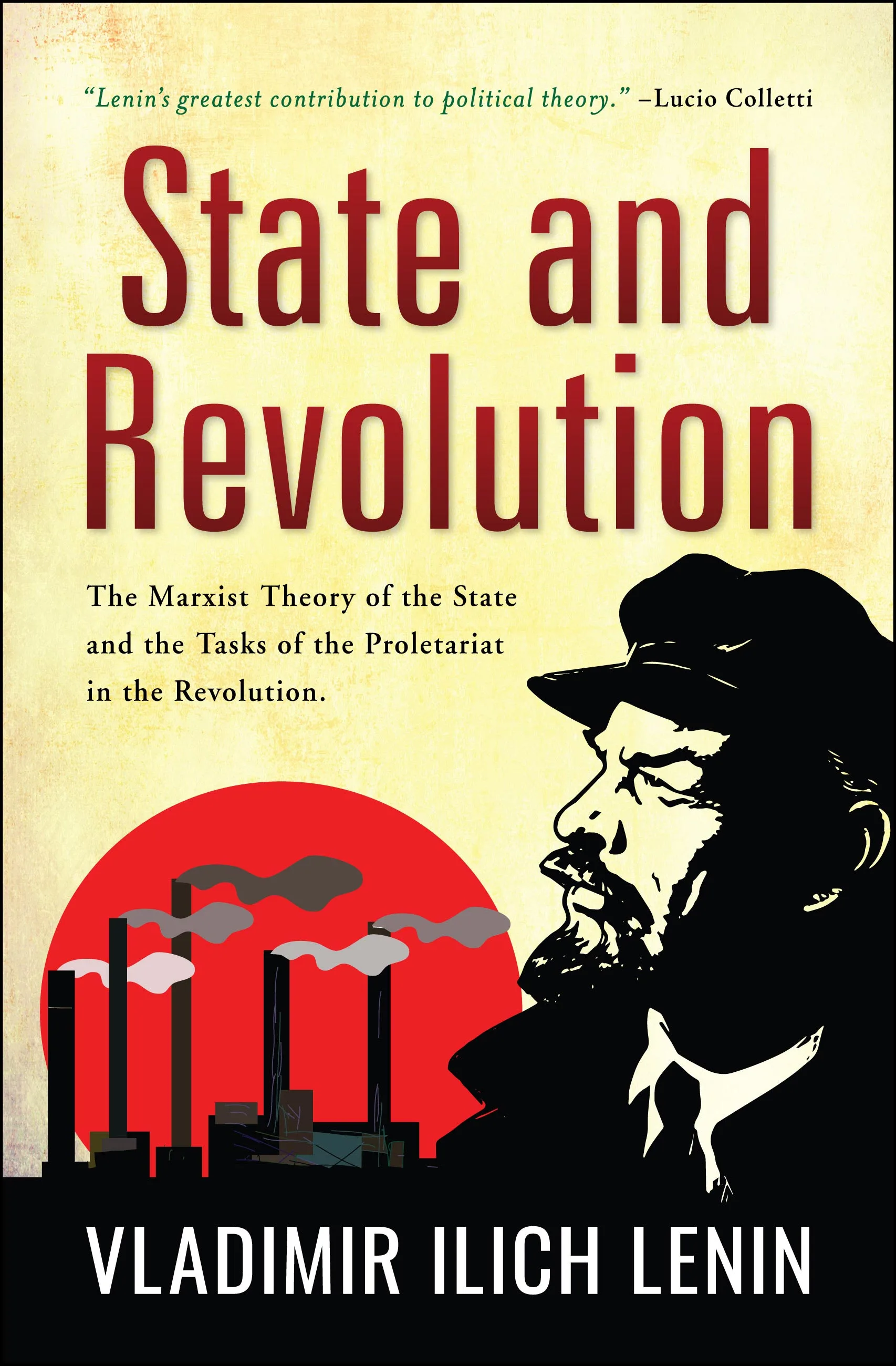
State and Revolution
eBook
• 105 Pages
• INR 51.00
• English
• 9789390492541
No ratings yet
| Publisher | General Press |
|---|---|
| ISBN13 | 9789390492541 |
| ASIN/SKU | B096HWY81V |
| Book Format | eBook |
| Language | English |
| Pages | 105 |
| List Price | INR 51.00 |
| Subject Code | POL005000, POL010000, HIS032020 |
| Publishing Date | 07/06/2021 |
| Book Code | BD00068721 |
Buy this Book
Amazon Stores
Ebook Stores
Other Stores
Discover State and Revolution by Vladimir Ilich Lenin. This book is published by General Press in eBook format, ISBN 9789390492541, ASIN B096HWY81V, under Politics and Social Sciences, Communism and Socialism, Politics and Government.
Book Description
Written in the fervent summer of 1917, just months before the October Revolution, Vladimir Lenin’s 'State and Revolution' is a burning manifesto born from a desperate desire for profound human liberation. While often viewed through the dense lens of political theory, at its core, this book is an urgent, impassioned argument against the systemic oppression of the working class.
Lenin forcefully argues that the modern state is not a neutral peacemaker, but an instrument designed by the wealthy to exploit the poor. With piercing clarity, he asserts that a truly just society cannot be built by simply electing new leaders into a corrupt system; the old, oppressive machinery must be entirely dismantled. In its place, he envisions a temporary "dictatorship of the proletariat"—a system run by and for everyday workers.
Yet, Lenin’s ultimate vision is surprisingly utopian. He passionately believes that once class exploitation is eradicated, the need for police, prisons, and violent authority will naturally vanish. The state itself will slowly "wither away," leaving behind a peaceful, self-governing community of equals where people work according to their abilities and receive according to their needs.
Though history complicated his vision, reading this pivotal work today offers a fascinating glimpse into the raw, uncompromising hope of a revolutionary. It is a striking reminder of humanity's enduring, sometimes volatile, quest to tear down unequal structures and build a world rooted in genuine equity and shared dignity.
Lenin forcefully argues that the modern state is not a neutral peacemaker, but an instrument designed by the wealthy to exploit the poor. With piercing clarity, he asserts that a truly just society cannot be built by simply electing new leaders into a corrupt system; the old, oppressive machinery must be entirely dismantled. In its place, he envisions a temporary "dictatorship of the proletariat"—a system run by and for everyday workers.
Yet, Lenin’s ultimate vision is surprisingly utopian. He passionately believes that once class exploitation is eradicated, the need for police, prisons, and violent authority will naturally vanish. The state itself will slowly "wither away," leaving behind a peaceful, self-governing community of equals where people work according to their abilities and receive according to their needs.
Though history complicated his vision, reading this pivotal work today offers a fascinating glimpse into the raw, uncompromising hope of a revolutionary. It is a striking reminder of humanity's enduring, sometimes volatile, quest to tear down unequal structures and build a world rooted in genuine equity and shared dignity.
Author Biography
Lenin, Vladimir Ilyich (1870-1924) - one of the leaders of the Bolshevik party since its formation in 1903. Led the Soviets to power in October, 1917. Elected to the head of the Soviet government until 1922, when he retired due to ill health.
Lenin, born in 1870, was committed to revolutionary struggle from an early age - his elder brother was hanged for the attempted assassination of Czar Alexander III. In 1891 Lenin passed his Law exam with high honors, whereupon he took to representing the poorest peasantry in Samara. After moving to St. Petersburg in 1893, Lenin's experience with the oppression of the peasantry in Russia, coupled with the revolutionary teachings of G V Plekhanov, guided Lenin to meet with revolutionary groups. In April 1895, his comrades helped send Lenin abroad to get up to speed with the revolutionary movement in Europe, and in particular, to meet the Emancipation of Labour Group, of which Plekhanov head. After five months abroad, traveling from Switzerland to France to Germany, working at libraries and newspapers to make his way, Lenin returned to Russia, carrying a brief case with a false bottom, full of Marxist literature.
On returning to Russia, Lenin and Martov created the League for the Struggle for the Emancipation of the Working Class, uniting the Marxist circles in Petrograd at the time. The group supported strikes and union activity, distributed Marxist literature, and taught in workers education groups. In St. Petersburg Lenin begins a relationship with Nadezhda Krupskaya. In the night of December 8, 1895, Lenin and the members of the party are arrested; Lenin sentenced to 15 months in prison. By 1897, when the prison sentence expired, the autocracy appended an additional three year sentence, due to Lenin's continual writing and organising while in prison. Lenin is exiled to the village of Shushenskoye, in Siberia, where he becomes a leading member of the peasant community. Krupskaya is soon also sent into exile for revolutionary activities, and together they work on party organising, the monumental work: The Development of Capitalism in Russia, and the translating of Sidney and Beatrice Webb's Industrial Democracy.
After his term of exile ends, Lenin emigrates to Münich, and is soon joined by Krupskaya. Lenin creates Iskra, in efforts to bring together the Russian Social Democratic Labour Party, which had been scattered after the police persecution of the first congress of the party in 1898.
Lenin, born in 1870, was committed to revolutionary struggle from an early age - his elder brother was hanged for the attempted assassination of Czar Alexander III. In 1891 Lenin passed his Law exam with high honors, whereupon he took to representing the poorest peasantry in Samara. After moving to St. Petersburg in 1893, Lenin's experience with the oppression of the peasantry in Russia, coupled with the revolutionary teachings of G V Plekhanov, guided Lenin to meet with revolutionary groups. In April 1895, his comrades helped send Lenin abroad to get up to speed with the revolutionary movement in Europe, and in particular, to meet the Emancipation of Labour Group, of which Plekhanov head. After five months abroad, traveling from Switzerland to France to Germany, working at libraries and newspapers to make his way, Lenin returned to Russia, carrying a brief case with a false bottom, full of Marxist literature.
On returning to Russia, Lenin and Martov created the League for the Struggle for the Emancipation of the Working Class, uniting the Marxist circles in Petrograd at the time. The group supported strikes and union activity, distributed Marxist literature, and taught in workers education groups. In St. Petersburg Lenin begins a relationship with Nadezhda Krupskaya. In the night of December 8, 1895, Lenin and the members of the party are arrested; Lenin sentenced to 15 months in prison. By 1897, when the prison sentence expired, the autocracy appended an additional three year sentence, due to Lenin's continual writing and organising while in prison. Lenin is exiled to the village of Shushenskoye, in Siberia, where he becomes a leading member of the peasant community. Krupskaya is soon also sent into exile for revolutionary activities, and together they work on party organising, the monumental work: The Development of Capitalism in Russia, and the translating of Sidney and Beatrice Webb's Industrial Democracy.
After his term of exile ends, Lenin emigrates to Münich, and is soon joined by Krupskaya. Lenin creates Iskra, in efforts to bring together the Russian Social Democratic Labour Party, which had been scattered after the police persecution of the first congress of the party in 1898.
Editorial Reviews
• Ralph Miliband (Marxist Sociologist, Jacobin / Socialist Register):
Miliband praised the work as "one of Lenin’s most important works" and an authoritative "sacred text" of Marxist thought. However, he critically noted that the book "far from resolving the problems with which it is concerned, only serves to underline their complexity... namely that the exercise of socialist power remains the Achilles' heel of Marxism".
• Robert V. Daniels (American Historian):
Representing a traditional Western scholarly view in 1953, Daniels famously reviewed the book as being "permeated with an idealistic, almost Utopian spirit". He described the treatise as an "argument for Utopian anarchism" that felt completely out of character with the rest of Lenin’s usually pragmatic and authoritarian political thought.
• Slavoj Žižek (Philosopher and Cultural Critic):
In his analysis of Lenin's 1917 writings, Revolution at the Gates, Žižek praised the "high theory" found in The State and Revolution. He noted that the text possesses "an almost classical clarity in tracing the contours of the struggle in which they participate," arguing for the text's ongoing relevance in modern political struggles.
• Alfred Rosmer (French Syndicalist and early Communist):
Reflecting on the book's initial publication, Rosmer recalled that the text was a "pleasant revelation" for French syndicalists and anarchists. He noted their shock at the anti-state rhetoric: "They had never heard such language from the Marxists they knew. They read and re-read this interpretation of Marx, which was quite unfamiliar to them".
• Nikolai Bukharin (Bolshevik Revolutionary, reviewing in Kommunist, 1918):
Writing a contemporary review just after the October Revolution, Bukharin praised Lenin's work for its revolutionary content. He highlighted it as the crucial theoretical document that finalized the Bolshevik break with the "deadweight of a social democratic movement that had become almost totally integrated into the capitalist system".
• Monthly Review (Independent Socialist Magazine):
In a modern retrospective, the Monthly Review described the book as essential reading for understanding capitalist structures, calling it "the clearest exposition of the role of the state and the need for the masses to destroy it in order to bring about a society without class divisions of any sort".
• Alfred G. Meyer (Political Scientist and Historian):
In his foundational academic book Leninism, Meyer evaluated the text not as a rigid blueprint, but as a reflection of the "dream of the 'commune state'." He grouped the book with Lenin's other highly optimistic, almost romantic proclamations made during the chaotic early months of 1917.
• Lorenzo Chiesa (Philosopher, in Crisis & Critique):
Reviewing the ideological mechanics of the book, Chiesa argued that a detailed reading leads to a paradoxical conclusion: "The socialist state dialectically undoes itself precisely through its consolidation". He countered critics who call the book merely "utopian," arguing its juxtaposition of state and communism is a "necessary presupposition" for Lenin's goals.
• Lars T. Lih (Scholar of Russian History):
Lih reviewed the text as an intense weapon of political polemic. He pointed out that Lenin used the book relentlessly to expose the "vacillation" and "evasiveness" of his former mentor, Karl Kautsky, on the issue of state power, while simultaneously harboring deep admiration for Kautsky's earlier, more orthodox Marxist writings.
• Alain Badiou (French Philosopher):
While deeply critical of the traditional state form, contemporary communist thinkers like Badiou have debated the legacy of The State and Revolution. Badiou has challenged the text's central premise by arguing that "communism" and "state" are fundamentally incompatible concepts, contrasting with Lenin's transitional "socialist state".
Miliband praised the work as "one of Lenin’s most important works" and an authoritative "sacred text" of Marxist thought. However, he critically noted that the book "far from resolving the problems with which it is concerned, only serves to underline their complexity... namely that the exercise of socialist power remains the Achilles' heel of Marxism".
• Robert V. Daniels (American Historian):
Representing a traditional Western scholarly view in 1953, Daniels famously reviewed the book as being "permeated with an idealistic, almost Utopian spirit". He described the treatise as an "argument for Utopian anarchism" that felt completely out of character with the rest of Lenin’s usually pragmatic and authoritarian political thought.
• Slavoj Žižek (Philosopher and Cultural Critic):
In his analysis of Lenin's 1917 writings, Revolution at the Gates, Žižek praised the "high theory" found in The State and Revolution. He noted that the text possesses "an almost classical clarity in tracing the contours of the struggle in which they participate," arguing for the text's ongoing relevance in modern political struggles.
• Alfred Rosmer (French Syndicalist and early Communist):
Reflecting on the book's initial publication, Rosmer recalled that the text was a "pleasant revelation" for French syndicalists and anarchists. He noted their shock at the anti-state rhetoric: "They had never heard such language from the Marxists they knew. They read and re-read this interpretation of Marx, which was quite unfamiliar to them".
• Nikolai Bukharin (Bolshevik Revolutionary, reviewing in Kommunist, 1918):
Writing a contemporary review just after the October Revolution, Bukharin praised Lenin's work for its revolutionary content. He highlighted it as the crucial theoretical document that finalized the Bolshevik break with the "deadweight of a social democratic movement that had become almost totally integrated into the capitalist system".
• Monthly Review (Independent Socialist Magazine):
In a modern retrospective, the Monthly Review described the book as essential reading for understanding capitalist structures, calling it "the clearest exposition of the role of the state and the need for the masses to destroy it in order to bring about a society without class divisions of any sort".
• Alfred G. Meyer (Political Scientist and Historian):
In his foundational academic book Leninism, Meyer evaluated the text not as a rigid blueprint, but as a reflection of the "dream of the 'commune state'." He grouped the book with Lenin's other highly optimistic, almost romantic proclamations made during the chaotic early months of 1917.
• Lorenzo Chiesa (Philosopher, in Crisis & Critique):
Reviewing the ideological mechanics of the book, Chiesa argued that a detailed reading leads to a paradoxical conclusion: "The socialist state dialectically undoes itself precisely through its consolidation". He countered critics who call the book merely "utopian," arguing its juxtaposition of state and communism is a "necessary presupposition" for Lenin's goals.
• Lars T. Lih (Scholar of Russian History):
Lih reviewed the text as an intense weapon of political polemic. He pointed out that Lenin used the book relentlessly to expose the "vacillation" and "evasiveness" of his former mentor, Karl Kautsky, on the issue of state power, while simultaneously harboring deep admiration for Kautsky's earlier, more orthodox Marxist writings.
• Alain Badiou (French Philosopher):
While deeply critical of the traditional state form, contemporary communist thinkers like Badiou have debated the legacy of The State and Revolution. Badiou has challenged the text's central premise by arguing that "communism" and "state" are fundamentally incompatible concepts, contrasting with Lenin's transitional "socialist state".
Book Summary
Written in the summer of 1917, amidst the escalating chaos of the Russian Revolution, Vladimir Lenin’s "The State and Revolution" stands as a foundational text of Marxist political theory. Composed while Lenin was in hiding, the book was intended not merely as a theoretical exercise but as an urgent, practical manifesto for the impending Bolshevik seizure of power. Lenin sought to resurrect the original, unadulterated teachings of Karl Marx and Friedrich Engels regarding the nature of the state, arguing that their radical ideas had been deliberately distorted by moderate socialists and reformists. The core objective of the work is to clarify the relationship between the proletariat and the state, firmly establishing that a peaceful transition to socialism is an impossible illusion. Instead, Lenin constructs a rigorous argument for the absolute necessity of violent revolution and the complete destruction of the existing capitalist state apparatus.
The fundamental premise of Lenin’s argument, drawn directly from Engels, is that the state is not a neutral arbiter of justice or an expression of societal consensus. Rather, it is the direct product and manifestation of irreconcilable class antagonisms. According to Lenin, the state only arises when societal divisions between classes—specifically the bourgeoisie, who own the means of production, and the proletariat, who sell their labor—become so deep that they cannot be peacefully reconciled. Therefore, the state functions exclusively as an organ of class rule, an instrument designed for the systematic oppression of one class by another. It exists to maintain order by legalizing and institutionalizing the exploitation of the working class, thereby ensuring the continued dominance of the capitalist elite.
To enforce this oppression, the bourgeois state relies on what Lenin describes as "special bodies of armed men." He argues that a self-acting armed organization of the entire population is impossible in a society torn apart by class conflict. Consequently, the state builds and maintains professional standing armies, police forces, and an expansive penal system. These institutions are not designed to protect the general public, but rather to protect the private property and political power of the ruling class from the inevitable unrest of the exploited masses. Furthermore, this state machinery is supported by a sprawling, privileged bureaucracy that exists entirely above the people, remaining functionally unaccountable to the working class it governs.
A significant portion of "The State and Revolution" is dedicated to a blistering critique of the opportunists and social chauvinists of Lenin’s time, most notably the prominent Marxist theorist Karl Kautsky. Lenin accuses these reformists of castrating Marxism by stripping it of its revolutionary soul. The reformist view held that the working class could achieve its goals peacefully through universal suffrage and parliamentary democracy. Lenin vehemently rejects this, arguing that a democratic republic is simply the best possible political shell for capitalism. Under this system, the illusion of democratic participation merely masks the dictatorship of the bourgeoisie, as the real, levers of power always remain entrenched in the banks, the bureaucracy, and the military-industrial complex.
Because the existing bourgeois state is fundamentally designed to oppress, Lenin insists that it cannot simply be taken over and repurposed by the working class for their own ends. Quoting Marx’s reflections on the 1871 Paris Commune, Lenin asserts that the proletariat must aggressively "smash" and "destroy" the ready-made state machinery. This is a central, non-negotiable tenet of Leninism: the capitalist state cannot be incrementally reformed from within; its core institutions—the police, the army, the bureaucratic administration, the judiciary—must be violently dismantled. This total destruction is the essential precondition for any genuine proletarian revolution, clearing the ground for an entirely new form of societal organization.
Once the bourgeois state is destroyed, it must be immediately replaced by a new, transitional form of state power: the dictatorship of the proletariat. Lenin argues that the working class needs a state—which remains essentially a centralized organization of violence—in order to crush the inevitable resistance of the overthrown capitalists and to lead the masses in organizing a socialist economy. However, this new proletarian state is fundamentally different from all previous states. While former states were the instrument of a minority suppressing the majority, the dictatorship of the proletariat is the instrument of the vast majority suppressing a tiny minority of former exploiters. It is, therefore, a radically more democratic state for the masses, but strictly dictatorial against the bourgeoisie.
To illustrate what this new proletarian state should look like in practice, Lenin points to the Paris Commune as the ultimate historical blueprint. He praises the Commune for replacing the standing army with the armed masses and for abolishing the privileged, high-paid bureaucracy. In the Commune model, all public officials, including judges and administrators, are elected by universal suffrage and are subject to immediate recall by the people at any time. Furthermore, these officials are paid no more than the wages of an average worker, effectively stripping government service of its lucrative prestige and careerism. The Commune also merged legislative and executive functions into a single working body, eliminating the endless, deceitful talk of bourgeois parliaments in favor of direct, practical action.
Lenin then delineates the transition from capitalism to full communism, dividing it into two distinct phases. The lower phase, often referred to as socialism, immediately follows the revolution. During this stage, the means of production are converted into public property, eliminating the exploitation of man by man. However, society still bears the economic, moral, and intellectual birthmarks of the capitalist system from which it emerged. In this phase, wealth is distributed according to the principle of "from each according to his ability, to each according to his work." Because people have different natural abilities and circumstances, this system still generates inequality. Therefore, a state apparatus remains necessary during socialism to safeguard the public ownership of property and to enforce this bourgeois standard of distribution.
The ultimate goal of the Marxist project, however, is the higher phase of communism. This phase is reached when the productive forces of society have developed to such an extent that there is an overwhelming abundance of material wealth, and labor has become not just a means of life, but life's prime want. At this point, society can cross a historical threshold and adopt a new guiding principle: "from each according to his ability, to each according to his needs." As class distinctions entirely vanish and the exploitation of labor is completely eradicated, the need for any apparatus of systemic coercion vanishes with them. People become so accustomed to observing the fundamental rules of social life that they work voluntarily according to their abilities.
It is only in this higher phase of communism that the state finally and completely "withers away." Lenin is careful to distinguish this Marxist concept from the anarchist demand for the immediate abolition of the state overnight. The state is not actively abolished by a decree; rather, it gradually becomes obsolete and dies out naturally as its repressive functions are replaced by the voluntary, self-governing administration of things by the people themselves. Ultimately, "The State and Revolution" serves as a profound articulation of this visionary trajectory. It remains one of the most uncompromising and influential political tracts of the twentieth century, laying bare the brutal mechanics of power while simultaneously dreaming of a future where true human freedom renders the state itself a relic of the past.
The fundamental premise of Lenin’s argument, drawn directly from Engels, is that the state is not a neutral arbiter of justice or an expression of societal consensus. Rather, it is the direct product and manifestation of irreconcilable class antagonisms. According to Lenin, the state only arises when societal divisions between classes—specifically the bourgeoisie, who own the means of production, and the proletariat, who sell their labor—become so deep that they cannot be peacefully reconciled. Therefore, the state functions exclusively as an organ of class rule, an instrument designed for the systematic oppression of one class by another. It exists to maintain order by legalizing and institutionalizing the exploitation of the working class, thereby ensuring the continued dominance of the capitalist elite.
To enforce this oppression, the bourgeois state relies on what Lenin describes as "special bodies of armed men." He argues that a self-acting armed organization of the entire population is impossible in a society torn apart by class conflict. Consequently, the state builds and maintains professional standing armies, police forces, and an expansive penal system. These institutions are not designed to protect the general public, but rather to protect the private property and political power of the ruling class from the inevitable unrest of the exploited masses. Furthermore, this state machinery is supported by a sprawling, privileged bureaucracy that exists entirely above the people, remaining functionally unaccountable to the working class it governs.
A significant portion of "The State and Revolution" is dedicated to a blistering critique of the opportunists and social chauvinists of Lenin’s time, most notably the prominent Marxist theorist Karl Kautsky. Lenin accuses these reformists of castrating Marxism by stripping it of its revolutionary soul. The reformist view held that the working class could achieve its goals peacefully through universal suffrage and parliamentary democracy. Lenin vehemently rejects this, arguing that a democratic republic is simply the best possible political shell for capitalism. Under this system, the illusion of democratic participation merely masks the dictatorship of the bourgeoisie, as the real, levers of power always remain entrenched in the banks, the bureaucracy, and the military-industrial complex.
Because the existing bourgeois state is fundamentally designed to oppress, Lenin insists that it cannot simply be taken over and repurposed by the working class for their own ends. Quoting Marx’s reflections on the 1871 Paris Commune, Lenin asserts that the proletariat must aggressively "smash" and "destroy" the ready-made state machinery. This is a central, non-negotiable tenet of Leninism: the capitalist state cannot be incrementally reformed from within; its core institutions—the police, the army, the bureaucratic administration, the judiciary—must be violently dismantled. This total destruction is the essential precondition for any genuine proletarian revolution, clearing the ground for an entirely new form of societal organization.
Once the bourgeois state is destroyed, it must be immediately replaced by a new, transitional form of state power: the dictatorship of the proletariat. Lenin argues that the working class needs a state—which remains essentially a centralized organization of violence—in order to crush the inevitable resistance of the overthrown capitalists and to lead the masses in organizing a socialist economy. However, this new proletarian state is fundamentally different from all previous states. While former states were the instrument of a minority suppressing the majority, the dictatorship of the proletariat is the instrument of the vast majority suppressing a tiny minority of former exploiters. It is, therefore, a radically more democratic state for the masses, but strictly dictatorial against the bourgeoisie.
To illustrate what this new proletarian state should look like in practice, Lenin points to the Paris Commune as the ultimate historical blueprint. He praises the Commune for replacing the standing army with the armed masses and for abolishing the privileged, high-paid bureaucracy. In the Commune model, all public officials, including judges and administrators, are elected by universal suffrage and are subject to immediate recall by the people at any time. Furthermore, these officials are paid no more than the wages of an average worker, effectively stripping government service of its lucrative prestige and careerism. The Commune also merged legislative and executive functions into a single working body, eliminating the endless, deceitful talk of bourgeois parliaments in favor of direct, practical action.
Lenin then delineates the transition from capitalism to full communism, dividing it into two distinct phases. The lower phase, often referred to as socialism, immediately follows the revolution. During this stage, the means of production are converted into public property, eliminating the exploitation of man by man. However, society still bears the economic, moral, and intellectual birthmarks of the capitalist system from which it emerged. In this phase, wealth is distributed according to the principle of "from each according to his ability, to each according to his work." Because people have different natural abilities and circumstances, this system still generates inequality. Therefore, a state apparatus remains necessary during socialism to safeguard the public ownership of property and to enforce this bourgeois standard of distribution.
The ultimate goal of the Marxist project, however, is the higher phase of communism. This phase is reached when the productive forces of society have developed to such an extent that there is an overwhelming abundance of material wealth, and labor has become not just a means of life, but life's prime want. At this point, society can cross a historical threshold and adopt a new guiding principle: "from each according to his ability, to each according to his needs." As class distinctions entirely vanish and the exploitation of labor is completely eradicated, the need for any apparatus of systemic coercion vanishes with them. People become so accustomed to observing the fundamental rules of social life that they work voluntarily according to their abilities.
It is only in this higher phase of communism that the state finally and completely "withers away." Lenin is careful to distinguish this Marxist concept from the anarchist demand for the immediate abolition of the state overnight. The state is not actively abolished by a decree; rather, it gradually becomes obsolete and dies out naturally as its repressive functions are replaced by the voluntary, self-governing administration of things by the people themselves. Ultimately, "The State and Revolution" serves as a profound articulation of this visionary trajectory. It remains one of the most uncompromising and influential political tracts of the twentieth century, laying bare the brutal mechanics of power while simultaneously dreaming of a future where true human freedom renders the state itself a relic of the past.
Sample Chapters
Chapter 1 : Class Society and the State
1. The State: A Product of the Irreconcilability of Class Antagonisms
What is now happening to Marx’s theory has, in the course of history, happened repeatedly to the theories of revolutionary thinkers and leaders of oppressed classes fighting for emancipation. During the lifetime of great revolutionaries, the oppressing classes constantly hounded them, received their theories with the most savage malice, the most furious hatred and the most unscrupulous campaigns of lies and slander. After their death, attempts are made to convert them into harmless icons, to canonize them, so to say, and to hallow their names to a certain extent for the “consolation” of the oppressed classes and with the object of duping the latter, while at the same time robbing the revolutionary theory of its substance, blunting its revolutionary edge and vulgarizing it. Today, the bourgeoisie and the opportunists within the labor movement concur in this doctoring of Marxism. They omit, obscure, or distort the revolutionary side of this theory, its revolutionary soul. They push to the foreground and extol what is or seems acceptable to the bourgeoisie. All the social-chauvinists are now “Marxists” (don’t laugh!). And more and more frequently German bourgeois scholars, only yesterday specialists in the annihilation of Marxism, are speaking of the “national-German” Marx, who, they claim, educated the labor unions which are so splendidly organized for the purpose of waging a predatory war!
In these circumstances, in view of the unprecedently wide-spread distortion of Marxism, our prime task is to re-establish what Marx really taught on the subject of the state. This will necessitate a number of long quotations from the works of Marx and Engels themselves. Of course, long quotations will render the text cumbersome and not help at all to make it popular reading, but we cannot possibly dispense with them. All, or at any rate all the most essential passages in the works of Marx and Engels on the subject of the state must by all means be quoted as fully as possible so that the reader may form an independent opinion of the totality of the views of the founders of scientific socialism, and of the evolution of those views, and so that their distortion by the “Kautskyism” now prevailing may be documentarily proved and clearly demonstrated.
Let us begin with the most popular of Engels’ works, The Origin of the Family, Private Property and the State, the sixth edition of which was published in Stuttgart as far back as 1894. We have to translate the quotations from the German originals, as the Russian translations, while very numerous, are for the most part either incomplete or very unsatisfactory.
Summing up his historical analysis, Engels says:
“The state is, therefore, by no means a power forced on society from without; just as little is it ‘the reality of the ethical idea,’ ‘the image and reality of reason,’ as Hegel maintains. Rather, it is a product of society at a certain stage of development; it is the admission that this society has become entangled in an insoluble contradiction with itself, that it has split into irreconcilable antagonisms which it is powerless to dispel. But in order that these antagonisms, these classes with conflicting economic interests, might not consume themselves and society in fruitless struggle, it became necessary to have a power, seemingly standing above society, that would alleviate the conflict and keep it within the bounds of ‘order’; and this power, arisen out of society but placing itself above it, and alienating itself more and more from it, is the state.” (Pp. 177-78, sixth edition)
This expresses with perfect clarity the basic idea of Marxism with regard to the historical role and the meaning of the state. The state is a product and a manifestation of the irreconcilability of class antagonisms. The state arises where, when and insofar as class antagonism objectively cannot be reconciled. And, conversely, the existence of the state proves that the class antagonisms are irreconcilable.
It is on this most important and fundamental point that the distortion of Marxism, proceeding along two main lines, begins.
On the one hand, the bourgeois, and particularly the petty-bourgeois, ideologists, compelled under the weight of indisputable historical facts to admit that the state only exists where there are class antagonisms and a class struggle, “correct” Marx in such a way as to make it appear that the state is an organ for the reconciliation of classes. According to Marx, the state could neither have arisen nor maintained itself had it been possible to reconcile classes. From what the petty-bourgeois and philistine professors and publicists say, with quite frequent and benevolent references to Marx, it appears that the state does reconcile classes. According to Marx, the state is an organ of class rule, an organ for the oppression of one class by another; it is the creation of “order,” which legalizes and perpetuates this oppression by moderating the conflict between classes. In the opinion of the petty-bourgeois politicians, however, order means the reconciliation of classes, and not the oppression of one class by another; to alleviate the conflict means reconciling classes and not depriving the oppressed classes of definite means and methods of struggle to overthrow the oppressors.
For instance, when, in the revolution of 1917, the question of the significance and role of the state arose in all its magnitude as a practical question demanding immediate action, and, moreover, action on a mass scale, all the Social-Revolutionaries and Mensheviks descended at once to the petty-bourgeois theory that the “state” “reconciles” classes. Innumerable resolutions and articles by politicians of both these parties are thoroughly saturated with this petty-bourgeois and philistine “reconciliation” theory. That the state is an organ of the rule of a definite class which cannot be reconciled with its antipode (the class opposite to it) is something the petty-bourgeois democrats will never be able to understand. Their attitude to the state is one of the most striking manifestations of the fact that our Socialist-Revolutionaries and Mensheviks are not socialists at all (a point that we Bolsheviks have always maintained), but petty-bourgeois democrats using near-socialist phraseology.
On the other hand, the “Kautskyite” distortion of Marxism is far more subtle. “Theoretically,” it is not denied that the state is an organ of class rule, or that class antagonisms are irreconcilable. But what is overlooked or glossed over is this: if the state is the product of the irreconcilability of class antagonisms, if it is a power standing above society and “alienating itself more and more from it,” it is clear that the liberation of the oppressed class is impossible not only without a violent revolution, but also without the destruction of the apparatus of state power which was created by the ruling class and which is the embodiment of this “alienation.” As we shall see later, Marx very explicitly drew this theoretically self-evident conclusion on the strength of a concrete historical analysis of the tasks of the revolution. And – as we shall show in detail further on – it is this conclusion which Kautsky has “forgotten” and distorted.
2. Special Bodies of Armed Men, Prisons, etc.
Engels continues:
“As distinct from the old gentile [tribal or clan] order, the state, first, divides its subjects according to territory…”
This division seems “natural” to us, but it costs a prolonged struggle against the old organization according to generations or tribes.
“The second distinguishing feature is the establishment of a public power which no longer directly coincides with the population organizing itself as an armed force. This special, public power is necessary because a self-acting armed organization of the population has become impossible since the split into classes… This public power exists in every state; it consists not merely of armed men but also of material adjuncts, prisons, and institutions of coercion of all kinds, of which gentile [clan] society knew nothing…”
Engels elucidates the concept of the “power” which is called the state, a power which arose from society but places itself above it and alienates itself more and more from it. What does this power mainly consist of? It consists of special bodies of armed men having prisons, etc., at their command.
We are justified in speaking of special bodies of armed men, because the public power which is an attribute of every state “does not directly coincide” with the armed population, with its “self-acting armed organization.”
Like all great revolutionary thinkers, Engels tries to draw the attention of the class-conscious workers to what prevailing philistinism regards as least worthy of attention, as the most habitual thing, hallowed by prejudices that are not only deep-rooted but, one might say, petrified. A standing army and police are the chief instruments of state power. But how can it be otherwise?
From the viewpoint of the vast majority of Europeans of the end of the 19th century, whom Engels was addressing, and who had not gone through or closely observed a single great revolution, it could not have been otherwise. They could not understand at all what a “self-acting armed organization of the population” was. When asked why it became necessary to have special bodies of armed men placed above society and alienating themselves from it (police and a standing army), the West-European and Russian philistines are inclined to utter a few phrases borrowed from Spencer or Mikhailovsky, to refer to the growing complexity of social life, the differentiation of functions, and so on.
Such a reference seems “scientific,” and effectively lulls the ordinary person to sleep by obscuring the important and basic fact, namely, the split of society into irreconcilable antagonistic classes.
Were it not for this split, the “self-acting armed organization of the population” would differ from the primitive organization of a stick-wielding herd of monkeys, or of primitive men, or of men united in clans, by its complexity, its high technical level, and so on. But such an organization would still be possible.
It is impossible because civilized society is split into antagonistic, and, moreover, irreconcilably antagonistic classes, whose “self-acting” arming would lead to an armed struggle between them. A state arises, a special power is created, special bodies of armed men, and every revolution, by destroying the state apparatus, shows us the naked class struggle, clearly shows us how the ruling class strives to restore the special bodies of armed men which serve it, and how the oppressed class strives to create a new organization of this kind, capable of serving the exploited instead of the exploiters.
In the above argument, Engels raises theoretically the very same question which every great revolution raises before us in practice, palpably and, what is more, on a scale of mass action, namely, the question of the relationship between “special” bodies of armed men and the “self-acting armed organization of the population.” We shall see how this question is specifically illustrated by the experience of the European and Russian revolutions.
But to return to Engels’ exposition.
He points out that sometimes – in certain parts of North America, for example – this public power is weak (he has in mind a rare exception in capitalist society, and those parts of North America in its pre-imperialist days where the free colonists predominated), but that, generally speaking, it grows stronger:
“It [the public power] grows stronger, however, in proportion as class antagonisms within the state become more acute, and as adjacent states become larger and more populous. We have only to look at our present-day Europe, where class struggle and rivalry in conquest have tuned up the public power to such a pitch that it threatens to swallow the whole of society and even the state.”
This was written not later than the early nineties of the last century, Engels’ last preface being dated June 16, 1891. The turn towards imperialism – meaning the complete domination of the trusts, the omnipotence of the big banks, a grand-scale colonial policy, and so forth – was only just beginning in France, and was even weaker in North America and in Germany. Since then “rivalry in conquest” has taken a gigantic stride, all the more because by the beginning of the second decade of the 20th century the world had been completely divided up among these “rivals in conquest,” i.e., among the predatory Great Powers. Since then, military and naval armaments have grown fantastically and the predatory war of 1914-17 for the domination of the world by Britain or Germany, for the division of the spoils, has brought the “swallowing” of all the forces of society by the rapacious state power close to complete catastrophe.
Engels’ could, as early as 1891, point to “rivalry in conquest” as one of the most important distinguishing features of the foreign policy of the Great Powers, while the social-chauvinist scoundrels have ever since 1914, when this rivalry, many time intensified, gave rise to an imperialist war, been covering up the defence of the predatory interests of “their own” bourgeoisie with phrases about “defence of the fatherland,” “defence of the republic and the revolution,” etc.!
3. The State: an Instrument for the Exploitation of the Oppressed Class
The maintenance of the special public power standing above society requires taxes and state loans.
“Having public power and the right to levy taxes,” Engels writes, “the officials now stand, as organs of society, above society. The free, voluntary respect that was accorded to the organs of the gentile [clan] constitution does not satisfy them, even if they could gain it…” Special laws are enacted proclaiming the sanctity and immunity of the officials. “The shabbiest police servant” has more “authority” than the representative of the clan, but even the head of the military power of a civilized state may well envy the elder of a clan the “unrestrained respect” of society.
The question of the privileged position of the officials as organs of state power is raised here. The main point indicated is: what is it that places them above society? We shall see how this theoretical question was answered in practice by the Paris Commune in 1871 and how it was obscured from a reactionary standpoint by Kautsky in 1912.
“Because the state arose from the need to hold class antagonisms in check, but because it arose, at the same time, in the midst of the conflict of these classes, it is, as a rule, the state of the most powerful, economically dominant class, which, through the medium of the state, becomes also the politically dominant class, and thus acquires new means of holding down and exploiting the oppressed class…” The ancient and feudal states were organs for the exploitation of the slaves and serfs; likewise, “the modern representative state is an instrument of exploitation of wage-labor by capital. By way of exception, however, periods occur in which the warring classes balance each other so nearly that the state power as ostensible mediator acquires, for the moment, a certain degree of independence of both…” Such were the absolute monarchies of the 17th and 18th centuries, the Bonapartism of the First and Second Empires in France, and the Bismarck regime in Germany.
Such, we may add, is the Kerensky government in republican Russia since it began to persecute the revolutionary proletariat, at a moment when, owing to the leadership of the petty-bourgeois democrats, the Soviets have already become impotent, while the bourgeoisie are not yet strong enough simply to disperse them.
In a democratic republic, Engels continues, “wealth exercises its power indirectly, but all the more surely,” first, by means of the “direct corruption of officials” (America); secondly, by means of an “alliance of the government and the Stock Exchange” (France and America).
At present, imperialism and the domination of the banks have “developed” into an exceptional art both these methods of upholding and giving effect to the omnipotence of wealth in democratic republics of all descriptions. Since, for instance, in the very first months of the Russian democratic republic, one might say during the honeymoon of the “socialist” S.R.s and Mensheviks joined in wedlock to the bourgeoisie, in the coalition government. Mr. Palchinsky obstructed every measure intended for curbing the capitalists and their marauding practices, their plundering of the state by means of war contracts; and since later on Mr. Palchinsky, upon resigning from the Cabinet (and being, of course, replaced by another quite similar Palchinsky), was “rewarded” by the capitalists with a lucrative job with a salary of 120,000 rubles per annum – what would you call that? Direct or indirect bribery? An alliance of the government and the syndicates, or “merely” friendly relations? What role do the Chernovs, Tseretelis, Avksentyevs and Skobelevs play? Are they the “direct” or only the indirect allies of the millionaire treasury-looters?
Another reason why the omnipotence of “wealth” is more certain in a democratic republic is that it does not depend on defects in the political machinery or on the faulty political shell of capitalism. A democratic republic is the best possible political shell for capitalism, and, therefore, once capital has gained possession of this very best shell (through the Palchinskys, Chernovs, Tseretelis and Co.), it establishes its power so securely, so firmly, that no change of persons, institutions or parties in the bourgeois-democratic republic can shake it.
We must also note that Engels is most explicit in calling universal suffrage as well an instrument of bourgeois rule. Universal suffrage, he says, obviously taking account of the long experience of German Social-Democracy, is
“the gauge of the maturity of the working class. It cannot and never will be anything more in the present-day state.”
The petty-bourgeois democrats, such as our Socialist-Revolutionaries and Mensheviks, and also their twin brothers, all the social-chauvinists and opportunists of Western Europe, expect just this “more” from universal suffrage. They themselves share, and instil into the minds of the people, the false notion that universal suffrage “in the present-day state” is really capable of revealing the will of the majority of the working people and of securing its realization.
Here, we can only indicate this false notion, only point out that Engels’ perfectly clear statement is distorted at every step in the propaganda and agitation of the “official” (i.e., opportunist) socialist parties. A detailed exposure of the utter falsity of this notion which Engels brushes aside here is given in our further account of the views of Marx and Engels on the “present-day” state.
1. The State: A Product of the Irreconcilability of Class Antagonisms
What is now happening to Marx’s theory has, in the course of history, happened repeatedly to the theories of revolutionary thinkers and leaders of oppressed classes fighting for emancipation. During the lifetime of great revolutionaries, the oppressing classes constantly hounded them, received their theories with the most savage malice, the most furious hatred and the most unscrupulous campaigns of lies and slander. After their death, attempts are made to convert them into harmless icons, to canonize them, so to say, and to hallow their names to a certain extent for the “consolation” of the oppressed classes and with the object of duping the latter, while at the same time robbing the revolutionary theory of its substance, blunting its revolutionary edge and vulgarizing it. Today, the bourgeoisie and the opportunists within the labor movement concur in this doctoring of Marxism. They omit, obscure, or distort the revolutionary side of this theory, its revolutionary soul. They push to the foreground and extol what is or seems acceptable to the bourgeoisie. All the social-chauvinists are now “Marxists” (don’t laugh!). And more and more frequently German bourgeois scholars, only yesterday specialists in the annihilation of Marxism, are speaking of the “national-German” Marx, who, they claim, educated the labor unions which are so splendidly organized for the purpose of waging a predatory war!
In these circumstances, in view of the unprecedently wide-spread distortion of Marxism, our prime task is to re-establish what Marx really taught on the subject of the state. This will necessitate a number of long quotations from the works of Marx and Engels themselves. Of course, long quotations will render the text cumbersome and not help at all to make it popular reading, but we cannot possibly dispense with them. All, or at any rate all the most essential passages in the works of Marx and Engels on the subject of the state must by all means be quoted as fully as possible so that the reader may form an independent opinion of the totality of the views of the founders of scientific socialism, and of the evolution of those views, and so that their distortion by the “Kautskyism” now prevailing may be documentarily proved and clearly demonstrated.
Let us begin with the most popular of Engels’ works, The Origin of the Family, Private Property and the State, the sixth edition of which was published in Stuttgart as far back as 1894. We have to translate the quotations from the German originals, as the Russian translations, while very numerous, are for the most part either incomplete or very unsatisfactory.
Summing up his historical analysis, Engels says:
“The state is, therefore, by no means a power forced on society from without; just as little is it ‘the reality of the ethical idea,’ ‘the image and reality of reason,’ as Hegel maintains. Rather, it is a product of society at a certain stage of development; it is the admission that this society has become entangled in an insoluble contradiction with itself, that it has split into irreconcilable antagonisms which it is powerless to dispel. But in order that these antagonisms, these classes with conflicting economic interests, might not consume themselves and society in fruitless struggle, it became necessary to have a power, seemingly standing above society, that would alleviate the conflict and keep it within the bounds of ‘order’; and this power, arisen out of society but placing itself above it, and alienating itself more and more from it, is the state.” (Pp. 177-78, sixth edition)
This expresses with perfect clarity the basic idea of Marxism with regard to the historical role and the meaning of the state. The state is a product and a manifestation of the irreconcilability of class antagonisms. The state arises where, when and insofar as class antagonism objectively cannot be reconciled. And, conversely, the existence of the state proves that the class antagonisms are irreconcilable.
It is on this most important and fundamental point that the distortion of Marxism, proceeding along two main lines, begins.
On the one hand, the bourgeois, and particularly the petty-bourgeois, ideologists, compelled under the weight of indisputable historical facts to admit that the state only exists where there are class antagonisms and a class struggle, “correct” Marx in such a way as to make it appear that the state is an organ for the reconciliation of classes. According to Marx, the state could neither have arisen nor maintained itself had it been possible to reconcile classes. From what the petty-bourgeois and philistine professors and publicists say, with quite frequent and benevolent references to Marx, it appears that the state does reconcile classes. According to Marx, the state is an organ of class rule, an organ for the oppression of one class by another; it is the creation of “order,” which legalizes and perpetuates this oppression by moderating the conflict between classes. In the opinion of the petty-bourgeois politicians, however, order means the reconciliation of classes, and not the oppression of one class by another; to alleviate the conflict means reconciling classes and not depriving the oppressed classes of definite means and methods of struggle to overthrow the oppressors.
For instance, when, in the revolution of 1917, the question of the significance and role of the state arose in all its magnitude as a practical question demanding immediate action, and, moreover, action on a mass scale, all the Social-Revolutionaries and Mensheviks descended at once to the petty-bourgeois theory that the “state” “reconciles” classes. Innumerable resolutions and articles by politicians of both these parties are thoroughly saturated with this petty-bourgeois and philistine “reconciliation” theory. That the state is an organ of the rule of a definite class which cannot be reconciled with its antipode (the class opposite to it) is something the petty-bourgeois democrats will never be able to understand. Their attitude to the state is one of the most striking manifestations of the fact that our Socialist-Revolutionaries and Mensheviks are not socialists at all (a point that we Bolsheviks have always maintained), but petty-bourgeois democrats using near-socialist phraseology.
On the other hand, the “Kautskyite” distortion of Marxism is far more subtle. “Theoretically,” it is not denied that the state is an organ of class rule, or that class antagonisms are irreconcilable. But what is overlooked or glossed over is this: if the state is the product of the irreconcilability of class antagonisms, if it is a power standing above society and “alienating itself more and more from it,” it is clear that the liberation of the oppressed class is impossible not only without a violent revolution, but also without the destruction of the apparatus of state power which was created by the ruling class and which is the embodiment of this “alienation.” As we shall see later, Marx very explicitly drew this theoretically self-evident conclusion on the strength of a concrete historical analysis of the tasks of the revolution. And – as we shall show in detail further on – it is this conclusion which Kautsky has “forgotten” and distorted.
2. Special Bodies of Armed Men, Prisons, etc.
Engels continues:
“As distinct from the old gentile [tribal or clan] order, the state, first, divides its subjects according to territory…”
This division seems “natural” to us, but it costs a prolonged struggle against the old organization according to generations or tribes.
“The second distinguishing feature is the establishment of a public power which no longer directly coincides with the population organizing itself as an armed force. This special, public power is necessary because a self-acting armed organization of the population has become impossible since the split into classes… This public power exists in every state; it consists not merely of armed men but also of material adjuncts, prisons, and institutions of coercion of all kinds, of which gentile [clan] society knew nothing…”
Engels elucidates the concept of the “power” which is called the state, a power which arose from society but places itself above it and alienates itself more and more from it. What does this power mainly consist of? It consists of special bodies of armed men having prisons, etc., at their command.
We are justified in speaking of special bodies of armed men, because the public power which is an attribute of every state “does not directly coincide” with the armed population, with its “self-acting armed organization.”
Like all great revolutionary thinkers, Engels tries to draw the attention of the class-conscious workers to what prevailing philistinism regards as least worthy of attention, as the most habitual thing, hallowed by prejudices that are not only deep-rooted but, one might say, petrified. A standing army and police are the chief instruments of state power. But how can it be otherwise?
From the viewpoint of the vast majority of Europeans of the end of the 19th century, whom Engels was addressing, and who had not gone through or closely observed a single great revolution, it could not have been otherwise. They could not understand at all what a “self-acting armed organization of the population” was. When asked why it became necessary to have special bodies of armed men placed above society and alienating themselves from it (police and a standing army), the West-European and Russian philistines are inclined to utter a few phrases borrowed from Spencer or Mikhailovsky, to refer to the growing complexity of social life, the differentiation of functions, and so on.
Such a reference seems “scientific,” and effectively lulls the ordinary person to sleep by obscuring the important and basic fact, namely, the split of society into irreconcilable antagonistic classes.
Were it not for this split, the “self-acting armed organization of the population” would differ from the primitive organization of a stick-wielding herd of monkeys, or of primitive men, or of men united in clans, by its complexity, its high technical level, and so on. But such an organization would still be possible.
It is impossible because civilized society is split into antagonistic, and, moreover, irreconcilably antagonistic classes, whose “self-acting” arming would lead to an armed struggle between them. A state arises, a special power is created, special bodies of armed men, and every revolution, by destroying the state apparatus, shows us the naked class struggle, clearly shows us how the ruling class strives to restore the special bodies of armed men which serve it, and how the oppressed class strives to create a new organization of this kind, capable of serving the exploited instead of the exploiters.
In the above argument, Engels raises theoretically the very same question which every great revolution raises before us in practice, palpably and, what is more, on a scale of mass action, namely, the question of the relationship between “special” bodies of armed men and the “self-acting armed organization of the population.” We shall see how this question is specifically illustrated by the experience of the European and Russian revolutions.
But to return to Engels’ exposition.
He points out that sometimes – in certain parts of North America, for example – this public power is weak (he has in mind a rare exception in capitalist society, and those parts of North America in its pre-imperialist days where the free colonists predominated), but that, generally speaking, it grows stronger:
“It [the public power] grows stronger, however, in proportion as class antagonisms within the state become more acute, and as adjacent states become larger and more populous. We have only to look at our present-day Europe, where class struggle and rivalry in conquest have tuned up the public power to such a pitch that it threatens to swallow the whole of society and even the state.”
This was written not later than the early nineties of the last century, Engels’ last preface being dated June 16, 1891. The turn towards imperialism – meaning the complete domination of the trusts, the omnipotence of the big banks, a grand-scale colonial policy, and so forth – was only just beginning in France, and was even weaker in North America and in Germany. Since then “rivalry in conquest” has taken a gigantic stride, all the more because by the beginning of the second decade of the 20th century the world had been completely divided up among these “rivals in conquest,” i.e., among the predatory Great Powers. Since then, military and naval armaments have grown fantastically and the predatory war of 1914-17 for the domination of the world by Britain or Germany, for the division of the spoils, has brought the “swallowing” of all the forces of society by the rapacious state power close to complete catastrophe.
Engels’ could, as early as 1891, point to “rivalry in conquest” as one of the most important distinguishing features of the foreign policy of the Great Powers, while the social-chauvinist scoundrels have ever since 1914, when this rivalry, many time intensified, gave rise to an imperialist war, been covering up the defence of the predatory interests of “their own” bourgeoisie with phrases about “defence of the fatherland,” “defence of the republic and the revolution,” etc.!
3. The State: an Instrument for the Exploitation of the Oppressed Class
The maintenance of the special public power standing above society requires taxes and state loans.
“Having public power and the right to levy taxes,” Engels writes, “the officials now stand, as organs of society, above society. The free, voluntary respect that was accorded to the organs of the gentile [clan] constitution does not satisfy them, even if they could gain it…” Special laws are enacted proclaiming the sanctity and immunity of the officials. “The shabbiest police servant” has more “authority” than the representative of the clan, but even the head of the military power of a civilized state may well envy the elder of a clan the “unrestrained respect” of society.
The question of the privileged position of the officials as organs of state power is raised here. The main point indicated is: what is it that places them above society? We shall see how this theoretical question was answered in practice by the Paris Commune in 1871 and how it was obscured from a reactionary standpoint by Kautsky in 1912.
“Because the state arose from the need to hold class antagonisms in check, but because it arose, at the same time, in the midst of the conflict of these classes, it is, as a rule, the state of the most powerful, economically dominant class, which, through the medium of the state, becomes also the politically dominant class, and thus acquires new means of holding down and exploiting the oppressed class…” The ancient and feudal states were organs for the exploitation of the slaves and serfs; likewise, “the modern representative state is an instrument of exploitation of wage-labor by capital. By way of exception, however, periods occur in which the warring classes balance each other so nearly that the state power as ostensible mediator acquires, for the moment, a certain degree of independence of both…” Such were the absolute monarchies of the 17th and 18th centuries, the Bonapartism of the First and Second Empires in France, and the Bismarck regime in Germany.
Such, we may add, is the Kerensky government in republican Russia since it began to persecute the revolutionary proletariat, at a moment when, owing to the leadership of the petty-bourgeois democrats, the Soviets have already become impotent, while the bourgeoisie are not yet strong enough simply to disperse them.
In a democratic republic, Engels continues, “wealth exercises its power indirectly, but all the more surely,” first, by means of the “direct corruption of officials” (America); secondly, by means of an “alliance of the government and the Stock Exchange” (France and America).
At present, imperialism and the domination of the banks have “developed” into an exceptional art both these methods of upholding and giving effect to the omnipotence of wealth in democratic republics of all descriptions. Since, for instance, in the very first months of the Russian democratic republic, one might say during the honeymoon of the “socialist” S.R.s and Mensheviks joined in wedlock to the bourgeoisie, in the coalition government. Mr. Palchinsky obstructed every measure intended for curbing the capitalists and their marauding practices, their plundering of the state by means of war contracts; and since later on Mr. Palchinsky, upon resigning from the Cabinet (and being, of course, replaced by another quite similar Palchinsky), was “rewarded” by the capitalists with a lucrative job with a salary of 120,000 rubles per annum – what would you call that? Direct or indirect bribery? An alliance of the government and the syndicates, or “merely” friendly relations? What role do the Chernovs, Tseretelis, Avksentyevs and Skobelevs play? Are they the “direct” or only the indirect allies of the millionaire treasury-looters?
Another reason why the omnipotence of “wealth” is more certain in a democratic republic is that it does not depend on defects in the political machinery or on the faulty political shell of capitalism. A democratic republic is the best possible political shell for capitalism, and, therefore, once capital has gained possession of this very best shell (through the Palchinskys, Chernovs, Tseretelis and Co.), it establishes its power so securely, so firmly, that no change of persons, institutions or parties in the bourgeois-democratic republic can shake it.
We must also note that Engels is most explicit in calling universal suffrage as well an instrument of bourgeois rule. Universal suffrage, he says, obviously taking account of the long experience of German Social-Democracy, is
“the gauge of the maturity of the working class. It cannot and never will be anything more in the present-day state.”
The petty-bourgeois democrats, such as our Socialist-Revolutionaries and Mensheviks, and also their twin brothers, all the social-chauvinists and opportunists of Western Europe, expect just this “more” from universal suffrage. They themselves share, and instil into the minds of the people, the false notion that universal suffrage “in the present-day state” is really capable of revealing the will of the majority of the working people and of securing its realization.
Here, we can only indicate this false notion, only point out that Engels’ perfectly clear statement is distorted at every step in the propaganda and agitation of the “official” (i.e., opportunist) socialist parties. A detailed exposure of the utter falsity of this notion which Engels brushes aside here is given in our further account of the views of Marx and Engels on the “present-day” state.
Reader Reviews
No reviews yet.
State and Revolution
Download Cover Image
Do you want to download the full cover image for State and Revolution?