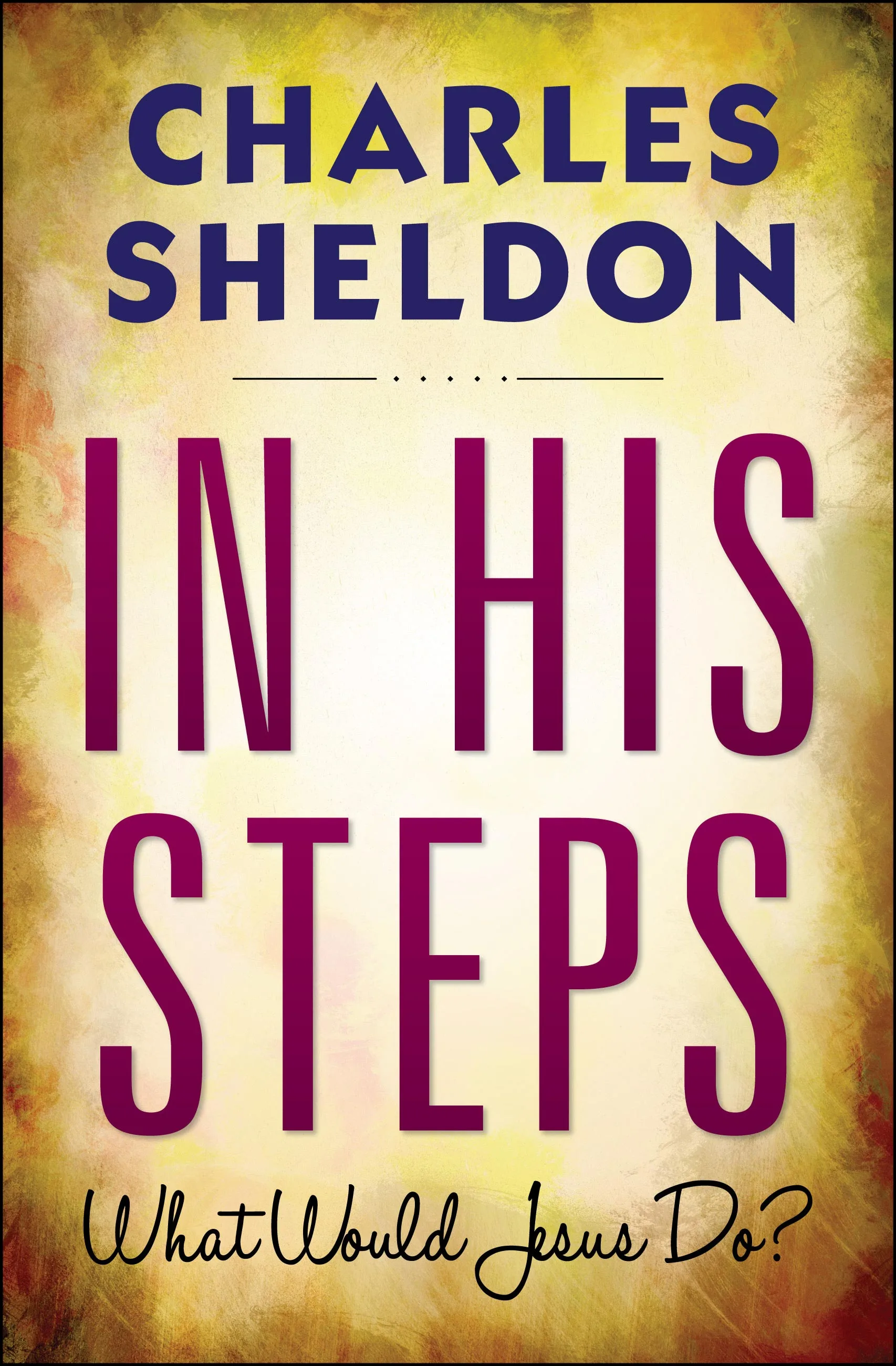
In His Steps
eBook
• INR 70.00
• English
• 9788194764847
No ratings yet
| Publisher | General Press |
|---|---|
| ISBN13 | 9788194764847 |
| ASIN/SKU | B08KJP2J2C |
| Book Format | eBook |
| Language | English |
| List Price | INR 70.00 |
| Subject Code | FIC042040, REL067000, FIC019000 |
| Publishing Date | 08/10/2020 |
| Book Code | BD00068724 |
Buy this Book
Amazon Stores
Ebook Stores
Other Stores
Discover In His Steps by Charles M. Sheldon. This book is published by General Press in eBook format, ISBN 9788194764847, ASIN B08KJP2J2C, under Christian Books and Bibles, Christian Living, Christian Fiction.
Book Description
What would happen if ordinary people stopped asking what was easiest, safest, or most profitable and instead asked one simple question: “What would Jesus do?” 'In His Steps' by Charles M. Sheldon is a classic Christian fiction novel that explores faith, morality, compassion, and social responsibility through a powerful challenge that transforms the lives of an entire community.
The story begins when Reverend Henry Maxwell, the pastor of a comfortable Christian congregation, encounters a struggling man whose difficult circumstances force him to reconsider what it truly means to follow Christ. The encounter leaves a deep impression on Maxwell, especially when the man challenges Christians to think seriously about how Jesus might respond to the hardships and injustices around them. Soon, Maxwell presents his congregation with a radical commitment: before making important decisions, they should honestly consider what Jesus would do and then act according to that answer, even when doing so requires sacrifice.
As different members of the community take this challenge seriously, the consequences reach far beyond the walls of the church. A talented newspaper editor must reconsider the kind of stories his publication promotes. A successful businessman faces difficult choices about money, competition, and the welfare of his employees. A gifted singer is forced to think differently about her career and personal ambitions. Other characters discover that genuine Christian faith is not simply a matter of attending church or professing belief; it involves responding to poverty, inequality, temptation, and suffering with practical love and courage.
What makes 'In His Steps' especially compelling is the way Sheldon connects spiritual conviction with everyday life. The characters are not perfect, and their decisions are rarely simple. Choosing to follow the example of Christ can cost them comfort, reputation, financial security, and personal happiness. Yet their struggles reveal how even one sincere question can challenge deeply rooted habits and inspire meaningful change.
Written in a straightforward and accessible style, this influential Christian novel remains memorable because its central question is both simple and demanding. 'In His Steps' invites readers to consider what faith looks like when it moves beyond words and becomes a guide for real-life decisions. Its enduring message continues to provoke reflection long after the final page, leaving readers to wonder what might change if they, too, began asking the question for themselves.
The story begins when Reverend Henry Maxwell, the pastor of a comfortable Christian congregation, encounters a struggling man whose difficult circumstances force him to reconsider what it truly means to follow Christ. The encounter leaves a deep impression on Maxwell, especially when the man challenges Christians to think seriously about how Jesus might respond to the hardships and injustices around them. Soon, Maxwell presents his congregation with a radical commitment: before making important decisions, they should honestly consider what Jesus would do and then act according to that answer, even when doing so requires sacrifice.
As different members of the community take this challenge seriously, the consequences reach far beyond the walls of the church. A talented newspaper editor must reconsider the kind of stories his publication promotes. A successful businessman faces difficult choices about money, competition, and the welfare of his employees. A gifted singer is forced to think differently about her career and personal ambitions. Other characters discover that genuine Christian faith is not simply a matter of attending church or professing belief; it involves responding to poverty, inequality, temptation, and suffering with practical love and courage.
What makes 'In His Steps' especially compelling is the way Sheldon connects spiritual conviction with everyday life. The characters are not perfect, and their decisions are rarely simple. Choosing to follow the example of Christ can cost them comfort, reputation, financial security, and personal happiness. Yet their struggles reveal how even one sincere question can challenge deeply rooted habits and inspire meaningful change.
Written in a straightforward and accessible style, this influential Christian novel remains memorable because its central question is both simple and demanding. 'In His Steps' invites readers to consider what faith looks like when it moves beyond words and becomes a guide for real-life decisions. Its enduring message continues to provoke reflection long after the final page, leaving readers to wonder what might change if they, too, began asking the question for themselves.
Author Biography
Charles Monroe Sheldon (1857-1946) was born in Wellsville, New York. After receiving his education at Brown University and Andover Theological Seminary, he founded the Central Congregational Church in Topeka, Kansas, in 1889. He wrote stories that he often read to his congregation. In 1897 he published his highly popular In His Steps. The book was an instant success and for sixty years remained the largest-selling book in the United States after the Bible, with sales estimated at more than twenty-two million copies worldwide. From 1920 to 1925, he edited the Christian Herald. Some of the journalist conventions he pioneered are commonly used in the American press today.
Editorial Reviews
Editorial Reviews will be added soon…
Book Summary
Charles M. Sheldon’s In His Steps is a Christian novel built around one simple but challenging question: “What would Jesus do?” First published in 1896, the novel follows a group of ordinary people who decide to place this question at the center of their daily lives. Rather than treating Christianity as something limited to church services, beliefs, or religious language, Sheldon asks what would happen if people sincerely tried to make their decisions according to the example and teachings of Jesus Christ.
The story begins in the fictional town of Raymond, where Reverend Henry Maxwell is the pastor of the First Church of Raymond. One Sunday, a poor and unemployed man named Jack Manning appears at the church and describes the desperate conditions facing him and his family. He has searched unsuccessfully for work and has experienced rejection and poverty while respectable people around him continue to live comfortably.
Manning's presence forces Reverend Maxwell to confront an uncomfortable truth. The church talks about following Christ, but how much does it actually resemble Christ's compassion toward suffering people?
The poor man's story affects Maxwell deeply. Although Manning later dies, his words remain with the minister. Maxwell begins to recognize the gap between Christianity as a set of beliefs and Christianity as a way of life.
He therefore challenges members of his congregation to make a radical commitment: for one year, whenever they face an important decision, they should ask themselves, “What would Jesus do?” They are not merely to speculate about what Jesus might do. They are expected to make decisions based on the answer, even when doing so requires sacrifice, financial loss, social embarrassment, or personal inconvenience.
At first, the idea seems simple. In practice, it becomes extraordinarily difficult.
One of the first people to accept the challenge is Rachel Winslow, a talented young singer. She has an opportunity to pursue a successful career, but she begins questioning whether her ambitions are compatible with a life devoted to serving others. Her struggle illustrates an important theme of the novel: following Christ may require a person to reconsider desires that society considers completely normal and admirable.
Another important character is Edward Norman, a successful newspaper editor. He begins applying the question to journalism and realizes that his newspaper often values profit and popularity more than truth and public service. The decision to change the newspaper's direction puts its financial future at risk.
Norman's story demonstrates that the principle of “What would Jesus do?” has consequences in professional life. Christianity, Sheldon suggests, cannot be separated from business practices, journalism, politics, or economics. Moral principles matter wherever decisions are made.
As more people adopt the challenge, the effects spread throughout Raymond. The characters begin confronting questions about poverty, labor, alcohol, entertainment, politics, and social inequality.
One of the novel's strongest themes is the relationship between Christianity and poverty. Sheldon argues that Christians cannot genuinely claim to follow Jesus while remaining indifferent to people who suffer. The wealthy members of Raymond's churches must reconsider how they use their money and influence.
The novel therefore presents Christianity as an active form of compassion. Helping the poor is not simply an act of charity performed from a distance. It involves understanding their circumstances and asking why poverty exists in the first place.
The characters also discover that following Christ can create conflict. People who benefit from existing systems may resist change. Employers may dislike demands for better working conditions. Business owners may oppose reforms that reduce profits. Political interests may resist moral criticism.
Sheldon does not portray these changes as effortless. His characters experience fear, doubt, financial difficulty, and opposition. Some begin enthusiastically but struggle when the cost becomes real. This makes the central question more demanding: it is relatively easy to ask what Jesus would do when the answer costs nothing. It is much harder when obedience threatens one's comfort or success.
The novel also examines personal relationships and sacrifice. Characters must sometimes reconsider romantic ambitions, social expectations, and family decisions. The question of what Jesus would do becomes a test of whether love means simply getting what one wants or genuinely seeking another person's welfare.
Perhaps the most important transformation occurs in the characters themselves. They begin to realize that Christian discipleship is not primarily about appearing religious. It is about becoming different people—more compassionate, courageous, honest, generous, and willing to sacrifice.
Sheldon also emphasizes the power of collective action. One person's decision can influence another, and a group of people committed to the same moral principle can begin changing an entire community. The novel therefore moves from individual spiritual awakening toward social reform.
At the same time, the book does not suggest that every problem can be solved immediately. Its characters make mistakes and struggle to understand what the right course of action is. The question “What would Jesus do?” is not presented as a magical formula with an obvious answer to every situation. Instead, it requires prayer, reflection, courage, and a willingness to sacrifice self-interest.
The title In His Steps captures the heart of the novel. To walk “in His steps” means more than admiring Jesus or agreeing with Christian teachings. It means trying to imitate his compassion, humility, courage, forgiveness, and concern for people who are overlooked.
Ultimately, In His Steps is a story about putting faith into practice. Sheldon challenges comfortable Christianity by asking whether belief has any meaning if it does not influence how people spend money, choose careers, treat workers, respond to poverty, conduct business, and relate to one another.
The novel's enduring appeal comes from the simplicity of its central question. Anyone can understand it, but answering it honestly can be difficult.
“What would Jesus do?” asks a person to look beyond convenience and self-interest. It challenges us to consider the effect of our choices on other people and to measure success not merely by wealth, popularity, or comfort but by service and moral integrity.
In the end, Sheldon's message is that Christianity becomes most powerful when it moves from the church into everyday life. True discipleship is not simply something a person believes. It is something a person does.
In His Steps therefore remains a direct and humane challenge: if we claim to follow a compassionate teacher, are we willing to follow his example when doing so demands something from us? For Sheldon, the answer determines whether faith remains an idea—or becomes a way of living.
The story begins in the fictional town of Raymond, where Reverend Henry Maxwell is the pastor of the First Church of Raymond. One Sunday, a poor and unemployed man named Jack Manning appears at the church and describes the desperate conditions facing him and his family. He has searched unsuccessfully for work and has experienced rejection and poverty while respectable people around him continue to live comfortably.
Manning's presence forces Reverend Maxwell to confront an uncomfortable truth. The church talks about following Christ, but how much does it actually resemble Christ's compassion toward suffering people?
The poor man's story affects Maxwell deeply. Although Manning later dies, his words remain with the minister. Maxwell begins to recognize the gap between Christianity as a set of beliefs and Christianity as a way of life.
He therefore challenges members of his congregation to make a radical commitment: for one year, whenever they face an important decision, they should ask themselves, “What would Jesus do?” They are not merely to speculate about what Jesus might do. They are expected to make decisions based on the answer, even when doing so requires sacrifice, financial loss, social embarrassment, or personal inconvenience.
At first, the idea seems simple. In practice, it becomes extraordinarily difficult.
One of the first people to accept the challenge is Rachel Winslow, a talented young singer. She has an opportunity to pursue a successful career, but she begins questioning whether her ambitions are compatible with a life devoted to serving others. Her struggle illustrates an important theme of the novel: following Christ may require a person to reconsider desires that society considers completely normal and admirable.
Another important character is Edward Norman, a successful newspaper editor. He begins applying the question to journalism and realizes that his newspaper often values profit and popularity more than truth and public service. The decision to change the newspaper's direction puts its financial future at risk.
Norman's story demonstrates that the principle of “What would Jesus do?” has consequences in professional life. Christianity, Sheldon suggests, cannot be separated from business practices, journalism, politics, or economics. Moral principles matter wherever decisions are made.
As more people adopt the challenge, the effects spread throughout Raymond. The characters begin confronting questions about poverty, labor, alcohol, entertainment, politics, and social inequality.
One of the novel's strongest themes is the relationship between Christianity and poverty. Sheldon argues that Christians cannot genuinely claim to follow Jesus while remaining indifferent to people who suffer. The wealthy members of Raymond's churches must reconsider how they use their money and influence.
The novel therefore presents Christianity as an active form of compassion. Helping the poor is not simply an act of charity performed from a distance. It involves understanding their circumstances and asking why poverty exists in the first place.
The characters also discover that following Christ can create conflict. People who benefit from existing systems may resist change. Employers may dislike demands for better working conditions. Business owners may oppose reforms that reduce profits. Political interests may resist moral criticism.
Sheldon does not portray these changes as effortless. His characters experience fear, doubt, financial difficulty, and opposition. Some begin enthusiastically but struggle when the cost becomes real. This makes the central question more demanding: it is relatively easy to ask what Jesus would do when the answer costs nothing. It is much harder when obedience threatens one's comfort or success.
The novel also examines personal relationships and sacrifice. Characters must sometimes reconsider romantic ambitions, social expectations, and family decisions. The question of what Jesus would do becomes a test of whether love means simply getting what one wants or genuinely seeking another person's welfare.
Perhaps the most important transformation occurs in the characters themselves. They begin to realize that Christian discipleship is not primarily about appearing religious. It is about becoming different people—more compassionate, courageous, honest, generous, and willing to sacrifice.
Sheldon also emphasizes the power of collective action. One person's decision can influence another, and a group of people committed to the same moral principle can begin changing an entire community. The novel therefore moves from individual spiritual awakening toward social reform.
At the same time, the book does not suggest that every problem can be solved immediately. Its characters make mistakes and struggle to understand what the right course of action is. The question “What would Jesus do?” is not presented as a magical formula with an obvious answer to every situation. Instead, it requires prayer, reflection, courage, and a willingness to sacrifice self-interest.
The title In His Steps captures the heart of the novel. To walk “in His steps” means more than admiring Jesus or agreeing with Christian teachings. It means trying to imitate his compassion, humility, courage, forgiveness, and concern for people who are overlooked.
Ultimately, In His Steps is a story about putting faith into practice. Sheldon challenges comfortable Christianity by asking whether belief has any meaning if it does not influence how people spend money, choose careers, treat workers, respond to poverty, conduct business, and relate to one another.
The novel's enduring appeal comes from the simplicity of its central question. Anyone can understand it, but answering it honestly can be difficult.
“What would Jesus do?” asks a person to look beyond convenience and self-interest. It challenges us to consider the effect of our choices on other people and to measure success not merely by wealth, popularity, or comfort but by service and moral integrity.
In the end, Sheldon's message is that Christianity becomes most powerful when it moves from the church into everyday life. True discipleship is not simply something a person believes. It is something a person does.
In His Steps therefore remains a direct and humane challenge: if we claim to follow a compassionate teacher, are we willing to follow his example when doing so demands something from us? For Sheldon, the answer determines whether faith remains an idea—or becomes a way of living.
Sample Chapters
Chapter 1
“For hereunto were ye called; because Christ also suffered for you, leaving you an example, that ye should follow in his steps.”
It was Friday morning and the Rev. Henry Maxwell was trying to finish his Sunday morning sermon. He had been interrupted several times and was growing nervous as the morning wore away, and the sermon grew very slowly toward a satisfactory finish.
“Mary,” he called to his wife, as he went upstairs after the last interruption, “if any one comes after this, I wish you would say I am very busy and cannot come down unless it is something very important.”
“Yes, Henry. But I am going over to visit the kindergarten and you will have the house all to yourself.”
The minister went up into his study and shut the door. In a few minutes he heard his wife go out, and then everything was quiet. He settled himself at his desk with a sigh of relief and began to write. His text was from 1 Peter 2:21: “For hereunto were ye called; because Christ also suffered for you, leaving you an example that ye should follow his steps.”
He had emphasized in the first part of the sermon the Atonement as a personal sacrifice, calling attention to the fact of Jesus’ suffering in various ways, in His life as well as in His death. He had then gone on to emphasize the Atonement from the side of example, giving illustrations from the life and teachings of Jesus to show how faith in the Christ helped to save men because of the pattern or character He displayed for their imitation. He was now on the third and last point, the necessity of following Jesus in His sacrifice and example.
He had put down “Three Steps. What are they?” and was about to enumerate them in logical order when the bell rang sharply. It was one of those clock-work bells, and always went off as a clock might go if it tried to strike twelve all at once.
Henry Maxwell sat at his desk and frowned a little. He made no movement to answer the bell. Very soon it rang again; then he rose and walked over to one of his windows which commanded the view of the front door. A man was standing on the steps. He was a young man, very shabbily dressed.
“Looks like a tramp,” said the minister. “I suppose I’ll have to go down and—”
He did not finish his sentence but he went downstairs and opened the front door. There was a moment’s pause as the two men stood facing each other, then the shabby-looking young man said:
“I’m out of a job, sir, and thought maybe you might put me in the way of getting something.”
“I don’t know of anything. Jobs are scarce—” replied the minister, beginning to shut the door slowly.
“I didn’t know but you might perhaps be able to give me a line to the city railway or the superintendent of the shops, or something,” continued the young man, shifting his faded hat from one hand to the other nervously.
“It would be of no use. You will have to excuse me. I am very busy this morning. I hope you will find something. Sorry I can’t give you something to do here. But I keep only a horse and a cow and do the work myself.”
The Rev. Henry Maxwell closed the door and heard the man walk down the steps. As he went up into his study he saw from his hall window that the man was going slowly down the street, still holding his hat between his hands. There was something in the figure so dejected, homeless and forsaken that the minister hesitated a moment as he stood looking at it. Then he turned to his desk and with a sigh began the writing where he had left off.
He had no more interruptions, and when his wife came in two hours later the sermon was finished, the loose leaves gathered up and neatly tied together, and laid on his Bible all ready for the Sunday morning service.
“A queer thing happened at the kindergarten this morning, Henry,” said his wife while they were eating dinner. “You know I went over with Mrs. Brown to visit the school, and just after the games, while the children were at the tables, the door opened and a young man came in holding a dirty hat in both hands. He sat down near the door and never said a word; only looked at the children. He was evidently a tramp, and Miss Wren and her assistant Miss Kyle were a little frightened at first, but he sat there very quietly and after a few minutes he went out.”
“Perhaps he was tired and wanted to rest somewhere. The same man called here, I think. Did you say he looked like a tramp?”
“Yes, very dusty, shabby and generally tramp-like. Not more than thirty or thirty-three years old, I should say.”
“The same man,” said the Rev. Henry Maxwell thoughtfully.
“Did you finish your sermon, Henry?” his wife asked after a pause.
“Yes, all done. It has been a very busy week with me. The two sermons have cost me a good deal of labor.”
“They will be appreciated by a large audience, Sunday, I hope,” replied his wife smiling. “What are you going to preach about in the morning?”
“Following Christ. I take up the Atonement under the head of sacrifice and example, and then show the steps needed to follow His sacrifice and example.”
“I am sure it is a good sermon. I hope it won’t rain Sunday. We have had so many stormy Sundays lately.”
“Yes, the audiences have been quite small for some time. People will not come out to church in a storm.” The Rev. Henry Maxwell sighed as he said it. He was thinking of the careful, laborious effort he had made in preparing sermons for large audiences that failed to appear.
But Sunday morning dawned on the town of Raymond one of the perfect days that sometimes come after long periods of wind and mud and rain. The air was clear and bracing, the sky was free from all threatening signs, and every one in Mr. Maxwell’s parish prepared to go to church. When the service opened at eleven o’clock the large building was filled with an audience of the best-dressed, most comfortable looking people of Raymond.
The First Church of Raymond believed in having the best music that money could buy, and its quartet choir this morning was a source of great pleasure to the congregation. The anthem was inspiring. All the music was in keeping with the subject of the sermon. And the anthem was an elaborate adaptation to the most modern music of the hymn,
“Jesus, I my cross have taken,
All to leave and follow Thee.”
Just before the sermon, the soprano sang a solo, the well-known hymn,
“Where He leads me I will follow,
I’ll go with Him, with Him, all the way.”
Rachel Winslow looked very beautiful that morning as she stood up behind the screen of carved oak which was significantly marked with the emblems of the cross and the crown. Her voice was even more beautiful than her face, and that meant a great deal. There was a general rustle of expectation over the audience as she rose. Mr. Maxwell settled himself contentedly behind the pulpit. Rachel Winslow’s singing always helped him. He generally arranged for a song before the sermon. It made possible a certain inspiration of feeling that made his delivery more impressive.
People said to themselves they had never heard such singing even in the First Church. It is certain that if it had not been a church service, her solo would have been vigorously applauded. It even seemed to the minister when she sat down that something like an attempted clapping of hands or a striking of feet on the floor swept through the church. He was startled by it. As he rose, however, and laid his sermon on the Bible, he said to himself he had been deceived. Of course it could not occur. In a few moments he was absorbed in his sermon and everything else was forgotten in the pleasure of his delivery.
No one had ever accused Henry Maxwell of being a dull preacher. On the contrary, he had often been charged with being sensational; not in what he had said so much as in his way of saying it. But the First Church people liked that. It gave their preacher and their parish a pleasant distinction that was agreeable.
It was also true that the pastor of the First Church loved to preach. He seldom exchanged. He was eager to be in his own pulpit when Sunday came. There was an exhilarating half hour for him as he faced a church full of people and know that he had a hearing. He was peculiarly sensitive to variations in the attendance. He never preached well before a small audience. The weather also affected him decidedly. He was at his best before just such an audience as faced him now, on just such a morning. He felt a glow of satisfaction as he went on. The church was the first in the city. It had the best choir. It had a membership composed of the leading people, representatives of the wealth, society and intelligence of Raymond. He was going abroad on a three months vacation in the summer, and the circumstances of his pastorate, his influence and his position as pastor of the First Church in the city—
It is not certain that the Rev. Henry Maxwell knew just how he could carry on that thought in connection with his sermon, but as he drew near the end of it he knew that he had at some point in his delivery had all those feelings. They had entered into the very substance of his thought; it might have been all in a few seconds of time, but he had been conscious of defining his position and his emotions as well as if he had held a soliloquy, and his delivery partook of the thrill of deep personal satisfaction.
The sermon was interesting. It was full of striking sentences. They would have commanded attention printed. Spoken with the passion of a dramatic utterance that had the good taste never to offend with a suspicion of ranting or declamation, they were very effective. If the Rev. Henry Maxwell that morning felt satisfied with the conditions of his pastorate, the First Church also had a similar feeling as it congratulated itself on the presence in the pulpit of this scholarly, refined, somewhat striking face and figure, preaching with such animation and freedom from all vulgar, noisy or disagreeable mannerism.
Suddenly, into the midst of this perfect accord and concord between preacher and audience, there came a very remarkable interruption. It would be difficult to indicate the extent of the shock which this interruption measured. It was so unexpected, so entirely contrary to any thought of any person present that it offered no room for argument or, for the time being, of resistance.
The sermon had come to a close. Mr. Maxwell had just turned the half of the big Bible over upon his manuscript and was about to sit down as the quartet prepared to arise to sing the closing selection,
“All for Jesus, all for Jesus,
All my being’s ransomed powers...”
when the entire congregation was startled by the sound of a man’s voice. It came from the rear of the church, from one of the seats under the gallery. The next moment the figure of a man came out of the shadow there and walked down the middle aisle.
Before the startled congregation fairly realized what was going on the man had reached the open space in front of the pulpit and had turned about facing the people.
“I’ve been wondering since I came in here”—they were the words he used under the gallery, and he repeated them—”if it would be just the thing to say a word at the close of the service. I’m not drunk and I’m not crazy, and I am perfectly harmless, but if I die, as there is every likelihood I shall in a few days, I want the satisfaction of thinking that I said my say in a place like this, and before this sort of a crowd.”
Henry Maxwell had not taken his seat, and he now remained standing, leaning on his pulpit, looking down at the stranger. It was the man who had come to his house the Friday before, the same dusty, worn, shabby-looking young man. He held his faded hat in his two hands. It seemed to be a favorite gesture. He had not been shaved and his hair was rough and tangled. It is doubtful if any one like this had ever confronted the First Church within the sanctuary. It was tolerably familiar with this sort of humanity out on the street, around the railroad shops, wandering up and down the avenue, but it had never dreamed of such an incident as this so near.
There was nothing offensive in the man’s manner or tone. He was not excited and he spoke in a low but distinct voice. Mr. Maxwell was conscious, even as he stood there smitten into dumb astonishment at the event, that somehow the man’s action reminded him of a person he had once seen walking and talking in his sleep.
No one in the house made any motion to stop the stranger or in any way interrupt him. Perhaps the first shock of his sudden appearance deepened into a genuine perplexity concerning what was best to do. However that may be, he went on as if he had no thought of interruption and no thought of the unusual element which he had introduced into the decorum of the First Church service. And all the while he was speaking, the minister leaded over the pulpit, his face growing more white and sad every moment. But he made no movement to stop him, and the people sat smitten into breathless silence. One other face, that of Rachel Winslow from the choir, stared white and intent down at the shabby figure with the faded hat. Her face was striking at any time. Under the pressure of the present unheard-of incident it was as personally distinct as if it had been framed in fire.
“I’m not an ordinary tramp, though I don’t know of any teaching of Jesus that makes one kind of a tramp less worth saving than another. Do you?” He put the question as naturally as if the whole congregation had been a small Bible class. He paused just a moment and coughed painfully. Then he went on.
“I lost my job ten months ago. I am a printer by trade. The new linotype machines are beautiful specimens of invention, but I know six men who have killed themselves inside of the year just on account of those machines. Of course I don’t blame the newspapers for getting the machines. Meanwhile, what can a man do? I know I never learned but the one trade, and that’s all I can do. I’ve tramped all over the country trying to find something. There are a good many others like me. I’m not complaining, am I? Just stating facts. But I was wondering as I sat there under the gallery, if what you call following Jesus is the same thing as what He taught. What did He mean when He said: ‘Follow Me!’? The minister said,”—here he turned about and looked up at the pulpit—”that it is necessary for the disciple of Jesus to follow His steps, and he said the steps are ‘obedience, faith, love and imitation.’ But I did not hear him tell you just what he meant that to mean, especially the last step. What do you Christians mean by following the steps of Jesus?
“I’ve tramped through this city for three days trying to find a job; and in all that time I’ve not had a word of sympathy or comfort except from your minister here, who said he was sorry for me and hoped I would find a job somewhere. I suppose it is because you get so imposed on by the professional tramp that you have lost your interest in any other sort. I’m not blaming anybody, am I? Just stating facts. Of course, I understand you can’t all go out of your way to hunt up jobs for other people like me. I’m not asking you to; but what I feel puzzled about is, what is meant by following Jesus. What do you mean when you sing ‘I’ll go with Him, with Him, all the way?’ Do you mean that you are suffering and denying yourselves and trying to save lost, suffering humanity just as I understand Jesus did? What do you mean by it? I see the ragged edge of things a good deal. I understand there are more than five hundred men in this city in my case. Most of them have families. My wife died four months ago. I’m glad she is out of trouble. My little girl is staying with a printer’s family until I find a job. Somehow I get puzzled when I see so many Christians living in luxury and singing ‘Jesus, I my cross have taken, all to leave and follow Thee,’ and remember how my wife died in a tenement in New York City, gasping for air and asking God to take the little girl too. Of course I don’t expect you people can prevent everyone from dying of starvation, lack of proper nourishment and tenement air, but what does following Jesus mean? I understand that Christian people own a good many of the tenements. A member of a church was the owner of the one where my wife died, and I have wondered if following Jesus all the way was true in his case. I heard some people singing at a church prayer meeting the other night,
‘All for Jesus, all for Jesus,
All my being’s ransomed powers,
All my thoughts, and all my doings,
All my days, and all my hours.’
and I kept wondering as I sat on the steps outside just what they meant by it. It seems to me there’s an awful lot of trouble in the world that somehow wouldn’t exist if all the people who sing such songs went and lived them out. I suppose I don’t understand. But what would Jesus do? Is that what you mean by following His steps? It seems to me sometimes as if the people in the big churches had good clothes and nice houses to live in, and money to spend for luxuries, and could go away on summer vacations and all that, while the people outside the churches, thousands of them, I mean, die in tenements, and walk the streets for jobs, and never have a piano or a picture in the house, and grow up in misery and drunkenness and sin.”
The man suddenly gave a queer lurch over in the direction of the communion table and laid one grimy hand on it. His hat fell upon the carpet at his feet. A stir went through the congregation. Dr. West half rose from his pew, but as yet the silence was unbroken by any voice or movement worth mentioning in the audience. The man passed his other hand across his eyes, and then, without any warning, fell heavily forward on his face, full length up the aisle. Henry Maxwell spoke:
“We will consider the service closed.”
Chapter 2
Henry Maxwell and a group of his church members remained sometime in the study. The man lay on the couch there and breathed heavily. When the question of what to do with him came up, the minister insisted on taking the man to his own house; he lived nearby and had an extra room. Rachel Winslow said:
“Mother has no company at present. I am sure we would be glad to give him a place with us.”
She looked strongly agitated. No one noticed it particularly. They were all excited over the strange event, the strangest that First Church people could remember. But the minister insisted on taking charge of the man, and when a carriage came the unconscious but living form was carried to his house; and with the entrance of that humanity into the minister’s spare room a new chapter in Henry Maxwell’s life began, and yet no one, himself least of all, dreamed of the remarkable change it was destined to make in all his after definition of the Christian discipleship.
The event created a great sensation in the First Church parish. People talked of nothing else for a week. It was the general impression that the man had wandered into the church in a condition of mental disturbance caused by his troubles, and that all the time he was talking he was in a strange delirium of fever and really ignorant of his surroundings. That was the most charitable construction to put upon his action. It was the general agreement also that there was a singular absence of anything bitter or complaining in what the man had said. He had, throughout, spoken in a mild, apologetic tone, almost as if he were one of the congregation seeking for light on a very difficult subject.
“For hereunto were ye called; because Christ also suffered for you, leaving you an example, that ye should follow in his steps.”
It was Friday morning and the Rev. Henry Maxwell was trying to finish his Sunday morning sermon. He had been interrupted several times and was growing nervous as the morning wore away, and the sermon grew very slowly toward a satisfactory finish.
“Mary,” he called to his wife, as he went upstairs after the last interruption, “if any one comes after this, I wish you would say I am very busy and cannot come down unless it is something very important.”
“Yes, Henry. But I am going over to visit the kindergarten and you will have the house all to yourself.”
The minister went up into his study and shut the door. In a few minutes he heard his wife go out, and then everything was quiet. He settled himself at his desk with a sigh of relief and began to write. His text was from 1 Peter 2:21: “For hereunto were ye called; because Christ also suffered for you, leaving you an example that ye should follow his steps.”
He had emphasized in the first part of the sermon the Atonement as a personal sacrifice, calling attention to the fact of Jesus’ suffering in various ways, in His life as well as in His death. He had then gone on to emphasize the Atonement from the side of example, giving illustrations from the life and teachings of Jesus to show how faith in the Christ helped to save men because of the pattern or character He displayed for their imitation. He was now on the third and last point, the necessity of following Jesus in His sacrifice and example.
He had put down “Three Steps. What are they?” and was about to enumerate them in logical order when the bell rang sharply. It was one of those clock-work bells, and always went off as a clock might go if it tried to strike twelve all at once.
Henry Maxwell sat at his desk and frowned a little. He made no movement to answer the bell. Very soon it rang again; then he rose and walked over to one of his windows which commanded the view of the front door. A man was standing on the steps. He was a young man, very shabbily dressed.
“Looks like a tramp,” said the minister. “I suppose I’ll have to go down and—”
He did not finish his sentence but he went downstairs and opened the front door. There was a moment’s pause as the two men stood facing each other, then the shabby-looking young man said:
“I’m out of a job, sir, and thought maybe you might put me in the way of getting something.”
“I don’t know of anything. Jobs are scarce—” replied the minister, beginning to shut the door slowly.
“I didn’t know but you might perhaps be able to give me a line to the city railway or the superintendent of the shops, or something,” continued the young man, shifting his faded hat from one hand to the other nervously.
“It would be of no use. You will have to excuse me. I am very busy this morning. I hope you will find something. Sorry I can’t give you something to do here. But I keep only a horse and a cow and do the work myself.”
The Rev. Henry Maxwell closed the door and heard the man walk down the steps. As he went up into his study he saw from his hall window that the man was going slowly down the street, still holding his hat between his hands. There was something in the figure so dejected, homeless and forsaken that the minister hesitated a moment as he stood looking at it. Then he turned to his desk and with a sigh began the writing where he had left off.
He had no more interruptions, and when his wife came in two hours later the sermon was finished, the loose leaves gathered up and neatly tied together, and laid on his Bible all ready for the Sunday morning service.
“A queer thing happened at the kindergarten this morning, Henry,” said his wife while they were eating dinner. “You know I went over with Mrs. Brown to visit the school, and just after the games, while the children were at the tables, the door opened and a young man came in holding a dirty hat in both hands. He sat down near the door and never said a word; only looked at the children. He was evidently a tramp, and Miss Wren and her assistant Miss Kyle were a little frightened at first, but he sat there very quietly and after a few minutes he went out.”
“Perhaps he was tired and wanted to rest somewhere. The same man called here, I think. Did you say he looked like a tramp?”
“Yes, very dusty, shabby and generally tramp-like. Not more than thirty or thirty-three years old, I should say.”
“The same man,” said the Rev. Henry Maxwell thoughtfully.
“Did you finish your sermon, Henry?” his wife asked after a pause.
“Yes, all done. It has been a very busy week with me. The two sermons have cost me a good deal of labor.”
“They will be appreciated by a large audience, Sunday, I hope,” replied his wife smiling. “What are you going to preach about in the morning?”
“Following Christ. I take up the Atonement under the head of sacrifice and example, and then show the steps needed to follow His sacrifice and example.”
“I am sure it is a good sermon. I hope it won’t rain Sunday. We have had so many stormy Sundays lately.”
“Yes, the audiences have been quite small for some time. People will not come out to church in a storm.” The Rev. Henry Maxwell sighed as he said it. He was thinking of the careful, laborious effort he had made in preparing sermons for large audiences that failed to appear.
But Sunday morning dawned on the town of Raymond one of the perfect days that sometimes come after long periods of wind and mud and rain. The air was clear and bracing, the sky was free from all threatening signs, and every one in Mr. Maxwell’s parish prepared to go to church. When the service opened at eleven o’clock the large building was filled with an audience of the best-dressed, most comfortable looking people of Raymond.
The First Church of Raymond believed in having the best music that money could buy, and its quartet choir this morning was a source of great pleasure to the congregation. The anthem was inspiring. All the music was in keeping with the subject of the sermon. And the anthem was an elaborate adaptation to the most modern music of the hymn,
“Jesus, I my cross have taken,
All to leave and follow Thee.”
Just before the sermon, the soprano sang a solo, the well-known hymn,
“Where He leads me I will follow,
I’ll go with Him, with Him, all the way.”
Rachel Winslow looked very beautiful that morning as she stood up behind the screen of carved oak which was significantly marked with the emblems of the cross and the crown. Her voice was even more beautiful than her face, and that meant a great deal. There was a general rustle of expectation over the audience as she rose. Mr. Maxwell settled himself contentedly behind the pulpit. Rachel Winslow’s singing always helped him. He generally arranged for a song before the sermon. It made possible a certain inspiration of feeling that made his delivery more impressive.
People said to themselves they had never heard such singing even in the First Church. It is certain that if it had not been a church service, her solo would have been vigorously applauded. It even seemed to the minister when she sat down that something like an attempted clapping of hands or a striking of feet on the floor swept through the church. He was startled by it. As he rose, however, and laid his sermon on the Bible, he said to himself he had been deceived. Of course it could not occur. In a few moments he was absorbed in his sermon and everything else was forgotten in the pleasure of his delivery.
No one had ever accused Henry Maxwell of being a dull preacher. On the contrary, he had often been charged with being sensational; not in what he had said so much as in his way of saying it. But the First Church people liked that. It gave their preacher and their parish a pleasant distinction that was agreeable.
It was also true that the pastor of the First Church loved to preach. He seldom exchanged. He was eager to be in his own pulpit when Sunday came. There was an exhilarating half hour for him as he faced a church full of people and know that he had a hearing. He was peculiarly sensitive to variations in the attendance. He never preached well before a small audience. The weather also affected him decidedly. He was at his best before just such an audience as faced him now, on just such a morning. He felt a glow of satisfaction as he went on. The church was the first in the city. It had the best choir. It had a membership composed of the leading people, representatives of the wealth, society and intelligence of Raymond. He was going abroad on a three months vacation in the summer, and the circumstances of his pastorate, his influence and his position as pastor of the First Church in the city—
It is not certain that the Rev. Henry Maxwell knew just how he could carry on that thought in connection with his sermon, but as he drew near the end of it he knew that he had at some point in his delivery had all those feelings. They had entered into the very substance of his thought; it might have been all in a few seconds of time, but he had been conscious of defining his position and his emotions as well as if he had held a soliloquy, and his delivery partook of the thrill of deep personal satisfaction.
The sermon was interesting. It was full of striking sentences. They would have commanded attention printed. Spoken with the passion of a dramatic utterance that had the good taste never to offend with a suspicion of ranting or declamation, they were very effective. If the Rev. Henry Maxwell that morning felt satisfied with the conditions of his pastorate, the First Church also had a similar feeling as it congratulated itself on the presence in the pulpit of this scholarly, refined, somewhat striking face and figure, preaching with such animation and freedom from all vulgar, noisy or disagreeable mannerism.
Suddenly, into the midst of this perfect accord and concord between preacher and audience, there came a very remarkable interruption. It would be difficult to indicate the extent of the shock which this interruption measured. It was so unexpected, so entirely contrary to any thought of any person present that it offered no room for argument or, for the time being, of resistance.
The sermon had come to a close. Mr. Maxwell had just turned the half of the big Bible over upon his manuscript and was about to sit down as the quartet prepared to arise to sing the closing selection,
“All for Jesus, all for Jesus,
All my being’s ransomed powers...”
when the entire congregation was startled by the sound of a man’s voice. It came from the rear of the church, from one of the seats under the gallery. The next moment the figure of a man came out of the shadow there and walked down the middle aisle.
Before the startled congregation fairly realized what was going on the man had reached the open space in front of the pulpit and had turned about facing the people.
“I’ve been wondering since I came in here”—they were the words he used under the gallery, and he repeated them—”if it would be just the thing to say a word at the close of the service. I’m not drunk and I’m not crazy, and I am perfectly harmless, but if I die, as there is every likelihood I shall in a few days, I want the satisfaction of thinking that I said my say in a place like this, and before this sort of a crowd.”
Henry Maxwell had not taken his seat, and he now remained standing, leaning on his pulpit, looking down at the stranger. It was the man who had come to his house the Friday before, the same dusty, worn, shabby-looking young man. He held his faded hat in his two hands. It seemed to be a favorite gesture. He had not been shaved and his hair was rough and tangled. It is doubtful if any one like this had ever confronted the First Church within the sanctuary. It was tolerably familiar with this sort of humanity out on the street, around the railroad shops, wandering up and down the avenue, but it had never dreamed of such an incident as this so near.
There was nothing offensive in the man’s manner or tone. He was not excited and he spoke in a low but distinct voice. Mr. Maxwell was conscious, even as he stood there smitten into dumb astonishment at the event, that somehow the man’s action reminded him of a person he had once seen walking and talking in his sleep.
No one in the house made any motion to stop the stranger or in any way interrupt him. Perhaps the first shock of his sudden appearance deepened into a genuine perplexity concerning what was best to do. However that may be, he went on as if he had no thought of interruption and no thought of the unusual element which he had introduced into the decorum of the First Church service. And all the while he was speaking, the minister leaded over the pulpit, his face growing more white and sad every moment. But he made no movement to stop him, and the people sat smitten into breathless silence. One other face, that of Rachel Winslow from the choir, stared white and intent down at the shabby figure with the faded hat. Her face was striking at any time. Under the pressure of the present unheard-of incident it was as personally distinct as if it had been framed in fire.
“I’m not an ordinary tramp, though I don’t know of any teaching of Jesus that makes one kind of a tramp less worth saving than another. Do you?” He put the question as naturally as if the whole congregation had been a small Bible class. He paused just a moment and coughed painfully. Then he went on.
“I lost my job ten months ago. I am a printer by trade. The new linotype machines are beautiful specimens of invention, but I know six men who have killed themselves inside of the year just on account of those machines. Of course I don’t blame the newspapers for getting the machines. Meanwhile, what can a man do? I know I never learned but the one trade, and that’s all I can do. I’ve tramped all over the country trying to find something. There are a good many others like me. I’m not complaining, am I? Just stating facts. But I was wondering as I sat there under the gallery, if what you call following Jesus is the same thing as what He taught. What did He mean when He said: ‘Follow Me!’? The minister said,”—here he turned about and looked up at the pulpit—”that it is necessary for the disciple of Jesus to follow His steps, and he said the steps are ‘obedience, faith, love and imitation.’ But I did not hear him tell you just what he meant that to mean, especially the last step. What do you Christians mean by following the steps of Jesus?
“I’ve tramped through this city for three days trying to find a job; and in all that time I’ve not had a word of sympathy or comfort except from your minister here, who said he was sorry for me and hoped I would find a job somewhere. I suppose it is because you get so imposed on by the professional tramp that you have lost your interest in any other sort. I’m not blaming anybody, am I? Just stating facts. Of course, I understand you can’t all go out of your way to hunt up jobs for other people like me. I’m not asking you to; but what I feel puzzled about is, what is meant by following Jesus. What do you mean when you sing ‘I’ll go with Him, with Him, all the way?’ Do you mean that you are suffering and denying yourselves and trying to save lost, suffering humanity just as I understand Jesus did? What do you mean by it? I see the ragged edge of things a good deal. I understand there are more than five hundred men in this city in my case. Most of them have families. My wife died four months ago. I’m glad she is out of trouble. My little girl is staying with a printer’s family until I find a job. Somehow I get puzzled when I see so many Christians living in luxury and singing ‘Jesus, I my cross have taken, all to leave and follow Thee,’ and remember how my wife died in a tenement in New York City, gasping for air and asking God to take the little girl too. Of course I don’t expect you people can prevent everyone from dying of starvation, lack of proper nourishment and tenement air, but what does following Jesus mean? I understand that Christian people own a good many of the tenements. A member of a church was the owner of the one where my wife died, and I have wondered if following Jesus all the way was true in his case. I heard some people singing at a church prayer meeting the other night,
‘All for Jesus, all for Jesus,
All my being’s ransomed powers,
All my thoughts, and all my doings,
All my days, and all my hours.’
and I kept wondering as I sat on the steps outside just what they meant by it. It seems to me there’s an awful lot of trouble in the world that somehow wouldn’t exist if all the people who sing such songs went and lived them out. I suppose I don’t understand. But what would Jesus do? Is that what you mean by following His steps? It seems to me sometimes as if the people in the big churches had good clothes and nice houses to live in, and money to spend for luxuries, and could go away on summer vacations and all that, while the people outside the churches, thousands of them, I mean, die in tenements, and walk the streets for jobs, and never have a piano or a picture in the house, and grow up in misery and drunkenness and sin.”
The man suddenly gave a queer lurch over in the direction of the communion table and laid one grimy hand on it. His hat fell upon the carpet at his feet. A stir went through the congregation. Dr. West half rose from his pew, but as yet the silence was unbroken by any voice or movement worth mentioning in the audience. The man passed his other hand across his eyes, and then, without any warning, fell heavily forward on his face, full length up the aisle. Henry Maxwell spoke:
“We will consider the service closed.”
Chapter 2
Henry Maxwell and a group of his church members remained sometime in the study. The man lay on the couch there and breathed heavily. When the question of what to do with him came up, the minister insisted on taking the man to his own house; he lived nearby and had an extra room. Rachel Winslow said:
“Mother has no company at present. I am sure we would be glad to give him a place with us.”
She looked strongly agitated. No one noticed it particularly. They were all excited over the strange event, the strangest that First Church people could remember. But the minister insisted on taking charge of the man, and when a carriage came the unconscious but living form was carried to his house; and with the entrance of that humanity into the minister’s spare room a new chapter in Henry Maxwell’s life began, and yet no one, himself least of all, dreamed of the remarkable change it was destined to make in all his after definition of the Christian discipleship.
The event created a great sensation in the First Church parish. People talked of nothing else for a week. It was the general impression that the man had wandered into the church in a condition of mental disturbance caused by his troubles, and that all the time he was talking he was in a strange delirium of fever and really ignorant of his surroundings. That was the most charitable construction to put upon his action. It was the general agreement also that there was a singular absence of anything bitter or complaining in what the man had said. He had, throughout, spoken in a mild, apologetic tone, almost as if he were one of the congregation seeking for light on a very difficult subject.
Reader Reviews
No reviews yet.
In His Steps