
Simon the Coldheart
eBook
• INR 51.00
• English
• 9789354990472
No ratings yet
| Publisher | General Press |
|---|---|
| ISBN13 | 9789354990472 |
| ASIN/SKU | B09XMHN4MZ |
| Book Format | eBook |
| Language | English |
| List Price | INR 51.00 |
| Subject Code | FIC014010, FIC027020 |
| Publishing Date | 01/04/2022 |
| Book Code | BD00068827 |
Buy this Book
Amazon Stores
Ebook Stores
Other Stores
Discover Simon the Coldheart by Georgette Heyer. This book is published by General Press in eBook format, ISBN 9789354990472, ASIN B09XMHN4MZ, under Literature and Fiction, Romance, Historical Fiction.
Book Description
Set against the backdrop of the Hundred Years’ War in the early fifteenth century, Georgette Heyer’s "Simon the Coldheart" traces the extraordinary ascent of Simon Beauvallet. Born illegitimate to a noble father, fourteen-year-old Simon refuses to be hindered by his humble beginnings. Following his mother’s death, the fiercely independent boy deliberately seeks service in the household of his father’s greatest enemy, Fulk of Montlice, rather than begging for patronage.
Through relentless determination and unyielding stoicism, Simon rises from a lowly page to a towering, gilded knight. He earns the deep respect of kings, as well as the unlikely friendship of both his master’s son and his own legitimate half-brother. Yet, despite his worldly triumphs and innate sense of justice, he remains stubbornly immune to romance. Valuing duty and pragmatism far above poetry, he is swiftly christened "Simon the Coldheart" by those around him.
Everything changes in the aftermath of the Battle of Agincourt. Tasked by King Henry V to lay siege to the French city of Belremy, the impenetrable knight finally meets his match in the fiercely defiant Lady Margaret. Refusing to yield her beloved castle to the English invaders, Margaret initiates a thrilling battle of wills. However, when Simon risks his own life to rescue her from a vicious kidnapper, his famously frozen heart finally thaws. Ultimately, Margaret surrenders not just her stronghold, but her heart, transforming the legendary knight into a profoundly devoted lover.
Through relentless determination and unyielding stoicism, Simon rises from a lowly page to a towering, gilded knight. He earns the deep respect of kings, as well as the unlikely friendship of both his master’s son and his own legitimate half-brother. Yet, despite his worldly triumphs and innate sense of justice, he remains stubbornly immune to romance. Valuing duty and pragmatism far above poetry, he is swiftly christened "Simon the Coldheart" by those around him.
Everything changes in the aftermath of the Battle of Agincourt. Tasked by King Henry V to lay siege to the French city of Belremy, the impenetrable knight finally meets his match in the fiercely defiant Lady Margaret. Refusing to yield her beloved castle to the English invaders, Margaret initiates a thrilling battle of wills. However, when Simon risks his own life to rescue her from a vicious kidnapper, his famously frozen heart finally thaws. Ultimately, Margaret surrenders not just her stronghold, but her heart, transforming the legendary knight into a profoundly devoted lover.
Author Biography
Georgette Heyer was a prolific historical romance and detective fiction novelist. Her writing career began in 1921, when she turned a story for her younger brother into the novel The Black Moth. In 1925 she married George Ronald Rougier, a mining engineer. Rougier later became a barrister and he often provided basic plot outlines for her thrillers. Beginning in 1932, Heyer released one romance novel and one thriller each year. Heyer was an intensely private person who remained a best selling author all her life without the aid of publicity. She made no appearances, never gave an interview and only answered fan letters herself if they made an interesting historical point. She wrote one novel using the pseudonym Stella Martin.
Her Georgian and Regencies romances were inspired by Jane Austen. While some critics thought her novels were too detailed, others considered the level of detail to be Heyer's greatest asset. Heyer remains a popular and much-loved author, known for essentially establishing the historical romance genre and its subgenre Regency romance.
Her Georgian and Regencies romances were inspired by Jane Austen. While some critics thought her novels were too detailed, others considered the level of detail to be Heyer's greatest asset. Heyer remains a popular and much-loved author, known for essentially establishing the historical romance genre and its subgenre Regency romance.
Editorial Reviews
Editorial Reviews will be added soon…
Book Summary
"Simon the Coldheart" by Georgette Heyer is a sweeping historical novel set during the turbulent years of the Hundred Years' War. Unlike the author's well-known Regency romances, this book is a richly detailed medieval adventure that follows the life of Simon Beauvallet, a young man whose ambition, courage, and unwavering discipline shape his extraordinary destiny. Born into a noble but impoverished family, Simon grows up in a world where power is won through strength, loyalty, and military skill rather than inherited privilege. From an early age, he is determined to rise above his circumstances. His calm nature, stern self-control, and refusal to let emotions cloud his judgment earn him the nickname "the Coldheart." While others see him as distant and unfeeling, Simon is driven by a powerful sense of purpose that leaves little room for personal weakness.
Simon begins his journey as a page and later becomes a squire, learning the demanding code of knighthood through years of hardship and discipline. He proves himself on the battlefield with remarkable courage and intelligence, quickly gaining the respect of powerful lords and seasoned warriors. Every victory strengthens his reputation, but it also places heavier responsibilities on his shoulders. Instead of seeking glory for its own sake, Simon carefully builds his position through loyalty, patience, and calculated decisions. His rise is not easy, as the medieval world is filled with political intrigue, betrayal, and shifting alliances. Friends may become enemies overnight, and survival often depends on reading people's true intentions. Simon's ability to remain composed under pressure becomes one of his greatest strengths.
As England and France remain locked in endless conflict, Simon finds himself fighting in some of the most dangerous campaigns of the era. Georgette Heyer vividly recreates the brutal realities of medieval warfare, from lengthy sieges and bloody battles to the hardships endured by soldiers on long military expeditions. Simon's courage earns him honors and promotions, yet each triumph comes at a personal cost. He witnesses death, destruction, and the cruel consequences of ambition, experiences that harden him even further. While other men are driven by greed or revenge, Simon remains focused on duty and the pursuit of excellence. His growing reputation attracts admiration from allies and fear from opponents, making him a respected figure in both military and noble circles.
Despite his seemingly icy exterior, Simon is far from heartless. Beneath his disciplined manner lies a man capable of deep loyalty and quiet compassion. However, he rarely allows these feelings to surface, believing that emotional attachments can weaken a leader. This belief is repeatedly challenged as he encounters people who inspire friendship, admiration, and eventually love. Throughout the novel, Simon struggles to balance his personal desires with the responsibilities that come with his rising status. His emotional restraint often causes misunderstandings, as those around him mistake silence for indifference. Yet readers gradually discover that his actions speak far louder than his words, revealing a man who consistently places the welfare of others before his own happiness.
One of the novel's most compelling elements is Simon's relationship with the women he meets during his journey, particularly Lady Margaret. Intelligent, proud, and strong-willed, she refuses to be intimidated by Simon's reputation or reserved personality. Their relationship develops slowly through shared experiences, mutual respect, and moments of quiet understanding rather than dramatic declarations of love. Margaret sees beyond Simon's stern exterior and recognizes the kindness and vulnerability he carefully hides. At the same time, Simon learns that true strength does not lie in suppressing emotion but in accepting it without sacrificing honor. Their evolving relationship adds warmth and humanity to a story otherwise dominated by war and political conflict.
The political landscape of medieval Europe forms an equally important backdrop to Simon's personal journey. Noble families compete for influence, kings struggle to maintain authority, and ambitious commanders pursue both military victory and personal advancement. Simon must navigate these dangerous power struggles with caution, knowing that one mistake could destroy everything he has worked to achieve. His integrity often sets him apart from others who are willing to deceive or betray for personal gain. Although his honesty occasionally places him at a disadvantage, it ultimately earns him lasting respect. Heyer skillfully weaves real historical events into the fictional narrative, creating a believable world where personal ambition and national history become inseparably linked.
As Simon matures, he begins to question the ideals that shaped his youth. The endless cycle of war, political rivalry, and violence forces him to reconsider what success truly means. Titles, wealth, and military victories no longer seem sufficient rewards for a life filled with sacrifice. He gradually realizes that loyalty, trust, friendship, and love are equally important achievements. This emotional growth transforms him from a brilliant but emotionally distant warrior into a more complete and compassionate leader. His journey becomes not only one of external success but also of inner understanding, as he learns to value human connections alongside honor and duty.
Georgette Heyer's remarkable attention to historical detail gives the novel exceptional depth and authenticity. She recreates medieval customs, castles, clothing, military traditions, and courtly manners with impressive accuracy, immersing readers in a vividly realized fourteenth-century world. The language reflects the period without becoming difficult to follow, while the characters feel authentic rather than modern figures placed in historical costumes. Battles are described with realism and excitement, political negotiations carry genuine tension, and everyday life in medieval society is portrayed with equal care. Rather than allowing historical detail to overwhelm the story, Heyer uses it to enrich the characters' experiences and make their choices more meaningful.
By the novel's conclusion, Simon has achieved the recognition and status he sought for so many years, but his greatest victory lies in the transformation of his character. He learns that true greatness is measured not only by military triumphs or noble rank but also by integrity, compassion, and the courage to embrace love. The man once known as "the Coldheart" proves capable of profound devotion and humanity without abandoning the discipline that made him successful. His life demonstrates that strength and tenderness are not opposites but qualities that can exist together in a truly honorable person.
"Simon the Coldheart" is ultimately far more than a tale of medieval warfare or heroic adventure. It is a richly layered story about ambition, identity, honor, sacrifice, and emotional growth set against one of history's most dramatic periods. Georgette Heyer combines meticulous historical research with compelling storytelling to create a novel that feels both grand in scope and deeply personal. Through Simon's remarkable journey from an ambitious young squire to a respected knight and leader, the novel explores timeless questions about what it means to earn respect, remain true to one's principles, and discover the value of love in a world shaped by conflict. It remains one of Heyer's finest historical achievements, offering readers an unforgettable blend of action, romance, and historical authenticity.
Simon begins his journey as a page and later becomes a squire, learning the demanding code of knighthood through years of hardship and discipline. He proves himself on the battlefield with remarkable courage and intelligence, quickly gaining the respect of powerful lords and seasoned warriors. Every victory strengthens his reputation, but it also places heavier responsibilities on his shoulders. Instead of seeking glory for its own sake, Simon carefully builds his position through loyalty, patience, and calculated decisions. His rise is not easy, as the medieval world is filled with political intrigue, betrayal, and shifting alliances. Friends may become enemies overnight, and survival often depends on reading people's true intentions. Simon's ability to remain composed under pressure becomes one of his greatest strengths.
As England and France remain locked in endless conflict, Simon finds himself fighting in some of the most dangerous campaigns of the era. Georgette Heyer vividly recreates the brutal realities of medieval warfare, from lengthy sieges and bloody battles to the hardships endured by soldiers on long military expeditions. Simon's courage earns him honors and promotions, yet each triumph comes at a personal cost. He witnesses death, destruction, and the cruel consequences of ambition, experiences that harden him even further. While other men are driven by greed or revenge, Simon remains focused on duty and the pursuit of excellence. His growing reputation attracts admiration from allies and fear from opponents, making him a respected figure in both military and noble circles.
Despite his seemingly icy exterior, Simon is far from heartless. Beneath his disciplined manner lies a man capable of deep loyalty and quiet compassion. However, he rarely allows these feelings to surface, believing that emotional attachments can weaken a leader. This belief is repeatedly challenged as he encounters people who inspire friendship, admiration, and eventually love. Throughout the novel, Simon struggles to balance his personal desires with the responsibilities that come with his rising status. His emotional restraint often causes misunderstandings, as those around him mistake silence for indifference. Yet readers gradually discover that his actions speak far louder than his words, revealing a man who consistently places the welfare of others before his own happiness.
One of the novel's most compelling elements is Simon's relationship with the women he meets during his journey, particularly Lady Margaret. Intelligent, proud, and strong-willed, she refuses to be intimidated by Simon's reputation or reserved personality. Their relationship develops slowly through shared experiences, mutual respect, and moments of quiet understanding rather than dramatic declarations of love. Margaret sees beyond Simon's stern exterior and recognizes the kindness and vulnerability he carefully hides. At the same time, Simon learns that true strength does not lie in suppressing emotion but in accepting it without sacrificing honor. Their evolving relationship adds warmth and humanity to a story otherwise dominated by war and political conflict.
The political landscape of medieval Europe forms an equally important backdrop to Simon's personal journey. Noble families compete for influence, kings struggle to maintain authority, and ambitious commanders pursue both military victory and personal advancement. Simon must navigate these dangerous power struggles with caution, knowing that one mistake could destroy everything he has worked to achieve. His integrity often sets him apart from others who are willing to deceive or betray for personal gain. Although his honesty occasionally places him at a disadvantage, it ultimately earns him lasting respect. Heyer skillfully weaves real historical events into the fictional narrative, creating a believable world where personal ambition and national history become inseparably linked.
As Simon matures, he begins to question the ideals that shaped his youth. The endless cycle of war, political rivalry, and violence forces him to reconsider what success truly means. Titles, wealth, and military victories no longer seem sufficient rewards for a life filled with sacrifice. He gradually realizes that loyalty, trust, friendship, and love are equally important achievements. This emotional growth transforms him from a brilliant but emotionally distant warrior into a more complete and compassionate leader. His journey becomes not only one of external success but also of inner understanding, as he learns to value human connections alongside honor and duty.
Georgette Heyer's remarkable attention to historical detail gives the novel exceptional depth and authenticity. She recreates medieval customs, castles, clothing, military traditions, and courtly manners with impressive accuracy, immersing readers in a vividly realized fourteenth-century world. The language reflects the period without becoming difficult to follow, while the characters feel authentic rather than modern figures placed in historical costumes. Battles are described with realism and excitement, political negotiations carry genuine tension, and everyday life in medieval society is portrayed with equal care. Rather than allowing historical detail to overwhelm the story, Heyer uses it to enrich the characters' experiences and make their choices more meaningful.
By the novel's conclusion, Simon has achieved the recognition and status he sought for so many years, but his greatest victory lies in the transformation of his character. He learns that true greatness is measured not only by military triumphs or noble rank but also by integrity, compassion, and the courage to embrace love. The man once known as "the Coldheart" proves capable of profound devotion and humanity without abandoning the discipline that made him successful. His life demonstrates that strength and tenderness are not opposites but qualities that can exist together in a truly honorable person.
"Simon the Coldheart" is ultimately far more than a tale of medieval warfare or heroic adventure. It is a richly layered story about ambition, identity, honor, sacrifice, and emotional growth set against one of history's most dramatic periods. Georgette Heyer combines meticulous historical research with compelling storytelling to create a novel that feels both grand in scope and deeply personal. Through Simon's remarkable journey from an ambitious young squire to a respected knight and leader, the novel explores timeless questions about what it means to earn respect, remain true to one's principles, and discover the value of love in a world shaped by conflict. It remains one of Heyer's finest historical achievements, offering readers an unforgettable blend of action, romance, and historical authenticity.
Sample Chapters
Part I
Chapter 1: How he came to Fulk of Montlice
He came walking from Bedford into Cambridge one May morning when the sun was still young and the dew scarce gone from the grass. His worldly possessions he carried on his back in an old knapsack; his short jerkin was stained and torn, and there were holes in his long hose. On his square head and drawn over his brow he wore a frayed cap set jauntily, with a heron’s feather pointing skywards. He carried a quarter-staff, and stepped out right manfully, scanning the flat fen-land from beneath his thick brows, his young mouth dogged, his sombre eyes coldly calculating. Of years he numbered fourteen, but his shoul-ders had a breadth beyond his age, and his thighs a thickness of muscle that gave him the appearance of a grown man dwarfed. Nor was the face below the clubbed fair hair that of a child, for in the low brow lay strength, and about the straight mouth purpose. There was little boyishness in the eyes, but a frowning look, and at the back, lurking in the green-blue depths, a watchful gleam that was never absent.
One spoke to him on the road, a pedlar tramping south, and gave him good-day. He answered in a crisp, deep voice, and smiled, showing a row of strong white teeth.
‘Whither goest thou, younker?’ the pedlar asked him idly.
‘To my goal, fellow,’ Simon retorted, and passed on. The pedlar called after him for his haughtiness, but he paid no heed. He was never one to waste words.
So at length he came to Montlice, which was his goal, and stood for a moment before the drawbridge, surveying the rugged castle. A man-at-arms, lounging on the bridge, hailed him good-naturedly.
‘What want ye, boy? This is the lion’s den.’
The glimmer of a smile came to light the darkness of Simon’s eyes.
‘I seek the lion,’ he said, and walked forward across the bridge.
The man laughed at him, barring his passage.
‘Ho-ho! Ye seek the lion, eh? He would make but one mouthful of you, my fine sprig.’
Simon looked up into his face, jutting brows lowering, eyes agleam.
‘I seek my Lord the Earl,’ he said. ‘Out of the way, sirrah!’
At that the man clapped his hands to his sides, shaken with herculean laughter. Having recovered some-what he achieved a clumsy bow.
‘My lord is from home,’ he said, mocking Simon.
‘You lie!’ Simon answered quickly. ‘My lord will know how to punish a lying servant. Let me pass!’ He awaited no permission, but slipped by, eel-like, and was gone across the bridge in a flash. Out of sight he paused, not hesitating, but seeming to debate within himself. He looked thoughtfully at the great gateway, standing wide with soldiers lounging there, and his lips tightened. He went swiftly through, light-footed and sure, and attracted but little notice. One of the men stopped his task to shout a surprised question after him, and Simon answered briefly over his shoulder: ‘On my lord’s business!’ The man laughed, thinking him some scullion’s child, and turned back to his companion. Simon went on up the winding slope to the castle door and was there met by a group of men-at-arms who denied him ingress.
‘To the scullions’ entrance, babe!’ one told him, and the muscles about his mouth stood out in anger. He kept his ground, not a whit afraid.
‘I must see my lord,’ he answered, and only that.
‘Wherefore, pup?’ the man asked him, and when he would not answer, sought to hustle him roughly away.
But Simon wriggled from under his hands, and springing to one side, brought his heavy quarter-staff down athwart the man’s shoulders with so much force that, great man though he was, the soldier stag-gered.
Matters then would have gone ill with Simon but for the appearance of a boy, a little younger than himself, who came strolling towards them, followed by two liver-coloured hounds. He was dark, and magnificently clad, and he carried himself with an air of languid arrogance.
‘Holà there!’ he called, and the soldiers fell away from Simon, leaving him to stand alone, arms folded and head turned to survey the newcomer.
The boy came up gracefully, looking at Simon with a questioning lift to his brows.
‘What is this?’ he asked. ‘Who are you who strike our men?’
Simon stepped forward.
‘So please you, sir, I seek my Lord the Earl.’
One of the men, he whom Simon had dealt that lusty blow, started to speak, but was hushed by an impe-rious gesture from the boy. He smiled at Simon with a mixture of friendliness and hauteur.
‘I am Alan of Montlice,’ he said. ‘What want you of my father?’
Simon doffed his cap, showing his thick, straight hair clubbed across his brow and at the nape of his brown neck. He bowed awkwardly.
‘I want employment, sir,’ he replied. ‘These men deny me entrance.’
Alan of Montlice hesitated.
‘My father stands in no need –’ he began, then paused, fingering his dark curls. ‘There is that in you that I like,’ he said frankly. ‘Come within.’
Simon bowed again, but he gave no thanks, only standing aside for the young Montlice to pass through the doorway. And as Alan went by, he shot him an awkward look, keen as steel, appraising him as it were. That was a trick which in after years had the effect of disconcerting his foes most mightily. Alan did not see the glance, but swept into the castle whistling through his teeth. Across the great stone hall he led Si-mon to an archway over which hung a leathern curtain, nail-studded. Before he pulled it back he spoke again to Simon, in a whisper.
‘Ye will speak my lord fair,’ he cautioned. ‘He is not so douce.’
A flickering smile touched Simon’s lips.
‘Fulk the Lion,’ he said. ‘I know.’
‘He is to be feared,’ Alan said, breathless.
Simon looked scorn.
‘I fear no man.’
At that Alan opened wide his brown eyes and giggled a little.
‘Ye do not know my lord,’ he said, and pulled the curtain aside.
They entered a fair room carpeted with rushes and hung with all manner of paintings, biblical and histori-cal. A table stood in the middle, and although it was now past eight o’clock in the forenoon, the remains of my lord’s breakfast still stood upon it: a chine of salt-beef, a broken manchett, and a tankard of ale. In a great chair beside the table, leaning back at his ease, sat Fulk of Montlice, a giant of a man, deep-chested and magnificently proportioned, as fair as his son was dark, with a crisp, golden beard, whose point came forward belligerently. One of his hands was tucked in the belt of his long gown, the other lay on the table, massive and hairy. Alan ran forward and fell to his knees.
‘Sir, here is a boy who would speak with thee.’
My lord’s heavy, light-lashed eyelids lifted and his small blue eyes travelled slowly from his son to Simon.
‘Should know that I do not speak with every vagrant whelp who is presumptuous,’ he said, a rumbling note of annoyance in his voice. ‘Away with you, sirrah!’
Simon stepped to the table, cap in hand.
‘I am no vagrant, good my lord. Nor will I be so miscalled.’
Alan stayed on his knees, affrighted at such temerity, but my Lord of Montlice laughed.
‘Good lack, what then are you, springald?’
‘I hope one day to be a man, my lord, even as you,’ Simon answered. ‘That is my ambition, sir, and so I come to seek employment with you.’
Montlice flung back his head and laughed again.
‘For that you beard the lion in his den, eh? I will eat you for my dinner, cockerel.’
‘So said they at the gate, my lord, but you will find me of more use alive than eaten.’
‘Shall I so? And what canst do? Wind silks for women-folk?’
‘That and other things, my lord,’ Simon answered coolly.
‘Soso! What then? Tend my hounds, or are they too strong for your management?’
At that Simon curled his lip in disdain.
‘There does not live the beast I will not tame, my lord.’
My lord’s eyes were now a-twinkle. He clapped the table jovially.
‘By the Rood, I like thy spirit, my young spring-chicken! Canst take a buffet?’
‘Ay, and give one.’
My lord cast him a quizzical look.
‘As thou didst to my man without?’
If he expected Simon to show discomfiture he was disappointed, for Simon only nodded. My lord laughed.
‘Impudence! Why camest thou to the great door? Know ye not the scullions’ entrance at the back?’
‘I have never approached my goal through the back door, my lord, nor ever will. I march straight.’
‘It seems so indeed,’ said my lord. ‘Well, what dost thou want of me?’
‘I would carry your lance and squire you, sir.’
Montlice snapped his fingers, jeering.
‘Thou sit a horse! A flea on a camel!’
The thick brows drew closer together and a little colour stole into Simon’s cheeks.
‘I shall grow, my lord.’
‘Nay, nay. Art too small. What are thy years?’
‘Fourteen, sir.’
‘A babe, forsooth! Get thee gone, babe; I’ve no need of squires.’
Simon stood still.
‘Your page, then, till I am grown to your liking.’
‘God’s my life, methinks thou art over-bold, babe, I do not take peasants for my pages.’
‘I am no peasant.’
‘Ho-ho! What then?’
‘As gentle as yourself, my lord.’
‘By Our Lady! What are called?’
‘Simon, my lord.’
‘Well, it’s a name. What else?’
Simon lifted his shoulders, half-impatiently.
‘I call myself Beauvallet, sir.’
My lord pursed his full lips.
‘It hath a ring,’ he nodded. ‘What is thy real name, sirrah?’
‘I have none.’
‘Tush! Your father’s name!’
Simon did not answer for a moment, but at last he shrugged again, and looked up.
‘Geoffrey of Malvallet,’ he answered.
‘Holy Virgin! I should have known that face! Art Malvallet’s bastard then?’
‘So my mother told me, my lord.’
‘Who is she? Does she live?’
‘She is dead these four years, sir. She was one Jehanne, of Malvallet’s household. That is nothing.’
Montlice sank back again.
‘Ay, ay. But what proof have you?’
‘A ring, my lord. Little enough.’
‘Show me.’
Simon put his hands up to his neck and drew a riband from his breast from which hung a golden ring. Montlice looked at it long and curiously.
‘How came she by this?’
‘I never asked, my lord. It matters not to me whether I am Malvallet’s son or another’s. I am what I choose to be.’
‘Here’s a philosophy!’ Montlice became aware of his son, still kneeling, and waved him to his feet. ‘What thinkest thou, Alan? Here is one of the Malvallet brood.’
Alan leaned carelessly against the table.
‘Malvallet is no friend of ours, sir, but I like this boy.’
‘He hath courage. Tell me, babe, where hast been since thy mother died?’
‘I had a home with her brother, sir, a wood-cutter.’
‘Well, and then?’
‘I wearied of it, my lord, and I came here.’
‘Why not to thy father, bantam?’
Simon jerked his shoulder again.
‘Him I have seen, my lord.’
Montlice rumbled forth a laugh.
‘And liked not his looks?’
‘Well enough, sir, but you also had I seen, and of both have I heard.’
‘God’s Body, do I so take thy fancy?’
‘Men call you the Lion, my lord, and think it harder to enter your service than that of Malvallet.’
My lord puffed out his cheeks.
‘Ay, so is it. Ye like the harder task, babe?’
Simon considered.
‘It is more worth the doing, my lord,’ he replied.
My lord looked him over.
‘Art a strange lad. Having forced thy way into my stronghold, thou’lt not leave it?’
‘I will not.’
‘I am no easy master,’ Montlice warned him.
‘I would not serve any such.’
‘Ye think to earn knighthood with me?’
Simon glanced up.
‘What I become will be of mine own making, sir. I ask no favours.’
‘Then I like thee the better for it. Shalt be page to my son till I find thee fitter occupation. And that to spite Malvallet, look you. Art satisfied?’
Simon knelt.
‘Ay, my lord. And I will serve you faithfully and well, that there shall be no gratitude to weigh me down.’
Montlice smote him on the shoulder, delighted.
‘Spoken like a sage, my little fish! Well, get thee gone. Alan, take him, and see to it that he is clothed and fed.’
And thus it was that Simon came to Fulk of Montlice.
Chapter 2: How he Grew to Manhood
From page to Alan, he became page to my lord himself, and was decked out in Montlice red and gold. Very brave he looked in the short red tunic worked with gold and caught in at the waist by a leather belt. His hose were gold, his shoon red, and red was the cap that sat a thought rakishly on his fair head. His duties were many and arduous, nor did my lord spare him any fatigue or exertion. He slept on a hard pallet across Fulk’s threshold, rose early and went late to bed. It was part of his duty to wait upon my lord and his lady at dinner, and every morning at ten Simon took his stand on the dais beside my lord’s chair, at-tending to his wants or standing immobile the while my lord and his guests ate and drank their fill. He was at three people’s beck and call: my lord, his lady, and young Alan, and he spent his time running from one to the other.
He grew apace in height and breadth and strength until there were few who could throw him in a wrestling match; few who could shoot an arrow farther or more precisely, be it at butt, prick or rover; and few who could stand beneath his mighty buffet. Yet for the most part he was gentle enough, if stern, and it was on-ly when his cold anger was aroused that the caged lion within him sprang to life and swept all before it. And when that happened there came that light to his eyes which could make the hardiest evil-doer cringe and the most arrogant squire cry mercy, even before Simon’s iron hands had touched him.
Blows he received a-many, whenever my lord chanced to be in an ill-humour, which was often, but they never disturbed his cold composure, nor awakened any feeling of resentment in his breast. From Fulk he bore blows in an acquiescent mood that yet held no meekness nor humility, but woebetide the squire or serf who crossed his path belligerently inclined! When he still was page, my lord’s squire, Lancelot of the Black Isle, commanded him loftily, and when Simon paid no heed to his orders, dealt him a buffet that should have felled him to the ground. Simon staggered under it, but recovered, and gave back blow for blow with so much force behind his steel wrist that Lancelot, full five years his senior, went tumbling head over heels and was sore and bruised for days after. When Fulk heard the tale he made Simon squire in Lancelot’s place, and swore that there was more of himself in Simon than in his own son.
But it was seldom that Simon fell afoul of his peers. His very calmness of temper compelled respect, and for that he was every inch a man, men liked him and were eager to call him friend. Friendship he never courted, caring nothing for man’s opinion of himself, nor seemed he to have an ounce of affection in him, save it were for Fulk of Montlice, or Alan, whom he regarded with a mixture of contempt and liking. His fa-ther he saw a-many times, but it is doubtful whether Geoffrey of Malvallet noticed him. Once indeed at Bedford in the court of law, whither Simon had gone in Fulk’s wake to settle a dispute over some land be-tween Montlice and Malvallet, Geoffrey, glancing idly around, surprised an intent stare from his enemy’s page, who sat with his chin in his hand, calmly and keenly scrutinising him. Geoffrey looked him over haughtily, but when his eyes met Simon’s and encountered that strangely disconcerting gleam he turned his head away quickly, a tinge of colour in his cheeks. Simon continued to survey him, not from any wish to annoy, but simply because he was interested, and wished to see what manner of man was his sire. He was not ill-pleased with what he saw, but neither was he enthusiastic. Geoffrey was a tall man, and slim, fastidious in his dress and appointments, soft-spoken, and proud – so said Montlice – as Lucifer himself. His close-cropped hair was grizzled now, but his eyes were like Simon’s in colour, and as deep set. His eyebrows were too thick and straight, but his mouth was gentle and full-lipped, which Simon’s was not, and his brow was not so rugged. He had one son, Geoffrey, who was just two years older than Simon, and whom Simon had never seen.
Between Alan and Simon positions were very soon reversed. It was Alan who gave devoted love and obe-dience; Simon received, and could return naught but a tolerant protection. They played together often, but in every sport Simon was an easy victor save when the game was of a gentle kind. At bowls and closh Alan could beat him, but when they played at balloon ball, Alan ruefully declared that he was no match for Si-mon, who played with his naked hand and struck the great leather ball with such deadly accuracy and strength that Alan was fain to dodge it instead of returning it. At archery he was even less skilled, and Si-mon watched his efforts to bend the bow with a contemptuous, rather amused air, which incensed young Alan so that he shot his arrow still more wide of the mark than ever. Simon tried to teach him the sport of the quarter-staff, and wielded his own staff moderately enough, in deference to Alan’s tender years. But Alan, although he was not lacking in courage, disliked such rude and rough play, and would not engage with Simon. He liked to go out chasing or hawking, and he showed an aptitude for pretty and quick sword-play. Tourneys were not so much to his taste, and rather than enter into any of these pastimes would he sit at home, strumming upon his harp and weaving fanciful songs to his many lady-loves. He would paint, too, and make poesies, for all the world like some troubadour of a century ago. With the ladies he was ev-er a favourite, and by the time he was fifteen he was forever paying court to some dame or another, greatly to Simon’s disgust.
‘Hast thou never loved?’ he asked Simon once, plaintively.
They were sitting together in a room high up in one of the turrets, Alan playing his harp, and Simon fash-ioning a new string to his great bow.
Simon did not raise his eyes from his task, but his lips curled disdainfully.
‘Oh, love, love! Art for ever prating of this love. What is it?’
Alan played a soft chord or two, bending his handsome head a little to one side. His dark eyes glowed, and he smiled.
‘Dost thou not know? Is there no maid who stirs thy heart?’
‘I know of none,’ Simon answered shortly.
Alan put his harp away and crossed his shapely legs. He was wearing a tunic of peacock-blue velvet with long sleeves, lined with gold, that touched the ground. There was a jewel in his left ear, and a ring on his finger, while the belt that drew in his tunic at the waist was of wrought gold, studded with gems. He formed a striking contrast to Simon, who was clad in a long robe of crimson, with high boots on his feet and no ornament on all his dress. He still wore his hair clubbed at neck and brow, although it was now customary to display a close-cropped head. He was sixteen at the time, and already stood six foot in height, with mighty thews and sinews, a broad back down which the muscles rolled and rippled, and a pair of arms that were bear-like in their strength. Beside Alan’s slim figure he seemed a very giant.
Alan watched him for a moment, still smiling.
‘My sisters are not so ill-looking,’ he remarked, a laugh in his eyes. ‘Elaine is perhaps more comely than Joan.’
‘Is she?’ Simon said, still intent on his task.
‘Which dost thou like the best, Simon?’ Alan asked softly.
‘I know not. I have never thought.’ He glanced up, a sudden smile flashing across his face. ‘Dost suggest that one of them should stir my heart?’
‘They do not? Ye feel not the smallest pulse-leap in their presence?’
Simon stretched his new string experimentally.
‘A pulse-leap,’ he said slowly. ‘What folly! My pulse leaps when I have sent an arrow home, or when I have thrown my man, or when a hawk has swooped upon its prey.’
Chapter 1: How he came to Fulk of Montlice
He came walking from Bedford into Cambridge one May morning when the sun was still young and the dew scarce gone from the grass. His worldly possessions he carried on his back in an old knapsack; his short jerkin was stained and torn, and there were holes in his long hose. On his square head and drawn over his brow he wore a frayed cap set jauntily, with a heron’s feather pointing skywards. He carried a quarter-staff, and stepped out right manfully, scanning the flat fen-land from beneath his thick brows, his young mouth dogged, his sombre eyes coldly calculating. Of years he numbered fourteen, but his shoul-ders had a breadth beyond his age, and his thighs a thickness of muscle that gave him the appearance of a grown man dwarfed. Nor was the face below the clubbed fair hair that of a child, for in the low brow lay strength, and about the straight mouth purpose. There was little boyishness in the eyes, but a frowning look, and at the back, lurking in the green-blue depths, a watchful gleam that was never absent.
One spoke to him on the road, a pedlar tramping south, and gave him good-day. He answered in a crisp, deep voice, and smiled, showing a row of strong white teeth.
‘Whither goest thou, younker?’ the pedlar asked him idly.
‘To my goal, fellow,’ Simon retorted, and passed on. The pedlar called after him for his haughtiness, but he paid no heed. He was never one to waste words.
So at length he came to Montlice, which was his goal, and stood for a moment before the drawbridge, surveying the rugged castle. A man-at-arms, lounging on the bridge, hailed him good-naturedly.
‘What want ye, boy? This is the lion’s den.’
The glimmer of a smile came to light the darkness of Simon’s eyes.
‘I seek the lion,’ he said, and walked forward across the bridge.
The man laughed at him, barring his passage.
‘Ho-ho! Ye seek the lion, eh? He would make but one mouthful of you, my fine sprig.’
Simon looked up into his face, jutting brows lowering, eyes agleam.
‘I seek my Lord the Earl,’ he said. ‘Out of the way, sirrah!’
At that the man clapped his hands to his sides, shaken with herculean laughter. Having recovered some-what he achieved a clumsy bow.
‘My lord is from home,’ he said, mocking Simon.
‘You lie!’ Simon answered quickly. ‘My lord will know how to punish a lying servant. Let me pass!’ He awaited no permission, but slipped by, eel-like, and was gone across the bridge in a flash. Out of sight he paused, not hesitating, but seeming to debate within himself. He looked thoughtfully at the great gateway, standing wide with soldiers lounging there, and his lips tightened. He went swiftly through, light-footed and sure, and attracted but little notice. One of the men stopped his task to shout a surprised question after him, and Simon answered briefly over his shoulder: ‘On my lord’s business!’ The man laughed, thinking him some scullion’s child, and turned back to his companion. Simon went on up the winding slope to the castle door and was there met by a group of men-at-arms who denied him ingress.
‘To the scullions’ entrance, babe!’ one told him, and the muscles about his mouth stood out in anger. He kept his ground, not a whit afraid.
‘I must see my lord,’ he answered, and only that.
‘Wherefore, pup?’ the man asked him, and when he would not answer, sought to hustle him roughly away.
But Simon wriggled from under his hands, and springing to one side, brought his heavy quarter-staff down athwart the man’s shoulders with so much force that, great man though he was, the soldier stag-gered.
Matters then would have gone ill with Simon but for the appearance of a boy, a little younger than himself, who came strolling towards them, followed by two liver-coloured hounds. He was dark, and magnificently clad, and he carried himself with an air of languid arrogance.
‘Holà there!’ he called, and the soldiers fell away from Simon, leaving him to stand alone, arms folded and head turned to survey the newcomer.
The boy came up gracefully, looking at Simon with a questioning lift to his brows.
‘What is this?’ he asked. ‘Who are you who strike our men?’
Simon stepped forward.
‘So please you, sir, I seek my Lord the Earl.’
One of the men, he whom Simon had dealt that lusty blow, started to speak, but was hushed by an impe-rious gesture from the boy. He smiled at Simon with a mixture of friendliness and hauteur.
‘I am Alan of Montlice,’ he said. ‘What want you of my father?’
Simon doffed his cap, showing his thick, straight hair clubbed across his brow and at the nape of his brown neck. He bowed awkwardly.
‘I want employment, sir,’ he replied. ‘These men deny me entrance.’
Alan of Montlice hesitated.
‘My father stands in no need –’ he began, then paused, fingering his dark curls. ‘There is that in you that I like,’ he said frankly. ‘Come within.’
Simon bowed again, but he gave no thanks, only standing aside for the young Montlice to pass through the doorway. And as Alan went by, he shot him an awkward look, keen as steel, appraising him as it were. That was a trick which in after years had the effect of disconcerting his foes most mightily. Alan did not see the glance, but swept into the castle whistling through his teeth. Across the great stone hall he led Si-mon to an archway over which hung a leathern curtain, nail-studded. Before he pulled it back he spoke again to Simon, in a whisper.
‘Ye will speak my lord fair,’ he cautioned. ‘He is not so douce.’
A flickering smile touched Simon’s lips.
‘Fulk the Lion,’ he said. ‘I know.’
‘He is to be feared,’ Alan said, breathless.
Simon looked scorn.
‘I fear no man.’
At that Alan opened wide his brown eyes and giggled a little.
‘Ye do not know my lord,’ he said, and pulled the curtain aside.
They entered a fair room carpeted with rushes and hung with all manner of paintings, biblical and histori-cal. A table stood in the middle, and although it was now past eight o’clock in the forenoon, the remains of my lord’s breakfast still stood upon it: a chine of salt-beef, a broken manchett, and a tankard of ale. In a great chair beside the table, leaning back at his ease, sat Fulk of Montlice, a giant of a man, deep-chested and magnificently proportioned, as fair as his son was dark, with a crisp, golden beard, whose point came forward belligerently. One of his hands was tucked in the belt of his long gown, the other lay on the table, massive and hairy. Alan ran forward and fell to his knees.
‘Sir, here is a boy who would speak with thee.’
My lord’s heavy, light-lashed eyelids lifted and his small blue eyes travelled slowly from his son to Simon.
‘Should know that I do not speak with every vagrant whelp who is presumptuous,’ he said, a rumbling note of annoyance in his voice. ‘Away with you, sirrah!’
Simon stepped to the table, cap in hand.
‘I am no vagrant, good my lord. Nor will I be so miscalled.’
Alan stayed on his knees, affrighted at such temerity, but my Lord of Montlice laughed.
‘Good lack, what then are you, springald?’
‘I hope one day to be a man, my lord, even as you,’ Simon answered. ‘That is my ambition, sir, and so I come to seek employment with you.’
Montlice flung back his head and laughed again.
‘For that you beard the lion in his den, eh? I will eat you for my dinner, cockerel.’
‘So said they at the gate, my lord, but you will find me of more use alive than eaten.’
‘Shall I so? And what canst do? Wind silks for women-folk?’
‘That and other things, my lord,’ Simon answered coolly.
‘Soso! What then? Tend my hounds, or are they too strong for your management?’
At that Simon curled his lip in disdain.
‘There does not live the beast I will not tame, my lord.’
My lord’s eyes were now a-twinkle. He clapped the table jovially.
‘By the Rood, I like thy spirit, my young spring-chicken! Canst take a buffet?’
‘Ay, and give one.’
My lord cast him a quizzical look.
‘As thou didst to my man without?’
If he expected Simon to show discomfiture he was disappointed, for Simon only nodded. My lord laughed.
‘Impudence! Why camest thou to the great door? Know ye not the scullions’ entrance at the back?’
‘I have never approached my goal through the back door, my lord, nor ever will. I march straight.’
‘It seems so indeed,’ said my lord. ‘Well, what dost thou want of me?’
‘I would carry your lance and squire you, sir.’
Montlice snapped his fingers, jeering.
‘Thou sit a horse! A flea on a camel!’
The thick brows drew closer together and a little colour stole into Simon’s cheeks.
‘I shall grow, my lord.’
‘Nay, nay. Art too small. What are thy years?’
‘Fourteen, sir.’
‘A babe, forsooth! Get thee gone, babe; I’ve no need of squires.’
Simon stood still.
‘Your page, then, till I am grown to your liking.’
‘God’s my life, methinks thou art over-bold, babe, I do not take peasants for my pages.’
‘I am no peasant.’
‘Ho-ho! What then?’
‘As gentle as yourself, my lord.’
‘By Our Lady! What are called?’
‘Simon, my lord.’
‘Well, it’s a name. What else?’
Simon lifted his shoulders, half-impatiently.
‘I call myself Beauvallet, sir.’
My lord pursed his full lips.
‘It hath a ring,’ he nodded. ‘What is thy real name, sirrah?’
‘I have none.’
‘Tush! Your father’s name!’
Simon did not answer for a moment, but at last he shrugged again, and looked up.
‘Geoffrey of Malvallet,’ he answered.
‘Holy Virgin! I should have known that face! Art Malvallet’s bastard then?’
‘So my mother told me, my lord.’
‘Who is she? Does she live?’
‘She is dead these four years, sir. She was one Jehanne, of Malvallet’s household. That is nothing.’
Montlice sank back again.
‘Ay, ay. But what proof have you?’
‘A ring, my lord. Little enough.’
‘Show me.’
Simon put his hands up to his neck and drew a riband from his breast from which hung a golden ring. Montlice looked at it long and curiously.
‘How came she by this?’
‘I never asked, my lord. It matters not to me whether I am Malvallet’s son or another’s. I am what I choose to be.’
‘Here’s a philosophy!’ Montlice became aware of his son, still kneeling, and waved him to his feet. ‘What thinkest thou, Alan? Here is one of the Malvallet brood.’
Alan leaned carelessly against the table.
‘Malvallet is no friend of ours, sir, but I like this boy.’
‘He hath courage. Tell me, babe, where hast been since thy mother died?’
‘I had a home with her brother, sir, a wood-cutter.’
‘Well, and then?’
‘I wearied of it, my lord, and I came here.’
‘Why not to thy father, bantam?’
Simon jerked his shoulder again.
‘Him I have seen, my lord.’
Montlice rumbled forth a laugh.
‘And liked not his looks?’
‘Well enough, sir, but you also had I seen, and of both have I heard.’
‘God’s Body, do I so take thy fancy?’
‘Men call you the Lion, my lord, and think it harder to enter your service than that of Malvallet.’
My lord puffed out his cheeks.
‘Ay, so is it. Ye like the harder task, babe?’
Simon considered.
‘It is more worth the doing, my lord,’ he replied.
My lord looked him over.
‘Art a strange lad. Having forced thy way into my stronghold, thou’lt not leave it?’
‘I will not.’
‘I am no easy master,’ Montlice warned him.
‘I would not serve any such.’
‘Ye think to earn knighthood with me?’
Simon glanced up.
‘What I become will be of mine own making, sir. I ask no favours.’
‘Then I like thee the better for it. Shalt be page to my son till I find thee fitter occupation. And that to spite Malvallet, look you. Art satisfied?’
Simon knelt.
‘Ay, my lord. And I will serve you faithfully and well, that there shall be no gratitude to weigh me down.’
Montlice smote him on the shoulder, delighted.
‘Spoken like a sage, my little fish! Well, get thee gone. Alan, take him, and see to it that he is clothed and fed.’
And thus it was that Simon came to Fulk of Montlice.
Chapter 2: How he Grew to Manhood
From page to Alan, he became page to my lord himself, and was decked out in Montlice red and gold. Very brave he looked in the short red tunic worked with gold and caught in at the waist by a leather belt. His hose were gold, his shoon red, and red was the cap that sat a thought rakishly on his fair head. His duties were many and arduous, nor did my lord spare him any fatigue or exertion. He slept on a hard pallet across Fulk’s threshold, rose early and went late to bed. It was part of his duty to wait upon my lord and his lady at dinner, and every morning at ten Simon took his stand on the dais beside my lord’s chair, at-tending to his wants or standing immobile the while my lord and his guests ate and drank their fill. He was at three people’s beck and call: my lord, his lady, and young Alan, and he spent his time running from one to the other.
He grew apace in height and breadth and strength until there were few who could throw him in a wrestling match; few who could shoot an arrow farther or more precisely, be it at butt, prick or rover; and few who could stand beneath his mighty buffet. Yet for the most part he was gentle enough, if stern, and it was on-ly when his cold anger was aroused that the caged lion within him sprang to life and swept all before it. And when that happened there came that light to his eyes which could make the hardiest evil-doer cringe and the most arrogant squire cry mercy, even before Simon’s iron hands had touched him.
Blows he received a-many, whenever my lord chanced to be in an ill-humour, which was often, but they never disturbed his cold composure, nor awakened any feeling of resentment in his breast. From Fulk he bore blows in an acquiescent mood that yet held no meekness nor humility, but woebetide the squire or serf who crossed his path belligerently inclined! When he still was page, my lord’s squire, Lancelot of the Black Isle, commanded him loftily, and when Simon paid no heed to his orders, dealt him a buffet that should have felled him to the ground. Simon staggered under it, but recovered, and gave back blow for blow with so much force behind his steel wrist that Lancelot, full five years his senior, went tumbling head over heels and was sore and bruised for days after. When Fulk heard the tale he made Simon squire in Lancelot’s place, and swore that there was more of himself in Simon than in his own son.
But it was seldom that Simon fell afoul of his peers. His very calmness of temper compelled respect, and for that he was every inch a man, men liked him and were eager to call him friend. Friendship he never courted, caring nothing for man’s opinion of himself, nor seemed he to have an ounce of affection in him, save it were for Fulk of Montlice, or Alan, whom he regarded with a mixture of contempt and liking. His fa-ther he saw a-many times, but it is doubtful whether Geoffrey of Malvallet noticed him. Once indeed at Bedford in the court of law, whither Simon had gone in Fulk’s wake to settle a dispute over some land be-tween Montlice and Malvallet, Geoffrey, glancing idly around, surprised an intent stare from his enemy’s page, who sat with his chin in his hand, calmly and keenly scrutinising him. Geoffrey looked him over haughtily, but when his eyes met Simon’s and encountered that strangely disconcerting gleam he turned his head away quickly, a tinge of colour in his cheeks. Simon continued to survey him, not from any wish to annoy, but simply because he was interested, and wished to see what manner of man was his sire. He was not ill-pleased with what he saw, but neither was he enthusiastic. Geoffrey was a tall man, and slim, fastidious in his dress and appointments, soft-spoken, and proud – so said Montlice – as Lucifer himself. His close-cropped hair was grizzled now, but his eyes were like Simon’s in colour, and as deep set. His eyebrows were too thick and straight, but his mouth was gentle and full-lipped, which Simon’s was not, and his brow was not so rugged. He had one son, Geoffrey, who was just two years older than Simon, and whom Simon had never seen.
Between Alan and Simon positions were very soon reversed. It was Alan who gave devoted love and obe-dience; Simon received, and could return naught but a tolerant protection. They played together often, but in every sport Simon was an easy victor save when the game was of a gentle kind. At bowls and closh Alan could beat him, but when they played at balloon ball, Alan ruefully declared that he was no match for Si-mon, who played with his naked hand and struck the great leather ball with such deadly accuracy and strength that Alan was fain to dodge it instead of returning it. At archery he was even less skilled, and Si-mon watched his efforts to bend the bow with a contemptuous, rather amused air, which incensed young Alan so that he shot his arrow still more wide of the mark than ever. Simon tried to teach him the sport of the quarter-staff, and wielded his own staff moderately enough, in deference to Alan’s tender years. But Alan, although he was not lacking in courage, disliked such rude and rough play, and would not engage with Simon. He liked to go out chasing or hawking, and he showed an aptitude for pretty and quick sword-play. Tourneys were not so much to his taste, and rather than enter into any of these pastimes would he sit at home, strumming upon his harp and weaving fanciful songs to his many lady-loves. He would paint, too, and make poesies, for all the world like some troubadour of a century ago. With the ladies he was ev-er a favourite, and by the time he was fifteen he was forever paying court to some dame or another, greatly to Simon’s disgust.
‘Hast thou never loved?’ he asked Simon once, plaintively.
They were sitting together in a room high up in one of the turrets, Alan playing his harp, and Simon fash-ioning a new string to his great bow.
Simon did not raise his eyes from his task, but his lips curled disdainfully.
‘Oh, love, love! Art for ever prating of this love. What is it?’
Alan played a soft chord or two, bending his handsome head a little to one side. His dark eyes glowed, and he smiled.
‘Dost thou not know? Is there no maid who stirs thy heart?’
‘I know of none,’ Simon answered shortly.
Alan put his harp away and crossed his shapely legs. He was wearing a tunic of peacock-blue velvet with long sleeves, lined with gold, that touched the ground. There was a jewel in his left ear, and a ring on his finger, while the belt that drew in his tunic at the waist was of wrought gold, studded with gems. He formed a striking contrast to Simon, who was clad in a long robe of crimson, with high boots on his feet and no ornament on all his dress. He still wore his hair clubbed at neck and brow, although it was now customary to display a close-cropped head. He was sixteen at the time, and already stood six foot in height, with mighty thews and sinews, a broad back down which the muscles rolled and rippled, and a pair of arms that were bear-like in their strength. Beside Alan’s slim figure he seemed a very giant.
Alan watched him for a moment, still smiling.
‘My sisters are not so ill-looking,’ he remarked, a laugh in his eyes. ‘Elaine is perhaps more comely than Joan.’
‘Is she?’ Simon said, still intent on his task.
‘Which dost thou like the best, Simon?’ Alan asked softly.
‘I know not. I have never thought.’ He glanced up, a sudden smile flashing across his face. ‘Dost suggest that one of them should stir my heart?’
‘They do not? Ye feel not the smallest pulse-leap in their presence?’
Simon stretched his new string experimentally.
‘A pulse-leap,’ he said slowly. ‘What folly! My pulse leaps when I have sent an arrow home, or when I have thrown my man, or when a hawk has swooped upon its prey.’
Reader Reviews
No reviews yet.
Simon the Coldheart
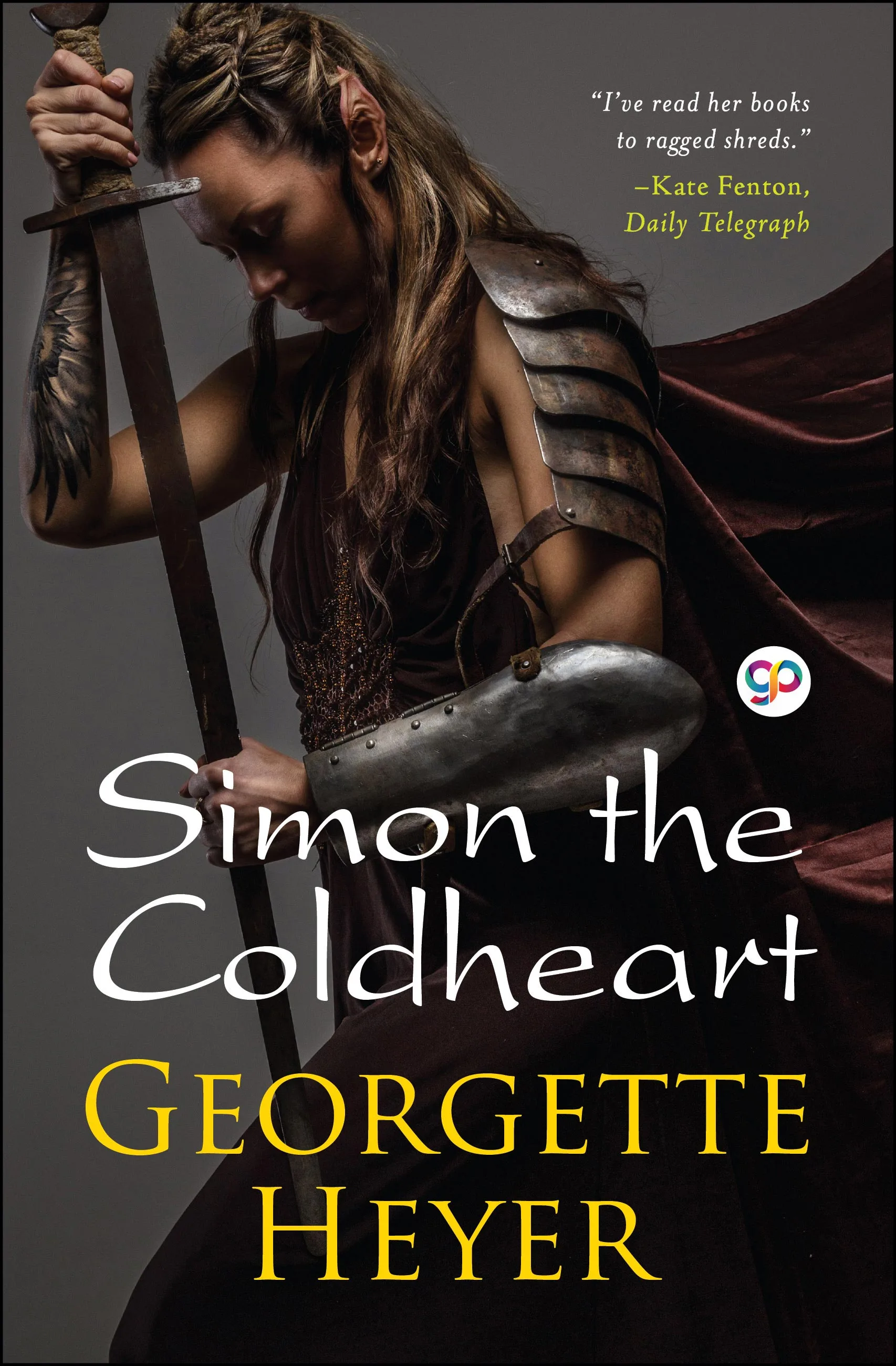
Download Cover Image
Do you want to download the full cover image for Simon the Coldheart?