
The Complete Prophecies of Nostradamus
eBook
• 267 Pages
• INR 99.00
• English
• 9789354990489
No ratings yet
| Publisher | General Press |
|---|---|
| ISBN13 | 9789354990489 |
| ASIN/SKU | B09XMJCQNF |
| Book Format | eBook |
| Language | English |
| Pages | 267 |
| List Price | INR 99.00 |
| Subject Code | OCC030000, HIS002010, OCC023000 |
| Publishing Date | 01/04/2022 |
| Book Code | BD00068833 |
Buy this Book
Amazon Stores
Ebook Stores
Other Stores
Discover The Complete Prophecies of Nostradamus by Nostradamus. This book is published by General Press in eBook format, ISBN 9789354990489, ASIN B09XMJCQNF, under History, Historical Reference, Philosophy.
Book Description
Nostradamus (Michel de Nostradame) was born on December 14, 1503 in St. Remy, Provence, France. Nostradamus came from a long line of Jewish doctors and scholars. He is considered by many as one of the most famous and important writers of history prophecies. He is famous mainly for his book ‘The Prophecies,’ consisting of quarantine in rhyme. Supporters of the trustworthiness of these prophecies attribute to Nostradamus the ability to predict an incredible number of events in world history, including the French Revolution, the Atomic bomb, the rise to power of Adolf Hitler and the attacks of 11 September 2001. However, no one has ever proved that Nostradamus's quarters can provide reliable data for the foreseeable future.
Nostradamus had the visions which he later recorded in verse while staring into water or flame late at night, sometimes aided by herbal stimulants, while sitting on a brass tripod. The resulting quatrains (four line verses) are oblique and elliptical, and use puns, anagrams and allegorical imagery. Most of the quatrains are open to multiple interpretations, and some make no sense whatsoever. Some of them are chilling, literal descriptions of events, giving specific or near-specific names, geographic locations, astrological configurations, and sometimes actual dates. It is this quality of both vagueness and specificity which allows each new generation to reinterpret Nostradamus.
Nostradamus had the visions which he later recorded in verse while staring into water or flame late at night, sometimes aided by herbal stimulants, while sitting on a brass tripod. The resulting quatrains (four line verses) are oblique and elliptical, and use puns, anagrams and allegorical imagery. Most of the quatrains are open to multiple interpretations, and some make no sense whatsoever. Some of them are chilling, literal descriptions of events, giving specific or near-specific names, geographic locations, astrological configurations, and sometimes actual dates. It is this quality of both vagueness and specificity which allows each new generation to reinterpret Nostradamus.
Author Biography
Michel de Nostredame (December 1503 – July 1566), usually Latinised as Nostradamus, was a French astrologer, apothecary, physician, and reputed seer, who is best known for his book Les Prophéties (published in 1555), a collection of 942 poetic quatrains allegedly predicting future events.
Nostradamus's father's family had originally been Jewish, but had converted to Catholic Christianity a generation before Nostradamus was born. He studied at the University of Avignon, but was forced to leave after just over a year when the university closed due to an outbreak of the plague. He worked as an apothecary for several years before entering the University of Montpellier, hoping to earn a doctorate, but was almost immediately expelled after his work as an apothecary (a manual trade forbidden by university statutes) was discovered. He first married in 1531, but his wife and two children died in 1534 during another plague outbreak. He worked against the plague alongside other doctors before remarrying to Anne Ponsarde, with whom he had six children. He wrote an almanac for 1550 and, as a result of its success, continued writing them for future years as he began working as an astrologer for various wealthy patrons. Catherine de' Medici became one of his foremost supporters. His Les Prophéties, published in 1555, relied heavily on historical and literary precedent, and initially received mixed reception. He suffered from severe gout toward the end of his life, which eventually developed into edema. He died on 1 or 2 July 1566. Many popular authors have retold apocryphal legends about his life.
In the years since the publication of his Les Prophéties, Nostradamus has attracted many supporters, who, along with some of the popular press, credit him with having accurately predicted many major world events.[7][8] Academic sources reject the notion that Nostradamus had any genuine supernatural prophetic abilities and maintain that the associations made between world events and Nostradamus's quatrains are the result of (sometimes deliberate) misinterpretations or mistranslations.[9] These academics also argue that Nostradamus's predictions are characteristically vague, meaning they could be applied to virtually anything, and are useless for determining whether their author had any real prophetic powers.
Nostradamus's father's family had originally been Jewish, but had converted to Catholic Christianity a generation before Nostradamus was born. He studied at the University of Avignon, but was forced to leave after just over a year when the university closed due to an outbreak of the plague. He worked as an apothecary for several years before entering the University of Montpellier, hoping to earn a doctorate, but was almost immediately expelled after his work as an apothecary (a manual trade forbidden by university statutes) was discovered. He first married in 1531, but his wife and two children died in 1534 during another plague outbreak. He worked against the plague alongside other doctors before remarrying to Anne Ponsarde, with whom he had six children. He wrote an almanac for 1550 and, as a result of its success, continued writing them for future years as he began working as an astrologer for various wealthy patrons. Catherine de' Medici became one of his foremost supporters. His Les Prophéties, published in 1555, relied heavily on historical and literary precedent, and initially received mixed reception. He suffered from severe gout toward the end of his life, which eventually developed into edema. He died on 1 or 2 July 1566. Many popular authors have retold apocryphal legends about his life.
In the years since the publication of his Les Prophéties, Nostradamus has attracted many supporters, who, along with some of the popular press, credit him with having accurately predicted many major world events.[7][8] Academic sources reject the notion that Nostradamus had any genuine supernatural prophetic abilities and maintain that the associations made between world events and Nostradamus's quatrains are the result of (sometimes deliberate) misinterpretations or mistranslations.[9] These academics also argue that Nostradamus's predictions are characteristically vague, meaning they could be applied to virtually anything, and are useless for determining whether their author had any real prophetic powers.
Editorial Reviews
Editorial Reviews will be added soon…
Book Summary
The Complete Prophecies of Nostradamus brings together the famous prophetic writings of Michel de Nostredame, better known as Nostradamus, the sixteenth-century French physician, astrologer, and author whose name has become almost synonymous with predictions of the future. The work is not a conventional book with a continuous narrative, a single argument, or a straightforward sequence of forecasts. Instead, it is a vast collection of cryptic four-line poems, known as quatrains, organized into sections called the Centuries. The commonly received collection contains 942 quatrains arranged in ten Centuries, although the seventh is incomplete and contains only 42 quatrains. The first edition of Les Prophéties appeared in 1555, and later editions expanded and altered the collection, making the textual history of the work complicated.
The title “Complete Prophecies” can therefore be slightly misleading because there is no single modern edition that completely eliminates the uncertainties surrounding the original texts, their order, and later additions. Different editions of Nostradamus contain variations, and some modern books also add interpretations, explanatory notes, or extra material. The 1996 Thorsons edition, for example, presents the prophecies as a collection of ten Centuries and emphasizes their elliptical language, wordplay, anagrams, astrological references, and allegorical imagery. What readers encounter, however, is fundamentally the same fascinating body of Renaissance prophetic literature: hundreds of deliberately obscure verses concerning wars, rulers, disasters, political upheaval, religious conflict, natural catastrophes, and dramatic changes in human society.
Nostradamus himself was born Michel de Nostredame in 1503 in Saint-Rémy-de-Provence, France. He trained as a physician and became known for his medical work before developing a reputation as an astrologer and prognosticator. His fame eventually grew beyond medicine, and his annual almanacs and predictions attracted considerable attention. His prophetic writings were produced in a period when astrology, medicine, religion, classical learning, and occult practices could overlap in ways that seem unusual to modern readers. Understanding this Renaissance setting is essential because The Complete Prophecies of Nostradamus does not come from the modern world of newspaper-style predictions. It belongs to a period when astrology and prophecy were taken seriously by many educated people and when political and religious uncertainty created a strong appetite for predictions about the future.
The structure of the work is one of its most distinctive features. The prophecies are grouped into “Centuries,” but the word does not mean that each section covers a hundred years. It refers primarily to groups of approximately one hundred quatrains. Most Centuries contain 100 quatrains, while Century VII contains only 42 in the standard 942-quatrain collection. The first edition published in 1555 contained only part of the material that later became associated with the complete work. Subsequent editions expanded the collection, and the 1568 posthumous edition is particularly important in the textual history of the Prophecies.
Before the quatrains themselves, the work contains prose material that helps establish Nostradamus’s prophetic persona. One important section is the preface addressed to his son César. Another is the famous letter addressed to King Henry II of France. These passages are important because they provide context for the prophecies and reveal how Nostradamus wanted readers to understand his work. Rather than simply listing predictions, he presents himself as someone attempting to perceive events far beyond his own lifetime. The prose sections also contribute to the mysterious atmosphere surrounding the collection because they use a language that can itself be difficult and indirect.
The central literary form of the book is the quatrain. Each prophecy is extremely short, but its apparent simplicity is deceptive. Nostradamus uses compressed images, unusual names, geographical references, astronomical language, historical allusions, and ambiguous expressions. His writing is primarily in French but draws upon Latin, Greek, Occitan, Italian, and other linguistic influences. Scholars have also noted his use of altered names and wordplay. The result is a text that rarely gives the reader a clear statement such as “In the year X, event Y will happen in country Z.” Instead, readers receive fragments that seem to point toward possible events without explaining exactly how or when they will occur.
This ambiguity is fundamental to the fascination of the book. A prophecy describing fire, war, a powerful ruler, a city in ruins, disease, famine, or conflict can potentially be connected with many different historical events. Once a major event occurs, readers may return to the quatrains and discover language that appears remarkably relevant. This has happened repeatedly throughout the history of Nostradamus’s reputation. His writings have been interpreted as predictions of events ranging from the death of King Henry II to the Great Fire of London, the French Revolution, Adolf Hitler, and modern disasters.
One of the most frequently discussed themes across the Centuries is war. Battles, invasions, sieges, armies, weapons, destruction, political alliances, and the deaths of rulers appear repeatedly. This is hardly surprising given the political environment of sixteenth-century Europe. Nostradamus lived during a period marked by dynastic struggles, religious wars, territorial conflicts, and shifting political alliances. His prophecies often reflect this atmosphere of instability. Rather than imagining a peaceful future interrupted by occasional disasters, the collection presents history as a recurring cycle of conflict in which powerful individuals and nations rise, struggle, and fall.
Kings and rulers occupy an especially prominent place. Many quatrains appear to refer to monarchs, princes, emperors, military commanders, and other political figures. Names are frequently distorted or disguised, which has encouraged centuries of speculation about their identities. The reader is repeatedly invited to search for historical personalities hidden behind unfamiliar words. This contributes to the puzzle-like quality of the collection. Nostradamus appears to be describing historical forces through symbols and coded references rather than straightforward biography.
Religion is another major concern. The sixteenth century was an age of intense religious conflict, particularly between Catholics and Protestants. The prophecies reflect fears of persecution, schism, violence, religious rivalry, and upheaval. Churches and religious authorities appear in the wider prophetic landscape, often alongside political rulers and military events. These passages show that Nostradamus’s imagined future was deeply connected to the religious tensions of his own time.
Natural disasters form another recurring category. Earthquakes, floods, fires, storms, famine, epidemics, and other calamities appear throughout the quatrains. Such predictions have contributed significantly to Nostradamus’s modern reputation because disasters are emotionally powerful and often generate recognizable imagery. Yet the very generality of many such descriptions also makes them difficult to test objectively. A prophecy about famine, fire, plague, or destruction can potentially be connected to numerous events across centuries. This is one reason scholars and skeptics caution against treating every apparent correspondence as evidence of supernatural foresight.
The famous predictions associated with Nostradamus illustrate this problem. Some readers have claimed that particular quatrains predicted the Great Fire of London, the rise of Hitler, the French Revolution, Napoleon, or the attacks of September 11, 2001. Modern publishers have sometimes emphasized these apparent connections because they make the book particularly compelling to contemporary readers. However, the text itself usually does not provide the precise, unambiguous description that later interpreters attribute to it. Instead, the connection is often constructed retrospectively by selecting particular words and interpreting them in light of an event that has already happened.
The word “Hister,” for example, has become famous in discussions of Nostradamus because some interpreters have attempted to connect it with Adolf Hitler. Yet historical and linguistic analysis points to “Hister” as a reference to the lower Danube region rather than a secret spelling of Hitler. This example illustrates how Nostradamus’s obscure language can encourage interpretations that seem persuasive only after modern readers already know the historical outcome.
Perhaps the most famous modern example is Century X, Quatrain 72, which has been interpreted as a prediction of events surrounding the year 1999. Because the verse contains a date-like reference and dramatic imagery, it has attracted enormous attention. Yet the anticipated catastrophe did not unfold in the precise way popular interpretations suggested. This illustrates an important feature of reading Nostradamus: specific-looking predictions can appear extraordinarily powerful when detached from their historical and linguistic context, but their meaning becomes much less certain when examined carefully.
The prophecies also repeatedly evoke astronomical and astrological imagery. Planets, stars, celestial configurations, zodiacal references, and unusual cosmic events contribute to the atmosphere of the work. Astrology was central to Renaissance ideas about prediction, and Nostradamus’s prophetic method cannot be fully understood without recognizing the importance of astrology in his intellectual environment. The heavens were often viewed as meaningful signs that could correspond to events on Earth. Consequently, the prophecies are filled with language suggesting that human history unfolds under larger cosmic influences.
Another important theme is the instability of human civilization. Cities rise and fall, rulers are replaced, armies cross borders, and societies experience periods of prosperity followed by disaster. The overall atmosphere is often dark. The reader encounters repeated images of bloodshed, plague, famine, fire, invasion, and political collapse. This has led many people to describe the Prophecies as a catalogue of catastrophes. Yet the darkness also reflects the historical world Nostradamus inhabited. Europe in the sixteenth century was not a stable environment, and fears about war, disease, religious conflict, and political instability were very real.
The appeal of the book ultimately lies not only in whether Nostradamus genuinely predicted the future but also in the human fascination with uncertainty. People have always wanted to know what lies ahead. Prophecy promises a kind of forbidden knowledge: the possibility of looking beyond the present and discovering what history has in store. Nostradamus’s unusual technique intensifies this fascination because his predictions never completely reveal themselves. Readers must interpret them. Each generation can therefore return to the same verses and ask whether they speak about its own fears.
This creates an unusual relationship between the text and its readers. The reader becomes part detective, part historian, and part interpreter. A place name may seem to point toward one country; a distorted personal name may suggest a famous leader; a reference to fire may evoke a particular disaster; an astronomical image may appear to provide a date. The act of interpretation becomes almost as important as the prophecy itself. In this sense, The Complete Prophecies of Nostradamus is not merely a collection of predictions. It is a literary puzzle that has invited generations of readers to participate in constructing meaning.
From a historical perspective, the book is particularly valuable as a window into Renaissance ideas about time, fate, religion, astrology, politics, and catastrophe. Even readers who reject supernatural prophecy can find the collection fascinating as a product of its age. Nostradamus reveals a world in which the boundaries between medicine, astrology, religion, literature, and prediction were far less sharply defined than they are today. His work also demonstrates how quickly an author’s reputation can become larger than the original text. Over the centuries, countless interpretations, translations, editions, and popular books have added layers to the Nostradamus legend.
The question of whether Nostradamus really predicted the future is therefore one of the most important questions surrounding The Complete Prophecies of Nostradamus, but it should not be confused with a straightforward literary question. The quatrains are sufficiently ambiguous that many apparent “hits” can be identified only after an event has occurred. The fact that a verse can be interpreted to resemble a historical event does not necessarily demonstrate that Nostradamus specifically predicted that event. Modern readers should therefore approach the collection with curiosity but also with skepticism, distinguishing the original text from later interpretations.
Ultimately, The Complete Prophecies of Nostradamus is best understood as a fascinating mixture of Renaissance prophecy, poetry, astrology, historical imagination, and linguistic mystery. Its hundreds of quatrains create a haunting vision of a world repeatedly threatened by war, political upheaval, disease, natural catastrophe, and the rise and fall of powerful individuals. At the same time, the very obscurity that makes the prophecies difficult to verify is what has allowed them to remain endlessly fascinating.
For readers searching for an in-depth summary of The Complete Prophecies of Nostradamus, the central takeaway is that this is not a conventional prediction book with a clear chronological list of future events. It is a cryptic collection of poetic visions whose meaning has been debated for nearly five centuries. Nostradamus presents history as a turbulent landscape in which rulers rise and disappear, nations fight, cities suffer, nature becomes destructive, and humanity repeatedly faces uncertainty. Whether viewed as genuine prophecy, Renaissance literature, astrology, historical symbolism, or an extraordinary exercise in ambiguity, the work continues to fascinate because it confronts one of humanity’s oldest questions: can the future ever truly be known? The enduring power of Nostradamus lies precisely in the fact that his verses never provide a final answer. They leave the future open, mysterious, and waiting for interpretation.
The title “Complete Prophecies” can therefore be slightly misleading because there is no single modern edition that completely eliminates the uncertainties surrounding the original texts, their order, and later additions. Different editions of Nostradamus contain variations, and some modern books also add interpretations, explanatory notes, or extra material. The 1996 Thorsons edition, for example, presents the prophecies as a collection of ten Centuries and emphasizes their elliptical language, wordplay, anagrams, astrological references, and allegorical imagery. What readers encounter, however, is fundamentally the same fascinating body of Renaissance prophetic literature: hundreds of deliberately obscure verses concerning wars, rulers, disasters, political upheaval, religious conflict, natural catastrophes, and dramatic changes in human society.
Nostradamus himself was born Michel de Nostredame in 1503 in Saint-Rémy-de-Provence, France. He trained as a physician and became known for his medical work before developing a reputation as an astrologer and prognosticator. His fame eventually grew beyond medicine, and his annual almanacs and predictions attracted considerable attention. His prophetic writings were produced in a period when astrology, medicine, religion, classical learning, and occult practices could overlap in ways that seem unusual to modern readers. Understanding this Renaissance setting is essential because The Complete Prophecies of Nostradamus does not come from the modern world of newspaper-style predictions. It belongs to a period when astrology and prophecy were taken seriously by many educated people and when political and religious uncertainty created a strong appetite for predictions about the future.
The structure of the work is one of its most distinctive features. The prophecies are grouped into “Centuries,” but the word does not mean that each section covers a hundred years. It refers primarily to groups of approximately one hundred quatrains. Most Centuries contain 100 quatrains, while Century VII contains only 42 in the standard 942-quatrain collection. The first edition published in 1555 contained only part of the material that later became associated with the complete work. Subsequent editions expanded the collection, and the 1568 posthumous edition is particularly important in the textual history of the Prophecies.
Before the quatrains themselves, the work contains prose material that helps establish Nostradamus’s prophetic persona. One important section is the preface addressed to his son César. Another is the famous letter addressed to King Henry II of France. These passages are important because they provide context for the prophecies and reveal how Nostradamus wanted readers to understand his work. Rather than simply listing predictions, he presents himself as someone attempting to perceive events far beyond his own lifetime. The prose sections also contribute to the mysterious atmosphere surrounding the collection because they use a language that can itself be difficult and indirect.
The central literary form of the book is the quatrain. Each prophecy is extremely short, but its apparent simplicity is deceptive. Nostradamus uses compressed images, unusual names, geographical references, astronomical language, historical allusions, and ambiguous expressions. His writing is primarily in French but draws upon Latin, Greek, Occitan, Italian, and other linguistic influences. Scholars have also noted his use of altered names and wordplay. The result is a text that rarely gives the reader a clear statement such as “In the year X, event Y will happen in country Z.” Instead, readers receive fragments that seem to point toward possible events without explaining exactly how or when they will occur.
This ambiguity is fundamental to the fascination of the book. A prophecy describing fire, war, a powerful ruler, a city in ruins, disease, famine, or conflict can potentially be connected with many different historical events. Once a major event occurs, readers may return to the quatrains and discover language that appears remarkably relevant. This has happened repeatedly throughout the history of Nostradamus’s reputation. His writings have been interpreted as predictions of events ranging from the death of King Henry II to the Great Fire of London, the French Revolution, Adolf Hitler, and modern disasters.
One of the most frequently discussed themes across the Centuries is war. Battles, invasions, sieges, armies, weapons, destruction, political alliances, and the deaths of rulers appear repeatedly. This is hardly surprising given the political environment of sixteenth-century Europe. Nostradamus lived during a period marked by dynastic struggles, religious wars, territorial conflicts, and shifting political alliances. His prophecies often reflect this atmosphere of instability. Rather than imagining a peaceful future interrupted by occasional disasters, the collection presents history as a recurring cycle of conflict in which powerful individuals and nations rise, struggle, and fall.
Kings and rulers occupy an especially prominent place. Many quatrains appear to refer to monarchs, princes, emperors, military commanders, and other political figures. Names are frequently distorted or disguised, which has encouraged centuries of speculation about their identities. The reader is repeatedly invited to search for historical personalities hidden behind unfamiliar words. This contributes to the puzzle-like quality of the collection. Nostradamus appears to be describing historical forces through symbols and coded references rather than straightforward biography.
Religion is another major concern. The sixteenth century was an age of intense religious conflict, particularly between Catholics and Protestants. The prophecies reflect fears of persecution, schism, violence, religious rivalry, and upheaval. Churches and religious authorities appear in the wider prophetic landscape, often alongside political rulers and military events. These passages show that Nostradamus’s imagined future was deeply connected to the religious tensions of his own time.
Natural disasters form another recurring category. Earthquakes, floods, fires, storms, famine, epidemics, and other calamities appear throughout the quatrains. Such predictions have contributed significantly to Nostradamus’s modern reputation because disasters are emotionally powerful and often generate recognizable imagery. Yet the very generality of many such descriptions also makes them difficult to test objectively. A prophecy about famine, fire, plague, or destruction can potentially be connected to numerous events across centuries. This is one reason scholars and skeptics caution against treating every apparent correspondence as evidence of supernatural foresight.
The famous predictions associated with Nostradamus illustrate this problem. Some readers have claimed that particular quatrains predicted the Great Fire of London, the rise of Hitler, the French Revolution, Napoleon, or the attacks of September 11, 2001. Modern publishers have sometimes emphasized these apparent connections because they make the book particularly compelling to contemporary readers. However, the text itself usually does not provide the precise, unambiguous description that later interpreters attribute to it. Instead, the connection is often constructed retrospectively by selecting particular words and interpreting them in light of an event that has already happened.
The word “Hister,” for example, has become famous in discussions of Nostradamus because some interpreters have attempted to connect it with Adolf Hitler. Yet historical and linguistic analysis points to “Hister” as a reference to the lower Danube region rather than a secret spelling of Hitler. This example illustrates how Nostradamus’s obscure language can encourage interpretations that seem persuasive only after modern readers already know the historical outcome.
Perhaps the most famous modern example is Century X, Quatrain 72, which has been interpreted as a prediction of events surrounding the year 1999. Because the verse contains a date-like reference and dramatic imagery, it has attracted enormous attention. Yet the anticipated catastrophe did not unfold in the precise way popular interpretations suggested. This illustrates an important feature of reading Nostradamus: specific-looking predictions can appear extraordinarily powerful when detached from their historical and linguistic context, but their meaning becomes much less certain when examined carefully.
The prophecies also repeatedly evoke astronomical and astrological imagery. Planets, stars, celestial configurations, zodiacal references, and unusual cosmic events contribute to the atmosphere of the work. Astrology was central to Renaissance ideas about prediction, and Nostradamus’s prophetic method cannot be fully understood without recognizing the importance of astrology in his intellectual environment. The heavens were often viewed as meaningful signs that could correspond to events on Earth. Consequently, the prophecies are filled with language suggesting that human history unfolds under larger cosmic influences.
Another important theme is the instability of human civilization. Cities rise and fall, rulers are replaced, armies cross borders, and societies experience periods of prosperity followed by disaster. The overall atmosphere is often dark. The reader encounters repeated images of bloodshed, plague, famine, fire, invasion, and political collapse. This has led many people to describe the Prophecies as a catalogue of catastrophes. Yet the darkness also reflects the historical world Nostradamus inhabited. Europe in the sixteenth century was not a stable environment, and fears about war, disease, religious conflict, and political instability were very real.
The appeal of the book ultimately lies not only in whether Nostradamus genuinely predicted the future but also in the human fascination with uncertainty. People have always wanted to know what lies ahead. Prophecy promises a kind of forbidden knowledge: the possibility of looking beyond the present and discovering what history has in store. Nostradamus’s unusual technique intensifies this fascination because his predictions never completely reveal themselves. Readers must interpret them. Each generation can therefore return to the same verses and ask whether they speak about its own fears.
This creates an unusual relationship between the text and its readers. The reader becomes part detective, part historian, and part interpreter. A place name may seem to point toward one country; a distorted personal name may suggest a famous leader; a reference to fire may evoke a particular disaster; an astronomical image may appear to provide a date. The act of interpretation becomes almost as important as the prophecy itself. In this sense, The Complete Prophecies of Nostradamus is not merely a collection of predictions. It is a literary puzzle that has invited generations of readers to participate in constructing meaning.
From a historical perspective, the book is particularly valuable as a window into Renaissance ideas about time, fate, religion, astrology, politics, and catastrophe. Even readers who reject supernatural prophecy can find the collection fascinating as a product of its age. Nostradamus reveals a world in which the boundaries between medicine, astrology, religion, literature, and prediction were far less sharply defined than they are today. His work also demonstrates how quickly an author’s reputation can become larger than the original text. Over the centuries, countless interpretations, translations, editions, and popular books have added layers to the Nostradamus legend.
The question of whether Nostradamus really predicted the future is therefore one of the most important questions surrounding The Complete Prophecies of Nostradamus, but it should not be confused with a straightforward literary question. The quatrains are sufficiently ambiguous that many apparent “hits” can be identified only after an event has occurred. The fact that a verse can be interpreted to resemble a historical event does not necessarily demonstrate that Nostradamus specifically predicted that event. Modern readers should therefore approach the collection with curiosity but also with skepticism, distinguishing the original text from later interpretations.
Ultimately, The Complete Prophecies of Nostradamus is best understood as a fascinating mixture of Renaissance prophecy, poetry, astrology, historical imagination, and linguistic mystery. Its hundreds of quatrains create a haunting vision of a world repeatedly threatened by war, political upheaval, disease, natural catastrophe, and the rise and fall of powerful individuals. At the same time, the very obscurity that makes the prophecies difficult to verify is what has allowed them to remain endlessly fascinating.
For readers searching for an in-depth summary of The Complete Prophecies of Nostradamus, the central takeaway is that this is not a conventional prediction book with a clear chronological list of future events. It is a cryptic collection of poetic visions whose meaning has been debated for nearly five centuries. Nostradamus presents history as a turbulent landscape in which rulers rise and disappear, nations fight, cities suffer, nature becomes destructive, and humanity repeatedly faces uncertainty. Whether viewed as genuine prophecy, Renaissance literature, astrology, historical symbolism, or an extraordinary exercise in ambiguity, the work continues to fascinate because it confronts one of humanity’s oldest questions: can the future ever truly be known? The enduring power of Nostradamus lies precisely in the fact that his verses never provide a final answer. They leave the future open, mysterious, and waiting for interpretation.
Sample Chapters
Sample Chapters will be added soon…
Reader Reviews
No reviews yet.
The Complete Prophecies of Nostradamus
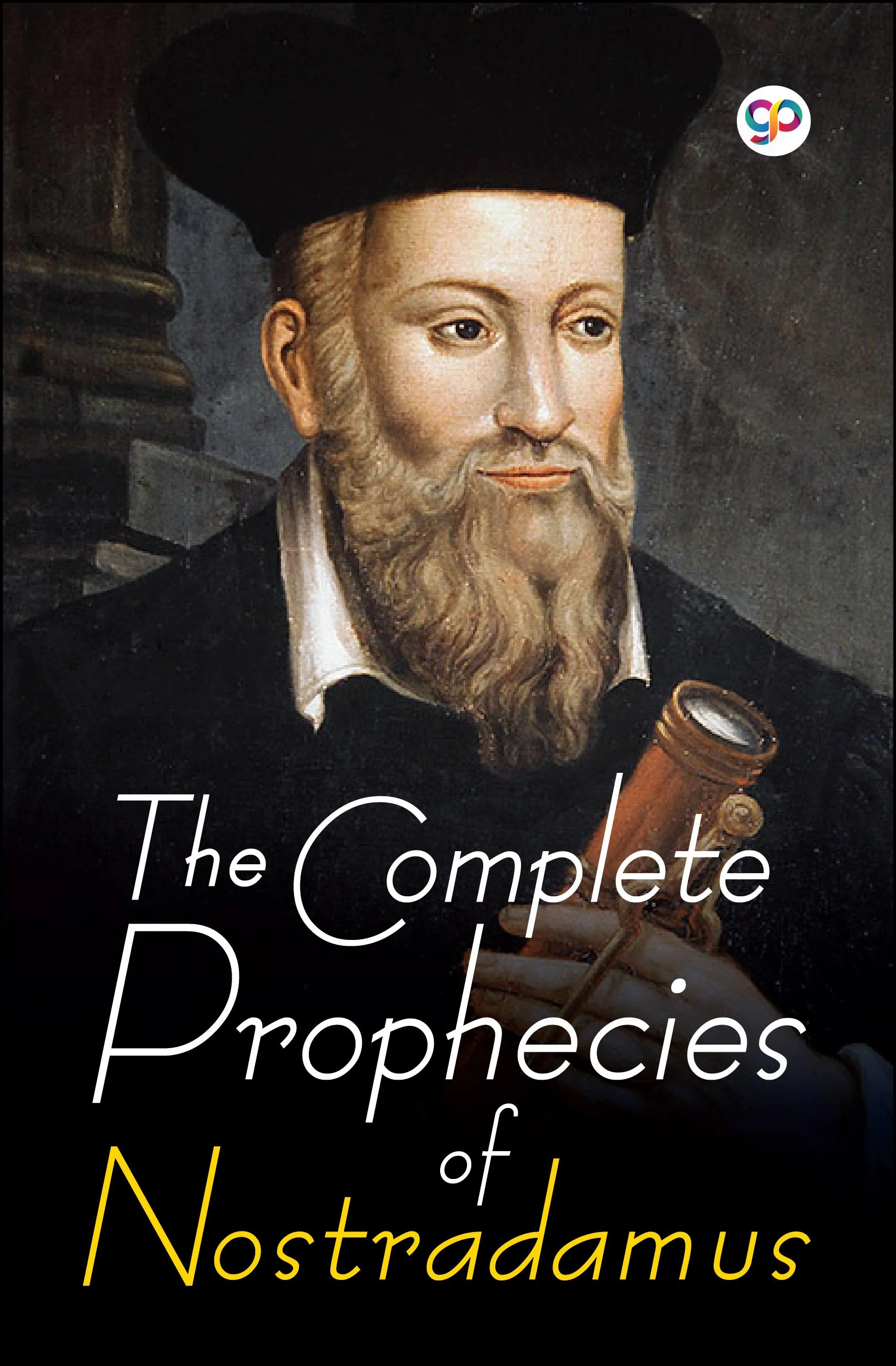
Download Cover Image
Do you want to download the full cover image for The Complete Prophecies of Nostradamus?