
The Problems of Philosophy
eBook
• INR 99.00
• English
• 9789354990687
No ratings yet
| Publisher | General Press |
|---|---|
| ISBN13 | 9789354990687 |
| ASIN/SKU | B09XMJX37F |
| Book Format | eBook |
| Language | English |
| List Price | INR 99.00 |
| Subject Code | PHI000000, PHI009000, REL000000 |
| Publishing Date | 01/04/2022 |
| Book Code | BD00068841 |
Buy this Book
Amazon Stores
Ebook Stores
Other Stores
Discover The Problems of Philosophy by Bertrand Russell. This book is published by General Press in eBook format, ISBN 9789354990687, ASIN B09XMJX37F, under Non Fiction, Nonfiction, Philosophy.
Book Description
What if the things you see, touch, and believe to be real are not quite what they seem? In 'The Problems of Philosophy', Bertrand Russell presents a classic work of philosophy that explores some of the deepest questions about knowledge, reality, truth, and human understanding in a remarkably clear and approachable way. Rather than building a fictional plot, Russell takes the reader on an intellectual journey, beginning with ordinary experiences and gradually revealing the surprising philosophical problems hidden within them.
The book asks questions that most people encounter without realizing they are philosophical: How can we know that the world outside our minds really exists? Can our senses be trusted? What is the difference between appearance and reality? How do we know that something is true, and what does it mean to say that we know it? Russell uses familiar examples, such as looking at an object like a table, to show how easily our everyday assumptions become complicated when examined carefully. His purpose is not to confuse the reader but to encourage a deeper and more thoughtful way of looking at ordinary experience.
As the discussion develops, Russell considers ideas about knowledge, perception, certainty, induction, truth, universals, and the relationship between mind and matter. He also explores the role of philosophy itself, arguing that its value does not depend solely on finding definite answers. Instead, philosophical thinking can expand the mind by challenging assumptions, widening our sense of possibility, and making us more aware of what we do not yet understand.
One of the greatest strengths of 'The Problems of Philosophy' is Russell’s ability to make difficult ideas accessible without reducing their importance. Written for readers who may have little previous knowledge of philosophy, the book remains an engaging introduction to philosophical thought while raising questions that continue to matter today. For anyone curious about reality, knowledge, and the limits of human certainty, this enduring classic offers a fascinating invitation to think more deeply—and to discover just how many mysteries are hiding behind the simplest things we take for granted.
The book asks questions that most people encounter without realizing they are philosophical: How can we know that the world outside our minds really exists? Can our senses be trusted? What is the difference between appearance and reality? How do we know that something is true, and what does it mean to say that we know it? Russell uses familiar examples, such as looking at an object like a table, to show how easily our everyday assumptions become complicated when examined carefully. His purpose is not to confuse the reader but to encourage a deeper and more thoughtful way of looking at ordinary experience.
As the discussion develops, Russell considers ideas about knowledge, perception, certainty, induction, truth, universals, and the relationship between mind and matter. He also explores the role of philosophy itself, arguing that its value does not depend solely on finding definite answers. Instead, philosophical thinking can expand the mind by challenging assumptions, widening our sense of possibility, and making us more aware of what we do not yet understand.
One of the greatest strengths of 'The Problems of Philosophy' is Russell’s ability to make difficult ideas accessible without reducing their importance. Written for readers who may have little previous knowledge of philosophy, the book remains an engaging introduction to philosophical thought while raising questions that continue to matter today. For anyone curious about reality, knowledge, and the limits of human certainty, this enduring classic offers a fascinating invitation to think more deeply—and to discover just how many mysteries are hiding behind the simplest things we take for granted.
Author Biography
Bertrand Russell (1872 - 1970). Philosopher, mathematician, educational and sexual reformer, pacifist, prolific letter writer, author and columnist, Bertrand Russell was one of the most influential and widely known intellectual figures of the twentieth century. In 1950 he was awarded the Noble Prize for Literature in 1950 for his extensive contributions to world literature and for his "rationality and humanity, as a fearless champion of free speech and free thought in the West."
Photo by Photographer not identified (Bertrand Russell (1916). Justice in War-Time.) [Public domain], via Wikimedia Commons.
Photo by Photographer not identified (Bertrand Russell (1916). Justice in War-Time.) [Public domain], via Wikimedia Commons.
Editorial Reviews
Editorial Reviews will be added soon…
Book Summary
The Problems of Philosophy is one of Bertrand Russell's most accessible and enduring works. First published in 1912, the book introduces readers to some of the deepest questions that have occupied philosophers for centuries. Rather than presenting philosophy as a collection of fixed answers, Russell portrays it as an ongoing search for truth. He encourages readers to question everyday assumptions, examine the limits of human knowledge, and appreciate the value of careful reasoning. Written in simple yet elegant language, the book remains an excellent introduction to philosophical thinking.
Russell begins with a question that appears surprisingly ordinary: Can we truly know that the objects we see around us exist exactly as they appear? To explore this, he uses the example of a table. At first glance, the table seems to possess definite qualities such as color, shape, hardness, and size. However, Russell points out that these qualities change depending on the observer's position, the lighting, or even the sense being used. The table may appear brown in one light, lighter or darker in another, and different from various angles. This observation leads to an important distinction between what we directly experience and what may actually exist.
From this example, Russell introduces the concepts of sense-data and physical objects. Sense-data are the immediate experiences we receive through our senses—the colors, sounds, textures, tastes, and smells we perceive. Physical objects, on the other hand, are the things we believe exist independently of our perception. Russell argues that while we can be certain of our experiences, we cannot be absolutely certain that external objects possess the exact properties we attribute to them. This does not mean that the external world does not exist, but rather that our knowledge of it is indirect.
Russell then examines the nature of knowledge itself. He distinguishes between knowledge by acquaintance and knowledge by description. Knowledge by acquaintance comes from direct experience. We are acquainted with our own thoughts, feelings, and immediate sensory experiences because we encounter them firsthand. Knowledge by description, however, refers to things we know through information or inference rather than direct contact. For example, most people know about distant galaxies, historical figures, or microscopic organisms through descriptions provided by science and history rather than through personal observation. Russell argues that much of human knowledge depends on this second type.
The book also explores the challenge of certainty. Throughout history, philosophers have searched for beliefs that cannot possibly be doubted. Russell acknowledges that complete certainty is difficult to achieve. Instead of expecting absolute proof for every belief, he suggests that rational inquiry often relies on probability, evidence, and logical consistency. Scientific knowledge, for instance, continually develops as new discoveries refine earlier understanding. Rather than seeing this as a weakness, Russell views it as a strength because it reflects a willingness to revise beliefs when better evidence becomes available.
One of the central themes of the book is the relationship between appearance and reality. Everyday experience often encourages people to accept appearances without question, but philosophy asks whether reality may be more complex than it first seems. Russell explains that many things once believed to be obvious have later proved false. Careful reasoning therefore becomes essential for distinguishing genuine knowledge from mere assumption. Philosophy teaches intellectual humility by reminding us that confidence should always be supported by evidence.
Russell also discusses the role of science in understanding the world. He greatly admires scientific inquiry because it relies on observation, experimentation, and logical analysis. However, he points out that science itself rests upon certain philosophical assumptions, such as the existence of an external world and the reliability of natural laws. Philosophy, therefore, complements science by examining the foundations upon which scientific thinking is built. The two disciplines are not rivals but partners in humanity's search for truth.
Another important subject Russell examines is induction—the process of drawing general conclusions from repeated observations. We naturally expect the future to resemble the past because experience suggests regular patterns. The sun has risen every morning, so we expect it to rise tomorrow. Yet Russell notes that this expectation cannot be proven with absolute certainty. It is based on habit and accumulated evidence rather than logical necessity. This insight highlights one of philosophy's recurring challenges: many of our most practical beliefs cannot be demonstrated beyond all doubt.
The book also investigates universal concepts such as numbers, mathematical truths, and logical principles. Russell argues that some forms of knowledge differ from knowledge gained through the senses. Mathematical truths, for example, do not depend on individual experiences. Statements such as two plus two equals four remain true regardless of who observes them or where they are applied. This suggests that certain truths belong to a realm of logical relationships rather than physical observation.
Russell further explores how judgments are formed. When people make statements about the world, they connect different ideas into meaningful propositions. Determining whether these judgments are true requires examining both evidence and logical structure. Philosophy trains the mind to analyze arguments carefully, identify hidden assumptions, and distinguish sound reasoning from weak conclusions. Russell believes this discipline strengthens intellectual honesty and encourages clearer thinking.
The discussion gradually moves toward broader philosophical questions concerning mind, matter, and existence. Russell considers whether reality consists entirely of physical objects or whether mental experiences occupy a unique place in understanding the world. While he avoids dogmatic conclusions, he consistently argues that philosophical inquiry should remain open to evidence rather than relying on tradition or unquestioned authority.
Ethics and values also receive thoughtful attention. Although the book focuses mainly on knowledge, Russell recognizes that philosophy influences how people live. By encouraging independent thought, philosophy helps individuals escape prejudice, superstition, and narrow-mindedness. A philosophical outlook promotes fairness because it teaches people to evaluate ideas on their merits rather than accepting them simply because they are popular or familiar.
One of Russell's most memorable arguments concerns the value of philosophy itself. Critics sometimes claim that philosophy is impractical because it produces few definite answers. Russell disagrees. He argues that philosophy's greatest contribution lies not in providing certainty but in expanding the imagination and broadening intellectual horizons. By questioning assumptions, philosophy frees the mind from rigid habits of thought. It encourages curiosity, tolerance, and a willingness to consider different perspectives.
According to Russell, people who never question their beliefs often live within an invisible prison of custom and habit. Philosophy breaks down these barriers by revealing that many accepted opinions deserve careful examination. Even when final answers remain uncertain, the process of thoughtful inquiry enriches the mind and deepens one's understanding of both the world and oneself.
Russell concludes that the pursuit of wisdom is valuable precisely because it resists easy certainty. The universe is vast and complex, and human knowledge remains limited. Recognizing these limits is not a sign of weakness but of intellectual maturity. Philosophy teaches humility without leading to despair, replacing dogmatic confidence with thoughtful exploration.
Ultimately, The Problems of Philosophy is an invitation to think more deeply about reality, knowledge, and human understanding. Bertrand Russell demonstrates that philosophy is not confined to academic debate but arises from ordinary questions about everyday experience. Through clear reasoning, careful analysis, and an enduring respect for evidence, he shows that the search for truth is one of humanity's most meaningful pursuits. More than a century after its publication, the book continues to inspire readers to question wisely, reason carefully, and remain open to the endless possibilities of learning.
Russell begins with a question that appears surprisingly ordinary: Can we truly know that the objects we see around us exist exactly as they appear? To explore this, he uses the example of a table. At first glance, the table seems to possess definite qualities such as color, shape, hardness, and size. However, Russell points out that these qualities change depending on the observer's position, the lighting, or even the sense being used. The table may appear brown in one light, lighter or darker in another, and different from various angles. This observation leads to an important distinction between what we directly experience and what may actually exist.
From this example, Russell introduces the concepts of sense-data and physical objects. Sense-data are the immediate experiences we receive through our senses—the colors, sounds, textures, tastes, and smells we perceive. Physical objects, on the other hand, are the things we believe exist independently of our perception. Russell argues that while we can be certain of our experiences, we cannot be absolutely certain that external objects possess the exact properties we attribute to them. This does not mean that the external world does not exist, but rather that our knowledge of it is indirect.
Russell then examines the nature of knowledge itself. He distinguishes between knowledge by acquaintance and knowledge by description. Knowledge by acquaintance comes from direct experience. We are acquainted with our own thoughts, feelings, and immediate sensory experiences because we encounter them firsthand. Knowledge by description, however, refers to things we know through information or inference rather than direct contact. For example, most people know about distant galaxies, historical figures, or microscopic organisms through descriptions provided by science and history rather than through personal observation. Russell argues that much of human knowledge depends on this second type.
The book also explores the challenge of certainty. Throughout history, philosophers have searched for beliefs that cannot possibly be doubted. Russell acknowledges that complete certainty is difficult to achieve. Instead of expecting absolute proof for every belief, he suggests that rational inquiry often relies on probability, evidence, and logical consistency. Scientific knowledge, for instance, continually develops as new discoveries refine earlier understanding. Rather than seeing this as a weakness, Russell views it as a strength because it reflects a willingness to revise beliefs when better evidence becomes available.
One of the central themes of the book is the relationship between appearance and reality. Everyday experience often encourages people to accept appearances without question, but philosophy asks whether reality may be more complex than it first seems. Russell explains that many things once believed to be obvious have later proved false. Careful reasoning therefore becomes essential for distinguishing genuine knowledge from mere assumption. Philosophy teaches intellectual humility by reminding us that confidence should always be supported by evidence.
Russell also discusses the role of science in understanding the world. He greatly admires scientific inquiry because it relies on observation, experimentation, and logical analysis. However, he points out that science itself rests upon certain philosophical assumptions, such as the existence of an external world and the reliability of natural laws. Philosophy, therefore, complements science by examining the foundations upon which scientific thinking is built. The two disciplines are not rivals but partners in humanity's search for truth.
Another important subject Russell examines is induction—the process of drawing general conclusions from repeated observations. We naturally expect the future to resemble the past because experience suggests regular patterns. The sun has risen every morning, so we expect it to rise tomorrow. Yet Russell notes that this expectation cannot be proven with absolute certainty. It is based on habit and accumulated evidence rather than logical necessity. This insight highlights one of philosophy's recurring challenges: many of our most practical beliefs cannot be demonstrated beyond all doubt.
The book also investigates universal concepts such as numbers, mathematical truths, and logical principles. Russell argues that some forms of knowledge differ from knowledge gained through the senses. Mathematical truths, for example, do not depend on individual experiences. Statements such as two plus two equals four remain true regardless of who observes them or where they are applied. This suggests that certain truths belong to a realm of logical relationships rather than physical observation.
Russell further explores how judgments are formed. When people make statements about the world, they connect different ideas into meaningful propositions. Determining whether these judgments are true requires examining both evidence and logical structure. Philosophy trains the mind to analyze arguments carefully, identify hidden assumptions, and distinguish sound reasoning from weak conclusions. Russell believes this discipline strengthens intellectual honesty and encourages clearer thinking.
The discussion gradually moves toward broader philosophical questions concerning mind, matter, and existence. Russell considers whether reality consists entirely of physical objects or whether mental experiences occupy a unique place in understanding the world. While he avoids dogmatic conclusions, he consistently argues that philosophical inquiry should remain open to evidence rather than relying on tradition or unquestioned authority.
Ethics and values also receive thoughtful attention. Although the book focuses mainly on knowledge, Russell recognizes that philosophy influences how people live. By encouraging independent thought, philosophy helps individuals escape prejudice, superstition, and narrow-mindedness. A philosophical outlook promotes fairness because it teaches people to evaluate ideas on their merits rather than accepting them simply because they are popular or familiar.
One of Russell's most memorable arguments concerns the value of philosophy itself. Critics sometimes claim that philosophy is impractical because it produces few definite answers. Russell disagrees. He argues that philosophy's greatest contribution lies not in providing certainty but in expanding the imagination and broadening intellectual horizons. By questioning assumptions, philosophy frees the mind from rigid habits of thought. It encourages curiosity, tolerance, and a willingness to consider different perspectives.
According to Russell, people who never question their beliefs often live within an invisible prison of custom and habit. Philosophy breaks down these barriers by revealing that many accepted opinions deserve careful examination. Even when final answers remain uncertain, the process of thoughtful inquiry enriches the mind and deepens one's understanding of both the world and oneself.
Russell concludes that the pursuit of wisdom is valuable precisely because it resists easy certainty. The universe is vast and complex, and human knowledge remains limited. Recognizing these limits is not a sign of weakness but of intellectual maturity. Philosophy teaches humility without leading to despair, replacing dogmatic confidence with thoughtful exploration.
Ultimately, The Problems of Philosophy is an invitation to think more deeply about reality, knowledge, and human understanding. Bertrand Russell demonstrates that philosophy is not confined to academic debate but arises from ordinary questions about everyday experience. Through clear reasoning, careful analysis, and an enduring respect for evidence, he shows that the search for truth is one of humanity's most meaningful pursuits. More than a century after its publication, the book continues to inspire readers to question wisely, reason carefully, and remain open to the endless possibilities of learning.
Sample Chapters
Sample Chapters will be added soon…
Reader Reviews
No reviews yet.
The Problems of Philosophy
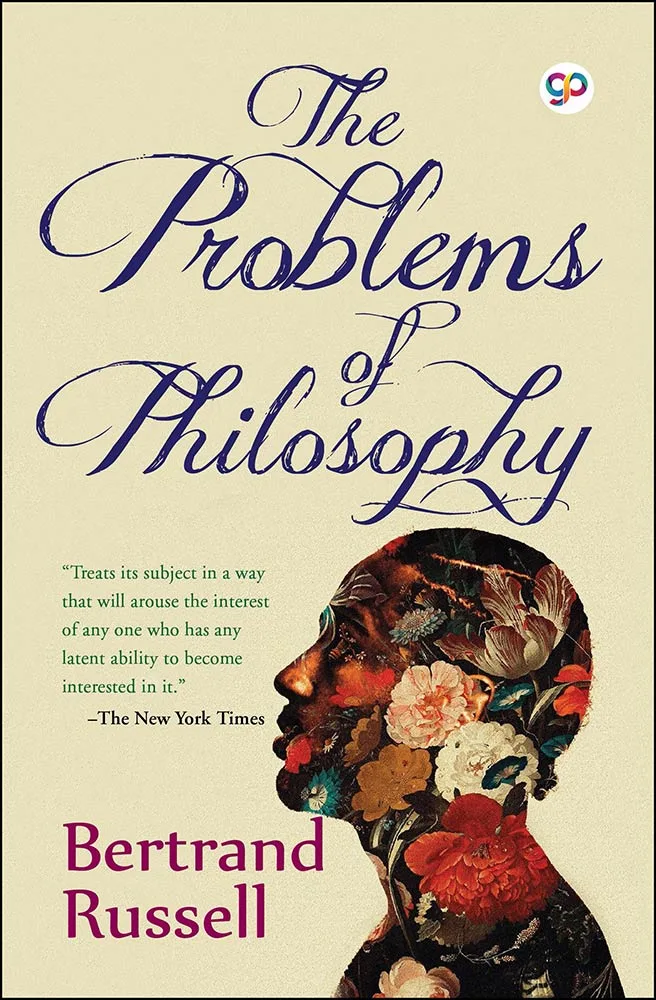
Download Cover Image
Do you want to download the full cover image for The Problems of Philosophy?